
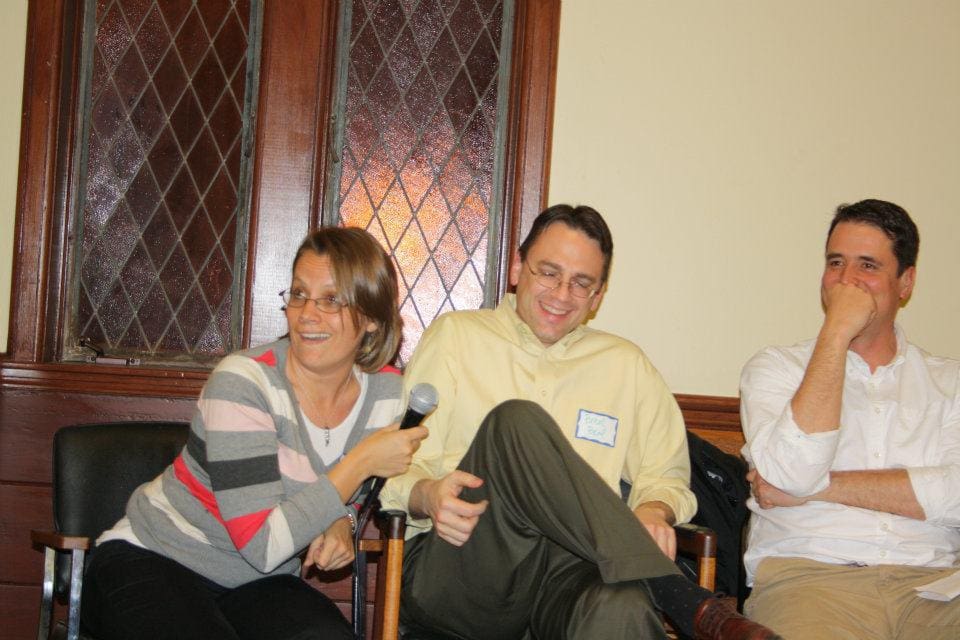
What do you tell your kids when you no longer know the answers you used to be sure of? At the January 2012 Mormon Stories regional conference in Houston, Texas, dedicated to “Maintaining Positive Relationships Through Empathy and Dialogue,” a panel of parents in mixed-faith marriages took that question from a room full of people living the same thing. The panel participants are Heather Olson-Beal, Brent Beal, Jacob Brown, and John Dehlin, with a fifth panelist and several audience members who are not named in the transcript.
John introduces the panelists: Heather comes from a Houston-area Mormon family he has known since he was a teenager; Brent, her husband, is a business professor whose faith crisis put real strain on their marriage; Jacob stopped attending about two years earlier while his wife still goes, and their two young children attend church every other Sunday under an arrangement he asked for. One panelist describes telling her children honestly that she used to know, and now does not, and inviting them to say what they think.
From there the conversation moves to the hard cases. What do you do when a grandparent or Sunday school teacher deliberately teaches your kids the opposite of what you are teaching them? A young woman from the audience describes how her Young Women leaders stopped speaking to her when her mother quit attending. A mother says she feels she is watching her own kids “through clouded glass” because they take their questions to their believing father. Brent describes the experience of baptizing his son knowing his wife could not participate the same way, and Heather recalls the day of their daughter’s baptism, when a conference talk she found deeply anti-woman left her shaking and in tears. The panel ends on temple weddings and the parents who get left outside, Heather’s encouragement to build your own family rituals, and John’s suggestion that kids marry civilly first so everyone can attend.
What’s covered
- 00:00 Welcome and conference introduction
- 03:37 Meet the panelists and their stories
- 09:34 Faith conversations with children
- 35:56 Pressure from extended family and community
- 49:31 Boundaries, interviews, and church authority
- 1:04:20 Communicating as mixed-faith couples
- 1:11:39 Ordinances, baptism, and belonging
- 1:25:57 Sealings, weddings, and creating new traditions
- 1:34:06 Closing reflections and hymn
Related episodes: 329: Houston Mormon Stories Conference Open-Mic “Story Sharing” Time · 331: The Bill Prince Family Story – From Stake Presidency and Houston Mormon Royalty to Ex-Mormons · How to Improve Your Marriage After One of You Loses Their Testimony | Ep. 157-159
Episode Transcript
Host: John Dehlin · Guests: Brent Beal, Heather Olson-Beal, Jacob Brown
This transcript is machine-generated and lightly edited for readability. The audio is authoritative. Please excuse occasional errors in names and spelling.
Welcome and Conference Introduction
John Dehlin [00:00:00] The following episode was recorded as part of the January 2012 Mormon Stories Regional Conference held in Houston, Texas. To join or form a regional Mormon Stories community or to organize a conference like this in your neck of the woods, please check out the Support communities tab@mormonstories.org and thank you for listening. Mormon Stories Podcast is a production of the Open Stories Foundation. All donations to Mormon Stories are fully tax deductible and go directly towards keeping the podcast alive and towards building a community of support for Mormons like you. To support the podcast or to join the community, please become a monthly subscriber today@mormonstories.org
Guest [00:00:50] so,
John Dehlin [00:00:53] okay, be honest with me. Some of the panelists noticed that all of you were enjoying these conversations and so they offered to like do the panel another time. I feel like these people are brilliant and I feel like a lot of you are trying to figure out how you're gonna raise your kids in this situation. So I think it's a worthwhile conversation. So any of you, are any of you interested in this topic of how to raise your kids in this situation, raise your hand.
Heather Olson-Beal [00:01:18] Okay.
John Dehlin [00:01:20] Alright, then we'll go ahead with it. So the panel is going to have three participants. Yeah, these microphones are actually not to help you hear. Can you hear? What's that for? What? Me? Oh, oh, you. Okay, awesome. So we have five participants, counting me. Heather Olson Beale. Where are you? Heather? Come sit up. Come sit over here. Heather comes from a very, a very cool Mormon family. I've known the Olson's, I don't know, since I was probably 15 years old. And her parents were both professors at Sam Houston State University in Huntsville, Texas. They were in the ward the. That my mom married into after my parents got a divorce. And so I would go visit her in Huntsville and I would get to know the Olson's her dad. What's his first name? James Olson. Jim Olson. He was stake president. Over what? Stake Conroe, College Station, College Station Stake. Later he was a general authority or an area authority for the church, but you know, a historian, expert on John Wayne. Just a brilliant. And his mother too as a PhD like, very educated family, aware of sunstone and dialogue liberals in many ways, but totally committed to the gospel. And so they raised these beautifully talented children. What, four or five children? Yeah, One of her sisters is an md, her brother is a journalist. Right? Yeah. Am I good? And Heather has a. Heather has a PhD as well, except she's really witty and bright and down to earth. And you never necessarily know it just from talking to her, so. Is that a compliment? Oops. I just. No, you wouldn't know Here.
Meet the Panelists and Their Stories
Guest 2 [00:03:37] Talking to that it goes under the radar.
John Dehlin [00:03:41] Yeah. Yes, I was. Thank you, Jason. Thanks for. Thanks for helping out. A brother. Brent is Heather's husband. I met them right when they were getting married. Brent also has a PhD. I don't know why I keep focusing on that, but I just think these people are wonderful. He's a business professor. These are two deeply thoughtful people, and I knew them before they ever even thought about a crisis of faith. And then I was there maybe with an email or two and maybe a phone call when Brent was really having a struggle and Heather was trying to support Brent. And I think their marriage took some heat for a while as they were trying to work through that. I hope this isn't news to you. Their daughter, But, you know, so they're, they're sort of a mixed faith marriage, but I think they're probably more on the same page than not on the same page these days. But they're also trying to raise their kids in the church. I think that's really cool. Jacob Brown, I don't know anything about you, but come on up here. You're gonna have to tell us a little bit about yourself and what, what it is that we all need to know about you. Why don't you tell us a little bit about yourself and what brought you to the panel?
Jacob Brown [00:05:04] Okay.
John Dehlin [00:05:05] By the way, this is, this is not for amplification. This is for our podcast listeners. So hopefully you can hear us. But if you're wondering why you can't hear through the microphone, it's because it's going into the recorder.
Jacob Brown [00:05:16] Okay, thanks. Right now I live up in Dallas in a little city called Greenville out to the east. And I came here with my wife and we have two kids, a seven year old boy and a four year old girl. They're out in Katy, Texas right now with their grandparents while we come here. So that was great for them. I stopped going to church about two years ago. I had my own crisis and my wife still goes and, you know, for a while I struggled on my own. And then I, you know, Mormon stories and all the online community started to really help me out and started to really help me to think about things a little bit more and to feel like I wasn't alone. Right now our kids go to church every other Sunday. It's kind of an arrangement that I asked for when I had my crisis. So that's why it's kind of important to me how we communicate with our children about these kind of issues, how they relate to them as well.
John Dehlin [00:06:20] Thank you, Jacob. The last person who's going to join us is the mysterious Ann Peffer. Ann, come on up. Ann's the reason why we have these conferences, because I certainly don't have time to organize these things. And Ann attended our first regional conference in New York City. And after it was all over, I told her, man, I just. I think there's so many people we could help, but I don't have time. I'm getting a PhD and my family and Mormon stories just takes all my time. But I have this, you know, I think we could do these cool things like these conferences and set up these regional communities. And I'm, like, going, look at all these cool things we could do. And she's just quietly taking notes. And the next day she goes home and she creates, like, 60 Facebook groups and starts planning conferences. And we've had seven or eight conferences since then. We have, like, 80 or 90 now regional communities across the world. Sweden and London and Japan and Latin America, you know, New York and D.C. and Houston. And it's really meaning a lot to a lot of people. And that's hand. And. Ann's getting a master's degree in clinical psychology from a university not to be named in Boston. Right, Jason. And she and her husband. Well, maybe you can tell the story, but basically, her and her husband right now aren't attending church, and the kids aren't attending the church, but they've worked through a transition of their own as well. And right now, my kids all go to church. And when my wife and I had our crisis of faith, we took them out of church for a year, and then I missed church, and so we went back for another year, and then I got sick of church again, and finally the kids got sick of me changing my mind, and they decided they wanted to keep going, even though we were. We've told them everything we do and don't believe. We've been really direct with them about that, and they still choose to go. And we don't feel like it's our job to forbid them from church, and they really like it, so we support them, and they know what they're getting into, and they choose it. So I can start off by asking questions myself. Do any of you have questions that you would want to ask as you're trying to navigate, or should I just start and then you guys can jump in? Does that sound all right? Where's the other microphone? Okay. All right, so I guess. I guess step One is to talk about how to talk to your kids about it when you're going through it and you feel like you might, they might be starting to get a clue and you're trying to figure out if to break the news and if to break the news, how to break the news, what to say and what not to say. So why don't we start with Heather and we can go from there? No.
Navigating Faith Conversations with Children
Guest 2 [00:09:34] So the question is, is this working?
John Dehlin [00:09:37] Talk.
Guest 2 [00:09:37] I'll tell you, is it working?
John Dehlin [00:09:39] Yeah, hold it right up to your mouth and talk aside.
Guest 2 [00:09:41] Hold it right up to mouth. So the question is how to communicate to our kids that we're having issues or struggling with testimony related things.
John Dehlin [00:09:49] Yeah, as you. Well, let's see. Yeah, Conversation with our children. Yep. Yeah. Yeah, let's start there. I'm just making sure.
Guest 2 [00:10:04] Okay. And my daughter's here, so that's an added bonus.
John Dehlin [00:10:08] That means she could hold her right
Guest 2 [00:10:09] like that right here so she could like call bull on me if I say something that's not right. Right. I'll say that I just generally, and this has evolved over a few years that I, as they've gotten older, they just have asked questions and I don't know if that comes from things that they hear us say or just from them and just from kids, but I have felt over time that I just had to be honest with them. I feel like I've got so they are almost 9, almost 12 and 15. Lots of times I've felt like they asked me these questions and I think I don't know the answer to that question. And five years ago I would have known the answer to that question. And so do I give them the five year old answer or do I give them. Because that one's very certain. Or do I give them where I am now, which isn't an answer at all, which is like an I don't know kind of thing. So I think that's just what I say. I feel like I owe it to them. I mean, they're amazing and I'm humbled to even have any participation or involvement in their kind of existence on this planet. But I feel like I owe it to them to be honest about what I'm going through. So I think that when they ask me things, I'll say, well, some people think this. Well, church doctrine says this. Here's what I think. I used to think this and that used to make me feel good and now it doesn't make me feel good and I don't think this. And now I'm not sure. And sometimes I'll say, dad thinks this, I kind of think that, or he thinks that even more than I think that. And then I try to just say, what do you think? Because I want to try to communicate to them that just because I think it doesn't mean that that's what. That that's what they need to think. And I don't know if that's right. I mean, I have wondered sometimes. And I feel bad. Part of me feels bad that I can't pass along a sense of surety to them, the kind that I grew up with and that many people spoke about. But I hope that when they get older, that when things are hard in life, that they'll be able to remember. Well, my mom was honest with me, even if I didn't know those answers, and that they'll be able to appreciate that. I don't know if that will happen or not, but that's my hope. Do you want to add?
Brent Beal [00:12:10] Do I need to add? Kennedy rode with us down here to the conference. We had no idea she was going to be in on this conversation, but I quizzed her on the way down. I ran some of the questions by her that we. We had because I wanted to see what she would have to say. And then it was interesting, wasn't it, Kennedy? So how do you have the conversation with your kids? For me, it just goes back to the. A couple years ago, Kennedy was getting older, and I really had to kind of come to grips with what I wanted to communicate to my kids. What is it that I wanted to teach them? And. And I struggled with that. I didn't know what. I mean, if they were to pin me down at the dinner table and say, okay, dad, you've lived a few more years than us. What have you figured out? Give us some wisdom here. As though kids, wherever, frame it that way, right? What would I say? And over time, just kind of thinking about that, what I concluded is that I just want to give them a sense that there are these big questions in life. Is there a God? If there is a God, what does that God expect of you? How do you go about answering those questions? Well, all of humanity has dealt with those issues for thousands of years. Are there any simple answers to those? Well, probably not. But what I want to communicate to them is that they need to struggle with that. They need to answer those in some way or come to grips with that in some way. And I'll help them all I can. I know church doctrine. I'm happy to explain it to Them. Kennedy, I'm sure, has heard more than enough about different aspects of church doctrine. And I'll tell them what other people believe, what other people think, if I'm aware of it. So I hope it's not like I'm not teaching them anything. What I want to teach them is those questions are very important. Everybody, sooner or later, I think, has to come to grips with those questions. They're answered a particular way in the church. So if you choose to accept those answers, then that's great. But realize that there are other answers as well, and that it's. At some point they're going to have to take personal responsibility for how they deal with. With those questions. And I hope I can get that across. Kennedy's old enough for me to just kind of tell her that we have younger kids. You can't really frame it that way, but you can give them an idea that that's where you're headed. So you want to make it age appropriate.
Heather Olson-Beal [00:14:51] My answer is very similar to both Heather's and Brent's. I think another issue that comes up as we're having these discussions with our children is that we're going through a crisis often at the time. And one of the things. One of my primary concerns is with that crisis, am I communicating too much of my own distress to. To my children? Because it can be hurtful to children when parents rely on them too much for emotional support. So when I was a very young and idealistic mother, I made sure that whenever I was upset about something, that I didn't show my children those feelings because I didn't want to hurt them with my own grief or my own sadness. And I wanted to be instead the mother who was there for them in their sadness. But I realized when my kids were maybe six or seven, that because I wasn't ever sharing myself with them when I was sad about something, that they could feel this distance between us. And so I learned. I mean, I still definitely think that it's really important for parents not to rely upon their children for that emotional support and to put that burden of being the parent for me. But I learned that it was okay if I was just honest and shared a little bit about where I was in my hurt. And so with the same thing that Brent and Heather have talked about, about being open and having discussions and sharing my own questions and my own doubts. Also with the part of the crisis, it would be. I found that it's okay to be weak in front of my kids and not to be weak for the purpose of Getting help from them, necessarily, but also not preventing them from offering me comfort at times, too, when I'm upset, because I think that's a good skill for them. So it's been finding that balance and being real and authentic with my children about who I am has helped.
Jacob Brown [00:16:45] My kids are still really young, and so they're at the age where you can't even really talk to them about a lot of things that you're going through. So they can really only kind of just see what you're experiencing, see that, you know it's hard for you and that there's something serious that you're going through. And part of. Part of why I, you know, didn't ask that they go to church every other Sunday was so that I could spend time with them on that off Sunday, and we could go to do stuff together and perhaps have a moment alone, and they could ask questions or bring up concerns or, you know, it became one Sunday was to go to church, and the other Sunday was to share time with dad and go do stuff with me. And I found that over time, my son does ask me more questions. He's the one that's seven, and he asks some pretty smart questions. Sometimes I'm impressed. But I try not to drag them into the drama because it is very. It can be very hard, especially in a mixed marriage. So
John Dehlin [00:17:47] I'm going to just push back on you guys a little bit. I was with my accountant once, and he basically said to me, you know, I realized the church wasn't what I thought it was when I was, you know, a young dad. And I just realized that, you know, I'm not going to mess with this. This is like six generations of truth. This is stability. Their mom is a believer. You know, this is stable. This is their sense of morality. You know, teenagerhood is hard enough without having to have parents with the crisis of faith, let alone then instigating a crisis of faith potentially with your children. You're going to confuse them. And so he said, what I decided to do was just to pretend like I believed and just suck it up, be a man, man up, as they say, and go with the program. And then when they're older, when they're 20, when they're 25, when they come to you and they say, you know what? This is weird, then you go, okay, let's talk about that. But then the kids are driving it, and it's not you introducing the problems and confounding them and confusing them at a really tender age. And I'm just Curious whether any of you guys can argue with that or, you know, I'd like to argue with that. All right, bring it on.
Brent Beal [00:19:13] All right. Heather wanted to argue with that as well. Sure. And I think there is some legitimacy to the idea that kids need structure and they can't deal with some of the complexities of what we're talking about. So it might be tempting just to hand them a, you know, paint by numbers kind of approach to spirituality. And I'm characterizing it kind of roughly just to kind of push back a little bit. So I think it's important to communicate what you've learned in life as parents. And if you've learned that these are difficult, complex issues that don't necessarily have simple black and white answers, then I think you have some responsibility to do your best to try to pass that along to your kids. I wouldn't have want my parents to have pretended to be something they weren't for me. I would have wanted them to trust me enough even when I was 10 or 12 or 14. I think even at that age, I would have wanted them to give me honesty and to tell me what they really had learned from life and not to try to pretend that there was just a bunch of simple answers to these very difficult questions. And I think if you do teach that to your kids, then when they do become 20 or 22 or 25, that transition from this kind of black and white fairyland into the realities of life can be pretty difficult. And that might happen when they're at college by themselves and you're not there, or maybe they're married and they're dealing with these issues and you're not around. And so I really think the opportunity to teach this stuff to your kids, to pass that along, is when they're yours, when they're living with you and when they're growing up and when you have that opportunity and that time to be with them. So that's my attempt to kind of push back.
John Dehlin [00:21:13] You have to come up if you want to ask a questioning audience,
Jacob Brown [00:21:19] well,
Speaker G [00:21:19] wouldn't you think that there might be some resentment if that was withheld for all that time? And you're thinking that, you know, your parent for all these years is a true believing, faithful Mormon, while all the while you find out that they've had their own doubts. So to me, that would be another motivation for wanting to do it when they're young. One of my. One of my concerns, I guess, is my kids are very young. They're younger than yours. I'm concerned about what they're learning in church, and how do I, I guess, like, mediate that without trying to seem offensive towards what they're learning? Allow them to, I guess, grow in the church to where they can eventually make a decision, but still, I guess, like, mediate what they're learning and what I don't agree with. Does that make sense at all? So that I can be honest with them now as they're young, so that they know where I stand, but do it in a way that's not. Like I'm going against the church completely.
Heather Olson-Beal [00:22:27] Can I.
Guest 2 [00:22:28] Can I interject? It's hard. I think that's hard. Kennedy, you want to talk about what our car rides are like after church? No. Well, we don't do this intentionally, but it does come up where we get in the car and we'll say, well, you know, what did you guys talk about? And then sometimes people will say something, and I'll be like, whoa, that's like, so many layers of crazy. It's hard for me to know which one to start with. And that is probably something I would
Speaker H [00:22:58] say,
Guest 2 [00:23:01] so that's not very respectful. But sometimes you just gotta just name it and just put it out there. But again, I just try to say, well, that's what that person thinks, and that's not what I think. And I can answer that totally, like, in Mormon speak also, and say, you know, I have learned. I went to primary. I learned all about listening to the Holy Ghost, call it whatever you like, but each of us has, like, a moral compass. And I feel like I, you know, I can be receptive to that. And if I hear an idea that doesn't sit well with me, I'm like, that's the Holy Ghost telling me that that's not a right idea or that's not a right place to go or a path to go down. The problem is just when you get those feelings, when it's something related to a piece of church doctrine, and then what do you do with it? And I'm like, I do with it what I do with anything else that doesn't sit right with me. I mean, I can hear that, and I know that doesn't feel right to me. And I've told, like, I read this book with Stuart. He's our youngest, when he was probably six, about Moses, and he had never read the story. Check this out. This library book that had really cool illustrations. And he was so bugged by that story, every aspect. It was the whole Pharaoh. And he was disgusted that there was slavery, which I'm like, buddy, you got some learning to do, okay? He was telling me that Martha Luther King said that you have to judge people by the content of their character, not the color of their skin. And I'm like, that's right. But the Hebrews and the Israelites weren't really about that, okay? And he was upset, upset that God was allowing all these terrible things to happen to people. And then he just about broke down when I said, well, God told them about the Passover, if they painted the blood on the door, that they would save their babies. And he said, so are you saying that God gave that message only to some of those people? And I'm, like, sitting there and I'm thinking, yeah, this is a crazy story. I don't care where it came from. And so. And I tried to explain it to him, and we finally got finished. He said, mom, I did not like that story at all. And he said, I just don't like to think that God would tell a whole group of people how to save their babies and the other ones not.
Brent Beal [00:25:03] Oh.
Guest 2 [00:25:03] He also didn't like it when the whole Red Sea got parted and then all the people got drowned, the rest of the bad people, you know? And I said, you know what? I don't like to think about a God that does that either. So anytime I hear someone saying that God does something that's unkind or mean to one person or a whole group of people, I don't believe that comes from God. And he said, I like that idea of God. I'm like, so. I mean, I don't know. Is that disrespectful? If he had learned that at church, maybe. But it felt like a good, cozy conversation. So
Brent Beal [00:25:34] I'll make just one small, brief comment that dovetails on that. For me, it's all about the center of gravity, in a sense. I want my kids to learn that it's them, that religion is ultimately about them and what they believe about God and how they're going to answer those big questions. The church is there to help them, so they should take what's useful and take what's useful from us and take what's useful from anywhere. But they're the center of that. They don't exist to support the church. Their purpose is not to serve the church. Their purpose is not just to go and have the church hand them an instruction manual for life. When it comes right down to it, I mean, if you push me, I try to be a religious at times, but if you push me a little bit, I find that There are things that I really believe if there's a God out there, whatever shape or form that God may be in, he or she's not around right now. And I honestly believe, at least not around to any great degree that I can figure out. I honestly believe that whatever that entity is expects us to use the brains that he gave us or she. And so I don't think that God would have put us down here and left and then just expected us to wander around until we find some instruction manual randomly. I guess that's only available to.001% of the population, and then follow it without thinking that that doesn't make sense to me. So I want my kids to know that this is about them. And it's not that I don't want to. I've been accused of not wanting to teach my kids anything, which I violently disagree with. I do want to teach my kids something that's very important to me. And I know what I want to communicate. And what I want to communicate is they need to answer these questions. And they are the center of that particular issue of their own spirituality. They need to take responsibility for that. So if they. If they want to take what's useful from the church, great. It's beautiful. There's a lot of good there, for sure. But they shouldn't feel obligated just to accept all of it because somebody says they should. That's. That's not. That's not how you take personal responsibility.
John Dehlin [00:27:58] I'm not cutting you off. I want to respond. And then I want Ann to respond to me and say whatever she was going to say. I'm going to play devil's advocate for a second. If you read anything, if you know anything about the human brain and human psychology, it's that the human brain is not fully formed until the mid-20s. Kids are not capable of discerning and making a lot of these decisions. I'm playing devil's advocate. What they need is a framework. They don't need parents to go, whatever you think is true. I don't know. What do you think? They need an iron rod. They need do this, don't do that, believe this stuff, get the framework. Get to this point where your brain's fully formed. Get to the point where you're no longer like, your hormones are so buzzing terribly that you're wanting to sleep with everything that moves, all the temptations and drugs and whatever of high school. Like, get through that and let religion be the thing that gets you to maturity. Give them something solid and firm to hold onto then you have that conversation. Not when they're 12, have it when they're 25.
Heather Olson-Beal [00:29:07] Sorry, I was going to talk about the very, very young children to address her question over here.
John Dehlin [00:29:11] Oh, sorry.
Heather Olson-Beal [00:29:13] I think it's important because we need to decide if we're talking about teenagers or 2 year olds, 3 year olds, 4 year olds who are going to nursery and hearing interesting stories. And I would like to make a case that even the really young children are okay without black and white information coming from their parents. And I say this because I don't think they really experience a black and white world. I think that adults underestimate what they go through and the types of things that they are thinking about. I know that not all children at the age of four or five are looking into deep thoughts, but you know, I remember when I was very young hearing the story about Joseph Smith getting his leg operated on in primary without any help from alcohol or any sort of pain medication. And you know what I thought? I thought I need to be as strong as Joseph Smith. And I took it upon myself because I'm learning this at church and I'm learning that that's what God wants, is for me to have this strength and this vitality that Joseph Smith had and become this ideal person. And, and it hurt me because I wasn't that good. And so I think that sometimes we think that we're giving them a gift with this black and white world and perhaps because they are interpreting our black and white gift in very black and white terms, they are hurt by their own thinking. And it can be very, very helpful for parents instead to sit down and just start having discussions with these little kids and on whatever level they're capable of, but not to underestimate where they are and what they can really think. And I learned with my own children that maybe if they didn't understand everything I was saying at 4 and 3, that those conversations sunk in over time. And by the time they were eight or nine, they were thinking on a very abstract level, no matter what Piaget says, because they had been exposed to it.
John Dehlin [00:31:01] She whips out Piaget.
Heather Olson-Beal [00:31:04] So but you know, one interesting experience I had, and this goes for all topics, I would say religion is just one of them. But my 7 year old had been listening to my parents and I have very complex discussions with her older siblings for years. They are five years between her and the next older sibling and something bad happened in a class and she was really upset over some little childish thing. And instead of giving a black and white Answer. She started this conversation with me and she found herself talking in all of these really, really deep terms for the first time. And it was fun to see her capably stepping forth into the world of being able to communicate on a level much deeper than you'd expect from a seven year old. And it was because she had heard conversations, she had been exposed to ideas, she had been able to speak or to listen to the point at which she could speak for herself and understand things. So don't underestimate your kids.
Jacob Brown [00:32:09] I guess my thought is that I want to give my kids a Liahona and not an iron rod, you know, because the only way I could give them an iron rod is to give what I know in my experience and what I went through. And I don't think, you know, that my path is the right one for everybody. They need to find their own. But when they're young and their children, they need boundaries. They need protective boundary. They need boundary that keeps them safe. And as they get older and older, this boundary can grow and they can learn to use that Liahona better. And that's the kind of personal inspiration and insight and self confidence that I want my kids to have. And so I feel like I'm more just to protect them as they grow and make sure that boundary grows to allow them to follow the path that they need to find for themselves.
John Dehlin [00:32:56] I'm going to take moderator's liberty and actually contribute a tiny bit. Two things that I see kind of really important from someone who's trying to become a psychologist. Something that I've discovered is that, and this ties to what Heather was saying, your perception of how God is is probably one of the most important religious or psychological things you'll ever form. And this is very well illustrated in the book the Backslider by Levi Peterson, where people who are raised with this notion of a vindictive, jealous, angry retributary God get messed up because they believe that God will punish them, is out to get them. And just like he killed those Canaanites, if you step out of line, if you touch the ark, he's going to zap you down too. And so I, like Heather and like Lil Bennion and others, have just made the decision that for me personally, I'm not going to believe in any act or belief by a divine being that is anything other than loving, period. And I'm not going to allow my children to adopt any such belief either. And so back to your question about what I call neutralizing sometimes what they hear at church or deprogramming. It sounds terrible because there's a lot of good things. But we used to go through this problem where, you know, we were like trying to make it work. And so we take them to church and then we'd hear stuff and we'd be like, we come back for dinner and we're like, all right, we got a list of five things that were taught today that we're going to discuss because mom and I don't agree. And dinner was this really contentious thing where the kids are all confused and we're bringing all our problems and they may have not even been paying attention. And after like six months, they're like, why do we even go? Because you're just like, all it is is you, like telling us all this stuff that's crazy. Like, don't take us, like, you know, it's too confusing. And the truth is that's an extreme. But it's also an extreme to just let them learn any old silly thing that they're taught. The other thing that I just want to say is that, and this is reflecting what Ann said, children, there are certain things that children understand naturally and we actually unteach them. So it's very natural for a child to believe that everyone should be treated equally, that no one is better than anybody else. You know, that Uncle Tommy, even though he's got a boyfriend, is still a good person. Like that's going to be natural to a kid. Guess how they unlearn that? It's through what we teach them. And so I'm not going to. I'm personally not going to let my kids. I'm not going to unlearn them. And this goes back to just this point that they have this wisdom and fairness and sense of love that they bring with them. And we just have to be careful to not let that get programmed away. Yes.
Pressure from Extended Family and Community
Heather Olson-Beal [00:35:56] Okay, so what happens, I want to know if any of you have had this experience or an experience like this
Speaker I [00:36:02] that you could share.
Heather Olson-Beal [00:36:03] But what happens when, well meaning grandma, grandpa, sister in law, whoever Sunday school teacher, decides to tell your kids things that are in direct conflict with what you're teaching them under the, I guess, understanding that they know that you're untraining them or unteaching them and they want to bring your kids back in? Does anybody have an experience like that? And how they deal with those kinds of situations and those kinds of relationships from well meaning family and friends. Depends on the age of my children. If someone is going to go against me with a very young child, I don't think they have a right. I'm the parent, especially if it's intentional, even if it's a family member. I have boundaries between what I teach my family members or what I teach my children and what even my family members can teach my children. But you know what? One of the. I'm raising my children when they're young, at least from my perspective, to be able to take lots of different perspectives, hopefully by the time they're 10 or 11 or 12, and to be able to think about them themselves and make their own decisions. So for me, as soon as I felt like my children were in that place where they were capable of listening and discerning and thinking about things themselves, then I began just encouraging people to say what they wanted because I think it's important that they start hearing those things now. Lots of perspectives in the world and all the perspectives deserve to be heard. But don't mess with my 3 year old.
Guest 2 [00:37:47] I have not had that experience with any family member. Not yet. But it definitely happens with people at church probably every Sunday. I mean, that someone. You know, we have a lesson in young women about how, you know, women shouldn't work and women shouldn't wear pants to church. And that feels, in my mind, like it's sort of targeted towards a certain person. And I am annoyed. I'm annoyed because I'm like, you know, I'm kind of like, really? I mean, if you have an issue with me wearing pants, number one, I'm not Laura Ingalls Wilder, okay? It's 2012. Number two, like, take it to me rather than go into one of my kids and try to make me look like I'm bad or whatever. But I've asked them numerous times. It happens with school teachers all the time, too. I mean, they pick up things from a lot of different places that I don't agree with. So it's not only church. If it were only church, that would be an issue. But we live in a small town in East Texas, so it's coming at us from everywhere we look. The layers of crazy. Okay? It's not just Mormonism, but. And that's why we just say, okay, well, that's what so and so thinks. That's not what we think. I've asked my kids before, do you want me to go and talk to that person? Do you want me to try to mediate? And they say no. And so if it were something where I really felt like they were being harmed, I hope that I would go and just do it for them. But there have been many times when I've said, you know, this wrong thing happened at school, or somebody said this, do you want me to go talk to them? And they usually say no. And I feel like when they get to a certain age, they need to be able to take care of their, you know, their own business.
John Dehlin [00:39:24] Okay, I'm just gonna add that something crazy happened in our family because our first daughter said, I'm never going to byu. You know, we're like, okay, whatever, you know, whatever you want to do. But she said, I'm going to seminary. I'm like, what? You know, you're going to choose. You know, you could be taking like an art class or like a physics class and you're gonna take some of that time and go to seminary. She's like, yeah, dad, it's important to me. So I was like, okay, you know, yeah, absolutely. If that's important, you go do it. It's crazy. And she's one of the ones who just chooses to go every week. But when she comes back every day from seminary, it's like, they taught me the craziest thing today, you know, and I spoke out and I told the seminary teacher what I really thought. And, you know, it's just interesting that for her now at age 16, this is a fantastic opportunity for her to find something to push and pull against. Kind of like Dan said, it's a chance for her to wrestle and to figure out what she does and doesn't believe. It's been really healthy for her and it hasn't worked. You know, I want to believe, and this may not work for everybody, but if you're being a good parent and you're like, have credibility with your kids because you're cool or you're respectful, or you live in a way that your kids kind of say, yeah, that's a pretty cool way to live. I have to believe that they're not going to just totally dismiss all the values and the fundamental principles that you teach them. That's going to be an anchor for them. And so when they learn to love Uncle Scott and his partner Tim, you know what I mean? And they've really come to love that guy. No crazy thing that some. No homophobic thing that a seminary teacher is going to say is going to change their mind about Uncle Scott, you know, in fact, just a really sweet thing happened. My 13 year old Maya became sensitive to the gay and lesbian issue. She now knows every gay kid in the school at 13. And there's one kid who was suicidal and his parents wanted to send him away because he's gay. And so he was planning to move with uncle in Arizona, but he was suicidal. All the kids treated him brutally. And Maya came to me and said, dad, can you help me? Can you help me give something to this kid? When anyone criticizes him, I yell at them. Like, I stand up on his behalf, but he's really sad. We talked about the Trevor project, which is a hotline for gay kids. We talked about the It Gets Better project. She sent him a couple links in a couple videos, and now she's standing up for what she believes in. This isn't because I'm, like, going, you need to stand up for gays. This is because we have tried to teach them correct principles and then let them govern themselves. And it turns out that works sometimes. At least that's for me. Okay, so what about even you guys who are still going to church and you're not. And you're not. Right. Like, the church can send the message that the parents are the problem, right? Yeah. Like, what about the fear that the kids are going to become radicalized, you know, and that they're gonna turn back on you? And this happened with Levi Peterson. Anybody ever heard of Levi Peterson? I just mentioned him. Right? So his daughter was raised, like, on the ski slopes on Sunday. He didn't take her to church, but just in high school in Ogden. She made some friends, and they happen to be active LDs, and they're like, hey, want to come to seminary with us? And. And she's like, well, sure, you're my friends. I'll come. And she started going and she started believing in the church. And this is like an avowed, you know, atheist and, you know, non believer, and he's kind of prominent. And here is his daughter sort of becoming, you know, sucked in by the institution to the point where he found out that when she was bearing her testimony in front of all her friends and the whole ward, she was saying, I hope and pray that someday my dad will see the light and come back to church. You know, you guys are going, oh, how terrible. It's interesting because Levi wasn't. Wasn't worried. I mean, you know, he felt sad about his child, but he trusted his child. And that story had a happy ending. But before I give you that ending, what about the fact that the church might make your kids disrespect you and look down on you?
Brent Beal [00:43:59] Sure. My middle daughter, Maren, who's. Who's very cute and insightful one day after. And I'm kind of conflicted about This I hadn't really planned on. I don't know what I think about this. I guess I know more what I think about this now. Anyway, after sacrament meeting, she stood up on the pew. So she was right, you know, as looking at me right in the. In the eyes. And she just kind of jokingly, in her little way, said, dad, I figured it out. I figured it out. You're just kind of a church loser. That's why you don't get to do anything. And then she get. And then she gave me a big hug and I'm like, well, what do you mean? Well, you know, you don't get to give any talks. They don't ask you to give any prayers, and you taught Sunday school, but then you kind of got fired from that position. And so then she just ran off down to primary. And so, yeah, I mean, that's the kind of thing that you're talking about, right? So how do you handle that? Well, I don't know how you handle that. Hopefully you teach your kids to take the good, and hopefully you got a good enough relationship with them that they'll take some of that good from you.
Guest 2 [00:45:09] I'm gonna interject. Give that to me. Well, she said that, but. And he has worried about that for a little bit longer than I have and sort of imagining scenarios like that where, you know, feel sorry for us because my dad or my mom isn't this or that or whatever. And I just told him for a number of years, I just have to think that the kids love you enough, that that's going to be what will be their anchor rather than what somebody else thinks. So she said that you're a church loser and she was being funny. And it is kind of funny, but then it's also really kind of sad. But when she said it, she was not being sad. She was saying it was funny, like it was a joke. And I don't think that there's anything. Any part of her that thinks that he's a loser.
Heather Olson-Beal [00:45:50] So they know.
Guest 2 [00:45:52] I think they think he hung the moon despite the fact that he doesn't do or believe a whole other list of things. And I have to believe that they, in the end, are going to trust that rather than what other people are telling them. And that could be a fool's errand. But that's. I mean, but the proof's in the pudding. I mean, I don't see that. I don't see them getting those messages. So I don't think they really think he's a. Well, they do think he's a church loser, but they don't think he's a loser. That's an important distinction.
Heather Olson-Beal [00:46:20] One of the great things about having conversations with your children from a very young age on all the way through, when you aren't giving them definitive answers, is that they develop this resiliency. Because when they hear people who have definitive answers or who are going to label others and point other people out or say daddy is a bad guy or whatever, they won't necessarily accept that because they will be so used to in their lives thinking through things on a more complex level and not necessarily accepting anything that anyone says. So I think that having the conversations, although there may be times that the children will pass through when they're more susceptible or to peer pressure or they really care about making those friends, but that those times are less likely to last if you're honest and open and authentic. And the other thing I'd say is, you know what, when we're parenting over what other people are going to think, even our children are going to think, and we're worried about that embarrassment level or whatever, we're parenting for the wrong reasons and we're not taking care of our kids. So just go with it. It's not that big of a deal. Well, it could be, but.
Jacob Brown [00:47:31] One of the first things that when I stopped going to church is I stopped doing prayers at each meal and it's kind of awkward. I didn't know what to do, you know, am I supposed to sit there quietly? Am I supposed to pretend that I want to pray too? Because I kind of lost faith in that. And immediately my kids started, you know, saying prayers and they would include the line, well, God bless Daddy, that he'll come back to church. And I had no idea what to do with that. It was devastating to me. I felt like the primary teacher's telling him to say that, you know, surely they didn't come up with that on their own. And over time, my 7 year old, I don't think he, he says that anymore. He still prays and my 4 year old still does. But I think that, you know, if we do what we're talking about, where you keep an open dialogue, that they'll understand that it's not as simple as just praying for something to happen and it'll happen. It's not as simple as daddy's doing something wrong. And that's, I guess that's all I can do is hope because I think it would be more devastating to stand up and interrupt their prayer and say, don't pray for me to come back to church. You know, maybe when they're a little older, then you can. You can have those conversations or have those conversations at night when you're putting them to bed, where it's not a conflict, a direct conflict.
John Dehlin [00:48:43] Last thing I'll add is that part of how they end up viewing you is probably going to depend on how you act. So if you, you know, if you act angry and bitter and critical and negative, and that's how you decide, you're going to be not like the church. And they see people at church being friendly and kind and loving and charitable, they're probably going to kind of side with the church and kind of, you know, not love you as much. But if you emulate, just like Dan was trying to say, quoting Carolyn Pearson, if you shine forth with love and health and happiness and fulfillment, well, that's pretty compelling. And I think we need to take responsibility for that as well. Yes. Thank you.
Boundaries, Interviews, and Church Authority
Speaker H [00:49:31] All right. I didn't really have a question. I had a statement. I am on the child side of, I guess, kind of what you're asking. How do you deal with when the church leaders are acting and kind of putting the parents down?
John Dehlin [00:49:43] We don't want to hear from you.
Guest 2 [00:49:45] Just saying.
John Dehlin [00:49:46] I'm kidding.
Speaker H [00:49:48] Okay. Well, from the child's point of view, my parents were getting divorced. From the outside, we were the perfect family. Well, you know, on the inside, it's not that way. And that's just kind of the way it was. And when they saw that my mom wasn't coming to church, my youth leaders, specifically my young women leaders, wouldn't talk to me. They wouldn't look at me. They avoided me at all costs. And I guess what I'm trying to say is that I still love my mom, and she was open with me about how she felt about the church and that she loves the church, but she just can't do that right now and be open with your kids, because that helped me. Because now I know that my mom does love me and that's all that matters. I don't care what all my leaders think about her. I guess that's kind of about it.
John Dehlin [00:50:52] Okay. Yes, I was going to ask a question about sex, but let's hear from you instead.
Guest 2 [00:51:00] Let's have some more questions.
Brent Beal [00:51:03] That's a pretty high bar.
Speaker I [00:51:05] Okay. I want this question or answer to come from somebody besides Jacob, because I'm married to him, and I mean, he can answer, too, but I want somebody else's opinion who may have more experience because Obviously we don't have all the answers. What do you do? The question that was asked earlier about family members teaching, you know, outside family members, parents, siblings, whatever, teaching your children things that are contrary to what you believe. Well, what if you're in a mixed marriage and you don't agree on things? How do you go about dealing, teaching young children what each of you believes, having them respect both of you without necessarily causing conflict and maybe making the other parent look bad? Not that I would ever try to make my husband look bad, but just in general, how would you work that?
Heather Olson-Beal [00:51:57] Well, my husband and I came to the agreement and actually it was very natural for us, partially because all along we had been raising our children with these genuine conversations specific for their developmental level. But we came to the agreement that it was that each of us could speak our own truth and that each of us could have those conversations in our own way with the children, trusting that if they were done with love, that the children would learn from both of us and that when the time came that they were old enough, they could make their own decisions. And what we want we didn't agree on a lot, but what we could always agree on was that what we want for our children is for them to have a sense of self by the time they hit the age of about 16 or 17. And I knew that I couldn't give them my sense of self and my husband knew that he couldn't give them his sense of self. And we both knew that we had to trust them to become their own people. And that goes for whatever career they might choose or whatever religion they might choose or whomever they may become. And if I were to try and force my way, or he were to try and force his way, not only would we be fighting between ourselves, but we'd be hurting our children and we'd be communicating that we couldn't, that we didn't trust them. And you know, it worked really beautifully. And in the end the children have made decisions, but you know what? Neither of us know what their futures will be. How old are your children? I have a 15 year old, 13 year old and a 7 year old. So we actually did end up following the children out of activity. So it's May son, when he was 11, decided that he didn't want to get the priesthood. And we were right before his 12th birthday and we were living in a ward where there was no social pressure for him to do so. And he stated himself that if we were living in a ward in which there were several boys his age that he would have gotten the priesthood, but as it stood, he didn't see the value in it. And because my husband cared more about him and was more committed to the philosophy of letting him develop that sense of self than he was about his son following in his own footsteps, he was fine. He wanted to validate his son and his decision. And I'm sure it hurt. But to me it hurts less to have your kids become successful adults and successful people because they have a sense of self than it does to see them jump into things that they're not ready for.
John Dehlin [00:54:50] You don't get to talk.
Jacob Brown [00:54:51] Yeah, I'm off the.
John Dehlin [00:54:52] Sorry.
Brent Beal [00:54:55] Can I ask a practical question or raise a practical issue? Bishop's interviews. She doesn't believe me about some of the interviews I had with my bishop. I think we grew up in different ch churches sometimes. So I'd just like to kind of raise that issue maybe for other people here on the panel. I know what I kind of think about that. I think that's one of the areas where you need to kind of watch out and protect your kids from the institution. But here, I'll pass that along.
Guest 2 [00:55:25] To pass that bomb along.
Brent Beal [00:55:28] Well, it seems like some other people have that question as well.
Guest 2 [00:55:33] I actually can't ever believe that it seemed normal to me to have a 12 year old kid go into a room with a strange older man and close the door and talk about anything, not even only just sexual things. I have a few memories of feeling uncomfortable even as an adult, just to have. Just to be in that room and have, you know, tell me about your testimony of the atonement. And then I just feel like I really don't want to have this conversation with you. Like it felt like to me like this is fake and this isn't coming from me and you're obviously sort of fishing for me to say a certain thing so that you can sign my paper. I don't like that feeling. But I never had any of the kind of crazy that he had and that I've heard that other people had. And John's stepfather was my bishop for a very, very long time, luckily. But we just decided before our kids turned 12 that we were not going to abide that. That's one of the things that's on my list of way too crazy things. So we just went and told our bishop, this isn't anything personal about you. We would be saying this to anyone, but we do not feel comfortable for a whole host of reasons with our kids coming into your office with the closed, you know, behind a closed door and having you talk to them, really about anything. So before you do those interviews, we want to know when they're going to be. And one of us will be there. And it seemed like it was going okay until the bishop was like, that's fine. You just need to understand that if it gets to the point where there's any sort of, you know, sexual sin that needs to be confessed, that, you know, you'll have to be okay with, with being in the room and listening, you know, to her say that. And then I was like, I thought we were cruising along.
Brent Beal [00:57:07] Good.
Guest 2 [00:57:08] Like, you were nodding, and then you said that, and it was like. And then he actually just said, well, that won't be an issue, because if that ever comes up, that's not a conversation that we'll be having here. We'll be having that at home. And then he didn't really even respond. And I think. I mean. And I feel sorry for him in a way because. Because he's, of course, he's a very, very nice, wonderful man. And I'm sure he just didn't know what box to put that in, because that's not what you do. So he was just responding and saying, that's fine, but if she has to confess that she's done xyz, you gotta be okay with it. And I was like, yeah, we're not. That's the crux of the issue. You know, I'm not okay. My son's not 12 yet. I'm not okay with anyone ever asking him anything about masturbation that will happen over my rotting corpse. That just will not. And I've told them, I'm like, if anyone ever tries to talk to you about that, about what you do with your body, you just need to say, I'm not comfortable talking to you about that. And damn right I shouldn't be comfortable talking to you about that.
Speaker H [00:58:05] Okay.
Guest 2 [00:58:06] Are we allowed to cuss on your podcast. Anyway? And Kennedy, poor Kennedy, she's here, but look, she's texting, so she's not even paying attention. She actually got caught and had an interview before we'd had that conversation. And we weren't anticipating it. It was one of those sneak. Like, we'll just grab her, like, after she's turned 12. And she told us she probably doesn't even remember this. She said, well, it did make me uncomfortable. And I was like, why? And it was that same reason. In a room with a man who's probably 40, asking you about your testimony. Tell me how you feel about this. And what about chastity? And she was, you know, well, what about it? He's like, well, what do you, you know, what is chastity? And I'm like, yeah, it's just not a conversation that my 12 year old needs to be having. And it was after that interview that I was like, okay, we need to go have that conversation because that was the last time that that went down.
John Dehlin [00:59:05] You're allowed to talk again.
Jacob Brown [00:59:08] I don't know what to do about that.
Heather Olson-Beal [00:59:13] Well, first of all, I agree there isn't going to be any grown middle aged man in a room with any of my children talking about, about sex. I think that if my children do have issues and they need someone besides me to talk to them because sometimes children need, especially teenagers need someone besides mom and dad. They're trained counselors whom I would prefer and I'd prefer to help select who that person is, not have that person selected for me by some random person. And certainly older men talking to teenagers about sex in closed rooms is just bad news all the way around. So practically speaking, what I did about this was I first went to my daughter and I talked to her about what the interview would be like and some of the issues that the Beals have brought up and things that have happened in the past, including the discussions that could take place about sex and questions she might be asked. And I told her that, number one, there wasn't going to be any discussion about sex because I was going to talk to the bishop first about that part of it. But number two, that as far as the interview itself would go, that she has a right to say whether or not she wants to have that interview take place or not. And if she is uncomfortable, then that wouldn't happen and I would just talk to the bishop about it. But if she did feel like she was to going comfortable and wanted to go ahead and go forward with the process that she already understood because it had been explained to her beforehand that she had that choice. And she said, yeah, I'll do an interview with the bishop. And so I went and talked to the bishop and I said, okay, Bish, look, this is how it's going to go. You can talk to her about the things, it's true, you could talk to her about what you want. My daughter, she's a teenager, she should be able to articulate herself in the way she wants to articulate herself and answer the question she wants to answer and not answer the one she doesn't want to answer. And I told that to her as well. You know, and of course she's still going to feel like he's an authority figure. You know, I'm not having any idealistic ideas that she's going to go in there and stand up to the bishop, but I think I thought that that needed to be stated to both him and to her, that she did have the right to express herself authentically in whatever way it was. And then, you know, no sex. And he agreed. So. And she went to the interview and we're not going to church anymore, so that's not really an issue any longer. But she went to the interview and she felt awkward, but no big deal.
John Dehlin [01:01:40] My answer is a bit of a hybrid. I started like them, told the bishop, no talk about sex around my kids or masturbation. I attended every interview for a while. And then at some point, one of my daughters just said, dad, it's embarrassing. I can handle. I can handle this myself. It's a big deal. Let me do it. I'll be fine. And what am I going to say? No, you need me. So that's how we're doing it right now, and it's working. Okay. Where's your wife? I just wanted to answer your question with one other perspective. Lori Gallagher said this. We did a podcast on like a three or four hour podcast on raising kids after a crisis of faith, and I really recommend you listen to it. It's from about a year ago, but one of the things she said in there is that kids will take you down if you guys are divided, right? Kids are hard enough, but if you guys are like, undermining each other, you guys are toast. You know, like Abraham Lincoln said, a house divided against itself cannot stand. That's true. So I'm gonna. I'm gonna kind of make. I'm gonna kind of go one step further than what was said about you guys not criticizing or undermining each other and allowing each of you to have your say. I would recommend that you do everything you can to make your kids feel like he is awesome and worthy and respectable and that you do everything you can to tell the kids you believe the same thing. So it's not only that you're sending the message that each has the right, but that both are awesome and equally validated. Because the last thing you want is the opposite where, oh, well, you're trying to pull them a little bit this way, so then you react by pulling them a little bit more that way, and then you react by pulling him even four steps more this way. That's called collusion. And what you end up doing is ripping the family apart, confusing the children. They hate both of you and you know they don't want anything to do with either of you. Err on the other side of that. Right. And you try and show extra respect to the believing point of view so that your wife feels safe, like you're on her team in terms of making sure that she's respected in front of her kids. And you do the same thing so that your kids are like, yeah, my dad doesn't believe, but he's awesome. My mom says so. And she really respects him. And I'm going to too. That's just my suggestion. It works way better if you want to talk. Come on. Okay, sorry to jump back, but I didn't feel like we totally answered your question.
Communicating as Mixed-Faith Couples
Speaker I [01:04:20] With that. Is it recommended to do it separately together? Because I know that Alex goes and talks to Jacob. Our 7 year old goes and talks to Jacob about things. Sometimes he talks to me about things and sometimes, occasionally he'll talk to me about something that Jacob's talked to him about. But I hear from Jacob a lot that mom told, or Alex told dad that mom said this. So it feels to me like Alex goes to Jacob a lot more than he does to me. And he'll tell Jacob everything I say, but I don't necessarily hear everything Jacob says. So for me, I feel like I'm on the outside looking in, having no clue, like through clouded glass, and I can't see what's going on with my own kids. And it would be like with her and her parents, you know, her parents go and teach them to something or her parents teach her kids something and then she never hears about it. So she doesn't know even how to respond because first off, she doesn't even know it's happened. And so I feel, I mean, we're not as lucky as. I have no idea what your name is. The couple, the Knucklebys, we hit this with children involved and there was a lot of really crazy, tense things that happened at the same time. And we haven't been able yet to come to the resolution where they have, where they are together and they can work as a team and if they had kids, it probably wouldn't be as big of a deal. We haven't been able to reach that resolution yet in our marriage. And so while I feel like I'm an outsider looking and I'm sure Jacob probably feels that way sometimes, how can we get together to be as a. Is there a way we can pull together As a team, even if we are not seeing eye to eye, is there a way to resolve that? I guess, at least for the children,
Heather Olson-Beal [01:06:10] I don't have any real answers. All I can really say is what we did and what worked for us. And that would be, is that the discussions were open when I was speaking my side. My husband knew what my side was, and I was speaking in front of him at times. It wasn't as if I wasn't allowed to talk to the kids unless he was there, but I was open with what I was saying, and it was the same for him. And beyond that, another thing we did is we'd kind of argue for each other's side sometimes, so that I was presenting my side. But then I'd say, but you know what dad would say about this? He'd probably say A, B, C, D, E, F and G. Even though I just told you X, Y and Z. And that I didn't worry that just because they were hearing A, B, C, D, F and G and X, Y and Z at the same point in time that they were going to be confused and fall off the deep end or whatever. Because I have confidence in children, even young ones, but definitely teenagers, that they can handle all sorts of information that doesn't exactly meet up. I mean, the whole life is full of things like that. But it goes back to what John was saying. If my husband and I had made it a tug of war or we were keeping things secret from each other, then no longer would we have been been working together towards the ultimate goal of helping our children gain their own sense of self and their own identity and being able to make their own decisions. We would have been, each of us working towards our own personal goal of getting validation and being the way we wanted the kids to go. So, in a sense, you kind of have to. You have to love your children more than yourself. And love, love that thought or that hope that they're going to become someone of their own more than you care about them being like you or getting your way. And it's a tough sacrifice, but it's worth making for your kids because you don't want to. You know, life's hard enough without destroying your children.
Brent Beal [01:08:22] I just like to second what she said. And I also like to add that kids are smart and kids smell inauthenticity pretty quickly, I think. And I think what that means is that. And luckily, Heather and I haven't had too much of a gap to bridge, but I think what it means is that you truly have to understand the other person's, I would say, not only understand where the other person is coming from, but respect where the other person is coming from. You know, if you truly respect your spouse and you respect their beliefs, even though those beliefs are different than yours, then you're going to represent them fairly to your kids. Your kids are going to ask you something and you'll answer in the terms of we. I mean, you'll say something like, well, I believe this, she believes that, or my spouse believes that, and there's sincerity there. If you're trying to undermine what your spouse is doing, I think it's not only problematic with the kids, it's probably problematic for your marriage as well.
John Dehlin [01:09:31] I really liked what. I like Matt and Amanda's story a lot. You know, what I hear in you is kind of fear a little bit like you don't want to be undermined. You don't want to be unfairly represented. You want to be able to have an equal say and you want to be able to co parent your kid in a legitimate way. And what I like about what Matt said and what I think is one way to really get the root of this, and I don't know if this is possible, but if you can do all the studying you can so that you not only understand his position, but really respect it, right? So that you could advocate his position as well as he could, even though you feel differently. And then if you can do the same thing even though you don't believe it anymore, you can get to what Matt was talking about where he's like, oh, I got a newfound respect for the integrity and the thought of what you're doing. And I'm going to be really respectful for that. Once you guys build that trust and confidence that you've got each other's back and that the other will be your best advocate because you've done the work to have empathy, then it's not like a mask. You can really advocate both sides. And he's going to trust that you'll do it with credit for his position, and he's going to, you know, and vice versa. And you'll feel confident that he'll represent you and he'll feel confident that you'll represent him well. And then you're not operating in fear anymore. You're both operating under genuine respect for each other and love and respect for what you each bring. I think it sounds idealistic, but that's what I would hope for you guys, because really, this will rip the marriage apart if it becomes a tug of war. You know, so real quick, I think it's about time to start wrapping up, but I'm just going to say, what about baptism? How do we handle ordinances? Are there any complications or issues around ordinances or baptism that are worth discussing?
Ordinances, Baptism, and Belonging
Brent Beal [01:11:39] I was acutely aware that I was going to be able to do the baptism and participate in a way that my wife wasn't. This was the third time around with our son, who's 8. I'll let her maybe comment on that. I know that doesn't speak specifically to the issue of whether or not to go through the ordinance or not, but it is complicated. It does become complicated. How do you participate. How do you participate as a husband and wife when you know that only the husband is really going to be able to officiate in that ordinance? When you may not view that as fair, you may feel that that's very unjust. You may feel that that's setting an example for your kids that you don't want them to see. At the same time, the ordinance may have some value for one of you or for both of you. And I feel like I may be complicating the issue more than answering, so maybe I'll stop complicating. But there certainly are a lot of questions to ask and a lot of things to think about.
Guest 2 [01:12:40] Well, the day my oldest daughter got baptized, I will remember as a beautiful day and also a very painful, difficult day. And she looks confused because she's probably not heard this. That day we had a lot of family in visiting, and we had one of those not so good piped in state conferences where the people are in the tabernacle or whatever, and they broadcast it. I honestly don't remember who it was that spoke. I have an idea, but since I'm not sure I shouldn't invoke that person memory, but gave a talk that I would consider to be very anti woman. I was shaking during the meeting, and I was feeling like my daughter's gonna get baptized in five hours. And. And I felt kind of like, I don't know if I want this. I disagree with this so violently, and it so conflicts with kind of everything that I believe in. And then we went home and I was crying and I was trying to get food ready for all these people. And then Brent's parents, God bless them, said something like, what's wrong with Heather? She seems like she's not doing good. And it was like, yeah, is it the tears and, like the dish slamming? You know, what's giving her away? And he said, well, she's pretty upset about what Elder so and so said in the talk about women or the priesthood. I honestly can't. I've blotted it out of my mind. And his dad was like, oh, but men have the priesthood. And Brent was like, yeah, it's a little bit more complicated than that, you know. Anyway, my dad, who's a very, very compassionate and diplomatic soul, saw me and saw really that I was wrestling with this. I was crying. And he actually just said to me, and I'll never forget this, in all this chaos and all these kids running around, he just said, heather, you're going to get to. You may get to a point where you can't participate in the church anymore if it causes you so much anxiety and so much sadness. You can't just sort of feed yourself with a daily diet of anxiety. Which is interesting that we're thinking about this now, because I kind of feel like I have been doing that. But he said, if you get to the point where you just can't take it anymore, then you are just going to have to step back. And I sort of felt like hearing that from my dad gave me. I mean, I felt like just a wash of peace come over me. And I felt like, okay, this is going to be okay. This is not the end of the world. There are all these good reasons, all these people are here. And a baptism and baby blessings to me are really beautiful things where the whole family, when it can happen, is there. And it's really about the kid. It's not so much about adherence to a certain degree of orthodoxy. To me, it's about celebrating a kid growing up. So we went ahead and did it. But, I mean, it's been kind of that sort of issue coming up each time the kids have gotten baptized. What he was alluding to was just. I kind of felt like with my son, I'm like, hey, I've got some more street cred. Meaning, like, I'm kind of still doing more of what I'm supposed to be doing. And I've got my calling and I'm doing this, and I can sort of check off a few more boxes. Not that that's good. And it doesn't matter how many boxes I check off. It doesn't matter how good I am and how closely I adhere to all those things. I'm never going to be able to participate in any ordinance like that. And so when I hear men sometimes complain and whine, and he hasn't done this too much, but I hear it a lot about how I'm not going to be able to participate in this ordinance because I'm not worthy or whatever. And I'm like, yeah, sucks to be you. I'm never going to be able to do that. That will never be my right. And I felt very sad. My son got baptized in our old ward building, and there actually was a big piece of plexiglass. And I'll really never forget, and I feel I have been harmed by that. And that. That is a message I did not want my son to get, that his dad went in there with him and I sat on the other side of a literal piece of glass. And I wasn't even allowed to be one of the people standing there saying, you know, okay, it's good, it's done. And so I watched as an outsider, although I felt like I grew that kid. He breathes air on this planet because of me, and that's not enough to make me be able to participate in that. And that's a harmful message. So I watched that, and then I went around to the back and I helped him with a towel. But I resent having to be the towel holder. And so I was glad for him. And it was a beautiful day, and we had all this family there, but that's something that really can't be undone. I don't regret it, but it is what it is.
Jacob Brown [01:16:59] I remember even before I stopped going to church, having to give the baby blessing for my two kids. And I thought about the standard things that they say in a blessing. You know, your kid will be baptized and get the priesthood and go to the temple and find a worthy mate. And for some reason, I don't know, I wasn't even in the mode of criticizing the church or anything like that, but the baby blessings I gave to both of my children were not like that at all. They were all very much personal. They were all about, you know, them being. Growing up, being healthy and taking care of other people and being loving. They were very generic. And so I feel like they're at least for baby blessings, there's a real way, you know, to kind of. To tame it down a little bit so that it doesn't feel like you're setting a path for them to follow. Exactly.
Heather Olson-Beal [01:17:48] If you had another baby, would you bless it?
Jacob Brown [01:17:52] No. You know, right now, I'm out of the church. I have my name taken off the record, so I wouldn't be able to.
Heather Olson-Beal [01:18:07] We went through that, and it's like, you know, that's a ceremony that I and my husband treasured. But then he went through this crisis and, you know, I wanted the ward to celebrate this baby. I wanted our families too. But he's like, I can't do this because morally I can't. And so we went with our family and then he did it at home. But then it was just us and our parents. And so I was just wondering, you. No, it wasn't a priesthood.
Speaker H [01:18:40] Right.
Heather Olson-Beal [01:18:41] But you yourself, I gave this blessing. And so I was just wondering, if you had another one, what would you do in that situation?
Jacob Brown [01:18:51] I mean, I think in a lot of ways, when I was first disaffected, I saw these ordinances as very literal, you know, and so it was offensive to think, oh, my kid's gonna get baptized, my kid's gonna follow through this stuff that I don't believe in. It's almost in opposition to my core. But now, and I think this is where Mormon Stories has kind of helped me or Mormon matters, is to kind of see things a little more nuanced view and that maybe I can handle this a little bit better if I don't see it as, you know, he's being baptized into the church and he is now a member of the church and not seeing it as literal, but seeing it as more of a family experience or a ritual or something that can be good for them and finding that view instead of finding the view of, you know, there's another person on the rolls of the church.
John Dehlin [01:19:38] Wait, is this a different question?
Speaker J [01:19:40] A little bit different.
John Dehlin [01:19:41] Okay, wait, did you want to respond first?
Heather Olson-Beal [01:19:47] I would. I have something very quick to say. I'd say as far as a baby blessing, whatever the mother wants in a lot of ways should kind of just go. I hate to be anti male or anything, but after you've been through the long, horrible pregnancy and you've had your body ripped apart and you're nursing a baby maybe, but you're losing sleep no matter what. It's a moment for mothers and I hope that's. Obviously, I'm a woman, so I'm opinionated and I know it's a big deal for the men too, but anyway. And then I would say, as far as later ordinances go, it's about the kid. It's his or her day, and it's about making that day right dependent upon what that child needs. And, you know, you never know where your kids are going to be. So, yeah, I wasn't there for the baptism the way I wanted to be. And I feel the same way Heather does in a lot of respects. I mean, I gave birth to These people. But you know what, by the time he was 12, he wasn't getting the priesthood because of women's issues. So, you know, you never know.
John Dehlin [01:21:01] I have just a really quick response and I don't want Heather to club me over the head for saying this, but I'll get out of the way. Yeah. So I don't have a temple recommend right now because I don't feel comfortable paying a full tithing. And I had heard that there's been a change in the handbook of instructions. Maybe you guys have seen my Facebook page. But I went to the bishop and I just said, hey, is this going to be a problem? Because my son wanted me to baptize him, so I didn't want to like say no. And so I asked the bishop if there'd be a problem. And I won't go through the details because it was quite a big deal that got escalated to the stake president. But ultimately the manual says that unless you're a temple recommend worthy person, you can't perform a Melchizedek priesthood ordinance. And so I won't be ordaining my, my son, but I will be allowed to baptize him. And I know that, you know, Heather's saying, wah, wah for you. I'll just say that there's a slight difference in that. If a woman doesn't perform the ordinance, there's no stigma attached. But when a kid gets baptized in the ward and the dad's not doing it, everybody's looking at the dad saying, who's he? Who's he sleeping with? You know, and you know, that's. And you know what, believe it or not, I don't think that this ordinance is going to matter a whit as to whether or not Winston gets to go to heaven and be with his heavenly father, if there even was one. But for some reason, to be told that I couldn't perform the ordinance was really an emotional thing for me. So it did matter.
Speaker J [01:22:51] I had kind of a comment and a question. The comment was, you know, we've been through, it's probably been about 10 years since my big crisis of faith. And as I've kind of stood back and didn't take any drastic action at the time, you know, I think I've sort of calmed down a little bit and I sort of, you know, with the ordinances and stuff like that, I view it more of things sort of metaphorically. And we found a solution of being able to give our baby a blessing, not a priesthood blessing. Sometimes when the kids get sick, I'll Give them a blessing, not a priesthood blessing, and I feel comfortable doing that. But. And I know it's late, but I'm going to throw out a bombshell here, okay? Because this is sort of ultimately what I think about sometimes. You know, our kids go to church and they hear lots of good things and there's lots of good. Lots of good things. But I ask myself, what happens if I'm not able to go to their wedding in the temple? And, you know, that's one of the most important days of their life. And I don't have an answer for that. I don't know if anybody has an answer, but I'm just gonna throw it out there and say, you know, what if. What if your daughter chooses to get married and you're not allowed to participate in that? I don't know. What are your thoughts on that?
Brent Beal [01:24:19] I've told both my daughters that I will lie my ass off. So I will. I'll have a temple recommend, no prob. No, seriously, these. This ordinance issue is a very tough nut to crack. And I'll just make one quick observation and pass the mic because I have no response. Really? That's going to be useful, I'm afraid. The church is an organization. It has to. In order to survive, it has to have hooks, it has to draw people in. Ordinances serve that purpose. Whatever side you happen to be on, I think you have to recognize kind of the functional role these ordinances play. They're intended to be deeply embedded in ritual and in family, and they're intended to be important and you have to be worthy, which means you have to do certain things that benefit the organization in order to be able to participate. Therefore, the Mormon Church is very successful in what it does relative to other institutions. That's just kind of a fact. So this. This is a tough nut to crack, and it's designed to be a tough nut to crack. And unfortunately, we're some of the nuts that are getting cracked. So if you look at it that way, that's just kind of the reality. So you have to find some way to. There are no easy solutions here, and I think it's designed that way. It is difficult. So you just have to kind of manage it the best way you can.
Sealings, Weddings, and Creating New Traditions
Heather Olson-Beal [01:25:57] So there's nothing wrong with putting together your own beautiful family event, tradition, ritual, and doing it your way in your home or in the hot tub at the hotel or wherever it needs to be, and in whatever way you want, and writing your own vows and being a family and growing together. In my opinion, you've got the authority.
John Dehlin [01:26:24] I'm trying to plant the idea in my kid's mind that it would be awesome if they would just kind of. Well, we have a lot of cousins and aunts and uncles that aren't members, right? And they love their cousins and aunts and uncles and you know, and so I'm trying to plant the idea. Look, take the, just plan if you can. If you love, you know, those people and you want them at this event, take the bullet. Get married civilly first, right? Hopefully the church will change its policy. Get married civilly first, wait a year and then have a beautiful sealing ceremony. I'm trying to plant that. The truth is they, there's a lot of pressure. Their spouse, you know, the person, their fiance may not be up for that and I may lose that battle. And in that case, the truth is it's like a little 20 minute thing, you know, you usually don't know the sealer and he says, whatever standard thing, he says it can be meaningful. It can be just, you know, this kind of get him in and get him out and that doesn't, you know, it can be about them and you can still enjoy the day. You know, you can have a ring exchanging ceremony during the reception and you can just celebrate the day but not get spun up about the fact that the Mormons had to do what they did in that little temple thing. And that's okay. I'm going to be of good spirit and roll with it and we're all going to forget this day anyway, you know, really. And what we're going to remember is what the spirit was that we carried while we were there. And I'm just trying to steel myself for that. But I'm sure it's going to be hard.
Brent Beal [01:28:00] 30 second rant in Europe, the church civil ceremony, because you have to do a civil ceremony first. You can go immediately to the temple and get sealed. The reason the church maintains the policy they do should be pretty clear to people in here. It's leverage and there really isn't any doctrinal or really any moral justification for making parents sit outside when I see that happen. This whole idea that we value families is tainted. To me, I honestly am embarrassed that our church does that. There is no excuse for that kind of policy. So I would hope that as individuals, to whatever degree, we're still embedded and associate with the organization, with the church, that we would push for that change in policy. You really should be able to have a civil ceremony like they do in Europe, like they do in most other Countries outside of the U.S. the only reason they get away with it in the US Is because they can. But we should be able to have a civil ceremony, and then you should be able to go perform the ritual in the temple.
John Dehlin [01:29:09] About this. Yeah, okay.
Speaker K [01:29:11] Just really fast. And this is something that we've kind of forgotten from our collective memories here. But I don't remember if it was like a hundred years ago or 150 years ago or something, but when the church first came out with the eternal sealing as an ordinance in the temple, that was not considered the wedding. That was the marriage and the sealing are two separate things. And you would already be married, and then you would separately get a ceiling for time and all eternity. But that was not the same thing as the marriage here on Earth. It was something where you did the marriage first and then got the ceiling. And it was only later that the two became conflated and became one and the same, where your marriage was also your eternal sealing. And I think we've forgotten that there's another way to do it, because it used to be exactly the way that you were saying we need to change it back to. It used to be that you would do the traditional standard civil marriage and then later do the ordinance for time and all eternity. And there's really no reason it shouldn't still be that way. But like you said, leverage. So, anyway, I just had to point
John Dehlin [01:30:09] that out because Julie.
Guest [01:30:17] Well, after we left the church, we had one daughter, Mary, in the Salt Lake Temple, wasn't it? And then another daughter that was. She was married civilly first and then was sealed in the St. George. Was St. George. St. George Temple. Yeah. And it was. It was an awkward, not a fun feeling sitting outside, you know. And what was even worse was I remember Bill's aunt came out and said, oh, it was such a beautiful service. Thanks. No, well, she didn't know any better. But the thing that I. I think the thing that helped me is I thought, you know, at least I've been a member all my life. And I had been to several weddings before in the temple. I kind of knew what I was missing. And I thought, you know, how can I be angry about this? It's the way I raised her. You know what I mean? I raised her to want to do this. You know, this is what I taught her all these years. And so I couldn't be that angry. Naturally. I wish, like all of you, that the policies would change. My husband and I even, we had had plans to be sealed in the temple, but I hadn't been a member for a whole year, and we thought we were going to get special permission, but they decided they were going to crack down. So we finally decided that if we tried to wait for another six months, we didn't know if we'd be worthy. So we decided we better go ahead and get married civilly first. And that worked for us. And then we got sealed, like, about
Heather Olson-Beal [01:31:45] a year later after that.
Guest [01:31:46] But so, anyway, The bottom.
John Dehlin [01:31:53] My dad was in favor of us doing that because he knew I was a prince. And I wish.
Guest [01:32:00] But anyway, that's all I was going to say, is just that, you know, for us, it was not. Was it very painful for you, Bill? Was it painful for you?
Speaker L [01:32:09] It was.
John Dehlin [01:32:10] But, hey, we made those. Those were the choices we made. You know, when we left the church, we knew there'd be a lot of pain, but it's one of those things where we felt like we still have to do it, you know? You know, what did they say?
Speaker J [01:32:26] Do what is right.
Brent Beal [01:32:26] Let the consequence follow.
John Dehlin [01:32:28] And so that's just what we had to do.
Guest [01:32:30] My other favorite thing is it is what it is.
John Dehlin [01:32:33] Yeah, that's true. I just thought it was interesting that when Dan Witherspoon interviewed Daniel Peterson, you know, the head of the Maxwell Institute for the Church and sort of the arch apologist for our generation, he actually expressed his desire that this policy change, and he expressed his dis. His dissatisfaction with the policy. So that's kind of cool to have Daniel Peterson on our side. It's not every day that that happens, so let's celebrate it and. Okay. Okay. All right. Well, I don't want to end prematurely, but it's also been a good, good hour or so of time, so let me just take a minute. I want to thank our panelists for their wonderful wisdom. Thank you so much. Let's give them a round of applause. I just want to take a second. This is Ashley and Amanda and Matt and Ann and anyone else who is involved in planning the conference, please stand up. Daniel, please stand up. Want to thank them for their participation. You guys deserve chocolates and flowers and all sorts of things, but I apologize.
Closing Reflections and Hymn
Heather Olson-Beal [01:34:06] It's my fault.
John Dehlin [01:34:07] They're in the mail. They're coming. They're coming in the mail. But thank you for a wonderful event. Really, this has been marvelous. So thank you. Thanks to everyone. Thanks for coming from everywhere that you've come. Let's do this again in a year.
Heather Olson-Beal [01:34:26] And in the meantime, you guys, this is your region. Put it together the way you want. I want everybody here to know that you are all free to organize any event. You don't need someone like me or John to call you to any calling. If you want to organize a book club, organize it. If you want to put together a playgroup, put it together. This is for you. It's not for us. We don't live here. We can't make this happen. We can't. We can come next January, but between now and then, what you've got is who you are. And I think I'm hoping that some great connections have been made today and that you can move forward and make this your space where you have each other.
John Dehlin [01:35:04] Amen. And I just want to know the reason why I created the communities. It'd be nice if you guys enjoy each other's company. Like, I think that is really something that we sincerely want. I get people contacting me every day saying, I live in Dallas, I live in Houston, and I have nobody. My marriage is about to fall apart. I'm, you know, suicidal or suffering in a severe way, and there's no one I can talk to and I can't answer all those emails and make all those phone calls anymore. Somebody lied today and said that I answer every email now. I answer about 15, 20% of the emails I get. And so we're building this region so that when the next generation of you are in that really difficult pain place, we can refer them to people face to face so that the believer can have some believers to talk to, the unbelievers can have some unbelievers, so that the mixed faith couples can help each other, so the parents can get ideas on how to raise their kids so they cannot feel alone. And so we need you guys to build, you know, pay this forward if you're willing. We need you to create something vibrant so that we can support these other people who need it. So that's our final request to you. Thanks to the Moores for all they've done as well for helping us during this trip.
Brent Beal [01:36:26] And
John Dehlin [01:36:28] yeah, see you guys in a year. Thank you very much. Thank you for joining us today on Mormon Stories. Music today was provided by the Saber Rattlers. Check them out@sabre-rattlers.com the Mormon Stories logo was generously donated by StudioCase.com thanks for listening.
Speaker L [01:36:47] Come, come, ye saints no toil nor labor fear but with joy wend your way though hard to you this journey may appear Grace shall be as your day Tis better Father far for us to strive Our useless cares from us to drive to the San Jo your hearts will swell oh, all is well, all is well Hell, why should we mourn? I think our lot is hard
Speaker J [01:37:51] Tis
Speaker L [01:37:52] not so, all is right why should we think to earn a great reward if we me now shun the fight? Gird up your lo Fresh courage take our God Will ever us for sake soon we'll have tale to tell. Oh, all is well, all is well oh, all is well, all is well. Sam. And should we die before our journey is through Happy days. All is well we then are free from toil and sorrow too with the just we shall dwell but if our
Guest [01:40:12] lives
Speaker L [01:40:14] are spared again to see the saints the rest obtain I will make this glory swell. Oh, all is well, all is well all is well I All is well, all is well oh, all is well, All is well all is away. Sam.
Transcript © 2026 John P. Dehlin. All rights reserved. Brief quotations are welcome with attribution and a link to mormonstories.org; all other use requires written permission.


6 Responses
Amazing! Thanks to all the panelists for being so open and honest in sharing your feelings and experiences. I felt hopeul that children can be raised in a healthy, nurturing, and open way after a faith crisis. My husband has decided that he will not be a part of the church ast this time. I completely understand and respect his decision. I have chosen to remain somewhat active (dislike the label of active/less-active, but I plan do my calling and at least attend primary with my children) while I process and continue in my own journey. I do have a quesion that was touched on….but hoping for some further thoughts and insight.
How do you handle the extended family’s influence on your children. I come from a very rigid, orthodox, letter of the law livin, and law lovin family. I am sure that they will consider it their righteous”duty” to warn my kids about the sinful path that “satan has lead” their dad down. My husband is absolutely one of the kindest, most empathetic and compassionate people I know. This choice was made as a matter of integrity. He could no longer support an institution that can be oppressive and cruel toward those we associate with and call our friends. I don’t know if there needs to be ‘ground rules’ or how to navigate this. My older kids have personal e-mail accounts and correspond regularly with extended family. Thinking about this is heartbreaking….I know there will be no understanding or compassion…only judgements and scriptures verse suggestions. We are pretty open and honest with our kids, but worry about the influence of other family. Help! What has worked for you?
Excellent podcast! The suggestion that each spouse know enough about the other’s position to explain it to the children was interesting, but probably not helpful or practical for most folks. My spouse has refused to read what I’ve read and has told me on several occasions that she just doesn’t understand where I’m coming from. As a former believer, I can certainly explain her POV to the children, but I wouldn’t expect her to be able to explain mine.
As a middle aged Latter-day Saint raised by an LDS mother and a Roman Catholic father, I have to tell you I do not believe that mixed faith marriages are the best way to raise children. My parents tried hard to be respectful of each other’s beliefs, so respectful that the children were taught next to nothing about Jesus or God or the Bible in order not to unduly influence my siblings and I one way or the other. I chose the LDS faith as a teenager, on my own, and pursued my own religious quest for knowledge and belief. I have watched my siblings and particularly their children pursue no religious course and end up not even knowing what Christianity believes in general terms. My nieces and nephews could not even tell you what Christians believe about Easter or who Christ was! I simply do not believe this works on a practical level.
My parents were of different faiths — Mom was Catholic and Dad was Congregationalist — and it worked out fine. They reached out to one another. Mom joined Eastern Star because Dad was active in Masonry, even though involvement in Masonry was unusual for Catholics at that time. Dad helped teach me the Catholic catechism, played golf with our parish priests, and sometimes went to the convent and took all the sisters out for dinner.
They focused on the things that their faiths had in common, and on being examples of kindness and virtue.
This is a fabulous podcast. I appreciate so much all who shared their experiences and thoughts about talking to our children. I feel more empowered to share my new understandings and beliefs with my children and am so grateful for everyone’s insight! Thank you, thank you.
Very interesting. Why does it cut out right at the baptism story? Is there a way to hear the rest of it? It cuts out right where her father is talking to her after church and before the baptism, not too far from the end of the tape. Thanks.