
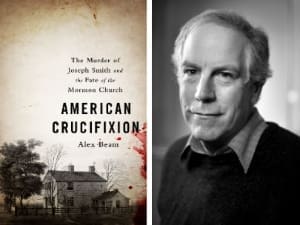
Alex Beam is a churchgoing Episcopalian and a Boston newspaper and magazine writer of three decades who spent two and a half years with Joseph Smith in Carthage, Illinois, writing “American Crucifixion: The Murder of Joseph Smith and the Fate of the Mormon Church.” In this live conversation, recorded in front of an audience, John Dehlin walks him through Joseph Smith’s final years in Nauvoo, his killing at Carthage Jail, and what came after, and asks him to be candid about how those events look to someone who does not see Joseph as a prophet.
Beam explains why he does not use the word “martyrdom” outside of Utah, why he is not persuaded by the argument that the Mormon vote decided the 1844 presidential election, and why his book steps on the pedal where polygamy is concerned: in his telling, a tiny group of dissenters with grievances over plural marriage and business dealings set off the chain of events that ended in Joseph’s death. John pushes back from the perspective of someone raised to revere Joseph, and the two go back and forth over the accounts of Joseph approaching other men’s wives, the destruction of the Nauvoo Expositor and the legal fallout, Joseph’s abandoned flight across the river, and what he and his companions were and were not wearing on the night of the killing.
Beam also gives his take on the succession crisis, including his view of Sidney Rigdon, before taking questions from the audience. One listener asks whether he was ever tempted to convert. He says no, but that there were moments when he felt the strength of the church and its people. In closing he says he went into the project with a certain respect for Joseph Smith and came out with a certain respect for him, and that the greatest gift of the project was his exposure to Mormons themselves.
Audience members who asked questions are not named on the recording.
What’s covered
- 00:00 Introduction and guest welcome
- 07:13 Alex Beam’s background as a writer
- 10:40 Researching Mormon history as an outsider
- 18:32 Joseph Smith’s life and why he was hated
- 32:55 Smith’s political ambitions and hubris
- 42:18 Polygamy and the unraveling of Joseph Smith
- 53:30 Patterns of coercion and spiritual manipulation
- 1:07:50 Destruction of the Nauvoo Expositor and the legal fallout
- 1:19:22 Joseph Smith’s final days and imprisonment
- 1:28:31 The night of the Carthage Jail killing
- 1:39:59 The succession crisis after Smith’s death
- 1:50:56 Audience questions and an outside perspective on Mormonism
- 2:19:15 Closing reflections
Related episodes: Wallace Stegner's "Mormon" Story w/ Alex Beam and Barbara Jones Brown | Ep. 2083 · An Introduction to Mormon Polygamy with Todd Compton | Ep. 12-14
Episode Transcript
Host: John Dehlin · Guest: Alex Beam
This transcript is machine-generated and lightly edited for readability. The audio is authoritative. Please excuse occasional errors in names and spelling.
Introduction and Guest Welcome
Alex Beam [00:00:00] 1, 2, 3.
John Dehlin [00:00:07] Mormon Stories Podcast is a production of the Open Stories Foundation. All donations to Mormon Stories are fully tax deductible and go directly towards keeping the podcast alive and towards building a community of support for Mormons like you. To support the podcast or to join the community, please become a monthly subscriber today@mormonstories.org. hello and welcome again to another edition of Mormon Stories Podcast. I'm your host, John Dehlin, and I have to begin by thanking Kelly and Brett for being so generous as to not only host, but set up and arrange for the catering. You guys are doing a beautiful job. I love my cousin. I love my cousin's wife and their family. Brett and I. Brett's meant a lot to me as well. I grew up in Texas. Brett very isolated from my Mormon family. And reconnecting with not only Brett and Kelly, but his siblings and their families and other members of the Parkinson clan, which is kind of where my mom's side hails from, has been just a great honor and a treat for me. And Brett's not only been a great cousin, but a great friend for the past decade or more, of course, more. But I sure enjoyed getting to know him as an adult. And so thank you again. You guys are wonderful. And Kelly, Where's Kelly? Thank you, Kelly, for that beautiful musical number and for the other musicians. Before I begin, Alex, you said you wanted to say a word or two.
Alex Beam [00:01:43] Alex going to be speaking to the
John Dehlin [00:01:44] mic, but the mic is just going into the recorder. You won't be hearing any amplification from the microphone, but it's just to have good audio.
Alex Beam [00:01:52] So with that, I wanted to thank you, actually. I know your work very well, and I'm really honored to be on your podcast. So thank you very much for your many. I've only been listening to you for two years, but now I regret the seven years I haven't. The Parkinson's are hiding now, but I also wanted to thank them. They're out of hiding. Thank you so much. It's very generous of you to open your home to feed us. Feed me, lonely gentile in the wilderness. And lastly, I'd like to thank the audience for coming. This is not the first time I've spoken to a group of largely LDS people. And the one thing I have to tell you is that it is such a delight for a writer to be speaking to knowledgeable men and women. And I know this is also not the first time. I know many people here have either started my book or read portions of it. I assure you Almost every time an author talks about his book, he's sort of trying to push it over on you. And I know that that's not the case here. And the kind of knowledgeable exchange is a very rich and rewarding experience for me. So thank you all very much for coming.
John Dehlin [00:03:12] Thanks, Alex. And we're honored to have you for the listening audience. For the listening audience today on Mormon Stories, our guest is Alex Beam. The book that we're talking about is American Crucifixion, the murder of Joseph Smith, and the fate of the Mormon Church. I've read every page of the book, which it was an honor for me to read. I'll read from the jacket. In terms of an introduction to Alex, I wanted to save his background for the actual interview, which will be going into his background. But Alex Beam is a columnist for the Boston Globe and for the International Herald Tribune. He's the author of two works of nonfiction, Gracefully Insane, which I understand is about McLean Hospital. Is that right?
Alex Beam [00:04:02] It is about McLean Hospital, yeah.
John Dehlin [00:04:04] Yeah.
Alex Beam [00:04:04] Excuse me. Yes, it's a sort of biography of McLean Hospital. That's. I hope our psychiatrist friend might. Anyway, why do you ask him?
John Dehlin [00:04:12] Well, one of my mentors in my graduate program ended up interning at McLean Hospital from Utah State, and so he works there now.
Guest [00:04:22] Oh, really?
Guest 2 [00:04:23] Okay.
John Dehlin [00:04:23] So it's just a nice little coincidence, Right?
Alex Beam [00:04:26] Right. It's a real piece of New England history, actually, which is why I wrote
John Dehlin [00:04:30] the book, and a couple people wrote in comments about that book. Another book that's mentioned in your bio here is a book called A Great Idea at the Time. What was that about?
Alex Beam [00:04:40] That's a book about the Great Books Movement. Okay. Of the sort of 40s, 50s, and 60s. It essentially was a kind of a popular intellectual movement that came out of the University of Chicago. And so I basically wrote that book out.
John Dehlin [00:04:54] And there have been entire universities based on that system, Right?
Alex Beam [00:04:56] Yes. Saint John's. Saint John's College in both New Mexico and Maryland.
John Dehlin [00:05:02] Or the. My wife has. My wife has a friend who attended
Alex Beam [00:05:04] St. John's yeah, well, I'm. If you go to Facebook, you'll see that my College affiliation is St. John's College, which I didn't attend.
John Dehlin [00:05:12] Right.
Alex Beam [00:05:13] But anyway, I attended Harvard, just so you know. I attended Yale, just so you know.
John Dehlin [00:05:17] Was it Yale?
Alex Beam [00:05:17] Yes.
John Dehlin [00:05:18] Why did I think Harvard?
Alex Beam [00:05:19] I don't know.
John Dehlin [00:05:19] Okay, sorry. My bad, my bad. Is that better or worse than Harvard?
Alex Beam [00:05:25] I'm sure they're both like byu. They're great universities. Ever the diplomat.
John Dehlin [00:05:32] It also says here that he has written for Atlantic Monthly, Slate and Forbes. And he lives in Newton, Massachusetts with his wife and three sons.
Guest 3 [00:05:42] Right.
Alex Beam [00:05:42] That's the beginning of the deception, of course, because my sons are all old and happy and doing their thing, but I do have three sons.
John Dehlin [00:05:49] Well, welcome to Mormon Stories. We're very happy to have you here.
Alex Beam [00:05:52] Thank you so much.
John Dehlin [00:05:53] I'll ask you questions for an hour or two and then we're going to open up to audience questions. I also just want to thank all of you for coming. For those of you who paid for the dinner, thank you. Hope you enjoyed it. But also those of you who have contributed to Mormon Stories, your contributions have literally paid for my ability to still sustain my family while I'm in graduate school. So for those of you who have been able to support us, this is a small attempt to try and thank some of our supporters. But my wife and I, Margi, she's here in the third row in the pink. We're both very, very grateful for your generous contributions that have made all this possible. And also just thanks for coming. It's a delight to have you all here. Okay. Boy, it would not be difficult to over prepare for this interview. I've got 1,000 questions and I bet the audience has 8,000 more. But I think where I want to begin is by having you talk a little bit about your background. Just tell us a little bit about yourself and you know, what, you talked about having a religious background. A little bit. I'm interested a tiny bit in that. And just what brought you to the point where you considered writing this book? And we'll talk about that specifically after.
Alex Beam's Background as a Writer
Alex Beam [00:07:13] Okay, fine. Thanks for asking. As they say in Newton, Massachusetts, I'm a writer. I'm a professional writer. I've been working for newspapers and magazines for three decades. I published a couple of novels. I have the religion gene. I'm kind of quoting a Mormon friend of mine who claims she doesn't have the religion gene. I'm a church attending Episcopalian. I have written books on radically different subjects. Obviously, to spend two and a half years with Joseph Smith in Carthage, Illinois is a huge departure from hanging out on the campus of McLean Hospital in Belmont, although Belmont, of course, is a very vivid connection.
John Dehlin [00:07:55] Is that Mitt Romney territory?
Alex Beam [00:07:57] I should say, not that you asked. Mitt Romney now lives on the grounds of McLean Hospital in Belmont because a portion of the hospital was sold off for condominium units. And so if you saw footage of him voting in the election, he actually was. That footage was from McLean Hospital. In any case, there's not. You know, I write books with great joy. I'm lucky enough to write books about subjects that interest me. And, you know, I did not come to this book through revelation or. And the creation story is rather mundane, if you want to hear it.
John Dehlin [00:08:29] Yeah, yeah, please. And feel free to address the audience if you want. You can look back at me.
Alex Beam [00:08:33] But yeah, yeah, fine. I mean, I was at a very low point in my life in June of 2011, and I received an email from my friend who's a literary agent, and he said, would you like to write a book about Joseph Smith? And he had had lunch with a young editor at a good publishing house in New York who basically wanted to write, have written, I guess, a popular history, a book that we, frankly, we weren't envisioning an LDS audience for this book. We were envisioning an American history audience. He felt it was a violent incident in American frontier history. I think it's the only incident I can think of where a person is actually executed for his religious beliefs. I mean, a person of substance, sort of. It's a lynching of a major American religious figure. And I was at a point where I really wanted to leave newspaper writing, which I was doing, and plunge myself into this book. So, I mean, I answered the email in the affirmative. I did want to write a book about Joseph Smith, and that started the whole process. It's hard to explain in a way that I had to then create a proposal for the book. So I had to propose. Make an outline and propose the book to the actual publishing house that in fact, wanted to publish it. But that was this kind of amazing time for me because I realized, and this would become important when I had to actually write the book. I realized that I knew nothing about Joseph Smith, I knew nothing about the Mormon Church, and that this was going to be a lot more than sort of my personal problem. This was going to be a significant hurdle to bring readers to the kind of the dramatic events in Carthage, Illinois, in 1844 was. I mean, I guess, you know, what's step one? Where do you start telling a story that's familiar to you, but certainly not familiar probably to the kind of people I was hoping would buy my book.
Researching Mormon History as an Outsider
John Dehlin [00:10:40] So as a journalist in Boston during the 80s and 90s and 2000s, I'm sure you heard of Mitt Romney here or there. Was there any. Did you ever cover Mitt Romney? And did that at all, you know, inform the beginnings of considering the book?
Alex Beam [00:10:59] Well, yes and no. I mean, I've interviewed Mitt Romney A couple of times. I'm well disposed towards Mitt Romney, which is not the default setting at the Boston Globe, I can assure you. And I voted for Mitt Romney twice, and I'm not particularly shy about it.
John Dehlin [00:11:11] As governor or once as governor, once
Alex Beam [00:11:13] for president, which again, isn't the default setting at the Boston Globe or in Boston, Massachusetts, as I'm sure you know. He's someone I hold in high regard for a variety of reasons, not the least of which, curiously, is his attitude towards his father. You know, I have my own. I have my own drives. I think many men have a lot of drives based on what their fathers may or may not have done in their life. And I think Mitt Romney's very forthright about that. But I have to say, no, the two were not at all related. I mean, except that I. As I've said, you know, when I started the book, I had a rather mild pro Mormon prejudice, and when I finished the book, I had a rather mild pro Mormon prejudice, but. But nothing profound.
John Dehlin [00:12:04] So why pro Mormon as a beginning bias?
Alex Beam [00:12:08] I think because we're. I think because where I live, all my actual intimate friends are anti religious, so that my actual bias is more pro religious, pro organized religion. Just to open a parenthesis. I've worked at the Boston Globe for some. Literally everyone I work with at the Boston Globe attended parochial school somewhere in Massachusetts. They are brilliantly educated, of course, they're fluent in Latin. They all went to good colleges. And they all hate the Catholic Church. They've all dropped out of the Catholic Church. I'm just not that person. I mean, not Catholic, among other things. I just don't hate organized religion. And so, I mean, so in that sense, I had no preconceived negative views of the Mormon Church.
John Dehlin [00:12:52] And had you had interactions with Mormons growing up in your adult years, I
Alex Beam [00:12:56] would have to say almost. Almost zero. Oh, wow. Almost zero. I. My son and I were approached by missionaries in a beautiful garden in Madrid. And, you know, we talked to them for some time. Obviously missionaries have come to my house in Newton, Massachusetts. I guess I would say almost zero, frankly.
John Dehlin [00:13:14] Okay.
Alex Beam [00:13:14] Before. Before I started working on this book.
John Dehlin [00:13:16] Okay, so from your perspective, no axe to grind against religion or Mormonism going into the book?
Alex Beam [00:13:23] That's easy for me to say. I mean, but that's. Yeah, that's. That's my story and I'm sticking to it.
John Dehlin [00:13:27] Okay.
Alex Beam [00:13:28] Okay.
Guest 2 [00:13:28] Right.
Guest 3 [00:13:28] All right.
Alex Beam [00:13:31] Okay.
John Dehlin [00:13:31] Fantastic. Well, let's talk about what. What was the audience that you envisioned? Who are you writing this book? For, and I'm not a historian, far from it, but I know that historians take a lot of pride in what they do. So to what, what level of sort of scholarship were you aspiring to with this book? And you know, tell us a little bit about who you're directing the book for.
Speaker F [00:13:58] Right.
Alex Beam [00:13:58] I guess I remember my college roommate's dad lived in Greenwich, Connecticut, and he used to have like, books that had just been published about various incidents in American history on his coffee table. And I thought that's actually the kind of person I envisioned as a buyer, a man or woman who buys sort of hardcover works of popular fiction, popular nonfiction about American history. I mean, the best known, you know, Mornings on Horseback is just a fantastic book by David McCullough. There's so many examples. But I would say Michael Beschloss first book, unbelievably fascinating account of the year relations between Joseph P. Kennedy and Franklin Roosevelt. I guess I wanted to write a truthful, interesting, factual, narrative driven book about a violent and fascinating moment in American history that frankly, no one I could envision would ever have heard of.
John Dehlin [00:15:03] And there have been some questions about. And we're jumping in a bit to the weeds before we even begin. But I just want to sort of lay out your goal. Of course you wanted to be as accurate as possible. One of the criticisms I've read is that there's some reliance on secondary sources in your book. Talk about that decision as you're going through the materials, to what extent that was or wasn't important or a problem for you, and how you kind of make that call.
Alex Beam [00:15:30] Well, again, I gotta divide that into two questions. Yes. As I envisioned the work of popular history I wanted to write, I was definitely going to rely on secondary sources a great deal. I wasn't going to sort of reinvent the wheel where the martyrdom was concerned. If I stumbled across new information, which seemed somewhat unlikely, I certainly wouldn't ignore it. Let me address the first part of that. Accuracy was important to me. And of course, since I think I'm reasonably aware that there are some factual mistakes in this book, as there are in other books I've written. But all I can say is I asked, as I say in the book itself, I asked people I trusted to read specific chapters, and in one instance I asked a friend to read the whole book. What I really was worried about here was howlers, howlers for the LDS audience. And I'm not completely convinced I avoided howlers. But the worst case scenario for me, and I'll do, you know, would be to mischaracterize the endowment ceremony, which I may well have mischaracterized, by the way, but in other words, I had to have four or five sets of Mormon eyes read what I wrote about the endowment, about the King Follett speech or whatever. And so, I mean, nothing is perfect, but that was my main consideration, was don't make a mistake that would let a Mormon reader who did not have your best interests at heart hammer you. So that I kind of tried to avoid that eventuality is all I can say.
John Dehlin [00:17:23] Okay. I just want to note that we're kind of at the three year anniversary of you being invited to consider writing the book.
Alex Beam [00:17:32] Yes.
John Dehlin [00:17:32] And so I contemplate how much I, as a Mormon who's lived for 44 years, how much I learned from the book. And I'm trying to imagine having you, someone who's outside of the faith, having learned that much material in a matter of two to three years. That's kind of an intense process, I think.
Alex Beam [00:17:55] I think you mean that as a compliment, but I do, I do. You know, it's an embarrassingly short period of time and I mean, I wish, I would rather say it took me seven years, you know, but I can't. Those are the facts.
John Dehlin [00:18:10] Was it a full time thing for.
Alex Beam [00:18:12] I took a few years, two or three years. I took about 14 months off of work, I can't remember, but I took a fair amount of time off of work. I took a buyout at the same time, but it was less than two years of full time work. But I don't know, I worked on it intensely. So there it is.
Joseph Smith's Life and Why He Was Hated
John Dehlin [00:18:32] All right. Okay. So before we actually talk about the immediate events leading up to what some call the martyrdom, there's a lot of people who don't like the usage of the term martyrdom.
Alex Beam [00:18:47] Well, I know that that's a whole, that's, that's a connoisseurs debate. And of course, I mean, I don't want to, Again, I don't want to put anyone off, but it's not a term I would use, obviously, outside of this area code. I mean.
John Dehlin [00:18:57] Right, okay.
Alex Beam [00:18:58] No one would have any idea what I'm talking about.
John Dehlin [00:19:00] We'll get to that. Okay, we'll get to that.
Alex Beam [00:19:02] So,
John Dehlin [00:19:05] okay, my first question is, do you have any idea how a faithful Mormon is raised to view Joseph Smith?
Alex Beam [00:19:15] I mean, I think I can truthfully answer that question. Yes, I have some idea.
John Dehlin [00:19:20] Can you, can you just try characterize that a little bit? Spend 30 seconds. What is the average believing Mormon, how do they view Joseph Smith and what do they know about him?
Alex Beam [00:19:31] Well, gee whiz, is that too intense of a question?
John Dehlin [00:19:35] Do you want me to say.
Alex Beam [00:19:35] I could say no, no, no. I like pointed questions. I just, I want to get through it, you know, I sort of want to get through quickly. I mean, I have been in Mormon churches, you know, I have inaccurately stated in previous appearances, you know, that Mormons are asked to give testimony once a year that Joseph Smith is a true prophet of God. I understand it's a mistake, but my point is, I mean, I've been to Temple Square. I think the average Mormon, of course, is taught from a young age that Joseph is a true prophet of God. Right. That this was a young man from Vermont and upstate New York who had a well documented youth and experienced, started having religious experiences in his very early teens, told people about them. And I mean, behind your question, I mean, do I think generally speaking there's a highly idealized view of Joseph Smith as an adult? I would answer yes, I suspect there is. But I'm not the one, of course, who's been in primary, I mean, et cetera. I can't even pretend to. I'm not going to try and pretend that I've been through Mormon culture because I haven't.
John Dehlin [00:20:55] Yeah. And you know, some of the highlights that we would be raised knowing, you know, a farm boy, worked really hard, got sick, got an infection in his leg, didn't drink the alcohol and bore the pain of the surgery because he was so courageous, made it through, had that vision at age 14, was called of God, lived a virtuous and an honorable life until he saw Moroni, the plates and everything. Married to Emma, loved Emma. They had this idyllic partnership together. No real knowledge of polygamy as far as the quote, martyrdom goes, led like a lamb to the slaughter, innocent of all charges, and was murdered in cold blood again, pure and white as a driven snow, you know, healed the sick, loved everybody, was progressive on women's issues, was progressive on black issues, was ahead of his time, an ideal father, an ideal husband. I mean, that's just what I gained and what many of the people I talked to gained. Now this is a setup for a follow up question.
Alex Beam [00:22:06] Okay, great. A few.
John Dehlin [00:22:08] The follow up question is, do you understand how deeply disturbing your account is when juxtaposed to that sort of perception of Joseph that many of us were raised with and how did that affect. How has it or did it affect
Alex Beam [00:22:23] your writing of it? I would have to say the answer to that question is no. And maybe I owe an apology, if not to the people in this room than to other people. Because no, I didn't seek out in any way to write a book that was particularly disturbing to anyone. Although in a way you need to ask where am I coming from? You took some time to say, now go ahead, take it. Where am I coming from? I mean, what's, you know, speaking the truth in love. If you're not in the church, let's say you're a literate, literate, literate member of the American public. I mean, if you've, and this is not for the under 40 crowd, if you've read one book about Mormon history, you've read Fawn Brodie's book, period. If you're under 40, you've read under the Banner of Heaven of pretty virulently anti Mormon book. Now I'm not coming from under the banner of Heaven, but I mean, so again, the first step I would have taken towards knowing Joseph Smith would have been to read Fawn Brody in this. I actually did a presentation a couple days ago. I mean, interestingly enough, you know, when Michael Quinn was a graduate student at Yale in history, his the fellow graduate students would ask him, well, how can I learn about Joseph Smith? And Quinn hates the Fawn Brodie biography. And he said, yet it pained me to say the only book I could recommend to these people was Fawn Brodie. So I mean, I'm coming to Joseph from a highly secularized, you know, non believing point of departure where I see him as an extremely important actor in American history, but no more than that
John Dehlin [00:24:13] meaning obviously not a prophet.
Alex Beam [00:24:16] Well, I'm not in the church. I don't, it's not, it's not incumbent on me to pass judgment on whether he's a prophet, but in my personal belief, of course I don't see him as a prophet.
John Dehlin [00:24:25] And what if people were to say that either you set out or the results of what you did was basically to just tear him down and to make him look bad?
Alex Beam [00:24:34] Well, I mean, first of all, I guess I would say no, that wasn't my purpose. I guess the issue of sort of what was in my heart is actually quite important to me. And you know, when I was at the mha, I met this historian, I told you, named Artist partial, who's a very fervently believing Mormon. And I had sent her my book and you know, she, and she said, you know, it was a good book is actually what she said. It's not a book she would have written And I kind of burst out to her, I said, you know, you really need to know that there was no whiff of anti Mormon animus in me when I wrote this book. And she said, yes, I feel that. I suppose it pains me a little bit that not everyone feels that way. And I think perhaps people have legitimate reactions and complaints. But it was really important to me whether I came to the subject with an openness of mind and an openness of heart. And again, I think self analysis in these lines is always subject to question.
John Dehlin [00:25:48] Sure, of course. Well, that's why I'm so excited to interview you. A couple years ago I interviewed a famous Yale anthropologist named Michael Koh. He's a famous Mesoamerican archaeologist. You know, at the time, at some point in history, my guess is he knew more about Mesoamerican history than probably, you know, any archaeologist in the world, or at least was in the top group. And I was very interested in his outsider view of the origins of the Book of Mormon. I'll refer my listeners to that episode. It's one of the episodes I'm most proud of for Mormon stories. It's actually a series and that's what I love about this book. I mean, what we're talking about here is a guy who three years ago knew, in your own words, kind of next to nothing about Mormonism. And you've now spent two plus years digging deeply into the history of. To make, at least from your perspective, a best attempt at objectivity, acknowledging that objectivity is impossible. But certainly you would say, and I want to take you at your word, that in your heart, your goal was to be as fair and as objective as you could. And that's something that makes this book very compelling as a Mormon.
Alex Beam [00:27:03] Okay, well, thank you for saying that. I mean, it wasn't meant to,
Guest 2 [00:27:09] you
Alex Beam [00:27:09] know, take anything away from anyone. I could never, even if you ask the question, I don't think I could ever. I don't really know who I wrote this book for. I wrote this book for my mother, you know, as the smartest person I know, who actually unfortunately didn't get to read it. But I don't know, you know, I don't think I ever wrote it with, oh, this faithful Mormon is going to be angry at me. Or I did, you know, I did certainly. I guess writerliness is my highest standard. You know, like, is this a book that another writer would say, this is a nicely crafted piece of work that's sort of my audience.
John Dehlin [00:27:45] Okay, thank you. So having dug so deeply with an attempt at objectivity. Why was talk about Joseph's personality and his behaviors leading up to when the controversies really started to erupt in Nauvoo? Help us understand why Joseph was hated so much by so many people outside of the church.
Alex Beam [00:28:13] Right. I mean, there's even a chapter in my book, and again, I know many of you have read this, which I certainly never hesitated to, you know, sign the title to Everybody Hates the Mormons. Because in Hancock County, Illinois and in the surrounding area on the American frontier, everybody really did hate the Mormons. You know, your questions about Joseph. Joseph was hated, but I think not always for the right reasons, frankly. Obviously he had a huge, a huge personality, you know, one of the great, great personalities in American history. I don't use terms like, you know, con man, mountebank, faker. That's not how I think of Joseph. I think of him as a very powerful evangelist. I mean, remembering that I'm not with the church and not planning to be with the church people, you know, he certainly was the raised nail that allowed himself to be hammered down. I mean, he and I will separately answer part of your question by saying that I think the last 18 months of his life may be a separate period of his life. I hint at this in the book. I use the term manic intensity. I write that the pace of events in Joseph's life seems to be quickening in the last 18 months of his life. And I really feel like I'm leaving that for, for the next major, major Joseph Smith scholar, to maybe help us out. And there's been some feeling around those issues that I'm happy to talk about. But I mean, you know, Joseph was hated for religious blasphemy, certainly hated for,
John Dehlin [00:30:02] I think for what were the main blasphemies.
Alex Beam [00:30:04] Well, to create a third canonical Bible is a blasphemy in itself. Right. To retell the story of Jesus Christ is a blasphemy in itself. To discover, quote, unquote, you know, lost books of the previous testaments is a blasphemy in itself. I'm speaking, I think, how a early 19th century American with an interest in religion would speak. I don't actually single people out for blasphemy. But I mean, to go back to the Mormons parlors, you know, position in Hancock county in 1843 and 1844, as, you know, voting in block, everyone in this room knows, you know, the Mormons always cast their 35 to 4,000 votes together. So that guaranteed that everyone who voted against them hated them.
John Dehlin [00:30:59] How Many votes?
Alex Beam [00:31:00] Well, I use the term 3500 to 4000.
John Dehlin [00:31:02] Okay.
Alex Beam [00:31:03] You know, the population of Nauvoo was deemed to be between 11 and 12%
John Dehlin [00:31:06] because women can't vote and children can't vote.
Guest [00:31:09] Well, that's right.
Alex Beam [00:31:09] But what's fascinating about this part of America, I'm not, certainly not an expert anywhere else in America, is that everybody who shows up can vote. So, you know, again, as many of you know, fully a third of the population of d' Anville basically had just gotten off the boat from England. But they're allowed to vote in that part of. In Illinois generally, in any event. So they had political enemies. They had clashing economic interests. And I think it's important to say that success breeds contempt. Right. I mean, Mormons, even to a room full of Mormons, I always use an adjective like insular, or you could use cohesive. But I mean, the togetherness, the stickiness of Mormons means that non Mormons might, well, not like them. And of course, when that's coupled with economic success, which it was to a certain extent. Nauvoo, of course, was 10 times as large as the county seat, Carthage, 15 times as large as any other town in that part of the world. So there was just plain resentment and anger against the Mormons.
John Dehlin [00:32:20] I had heard this before, but I didn't believe it. You mentioned in your book that at its zenith, Nauvoo was the largest city in the entire state of Illinois. Is that right?
Alex Beam [00:32:31] Well, that's a much repeated quote, unquote fact. I didn't come up with that fact.
John Dehlin [00:32:35] And they built it in four years.
Alex Beam [00:32:37] Right. But it's a statistical trick. Right. Because Chicago's growth is like this. But literally in 1843, Nauvoo is larger than Chicago because Chicago is so low on that slope.
John Dehlin [00:32:51] Still, a semi remarkable achievement.
Guest [00:32:54] It is.
Smith's Political Ambitions and Hubris
Alex Beam [00:32:55] And I bet people in this room know there's a book out there called Junius and Joseph, a book I in no way endorse, but it advances this intellectually intriguing hypothesis that the block of Mormon voting controlled the presidential vote in the state of Illinois, and that the presidential vote in the state of Illinois determined the outcome of the 1844 election. I'm not. I'm just not down with this argument. But it is. So, in other words, these two authors say that the Mormons held the. Were the key that slipped the lock to the 1844 election, which I don't happen to believe.
John Dehlin [00:33:39] Why did you say it?
Alex Beam [00:33:40] I think it's fascinating.
John Dehlin [00:33:45] Okay, now, your response to my Question was fabulous. I have to sort of reveal a little bit of my bias as informed by the book, also informed by Fawn Brody's book and other readings I've done on Joseph. I have to say that when I read some of these early chapters in your book about Joseph Smith, I got really, really angry. And I got angry with the level of hubris and I couldn't think of a better word. And many people that I've talked to use the same word. I became almost furious with the level of just how brash he seemed to be at times and the level of hubris that I encountered from not only his Nauvoo times, but even some pre Nauvoo times. Do you have a sense for what parts of the book I'm referring to there? And if so, can you just give the listeners who haven't read your book yet a taste of what I might mean by hubris?
Alex Beam [00:34:52] I think I can. Again, I feel this is actually the unwritten book about Joseph Smith that I'm happy to talk about in some detail. But I think it's something I only hint at. But I mean, Joseph is really reaching high in 1843 and 1844. And there's, you know, to get ahead. You know, there's even someone once compared Joseph Smith to Bill Clinton, which is actually quite interesting, this notion of this unbelievably gifted man. And men, I don't know much about women, but men are often prone to putting themselves into situations where they feel nothing will be revealed. You know, I'm invulnerable. This will never come out. But, yeah, I mean, Joseph was exercising, I mean, terrific hubris. Certainly in the last 12 months of his life, he was running for president again, something we can talk about if necessary. I know what I think about Joseph's run for president. I mean, I think it was quixotic. It's the adjective I use in the book. I think it was hubristic. I think it was silly, frankly. He had his reasons and we can go through that, I guess.
John Dehlin [00:36:03] But he sent apostles out to campaign for him, Right?
Alex Beam [00:36:06] Well, these quote unquote Volunteers, like 144 of them or something. Yeah, I mean, that was, I mean, the dictatorship. I think he had entered into a sort of a highly individualistic, charismatic dictatorship, you know, of Nauvoo, but one that, to be fair, that where it would be a benevolent dictatorship. I mean, I guess I think I use that line after his death. I say, you know, even a benevolent dictatorship needs a dictator. And his followers were generally 100% behind him. Indeed, you know, when the dissidents had to stand up to be counted, there were only 300 of them. So that's three. You know, I don't know, I can't even do the math, but it's well under 1%. We've talked and others have talked about. I find that the various overlapping councils and, and as these sort of means of control that Joseph instituted towards the end of his life, some of them are quite familiar to Mormons. I don't know. I find the layering of ritual upon ritual, the anointing, the second anointing to create ever more sort of specific groups of favored individuals, favored couples. You're on this council. Oh, but you're on this council. All these councils are secret. It sort of, you know, for the non Mormon certainly culminates in the creation of the so called Council of 50 which is known as the Council of the Kingdom of God. I mean Joseph, all these quotes are definitely available where you know, Joseph is talking about already staffing, staffing the government for the Kingdom of the Americas after the coming of Jesus Christ. And this did come up, the one detail that did come up at the Mormon Historical association meeting that took place a few days ago. They kind of gave some teasers about the minutes of the Council of the Kingdom of God. And interestingly, Joseph had named his cabinet for when he was going to assume the presidency of the United States. Now Ron Esplin didn't give us the names actually, but he said in these minutes there were the names of the people who have been designated to be Secretary of Defense, Secretary of War, et cetera. So I mean, I hope. Is that what you're asking about?
John Dehlin [00:38:28] Because not just that, tell the story about. I believe it was John Quincy Adams son who comes to visit Joseph and along with the son of a governor of.
Alex Beam [00:38:41] Yeah, tell that story. It's a Quincy and Winterpool. I mean I don't. That's a very, very well documented story. These two Boston aristocrats get off the Mississippi and I think it's in 1844 and they. But Joseph did a lot of that. You know, Joseph did a lot of receiving. He received John C. Calhoun's two sons. It was pretty common for people to look in and Joseph encouraged this for people to come to Nauvoo to meet him and to see what he had done, frankly by creating this thriving Mormon colony. I mean, I guess you're hinting at the fact that, I mean at the
John Dehlin [00:39:19] conclusion of their visit they say what to Joseph?
Alex Beam [00:39:23] Well, refresh.
John Dehlin [00:39:24] My memory, isn't this a lot of power for one man to have?
Alex Beam [00:39:27] Yes. They say to him, isn't this a lot of power for one man to have?
John Dehlin [00:39:30] I mean, what are all his positions at the time? Well, go through the Nauvoo chart like.
Alex Beam [00:39:34] Yeah, yeah, he's mayor, he's chief justice, he owns all the property. As someone in this room pointed out, he's a chief clerk. Thank you for reminding me. He's the only lieutenant general in the United States. There will never be another lieutenant general. Well, I don't know, you laugh, but these are truthful facts. He's obviously the head of the church, right? I mean, we can't forget that Prophet of God. He's a prophet of God. He's the king of Israel. Ruler of Israel.
John Dehlin [00:39:58] And he had himself anointed, what, by the Council of 50. King of the world.
Alex Beam [00:40:04] King of the world. King of the kingdom of God. Okay, yeah. You're putting a spin on this. You're putting a spin on this.
John Dehlin [00:40:11] I'm putting a spin on this.
Alex Beam [00:40:12] I'm just putting the facts out there. But I mean, I think. I mean, you're gonna.
John Dehlin [00:40:17] So that's a lot of power for one man to have.
Alex Beam [00:40:19] Yes, yes, that's the question. And this is like a quiz where I have to remember something I wrote. No, no, no, no, no. I know the answer. I know the answer. And he answers. I believe he answers in someone else's hands.
John Dehlin [00:40:30] In your hands, perhaps.
Alex Beam [00:40:31] In your hands, perhaps.
John Dehlin [00:40:32] Right.
Alex Beam [00:40:33] So much power could not be concentrated, but in my hands, everything's okay. Yeah. I don't know. I mean, but to quote myself, I say, you know, I said, if Joseph was experiencing megalomania, he came by it honestly.
John Dehlin [00:40:52] What do you mean?
Alex Beam [00:40:54] I mean, his life story from 1830 to 1844 is without parallel in American history. The claims that he made, I mean, the fact he faced a firing squad, there was an attempt to castrate him, they poured acid down his throat. I think something about Joseph, well, that you won't find in the non Mormon record. I think he exhibited physical courage quite a lot. The fact that he created a lasting religion in 14 short years, a religion that, again, to quote myself, you know, that crossed the Mississippi into the mainstream of American history, dominated the history of the American west for the remainder of the 19th century. I mean, again, I repeat, if he exhibited signs of megalomania, he came by it honestly.
John Dehlin [00:41:50] Beautiful. So to what extent did polygamy play a role ultimately in his undoing? You talk about it a lot in the book. Talk about it a bit here was that, you know, as far as we sort of correlated, believing Mormons go, lamb of the slaughter, innocent. Was polygamy an important part of his ultimate undoing?
Polygamy and the Unraveling of Joseph Smith
Alex Beam [00:42:18] Well, yes, I have to say yes, because that's. Because that's the argument made in my book. Certainly, you know, there are other. Just. I'll briefly kiss off the other views before, but I mean, I think an important rival historical interpretation is that the political and the socioeconomics played, some would say played a much more powerful role, that the anger directed against Joseph and the Mormons was political and socioeconomical, probably rolling in hatred for the religion as well. I definitely step on the pedal where polygamy is concerned. I have a fairly long chapter about polygamy, which I have to confess, I almost couldn't stop writing. I mean, it's very readable material. God will strike me down for saying that. Here's the narrow case, which you're definitely welcome to push up against. But the reason you. You can't say polygamy, frankly, didn't lead directly to the death of Joseph Smith is because this tiny group of dissidents who published the Nauvoo Expositor, I would argue, I think I'm correct. Their primary anger, to be fair, they have other disagreements with Joseph, but their primary disagreement with Joseph is over polygamy, which they definitely consider blasphemy and a departure from Joseph's own true teachings. Now, as we know, it is the publication of the Nauvoo Expositor by this small group of dissidents that. That is the path that takes us directly to the assassination of Joseph Smith, because I say it is the sword that he placed in the hands of his enemies because his enemies were looking for any excuse, frankly, to get him to Carthage and probably to string him up. And this. They ginned up various indictments. Now, again, people who know the history well know that he was also indicted for having more than one wife. But primarily, the legal actions against him. Yeah, the legal actions against him in Carthage were. They ginned up some. There was a crime against the First Amendment. It was a crime to destroy a printing press, which he did. Maybe it was a crime, maybe it wasn't, but that's certainly what he was indicted for. And it was whether he was going to honor. They sent a bailiff twice to get him, and he evaded the bailiff twice. Constable. But the decision of whether he would go to the county seat in Carthage to face these charges relating to the destruction of the press was a decision that Ultimately was going to cost him his life.
John Dehlin [00:45:17] Right. And the chapter in the book, and it may be multiple chapters, that talks about promises he made to both the Whigs and the Democrats. And do you want to talk about that a bit? I mean, it's an important. It's fun. It's interesting stuff.
Alex Beam [00:45:34] Well, it's very important, frankly. It's somewhat detailed, but obviously not obviously. But there are two political parties in Hancock county, and Joseph is very, very political, and he's very, very smart where politics is concerned. He's smart in other ways, frankly, but he is always sort of playing the Democrats and the Whigs off against each other in the interest of gaining status for the Mormons. And the real problem is that he goes too far in one election that, not coincidentally, is very close to his own death. Where this is, because it's worth reading in the book, it's kind of hard. It's hard to describe this level of detail, but Joseph, yet again, has been thrown in jail somewhere up north. And Joseph is always, like, hilarious. He's always on the best of terms with the greatest lawyers in Illinois. And somehow he learns that one of these great, great Illinois lawyers is in the neighborhood and might be able to spring him from where? He's in Dixon. Dixon somewhere. Dixon, Illinois. And in fact, this lawyer says to Joseph, yeah, I can get you out of jail, but you'll have to endorse me in my congressional run. And Joseph says, fine. The problem is that when it comes time to actually vote, it turns out that Hyrum, Joseph's brother Hyrum, has made a different commitment in connection with his own desire to remain in the Illinois legislature. And so there's this crazy moment involving, as I recall, Joseph, his brother Hyrum, and William Law, one of the first counselors who will become Joseph's greatest enemy, all debating in public in Nauvoo, where they say. Hyrum says, oh, there's been a revelation. Don't vote for that guy. And Law says, what are you talking about, a revelation? Then Joseph said, well, wait a minute. I had this other revelation. So these competing revelations. I think it's kind of tawdry because it involves. Know who you're going to vote for. But it ends badly. It ends badly because both the Whigs and the Democrats simply write Joseph off. They just say, you know, it's too crazy down there in Nauvoo. On the one hand, there's a lot of votes. On the other hand, there's no commitment to anything. That guy's not a Democrat. He's not a Whig. He's after his own interests and, you know, and even they can't figure out what they are.
Speaker F [00:48:10] So.
John Dehlin [00:48:12] But before we. Before we talk about the actual assassination, as you call it, and then the trial afterwards, I want to sort of talk just a bit about some of the patterns that I feel like I detected from your book, but also from other books that I've read. And these are patterns that I sometimes, in my more angry moments, and I know that it's important for you to not be angry as a historian. Many of us, when we learn this stuff, are angry. And that's why I asked that original question about how aware you might be about how angry your book might make a believing Mormon. And your book made me angry at Joseph, and it made me angry at Joseph because I detected some patterns. And not only did I detect some patterns, but I felt like these patterns have become the legacy that we're left with today. In other words, I see these patterns that Joseph established living themselves out today and how the Church treats many of its more thinking members and any of its enemies or dissidents. And so I know it's going to be hard to talk about this kind of stuff, but if you'll indulge me to the extent that you can, this would be what I see. Okay. I see that there is. There is, you know, a lot of good, positive things going on wherever Joseph and the Church are. There's people being industrious. There's good, honest, moral, clean people building houses and temples and serving each other and loving each other. You know, there are reports of miracles happening. There are just good, salt of the earth people living noble and good lives. So I'll stipulate that. But that's not going to be the focus on my questions because those things don't make me angry. I like that stuff, and I'm. And I don't deny it. But what I see. Step one of what I see is misdeeds and the changing of stories over time. In other words, in the inner circles of Joseph's inner circles, there are people in power, in some instances behaving very badly. And I don't know if you're uncomfortable characterizing that way, but I've got lots of examples that I read from your book of people using coercion, of people maligning other people, of people using their power with young girls, with young women, of people being defrauded of money, of people losing incredible amounts of money, of people wielding influence in ways that literally can lead to the destruction Destruction of lives and of COVID ups. Right. Of people covering things up and the story changing over time. So revelations might happen, but then other revelations might happen that are different from the previous revelations. So the previous revelations get erased and the new revelations get put forth, but lots of very shady behavior. Is that fair?
Alex Beam [00:51:38] I'm hearing more from you than I feel is in my book, to be honest. For instance, you talk about. I'm not aware that I talk much about financial skullduggery. Or do I?
John Dehlin [00:51:54] Well, you know, the Kirtland bank scandal is an example that you talk about where a large percentage of members, some of them lost everything they have that when Joseph leaves Kirtland, he flees in the night, as I read from your book. Because he probably would have been in big trouble if he had stayed. And that, that stuff that happened with the Kirtland Bank, I mean, it's named an anti bank because the bank wasn't approved.
Alex Beam [00:52:19] But that's not. I mean, that's not Alex Beam. I mean, that's. You should have known that. That's in the history. I mean, that and that's. And everybody, everybody was doing that. I mean, in a way. So I guess I challenged a little bit.
John Dehlin [00:52:32] Okay, I'm not saying any of this is you.
Alex Beam [00:52:33] Okay.
John Dehlin [00:52:34] I'm saying this is the information you helped me understand better, I guess.
Alex Beam [00:52:39] Although, I mean, the Kirtland bank is just. I mean, everybody's got their spooky bank at that time. And it was an error of judgment for obviously, and it was illegal. I mean, but it's. I don't know. I thought you were. Because, for instance, William Law sued. I'm hoping my memory's gonna kick in here. There were lawsuits concerning the legacy of a rich young woman between Law and Joseph Smith. And I definitely don't, I don't think, A, I write about that and B, I don't think I take a position on it. There's a lot of extremely aggressive charging and counter charging in Nauvoo. And I didn't hear what I intended to write in that particular list.
Patterns of Coercion and Spiritual Manipulation
John Dehlin [00:53:30] Okay, well. Okay, so we'll use polygamy as an example. You talk about how men would come home and find Joseph at the table with their wife.
Alex Beam [00:53:42] Correct.
John Dehlin [00:53:43] And Joseph would say, what was he doing here? And she would say, what?
Alex Beam [00:53:50] Well, right. I mean, these accounts are that he was making woo. Right. I mean, to her, that he was attempting to get over on her, as Ray Charles would say.
John Dehlin [00:54:04] But as someone who is not LDS and doesn't see him as a prophet, is that not kind of a little bit alarming or problematic?
Alex Beam [00:54:14] Well, I don't know. I mean, isn't, I mean, if you're in the church, don't you say that polygamy, don't you say that polygamy is a doctrine that he's beginning to share with fellow members and so that maybe. I don't think this is my view and I don't think it, you know, I don't think it's the view that's put across in the book, so to speak. But isn't that the sort of the COVID for this kind of behavior that Joseph is acting out a doctrine that he purports to have had revealed to him?
John Dehlin [00:54:44] Yeah. Yeah. Okay, but are you buying that?
Alex Beam [00:54:46] I don't buy it, no.
John Dehlin [00:54:47] Okay. Okay. So there's something else going on and I, I would, I would have to guess that your assumptions would be that it's not altruistic or, you know, kindness.
Alex Beam [00:54:59] I don't, Yeah, I mean, I don't.
John Dehlin [00:55:02] Are you trying not to, Are you trying to reserve judgment?
Alex Beam [00:55:06] Wait a minute, I don't. That would, the book doesn't reserve judgment. So it would be a little hypocritical of me to sit here and try to reserve judgment. Obviously, I don't buy into really any narrative or counter narrative that purports that, you know, polygamy began in 1831 and that there's a threat of accountable behavior. I don't, I don't have. That's not my view. So, I mean, I guess there's a lot more of extreme views of Joseph's behavior that I'm actually a little uncomfortable. I'll give you an example. I'm a little uncomfortable condemning. I mean, I have seen it. You know, a common anti Joseph trope is oh, look what he did with young girls. Well, in fact, you know, women under Illinois law could be married at age 12. Okay. Many historians have pointed out it was highly common in many other states for women to be married at age 14. So if he married or sealed himself or whatever you choose to call his relationships, I mean, it's not fair, it seems to me to say, oh, this is an outrage. Look what he's doing with young women. There's one example. You look like you're angry.
John Dehlin [00:56:18] You mean it's not illegal?
Alex Beam [00:56:19] It's not, it's not, it's not other people. If it's illegal to marry a 12 year old girl, that means people are marrying 12 year old girls. Right.
John Dehlin [00:56:31] But if you think about him claiming to be a Prophet of God. You know, God's. I think at one point he said in some ways he was greater than Jesus. You know, he was quoted as saying he was able to do things Jesus wasn't able to do.
Alex Beam [00:56:44] Yeah, that's in an. Yeah. I mean, that's an example of braggadocio.
Guest [00:56:48] Right.
Alex Beam [00:56:48] I mean, because he has these manic flights. Right, right. Okay.
John Dehlin [00:56:52] Right.
Alex Beam [00:56:53] So.
John Dehlin [00:56:53] So if you think about the incredible power that he had, and then you've got these 14, 15, 16 year old girls that he'll bring into some room and say, you know, I've been told by God that you're supposed to marry me. And by the way, if you do, your parents will be saved. And I don't know what he would say as a consequence if they didn't. But I'm sure it wasn't always favorable. And then he would marry them. And I think in many cases. Would you agree there was probably sexual relations?
Alex Beam [00:57:27] I happen to think so, yeah. Then you're leaving out the angel with the flaming sword. Okay, yeah.
John Dehlin [00:57:32] He would say. What would he say?
Alex Beam [00:57:34] Well, I mean, it's astonishing. I mean, he would say, of course, to me at least, one of the fascinating things about polygamy is that even Joseph curiously spoke of it as kind of a not very appealing idea and claimed that an angel with a flaming sword revealed the doctrine to him, that he initially opposed it, and then this forceful personality sort of forced him to adopt it. But he used that same image in conversations with women where he would say, you know, I've had this revelation. If you don't accept the verity of this revelation, you know, an angel with a flaming sword will come, et cetera, et cetera. And at least one instance, of course, some of these young ladies do, the angel does visit them and testifies to them the truth of the doctrine.
John Dehlin [00:58:20] Right. And I guess I'm saying as someone who at some point in my adult life started learning about these stories,
Alex Beam [00:58:28] when
John Dehlin [00:58:28] that happens, you find out that maybe he sent a man on a mission and then, you know, married his wife while the man was on the mission. Or, you know, he took vulnerable people who had money and married them and kept their money. You know, here's how I say that's an allegation.
Alex Beam [00:58:47] And certainly I never write in the book that he sent someone, although others have certainly written that he would send men on missions in order to get over on their wives. Although to be fair, I don't think I write that. I mentioned that he's supposed to have come on to Sarah Pratt while her Husband was on a mission. But I don't think I characterize why he sent Orson Pratt on a miss.
John Dehlin [00:59:05] Sure. But as a Mormon, when I'm reading this stuff, it's, you know, it's really difficult. And so when we read that stuff, it's very easy. You know, we look at. We feel it's okay to look at Warren Jeffs and say, what an evil person. What a bad, evil, despicable man, or Jim Jones, or pick some type of cult leader that we all feel comfortable demonizing. Right. David Koresh. Right. Why is Joseph any different than that?
Alex Beam [00:59:43] For me, he's just not that person. You know, I totally understand what you're saying, but I think the Michael Quinn's of the world would say because he definitely believed that he was acting in the interests of his religious beliefs. Now then you say, well, so did David Koresh, so did Warren Jeffs. And I don't necessarily have a counter argument for that.
John Dehlin [01:00:10] Okay. Did you ever feel that level of frustration or anger for those young girls, for those married women he married, women who were already married to other men. The financial stuff, just the deception that seemed to have happened. Did you ever emotionally connect with any of that in terms of frustration or disappointment?
Alex Beam [01:00:33] Well, in a way, I really had no emotional connection to Joseph Smith. And I'm hearing something different from you.
John Dehlin [01:00:38] Yeah, for sure.
Alex Beam [01:00:40] You know, the Brotherton testimony is astonishing. I mean, the fact is that some of these women gave Joseph Smith quite as good as he got, so to speak. So, I mean, not every attempt at seduction was successful. Certainly, you know, The William Law situation, again, led directly to his own death. So I don't know. I wasn't. Jeez, I'm not being very sensitive to. I mean, you know, the, the two sets of sisters that lived in the Nauvoo mansion. To me, that looks pretty clearly like sexual predation. Right. I mean, on the other hand. Geez, I can't believe I'm saying this, but weren't they. They were faithful to the church. Right. So they didn't perceive themselves as victims of sexual predation, Isn't that fair to say?
John Dehlin [01:01:39] Sure, sure, that's right. Okay, well, I won't keep pushing that too much further. Obviously, I'm trying to give voice to many people who learn about this stuff and feel outraged. Right, right.
Alex Beam [01:01:53] It's not me. It's not me. It's not me.
John Dehlin [01:01:56] What you're saying is it's the historical record, not you.
Alex Beam [01:01:59] Yeah, I mean, I don't. This is an important part of Joseph's, you know, Engagement with life. It's quite seeming. And of course, it's. If anybody in the 21st century hates Mormons, you know, one of the reasons is they say, well, can you believe how Joseph Smith behaved? It's sort of just accepted. And that's. That's at a level that you and I aren't talking on right now.
John Dehlin [01:02:21] Sure, sure.
Alex Beam [01:02:22] Okay.
John Dehlin [01:02:23] Okay. So what. What were the immediate events that led to his incarceration? Let's start talking about kind of around marching in his incarceration and what happened after.
Alex Beam [01:02:38] Well, he makes this Joseph, really. He has these enemies who publish this newspaper called the Nauvoo Expositor, which criticizes Joseph stridently, criticizes him for running for president, criticizes him for polygamy, criticizes him for other. For the. Excuse me, for the doctrine of multiple gods.
John Dehlin [01:03:04] So talk a tiny bit about the laws and just about their background and what William Law's position was before he got upset and why he got upset.
Alex Beam [01:03:17] I mean, William Law is Joseph's. What can you say? Well, first of all, he's a member of the First Presidency. The First Presidency. It's not exactly current, but I think he takes Sidney Rigdon's place in the first presidency in 1842. If I'm wrong about that, I'm wrong about it. But in any case, he's a trusted advisor to Joseph. He's come from Canada, and he's distinguished among the kind of people come to Nauvoo because he's rich. He's married a rich woman who's worth $7,000. And he's a successful business person. And probably not very intelligently. He goes into the. The real estate business in Nauvoo, and Joseph is in the real estate business in Nauvoo also. And there's some very legitimate concerns at play here because Joseph has dredged the pestilential lowlands and needs to have the bottom tier of Nauvoo colonized with people. And Law and his pal Foster are actually developing the much more salubrious highlands in Nauvoo, and Joseph calls them out for that. So there's definitely an economic rivalry. In any case, Law has status. I mean, he has status in Joseph's church as first counselor. He has money. And then there's this hotly debated issue. Law has his beautiful, rich wife, whom Law says Joseph made advances to her name, Jane Law, Jane Silverthorne Law. And
John Dehlin [01:05:05] any about the story of the advances?
Alex Beam [01:05:07] Well, I reread what I wrote about it actually earlier. I mean, there are sort of two narratives you know, if you will, I find one sort of unbelievable, but Law rather simply says that Joseph came on to his wife and it infuriated Law and he broke with the church and he and his group of like minded people published this anti Joseph newspaper which led to Joseph's being indicted in Carthage.
John Dehlin [01:05:36] And was Joseph coming on other people's wives, you know, previous to this, according
Alex Beam [01:05:41] to your study of this, according to the story I tell. Yes.
John Dehlin [01:05:44] Multiple. Multiple.
Alex Beam [01:05:45] Yes. Yes.
John Dehlin [01:05:46] Okay.
Alex Beam [01:05:47] Which, I mean this is this complicated distinction between polygamy and polyandry, which is a woman having more than one husband in any case. So there's a rather complicated, I find it a little bit involved explanation that Joseph was withholding an endowment from Law because he had been an adulterer in Canada. In other words, whenever people accuse Joseph of something, he counter accuses here as confederates. Counter accuse and say no, you know, we didn't make that advance to that woman. She's a whore. She made us, you know, she tempted us to make this advance and we chastely rebuffed her. That's, that is a common, at least I would characterize it a common and rather ugly scenario that repeats itself in Nauvoo.
John Dehlin [01:06:47] So if somebody said I won't be your polygamist wife or I won't let
Alex Beam [01:06:50] you have my daughter, which was rare, to be fair. I mean, I think there's only two or three examples.
John Dehlin [01:06:54] Nancy Rigdon was one.
Alex Beam [01:06:56] Thank you for reminding me. Yeah, I mean Nancy Rigdon was one and was sort of was blackened by Joseph and actually probably so in some
John Dehlin [01:07:07] ways they'd be publicly maligned for refusing to do what he was trying to do by describing them as being very immoral, bad people.
Alex Beam [01:07:17] Right. And as you know, and I don't write about this in my book, Joseph was able to lay off a lot of this behavior on John C. Bennett, who hardly figures in my book because I felt my non Mormon. It was just too complicated to explain who John C. Bennett was. But he was indeed what looks like a rather nefarious figure. The one time mayor of Nauvoo, drafted into Nauvoo by Joseph, who was again also a sexual predator and quite possibly an enabler for Joseph's behavior.
Destruction of the Nauvoo Expositor and Legal Fallout
John Dehlin [01:07:50] Yeah. So Jane Law says no, William Law's upset. And William and Jane Law, there are
Alex Beam [01:07:59] other people, the foster brothers and there's. There are other people with grievances against Joseph and Joseph has grievances against them too. They involve, they involve alleged acts of polygamy. You know, they also involve business concerns with The Fosters. So there is this, again, very small group of people who are willing to stand up against Joseph.
John Dehlin [01:08:28] And so after they're maligned publicly, what do they do?
Alex Beam [01:08:33] Well, they actually start a rival church. They start the Reformed Church of Jesus Christ of Latter Day Saints. And the reason I use this number 300 is because that's the only time they ever had a service. 300 people showed up. So I feel like that's a fair, a fair gauge for the miniscule nature of the dissent. But again, I mean, it's crazy. They published this newspaper. I believe 5,000 copies are printed, and it changes the course of Mormon history.
John Dehlin [01:09:03] And that's the Nauvoo Expositor.
Alex Beam [01:09:05] That's the Nauvoo Expositor. I mean, the funniest thing in my. I hate to keep, I hate to keep throwing myself back on humor, but I was surprised that the guy they got to be the editor, who was an actual journalist, who put. He thought all the copy was dummy copy. He thought they would come back from Carthage and take out all these slanderous attacks on Joseph, which they didn't. They left him to publish this incredible anti Joseph Smith tract. I'm blanking on his name. I'm sort of embarrassed.
John Dehlin [01:09:36] Oh, that's right.
Alex Beam [01:09:37] But in any case, this was, this was published.
John Dehlin [01:09:40] And would you say that the content of the novel Expositor, if there were a pie chart, what percentage of the allegations have credible historical backing or are likely true versus just false accusations or made up accusations that were likely false?
Alex Beam [01:09:59] That's a good question. I would say that the, that the statements were in the main, true.
John Dehlin [01:10:07] Okay, so it wasn't a bunch of anti Mormon lies. It was factual criticisms.
Alex Beam [01:10:12] Well, to say that, I mean, to say that Joseph was departing from his own teachings, of course, that's. I mean, only Joseph really can say that. So they were, you know, that in that sense Joseph would say, you know, he would, he would defend the consistency of what he said. But that's certainly not their view. They felt that Joseph had that, for instance, on the, on the doctrine of multiple gods, they felt this, that this was not pure teaching. This was not pure restoration gospel from
John Dehlin [01:10:39] the King Follett discourse.
Alex Beam [01:10:40] Correct.
John Dehlin [01:10:40] Yeah, but the allegations about polygamy, about, you know, bringing over immigrants and taking
Alex Beam [01:10:44] them as wives, I'm comfortable with Adam. I think that's truthful. Yeah.
John Dehlin [01:10:49] Okay, so what's Joseph's response?
Alex Beam [01:10:53] Well, this is in this book that Dinger published. It's in the council, the Nauvoo High Council minutes. I mean, Joseph convenes the Nauvoo High Council. And you can read this verbatim, and you probably should. Again, I'm thrown back on my own somewhat sardonic account of these events, but Joseph and his people, they want to destroy the printing press. They want to make sure that there's never another issue of this particular newspaper printed. And so Joseph starts riffling through Gladstone, you know, which is basically, these are Gladstone's legal commentaries from England. This is basically the accepted law in America at the time. Joseph, this is. My characterization, is sort of looking for pretext, because of course, there is no legal pretext to destroy a printing press. But he finds one deep in some footnote where Gladstone says, you know, well, maybe, you know, a scurrilous press could. Can be characterized as a nuisance, and you can empower yourself to destroy a nuisance. So in any case, the Nauvoo High Council calls the Expositor. Yeah.
John Dehlin [01:12:01] Now, for those who. I'm sorry to interrupt. For those who are even. For the Mormons that even care enough to ask a question about was it legal, which I think is a very small percentage of active believing Mormons, I think the line they're told is, oh, it was absolutely legal to destroy that printing press.
Alex Beam [01:12:17] Well, I'm going to make a little parenthesis here and you can edit it out later. But of course, there's a famous article I had a lot of trouble getting through by Dallin Oaks about the legality of destroying the Nauvoo Expositor printing press. It's important for me to single out Dallin Oaks book called Carthage Conspiracy, co written with Marvin Hill, I think is one of maybe the four or five honest books ever written in American history. So I have no beef with Dallin Oaks. And of course, I know that he's. I purport to know. He's the former head of the University of Chicago Law School, a distinguished jurist in his time. But I think the idea that Joseph was legally empowered to destroy the Navo Expositor printing press is a complete joke.
John Dehlin [01:13:07] Is a joke. But the book is okay. The Carthage Conspiracy book.
Alex Beam [01:13:12] Fantastic. I mean. No, fantastic.
John Dehlin [01:13:15] Doesn't he claim in the book that it was okay to destroy the press?
Alex Beam [01:13:18] No, no, the book is about. On a totally separate subject.
John Dehlin [01:13:20] Okay. Okay.
Guest 3 [01:13:21] Sorry.
Alex Beam [01:13:21] It's. And I mean, I can't praise this. I mean, a separate obsession of mine is like, which books are honest in Mormon history. I happen to. I happen to think Mormon Enigma is an honest book. I guess not everyone agrees with me. That's a biography of Emma Smith. But I really think Carthage Conspiracy is a book where you feel that the two writers are really cleaving to the facts. I think it's, in my view, it's exclusively about this sham, disgraceful trial which I know we're going to get to. And it speaks to this issue, interestingly enough, about sources because I wrote a chapter on the trial and I could not pretend to say that. I mean, I do pretend in fact to claim that I used other sources. But this book is the definitive account of the trial, in my opinion.
John Dehlin [01:14:12] But the defense that the destruction of the press was legal.
Alex Beam [01:14:15] Laughable.
John Dehlin [01:14:16] Laughable. Okay, so, you know, I will refer the listeners to the book to get the details. But what's Joseph's eventual reaction to what he's going to do? Because obviously Warsaw and Carthage and the surrounding areas don't love the fact that the printing press was destroyed.
Alex Beam [01:14:36] Yeah, no, suddenly they're the great. Everyone's a great defender of the First Amendment. But again, this is really an example. I mean, there are these rabble rousers we haven't talked about. I mean, you know, we're talking about Joseph. But you know, let's remember, even paranoids have enemies. Joseph had very real powerful enemies in the area. One of them is, you know, young Tommy Sharp, the furiously Mormon hating editor of the Warsaw Signal. He has a large audience for this newspaper. You know, there are marauders in Hancock county who are already, you know, eagerly pressuring outlying Mormon settlements, attacking them. In a sense, I guess you would argue you're hearing the same notes that you heard in Missouri in 1838. So I mean, there are militia leaders, there are men under arms who really have it in for Joseph Smith.
John Dehlin [01:15:41] And so what's Joseph's reaction when the anger starts rising and people start, you know, getting really concerned? What does he do?
Alex Beam [01:15:52] Well, is there a right answer to this question? I mean, are you referring to the fact? I mean. Well, if what he really does is he dodges this constable twice, he makes this decision, which is reality based, as we would say in the 21st century, that to go to Carthage would be to court disaster. Again, there's a fascinating kind of academic back and forth. Did Joseph quote unquote.
Guest 3 [01:16:16] No.
Alex Beam [01:16:17] That he was going to die? I mean, I don't think I really weigh in on that. But having said that, he certainly knew that it was a very dangerous proposition to go to Carthage. Even probably the journey to Carthage, although it did not prove to be dangerous, was just to go those 20 miles. And he went there eventually with a huge Armed entourage. That was even in itself extremely dangerous. But he chose initially, a, you know, not to go to Carthage to face these trumped up charges against him. And then B, I mean, which is a strange place where I actually choose to begin. Yeah, yeah, go ahead, keep going.
John Dehlin [01:16:59] Just keep talking.
Alex Beam [01:17:00] I actually choose to begin my book. And I get. I would have some trouble explaining why I choose to begin and end my book at where I do, although the beginning isn't that hard to explain. But Joseph at the beginning of my book is in a boat with three other people rowing westwards on the Mississippi River. He is actually fleeing, you know, fleeing the indictment of Carthage. He's talking about escaping to the Rockies. He's told various people that he's going to escape to the Rockies. He told his wife he's going to Washington D.C. it's extremely confusing, but it's a tense. I mean, it's a strange moment. It looks like. I guess it looks like cowardice. Okay. And the reason it looks like cowardice is that he's actually accused of cowardice by his wife and by some of his most intimate associates who, who say, you cannot flee across the river. You cannot leave us, your flock. There are 11, 12,000 of us here. Hancock county is literally up in arms. And they sway Joseph. I mean, I'm pretty confident of the sourcing here. In fact, it's in the official, the church's official history that people cross the river to find Joseph and they talk to him. They're essentially emissaries from Emma. And this gets complicated later. And they say, this is the wrong move. You simply have to come back to Hancock county because we are your flock and you are our shepherd. And he does then cross the river backwards in an eastward direction. And this again is in the record that, you know, Brigham Young will later accuse Emma Smith of engineering her husband's death.
John Dehlin [01:18:59] Right. So Emma gets blamed for Joseph's death, for encouraging him not to desert the Saints. One of the listeners asked if there's any chance, are there any credible backing to support the idea that he wasn't actually fleeing, he was just trying to avoid, you know, capture or harm until he had a chance at a fair trial.
Joseph Smith's Final Days and Imprisonment
Alex Beam [01:19:22] I don't, I don't know. I mean, that's, that's not this, that's not the overt statements that he made, even to Emma. He said he was going to Washington D.C. and to other people. I, I believe Clayton. This is hilarious. He tells Clayton to bury the Council of 50 Records while he flees across the river.
John Dehlin [01:19:39] Bury or destroy as I read in your book.
Alex Beam [01:19:41] I thought, bury.
John Dehlin [01:19:42] I could be wrong, but I. But bury or destroy is what I read.
Alex Beam [01:19:45] I see. Well, they're with us today, sort of. Yeah. But his statement is that he's. You know, again, it's important to know in the historical context that this Joseph has had his eye on this basin outside our window for, you know, for a while. Joseph had always seen the. The going out past the Rockies as a possible place for relocating his people.
John Dehlin [01:20:17] Right. So he decides to give himself up, and he comes back to Nauvoo. I love your writing about this part. You know, he comes back, he delivers a final speech. He ends up delivering two, as I understand it, because he leaves and comes back one more time.
Alex Beam [01:20:36] Right, right. Yeah, that's. I find that a little bit muddied. I mean, that is crazy, because Joseph, he says goodbye to his whole family, everyone's weeping, and then as he gets out there, he meets these people who say, wait, wait, we've got to go back to Nauvoo and we've got to take all your. Confiscate all your arms. Which he does. I mean, he goes back to Nauvoo and allows this guy to essentially disarm
John Dehlin [01:20:57] because the country wants their weapons back, right?
Alex Beam [01:21:00] Well, yeah, the state of Illinois wants its weapons back. But, I mean, you know, this is not to be laughed about. I mean, because again, I think the. The Mormons have a legitimate fear now of genocide and legitimate fear of genocide. I mean, it will come to pass, of course, that there's a lot more weapons in Nauvoo than just the ones that belong to the state of Illinois. But nonetheless, things are in a bad state right now.
John Dehlin [01:21:26] So eventually, Joseph does go to Carthage and talk a bit about his interactions with Governor Ford.
Alex Beam [01:21:34] Right. I mean, there's a chapter. I mean, it's funny in my book, I'm constantly. And I mean this as a criticism, I'm constantly dancing in and out of this Christ narrative, like the journey to Carthage, you know, the journey to Jerusalem, the lamb going to the slaughter. And I'm often using Mormon sources or Joseph's own rhetoric. And so, you know, just to amp it up, I have a chapter called Enter Pontius Pilate, which is how I. You have to wait for the punchline here, but it's how I characterize the governor of Illinois, Thomas Ford, this incredibly pusillanimous character, reviled in Mormon history, I think, quite properly, who realizes Hancock county is essentially aflame with anti Mormon feeling. Ford leaves Springfield, then the capital of Illinois, comes to Hancock county and says, I'm going to take care of everything. I'm going to sort of bring peace to Hancock County. I just want to say, you know, you go, oh, well, you called him Pontius Pilate, Alex. You're kind of waiting the dice. In his own memoir, actually, Ford, who's both an erudite and a pathetic character, when he describes this period of his life, he says, you know, it's funny, no one's ever going to remember this kind of undistinguished governor of Illinois, except as a Pontius Pilate figure who helped engineer the death of a major figure in American religion. In any event, Ford comes down to Carthage and again, there's legitimate academic disagreements about sort of what happens next. Carthage is an armed camp. Numbers are hard to come by, as the Wall Street Journal likes to say. But there's at least between 1300 and 1800 Illinois militia who've come to Carthage really, really hoping to kill, to kill a lot of Mormons and at the very least, probably to kill Joseph Smith. And so Ford, you know, he convenes a series of meetings with Joseph. These are all on the official church record. They're really long. I don't quote many of them at any length where both sides sort of lay out their positions. I mean, the worst thing about Ford, of course, is that he's constantly assuring Joseph of his safety and making guarantees to Joseph. And he does seem to be willfully blind to the machinations of Captain Robert Smith and the other militia leader, whose name is unfortunately Scott Escaping Me. Ford doesn't seem to sort of really understand what's going on, of course, why would. He's not from that part of the world. He doesn't really know what's going on. And so he takes, for instance, at face value the assurances of the various militia leaders that they have no designs against the life of Joseph, they merely want to see him have a fair trial. And these are simply lies.
John Dehlin [01:24:41] And it just seems so convenient that, you know, Joseph's in jail. Governor Ford just coincidentally decides he's going to take a trip to Nauvoo to speak to the Saints there. And very conveniently, while he's away speaking to the Mormons in Nauvoo, what happens, right?
Alex Beam [01:25:01] I mean, and this is, this is, this is historical territory that has really been been worked over. I mean, it's even more perfidious than that in that, in this sort of three day period where Joseph Hyrum, excuse me, John Taylor, Willard Richards and others, but the four mainly are in prison. Ford is in constant contact with him. And Ford says, I'm going to go to Nauvoo to make, to sort of calm down the Saints, but I'm going to take you with me. He promises he's going to take Joseph to Nauvoo, which of course gives Joseph a real ray of hope. And Ford is also in constant contact with these extremely violent, extremely duplicitous, lying militia captain types. He's having sort of separate discussions with them. Ultimately, he decides indeed to go to Nauvoo alone. He disbands the militias formally. Before he goes to Nauvoo, he says, you guys all go home. In fact, many of them do. There are various economic pressures on these militias in any case, as John correctly says. Now the map gets really complicated because in Warsaw, Illinois, there's a separate group of Mormon hating militias who I think if you look at the record, want to do one of two. They're actually divided as to whether they want to go to Nauvoo and kill Mormons, which seems to them like a profitable use of their time, or do they want to go to Carthage and kill Joseph Smith and his followers. And when they learn that Thomas Ford has decided to go to Nauvoo, they realize, well, we won't go to Nauvoo, we will go to Carthage. And in fact, it's this group from Warsaw that is the famous group in Mormon history, the group that's, that's sneaking along the fence next to the Carthage jail, the group that has put gunpowder on their faces. They may or may not have had masks and Indian headwear. They may or may not have been trying to disguise themselves as Indians. In any case, this is the shadowy group that approaches the Carthage jail from the southwest. And basically, of course, this Thomas Ford has accepted the assurances of the local Carthage grey militias who are on the square of Carthage, that they will protect Joseph under any circumstances. And these people are perfidious liars. And they in fact, do not protect Joseph from the Warsaw militias that attacked the jailhouse. In fact, it's pretty obvious that they participate in the killing of Joseph and the other people. And. But the best known incident that I'm sure is familiar to all of you is how the actual guard of Carthage graves in various accounts number either 6 or 8, are either firing over the heads of the Warsaw militia who've come to lynch Joseph, or else they're firing blank rounds. This supposedly gets litigated at trial. In any event, these two rogue militias conspire to Just again, I bet many of you have been to Carthage, so you know the story.
Guest 2 [01:28:24] They.
Alex Beam [01:28:24] They run up the stairs and they. They just. They kill everything they can possibly see.
The Night of the Carthage Jail Killing
John Dehlin [01:28:31] Was Joseph wearing his garments the night he was killed? No, not wearing his garments. Took him off.
Alex Beam [01:28:38] I believe only one of them. Say that again.
John Dehlin [01:28:41] John Taylor.
Alex Beam [01:28:42] John Taylor was wearing his garment.
John Dehlin [01:28:43] Okay, so he was not wearing his garments.
Alex Beam [01:28:46] No, but. And that's blamed on. I. Geez, I know this. That's blamed on Emma, too, by the way. That's blamed on Emma because he spent the last night before he went to Carthage with her. And it's blamed that she didn't.
John Dehlin [01:28:55] It's always the woman. It's always.
Alex Beam [01:28:57] That's pretty.
John Dehlin [01:28:59] Come on, we know that.
Alex Beam [01:29:01] Yes, that's right.
John Dehlin [01:29:02] Because it was hot.
Alex Beam [01:29:03] Yeah, but I'm okay. Lds. Is that a reason to take off your garments? I mean.
John Dehlin [01:29:06] Well, I don't know. Okay, so he wasn't wearing his garments. Were cigars smoked by Joseph and his friends?
Alex Beam [01:29:15] I don't know. Are they in my book that.
John Dehlin [01:29:16] Yes.
Alex Beam [01:29:16] Are they? Okay, then it must be true, right?
John Dehlin [01:29:19] Did you guys read that?
Alex Beam [01:29:21] Okay, I remember the bottle of wine.
John Dehlin [01:29:22] Obviously, the bottle was wine consumed.
Alex Beam [01:29:24] Well, wine was consumed. Again, that's in the official church history. Yes.
John Dehlin [01:29:28] And were guns smuggled in for Joseph's use?
Alex Beam [01:29:31] Yes. I mean, quite properly. I mean, frankly. I mean, I don't claim to be a historian. You're very generous in calling me a historian, by the way. But I mean, this becomes an issue of writing like, was Joseph murdered in cold blood? I say yes. Of course, to me, it's incontrovertible. But I guess if you're a stickler for language, I mean, you'd have to say that they were armed. I mean, again, one of the arms wasn't used. Joseph definitely emptied the pepper pot, which misfired, I believe, four or six times, et cetera, et cetera, et cetera. So I don't know. I wish they'd had more arms, frankly. I wish they had killed more mobbers. So there you have it.
John Dehlin [01:30:21] So something that was particularly troubling to me was to read the account of Joseph falling out of the window. You know, Hiram's been shot in the face, I believe. Was it Richard who was behind the door?
Alex Beam [01:30:35] Yeah, he's behind the door. Yeah.
John Dehlin [01:30:37] And John Taylor gets shot. Part of his side is kind of torn off.
Alex Beam [01:30:44] Yeah. He's really kind of filled full of lead. He has four shots in him.
Guest 2 [01:30:47] Yeah.
John Dehlin [01:30:48] And then Joseph obviously tries to. Tries to jump out the window. What? Correct.
Alex Beam [01:30:54] Yes. I mean, I think that's. Yes. I mean, it's, it's. It's definitely in my. I mean, I mean, tragically, again, I bet many of you have been to Carthage. So, you know, you know, that. That there's. I think it faces southwest. Then there's a window. And Joseph, I think, has this human reaction that if I can get to the window, I can maybe assume. But in fact, he's. Again, this is like the Kennedy assassination. And I'm certainly not going to belittle the killing of Joseph Smith. And in fact, there's a whole lengthy article done by ballistics experts that I find also extremely unconvincing. But nonetheless, it's clear that Joseph is not only killed by fire coming through the door from the mobbers who come up the stairs, but he's actually killed, if you will, a second time by fire from the ground, which probably, you know, which causes him to tumble out of the window frame that he's straddling. I then include in my story, I mean, a much reported, I mean, third killing of Joseph Smith, which is the fact that supposedly Joseph's body is then taken to the lip of this well, and it's Williams, I guess that Williams orders his troops to essentially kill Joseph a third time.
John Dehlin [01:32:14] They basically prop him up.
Alex Beam [01:32:16] Yeah, I have a little trouble believing that, frankly. But it's reported many different times. I mean, it's so horrific. In any case, Joseph is extremely dead. I think he's probably extremely dead by the time he comes out the window. And I guess I'm sure I have to assume. I keep assuming people know things and then it turns out maybe people don't. But, I mean, I guess, were you going to ask, I mean, what his last words were?
Guest 3 [01:32:40] Or.
Alex Beam [01:32:40] I mean, do we all know what his last words were?
John Dehlin [01:32:42] Go ahead.
Alex Beam [01:32:44] I'm sure you all know what his last words were. It was the Masonic call for distress, you know. Oh, Lord, have you no pity on the widow's son? There was a guy at the Mormon Historical association, actually, who could go on forever about this subject. I must say it was quite interesting, but it's generally accepted, I mean, that. That Joseph from the window was appealing to his fellow Masons not to shoot him because Masons don't raise their arms against other Masons. And he was right about one thing, that a lot of the people on the ground who were shooting at him were Masons, but it was of no avail. His recorded plea for them not to kill their fellow Mason, because they did.
John Dehlin [01:33:31] And you also mentioned that Ford was a Mason and he was warned that Joseph was also a Mason. Correct?
Alex Beam [01:33:35] Yes, but I mean, everyone in Illinois was a. Everyone was a Mason, which this is. Again, this is a separate. I'll briefly go into it in my book because I'm reasonably convinced, I'm convinced for myself that Joseph adopted Masonry again, out of. For political reasons, that it was an astute thing for him to do in Hancock County.
John Dehlin [01:33:59] Something I didn't read in your book and maybe I missed it, but something that I've heard other people allege is that Masons were angry at Joseph for co opting the Masonic ceremony into the LDS endowment and that maybe some thought that that was betraying his promises to the Masonic Lodge.
Alex Beam [01:34:21] Yes, is the short answer. This factors into our earlier discussion about everyone hating the Mormons. And I don't actually write about this, but yeah, the Masons also hated the Mormons. I'll get to that reason in a second. But they hated the Mormons because rather typically, when Joseph took on the rights, he immediately created the largest lodge in Illinois. You know, he kind of fast tracked everybody he knew in Nauvoo to join the Masonic Lodge of Nauvoo. So suddenly they were dominating all of Masonry in Illinois, which infuriated people. Yes, I think I'm going to say something that's true, but it's not in the book. The Masons did accuse him of perverting, if you will, their initiation rights into what I think are the endowment rights initially that he conducted in the second floor of his store. But I think the thing that engendered genuine hatred in the Masons was that they learned that women were present at the endowment rites and that women participated in some of the endowment rites. And that does not. Masonry isn't exclusively a male ritual.
John Dehlin [01:35:38] Again, it's the women. Okay, so really quick. Does Ford go to Nauvoo saying, yeah, they're going to kill Joseph and I'm okay with that, or does he go thinking I've left him in very safe hands and he'll be there when I return?
Alex Beam [01:35:58] I don't. I don't know the answer to that. I actually, the way I write it in the book is I don't. I see Ford as being stupid, but not. But not. But not cynical. But I'm not. That's my position. You know, Ford is. I think he actually believed that, you know, that the Carthage Greys would keep order while he went to lecture the Mormons, you know, to be nice people. His conduct is indefensible, you know, throughout the entire Episode, but not an intentional
John Dehlin [01:36:33] order to murder from your standpoint?
Alex Beam [01:36:36] Well, he. In the church history. And again, I don't think it's. I mean, people tell Ford. I mean, it's not just in the. It's People tell Ford, you know, if you leave town, Smith is going to die. And this is, of course, one of my chapter heads is called. Well, I don't believe that people are that cruel. So he's an idiot. People are that cruel. He misread the situation. I mean, did he deliberately leave Joseph to die? I mean, I certainly don't disrespect any Mormons who think that to be true. I don't think it to be true. And Ford himself denies it. I mean, it's an arguable point of history.
John Dehlin [01:37:11] Sure. Is there any way that Joseph could have received a fair trial? I'm sorry? That Joseph's assailants could have received a fair trial?
Alex Beam [01:37:21] Well, your first question is actually more interesting. I mean, because the answer is because, as you know, Joseph is also. I mean, he's killed so many different times. He's killed by Robert Smith. You know, the magistrate who in fact should have freed him according to law, but actually just on a whim, says, well, I'm putting you in jail for three more days, really, just because I feel like it. And there's someone whose motives can be questioned. He's probably putting Roosevelt in jail for three more days to give the Carthage Greys a chance to kill him. So could Joseph have gotten a fair trial? You know, no, not if Robert Smith is running justice in Carthage. The story of the trial. Well, again, you know, the people who supposedly killed Joseph, and I go into this at some length, I think, and there are others who have looked at this more closely, but I think if we got the real heavyweights from the church history librarian here, I think we could name the people who killed Joseph Smith. I don't think we'd have much trouble doing that. The fact is those people simply vanished, you know, and if you left the state at that time, you know, you weren't. No one was ever going to find you. So what happened, I think, as many of you know, is that for, I guess, really for reasons of political expediency, Ford insisted that there be a trial. In other words, Joseph is killed in plain, in broad daylight. So someone's got to pay for this. So Ford insists that there be really a show trial that takes place, I guess, roughly once in May. It's like 11 months after Joseph's killing. And it's just A complete farce and a miscarriage of justice. And essentially these. I'm certainly no lawyer, but these people who could be deemed to be, I guess, what, party to the killing of Joseph Smith, people who might have incited others to come, killed Joseph Smith, are put on trial in this nonsensical 30 day. Is it 30 days or three days?
John Dehlin [01:39:21] Good question.
Alex Beam [01:39:22] It might be 30 if you include the voir dire, which in itself was a farce, the choosing of the jurors. In any case, it ends up with everyone's let free. And then there's Ford has promised also to put on trial the murderers of Hyrum Smith. In that trial, fact never even takes place.
John Dehlin [01:39:43] So that takes us to the end. You talk a little bit about the succession crisis. It sounds like many people thought they were to succeed Joseph. True.
The Succession Crisis After Smith's Death
Alex Beam [01:39:59] Yeah. I'm not the world's greatest expert on the succession crisis, I'd be the first to say, because I noticed that the Church history library, right when I was reading my book, did a whole analysis saying there was no succession crisis. So I realized, oh, yeah, yeah, I guess that's a coinage I'll have to take some responsibility for. Although it's widely accepted, of course, that. I mean, it's obvious there was a succession crisis because Joseph's brother William, there was a dynastic faction that felt that the church should be taken over by relatives of Joseph Smith. There was Sidney Rigdon, probably familiar to you, who at one time may have had a legitimate claim on being Joseph Smith's successor. I mean, I was rereading Bushman. Bushman thinks he's mentally ill. I think Bushman's right. Rigdon became mentally ill. So he wasn't really a very powerful contender to take over the Mormon religion. And then again, I think most Mormons know the story of. Of Brigham returns from Portsmouth, New Hampshire. And so I sort of accept the. I mean, the facts that are put forward don't happen to be true, but I certainly accept that the church accepts Brigham as Joseph's successor by acclamation.
John Dehlin [01:41:14] But you even mention in your book that Joseph gives his son a blessing, saying that Joseph Smith III would be a successor.
Alex Beam [01:41:20] True, yeah, I do say that. But I also say that Joseph blessed. Blessed other potential successors as well. I mean, he wasn't parsimonious when it came to naming people as his true heir, including Brigham, of course. So, I mean, there were five or six people whom Joseph had personally said, oh, this person will take over the church after my death. It's a fascinating subject, possibly not My strong suit.
John Dehlin [01:41:49] And it was fun to read about James Strang and how important he was.
Alex Beam [01:41:52] How could I forget Strang?
John Dehlin [01:41:54] Yeah. It was important to read about Strang and the king of Beaver island and that he sort of. He sort of repeated so much of what Joseph did and that even some of the witnesses sort of believed Strang as immediately as they believed Joseph.
Speaker G [01:42:09] Yeah.
Alex Beam [01:42:10] This is a tricky one. You know, I have to say, I personally find Strang ridiculous, and I find it easy to make fun of Strang, but, I mean, there are. There are followers of James Strang still alive today. Still alive today. And so I have to sort of interrogate myself. Well, wait a minute. I'm willing to find Strang ridiculous. But Strang almost acts out. You'd say almost action for action acts out the Joseph Smith narrative.
John Dehlin [01:42:41] He comes up with plates. He comes up with scripture. He gets witnesses to the plates. He claims to have visions. Eventually polygamy.
Alex Beam [01:42:50] I mean, incredible. Yeah. I mean, he starts out preaching, you know, one man, one wife. And then sort of later in the game, he has a revelation. It's crazy, but I don't. I don't know. I. Anyway, Strang is. Strang's another. It's. That's a real complicated writerly decision, you know, And I just couldn't not write about him because. But he, frankly has no place in my book and probably shouldn't have been there. But I just. The story is so. So nuts. And I think to this day, I think this letter that Joseph Smith may or may not have written to Strang, I think is. Some people believe it to be a. I call it a forgery. So I guess I made up my mind, but I think the world doesn't necessarily agree with me.
John Dehlin [01:43:37] So there's this really gripping, for me, part and part of the book where it talks about Joseph Smith iii. He's trying to figure out what was true. He's going around talking to all these people. He's heard all these rumors. And at some point, Joseph Smith iii, Joseph Smith's son, seeks out his mother, Emma, who's married to. Was it Louis Bituman at the time, who also has a lover. And Emma sort of knows about it. And there's sort of, as you describe it, a menagerie going on potentially, but that's an aside. And Joseph iii, this sort of earnest child that wants to know the truth about his father. He goes to Emma and he asks her a few questions.
Alex Beam [01:44:21] Right. This is a. This is probably something else that doesn't belong in my book, but I couldn't not write about. I mean, this is a separate story, frankly. You know, this is the story
Guest [01:44:33] of
Alex Beam [01:44:33] the RLDS, which eventually will be led by Joseph Smith III. And this is the story that the RLDS wants to tell itself in the 1840s and 1850s. They are resolutely non polygamous. And it becomes very important for both Joseph Smith III and his mother, Emma. I can't even begin to imagine what was going through Emma's mind, but they become in complete denial and indeed that Joseph Smith was ever espoused a doctrine of polygamy. And in this interview, Joseph Smith is interviewing his own mother to get affirmation for his view that his father never had more than one wife. And he gets that affirmation from Emma, who says, you know, your father had only one wife, and that was me. And this confirms Joseph Smith III in his belief. And I think that the context, of course, is this continual war between the Josephites and the Brighamites. I mean, a war of unequals, I think it's. It's fair to say, because that's a war that Brigham's gonna win.
John Dehlin [01:45:54] So Emma says no polygamy here was ever practiced.
Alex Beam [01:45:58] No wife other than myself. Yeah, right. As you know, he also, I believe in Utah, he comes across a woman who actually was married to his father, Joseph Smith, who disabuses him of his notions that his father never practiced polygamy, and also says that. That his interview with his mother took place in false circumstances because bitumen was present in the room and she would never have discussed polygamy. I mean, I don't. That's Melissa Lott, is the speaker there. I don't know. It's very hard to know what's going through Emma's mind. I'm not the expert on Emma.
John Dehlin [01:46:32] But you're not persuaded by Emma. Emma's final testimony in that regard, because there are some listeners who wrote in we should take seriously that possibility for you.
Alex Beam [01:46:41] I'm not. I'm not convinced of it at all. And I mean. And I feel that the two women who are her definitive biographers aren't convinced of it either. Right.
John Dehlin [01:46:51] So you end the book with a really interesting sort of account that involves John Taylor. Why don't we end my interview portion with your discussing about why you wanted to end with that and what it says, and then we'll open up for questions.
Alex Beam [01:47:10] You know, part of the answer. Because I don't know why I ended the book with that, except that I was just terribly moved. I think it's the most it just
John Dehlin [01:47:18] moved me to paint the setting.
Alex Beam [01:47:19] I will paint the setting, I will paint the end. But I'll probably go to my grave saying why were the last words of my book and Joseph and Hyrum were true men of God? It contradicts everything he wrote in the beginning. But anyway, I just found this astonishingly moving that in. In 1854, ten years after the martyrdom, on June 26th in Salt Lake City, there's a ceremony presided over by Brigham to commemorate the 10th anniversary. But why this is important to me, frankly, is that this is actually the beginning of the actual history of the martyrdom. It's only Taylor is invited to start to write down and he creates, I think, an entirely reliable 30 page memo about the martyrdom that's in the. It's an appendix to B.H. roberts book called the Rise and Fall of Nauvoo. In any event, Brigham convenes, I think probably a lot of the Saints, shall we say, in the old Tabernacle. And he speaks warmly, obviously of the martyred Joseph and Hyrum. And then John Taylor gets up to speak. And here I'm writing this for my other readers, for my non Mormon readers, because I want them to know what I think of John Taylor. And you know, what I think of somebody who's left for dead in a pool of blood, straw and cockroaches, you know, and who suffers, you know, through two operations without anesthesia. I mean, I say, you know, I say that John Taylor is really a metaphor for Mormonism itself and that, you know, he gets up off of the bloody floor in Carthage and goes on as Mormonism itself goes on, goes to Utah thrives. Taylor's story, of course, is known to you, although at this moment in 1854, he has not yet become his story. But I explained to my readers that he's a powerful rival to Brigham Young. He's not scared of Brigham Young. He talks back to Brigham Young. And of course, this man, a Canadian Englishman left for dead, whose wife is mocked, by the way, by a female resident of color, Carthage, when his wife comes to pray for him, you know, will go on to become not only the president of the Church of Jesus Christ of Latter Day Saints, but will die, will die as I write on the do. He'll die in open rebellion against the federal government. And I have really sort of nothing but, but admiration for this person. So I end the book with Taylor's, with portions of Taylor's address to the Saints, which has at least two very moving comments to Me. First of all, he tells the assembled Saints in 1854, he says, I know any one of you would have gladly exchanged places with us in the Carthage jail, meaning you would have gladly died in the place of Joseph and Hyrum. And then he makes this testimony, he says, and we all know that Joseph and Hyrum were true prophets and men of God and will live forever. And so those are the last words in my book for which I can offer absolutely no explanation.
Audience Questions and Outside Perspective on Mormonism
John Dehlin [01:50:56] Excellent. I'm going to start with just one question that's already been submitted, because I'm just. It's kind of a fun question for me. And then I'm going to open it up to all you guys for questions, and I'll ask you guys to actually use Alex's mic for your question, because the headset's going to be a pain. But we want the listeners to hear the question. But one of the listeners asked, in your readings about Joseph Smith and about the history, did you ever feel tempted to convert to Mormonism? So that was the first question.
Alex Beam [01:51:32] Why am I pausing before answering? The honest answer is no. But there were times, you know, when I just. I felt the. There were times when I felt the strength of the church, let me put it that way. And I felt the strength of the people in the church, you know, a lot of times. And I was moved by the strength of the people in the church, and I was moved by the goodwill of the people in the church. I think I should leave it at that. I mean, I am becoming more religious as I get older, but I don't want to answer in a flip way, so I'll simply answer in the negative.
John Dehlin [01:52:14] All right, audience, come up for questions. And I can flip to the blog to supplement if people don't have any. All right, first question.
Speaker G [01:52:34] Alex, in your book, you portray Joseph in the polygamy chapter as being very immoral. And even he's seducing women. He's attempting to seduce young girls. And at one point you say his hypocrisy was breathtaking. And my question for you is, if it was so breathtaking as you're reevaluating it through the years, what's going on in the heads? Or what would you surmise is the thoughts of Brigham Young and John Taylor and Zina Huntington and Eliza Snow? These were very devout people, and apparently they were either confederates and going along with all this, or I see them as being so doggone stupid or indiscerny, they couldn't figure out all of these debaucheries. And these immoralities that you portray him as having been performing or attempting to perform. So how do you factor this in the fact that they still believed in him and followed him and never really broke away?
Alex Beam [01:53:40] I mean, the questioner is Brian Hales, who's something of an expert on polygamy. He's written a three volume history of polygamy. When I say his hypocrisy was breathtaking, I think the secret nature of polygamy is breathtaking. I think I may have used that phrase when he is putting people on trial for polygamy at the same time that he is urging his confederates to do the very same thing in secret. And I do call that breathtaking hypocrisy. I don't understand. And I don't understand. I don't ever suggest that Brigham Young is stupid or galled in any way. You know better than I that it's Brigham who says the famous quote, you know, there was no time that I so desired the grave as when he heard about polygamy. And I read that as like Clayton and others, that he found it to be a shocking and an immoral suggestion, a suggestion that he later embraced as, I don't know if moral is the right term, but certainly a suggestion that he later embraced as canonical and a product of revelation. So I don't say that Brigham or anyone else is stupid, but again, I would repeat that I think a doctrine that's practiced in secret, that I would, and I know you disagree with me, respectfully. But it's easy for us to sit up here and talk about sexual predation, but a lot of Joseph's actions look predatory to me. I guess I'll leave it at that.
John Dehlin [01:55:53] I mean, I was struck and the book mentions it and then go to Mark. I was struck by the fact that the, as I understand it, the 1835 version of the Doctrine and Covenants is forbidding polygamy, saying that we're not doing it. I was struck by the fact that Joseph, according to your book and other books, publicly denies practicing polygamy. And you know that he was, as you mentioned, blaming other people and prosecuting them for that while he was denying doing it himself. I guess to me that that does look potentially hypocritical, Brian. So, I mean, that's, yeah, that's, that's, you know, that was one of the things that was hard and frustrating for me to see because it wasn't. And then there's the quote from William Clayton or I don't know who said it, but It. But when they asked Joseph, you know, why is it that we're telling all the members that polygamy should not be practiced yet in our little inner circle, we are practicing it, Joseph's response was, well, they've got the milk. You know, the members of the church have the milk, but those of you in my little entrusted inner circle, I'm going to share with you the meat. And it may be that God was leading all that, but. But. But I can certainly see how someone would also come to the conclusion that there was deception and hypocrisy there. You didn't ask me the question, but that's my visceral reaction, having read the book. Mark. And then back here.
Alex Beam [01:57:37] Come on. Sorry, I'm right here. I'm just curious. Two quick questions. One is, did you seek or receive cooperation from the church headquarters in writing your book? And second is, how did you come up with the title? Why not American Martyr or American Assassination
Guest 3 [01:57:56] rather than American Crucifixion?
Alex Beam [01:57:59] I came up with a title because it was provocative and it was a great title for this book. In fact, I sent an email to the editor saying even if I. I came up with it really early when I was working on. On the proposal. And I said, if I don't write this book, you can have this title for free. Because I thought it was a great. A great title. And if necessary, I can even defend how the title works for these circumstances. I don't. This the church. You know, it's the church. I had no. You know, you can walk into the church history library. You and I can walk in there together. So I have no beef, per se. It's funny, because I just saw Richard Turley at the Mormon History association, and we had a very uplifting session. So I felt emboldened to walk over and thank him for not answering my letter, not answering my phone call, and not answering my direct appeal to his face when I met him in Arlington, Massachusetts, and he smiled, and I reminded him that I'm from Boston. And I never forget what that was a reference to. Was Richard Bushman had been working on the Joseph Smith papers and had told me that he had recently proofed the third volume of Joseph's diaries. This is a couple years ago. And I went, holy cow, man. I could. These are the. Now I said, wow, I could use, you know, the act. The church diaries. In fact, if you want to use those diaries now, you have to use a signature books version. And so that's what I wrote to. I mean, I asked if I could See that, use those in my book. And I never got a response. To be fair, there's a couple things. You know, they now claim that those diaries were held up for publication because they're going to. To reintegrate this new material from the Council of 50 into the footnotes of volume three of the diaries. I want to, just for the record, people who spend a lot of time at the Church History Library, like John Turner, Brigham Smith's biographer. Excuse me, no, excuse me, excuse me. Brigham Young's biographer, really feel comfortable there and really praise the, you know, the incredible level of cooperation and help they've had from the church. And I've come to know John Turner pretty darn well because I saw him sounding off in the New York Times about how open the church had become. And I put him on the spot, to paraphrase. And I said, what did they not let you see? And it was utterly fascinating. The things that they didn't let him see were of, I would argue, utterly trivial significance. And I can't even remember them right now, but they related to excommunications or excommunications, things that wouldn't have affected his work in the least. There were some elements of, like Woodruff's memos or something. So I think if you invest more than the. Than the time I invested, I think you can get a lot of valuable help from the church.
John Dehlin [02:01:20] There's a question in the back.
Speaker F [02:01:29] Alex, thank you. As a fellow writer, I appreciate you explaining the audience for this book. You said it was a book written for writers. And as a writer, I appreciate, appreciated this book. When I read a book, I look at it from a structural level. You've said it was a work of popular nonfiction, which is a genre I'm not totally familiar with as a separate genre. As I read the book, I saw several genres represented. You start your book out with a cast of characters which I find very engaging, which would be more indicative of a play. You talk about the raven haired poetess when referring to Eliza Snow, which conjures up the COVID of a Harlequin romance. Those who know Eliza Snow perhaps would not use those words to describe her. She had at age 38 when she. She married Joseph Smith, published a few poems, but she was an old maid who worked as a governess at the time. But that page where you described Eliza Snow as the raven haired poetess was particularly interesting to me. I got to pull it up. At the bottom of the page you mention a familiar story about Eliza getting upset with, I mean, Emma getting upset with Eliza. But at the end of the paragraph, you said Snow never spoke of the stairway incident, confirming only that she had been the Prophet's wife and lover. Now, I'm also a professional copy editor, mostly of historical nonfiction. And so I look at footnotes, especially those in quotation marks, and I happened to look up your footnotes for this, which referenced two books that you regard highly. One was Fawn Brody's, and the other was Mormon Enigma. I went to the pages that you referenced, and neither of those referenced a statement by Eliza that she had been the Prophet's lover. In fact, you went much further than Fawn Brody, who intimated that maybe the marriage was consummated. Being a little familiar with the relationship between Eliza and Joseph, as far as primary documents, she only made a couple statements, statements that were very nebulous, and it was very difficult to determine whether she consummated her relationship at all, let alone was his lover. So when I'm reading works of nonfiction and I check out footnotes, and I go there and I find out the information that's supposed to be there is not there, it tends to discredit the author and my mind. And while while nonfiction doesn't have to be true, it's about facts and people who are true, and the author's obligated to write what he believes to be true. So my question is to you that obviously this information did not come from the sources cited. Where did you get that information?
Alex Beam [02:05:11] I actually went back to Mormon Enigma because I knew that this question would be asked. And I believe the first of all, wife and lover, I guess people, indeed copyed, have challenged that. What I did mean was that he was actual, that he had conjugal relations with Eliza Snow, which, as you know, I think is in Mormon Enigma, which I do cite, which I did look up. Eliza is asked about this later in life, and she does, I mean, in your view, give ambiguous answers? In my. And I apologize, because this is not 100% in my mind at this moment. But there is a famous quote from Eliza Snow that I'm not bringing up where she talks about being Joseph's wife. And I'm perfectly comfortable. I'm perfectly comfortable with that. And with all due respect, I disagree with you. And I'm not the first person to say that Joseph had conjugal relations with Eliza Snow, and I doubt I'm going to be the last. You said, you know, nonfiction doesn't have to be true. That's wrong. Nonfiction does have to be true, Whatever you're talking about. The genre of popular nonfiction is an established genre. I call it popular history. So yeah, I know the facts in my book should be true. I'd be, you know, I'm not. I don't have my armamentarium of books with me. I don't agree with you on this point and with all due respect, I mean, it's weird that you would assail me for calling Eliza Snow a poetess when I quote a great deal of her poetry in my own book, which is not fiction, it's nonfiction. In fact, she's probably the most famous poet of the Mormon 19th century and did write about the martyrdom, as I'm sure you know. And I think she had dark hair because I've seen pictures of her. So in what she.
John Dehlin [02:07:29] I think she didn't like the word lover. I think that might.
Alex Beam [02:07:31] I think that. I simply disagree with you if she wrote I simply disagree with you. But yeah, lover is. Lover implies mistress. And. And perhaps that was a bad word choice because that's not accurate. What I meant was that, you know, as you know in the language of the time, that she was his wife. His wife in more than name. That is what I meant. So I assumed you would sort of go after the throwing Eliza down the stairs incident, but. Which does show up in Bushman and others, but that's certainly, I would argue, a more problematical historical incident. Anyway.
John Dehlin [02:08:24] Yes, come on up.
Guest [02:08:32] First of all, thanks for being here. I appreciate the information. I enjoyed your book. I'm also on my personal kind of faith journey as well. And I've read Under the Banner of Heaven, which I actually put personally felt was really written from a non biased perspective for some reason. I just felt that way. Brody's I felt was kind of had an agenda against Joseph. I felt like Bushman's had an agenda, kind of pro Mormon in a sense. Yours I felt was very unbiased. So I appreciate that and I appreciate your explanation as to why that. So I felt that. So that's kind of my preference to the question of do you feel compelled to write further on some other issues about the church? Because I would be interested to hear your perspective because it does seem very unbiased, if that makes sense.
Alex Beam [02:09:22] Well, thank you. No, no, that's not an honest answer either though. But I don't know. I'm utterly fascinated by Mormon history and by the church. And if this book were to succeed, I would do. I would write another book of popular history about ignore me, keep going. I would do a second book because in a way I think some of these stories have been under told. I think specifically Joseph and Brigham are. Yeah. The question is, I don't want to. I can't say it's going to be so embarrassing when this book doesn't get written, you know, because. And not, you know, so. But I really feel that, you know, that. And I wrote this. I really feel that John and Phil Barlow agrees with me. I think academic historians have undersold Brigham. I think Brigham is just an unbelievably fascinating and powerful character, as I said, you know, maybe even the key that unlocks the history of the American West. But I mean, I'm 60 years old, I'm under contract to do a different book entirely. So I don't. I honestly don't know. Honestly don't know.
John Dehlin [02:10:59] Next question.
Guest 3 [02:11:05] Alex, I'm really grateful for the work that you've done in this. One of the challenges that we have from within Mormonism is those who are in defense of the character of Joseph Smith, in defense of the actions, trying to find God within the commandments, God within the actions of the characters, that we're looking back 180 years at that. Sometimes those who are now concerned about the character, the actions of those within our own community, it can sometimes get narrowed down with the enormity and the grand scope of all of the challenges around the behaviors and characters of these individuals that we can argue about a single word, such as lover versus a wife versus conjugal or something that that becomes the great defense of some of these things. Sometimes you can take an enormity of it. I was so appreciative of the outside perspective. I want to lead up to a question, I promise, by sharing an experience I had early on in the book that there were a couple of times that I was reading early on in the book and I realized he has set up no context for where he is in the book. Because those of us who've been studying it, we know how much more there was behind us. And on the second time of me flipping back pages, trying to figure out where you had referred to this point, when I realized, no, he's only writing about, excuse me, writing about the last years of his life, only about the martyrdom or the assassination of Joseph Smith. And so he's assuming all things that have gotten us to that point, I realized I'm only reading the end chapter to this man's life. So to ask, as has already previously been done, would you consider, because it would be fascinating for us for you to possibly step backwards one more chapter in his life and go maybe 1830-18, and then maybe as a trilogy, go from 1820 to 1830. But to have that outsider's perspective, that is a plea and a credit. Have you found those topics to be interesting to come at from an author's perspective?
Alex Beam [02:13:23] Well, thank you. Thank you for that praise. No, absolutely. No, that's. No, no, I know.
Guest 2 [02:13:32] No,
Alex Beam [02:13:35] no, that's just too. I mean, at the end of the day here, I really was telling. It's an action story. Okay. Because no one asked. The editor, who thought this would be a good book, loves a book called Manhunt, which is an astounding. A work of popular history about the 13 day pursuit of John Wilkes Booth. Really a wonderful book for the reader because the clock, you know, that drives the book is it's 13 days, it's going to begin and it's going to end. And this particular editor viewed the martyrdom as essentially an event that begins on June 7th and ends on June 26th. The paper's published on June 7th. Joseph is dead by June 26th. So it's too. No, that world, the world of Joseph. I mean, it's. No, I mean, like, you know, Dan Vogel lives in that world. Richard Bushman lives in that world. I don't know who. I mean, it's Michael Quinn. Yeah. I mean, those people are giants. And it won't. And that was the subject of my presentation at the mha. I mean, that is the white whale. That incontrovertible biography of Joseph Smith won't be written in our lifetime. And I would never have the presumption to even, you know, I've said too much about Joseph tonight, frankly. I mean, it's just he's too astonishing a person for me to go back to that. Well,
John Dehlin [02:15:27] Next question.
Guest 2 [02:15:32] Thank you. So I don't know if this is irrelevant based on your response to the last question, but I'm just curious. You said that after writing the book that you don't necessarily believe that Joe Smith was a person, prophet, someone, or as members of the church. When we hear that, then we assume, you know, then he must have made a lot of things up that he presented, you know, Book of Mormon, a lot of what he said. So my question to you is, do you have an opinion on maybe what his motives were for his life, for everything that he brought, you know, for. Does that make sense? What do you think was like, I guess, what are your opinions on maybe what are some of his motivating factors for bringing forth this religion?
Alex Beam [02:16:19] I see. I mean, I won't be giving you any satisfaction on that front because, I mean, you know, Vogel has called him a pious deceiver. Brody has her own formulation, you know, a victim of his own self aggrandizement who came to believe the doctrine that he initially knew to be untrue. And then, you know, I don't know. I'm just not, I'm not passing judgment on Joseph. I mean, I. What's in, you know, certainly some people, I think, completely legitimately feel that the book passes judgment on Joseph. You know, I repeat, you know, I'm not a member of the church. I'm not personally convinced by his prophecy, but I don't. But what my opinion is so unimportant, you know, to you and to me. I know that your question is placed in good faith, but others have gone before me there and I leave it to them. I'm not going to pass judgment on the creator of this astonishing religion.
John Dehlin [02:17:26] Any other questions? All right, Alex, I don't know if you've ever listened to the end of a Mormon Stories interview, but I always end in the same way. I like to ask my listeners to share with. I like to ask my guests to share with listeners kind of what they believe in. And you know, we call that a testimony in Mormonism. But even those who have left the faith or left belief altogether, they still obviously have values and beliefs. And so I guess I would just want to thank you so much for not just your time with us tonight, but for the incredible gift, in my opinion, that is this book, an outsider's perspective on, you know, the later life of Joseph Smith and his death, and which I'm just grateful that an outsider would. Would take the time and the care to learn about our history and to share back with us in ways that gives to us in astonishing ways, given that we were raised in this tradition and yet are learning from you so much that is interesting. But having stalled enough to hopefully give you some time to share a little bit, you can say, you know, what you learned from the life of Joseph Smith that you carry forward something valuable or interesting or a couple things, or if you just have a set of values or truths that you like to live by. I always like to leave our listeners with some wisdom and some perspective that you may have a little bit of. So just tell us a little bit about some of what you believe or would like to leave with them as some parting thoughts.
Closing Reflections and Farewell
Alex Beam [02:19:15] Well, it's kind of you to ask.
John Dehlin [02:19:16] Step out of the historian and step into the human a little bit.
Alex Beam [02:19:19] Maybe I'm Very human and very unhistorian. That's interesting. What did I learn? I mean, I guess the greatest gift I got in the last two and a half years, frankly, was exposure to your church. And, and even, you know, I understand I've received much harsher criticisms than I've received tonight. And I understand how parlous it is to write about someone who is essentially a holy figure. Mormons are very nervous about that because they say, no, Joseph isn't holy. He was a prophet of the divine, but he is essentially sort of a beatified and holy figure. And I guess I went into this project with a certain amount of respect for Joseph, and I emerged from this project with a certain amount of respect for Joseph. You know, my own beliefs are. Let me. I think I'll try to be as brief as possible, I think.
John Dehlin [02:20:35] Take your time.
Alex Beam [02:20:36] No, no, the older I get, something that I would have laughed at 10 or 15 years ago. But, you know, the question of what becomes with us after we die is a lot less trite to me than it was 10 or 15 years ago. And I
Guest [02:21:02] applaud
Alex Beam [02:21:04] Joseph Smith, you know, and the religion for investigating this question. And I don't know. I know there are spectrums of belief in this room, but the focus. And I just finished reading an astonishing novel called the Bishop's Wife, which is set in contemporary Draper, of all things. It's a mystery detective novel, but the fact that many Mormons behave here in the world with an eye towards how they will be existing in another world is fantastically engaging and interesting to me. And I'm certainly not looking you in the eye and saying, that's helpful, that's you. But it's some people. It's definitely a lot of members of the church, and that is incredibly distinctive to me and totally worthy of respect and investigation, short of conversion, I would argue. But as opposed to you, I don't know. There's just. There's just not. Being raised in the faith, I find many, many beautiful curiosities about it, you know, rather than off putting curiosities.
John Dehlin [02:22:33] All right, let's give. Let's give Alex a.
Alex Beam [02:23:01] Come, come, ye saints. No toil nor labor fear. But with Jo.
Transcript © 2026 John P. Dehlin. All rights reserved. Brief quotations are welcome with attribution and a link to mormonstories.org; all other use requires written permission.
82 Responses
I think that Hugh B Brown said it best:
”I admire men and women who have developed the questing spirit, who are unafraid of new ideas as stepping stones to progress. We should, of course, respect the opinions of others, but we should also be unafraid to dissent–if we are informed. Thoughts and expressions compete in the marketplace of thought, and in that competition truth emerges triumphant. Only error fears freedom of expression… This free exchange of ideas is not to be deplored as long as men and women remain humble and teachable. Neither fear of consequence or any kind of coercion should ever be used to secure uniformity of thought in the church. People should express their problems and opinions and be unafraid to think without fear of ill consequences…. We must preserve freedom of the mind in the church and resist all efforts to suppress it.”
March 25, 1958, BYU Speech, “MAN AND WHAT HE MAY BECOME.”
I’d like to highlight, “Thoughts and expressions compete in the marketplace of thought, and in that competition truth emerges triumphant.” What is the “marketplace” that he refers to? Is the “marketplace” only internally inside our heads, within our own thoughts, as the church seems to be advocating today? Or, is it external and open, where an exchange of thoughts and ideas can be expressed and intermingled among other thoughts? I believe it to be the latter.
Why is it wrong to want truth?
Why is it wrong to talk about truth?
Why is it wrong to help others learn and process truth?
Why fear the truth?
The only way to discover truth is to ask questions and observe answers, making mistakes along the way, but learning from those mistakes. Just ask Joseph Smith, Jr. He believed this. Why are we not allowed to believe this as well, without fear of reprisal? I honestly do not think Joseph Smith, Jr. would approve of this spirit of fundamentalism that hinders progress and discovery of truth.
The 9th Article of Faith states, “We believe all that God has revealed, all that He does now reveal, and we believe that He will yet reveal many great and important things pertaining to the Kingdom of God.”
If the Quorum of the 12 and the First Presidency are truly receiving revelation, how is revelation suppose to happen without asking questions first? Shouldn’t they be listening to the voice of the people and supplicate God for answers? If not, why are they even there? To be CEO’s, establishing committees, sitting on Boards of Directors, and managing vast business interests? Or are they there to serve God and His people? I hope the true intent is to serve people, not a corporation.
I’m wondering why Beam seems so reticent about indicting Joseph Smith where he deserves to be called out. Or are we so sensitive about offense that even the 14 year old girls led like lambs to the polygamy slaughter only get our collective shrug of the shoulders “that’s just the way it was back then” attitudes?
I caught it early in the podcast about the difference between Alex Beam and John Dehlin, and that is the difference of emotional investment. It is my opinion that John can be so invested as not being able to leave an institution rife with damaging and immoral attitudes, teachings, structures and adherents, whereas Beam came across to me with his liberal sensitivities against offense that his brain almost fell out of his head when confronted with claims made in his own book. Yuck.
Mr. Beam, perhaps as you lecture and interview around your book in these “area codes” you ought expect responses beyond clinical history and be better prepared for passion and emotion beyond words on pages in books to avoid the stammering and awe shucks rock kicking here today. Mormons if you don’t know it, are required far beyond most gentle protestantism a deep. lifelong and emotional abiding faith commitment from cradle to grave. This was the observation from Michael Coe (My favorite podcast too John), as he also tried almost beyond my comfort level to assure that he would never try to take one’s faith away, although every minute of the podcast falsified the “Most correct book on Earth”, the keystone of our religion, and anyone with any integrity and morality could not come away knowing that the BoM is not a historical account. Coe and perhaps Mr. Beam should understand that it isn’t about the messenger. I understand that religion is hugely important, and that Beam admits to becoming more religious the older he gets, but for us that have escaped this particular religion that is not similar to the Unitarians or Episcopalians who may be able to come and go far much easier, but far more similar to the Jim Jones and David Koreshes of the world where one cannot escape such societies with one’s dignity, reputations, and places in communities intact, it is a big deal. When we learn that we have been wrong about a life long philosophy, not wrong, but really wrong in a big way and about a big thing, it is close to the heart. But also know, we are excited and liberated, like we’ve been saved from a sinking ship. Forgive us when it seems like we’re put off by you not being as excited as we are.
Rude Dog,
This is probably overstated *quite* a bit
“I understand that religion is hugely important, and that Beam admits to becoming more religious the older he gets, but for us that have escaped this particular religion that is not similar to the Unitarians or Episcopalians who may be able to come and go far much easier, but far more similar to the Jim Jones and David Koreshes of the world where one cannot escape such societies with one’s dignity, reputations, and places in communities intact, it is a big deal.”
I’m sure there are members who feel trapped that have no testimony but have all LDS friends and family; I think the interspousal issues must be the most difficult for all involved.
For the people who think they have been deceived – i can understand being frustrated – but the organization would not have existed for as long as it has if the leaders did not truly care about the members. If you expect to exist free from judgement perhaps you could offer up the same respect in return.
But show a *little* respect – none of this strife is about power and repression (certainly not for anybody living in the church today!) it’s primarily about sincere belief coming in conflict with sincere disbelief.
That’s cute John, using “testimony” as if it were a legitimate term, let alone a term of knowing. Using the term “testimony” outside the Mormon and Born Again Christian paradigm leaves most in a perplexed expression. Perhaps you should go as far as to contact the various national academies and recommend that their methods of epistemology are archaic, and that the “burning bosom” method of knowledge acquisition should be employed. When comes the day when one grows up and leaves a bawling immaturity that defines the infancy of our species will realize that when it comes to the metaphysical, the supernatural, there is nothing that one can “know”, but only what can be believed or not believed. I get it that one can believe, but don’t project upon the true reality, that somehow God has spoken to you but not to me, for greater hubris and solipsism there is none. I don’t think the religious realize how “proud” they really are.
That we as Mormons have been deceived there is no question. All one has to do is go to the church’s own website and read the essays relating to controversial doctrines to realize that the message there is far different than the message we were raised with, and the message in every Sunday’s GD class. Your comment of leaders caring about members (is there a differentiation between leaders and members?) relating to the longevity of this church seems a non-sequitur to me. Seems there are much older religions with clergy caring over their flocks. Point?
“Criticism of religion plucks the imaginary flowers on the chain not in order that man shall wear the chain without consolation, but that man may throw off the chain and cull the living flower”. I will show no respect John, unless you think lying to children is actually a honorable pursuit in life. It is about repression. It is about being dictated to from an absolute authority. Just ask John Dehlin.
John Dehlin, you keep it up. You have nothing to apologize for. You have every right to be passionate, and personal passion of speaking truth to authority must abound. Trust your direction. It is away from witchcraft and superstition and towards the slow yet steady progression of the human condition, which is measurable, testable, observable, and lies far away from the black hole of moral chaos and relativism known as “testimony”.
Well spoken sir!
Enjoyed your post. I think you describe your experience quite well.
Dear Rude Dog. I appreciated your letter for its accurate and articulate clarification about the differences between some believers/faiths and others. Mormonism requires so much more than most liberal, progressive Christian faiths, and it is unfortunate but true, that Mormons… “cannot escape such societies with one’s dignity, reputations, and places in communities intact”. I applaud your liberation. I know it came at great personal effort and cost. Bravo!
The issue of what is true and what is not true is of paramount importance to me. This factors in to my views about religion, politics, the environment, day to day decisions that impact my family, etc. It is difficult, but I must remain open to challenging all my assumptions, and be willing to go where the evidence leads. Otherwise, I’m settling for a group delusion… controlled and manipulated by others.
John has tens of thousands of LDS members listening to his podcast and he is as much of a member as any of them. His role was never to defend the Church against the author. If he want to pressure the author from the other direction it must be his right as interviewer to do so – playing devils advocate if you wish.
https://alwaysquestionauthority.files.wordpress.com/2013/11/jfk-enemy-of-truth.jpg
Loved it. I enjoyed the question from the audience that challenged the integrity of his research. Putting a Bostonian on the spot to defend their honesty? I’m surprised that didn’t get more heated! He handled it well and I’m glad you did not intervene. Kudo’s to the questioner, too.
Thanks for digging in with your questions and for not letting this just be an opportunity for a writer to sell a book.
When I first heard of this book about a month ago, I immediately purchased it and thoroughly enjoyed it. For many years I have wanted to see someone who did not have a personal bias cover this history. It was great to read someone’s writing that was not defending or attacking only sharing the information solely because it is interesting material. I also enjoyed this podcast because it confirmed the lack of bias in covering the material. I appreciate all of the work done by the author as well as mormon stories in bringing attention to this great book.
Enjoyed it. John’s present difficult circumstance shows and i think it takes Alex by surprise. Even though i found it confusing to have the nonmormon defending, it gave Alex some credit as unbiased. I understand Johns frustration but i thought he got a little aggresive and leading at times. Enjoyed it.
Pete – I admit that my tone was particularly harsh the day I interviewed Alex. Just as a matter of disclosure — that day (only a few hours earlier) was the day I had received my letter from my stake president threatening a disciplinary council — so my feelings were particularly raw.
I am going to work hard to be less aggressive in my interviews going forward, and I sincerely apologize for the lapses of late. — John
Thank you for all that you have done for Mormon Stories over the years and many lives you have touched. We all fall short. If we all decided to stop doing good in the world for fear of a bad day, or that our sins might be visible, the world would be a poorer place indeed.
Hi John,
I noticed the slight aggressiveness of late as well. (In fact, I was grocery shopping this evening while listening to this podcast and I gasped out loud at one question and I think I scared an old lady buying lettuce!) But I don’t think you can be blamed – I could only imagine all the conflicting emotions you must be feeling right now.
As Matthew said, thanks so much for all you’ve done for us listeners over the years. I think, quite sincerely, that your family of podcasts are one of the reasons I’ve been able to make my own difficult faith transition and still keep my family together.
All my best,
Adam
I concur, overall I enjoyed, but it seemed as Alex was more pro-Mormon than John.
James,
I think Alex was more publicly polite about mormonism because the history is simply the history to Alex. To mormons the history is a rude awakening that they have been deceived for some portion of their life. Thus, John and Alex may come across somewhat differently in the discussion.
But as to whether Alex is more pro-mormon, well, he’s not converting, he doesn’t think smith was a prophet, he says Smith was displaying breathtaking hypocrisy and that Joseph’s decision to destroy the printing press and secret polygamy lead to his demise. The facts Alex lays out in the book are a simply recitation of history but a huge embarrassment for the mormon church.
Awesome; great book! Very accurate, and Alex showed a lot of respect in the interview. Couldn’t stand the questioner! Laying out her resume, and giving an annoyingly prepared speech. Just picking at the smallest detail. If you can prove Joseph was intimate with even 1 woman, other than Emma, then it’s very safe to assume it was all of them! At the very least there was deception, secret relationships, and lies. I don’t believe God would tell any man to lie to his wife; especially about something so significant!
Does anyone know, (John do you?) if that annoying questioner was Brian Hale’s wife?
Rude Dog – Yes. That was Brian Hales’ wife.
As with the Christine Clark interview, John, you’re partially replacing your role as an objective interviewer with the role of an editorial commentator. While that is not necessarily a bad thing it marks a change with your hundreds of previous interviews. You’re understandably wound up about the threat of being booted out of Mormondom’s supposedly big tent. I can’t imagine a more opinionated, even strident tone, however, helping shore up your cause against your poor stake president being directed to give you the boot.
Continued good to strength to you! After nine years of Mormon Stories your podcasts continue to benefit me. Seeing the Mormon experience through the eyes of others helps me weigh what I value in my beliefs and inclines me to stay in the face of questionable or doctrinally-unsupported traditions that have grown up in our faith. My loyalty to Jesus Christ has deepened through your interviews.
I noticed this too. A few times Alex had to calm things down and seemed to play the role of the member.
Overall I loved this interview. I read that book last week and it was just coincidence that John interviewed him this week. Great stuff and I am as always amazed at John’s ability to get the “get.” Best interviews on the Internet.
Jess I admit that my tone was particularly harsh the day I interviewed Alex. Just as a matter of disclosure — that day (only a few hours earlier) was the day I had received my letter from my stake president threatening a disciplinary council — so my feelings were particularly raw.
I am going to work hard to be less aggressive in my interviews going forward, and I sincerely apologize for the lapses of late. — John
An extra helping of hugs and kudos to you, John, for motoring forward in the face of unfriendly news from God’s representatives. I agree with Doubting T–your knack for interviewing world-class folks is second to none. Thank you again for the interview with Grandma Tanner. It helped me reject the hatred for her that had seeped from my Mormon upbringing into my own perceptions and biases. Jesus Christ doesn’t hate her–why should we?
I understand it is a very minority opinion, but (in Rock Waterman style) I simply no longer belief Joseph Smith was a polygamist. It always strikes me as odd to have the idea dismissed so easily by so many. At least give the idea serious consideration. I would love to see a book like American Crucifixion written from the assumption that Joseph opposed polygamy. That book I would buy. This book, meh. I don’t know. Same old narrative that chases the wrong scent in my opinion.
Bob,
This topic has been fascinating to me. First, to be taught (by omission) that Joseph was only married to Emma and it was a romance for the ages. Then to learn that he may have had 30 plus wives. Finally to hear that Joseph opposed polygamy all together.
For me it comes down to what happened after Joseph died. At that point in time there is no doubt that Brigham Young and eventually thousands of others in the church would believe in and practice polygamy.
Now even the LDS church based in Salt Lake acknowledges Joseph was a polygamist.
What is the main point of denying Joseph practiced the doctrine of plural wives? That Joseph was beyond such immoral behavior and that the LDS church today is teaching false doctrine?
The “main point” is simply to understand, as much as possible, what is historically true. Let the chips fall where they may.
“Now even the LDS church based in Salt Lake acknowledge Joseph was a polygamist.” Well, yes, of course they do.
To take just one case, I think the church would have me believe that Joseph Smith wrote a letter to Nancy Rigdon with the famous line “That which is wrong under one circumstance, may be, and often is, right under another.” I think the historical evidence points to John Bennett as the author and distributor of that letter. I just don’t see any evidence that Smith was hitting on Nancy Rigdon. Maybe he was. But I don’t see historical evidence of it.
As I see it, there are two forces causing bias on this topic.
1. The Salt Lake church needs Joseph to be a polygamist, else it throws Brigham Young (and thus the Salt Lake church) under the bus. Harping on how bad Smith was because of polygamy etc is exactly what the SL church wants from its opposition. It reinforces their position as heirs through Brigham Young.
2. Those who don’t like Joseph Smith are often highly invested in him being a horrible person and a pedophile. “Joseph married teenage girls” is an important tool in their “Joseph was horrible” tool box. They don’t want to give it up.
So both the pro and con sides are invested in pushing the idea. Which is all fine, if there is evidence to support it. I just don’t see the evidence. I find back-dated journal entries unconvincing, sorry.
So to me when I hear the anger toward Smith for molesting little girls, well, I just wish we could pause for a moment. Because I don’t see the historical support for it. But again, I understand this is a minority view. I understand I could be wrong. But as of right now, it is the view that seems a best fit to me.
Boy, I’m with you on this one, Bob. Perhaps like you I’m a Missourian on the question of polygamy. While I love the stories of my polygamous Mormon ancestors I hold nothing sacred nor believable about their polygamy being the will of God. I’m inclined to Nephi’s brother, Jacob, indicting the priesthood brethren of his day for following the ‘abomination’ of having multiple wives and concubines like David and Solomon. ‘Abomination’ is a remarkably pointed term used in the Old Testament among others to describe the cult of Milcom, Moloch and Chemosh followed by some of Solomon’s wives that required the burning of one’s children as sacrifices.
If we need to start worrying about back-dating in the Church, than a lot of things, polygamy included, become suspect. Like Priesthood authority. The whole thing is such a huge mess when you start to dig into it all. Better just take the correlated story and be done with it if you feel you need to stick around. Because otherwise, you are going to find trouble around every possible corner.
“1. The Salt Lake church needs Joseph to be a polygamist, else it throws Brigham Young (and thus the Salt Lake church) under the bus.”
But the narrative we all learn growing up in the church is exactly this. In over 37 years in the church, I never heard once that Joseph was a polygamist. Not sure why you think the church “needs” this now. There are plenty of other facts that throw the church under the bus.
We all must not have learned the same exact narrative growing up in the church. I was taught pretty consistently that Joseph was a polygamist. What causes most people trouble, in my experience, is not so much the polygamy as when they hear he married teenagers or married women who were already married to someone else. That usually comes as a shock. But I can’t remember a time when I didn’t know the basics about Joseph Smith and polygamy. Did your D&C not have a section 132?
The need to portray Joseph as a polygamist is nothing new or modern for the church. They really don’t want to teach polygamy and they don’t want to talk about Joseph Smith’s polygamy, but they also CANNOT suggest it did not happen. They are stuck defending Brigham Young’s (and others) stories about Joseph and polygamy so as not to undermine their own line of authority and right of succession. To question Joseph’s polygamy is to question Brigham Young and all that early history of succession between the Salt Lake and Missouri churches. They can’t do it. Out of the question.
So in my view, LDS history has this bias. I think it’s time to take a fresh look at the source documents and see what’s real. At least be open to the possibility.
To me the issue is this: if Joseph was a liar about so many things, then there is no reason to believe he was contacted by angels and gods, found the golden plates… yada yada yada. I can respect the individual human beings that make up the LDS church, but I cannot respect the dogma, the false doctrines, and the fairy tales about the universe. This is teaching lies to children who grow up to teach these same lies to their children, and on it goes. Everything a “good Mormon” does can be done without believing in false doctrines.
Bob, while it may make you feel better to think Joseph was not a polygamist the facts just don’t substantiate your (or Rock’s) belief. In fact both Elder Marlin K. Jensen (Former LDS Church Historian) and Richard E. Turley, Jr. (Assistant Church Historian) both admit to both his polygamy and polyandry during the Swedish Rescue. It’s very safe to say these two have access to documentation that will never see the light of day. Even with the data we have though, no credible historian could write what you would like to see and still call it non-fiction.
Jay,
What evidence leads you to believe that Joseph was trying to marry Nancy Rigdon? Or that he proposed marriage to Helen Mar Kimball? Point me to something compelling and change my mind. Helen Mar Kimball’s own story told years later in Utah after a lifetime of polygamous living? Do you find that credible? Why exactly? Because a “credible historian” said so? Sorry, but that doesn’t work for me.
Yes, LDS Church representatives “admit” to all the stories that LDS Church representatives have been telling from the beginning. Surprise, surprise. What exactly happens to the church’s succession and authority claims if they DENY the polygamy stories? Hint: It doesn’t end well for the church. So if the church is suppressing documents as you claim, doesn’t it make sense that the suppression could flow the other direction – to suppress documents that exonerate Smith of polygamous involvement? Can you imagine the church releasing a document proving that Brigham Young faked up Section 132? I can’t.
I honestly don’t care one way or the other if he was or was not a polygamist. But if he was NOT a polygamist, if none of those accusations are true, it’s one of the biggest, dirtiest, most successful smears in history. And if it’s a smear, I don’t want to participate in it. So I’d really like to get the facts straight.
Hi Bob,
Given the DNA data (none of the testable children turn out to have been fathered by Joseph, including Josephine) and the motives for those who did allege sex (both detractors and supporters had reason to posit the marriages were sexual), it is at least plausible that Joseph might not have consummated the marriages.
However there is significant evidence that he did teach polygamy and that he did not feel polygamous marriages should remain celibate.
However it is also interesting to note that only a small handful of children were conceived by all plural wives prior to Joseph’s death. So even though Joseph obviously taught polygamy and that plural marriages should involve procreation, no one was doing much procreative activity prior to 27 June 1844. That’s a lot of not having sex, considering the numbers of men and women involved.
As for the lovely ladies who euphemistically claimed to have been sexual with Joseph, remember the reasons they give for failing to conceive. Then remember Todd Akins’ reasons for saying women are less likely to conceive when “legitimately” raped. If Todd was wrong (and he was), then why do we believe the stories of Mormon women who claimed sex but never conceived a child by Joseph?
Your argument only makes sense in the case that all consumations result in pregnancy. I know we believe the 19th century to be barbaric but believe it or not, there were birth control methods even back then, and the question should be in context, did Joseph with his propensity to lie to Emma and his outer circle have motivation to “hide” any sexual conduct by preventing pregnancy or even terminating the few that may have come up, or was he honest in all of his polygamous unions with his claims they were “chaste” at least physically. (Meg, imagin your husband saying to you “I’m not sleeping with her, but I do love her. I understand that they are sisters and serving as our help, you must share together in our relationships, and prepare for more. The Lord wills it, and you, in order to stand worthy before The Lord, will have to accept it. Nevermind the revelations brougth forth by my hand about polygamy being instituted for the raising of seed unto The Lord, I’m not about ‘raising of seed conduct’, trust me.” The fact that the sexual question seems to be formost for some says much more about the questioners i.e, Hales and yourself, than it does about anything else.) There seems to be much harsher moral questions about the betrayal of emotional fidelity and the mathematics after telliing a man to leave his parents and cleave unto his wife, so they may be one flesh, only to find the sum of gender approximation of one man one woman to be thrown out the window due to the hoarding of women by the inner cirlcle of the chosen circle of blessed in numbers of “prophets and apostles”, and many of the “followers” out in the cold, due to numbers, and becoming the “lost” among them.
On the other hand one finds it peculiar that Brigham Young practiced a sexual polygamy that would according to your argument went contrary to Joseph’s practice and revelation to set his presidency at odds to Josephs making him a fallen prophet and the RLDS the chosen line after Joseph.
If your argument is to have it both ways. Joseph was chaste, Brigham was called, then don’t even respond to my post for yours is truly the laziest of all arguments. One that has it both ways with no chance of being falsified, contridicted. Basically your saying that every action by the Church of Jesus Christ of LDS was sactioned by God. Joseph was right. Brigham was right. Everybody was right. It’s all context. Meg Stout, do you at all miss your critical faculties?
“Joseph obviously taught polygamy”? Can you show me where?
The main method of birth control during the slavery years and Joseph Smith’s time was abortion. This is why during these years, the abortion rate sky-rocketed to the highest in history. And was also the reason why, during the slavery years, there was not more scandalous bi-racial offspring. Laws against abortion, and how to do it, did not emerge until later. Joseph kept a doctor in his hierarchy, though it did not require a doctor to do it.
It is insulting to disbelieve dozens of women in favor of believing one man who was known to lie, occasionally, when convenient.
To quote Rock Waterman:
“But the startling conclusion I came to is that most historians, both Mormon and non-Mormon, who have taught that Joseph Smith was a secret polygamist, were proceeding from a false assumption. Several false assumptions, actually; not the least of which was that the many women who claimed to have been Joseph Smith’s plural wives had no reason to lie. The truth is the precise opposite. They had some very good reasons to lie.”
No one had more reason to lie than Joseph Smith… the “prophet”. Everything he created would fall down around him if he were to admit the truth. These women had very little power in this male-dominated culture and religion. They were not equal citizens, let alone equal marital partners. When Joseph tells you your eternal salvation depends on following his dictates… you do! Present day examples of this happen all around us in 2014… among women and men that are much better educated and living in a “free” democracy.
It is insulting to believe a dozen men (Young, Kimball, Richards, Taylor, etc) who were known to lie, occasionally, when convenient, in favor of not believing one woman (Emma).
Brigham Young had more reason to lie than Joseph Smith did. Everything he created would fall down around him if he were to admit the truth.
The women who had even less power in Utah than in Nauvoo went along with Young’s desire for them to lie about their marriages to Smith. When Brigham tells you your next meal depends on following his dictates… you do!
Bought and read the book a month ago. After years of study following my initial faith journey started, not much was new or particularly shocking. I actually appreciated the lack of bias Beam displayed throughout the book and the interview. I feel like this is something I could share with many friends and family who engage in the JS “worship” John spoke of.
Regarding the interview, I too was taken aback by your tone John. I have defended the podcast in the past as unbiased, citing as well the balance of believers/non-believers, your tone and also the benefits to those struggling in their faith. The past month has shaken me, as I had believed I was carving out a safe place for myself so in many ways I get where you are coming from. The attempts to draw Beam into the emotion of the moment were appropriately rebuffed, again a testament to his lack of bias. I want more insight into the character of JS and a cohesive weaving of people and events that led to his ultimate demise. I was hoping Beam would have a little more to offer in that regard beyond what he wrote in his book.
Excellent book, disappointing interview. John, many of us feel your pain. All my best to you in your search for peace.
I have to agree with some of the comments made here already. This isn’t much of an interview, it’s more John trying to get the author, who does not have his deep-seated anger, to validate his view of Joseph Smith, which is a very negative one. Much of the discussion to me seemed like Mr. Beam getting a little blind-sided that he was just there to corroborate John’s personal view.
I get why John is mad. I have been mad too. I guess I just see little value in these podcasts lately where John tries to feed questions and comments to the guests along a trail of supporting his conclusions about Joseph Smith and the early Church.
I don’t know how John initially portrays himself to those he requests to interview but I kind of take issue with him presenting himself, especially to non-Mormons, as simply a Mormon. He says things as “we Mormons”. I get that he is in fact a Mormon and that he has a right to identify himself as such, but, especially when discussing his views of the Church, I think there should be a qualifier in there to say that he is “unorthodox” or something like that. There are many Mormons that have read the books, done a lot of the investigations he has, and have come to a different determination than he has. Many of these Mormons have still left the door open, however slightly, for the possibility of truth or divinity in the Church and are far less skeptical and express much less negative criticism, even after investigating these “difficult issues”.
I have been listening to these podcasts for only a month or so now but I have listened to a lot of them and I have to say that the tone of these interviews lately have been far less objective, in favor of a view that this is all just garbage. I think that is fine if that is where John is ending up, but we shouldn’t kid ourselves into thinking that we are listening to, or participating in, a thoughtful and objective discussion about things in a non-condescending manner.
I appreciate the forum for those of us Mormons who have serious questions. I think that there has been a lot of good to me personally but I just feel like this is all turning into a repetitive, rhetorical argument with the sole purpose of supporting the argument that Joseph Smith was a bad guy and that Church leaders are, and have been, nothing but deceitful men who do much more harm than good. That is one view, and often I find myself with a similar view, but it certainly isn’t an objective one.
Adam – I admit that my tone was particularly harsh the day I interviewed Alex. Just as a matter of disclosure — that day (only a few hours earlier) was the day I had received my letter from my stake president threatening a disciplinary council — so my feelings were particularly raw.
I am going to work hard to be less aggressive in my interviews going forward, and I sincerely apologize for the lapses of late. — John
I’m another listener concerned about the tone these interviews have been taking lately. This interview in particular seemed to be more about John’s own positions framed in the form of a question.
I don’t care if Beam knows how modern day Mormons perceive Joseph Smith. I want to know about his own experience and insights in writing this book.
Brandon – I admit that my tone was particularly harsh the day I interviewed Alex. Just as a matter of disclosure — that day (only a few hours earlier) was the day I had received my letter from my stake president threatening a disciplinary council — so my feelings were particularly raw.
I am going to work hard to be less aggressive in my interviews going forward, and I sincerely apologize for the lapses of late. — John
Hey everyone – I admit that my tone was particularly harsh the day I interviewed Alex. Just as a matter of disclosure — that day (only a few hours earlier) was the day I had received my letter from my stake president threatening a disciplinary council — so my feelings were particularly raw.
I am going to work hard to be less aggressive in my interviews going forward, and I sincerely apologize for the lapses of late. — John
Thank you for clarifying, John. Very understandable.
John Dehlin, my son Spencer attended St. John’s College in Annapolis and Santa Fe. He has left the church, which dissatisfaction began in college.
I found most interesting the question Brian Hales asked near the end. Referring to Alex Beam’s treatment of polygamy Brian said:
“If [Joseph Smith’s hypocrisy] was so ‘breathtaking,’. . . what would you surmise [were] the thoughts of Brigham Young and John Taylor and Zina Huntington and Eliza Snow – these were very devout people, and apparently they were either confederates, going along with all this, or I’d see them as being so dog gone stupid or indiscerning [sic] that they couldn’t figure out all these debaucheries and these immoralities that you portray him as having been performing or attempting to perform. So how do you factor this in? The fact that they still believed in him and followed him and never really broke away.”
Hales seems incapable of seeing how it’s possible for a devout person, particularly a smart Mormon one, to be deceived into along with Joseph’s immoral behavior – or of acceding to the proposition, “that which is wrong under one circumstance, may be, and often is, right under another.” Well, this supposition is a naïve assessment of what devout religious – or otherwise dogmatic and ideological – people are psychologically capable. It seems like a bit of question begging also.
These weren’t just devout Mormons. They were devout followers of Joseph Smith. They had already received everything worthy of their devotion from Joseph’s mouth: exclusive truths, divine authority, elevated social status, and assurances of celestial kingdoms. They had already bought his claim to have “communed with Jehovah.” So, with these beliefs in place, and so much at stake, it’s hardly surprising that they would submit to Joseph’s “reframing” of polygamy and polyandry as celestially sanctioned plural marriage. Their basis for their accepting this new belief was identical to the basis for the rest – line upon line going back to golden plates that never materialized.
What’s more, their intelligence likely enhanced their motivated reasoning as they quickly worked through the cognitive dissonance that apparently attended their “first blush” indoctrination of the new law. We’ve seen his mental process again and again. Consider all the smart and devout LDS scholars who worked out how Blacks forfeited their right to the priesthood in the pre-Existence. Seems to me that constitutes going along with immoral behavior, unless you sill insist it was God’s will.
Equating devout and smart with having an independent moral compass, or with being insulated from deception – including self-deception – is the demonstrably mistaken conception of devout believers living inside bubbles of exclusive truth. And finally, let’s not forget those smart and devout people, such as William and Jane Law, who preserved their independent moral compasses and rejected polygamy. “How do you factor this in?”
Not sure what the deal was with Laura Hales critical pounce in a public forum on Beam’s use of the phrase “raven-haired poetess and lover”. Eliza had dark hair, she published over “20 poems in local newspapers by 1832” according to wikipedia – yeah a secondary source so look up the primary references yourself before scolding a writer after an interview. The urban dictionary entry for lover states that the word refers to someone you love in a romantic sexual sense, a sweetheart. Eliza was Joseph’s wife in “very deed” and told Heber C Kimball that she was not a wife in name only, and thought Heber knew “Joseph better than that”.
I figured right away while listening that she was probably Brian’s wife (and actually came here to confirm it). It’s maddening to me how someone can be worried about something so trivial as the word “lover.” Eliza was married to Joseph. She admitted having slept with him. Ridiculous.
I agree with you. Laura Hales was grasping at straws to try to discredit the author, but she only made herself look foolish.
Of course, I would replace the word “lover” with “liar”. Eliza Snow lied about her relationship with Smith. After being a plural wife of Brigham Young for many years she had every incentive to lie about being married to Smith in order to support Young’s lie that polygamy originated with Smith.
Where is the evidence to support that accusation? I’m sincerely interested.
(This is my 4th attempt to post a reply. The other’s have gone “poof” and disappeared. I’ll keep this one short.)
Read Rock Waterman’s post at Pure Mormonism called “Why I’m Abandoning Polygamy”.
Consider what it means if Section 132 was produced by Brigham Young instead of Smith. Look at how much history was rewritten by Young (et al) and how those rewrites painted Smith. Eliza’s claims are simply part of that revisionist history.
Another great podcast John. I could sense your anger in this one, but understandable now knowing about you receiving the letter from your Stake President that morning.
I did find it comical that Brian Hales was out to troll Alex Beam. Brian came across as a loser, not someone with a PhD. In fact, Alex was so calm and collected during the entire interview even when John was clearly trying to get him to say something negative about Joseph and when Brian was trolling that it made Alex even more credible. Good job to Alex Beam.
I can’t wait to read the book.
I truly do not understand the negative tone of some people’s comments. Brian Hales question was perfectly reasonable and asked very respectfully. There should be no reason why all comments, whether for or against, can’t be respectful.
It certainly is understandable the pressure of the letter he received and that it would have an impact on the interview. People need to understand that it is very difficult to hold back the emotions on something that you have spent your whole life invested in only to find out there was so much deception involved. I know all of us listeners have felt this way many times and should not be judging. To me it shows how authentic these podcasts really are, because they capture the emotions that we all feel, and no one of us feels the same every day. Sometimes we can feel positive and try to be fair and balanced and on other days feel deceived and angry. I hope everyone who has criticized John for his emotions coming out can look at themselves to see if they have not had those moments.
While I think some of them are criticisms of John’s emotions, I think that some of these comments (mine included) are not necessarily being critical. These podcasts are not presented to the listeners as us “following John along his path” but more to have real interviews with real questions. John’s emotions may be up and down, as mine are on all these issues, from day to day and that it would be impossible to set all emotions aside, especially given the news he had received that day. I don’t think, however, that John would want us to be listening to his interpretations or to have what we hear tainted by the ebb and flow of his personal emotions. I genuinely think that he wants to provide a forum for open discussion from people that stand on all sides of an issue. That may not be possible though.
All I’m saying is that we ought not kid ourselves into thinking that we are considering all sides of an argument when these interviews are led in a certain direction. If a conclusion is our starting point and will frame an entire conversation, then all we are listening to is a bunch of people with comments solely in support of that conclusion.
For me, there is no judgement except for the fact that I judge (for me personally) how this interview was conducted by John as to be biased with a narrow viewpoint. Generally, I don’t think John’s interviews are this way, which is why I posted my comment.
If I recall correctly, I think Alex discusses this interview in his Radio West interview: https://radiowest.kuer.org/post/american-crucifixion
I have not listened to this interview with John yet, but I am not surprised John feels he was “harsh.” Mormonism is personal to us. We gave two years, we gave 10%, we gave 1000s of hours, and gave our minds and bodies, we gave our all, and in the end we discovered we were lied to about everything. As Michael Coe said in his interview, being an Episcopalian doesn’t define Michael Coe, but being a Mormon defines Joe Geisner (he did not say this last part, but you get the idea). So Alex is removed from the emotional stuff. I love Alex’s book, I think he did a great job. Same with John Turner’s bio of Young and Jan Shipps look at the beginnings of Mormonism. But each of them really has not written all they could about the ugliness of Mormonsim. I don’t know if that is good or bad. Turner has written a paper that covers events about Young and his cruelty. He has not published this paper, most of us speculate that he is holding back because it is so raw and Turner does not want to offend his believing friends. Maybe Alex would prefer not to do the same. Some call this being polite; I am fine with their being polite.
Loved this podcast and I’m very excited to read the book. I am constantly seeking unbiased information regarding the early years of the church, especially when it concerns some of the hot-button issues we hear about often.
I think many of the previous comments have addressed the actual interview along with John and Alex’s performances. I feel both did an exceptional job discussing the major points of the book on staying on topic. Thank you again John for all the work you do and keep it up!
Yeah, this one was painful. Leading questions. Beam seemed genuinely dismayed. I kept expecting him to say, “This is not the interview I wanted to have”. But painful experience like this is good, because it reminds you viscerally what you never want to do again.
I found this to be a truly remarkable interview. John, you really are working through some of your emotions on stage, and while it apparently makes some listeners uncomfortable because you don’t hew to the traditional interviewer role, in this instance it created an amazing dynamic for someone (me, actually) who is also working through similar issues. Alex is trying to be impartial and journalistic, and you are putting his work in disaffected Mormon context. Alex does sound like the interview was not what he expected, but he’s not green and has certainly suffered slings and arrows previously. I found most interesting the few moments he lets his true feelings come out–when he alludes to the predations of Joseph. At the bar round midnight, I think Alex Beam just might concede that he thinks Joseph Smith was a sexual predator. If he was not aware of how offensive that characterization would be to believing Mormons, he certainly is now.
Hey John – why the harsh tone in this interview? Having a particularly rough day? Maybe try to be less aggressive in your interviews going forward.
:)
Grant, he received his “church court” letter that very same day. It was an emotional time for him but he had to press on admirably, considering the circumstances.
Alex wants to sell some books. He’s polite in the interview. The facts in his book tell the story. It’s the facts about Joseph that leave so many mormons angry. Angry at the truth.
Fantastic interview. I felt endeared to Alex beam after the podcast and bought the book. I can’t wait to read it! Thanks john for another interesting and thought provoking interview.
Thank you so much for this wonderful podcast, especially it’s length, I could have listened to it hours more ! I felt a bit hurt for Alex everytime he had to defend, that the harsh question had nothing to do with his book, lol, but I understand John wanting to point out the ideas that hurt so many people.
I especially was happy with what was shared about Joseph Smith’s death. These last few months I came to the conclusion Joseph was not killed, because of polygamy – that was already going on for years, so, should have happened earlier – but I came to the conclusion Joseph was killed short after he wanted to give women access to the priesthood. The idea rose in me that patriarchy minded mormon males wanted to avoid this from happening.
At 135.00 minutes from this podcast I learned I was pretty close: it is said that the masonry didn´t want women to participate in anything of their rituals and so Joseph was killed so it couldn´t be continued.
Yesterday, I ‘accidentely’ got lost via MormonThink, short tempelvideo, unto a large interview from William Cooper about masonry on youtube. To hear from Alex how Joseph Smith was held in jail 3 days longer by the magistrate [at 137.00 min.], which is questionable, cos made it possible for the masonry-mob to kill Joseph. As I learned from William Cooper, that influential people mostly are in masonry, it was very easy to organise Joseph Smith’s death this way.
Even though John makes a joke, blaming the women, I hope everyone also sees, how patriarchy works against women and blaming women for everything. Patriarchy makes sick rules, like to exclude women. And when healthy minded men want to correct these rules, patriarchy harms the healthy minded men, even murder them, and women got the blame ! (For instance: Kate Kelly gets excommunicated for asking valid questions) But it IS patriarchy that is sick and should be blamed !
Thank you John for underlining it with a joke, but as soon as men are starting to get over and kick out the sickminded patriarchy fantasies, we can start creating a healthy world, a healthy society, and healthy lives of inclusion: no matter what gender, color, family it’s raised in, etc etc. Everyone has talents to share and everyone is important on the same level on every spot in society to make society a pleasure to live in and to make society work. My dream is that it may work out this way someday !
Peace,
Adrie de Jong
The Netherlands
After listening to this podcast I realized that though I knew the vast majority of this historical information presented here, there was still some new information that I did learn. I had dinner with Mike Quinn one time several years ago and he told me what a complex man Joseph was. He also gave me the impression that anyone who attempts to tell Joseph’s story is in for a huge project because it’s no small feat to tell his story.
My hat is off to Alex Beam for writing this book and also for being such a gentleman in the interview as I think he really was on the hot seat or at least he perceived he was as he was in the room with several LDS people. I also admire Alex Beam for his natural objectivity in writing this book. Being objective in writing is a tough thing to do especially in our day and age.
This is an excellent critique of Beams polygamy chapter. I think my previous fears have been realized. When people get paid to write books these days like Alex Beam did I don’t know why in the world they don’t use primary source documents very often. Just like the Hollywood drama many popular writers of today are not only sensationalistic but a bit shallow on their historical writing. These writers want the narrative to fulfill their preconceived notions and make for a dramatic read that will leave the reader unable to put the book down.
I don’t trust very many of these writers who are not authentic historians. I realize that history of Joseph is complex just like Mike Quinn explained to me a long time ago. So is the early history of the LDS Church. There are possibly thousands of books written about Joseph Smith, Jr. It is very difficult to be objective (on all sides) especially with such a fascinating and complex historical figure as Joseph.
https://blog.fairmormon.org/2014/06/20/a-review-of-alex-beams-treatment-of-polygamy/
ROFL!! You have to be joking right. You talk about poor history and sensationalism and then you provide a link to FAIR. Is this a serious comment or are you being satirical?
Jay, Do you consider Brian Hales’ writings to be generally poor history and sensationalism? Or are you just reacting to the FAIR brand name?
Yes, Brian Hales is a wonderful researcher, but he then proceeds to draw conclusion that are not substantiated by all the research. His research is impeccable, his conclusion are terrible.Unfortunatley for him His own bias for Joseph makes him less credible as a scholar and that is really too bad.
Resorting to Ad Hominem? Seriously. If you can’t critique the facts of history just don’t say anything. We should be beyond resorting to the tactics of FAIR and FARMS.
LMAO!! That is funny. Oh well… I haven’t seen you comment except to just state personal opinions about Brian Hales “bias” and that his conclusions are “terrible” which says virtually nothing except for stating your personal opinion. If someone likes Joseph Smith, Jr. they are biased but if they do not like him they are objective? Hmmm. I have an important message for you Jay. We are ALL biased. There is absolutely no scholar who is not. We are not robots.
Touche Benjamin. That is a valid critique. Thanks for calling my attention to it.
Had promised myself that I wouldn’t read anything about religion or Mormonism for awhile. then, I heard this interview. I immediately bought the audible book and have been enjoying it for several days. Entertains like great historical fiction. And best of all, I’m learning things about that time period that I never knew!
American crucifixion: truth or fiction
Author Alex Beam’s deceptive title, is the first of his ethical compromises when attempting to describe the life and times of Joseph Smith founder of our only authentic, exceptional, poly-deist and meta-meta-physical chauvinist theocracy created through the Divine Right Rite and the law of witnesses.
I da-no, making it up as you go along has its tender moments.
The crucifixion of Joseph Smith is a stretch when making it up as you go along. Seems one can only make so much up before it looks by the tribals as “THE CHURCH IS TRUE” or, “Oh, my Gosh what have I gotten into.”
How is it possible for an unreliable narrator, general officer, commander of a three thousand man standing army, printer and minter of Nauvoo Bogus money, land speculator, sexual predator, Necromancer and Psychopath CAN CLAIM THE MANTEL of BEiNG CRUCIFIED –– If so Hyrum was Crucified too.
When describing a charlatan, poser thief, thug and hypocrite; one might lightly toss off the conjecture and go for full blown Messianic Martyrdom.
Lest we forget the American Exceptionalist Jacksonian era, where on the frontier fringe anything was possible and magic was easy with the personalities drawn to that flux ridden, morally vacabt boundary –– on the frontier many were dispatched with vigor.
The zeitgeist went on further westward to found yet another New Zion.
Enough with the crucifixions already. By Alex Beam’s lights, Brigham Young was the Messiah Incarnate.
I know the title is sexy, seductive and sensational but not very honest / true.
QED
I meant to write:
Lest we forget the American Exceptionalist Jacksonian era, where on the frontier fringe anything was possible and magic was easy with the personalities drawn to that flux ridden, morally vacant boundary –– on the frontier many were dispatched with vigor by far less just punishments than the execution of the Lt. General Joseph Smith Jr.
I found his comments on the Oaks and Hill book on the Carthage Conspiracy interesting. He praised the historical depth and fairness of the book but said that the legal argument re: Smith’s right to destroy the Expositor was “laughable.” I think this reflected the authors–the history was provided by Hill, while the legal arguments were provided by Oaks.
This interview was painful to listen to. I know John Dehlin as a gracious host. That is the reason he is able to get many enlightening interviews. I couldn’t understand why the interview was so hostile. I had to stop the podcast and do research and read the comments in the middle. I thought that Alex Beam must have done something horrible that I was unaware of to get that treatment. Now reading the comments I understand that it was a painful day for John Dehlin and that he brought this with him to the interview. This goes to highlight the cruel nature of the excommunication process. It is a despicable practice and creates incredible pain. My heart aches for those who have been through this experience. I appreciate that John clarified the situation in the comments. I can imagine Alex Beam receiving a profuse apology and a large basket of fruit and a bottle of good wine from John Dehlin later. This interview requires an added preface or prologue.