
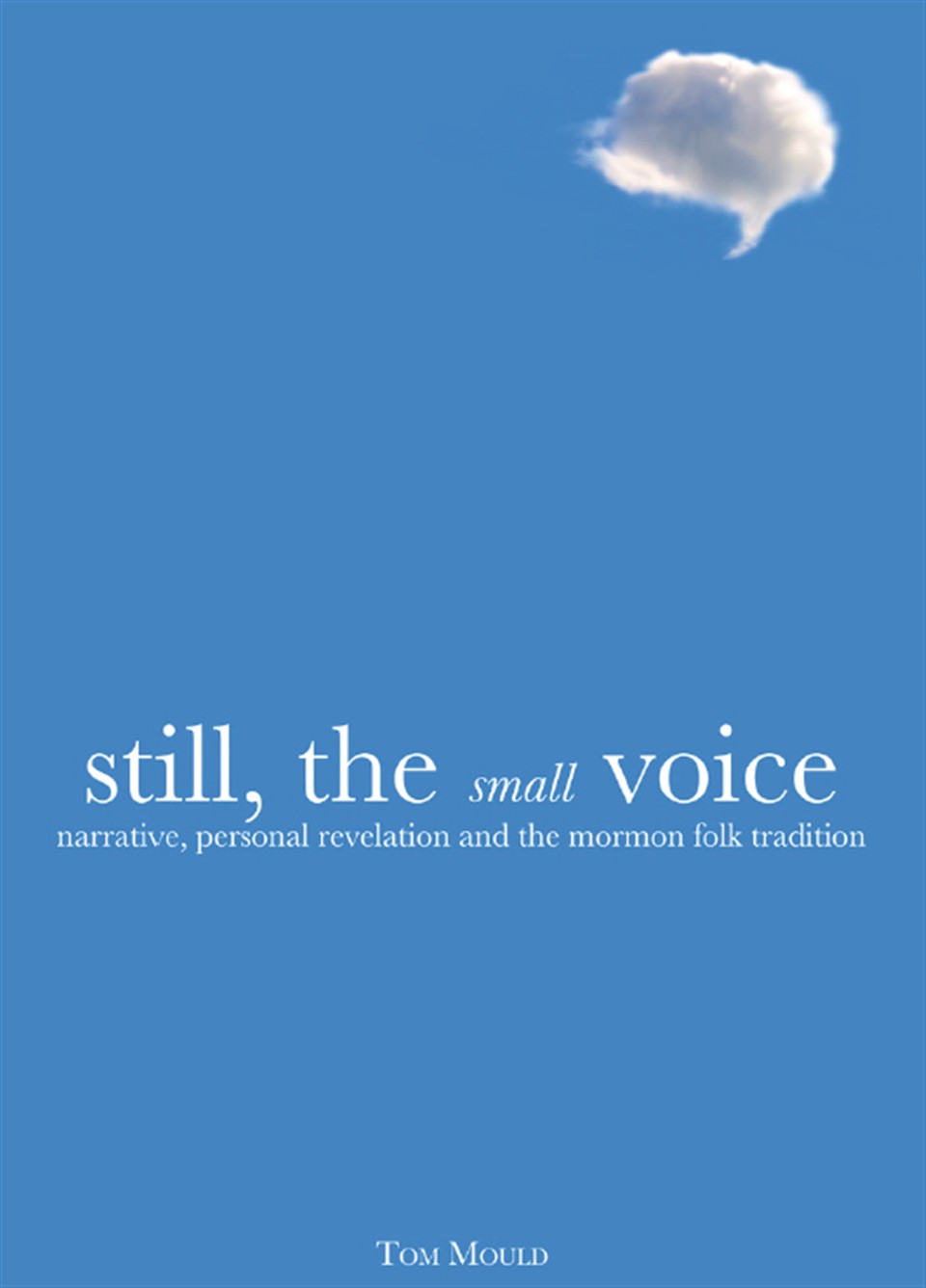
 In this episode, Scott H. interviews Dr. Tom Mould about his recent book: “Still the Small Voice: Narrative, Personal Revelation, and the Mormon Folk Tradition“. Dr. Mould is an associate professor of anthropology and folklore at Elon University and director of Elon’s Program for Ethnographic Research and Community Studies. A non-Mormon, Dr. Mould nonetheless became very familiar with the Mormon experience in his field work. He immersed himself in a Mormon community, attending church meetings, family home evenings, and even father/son campouts. His perspectives on how Mormons experience, share, and interpret personal revelation is fascinating for anyone interested in Mormon studies or folklore studies in general.
Episode Transcript
Host: Scott Holley · Guest: Tom Mould
This transcript is machine-generated and lightly edited for readability. The audio is authoritative. Please excuse occasional errors in names and spelling.
Introducing Dr. Tom Mould and His Research
Scott Holley [00:00:00] 1, 2, 3.
Guest [00:00:07] Mormon Stories podcast is a production of the Open Stories Foundation. All donations to Mormon Stories are fully tax deductible and go directly towards keeping the podcast alive and towards building a community of support for Mormons like you. To support the podcast or to join the community, please become a monthly subscriber today@mormonstories.org.
Scott Holley [00:00:29] hello and welcome to Mormon Stories. My name is Scott Holley. John Dehlin has allowed me to guest host today, and I'm very excited for the guests that we have on today's program. I would like to introduce everyone to Dr. Tom Mould. Tom is the author of a book that was published this past year by Utah State University Press called Still the Small Voice. Tom, welcome to Mormon Stories.
Tom Mould [00:00:53] Thanks very much, Scott.
Scott Holley [00:00:55] So I first came across Tom's book this past year when review of it was posted on By Common Consent. I was in the process of doing some of my own personal research on personal revelation theology, and when I came across Tom's book, it was really fantastic for me in filling some gaps in my personal study and research. Just I'll give a little bit of background and then let's let Tom correct and fill in. Basically, Tom, from what I understand, your book was field research where you went out and interviewed and sat in on fast and testimony meetings and went out with missionaries and really attempted to understand how it is that we as Mormons experience interpretations and communicate our personal experiences with the divine. Do I kind of have that correct?
Tom Mould [00:02:01] Yeah, that's a nice summary. In our field, we refer to that kind of research as ethnographic research, which means that we go and we try to immerse ourselves in the culture. So we participate in the culture. So it means we sit in the pews, we participate in, in my case, priesthood meetings, Sunday school, sacrament meetings, fast and testimony, Father Son campouts, splits with the missionaries and really try to understand a particular culture from an insider perspective. Of course, it's an impossible goal, but it's one that we strive towards so that we get a bit of an insider perspective and not one that's kind of dictated by our own academic or personal interests, but, but rather dictated by the community.
Scott Holley [00:02:52] So I have to ask, have you been called Brother Mould then?
Tom Mould [00:02:57] Absolutely. Brother Mould and a dry Mormon, both. Because I'm not a member of the church, though I am a member of a Christian faith community. But yeah, and I refer to other people as Brother and I'm always up front about where I sort of stand. And, you know, I made good friends and colleagues in the community. So Brother seemed appropriate.
Scott Holley [00:03:22] I think that's fantastic. Yeah, I think that in my experience, the ultimate sign of acceptance within our community from people on the outside is the use of the term brother. So that's great to hear that it was both used and received well. And as you mentioned, and it definitely worth pointing, pointing out, Dr. Mould came at this from the outside. And personally, I just have to say with how much Mormonism has been in the news lately, from what often is a shock value from people whose experience within of our community is from perhaps the fringes are focused on. On things which aren't necessarily of core value to us as Mormons. What a breath of fresh air it is to be able to talk to you who has approached this from a perspective of understanding and respect. So I'll give just a little bit more of your background and then let you jump in. So, Professor Mould, associate professor of Anthropology and Folklore at Is It Pronounced Elon University.
Tom Mould [00:04:35] That's right.
Scott Holley [00:04:36] And director of Elon's Program for Ethnographic Research and Community Studies. Two previous books on the Choctaw narrative. Am I pronouncing the name correctly? Choctaw?
Tom Mould [00:04:50] Yep, absolutely.
Scott Holley [00:04:51] And those are titled Choctaw Prophecy, A Legacy of the Future and Choctaw Tales. And you've also published on issues of generic boundaries and constructed identities, with a real focus on the study of oral narrative. And your interest in prophecy and narrative, I'm guessing, is really what led you to our community, is that correct?
Tom Mould [00:05:19] It is. I'll give you the short version, and you can have the longer if you want it, but the short version is I had been doing a lot of work with the Choctaw tribe in Mississippi, and after doing kind of a survey of their broad oral traditions and narratives, saw prophetic narrative as being kind of an understudied but important type of story that was shared in that community. And after my work there, I thought, well, I'd like to look at some other communities and see how prophetic narrative shows up in other areas. And kind of a chance conversation with a colleague of mine that I was team teaching with, who happens to be lds, led me to following him to church and focusing on initially it was going to be prophetic narratives. It really, as we talked more and more and the kind of narratives that I was thinking I was going to study, it became clear that personal revelation was the sort of the central and such a vibrant and dominant narrative tradition in the community. That's where my energy should be focused. That prophecy, prophecy and prophetic narrative still fits there, but it's Maybe not the best term, as I learned.
Scott Holley [00:06:26] Yeah. And you mentioned at one point in your book that actually in reviews of some of the previous or earlier traditions within our faith, you know, going back to the 1800s, that you see prophetic narratives show in a more strict sense of prophesying towards the future about yourself, others, the community, the world, et cetera. That. That. That part of the tradition was perhaps more vibrant in years past and has kind of been subsumed by this current personal revelation that we see today. Is that. Would you say that's accurate?
Tom Mould [00:06:59] I think it is. And I think part of the reason for that is the focus on stewardship that certainly emerges in Revelation that Joseph Smith received that are encoded in the Doctrine and Covenants. But, you know, and we have actually talked about this, you've talked about it in podcasts quite nicely about sort of the cultural norms back in the 19th century and the openness to, for want of a better term, sort of a magical world, a world where that kind of prophesying would not have been seen in the same kind of maybe askance or skepticism that today's culture, whether within the church or outside of it. It's often met.
Scott Holley [00:07:45] Great. So I guess to start off, would really love to set some terms. And obviously language is hugely important in how we communicate and understand really everything within religion, certainly personal narrative. And want to start with this term folklore. Now, it seems to me that there's not only an academic term or the academic notion of folklore, which you're obviously fully immersed in, but then there's also the popular understanding of folklore, and then there's perhaps a third bucket, which is Mormonism, and certainly this idea of folk. I think we tend to focus on the term folk doctrine, which has maybe its own set of meanings. So maybe you can help us set the groundwork for really why it is folklore, and you know, why it's. Why it's important that we study it. Sure.
Defining Folklore and Its Scholarly Tensions
Tom Mould [00:08:44] So the term, as you point out, is fraught with different definitions, connotations. It's a term that, honestly, in the disciplinary field of folklore, we struggle with and have had big, robust and complicated and messy conversations about, because the vernacular term, the everyday use of that term, typically means false. We say, oh, that's just folklore. So not only is it false, but it diminishes it as trivial. As folklorists, of course, we don't think what we do is trivial. No surprise there. But the discipline focuses on expressive culture of all types, often what we might call traditional culture. There's a famous. It's famous to us. Warren Roberts, the first person to get a PhD in folklore at Indiana University, often described what we do as addressing the 95% of the world. And that has a sort of nice resonance right now with the 99%. But that history and the study of kind of elite culture often focused on sort of the 5%, and that folklore says the lived experiences of the mass majority of the people in the world are vibrant and rich and aesthetically pleasing and beautiful and worthy of study. That's the approach that folklorists take to culture. That's maybe a little bit different, let's say, than some disciplines. Anthropology, of course, can certainly do that sort of work in terms of the study of culture. But the folklorist really focuses on the expressive part of culture. So we're looking at narratives not just what they can tell us about a particular belief system, but also as carefully and artistically constructed. There's a reason why urban legends, for example, spread so fast, because they're easy to tell, they're compelling, they're entertaining, and they pack a punch. That's why the focus on personal revelation narratives, and not necessarily just personal revelation, is an experience because we convey so much meaning in those stories we tell. And it's folly, I think, to ignore the fact that we're telling a story when we're sharing that experience. And it's not just sort of general discourse that's a perfect mirror for our experiences.
Scott Holley [00:11:07] So 95%. So folklore is a lived human experience, not just the purview of peculiar people like us Mormons.
Tom Mould [00:11:18] Absolutely. I mean, everybody is the. Everybody are. Everybody is the folk. We're all the folk. Everybody has folklore and participates in it on a daily basis. And we don't rule out the elite culture either. People in power have their folk traditions as well. I think the classic sort of example as well. Folklore study banjo playing and other artists study opera and Picasso or something. All of those traditions have informal ways that their practitioners engage with each other and the ways that they communicate with each other. It's a very democratic enterprise, honestly.
Storytellers and Performance in Mormon Tradition
Scott Holley [00:12:02] Now, you had mentioned in your description that people who. The study of folklore requires that you're identifying people who regularly perform within a tradition. Obviously, most of the listeners of this podcast who have been within the Mormon tradition understand that that's all of us, that we're all, at any given moment, going to be called to stand up at the end of the sacrament meeting when the speaker has not taking up their allotted time and share what we know, or at the Father Son camp out or at work, that we're always that all of us, every member a missionary, and every missionary is telling, as you mentioned, a story of their own personal experience. Was that surprising to you to come into our tradition and find that literally everyone was a carrier of a story?
Tom Mould [00:12:55] Yes and no. The no part is that because I come up with this assumption that everybody participates in various types of traditions, I expected everyone to be participating in a particular community with various types of folklore, let's say, or various types of expressive culture. What I didn't expect, what did surprise me, was how vibrant the narrative tradition in particular was and how I'd come from working with the Choctaw, where oral narrative is certainly a dominant part of sort of a tribal culture there. And yet people were sort of recognized as storytellers. This elder was a great storyteller. This person was a great storyteller. And it wasn't as broadly shared. And so I gotta say, it was like Christmas every day working in the church, because everybody really did. It was not trying to find the one or two people that sort of stood out. In fact, because of expectations for humility, people didn't particularly want to sort of stand out, certainly not as storytellers. Because, again, if we go back to that terminology, storyteller also sounds like someone telling stories that is telling lies. And so the idea of saying, hey, your most sacred experience, your personal revelations, when you share them as stories, makes you storytellers. And I'm really interested in you as a storyteller. That can get really uncomfortable.
Scott Holley [00:14:23] Yeah, I can imagine if you go up to someone after fast and testimony meeting and say, wow, you're really great at delivering testimonies, that they would probably take an affront to that because it's not about the performance per se, in terms of how we're judging or wanting to be seen.
Tom Mould [00:14:42] That's exactly right. And I like that you qualified that last part. I mean, there is that sort of how we want to be perceived. Because in quiet whispers, in small sort of laughs, in the corridors between services, people do recognize that they are being judged and that they are judging other people based on their performances. The kind of rampant stories or legends about playing testimony bingo suggests that, wow, some people say the same things over and over. And so that is happening. But it's certainly, as you say, it's not what we're supposed to be focused on, and it's not the primary focus. And so it's important to look at all of it. But let's not lose sight of those, you know, the dominant kind of function of sharing these narratives.
A Lay Church and the Flourishing of Folk Narrative
Scott Holley [00:15:36] Now, one of the things you mention in your book is that because our church is a lay church that we have perhaps a. That that leads to a greater tendency towards the development of an informal religious folk tradition. So could you expound on that a little bit? What do you think the connection is there between having a lay church and greater informal tradition?
Tom Mould [00:16:01] Yeah, I think actually you really nailed it when you talked about whether I was surprised or not coming into the tradition because as a lay church, everybody does participate in the church that I grew up and in churches I've been to, you've got a trained minister, trained priest, someone standing up at the front who guides the dominant guide in the religious instruction in the faith. And having everybody in the pews take their turns up there, whether it's during sacrament meeting or volunteering during fast and testimony, has a profound effect, I think, on the. The ownership of the religion that people are not just kind of. Not just that they can take a kind of a personal and engaged role, but actually have to go ahead.
Scott Holley [00:16:59] I was just going to say, but perhaps an outsider would say, but Mormonism is so top down and so hierarchical. Wouldn't that put us in such a narrow box that perhaps we can't necessarily be creating meaning within those experiences outside of certain very prescribed boundaries? Or do you think that may be overstated?
Tom Mould [00:17:28] Yeah, I think that is a central tension not just in sort of the scholarship and literature and even kind of popular media, but for individuals. You've got things like General Conference where there's an attempt in terms of the hierarchy to sort of establish a shared message for all. You've got teaching manuals and guidebooks for Sunday school, etc. That again attempt a sort of a uniform approach to a lot of the issues of faith. But you know, whether it's unavoidable because of the lay church that simply can't. That kind of structure just doesn't hold on a day to day basis. And that's sometimes to the consternation, I think, of the bishopric or the ward stake presidents rather, because people do get up during fast and testimony meeting and they do get up during sacrament meeting and they say things that make the bishopric cringe sometimes because it may not follow specifically the doctrine that is coming from Salt Lake, but it engenders great conversation and great discourse. So yeah, I don't think I really answered your question.
Scott Holley [00:18:53] Yeah, I think that all of us can identify those moments where we've seen the bishop up there kind of fidgeting in his seat you know, I was actually having an interesting conversation with my mother in law about this the other night where we were talking about testimony meetings and I made the comment of, yeah, I love when the guy gets up and bears his testimony about, you know, his water purification system. And her response was, well, now you're being a little flippant. And perhaps I was on one hand, on the other hand, I think that it shows a level of, you know, specifically thinking now about someone coming in from the outside who possibly has that idea of rigid hierarchy and top down instruction to see that level of individuality and personality coming through and really also how widely we see God's influence, you know, that he can tell us which water purification system is the best one to get or, you know, help us make sure we're walking down the right path side of the street. I actually tend to view those as positives in our tradition. That level of variation that I think you may make a great point that it is nearly impossible to control when you're telling people to stand up and share their stories. It's hard to keep those within a box based on how widely varied our life experiences are, even within the church.
Tom Mould [00:20:27] Yeah, I couldn't agree more. I mean, it's certainly one of the things that has drawn me to just continuing my study is that vibrancy and tension between to what degree is that freedom sort of encouraged or allowed? And at what point are there sort of interventions, conversations that say, you seem to be going a little too far afield here. Yes, I think it's a great plus.
Tensions Around Sharing Personal Revelation
Scott Holley [00:20:53] So you mentioned earlier in your introduction that one of the reasons that, or one of the tensions that we manage when we are sharing our personal revelation experiences within the church is this idea that we need to express humility at the same time we're expressing an experience with the divine, which perhaps people would say is an impossibility. If God's talking to you, how are you possibly going to be humble about that? Because that's a huge, huge claim. So maybe you can talk a little bit about that paradox and how you observed it and how we go about managing that. How do we as Mormons both share a convincing story that yeah, this was the Holy Ghost and I was inspired to do this and I do have that connection while at the same time saying, but I'm still humble?
Tom Mould [00:22:00] Yeah, I think it's one of the central tensions and I think it highlights the reason why it's important to distinguish between the experience and the narrative. Because the experience is something that happens personally and a Narrative is something that happens socially. And once you engage in that social interaction, that relationship with other people, it becomes fraught with the perils of Persona of projecting oneself in a way that is or is not consonant with the values of the church. And this is actually. It kind of goes back a little bit to your question about sort of folk doctrine or something or divergences between how the religion may be enacted in the personal or within a ward and how it may be sort of constructed in Salt Lake City through the church. But you get a bit of mixed messages. I mean, if you go back and look at the church leaders, you've got some church leaders who are saying, listen, sharing your stories is dramatically important. It's important for other people to hear your experiences for your own edification, for shared and mutual edification, for building testimony that when you express these stories, you not only help other people build their testimonies, but you build your own. That you can actually re experience the Holy Ghost when you share that story again. But then you'll also hear other leaders really cautioning. And this will show up in some of the teaching manuals for missionaries of, you know, don't share the really dramatic experiences that you have. People may latch onto the dramatic part and miss the theological significance.
Scott Holley [00:23:43] Yeah. I have to tell you another conversation I had prior to this interview where I said I was going to be interviewing an author who'd written about Mormon personal the sharing of personal revelation experiences. And he said, well, I don't think personal revelation should be shared. And I said, well, he said, I don't think it should be shared because it's personal. And I said, well, what about testimonies? Well, yeah, we need to make sure we share our testimonies
Tom Mould [00:24:10] well, and. Exactly. And that's a tension that people fall in different spots. And honestly, there was a lot of. I went through a lot of sort of angst in the initial stages of is this appropriate? And my fieldwork made it clear that the people that I worked with in particular, but felt it's extremely important for us to talk about these things in appropriate ways. That's the kind of key thing. Context is so important for all of this. But the idea of casting pearls before swine, people are hesitant to share personal experiences that they think are going to be denigrated by the audience member talking to me. If I establish rapport, if people trust me and they understand that I'm sincere in my interest and respect their faith, they'll open up and they'll share these stories. Then the question, though, becomes if that goes into a book and out into the larger world, how do we sort of guarantee the same kind of respect given to the stories once the context is not controlled in that way? And so people put a lot of trust, I think, and faith both in me and in this process and in hopefully my ability to put it in the kind of context that will at least minimize someone coming to these narratives and being worried about the kind of thing that the person you spoke with was worried about, which is these are personal, they're not supposed to be shared widely. Tell them to stop publishing. Right, something like that.
Scott Holley [00:25:39] I thought it was really interesting that you had observed that actually the level of perhaps if we put a spectrum of dramatic personal revelation experiences that you tend to see the more dramatic experiences narrated within our 3 hour block towards the end, because by then it's smaller groups and you know that, you know, the Mormons who only show up to sacrament meeting and aren't as committed have gone home by then and you're within a more trusted group.
Tom Mould [00:26:12] Yeah, that's exactly right. And I think, I think it's, I think you're right about the size, about the makeup. I think also part of it is that it's more discursive and dialogic. In other words, in priesthood meetings, more so than in sacrament meetings, people are having discussions and conversations. And so people can bring some of these experiences to the floor and actually kind of interpret and work through them with their peers. Which again, I guess maybe gets us a little bit back to that whole notion of the tension between humility and righteousness, of receiving divine and still being humble in those small experiences. If you can bring it up in a more discussion based way, it doesn't feel so top down. It doesn't feel like somebody's putting themselves on a pedestal necessarily and kind of preaching down in some ways.
Scott Holley [00:27:02] I would guess though that the more dramatic experiences, and there's probably even a level that goes beyond what we hear in church. And certainly I've, in my personal life, I've had this experience where within a very personal family setting, you're sharing experiences that go even beyond what you would hear during most three hour block church experiences now.
Tom Mould [00:27:26] Yeah, absolutely. And in fact there are a number of narratives that I have on tape that will never see the light of day because I was in people's homes during family home evening, for example, and people did share stories with me and they understood and I always made it clear if at any point you sort of think back and think, you know, that was, that was powerful for me to share to you, but not appropriate for the book or not appropriate with my name attached to it, then that happened. I wouldn't say a lot, but it happened enough. And I absolutely respect that because, again, so much of the enterprise of ethnography and about the fieldwork that folklorists do is about these relationships. And you honor that. And I don't think there's a single thing. I don't think this book is any less. It's not any less true, it's not any less authentic, it's not any less accurate for missing those stories and protecting or, I guess, valuing people's boundaries on what they want to share.
Scott Holley [00:28:37] Yeah. You know, I'm thinking back to my mission experience now, and I served in Chile in South America, and I was struck right away by, you know, we would come back to visit with an investigator to whom we'd extended an invitation to read and pray, and we would ask, you know, what was your experience? And they would start talking about dreams and visions, you know, well, you know, actually I had a dream last night and I had a vision of Jesus. And I'm sitting here like, whoa, I've, you know, 20 years in the church, I've never had anything remotely like that. But then you hear it enough that you realize that, okay, there is a culture norm and expectation, and the sharing of that is completely valid within, you know, has been so validated. I guess I'm wondering personally if, you know, and I understand that this may be hard to gauge, but do you think that we are at risk of losing those lived experiences within the church if they're not communicated? If there's a focus on de emphasis of communicating those within our tradition, are our children not going to have those experiences? Perhaps if the message is continually share things that are too dramatic,
Tom Mould [00:30:09] this is a judgment call as you sort of preach it. But I think, yes, and here's why I think, yes, exactly as you picked up. And one of the things I say in the book is I think we need more study of Mormonism and the culture surrounding belief practices in other countries. Because when missionaries came back, whether from Chile or Italy, those places in particular, but really anywhere in South America, there seemed to be a cultural norm for more dramatic personal revelation to share, that far more frequently, Catholics in South America in particular, who were investigating the church seemed to be quite open to the idea of fairly dramatic personal revelation. And what a lot of the folks I talked with said, look, it's about it's personal revelation. And so it's going to come in a way that you can hear. And if you are not sort of. If you're conditioned to think of the dramatic as being either hokey or unacceptable or too weird or something, the belief is the Holy Ghost isn't going to talk to you that way, but rather talk to you in a way that will sort of open your mind and heart so that you can hear. I think if we follow that to its logical conclusion, I think if people are worried about or concerned about or kind of stigmatize dramatic revelation, then it won't be the norm, it won't be accepted, and then it will be too weird, let's say, for the Holy Ghost to use for those folks. And people say that very explicitly and say, I don't think I'll ever get a dramatic personal revelation, because I don't think that's how I'm going to respond. Well, in terms of will it go away? It could. Now, is that a terrible, terrible thing? I guess if you stand back and say, as long as there is an avenue for people to have their hearts open to personal revelation, whether it's not even the still, small voice, but the really, really tiny, quiet, whispery small voice, if it still works, it works. But it worries me, I suppose, a little to think if, if that becomes such a norm, do we risk, when missionaries go out into the field and encounter these other cultures, to what extent is that bias going to be conveyed? I don't know.
Scott Holley [00:32:35] Yeah, that makes sense. We talk about building relationships of trust on missions, or at least we used to. And does the divide become wider? It's tough to say, I guess, because perhaps in a secularizing world, you know, I suppose you could make the argument that's happening and will probably happen regardless of the norms within our particular faith and culture.
Tom Mould [00:33:05] And I think that's true. But I think there is also, I mean, if within a particular ward or within the church more broadly, if they're maintained, if there was a norm that said, you know, that. That validated those kinds of experiences. Because I don't think, I mean, when I'm looking at different kinds of discourse, people saying the hesitancy of sharing dramatic revelation has been getting louder and louder, as far as I can tell from church leaders, those are the kinds of warnings that show up more and more often in the training manuals. And so I think if that stopped, I think if there was more leeway given, I think you could have. I mean, we talked about this yesterday. I think you could kind of maintain a sort of God's peculiar people sort of identity within the church that could coexist with a more secularized mainstream US Society or something like that. I just don't see the church moving in that direction. I see a church that's moving towards efforts at greater acceptance broadly, perhaps at the risk of losing some of this distinct ways of engaging in faith.
Scott Holley [00:34:12] Yeah. And I think that you see that tension today where there is among the membership a desire to hold on to that peculiarity in the face of perhaps a desire to also be accepted. So I can completely agree with that idea that that tension's there. So you talk about. We talked a little bit about the potential risks and sharing the sacred and hazards of the tension between humility. You bring up a few strategies or tactics that you identified that we use to navigate that. And there are three that I picked up on coded language, kind of eschewing explicit terms for implicit ones. And then the third was the use of the passive voice. And the last one in particular, I hadn't really thought of until I read it. But, you know, the idea that instead of saying I was prompted to go look at my neighbor's house and turn off the valve to the, you know, whatever we're warned to do, it was. The thought came into my head, in other words, something happened. But I'm not going to explicitly ascribe who the actor was, because everyone knows that it was the Holy Ghost telling me and then me going and doing.
Language, Humility, and How Stories Are Told
Tom Mould [00:35:48] Yeah, that's right. I mean, that's exactly what passive voice allows you to do, is to not have a pronoun, to not, you know, to say who's doing the. Who the actor is. And so, as you say, if you're going to use an active voice construction, you say, the Holy Ghost prompted me to do X. In terms of your college writing courses or your grammar courses, active sentences are better. But in oral performance, you're doing all kinds of rhetorical moves. And this is a linguistic shift that does exactly that. It doesn't explicitly name the divine. And I think that that's there for a couple of reasons. One is depending on the audience in terms of their own acceptance of personal revelation or of divine engagement and encounters, etc. That's particularly useful for someone who may not understand those traditions or fully embrace them. But again, it goes back to that issue of humility. Let the audience member fill in the blank. And that, I think, is a powerful thing for two reasons. One is it does allow somebody to be more humble. But it also gets back to that kind of social contract of storytelling, is that there Is an audience an explicit recognition of the power of that audience to come to the table, not just as a listener, which is a very sort of unequal relationship, but actually as a co partner in creating meaning. And so there are a number of examples in the book, but just over and over, people told stories where clearly the goal was for the audience and the narrator together to develop an interpretation jointly. Now, I think clearly many of the storytellers had an idea of what they wanted to say and what they thought was going on. But having a community come forward and evaluate and sort of confirm that is really powerful, I think, spiritually and socially.
Scott Holley [00:37:47] Yeah. And you mentioned that as we're sharing, we tend to employ a lot or we tend to say and do a lot of things to ensure that our audience is with us and actually that we're part of the audience. So you talk about this kind of stepping outside yourself and saying, I looked at what was happening and wondered, is this really the Holy Ghost? And that's one of the points that you mentioned, this Persona of doubt. In fact, one of the things you say is narrators mind the experience, highlighting elements that deflect self aggrandizement. While narrating these experiences, people often highlight rather than subsume spiritual weakness. So we put ourselves in the other person's shoes and say, but actually, I'm weak, just like you. And you know, I didn't, you know, it took the Holy Ghost, it took him three times to get through to me because I was just so, you know, I wasn't listening. I wasn't in a good place. I guess the question I have though is that do we run the risk of feigned humility and inauthenticity in that or from your experience, is that. Does that humility actually influence how we experience it, or are we, when we're in the midst of a personal revelation, are we driven towards humility because of how that's shared? That's kind of a long winded question. I don't know what you want to draw out of that.
Tom Mould [00:39:25] Yeah, I'll answer. I think there's a deeper question there that you're getting at that I'm. I may not answer. Right. And we may have to come back to that piece. But in terms of the issue of humility and to what extent we might sort of whether it's feigned or fabricated or how it helps us or hinders us from interpreting a particular experience, in the field work that I did, there's no way to know. I wasn't there for people's personal revelations. But to a large extent, what it appears to be is that when people share their own stories, they're certainly not fabricating anything. What they're doing is because there is this norm of sharing the part about not listening the first time around, then people recognize that as a pattern in performance. So if that happened in their own experience, they're more likely to remember that element as opposed to dismiss it as irrelevant, I would say, because it's a pattern. Take that and then couple it with the sort of social work that it does, which is what kind of started us on this conversation in the first place. In other words, it does allow people to kind of step back and not only establish a kind of a humble Persona, but to sort of say, listen, you're hearing this story, and you may kind of doubt whether this was sacred or revelation. Listen, buddy, I doubted too. I was right where you are right now then, and I was asking these questions, and I resisted and I didn't want to. But ultimately, you know, it came again and again, and I couldn't deny it. And look what happened. And so it's a kind of a recognition to the audience that says, this may be where you are now hearing this, but it's exactly where I was. And this is how I concluded. You may not conclude the same place I do, but it's there. So that's a piece of it. But I think you were getting at something else, and I'm not sure.
Scott Holley [00:41:21] Well, I mean, I think that that was it. I think that the. And it also gets to kind of this issue of coded language, which is when we're talking about. When we're sharing our personal revelation, are we consciously adding in those elements that we know are important for the acceptance so that, you know, we're going to talk about how it's interpreted and received? Are we consciously adding in those elements after the fact, or is it literally changing how we're experiencing it? And I guess you made the point of, you know, not necessarily being there. But I wonder if while we're having the personal revelation, we aren't saying, okay, well, I don't have to listen to this initial prompting because I know I'm gonna get it two more times.
Tom Mould [00:42:12] Right?
Scott Holley [00:42:12] Right
Tom Mould [00:42:16] from conversations I've had with people, I don't know anybody that sort of waited, thinking, oh, yeah, I'm gonna get three of these.
Scott Holley [00:42:24] Come back to me again tomorrow and I'll know it's real.
Tom Mould [00:42:27] That's right. But I think. I think what is clear is that. Is that those pauses that they took are going to be remembered. And so the experience piece, other things happened during that personal revelation. There may be other things that suggested it wasn't revelation or time delays with other information happening or aspects of who they were with other details of this experience, that because the narrative tradition doesn't typically include them, they may not necessarily remember them. And so because experience, and Louise Mink makes this argument that experience actually comes after the narrative, that it's the narrative that creates the meaning that allows us to even think about this as an experience as opposed to just a sort of a series of unrelated stimuli. And then when we pull it together to say, okay, that was an experience of personal revelation with the divine, that that puts a meaning on it when we narrate it as a coherent thing. So I think the narrative tradition does shape how we experience things. However, it's important not to take that too far. David Hufford, a folklorist who works in the medical field, has argued that there are sort of two kind of paradigms here. There's cultural source theory, experiential source theory, and the experiential source theory says that we have these experiences that are distinct from our cultural expectations and norms. And he points to this phenomenon of the old hag, that people across the globe in vastly different cultures, with individuals who have never heard of this phenomenon, still wake up in the middle, or think they're waking up in the middle of the night and believe there's an old sort of wizened old woman sitting on their chest, a very evil and malevolent force, and that they cannot move, and that this is not simply because they've heard stories about the old hag, and they're kind of bringing this sort of supernatural interpretation on stimuli that can be explained by chemistry or biology or some other kind of phenomenon. But that's an entirely experiential source theory kind of interpretation. The cultural source theory is what David Hufford is responding to, which says, no, no, no, it's all just kind of emerging out of your culture. So that if you. And I use this example, actually, when I'm working with the Choctaw, Harold Combi, who was one of the wonderful guy down in Mississippi who I worked with, he and I were both chatting one day in the living room and this little statue of a horse fell off the mantel. And he said, ah, well, the ancestors, the spirits are with us. And so we talked a bit about that. And he said, well, how did you interpret that? And I said, well, I said, my initial interpretation was that maybe a car went by that I wasn't paying attention to, but there was some sort of vibration, and it was close to the edge and it fell off. And he said, and my interpretation of that is dramatically different. We had the same sort of thing happen, but we came at it from different cultural backgrounds of what we expected was going on, expected to see. I think it's a mix between the two. I think it's culture tells us what's relevant that we should pay attention to. And the experience says, here are the sort of stimuli in the world that we're responding to.
Scott Holley [00:45:57] Yeah, that does. So potentially, then, what that would suggest is that there's part of the experiences that we potentially don't focus on as much because it wouldn't fit within the narrative. Is that fair?
Tom Mould [00:46:15] I think that is fair. I think it is. I think it's sort of very difficult to prove because it's the narrative that's sort of our. It's not material, but it's sort of our object. It's our text for analysis. And so if it's the only thing we've got, it's tough to sort of, you know, Plato's cave of shadows. We're sort of stuck looking at the shadow.
Scott Holley [00:46:35] But unknown. Unknowns.
Tom Mould [00:46:40] Yes. Well said.
Unfulfilled Revelations and Broad Mormon Experience
Scott Holley [00:46:42] So yesterday we were talking a little bit about the listenership to this podcast. Mormon Stories tends to have a broad listenership within the Mormon experience, but that a number of the listeners tend to be people who have, for one reason or another, found themselves perhaps on the fringes of Mormonism, or perhaps some have even lost part or all of their literal faith. And so you talk about a couple of things that I think would be really interesting, particularly for our listenership on the interpretation side, which is one, how we interpret the idea or how we experience the idea of unfulfilled revelation, and also how we interpret the ambiguity of the divine communication. Maybe you can talk just a little bit about your experience. We tend not to share unfulfilled revelation. Right. We do tend to focus on. You talk about superlative endings. Not only did the investigator get baptized, but his son became the stake president, and his daughter baptized an entire village in the northern part of the country. What was your experience with it in unfulfilled revelation? How it was shared, how it was interpreted.
Tom Mould [00:48:03] Yeah. So you're exactly right. Unfulfilled revelation is very rarely narrated. And the reason for that is that narration as a genre, as a form, typically requires resolution. I mean, if we think of that kind of classic narrative triangle that starts with a complication and has rising action is sort of a climax or transformation and then a denouement where sort of the action falls and then there's a resolution. That's what we expect out of narrative. And so if we don't have that resolution, it's very hard to narrate it. And that's why I say it's so important that we distinguish between the narrative tradition and experience. Because if we assume by looking at the narrative tradition by only what we hear when people are sharing their stories, that that's what personal revelation is as an experience is like, we're going to be really misguided. We're going to think that we get responses the minute we pray for them, that we're going to be constantly guided out of traffic accidents, for example, that we're going to be guided to our spouse in clear, unequivocal ways. And that revelation predominantly when we get either it's formulaic. Well, it's formulaic and it's going to be resolved in a way that we feel fairly confident was in fact the Holy Ghost. And in fact, many people still have experiences where there's a question mark there. Certainly that question mark is part of the narrative when they're sharing it. That people say, is this the Holy Ghost? Should I act on what I just felt? But the story almost always confirms yes, that the person does act and good things happen and it's clear it was the Holy Ghost or they don't act and bad things happen, which still confirms the Holy Ghost. So those are the two types of narratives that we tend to get. The unfulfilled personal revelation people talk about all the time and say it's quite common, but is just not narrated.
Scott Holley [00:50:11] So you, you mentioned though that the ambiguity, the Holy Ghost is proven in kind of diametric outcomes. I wonder if you came across situations where people were open about questioning whether or not the, the model,
Guest 2 [00:50:37] is it
Scott Holley [00:50:37] me that's broken or is it just the process hasn't been fulfilled or wow, does this thing really even work?
Tom Mould [00:50:45] And those stories, I include just a couple in the book, but they certainly exist. And actually you and I were talking about this as well, of what happens sort of Festinger's question, what happens when prophecy fails? What are the psychological moves? What are the spiritual moves that we might make? And typically if they're narrated within the church, within a church setting, then there's a sense that they're still doing that larger expectation for faith promoting stories, which many personal revelation narratives are sort of expected to be, and that they're still confirming Something. So when Sean Tucker, for example, shares this story, and he shares it pretty regularly with the young men, young people who are trying to figure out what personal revelation is and how to discern the Holy Ghost and things like that, of being positive that their first child was a boy. And then Justine was born.
Scott Holley [00:51:43] Yep. Then with the E at the end, right?
Tom Mould [00:51:47] Yes. Justine, right? Yes. So a little girl was born. And so Sean went back and he questioned and he said, what happened here? And ultimately he decides it's not that the Holy Ghost was wrong. It's not the divine was wrong. It's that his ability to discern the Holy Ghost and his ability to understand the promptings that he was receiving were wrong. And he needs to keep working on that as a skill of discernment. Other people. And that sort of moment where maybe if it happens once or twice or you keep questioning, but if it becomes so difficult, it's those kinds of experiences that certainly could lead to someone becoming a bit disaffected, whether with just the concept of personal revelation or with the church more generally, that does raise a series of questions of how true is this church? As I say, the people that I was working with were people who were
Scott Holley [00:52:45] fully active and attending.
Tom Mould [00:52:47] Yeah, very active. So I wasn't. And I wasn't working with people, at least to my knowledge. I wasn't working with people who were sort of on the border of leaving the church. None have left that I know of. And I'm still in contact with most of the folks I worked with, but I think that could happen. And I give one other example in the book about a woman who is convinced that she has actually her sister has personal revelation that she's going to have these sort of seven blonde children, and that her sister does have some children, but they have dark hair, every one of them. But her sister did have a number of miscarriages. And so here the question was not, I mean, so what this kind of did for the sister, for this one woman thinking about revelation this way, it didn't make her think that her sister didn't have revelation. She was convinced that she had, but it made her kind of rethink how she was thinking about the pre existence and the spirit world and whether it was possible that in fact those miscarriages were still her children, and that when she dies and is finally sort of resurrected and joins the celestial kingdom, that she would be reunited with seven blonde children at some point. So that actually opened up a conversation with herself about theology.
Scott Holley [00:54:16] We're filling in the blanks. Theology I'm reminded actually of a couple of stories and it tends to be around this idea of childbirth and family and the life and death experience that we have within family bonds. But there are people who have enormously evolved theologies of both the afterlife as well as the pre existence based on these kind of personal experiences.
Tom Mould [00:54:52] Exactly. And that actually takes us almost sort of full circle back to the beginning when you were asking about sort of folk doctrine in the lay church and hierarchies and things like that, is that I think there remain theologically, and I'm not a theologian, but just in the reading that I've done, a lot of question marks. I mean, there certainly are for people in the pews that I'm talking to about the afterlife, about the celestial kingdoms, and especially as divorce becomes more common, people who aren't marrying at all, can they still gain all those. And the conversations that I'm reading from church elders, those seem to be shifting a little bit. And I don't mean that in some sort of, oh, the story's changing. I mean, this is a church that relies on revelation, the idea God is still speaking. So we should expect those kinds of moves, but with so many sort of holes and exactly what's supposed to happen, yet we do. If we really are seeking, we are going to fill in some of those gaps. And, and again, I think that's a plus. And I think it's what makes the church, in my experience with the folks I worked with, so vibrant and so kind of exciting, at least as an outsider, to work with people and see how they're navigating and really being so proactive and creative and thinking about how all this fits together.
Personal Narratives as a Mirror of Culture
Scott Holley [00:56:16] Great. So want to move into culture really quick. You talk about how personal narratives are kind of a mirror for our culture. And one thing that really struck me in your book as well is you wrote a. An excellent blog posting on by common Consent about this is the idea that because we as Mormons see the power of God in personal revelation, that helps above all keep us from harm, spiritual harm, as well as physical harm, that the narration emphasizes this by first, first of all reminding us of those dangers of how dangerous a world we live in where Satan's around every corner wanting our soul, where our car at any time could careen off of a cliff if we don't listen to this prompting and avoid the pothole. Do you. And certainly there is people who talk about, you know, how certain issues of depression within the church and some of it's. We tend to talk about it in terms of hierarchy and, you know, strict codes of behavior and normative practices. But it's interesting to consider as well the impact of this constant reminder of how dangerous the world is on, on our levels of anxiety. So do you think that we create within our experience feelings of anxiety based on kind of this constant reminder of how dangerous our world is?
Tom Mould [00:58:05] Yeah, I found this endlessly fascinating for so many reasons. And one of them is because of the kind of larger context I think that this is all operating under, which is conversations that certainly I heard a lot in the Burlington First Ward where I did most of my fieldwork, which is to what extent that the earth, the mortal existence, is in fact sort of this kind of constant trial. Right. That you come from the pre existence and you're on earth to basically be tested. And can you gain a testimony, join the church, have this faith so that when you go to the spirit world and then on to the celestial kingdom or to the various levels of heaven, will you sort of survive, if you will, all of these kinds of attacks? And so, but then other people were saying, you know, look, but God and Jesus created this earth. I mean, we had Eden for a while. And to constantly conceive of the mortal world, the temporal world as being bad is really sort of a destructive way of moving through the world. But there is this tension, there's this sort of theological backdrop that suggests this is a bad and rough and hard place to live, Though you can find wonderful peace and love, you know, through faith through the church versus this kind of, you know, we really even shouldn't evoke the adversary or Satan or you know, that name very often because it does sort of give more power. That's right. So I think that's the larger backdrop for this tension. And so then you've got these stories that again, I go back to that notion of the general kind of generic system for these narratives is that personal revelation narratives are seen as faith promoting stories to a large extent. They're certainly used that way in a lot of church publications and they're certainly used that way in informal conversations and social discourse. Not always, but usually. And the confirmation is God cares, God watches, God is there. If you put your faith in him, you'll be protected. But to get there, as you point out, the initial backdrop is a dangerous place. Now when I wrote that blog, the comments that people, because that's why of course, ignore the blog, read the comments, that's the interesting stuff is that it was really torn. Some people, and especially I think most people really latched onto the idea of how this plays out in the mission field, because so much of the way I brought it up in the book was exactly that way as well. Some missionaries felt, yes, these stories kind of scared them a bit, and that was a good thing because the world was scared. There were dangers, there were bad people out there who would abuse them on their missions. I think maybe more of them, however, sort of felt invincible by the stories that they didn't focus maybe on the initial danger and did focus more on the kind of conclusion and just barreled out there into perhaps some fairly dangerous situations, into some communities that, you know, with high rates of crime and felt that they would be protected. So I think as they've gotten older, I think they're like, oh, my gosh, what was I thinking? Some of them commented in that way, right? It's certainly not one or the other. It's a tension that exists out there, and some people will fall in one camp and some in another. But with that larger context, I think it does hit at, I don't want to say a nerve particularly, but at a central tension within the church that people struggle with in lots of different ways about how we view the temporal world and how it fits within the plan of salvation.
Folklore, Legend, and Mormon Doctrine
Scott Holley [01:01:57] One other thing you mentioned in terms of the culture was a quote that really stuck with me was he said, with the vibrant memorate tradition, legends may simply be unnecessary, or this idea that we're feeling our discursive narrative and our dialogue within the church of the here and now. You know, this is the personal revelation I had last week. You know, this is Brigham Young's personal revelation that he had 200 years ago, or this is what the prophet said last week. This is his, you know, and even his revelations tend to be personal. It was me being told to, you know, go visit this person in the hospital, not me being told this is what I should say to everyone in the church. So, and I think that the reason that that struck me is because there's this concept, this kind of elusive idea of what is Mormon doctrine. And the definition of folk doctrine, at least from my perspective, tends to be so post hoc that, you know, it's the folk doctrine is the doctrine that, you know, was real doctrine 50 years ago but is fairly inconvenient today. You know, that that's kind of a, you know, perhaps a flippant way of putting it. But. But to this idea that, you know, there is theology within our memorates, there is theology within the legends as well. But having the memorate tradition allows the theology to subtly shift over time such that, you know, 10 years ago you can talk about the sin of having homosexual thoughts, but today we don't even talk about the thoughts in those terms that, you know, we can move the goalpost because the theology is wrapped within personal experience and it's always in the here and now. Does that jive with what you see? Do you think that our ability or the focus on memorates can create that kind of subtle shift in time over of theology, or at least of those elements of theology that we tend to focus on?
Tom Mould [01:04:17] That's a great question. I'm not sure I put my brain to thinking about that in specifically that way. I think my initial response would be yes, because what is the church, after all? I mean, you know, there is formal doctrine, but kind of how it's enacted and how it's performed, if you will. And I use performance not to mean somebody up on a stage, simply how it's enacted. Right. And that. That is the church, that is the religion. Leonard Premiano, a folklorist who teaches at Cabrini College, which is a Catholic institution, and studies folklore, lore and religion. And the intersection between the two certainly makes the argument that it's a real fallacy and it's folly to separate out sort of this notion that there is a church that is distinct from how it's enacted by the people of faith because it's those people performing that faith that is the church. Now, we do still, of course, distinguish between kind of the sort of the general authority in LDS Church and the Pope for Catholics and this kind of formal hierarchy and structure as an institution. But in terms of what it means to be lds, yeah, I think very much that theology is going to be shaped by personal revelation, those personal memorandes. But that's only a kind of an initial, though. I think there's a lot more to be explored there. I think it's, as I say, it's a great question and it's rich in implication.
Scott Holley [01:06:06] Let's wrap up with that then. There's a couple of personal questions I highlighted yesterday and sent them to you in red. Feel free to dodge or not. And graciously you've accepted that invitation. So I want to get to those personal ones. But you mentioned what's next, and you bring up a whole bunch of areas at the end of your book that, frankly, I got very excited to see that, you know, that that's on the horizon for Mormon studies within the lens of folklore. So what do you see as being next? How can Mormonism inform folklore how can folklore inform Mormonism? What do you see coming down the pike?
What Mormonism Can Contribute to Folklore Studies
Tom Mould [01:06:45] Yeah, so here's what I'd like to see coming down the pike. And you know, there's that sort of sounds like I'm punting, I'm not going to do it. But we mentioned before just the idea of more fieldwork outside the Mormon corridor. Honestly, more fieldwork working with how lds, how that faith is lived in very different cultures. Right now, the bulk of the study, when we go to other cultures, it's sort of the missionary experience in another community or in another culture, but not so much of how that community takes its own cultural norms, et cetera, and finds ways to make them meaningful with the LDS faith. We all do it, every church does it, everybody does it. So I think that's a place that I'd really love to see more work. I think we could do more work with cross cultural analysis. To be perfectly honest, when you look at some of these polls just done in the United States, I think there is a general sense that there's a sort of secularization of public life. But in fact, the numbers of people who believe in spirits, in direct communication from a divine spirit, I can't remember the numbers, but I want to say it's in the 60s or 70%. And I think people have this perception that it's like 12% or that some tiny little minority. I think if we could do more work where we're looking at some of the commonalities across these religions, I think it would be really helpful. One, it doesn't isolate LDS or any other faith as being somehow strange in this aspect. A lot of people rely on prayer and answers to prayer to live their lives.
Scott Holley [01:08:33] Hopefully some budding folklorists who are listening to this can pick up on that. And, and certainly I think that there's plenty of our listeners who are interested in understanding and exploring that as well.
Tom Mould [01:08:45] I hope so. Can I add one last, one last thing, which I would really love to see picked up, and you asked what can Mormonism sort of add to folklore? And it's always, of course, a two way street. But one of the things that struck me in my work here, and I've seen it in other places, was how individuals. And again, this goes back to that notion of maybe a kind of folk doctrine or sort of doctrine emerging out of individuals, is that people have slightly different ideas of how personal revelation works and what's included in personal revelation. So I mentioned the book, for example, Paul Clason and he and his family, Paul and Paulina and their children very much see a vibrant kind of engagement with their ancestors that, you know, sort of people who have passed on, but who are coming back and providing some of that guidance. So it's the Holy Ghost, and certainly there's God is directing the Holy Ghost, but that God's also directing these ancestors to come back. And so that family connection, I don't spend much time in the. In the book talking about it because it was more on the margins of how people were kind of what they were including. But if we could spend more time thinking about how individuals construct specific and very coherent ways of thinking. I think sometimes we talk about tensions within the community about this belief or this belief. We assume it's held by an individual that one person is really conflicted when in fact, different people have made perfect sense for themselves. And if we just attended to individual repertoires and individual constructions, I think we'd have a richer idea of how these traditions are actually lived and not essentialize. All LDs traditional, you know, personal revelation works this way.
Scott Holley [01:10:27] Yeah, absolutely. And I would add to that that within my own family, with genealogy work especially, we're encouraged to have that personal connection to our ancestors. And certainly we've, in our family have those shared experiences where the ancestors have directed our paths in certain things. In one of. Just to wrap up then, I mentioned to you that I was struck and early in your book, you were sharing the story of a man who was inspired to buy a dress for the daughter of a woman who was doing some work for him. And as he. And the way that you structure the narration in your book is like you would read in a play. This is what so and so said. This is what so and so said. And that you have the parentheticals of, you know, and he said and turned to this person and had this look on their face. And one of the parentheticals was, everyone, including me, got choked up. So. And I was. And you see bits and pieces of yourself during the book. And we talked about this yesterday about, you know, the responsibility of the person coming in to, you know, share as well, and how you were out and how you had to navigate, you know, being an observer, but at the same time sharing enough of yourself to make people comfortable. And I thought actually what came to mind during when I was reading that was the experience in the New Testament. I think it was Nicodemus, that does nearly convert me to be a Christian. And so I had that thought in my head, well, is he feeling the Holy Ghost? Is he interpreting it the same way? So maybe I could just leave it to you to talk about how did this impact you and maybe end up with your personal testimony of what are your personal feelings about. Obviously, you can take it from there. Whatever you feel like you'd like to end on about what your personal thoughts are about this experience.
A Story of Spiritual Prompting in Everyday Life
Tom Mould [01:12:30] Sure. So one. And it is confusing in the book, it's actually Lee is a woman who's sharing this story.
Scott Holley [01:12:38] Oh, excuse me. Excuse me.
Tom Mould [01:12:40] No, not a problem at all. But I just, you know, when I think about that story, I think so much about every bit of it, of where I was sitting and who I was with. And, you know, so for me, it's very visceral. But it's Ken and Lee Mullen who are just phenomenal people. I wish I could just talk about them for a while, but just wonderful and warm. And Lee, the. In this case, Ken's wife and, you know, she. This is the babysitter that's working for them. And she gets this prompting to buy this dress for her babysitter. And the dress, I mean, she was thinking of a small kind of little gift for her birthday, as one might for somebody who's your babysitter. And a dress cost significantly more. And so she kind of dismisses it at first, like, well, I don't need to get her a dress. But, you know, the prompting is persistent. And so she does buy the dress and she brings it over to the house. And this is actually where we all get a little choked up, which the mother answers the door, the girl's mother, and the mother starts to cry and had asked for. She had been praying and praying for a way to find a way to buy a dress for her daughter, which they could not afford for her daughter's first dance. And so I think when you asked me that question yesterday, I really have been thinking about what was it that really got me there. I think it's a couple things. I think a lot of it is empathy, that when Lee tells that story, she puts you into the story, and you absolutely feel the anguish and pain that that mother felt in not being able to provide a dress for her daughter. And as a parent, that just cuts to the bone. And so I think emotionally it was very powerful, and certainly it was very powerful emotionally to Lee during the experience. I also know that for Lee, and I think for Ken as well, it was also extremely powerful because of the divine hand involved, that this was the holy Ghost prompting her.
Scott Holley [01:14:59] Great.
Tom Mould [01:15:00] To what extent did I expect or imagine that? I was sort of mutually edified as well. I'M not sure in my own religious background and we talked a little bit about expectations and I typically, in my, yeah, I was not raised to expect to kind of hear from God. I wasn't raised to expect to feel personal revelation and to hear the Holy Ghost. And so I think, you know, and you, I really have enjoyed your working through the kind of this distinction between what's emotion, what's an emotional response and what's the Holy Ghost. And I don't have a good answer except that in the same way that when I saw that horse fall off the mantle with Harold Combie, I thought it was vibrations from a train or a car and that he saw spirits. And in this case, I think predominantly I was responding to a very human, empathetic kind of. It was an empathetic kind of response. But I'm also not willing to rule out something larger. And that's the kind of, that's what I put out on the table when I talk to people. I mean, you mentioned that this is give and take. I can't ask people to open up about their spiritual lives and not expect to open up about mine. That's a very honest answer for me is that I am questioning in those ways and I absolutely believe in the validity of all of these experiences for the people who are receiving them. I'm not sure yet whether I am in a place that's open enough to receive some of that.
Scott Holley [01:16:39] Tom, I appreciate that and I really appreciate you coming on Mormon Stories today. Again, Tom's book is still the small voice available, I guess, wherever books are sold. Certainly Amazon.com was where I was able to find it. Again, thank you so much for what you've done for Mormon Studies and hopefully again people will pick up on this and that we'll see just more great work coming out of this discipline as it relates to to our lived experience. The discussion will continue over@mormonstories.com or.org, excuse me. And hopefully everyone will feel able to go and post their thoughts. And Tom, perhaps we might even get you over, hovering over some of those comments that come up on the blog after this is posted as well.
Tom Mould [01:17:34] Yeah, no, I'd love to. I'd love to stay part of the conversation. That sounds great.
Scott Holley [01:17:38] Well, thanks again, Tom, and thanks to our listeners and good day.
Tom Mould [01:17:43] Thank you. Scott.
Guest [01:17:46] Thank you for joining us today on Mormon Stories. Music today was provided by the Saber Rattlers. Check them out@sabre-rattlers.com the Mormon Stories logo was generously donated by StudioCase.com thanks for listening.
Closing Reflections and Hymn
Guest 2 [01:18:01] Come, come, ye saints no toil nor labor fear but with joy wend your way Though hard to you this journey may appear Grace shall be as your day Tis better find far for us to strive Our useless cares from us to drive to your hearts will swell oh, all is well all is well well, why should we mourn? I think our lot is hard T not so all is right why should we think to earn a great reward if we we now shun the fight Gird up your lo Fresh courage take our God will never us for sake soon we'll have tale and tale oh, all is well all is well oh, all is well all is well. Sam. And should we die before our journey is through happy days yeah, all is well we that are free from toil and sorrow too with the just we shall dwell but if our lives
Scott Holley [01:21:28] are
Guest 2 [01:21:29] spared again to see the saints the rest obtain I will make this chorus swell oh, all is well all is well all is well all is well all is well oh, all is well. All is well all is
Scott Holley [01:22:19] Sam.
Transcript © 2026 John P. Dehlin. All rights reserved. Brief quotations are welcome with attribution and a link to mormonstories.org; all other use requires written permission.
15 Responses
I enjoyed listening to the post.
I found it particularly interesting the discussion about telling stories and bearing testimonies in the passive voice and how this allows the story teller and the listener to fill in the blanks together. That group reassurance is very powerful, and something that I somewhat miss since I have taken a few steps away from testimony bearing in recent years. I might suggest that the mormon stories podcast fills this particular hole in our lives that some of us hadn’t put a name to.
Great job.
Thanks, Joe!
I agree Joe, I found that fascinating as well! One of the other reasons that we use the passive voice is that it helps us manage the central tension of proving the Holy Spirit while not coming across as prideful. Saying “the thought came to me”, rather than “I heard the voice of the Holy Ghost tell me” conveys a similar message while allowing the speaker to maintain a posture of humility. Our narrative tradition allows us to convey a lot of hidden meaning when we share!
John,
I appreciate your efforts at informing people of all the diversity with in and with out of the institution of the church. This interesting interview open up my thoughts about my experiences with this “personal revelation” issue. Let me share with you some of those thoughts.
As a back ground I began having revelations at an early age, the first one I could articulate at the age of twelve. These experiences run the gamut of hearing “the still small voice” to having direct interaction with the Divine. Generally I’ve kept 99% of these to just my immediate family and ultra close friends; purposely leaving out church members; especially during institutional settings.
I realized at that young age, that the kinds of spiritual experiences I was having were not what is “normal”. Because of the socialization process, I was “taught” to value what is “normal”, I tended to push these experiences into my mental background. When I attended BYU I took the Self Deception course taught by C. Terry Warner; where I learned to articulate this socialization process, all the while denying that this process had influenced me. I “discovered” that my entire life had been a “lie”; in that I was not doing “good” for itself, rather I was doing “good” for the approval of others. When this “world view” crashed, I was only left with those spiritual experiences; which by the way, came center stage in my “new world view”; and even increased.
My refusal to share these experiences with church members, is partly based on this understanding that a paradigm shift must occur; which shift is viewed by church members as “despair” (defined as the “tool of the devil”). I’m neither able or willing to step in and assist any one in rebuilding their shattered “world view”. I see this “despair” as essential to the “broken heart and contrite spirit” requirement prior to the intervention of the Divine, often referred to as “the atonement”. This “dis-ease” of the socialization process (the fallen state of mortals) is cured only by the Divine, directly.
I have also suffered persecution in numerous forms (from mocking, accusations of apostasy, up to and including temple recommend denial) from church authorities, when I have just “hinted” (shared no details) that I’ve had “significant” spiritual experiences. I have been warned by the still small voice, to be silent in the church institutional context. This “silence” has been misinterpreted as prideful arrogance and rebellion against authority. I’ve been grilled in an inquisitional setting at the ward and stake level and accused of receiving revelation from the “other side”, on six occasions during the past twenty years. I’m certain that had I not maintained silence during this time, I would have been subject to church discipline.
I will admit that prior to the still small voice commanding my silence, I had “stepped on the toes of some powerful people, especially regarding my political perspective (libertarian, i.e. no government, because of the coercion involved) and accusing those who favor government as “morally deficient”; which was “harsh” on my part.
Because of my personal revelations, several family members were prevented from suffering physical harm or death; various employment opportunities were realized; financial disaster was avoided; my sins, and guilt were removed; my mate was chosen; visions of the future were received, conversing with deceased loved ones were enjoyed; and I could go on, but I’ll cease. All these “blessings” were Divine gifts to me and I treasure them above the institutional church’s promises. So, for me the Church’s historical, doctrinal, and social “issues” presented here are interesting, but are minor to my life. I don’t have to defend any other person’s works or words, either living or dead. I know for my self.
I wish you well in your journey.
One of the powerful aspects of Dr. Mould’s approach explicitly assumes the truth and rationality of personal revelation experience. “Some past studies have explained away the supernatural according to cultural, social and psychological factors… Hufford’s remedy is to reverse the tables, assuming truth and rationality grounded in experience, rather than psychosis and irrationality.” p139. Thank you for sharing your experiences here!
I enjoyed this podcast. I appreciate Dr. Mould’s combination of empathy while performing objective research. Thanks for sharing.
Agree, Dean. There is a lot that we can learn about how to approach people where they are with respect and empathy.
I would have liked to hear some discussion about the value or reliability of personal revelation. The human mind can easily create strong emotions, voices and even full hallucinations. In the church, when members feel the slightest warm fuzzy, they are told “that’s the spirit” Yet it is no different than what they might feel listening to a nice piece of movie, or even an emotionally manipulative movie. If “personal revelation” comes from without, then one must question the source of it. It seems to me that if personal revelation if from a spirit, then that spirit is clearly a prankster, like Loki of Nordic mythology. After all, he tells one person Mormonism is true, another that Islam is true, another that Pentacostal religion is the only way. In fact, he tells people of every religion that theirs is the true one. Furthermore, he tells LDS members to become polygamists. He tells middle aged FLDS men to have ritual sex with a 12 year old girl. He tells people to marry a partner that they are totally imcompatible with. Clearly, personal revelation is not to be trusted any more than any idea that pops into our heads. So utlimately, what is the value of it?
Hi Canuck – I made this observation, above, but one of the things that I loved about Tom’s approach was his balance of cultural source theory and experiential source theory… ie we are products of both our lived experiences and our lived experiences within our social norms for communicating experiences with the divine. Psychology can make very important contributions to our experiences of the divine, (see recent podcast with Dr. Nagel or my podcast on Mormon Matters). But anthropology also has much to teach us about how our community norms shape our narratives and hence our understanding of our lived experiences. Finally, although I am a skeptic when it comes to the role of divinity in personal revelation, I am not swayed by your logical argument that all experience with the divine is necessarily mythical because some experiences obviously are. Again – I’m not claiming that any particular revelation is not mythical, I’m just arguing that your assertion that Loki/FLDS invalidates all revelation is unconvincing. Why not assume that the vikings, pentecostals, and FLDS had an inkling of encounter with the divine that they embellished and enhanced beyond recognition? Your argument seems to rely on its conclusion for its own evidence – “revelation is ridiculous so evidence of ridiculous revelation obviously means that revelation is ridiculous.”
You make some good points. I can see value in seeking revelation, as long as that revelation is backed by logic and evidence. For example, in choosing a mate, using it as confirmation of a decision, rather than to make a decision. I do believe in the divine, so I can see that there could be revelation with the divine. But not in the LDS manner, where that revelation goes counter overwhelming evidence. I think revelation must always take second place to evidence and logic.
This was pretty interesting. Personal LDS narratives are very interesting to me as an outsider as well. Framing one’s life narrative with the rich lore (non-pejorative) of the LDS faith is just plain interesting, and quite foreign and yet familiar to my Catholic experience. The Catholic Church has many unique Saint narratives, that often blend the mundane and the miraculous, but I hardly ever hear any member of the Church talk about the supernatural involving itself in their lives.
Thanks Arthur! I think that as Mormons we take for granted just how much of our narrative tradition is, as you put it, both “foreign and yet familiar” to outsiders. There is so much to be gained from having a safe community where people can mutually affirm their experiences with the divine. Which reminds me. I’d love to have a series on Mormon Stories at some point where a Mormon Stories interviewer pairs up with a member of another faith tradition, each attend each others services, and then “return and report” on what each found similar, striking, different, perplexing, etc.
That sounds rather interesting. :)
Wow, what a fantastic, illuminating, and thought provoking discussion. Thank you so much for your time, expertise, and preparation Scott and Dr. Mould. And as someone finishing up my doctorate at UNC, it was great to go “back to Carolina in my mind” :).
Tom’s empathetic professionalism really shined during this interview. I know it is a professional ideal, but hearing his sympathetic outside perspective was refreshing.
Early in the podcast when you were talking about prophecy it made me wonder how familiar Tom is with patriarchal blessings. I think they would make for a fascinating study, both from the perspective of the givers and receivers. I think that they are one of the most direct sources Mormons look to for predictions about their future both personal and global (it is very common for Mormons to try to gauge the timing of the Second Coming using patriarchal blessings for example).
I really enjoyed the modeling of the anthropological focus on “lived religion”. So needed and valuable.
Good discussion of ambivalent place of praising performance. When people would tell me “that was a great testimony”, I never quite knew how to respond.
I still bear my testimony, and wonder if people notice that I never bring up the standard components.
Which leads me to my next point. I think one of the areas of greatest tension is between personal and institutional revelation. Yes, members “make up Mormonism”, but from the inside, or at least the inside fringes, there seems to be an extraordinary pressure to conform performance to the standard expressions. I find the implications of Elder Dallin Oak’s “Two Channels of Revelation” to be deeply disturbing and problematic. He basically says that the purpose of personal revelation is to confirm institutional revelation and that if we feel something that does not conform, it comes from the devil: https://www.lds.org/general-conference/2010/10/two-lines-of-communication?lang=eng
Yes, people live their own form of the religion, but the LDS Church is particularly powerful in the way it condones, condemns, and constrains relationship with the divine.
I have heard stories of bishops and Stake Presidents getting up after someone’s testimony and calling it “false doctrine” etc. Sometimes it does not stop at eye rolling or discomfort.
I don’t know if you bring this up in the book, but there are for example extremely clear criteria on what a testimony should include, which is why bingo is so possible to play:
“A testimony is a simple expression of what we feel. The member who has fasted both for the blessing of the poor and for the companionship of the Spirit will be feeling gratitude for the love of God and the certainty of eternal truth.”
https://www.lds.org/general-conference/1996/10/witnesses-for-god?lang=eng
People have even capitalized on this; I was slightly horrified when my daughter’s grandmother bought her a “testimony glove” book for her baptism: https://deseretbook.com/Testimony-Glove-Kristen-M-Oaks/i/5044695
I also enjoyed the discussion of how our cultural conditioning constrains and shapes our spiritual experiences. I too think we receive spiritual experiences only as we believe they are possible I also hope we can open ourselves to the way others experience the divine. Too often the LDS Church proselytes not only Mormonism, but American Mormonism. It is unfortunate. I too would mourn the loss of the dramatic spiritual experiences. I want to foster those; I love the magic of Mormonism.
Regarding the discourse of doubting and rejecting the spirtiual promptings, though I agree with the conclusions expressed in the podcast, I think it is also a natural result of the collision of worldviews (secular and rational vs. spiritual and imminent divine participation).
Fascinating point about LDS culture emphasizing the pervasive spiritual and physical harm as a counterpoint to the narratives of being rescued from harm (because of the unique resources of Mormonism of course). I agree this has a negative fragility where people do not feel safe, and an overabundance of anxiety. If Mormonism is a high priced solution, there needs to be a hell of a problem.
Tom, one of my favorite points (regarding the evil world) is the temple teaches that this world is the Telestial Kingdom. I wish Mormons would emphasize more than this world is a place of glory, not only of adversity and testing.
I was deeply moved by the end of the podcast. As a non-literal believer (I would call myself an agnostic religious humanist) who loves Mormonism, I am acutely sensitive to the harm Mormonism does, while also wanting my children to have the toolset to hear from the divine in whatever way works for them. I want them to expect to hear God tell them to buy a dress if that is what needs to happen.
Of course, I want my children to gain the best of my tradition while rejecting the harmful elements, all the while appreciating the good in the traditions of others, so we will see how it goes. :)
Uh…no “he” doesn’t. Here is formula for discerning when you are actually being guided by the one and only true God, through one of His means/ways of guiding you (aka a voice, inspiration, dreams, vision, et al) and when you are being deceived by his enemy, the author of all lies: if you are being obedient to the commandments of God. Check out 1 John 2: 3-5. If you are not living your life in compliance with the commandments, the teachings of Jesus Christ, the gospel as it is found in the Bible, and keeping and obeying the covenants you have made, then you are not qualified (nor would God burden you) with any more light or inspiration than you presently have. And if you think you are being guided, it is by some other voice, unless you are being given a particular gift of guidance. As it pertains to “revelation” about truth, you are not receiving any enlightenment whatsoever from God if your life is not obedient to His commandments. He loves you too much to give you more light than you are willing to obey.