
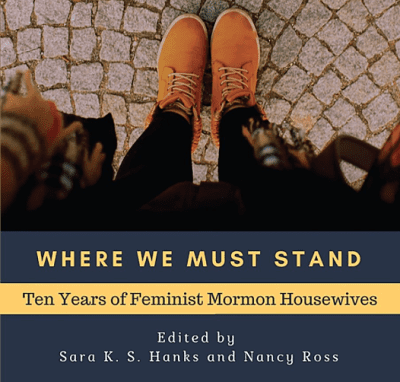
 Join us as we interview editors Nancy Ross and Sara Hanks to discuss their book, “Where We Must Stand: Ten Years of Feminist Mormon Housewives,” an anthology of blog posts from the first decade of the Feminist Mormon Housewives Blog, 2004—2014.
The posts discuss Mormon women’s experiences of wrestling with feminism in a conservative religious tradition. The book highlights individual moments of reflection and faith while tracking the growth and progress of a larger community and religious social movement. Bloggers and community members moved from writing to activism, witnessed the public excommunication of a community member, mourned, and changed. The Feminist Mormon Housewives blog emerged at a time when the broader Mormon feminist movement was in decline. The bloggers shared their discovery of Mormon feminist history, concerns and fears about polygamy, the difficulty of navigating church and family relationships, losing and finding faith, the worst sex talk that ever happened in a church setting, and the awakening of a broader social consciousness. In doing so, they invited a new generation of women into the movement and helped to rebuild it.
Other links referenced in the conversation:
- Peggy Fletcher Stack’s article “Where Have All The Mormon Feminists Gone?”
- Lisa Butterworth’s Symmetry Solutions practice
- Policies surrounding menstruation in LDS temples
- Wear Pants to Church movement
- Lindsey Hansen Park’s Year of Polygamy Podcast
Episode Transcript
Host: John Dehlin · Guests: Nancy Ross, Sara Hanks
This transcript is machine-generated and lightly edited for readability. The audio is authoritative. Please excuse occasional errors in names and spelling.
Introduction and Mormon Stories Updates
Part 1 of 2 · Ep. 953
Nancy Ross [00:00:25] You.
John Dehlin [00:00:30] Hello everyone and welcome to another edition of Mormon Stories podcast. I'm your host, John Dehlin. It's July 17, 2018 and I could not be more excited to be doing today's interview. Today we are going to be discussing a super important book that I just heard about in the past few months, but was just able to start really reading over the past week or so. The book is entitled Where We Must 10 Years of Feminist Mormon Housewives, edited by Sarah K.S. hanks and Nancy Ross.
John Dehlin [00:01:10] Nancy and Sarah have joined us today for this interview. We're planning on it going a little under two hours and the entire purpose of this interview is to discuss this really important book. Before, podcasts were super popular, but after the September 6, the blogging, the Mormon blogging world kind of entered the scene around 2004, first with blogs like Times and Seasons and I think By Common Consent came right up soon after. And right within that time, a young housewife, red haired housewife from Idaho, decided that she felt like there needed to be a space for Mormon feminists to discuss feminism. And she started a blog called Feminist Mormon Housewives, which exists to this day.
John Dehlin [00:02:04] But that, that, that blog, Feminist Mormon Housewives played a super important role in, you know, kind of the mid-20s, you know, the mid-2000s and beyond in helping to get us to where we are now today in modern Mormonism.
John Dehlin [00:02:23] And so Sarah and Nancy have done this really important work of compiling important essays from ten years of feminist Mormon housewives into this book, along with some brief history, sort of giving us a caption of each year as it progressed. So we are going to be talking to Sarah and Nancy today. Before we jump into that, a few quick announcements. We are really excited to announce that we have our first Mormon Stories billboard that is now up along the I15 corridor. So if you are traveling southbound on I15 in Salt Lake City from downtown, right around 3500 south facing north, there's a digital billboard that cycles through various ads and one of those ads is a Mormon Stories podcast ad.
John Dehlin [00:03:15] We have plans for expanding this billboard campaign, but for those interested, pay attention to it and check it out. We're really proud of that. We're grateful for the donors that have made the billboard possible. We need a little more support because we're going to be expanding this campaign. You can hear about this in the coming weeks, but for those interested, check it out. In addition, just really quickly, we have several events coming up, Mormon Stories podcast workshops and retreats that are really important for those who are struggling in a Mormon faith transition in their marriage, in their personal lives, with their kids, with their extended family.
John Dehlin [00:03:52] We're coming to Idaho Falls August 10th 11th, Portland, Oregon, August 17th 18th. We hopefully are coming to Sweden and Switzerland in mid September. Of course, we have the Bahamas cruise October 24th through 28th, and then we're coming to Sacramento November 2nd through 3rd and early 2019. We're starting to get some events on the calendar. We're thinking about Ogden. We're thinking about South Jordan. We're thinking about the Midwest and other areas. So email us@staffopenstoriesfoundation.org if you have questions about an event or want to plan an event or host an event. And check out mormonstories.org events if you want to consider or attend any of these events.
Welcome: Meet the Book's Editors
John Dehlin [00:04:36] All right, so without any further ado, it is time to welcome to Mormon Stories Podcast the authors of this wonderful book, the editors of this wonderful book, Sarah Hanks and Nancy Ross. Nancy, you first. Welcome to Mormon Stories.
Nancy Ross [00:04:53] Good to be here.
John Dehlin [00:04:54] Now, this is your first appearance on Mormon Stories, right?
Nancy Ross [00:04:59] Probably. I think I may have been on a panel a few years ago shortly after the exclusion policy, but I'm not quite sure if that was exactly Mormon
John Dehlin [00:05:07] Stories, but it's hard for me to keep track. I've got over 950 episodes. Welcome. We're so glad you're here. And Nancy, tell us just a bit about yourself, just so we have a bit of your background.
Nancy Ross [00:05:21] Sure. I am a professor. I'm an art historian and I teach at Dixie State University.
John Dehlin [00:05:30] Nice. So do you live in Southern Utah then?
Nancy Ross [00:05:32] Yeah, I live in St. George, yes.
John Dehlin [00:05:34] So you're joining us all the way from St. George?
Nancy Ross [00:05:36] That's right. Yes.
John Dehlin [00:05:37] Well, so glad you're here. And Sarah Hanks, welcome as well today to Mormon Stories Podcast. Tell us a bit about yourself and if I think this might be among your first appearances. Is this your first appearance?
Sara Hanks [00:05:52] Yeah, it is, Yeah. I was on, you know, I've been on some podcasts in the, in the ether in the adjacent to Mormon Stories, but nothing on Mormon Stories itself before. But yeah, I was born and raised where Nancy lives and in southern Utah, St. George area and currently live in Layton with my husband and two kids. I'm a freelance writer and editorial assistant for like a health food website and I've, I have been in the Mormon feminist community like my whole adult life and have written for feminist Mormon housewives and just happy to be here. Glad to talk about the book.
John Dehlin [00:06:35] So happy to have you. We know you're not from Layton because you pronounce it Layton and not Leighton. Is that right?
Sara Hanks [00:06:41] I mean, that's true. I'm not. But I'm sure that I have my. Well, I know for a fact that I have my Utah accent. Things that come out, especially when it comes to pronouncing things like feel as Phil or deal as dill.
John Dehlin [00:06:57] That's very self aware of you.
Sara Hanks [00:06:59] Well, sure.
John Dehlin [00:07:01] My producer Tim has just let me know that episode 517 of Mormon Stories podcast is called Discussing Gender and Mormon Apologetics with Nancy Ross, Kevin Barney, and Jessica Finnegan. I don't even know. I'm not even sure. I guess I moderated that one. But I'm really sorry, Nancy, for not remembering.
Nancy Ross [00:07:23] That's all right. It's like 400 and something episodes ago.
John Dehlin [00:07:27] I'm getting old is the problem. All right, well, we're really excited you guys are here really quickly. I think it'd be fun just to do a tiny bit of biography of both of you. So let's start with you, Nancy. Can you talk about your either feminist upbringing or your feminist awakening? Because not every Mormon woman today self describes as feminists. So how did you get to become a feminist, Nancy Ross? Assuming that you are not or not
Guests' Personal Journeys into Mormon Feminism
Nancy Ross [00:07:56] just the editor, But I am absolutely a feminist. Absolutely. So, you know, I grew up LDS. My mother had actually been involved in the Exponent 2 community.
John Dehlin [00:08:08] Whoa, that's cool.
Nancy Ross [00:08:10] Yeah, there actually aren't many second generation Mormon feminists, but that's something that I can claim. She'd been on the. Had worked on the magazine in the early 90s, so that's pretty cool. And she didn't really talk to me about feminism. I think she was worried about, like, poisoning my faith somehow and was very concerned that I was a very zealous young Mormon and that her feminist thoughts and ideas might corrupt that somehow. But as growing up, I was very involved in the church and very devout and read the scriptures a lot and did all the things I was supposed to do, but also noticed a lot of things like the young men and the ward went on these super fabulous trips all the time.
Nancy Ross [00:08:53] And we lived in a fairly poor ward in a fairly poor area in central Maine. And there were just a lot of things that the boys got to do that the girls never got to do. And it was hard to sweep that aside. And I remember being a teenager and asking my dad, you know, like, hey, what's, what's up with that? And he was in the bishopric at the time and he just told me, you know, like, to keep boys in the church, they just got to do this stuff. But to keep girls in the church, girls just need different things. And I really didn't like that explanation because I didn't think that the girls were.
Nancy Ross [00:09:25] Had different value in the church or that they should have different value. So I grew up kind of as. But mostly I kept my questions or issues to myself. I had a lot of positive experiences in the church.
Nancy Ross [00:09:39] I did my education in the uk, my undergrad years, and my graduate school years, where I met my husband and had a great experience in church through my grad school years and felt that the church was a more welcoming place than I'd seen in other places. The Cambridge ward at that time was just a wonderful place to be.
Nancy Ross [00:10:02] But then we finished up our degrees and I was pregnant, and then we moved to southern Utah. And I'd never lived, like, I'd never really visited much west of Philadelphia. So it was a bit of a shock to the system to move to St. George and suddenly being thrown into a life of having young children. I have two daughters that are very close in age and a very, very conservative ward in southern Utah. And that was just really ripe for a big and powerful feminist awakening of, hey, wait, this isn't working for me and I need to do something else.
John Dehlin [00:10:36] So what year would that have been?
Nancy Ross [00:10:39] So my kids were born in 2007, 2008. I probably started reading Feminist Mormon Housewives in 2005, but initially it was like a guilty pleasure, you know, and then I kept giving it up. Oh, I shouldn't read that anymore. It's a little scandalous.
Nancy Ross [00:10:55] And then eventually I just stopped giving it up and realized that it was really helpful for me in navigating church and family and situations. And I was also bidding to adjunct and work on some projects at that time, but also feeling a lot of pressure from other people that I shouldn't want to work, even though it was gave me a lot of joy to do things like teach and to do things like research.
Nancy Ross [00:11:22] But I also felt like I should really just hunker down and do the housewife thing. And it just didn't work out all that well. I became involved with Ordain Women as soon as it kind of went live in 2013 and became involved with that board. I was on that first board.
Nancy Ross [00:11:41] And, you know, after the exclusion policy, I ended up leaving the church, even though I tried to hang on for so long and helped to found a congregation of Community of Christ. And I'm going to be ordained like next week. So, you know, it's a kind of a full circle thing there, you know. But, but, but for the 35 years I was in the LDS Church, I was very all in until it was just going to kill me to stay in. Okay, so.
John Dehlin [00:12:12] So you're. That you're a community of Christ in St. George. I've heard about that.
Nancy Ross [00:12:16] That's correct.
Sara Hanks [00:12:16] Yes.
John Dehlin [00:12:17] That's you.
Sara Hanks [00:12:18] Yep.
John Dehlin [00:12:18] Excellent. And did I hear you right? You escaped the Cambridge ward? Not self describing as a, as a feminist. Is that right?
Nancy Ross [00:12:27] So. Yeah, but. But not Cambridge Boston. Cambridge, England.
Sara Hanks [00:12:29] So.
John Dehlin [00:12:30] Got it. Sorry, I. Yeah, yeah.
Nancy Ross [00:12:33] No, that's okay. Right. Like if it, you know, Laura, if, you know, if Laurel Thatcher Ulrich had been my gospel doctrine teacher, then that would have been like the best thing that would have ever happened to me, ever. But no, I was in Cambridge, England, where we had like a lot of students in the ward, a lot of American military in the ward, and then local English people in the ward. But that was still about my most flexible, moderate church experience and quite a happy one for me.
John Dehlin [00:12:59] Got it. So you. The year you started reading Feminist Mormon Housewives in Pain in the Conflict was when was.
Nancy Ross [00:13:09] So I started reading Feminist Mormon Housewives before the Pain.
John Dehlin [00:13:12] No, no, no, I know, and I'm saying what year was. What year was it like, painful for you?
Nancy Ross [00:13:16] So, like 2008. My youngest, my. My youngest child had just been born. I had effectively two babies. And it was a very overwhelming.
John Dehlin [00:13:26] Okay, I've just, I've got the timeline in my mind, so I just want to know when Nancy enters it. Okay. All right, Sarah, your turn.
Sara Hanks [00:13:32] Okay, let's see. So like I mentioned, I grew up in St. George. I was the oldest of five kids in my family. Very faithful southern Utah Mormon family from pioneer stock and farming family. And I too really felt so, so all in with the church. I loved young women's. I loved girls camp. I just, I felt so nurtured and also felt a real sense of my identity being like a perfect Mormon girl, you know, who did all the things right.
Sara Hanks [00:14:08] And so that was a really big deal. There were things, you know, looking back, I can tell there were things that would kind of hint at a future feminism. I was very frustrated by what seemed to be double standards when it came to, like, dating.
Sara Hanks [00:14:23] Some of my leaders really hammered hard that like, boys should pursue, girls should be pursued. And I just thought, that doesn't make any sense. What if I like a boy? Like, why shouldn't I be allowed to ask him out?
Sara Hanks [00:14:34] So there were little things like that. But then when I was in college and engaged towards the end of my college career was when the whole Proposition 8 thing happened. And that was really distressing for me. I heard about Proposition 8 completely outside of a Mormon context. I didn't know that Mormonism had any. I didn't know the church was involved at all or had any position on it. And my immediate response was like, yeah, gay people. Like, why shouldn't gay people be able to be married and build their lives? You know? And that's a perfectly good option. And so then when I found out that my instincts were at odds with the church, I was like, whoa, like, now I'm not a perfect Mormon girl anymore.
Sara Hanks [00:15:16] What am I going to do with this? But I really tried to, like, button down and, you know, did the very, very mature thing of, like, posting a thing on Facebook about how, even though it was so hard to do, I sustained the prophet and was against Proposition 8 even though I didn't live in California. Like, I didn't have any. I wasn't voting on it, but it seemed really important at the time.
Sara Hanks [00:15:36] And then immediately after that was when I went to the temple preparation to get married. And that was sort of the tipping point. The temple endowment, which I had looked forward to as this incredible experience that would bring me closer to God and really be an incredible source of spiritual nourishment was just the worst.
Sara Hanks [00:15:58] I had a terrible experience, and I didn't know what to do with that either. And so that was kind of the beginning of me looking for things like feminist Mormon housewives to make some sense of it, because I still really wanted to be in the church, and I really wanted to get back to being a perfect Mormon girl.
Sara Hanks [00:16:17] And I needed some people to show me that it was even possible to stay in the church when you were having a hard time. And so that was kind of the beginning of my relationship there with the Mormon feminist community. And then over time, it grew, and. And this was when Mormon feminism was sort of moving into Facebook as well. And so I was making these incredible friendships and eventually was kind of recruited to be one of the bloggers of Feminist Mormon Housewives. And that was in 2013, just a year prior to the 10th anniversary in 2014. And that was when I was like, let's make a book. We've been out here for 10 years. So, yeah, that was kind of the timeline for me.
John Dehlin [00:16:58] Got it. So that intro that I read, that was yours, right?
Sara Hanks [00:17:01] Yeah, the preface was from me.
John Dehlin [00:17:04] Okay, the preface.
Sara Hanks [00:17:04] And Nancy wrote one that's kind of more historical and mine was here's what it's like to make this book.
John Dehlin [00:17:11] Got it. Okay, so let's go way, way, way back and let's give our listeners a little bit of pre FMH history, kind of a. Kind of a Mormon feminism history in five minutes, if that makes sense. So whether that's Exponent or, you know, Sunstone, September 6th. Give us just the primer to set the stage for Peggy Fletcher Stack's article saying where have all the feminists gone? Nancy, is that you because you wrote the history blurbs or.
A Brief History of Mormon Feminism
Nancy Ross [00:17:41] Sure. So I would say that a long time ago, Joseph Smith died and Emma Smith didn't go west, and that's the beginning of Mormon feminist.
John Dehlin [00:17:48] I love it.
Nancy Ross [00:17:49] Or at least, you know, I mean, there are actually lots of feminist things that happened before that particular point with the Relief Society. But really her big first act of resistance is to say no to Brigham Young. And I feel like that's an important marker in Mormon feminist history. Mormon women have always, you know, were, were feminists before they were conservatives. And you know, you try tweeting that out and it, you get a lot of nasty responses back. But, but Mormon women were feminists before they were conservatives and they were involved in the women's suffrage movement at the end of the 19th and the early 20th century.
Nancy Ross [00:18:23] And you know, fast forward a few generations, there were some awesome women who were pretty feminist y, like Esther Peterson or Juanita Brooks or, you know, and various others that, you know, had groups that were meeting in Utah. But in the late 60s, the group that would found the Exponent 2 began meeting as a consciousness, a feminist consciousness raising group in Boston. And I believe it was Judy Dushku also, also belonged to several other feminist consciousness raising groups. And she would bring the materials that she read in those other groups to her feminist group. And many of the women agreed that some of that literature was a little too radical for them.
Nancy Ross [00:19:08] But I believe Claudia Bushman said something like they read it with great interest. And so when the reliefs, I believe when the Relief Society publication ended in the early 70s and they kicked off their own magazine called Exponent 2 in 1974, and the movement has really been more of an organized publishing writing movement since 1974, you know, it resisted the ERA and saw figures like Sonia Johnson and Mormons for ERA.
Nancy Ross [00:19:40] There were other groups like the Mormon Women's Forum that met in Salt Lake. There were groups meeting at byu. There really have been groups of networked Mormon feminists for about four decades.
John Dehlin [00:19:53] I love it. I remember what was the name of the Feminist group that Joanna Brooks was a part of at BYU while I
Sara Hanks [00:20:00] was there, I believe it was Voice.
John Dehlin [00:20:02] Voice, yeah, Voice. And they would hold candlelight vigils, I think, for rape victims. They would protest anti abortion legislation on the campus. Super active while I was there. When I was before, I identified as a feminist myself. So. Yeah. And then the September 6, of course, was a really important inflection point for feminism. Do you want to just talk about that a little bit?
Nancy Ross [00:20:29] Sure. Well, Maxine Hanks wrote, was, edited, edited a book called Women in Authority that was really beginning to take a deep dive into Mormon women's history. And there were some chapters of that particular book that were deemed to be fairly controversial. Mike Quinn had a chapter that was deemed to be fairly controversial. And just the whole project was seen as a bit of a challenge because while Mormon women had been writing history before 1992, when that book was published, I think there was a lot of energy and momentum in that particular publication. And so, Maxine, what was the content
John Dehlin [00:21:06] of some of those chapters? What were the topics that were trigger points for some of the Brethren?
Nancy Ross [00:21:12] There was Heavenly Mother was a topic, Women Giving Blessings. There was a lot of a history of women's publication. Just all these wonderful activities that women used to spearhead on their own in the semi autonomous Relief Society. So this idea that women had really held their own power and authority, had claimed their own spiritual power and authority through rituals like blessing, and had really run their own organizations, you know, largely without the help of the men. They raised their own money, ran their own organizations and wrote their own publications. All of that, I think, was. And remembering that and bringing that history to the foreground, I think all of that was a challenge to correlation and the direction that the Church had been moving in the years after the defeat of the era or the not passing
John Dehlin [00:22:03] of the era, it's safe to say that. Oh, were you gonna say something, Sarah?
Sara Hanks [00:22:07] No, just confirming that, Nancy.
John Dehlin [00:22:09] Okay. Okay. Yeah. It's safe to say that feminism might have been the biggest concern of the Brethren during the September 6th sort of fiasco. Is that fair to say?
Nancy Ross [00:22:19] I believe so. Certainly. That's. Most of the September Six were disciplined because of their feminist writing. And then we also see other feminists in the years after, like Margaret.
John Dehlin [00:22:34] Margaret Toscano.
Nancy Ross [00:22:35] Yeah, Margaret Toscano. Right. And Janice Allred and others excommunicated and disciplined for their feminist writings. So feminist writing seems to have been a real problem for the church hierarchy in the early 90s or throughout the 90s.
John Dehlin [00:22:49] So the brethren were super Scared of feminism, it appears, up through that point and beyond. So what happens when 1993 comes and goes? What does that do to Mormon feminism?
Sara Hanks [00:23:05] Well, I mean, there's kind of two. There's two ways to tell the story. I think the most simple and transparent would be that it really drove Mormon feminism underground. That when so many Mormon women who had feminist leanings saw this discipline, saw the general attitude of the church being so unfriendly and unwelcoming, women felt like they had a decision to make. Either they could keep their feminist feelings to themselves and remain Mormon, or they could sort of distance themselves from the church and be more authentic to those beliefs.
Sara Hanks [00:23:41] And so over the course of those years, when more discipline was happening and the feminist traditions of Mormon women were sort of being denied, you kind of had the sense that it wasn't. That this was not a community that was thriving anymore and creating new material, however underground. You know, I said it was sort of driven underground. Underground things were still happening. People were still making connections. There were these listservs which were sort of the forerunner to, you know, online forums and blogs where people could connect with each other in email and kind of come up with new ideas, or not even new ideas, but just kind of revisit old ideas with one another
John Dehlin [00:24:28] and keep the fire burning.
Sara Hanks [00:24:29] Right, the fire burning. But the tricky thing about that is you kind of had to know somebody to be invited. It wouldn't be anything that you could just find through a Google search or that there would be, like, a public event, you know, that you could. Could go to. It was very much based on relationships, and it was much more private, which I think was important for people's feelings of safety, you know, that they felt like they could say what they believed, but in a way that wasn't going to be published and therefore put them at any kind of risk.
John Dehlin [00:24:58] Do we remember any of the names of these Internet forums or groups? It's okay if we don't.
Nancy Ross [00:25:04] Yeah, there was the. So I recently talked to Lynn Matthews Anderson, who's. Who's kind of set a lot of this stuff up, and I think I might get the name just a bit wrong. But it's like the Latter Day Women's Caucus or the Electronic Latter Day Women's Caucus, I believe, and I think there were a few other related listservs.
Sara Hanks [00:25:21] Yeah, I think they call that elwc. That sounds.
Nancy Ross [00:25:25] Yeah, that's right. Yeah, the Electronic Latter Day Women's Caucus. Something like that. Yeah.
Sara Hanks [00:25:30] So.
Nancy Ross [00:25:31] But it's important that while we say that or there's this idea that Mormon feminism went under the ground underground in the 90s, that when we actually look at the books that Mormon feminists publish and we kind of track them by decade, there's actually an explosion of Mormon feminist writing in the 90s. And so while there is a lot of fear, and when we say that Mormon feminism went underground after the September 6, a lot of people, or in conversations with others, I've talked a lot or other people have said a lot about how much fear they felt. You know, the fear of church discipline fear, fear of, you know, creating rifts in families and that sort of thing, but that there were still more outspoken women who were writing and writing very publicly about.
Nancy Ross [00:26:12] About feminist things who were not disciplined at the same time. So that's important to also acknowledge that there's a lot of fear and there's fear in the community and that prevents people from acting. But there's still a lot of writing. And these publications really continued through that period. They Mormon Women's Forum, the exponent, you know, that these were still active periods for those groups.
John Dehlin [00:26:36] And what was the annual meeting that kept happening? The annual conference in Salt Lake? Counterpoint. Right. And that was Margaret Toscano and who else?
Sara Hanks [00:26:46] And Janice Allred. Okay, and that still goes on now.
John Dehlin [00:26:51] Right. Okay, so take us to Peggy Fletcher Stack's article then. Is that the match that lit the feminist Mormon Housewives flame?
The Origins of Feminist Mormon Housewives Blog
Sara Hanks [00:27:00] I don't think it was. Honestly. It's like an incredible. It's a very serendipitous.
John Dehlin [00:27:06] Serendipitous coincidence.
Sara Hanks [00:27:07] Yeah, but.
Nancy Ross [00:27:08] Right.
Sara Hanks [00:27:09] In 2003, Peggy Fletcher stack wrote an article for the Salt Lake Tribune entitled Where have all the Mormon Feminists Gone? And she sort of reflected on this history saying, you know, we had people and women in suffrage. We had women promoting cultural feminism in the 30s and 40s, and we had this explosion during the women's lib movement. Where have all the Mormon feminists gone? And I believe that it was Claudia Bushman who said in that article, mormon feminism is dead or dying in this generation. Go ahead, Nancy.
Nancy Ross [00:27:40] No, no, you finish and I'll jump in.
Sara Hanks [00:27:42] I think that that's just. That's a flashpoint that says, okay, this is an indication of where we are, or at least where we are perceived as being. And it's an important backdrop to the creation of feminist Mormon housewives.
Nancy Ross [00:27:57] And I think in that time, you know, I've certainly heard that Peggy got a lot of grief for that article for not being connected to the areas where Mormon feminism was thriving. But it was happening in these listserv. It was thriving in these listservs, which were not really accessible unless you knew the right people. But. But what happened is that after the September 6, and a lot of women will say this is that their daughters left the church. And so that by the time 2003 rolls around when Peggy writes that article, there isn't a lot of young blood for Mormon feminist organizations to draw on to help keep publications alive. And so Mormon feminist publications and organizations are really struggling to find new people to kind of take over so that the older generation can kind of retire and move on because there just isn't. There just isn't a younger, much of a younger crowd.
John Dehlin [00:28:54] And thus enters fmh Lisa. Lisa Butterworth, who wants to give a quick little bio of Lisa and the founding of FMH.
Sara Hanks [00:29:02] I'll do that. So Lisa Butterworth in 2004, she was a Mormon feminist without a sense of this whole Mormon feminist history. She just was a Mormon woman who was liberal. And it was also the 2004 election, so political stuff was definitely in the air. And she was also the mom of three kids under the age of four. And she was a stay at home mom. And so that's a very immersive.
John Dehlin [00:29:30] In Idaho.
Sara Hanks [00:29:31] In Idaho. In Boise, Idaho. And she had the Internet and so she found blogs like Times and Seasons of Vicom and Consistency. And she was so excited to be able to connect with other people who saw some of the, some of these things the same way she did or who could, you know, help her work some of this stuff out. But as you mentioned, John, there wasn't really like a feminist focus or a women centered focus. And she kind of liked the idea of starting something. And so she started feministmormonhousewives blogspot.com and that was just sort of the beginning. She didn't feel like she was carrying on a torch or anything.
Sara Hanks [00:30:11] She was just, she just wanted to talk about some stuff and not do it completely in her own head. She wanted to be able to connect with other people. And so her very first post on the blog actually was about VeggieTales, the animated cartoon that her kids were watching, and how frustrated she was at the, at the way that all the female characters were portrayed there. So it was very, you know, it was light hearted.
Sara Hanks [00:30:37] It wasn't taking itself too seriously. And that was sort of, that was sort of the starting point and the tone that Lisa set for the entire community that would eventually arise.
John Dehlin [00:30:49] And what was her feminist awakening rooted in? Was it going to college? Was it Learning stuff at, you know, some university. Was it reading a book? What was it?
Sara Hanks [00:30:58] Nancy might be able to know more on this. I believe that it was simply the kind of like an accumulation of things feeling, you know, when she was younger, like maybe people were saying things about feminism or about the civil rights movement that were disparaging and not feeling like that quite felt right. And then learning things in college and then going to church and, you know, not just not feeling like it was all making sense. She had kind of gone through her own faith crisis prior to beginning the blog.
John Dehlin [00:31:30] Love it. Oh, go ahead.
Nancy Ross [00:31:31] Well, and I think, I think it's important to realize that feminism doesn't just come from like books and going to college, but it's really that when you're a woman in a very conservative patriarchal tradition, that there's just a lot of conflict where your body is the site of that conflict, whether you want it to be or not. And so there's just a lot of experience, I think. So I think for her a lot of it was just accumulated experience where, you know, your body is kind of the center of tension and you never really wanted it to be that way.
John Dehlin [00:32:04] Love it. Can you guys describe for us Lisa's writing style as I was going back and reading her posts, and by the way, 2014 was a really important year because, you know, personally, I remembered I leave Microsoft in 2004, I come to Logan in 2004. I discovered times of season by common consent in 2004. And then, you know, that's when Lisa starts Feminist Mormon Housewives. We have come so far in Mormonism in the past 14 years and 2004 is probably gonna go down as a really important starting point for all that. But as I remember reading Lisa's posts, they were, they were so delightful. Talk about her style and then I'll reflect on that. Who wants to talk about how she wrote, what her posts, what her writing was like?
Nancy Ross [00:32:58] So a lot of it centered around like issues of motherhood and what she was encountering that was challenging in the church. You know, some of it was whimsical, like Veggie Tales. And then there's also a series of posts that are referred to as the Poop Chronicles.
John Dehlin [00:33:10] And which is what? Poop Chronicles meaning what?
Nancy Ross [00:33:13] Just like stuff with your kids that goes wrong, you know, like when you're in that really intense period of parenthood, motherhood specifically, where it, you know, it's just the kids needs are overwhelming and it's just an extremely intense period of time.
Sara Hanks [00:33:27] And usually those posts did revolve around poop like some sort of diaper emergency.
Nancy Ross [00:33:34] Yeah. Right. And it's really difficult stage of parenting, of mothering. And. But we. But in that time, there were just a lot of expositions of what that means. And then I think also combining those very lived experiences of motherhood with, you know, messages about motherhood in the church, that motherhood is supposed to be joyful and this is the most wonderful thing that you've ever encountered. And the stark contrast of like, you know, poop emergencies with pedestalize, the pedestalization of women and language around the pedestalization of women. Right. They just don't mesh all that well.
Sara Hanks [00:34:15] Right. And the thing with Lisa's writing style is it, for one thing, it was usually very stream of consciousness. Not a lot of, you know, punctuation or erasing anything and making it sound better, you know, quote unquote better. It was just very much from the heart.
Sara Hanks [00:34:34] Wanted to read one, just one little paragraph as an example. It is on page 22 of the book. It's from a post that she wrote in 2005 called Proclamation Confession, where she was writing about why she didn't like the family proclamation. But the way she started it was, oh, goodness, now the kids are in bed, the baby is done crying. I've cleaned up 10 pee spots off the floor. Why couldn't she just pee in one spot? I still have to do the dishes and clean the blue finger paints the four year old found. And Blue man grouped all her dolls with like. It's just. It's just very much like, bleh.
Sara Hanks [00:35:06] Here's some stuff that's in my brain and I'm gonna get it out and I'm not gonna try to make it look pretty. But it somehow was so much more approachable and endearing when she's making up words and just letting things be that really it was very formative for the entire experience of like being at fmh.
Nancy Ross [00:35:26] Yeah. And that sense of raw emotion and recounting of experience. Experience is something that is definitely characterized like FMH writing over the decade that the book covers, just, you know, the rawness of it, the difficulty of it, the imperfection of it, but also the beauty that comes out of that accessibility and that, you know, just kind of spilling out onto the screen.
John Dehlin [00:35:54] Yeah. It reminds me of Mark Twain's sort of Huck Finn or Tom Sawyer. Not that there were things that were grammatically incorrect, but it's just there's a casualness or a heartfeltness or an informalness about it, that kind of Lures you in because it's just kind of fun and folksy and vulnerable. But that is not to say that it's shallow and non substantive. It's extremely powerful and substantive. And so it's a nice one two punch.
Sara Hanks [00:36:27] Yeah, that's true. And she would often really, you know, dive deeply into these subjects like the family proclamation or polygamy or whatever. And then she would sort of offset it, make it a little gentler by saying things like, it's just pure yuck, yuck yuckiness. You know, so it wasn't, it wasn't all just intellectual, like phrasing. It was like, here's my gut reaction. I hate this. You know, so that blend was just, it was just really impressive. I think it appealed to a lot of people.
Creating the Ten-Year Retrospective Book
John Dehlin [00:36:58] So let's pause the narrative and let's talk about the creation of the book and how you structured it and then we'll go a little bit through the book. So Sarah, this was your kind of baby at first, is that right?
Sara Hanks [00:37:10] Right. Yeah. So the blog was started in August 2004. So in August 2014 was the anniversary. And I had been blogging with FMH for a year. I'd been reading it for, for maybe like seven years. And I went to my other co bloggers and said, what would you guys think of making a book? I'll like spearhead it. I just think it should really happen. What do you all think? And they all gave me their blessing. And so what I did was I started by reading posts that had been published in those first 10 years and came to find out that There were over 4,000 of them, which works out to at least one every day.
Sara Hanks [00:37:50] Which was just incredible that a blog could exist for that long and be so disorganized. Like there was never any plan to any of it but that it could, creating so much content and engagement. So I read through all those posts and any that just stood out as being particularly meaningful or relevant or funny or insightful or whatever, I would just write them down in a Google Doc and just think, well, I'll revisit this list later and we'll figure out what actually should be in the book. And so it took me a few months to finish that project.
Sara Hanks [00:38:24] Luckily I was, I was a stay at home mom at the time to just one baby who happened to be very chill. And so I had a lot of time to just read and read and read and I had my final list and then cut it down and cut it down and cut it down to where I felt like it might be manageable as a book.
Sara Hanks [00:38:41] And I really wanted to make sure there were post kind of representing the important topics that Mormon feminism seemed to really care about, like motherhood, marriage and including gay marriage and how. And the whole wrestle that FMH went through during Proposition 8.
Sara Hanks [00:38:59] Things like modesty, things like sex and sexuality, just. And many more. And so then I had that list and there, after that, there were so many stops and starts. I became pregnant for the second time and was very, very sick. And so I put it all on the shelf for a while and there were just other things that came up that would kind of push the project forward and then make it stop. And so I thought it was probably just never going to happen. After I'd been working on it for about three years, I was like, this is just. I'm not going to worry about this anymore.
Sara Hanks [00:39:34] It's been too much. But then about a year ago, I had known Nancy for a long time, but about a year ago we connected over this project and she said, I'll help you make it happen. Let's try to do this. And so over the past year we just did a lot of emailing and a lot of shared Google Docs and eventually figured out how we were going to self publish with the blessing of the Feminist Mormon Housewives board and also with a lot of help from Joanna Brooks, who had self published before herself and could tell us that we really didn't need to freak out about it.
Sara Hanks [00:40:08] Like we could, we could handle it. And so it. We had to cut down that list even more. So to make a book that was a reasonable size and we published it this past may tell us the structure,
John Dehlin [00:40:21] the basic structure of the book.
Sara Hanks [00:40:23] Nancy, do you want to do that? I've been talking.
Nancy Ross [00:40:25] No, you're good. So we're just going through. So the book is kind of goes. There are 11 chapters each for one of the years that we cover. So 2004 to 2014. And each we were trying to take up the.
John Dehlin [00:40:39] Is that 11 years total?
Sara Hanks [00:40:41] It is because there's a chapter for 2004 and 2014. And then so even though it's 10 years, it's not perfectly lined up.
John Dehlin [00:40:49] That's cool. That's cool. Yeah.
Nancy Ross [00:40:52] But yeah, so there's a chapter. Chapter for each year and we tried to pick the best posts that represented the community responses to things that were going on that year together with developing particular themes across the years. And that's. Which is something that's really interesting that, you know, the same topics kind of kept coming up the way that they do in the fringe Mormon community. But each time they would come up, the community would develop them in that discussion further. So there's a chapter for each year 2004-2014. Each chapter has a very short historical essay kind of saying what was happening in the world and in the church during that time.
Nancy Ross [00:41:31] And it gives some context for what the posts are about. There are also some essays at the beginning of the book. Sarah writes a foreword, I write a little historical essay, and Lisa has a little kind of looking back on her founding and writing for FMH at the beginning of the book. And. And then at the end of the book, there are, I believe, eight reflective essays by bloggers, people in the community, looking back on what feminist Mormon housewives and the blog meant to them. And we also have a whole bunch of notes. So it's set up like an anthology.
Nancy Ross [00:42:10] It's not academic, it's self published. But it's very much trying to say, here's what we wrote about, here's what the development of our community and of our discussion, how we track that year by year. But there are also lots of threads that go through that. Motherhood is a really important thread. Polygamy is a really important thread. And Lisa's first polygamy post, she basically says, I don't want to talk. Talk about this and don't try and talk to me about this. Like, this is too uncomfortable for me to talk about. And of course, that's the first in a series of, you know, many tens of posts on the. On the blog and throughout the Mormon feminist community on polygamy.
John Dehlin [00:42:49] And so that was FMH, Lisa's ultimate polygamy post in 2005. Right?
Nancy Ross [00:42:54] Something like that. There may have even been one before that, but. But there was a lot of resistance, and not only from her, from other people in the community, where one thing that was great about the Mormon feminist community is that we just tackled a lot of really taboo topics. And so our book really begins to, you know, follows the thread of some taboo topics like the challenge of motherhood in the LDS Church and how that motherhood appears in a variety of ways.
Nancy Ross [00:43:21] Polygamy is another theme. Mother in Heaven is another theme that gets. That's followed through. Activism is a theme that is followed through and really throughout the whole of the book. Like at the beginning of the book, critiques of the church are very gentle. You know, it seems and feels really radical. And this was true for me as a reader during that time, which is that anytime anyone says anything critical it was like, you know, and I certainly remember having that kind of internal reaction reading, like, do they know that they're not allowed to say this stuff? You know, and really have that internalized fear of critique of the church or critique of our own experiences.
Nancy Ross [00:43:59] But what happens is that as time goes on, the community normalizes that kind of critique and then gets better at critiquing and then begins to bring in kind of an education process where we all get better educated in feminist theory and in our ability to.
Nancy Ross [00:44:16] To critique and to kind of react to fairly standard critiques against feminism. And there's a. There's a very strong educational process. So one of the critiques of people who've participated in the community for a really long time is that we just keep talking about the same five to 10 things. And that's true. We do keep talking about the same five to 10 things, but every time we talk about it, we get smarter about it, and there are better and more inputs and more information. And I think that's really been a strength of the community, and I think we tried to bring that out in the book, is that these conversations really develop in significant ways as time goes on.
Nancy Ross [00:44:55] You know, it goes from like Lisa not wanting to talk about polygamy to Lindsay developing a podcast all about polygamy. So, like, that's a big change over a lot of years, where we all learn and grow and that kind of thing.
John Dehlin [00:45:10] And as if other parts of Mormonism don't talk about the same things over and over again. Like. Like progressive and post Mormon is talking about Book of Abraham and Book of Mormon historicity. I mean, that's been going on for decades. Right, Right.
Nancy Ross [00:45:23] We all have our hobby horses.
Sara Hanks [00:45:25] And the thing is, it's not. It's the same community talking about the same stuff, but it's not the same People often, you know, people kind of figure out what they need to figure out, and then they might move on. But in the meantime, more people are coming up saying, I just found out Joseph Smith was a polygamist. You know, and so they still deserve to be able to talk about those things, too. And that's. And that's another element of it, is how you see new voices coming in, saying a lot of familiar things, but every time, it's so sincere and it's so personal.
John Dehlin [00:45:57] Yeah.
Nancy Ross [00:45:57] And this is something we see to this day. You know, we've got people jumping in various Mormon feminist groups and, you know, how do I critique modesty? You know, we've been working on how to critique modesty for, you know, 15, 14, 15 years now. And so those of us who've been around in the community feel like, ugh, modesty, that's an easy one. But if it's new to you and you've never pushed back against that before, then there's an educational process that needs to happen.
John Dehlin [00:46:24] Love it. Other topics, I wrote down, I wrote down my list of like categories of essays. There's being a working moment, there's patriarchy. The proclamation on the family gets talked about quite a bit. Sort of like defending feminism, teaching people about the basics of feminism, reconciling feminism and faith. You know, the temple. You already mentioned sex, sexuality and modesty, activism, LGBT stuff. And then towards the end, it's kind of really interesting. The 10 year anniversary kind of hits right when Kate Kelly and ordained women are, are really raging. So there's a lot of talk at the end about ordained women and excommunication and being silenced versus speaking out. And then also wasn't there a bit of a racial awakening about. An awakening about racism and people of color and multiculturalism?
Sara Hanks [00:47:17] Definitely. Nancy, why don't you go ahead with that?
Nancy Ross [00:47:22] So, yes, that does happen in the community. And that's been a huge theme of the community for about the last three years.
John Dehlin [00:47:28] So that's more after.
Nancy Ross [00:47:30] Yeah, that's kind of beginning just about as the book is ending.
John Dehlin [00:47:34] Okay.
Nancy Ross [00:47:34] And so that doesn't really become a fully fledged part of this particular book.
John Dehlin [00:47:40] But that's volume two.
Nancy Ross [00:47:42] That's right, it's for volume two.
Sara Hanks [00:47:44] Yeah. And but there is a really important post that is, well, a couple of posts that end up in the book from Kalani Tonga, who is a biracial woman. Her dad is Tongan, her mom is white. And talking about being biracial and talking about being biracial in a largely Tongan community too. And so I think that there is, just like in the larger culture, there does start to be more of a willingness and a desire to open your eyes to issues of race and cultural differences that you can start to see little hints of towards the end of the book as well.
John Dehlin [00:48:21] And we should mention that we invited Kalani and Gina Colvin to be on this episode and both of them, last minute had some glitches that made them not able to attend. So.
Sara Hanks [00:48:31] Yeah, and we miss them. We love both of them so much.
John Dehlin [00:48:34] We definitely wanted to have them on. So our condolences to whatever. To whatever made them so they're not able to come. What's that?
Sara Hanks [00:48:45] Get well soon.
John Dehlin [00:48:46] Yeah, get well soon. Okay, so let's do something that's probably going to be impossible to do. I've got a ton of questions, just about, you know, thoughts about the impact and that sort of thing. Let me start by saying what do you think Lisa hoped would accomplish by creating this blog and then did, did the role of a change in her mind and for the blog overall over time? Like with Mormon stories, I started out like wanting to keep people in the church and believing that if we talked openly about stuff we could just work through it all and Mormonism would grow and thrive. And of course things don't always end as you start. So with fmh, do you have a sense for kind of what her original goals were and then if those goals or objectives changed, what they changed to?
Sara Hanks [00:49:34] I think I did change. I have my understanding of Lisa's thought process with it. And then also as she becomes not the only blogger and it becomes a group blog, then everybody else's goals with it too. And I hope I'm right. I hope I don't misrepresent you. Lisa, basically, I think her original goal was she just wanted to make some friends. She just didn't. She just didn't want to be alone in this anymore. She wanted to be able to say what she thought and she wanted to talk to other women that she thought were really, really cool about stuff that was important to them.
Sara Hanks [00:50:06] And then as it became more popular and there was more of a community coming and there were people commenting that Lisa didn't know and whatever. I think then the goal and the tagline of feminist Mormon housewives became a safe place to be feminist and faithful. And it shares some commonalities with that whole idea you were talking about, John, of like helping people stay in the church. But I think more from a perspective of like helping people be okay in the church, like a person centered focus of like, we want to make sure that you know each, each of you individually that it's okay to be a feminist and Mormon and that you can do it and we're gonna be here for you.
Sara Hanks [00:50:46] And so there was a lot of difficulty trying to balance those two things. Like what does it mean to be faithful? How feminist can you be and still have a temple recommend or still have a calling? How faithful do you, how quote unquote faithful do you have to be to really be a Mormon? Things like that.
Sara Hanks [00:51:03] And that was the point, that was the posture of the blog for a long time. And I think it was really helpful for people when they didn't, when they felt like they needed some kind of community that really understood them and was a place of spiritual growth, but they couldn't really get that at church. But they were still going to church. They could still get that with the other women and some men on the blog and in the blog family.
Sara Hanks [00:51:28] And then about the time of the 10th anniversary and like you mentioned, ordain women and Kate Kelly's excommunication, I think that was the beginning stage of the creators and the, like. I don't know, the steerers of the blog, the people who are running the show. I think that was kind of their first time thinking, is it really a good goal to try to be faithful in a way that the church recognizes? Like, what if. That. What if you can't be faithful to the LDS church and still, like, live in alignment with your own values and principles?
Sara Hanks [00:52:06] And so there started to be more of a willingness to say, like, no, I don't go to church anymore and I don't have a temple recommended. I don't pay tithing because I don't feel like that would be correct. I don't feel like it would be noble of me.
Sara Hanks [00:52:23] And at this point, the focus of the blog has changed from a safe place to be feminist and faithful to now the tagline is spreading the radically inclusive gospel of Jesus Christ. Oh, Doug. Spreading the radically inclusive gospel of Jesus Christ.
Sara Hanks [00:52:43] And so there is less of an emphasis on wanting to make sure people, you know, are able to, like, still have a calling or whatever, you know, and be acceptable in the church. And more just like, we need to focus on justice and love and the more inclusive approach, you know, even if it's not particularly Mormon, kind of more radically Christian.
John Dehlin [00:53:07] And when I say radical, I mean roots, like the core Jesus gospel.
Sara Hanks [00:53:11] Right, right, right. So, yeah, I think the goals really have changed, but it wasn't. It took a long time. You know, the blog kept that approach for over 10 years, that original approach of feminist and faithful for over 10 years, and did a lot of good with it, I think served a lot of people. But then because of kind of these external forces, there seemed to be a great need to look more critically at whether that goal was worthwhile and sustainable.
Key Essays and Moments from the First Decade
Part 2 of 2 · Ep. 954
John Dehlin [00:00:30] All right, so we've got about. We've got about one hour left, and what I want to try and do for maybe 30 minutes, if that's not too ambitious, we'll kind of think of this as part two of the episode. Let's start by talking about some of the most seminal essays and some of the most important authors. Obviously, you had to exclude a ton of essays and a ton of authors, but just to give listeners a sense or to allow those who were following FMH to kind of do a walk down memory lane, maybe each of you go back and forth. I can nominate some essays as well. I've got a bunch starred here. But let's just talk about some of the biggest essays and the biggest essayists.
Nancy Ross [00:01:17] Okay? Yeah, absolutely.
John Dehlin [00:01:20] And we can do one from each decade or whatever you want to do one from each year or whatever you want to do there.
Nancy Ross [00:01:26] Looking through my table of contents right now, there's one that comes to mind for me, but it's from 2006, so I don't want to jump ahead.
John Dehlin [00:01:33] No, we could jump back and forth. It doesn't matter.
Nancy Ross [00:01:35] Okay, so. And this one might stand out to me for personal reasons in addition to, like, you know, more objective purposes. But in 2006, there was a guest post from Caroline Klein, who. Who's a very respected Mormon feminist scholar and has worked a lot with the exponent. But she wrote a post called Lessons I Learned in the Temple, and this was the first post. I mean, the Temple, of all subjects in Mormonism, is the thing that's like, the most sensitive and where you really need to tread carefully. And so it wasn't until 2006 that FMH published a post that was specifically about the Temple and about personal dissatisfaction with the temple.
Nancy Ross [00:02:20] And it's very. It's just very personal. Like most of the posts at FMH were. It was her recounting her experience, receiving her endowments and kind of coming to terms with the pain that she felt in the temple as a woman, and also kind of what she decided to do with it. And at the end, she talks about how my relationship with God and my respect for myself are more important to me than going to the temple. And I'm not gonna allow people to tell me anymore that I am required to hurt myself in order to live a godly life.
John Dehlin [00:02:59] Yeah, I underlined a few parts of that essay. She says, I do not currently participate physically in temple rituals, and I'm starting to be able to not participate emotionally and spiritually with what I see as mistaken conflations of a sexist culture with doctrine. And then she goes to write. I've begun to realize that I can choose to not believe in ideas that violate me as a woman, that cut me down, that make me think less of myself and my potential. And this is sort of like saying, claim your power, right?
Sara Hanks [00:03:33] Yeah, it is. And it. But it comes with a lot of pain. It's not like, claim your power. This is super empowering. It's like, okay, because of the tremendous amount of pain I experience in this particular place, I've got to figure out how I can continue to be Mormon and, like, separate myself from the temple, which is a very difficult thing to do because so much of Mormonism focuses on the temple and remembering the temple. And, you know, Mormons wear garments which remind them of the temple. And so it's an incredibly difficult thing. When I first read this as a reader, this was, like, the first time I'd ever heard a woman talk about the.
Sara Hanks [00:04:09] Or ever heard about people talk about the temple being painful. And so that was. It was tremendous as our reader in this moment, because it was like, wow, I have never heard anybody say anything like this. And even though I'd had my own difficult moments in the temple up to this point, this was really a revelation and validated some of the smaller things that I had had issues with, as kind of Caroline gave voice to that. And it was such a powerful. I want to say expose, but not quite exactly, but expose of feeling and experience.
John Dehlin [00:04:50] Yeah. And two things come to mind. One is just that clearly there were tens of thousands of women and men out there who were uncomfortable at the temple ceremony. So she wasn't just voicing her concerns. It was something that was just unspoken that mountains of people resonated with. And also, this is kind of before New Name Noah's publishing the videos on YouTube of the temple ceremony. We all take for granted now a more public discussion of the temple ceremony, but particularly in a faithful context, this kind of was a radical act, right?
Nancy Ross [00:05:26] Right. Oh, completely. I mean, like, Nancy and I think regardless of whether you have. Have come in contact with that New Name Noah material, I think now a lot of us in the fringe Mormon community take for granted that it's like, it's pretty okay to talk about frustrations with whatever, but especially the temple. And sometimes it pays to remember, like, oh, yeah, if I were. If I had heard something like that in my youth, like, that would have been completely off script. And it was off script for 2006 at a blog that really tried to value Faithfulness. But it also was done in a way that was so personal and so it couldn't be written off as just like anti Mormon stuff because it was so very personal and raw.
Sara Hanks [00:06:22] Right. And it comes. And her pain comes from a very place, from a place of tremendous belief. Right? It's because she believes that it is painful. If she did not believe, it would not have been the painful experience it was. And so that's often that, you know, one of the big issues with Mormon feminism is that, you know, where do we make space for belief in our critiques and how do we kind of acknowledge that belief and spirituality are still important pieces of this, even if that changes and looks different from that same from that same year? I think my like earth shattering post from 2006 is called I'm a Slug by Lisa Butterworth.
Sara Hanks [00:07:06] And that just talks about the kind of semi annually mental health breakdown that she used to experience as a mother to three very young children. And that's something that really resonated with me in my early motherhood days. And I thought, you know, if motherhood is meant to be so wonderful, why is it so awful? Feeling. And I think that that post really speaks to the extremeness of feeling and then also to that tension of, well, what happens when you go to Relief Society or church on a Sunday and people frame motherhood in this, you know, sunflowers and light kind of way. And your experience of it is something extremely dark and in many ways extremely negative. And that was certainly my experience. And so that's an important post for me. Let's speak to the truth of the difficulty of motherhood.
John Dehlin [00:08:02] What I loved about that one, you know, it invokes It's a Wonderful Life, which is one of my favorite movies, and it talks about how we're all okay with George Bailey having that meltdown, but what if the Donna Reed character had had the same meltdown? There's no way that would have been acceptable, you know, and it's just, it's basically just acknowledging the stigma or the expectation or pressure on women to always keep it all together all the time, and that it's not okay to lose your stuff, you know, as a woman, but that it should be, but that
Nancy Ross [00:08:33] we need, and I think she even talks about we need to set this up on a schedule so that we can all have our breakdowns when we need to have them and make sure that other people will fit in for us. And that sounds pretty good.
John Dehlin [00:08:46] Yeah, that's actually really healthy. That's good stuff. She was destined to Become a therapist, wasn't she?
Sara Hanks [00:08:52] Absolutely. Absolutely.
John Dehlin [00:08:53] If you're in Boise or you want distance coaching, look up Lisa Butterworth. She does therapy today.
Nancy Ross [00:09:01] Yeah, she does. And I think it's interesting, you know, since you bring that up, it just reminds me of something that I talked about a lot this past weekend. I was in Phoenix for some events about the book. And one thing that kept coming up a lot was the transition out of Mormon feminism and how people kind of spend their time in this community being really engaged, and then they tend to move on. And I think what can often happen is when you're in these spaces and you're really engaging, you can kind of find your. I don't know if it's too cheesy to say, but you can sort of find your calling.
Nancy Ross [00:09:31] You can realize what you're really passionate about. You can gain the empowerment and the language to feel like you can actually pursue it. And then when it's time, you can kind of make that your focus instead of the Mormon feminism. And certainly that's not how it is for everybody, but when you have people like Lisa as an example, she really learned how to.
Nancy Ross [00:09:52] How to be in a leadership position and how to be in a therapeutic position in this world, and then she took those skills into her own practice. And there are other people who have done very similar things or have found their passion projects through Mormon feminism.
Sara Hanks [00:10:08] Yeah. For my. Just following on from that, Sarah, for myself, you know, I never took a class on feminism when I was in college, ever, and. But I learned so much about feminist theory that that really kind of propelled me into feminist teaching and into teaching and to teach using kind of feminist values and practices. And so I think so many of us have been impacted in very deep ways by our participation in the movement. Isn't it isn't just that, oh, identify openly as a feminist. It's that something about me and how I understand myself has changed in a fundamental way, and that shifted my own sense of calling and mission. And that's pretty. That's a pretty big deal.
Nancy Ross [00:10:50] Yeah,
John Dehlin [00:10:52] I love it. All right, well, let's keep going. I starred Abe Lincoln and yard work in 2006. That was about, I think, Rachel Laertson. Is she related to Stephanie Larsen?
Nancy Ross [00:11:06] I don't believe so, actually.
John Dehlin [00:11:08] I guess it would probably be through marriage. But she was basically lamenting the lack of discussion about Christ in an Easter service. So there were commentaries about just church experience and, you know, that didn't necessarily have anything to do with feminism, but just kind of people talking about Their Mormon church experiences. Right?
Nancy Ross [00:11:29] Totally.
Sara Hanks [00:11:30] Well, and I would actually say that not talking about Jesus in a church service is a feminist issue.
John Dehlin [00:11:36] Oh, yeah, Tell us why. Yeah.
Sara Hanks [00:11:38] When we don't have a focus on Jesus in a Christian church service, then the message becomes the message of whatever the patriarchal organization wants it to be instead of focusing it on, you know, like the actual message of Jesus is a message about overturning power structures and upending those, you know, acknowledging those at the margins and speaking to those at the margins and giving them voice and naming them as blessed. And so I would say the message of Jesus is deeply feminist. So keeping it out of church is a deeply unfeminist act.
John Dehlin [00:12:15] Love it. Thank you. That's great. All right, well, let's go kind of march into some of the other years and let's highlight a few more. I've got some, but why don't you guys start and then I can throw some in too.
Nancy Ross [00:12:28] One that was really. That really caused a stir and has a clickbaity title before. Clickbaity titles, I think was written by Laurie Burke, who wrote as Not Ophelia. She wrote in 2008, Traditional marriage is dead and it's a good thing too. And it was all about. It was kind of a reaction to Proposition 8 and kind of the ruckus that was being caused in the United States and in the Church.
Nancy Ross [00:12:55] I'll read just a little bit. We had to redefine marriage to be relevant to 21st century life. We now talk about love and sharing our lives and being equal partners and mutual respect. Because of this, the world and the church have had to reinvent marriage. Society has reinvented it through laws many decry no fault divorce. But once marriage became a joining of two loving, devoted and equal partners, it's hard to force one to stay when he or she no longer wants to. Others decry same sex marriage. But once society redefined marriage from a chattel arrangement to one between equals, you need more reasons than unshared religious values or the ick factor to prevent people from marrying the one they love.
Nancy Ross [00:13:34] The Church has also reinvented marriage, most recently in the proclamation on the family. But as grand or inspired or annoying or frightening as you might find that document, it doesn't reflect the reality of what marriage in the church was 100 or 50 or even 20 years ago.
John Dehlin [00:13:51] Oh, and I have to add, reread the polygamy parts of D and C 132. Or ask someone who took her marriage vows before 1990 what she covenanted it was a kind of marriage quite foreign to the one described in the Proclamation of the Family.
Nancy Ross [00:14:04] Right. That erupted after that was epic.
John Dehlin [00:14:11] Yeah. Oh, yeah, I remember that. And also, it's almost like the Proclamation of the Family is kind of like the sinister bad guy. Like the. If there's an enemy to feminist Mormon housewives, I'd say the Proclamation of the Family was one of the enemies. True or not true?
Nancy Ross [00:14:30] I think that's fair. I haven't thought about it that way, but it does come up a lot, you know, and it's interesting because there are plenty of Mormon feminists who would find things about the proclamation that they felt were reassuring from a feminist perspective. The acknowledgment of heavenly parents, the emphasis on equal partners, you know. But then there's always a flip side to it, and it does come up again and again in the book, for sure.
John Dehlin [00:15:02] Excellent. Nancy, were you going to say something?
Sara Hanks [00:15:04] No, no, go ahead.
John Dehlin [00:15:05] Okay. Yeah, that was definitely one of the essays I had starred. Also, Laura Compton wrote about Mormons for marriage. I very much was working with Laura a bit on that. And I remember it was sort of even the precursor to Mormons Building Bridges. Laura, with Nadine Hanson, was starting to do a lot of Prop 8 activism right then. Ground Zero, 2008, to kind of oppose. They were like collecting the names of donors to proposit Mormon donors to Proposition 8 in California. Laura was, you know, Laura Compton was doing radio ads, you know, NPR interviews and trying to marshal support. And we did the very first march with Mormons for Prop 8 during that. That time as well. So against Prop 8. So that was cool that Laura was included. Other. Other essays you guys wanted to talk about as the chronology marches on.
Nancy Ross [00:16:06] Just so many.
John Dehlin [00:16:08] No, I know, I know. It's impossible.
Nancy Ross [00:16:10] Yeah.
Sara Hanks [00:16:11] So I'm. I'm skipping ahead just a little bit here. And I might be skipping over. Okay, so. So one of the. One of the big. One of the big ones, and I can't quite remember exactly where it is, but it's the disaster Bishop sex talk. And then Natasha Helfer Parker responds to the disaster Bishop sex talk. So that's a big deal. Just kind of taking down harmful sexual messages that, you know, all women effectively grow up with in Mormonism.
John Dehlin [00:16:47] But the one that was an answer to a previous one. Right, right.
Nancy Ross [00:16:53] It was kind of a pair of posts, the first one. And These are in 2012 for reference. Yes. The first one was written by a reader. It was a guest post about her bishop's quote unquote, women's Conference.
John Dehlin [00:17:06] It was women's conference or do your wifely duty to protect your husband from sin.
Nancy Ross [00:17:12] It was all about sex and how much men need sex and, you know, you better.
John Dehlin [00:17:17] Women gotta step up if you don't
Nancy Ross [00:17:19] want him to stray. And so she wrote about that. And then Natasha Helfer Parker came in with the.
John Dehlin [00:17:26] And it was notes from an actual training that an actual ecclesiastical leader gave
Sara Hanks [00:17:31] from a Relief Society meeting.
John Dehlin [00:17:33] Like, yeah, yeah, yeah.
Nancy Ross [00:17:35] I mean, and it's, it's, it makes your blood boil. But it's not because it's so outlandish. You're like, no, I've heard this before. Maybe not all in the same meeting with slides, but like, I've heard these things before. This isn't new, it's just upsetting. And Natasha Oliver Parker really does a good job of responding to it in a way that's not just like, this is the worst. What bullshit. She, she really takes it down very thoughtfully and says, here's why this is incomplete. Here's blah, blah, blah, you know, and it's so that again, that was something that really caused a stir and a lot of people related to it. I mean, how could you not.
Sara Hanks [00:18:14] Yeah, that was quite, quite a pair of posts. So earlier in that same year, we've got Blood in the Water by Lane Huff and we're going to pair that with Call to Action Addressing the temple Issue, period by Elizabeth Hammond. And so this was this blog post, and this pair of blog posts really was the first third wave Mormon feminist action, you know, activist action. So Lane Hough talks about the inconsistencies in going to different temples and girls and women being told that they can or cannot participate in temple baptisms if they are having their period at that time. And the difficulty of exclusion.
Sara Hanks [00:18:56] And then Elizabeth Hammond calls us to action to call different temples and find out what their policy is. And eventually somebody takes this to someone high up and then a clarification is issued. And there was a little news story in the Tribune, I think, kind of mentioning or outlining the clarification.
John Dehlin [00:19:18] And I so remember this happening and there was sort of this idea that, you know, whether it's the September six or rumors about some racism apology that the church was going to make, but then it got scuttled because it got leaked. There was this question in progressive Mormonism about can we affect direct change through our actions. And there was a lot of wondering, you know, with the Internet, are we going to be able to actually affect change? And if I recall right, wasn't this periods in baptism fonts before Wear pants to church day.
Sara Hanks [00:19:55] Yes.
John Dehlin [00:19:56] Yeah. And I remember, like, kind of paying attention. I was like, whoa. And I was friends with Elizabeth and Ryan Hammond, and I remember thinking, oh, my gosh, they. They actually made a difference. Like, people paid attention and that. It doesn't sound like a big thing now, but at the time, I. It sure made an impression on me.
Sara Hanks [00:20:15] Yeah, I would definitely say that in. By the end of 2012, when there was the first Wear Pants Day. Wear Pants Church Day in December of 2012, and then through actions like Let women pray and the arrival of ordained women, that 2012, the beginning of 2013, there is a lot of change that felt really possible and a tremendous amount of, like, hope and also momentum within the Mormon feminist movement. Like, hey, we're making a difference, you know, and the church is responding to us and we are asking and asking for these really low bar things, but, like, they are being given. You know, a woman did pray. A clarification was made. You know, you know, pants was a little crazy, but it.
Nancy Ross [00:20:58] But it.
Sara Hanks [00:20:58] But it happened and people. And people did it, and it didn't seem like anyone was excommunicated over their pants. So, you know, at that time, there was such a sense of hopefulness, and I remember feeling that, and it just felt so. It felt really great to be a Mormon feminist at this time. It felt like, wow, we are a people on the move.
John Dehlin [00:21:17] Describe where pants. Oh, go ahead, Go ahead, sir.
Nancy Ross [00:21:20] I just was saying it felt like there was so much hope in the air and we had all this energy. We had been working for years just talking to each other, kind of building ourselves, building our understanding, and now it was like it could bloom and we were psyched.
Pants to Church, Ordain Women, and Activist Debates
John Dehlin [00:21:34] Yeah. Describe where pants the church day. Because people don't even remember that probably, but I do.
Nancy Ross [00:21:41] Yeah. You mentioned Stephanie Lauritson. So Stephanie Lauritson is a Mormon woman, Mormon feminist living in the Salt Lake Valley. And she had just a personal blog called the Mormon Child Bride.
John Dehlin [00:21:54] And she wrote great writing. Right? Amazing.
Nancy Ross [00:21:56] She's an incredible writer.
John Dehlin [00:21:57] Yeah.
Nancy Ross [00:21:58] Funny, smart, just great. So sharp. She wrote this post where she was like, kind of lamenting this feeling of like it was all just words and not a lot of action, which is a very common thing, I think when in any activist movement, any social movement, when younger people come up, they might feel like we're just talking about things, we're never doing anything. So she wrote this post. It got a lot of attention within Mormon feminist circles. And there were some people who were like, okay, well, we feel like maybe we could do something. Let's come up with this. And. And there was a group that was convened that they called oh, God.
Sara Hanks [00:22:38] All enlisted.
Nancy Ross [00:22:39] All enlisted from the. From the hymn. And the first thing that they decided to do, they thought, oh, let's just take. Let's just do something really simple, just something that can kind of like unite us. Let's do a wear pants to church day.
Nancy Ross [00:22:54] There's no formal dress code for what you can and can't wear to church, but the cultural expectation for most of us is if you're a woman, you wear a dress or a skirt to church. Let's just wear pants to church, it's fine. And the attention and the response was unbelievable, both positive and negative.
Nancy Ross [00:23:12] There were a lot of people who did wear pants to church, or there was also the option to wear purple, like, as a support. You know, men might wear purple ties or something. And a lot of people did it. This was In December of 2012, just this one particular Sunday. But there were also a lot of people who were very upset by it, Very upset by people kind of breaking that cultural boundary.
Nancy Ross [00:23:36] And there were news stories about it on all the local stations and in the newspapers. And so that was a collective action that was mostly about raising awareness of who might be another Mormon feminist in your ward or just showing people like, hey, we're here. We're kind of. We might be square pegs in a round hole or whatever, but like, we're. We're here and we're willing to own our space as fringy or feminist Mormons.
Nancy Ross [00:24:04] And it was. It was incredibly exciting and weird and. But just cool. There were. It was. It was a touch point for the community, I think.
John Dehlin [00:24:15] And women were taking selfies of themselves wearing pants to church. And it was. It was kind of a social media movement, you know.
Nancy Ross [00:24:21] Absolutely.
John Dehlin [00:24:22] It was a thing. And then. And then you mentioned this, but, you know, prior to whatever 2013, a woman had, like, never prayed in general conference in recent memory. Right. And did that change begin with a feminist Mormon Housewives post?
Nancy Ross [00:24:40] No, it didn't. It was. It was. It could. It might possibly have begun in the feminist Mormon Housewives Facebook group, which was really active and thriving at this time and at that time and still is. So it could have started there, but I'm not sure. My memory kind of fails me. But a group of Mormon feminists came up with this campaign and they made a website for it and a Facebook page. And there was a post at FMH that I really love, and it's from Alice Fisher Roberts, who is. She's written a lot at Feminist Mormon Housewives, but she talks about her own grandmother being the first one to give a prayer in their ward.
Nancy Ross [00:25:19] You know, there was a long time when women weren't permitted to give prayers in sacrament meetings, but then that policy changed and her grandmother was invited to be the one who gave the first prayer by a woman in their ward. And she talked about just how meaningful that was for her and why that kind of convinced her to participate in this Let Women Pray letter writing campaign.
Nancy Ross [00:25:40] And there were many people who sent letters to Salt Lake saying, you know, please consider having women pray in General Conference. And the following General Conference. Jean Stevens did give the opening prayer and. Or in one of the meetings. Anyway. It just, it felt really incredible, like this feeling of, they know we're here, we're getting some stuff done. You know, it was very comforting and faith promoting for a lot of people, I think.
John Dehlin [00:26:10] So I guess that takes us to 2013. And ordained women and what was the role of FMH as a part of the ordained women kind of movement?
Nancy Ross [00:26:21] Right.
Sara Hanks [00:26:22] So initially. So there's a post in here, thoughts on the ordination of Women, our diversity of views from 2013, which is kind of a round robin of comments by most of the PERMA bloggers on what they think about the ordination of women.
John Dehlin [00:26:37] And some of them are after Kate had announced ordained women.
Nancy Ross [00:26:41] Yes.
John Dehlin [00:26:42] So Kate announces ordained women and then. And then FMH responds with essays.
Nancy Ross [00:26:49] Okay, right.
Sara Hanks [00:26:50] Yeah. And so, yes, and this is pretty quickly, because I think it's March 17 that ordained women is announced and goes public. And this post is from March 21st. So it's a very quick response. And that was the great thing about blogging, is that you could have quick responses to ongoing media events.
Sara Hanks [00:27:11] And that first post, you know, a lot of people are a little uncertain about whether they're going to declare that they're for the ordination of women. And some people are for it and some people are uncertain, or some people are saying, you know, I don't necessarily want the priesthood, but I'd like it if other women had the priesthood. But what happens is that that movement in the community, it kind of changes the whole feeling around the ordination of women pretty quickly, where a lot of people really hadn't been for it or really wouldn't talk about it openly because it still felt a little too scandalous, even in Mormon feminist spaces.
Sara Hanks [00:27:47] And then it kind of pushed the issue out into the front and then very quickly became a very acceptable thing to believe in. Mormon feminist circles that women should be ordained. So,
Nancy Ross [00:28:00] and there's something that I wanted to share from another post that's relevant to this and this whole question of activism and FMH's place in all of it. So there's A post from 2013 written by Natalie Kelly, who was another prolific writer on the blog. And she now she's a union organizer, like for her profession in Seattle. She has a lot of education in this whole, the whole activism sphere. And she wrote this post, it was right after wear pants at Church day. It was right before ordering women.
Nancy Ross [00:28:32] But she talks about kind of some basic theory of activism and organizing and how kind of giving some people, some people, some like groundwork to build on. But she says in there, FMH is not opposed to activism. A multiplicity of approaches is the best way to ensure a lively, creative, sustainable movement. Militant radicals in the trenches persuade the powers that be to negotiate with the less dangerous feminists. It's all vital. But what FMH does best is build that base, find those baby feminists, create solidarity and host conversations about what the next steps should be. She also says fingers point to us first at the bare mention of Mormon feminism.
Nancy Ross [00:29:14] So we are careful to preserve our cred and environment for a wide tent of Mormon feminists. It doesn't mean we hate activism. It doesn't mean that many of us wouldn't love to see the entire structure of the church office building change in the twinkling of an eye. That it means that we have to maintain this place to do the work that should be at the heart of any good campaign strategy, organizing.
Nancy Ross [00:29:35] And so it wasn't, you know, FMH wasn't synonymous with ordained women. It wasn't synonymous with these activism, the act, these activist movements themselves, but was like kind of a garden where a lot of it was growing and the.
John Dehlin [00:29:53] Go ahead.
Sara Hanks [00:29:54] I was just going to say the Facebook group for feminist Mormon housewives was kind of the main place to advertise and recruit people to be involved. And so it was an essential community and essential space for the growth of activism.
John Dehlin [00:30:09] And so ordained women's kicked off in 2013 and then tell us what happened. And for those who were either living under a rock, born too late, or were so true, believing they weren't paying attention. Tell us what happened and how that affected feminist women housewives, what that was like for them too.
Sara Hanks [00:30:29] So in June, well, so In April of 2013, Ordain women hold a big action where several hundred men and women gather at City Creek park and March Temple Square. And the women ask for entry into the prison priesthood session and are refused.
Sara Hanks [00:30:51] And that got a lot of media attention. That action was repeated in April of 2014, but with about 500 people this time, so a much bigger crowd. And that got a lot. That got a lot of attention. I was at the head of the line, you know, walking to the temple square, and it was exhilarating and terrifying, all in one thing.
Sara Hanks [00:31:18] And shortly after that, just really a couple of months after that, Kate Kelly found out that she was going to have a church trial, so that she was under charges of apostasy and was excommunicated on June 23rd of 2014. And we held a rally for her the night of her court. You were there, John.
Sara Hanks [00:31:44] There were a lot of people there. It was a really difficult moment, to say the least, for myself. I was very believing, and I was a Relief Society teacher at the time, and I just believed in my heart of hearts that somebody with more sense was going to just shut the nonsense down and make sure that she wasn't excommunicated. Because why would the church spend so much money and time and effort trying to build its reputation? This is very much in the middle of the Mormon moment, you know. You know, with the I'm a Mormon campaign and Mitt Romney. Yeah, Mitt Romney. And build goodwill and respond in a reasonable way to the Book of Mormon musical and all these different things that went on during that time.
Sara Hanks [00:32:26] You know, why would the church throw that all away by excommunicating a woman for asking church leaders to pray about whether or not women could be ordained, but they did so. And that was devastating. You know, that was devastating for everyone. That was devastating for ordained women. That was, you know, in that moment, that was really devastating for Kate. It was devastating for our Mormon feminist community.
Sara Hanks [00:32:50] It was. It was a very difficult time. I think one of the ways in which we responded as a community is that the level and depth and sharpness of the critique really amped up in the wake of that event.
Sara Hanks [00:33:06] I remember especially Lindsay Hanson Park's posts in the wake of that becoming far more openly critical and harsh, and with a harsher criticism of the church and a more direct criticism that really wasn't pulling many punches. And I remember, you know, reading, you know, the blog and seeing it become a little firmer in that way and being surprised.
John Dehlin [00:33:29] And I don't even remember seeing Lindsay at the ordained women actions. Like, I don't even think she. She did an ordained women like statement on the ordainment website. So. Is that right?
Sara Hanks [00:33:40] I. I Can't. I can neither confirm nor deny that I don't remember her doing one. I remember her being at the rally and speaking briefly the night before Kate's excommunication. I remember her being present.
John Dehlin [00:33:54] What I'm saying is it seems to have radicalized people, the whole event.
Nancy Ross [00:33:57] It did. And it felt so personal to so many people. It didn't matter if you knew Kate. It didn't matter if you had been to the ordained women actions. It didn't matter if you had an ordained women profile. Just the thought that you were like, in. Considered, at least loosely, in the same category as this person that the church had now said was no longer welcome, it just. It felt like a clarifying moment for a lot of people, I think. Like, maybe. I don't know if I want to be in the church because it doesn't even seem like the church wants me there as I truly am. You know, it was. It was felt very deeply
Sara Hanks [00:34:36] and as a community. Right. We built this little, you know, this momentum of activism. Like, we can ask for things and the church will respond positively. We can ask for clarification of temple and baptism's policy, and the church responded positively. We can ask for women to pray in general conference. And the church responded positively. We can openly ask for women's ordination. And the church for a year, let that. Let that go on without kind of smacking it down. And so, and so when that actual news was released that Kate Hibbenex communicated, it was just devastating, not only because, but because all that we felt like we had built had been lost.
Sara Hanks [00:35:22] Like in a moment, in a heartbeat, it was gone. And we thought that the church was becoming a more moderate institution. You know, gone were the days of the 90s when feminists who wrote stuff that was slightly challenging were excommunicated and were hearkening in this new era of moderation and tolerance and difference of. Of opinion and newer space, newer and more spaces for women. And it was just like, nope, nope, that was not true.
John Dehlin [00:35:50] Yeah, it's almost like you could see the brethren going, okay, we'll give you a little. Okay, we'll give you a little more. Okay, we'll give you a little more. All right, enough. You're done. Right?
Nancy Ross [00:35:59] It definitely did feel that way. Like, don't get too confident in what we're willing to. To allow.
John Dehlin [00:36:09] Yeah. So you say that that impacted FMH. I mean, we can go into 2014 as the final year, but it made the post maybe a little bit sharper, a little bit more radical, a little More hardcore. And a lot of women and bloggers were disappointed. And then I'm guessing a lot left the church. Right. That was kind of the year that many people said, I can't do this anymore.
Sara Hanks [00:36:35] Yeah. In 2013, I surveyed the community. We got about 1800 responses. And at that time a lot of people were very active and believing for those that it's not a random sample survey, but about 70 something percent were, you know, fully active and involved in their wards. But by the time 2015 came around the beginning of 2015, those numbers had dropped and, you know, people, a lot of people had left the church.
John Dehlin [00:37:09] Yeah, I don't know all of the bloggers, but, you know, just the informal survey of the ones that I personally know. Paula Goodfellow, Taryn Nelson Seawright, ecs. I don't know if she uses her real name. Lindsay Claudia Fox Repin, Joanna Brooks, Mel Selko, they've all left the church. Right. And I, I'd be curious to know, of all the bloggers who blogged for fmh, what percentage are still active believing members?
Nancy Ross [00:37:38] Right. Well, I can't tell you for certain, but I'll, I'll tell you this much based on my memory. So basically there was like a group of people who ran fmh, you know, at least loosely, who were moderating the Facebook group, writing on the blog, or were previous bloggers, but still kind of like in the mix. And before Kate was excommunicated, I think it was about 60 to 70% of us who were active. And now from that same group of people, it's maybe 5% who are active. And even though.
John Dehlin [00:38:13] 5%.
Nancy Ross [00:38:14] Yeah. And even those who are active, it's very, you know, there's been a change for them too in terms of their level of engagement. And that wouldn't, that might not have been the case just because of Kate excommunication, but then also the exclusion policy, personal things happening in families and wards, you know, but the transition was very clearly there. And one thing that I think gets lost in this moment, you know, at this exact moment when Kate's trial and excommunication were coming up, there were so many less high profile people who were having disciplinary action in their own wards and temple recommends taken away. They weren't anybody who would have any, who would have name notoriety.
Nancy Ross [00:39:01] But if you're in the Mormon feminist community in these Facebook groups and you're hearing every day about friends of yours who are being called into their bishop's office or being treated in a hostile way by their home teachers, it feels like it begins to feel like a big trend and not just an isolated incident. And so that sort of, that, that factors into it as well.
John Dehlin [00:39:26] Totally. So if you think about the role that blogs played, let's just say up to 2012, 2014, and then you look at the role that blogs play now in 2018, it's been a marked, significant decline. I remember BCC and TNS were like the gatekeepers and FMH were the gatekeepers. For the first few years I was doing my stuff and I felt excluded and so I would. That really hurt my feelings. But now it's almost like podcasts reign supreme in the Mormon, Mormon discourse and blogs are kind of forgotten or irrelevant. So you know, how much of the, you know, what happened fmh, how much of that was. Kate Kelly? How much of that was just broader dynamics in social media. Podcasts Rising vs Blogs Falling, Facebook emerging. Talk about the. I hate to say about the decline of FMH because it has declined.
The Shift from Blogs to Podcasts and Looking Forward
Nancy Ross [00:40:26] Right.
Sara Hanks [00:40:27] Go ahead.
Nancy Ross [00:40:28] Okay, I'll go ahead. I think my estimation of it is that it's very much on track with the larger movement of social media and the way that technology works and that blogs just don't hold as much appeal for people in any community or industry as they used to.
Nancy Ross [00:40:46] You can't discount the very Mormon specific stuff that's happened in the last few years and how that has disillusioned people and made them not want to try anymore. You know, so much of the fire that was allowing FMH to keep going was people very individually trying to figure out, hey, I really want to stay Mormon, but it's really hard. So I'm going to keep writing stuff and I'm going to keep engaging and keep trying to sort of like parse these things out and figure out my very special brand of how to be a Mormon. And once people decide, like, I'm out, there's not as much of a need to engage on that level.
Nancy Ross [00:41:26] And so I don't know, you know, what percentage is either of those two things, but I think about how many people in general are saying, you know, don't even worry, don't even bother with blogging anymore. Like you need to do podcasts or you need to do Instagram accounts or you need to go to Slack channels or whatever, like that's where you need to be. And I just think that that has. I think that's the lion's share of the decrease of FMH's influence and content.
Sara Hanks [00:41:58] But I think so I want to say absolutely to everything Sarah has Just said, I think we do see some readership growing, like in the Exponent blog. So the FMH used to be this like, onboarding of Mormon feminists. Like, if you're new to feminism, you know, and you're a Mormon, you know, come into our space and we will, like, gather you up and like, teach you all the ways of Mormon feminism. And then as that community has really developed and been around for a long time, as we've been tackling issues of race, it's become more difficult for people to kind of onboard into Mormon feminism through feminist Mormon housewives.
Sara Hanks [00:42:40] Because if you don't have a certain degree of like, racial competency, then you're going to make some mistakes and maybe be put off by that community pretty quickly because it's no longer the kind of beginner feminist space that it once was that is now being served by other communities online, like the Exponent community and the aspiring Mormon women Facebook group. And so their configuration of the community is different. Like, it used to very much focus around what was going on in the FMH blog and the FMH podcast and the FMH Facebook group and the FMH brand was, you know, housed all a huge chunk of our community.
Sara Hanks [00:43:21] But that just isn't the way that things are happening at the moment. And as people kind of move out of Mormon feminism, but they were really attached to fmh, that really begins to swing the dynamic of the community.
Nancy Ross [00:43:34] That's true. And I think part of it too is like you mentioned before, Lisa moving on, you know, she was. FMH was basically her unpaid career. It was her vocation for a very long time. And then she went to school and now she's in private practice. And it's just like if you don't have a leader at the helm and if there's not another. I think in her podcast with you years ago, John, she talked about wanting a Dread Pirate Roberts to come take up the mantle of fmh. And I don't think there is another Dread Pirate Roberts who's like, yeah, I will take on, yeah, of thousands of people and an entire historical movement. It's, you know, she. She didn't know what she was getting into when she started the blog, and now somebody would know what they were getting into. And I don't think a lot of people have the stomach for it.
John Dehlin [00:44:17] You know, that. That is so true that when, when big things have been done in progressive post Mormonism, it's because just some determined semi charismatic leader just is gonna do this thing for multiple years, come heck or high water. You know what I mean? And if that person disappears, there goes the project, you know, And Lisa was that. And how could you. How could you minimize her role in all this? Right? You couldn't.
John Dehlin [00:44:50] All right, so here's. Here's a question that I haven't pre rehearsed that it's the kind of thing that sometimes can get me in trouble, but I'm just. I'm gonna try and just express it because I think it's important, and I want to hear your views on it, you know, when you think about.
John Dehlin [00:45:08] Okay, so let's just say more Mormon Stories, for example. And this isn't to bring it back to me or to men, but it's trying to talk about where we are today. So if you look at Mormon stories, Mormon Stories has more listeners than ever. More, more Downloads than ever.
John Dehlin [00:45:26] 2018's its best year ever. More support. If you look at CES Letter, it's completely grown, and it's very, very popular. So those are two examples of initiatives that have begun 3, 5, 10, 12 years ago that are still really thriving.
John Dehlin [00:45:46] If you look at Mormon feminism in 2018, I think it's in a tougher spot. Now, that's just my perception. But you knew where to go to a while back. You went to FMH or you went to. And of course, exponents still plugging along.
John Dehlin [00:46:04] And then there are other spaces. I don't want to minimize that, but I'm just saying, in my view, I've been observing this stuff for 14 years now. There's something. There's less of a palpable feminist core energy within Mormonism than what I felt four or eight years ago.
John Dehlin [00:46:28] Now, first of all, I know that may be hurtful at a minimum and maybe even untrue at a maximum. Are you guys willing to concede that before I kind of make the next point?
Sara Hanks [00:46:38] I would say. I would go back to my last point and say that the dynamic of the community has shifted. And so while there's part of me that maybe a year ago would have been like, yeah, I totally agree with you. I've seen some different shifts, measurable shifts in the community that were unexpected in some of the research that I do. And so now. Now I have a different thought. But I certainly agree that there is. There is a different energy, there is a different perception. And that certainly, as FMH used to be kind of the mainstay of the Mormon feminist community, it's not anymore. And that, you know, if we're looking to that space for feminist, you know, feminist activity, it isn't there in the same volume and with the same degree of, like, enthusiasm and action that that there was, you know, in the past.
John Dehlin [00:47:26] Yeah. And that. And just like we talked about after post 1993 feminism, not really going underground, it just kind of, you know, taking new forms. These embers are going to keep burning. They're not going away. And just because there's a change in visibility or even critical mass at a certain juncture doesn't mean something's dead or won't thrive later or become bigger than ever. But, you know, back five, 10 years ago, when you wanted a public conversation about feminism that was vibrant and active and in everyone's face all the time, that FMH was that. And, you know, Europe, polygamy's got some of that. But, you know, it's so focused on polygamy.
John Dehlin [00:48:14] Even though feminism is the point, I think of the podcast, and it's an outgrowth of feminist Mormon housewives, I think is important to say, okay, so, you know, here's the point I was trying to make when you. And you know, I'm gonna even make it worse by bringing in sort of people of color. But when you think about like, you know, the Jonathan Streeter kind of, you know, fake apology, you know, it was the same sort of reaction or the same sort of thought that came to many people. It's like, if you're a person of color, like, many people haven't even been thinking that in 2018, there are a lot of believing people of color.
John Dehlin [00:48:56] Because, you know, for a privileged person who's not really conscious of people who might be a discriminated minority, someone in the majority with a lot of privilege would go, why would a person of color just ever be a Mormon in the first place? So of course they wouldn't think of people of color in 2018 as being believing Mormons, because why would anyone be that? Thus the insensitivity of a fake apology just wasn't even on the radar. Because you just can't even imagine why would any person of color ever be a Mormon in 2018. Something very similar would be, you know, as I was reading this book and reading about the idealism of feminist Mormon housewives and truly how faithful these essays were for so many years, there's that thought in my mind of like, well, there's some would say from a privileged point of view, from a ignorant point of view, there's just a basic flaw in logic.
John Dehlin [00:49:53] Like, women were second class citizens from the start. They were disenfranchised from the start. So why ever try and build a faithful enterprise for Mormon feminism? It should have been a non starter because it was sexist and discriminatory from the beginning.
John Dehlin [00:50:14] So is it fair at all to sort of bring that up as a question, you know, not to say it was a fool's errand because it was a beautiful, powerful embarrassment, important movement in the lives of many people. But is part of the reason why it's not in the same space as, you know, kind of like church history, critical post Mormonism is because some would say, are you building on sand? Are you. Is Mormon feminism, faithful Mormon feminism, trying to build a foundation on a fundamentally patriarchal and sexist sort of foundation where it can never thrive.
Sara Hanks [00:50:56] So I just want to, I want to jump on and I'm sure that Sarah has a lot of good things to say as well. I had this conversation last week exactly like pretty much what you just said
John Dehlin [00:51:07] last week with not totally out in
Sara Hanks [00:51:09] left field here with someone who had never been, who had never been a Mormon, but very thoughtful and, and this is, and I'm gonna tell him, tell you what I, what I told him, which is that I think one thing that Mormon feminists have done, which is to write if they're, if they're, you know, we all want to believe, oh well, all Mormons believe the same thing. We all know that's not true. There's a huge spectrum of Mormon belief. You know, you've got, you know, very extreme, very conservative on the one hand, but, but Mormon and Mormon feminists tend to inhabit this other end. And what Mormon feminists have done is take ideas of the restoration and asked what could Mormonism be?
Sara Hanks [00:51:47] And we have tried to live, envision what could be and then live into the space of what we wanted to see Mormonism grow into. And meanwhile, like, right, like all the activities like over here on this more conservative end, right, that's the church hierarchies. On this more conservative end, everything's over here. But we see within the Mormon feminist past and hope for a Mormon feminist or hope for a future that envisions some of the theology of Mormon feminism, where there is so much potential to do better, the restoration creates space and the potential to do better. Whether or not it has done better is a different issue.
Sara Hanks [00:52:26] But the idea is that within the spaces of Mormon feminism, we have tried to envision the version of the LDS Church that we wanted and then to live in, into that space. And so I want to say, and claim that solidly, which is that women are as much heirs to the Restoration as a church brethren are, or any men or anyone else's, and that people of color are also heirs of the restoration the way that anyone else's heirs of the restoration. And if other people can envision a millennial, like a millennial prepper snufferite, whatever Mormon feminists can say, we can envision a world that isn't sexist and a God who loves women and a mother God who loves her daughters.
Sara Hanks [00:53:13] And so that is the essential piece that we have lived into and lived into for generations. To say that the Mormonism that other people have envisioned is a different vision than what we have, but it can also be a better version than what we've got now.
John Dehlin [00:53:33] Love it.
Nancy Ross [00:53:34] I am so touched by everything Nancy just said. And I really feel, I mean, this is going to turn into a little bit of a Mormon feminist testimony meeting, but I really feel the power of everything that she just said. And I have so much righteous envy for the community of Christ and St. George who have been able to benefit from this, from her pastoral care and her prophetic vision.
Nancy Ross [00:54:02] Yeah, I mean, the thing, John, is that with that question and with the whole situation that undergirds that question, that's such familiar territory, that stuff that we as Mormon women talk about all the time, like, is this salvageable? Like can this, can we build something real here or is it just broken from the start? Like can we reform it? Or does it need to be completely upended? And I don't know that there's, I'm certainly not here to claim that there's one answer for every person, but I do know that, that I'm thinking a lot about something that Theresa Brown Edmonds says, and she's one of the, one of the writers from FMH who made an incredible contribution.
Nancy Ross [00:54:45] She says you can want to burn it down, but there are people in the building. And so it might, everything you said might be 100% true. It might be completely beyond rescue, but there are people in the building and there are people who feel such a deep lifelong commitment to the church and a deep, all consuming belief in the doctrines of salvation as taught to them through the LDS tradition that I don't want to, I don't, I don't believe and I don't want to. You know, the word is escaping me. I don't believe that it's unsalvageable for them because I believe in a God of miracles.
Nancy Ross [00:55:25] And I think people have figured out how to build something really beautiful in Mormonism and in Mormon feminism and other people have decided that they can't. And both of those things are completely divine and true. It's a very messy thing. I think that's the thing about Mormon feminism. And any feminist movement is like you, you spend a lot of time thinking that it's really clear cut, and then you realize that it's very messy and individual and there aren't clear answers.
Reflections, Closing Thoughts, and Upcoming Events
John Dehlin [00:55:57] Well, there's three things. Thank you, Sarah. That was beautiful. As well as your feedback, Nancy, There are three things that I know. One thing that I know is that this world will be a better place as it continues moving towards feminist ideology and feminist principles, and that Feminist Mormon Housewives has given us the blueprint for not just a more beautiful Mormonism, not just a more beautiful community of Christ, but for a more beautiful world.
John Dehlin [00:56:32] That's what I know, number one. Number two, I know that Mormon feminism is not dead and it won't die just like it has, you know, ebbed and flowed in the past. It will rise again and it will surge again and probably be more powerful and wise than it was before. And perhaps the most important point I'm making is that when that happens, the women, and maybe even men who take Mormonism to the next level and who successfully incorporate feminism into the church are going to use this book, where we must stand 10 years of feminist Mormon Housewives as a blueprint for what they do. Because they're not going to just have to build their own foundation.
John Dehlin [00:57:21] They're going to stand on the shoulders of giants who gave them the blueprint and who advanced the discourse into the modern age and have passed the torch forward. So you, Sarah Hanks, and you, Nancy Ross, along with all the wonderful women and a few men who made the feminist and who make the feminist Mormon Housewives movement so successful, have done an incredible service to all of us.
Nancy Ross [00:57:48] Yeah, thank you. Yeah, thank you. We're very proud of the book. I'm proud that it's something people can hold in their hands instead of having to search through, you know, messy archives to find things. And we hope that it is something that people will be able to return to in future years and gain an understanding of what this very specific Mormon moment was like.
John Dehlin [00:58:09] So how do people buy it? Where do they go?
Nancy Ross [00:58:12] So the easiest way is on Amazon. You can get it as an ebook or as a paperback, and if you buy it there or if you buy it at an event or wherever, a dollar from every book purchase goes to FMH's Tracy McKay Scholarship Fund, which helps single moms pursuing their education. We will also be at Sunstone. For any of you who are coming on Thursday at lunchtime, we'll have a book signing. And then immediately after. So, like the first afternoon session on Thursday, we'll have a panel with me and Nancy and Lisa Butterworth and Kalani Tonga talking about FMH and talking about the book. And we'll also have a table at FMH or, excuse me, at Sunstone the whole time where you can purchase books there as well. So, yeah, I think that that about covers it.
John Dehlin [00:59:01] You mentioned events. What events are happening? Where do people learn about the events?
Nancy Ross [00:59:06] So Sunstone is the only right now. We've had several through the summer, but any new ones that we have, we will announce them on the Feminist Woman Housewives blog. And if you happen to be in the FMH Facebook group or friends with Nancy or I on Facebook, then we will do our job and promote those.
John Dehlin [00:59:25] And there's still a Facebook group, right?
Nancy Ross [00:59:27] Yes, there is. Feminist Mormon Housewives Society.
John Dehlin [00:59:30] Okay. And is the blog. I saw mention that it could reactivate in 2018. Is the blog back up and running or.
Nancy Ross [00:59:39] Yep, it took a little hiatus and now it's back up and running with new content with the radically inclusive Gospel of Jesus Christ.
John Dehlin [00:59:47] Excellent. And then also we've made this book the Book of the month for MormonStories.org so when you go up to MormonStories.org right now, you'll see it highlighted in our swipe banner and I think even in the sidebar as the Book of the Month. So you can also purchase it there. Please do buy 10 copies, 1 for you and then 9 for the most important people in your life.
Sara Hanks [01:00:12] Absolutely do that.
Nancy Ross [01:00:14] Yeah. And review us on Amazon, please.
John Dehlin [01:00:17] Positive reviews.
Nancy Ross [01:00:19] Positive reviews. Even better. Yeah.
John Dehlin [01:00:21] Haters not welcome.
Nancy Ross [01:00:22] Not yet.
John Dehlin [01:00:23] All right, well, a huge personal shout out to all the women and a few men who made the 10 years so important for all of us. I still have a lot to learn, but I know that I'm a better human and I'm a better dad to my children, girls and boy, because of the influence of feminist Mormon Housewives in my life. And I hope that I'm a better husband to my wife Margi as well, thanks to this. So you guys are awesome. Everyone who contributed to this is awesome.
John Dehlin [01:00:58] Again, I'll end by saying where we must stand. 10 years of feminist Mormon Housewives, edited by Sarah Hanks and Nancy Ross. Check it out. And check out their table and booth at Sunstone and their presentation. You guys are awesome. Thank you so much for coming on Mormon Stories. It means a lot to me that you would come on and tell your stories here. Thank you.
Nancy Ross [01:01:20] Thank you.
John Dehlin [01:01:22] Great work. And just a quick thanks to everyone who makes Mormon Stories Podcast possible. Thanks to the donors that keep us alive, that keep our staff paid, that pay the bills, and they keep it going. If you are not a donor but you love the content that we create, please go up to MormonStories.org, click on the donate button at the top right of the page and you can support us there. 10, 20, 100 bucks a month, whatever you can afford. We're transparent in our finances, we're tax deductible and we're supporting people, including feminists, in what we do.
John Dehlin [01:02:00] Please spread the word. Please like us on Facebook. Please follow us on Instagram and Twitter. Please give us a positive review at Mormon Stories Podcast at Facebook or on itunes. Mormon Stories Podcast that makes a big difference to us. Those five star reviews are important and please just let people know about what we do. Please share it by word of mouth. And again, if you're struggling in a faith transition or know someone who is, check out MormonStories.org events. And we have events coming up. Sacramento, Idaho Falls, Portland, etc. Other cities coming to a place near you where we're just helping people in their difficult transitions.
John Dehlin [01:02:38] And Natasha Alfer Parker, a writer for this book, one of the posters is usually accompanying us on these events. So support us however you can. Thanks to Tim Corey and Cody Layton, along with the staff of the Open Stories foundation for making all we do possible, along with our board of directors, which includes some wonderful feminists like Kim, Kim Turner and Nadine Hanson. We're proud of, we're proud to have some wonderful historic feminists as a part of the Open Stories Foundation. So thanks everybody. Take care and please join us again soon. Goodbye everybody.
Transcript © 2026 John P. Dehlin. All rights reserved. Brief quotations are welcome with attribution and a link to mormonstories.org; all other use requires written permission.
Part 1:
Part 2:
Part 1
Part 2
8 Responses
I don’t understand popular feminism. It seems to me to be a movement where the concentration is solely vested in things wanted without appreciating any of those things which have been given. For example, I don’t see a movement to equalize child custody where women are overwhelmingly favored over men based solely on their gender. Or is there a belief by women that they are the better parent? I see a movement that calls for equal pay but the overwhelming opinion of women appears to be that they are uninterested in men who earn less than them. Very reputable studies have shown that single women will vote (nearly 75%) on the sole issue of individual empowerment and job preferences but that number dwindles to around 40% after they are married. Even in 2018, it is clear that a woman working while the man stays home and cares for the children is considered shameful, particularly by women.
I know everyone can note an example that doesn’t conform to the above opinion. My point is not that there’s no exception. My point is where the norms lie. Personally, I don’t believe *anyone* truly wants equality. Everyone has but one life and all would like that life to favor them.
I will treat your comment as sincere and respond as follows: feminism, like most -isms, does not have a unified policy platform. The unifying theme of feminism is that a woman’s sex should not deprive her of the same access to legal, economic, educational and social status as men enjoy. How to achieve that end is by no means agreed upon by feminists. Some believe that there should be complete dismantling of all gender based policies and structures to achieve equality in all things (e.g., if there is a draft for men, there should be a draft for women). In contrast, some believe that women should have special protections (e.g., paid maternity leave, different/ easier physical tests to qualify for the marines) in order to achieve equality. Some believe that there should be no gender differences at all (e.g. women should not wear dresses, or alternatively, men should wear dresses) while other feminists believe traditional notions of femininity and masculinity are harmless, or natural, or even beautiful, so long as they are not depriving people of important rights or opportunities. I’ve never heard a feminist argue that mothers should get special preference in custody decision, however, simply because they are women, and your other straw person arguments are similarly ridiculous. Perhaps in your circle it is considered shameful for a women to be the primary provider and the man to be the primary caregiver, but my family is structured that way as are many others in my circle (affluent, highly educated families living in progressive metropolitan communities), and anyone espousing your sentiment would be seen as too ridiculous to take seriously.
I completely agree with the first half of your opinion but afterward, we split company. Your comment, ” other feminists believe traditional notions of femininity and masculinity are harmless, or natural, or even beautiful, so long as they are not depriving people of important rights or opportunities” is where I stand. You say ” I’ve never heard a feminist argue that mothers should get special preference in custody decision, however, simply because they are women, and your other straw person arguments are similarly ridiculous.” I find that comment completely disingenuous. Have you heard of N.O.W.? Here’s a link that’s not based on emotional hypocrisy but rather, on factual evidence, https://recalculatingthegenderwar.tumblr.com/post/142883164331/most-powerful-american-feminist-organization-kills. Simply clicking on the highlighted areas will provide many more reliable sources. I’m okay with the ad hominem levied against me but I do want you to be aware that I am all too conscious of the terms, “straw man” and “ridiculous” as concerted buzzwords to delegitimize opposing views. I’ve also included a podcast from a woman wishing men a Happy Fathers Day. I hope you watch it with an open mind. https://www.youtube.com/watch?v=4Pp-0GcRVKg…………………………………Thanks
Regarding your first comment, would you please cite the sources you claim because I’ve never seen them and they don’t sound accurate. It’s presumptuous of anyone (not saying you) to attempt to define someone else’s reality. Anyone can shoot down a group of people who want progress by saying they don’t appreciate what they have. That’s just a circular argument which avoids the issues. Being categorical doesn’t always work. Millions of women support an Equal Rights Bill, whether or not (!) you believe it. It is not at all clear that female primary wage earners are ashamed. Where do you get these ideas?
I am a huge fan of FmH. In my early days of dissafection FmH was a home of sorts for me. 2006ish I was out based both on historical issues, and the moral issues of race, gender and sexual orientations that revealed the immorality and many times evil nature that is part of the Mormon whole. I was also very swayed by the arguments of atheism and left the church as much or more on scientific grounds as well, as to me the fact the Adam and Eve are fictitious changes everything and puts the foundations of all monotheistic religions on a foundation of sand. However after a couple of random posts (as Rudedog) at this pink site that I thought would be just a passing for me I was surprised at how comfortabe I was there, and the friends I felt connected with. I also was appreciative to develop my inner feminist, and leaned in at the feet of these wonderful women, and learned a greater love of the strength and struggle of my fellow sisters. I was a natural feminist as I watched a faithful mom have to take over for her family as my dad struggled with his struggle. I have strong sisters and an uppity, wonderful and sassy wife who for themselves as women deserve a society that demands “Equality of rights under the law shall not be denied or abridged by the United States or by any state on account of sex”, and they deserve my privilege as a white male to fight along side them to get this done.
I slowly lost interest in Mormon feminism as I too saw an organization picking up the patriarchal crumbs of a deeply and traditionally flawed religion, where not only are they wrong, but wrong on such a fundamental approach towards race, gender and sexual orientation. I think that religion is in decline, and that effects this movement. However I also think that feminism itself seems to self destruct with its far left regressivism, it’s narrow channel of ally definition, and the inability to somehow drub out an “us vs them” dichotomy of the sexes. Classic liberalism is in decline and has disspeared in many leftist circles. The feminist movement in my limited worldview has been one of the groups that have left liberalism behind, as many professional, highly educated moms, wives, daughters and sisters want nothing to do with this organization. While there is nothing in movement Feminist that I necessarily disagree with, I do realize that there is a huge gulf between philosophy and policy, and sometimes highly idealistic movements like feminism forget that, and to get things done in a center right country, we have to tack to center, not away from it.
John, your comment about a lost generation of feminist Mormons after the “September 6” was very insightful and 100% described my departure in the early 1990s along with many of my friends. I was a TBM BYU student at that time. I married in the temple but had feminist sympathies and was active in Voice. The “September 6” happened my senior year at BYU, and within four months, I left the church never to return. I didn’t leave because I was upset about the “September 6,” but it certainly informed my realization that there was no place for people like me within the believing community. Many of my BYU friends from that era left the Church within 1 year of “the September 6.” Had we not left, we would likely have formed an active, faithful yet feminist wing of church membership.
I’d be super interested to hear a deep-dive interview with Nancy Ross and her path to ordination in the Community of Christ. I hope you’ll consider doing that!
The battle of the sexes can end.
https://www.humancondition.com/freedom-essays/men-and-women-reconciled/