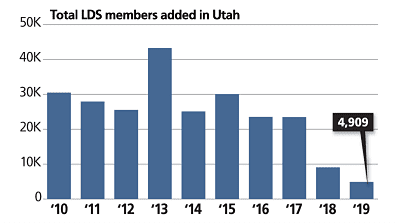
Today we speak with sociologists Rick Phillips and Ryan Cragun about “Why the Mormon Church has Declining Growth Rates in Utah and the World.”
We will be reviewing the following articles:
- Utah sees Latter-day Saint slowdown and membership numbers drop in Salt Lake County
- Top Ten Most Encouraging and Top Ten Most Discouraging Growth and Missionary Developments for The Church of Jesus Christ of Latter-day Saints in 2019
Part 1: This transcript is machine-generated and lightly edited for readability. The audio is authoritative. Please excuse occasional errors in names and spelling. John Dehlin [00:00:06] Mormon Stories is a production of the Open Stories foundation and relies solely upon the support of people like you, its listeners to help keep the podcast alive or to become a member of the community. Please become a monthly subscriber by visiting MormonStories.org and clicking the Donate button on the top right side of the page. All contributions to Mormon Stories are completely tax deductible and go towards producing the podcast and and building communities and programs of support for Mormons like you. Thanks for your support. Hello everyone and welcome to another edition of Mormon Stories Podcast. I'm your host, John Dehlin. It's January 24, 2020 and we are super excited today to be covering a topic that I know many of you are interested in or care about. Recently, the Salt Lake Tribune came out with an article entitled Utah Sees Latter Day Saints Slowdown and Membership Numbers Drop in Salt Lake county. This was a January 5th article that basically talked about how in multiple counties in Utah, Latter Day Saint or Mormon membership is actually either slowing its growth or actually in decline. And then of course there's another article called Top 10 Most Encouraging and Discouraging Growth and Missionary Developments for the Church of Jesus Christ of Latter day Saints in 2019, published by Matthew Martinich of Cumorah.com and so for those of you who have been following Mormon Stories for years, the names Rick Phillips and Ryan Cragan will not be foreign to you. Rick and Ryan are both thoughtful, prominent in my view, successful sociologists who come from a Mormon background and who occasionally have researched and written about and studied Mormonism. So that's going to be what we're going to be talking about today, why the Mormon Church appears to be either slowing in its growth rates or in decline in Utah and other elsewhere really quickly, a couple quick announcements. I'll make this super fast. We have a Mormon Stories Faith Crisis retreat coming up in Salt Lake City at the end of February. The actual dates are February 21st and 22nd. You can go to mormonstories.org events to register for that. If you or a loved one is having a faith crisis and you need support, these events are really helpful. And then Thrive is coming to Chicago in April 24 through 26. We have an amazing event scheduled in Chicago, again, MormonStories.org events to register for that. Other than that, we're super glad you're joining us. Thanks everyone who's joining us on Facebook Live. We would love to have your questions and comments there. And without any further ado, let's introduce or reintroduce or welcome back Our guests, Rick Phillips and Ryan Cragan. Welcome back to Mormon Stories podcast. Rick Phillips [00:03:14] Thanks for having me. Ryan Cragun [00:03:15] Thanks, John. John Dehlin [00:03:16] Rick, tell us your background really quick. Rick Phillips [00:03:20] I am associate professor, sociology and Religious studies at the University of North Florida in Jacksonville, Florida. Jacksonville is where you want to be today. Nice. And 70 degrees. I was raised in Utah as a young boy. I grew up in Logan and Cache Valley and then moved to Ogden, went to Weber State, got my master's degree at Utah State, and then went to Rutgers to get my PhD and there I wrote a dissertation on Mormon congregations and Mormon growth, and I've been teaching the sociology of religion and writing about the sociology of religion and specifically Mormon issues ever since. John Dehlin [00:04:02] All right, well, welcome back to Mormon Stories. It's great to have you. Rick Phillips [00:04:06] Thanks. John Dehlin [00:04:07] All right, Ryan, you're up. Ryan Cragun [00:04:09] Sure. Rick and I have very similar backgrounds. Kind of amazing. So I'm a little bit younger than Rick, but I grew up in Morgan, Utah, which when I was growing up, it was 89% LDS, which is fun. And we'll be talking about that, I'm sure. Served a moral mission. 96, 98 in Costa Rica, then went to undergrad at University of Utah, Go Utes. Then went to graduate school, University of Cincinnati, to specifically study the sociology of religion. While I was there, I didn't actually. I wasn't studying Mormonism. I was told that I shouldn't study Mormonism by my advisor, Rhys Williams, but I ended up kind of splitting. So I have two areas of research that I do, which is the non religious. So I was looking actually during my dissertation at people who leave religion. So that's a big focus of my research. And then the other side is Mormonism. Graduated in 2007 with my PhD, and I've been just down the road from Rick in Tampa, Florida, which is also delightful right now, since then. And I've been doing research on Mormonism and the non religious since 2007, basically, consistently. John Dehlin [00:05:13] And you got a book, right? You want to plug your book? Ryan Cragun [00:05:16] I have several. Well, Rick and I have a book together. Rick, talk about our first book together. Rick Phillips [00:05:22] We wrote a book about. We wrote a book in the run up to the 2012 election about Mitt Romney. Ryan Cragun [00:05:28] Could I vote for a Mormon for president? Could I vote for a Mormon for president? Rick Phillips [00:05:32] Yeah, we are sometime collaborators. Yeah. I'm working on a book on Utah, which I've been writing for a long time. I've been doing field work in Utah consistently throughout my career. Hopefully that will get written soon. Ryan's written a bunch of books on religion and the non religious right. Ryan Cragun [00:05:53] Yeah. The most recent one was an edited volume called Organized Secularism in the US where we were looking at, I mean, it's kind of in the, in the title, organized secular groups. So American Atheists, American Human Association, Freedom From Religion foundation, some of the other groups, and then maybe not just those big kind of national groups, but just organized secularism generally. So lots of places have these groups. Utah has atheist groups and secular groups and free thought groups, humanist groups. So that book was an edited volume where we combined a lot of research on that, which is. It's new. That research is new. So it's kind of fun. John Dehlin [00:06:29] All right. Well, welcome, Ryan, and welcome, Rick. We're super excited to have you. And let's dig in. So as we review this article, Utah Sees Latter Day Saints Slowdown and Membership Numbers Drop in Salt Lake County. It's an interesting article and I'll just read some of the highlights and then we'll start here and maybe we'll discuss your guys some of your theories on why the church seems to be either declining in its growth rates or flat out in decline in Utah. And just to start with this article by Matt Kennam. It says that the Church of Jesus Christ of Latter Day Saints recorded its smallest membership growth in Utah in at least three decades. This past year, 14 of the state's 29 counties saw the actual number of members decline. So that just out of the gate says that at 14 of 29 counties in Utah, the Mormon Church is in decline. Now, obviously, if other counties like Utah county are growing by a larger number, maybe that offsets it and we'll talk about that. I'll just read a couple more of the points. It says the most significant drop came in Salt Lake county, which saw the roster of Latter Day Saints fall by 6,710 even as the state's largest county grew by 10,000 people. So we've got Salt Lake county growing by 10,000 people, but having a actual net decline in Latter Day Saint membership. Those are some interesting thoughts out of the gate. Do either of you want to just start off with the response to those data? Rick, why don't we start with you? Rick Phillips [00:08:10] Well, there are a number of things going on. One thing is there's lots of in migration into Utah. As people who live there know, there are lots of equity migrants from California and other places. Utah has a thriving economy, educated workforce, lots of jobs in Salt Lake, and so a lot of non Latter Day Saints have been moving in Utah's. The share of Mormons in Utah peaked around 1990, and it's been a fairly bumpy decline ever since. So there's lots of in migration. The second thing is birth rates have fallen. Mormon families are still. The average Mormon family is still larger than the average American family. But those birth rates have fallen in concert with American birth rates. And I see there was another article that just came out showing that the birth rate in Utah had just fallen below replacement levels. And so Utah's birth rate has fallen rather rapidly. For as long as I can remember, Utah had the highest birth rate among states in the nation, and that's been eclipsed. Now South Dakota has the highest birth rate. So Utah has been surpassed. So there is a decline in birth rates. And some of that starting to show up now with people turning adult age. And of course there is a lot of resignations, formal resignations, and there are people who just no longer consider themselves Latter Day Saints, who when they're asked by survey researchers, or they just say, we're not LDS anymore. And that's been on the rise. One of the things you see when you look at the General Social Survey, some of the other data sets that sociologists examine, that this sort of wave of apostasy has been more pronounced in Utah and the Intermountain West. So there's a general secularizing trend in the United States and a movement towards non religion and people sort of abandoning formal religion. And that trend has been happening within Mormonism as well. But within that trend, there's another trend which is a rapidly accelerating abandonment of religion among Mormons just in Utah and the Intermountain west, over and above the general secularizing trend that we see. So there are some dynamics that are going on in Utah that are exacerbating this secularizing trend. So these three things, migration, birth rates and disaffiliation, are probably driving what's going on. And you see it in cosmopolitan counties like Salt Lake, which is the epicenter of all of these things. John Dehlin [00:10:53] All right, I love it. Rick Ryan, do you have an intro kind of response? Anything to add? Ryan Cragun [00:11:00] Maybe? I actually want to ask Rick a question. If we can kind of make this more of an interactive thing in sociology. We've long known of this phenomenon called white flight. Right. So as minorities move into neighborhoods, white people will move out of those neighborhoods. Right. Rick Phillips [00:11:17] For a variety. Ryan Cragun [00:11:18] It boils down to racism, but for a variety of reasons boil down to racism. Do you think there's like a functional equivalent of Mormon flight? Rick Phillips [00:11:26] Right. Ryan Cragun [00:11:27] That basically as non Mormons are moving into, say, Salt Lake County, Mormons, certainly it's not the case outside of Utah that Mormons feel like they have to be with other Mormons because they're often a minority. But in Utah, they have so long been the dominant majority that as they shrink and become a minority, do you think they're actually like, I gotta get out of Salt Lake County? And they're, they do that? Rick Phillips [00:11:51] Well, they have tried that, but they can't escape. I mean, that's what Eagle Mountain, that's what Eagle Mountain was for. Eagle Mountain is literally a refuge from, you know, the wicked Babylon of Provo. And it was designed specifically for that point. But I mean, the problem is you can't discriminate on the basis of religion for who buys a house. So if you go out in the sticks and you plot a subdivision and you have cheap housing there, you can't stop whoever wants to live there from living there. And cities can do what they can. I mean, Eagle Mountain attempted to implement some rather draconian ordinances and things like that to sort of maintain their, their family friendly way of life or whatever euphemism they use. There's nothing you can do about it because people, people move in. So this is the problem. I mean, the, the Latter Day Saints in the Intermountain west can't sequester themselves. There's, you know, one of the things that I'm looking for that will be an interesting bellwether and you start to see it beginning now are Mormon schools. You know, you have the equivalent of Mormon schools that are, they're like parochial schools right now. There's lots of homeschooling going on. But when you start to see LDS only high schools, then you'll know that you're reaching a critical mass. You can't, you know, when I was growing up in Logan, you could go down the street and count off the people that lived on the street. And those were also the people that lived on the ward. I mean, the ward and the neighborhood was tightly consolidated. So a block party was a ward party de facto. And now that's no longer the case. And so what happens is it's hard to. It's really getting more difficult to sequester young people away from non LDS playmates. And you might be able to do it in the neighborhood, but it's almost impossible to do at school. When I was, when I was 19, if I'm just going to admit my sins here. When I was 19, I didn't really want to go on a mission. I didn't want to go. I remember one of my friends and I sitting on my doorstep saying, yeah, we don't want to go on missions. But there was no thought that we weren't going to go. And the reason why is because at that time I thought, no girl will date me if I don't go on a mission. My brother didn't go on a mission, and I saw sort of the brutal social sanction that he endured. Well, you know, when Salt Lake county is now less than half lds, my non LDS friends are going to understand when I say, you know, I don't want to go knock on doors for two years. And so there's a place where. There's a place where I can flee to. So you have, I guess maybe you have attempts at Mormon flight, but you also have flight from Mormonism to do, you know, and things that were once normative are now elective. So the stigma of not going on a mission is lessened compared to my generation. Ryan Cragun [00:14:51] Yeah, I think you're right. So my hometown, I said I was from Morgan, technically, it's Mountain Green, which is basically kind of between Morgan City proper and Ogden. It's right at the mouth of that canyon right there. And I have a brother who's a real estate agent who basically sells all the homes in that area. Increasingly, it's people from out of state who are buying the homes there. And you're right, like These homes are $800,000. Yeah. They're massive homes. And they're buying them out of state. Right. And they're not Mormons moving in. So even if they were trying to sequester themselves, which I kind of get the sense, like they want to do that. Right. They want to have a community that is not just around the ward. It's literally the community. But they can't, because they can't stop people from moving in. That's clearly happening. Where I grew up, like you, we used to be able to go up and down streets and just say, that's a non Mormon House. The one out of every 20 years that was not a Mormon house. Rick Phillips [00:15:47] These are the non Mormon kids in my high school. Ryan Cragun [00:15:49] And now you can't even do that because it would be. Every other house is a non Mormon house. Rick Phillips [00:15:54] Morgan itself has a way to. I mean, Mountain Green is so close to Ogden that people are, you know, it's essentially a bedroom community for Ogden. Morgan itself has a way to go before it's completely secularized. There are still some holdout places. My brother lives in St. George and, you know, the volume of equity migrants from California that are moving there rapidly, rapidly transforming the place. So John Dehlin [00:16:23] are these transplants from California Mormons or never Mormons? Because that's sort of a general perception that over the past couple decades, people get rich in California and then they can't afford to live there anymore. They want to retire. And so they moved either Boise or Utah as a way to sort of buy that super large grandparents house and retire in Alpine or Highland or, you know, one of those types of places. Right? Rick Phillips [00:16:48] Yeah. You also see a thriving tech sector that draws in young professionals. There are all kinds of people moving to Utah that are not Mormon, and they want to go to the store and buy normal beer. They don't want to, you know, and so they. And they pay taxes and they put pressure saying, look, you know, we want to buy normal beer. And the thing about this is, is it changes the way that you. Changes the way that Mormons have to think about beer. Right. When I was. When I lived in Cache Valley, there were two kinds of people. There were people who abstained from alcohol, and there were, you know, alcoholics. I mean, there was no. The idea that there was some sort of responsible alcohol use would have preposterous. I mean, I was taught that people who use alcohol are destroying their livers and lives. And now what happens is you have the neighbors move in next door, and they both have great careers and they got wonderfully well behaved children who do great at school. And when you go over to their house, they have a fully stocked liquor cabinet right there, you know, sitting there for all to see. And you just can't square that with, you know, alcohol is uniformly. People who use it are uniformly wicked. Alcohol becomes not something that the bad people do. It becomes something that we don't do just for idiosyncratic theological reasons. And that's more difficult to maintain than just having some sort of blanket stereotype about the evils of the wicked world. What ends up happening is people with different norms, people with different values sort of encroach on Utah society. The sociologist Peter Berger argued that religion is strongest in places where everybody shares the same faith. Because in settings like that, he said that religion is a sacred canopy. And religion sort of integrates everything else, and this canopy sort of keeps things out. When you have religious pluralism, it fractures the canopy and it erodes the salience of religion, because competing claims to exclusive truth cancel each other out. If I say I have the exclusive truth, and you say you have the exclusive truth, and we have different exclusive truths, somebody's wrong, or maybe both of us are wrong. And so religion becomes Something that you become, something that is contested, that you have to sort of negotiate with society rather than something that's just taken for granted, something that just holds you enthralled. Ryan Cragun [00:19:19] We have to note on that point, right? That phenomenon of breaking down the sacred canopy and the plausibility structures has to happen at the micro level. So just because we have a highly pluralistic US population, you can still get bubbles, right? Where they have a very uniform environment and then their sacred canopy is intact and they're fine. And the argument that we're making right now in Utah is that you don't get those bubbles anymore, right? Like where can people flee? So they're just surrounded by other Mormons and now you're getting further and further out into the desert basically to have that happen. Or you can vernal or something, right? Rick Phillips [00:19:55] Or you can, you know, completely withdraw from mainstream to society to the point where you're like Hasidim. You know, you could do it that way too. But Mormons don't want to do that. They want to have their cake and eat it too. They want to participate in mainstream society, but they also want to live in a place where their sacred canopy is intact and that's no longer possible. I mean, they could retreat into weirdness or they can just sort of. To the extent that the demography of Utah begins to resemble the demography of the average state, participation in Mormonism in Utah will start to look like the participation of Mormon in average state. And one of the things we know about super strict religion is that it is easier to convert your friends than it is to retain your children, because people's religious beliefs sort of regress to the mean. If I want ultra strict religion and I marry someone that wants ultra strict religion, the chances are pretty good that my kids won't be as ultra religious as I am. So you see a natural sort of regression to the mean in the next generation. And you see that a lot in the mission field. When I was first doing my fieldwork, I compared a ward in New Jersey, which at that time was 49th in per capita Latter Day Saints, with a Utah ward. And in the Utah ward, you'd see people that were boys that were, you know, 18 and a half years old that would suddenly straighten up their life and go to avoid the stigma. And people would be like, wow, I can't believe that kid went, who? And in New Jersey you'd have perfectly devout kids that wouldn't go. And people would say, oh, I thought he'd go. And that's the absence, the presence or the absence of the sort of social pressure of a coercive community. And I think that what's happening in Utah is that you need a critical mass for that coercive community to be coercive. And that's starting to fray and it's starting to crumble. And when that happens, people who are not aligned with the church because of their subjective religiosity are more inclined to just say, no, I got better things to do on Sunday, or no, I'm not paying 10% of my income for that. So in addition to eroding plausibility, you have changes in the behavioral norms and then you reach a tipping point. John Dehlin [00:22:14] So I love it. So to Ryan's question, let me read another stat in the Salt Lake Tribune article. It says that Salt Lake county saw its Latter Day Saint membership decline by 6,6710. The second biggest drop was in Davis county where membership decreased by 838. And then to Ryan's question about sort of orthodox Mormon flight, it says Utah county, home to church owned Brigham Young University, saw the biggest numerical increase in members at 8,487, followed by Washington county at 2,441. So is there any way to know how much of that's orthodox Mormon flight within Utah versus, you know, Mormons moving from outside? Is there any way to know? Rick Phillips [00:23:03] I don't think so. You know, I think Utah county is the last. To me, when I think about urban areas that are the last bastion, Utah county is sort of the last bastion. I mean, birth rates are still within the state. Utah used to have the highest birth ration birth rate in the state and Utah county had the highest or in the nation. And Utah county had the highest birth rate in the state. Logan is sort of hanging on and Utah county are sort of hanging on. So there's still pockets here and there and still sort of persists. I mean, obviously when you go to Provo, it has a particular vibe. When you go to Logan, it has a particular vibe. But that's probably going to start to shift. That's probably going to start to change as well as all of the tech firms that are at the north end of Utah county begin to move south as the south end of Salt Lake county starts to cost a lot more. I don't know. I mean, you can't hold those bulwarks up forever. What do you think? You can't. Ryan Cragun [00:24:02] Right. So the other thing that I think Utah county has going for it is of course Brigham Young University. Rick Phillips [00:24:09] Right. Ryan Cragun [00:24:10] So Brigham Young, BYU is still going to attract probably, I mean, like the most orthodox members to go there. Right. Because really smart LDS kids who live outside of Utah, they have lots of options. They could go to lots of different universities and do perfectly fine and pay less in some places. Right. By going to a big state school and getting a great education. So it still has some draw. It's going to pull in, like Rick was saying, the most orthodox, the most devout, the most devoted. And if they end up staying, which many of them don't, I don't know what the rate of students who stay in the area after they graduate is, but some of them are gonna stay. So they have that going for them as kind of maintaining this pocket. Rick Phillips [00:24:55] Right. Ryan Cragun [00:24:58] Maybe they'll hold out longer, I really don't know. But back to John's question about knowing whether there's clear flight and that's what's actually happening. That's a really tough question. I mean, you'd have to have on the ground data, right? You'd have to be like interviewing people who are breaking. Yeah. You'd have to actually like be interviewing or surveying people who are moving counties and then asking them exactly why they're doing. Looking at those numbers, I don't think there's any clear way to definitively say this is Mormon flight or something like that. I don't think we could say that. Rick Phillips [00:25:29] I think. Wasn't Utah county still around like 80% or something like that? I have to pull this up real quick. I have a note that shows. So, you know, it is pretty much uneven. I know that Davis, Salt Lake and Weber have changed a lot, but Utah county seems to be holding on. Cache Valley seems to be holding on as well. Morgan county, which is a lot less populous than Rich county, seemed to be holding on. John Dehlin [00:25:57] Do we know why the birth rate amongst Mormons in Utah appears to be in decline? Any idea, any theories? Ryan Cragun [00:26:05] Go Rick? Rick Phillips [00:26:06] Well, the birth rate has been declining nationwide generally. And I think the general reason for birth rate declines that sociologists point to is we're shifting from a society where, you know, in agricultural societies, children are an economic benefit. You know, even an eight year old can gather eggs or churn butter and children, a quiver full of children make sure that you have someone to take care of you when you're old. And so many of the functions that the family used to serve now have been outsourced to, to the state. And we live in a society where children are an economic liability. I just saw the tuition that I'm going to have to Pay for my kids high school last week. And I can tell you they're a liability. They cost a fortune. And so to the extent, and you know, even 100 years ago, you worried about whether or not you were going to have, whether or not a child was going to survive to adulthood. Now we take for granted that our children will outlive us and the state takes care care of us when we're old. So the function or the nature of families has changed as children have become a liability. Birth rates have fallen. And I think birth rates have fallen, you know, in the post war nation precipitously. And the Mormon trend has always mirrored the national trend. Mormon birth rates have always looked like American birth rates, except a little higher. The average Mormon family tended to have like one more child per family. But the gap has started to narrow because in childbearing behavior, Mormons have always resembled Americans, but now the resemblance is becoming closer. So you have, I think Jana Rees in the next Mormon survey showed that a much higher percentage of Mormons that are millennials grew up in families with less than four children or three children than in our generation. So the same kinds of demographic pressures that are exerted on Americans generally have been exerted on Mormons as well. John Dehlin [00:28:14] For those of us who are old enough to remember kind of Mormonism in the 1980s, we remember prophets like Ezra Taft Benson getting up in General Conference and saying that the woman's place is in the home, that a woman shouldn't work outside the home, that they should have as many kids as possible. And you would think, maybe one would think that the church would never let go of that rhetoric because they want to continue growing. But the truth is, you know, you can't find a lot of statements like that over the past 10 years that I'm aware of. Which means that the church, the brethren, have somehow strategically decided that it's not to their advantage or in their belief system anymore to really pressure, you know, women to stay home and have a lot of babies and to pressure, you know, women to get out of the workforce. Do you guys have any thoughts on that? Ryan Cragun [00:29:11] It's a losing argument. They're just going to alienate people because that ship has sailed, right? We've known from Tim Heaton's work. And I actually just finished writing up the draft, just looking at the proofs for a book chapter on demographics of Mormons in the U.S. like Rick said, these forces have been playing out for a very long time. I love to use myself as an example. I'm one of nine kids right and one of the things that I would actually add to this is, I think, shifting economics in Utah. Kind of just the forces of production in Utah. We used to have more agriculture in Utah. So I was one of those kids who, starting at 6, I worked in the cherry orchard that my uncle owned. Right. I could spend a lot of time talking about, you know, how I was an economic net benefit for my family. But that is absolutely not the case for most kids today in Utah. Because who works in agriculture in Utah anymore? Right. That number has declined just like it has in the US to where we're down to under 2% of the US population works in any form of food production or agriculture. So it just doesn't make any sense. So clearly those numbers have shifted. And if the leadership keep pushing this idea that women should work in the home or women should stay home, work in the home, I like to say work in the home more than I'm trying to remember the numbers. It's close to 70% of women, even women with kids who are Mormon work outside the home. That it's done right. Like Fayette Accompli. It's not going to reverse itself. Rick Phillips [00:30:36] Economic realities. Ryan Cragun [00:30:37] Yeah, they lost that. Rick Phillips [00:30:39] In 2008, Ryan and I analyzed a data set called the ARIS. I don't remember what ARIS stands for. Ryan Cragun [00:30:48] American Religious Identification Survey. Rick Phillips [00:30:50] And what we found is that among Mormons, there are a higher degree of women who are not in the workforce in Utah than there are in the rest of the nation. But still the vast majority, large majority have to work. I think, you know, there are lots of women, I'm sure, that would. Or men that would like to stay home and take care of their kids. But economic realities are what they are. Ryan Cragun [00:31:17] Yeah. The only real difference that you see these days is Mormon women are more likely to work part time or work outside of the home. But they're still working. Right. I mean, the vast majority of them are working. They're just less likely to be working full time. But they still have to work for the reason Rick just said. It's just the economic reality that if you want to live a middle class lifestyle, you got to have two sources of income. You just have to. Rick Phillips [00:31:40] One of the things that I've noticed is that having a woman stay at home in Utah now is sort of a marker of status. And it is something that you see, I think, more commonly in the upper middle class than you see, you know, in the working class wards and things like that. And that it is, it still sort of has. There's. I Think there still is a legacy of the idea that that's the ideal family form. And so there tends to be a little bit higher status within wards and within neighborhoods of people that can pull it off. Have you noticed that at all? I mean, I think I'm in Utah more than Ryan. Ryan Cragun [00:32:18] Yeah, you are in Utah. I was actually going to ask John because one of the things that I've noticed, I have one kid, Rick has two kids, right. When I'm flying. So I'm through the airport or something like that, and I see a woman toting four kids, I kind of my eyebrows raised. Right. I'm like, wow, she's amazing. How is she handling four kids? Right. I'm one of nine. Right. So I have no idea how my parents did it other than the older kids took care of the younger ones. So I think that's still surprising. But one of the things, I don't spend enough time in Utah to really say this is a family of four kids in Utah unusual at all now? Or is that still like, yeah, that's fine. Like, that's not. That's not weird. Right. Because clearly in Tampa, in Florida, where I am, you see a woman with four kids and you're like, oh, geez, geez. That's a lot of kids to deal with. What's your take, John, Rick? You guys are both there more than I am. John Dehlin [00:33:09] My sense is that amongst orthodox Mormon families, four is very normal. Rick Phillips [00:33:14] Yeah. Four is about. Four is where you can claim to be doing your job for spirits waiting to come down to earth. Any less than that. John Dehlin [00:33:27] Okay, so this may be obvious to a lot of people, but I just want to ask it anyway. When we talk about people leaving the church, we talk about Jack Mormons, we talk about, you know, let's not talk about the secularization, the broader rise of the nuns kind of secularization trends. We'll talk about that next. But when we talk about sort of apostasy, people resigning, people just falling inactive, this may be an obvious question, but what do you guys see as the drivers for whatever percentage is attributed to that? Ryan Cragun [00:34:02] So why people leave, why people are John Dehlin [00:34:04] leaving, why Utahns are leaving. Yeah. Church activity or no longer identifying. Ryan Cragun [00:34:12] Rick is always right, I think, in setting the context for this. Right. The fact that the sense of community that everybody is Mormon is now kind of winnowed down makes it much easier to leave. And he does a really good job explaining that. So I should let him. But then I think it's all the same factors that broadly are affecting why people leave. Religions generally in the U.S. yeah. Rick Phillips [00:34:33] Why don't you talk about the national context and then we'll sort of Mormonize that when you're done. Sure. Ryan Cragun [00:34:38] So if we go back and just are trying to get a sense of this. Back in 1990, it was 7% of the adult population in the US was non religious. So when you were asked, what is your religion, if any, 7% said, I have no religion. By 2001, it had doubled. So it was 14%. And then the most current data is putting it somewhere between 24 and 26% of the US population says they have no religious affiliation. Right. Now, the important part to think about that is obviously not all of those people are non believers. They're not all atheists. They're not all kind of Richard Dawkins non believers. But just because religion is multidimensional, it just, you know, sure, 25% are non religious. Under 30, it's even higher. It's close to 1 in 3. But you can also kind of look at other dimensions. Right. So you can ask, well, what percentage believe in God? And that number, depending on how you measure it, can range anywhere from 50 to 70%. Rick Phillips [00:35:31] And. Ryan Cragun [00:35:31] And then you have a question like, how many actually go to church? More people will say they go to church than actually go to church. But the numbers that we have suggest that it's only about 1 in 5Americans are going to religious services on a weekly basis. So we have 25% who say, I have no religious affiliation. Atheists, agnostics, et cetera. They're now close to anywhere from 30 to 50% of the population. And then the percentage who go to church less than once a week is 80% of the U.S. population. And those numbers, the lower levels of religiosity on all of those dimensions have been going up since the 1990s, very demonstrably going up since the 1990s. John Dehlin [00:36:11] And some of the main reasons why, what's driving the secularization of America, broadly speaking? So Ryan Cragun [00:36:21] the general argument of secularization is that modernization causes this. Right. As we become a more modern society, people we call the disenchantment of the world. Right. People just don't think about things as being driven by the supernatural anymore. And so the way they think about the world shifts, I think there's a lot more that goes on there. Right. So. And kind of the leading theorist on this today, Steve Bruce, would agree that there's a lot more going on. So it's not, and I don't want to simplify it as something like science, it actually includes Things like equality. Right. And a sense of autonomy. So why should I go to church and listen to a bishop who has less education than I do, tell me what I should be doing. Rick Phillips [00:37:01] Right. Ryan Cragun [00:37:02] I've got a PhD or I've got a bachelor's degree. And not that the bishop isn't an amazing individual for all his own rights. Right. But maybe he's a car salesman. Right. Or he sells insurance. And I've read a lot more than he has. Those kinds of factors also contribute to this. And then you get like, gender and sexual equality issues. We know that's a big deal for young people in particular, where you have a religion like the LDS Church that continues to hold its position that gay individuals, lesbian individuals, they're not kind of held, you know, viewed the same way. Let's just keep it simple. Right? They're not viewed the same way for young people. That just makes no sense. Right? Rick Phillips [00:37:37] Yeah. Ryan Cragun [00:37:38] They've grown up with friends who are gay, and that's fine. Right. That's just life. That's the modern world. So holding that antiquated view is going to alienate young people. And then as you politicize things, that alienates young people. So there are many, many factors, all kind of loosely tied under that umbrella of modernization, is the argument. Rick Phillips [00:37:57] Yeah. The other thing is a lot of it is demographic. So you have a rapidly urbanizing population. You have a population with substantial mobility. So you have people moving around and aggregating in cities. I teach in the evangelical south, have many students that are the children of evangelical Christians. And, you know, they get to the point where I like this friend that's a Catholic, or I like this friend that's a Muslim. I just can't bring myself to believe that he's going to be tortured in hell forever. And so to alleviate the cognitive dissonance, you just stop believing in hell. And when you stop believing in hell, you know, that's the first domino. So just, you know, I think the general plausibility of religious precepts, not just for advancing science, but also just on the basis of your social dealings with other people and religious pluralism, these explanations of the world just become less plausible. And students, my students are not atheists, but they have a sort of, you know, God to them is sort of a bellboy in the sky that carries your bags through life. I mean, it's atheological. And, you know, they think about spirituality and things like that. But I've noticed, you know, I teach classes on the Bible, and one of the things that I've Noticed is that, you know, biblical literacy even among self professed students, just absolutely plummeted. I mean, if I ask my evangelical students who are raised in the church, what are the four gospels, you know, about half of them wouldn't know. Ryan Cragun [00:39:26] And the same is true of Catholics. Catholics are. It's abysmal. So when I'm teaching my social religion class, I'll talk about Catholicism as an example for lots of things and I'll, you know, who are my Catholics in here? And half the class will raise their hands. They have no idea what I'm talking about. Rick Phillips [00:39:39] Right. And I'm not any of the doctors, Ryan Cragun [00:39:41] I'm not even an expert on Catholicism. Right. But they have no idea what it is. Yeah. John Dehlin [00:39:45] I've heard some social scientists also and you alluded to this Ryan, but I just want to tease it out a bit that there's a cost to Republican conservative Republicanism being synonymous with the Christian right. And I know you've already talked about equality as well, but is it true there might be a cost in that association for religiosity more broadly? Ryan Cragun [00:40:11] Yeah, that's a good question. I don't know that the data are just like overwhelming slam dunk that when religions align themselves with political parties that they alienate people. We know that it does happen. Right. So there's actually some pretty good evidence to suggest this one study which actually is kind of interesting, right. American Grace. They actually talk about this, that when you get political from the pulpit, you actually drive people out. And it's not just the people who disagree with the political views. Right. It's actually generally across the board people are just like, that's not why I go to church. I don't go to church for political reasons. Now that may be changing. That could very well be shifting in some interesting ways. But one of the things that we also do know is when religions align themselves on social issues, they tend to concentrate the people who agree with them in the religion and the other people leave. Right. So one of the weird kind of consequences of the LDS Church continuing to hold the line on say their position on gays and lesbians is that they're forcing all of the people who are accepting of homosexuality out of the religion. Right. So you're actually getting a higher concentration of homophobic individuals in the LDS Church because all the other people are like, why am I going to stay in this religion that is not accepting of these values? So it has this weird kind of effect. And so it's like a chicken and the egg type thing, Right. If the religion holds the line, the liberals leave or the conservatives leave, if that were to happen, right? And then it becomes more concentrated. And so you actually get kind of a reiteration of what's going on, and it concentrates those values even more. Rick Phillips [00:41:49] So I think one of the reasons why Utah had always been able to resist this trend to a certain degree is because of the sheer density of Mormon ties in the community. So the one interesting thing you have going on in Utah is that there are costs for deviating from the party line outside of church. And so you have a system of surveillance that went on, Not a formal system of surveillance, but you have a lot of surveillance that took place in Mormon society that sort of held people who lacked sort of subjective commitments to the church. So, for example, if I want to drink coffee and I'm in the. In the food king, and I grab coffee and put it in my shopping cart, I don't just have to worry about the people in my congregation seeing me. I have to worry about people in my workplace, people in civic organizations. Virtually anyone I know wouldn't want them to see me with coffee in my shopping cart. And that really didn't exist anywhere else. And that sort of tied people who might otherwise deviate to the church. I remember my dad had the same saying. He used to always say when we were kids, on Sunday afternoon, he would always say, I don't know what's the bigger sin, Mowing the lawn on Sunday, or the fact that I'm not going to mow the lawn on Sunday just because I don't want the neighbors to see me mowing the lawn on Sunday. And so I think a lot of this, too, is demographic. And as the demographics start to ease, the costs of that deviance declines, and the ability to be surveilled declines, and the consequences of being seen decline. So people are like, yeah, whatever, I'm gonna mow my lawn, or I'll go put coffee in a shopping cart or John Dehlin [00:43:39] freaking go to Costco or skiing or the golf course. I'm really upset. One of the benefits of getting excommunicated was I got to snowboard and golf on Sunday and have the resorts and the golf courses be relatively empty. Others would say the lakes. And one of the things I feel really guilty about and a little bit sad is to whatever extent I've contributed to apostasy in Utah, I have also contributed to the flooding of people at Costco golf courses and ski resorts and lakes. Ryan Cragun [00:44:13] Oh, yeah, we have you to blame for that, John. Rick Phillips [00:44:16] There we go. John Dehlin [00:44:17] Maybe only a little bit. Rick Phillips [00:44:19] This started this sort of the, the technological. So we've talked about how demography has sort of undercut the coercive community. Technology has been undercutting this longer than people think. So in 1983, the Utah legislature passed something called the Cable Indecency act. And it was designed to censor HBO so that you couldn't pipe in movies that show bare breasted women into, you know, into living rooms. They attempted to censor HBO in Utah. So before 1983, if I wanted to see an R rated movie, I had to stand in line at a theater or I risked being seen coming out of the theater. Now you can do it. After that was struck down in federal court. Now you have those movies being piped into your home so you can enjoy them in the comfort of your own home. And it's the same kind of thing with perusing literature that's critical of the church. In the comfort of your own home. Technology will allow you to sort of pick at things that you shouldn't be picking at and learn things that you shouldn't be learning without the fear of being detected. And so one of the things that we've noticed is that if you look at sort of self reported religious behavior, church attendance or whatever of the people who have stayed, Mormon church attendance remains uniformly high. Church attendance numbers in terms of the percentage of self identified Mormons who go to church have stayed the same. So the trend in apostasy in Utah, over and above the general secularizing trend, are less committed members who have just decided, no, I'm, you know, I'm not interested in doing this anymore. And they just stop going. And of course, the more people who do that, the lower the costs. John Dehlin [00:46:18] So you're talking CES letter, you're talking podcasts, you're talking YouTube, all the Internet stuff, Google, et cetera. Rick Phillips [00:46:27] Yeah. And I even wonder, and this is something I'd want to ask you guys, I mean, I even wonder the extent to which the anti Mormon information is just sort of, you're allowed to think about it more than you used to. I mean, if you think about anti Mormon literature, almost all of the anti Mormon arguments that you see in the CES letter and some of the other things that you see. That stuff was around when I was young. I first encountered anti Mormon literature my sophomore year in high school. As I was walking across the street from Bonneville High to the seminary, there was a guy there handing out pamphlets. And I kept that pamphlet for 40 years because I've always sort of traced my apostasy to that pamphlet. But all of the things, Joseph Smith's polygamy, Adam, God, all that stuff, I think was relatively well known in my day. And I think people have generally been aware of it. They just haven't indulged in it before. I think there is a narrative among people who apostatize that the most common way for people to apostatize is to have never heard of these issues before and then suddenly encounter them and then fall away, which, of course is Ryan's script. But. But I think, you know, for the most part, people sort of have issues that bother them and it allows them to sort of turn to that stuff and say, okay, what's this? One of the things that I've been asking people about who have the sort of standard narrative that I encounter, this information that I've never heard before is I'll ask them, like, have you really never heard of that before? You never heard of Joseph Smith's polygamy before? A lot of them were like, yeah, you know, I heard about it, but I just heard it was, you know, I had always thought it was just an anti Mormon lie. And then, you know, something gave them the freedom to sort of read a little further. Ryan Cragun [00:48:19] Yeah. I mean, I've often made the argument that, I don't know, that it's the intellectual kind of component that is what really drives most people out of religion. I think it's. I go back to the context. Now, granted, I'm a sociologist, I care about context. Right. But I think it's shifting contexts that allow people to then ask those questions. Rick Phillips [00:48:40] Right. Ryan Cragun [00:48:41] So Rick mentioned. Yeah, you know, I can give the standard narrative of why I left, that I found stuff that I was like, oh, I had no idea about this, but I did that. After I had left Utah. Right. I moved to Cincinnati, Ohio. I was surrounded by academics. I was no longer. I was not enmeshed in a network of Mormons. And they were all believing. So I think that general decline of the Mormon community. Right. That very specific kind of policing Mormon community has made it so one people can ask those questions. It's safer to do so. And they can actually ask other people. They can find the other person in the ward who's maybe sitting in the back as well, and they can ask questions, reads the Tribune. Yeah, right. They can find those people. People. So I think that's happening. Right. But. But I think it's. It's the general kind of the whole society has shifted such that, like, these ideas are pervasive. Right. And it's not Again, it's not just the issues with Mormon history or doctrine or anything like that. It's the values. Right. So same sex marriage is legal across the entire United States. Right. Like everybody has to know that. And then you get R rated movies, right? Like those are getting piped into every home these days. It's just, it's pervasive. All sorts of values have shifted. And with the LDS Church not holding those values, it's now hard to maintain that. It's really hard to maintain. Like, nope, we're going to stick here. We're going to stay here when everybody else is shifting. Rick Phillips [00:50:08] I also think. Ryan Cragun [00:50:10] Go ahead. Rick Phillips [00:50:11] I also think we should talk about sort of apostasy or, excuse me, apologetics as a source of apostasy. I've always called Mormon apologetics sort of the halfway house of apostasy. And one of the things that I did in response to seeing anti Mormon literature is went to the apologetic arguments and tried to make sense of the apologetic arguments. And one of the things about apologetics that I think fails for a lot of people is that the apologetic arguments do one of two things. Either number one, they ask you to accept a difficult explanation for something over a simple explanation for something. And that just, you know, you want me to accept this convoluted explanation of Joseph Smith's polygamy over a perfectly adequate explanation that can be given in one sentence. So that happens a lot. The other thing that happens, I think, is this sort of notion of the incredible shrinking prophets where, you know, if you have DNA evidence now that shows that the Native Americans are not descended from the Lamanites, then you have to deal with all of these statements from church leaders, from Joseph Smith all the way up to Gordon B. Hinckley saying that there were. And you know, when I was, when I was a kid, When I was 17, 18, I believed that the veil was so thin between the Lord and his Anointed that Spencer W. Kimball essentially sort of walked and talked with God. And I think that was common for people of my age to believe that, that the prophets are literally in touch with God? And then so if you want to further the idea that the prophets are inspired and that they receive constant guidance, you have to ask yourself, why wouldn't at some point God say, psst, hey, the Native Americans are not the descendants of the Laman. You know, black people are not the cursed lineage of Cain. Like, how did that get left out? So you have, you know, you had Thomas Monson telling Elder Rasband that he received a revelation to call him as an apostle. And I was like, that's great, but somebody should have let Spencer W. Kimball know that when Native American children join the church, they don't turn white. I mean, it just so I think you have, you know, I will pay 10% of my gross for profits that are constantly in touch with God. I mean, if profits are a conduit from to heaven and they're receiving constant revelation and their guidance is inspired across the board, I'll pay 10% of my gross. But if the prophets are good men who are role models, who live lives worthy of emulation, I'm not going to pay 10% of my gross for that. And so, you know, anti Mormon literature apologetics have sort of changed the way that even the average Mormon thinks about his or her religion. And I think the Gospel topics essays are a classic example of that. They're doing the best they can to put lipstick on the pig, but, you know, the problems are still there. You can say that somebody was a few months shy of their 15th birthday. You know, any literate person knows that means 14. John Dehlin [00:53:23] Yeah, I'll give a couple theories and then I want to also get some of the comments in. I think, number one, the pervasiveness of the information, whether it's through the CES letter, Mormon think, you know, letter to my wife, you know, all the different websites now and then all the podcasts, Mormon stories, you know, Bill real rfm, you know, year of polygamy. It's just, I think you could argue, and I've talked to Jehovah's Witnesses and Scientologists, other members of other high demand religions. You could argue that moral Mormonism per capita leads all high demand religions in terms of their utilization of social media, podcasts, websites, Facebook, et cetera, even Reddit. The largest ex religious group on Reddit is the ex Mormon Reddit that's got, if not 150, 200,000 members. So the pervasiveness of the information. I do think there's something, you know, how like now that the church can't stop talking about pornography, telling people about it, reminding them about it, forbidding it, we have the highest usage of porn rates of any religion because that's also Rick Phillips [00:54:34] piped into your home. You don't have to go to an X rated theater or a dirty video store to get it. John Dehlin [00:54:39] But I think as the church becomes more and more fearful of Mormon stories, Podcast OF CES letter of all these things, the more they talk about it, the more they end up promoting it, which then is sort of this vicious cycle where they're actually accelerating the thing that they fear by demonizing people like me and others that are doing this work. I do think that a huge thing is not just people like Ryan that move outside of Utah, even within Utah, as groups like Oasis and thrive and all these Facebook groups and waca, women of a certain age and all the Mormon spectrum communities now that there are now that you can go to a coffee meetup in literally any city in Utah, whether it's Provo or Ogden or wherever bountiful, and you can meet in a coffee shop with a bunch of ex Mormons, find people in your community easily. Again, it makes you a little bit more willing to let go of the rod if you can grab on to an easily accessible community of cool people right nearby. And so the ability to create groups and to affiliate with groups even in Utah, I think that's a big thing. Rick Phillips [00:55:48] Foreign. John Dehlin [00:55:54] Thank you for joining us today on Mormon Stories. If you enjoyed this episode, please help us make more like it by becoming a monthly subscriber@mormonstories.org. John Dehlin [00:00:06] Mormon Stories is a production of the Open Stories foundation and relies solely upon the support of people like you, its listeners to help keep the podcast alive or to become a member of the community. Please become a monthly subscriber by visiting MormonStories.org and clicking the donate button on the top right side of the page. All contributions to Mormon Stories are completely tax deductible and go towards producing the podcast and and building communities and programs of support for Mormons like you. Thanks for your support. It seems like there's a snowball effect. In other words, remember that Harvey Milk movie? When Harvey Milk basically says when they know one of us, you know, they vote for us 2 to 1 or something like that. When you know a gay or lesbian or bisexual or transgender person, somehow the that affects you differently than if they're sort of those people out there that you don't really know. It seems like the more that people leave Mormonism, then the more ex Mormons that people know and then the infection or the virus or whatever the opposite of a virus is, it accelerates or grows, the more that people like us are known. Does that make sense? Rick Phillips [00:01:23] Yeah, yeah, I think there's totally a tipping point. John Dehlin [00:01:25] A tipping point. Rick Phillips [00:01:28] It's safer to come out now than it used to be. And if the coercive community is not as coercive as it used to be, if I have to choose between my son and my church, it's much easier to pick my son now than it used to be. And yeah, I think there's no doubt about that. And I think certain counties, I think, have reached that tipping point or going beyond that tipping point. John Dehlin [00:01:52] I think just a couple other things. I think it's probably non trivial that we have this sort of reverse Scientology effect. You know, when John Travolta and Tom Cruise and Leah Remini are all Scientologists. Well, that makes a lot of people want to join Scientology. But then when the celebrities start leaving and are vocal about it, that becomes a problem. We've seen that over the past few years in Mormonism as Tyler Glenn, Dan Reynolds, you know, Mindy Gledhill, you know, other high profile Mormons. Wayne Sermon when they publicly say, I'm leaving the church. And this is why, when your celebrities start fleeing, I think that becomes a problem. And then I think there's just self inflicted injuries. There are just. It's one thing to have sort of a quiet policy about LGBT people or whatever, but like that November 15th policy was just like a baseball bat to the face of so many people that otherwise could have handled sort of this kind of quiet closet, you know, homophobia. But when they're like excluding children and like, you know, making, you know, same sex marriage worse than murder in terms of, you know, it being declared as immediate apostasy and then the reversal, it's like whiplash. It's like, okay, it's one thing to have this heinous policy, you know, that is so vile, but then like call it doctrine and then just a couple years later reverse it. It's like a double whiplash whammy. I think excommunicating public figures is just like the Streisand effect. It's just bringing more attention to your barbaric, sometimes approaches. I think making, like you guys said, making bad gospel topics essays. I can't tell you how many people left the church over the blacks in the priesthood, you know, essay. And it's just like, okay, you're gonna throw Brigham Young and all the former prophets under the bus. Ryan Cragun [00:03:45] Yeah. Rick Phillips [00:03:46] Was he a prophet or not? John Dehlin [00:03:47] Yeah. Rick Phillips [00:03:48] I think rough stone rolling has had a huge effect on people who have read it. John Dehlin [00:03:52] Yeah. Rick Phillips [00:03:53] You know, when I was younger, the idea that Joseph Smith was involved in money digging was. And folk magic was a hideous anti Mormon lie. And then the church's most eminent historian writes about how it's true. John Dehlin [00:04:06] Yeah. And then just freaking take the microphone away from Dallin H. Oaks and Bednar. These guys need, if there was a need for correlation, it's for any, you know, it's for John H. Oaks and Bednar and these guys. I don't want to say clowns because that's disrespectful, but like, just these guys that are almost as bad as some of our worst politicians these days of just saying outrageously offensive things in 2020 that just drive people to suicide, drive people to depression or drive people out of the church. Like, again, have policies that aren't popular but like, get credible, nuanced, savvy public speakers that just don't like, stick salt, rub salt in the wound of all the people that are struggling. So these are some of the things that I see. I'll just read a couple comments from our awesome listeners. Juliet writes, and this is going back a bit. Seeing the stupid political opinions of highly religious people drives you to disrespect their religious people. Just this idea that Utah votes for Trump at rates as high or higher than so many states in the country. How do you square reasonable interpretations of Christianity with sort of. And I'm not saying Trump's evil because we have listeners, whatever you feel about Trump. I'm not trying to be political here, but, like, it's easy to look at some of Trump's utterances about immigrants or about, you know, minorities or discriminated people and just say, this guy seems to be the opposite of Christ. How can religious people, you know, embrace him? And then the reaction is just flee from the religion because, you know, if that's what religion is, I'm a part of it. Rick Phillips [00:06:01] That's a bigger problem where I live, where the evangelicals are all in for Trump. I think Trump's approval rating has fallen quite a bit in Utah. Yep. And, you know, Mitt Romney, I'll give him a little bit of credit for standing up to Trump a little bit. And you saw highly religious Mormons that were more inclined to vote for McMullen. So I do see a lot of Trump fans in Utah. But, boy, you should come to where I live to see the Trump fans. And I'm telling you, the second generation is lost because the idea that you're gonna elevate this guy for political expediency over and against everything you've always believed, just because he might put a judge in that you, like, really has stuck in the craw of young people. Ryan Cragun [00:06:50] You know, I've been thinking that we should. Not that you want to turn to Trump, John. Obviously, this wasn't meant to be that. But one of the things that I thought was really interesting when I was out there just over the holidays. Right. Is the number of my family members who turn to me. And these are people who are lds. Right. They're in the church who turned to me and knew that it was safe to trash Trump with me. Right. And I have to wonder, like, is it safe to do at church? Maybe it's not safe to do at church, but they know the liberal left leaning, progressive sociologist, family member who's coming from urban Tampa is in town. I can now unload on how much I loathe Trump and despise everything that he does. Right. Maybe not all of his political views. And that was kind of the interesting nuance, is that, like, okay, maybe some of the politics and some of the things he's. The policy stuff, which Trump doesn't have any, but people around him do. They were okay with some of that, but him as a person, they just could not get over how awful a person he is. And I think it's safer to do that in Utah, like you said, Rick, than it is in more evangelically dominated parts of the country. I was really struck by that. I Thought that was fascinating. Rick Phillips [00:08:01] Where I live, the comparison is always to King David. You know, King David had Uriah the Hittite murdered, but he was still God's instrument. And they equate Trump to King David, and that just sticks in the craw of young people. John Dehlin [00:08:16] Yeah. And it'll be interesting to see if. Is it Evan McMullen? Is that his name? Ryan Cragun [00:08:19] Yeah. John Dehlin [00:08:20] It'll be interesting to see if he runs again, because I think it was smart for the church to have him there to make it so the Republicans still get the electoral votes, but so that Utah couldn't be blamed as the highest Trump voting state. If McMullen's not there this time and there's not some conservative or Republican challenger, it'll be interesting to see where Utah ends up in terms of its percentage of Trump support. Right. Ryan Cragun [00:08:46] Yeah. Rick Phillips [00:08:46] Gonna be a wild year. Ryan Cragun [00:08:48] I have a lot of family members who say I voted my conscience and voted McMullen because I could not vote for Trump and I was never Hillary. Right. They were never gonna vote for Hillary, but it gave them an out. And it was, you know, at some level, like Rick said, respect. Right. They couldn't support this awful human being even if they agree with the politics. Rick Phillips [00:09:05] Right. Ryan Cragun [00:09:06] It was because they saw him as a sexual predator, as all of these kind of abusive things. They just couldn't vote for trump. But Evan McMullen was a perfectly viable third party candidate. Rick Phillips [00:09:16] They were willing to do that on politics, I think, and on Trump. I think Mormons talk the talk better than their evangelical counterparts. Ryan Cragun [00:09:24] Absolutely. John Dehlin [00:09:25] I have to share Spencer's comment. Spencer writes, racism, it's not as overt now, but it's systematic and fundamental to Mormonism. I think Mormonism still has a race problem, as indicated by recently them publishing a manual in 2020 that's still communicating this association between a curse and evil and dark skin. They're kind of stuck with that in the Book of Mormon, and they're trying to expunge it from the curriculum, but somehow it's slipping through anyway. It's just really hard to shed that stuff. Rick Phillips [00:09:56] You know, that's the key problem is it's in the Holy Book. And so you really have, I mean, you know, a biology textbook you can. You can edit and update, but the Holy Book is the Holy Book. And it's. I mean, you can change white and delightsome to pure and delightsome. You can sort of get away with that. But long expositions about, you know, we made their skin dark so that they'd be loathsome and nobody would want to marry them. Like that's kind of stuck in there. I don't know how you excise full chapters from Second Nephi. That's a problem. John Dehlin [00:10:27] Yeah. Okay, so anything else we want to say about Utah before we turn a little bit to the international stuff? I think this Salt Lake Tribune article mentions an increase in resignations. I know that the Mark Naugle website Quit Mormon has made it a lot easier to resign than ever before. I still think way more people just stop attending than actually go to the trouble of resigning. So many people are like, I don't want to make grandma mad. I don't want to hurt mom and dad's feelings so they just quietly fade. But keep that a secret from mom and dad or Grandma and Grandpa. And there's a lot of people frankly that keep attending but don't believe, but they just keep attending because they don't want to lose their spouse or because they don't want to lose business. So there is. I think it's probably worth mentioning that just because not all the people in Utah that actually self identify as Mormon or as attending church are, are either full believers or tithe payers. I think there's a lot of people that just for social or cultural reasons have to keep attending. You guys agree with that? Rick Phillips [00:11:34] So I think, yeah, I think the closing comment on Utah is, I think increasingly there's no reason for people who aren't subjectively ideologically committed to the faith to continue with the faith. Increasingly. But we're not there yet. There's still some vestiges. This coercive cultural system and leaving Mormonism can still cause a problem at work, disrupt families and things like that. But we definitely see a trend going in a singular direction here where it's less and less the case that people who don't want to go to church and don't want to affiliate are coerced into affiliating. That's what I would say is the master trend in Utah Mormonism. John Dehlin [00:12:17] Ryan, any final comments about Utah? Ryan Cragun [00:12:19] Just quick. I do want to kind of give credit to Matt Martinek, who does really good work. I mean, we're going to be talking more about his stuff and he seems to suggest that some of these big shifts may just be anomalous. He may not be wrong. Right. And so it's worth just kind of pointing that out. I work very closely with Ken Zidius and Ron Lawson, who one's former Jehovah's, well married to a Jehovah's Witness and one's a former kind of Seventh Day Adventist. And they're big into numbers. And Ken in particular, right, he loves numbers. He's doing lots of projections. One of the things that he's pointed out a number of times is that you get really weird anomalous blips in Mormon data, right. You don't see the same thing in the other two religious groups, but in Mormon data in particular, they change how they count numbers, right? Yeah, they change all sorts of things. And they don't tell anybody that they're doing that, right? So it could be that they were shifting some numbers around that they decided to count this, but not that. So to Matt's point, right, like this could just be anomalous, right? Like some weird number thing happened in counting. And that's totally possible. But then to Rick's point, the trend has been consistently in a certain direction, right. We know that growth has been declining, right. So the rate of growth has been declining for the Mormon Church for a long time in certain parts of the world, Utah included. And this, I think, you know, is suggestive of that. Even if it's not, you know, the smoking gun definitively it's headed in that consistent direction. Rick Phillips [00:13:57] I think that's an important point. One of the things that I always do when I look at LDS data is aggregate by year to sort of avoid this kind of thing. So for instance, Matt points out that in 2019 there were 181 congregations added and that's the highest in a long time. But in 2017 there were zero added and we went from zero to 181. Clearly, you know, the way things are tallying or, you know, there should, there maybe there are large bureaucratic decisions that are held off for a certain time and then all of a sudden we have, we devote the resources to new orgs or. So whenever you look at LDS data, I think of five year aggregation is a must. John Dehlin [00:14:41] Yep, love it. Ryan Cragun [00:14:42] Safer that way. John Dehlin [00:14:43] Really quickly, Paul writes, you are politically biased too, John. No one cares about your personal political view either. Keep politics out of your discussion. And then Eric writes, adios. And I just want to say I Rick Phillips [00:14:57] consider myself King David. John Dehlin [00:14:59] Yeah, I mean, just to be clear, I don't like talking about politics on Mormon stories because I, I have a specific mission and I don't want to alienate my listeners politically when I'm trying to fry a different fish, so to speak. But to say that we can't talk at all about it, I mean, I can be. I'm not a rabid Democrat or Republican. I feel like I'm Pretty moderate. I think there are good reasons to be Republican and Democrat. I do feel like it's fair to say Trump is divisive and polarizing and unkind generally in his speech. And that doesn't mean that I sign up to every Democratic platform plank and that I reject every Republican one. I consider myself sort of unaffiliated and moderate. But I don't know. I think we should be able to talk about people getting. Ryan Cragun [00:15:51] Rick and I are probably in the same boat. Rick Phillips [00:15:54] My sister is Donald Trump's biggest fan. My sister loves Donald Trump and I love my sister. She's a great person. So, you know, my politics. My politics. I'm not one of those people who think that people who disagree with me are bad people or dumb people or anything like that. Ryan Cragun [00:16:13] Yeah. And actually what I was saying, I was not trying. I may personally agree with them. Right. But I was not saying what I think of Donald Trump. I was actually saying what my Mormon relatives were telling me about Donald Trump, which is kind of the interesting part, that they think he's a deplorable human being. That's what I think is interesting, is that there are Mormons, devout, weekly attending tithe paying Mormons in Utah who find Donald Trump deplorable. And these are not young people. Right. These are people my age or older who are saying that. That's what they're saying. Right. So my politics aside, I was actually trying to keep my politics out of it. I just thought that was interesting. John Dehlin [00:16:48] Yeah. Anyway, I don't think we can totally avoid talking about politics. Ryan Cragun [00:16:55] Oops. John Dehlin [00:16:56] So, all right, so moving to this. Matt Martinich in Cumorah.com wrote a blog post called Top 10 Most Encouraging and Top 10 Most Discouraging Growth and Missionary Developments for the Church of Jesus Christ of Latter Day Saints. And I'm going to just read some of these in groups and have you guys respond in groups. So as far as the most encouraging things, I'll read a couple. Sixteen new temples announced, redistribution of missionary resources and stabilization of full time missionary force. 12 missions closed and four new missions open. Eight new missions to be organized. Let's start with those two. Any thoughts on those two positive announcements? Ryan Cragun [00:17:48] There have been a number of kind of social scientists or social science leaning people like David Stewart and Matt Martinick. Right. Who have been arguing that the church has misplaced missionaries if they really care about growth for a long time. And you can even see this in some of my early research where I was strongly suggesting, like these areas, you're not going to see any more Mormon growth. Right. They've passed the secular threshold. It's just not going to happen. Why the LDS Church has missionaries in Amsterdam is just beyond me. Right. Unless they're the only group that they should even be bothering with is migrants. Right. The migrants who move to Amsterdam might be receptive, but Dutch people generally have zero interest joining the LDS Church. Like, why send missionaries there? So this is finally them kind of realizing, hey, if we put missionaries in the hot spots, we're going to have more success, we're going to have bigger numbers. Rick Phillips [00:18:41] Right. Ryan Cragun [00:18:42] There are other issues with that, but I think that makes sense. So. And that's what lots of people have been telling the church to do for years. Rick, thoughts? Yeah. Rick Phillips [00:18:51] I think you also see, I think last year were the most missionaries ever, if you don't count the sort of double cohort when they change the missionary age. And so I think, you know, growth rates are slowing, but you still have growth. And when you have, you know, millions and millions of members, even 1% growth, that's a lot of people. And so, you know, when you, if you unleash people into the cities of the world and have them knock on doors, sooner or later they're going to find people. I mean, we're down to a little over two converts per missionary. But still, if you have 60,000 missionaries and they convert two people, you know, that's over 100,000 converts. Ryan Cragun [00:19:32] Yeah. I do have a question. So the first one you mentioned is the 16 new temples announced. And this is, I want to say it's more of a question than anything else. I really don't understand this push to put temples, these small temples all over the place. Right. So if you read carefully what he's saying, and if you look at where they're putting these temples in a lot of places, the population of Mormons is just, it's minuscule. John Dehlin [00:19:59] Like Rome, right? Ryan Cragun [00:20:00] Yeah. A couple thousand of them. Right. I actually just went to the Rome, the LDS temple in Rome this summer. Right. I happened to be on a, on a trip with family, and family wanted to go to that temple while we were there. I think I counted, I don't know, less than 20 people were there for the two to three hours that we were there. And almost every single one of them was a Mormon from the US Not a single one was from Italy. Right. And of course, we went to the Vatican the same day and there were hundreds. There were 40,000 people at the Vatican. There were less than 20 at the temple. Rick Phillips [00:20:34] Yeah. I think they have this sort of field of dreams if you build it, they will come approach. So one of the things that you see is that people who are endowed are much more likely to stay active. But they've got the causal arrow backwards. When I was in college, my friend subscribed to Forbes magazine and I was like, tim, why did you subscribe to Forbes magazine? He said, well, I read that 25% of Forbes subscribers are millionaires. I was like, no, subscribing to Forbes doesn't make you a millionaire. Millionaires are interested in reading Forbes. So yes, it's true that endowed members are more likely to stay active, but that's a self selection phenomenon. The same kinds of ideological commitments that keep you active also get you endowed. But I honestly think the reason why they build all these temples is because they see statistics like that and they believe if you build that they will come. Also. You have, you know, they're essentially in the United States. At least these things are tax free. And they got so much money they don't even know what to do with it. And you might as well buy land. I mean, the cost of the temple is incidental. You own huge tracts of land all across the nation. I mean, you just put, you know, real estate is what they do now. Ryan Cragun [00:21:52] Yeah, I was going to go there that. I think I may be more cynical than you are. Right. So you're probably right that they're thinking, oh, if we build it, they'll come. But you also have to just recognize they're buying property that is worth millions and billions of dollars and then sitting on it. Right. And saying, well, you know, this is for a religious function. It's tax free. We never have to pay taxes on this in almost every country around the world. Sure, it's a pretty building, but upkeep's probably fairly minimal. They may even have the members do a lot of the upkeep. They get to squat on land for an indefinite period of time. Right. Maybe I'm just being cynical. I don't know. John, do you have thoughts on why they're building all of these temples where there's just not even demand for them? John Dehlin [00:22:31] My understanding has always been that the church's understanding is that when you build a temple, more people in the surrounding area pay tithing. And so it's sort of an investment. You build the temple, you get more tithing revenue. So it's kind of a medium to long term revenue play. Again, in these areas where there's like 12 Mormons, I don't know how much that makes sense. Rick Phillips [00:22:55] The field of dreams approach. What's that the field of dreams approach. John Dehlin [00:23:01] But in places like Tooele, you know, yeah, it's. That's Orem. Another temple. Ryan Cragun [00:23:08] Taylor's. John Dehlin [00:23:09] Taylorsville or Guatemala or Taylorsville. Rick Phillips [00:23:12] 4 People of Taylorsville with no access to a temple. You gotta drive 50 blocks to get to a temple. John Dehlin [00:23:19] But I mean, I just think about my wife's parents. You know, when my wife, My wife's parents lived in the D.C. area when the D.C. temple were built. And, you know, he was a Yale trained psychiatrist, she was a nurse. They were secular. They built this big temple in D.C. all of a sudden it's this huge, prominent building. The Mormon friends say, hey, come out to the temple before it's dedicated. They go through, they fill out the card, the missionaries come and visit them. And now the church gets this family who has four more kids, so six kids in total, potentially for multiple generations. So I think there is a missionary and a revenue kind of increase that can be associated with some of these temples. There's also the speculation piece. I think the church is often wise enough to not just purchase the land for the temple, but either themselves or sort of friends and family purchasing the area subdivisions, commercial real estate around the temple and then developing that. Knowing that generally speaking, the property values increase in the area around a Mormon temple. There's a lot of sort of speculation opportunity there, both for the church and. Or for friends and family of those in the know. Rick Phillips [00:24:44] Yeah. Nowhere is this more evident than downtown Ogden. I mean, Ogden used to have one of those flying saucer temples and they completely remade it into a beautiful temple. And then they bought all of the property around the temple and put up housing there. So the church essentially has completely revitalized downtown Ogden. Ryan Cragun [00:25:07] Yeah. Well, just again, thinking about the temple in Rome, you know what the. It's technically not accurate, but the most prominent building next to the temple is. It's an Ikea. I was surprised by that. Rick Phillips [00:25:22] Right. Ryan Cragun [00:25:23] Like, we drove up and like, there's Ikea, there's the temple. Like, why are we doing this here? Rick Phillips [00:25:28] Right. Quintessentially American institutions. Ryan Cragun [00:25:31] Right. John Dehlin [00:25:33] I mean, there is a prestige play with Rome. Right. It's sort of like we're a major world religion and if you're going to go see the Vatican and you drive by and you see a big, beautiful Mormon temple, it's like, whoa, the Mormon Church, it's sort of like squatting nearby a major tourist attraction and you get some of that secondary effect. Ryan Cragun [00:25:55] 40 minutes outside of Rome. It's 40 minutes outside. Yeah. It's not anywhere near Downtown Rome. John Dehlin [00:26:00] Okay, well, then I'm just speculating. Ryan Cragun [00:26:02] Yeah, I was really surprised. But don't get me wrong, it was beautiful. It's a beautiful building. They've got a great. Rick Phillips [00:26:07] Why did you drive out to the temple in Rome? Ryan Cragun [00:26:10] I was with LDS family, right? They decided that's what they wanted to do. So we spent the better part of the day in Rome seeing the amazing sights in Rome, and we did start the day at the Vatican, right? But they were like, we are gonna go to the temple in Rome. And I was like, all right, fine. Like, again, this is what I study, so I have no problem with that. But we went out and there was the ikea, right? Of course. I was like, why is that? Why did they build this this far outside of the city? Right? So to John's point, it would make perfect sense if this was, like, right across the street from the Vatican. They had got a prime spot. I'd be like, oh, man, that was smart. Rick Phillips [00:26:42] Right? Ryan Cragun [00:26:43] And they got the cash to do it, so why not? It's 40 minutes out. It's not even in the suburbs. It's like beyond the suburbs, in the middle of nowhere, right next to an ikea. John Dehlin [00:26:53] Yeah. And I'm just spitballing here. Another possible theory is this idea of wealthy Mormon tourism. You've got. I can't tell you how many rich Mormon families I know of who traveled to Rome, and while they were in Rome, instead of visiting purely Florence or Venice or whatever, they had to visit the Rome temple and. And do ordinances in the Rome temple. So if you can sort of make sure that wherever your rich Mormons are going to travel, also make sure that there's a temple there for them to sort of feel more righteous or more fulfilled or to just get a couple sessions in. In sort of this tourist temple kind of co. Excursion, you know, it's not bad for the wealthy, faithful saints, I'd say. Ryan Cragun [00:27:46] That's an interesting idea. I hadn't thought about that. Right. That the wealthy Mormons who are traveling to. What was it? Pago Pago, right? Like, they're going to American Samoa now. They've got a temple they can go attend while they're there. Right. Go to the beach, go to the temple. John Dehlin [00:28:01] Okay. A couple other positive things that Matt mentions in Camorra.com for 2019, significant year for congregational growth in the United States. Creation of Africa central area announced. So lots of growth in central, eastern, and southeastern Africa. Continued rapid growth in West Africa. Let me see, eight new stakes organized in the Philippines. And of course, census Numbers from the Pacific, so kind of Oceania, so lots of growth. Oh, and then it mentions Bolivia, Ecuador, Peru, so basically. Oh, and the Caribbean, we're basically getting them all. And Timor or Leste. So basically statistical numerical growth in the Third World, which is something I think we've talked about in past years, churches probably declining in Western Europe, in developed Asia, in the United States and Canada is certainly, if you don't factor in birth rate, but you're gonna just continue seeing crazy bazillion numbers of baptisms in Latin America, Philippines, and now Africa. Do you guys have thoughts on that? Whether that's a positive thing, a negative thing, whether it's smoke and mirrors, whether it's real, whether it's just paper growth, whether it's sustainable growth. Rick Phillips [00:29:28] It looks like Ryan can speak more to this because he wrote about how mission fields have a sort of life cycle. And I think that Africa is in sort of the adolescent stage of this life cycle. Ryan Cragun [00:29:41] Yeah, no, that's exactly right. So in one of my first papers that I published, I was looking at what predicts where the LDS Church grows. Right. And the biggest factor is really the economic. The level of economic development of the surrounding area. Right. Once countries reach. I was using the Human Development Index, but once they reach about a 0.8 on the human Development Index, they cross through what I call the secular transition, where they're just not interested in these types of religions anymore. But for a variety of reasons, which we don't have to go into. People can find the paper on my professional website where I talk about all of this, but for a variety of theoretical reasons, I would say countries that are kind of developing. So these are developing countries. They're not the completely undeveloped countries, which there aren't as many of those anymore. But the developing countries. There is high demand for these types of religions for a variety of reasons. And all of the stuff that we just talked about aligns perfectly with that. Right. So. And I would actually even say that Latin America doesn't really align with this perfectly anymore. Chile is a great example. Chile isn't really a developing country anymore. It's now actually pretty highly developed. Their GDP has gone up, their per capita gdp. And that's also the country that you see in Matt Martinek's kind of stuff. Chile is really struggling to keep wards to keep members. Their activity rate is the lowest of all of the countries in Latin America. They're also the most highly developed country in Latin America right now. They've just done really, really well economically. So in the countries where you're seeing that they're kind of crossing through this threshold. Obviously, Uruguay is a grand exception to a lot of this, but it's aligning perfectly with a model that I developed back in, what, 2010 when I published that paper. It fits perfectly with what I was arguing then. John Dehlin [00:31:29] Rick, any more thoughts on that? Rick Phillips [00:31:31] No, Ryan did the work on that one. John Dehlin [00:31:34] But Chile's also interesting because we know from, you know, what we learned 10 years ago, plus that and this. You know, in the late 80s, Chile led the world in statistical baptisms. Some missions had over 1,000 baptisms a month. Guatemala, you know, my mission had like 750amonth at one point. But we know that you fast forward 10 or 20 years, Chile, they expanded branches and wards and stakes based on numerical baptisms, but they weren't able to retain their members. And so what you'd see is wards with like 1000 people on the rolls and only 40 people actually attending. They didn't have enough priesthood leadership to even staff the basic level positions in the ward. It became a huge burd. Things like home teaching and ministering and all that stuff in so many of these third world countries. And what the church ended up doing in Chile and what they've done for the past several years now is close wards and stakes at a very rapid rate. And what we see over time, and we'll probably get to this, is the number of Mormons in the world increasing, but the number of Mormons per unit, per branch, per ward, per stake actually increasing. So the church appears to be doing kind of this numbers game where they can still say 16 million 16.5 and they can say the church is growing, but what's really happening is they're just spreading a lot of inactive or ex Mormons over a relatively stable number of units. Is that all true? Rick Phillips [00:33:16] Yeah. Well, the thing that I always tell students in my Sociology of Religion class is that conversion to Mormonism is a little bit different than other kinds of conversion. If you think about Catholics, Catholics admit new members to the faith once a year after they've completed the Rite of Christian initiation for adults. Mormonism is the only church where if you're baptized and confirmed a member of the church, you're considered a member. But really, if you think about it, that's not the culmination of the conversion process. That's really the beginning of the conversion process. I mean, that's before people have established a track record of paying tithing. That's before they've really accepted a calling and done anything with their calling. We have given some lip service in the past about ending baseball baptisms, but they're not gone yet. As long as we are tabulating these things, as long as the number of convert baptisms is a metric, you're going to have mission presidents that sort of aim for the metric when the metric becomes the target. This is the kind of problem that you see. And there's still a lot of rushed growth that's going on. Ryan Cragun [00:34:23] Yeah, yeah. John Dehlin [00:34:25] So if we start going through kind of these, what Matt Marnitch basically calls the top 10 discouraging church growth and missionary developments, number one, he says total membership. He's basically saying that the 1 1.2% growth rate is the lowest growth rate reported since 1937. So is it fair to say we talked about this as we figured out how to title this episode. Is it fair to say that a declining growth rate means that if that trend continues, that ultimately the church is in decline? If the growth rate continues to become smaller and smaller, it means at some point it's not going to be a growth church anymore, which means negative. Rick Phillips [00:35:14] That's decline. Right now you have. And we don't know how many of those people are self identified. I think Ryan and I looked at Mexico one time and there was the over reporting in Mexico. The difference between the number of people claimed by the church versus the number who self identified was almost a million members. Yeah, it was something like. I think we determined that something like 7% of all latter Day Saints is a Mexican person who is counted by the church but doesn't claim to be lds. And the same thing is in Brazil. There's really no way of knowing until we match these against the censuses for Latin American countries. But I can, you know, I have a. It doesn't take a crystal ball to see what it's going to look like in Mexico and Brazil and Chile and Argentina. Ryan Cragun [00:36:03] Yeah. So, yeah, you're right. I mean, the growth rate is declining. Right. So it's going down now. When it hits negative, then they're admitting that they're actually losing in absolute terms members. Right. The tricky part about this is at some point that growth rate is, even when it's positive, is going to be balancing the losses. Right. And we don't know what that is. We don't genuinely know because Matt actually admits later in this report there's over 100,000 people who are resigning their membership every year. So if they're growing by a certain number, but they're still losing that many at a certain point because of the way they Kind of mess with their numbers, their membership numbers. They don't really make a lot of sense, Right. They report all these people, but they don't report attendance. A lot of other religions are like, no, these are the attenders, right? These are the ones who actually go. That's what you get with Jehovah's Witnesses. And they're actually underreporting the people who self identify. So it's a very different tr. But basically, as that gets closer to zero, you're getting close and closer to basically a net neutral. Right. They're just offsetting the losses every year with the growth. Rick Phillips [00:37:12] Well, to me, the metric to look at is stakes, because you can baptize anybody you want. You can have wards and branches with a few members, but a stake has to have a requisite number of Melchizedek priesthood holders. So if you look at the rate of stake formation, that's probably your best actual unfakable metric for how much the church has grown and how much the church is growing. And we're not net negative yet, but it has slowed considerably. And of course, as Ryan was saying earlier, you're going to aggregate these things over years because there'll be a flurry of state creation followed by years of no state creation, followed by another flurry. John Dehlin [00:37:53] Did you say, Ryan, that 100,000 people resign each year? Is that what you said? Ryan Cragun [00:37:58] Yeah, that's what Matt is estimating. John Dehlin [00:38:01] I haven't seen that. I've always thought the numbers around 20,000 and stayed kind of steady. Ryan Cragun [00:38:05] I'm pretty sure I saw that in the numbers. Rick Phillips [00:38:07] Well, he says the church has removed 100,000 or more membership records a year since 2014. So some of that is probably people turning 110. Right. You know that they stay on the records until they're 110. Ryan Cragun [00:38:20] Yeah. John Dehlin [00:38:21] Okay. Well, I'm not trying to argue with you, Ryan. I just. No, no, no. Ryan Cragun [00:38:23] I may have misread what he was saying. But we know that the numbers are high, right? It's tens of thousands of people are resigning every year. We that since the early 2000s that tens of thousands of people. I may have misread what he was saying, that it's 100,000 are getting removed from the. John Dehlin [00:38:37] Yeah, I think that's it. I think that's it. Ryan Cragun [00:38:39] Yeah. So I think that's right. John Dehlin [00:38:40] But the slowest growth. I mean, let's just to summarize this point, the slowest growth rate since 1937, that's probably a little bit troubling for some. Rick Phillips [00:38:50] As you know, just mathematically as organizations get bigger, you would think that percentage growth is going to get smaller. That's just a function of math. John Dehlin [00:39:02] Right. Law of large numbers. Right. Rick Phillips [00:39:03] Yeah. Ryan Cragun [00:39:05] Well, the other point to make there. Right. Is we have to consider where most of the members are versus where the rapid growth is. Right. So you're going to see really high growth rates in some parts of Africa if you're using as the base the existing membership and then it grows by a lot. But if we look at growth in the U.S. right. Which we're not really breaking that out per se, if still we have the largest population of Mormons in the US and they're growing at a very, very low rate. Right. And I actually looked just because I wanted to put this into perspective. So you've got a 1.2% growth rate for the church overall, the US population growth rate per year is 0.7%. Right. So this is not quite double that, but it's also including all of the growth that you're getting in the hot spots, which is basically Africa right now and a couple of other places. Right. But that rapid growth is offsetting very, very low growth in other parts of the world and in some places negative growth. Rick Phillips [00:40:00] Yeah. John Dehlin [00:40:02] And something I didn't mention in the negatives is that financially, how sustainable is it to be high growth in Africa, Philippines, These countries, I've been told, are net contributors to the Church's bottom line. Now the Church is richer than God now that we know that they have over $120 billion in investments, let alone total equity. But you could grow in third world countries by having sort of rich, clean cut Americans come and find ways to persuade super poor people to get baptized. But the less and less that members in the United States and developed countries are paying tithing and are committed to the Church, it becomes more and more of a financial burden for the Church to be able to sustain this growth outside. Rick Phillips [00:41:01] This had always been, this had always been my theory that every convert you baptized in Africa lowers the mean per capita tithing receipts. And so I had always thought that that would be a problem, but I don't think that anymore because there's enough money sitting, you know, if they really have $100 billion just sitting in the bank, they can cover the operating costs of the church into perpetuity with the interest they get off that. John Dehlin [00:41:29] Yeah, for sure. Rick Phillips [00:41:30] I really don't. The Church is rapidly reaching a point financially where they don't have to be responsive to the membership at all. It's a completely. If they wanted to morph into a real estate empire. They wouldn't even need any members because they have enough money to go into perpetuity. So I had always thought that, but now I'm not so sure. I mean, I don't know. I think that there's enough money there that they can continue to expand into the foreseeable future and never really have to dip into the principal. John Dehlin [00:42:01] Yeah, it's crazy. Rick Phillips [00:42:03] Yeah. But amazing amount of money. Ryan Cragun [00:42:05] Yeah, it's a ton of money. You have to wonder whether they're pulling from that money, though. John Dehlin [00:42:10] They're not. They're not. The only two things they've spent money on, according to the, you know, David Nielsen of Ensign Peak, is to bail out city creek for 1.5 billion and to bail out Beneficial Mutual Life at like 0.7 billion. And other than that, they're not dipping Ryan Cragun [00:42:28] in, which means they're offsetting all of the costs of the rapid expansion in Africa with current tithing revenue, basically. Right. From more developed countries. So they don't have to dip into that. Which means that pocket, that pool of money is just going to continue to grow for the foreseeable future because they don't have to draw on that. John Dehlin [00:42:48] They're saying there's about a billion annual. A billion dollars annual surplus each year after expenses of remaining tithing. Ryan Cragun [00:42:55] A billion. A billion. John Dehlin [00:42:56] Yeah. Ryan Cragun [00:42:56] Right. Which then they invest however they want. They drop it into that pool of Rick Phillips [00:43:01] funds by the state of Florida. That's what's currently. John Dehlin [00:43:05] The estimates are that within 20 to 30 years, the church will be worth a trillion dollars. Because that's how fast. Rick Phillips [00:43:11] 120 billion compounding interest. John Dehlin [00:43:14] Adding a billion dollars a year plus 7% gets you to a trillion within a couple decades. So we've already talked about declining birth rate. It mentions congregational growth as a problem. And you guys want to talk about congregational growth? Rick Phillips [00:43:34] Well, I think we touched on that. Ryan Cragun [00:43:36] That. Rick Phillips [00:43:37] I think. I think congregational growth is a very noisy metric, and that's why I prefer stakes. John Dehlin [00:43:46] Yeah, that makes sense. Okay. It talks about consolidations in southern South America, Chile, Argentina. We did talk about that a bit. The heyday of growth from the 80s and 90s in Latin America, and even Mexico seems to be kind of experiencing shrinkage. Is that right? Rick Phillips [00:44:04] Yep. Ryan Cragun [00:44:05] Yeah. A lot of those countries have passed through. Yeah, they're not. They're not growing as much as they were. John Dehlin [00:44:10] Oh, oh. And I have to mention that when we talk about convert baptisms, we kind of skipped over that. We saw the church open, you know, lower the missionary age and add women in high number Rates to the missionary roles. But we have not seen an increase in convert baptisms to any significant degree. And I think we've seen a decline in number of baptisms per missionary. Rick Phillips [00:44:39] Is that right? The number of converts per missionary continues to decline. Yeah. John Dehlin [00:44:45] And that's kind of weird. Right. And the number of missionaries is now in fall is in decline as well. Right. Rick Phillips [00:44:51] Well, this year they had more. This year it was up a bit. So they had a more raw number of missionaries, missionaries than they had in 2018. But the number of converts per missionary have gone down. You know, a lot of things are waiting to see the upcoming censuses in Latin America and it's going to be really interesting. So in the 2010 Brazilian census, there were like less than a quarter million self identified Brazilians and the church claimed over a million. I mean, less than one in five Brazilians on church rolls are self identified. And that was in 2010. So it'll be interesting to see what happens when these 20, 20 censuses come out in Latin America. John Dehlin [00:45:39] Absolutely. Ryan Cragun [00:45:40] Something that just occurred to me. Yes. They've lowered the age. This has no bearing on more female missionaries. Right. But when they lowered the age, what did that do to the caliber of missionaries themselves? Right. And part of what kind of just strikes this, I have a former student, she's living in New York City right now. She messaged me on Facebook, I don't know, a couple of months ago she was interacting with missionaries, right. And she took my social religion class. She knew, you know, obviously I have a background in this. And so she asked me a couple of questions. But basically she got online, right. Like we talked about earlier. And in two hours she knew more about Mormon doctrine than those missionaries did. And she was making them cry. And she's not mean, she was not trying to be mean. Right. She was just pointing out these things. Has anybody tried to figure out like by reducing the age to 18, have we just got like, really terrible, like poorly, not like not knowledgeable missionaries now going out and trying to convert people with just like the force of their will? Rick Phillips [00:46:44] I have always maintained that the missionary program is primarily or at least substantially for the missionaries. Lowering the age to 18 keeps them out of the University of Utah for a year. It allows them to, you know, I mean, if you think about it, young, young men in their late teens and early twenties, that's the nadir of religiosity. And so at that time, you send them on a mission to sort of inoculate them. And so I think, you know, principal function of lowering the Missionary age doesn't have anything to do with increasing the number of converts. It has to do with retaining young men that are at risk for defection. So the missionary program, I think in many respects is about the missionaries at least as much as it is about the converts. John Dehlin [00:47:28] But also, Ryan, to your point, you hear reports of very, very high levels of missionaries returning home early, of anxiety or depression or losing their faith or just struggling to obey the rules. I think the rate of early return missionaries is as high as it's ever been. I've heard estimates that it's up to a third of all missionaries who go out come home early for some reason. Rick Phillips [00:47:52] Well, and again, I think part of that has to do with, I mean, obviously the missionaries disproportionately come from Utah and the Intermountain West. Not all, but disproportionately. There were plenty of times on my mission where I was like, you know what? Be nice to go home, sure, I'm sick of this. But the stigma of early return was just beyond belief. And so it's difficult to know whether the missionary force has changed or whether the decline of the coercive community that we talked about has made it so that the stigma of early return is more bearable than it would have otherwise been. I mean, you know, in my generation, returning home early from a mission, wow, that's good luck getting any good luck getting a date. That would be really a stigmatizing event. John Dehlin [00:48:38] And thankfully, I've seen the church's rhetoric around early mission returns change in the past five years, where they're basically saying, no matter how long you serve, it's an honorable mission and don't judge anyone. And if you come home early, you shouldn't have shame. I've seen actually some proactive efforts on the church's part to reduce that stigma. Rick Phillips [00:48:59] And, and on the one hand, good for them. People having mental health problems should not be, you know, knocking on doors in Nicaragua. But on the other hand, allowing them to come home opens the door for other people who might want to come home. So again, it's the sort of two edged sword. John Dehlin [00:49:17] And there's also this idea that nowadays you don't have to say, I served a two year mission, you just say, I'm a returned missionary. And if you only serve three months, it's kind of, it seems like that's okay now, you served as long as Rick Phillips [00:49:33] you could, made the commitment to go. John Dehlin [00:49:35] Yeah, yeah. And it's honorable no matter what happens. Okay, a couple other points. It says growth rates decelerate in Brazil, no countries had stakes organized in 2019 for the first time. Rick Phillips [00:49:53] Well, they're running out of countries that don't have stakes, so I don't know what that means. John Dehlin [00:49:57] Say it again. Rick Phillips [00:49:59] Most of the countries that have a missionary force that already have stakes, that are out there have stakes. So we're running out of countries that don't have stakes where there's a presence, where there could be a stake. John Dehlin [00:50:09] So let's see. He writes, the church in 2019 did not organize its first stake country where no stakes previously operated. Ryan Cragun [00:50:17] Yeah. So it's not that big of a deal. John Dehlin [00:50:19] Okay. Okay. Brazil is in decline like the others. No growth in India, stagnant growth in Mexico. Many African countries with adequate religious freedom to permit a church presence continue to have no church presence. It's probably just unsafe in a lot of areas to have a lot of missionaries. Is that probably fair to say? Rick Phillips [00:50:44] Probably. Although the Seventh Day Adventists don't seem to care. Ryan Cragun [00:50:47] They don't. Yeah. And I don't know that it's entirely that. Right. So this might get to some of the bigger issues with rapid expansion, that maybe the church is playing it a little bit more safe this time. Right. So the rapid expansion that they engaged in in Latin America led to the baseball baptisms, to the horrible retention rates, to all of the problems that we've talked about and that many people have talked about. Maybe. I don't know. This is speculation. Maybe they're thinking, let's try and get a center here in certain parts of Africa where we actually have a consistent, you know, attending group of people, some strength, and then we can use that as expansion out rather than just going, oh, wait, that. That country's open. Let's get people in there. Now, now, now, now, now. Maybe they're taking it a little slower. I don't know. It would be smart of them to take it slower. John Dehlin [00:51:37] The final points that Matt has on here, he writes, discontinued stake in congregational closures in Taiwan. So Taiwan's in decline. Discontinued branch and stagnant growth in Malaysia and significant consolidation of wards in Singapore. So we're seeing a contraction of the church in developed Asia. I would also add in Western Europe, you hear about places like Scotland and England and Sweden and Norway and those sorts of countries just in free fall. And then the one thing I don't see here, it seems like 2019 saw a lot of closures of MTCs that there were MTCs in, like, Mexico or South America or even other places that kind of. So any thoughts, you guys, on Asia specifically or you know, other, other areas. Rick Phillips [00:52:28] I think it speaks to Ryan's point. Malaysia is rapidly developing. You know, there's. Malaysia is becoming a first world nation rapidly. And you know, as they, they're crossing this threshold that Ryan has identified Vietnam, places like that. Yes. John Dehlin [00:52:45] Something I don't like is that in missionary world and probably in many wards, if you become educated, the church members are quick to associate that with pride, or if you become less poor, the church is quick to say that the rich or the educated are prideful and that's why they're not open to the gospel. I don't like that association because I found that educated people with means sometimes are some of the most giving, kind, loving, thoughtful people I know. And I don't mean to have bias there. I'm just saying I don't like that stigma. Rick Phillips [00:53:21] Yeah, I don't like it. When I was a missionary, you know, we used to go to the less affluent parts of town because for whatever reason we taught more discussions there and we used to track down rich neighborhoods, but nobody would really let us in. So I don't think it has anything to do with their quality as people. But for whatever reason, they are less susceptible to the Mormon message. Ryan Cragun [00:53:48] I don't like it enough that I wrote an entire book chapter about it. John. John Dehlin [00:53:52] Which book and which chapter? Ryan Cragun [00:53:54] The book what you don't know about religion but should. And I remember the number, I don't remember the name, but it is chapter eight where I specifically talk about this whole claim of non religious people and more educated people being more prideful. And what I show is that it's demonstrably not true. Rick Phillips [00:54:11] Right. Ryan Cragun [00:54:12] So I found some good data from the World Value Survey, which I thought was just delightful, that asks based on. So I was comparing whether they're religious or not. Right. So how religious they are versus questions like I like to give people advice. Right. Which I think is a better measure of whether they're arrogant. Right. Rather than I'm religious or not. Right. So. And what you actually see is the most religious people also are the most likely to want to give other people advice. Right. So if you actually measure things like true measures of arrogance or pride, it turns out that it's the exact opposite of what you would expect. Right. And so in that book chapter, which I actually used to give this away, like anybody who wants to email me and ask for a copy of the book chapter, I'll happily send it to you because I think it's such an important point. But if you actually kind of think through that conceptually non religious people are basically saying, I don't know. And religious people are saying, actually, I know, even though I can't know which of those positions is actually the arrogant position. Right. So they've basically engaged in beautiful Orwellian doublespeak by saying, right, those who are non religious or those who are educated, they're the prideful ones, when in fact it's actually just the opposite, which I think is kind of interesting. Rick Phillips [00:55:32] Yeah. So take it from three PhDs. Educated people aren't proud. John Dehlin [00:55:37] We're not prideful, are we? No, no, no. So I want to give you guys. Rick Phillips [00:55:44] I know, because we have PhDs, John Dehlin [00:55:50] I want to give you guys each a chance to kind of give a closing statement. But there are two big questions that I get more than any other question. Question number one, we won't touch on, which is, do the brethren really believe or not? We won't touch on that today. But the second question is, you know, every ex Mormon wants to know, like, is this the year where the Church is in decline? Is the Church in free fall? Are we hitting the tipping point? Like, is the Church on its way to death? So if you guys had to answer that question in 2020, what would you say? Ryan, I'll ask you to go first, then you, Rick. Ryan Cragun [00:56:27] You know, back in the 1950s, there were a number of sociologists who went on a limb and said, religion will be gone by the year 2000. Right. And they were all wrong. So I can bet both Rick and I are going to say, right, like, the church is not going away tomorrow. The church is not going away in 10 years. These signs that we've talked about, right. Declining rates of growth. So their growth rates have been slowing down are indicative of globalization and development, particularly in the developed world. Right. But you're seeing this in other places that are rapidly developing. And then in the developing parts of the world, you're seeing more significant growth. The Church isn't going to go away. Right. It's going to be around for a long time. If I had to kind of project into the future, I'm not going to project any more than 20 years because it's just not safe to do that. Somebody's going to hold that against me. I would say that you're going to continue to see these rates of growth go down, depending. So that's kind of contingent on some other kind of global economic trends that we might see and potentially any catastrophes, things like that. But I think you're going to continue to see this decline. You're going to See more and more people in Utah. So a good kind of illustration I think we're going to see. And I actually gave a presentation on this like two years ago at a conference. In the next 20 years, Utah is going to be less than 50% Mormon. You're going to continue to see these kinds of things happening. The church is still here. You know, it's got enough inertia, enough momentum, enough dedicated members that it's going to stick around. You're going to see the membership in the developed world aging. They're going to lose more and more young people and even some older people are going to start leaving, but they're going to still get some growth. I think that's all going to happen 20 years from now. It'll look very different as a church. I think that's true, but it's not going anywhere. So as far as projecting out for 20 years, which is all I would be comfortable doing, I think it's going to be around. John Dehlin [00:58:29] When do you predict, Ryan, if you even have a prediction that the church will start to be numerically in decline? Did you already say that? Ryan Cragun [00:58:36] Well, so as a percentage of the population in Utah, I actually gave some projections as as far far as being numerically in decline. We know it is in some countries. Overall that's tough. I'd have to sit down and look at some numbers. But you know, it's going to continue to grow at a very slow rate probably for the next 10 to 15 years, I think that's safe to say. John Dehlin [00:58:57] Okay. You're breaking a lot of ex Mormon hearts out there. Sorry. Rick Phillips [00:59:02] Yeah, I see a lot of wishful thinking among ex Mormons. So, you know, almost all of my thinking about the church these days is confined to Utah. I really study Utah more than Mormonism now. And one of the things that I think is that, that, you know, with respect to Utah, the 2016 PRRI had an atlas showing that 51% of Utah is self identified Latter Day Saints. So the idea that Utah will be, you know, majority non LDs in terms of self identified members is probably on top of us right now. And so I think, I think the John Dehlin [00:59:43] Trib article puts it at 60%. Right? Rick Phillips [00:59:46] Well, that's the church's own figures. I mean the problem with those Trib figures is those are also people who are not necessarily self identified. So Ryan and I looked at a 1990 census called the NSRI and that was something like 70%. And then in 2008 the heiress had it at 60, some odd percentage. And now this religious values atlas that came out in 2016 has it at 51%. That's our best guess on self identified Latter Day Saints. And so what I think is this idea of distinctive Utah culture, a Mormon culture that exists independently of the church, a Mormon culture that can shape the behavior of people in the state beyond their personal proclivities and desire to behave. That is rapidly being extinguished. And I think you know that to me, Mormonism, the form of Mormonism and the way Mormonism is practiced is probably going to look a lot. Mormonism in Salt Lake will look a lot more like evangelicalism in Atlanta than it currently looks now. I think there are always going to be people who want to affiliate with the church. They're going to be people who find meaning in the church. Have a close friend who loves serving in the church. The lay clergy is his favorite thing. He enjoys his calling. He loves putting on a tie on Sunday. I don't think that's going anywhere. But the idea that your children are necessarily going to believe like you believe, forget about it. Ryan Cragun [01:01:18] Yeah, John Dehlin [01:01:20] yeah. And this is probably best evidenced by the church coming out against the legalization of marijuana, medical marijuana, and it passes anyway. The church coming out for conversion therapy or repair therapy for minors and they're backed into a corner and ultimately just yesterday or whatever, they have to approve it. And even though active believing Mormons are, are disproportionately overrepresented in the legislature, it's getting harder and harder for the kind of Mormon church to kind of lead Utah like a theocracy. Rick Phillips [01:02:03] And I think you increasingly see even among active Mormons, it's like, oh yeah, the church leaders, they do ecclesiastical stuff, you know, but they don't do the political stuff. John Dehlin [01:02:12] Yeah, yeah. Ryan Cragun [01:02:13] I wonder if what this portends. Right. Is that there's going to be a little bit of a shift away from a top down institution to an institution that at least has to recognize some of the demands of the members. Right. On the money issue, I don't know what's going to happen there. Right. But at least on the social values, on some of those issues, the church may not be able to tell people what to do anymore. John Dehlin [01:02:38] Fun times, interesting times. All right, Rick and Ryan. Rick, you want any closing thoughts or you got it all out? Rick Phillips [01:02:44] No. It was good to be with you again. Good to see you again, Ryan. Ryan Cragun [01:02:48] Yeah, absolutely. John Dehlin [01:02:49] All right, Rick, what a treat for Ryan Cragun [01:02:51] non alcoholic drinks at our next conference again. Yep. Rick Phillips [01:02:54] We'll be together in Jacksonville at the Southerns next month. John Dehlin [01:02:58] Any closing thoughts, Ryan? Ryan Cragun [01:03:00] No, thanks. This is always fun John, I appreciate it. John Dehlin [01:03:02] All right, well you guys do great work. So again, Rick Phillips and Ryan Craigen, you guys are awesome. Ryan, tell people where they can go for your website. Ryan Cragun [01:03:10] Super easy. It's just my name. Ryan t as in TomCragan.com or just Google me, Ryan Cragan. I do apologize. I have a long lost cousin who has the same name who's a computer web developer so occasionally he does get stuff for me, but very easy search, I pop right up. John Dehlin [01:03:25] So Ryan Craig and you have PDFs and stuff on your site every. Ryan Cragun [01:03:29] I violate copyright all the time, but every single article that I've ever published is up on my website and I shouldn't flaunt that at all. But you can easily find all of that and I have links to books and book chapters, all sorts of stuff up on the website. John Dehlin [01:03:41] And again, tell us the name of the one book that people should buy if they're going to buy one book. Ryan Cragun [01:03:46] Oh, so the organized secularism in the US is free. So it's actually an open access book so they don't have to buy that. Don't buy that one. There's a link to it on my website if you're going to buy one. It should be probably what you don't know about religion, but should. It's fun, it's engaging, a lot of fun reading. And if you do want that chapter on pride, email me and I'll send it to you. Send it to you for free. And your email ryant cragenmail.com all right John Dehlin [01:04:11] Rick, how do people follow your stuff? Rick Phillips [01:04:13] Google Rick Phillips Sociology or Rick Phillips unf. You'll go to my Academia Edu page where I too have violated copyright and posted everything I've ever written. John Dehlin [01:04:24] You guys don't respect intellectual property. Rick Phillips [01:04:27] My intellectual property. Ryan Cragun [01:04:29] We wrote it. John Dehlin [01:04:32] All right, you guys are awesome. Have a great weekend. Thanks for joining us and thanks for your great work. Rick Phillips [01:04:37] See you again. Ryan Cragun [01:04:37] Bye bye John. John Dehlin [01:04:38] And thanks to all our listeners who have joined us today. If you support us. Thank you. If you don't, we invite you to Support us@mormonstories.org your donations help make this possible. Thanks to everyone who shares this, who gives us a positive review, who gives us encouragement. We appreciate all that and we've got a lot more coming up in 2020, so stay tuned on Mormon Stories for more good stuff. You guys take care. Thank you for joining us today on Mormon Stories. If you enjoyed this episode, please help us make more like it by becoming a monthly subscriber@mormonstories.org. Sa. Transcript © 2026 John P. Dehlin. All rights reserved. Brief quotations are welcome with attribution and a link to mormonstories.org; all other use requires written permission.
Episode Transcript
Full text · 21,500 words · 10 chaptersHost: John Dehlin · Guests: Rick Phillips, Ryan CragunRead transcriptHide transcriptIntroduction and Guest Welcome
Part 1 of 2 · Ep. 1250
Utah's Declining Mormon Population and Demographics
Mormon Birth Rates and Family Size Trends
Why People Are Leaving the Church
The Role of Information Access in Apostasy
Race, Culture, and Social Dynamics in Utah Mormonism
Part 2 of 2 · Ep. 1251
Missionary Work and Temple Building Worldwide
Global Church Growth Patterns by Region
Resignations, Retention, and Congregational Decline
Predictions for the Church's Future and Closing Thoughts
Part 2:
Part 1
Part 2
14 Responses
Interesting discussion gentleman, you stretched my vision of the future of Mormonism for sure. I have more hope for a better future for my grandchildren now. Thank you.
In response to a comment one of your guests made relating to his discovery that alcohol consumption may not be all that the church portrayed it, I wrote the following.
A plea to post and believing Mormons:
First to post Mormons. After spending a day and a night keeping vigil with a daughter caught in the throes of alcohol detox, after watching her purge the effects of the alcohol on her young body dozens of times, after seeing her shake uncontrollably and describe the hideous hallucinations that tormented her, I ask you, I plead with you to reconsider your perspective that you are now free from what you might call arbitrary religious rules to abstain from alcohol. After all, you say, after leaving the church you discovered that your neighbors have a cabinet full of alcohol and they live productive lives, their children are happy, they are “responsible” drinkers. If you’ll indulge my need to be a bit pointed in this communication, there is no such thing as “responsible” drinking. I ask you to consider the toll in terms of human lives lost, relationships destroyed, brains and bodies decimated by the ravages of the poison we call alcohol. Regardless of whatever codes of conduct Mormonism imposes on its members, alcohol is a poison, biologically, chemically, scientifically a poison. It has no other effect on the human body except to poison it. I will defend your right to drink it, to do whatever you want with your body, but I would defend your right to drink battery acid if you so chose. A poison is a poison no matter how small, no matter how “responsibly” it is consumed. I ask you, I plead with you to reconsider your relationship to alcohol, not because it is part of a religious creed, but because, I propose, you have a social obligation to refrain from a practice that causes so much suffering. Support the millions of fellow human beings for whom the consumption of alcohol is devastating. I ask you, I plead with you to reconsider because, even if you think you can handle it, alcohol is still doing damage to your body in small, accumulating, incremental ways over the course of your life. A poison is a poison no matter how small.
Second to believing Mormons. After watching the mass exit of many of our young people into a world they are unprepared for, after watching thousands of our youth ill-equipped to navigate a world based on such different rules, I ask you, I plead with you to reconsider the ways in which you receive and promote the injunction from the church to abstain from alcohol. There’s too much talk in the church of “following” the commandments, “following” the prophet. We need to be more leaders and less followers. Leaders in truth, leaders in knowledge, leaders in consciousness. Followers are often less than educated and less conscious of the “whys” of what we do. Unless we become conscious, sovereign, empowered disciples of Jesus Christ, and only Jesus Christ, we are apt to be batted about in a brutal world. I believe Jesus Christ bought and paid for my soul in the supreme act of sacrifice, but I also believe he immediately deeded it back to me so I could stand independent in His kingdom, spiritually mature, a king or queen over my own body. I will defend the right of anyone to choose for themselves how they treat their body, but I want them armed with independent thinking and critical assessment abilities to make those choices. Believing Mormons must not be smug and self-righteous as they see their loved ones leave the church and engage in behaviors that cause them to suffer. We are complicit. We have framed our teachings and codes of conduct in ways that have resulted in many if not most Mormons living by these creeds because they have been told to, because they are afraid of eternal punishment, not because they do so consciously. I often hear in church the notion that God can do whatever He wants, that we are to obey Him because He said so. That just won’t cut it. This generation won’t accept that. God is God because He perfectly aligns himself with natural, immutable, eternal, transcendent laws that govern the consequences of behavior of sentient beings. Those laws must not be dressed up as arbitrary religious codes.
To post and believing Mormons: We are all in this together. We are all faulty, struggling human beings making mistakes every day, but there are truths that transcend our differences. I ask and plead for all of us to commit ourselves, as sovereign beings, to discovering and living by those truths, failing and falling and picking ourselves up to try again. I hope and pray that, along the way, we will come together under the banner of truth.
I was engaged to an alcoholic and know first-hand the misery caused by alcohol. My fiance was a member of the church when he was offered his first drink. Like so many others, he thought that it was all right to take “just one drink”. That one drink led to years of attempting to navigate life through a drunken stupor. It led to loss of jobs, run-ins with the law, a stint in a mental hospital, prison time, living in an environment of Hell on Earth and encounters with men who could knife you or take away your manhood without blinking an eye. He lost everything in life that makes life worth living, including a loving relationship leading to fulfilling family life. One night, he drunkenly stumbled into a canal, meeting his end face-down in three inches of stagnant, muddy water. Rulon was intelligent, funny, poetic and could play complicated jazz tunes on the piano – completely by ear. All this and more wascrificed on the greedy altar of alcohol.
John there are quite a few of your listeners that are anonymous they are in their 40s -60s many have been brought here by friends or family members who have left. We encounter them every day if you live in Idaho or Utah . Many have emerged from the prepper movement or the home school scene or some have arrived by way of rough stone rolling or the gospel topics essays. Over the past year or so how many bishops have been on Mormon stories. As Lindsey says there’s more than one way to Mormon. Be that as it is the trauma that these folks are going through is immense. Many of us also remember the trauma the nation suffered when Bill Clinton was impeached. That was very real to us . Adam shiff is making a mockery of a bastion in our democracy. No I’m not talking about Trump. I’m talking about our balance of power and the three branches of government. Hillary delivered the presidency to trump with her downplay of the deplorables that was her mistake. But I think she is still so arrogant as to repeat it again. You made mention of a similar effect going on in the upper realms of the church . Arrogance is much worse than ignorance. Think about it this way . God blesses a religion even though it is way out there it grows exponentially over 6-8 generations buildings and infrastructure abound . God deals with the history and the coverups because the ground work is getting done . Arrogance is kept in check by a steady leak of information. History let’s say so the throttle really goes down . His church gets bigger even the face of membership decline but the infrastructure is there . The truth is just one honest utterance away for this church. I have lots of reasons to believe this is the case . The same people who scoff at trumps demeanor, really need to look hard at Bill Clinton and Joe Biden for that matter , come on who are we kidding, the working class of this country know better . And deep down I think you do as well . We should all just pray . After all that’s what the lord inspired Joseph to do . There’s no foul in that and we can all agree . But the assessment made by your experts was tilted heavy left and the church has had a steady stream of lefty’s leaving since the sunstone era . The jumping off of the right is what is really troubling to the brothers in the big chairs . And pandering is not very professional. Kind of like having Adam shiff be your leader in a modern day which hunt . Only it’s the nation as a whole who is currently in the dunking chair . I would encourage you to continue with you interview s they are encouraging and enlightening. But remember the reality of great leadership is knowing well those who follow . And understanding that success in the absence of truth will always be brought down to failure. I believe Mormon stories has saved many lives . And I believe encouraging our children to profess truth before complete understanding has cost us many many lives . It’s wake up time . And I could care less what king David did , or who lined up to tar and feather Sidney and Joseph, I want to see the here and now get better. I want to believe that there is a plan and we are all involved. What else …just some understanding. Thanks from a responsible deplorable .after all you do have a fledgling group of righties listening now and then . And it’s nice to know they have a small voice at Mormon stories
As Africa is South America once was. As South America is Africa may become.
What does that mean?
In response to Joy’s post……..whilst I certainly have empathy for your daughter’s addiction experience. To paint alcohol with such draconian measures could only come from a Mormondom perspective, and misses the myriad of other addictive and harmful things in our culture hidden in plain sight. Some of us are prone to addictive tendencies, which can make life difficult….however, it’s on us to manage them, rather than seek an absolute ban on anything potentially harmful. There’s plenty of studies showing moderate alcohol consumption to have beneficial effects.
On the other hand, one of Mormon culture’s favorite vises, simple carbs and refined sugars, gets a free pass….even when being 100-200lbs overweight (not an uncommon sight in Utah|) and clearly “addicted” to eating….I don’t hear any demands to ban food!
Of course, that would be ridiculous, but you get my point.
Sugar could also be described as a “poison”, and is linked to a long list of ailments, including onset of dementia/ Alzheimer’s. We can find enjoyment in many simple pleasures, and all of us have to deal with tendencies towards being obsessive and over indulgent….banning everything potentially harmful is not a good solution…endeavouring to handle ourselves is . Isn’t that what we’re here for!
The prestigious Mayo Clinic says:
“Any potential benefits of alcohol are relatively small and may not apply to all individuals. In fact, the latest dietary guidelines make it clear that no one should begin drinking alcohol or drink more often on the basis of potential health benefits. For many people, the possible benefits don’t outweigh the risks and avoiding alcohol is the best course.”
1. “Draconian” is the wrong word to apply to my post. Draconian laws are imposed from an external source; I’m advocating for voluntary, educated self-regulation. Mormonism made a mistake when they attached temple attendance to abstinence from alcohol. “[T]each them correct principles, and they govern themselves” should be the fundamental of all we do in the church.
2. Food is necessary for our survival; alcohol is not. Food becomes addictive when we adulterate it in various ways and depart from the food on which we evolved to thrive. Moreover, the social cost from the abuse of food nowhere approaches the social cost from the abuse of alcohol.
3. There is no pleasure derived from the consumption of alcohol, or any other deleterious substance, that exceeds the potential pleasure from engaging in activities with full consciousness and health and all of our human faculties.
So Joy, I’ll just say a few words in response to your posts here….. I’m not looking to tangle with you at all, neither do I have a need to be ” right ” on this…your opinion is all yours, and you’re entitled to it, my posts are simply a commentary. Addiction recovery from any substance is traumatic for the individual and the family concerned, and is a difficult road to go down…I empathize with you and your daughter.
Even so, we can all find studies that lean more to what we would like to see. Some studies on red wine for example look to show some clear benefits of moderate consumption. I’m not really interested in those studies cos I don’t much like red wine,…now gin and tonic, well that’s a different matter! I drink it sometimes simply because I enjoy it, I have no idea on it’s health detriment or benefits, nor am I particularly interested in knowing them…I’m an occasional drinker and I’m also health conscious, a daily meditator, have my own spirituality and love life…I realize that getting pasted occasionally or regularly is not very good for ones health and not something that’s even enjoyable to me.
The statement of there being no pleasure derived from consuming alcohol versus engaging fully consciously in activities, seems rather rigid and is simply not true….I only have a drink cos it’s pleasurable, and I’m fully conscious….I engage all aspects of my life consciously. Virtually all the people that I know drink alcohol and do so because it’s a pleasurable part of their balanced life.
The word of wisdom was initially given as advice. It became mandatory in the early 1900’s….perhaps the church was looking to gain more control over the actions of it’s members? Taking a closer look at his life, it seems that JS himself liked a drink on occasions!
It might interest you to know that there are reports from AA that more and more long-time “occasional drinkers” are becoming addicted to alcohol overnight, sometimes for no particular reason. It all looks lose-lose to me. Sobering thoughts.
Great interview. Love it.
But…SEN-suh-seez?
Sorry, I should be less critical. I have also called out John for ec-SET-ruh, but alas, he is not the only one!
Raised in Ireland and saw first hand the devastation alcohol has on society. I live in Canada which is a heavy drug and alcohol culture and the affect on the youth is worse than ever and older workers are being hired because many younger workers come to work hung over or drugged out or both and make many mistakes on the job which leads to accidents and property damage. Many cannot come to work because they cannot get up and so older workers like my husband are in demand because they actually turn up and do the job. My husband is in his fifties and wanted to work three days a week but he is working 5 days a week,longer workdays and sometimes Saturdays to make up for the young men who do not turn up because of partying. He does not have to do this but he feels bad for the young boss who has actually been devastated by his employees lack of skills and violent reactions when they are fired. He is going to quit soon as he does other work that is less stressful and many times more money. He is tired of playing dad and father confessor to people who are close to 30 and older. People say just one drink does not harm but no one knows if just one drink is the one that leads to alcoholism.
Regarding careers for women as opposed to being in the home, perhaps the brethren have decided that all that extra tithing coming in is “good”.
Our generation was preached to about no birth control etc, but now it seems most logical that all that extra tithing coming in has changed their minds.
I always thought that God was the same yesterday today and forever, if he is the brethren are talking out the other side of their mouths because the money is just great.