
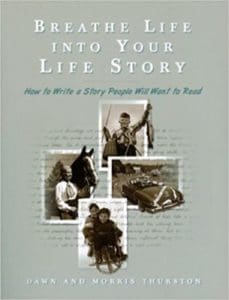
While Church leaders have counseled us to adopt the spirit of Elijah and write our life stories and family histories, they haven’t given us any instruction about how to do it. The truth is, many family histories we’ve inherited from well-meaning relatives could use a little help. Some aren’t particularly interesting because they’re primarily a collection of names and dates arranged into sentences that tell readers what their subjects did, but not who they were. Others suffer from an over-concern about painting family members in a favorable light. Everyone is a model of saintliness we’re supposed to revere and emulate. Of course, these kinds of “stories” are boring to read because we can’t take them seriously.
Dawn and Morris Thurston have written Breathe Life into Your Life Story, a book to help us write the kind of personal and family history we’d all like to inherit from our ancestors, one that’s a pleasure to read. Written for both novices and experienced writers, their book presents techniques to show you how to animate the people in your story so they become interesting, believable characters, rather than mere names on the page. You’ll learn how to re-create the world of your subjects so readers can visualize what it was like to live in their day. The book also treats topics like writing at the “gut level,” dealing with family skeletons, and using techniques that keep readers with you to the end. The podcast will tell you more.

Our Platforms:
Social Media:
Contact us:
MormonStories@gmail.com
PO Box 171085, Salt Lake City, UT 84117
Episode Transcript
Host: John Dehlin · Guests: Dawn Thurston, Morris Thurston
This transcript is machine-generated and lightly edited for readability. The audio is authoritative. Please excuse occasional errors in names and spelling.
Introducing Dawn and Morris Thurston
Dawn Thurston [00:00:00] Sa.
John Dehlin [00:00:50] Thank you for joining us on Mormon Stories. Today. We're very excited to have with us two authors, a couple, Don and Morris Thurston. You've heard a little bit from Morris in a couple previous episodes. So we're going to give the spotlight to Don and put Morris in the supporting role this time, if that's okay. Morris.
Morris Thurston [00:01:09] But excellent.
John Dehlin [00:01:10] But Don Thurston, welcome to Mormon Stories.
Dawn Thurston [00:01:12] Thank you. It's good to be here. John.
John Dehlin [00:01:14] Now, you're sort of a, I would say, maybe not in your words, but I would say an expert on, on people writing their own personal histories. And you have a book here. I'll just give it a shameless plug in the beginning and in the end and maybe through the middle. It's called Breathe Life into your Life Story, how to write a Story people will want to read.
Dawn Thurston [00:01:35] Correct.
John Dehlin [00:01:36] And you also are a lecturer, professor. What would you say in personal histories,
Dawn Thurston [00:01:42] teacher and lecturer wear? Well, I teach at Santiago Canyon College in Southern California in Orange County. I've been teaching there for about 12 years, and I also teach at the University of Utah. I've come up to Utah a couple of times and taught in a couple of their programs.
John Dehlin [00:02:00] And you also put on seminars and lecture more broadly? A little bit.
Dawn Thurston [00:02:05] Yeah, that's correct. We speak at genealogy fairs, family history fairs. We speak. We've spoken six times at BYU Education Week, spoken at women's conference. BYU Women's conference.
John Dehlin [00:02:19] So you've got the personal history stuff down?
Dawn Thurston [00:02:21] I think so.
What Got You Into Personal History Writing
John Dehlin [00:02:22] All right. Well, let's just start a little bit of personal history. What got you into this?
Dawn Thurston [00:02:28] Well, I guess I'd have to start with my marriage. When I married Maury, he was interested in genealogy, and he suggested that we take a genealogy class together at byu. I'm a convert to the church, and as far as I knew, there hadn't been any work done, genealogy work done on my family. He took me to the family history library. I remember the first time looking through a microfilm roll and seeing my grandmother's birth date or her birth record on the microfilm. It just kind of lit a fire under me and I got so excited. She was from Scotland and married to a coal miner. I'm a coal miner's granddaughter. So I wrote a family history about them. And when I finished, I thought, I've learned so much through the process that I could teach others how to do it. So I put together a curriculum and presented it to our local college, and I've been teaching ever since.
John Dehlin [00:03:32] Now, just to throw a tiny bit of a theological slant to this. When Mormons think about genealogy and family history, they often tend to think of, I've got to go do name extraction, and I've got to go, you know, perform a bunch of ordinances. It sounds like there are other aspects to the spirit of Elijah.
Dawn Thurston [00:03:53] Oh, I think so. We're also told by every prophet in my lifetime that we're supposed to keep a record of our lives and get our families, our parents and elderly relatives to record their lives also. And I think it's important that our children know who they came from. It builds a pride in who they are, family pride. And builds self esteem also. And so I think that that's part of the thinking and the instruction we've been given as Mormons to do that. So there's more than just doing temple work involved in family history.
John Dehlin [00:04:29] So family history doesn't just encompass redeeming the dead, but it also is. What's the other mission of the church? Perfecting the Saints.
Dawn Thurston [00:04:38] Perfecting the saints.
John Dehlin [00:04:39] It spans both of them.
Dawn Thurston [00:04:40] Not just redeeming the dead, but remembering the dead, I think is part of it.
John Dehlin [00:04:45] Absolutely. Well, let's just jump right into your book because it's an excellent book. I haven't read it cover to cover, but I've spent some time in here. And you really do take people from start to finish the things that they should think about. So let's just start with sort of a point. Number one, first things first, breathing lessons. What do you want to tell people there? Well, they're beginning. They're thinking about it, right?
Dawn Thurston [00:05:14] They're thinking about it. First of all, I should say that our book, I think, is a little bit different than the typical book that's out there about writing your family history. When I started teaching, I began collecting about every book that there is on the subject. And I got a lot of good information from them that I've used in my classes. But I realized that most of the books focus on memory prompts, things to get people writing, giving ideas, things to write about. But there wasn't a lot of focus on how to write it. And you probably, if you have some family histories yourself. John realized that there's a lot of family histories out there that aren't all that interesting. They're more, I did this and then I did this and I did this. And so being an English major, I had an interest in writing. And so the focus of that book is on techniques to help you write a more interesting life story, rather than just, I was born on and my parents were. But to tell the stories and to tell it in a way that people would want to actually read it. And so you asked about the first chapter, First Things First. I think that that chapter primarily focuses on alleviating some of the fears that people would have about writing about their lives. I noticed that most of my students, when they come, they feel like they want to get something down on paper, but they're also a little embarrassed about it. They think that maybe their lives weren't all that interesting, or that people might think they're arrogant for trying to get their paper, their story, on paper. And so that first chapter is just to give them the confidence and motivate them that they need to follow through on their good intentions, that it is a worthwhile pursuit.
John Dehlin [00:07:09] And you mentioned read to learn. What do you mean by that?
Dawn Thurston [00:07:12] Well, I think it's important that we read the kinds of things that we want to write. There's no better teacher than an author who. Who has covered the same kind of territory that you're trying to cover. So I always encourage my students to read memoirs, particularly memoirs about lives that are similar to their own, because they can learn how to write about difficult subjects, how to make people come alive, those kinds of things. And there's just a lot of excellent examples out there that they can use.
John Dehlin [00:07:44] And here you have I Know why the Caged Bird Sings by Maya Angelou. You have another one. I've read Angela's ashes by Frank McCourt. It is a wonderful, wonderful book. And even Jimmy Carter's book, An Hour Before Daylight. So just some of those for listeners to sort of think about.
Morris Thurston [00:08:02] It also tends to make you think about. You remember things. Almost all of us, if we sat down and had to talk about our lives, we'd say, well, we've forgotten far more than we remember. But as you're reading other people's stories and they have an experience, they tell, you think, oh, yeah, I had something kind of similar to that. And you can make a note or something so that when you go back to writing, you can put it down.
John Dehlin [00:08:28] That's good.
Dawn Thurston [00:08:30] So in our book, each chapter covers a specific technique for how to enhance their stories. And we borrow examples from all the books that we mention, and we give excerpts from those books to illustrate the points that. That we're trying to stress.
John Dehlin [00:08:47] Yeah. And they're often in the margins and things like Samuel Goldwyn once said, I don't think anyone should write their autobiography until after they're dead.
Morris Thurston [00:08:56] We try to get a little humor
John Dehlin [00:08:57] in there, which may not be Particularly helpful in the literal sense, but it is fun.
Dawn Thurston [00:09:03] Well, we don't want somebody writing our biography for us after we're dead. We want to get our story down ourselves so we can tell it the way we should want it told.
Why Everyone Should Write Their Life Story
John Dehlin [00:09:13] You know, I don't know if we're going to jump into this in later chapters, and you've touched a little bit about this, but we really should have you give a really firm plug for why people should consider writing their history. So motivate. And I'm sorry we're doing this a bit out of sequence, but, you know, someone's lived a long life, or maybe they even are midway through their life. Why should they take the time? You know, why not let others tell the story?
Dawn Thurston [00:09:38] Well, you're the one who has lived your life, and nobody's going to get it better, more correct than you are. And why wait and have your granddaughter write your story for you? She didn't live your experiences. She didn't know what it was like to live during the times in which you lived. She didn't know what was in your head. And so you're certainly going to write a better story about your life than anybody else would, and it's going to
Morris Thurston [00:10:04] be primary data for the future historians. Wouldn't you love to have your own great grandfather's or grandmother's journal about what it was like? Or a biography, autobiography, I mean, written by them. You just can't get that same thing if you get it secondhand.
John Dehlin [00:10:24] What about someone who says, you know what my life's not worth, really? You know, I was an accountant, I was a housewife, I live, you know, 68, 70 years, blah, blah, blah, nobody cares. What would you say to them?
Dawn Thurston [00:10:36] Well, I'd say, start writing anyway, and once you get into it, you're going to get excited about your life as you start thinking about it, and you'll realize that, yes, I have had an interesting life. Maybe I haven't done anything that would put me in a history book or made me famous, but I've lived through interesting times. I've made tough decisions, I've survived challenges. And the thing that is the most exciting for me as a teacher of students who are writing their stories, is to see people get excited about their lives as they get to writing about them, and they realize that their lives have been interesting and meaningful. And there's no greater gift you can give somebody than to have them realize that, particularly as they're getting older. And so not only when you write your life story are you giving a gift to your family, but you're really giving a gift for yourself as well.
John Dehlin [00:11:36] And let's just. Oh, go ahead, Morris.
Morris Thurston [00:11:38] Well, I was just going to say Dawn's classes are really quite remarkable. I sometimes have gone and attended for one reason or another. And she has students that have been with her for years and years and years. They keep taking the same course over and over and over again because they love it and they love the opportunity because she has them all write pieces and they take turns reading things they've written in class and they get to know each other on a level that you never would get to know someone in any other sort of a classroom setting. And they get a chance to tell their own stories and they like it so much that she's had people commute all the way from out in the desert. I mean, we're talking two hours of driving to get to a class a week to take it when they move and move away. So people do get excited once they get into it. It's just a question of being able to sit down, get started.
John Dehlin [00:12:35] And let's just end this little segment by talking about the benefit to others. So all sorts of self esteem and accuracy benefits, etc. You know, do you have any way to communicate how much posterity or even those in the present can benefit by a well written history?
Dawn Thurston [00:12:54] Maury, why don't you tell about what happened after your father wrote his life story?
Morris Thurston [00:13:00] Yeah, my dad wrote his story and he's just a normal guy. I mean, he's not any famous person, but he told it in a very interesting way. And his, his children have written him, of course, all of his children, but his grandchildren in particular have just written him these wonderful notes saying how much they appreciated him doing that and how much his life meant to them. He still gets comments from. He's deceased now, but he just died last year. But he would get comments for years after the book was written from his grandkids who were giving reports in school and would use his material like he was in the Second World War as fodder for their material and made them interested in studying about those things. He had people that weren't members of his family. He served for many years as a temple worker and many of the people there at the temple bought his book and read it and said, I was just fascinating with your story. So it benefited him in the sense that made him feel good. But a lot of other people felt good as well.
Dawn Thurston [00:14:13] You know, some of my students will complain to me because they feel like their children and Grandchildren aren't interested in what they're writing right now, and it may be that they don't show an interest in it while the authors are alive. But I'm sure that at some point they're going to really treasure having that memory.
John Dehlin [00:14:33] When life gets complex, you will take any resource you can take to help you work through the complexities of life.
Dawn Thurston [00:14:41] I just want to mention one other thing, too. I've had several of my students pass away over the course of the last dozen years, and I've attended their funerals, and a number of their stories have been read at their funerals. So if you want to have an interesting funeral, maybe you ought to write some stories about your life.
John Dehlin [00:14:59] And if you want to help shape what's said about you at your funeral, that's true. Okay, well, let's go to your second point in the book, the power of showing. Give your story the breath of life. How do you do that?
Dawn Thurston [00:15:12] Do you want to talk about that or should I?
Morris Thurston [00:15:13] Oh, you're the expert, Don.
Dawn Thurston [00:15:16] Well, I'm not. We do this together. But if you pick up any writing book, almost all of them will stress show, don't tell too often.
John Dehlin [00:15:29] This is text, so tell us what you mean by show.
Dawn Thurston [00:15:32] Okay. Well, it's integral to creating an interesting story. You could say you had a crotchety uncle, and that's telling. But a novelist would not say somebody had a crotchety uncle. He would show that uncle being crotchety by creating a scene where that uncle was complaining, slamming doors or whatever. And so the reader would infer that the uncle was crotchety. And so you can do the same thing when you're writing a family history or a life story. One of my students this last week was writing about the early years of her marriage, and she had a neighbor who was overweight. She was fat. Actually, instead of saying she was fat, she said her ankles rolled over her folded over her white laced shoes. And after she read the story, the class was. We had a critique period and people commented about that. And she said, yes, I finally learned that you show. You don't say someone's fat. You show they're fat by describing something about them. So readers can understand that. And it makes all the difference in how. How interesting a story is. And so you do things like recreating scenes from your past, including dialogue.
John Dehlin [00:17:05] There's lots of ways to show recreating dialogue. Now, what about the historicity questions of that?
Dawn Thurston [00:17:11] Well, a lot of people worry about that, and I always tell the students that if they're recreating a scene from their past. Generally, they can remember pretty much what was said. They try to get people talking in their stories, and it makes all the difference in how interesting it can be. You get father telling a story like he would have told around the dinner table when you were growing up, and the writer tries to recreate that voice, some of the mannerisms he had, some of the expressions he had. I tell them that in their introductions, they give a disclaimer where they say, I've tried to recreate the conversations to the best of my ability to heighten the interest of the story. I realize I haven't gotten everything exactly right that way. It protects them.
John Dehlin [00:18:07] Yeah, that makes sense.
Morris Thurston [00:18:08] And I think the important thing there is the truthfulness of the sentiment that's being expressed and not necessarily whether the exact words were being used. Most people probably realize, and if they don't, they should, that any memoir you read is only that person's view of what happened some time ago right now. And any dialogue you read in a memoir has been recreated because no one tape records this. You mentioned Angela's Ashes. That was a best seller, and maybe a lot of your readers have read that as well. But Frank McCord is remembering things about his childhood when he was 6, 7, 8 years old, and putting words in the mouth of his family. And if you think back, I'm sure you don't remember any specific words of any conversation you've ever had at that age. And yet, as you read through the book, we were enthralled with it, and we didn't feel like he was lying about things. We just enjoyed the story.
John Dehlin [00:19:06] Right, right. Well, I'll end with a little quote. This section you write, if a writer does not show us his suffering, he will not elicit either sympathy or interest. And so, you know, especially if someone's going to go about the trouble of writing a history, you better darn well make it interesting, otherwise, why bother? And this is an important way to do it.
Dawn Thurston [00:19:29] Well, there's a lot of unread family histories that are sitting on people's shelves. They're nice remembrances, but they very rarely get read.
John Dehlin [00:19:39] Right. So we don't want that.
Dawn Thurston [00:19:40] No.
John Dehlin [00:19:41] Okay, zoom in on key events or lights, camera, action, or as Raymond Chandler says it in your book, when in doubt, have a man come through the door with a gun in his hand. What are you saying there?
Dawn Thurston [00:19:58] Well, this is a chapter about recreating scenes from your life. And again, it's a form of showing. Instead of saying that, when I was in college, I belonged to a sorority, and I got involved in all kinds of fun pranks on campus. And that's summarizing, but why not recreate one of those pranks where your roommate comes to you and says, such and such is going on tonight. Let's go out. And I've got. I've borrowed a car and let's go out and do such and such a thing. And you actually take your reader step by step through that incident. There's no better way to make your life come alive for your reader than to do that. Frank McCourt did that in Angela's Ashes. Most of the memoirs that we cite in there as good examples do that. They take scenes from their lives and retell them so you feel like you're in the moment with your reader.
Scenes, Showing, and the Craft of Memoir
Morris Thurston [00:21:04] A lot of people have a hard time understanding what a scene is. When we teach our students, that's the one thing that they don't quite get, because we'll tell them to put something in a scene, and what will come back is not really a scene. So one way that we try to help them understand is to think of it in terms of a movie or a dvd. You know how you have scenes on a dvd. A scene takes place at a specific time in a specific place. It's not five days, or I used to do this, but it was on this day. This is what happened at this place, and that's what you describe, and that's a scene.
Dawn Thurston [00:21:46] Writing a scene requires creative writing techniques that a lot of us haven't had much experience with. And so people are fearful of doing it or trying it at first until I get them to practice it in my classes and. But when we're in college or in the workplace, we're primarily doing expository writing, where you're summarizing experiences you've had writing reports, that type of thing. So we haven't had a lot of training in doing it, but it's something that if you learn how to do, you can really enhance your life story.
John Dehlin [00:22:21] And just to sort of close on this one element, you have a quote in the sidebar that says, the reality is that authors of all the best memoirs take dramatic license of some sort, and we all know it, although we likely don't think about it very much now. You know, we, you know, in the LDS tradition, we have the example of Paul H. Dunn, who obviously maybe embellished a little bit too much, but. But it does sound like here you're saying, you know, don't worry, you know, accuracy is important, but don't worry about adding a dramatic flair and even some license. You know, don't let the facts always get in the way of a good story, in other words. So how do you. Is that what you're saying? And how do you. Am I acknowledging something that's a difficult thing to navigate? You know, what are your thoughts on that?
Dawn Thurston [00:23:10] Well, it's essentially, that's what we're saying, but we're also saying to let your readers know that that's what you're doing.
John Dehlin [00:23:18] Okay.
Dawn Thurston [00:23:18] So it protects your integrity as a writer. Now, there have been a number of people who. Who have made the front pages lately. James Fry, for instance, whose book, what was it, A Million Little Pieces. He's gotten into a lot of trouble for recreating incidents from his life because
John Dehlin [00:23:33] he didn't provide the appropriate disclaimer. Right?
Dawn Thurston [00:23:35] That's correct.
Morris Thurston [00:23:36] Well, beyond that, I mean, there is a point, I think, where a memoir becomes a novel fiction. And while you can recreate scenes and dialogue that capture the essence of an event that actually happened, it's quite another thing to invent the event. In other words, you don't tell people that, you know, you graduated from BYU when all you did was attend three classes and drop out.
John Dehlin [00:23:59] Yeah, right, right, right. And a final question is, I imagine people are going to try and shoot towards a specific length of a book. And so they obviously have to make a trade off between sort of telling, you know, covering the chronology and embellishing, or not embellishing, but dramatizing the events of the narrative. And so that's kind of a trade off, isn't it? And sometimes you could get so much into narrating the scenes that you're 300 pages in and you're only a third done with your life.
Dawn Thurston [00:24:35] Well, you make an excellent point. And there's no way that you can recreate a scene for every event in your life. And I always recommend that you pick incidents that would make good scenes a funny experience. You had a high point of your life, getting engaged, getting married, an embarrassing situation, things that would be colorful or poignant that would add a lot of interest to your book. And then you make transitions between those scenes by just summarizing and using your expository writing. So it's a combination of both.
John Dehlin [00:25:14] Part of it to keep people's interest, part of it to sort of help illustrate in an emotional way something that was significant, that maybe someone would have gotten lost or lost interest in reading the. The chronology, but the story pulls them in.
Dawn Thurston [00:25:29] That's correct.
John Dehlin [00:25:30] So it's Really a balance. It's kind of like icing and the cake itself and having the right combination of the two.
Morris Thurston [00:25:35] Right.
John Dehlin [00:25:35] To sort of make it a pleasant experience for the reader, listener. Okay, so writing at the gut level, let your feelings show. William Wordsworth from your book says, fill your paper with the breathings of your heart.
Dawn Thurston [00:25:50] That's a good quote, isn't it?
John Dehlin [00:25:52] That sounds dangerous. That sounds risky.
Dawn Thurston [00:25:56] It is. A lot of people are very fearful of getting their feelings out there, and they keep their readers at an arm's length. Your goal in writing your life story is to let people know who you are, to get to know you. And when you don't disclose how you feel about what happened to you, when you only record what happened to you, they're not going to have any sense of who you are.
John Dehlin [00:26:25] If you don't show that you care, how can you expect them to care?
Dawn Thurston [00:26:28] Well, that's right. You want your story to feel human, you want it to feel warm, and you want your personality to show through. And the only way you can do that is by showing how you feel about things. And I've had a number of men as students over the years. I seem to get a lot of engineers in my classes, former engineers, and they have a lot of trouble with this because they're used to dealing with facts and figures and names and dates, and they're very comfortable describing what their home looked like growing up, but they can't get at how their home made them feel while they were there. I had one student talk about sitting in his office and someone coming in and reporting to him that President Kennedy had been killed. And then he just went on with his workday as he described it. And I said, well, how did you feel when you heard that? I mean, that's what your children and grandchildren are going to want to know. They know that President Kennedy died in, what was it, 1963, but they'll want to know how you felt about it, how it affected your life. And that's what needs to get into your story.
Handling Difficult People and Sensitive Topics
John Dehlin [00:27:36] So this brings up something that, in my experience, can be really sticky. You know, families are wonderful, and they can also be very messy. Divorces happen, infidelities happen. Substance abuse happens. Abuse. All sorts of really nasty things happen. Right. And, you know, that makes things really sensitive, and it makes things touchy, let's say, even for a Mormon audience. You know, the church has given an example a bit in the past that says, let's focus on the positive. In fact, in general conference, they've even said, we don't believe in airing dirty laundry. So what advice that was given a year or two ago in General conference? So I'm not trying to put you against the Brethren at all, so forget I even told you that. But what advice do you guys give people about the tough stuff, the really tough stuff?
Dawn Thurston [00:28:30] Do you want to talk about it first?
Morris Thurston [00:28:31] Oh, you want me to contradict it, brother? No, I think actually Don and I both feel that when you read some of these tell all books where just every horrible thing that ever happened to somebody is spilled out on the page, we. We don't even like to read those books. But obviously some people do or they wouldn't be published.
John Dehlin [00:28:57] Most people do, actually.
Morris Thurston [00:28:59] Well, maybe so. But I think our feeling is that as long as you're honest about things, sometimes, particularly in a divorce situation, it's very hard to be honest and objective. You're telling your side of the story, but why did the divorce happen? Was it all the other person's fault or not? And if you feel like you can step back and be honest and give other people their due, then I think we would say you should get that out there if it's important to your story. Now, you shouldn't just be telling things that aren't important to your story about someone else. But if it's important, it should be there. And the only really qualifying, in my mind factor is that if there are people whose lives are still being formed, and if your opinions are still being formed, maybe some of these difficult things you ought to write about, but kind of keep to yourself until things have gelled a bit. I'm thinking specifically about children. That's a difficult relationship to write about. And their lives may be changing. They do change. We've experienced that as parents. And you will, as your children grow. And to put something down about a child on point A, when they may very well turn out to be point B and publish, it could damage a relationship that you don't want to have damaged. And so I would recommend people kind of hold back on that. But other than that, I think honesty is the best policy.
Dawn Thurston [00:30:34] You know, your question is one that more students are concerned with than almost anything else. Because we all have had difficult things happen to us in our lives, and we've had difficult people we've had to deal with. And how honestly should you present them? As Maurice said, people nowadays are telling everything. And yet most of us have grown up at a time where we want to keep skeletons in our closet. However, there are a lot of family histories out there that don't get read because the authors have painted everybody to look like saints. Grandfather is a paragon of virtue and integrity. And you read it and it just doesn't ring true because we all have faults. And so I think that there's a happy medium. And I always stress that you want to show all sides of an individual. You don't want to paint somebody as a saint, but you don't also want to paint them as a complete sinner. Also, if you can bring out reasons why people act the way they do and try to balance the good with the bad and you're being fair. And I think it's important that we treat people fairly. We are holding whoever we write about. We're holding their reputations in our hands, actually, because it's going to be on paper for anyone to read for all time. So we have to be very circumstantial in how we tell the truth. Just a quick example. My grandfather was an alcoholic, and it played a big role in our family when I was growing up. I'm a convert to the church, and my grandparents were not members of the church.
John Dehlin [00:32:23] But even members have that problem.
Dawn Thurston [00:32:25] Well, sure, or they have some other kind of problem. We often didn't go to their house because it was kind of unpredictable how he would be. And yet when I write about that situation, I'll want to bring out the fact. Some reasons why he used alcohol to kind of medicate himself. There were reasons for it. If I bring those out, it's being more fair to him. And I also intend to show his good side because he was a wonderful man when he wasn't drinking. And I have great memories of my associations with him. And so I would want to show that also. So I think there's ways of treating difficult situations. I always say tell the truth with love. And I think if you can do that and kind of balance everything, then you're going to have a story that rings true, but also is fair for others.
John Dehlin [00:33:22] My wife is fond of telling me that honesty without compassion is cruelty.
Dawn Thurston [00:33:26] Oh, that's good. Yeah, that says it well.
John Dehlin [00:33:30] Well, that's excellent. Well, that's a. That. That's a great chapter. All right, next. Next topic is writing about people. Breathe. Breathe life into your characters. How do we do that?
Dawn Thurston [00:33:49] Well, we just talked a little bit about that by being honest and showing all sides of them. But also there's a lot of techniques that you can use that fiction writers use to make their people, who are just products of their imagination, seem like real people. And when you're Writing about people you have known, there's no reason why you can't make them more than just names on the page. You can show what they look like, not just saying that they're tall and chubby or whatever, but go into more detail, showing. Actually showing what they look like, how they dressed, what some of their mannerisms were, that kind of thing. Revealing personalities. Not just summarizing, but going into detail, showing them an action by recreating a scene that you put them in. Those are just some of the ways. Can you think of.
Morris Thurston [00:34:53] Well, I was just thinking, as you were saying that, how valuable it is to be a reader, but reading with a purpose. The next time you read a book, a good novel, or even a nonfiction book, see how the author has described the characters. What came to my mind immediately was Levi Peterson's the Backslider. You've had Levi on your podcast. I just was enthralled with his descriptions of those folks down there on the ranch. I remember one in particular of. He described somebody, I think, as having the figure of an inverted triangle. No, a triangle. You know, narrow at the top and fat at the hips. But he did it in a. This was a person that in the book was a lovable person. It was the mother of the. Of the girl that our hero married. And so, you know, I would read that book of Levi's and say, what did he say about these people that made them so memorable? And then think about the people in my life, and how could I paint a memorable picture of them?
John Dehlin [00:36:00] I have to just throw in here that I would buy this book just for the quotes alone.
Dawn Thurston [00:36:05] But I've been told that before.
John Dehlin [00:36:07] I'm going to read a couple in this chapter, just for fun. Dave Ben Gurion, who is what, the former leader of Israel back in the days. Anyone who believes you can't change history has never tried to write his wimoirs. That's a good one. And George Bernard Shaw said, a good storyteller is a person with a good memory and hopes other people haven't.
Dawn Thurston [00:36:31] There you go. Yes.
John Dehlin [00:36:33] But something you write in here, just to close off this section, is really. I think it's a really good one. You say write with your nose, your ears and your fingers, not just with your eyes.
Dawn Thurston [00:36:48] Right. Most good novelists, if you. If you examine their descriptions of people and places, they're bringing in lots of sense details, how things smelled, how things felt to the touch when you're writing about people. When I think about my father. My father worked in a cabinet shop whenever I was around him, he smelled like sawdust. My grandfather smelled like cigar smoke because he smoked cigars. Our piano teacher may have smelled like talcum powder. When you bring in details like that, they seem more real, realistic. The same with the sounds of voices that people have, or the feel of someone's arm when you touch them or when they put their arm around you, what that felt like. Those are all sense details that you would include in writing about people. And the same with places, too, which you may be getting.
John Dehlin [00:37:50] That's a great segue. So writing about places put your life on the map. Well, you say it's not enough to mention a town and a date. You need to paint a picture of an environment rich with the sights, sounds and smells you knew when you lived there. Ground your story in a time and
Dawn Thurston [00:38:09] place that summarizes it very well. My parents courted in San Diego, California, during World War II. If I just left that as the sentence summary of that time period, that place. My children would picture San Diego as it is today. A resort area, a vacation spot. However, in order to make that time come alive, I need to describe San Diego as it was filled with sailors in their uniforms. Motels and apartments that were hard to get into because so many people were living there. Streetcars down the street, going up and down the street is the main form of transportation. The harbor filled with ships waiting to take the sailors out. And we need to do that as we're describing any of the places we lived growing up. We need to bring in the sights, sounds, smells of what it was like when we lived there. Same with our ancestors. If we were writing a family history, we need to do that research.
John Dehlin [00:39:12] Yeah, because context is everything, isn't it?
Dawn Thurston [00:39:14] It is.
John Dehlin [00:39:15] And any. Any good movie, it all starts out. Think of a Broadway musical starts out with the. You see the scenery, the town, and you see the streetcar going by, and you see the milkman or the flower girl walking by and. Or the deli or the butcher. It sort of paints this scene for the rest of the narrative to unfold.
Dawn Thurston [00:39:33] It does.
Morris Thurston [00:39:33] Jimmy Carter does a good job of that in his memoir about planes and grand growing up in rural Alabama.
Dawn Thurston [00:39:40] Georgia.
Morris Thurston [00:39:42] I'm sorry. We have another Alabama, don't we? And for me, you know, I grew up not far from where we're sitting right now in Hyde Park. I didn't grow up there, but I spent my first young years there, and I went back every summer after that. And so that will be an important part of my memoir. But Hyde park of my youth is not the same as Hyde park today, which is kind of a suburb of the Logan and, and it's starting to be a little bit more of an upper class place. But then it was just a small farming cow town and the best, the thing people always remembered were the different cow herds being driven down Hyde Park Lane. And, and you could, five o' clock in the afternoon, you had to wend your way through about three or four of these cow herds in order to get home. Those are the sorts of things that you need to tell because your children and grandchildren will have no idea if you don't.
Recreating Your World and Historical Context
John Dehlin [00:40:34] So for the next section entitled Recreating your world, Establish youh Life Context, that, that seems to extend from the location and you write. For many young people, the world you grew up in will seem to be as foreign as the frontier prairie surroundings of Abraham Lincoln. Is that possible?
Dawn Thurston [00:40:53] It is, isn't it? I think so.
John Dehlin [00:40:56] You mean your life growing up was different than mine?
Dawn Thurston [00:41:00] Yes, it was.
John Dehlin [00:41:00] Not that we're different generations.
Dawn Thurston [00:41:02] Yes, we are different generations. And it's true that we need to. You know, there's a lot that informs the context of our lives. It can be the family we grew up in. If it was a large Mormon family, it's going to be a different experience growing up than if it was a small Buddhist family, for instance. Other things creating your context would be the community in which you lived, the events that occur during your lifetime, the challenges you may have had during your life, the trends, the things that are popular pop culture as part of the context of your life. I went to high school when the Beatles came on the scene and I have a particular love for the music of that period. My sense of ethics, morality comes from that period. Growing up as a member of the church during that period and the things I was exposed to and we're all that way, we're all shaped by the context of our lives. It shapes our career choices in many cases.
John Dehlin [00:42:16] I'm 38 and I have a 12 year old. I once went through trying to explain to my kids how my life was different than theirs. And you wouldn't think, I wouldn't have thought, you know, that in 20 years, 25 years it would be that different. But there were no microwaves, there were no cellular phones, there were no computers, no personal computers. You know, the differences are just, they really are stark just between one generation.
Morris Thurston [00:42:44] When I write about what it was like to be a young lawyer starting out when I graduated from law school, young lawyers today can't comprehend what that would be like, to sit there and not have any computer, not only not on your desk, but not on your secretary's desk. Your secretary. We had a very strict policy in our firm that if you typed a letter, it was to be on bond fine letterhead paper. And if there was one typographical error on that page, she retyped the whole page. There was no white out allowed on letters to clients. And so that, plus, you know, research today, a lawyer today, if he's going to find a case, pops on his computer, he puts in a few keywords, out jumps 30,000 cases. In the old days, you walk down to the library, you pulled out Shepherd's citations or whatever or some treatise, and you read it for a while, and then you copied down the names of all the cases and the citations, and then you found another place in the library where the book was. You pull the book out, you look at that, and it's just an entirely different experience.
Dawn Thurston [00:43:50] A lot of my older students grew up during the Depression, and they loved to tell about those times because they were very difficult times. And it's a way of teaching their grandchildren why they think the way they think about certain things, particularly money. Making decisions, being careful about, making choices about purchases. And when they write about the poverty they lived in, the food rationing, the fact that they had an outhouse instead of a regular plumbing, it's a way of opening up a window into who they were as children. And they're hoping maybe their grandchildren, great grandchildren, will say, oh, that's why grandma thought the way she did. No wonder. If I'd lived during those times, I might have been more careful about buying my first home or whatever.
John Dehlin [00:44:42] Absolutely. In the next chapter entitled Linking your life with history, where were you then? You write, future generations will find your story more compelling if they can link it with something they have read in history books or studied in school.
Morris Thurston [00:44:59] Well, I mentioned my dad and his experiences in World War II and how his grandchildren have just really enjoyed that, even though he wasn't a big World War II hero, but just knowing where he was and what he did. And for me, I was in Norway on my mission when President Kennedy was shot. Perhaps one of the most important events in the lives of people in my generation. And so for me, not to tell about that would be really cheating my descendants of something. And now, as they read in school about President Kennedy being assassinated, they could go to my yet unwritten memoir and read about how when I came back from tracting and my landlady in Norway met me with an ashen look on her face and said, did you know your president has been shot? And so those are the sorts of things. We've all had those experiences. What were your listeners doing when that happened or when today the signal event, of course, is the twin Towers and the bombings there or the planes flying into them. And when that happened, Don and I were both teaching. I actually was teaching a Sunday school class on writing. And I told my class members to all go down and write about how they felt about it. And I actually, for once, took my own advice and did it myself. And just recently I put up some of my thoughts about the war on my blog, on my website. And Don read it and said, how did you remember all that stuff? And I said, well, I wrote it down at the time, but these are the sorts of things you want to comment on when you write your biography or autobiography.
John Dehlin [00:46:50] Hey, writing here, don't make your descendants wish you had written about the historical people you knew. Describe your experiences and share your feelings about them.
Morris Thurston [00:46:59] Yeah, my great, great grandfather Edson Barney was a friend of the prophet Joseph Smith, and he was in Zion's camp. He knew the prophet intimately. And he did write. I've got a paragraph or two about Joseph from him, so I give him the credit for that. I wish he'd written a chapter or two about Joseph. I would have loved to have had that. Others of my ancestors who also knew Joseph, we have a family rumor that one of them was a horse fanatic and loved to race horses with the prophet. Boy, I'd like to know more than that about that. They must have known it, but they haven't written about it.
John Dehlin [00:47:42] Sure.
Dawn Thurston [00:47:43] Another part of that chapter that's important is sometimes our families chose to move at certain times because of something that was going on in the larger world. Perhaps there was an economic downturn or a war or something that caused our families to do a certain thing. And it's important to look at, as we're writing about events in our lives, to look at what perhaps was going on in history that may have caused you to be born in a certain location. Maybe it was because of something larger that was going on rather than something more serendipitous.
Morris Thurston [00:48:26] Sometimes it requires research or thinking about it. I had a student who had moved to. Her family had moved into northern or into Idaho, I think it was, or perhaps eastern Oregon. And she said, ah, my knife. Nothing had to do with history in my life. I don't have anything to write about. I said, well, why did your family move there? And she said, oh, the grand Coulee Dam had been built, and that opened up a bunch of new agricultural area there. And I said, bingo. I mean, the Grand Coulee Dam is one of the marvels of the world at the time. Go down to the library, find out about that and put a little introduction to that segment of your life about the Grand Coulee Dam and how it got to be written. How it got to be built.
John Dehlin [00:49:11] Absolutely. Well, that's good stuff. The next chapter you have is intriguingly entitled the Hitchcock Rivet Readers with Conflict and Suspense. And we've talked a bit about this. I have to share a few Hitchcock quotes. You write Hitchcock saying, drama is life with the dull parts cut out. And you also have him saying other things later as well. I won't quote, but you also have the quote. We've talked about this. When you sugarcoat, downplay, or omit thorny life experiences, you sacrifice honesty, lose reader interest. So what can we say about this that we haven't already said?
Building Drama, Conflict, and Suspense
Dawn Thurston [00:49:54] Well, that chapter is primarily about techniques for telling a story. We've all had events in our lives where maybe our lives have been in danger or we've worried about achieving a particular goal. And there's lots of things that get in the way from us achieving that goal. We have time constraints, we have health issues or something like that. That chapter directs you how to write about those incidents in a way that builds up the tension so the readers are rooting for you and wondering how it's going to turn out. Are you going to be able to achieve the goal you had? Are you going to make a certain deadline? It's all about choosing good, strong nouns and verbs. It's all about pacing. It's all about not disclosing the outcome at the beginning, letting them worry about you a little bit.
John Dehlin [00:50:54] Sure, sure. And you write from Sydney Sheldon. Usually when people get to the end of a chapter, they close the book and go to sleep. I deliberately write my books so when the reader gets to the end of a chapter, he or she must turn one more page page. When people tell me I've kept them up all night, I feel like I've succeeded. So write a page turner. We'll end this chapter with Alfred Hitchcock also saying, give them pleasure. The same pleasure they have when they wake up from a nightmare.
Dawn Thurston [00:51:30] Well, you can take the smallest incidents, but the way you tell it can make it so much more interesting and satisfying for the reader.
John Dehlin [00:51:40] Sure. All right. Next chapter is what's essential and what's not, cutting the clutter. And I don't Even know what the quotes are here. But I will say, in the programming world, in computer programming, they say the best code, you know, you don't know. You're not done writing the best code. The question is not a matter of how much more code there is to write. It's sort of ending good code by saying, you know, that you. I've just. I've just mastered it. But it's about what you've taken out, not. Not what you've actually added. So forgive me for masquering the introduction to this section, but redeem me.
Dawn Thurston [00:52:20] Well, the same thing could be said for writing too. I think sometimes in the interest of telling a story, people put in too much extraneous detail when they could get to the point more quickly. And I think often it requires perhaps doing a small outline to begin with to decide what you want to say and then putting in as much detail as you can, but not going off on tangents. In my classes, I make my students conform their writing to only three pages. And they complain when they turn in a story. To me anyway, it can't be any longer than three pages. And what it does, it just teaches them how to write tightly so that they start with a paragraph that grabs your attention and they're right in the middle of a story, rather than taking a lot of paragraphs to introduce it and give all this backstory.
Morris Thurston [00:53:16] I found it amazing when I was teaching and I'd get the stories, how often I could take the first two or three paragraphs and just cross them out and the story would be better. And I find that with myself, I'll be writing and writing and writing, kind of explaining, you know, how I get leading into the story. Then I'll tell the story, then I'll go back and read it and I'll realize that those first two or three paragraphs were just. The only purpose they served was to get my own mind moving. But once that happened, they need to be cut. The hard thing is, it's hard for anyone to cut because that's the baby. You spent time writing it, by golly, if you wrote it, it's going to be in there. Maybe that's where an editor comes in. But if you can self edit, that's the best.
Dawn Thurston [00:54:00] Sometimes people use too many adjectives and adverbs to make their point when a stronger single verb or noun would create more of a visual impression. So that's another thing that we focus on in that chapter.
John Dehlin [00:54:17] Yeah. Mark Twain writes, I noticed that you use plain, simple language, short words and brief sentences. That is the way to write English. It is the modern way and the best way. Stick to it. Don't let fluff and flowers and verbosity creep in. When you catch an adjective, kill it. No, I don't mean utterly, but kill most of them. Then the rest will be valuable.
Dawn Thurston [00:54:38] That's true,
John Dehlin [00:54:41] but that is a bit of a pain to go to all the trouble to write it and then have to rewrite it and rewrite it and rewrite it. I mean, some people are lucky just to write it once.
Dawn Thurston [00:54:51] That's right.
John Dehlin [00:54:52] So how do you make the case that they need to write it again and again?
Dawn Thurston [00:54:55] Well, I always tell, you know, I'm instructing them to write an interesting story, but I always say, listen, the most important thing is that you get something down. Just get anything down. And then if you have time, go back and work on it and polish it. The greatest writers in the world write and rewrite their stories over and over again. And it's just often novice writers are surprised that you have to do this. They feel like the good, perfect words are going to come out of their head right off. And it isn't until later that they realize that, like anything, you have to practice and work at it until it gets good.
Morris Thurston [00:55:39] And we don't want to discourage people from writing either. I mean, the last thing we would want would be if someone were listening to this podcast and then said, oh, gosh, I could never do all that. I don't have time. The key is just what we say is to write a really terrible first draft, get it all down. If you die, at least your kids have got that. But the chances are that you'll have time to go back at some future time and polish it up a bit. Probably the worst thing is to stress about it as you're writing and write and rewrite and rewrite that first page of that first chapter and never get to the second chapter.
John Dehlin [00:56:16] So get it out.
Dawn Thurston [00:56:17] Yeah, right. And don't edit as you go along, but to just get that first draft down. Actually, the first draft is the very hardest. And when you go back and you start polishing, that's where the fun part comes in. At least for me anyway, because we move things around and delete and prune and polish to your heart's content.
John Dehlin [00:56:37] Sure. Well, good. Well, in the next section, you have Gabriel Garcia Marquez saying, one of the most difficult things is the first paragraph. I've spent many months on a first paragraph, and once I get it, the rest just comes out very easily. And this is the quote used in the chapter called Beginning With a Bang,
Getting Started and Following Through
Dawn Thurston [00:57:00] we put that chapter at the back, purposely. It seems kind of incongruous. It seems like it ought to go at the very front of the book. But we put it back there because people stress over how they're going to begin their stories, how they'll begin their book, how they'll begin their chapters. And generally you don't know how your memoir, your life story, is going to turn out until you finished it. And so why worry too much about the beginning? Often you're going to change things around. The focus may change as you get going. I know when I was in school, I used to stress over that first paragraph, and I'd never get the thing written. It took me forever. And when I learned that, you just get it down and then you go back. And generally as you're writing, you'll get more of a sense of how the beginning should. What it should be about and how it should be written.
John Dehlin [00:57:58] So you recommend writing the beginning sometimes towards the end of the process?
Dawn Thurston [00:58:02] Yes.
John Dehlin [00:58:03] Because it's an important part.
Dawn Thurston [00:58:04] Yes.
John Dehlin [00:58:04] It grabs them. It's a hook. Right.
Morris Thurston [00:58:06] It's a very important part. And you're not going to really know what that part is when you first start off. You can write a beginning if you want, but chances are you'll come back and change it. There's a variety of ways to start a book, and we give a number of examples in there. But we also encourage people just to go pick up some books off their bookshelf that are kind of similar to what they might be writing, history books or memoirs or whatever, and read about five or six first opening paragraphs. You know, how did they do it? A lot of people start with scenes, for example, or they start with a high point in their life or even a low point in their life. The book about Gordon B. Hinckley that his biography started with, when he walked out and faced the press corps after being called to be the new prophet of the church, didn't start with him being born in some log cabin in Utah or wherever it was. I'm being facetious, talking about Abraham Lincoln, but you very often want to start at a critical point, your life, and that will grab the reader in, and then you can go back and talk about your birth and that sort of thing.
Dawn Thurston [00:59:20] Too many people begin their life stories with their birth, which is probably the least interesting part of your life. So if you can come up with something, a fun, fun example, something that captures who you are, then you're going to keep your readers with you.
John Dehlin [00:59:36] And as you say in the book, middles and endings make better beginnings.
Dawn Thurston [00:59:40] Correct.
John Dehlin [00:59:41] And I'll just encourage the, the future readers of this book, they talk about, you know, different types of beginnings from the Stephen King approach, the James Michener approach, the Geraldo Rivera approach, the Hamlet approach, Benjamin Franklin. And I'm not going to have us tell them any of those approaches. So they'll buy the book.
Dawn Thurston [01:00:02] Good.
John Dehlin [01:00:03] So we'll leave that to their initiative. So we basically have one more chapter before the conclusion and that's jump starting. Your imagination. Story ideas for the stumped.
Dawn Thurston [01:00:18] Well, that chapter just includes a lot of questions. It's kind of the thing that you see in most life story writing books, just some writing prompts to give them ideas of topics, subjects, incidents in their lives they could write about. And there's a lot of them there. If they followed just half of those, they would have a good start on their story.
Morris Thurston [01:00:41] The one thing we do in the book too, and you've probably noticed it as you read, is in every chapter we have little blocks called learn by doing. And we have little homework assignments, things, you know, write this, write that. And if people were reading the book and actually did each of those learned by doing assignments, by the time they finished reading the book and did the assignments, they would have a great start on an autobiography.
John Dehlin [01:01:10] And just to share a few of the quotes from this chapter from I can't not mention a Monty Python member. You have John Cleese in here saying tension is wonderful for making people laugh. That's a good one. I agree. You have a Jewish proverb which says tell people the facts and you enlighten their minds, but tell them a story and you touch their souls.
Dawn Thurston [01:01:37] That's what our book is about, getting them to tell stories.
John Dehlin [01:01:42] Very good. All right, well, you know, your last, your final chapter is entitled breathing on your own, Steady to the end. Go ahead and tell us a bit about what that's saying. And if you want to just summarize for those who are contemplating their history, what final thoughts and feelings and encouragement you want to leave with them.
Dawn Thurston [01:02:04] Well, I wrote that chapter just to it's kind of a final motivational chapter to get them to follow through. Often people will read how to books writing books and they'll say, oh, isn't that nice? And it actually substitutes for the actual writing. So I open that chapter with a couple of examples from I mentioned John Grisham and how he somehow was able to write novels while he had a full time law practice and he would get up early in the morning at five o' clock and put in an hour or two before he began work. I mention J.K. rowling, richest woman in Britain, who single mom, would go to a cafeteria with her child in the stroller and had a good idea and began the first Harry Potter book. The chapter is really about making time to do it.
John Dehlin [01:03:09] Can we just throw one in?
Dawn Thurston [01:03:10] Yes.
John Dehlin [01:03:11] We have our own Juanita Brooks, who was just a housewife in the 50s. She was also a schoolteacher and she used to write and do her historical research in the ironing closet of her house and would take overnight trips to the Huntington Library to do her research while raising, I believe, five children.
Morris Thurston [01:03:32] Yeah, yeah. There's. People accomplish amazing things and no one really has an excuse for not writing their story and leaving it for their descendants. And we just, we just try to encourage them that to get started, do a little bit each day. If you wrote a page or two each day, by the time the year is over, you got a 300 page book.
John Dehlin [01:03:57] Yeah. And Don, I cut you off, please.
Dawn Thurston [01:04:00] Oh, let's see. I was just thinking of a student of mine who has cerebral pain palsy. She has a severe case of it and she uses a stick that she holds in her fist. She can't hold it in her fingers and she uses it to hit the keys on the keyboard of her computer that's specially outfitted for people with her disease. And she writes all the time and it takes her a tremendous amount of time to turn something out, but she is motivated. It's her way of communicating what she can't express through words. And if we want to do something, we'll find a way to do it. No matter. And I think Maury and I both feel so strongly about the importance of writing your family histories that we need to make it a priority in our lives and set aside some time either each week on Sunday afternoons after church, when we just do a little bit. And after weeks of this, you're certainly going to be able to accumulate enough that you're going to have a good story. It may take a while to do it, but if you're steady and you focus on it, you'll be able to accomplish what you set out to do.
John Dehlin [01:05:14] Well, excellent. Well, any final thoughts or feelings before I promote shamelessly the book again?
Morris Thurston [01:05:22] I always let my wife have the last word.
John Dehlin [01:05:24] That's a smart man.
Dawn Thurston [01:05:25] That's not so.
John Dehlin [01:05:26] That's a wise man.
Dawn Thurston [01:05:28] Can we promote our website?
John Dehlin [01:05:30] Oh, please.
Dawn Thurston [01:05:31] All right. If readers are interested in learning more, I have a brand new website called memoirmentor.com and it gives a lot of this information, especially focused for people who are interested in writing their life stories. We have excerpts from the book. I have a blog there focusing on this topic. And we also put together some podcasts so you can hear our voice even more if you're interested.
John Dehlin [01:06:00] So it's memoirmentor.com.
Dawn Thurston [01:06:02] correct.
John Dehlin [01:06:03] All right.
Morris Thurston [01:06:04] Me M. How do we spell I?
Dawn Thurston [01:06:07] R, M E, M, T O r dot com. Yes.
John Dehlin [01:06:11] So how do people get this book?
Morris Thurston [01:06:14] They can do a number of things. They can go to Deseret Book. It's carried there, and if the branch doesn't have it, ask for it or Amazon.com is another good opportunity. Benchmark books in Salt Lake and various stores around the country. But primarily, most of our students either get it from Amazon or Deseret Book.
John Dehlin [01:06:35] Can they buy it direct?
Morris Thurston [01:06:36] They can. We often where we lecture, we'll take books with us and people will buy them there. But through Dawn's website, they can contact her and if they would like, they can get it from her. I have a website as well, but hers is better for the book. Mine is morristhursten.com but it also mentions the book and how to get it.
John Dehlin [01:06:59] So it's memoir mentor again.
Morris Thurston [01:07:01] Yes.
John Dehlin [01:07:02] Well, the book is breathe life into your life story. How to write a story people will want to read. The authors are Don and Morris Thurston. Thank you both so much for coming on Mormon Stories. This has been very valuable.
Dawn Thurston [01:07:16] Thank you.
Morris Thurston [01:07:17] Thank you for having us,
John Dehlin [01:07:41] Sam.
Transcript © 2026 John P. Dehlin. All rights reserved. Brief quotations are welcome with attribution and a link to mormonstories.org; all other use requires written permission.
3 Responses
Slow down John….I cant keep up!! hehehehe
You are awesome mate.
Thanks, Stephen. Let’s talk soon!!! And I hope you are feeling better!!!
congratulations on your 100th episode. Awesome Job.