
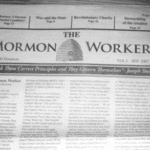
The Mormon Worker is an independent newspaper/journal devoted to promoting Mormonism, Anarchism, and Pacifism. The founders of the Mormon Worker feel that Mormon theology is not only compatible with, but genuinely supportive of, Anarchist political philosophy and pacifism, and are therefore interested in exposing fellow members of the Mormon Church to these political viewpoints. The Mormon Worker is not devoted to criticizing the institution and leadership of the Mormon Church, but rather to informing its members of the virtually forgotten radical elements of their religious tradition, as well as to providing Mormons with radical religious commentary on current political and economic events. The Mormon Worker is published and edited by active members of the Mormon Church, though it contains some articles written by members of other faiths and atheists as well. The opinions expressed in the Mormon Worker are not the offical views of The Church of Jesus Christ of Latter Day Saints.
Part 1
Episode Transcript
Host: John Dehlin · Guest: William VanWagenen
This transcript is machine-generated and lightly edited for readability. The audio is authoritative. Please excuse occasional errors in names and spelling.
Introducing The Mormon Worker Publication
Part 1 of 2 · Ep. 95
William VanWagenen [00:00:00] Sam.
John Dehlin [00:00:49] On Saturday, October 20, an article came out in the Salt Lake Tribune by Peggy Fletcher Stack entitled Latter Day Nod to Anarchy. And and in this article a new publication was described which is entitled the Mormon Worker, which is the brainchild of a young LDS man named William Von Wagenen. And so, William, welcome to Mormon Stories podcast.
William VanWagenen [00:01:16] Thanks. Glad to be here.
John Dehlin [00:01:19] So, wow, what an exciting article to come out. Why don't you tell us just to just give our listeners an overview of what the Mormon Worker is and how you got an article in the Salt Lake Tribune?
William VanWagenen [00:01:35] Well, the Mormon Worker is basically a newspaper that we're going to publish hopefully six times a year, about every two months. And it basically covers a wide range of issues, political, religious, economic, from a Mormon perspective, but it's also from a left wing or an anarchist perspective. Maybe. To start out, it might be important to say a little bit about what anarchism is because it's a word and a concept that's pretty misunderstood, largely because there are kind of two definitions of the word anarchy or anarchism. When people talk about anarchy popularly, obviously they think of chaos and destruction and disorder. And so when we're talking about anarchism, we're actually talking about something that's essentially the exact opposite of that, which is a political philosophy that advocates a socialist society where there is no, no government or socialism, where people voluntarily participate to have a communal economic system. No one's forced to participate or to do things that way. And that's kind of the thing that differentiates anarchism from communism, so to speak. Communism is based on force and forcing people with violence to do things economically the way that communists want to do it. And with anarchists, it's the opposite, where we believe socialism is the best way to do things to ensure that there aren't poor people and so that the wealth of the world is by and large equally shared and common. But we believe it's important for that to all be voluntary and for people to voluntarily create these different economic relationships that are more equitable than you'd get under a capitalist system, obviously.
John Dehlin [00:03:51] So before we I want to actually jump back and talk about your history and what led you to this point and then talk more about your ideas. But what's the response been to the newspaper article?
William VanWagenen [00:04:07] Well, it's actually been by and large pretty positive. I think on the Solway Tribune website a lot of people left comments after the article and there were quite a few very hostile comments. But ever since then, I've just gotten a lot of really very positive emails And a lot of people that have just been like, hey, thank you so much for putting this out. It makes us so happy to see that. And people kind of saying that it's so good to see that there are Mormons who aren't right wing and support the war and different things like this. So I think there are a lot of Mormons that don't necessarily agree with the prevailing political climate here in Utah at least, and oftentimes feel like they're the only ones that maybe don't agree with the way things are going right now. And so for them to suddenly see in Salt Lake Tribune an article about Mormons that you know are left wing or socialist or anarchist and against the war, they're just really, you know, they really kind of heartened by that. And we're like, oh, wow, I guess I'm not the only one who thinks this way. You know, there are other people who are trying to be faithful Mormons and who feel like they it's the proper thing to be a socialist and against the war because you're Mormon as opposed to, you know, thinking that way in spite of being Mormon. So, you know, it's been good.
William's Path to Socialism and Anarchism
John Dehlin [00:05:39] So tell us about anything in your youth or young adulthood that led you to the point of being a socialist or an anarchist.
William VanWagenen [00:05:53] I mean, I guess it's a combination of a lot of experiences, but a lot of it I think, you know, does come down just to over time, going to Sunday school and going to church every week and reading the Bible and the Book of Mormon here and there. I mean, I wasn't any more or less religious than the next kid. I was just an average kid. But it did strike me that on occasion that when economic issues were brought up in the scriptures, it always was talking about how The Nephites in 4th Nephi had all things common among them. And the same in the New Testament regarding the early Christians that they shared all their positions. And early on, the only alternatives I kind of knew about were communism and capitalism. So I remember being pretty interested in communism and reading the Communist Manifesto and different things like this, just because those phrases where some of the early saints had all things in common just seemed clearly contrary to capitalism, where the idea is you try to accumulate as much wealth as you can. And obviously after reading a decent amount of communist material, it became pretty clear that that wasn't the way to go. And obviously President Ezra Taft Benson was obviously pretty famous for denouncing communism, and I think rightly so because it's based on force and violence and So I actually agree with President Benson's analysis of communism. But unfortunately people then tend to think, oh well, capitalism must then be the right thing, because communism is bad. Anyways, when I was younger, those were only two options I knew about when I was on my mission. I served a mission in Frankfurt, Germany. And there was a guy, Annette, named Manuel, who was a friend of a member. And he was kind of like a, you know, kind of a German punk kid. And we just used to play soccer with him sometimes on our P days. And he was just a pretty cool guy. And about two years after my mission, I went back just to visit, you know, some people that I had baptized and just friends from my mission. And I hung out with him a little bit and he gave me this book called the German Anarchists of Chicago, or why America Doesn't Recognize Mayday. It was in German, but that's kind of a bad translation of the title. It was a book about the Haymarket Square martyrs that lived in Chicago in the late 1800s. There were these German anarchists who were organizing to pass laws for an eight hour work day. And there was an incident where they were at a rally promoting eight hour work day or promoting passage of laws for an eight hour work day. And a group of police came into the crowd and were going to start arresting people and so forth. And. And someone, I guess I shouldn't be giving this much detail probably, but at any rate, someone threw a stick of dynamite or a bomb into the crowd of police and killed a few policemen. And no one ever figured out who actually did that. But all of the most prominent anarchists and labor organizers in Chicago at the time were kind of rounded up and put on trial and just found guilty kind of regardless of whether they were involved or not. And a number of them were executed. So that was a pretty famous event in workers history, I guess. And to commemorate the execution of these five or six anarchists that again, didn't participate in that bombing or killing those police, but were executed nonetheless. That's where May Day came from.
John Dehlin [00:10:06] Around what year was it?
William VanWagenen [00:10:08] I believe it was 1886. My memory there is a little bit sketchy. That's a lot of years since I read the book. But at any rate, he gave me this book. It was in German, and I read it. And then there were a lot of kind of political speeches that these German anarchists living in Chicago gave. They were recorded in the book. And that's where I first was exposed to anarchism. And that was more of the socialism that I thought was compatible with what I was reading in the scriptures because it did emphasize assisting the poor, having things in common, but it wasn't based on force. It was based on free mutual cooperation, you might say. And so that's when I kind of first got introduced to it.
Defining Anarchism and Its Public Perception
John Dehlin [00:10:58] But real quick, one of the things that's mentioned in the Peggy Fletcher Stack article is the wisdom in using the term anarchist. You've talked about this a bit, but I just want to ask you about it again. You know, the average probably person or LDS person is going to think anarchist means anarchy. It means no government, which means no democracy, which means no constitution. Is that, is that a safe sort of assumption or is that getting it wrong?
William VanWagenen [00:11:30] Is it safe to assume that most
John Dehlin [00:11:33] anarchists would want to do away with the government?
William VanWagenen [00:11:36] Yes. But yes, when we say we'd like to, you know, have no government, it doesn't mean that you want, you know, chaos or anarchy in the sense that there's no organization to society and everyone's just kind of running around killing each other. What it really. Or that there's no democracy, because in fact, anarchism is actually an extension of, would be an extension of the democracy that we have in the United States today. For example, a few hundred years ago, virtually every government was a monarchy. And later on, democrats began pushing for the idea that political power should be spread out among as many people as possible, or to everyone, essentially. Everyone should vote, everyone should participate in making political decisions, and so on and so forth. And so from an anarchist perspective is a very good thing, however, if you have political democracy. But at the same time, there's no economic democracy, meaning that we have large corporations that are authoritarian, hierarchical institutions who have a lot of power to influence the political process. Workers that work for those companies or corporations have absolutely no say or input into how things are run into, how profits are used that are made from their labor while working for that company, and so forth. And anarchists would say, well, that's a bad thing. So just like political power should be dispersed amongst as many people as possible, which you have in a political democracy, we'd like to take that concept and also extend it to the economic realm so that corporations are run democratically, where the workers have a say in how corporations are run. Workers own the companies themselves, share the profits amongst each other. So there isn't a situation where a CEO is making 10, 20 million dollars a year while workers are making a few dollars an hour, and so on and so forth. So that is kind of what we mean by anarchism. There wouldn't necessarily need to be a government if economic power was decentralized and workers themselves had a way to actually run their lives and make decisions for their own lives, just like theoretically we can in a political way, by voting and so on and so forth.
Historical Examples of Anarchism in Practice
John Dehlin [00:14:26] So has anarchy ever been implemented in any country to any level of success, or is this mostly theoretical?
William VanWagenen [00:14:36] Well, that's a good question. That's a question that comes up a whole lot when I talk to people, because a lot of times people are like, well, that sounds really great. It would be great if there weren't any poor. It would be great if everyone had enough of the resources that they need to live and have enough food and a roof over their heads and so on and so forth. But it's just not possible. Or they would say, but unless people are perfect, there's no way it could be implemented. There are, however, some not very well known, but there are some examples of societies that have operated along these lines. There are some examples in Russia, right during and after the Russian Revolution, before the Bolsheviks or the Communists came to power and basically smashed all the workers councils that had arisen in Russia to run factories and farms and so on and so forth. In fact, that's what the word Soviet means is workers council. And so it's, you know, it's pretty sad that it was actually the Communists or the blood Bolsheviks who, when they came to power, stamped out all these workers councils that had arisen as a result of the revolution, where peasants in Russia essentially started working their own land instead of paying all the proceeds from whatever they grew on the land, giving it to a landowner. And Russian workers in factories, they would just basically take possession of the factories and run them themselves and disperse the profits amongst themselves and amongst their communities. Those are the type of things that were going on in Russia right during the revolution in 1917 when the Tsar was overthrown and it was the Bolsheviks who came in and basically hijacked that and turned Russia into a dictatorship.
John Dehlin [00:16:36] So far it's sort of been implemented in small degrees at short points in history, but never like a major country implementing it on a large scale.
William VanWagenen [00:16:50] Yeah, correct. That would be correct. The Spanish Civil War is another example that people could look into. A current modern day example would be the Zapatista communities in Chiapas, Mexico, that function along anarchist lines. But another thing for Mormons, if we're believing Mormons and we believe the Book of Mormon is the word of God, and we believe the Bible is the word of God, and that the Doctrine and Covenants is the word of God. It seems to me that even if these ideas do seem pretty crazy and pretty far fetched, which I must admit they do initially, it seems to me that as a Mormon, these are ideas that we should take seriously because of the fact that they are found in our scriptures. In 4th Nephi, it does talk about how the Nephites had a society after Christ came to the Americas where there were no poor among them, there weren't any classes of people. And so it seems to me that that is to us non Mormons would say, oh, it's just a myth, it's just a fairy tale. But to Mormons, we believe that those events actually happened, that they're historical. And so we should say, hey, there really were societies that were able to have no poor among them, share their goods, and have real economic equality. And so I think that should at least force Mormons to take these ideas more seriously than even other people would. I mean, if you're not a Mormon, you could say, well, great ideas, but it's impossible. I think as a Mormon, you should say, well, it really did happen, and that's really something that we can't strive for.
Mormon Theology and Economic Justice
John Dehlin [00:18:35] So let's talk about the theological in just a second. But let me start with just the practical and there's a bit of theology woven in here. But if you think about it, you know, America reigns, the United States of America reigns supreme politically and economically and militarily across the world. You know, capitalism defeated communism or socialism in the 1980s or 90s or whatever. You know, Mormons tend to be Republican and, you know, to many, to a large degree, I think the average American, and definitely the average conservative Republican American, which most Mormons tend to be, would say that America is, you know, the Constitution is inspired by God, America has a divine mandate, Capitalism is clearly the way. And any attempt to even consider something that isn't capitalistic, that isn't, you know, pro American and pro tradition, is sort of just heresy and outlandish and the pipe dream. So before we talk about the theological, you know that you obviously have to know that this is a major uphill battle you're facing just to surmount the political and the economic positions of most Mormons. And then we'll talk about the theological in just a second. But I know you realize that because you probably have to talk to people about this all the time. So, you know, what makes you feel confident that you could make headway here and, you know, what's your ultimate realistic dream of the results of your efforts? Do you actually see a day when America becomes anarchistic?
William VanWagenen [00:20:38] Obviously, the day that you know that there is an anarchist society in America, I think is pretty far off. And I'm sure I'll be be long dead before that happens. However, I still feel like it's valuable to promote these ideas because they do have. It does lead to good results if people think more along these terms. So if people feel like, for example, that war for gain is wrong, then there is a chance that people here in America, even if we never institute an anarchist society. But if people look at what's going on from an anarchist perspective, which makes you very critical of authority, if the government is doing anything, you're going to look at that very closely and scrutinize what's going on and say, well, why are we going to, to war in Iraq? Is it really to liberate Iraqis? Is it really about weapons, mass destruction? And it causes you to start asking some questions about what people in power are doing. And I think anyone who does that will find that the reasons that people in power, particularly in the case of the Iraq War, the reasons that they're doing what they go into war and so on and so forth, and the reasons that they're saying they're doing this are very different from the reasons that they're actually doing it. And it allows people to see more clearly what's going on politically and try to organize against that. Even now, it does seem kind of futile to try and end the Iraq war through activism and so on and so forth. But you do have to remember that that's how the Vietnam War essentially ended, because of the fact that the American populace was very anti war because of the Vietnam War. So in the decades after the Vietnam War, as a result of the terrible tragedy of the Vietnam War that prevented the United States government from waging other wars. A lot of the things that the US government did in Latin America in the 1980s had to be done underground. The CIA had to do things totally underground, fund their wars in Latin America through back channels, as opposed to just openly being able to invade some of those countries. And a lot of that was because Americans by and large had this aversion to war, which has now been broken down again thanks to 9 11. So I think there are actually some good consequences that can come from people thinking from an anarchist perspective, even if such a society is never actually realized. Regarding LDS people being mostly conservative and Republican and pro war and so on and so forth, I really do think that that is more of a cultural thing. Just has to do with people's particular upbringings. And it's just a cultural thing. It's not a theological thing. It's not because Mormonism says that that's the way things should be. And so I have actually found that many people who are quite conservative when they've read some of the things I've written, especially about the Iraq war and about anarchism and so on and so forth, they're actually very, very accepting of those ideas because once they're exposed to a new viewpoint which they can see is grounded in Mormon scriptures, they're very quick to embrace some of these different ways of looking at things, even if their whole lives, they grew up Republican and conservative and so on and so forth. Now, that doesn't always happen. A lot of times there's pretty intense resistance and people get quite upset and call me an apostate and, and all kinds of things. But I really feel like Mormons are more prone to view the world this way if they can actually be exposed to that viewpoint. And I think that is the biggest problem so far is that if you grow up in Utah, chances are you never even hear a good argument against the Iraq war. I mean, you just don't hear it. And if you're not exposed to that viewpoint, additional information that sheds light on why the Iraq war is wrong and the terrible tragedy that it's caused for the Iraqi people, then you are prone to support it, because in the news, whether it's CNN or Fox or whatever, you're only getting at the pro government viewpoint. I don't know if that answers the question.
John Dehlin [00:25:23] It sounds like you're kind of saying that if all you do is help people see the importance of how oppressive capitalistic systems can be, if you get people to reconsider their support of the war a little bit, and if you just help move the needle, you'll feel like you've contributed something, even if it stops far, far short of the full implementation of an anarchistic system.
William VanWagenen [00:25:51] Yeah, no, for sure. And you know, that was a big reason I decided to go to Iraq. The first for the first time in 2005 was not because I thought, oh, I'm going to go stop the war, or anything crazy like that. But I heard about this organization called Christian Peacemaker Teams. Actually, I met a few people from their organization who were working in the west bank in Palestine. I was studying in the west bank at a Palestinian university in 2000, and I met some of these people there. And then a couple years later, after the Iraq war, well, A couple years later, when I was graduating from or finishing graduate school, I knew that Christian Peacemaker Teams was working in Iraq. And what they were doing was helping families whose sons and fathers or whoever had been detained by the US army and were now in prison. Christian PeaceMaker teams or CPT, they would just help those families locate their relatives who were in prison. You know, not so they could even get them released or anything like that, but just so the families would know that their sons or fathers or brothers were alive and were just there in detention. And so that was the work that CPT was doing. And I thought, you know what, it just breaks my heart that thousands of innocent Iraqis are wallowing in detention in these US jails, are being tortured and abused and so forth, as we all know from the Abu Ghraib photos that came out, as well as other evidence. I thought, you know, what if I could go to Iraq and help some families locate their relatives like that, and give them some peace of mind and try to in a very, very small way, mitigate some of the terrible effects of the war. I thought, well, boy, that would just be awesome.
Doing Humanitarian Work in Iraq
John Dehlin [00:27:48] So how does somebody just go to Iraq? How do you go to Iraq and what do you do when you get there these days?
William VanWagenen [00:27:58] Obviously it's a lot harder than it was in the past. In fact, right after the initial invasion ended, the initial invasion ended, there were no visas, the borders were totally open. There were a lot of NGOs operating there. Over the course of the years, as the violence has gotten worse and worse and the situation has deteriorated, obviously it's much harder because so many people are getting killed. You do now need visas and there are so few NGOs working there that it really is a difficult thing. But back in the day, 2003, 2004, 2005, it was much easier. I just volunteered to work for Christian Peacemaker teams, spent some time in Colombia with them, kind of getting to know the organization. They have a project in Colombia, went to a month long training and then went and began working for them in Iraq.
John Dehlin [00:28:56] Do they pay you or do you have to pay to go? How is this financed?
William VanWagenen [00:29:01] It was just volunteer, so I didn't get paid anything.
John Dehlin [00:29:04] Did they pay your food, lodging?
William VanWagenen [00:29:08] Yeah, I mean, they just basically covered basic, basic expenses. I didn't pay them anything, but they didn't pay me any money. It was just a volunteer thing.
John Dehlin [00:29:18] So food and lodging, you're covered?
William VanWagenen [00:29:20] Yeah.
John Dehlin [00:29:20] So how long were you in Iraq?
William VanWagenen [00:29:24] The first time in 2005, I was there for four months. It was from May of 2005 until September of 2005. And I was living in Baghdad. And then I came home at the end of those four months, was back home in Utah for roughly a year and then went to Iraq again, the second time in November of 2006 until February of 2007. And the second time I was up in the Curtis region in the north in a city called Sulaymaniyeh, where actually things are quite a bit safer than in Baghdad.
John Dehlin [00:30:00] Weren't you just terrified going to Iraq?
William VanWagenen [00:30:07] Yeah, I mean, it was a scary thing. I remember being in Amman, Jordan, you know, the night before I was going to catch my flight to Baghdad. And you read so many things about people getting killed and kidnapped and this and that. I definitely thought to myself, oh boy, is this a good idea? But just felt strongly like it was the right thing to do. And to a certain degree you kind of feel like, well, it won't happen to me type of thing. Which is I guess, a bit naive. But even when I wasn't that, God even, I mean, this is a sad thing, is that there are millions of Iraqis, 20 million, 25 million Iraqis. However many people live in the country, there are millions of people that every single day don't know if they will make it through the day. They don't know when their kids go to school or their husband goes to work. They don't know if they're going to come back. They don't know if there's going to be a bombing, if you're going to be walking down the street and there'll be a bombing and that's it. I mean, you're dead. Or if you'll be kidnapped, if the US army will drop a 500 pound bomb on some house in the block and you or your relatives or someone will die. So yeah, for four months in Baghdad, where things were really crazy, every day you're kind of, it's in the back of your mind, you're like, oh man, is something bad going to happen today? And it's something you think about. And I lived through that for four months. But Iraqis have been living through that since 2003, you know, four years now, every day. And also it was really terrible under Saddam. It's much worse now than under Saddam. But also it was very bad under Saddam. So, you know, think about what Iraqis go through on just a daily basis year after year after year. And I mean, that's why Iraqis basically are. Almost every Iraqi I knew was basically had this feeling of despair and depression so many of their friends have been killed, so many of their family members have been killed. And there's just terrible stuff, stories just going all over the place there that, I mean, it's really hard to even fathom. And I got a taste of it for four months. But, you know, what Iraqi's been through is just so much worse than even what I experienced.
John Dehlin [00:32:42] So what was your role when you were there? How were you providing relief?
William VanWagenen [00:32:48] Again, that's what we were doing, trying to help people locate their relatives in American prisons. Also, when I was there, there ended up being a lot of torture that the Iraqi security forces were engaged in. When the US set up a new Iraqi government, they began establishing a new police force and new army and training them and so on and so forth. Particularly in that summer in 2005 was when a lot of these death squads began going around and engaging in sectarian killings with. Which obviously are very common now. But at the time, that was very new. Most of the death squads were coming were basically commando squads that were run out of the Iraqi Ministry of Interior. Again, they'd been trained by Americans and so on and so forth. These were the guys that were going around murdering people and start finding bodies popping up just on the side of the road and in the rivers and things like this. So when that started happening, a lot of torture was going on as well. Sorry, people who were being arrested by the Iraqi police, being taken to prisons run by the Ministry of Interior. They'd be interrogated and tortured by the Iraqi police. Oftentimes they'd be interrogated by Americans as well. Well, and then being tortured in really terrible ways. Electric shocks to the genitals, being hung from their ankles or hung from the ceiling by their ankles. There were a lot of accounts of people being tortured with electric power drills and so on and so forth. So anyways, a lot of people were being killed and tortured in this way by the Iraqi security forces. And so we were trying to. Trying to document cases of torture and also cases where people had been killed extrajudicially by the police and trying to pass that information on to larger human rights groups like Human Rights Watch and also the UN Office for Human Rights in Iraq there in the Green Zone, just to publicize the fact that they. This type of stuff was going on.
John Dehlin [00:35:08] So. So while you were in Baghdad, were you always in the Green Zone?
William VanWagenen [00:35:13] No, we actually lived just in a regular neighborhood in Baghdad.
John Dehlin [00:35:18] And did you see. Did you see explosions and war and stuff going on around you?
William VanWagenen [00:35:25] Yeah, I mean, there were in our Neighborhood. There was usually about one bombing per week.
John Dehlin [00:35:30] Like, you'd be sitting there working and you'd hear a bomb go off.
William VanWagenen [00:35:35] Yeah, a lot of times it happened early in the mornings, so sometimes you'd even be asleep still, and you'd be woken up by the sound of a bomb. It would kind of shake the windows a little bit, and you would go up to the top of our building and look out and see where the explosion had hit. So, yeah, I mean, that was pretty common about. I can't remember exactly when it happened, but maybe a month after I left. I could be wrong on this, but a month or two or three months after I left, actually, a mortar hit our building and shattered all the windows out. And no one from our organization was hurt. But another colleague I worked with, a guy from Canada, he was walking down the street one day in our neighborhood, and a bomb went off maybe 30, 40 yards from him. So, yeah, it was pretty much a weekly occurrence.
The Death of a Colleague and Its Impact
John Dehlin [00:36:27] And the Tribune article mentions that a colleague of yours that you were close to by the name of Tom Fox, you spent a lot of time with him, and he actually was killed in Iraq. Can you talk a little bit about what Tom was like, if he had an influence on you and how you found out about his demise?
William VanWagenen [00:36:54] Yeah, I mean, he was working there that summer when I was. We actually shared a room. And Tom was just a really great guy. He was a quaker from Washington, D.C. and had been in Iraq, I think, since the fall of 2004. And just a really kind and a great guy. I mean, it really broke his heart to see all the terrible things that were going on there again, people getting detained and tortured. And so obviously, he just wanted to do his kind of small part in trying to alleviate a lot of that suffering. And he's a pretty quiet guy. He was tall and skinny. He was bald. He didn't female. He agreed to really have much hair at all, but just a really, really nice and kind individual. But he was, in fact, like you mentioned, kidnapped since the beginning of, I believe, the beginning of December 2005, just a couple months after I came home. And he and three other people from our organization were kidnapped at the same time. They were coming back from an appointment in a neighborhood called Ghazaliya in Baghdad. It's a Sunni neighborhood. And some gunmen stopped their car, told the translator, and the driver basically kicked their translator and drivers out and sped off with them. And then they were all held for about four months. And Tom finally, I believe, was in March of 2006, after four months in captivity. His body was found on the side of the road. He'd been shot, I believe, in the head. And luckily the other three people who were captive with him were actually released or rescued by the British military a couple weeks later. There's a little bit of ambiguity about how that all actually went down, whether it was kind of a rescue or it was kind of a negotiated release. I don't. So don't know the details of how that happened, but luckily the other three, you know, were released and are still alive today, obviously. So anyways, Tom, because he was such a great, know, a great guy, and he actually wrote a lot of really excellent stuff about pacifism that, you know, I thought, you know, it would be awesome to include an article by him about pacifism. And so on the front page of the Mormon Worker, there's an article there by Tom Fox about pacifism.
John Dehlin [00:39:47] So I know that, you know, because the article, because the Sully Tribune article also mentions that you were kidnapped and your experience with Tom, you know, what does that do, I assume. Are you from Utah?
William VanWagenen [00:40:03] Yeah.
John Dehlin [00:40:04] So what does it do to a Mormon kid from Utah to go to Iraq to see a buddy die, to not only have friends get kidnapped to experience that yourself? Does that change your life forever? And how does it change you?
William VanWagenen [00:40:25] Yeah, I mean, although, I guess, you know, being lds, it's. It's a little bit like when, you know, you go to any LDS funeral and, you know, what do people talk about? They talk about the resurrection and they talk about the plan of salvation. And so when talking died, I mean, I was back here in Utah. I mean, I first heard that he. He was kidnapped, obviously. And then, you know, a couple months later, got a phone call from someone in CPT one night. I still remember that really vividly. I was just going to, you know, pick up a girl to basically go on a date. Natalie. And just as I was basically pulling up to her apartment, you know, I got a call and I didn't know the number. And, you know, I was kind of. Kind of had a bad feeling. You know, just anytime I got a call from an unknown number thinking, oh, boy, maybe there's something. There's some bad news about Tom and the other guys. And. And sure enough, you know, they called and said, you know, Tom's body was found today. He was killed. And, you know, besides just being sad and depressed and starting to cry, you know, just in typical Mormon fashion, just, you know, obviously began thinking to myself that, you know, Tom was such a Christ like person and all he ever wanted to do was to help other people. And you know, in the end he was killed for it, you know, which obviously no one, you know, there's nothing, nothing good about that. Obviously to be killed and martyred or something, something like that. But at the same time it was comforting to know that Tom was such a Christlike person that obviously he was in a better place and that he still existed even though he passed on, he'll be resurrected and so on and so forth. So that's a lot of what I thought about when I finally got the news that Tom had been killed.
John Dehlin [00:42:31] But what Just the overall experience. How will you be different in the rest of your life than you would have been had you not had that Iraq experience? Or how will you be different from the average 29 year old Mormon who grew up in Utah? In your mind, how has that experience overall, just the whole Iraq experience, changed your resolve or your commitment or your goals or your priorities or your outlook for, for what you see as the rest of your life, how are you going to be different than you would have been or that other people probably are today?
William VanWagenen [00:43:11] I guess obviously it puts a lot of things in perspective. Like in one way it's much easier to be happy and in other ways, a lot of times it's impossible, impossible to be happy. I guess it sounds contradictory, but let me explain why. After seeing people that are living through such terrible conditions, and I can't emphasize enough the terrible tragedy that has resulted from the US invasion of Iraq, and Iraqis, most of them actually welcomed the Americans because their life under Saddam was so bad, they couldn't imagine that things could get worse. And when the Americans came and as a result of the things that the Americans have done there, you know, not to put all the blame on the Americans because Al Qaeda and some Iraqi armed groups themselves have done really terrible things. But you know, it was the US invasion that was the catalyst for all the chaos and terror and madness that exist there now. You know, not to mention just the things that the United States has done itself in terms of killing people and causing misery directly. But I mean, when you see people that live in such terrible conditions, then coming back to the United States, if I ever start thinking, oh well, gee, my life's pretty hard, I don't have a job I like or, you know, there's this girl I liked and she now returns my phone calls and oh gee, you know, this and this and this isn't going the way I want it to go in life. You know, you just Start to think, oh, well, my gosh, how can I possibly, you know, think that my life, you know, how can I feel sorry for myself when, gee, look what these other people are going through? You know, so in that regard, it's much easier to be content with life and just feel grateful for, you know, what I've got. On the other hand, it's harder to be happy in that. You know, there's been a lot of times where things were going awesome for me, and I. And, you know, I'm just thinking myself, man, life is just awesome. And then, you know, after a second or two, I think, well, wait a minute, it's awesome for me. Life's great, going great for me. But what about all these other people in Iraq? So how can you really just sit there and be happy about how the world is, or even how my life is when things are going really well, when I know that look at all these other people who are experiencing such misery and such sadness and so much fear on. On a daily basis? And from being in Iraq myself, I mean, I got just enough of it to have a small glimpse of what those people are going through. But again, what they're experiencing is hundreds or thousands of times worse than what I ever had to go through. And that includes having a friend killed and having some close calls myself. I guess those are some of the ways that that has changed me.
Mormon Culture, Politics, and the Iraq War
John Dehlin [00:46:32] So give us a real quick take on, you know, the average Mormon in Utah probably is very much in support of President Bush in support of the invasion of Iraq. Maybe not thrilled with how the war has gone, but still maintaining the conviction that it was the right thing to do. Can you give in one or two minutes your best sort of thoughts and feelings and experience on why that opinion might be misguided?
William VanWagenen [00:47:08] You know, I guess I would just ask those people to, you know, think about the effect that it's had on everyday Iraqis and think about the, you know, now hundreds of thousands of people that have been killed and the complete and utter chaos that Iraq is in, and the fact that all the reasons that were given to go to war were not correct, and the fact that now the United States is doing its best to radically alter Iraq's oil industry. It was nationalized before, and now US Corporations are going to. Are moving in to sign contracts, profit sharing agreements, so that they can export that oil. You know, the United States has not done anything to benefit Iraq. The government in Iraq that exists today, even though it was, you know, put in place through a democratic process in which Iraq has actually voted, you know, which obviously is a good thing. But if you look at the human rights records and what kind of atrocities the current Iraqi government is committing, you know, along with the atrocities the Americans are committing, those far. Are far greater than the kinds of atrocities that Saddam was perpetrating.
John Dehlin [00:48:27] How is that? Tell me which. Tell us what you mean by that
William VanWagenen [00:48:33] in terms of. I guess. Well, there are certain periods, periods obviously, where it's probably good you ask me that question just so I can expand on that a little bit, because there are certain times when Saddam killed enormous numbers of people. The first example I could give is the Anfal campaign against the Kurds in the late 80s and just point out that the United States actively supported Saddam during those terrible atrocities against the Kurds in which he killed about 200,000 people. Secondly were the uprisings in 1991 after the first Gulf War, where the United States deliberately allowed Saddam Hussein to continue flying his helicopters so he could put down a revolt from the Shiites in which a few hundred thousand Shiites were killed. So again, Saddam did that with. With U.S. support. But after those periods of time, even though Iraq was a police state and still people were being tortured and political enemies of Saddam were being killed here and there, it was still a place or a society where you could lead a normal life. If you kept your nose out of politics and just went about your business, you could live and, and have a life. People were still scared, and there was terrible poverty as a result of the US UK imposed embargo on Iraq. But there was still some semblance of a normal life after the US Came. People disagree about the different numbers of casualties, but the best estimates from the John Hopkins School of Public Health are that roughly 100,000 Iraqis were killed in the initial U.S. invasion. And since that time, the number of Iraqis that have been killed, again, not just from the U.S. but from all sides, is probably 5 or 600,000. And the current Iraqi government, like I was mentioning in that period in 2005 when the Iraqi police, using the commando units that were set up by the United States, they were going around towards torturing and murdering and killing people. And the United States even, you know, in this last week or so, there are two pretty famous instances where the US did airstrikes on, you know, supposed insurgent locations and killed, I think, 11 civilians in one bombing and 15 civilians in another, continue to detain and arrest, you know, tens of thousands of Iraqis. And the current Iraqi security forces are still torturing people. So what good has come of what George Bush did, there's no good that's come from it, but there are just enormous amounts of misery and death and destruction that have come from it. And that's why the same people don't start wars, is because there's no such thing as a clean war. You can't kill just the bad guys. Civilians die in great numbers. And sure, there are times, I think, when it's okay to fight in self defense. I lean towards pacifism, but I acknowledge that there are times when, hey, you got to do what you got to protect your family and your wife and so on and so forth. But to start a war of choice the way George Bush did, I think is obviously criminal in the extreme. And he'll never be held accountable for that in this life. But despite all the different sins and terrible things that we all do throughout our lives, the thing that George Bush did in starting that war, I think, you know, the heinousness of what he did, you know, cannot be, cannot be overstated.
John Dehlin [00:52:42] But, you know, the average Mormon is Republican supporting Bush. You know, it's sort of like Mormon and Republican are almost synonymous, at least, you know, within Utah and some of the surrounding areas. And I could tell you that the average Mormon listening to you is likely thinking, you know, I'm uncomfortable with this. You know, this nation is divinely inspired. George Bush is a man of faith. You know, sometimes war is ugly, but the Book of Mormon, if it teaches us anything, it's that freedom is worth protecting. And you know, the, the average Mormon, I think, is probably feeling like you're a bit of a dissenter, a bit of a troublemaker, a bit of, you know, maybe even not very patriotic. But, but I would guess that the average Mormon feels like God is on the side of George Bush in this war. Would you disagree with that? That that's likely what the average Utah Mormon at least probably feels. Feels. And what would you say back to that type of sentiment?
William VanWagenen [00:53:55] You know, I wouldn't be surprised. I mean, I don't have statistics or surveys or polls, but, you know, obviously from my own anecdotal experience, that is, you know, seems to be the view that many Mormons here need to hold. But, you know, to be honest with you, when I talk to people about, you know, my experiences in Iraq and talk to them, you know, give them another perspective about what's going on, even very, very conservative Mormons are, in my, you know, experience, have been very quick to, you know, change their thinking on this issue. And I think a lot of the you know, I have a lot of conservative friends and my sense is when they heard like, oh, the US is going to go to war against Iraq, their feeling was, hey, we're going to, Saddam is a dictator, we need to go, it's going to help these people to liberate them from Saddam. And these Mormons didn't know what the real agenda was of the Bush administration and they didn't know the human suffering that really accompanied the bombing of the initial invasion and the tactics the US has used to try and pacify Iraq since then. They don't know those bloody and gory details and they don't really know the true consequences that the war has brought. And so in their minds they're still thinking, hey, we're trying to help Iraqis and this is going to bring them back better life. Look, we live under democracy, life is good for us. Let's help out these Iraqis and give them the same life that we have. If that were the case, if that were really truly what's going on, I would say, hey, well maybe you've got a good case for war. Unfortunately, that's not what's going on. And so I really have found that once even very conservative Mormons are very supportive of the war. Once they hear some new facts, hear some new perspectives, once they hear different interpretations of some Mormon scriptures about the Book of Mormon, for example, I think one of the big lessons of the Book of Mormon is about the dangers of war. That's in the end what led to the extermination of the Nephites is that they were a war loving and war mongering people and they refused to, to stop fighting. And so once Mormons hear new information, new perspectives, I think they're very quick to embrace some of these other viewpoints that are more, in my opinion at least more in line with the scriptures. How can you think differently if you've never heard another perspective? How can you think differently when you're watching CNN and Fox and the only thing they do is give the government's version of what's going on. And if that's all you're exposed to, well, how can you have a different viewpoint? Again, my experience has been that even very conservative Mormons, because they're good at heart, they're good people, they do change their minds on these things with the newspaper. I'm not trying to say, look, I'm a better person than some woman who supports reports the war or I'm going to heaven, you know, before they are because you know, in fact I'd probably say the opposite is true because I'm in many ways a really bad Mormon. You know, I try, but, you know, I'm not. You know, there are a lot of things I should do to be a better Mormon, but people like that, it's not like I'm saying I'm better than them because I'm not. I'm just saying because they're very good hearted people, but disagree with their viewpoints and the things that they are supporting. Even though they're supporting them, they have good intentions, they think the war is going to help people and so forth. It's not helping people. I don't think that means that these Mormons are bad or evil or anything like that. They're just misinformed. They need to see another viewpoint and if they're given that opportunity, they're going to change their minds. So I'm actually really confident that Mormons as a whole are going to be much quicker to embrace some of the ideas that we're trying to talk about or promote in my newspaper than say the average American would be. Obviously I could be wrong on that. We'll see if that happens. But I really do feel that way.
John Dehlin [00:58:31] Do you ever, and I know this is a tough question, probably putting you on the spot a bit, but do you ever wish that LDS Church leaders would speak out against the war more?
William VanWagenen [00:58:46] Yeah, it's kind of put me on the spot.
John Dehlin [00:58:48] So, you know, feel free to answer or not answer, whatever. I'm not trying to get dirt from you. I'm just wondering if you ever think about that or, or if you found ways to try and feel better about that or if it's just something that you just kind of try not to think about.
William VanWagenen [00:59:07] Yeah, I mean, obviously, you know, church leadership hasn't, hasn't come out and condemned the war. And you know, to be honest, I'm really not sure what to make of that. You know, maybe one day I'll have a chance, chance to talk to a general authority or to the prophet. Probably not. But if I did something I would definitely talk to them about. But I acknowledge that they are prophets, seers and revelators. And to me it seems like the appropriate thing to do would be to come out and condemn the war. But what's going on in their minds or what their reasoning is, I just have no idea. And so, you know, that's not something I'm interested in doing is saying, well, the leadership of the church should or should not do this. Sam,
The Mission and Content of The Mormon Worker
Part 2 of 2 · Ep. 96
William VanWagenen [00:00:00] Sam,
John Dehlin [00:00:48] Can you tell us a little bit about Dorothy Day and the Catholic Worker? I assume that was your inspiration for the Mormon Worker, is that right?
William VanWagenen [00:00:56] Yeah, to a large degree it was.
John Dehlin [00:00:58] Tell us about her and why and how she inspired you to sort of borrow from what she's done.
William VanWagenen [00:01:05] Okay. Like I said, she was a big inspiration. And in fact, on the front page of our newspaper in this first edition, my colleague, or comrade, whatever you call her, Cori Bushman, she wrote a really excellent kind of introductory article talking about the Catholic Worker and basically talking about how we're ripping it off. So I mean, obviously what we're writing about being against war and being for socialism and so forth is from a Mormon perspective, using the resources in Mormon theology that support those things. But obviously Dorothy Day is a huge inspiration and that's noticed even in the name of our paper, the Mormon Worker. But Dorothy Day was a really interesting lady. I'm no expert on her, but I've read a couple books about her and she, you know, I believe it was in like the, you know, back in like the 20s, the period of World War I. She was a journalist. She was actually a communist and atheist from what I understand, if I'm remembering correctly. And you know, she again was very active in, I believe in the Communist Party and wrote for a socialist newspaper. And, you know, as time went on, she converted to Catholicism and as a result started embracing the teachings in the Bible about pacifism, putting an emphasis on helping the poor, loving your neighbor and so forth. So decided to start this publication along with a fellow named Thomas Merton called the Catholic Worker. And it was basically talking about those type of issues, war and poverty and so on and so forth, but no longer from a communist perspective, but from a Catholic perspective. And she decided to name her paper the Catholic Worker because at the time there were all kinds of newspapers out in any kind of left wing or socialist paper. Always had that kind of, that kind of title like the Socialist Worker or when I was in Boston actually going to Harvard for graduating school, I had a subscription to the Communist Worker, which is a newspaper that's published still, even though I'm not communist and disagree with a lot of things that they would say. They had a lot of really good articles about the Iraq War and current events and things like that. So I really enjoyed reading the Communist Worker. So that's where she took the name and said, okay, well, we're going to do the Catholic Worker. And. And it's been going ever since. There are Catholic Worker houses all over the country. Where they're called hospitality houses, where homeless people or poor people can come and get a free meal. They're not all the same, but a lot of them do that type of stuff. And people live in voluntary poverty. They live very simple, simple lives and, and just try to do different things to help the poor, etc. So, you know, obviously not, not everything we do is exactly like the Catholic Worker and we feel like it's, you know, grounded in Mormon theology and in Mormon tradition. But that was definitely an inspiration. So
John Dehlin [00:04:37] good. So thank you for that. Let's talk about some of the main ideas that you're trying to convey. And as I looked at the article called why An Introduction to Mormon Anarchism and the actual URL, it says why Every Mormon Should Be an anarchist. What are some of the main ideas that you're trying to get across? So give us sort of the high level arguments or justifications or sentiments you're trying to convey about, you know, why people, why Mormons should, should pay more attention to what you're writing.
William VanWagenen [00:05:23] Well, some of the basic ideas that we're trying to get across, I mean, one is that in my view at least, you know, Mormon theology is opposed to capitalism. And I'm just kind of talking off the top of my head here, but in the Doctrine and Covenants, it says, it is not given that one man should possess that which is above another wherefore the world lieth in sin. And so there are so many things in the Doctrine and Covenants that talk about economics and that stress the fact that there should be no poor, that we should have our things, our possessions in common. And that can take a variety of different forms, which you see in early church history with the cooperative movements in Utah and the United Order movements and things like this. It wasn't all done the same, but there are ways to share things in common and take care of the poor as a society. And I think for whatever reason, many Mormons do feel like capitalism is somehow divinely sanctioned or, and that that is kind of the way to go and that's the way God wants things. I don't blame anyone for being a capitalist. And, you know, you got to pay your bills, you got to raise kids, and, you know, it's something that you can't really escape. But to think that capitalism, with all the inequality that that generates, having people who are terribly rich on the one hand and people who are starving to death and can't get basic health care on the other hand, that is simply contrary to Mormon scripture and to Be honest, I really don't know how someone could argue that capitalism is consistent with the Scriptures. You can argue, well, it is the only system we have got. It's a necessary evil. What can we do about it? But to say that that is the way, or that capitalism and its consequences are consistent with all of the passages in the Doctrine and Covenants that talk about economics, passages in the Book of Mormon and in the Bible, even that those somehow support capitalism. Personally, I don't see how that can be done, obviously, because again, people usually think only of capitalism and communism because communism is so restrictive of free agency and is based so much on force and violence. Obviously. Also, in my opinion, communism is very, very wrong. But for some reason people think that because communism is wrong and inconsistent with the scriptures that therefore capitalism is somehow correct. And again, I just can't see any evidence of that whatsoever. It's been interesting as I've been doing a bit more reading. I'm definitely far from an expert on church history, but from a lot of reading I've done, in fact, I just read a passage in a book the other day where there was a history of Missouri that was written by a non Mormon who commented that the reason that the Mormons were being persecuted and Joseph Smith was being run out of every town that he lived in was because he was constantly being accused of being a communist or promoting communism. And this was a historical book that was written back in the 1880s. So again, communism is opposed to the Gospel because of its restrictions on free agency. But why is it that according to this historical book written by a non Mormon, the late 1800s, he says that Joseph Smith and the Mormons were constantly being accused of being communists. It's because the economic ideals that they promoted were socialist in the sense that they promoted communal economics, having all things in common. And again, the contrast between how the Mormons did things and the way communism says things should be done is that there's no force involved in the way the Mormons did it. It was voluntary to participate and the secret police didn't come and shoot you in the middle of the night if you didn't want to participate. So that's a big thing. The other thing regarding war is that again, in the Doctrine and Covenants it says renounce war and proclaim peace. And like I've acknowledged, there are times when you have to use violence. Maybe there's no way around it sometimes, but from what the scriptures say, LDS scriptures say, both in the Doctrine and Covenants and the Book of Mormon, they say that Using violence in an offensive capacity or launching offensive wars or wars of aggression, that that is contrary to what God wants. And there are many passages in, well, I guess I shouldn't say many, but there are some passages in both the Book of Mormon and the Doctrine and Covenants that encourage us to adopt a pacifist ethic. I guess the big example is the story of anti nephi Lehi in the Book of Mormon where there's a number of Lamanites that convert to becoming believers in Christ, their former brethren. Some Lamanites basically attack them and instead of fighting back, they basically prostrate themselves on the ground and allow themselves to be slaughtered. Is that required? I don't think so.
Mormonism, War, and Voluntary Society
John Dehlin [00:11:13] Okay, so some of the main principles I'm hearing you talk about are that capitalism has some major flaws, that things need to be voluntary and not compulsory. I'm hearing you say that war, war is by its nature evil. Any other sort of main high level points that you're trying to get across in your philosophies and ideologies, etc.
William VanWagenen [00:11:40] You know, those are the main things in terms of ideas or ideologies, so to speak. But also a lot of things we'll emphasize in the paper are, you know, having articles about the Iraq war, articles about the conflict in Israel, Palestine and the terrible effects that the Israeli occupation of Palestine have had on indigenous Palestinians, both Muslims and Christians. You know, different kind of current events that may or may not be directly related to Mormonism. But we're just going to try and provide some, you know, some commentary on different current events that have to do with war and economics and so on and so forth.
Distribution, Printing, and Readership
John Dehlin [00:12:27] So what, how has the uptake been? You published 2000 in your first issue, is that right?
William VanWagenen [00:12:37] Yeah.
John Dehlin [00:12:38] And what's the uptake been like? You're giving them away, is that right?
William VanWagenen [00:12:45] Just kind of a combination, essentially. If someone wants one and they don't want to pay for it or don't have money, we'll just give them to them. I've been giving them just to a lot of my friends because a lot of them say we're going out somewhere and they buy me a burger and then for me the next day to charge them a dollar for newspaper, I just gave them away. But a lot of people, we do ask that people pay a dollar if they don't have one. Fine, no big deal, we'll give you one. And then we have been giving them away at a couple different bookstores downtown at Sam Weller's Rare Books and Ken Sanders Rare Books We've got some at the Graywell CDs on 13th east up by the University of Utah, and another place called the Red Light Books, which is also downtown. And they're just there along with the other free publications. So we try to keep those stocked. And as soon as the stack runs out, I try to drop by and drop another stack out there.
John Dehlin [00:13:50] Are they moving?
William VanWagenen [00:13:53] Up until now, I think we've got maybe about 600 left or so.
John Dehlin [00:13:57] And are people emailing you or calling you? What types of things are you hearing from people? You talked a bit about that at the beginning, but talk a little more about that.
William VanWagenen [00:14:08] Yeah, I mean, we've been getting a lot of response from people largely due to that article in the Salt Lake Tribune. I guess I understand how the PR industry works, you know, trying to get free advertising because, you know, it's just having that article in Salt Lake Tribune, you know, a lot of people read it about it and were really excited and went to the website. You know, there's a way to contact me by email on the way website. And so I've been getting. That's all I've been doing the last couple days and if I'm not at work is basically responding to emails about people that were really excited about it and just wanted to say, hey, appreciate what you guys are doing. Other people have been wanting subscriptions and so on and so forth. So there really has been, you know, I think a good response and you know, hopefully that will kind of continue to snowball and, you know, we'll see what happens from here.
John Dehlin [00:15:05] How many, how many emails have you received? About approximately like 10 or probably maybe
William VanWagenen [00:15:11] like 30, 40, something like that.
John Dehlin [00:15:13] Oh, that's a lot. And how is this funded? Who's funding this endeavor?
William VanWagenen [00:15:19] I pretty much just pay for it. And then, you know, as different people that are helping out, you know, that are also doing, doing everything with me, like Tyler and Cory Bushman, Ashley Bledsoe, Kristen Bushman, other people, other friends of mine, they've been selling copies and if they make a little bit of money, they give it back to me just to try and offset the cost a little bit, but basically just been paying for it. And I just kind of figured, well, even if I lose money on it, I think it's a worthwhile thing, so never really expect it to actually break even. If we do manage to get to that point where we have more money coming in than what it costs us, we kind of decided that we should just give the excess money to fast offerings and that way it would Be a way to, you know, actually do something good, you know, provide some financial donations to fast offerings that the church can use and, you know, then we'll just keep publishing it, just getting our costs back and donating all the excess. So.
John Dehlin [00:16:36] And what. What materials are you printing in newsprint or just in regular paper? Are you doing your own printing or do you outsource it?
William VanWagenen [00:16:45] No, there's a printing company here in Utah that's been doing that, did the first run for us. And so the newspaper just looks like it's just like a regular newspaper. It's a little bit smaller than, say, the Deseret News or one of these normal newspapers would be. It's not as big, but it's just on the exact same type of paper. And so it actually looks really cool. I don't know if anyone, you know, maybe a lot of people listening, obviously haven't seen what the paper looks like. And, you know, you can go to our website and the articles are online, they can be read there for free, but there's, you know, you can't actually see what the newspaper looks like, but the newspaper actually looks really cool. Tyler Bushman did all the formatting and just did an awesome job and did all the design and some of the logos. And just visually, I think it's. It's pretty cool.
John Dehlin [00:17:38] Is he related to Richard Bushman? Do you know?
William VanWagenen [00:17:42] I'm not 100% sure. I think he might have told me once that they're kind of distantly related.
John Dehlin [00:17:48] So what. This is my last technical question. So what does it cost per paper to print? 2,000. Just to give our listeners a sense for why they need to contribute and support what you're doing. Or if you're not comfortable talking about that, that's cool, too. But I'm just curious because I'm.
William VanWagenen [00:18:08] No, it's fine. I mean, to actually print the 2000 just cost roughly $500.
John Dehlin [00:18:15] Okay.
William VanWagenen [00:18:16] So it wasn't really anything exorbitant. And then it cost us more because I've been mailing out a lot of copies, and that costs, you know, like 20 cents for an envelope because you can't mail it just by itself. And then, you know, 40 cents or whatever for shipping. So you lost some more money on that. And then I have come to the realization that I mentioned before, I hate computers. But there are tons of people who really use computers a lot, and they love going to blogs and that's where they do most of their reading. So we are going to do some upgrades to the website and make it more professional so people can leave comments and have ways for people to purchase subscriptions online using credit cards and just have a lot more features.
John Dehlin [00:19:09] Maybe you should start a blog.
William VanWagenen [00:19:16] I don't know if it will be a blog, but after all the articles, you can leave a comment. And that will cost maybe $1,000 to get a decent website. So that's another cost. If people feel like donating, obviously, we very much appreciate that people have been donating. People have been donating, mostly just been buying subscriptions and then there's a couple people who've donated a little bit of money, but it's been pretty much, oh, good. I think that will increase. Hopefully that will increase a bit. But if not, you know, I think we can actually, I'm sure we can keep going, even if financially not much comes in.
Mormon Theology Meets Radical Politics
John Dehlin [00:19:59] Well, I know it's getting late, but there's two more short series of questions I'd love to ask if that's okay. One is just around the sort of the reality and the theology and the history within the Mormon Church. And here's just sort of what my observation is. My observation is that Mormon doctrine and theology has changed significantly over time. If you look at sort of what the Book of Mormon said in the Kirtland years, it's almost a totally different theology. You know, if you take out God and Jesus and an atonement, a resurrection, faith repentance, baptism, if you sort of put that aside, because that's sort of what all Christian religions seem to share. The Mormon theology and doctrine between the Kirtland years and the Nauvoo years are sort of fundamentally different. And then if you sort of take the doctrine and theology from the curtain from the Nauvoo years and compare that to how it is now, again, it's very, very different. And so, you know, I might say to you, of course, you can go back into Mormon scripture or the Bible or select periods in Mormon history and you can, you can justify, you know, a point of view, a point of view that supports united order, a point of view that supports pacifism, a point of view that supports, you know, anti capitalism or whatever, you know, serving the point poor. But, you know, if, if Mormon history has shown us anything, it's that modern prophets trump past prophets and that, you know, we need to pay more attention to current doctrine than whatever the doctrine was in the past. And you could take anything from blood atonement to Adam, God theory to polygamy. You know, the list is endless of the doctrines that we've completely walked away from as a church. And so the reality is it's almost irrelevant to invoke select scriptures or historical examples that support this philosophy or ideology that you're, you know, trying to advocate. It's almost irrelevant because the church today is clearly pro capitalism, pro Republican, pro war. That's my opinion. Pro, you know, you know, basically George Bush, Republicanism and all its sort of social political philosophy ramifications. And so, you know, in some ways, you really are advocating something opposed to what the church is currently implicitly, if not explicitly endorsing. And so how do you, you know, how do you reconcile that? I mean, we have a prophet, Syrian revelator today. If he wanted to bring us back to the united order or socialism or anarchism, he could do that, but he doesn't. If you want to speak against the war, he would, but he doesn't. And so in some ways, even though I really get the feeling in the sense that you're not trying to do this, this is not your intent, the ramifications or the implications are that the philosophies you're advocating are very much counter to where the church is today. How do you reconcile that.
William VanWagenen [00:23:35] Regarding, I guess, some of the changes that have taken place throughout the period of church history, unfortunately, it's the case that I'm not such a great, you know, I'm no church historian, no expert on church history. You know, hopefully I'll improve in that area in the future. But so, you know, I can't really comment on any of that. But I mean, it does bring up a good question. But maybe this is, you know, partly provides some of the answer to the question you asked previously about, well, you know, how do you feel that the prophet and the general authorities haven't come out and very strongly condemned the war? And I think to some degree they do remain out of politics on many issues, rightly or wrongly, some issues that do tend to make some comments about politics. Obviously in the case of gay marriage and things like that, it's not like they never make comments about politics, but it is, I guess, in light of the question you just asked me, I think it maybe is a really good thing that the leadership of the church has shied away from coming out and explicitly saying you should have these political views or those political views or vote for this person or for that person. And, you know, maybe the leadership of the church and the church as a whole leans in one particular direction, but they also don't come out and say you can't be a Democrat, for example, and Maybe as a result of, you know, some of the, you know, who knows if one day someone might come out and say, well, you can't be an anarchist and a Mormon. I don't think they'll ever come out and say that. I think they'll essentially say, look, the leadership of the church will acknowledge that, hey, look, there are a lot of different viewpoints you can take. Some of those are based on religion and theology. Some of them are based on people's experiences growing up. Some of them are based on the way they were brought up by their parents. Some of them are based on maybe the books that a person reads growing up. And so I think even though, like you mentioned, it is obvious that what we are advocating goes against the grain of the broader currents in the church, I think there is room enough for there to be anarchists in the church, just like I think most people realize that there is room for Democrats in church. So, yeah, maybe that doesn't answer your question so well, but I think that was another thing that I wanted to accomplish in writing the newspaper. Doing the newspaper is to simply let people know that, hey, look, you might be against the war, you might consider yourself a socialist, and there is a place for you in the church that we have. Every much is right, every much the right to be in the church that say a Republican is or has or a Democrat has. And again, like I mentioned, I think, you know, people are open to, you know, try to prove me wrong if, you know, if they actually cared enough to do so, which probably most don't. But, you know, people are welcome to try and prove my viewpoints wrong and say, well, hey, look, anarchism is not consistent with Mormonism. Socialism is not consistent with Mormonism. But I do feel like that these viewpoints are more consistent with the gospel, with the things that we have in scriptures that are in the standard works, than, for example, someone who's saying that capitalism is consistent with the gospel and with the scriptures and so forth. And again, maybe most members don't think the way I think. I mean, obviously they don't, but I think what is in the Doctrine and Covenants is holy scripture. And it wasn't revealed yesterday or whenever, but it's there and we acknowledge that as canonized scripture. And the Book of Mormon is canonized scripture. So maybe those things that I'm advocating don't get emphasized much anymore. But to say that those things aren't part of the church I think is incorrect because every person who sits down and reads the Book of Mormon will read 4th Nephi, about how the people lived back then. Everyone who sits down and reads the Doctrine and Covenants will read about the united Order and the different economic principles that are taught in the Doctrine and Covenants. Every missionary who gives someone a Book of Mormon or Doctrine and Covenants or whatever, those people will read those things that, in my opinion, advocate the type of things that we're advocating. And I think to say that that is no longer part of the church or cannot be a part of the church, you know, just isn't. Isn't quite correct. So.
John Dehlin [00:29:01] Sure, sure. So two last questions. The first is I've actually, you know, because I've had, you know, I went through a period of studying church history in depth and then feeling. Feeling sort of disillusioned and frustrated with the big difference between the history I thought was, you know, how things happen and, and what the actual historical records show. And that sort of launched me into this period of studying all sorts of Mormon intellectuals who have advocated various ideas, from feminism to gay rights to, you know, various theological views. And, you know, there's this pattern that happens where, you know, first of all, there's always this assumption that the advocate is sinning in some way, and, and that that was sort of what was behind their advocacy that ultimately ended up leaving the Church. But that's never been what I've discovered. What I've discovered is they had some sincere, you know, you know, they had some sincere viewpoint that was rooted either in scripture or in past statements by general authorities. They felt totally justified in their advocacy. They really felt like if the church was inspired, that it really should sort of move in that direction. And at first they were super idealistic. They just felt like if people could be informed, they would see the light. But then they started maybe getting some notoriety. They started gaining some traction, and the brethren or church leaders locally or administratively started feeling uncomfortable with what they were doing. They started getting pressure from ecclesiastical leaders and, and over time, either they were asked to sort of stop what they were doing or just they didn't get any traction and they started feeling disenchanted with their relationship, you know, with the church. And then ultimately, either they were sort of kicked out or they just left the church because they just didn't see harmony between what their heart told them was right and the way that the church administratively or bureaucratically was. Was moving. And so I know you're sort of early into this advocacy stage, but, you know, have you contemplated that, well, trod path that others have taken? Have you ever feared that that might be a road you might take? Or do you have just complete conviction that that's just a place you're never willing to go? You know, talk just a tiny bit about whether, you know, you've contemplated this and how you. How you see your path shaping up as you really start advocating these. These positions?
William VanWagenen [00:31:46] Yeah, I mean, it's a tough question because there's the experiences of a lot of other people that have been through that. I mean, to be honest, I'm just not familiar with that. And, you know, I definitely disagree with the idea that, you know, everyone who leaves the church leaves because they're a sinner or whatever else. There are people who have, as you mentioned, just legitimate concerns and intellectual problems with some aspects of the church and so forth. And I can understand why they decide that maybe the church isn't true or the church isn't for them or whatever. I think that definitely happens. But as far as myself, I mean, I really don't know. I mean, I guess I haven't thought about it too much. I mean, I've thought the way I think for years now. I mean, I'm 29, and I've pretty much began feeling like anarchism was politically the way that, you know, all people, and especially Mormons should go. And obviously over those, you know, since I was maybe 21 or 22 in those last seven years, you know, not much has changed.
John Dehlin [00:33:06] Right, right.
William VanWagenen [00:33:07] Just because the, you know, the Mormon worker is getting released now and is getting, you know, I still will say, a very, very mild, mild amount of attention. You know, the Mormon worker is new, but my views aren't new. And I don't know. I mean, I just try to think back on or am reminded of, you know, different experiences I've had throughout my life. I mean, particularly on my mission. And, you know, people talk about, you know, obviously a mission kind of providing foundation for their testimony for the rest of their life. And I think that's true of me. And so it's my mission. I mean, you know, to be honest, I've been a lazy Mormon here and there, and I've been more active at times and less active at times. But, you know, I can always look back to, you know, different experiences that I've had on my mission that, you know, confirms to me that, you know, personally at least, that the church is true, that the Book of Mormon is true. And are there going to be, you know, times when. When church members do things wrong? Sure. Are there going to be times when general authorities do things that are wrong? Or advocate views that are incorrect. I mean, I guess you can look back at comments from some members of the church having to do with racism and so on and so forth and obviously be quite embarrassed about the things that some people advocated. But by and large, I've had spiritual experiences that as far as I can tell in my life right now, have confirmed that the church is true. And again, the reason anarchism is so appealing to me, the reason that I do feel that war is so wrong, is really because I'm a Mormon and not in spite of it. In that Salt Lake Tribune article, a lot of people left comments on the Salt Lake Tribune website afterwards saying things like, well, and even on some other blogs where a little bit about our paper has been going around, people saying, oh, this kid's trying to use Mormonism as a cover for his politics and hijack Mormon theology and use it for his own purposes. And these people are dangerous and things like this. People have been writing stuff like that. And I honestly just disagree with them that my learning about anarchism and seeing the terrible things I've seen in Iraq and also in Palestine where I studied, where there was a lot of violence at the time. It was in the middle of the second intifada. That was in 2003 when I was there. Those things, having those experiences and learning what I've learned have really made me appreciate Mormonism even more. And yeah, obviously most Mormons don't agree with me, but all of our beliefs and ideas are influenced by more than simply religion in each person. Our views and beliefs are influenced by, again, culture, experience, somewhat by religion, etc. And so, you know, my experience is going to be different from every other Mormon's experience. The things that I am influenced by are to some degree going to be different than what every other Mormon has experienced. So, yeah, people are going to disagree with me, I'm going to disagree with them. But at the end of the day, I feel like all the experiences I've had and learning about anarchism and so on and so forth has simply made me appreciate Mormonism even more and made me even more proud to be a Mormon than even I was previously. So what the future holds and what's happening to these other people and whether I'm going to get into some type of trouble or bad things will happen as a result of maybe getting a bit of publicity about the paper, that might be. I mean, I just don't know what the future holds, but whoever out there there is that is going to say, hey, look what you're doing is dangerous or wrong or evil. And there's a lot of people I'm sure will say that. I just hope that they would just have some tolerance and say, hey, look, this is the way these people think, you know. And again, just like there's room in the church for Democrats, there's room in the church for Republicans, there's room in the church also for anarchists. And again, I think our views on politics and so forth are more consistent with the scriptures than, say, a Republican or Democrat. But, you know, just because everyone doesn't think like me, you know, that doesn't cause me to lose faith, so to speak, in the gospel or the divinity of the Book of Mormon, in the scriptures and even in the prophet, even though I'm sure I disagree with him on a lot of things. And if we had a talk about the Iraq war today, again, I don't know exactly what President Hinckley thinks, but most likely I'm going to disagree with him about a lot of things. But, you know, that doesn't mean the priesthood doesn't exist on the earth and so on, so forth.
John Dehlin [00:38:38] Right, Right. Well, let's just end by you. I don't want to say bearing your testimony, but what are the pillars of your faith? And when you contemplate the gospel and scripture and doctrine, what are the tenants and the pillars that drive and motivate you? You've talked a lot about them. But if you just had to summarize for our listeners the pillars of your faith, how would you summarize them?
The Pillars of William's Personal Faith
William VanWagenen [00:39:10] Again, I think maybe just going back to the basic things that Jesus taught, the way he lived his life. He was just a nice person or more than a nice person, but he was a nice person who looked out for the welfare of other people. He loved other people. He was kind to other people. He didn't like seeing, you know, people that were suffering and that were miserable. And, you know, to me, I mean, I guess those are the things, you know, say, for example, you find in the Sermon on the Mount about how to treat people, including your enemies. Those are the things that probably at the core are the things that are most important to me in terms of my testimony or what I think the gospel is, treating other people nicely, doing what you can to help other people. And again, obviously, with the idea that Jesus is our savior and was resurrected and that there is life after this life, those, I think maybe are kind of the things that I personally think are maybe the most important. Like in Matthew 25, where there's a scene at the Judgment Day where a person comes and says, lord, Lord, when did I ever give aid to the sick or to the needy and things like this? And the Lord says, well, anytime you did that to another person, you did that to me. I think that is kind of the core of the gospel, is just trying to do what you can to help other people, and that's really what life is about. I feel always a little bit uncomfortable talking about religious things like this. I really don't do an awesome job of really keeping every commandment like I should. There's so many things that times when I screw up in sin. And so it kind of seems weird to me to even talk about religious things, which is why even the newspaper kind of focuses less on spiritual things and more on kind of political things. But those are things that over the years have just made me feel like Christianity and specifically Mormonism is a true religion. And those type of things that, as bad as I may or may not be, and living up to them, those are things that to me make me think, oh, wow, I should really try. And that's the way to go.
John Dehlin [00:42:01] Well, William, I guess I'll just remind the audience that the website is themormonworker.org the publication bears the same title. And I just want to thank you so much for coming on Mormon Stories. I want to commend you for your, you know, your integrity and your courage and your idealism and. And just wish you all the best in what you do and let me know if I can help in any way.
William VanWagenen [00:42:34] Okay? Well, no, thank you, John. I mean, particularly. It's just nice to be able to speak at length about a lot of these different things, especially Iraq and the war and so forth, because so many times, you know, I ended up giving radio interviews and on, you know, KSL or TV and things like this, as result of the variety of things that have happened to me. And, you know, you only have 30 seconds or in the case of the radio, five seconds and, you know, or in a newspaper article, there's, you know, three quotes that are two lines. And it really is, you know, quite nice and a privilege to just be able to speak at length and, you know, try to do a better job of conveying, you know, some of these ideas that to a lot of people just seem, you know, they just. It's so strange they've never heard anything like that before. So anyways, just appreciate the chance to, you know, to be on, to be here and be able to do the
John Dehlin [00:43:30] interview so well, it's My pleasure. William Van Wagner, everyone. Thanks. Thanks again. The website is themormon worker.org Take care, William.
William VanWagenen [00:43:41] Okay, thank you. Sa.
Transcript © 2026 John P. Dehlin. All rights reserved. Brief quotations are welcome with attribution and a link to mormonstories.org; all other use requires written permission.
Part 2

Our Platforms:
Social Media:
Contact us:
MormonStories@gmail.com
PO Box 171085, Salt Lake City, UT 84117



11 Responses
i’m missing the actual stories? or are they just in the podcast section?
found them in the podcast. awsome jobs with the podcasts John, hope you’ll keep going for a while. not that many good mormon podcasts out there.
who is cory bushman?
I read about the “Mormon Worker” in the SL Tribune. Mr. Van Wagenen’s statements there were patently false and easily disproven. For example, he said:
“Though Mormons believe in obeying the law and respecting elected officials, they should see capitalism as a necessary evil rather than a system God endorses, he writes. If they were really following LDS principles, Mormons would all be anarchists.
“Every Mormon should look forward to the abolition of government,” Van Wagenen writes, “and the building of a socialist society based on free association and mutual cooperation.”
Really?
How does this statement jibe with the Twelfth Article of Faith or D & C 134:
“We believe that governments were instituted of God for the benefit of man; and that he holds men accountable for their acts in relation to them, both in making laws and administering them, for the good and safety of society.”
“We believe that every man should be honored in his station, rulers and magistrates as such, being placed for the protection of the innocent and the punishment of the guilty; and that to the laws all men show respect and deference, as without them peace and harmony would be supplanted by anarchy and terror; human laws being instituted for the express purpose of regulating our interests as individuals and nations, between man and man; and divine laws given of heaven, prescribing rules on spiritual concerns, for faith and worship, both to be answered by man to his Maker.”
I wonder if Mr. Van Wagenen believes God is an anarchist or whether he believes God has His own government and laws.
It’s good that people fight for social justice and peace while exposing the cancer of consumerism in our society. However, Mr. Van Wagenen goes too far when he suggests that Mormon doctrine teaches the abolotion of government.
While I agree that ultimately our goal is to implement the United Order after the collapse of the current order of things (i.e. the collapse of communism and capitalism when all nations of the earth cease to be) I fail to see how the word “anarchy” describes the establishment of the United Order. The collapse of the current order of things will come on its own, not by any principles of “anarchists.” So I’m confused by this whole thing, unless I just don’t get the point.
I am a Mormon, an anarachosyndycalist, and a libertarian socialist and I think that Van Wagenen work is fantastic. Anarchosyndicalism fits very well with the establishment of the united order. As a libertarian….Jefferson’s works and the Constituion are extremely important as they are some of the groundworks for a fantastic social order. I honestly believe, like Chomsky, that the social order of the future is Libertarian socialism when all oppresive chains will be broken and freedoms re-granted. The society we live in now is fascist according to Roosevelt’s definition. Corporatism is oppresive and must be broken. Christian Anarchism is, as a political philosophy, is not violent and follows civil disobedience.
I enjoyed this podcast. I’ll probably link to it.
I’m with you, William, in rejecting the Iraq War and those that will follow and affirming our higher focus on loving folks. You’re in good if not sparse company. President Kimball taught these principles strongly in his 1976 Ensign article, “The False Gods We Worship” https://www.nauvoo.com/library/kimball-false.html
Several paragraphs near the close of the piece sum it up well: “In spite of our delight in defining ourselves as modern, and our tendency to think we possess a sophistication that no people in the past ever had — in spite of these things, we are, on the whole, an idolatrous people — a condition repugnant to the Lord.
We are a warlike people, easily distracted from our assignment of preparing for the coming of the Lord. When enemies rise up, we commit vast resources to the fabrication of gods of stone and steel — ships, planes, missiles, fortifications — and depend on them for protection and deliverance. When threatened, we become antienemy instead of pro-kingdom of God; we train a man in the art of war and call him a patriot, thus, in the manner of Satan’s counterfeit of true patriotism, perverting the Savior’s teaching:
“Love your enemies, bless them that curse you, do good to them that hate you, and pray for them which despitefully use you, and persecute you;
“That ye may be the children of your Father which is in heaven” (Matthew 5:44-45).”
While we tend to get caught up in the patriotic fervor of pre-emptive wars we can’t escape the fundamental truth that love trumps hatred and aggression.
A corollary of our aggression being fundamentally wrong is that it will bring us grief. The Lord points out repeatedly in the scriptures that when we rely on the arm of flesh, sooner or later we’ll find ourselves disapointed in the extreme. In a prophecy recorded by Mosiah Hancock, Joseph Smith prophecied, “The United States will spend her strength and means warring in foreign lands . . . ” Foreign wars with mercenary armies efficiently bankrupted the imperial nations of Europe several centuries ago. It’s a pity we’re on course to follow their example with little of value to show for our efforts.
The rest of Joseph’s prophetic sentence usually gets all the attention: “. . . until other nations will say, “Let’s divide up the lands of the United States”, then the people of the U.S. will unite and swear by the blood of their forefathers, that the land shall not be divided.” Where we might be an example of gospel-inspired friendship and opportunity we’re swaggering about alienating folks who may one day decide to eat us for lunch.
So good strength to your efforts, William. While you’re a small voice in an America inebriated with prosperity and power, I believe you’re in harmony with the higher way that is coming. I believe there’s great value in promoting the principles of Zion. By raising our awareness about it you’re helping Zion to manifest. To Zion.
Who is Mayan Elephant?
In response to Dave’s comments:
Many people who are not educated on Anarchism as a political thought often hold the erroneous, yet popular, view of Anarchists as anti-law and order (much in the same way the public still holds erroneous thoughts of what mormonism is). We are not speaking of anarchism promoted by punk rockers who want to drink and do drugs with no interference, we are talking about a serious political philosophy.
Anarchism does not do away with leaders, laws, etc, it simply broadens democracy to include all aspects of life, including work. I therefore find no contradiction between D&C 134 and Anarcho-Syndicalism. In some progressive European nations this has already begun, for instance in Germany a board of executives in a corporation is directly accountable to the workers because he or she is elected by those workers. Here in the states, that executive would be chosen by people who have little to no interest in meeting workers needs in terms of healthcare, wages, etc.
Chomsky does a great job of explaining the core of Anarchist thought:
“…the term anarchism is used to cover quite a range of political ideas, but I would prefer to think of it as libertarian left, and from that point of view anarchism can be concieved as a kind of voluntary socialism…in the tradition of say Bakunin and Kropotkin and others. They had in mind a highly organized form of society, but a society that was organized on the basis of organic units, organic communities. And generally they meant by that the workplace and the neighborhood, and from those two basic units there could derive through federal arrangements a highly integrated kind of social organization, which might be national or even international in scope. And the decisions could be made over a substantial range, but by delegates who are always part of the organic community from which they come, to which they return and in which, in fact, they live.
Representative democracy, as in say, the United States or Great Britain, would be criticized by an anarchist of this school on two grounds. First of all because there is a monopoly of power centralized in the State, and secondly-and critically-because representative democracy is limited to the political sphere and in no serious way encroaches on the economic sphere. Anarchists of this tradition have always held that democratic control of one’s productive life is at the core of any serious human liberation, or for that matter, of any significant democratic practice.”
To learn more visit this link:
https://books.google.com/books?id=_HkOaB89p7YC&pg=PA133&lpg=PA133&dq=%22The+term+anarchism+is+used+to+cover+quite+a+range+of%22&source=web&ots=h9LjU_L8Ir&sig=wMyqLvM4fwTs3DS6EtgRWprA5cE&hl=en&sa=X&oi=book_result&resnum=1&ct=result#PPA133,M1
My great-great grandfather ran the only United Order in Salt Lake City during Brigham Young’s era. As my great grandmother related in my mom’s book:(see link for selfish, capitalistic, self-promotion ;-)
“When I was sixteen my father was appointed to take charge of a branch of the United Order organized in Salt Lake City. I helped him keep the records and that was a job in itself. I made shirts for the boys and men and dresses for the women and if that wasn’t enough I worked in the silk factory, unwinding the silk threads from the cocoons. That was careful, exacting work. I made ladies dresses outside the Order because I had a reputation of making beautiful gowns. I couldn’t keep the money I earned. It had to be given to the Order.
I was sure glad when the Order dissolved about two years later. When it was first started there were thirty-nine members, some with their families, who signed up. They met mostly in our old house at Second South and State. Here they gave their report of the hours spent and the kind of work they did. Prayers were said and food was served and more than a few slept there and made it their home.
This United Order had a mixture of nationalities. Five members were born in Scotland, thirteen born in Denmark, twelve in England and three came from Sweden. One was born in Calcutta, India and one came from Castilla, Spain. Then there were four born in the United States; one in California, one in Illinois and two in Utah, towns of Manti and Morgan. We needed a few interpreters but all were trying to learn and speak English. I was surprised how the Gospel seemed to envelop us bringing all of us together as a family.
Our farm was at Millcreek and we gathered our fruit from the 3rd Ward orchard. Mother assigned the women their tasks and helped them learn some new skills. She was always cheerful and encouraging and much loved by the sisters. Father with the help of Brothers Heber Searle and Neils Neilsen planned and rotated the work for the men.
There were a few who left the Order before it was disorganized. Joseph Waters was one. He made ladies slippers, men’s shoes and boots, so we were sorry to see him go. He said he was leaving for Spanish Fork in search of a wife as he had not found one here. Some blamed me for his leaving since he had asked me to marry him and I said no, because he was too old and not very handsome. This branch of the United Order failed like all the others leaving my folks poorer but wiser, my mother said.”
There was a reason that the United Order failed. It was because equal pay for unequal work doesn’t make practical sense.
Glen (the Capitalist)
P.S. to see a my defence of Kiyosaki-type Capitalism against a Christian right-wing blog take a look at: (search for Fullmer)
https://www.homeschoolblogger.com/stevebraun/92310/