
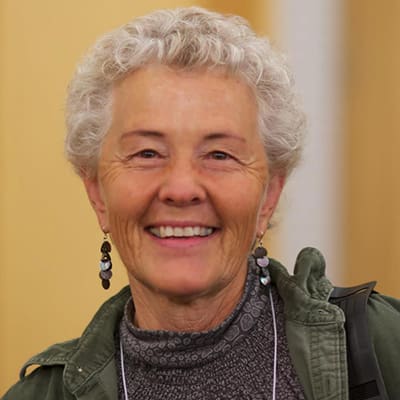
 Nadine McCombs Hansen has been championing progressive causes within Mormonism for over three decades. Some of her efforts include:
- Supporting the Equal Rights Amendment as a Mormon mother, including interactions with Sonia Johnson.
- Speaking out in favor of female priesthood ordination within Mormonism in the 1980s.
- Opposing Proposition 22 and Proposition 8 in California, in support of same-sex marriage.
- Working as an attorney in support of children of FLDS families in southern Utah.
In this 4-part series, Nadine discusses her evolution and reflects on her life as a progressive Mormon pioneer.
Episode Transcript
Host: John Dehlin · Guest: Nadine McCombs Hansen
This transcript is machine-generated and lightly edited for readability. The audio is authoritative. Please excuse occasional errors in names and spelling.
Introduction and Welcome
Part 1 of 4 · Ep. 693
John Dehlin [00:00:00] Mormon Stories is a production of the Open Stories foundation and relies solely upon the support of people like you, its listeners to help keep the podcast alive or to become a member of the community. Please become a monthly subscriber by visiting MormonStories.org and clicking on the Donate button on the right side of the page under support. All contributions to Mormon Stories are completely tax deductible and go towards producing the podcast and building communities and programs of support for Mormons like you. Thanks for your support.
Nadine McCombs Hansen [00:00:36] The kindly light amid encircling gloom
John Dehlin [00:00:43] Lead
Nadine McCombs Hansen [00:00:43] thou me on the night is dark and I am far from home.
John Dehlin [00:00:51] Hello everyone, and welcome to another edition of Mormon Stories podcast. It is January 24, 2017. My name is John Dehlin and we are here to interview someone who I think is a really. I would say she's a pioneer in modern Mormonism. That's just my bias. But she's been involved in all sorts of really important things. Her name is Nadine Hanson or Nadine McCombs. Hanson.
Nadine McCombs Hansen [00:01:21] McCombs.
John Dehlin [00:01:22] McCombs. Sorry, McCombs. And. And let me just list a few of the reasons why I think you'll be interested in Nadine. Nadine. You know, she's been a member of the church her whole life, but she was around enough to sort of have been raised in the church, to have experienced the Equal Rights Amendment, sort of issues related to the church in the late 70s. She became aware of Sunstone and Dialogue around that time. She's been involved in publishing articles for Dialogue and for Sunstone and being involved in Sunstone presentations for a long time. She's been, I would say, an activist for LGBT rights within the church for decades, but also for feminism in the church and female ordination. But she's also fascinating because she obtained a law degree while she was, you know, a Mormon mom. And her legal work, interestingly enough, has been to sort of act as a protector to the children of FLDS families. And we'll talk more about that as well. But she served as the Guardian ad litem, is that right?
Nadine McCombs Hansen [00:02:47] I've been a Guardian ad litem in a couple of cases involving FLDS children, but in a broader sense too, children in a number of different kinds of situations.
John Dehlin [00:03:00] Yeah, and that's fascinating. And she's just been a really active participant in everything that's been going on. Incidentally, her daughter is Laura Compton, who I started a group called Mormons for Marriage Equality or Mormons for Equality way back in the day. And then her son in law is Todd Compton, the author of A Few Books. But in Sacred Loneliness will be one that a lot of people are aware of. So there's just so much to talk about with Nadine. If you guys have seen my interview with Carolyn Pearson or Bill Bradshaw or Christine Jepsen Clark, it's one of those epic stories. This will definitely be a multi hour interview and it's just going to dig deep into the life of someone who's just really been involved in progressive Mormon thought and activism for multiple decades now. Nadine, first of all, welcome to Mormon Stories.
Nadine McCombs Hansen [00:04:01] Thank you.
John Dehlin [00:04:02] Do you want to correct the record? Is there anything that I got wrong?
Nadine McCombs Hansen [00:04:07] Well, you may have overstated a few things, but the general outline is definitely correct.
John Dehlin [00:04:13] All right, well, we're excited to have you here. We are broadcasting this live, so if there's anyone who is listening to the live stream, we love it when people make comments or ask questions on the live stream. So we just want to invite people to feel free to do that to the extent that they're interested. So. All right, Nadine, so we're going to be covering a lot, but let's jump in with your kind of Mormon childhood. Tell us a bit about your upbringing in the church.
Growing Up Mormon in Southern California
Nadine McCombs Hansen [00:04:44] Okay. I was born in Southern California in the San Fernando Valley, right at the early part of the beginning of the baby boom. I was born in 1947, 46 is the first year of the baby boom. So I grew up there in Southern California. My parents were married in the temple in the Salt Lake Temple. I was born quite a few years later because they were married before the war and had one child before the war. And then I came along after. They were not. We were always active in the church in terms of like going to Sunday school every week. But my parents were not really fanatical Mormons by any means. And they were really good people, had great parents. And my grandmother lived with us. Her husband had died right. A few years after my parents had gotten married and they lived up in Idaho at the time. And then my dad, you know, they lived through the Depression. And then as they were coming out of the depression, World War II was starting and my dad got a job down in Burbank at the Lockheed aircraft plant there. He went out to California before my mom did. And then she came out and my grandmother came. And at the beginning of World War II, my dad was working building aircraft for the war effort at Lockheed. So they didn't particularly want him to leave that work to join the military. But eventually he was going to be drafted and so he joined the army at that point, my brother was probably a couple years old and my mother went to work at Lockheed as a Rosie the Riveter and my grandmother did also. So they both worked there. And just as a societal point at that point, the men, many of the men had gone off to war. The women were needed in the factories and the government supported them by helping. I think they had daycare on site. So they did what they needed to do to get women into the workforce. And then at the end of the war, the men came back and the men needed the jobs and they wanted the women to go home. And there was a big push to have the women then leave the workforce so that the men would have jobs. It was an interesting time to grow up because I grew up in a blue collar neighborhood and it was a time when blue collar workers, men, fathers, husbands fathers, could work and support a family. And most mother stayed home, although mine didn't. Mine was home for a little while, but then went back to work. I don't actually have a memory of her being a stay at home mom. My grandmother lived with us though. And so I had a built in primary caregiver in my grandmother. My grandmother was a very, very devout Mormon, believed everything about the church and, and always pushed very hard for us to be active in the church. And she was really the driving force behind our church activities. And so I can remember when I was very young, before I went to school, she would go to Relief Society. My mother was at work, so she wasn't there, but Relief Society was during the day because of course the women were mostly at home. And so my grandmother would, she didn't drive, but she'd always get a ride. She'd never learned to drive a car, but she'd get a ride and we'd go over to Relief Society and they had a nursery and I can remember playing in the nursery and then on work day they'd be out quilting and they'd come and get us from the nursery and feed us lunch. And I can remember playing underneath the quilting frames. And so one of the things that I think people should understand is that that time of life, of growing up was a time when women outside of the church and women inside the church both kind of did the same things. Most women were stay at home moms then and so they were conforming to the gender roles that the church didn't even have to prescribe because that's what women did. Women stayed home and took care of their families.
John Dehlin [00:10:06] I was going to ask if your mom or grandma considered feminism at all because Rosie the Riveter is now a feminist icon. But at the time, my guess is it's just what you did.
Nadine McCombs Hansen [00:10:17] It was just what you did. Absolutely. And my mother, she enjoyed working. Well, after the war, when my dad came home, the men had the GI Bill and my dad signed up for a course in electronics. But after he got it, he found that he wasn't really very interested in it, but my mother was. So she finished the course and he got the certificate for it, but she got the knowledge. And later she went to work for a little startup company that made guidance systems for intercontinental ballistic missiles, ICBMs. And she became an electronics technician. So she was working in sort of this male dominated field for all of her life, really all of her working life. And they started out, it was one of these little companies that started out in somebody's garage and then got into be a bigger company. And then we were living in the San Fernando Valley. We lived in North Hollywood. I lived in the same house from the time I was about five months old until I was 12. When I was eight or nine, her company moved down south from there down to a place called Costa Mesa. And at that point my parents bought a new home out in Buena Park. That's where Knott's Berry Farm is. It's not too far from Disneyland. And they moved there, but they kept their house in North Hollywood. And my grandmother stayed in North Hollywood. So I continued to go to elementary school there in North Hollywood until I graduated from the sixth grade. But my mom moved down to Buena park and my dad kind of went back and forth between the two places. But on weekends I would go down to Buena park most of the time and visit with my mom. So I started establishing a new life where I was going to be once I got out of grade school.
Church Life in the 1940s and 1950s
John Dehlin [00:12:19] So anyway, any fun memories about being a member of the church, the Mormon Church back in the 40s and early 50s?
Nadine McCombs Hansen [00:12:27] Well, not the 40s. I was born in 47, so. Well, okay, yeah, my memory is in the 50s.
John Dehlin [00:12:33] Okay.
Nadine McCombs Hansen [00:12:34] Yeah, we were, we were in a ward. It was kind of an interesting ward. We lived in a very blue collar area and part of the ward took that in kind of the flatland down in the San Fernando Valley. But the ward also took in part of the Hollywood Hills. And so there were a lot of interesting people in our ward. They had sort of the, you know, I won't say poor folks because we weren't poor, but, but you know, the sort of middle income people. And then up in the hills, on the Hollywood Hills, there were doctors and lawyers and people who were in show business.
John Dehlin [00:13:11] Some of the people like Rosemary Reed
Nadine McCombs Hansen [00:13:13] or, you know, Rosemary Reed was not in the ward, but I can remember her being talked about. I think my grandmother might have known her, but we had. Two of the king's sisters were in our ward. Lex Diazevedo is the son of one of the king's sisters. He grew up in our ward, but he was older than me. He was closer to my brother's age. My brother is six and a half years older than I am, so I didn't really know him. There was one of the other sisters, had a girl who was my age that I went through primary with. They did lots of things then that was. It was sort of the heyday for Relief Society in a lot of ways. The Relief Society, I can remember them putting on really pretty extravagant bazaars. And my mother.
John Dehlin [00:14:08] What's a bazaar?
Nadine McCombs Hansen [00:14:09] Okay, we don't even know that now. Well, the women would make things. They would make handicrafts, they would make. They'd cook things, you know, bake goods and things, and then they would sell them. And that's how they raised the money for. To run the Relief Society, because it wasn't funded by the church.
John Dehlin [00:14:26] Wasn't correlated.
Nadine McCombs Hansen [00:14:26] It was not correlated. And so they would have these big bazaars, and I can remember seeing things piled out on the tables that were for sale, and my mother and my grandmother both crocheted, and they would crochet things around the edges of handkerchiefs, for instance. And those were always pretty big sellers. My mother tatted, which was a.
John Dehlin [00:14:52] That means something different now.
Nadine McCombs Hansen [00:14:55] Right. But that was. It's kind of a lost art at this point. I had her teach me how to do it a little bit, but I didn't have the patience for it. But that was very unique. And so we had some of the people in the ward who were wealthier, and they'd snap those things up really quickly. I can remember that. And then, like I said, my brother was six and a half years older than me. And so when he became a teenager, or when he was maybe 14. When he was 14, I was about 8. Now, this was a time of the baseball baptism era, and I think a lot of Mormons today have heard of the baseball baptisms as a missionary tool. Over in England, for instance, interestingly, there was an article about baseball baptisms in Sunstone, probably in the early 90s.
John Dehlin [00:15:55] Michael Quinn.
Nadine McCombs Hansen [00:15:56] Yeah. Yeah. Well, in that article, it talked about a missionary who helped to get that started and his name was Galen Grover. Well, it turned out that at that time, Galen Gover was my bishop when the article came out and he knew I subscribed to Sunstone, so he asked to borrow it because I guess someone had told him about the article and he read it and he told me he read it and then he said, you know, I never had a single baptism that came from baseball. He said, I just wanted to play baseball. And so other people took that and ran with it. So I think people have heard of that, have thought about that as something that they did just for missionaries, but they may have missed the point. That baseball program, that sports program that they had in the church also was going on and holding on to young men through their teenage years through the organized athletic leagues within the church. My brother was an outstanding softball pitcher. Eventually he pitched on a semi pro team. So the Studio City Ward had one of the very best softball teams in the whole church. And each summer for a number of years, they would go to Salt Lake and play in the all church softball tournament. And my brother pitched all the way to the championships, to the championship game of years.
John Dehlin [00:17:28] So across state lines, they would play across state lines, a championship that filtered all the way to Salt Lake City.
Nadine McCombs Hansen [00:17:33] Correct. So they would play within the stake, and then the teams that won the stake would play within the region. They would have a double elimination tournament within the region, and then the winning team would go to Salt Lake and have a tournament there.
John Dehlin [00:17:49] How fun.
Nadine McCombs Hansen [00:17:50] It was a lot of fun. And I was the bat girl, so I took care of the balls and the bats and shag balls when they did batting practice. And my dad was the coach. So although my parents were not overly obsessive about making sure that we got to our meetings, we did go to meetings because one of the requirements for these young men who were playing softball and they had junior and senior leagues, they had junior leagues that went from the time they were probably starting in junior high, or at least by the time they were 14 until they were 18. And then they had senior leagues where the adult men played. And. And so they would. I kind of lost my train of thought there, but. Oh, in order to be on the teams, they had to go to church and I think they had to attend like two sacrament meetings a month or something like that. There was a church attendance requirement in order for them to be there. And sometimes they had non member kids that were their friends who would come and play. There were. I know my brother had a couple of good friends that were not lds but they also came to church so they could play on the softball team. So that's just another aspect of what we've thought of as the baseball baptisms that also kept young men within the church.
John Dehlin [00:19:14] So did you have. Do you remember a primary? I think soccer meeting would have been split out from.
Nadine McCombs Hansen [00:19:21] Yes. We didn't have a block back then, so we would. Every week we'd go to Sunday school, and that was always in the morning. And we had a building where we didn't share a building for most of the time that I was growing up. And so we'd go to Sunday school in the morning, and then, unless it was fast Sunday, we'd go home. And then later in the afternoon, we would have sacrament meeting. And we didn't always make it back to sacrament meeting.
John Dehlin [00:19:51] So your grandma let you skip?
Nadine McCombs Hansen [00:19:53] Yeah, she did. She always went. I think. I think I probably went most of the time, but I didn't always go.
The Church Then and Now: Key Differences
John Dehlin [00:20:01] If you had to think about the church in 2017 versus the church in the 1950s and 60s, were there some major differences that come to mind just in terms of how it felt, what the experience was like, what the leadership was like, how the culture felt? It's kind of putting on the.
Nadine McCombs Hansen [00:20:22] It's a little bit hard to think of because I experienced it as a child and now I'm an adult.
John Dehlin [00:20:27] Yeah, sure.
Nadine McCombs Hansen [00:20:28] So I think I've seen things change over the years. And one of the things people had huge, immense regard for David O. McKay.
John Dehlin [00:20:42] He was there in the 50s. He was your brother in the 50s.
Nadine McCombs Hansen [00:20:46] I think I was about three or four. I think I was three when he became the president of the church. And although we certainly thought of him as prophet, seer and revelator, I don't really remember people talking about him so much as the prophet or following the prophet. I remember him being talked about as President McKay. And I think that one of the things that has evolved is the amount of reverence we give to the top leaders of the church. And it's not that. I mean, people loved and respected the leaders of the church back then, but I don't think they sort of deified them quite as much as they do now.
John Dehlin [00:21:31] So hero, leader worship.
Nadine McCombs Hansen [00:21:33] Yeah. At least that's my sense of things. And again, I was just a child, so I can't say for sure, but that's really my sense. And I kind of noticed that growing as I was growing up. Maybe I just became more aware of it. But of course, this was the uncorrelated church also. But I Wasn't really old enough to notice too much. How correlation. By the time correlation came along, I was certainly aware of what was happening. But in the uncorrelated church, that was just sort of how it was. So I wasn't thinking about that. There's a set of things that we believed. I learned the articles of faith in primary. In primary we had. The boys and girls were together until fourth, fifth and sixth grade. And at that point they had a divergent path. And the boys, I'm not really sure what the boys did in their program. The girls had kind of a homemaker path. And we were the. Let's see, we were the. I think the Bluebirds. And then we were the Meadowlarks. And then we were the seagulls.
John Dehlin [00:22:45] I never heard of those. Yeah, I heard of Mary, you know, Mary Miss.
Nadine McCombs Hansen [00:22:48] Right, Mary Miss came along later.
John Dehlin [00:22:50] Okay, okay.
Nadine McCombs Hansen [00:22:51] Yeah. And then we had these bandalos. They were made out of felt. They had one for the boys and one for the girls. The boys wore theirs down in. Bump the microphone. Sorry, in a V. And the girls wore their over the shoulder, as I recall. And there were things that you did requirements, you know, praying, reading the scriptures, helping people, things like that. And when you accomplished. Oh, learning the articles of faith. When you accomplished that, they gave you this little plastic thing that you would put onto this felt bandalow. And so I earned all of those. I remember that when. When I was in the sixth grade, I think it was. They had us do this cross stitch sampler and it had this motto for each of the years that we were in this girls part of the primary. And the first one, I think was Greet the day with a song. Maybe the meadow larks were first because I think that was the meadow larks. Greet the day with a song,
John Dehlin [00:23:57] make
Nadine McCombs Hansen [00:23:58] others happy and serve gladly. So we did that in a cross stitch. And for each of those years there was one of those themes and my mom still has mine. It's hanging on her wall.
John Dehlin [00:24:12] I want to see a picture. Will you send us a picture?
Nadine McCombs Hansen [00:24:15] I will send you a picture to do that.
John Dehlin [00:24:17] I want to put that in the post. That'd be fun.
Nadine McCombs Hansen [00:24:19] I can definitely do that.
John Dehlin [00:24:20] Do you remember young. Was it called Young men's, Young women's? Was it called mutual?
Nadine McCombs Hansen [00:24:25] It was a mutual improvement association, but it was certainly mutual.
John Dehlin [00:24:29] What was mutual improvement association?
Nadine McCombs Hansen [00:24:30] Well, that started when you were about 12. Well, 12, yeah. Probably at age 12 when you start seventh grade and went through high school.
John Dehlin [00:24:41] What was it?
Nadine McCombs Hansen [00:24:43] Well, it was kind of like young men's and young Women's now. So we met on a weeknight, and again, there was no block, so they didn't have a meeting on Sunday. And so they would meet on a weeknight. And I wasn't real active in mutual. I went when I was a beehive, and I had a teacher in beehives who was very. I'm not sure she had any children of her own. If she did, they were grown. But she was very dedicated to the beehives, and I can remember her coming over to my house and talking to me and going over the beehive manual. There was another bandalow. It was bigger. And again, you could do these. You had choices of things you could do to earn these little plastic awards that they put on the bandalow. And I didn't really earn very many of them. I think maybe a lot of them had to do with things that didn't interest me very much. The one I specifically remember earning was one where I took care of the yard and mowed the lawn and things like that. I kind of always enjoyed doing outdoorsy things.
John Dehlin [00:25:51] So do you remember, like, did they have dances, War dances, steak dances?
Nadine McCombs Hansen [00:25:55] They did. They had some war dances, and they had some stake dances.
John Dehlin [00:26:02] Did you go to those, or were you not super active as a youth?
Nadine McCombs Hansen [00:26:06] Well, when they did things on mutual night, for my first couple years as a beehive, I was active. And then when I was a mimate, I really wasn't active as a mimate. And then I kind of got active again when I was.
John Dehlin [00:26:23] So there was a miemade.
Nadine McCombs Hansen [00:26:24] I was a laurel, I think. Yeah. Yeah, it was.
John Dehlin [00:26:26] Oh, okay.
Nadine McCombs Hansen [00:26:26] Yeah, it was the mi maids. It was the beehives, and then the mi maids, and I think it was the laurels.
John Dehlin [00:26:30] Okay.
Nadine McCombs Hansen [00:26:31] And so, yeah, I did that.
John Dehlin [00:26:34] Was there a reason why you weren't as active because your parents were put into it?
Nadine McCombs Hansen [00:26:39] Well, okay. First we had moved out. I had. By that time, I'd moved out to bueno park. My grandmother stayed in north Hollywood, so I didn't have that driving force of grandma wasn't there. And then the other thing was, once I lived in buena park with my mom. A lot of times on weekends, I would go back to north Hollywood to see my grandma. And then if I went to church, I went to church with her rather than in the ward in buena Park. Now, I have one interesting thing that I have to tell about my ward in buena Park.
John Dehlin [00:27:14] All right?
Nadine McCombs Hansen [00:27:17] We had one of the counselors in the bishopric was brother Hoffman.
John Dehlin [00:27:26] So Mark Hoffman, Mark Hoffman's father, lived In Salt Lake City, not as California.
Nadine McCombs Hansen [00:27:30] Yeah, he grew up in the Buena park second Ward. Now I didn't know him, he was a few years younger than me. And you know, when you're a teenage girl, you're probably not very interested in the ten year old boys. So I didn't know him. And it's not like we were close with the family or anything, but his father was in the bishopric and I think I remember reading that he kind of started his forgery stuff maybe when he was a teenager. He took a dime and put a D. It was a 1914 dime and the 1914 D dime. I was a coin collector as a kid. 1914 D was a, was a very valuable coin. I think he somehow put a D onto a dime and was able to fool some, some coin collect, you know, some people that knew what they were doing and looked at coins. And I think he was fairly young. I don't know if he did that while he was, I would have been gone by that time. So I don't know if he did it when I, you know, I think I heard it was when he was a teenager, late teens and then he was doing stuff when he went on his mission, he was over in England. But anyway, just, just to be a name dropper.
Seminary, Testimony, and Teen Years
John Dehlin [00:28:43] Okay, so in your teen years developing your testimony, I assume there was seminary.
Nadine McCombs Hansen [00:28:50] Yeah. So what was seminary like? When I start, I only went to seminary the whole year for one year. But when I was in, when I went into ninth grade, I went into high school, I started seminary. The seminary teacher came around and recruited me to go to seminary. And it was Book of Mormon year. And so I signed up for seminary. It was early morning seminary of course. And I also, my first year of high school signed up for the swim team, which was every day after school, four days a week. And it was exhausting. And so after a couple weeks I decided something had to give. And what gave was seminary. But when I started seminary they gave us this big Book of Mormon. It was a big, probably like 10 inches tall by 6 inches or something. And it was probably the first Book of Mormon where they started putting in the Arnold Freeberg pictures. And then it had a bunch of pictures in from Latin America of ruins down there and talking about Latin America as the Book of Mormon lands. And I can remember that for the first couple weeks or a month or so. When I did go to seminary, I can remember the teacher talking about Latin America as being the place where the Book of Mormon peoples were. So when I quit going, it wasn't any reason. It wasn't lack of interest, because I really was kind of interested in religion and in learning about the Book of Mormon, but I was just so tired doing swim team and early Mormon seminary, morning seminary, that I just couldn't do it. And they came around, they tried to recruit me back in and kind of did the guilt trip thing, but my mom decided. She let me decide if I wanted to go. And once I made the decision, at that point, she stopped anybody from putting any further pressure on me to go. And so at that point, I kind of got. So I wasn't as active in the church anymore, but again, I was still going to church over in the. In the other.
John Dehlin [00:30:58] With Grandma.
Nadine McCombs Hansen [00:30:59] With Grandma, yeah. And my brother was by this time an adult, and he was still playing softball with the church team for a while longer, so I was still kind of active with that. So we still had plenty of church ties. It wasn't necessarily in the ward that I was in, and so I didn't make friends as much there.
John Dehlin [00:31:19] So. Do you remember your testimony growing as a teenager?
Nadine McCombs Hansen [00:31:22] Yes, I do. And even though I wasn't necessarily going to church in my ward, I was really kind of always interested in religion topics. So when I was. I think when Kennedy was killed.
John Dehlin [00:31:41] 63.
Nadine McCombs Hansen [00:31:42] 63. And I. What I wanted to do that Sunday was go to church. By this time, I had a car also.
John Dehlin [00:31:49] So you'd have been about 16.
Nadine McCombs Hansen [00:31:52] I was 16, yeah. And I. And that's where I wanted to be that Sunday. And I went by myself.
John Dehlin [00:32:00] What did you feel when he got killed? What did that feel?
Nadine McCombs Hansen [00:32:03] Devastating. Devastating.
John Dehlin [00:32:04] Would your parents have been Democrats? Would they have voted for him?
Nadine McCombs Hansen [00:32:07] They were Democrats. I'm not. I think they voted for him, but I'm not certain.
John Dehlin [00:32:11] Okay.
Nadine McCombs Hansen [00:32:13] But I was. You know, it's one of those times you remember exactly where you were and what you were doing. And I was in my Algebra 2 classes. And the school had this PA system where the principal could come on and talk to the class. And before it came on, you could hear two electronic clicks up in the speakers. And the whole class heard it. But the teacher was talking. He didn't. He kept on talking, and the class shushed him. And then the principal came on and said, we've been hearing news reports and it's been confirmed by the police that the President riding in a motorcade in Dallas was. Has been shot. At that point. They didn't know he was dead, they said. Shot and taken to the hospital, I think, is what he said. And then they came on later and told us. And it was just gloom over everybody. It was just really a horribly emotional time. And then. So then that was a Thursday, I think, and then they didn't have school the next day, and America was just glued to the television.
John Dehlin [00:33:16] You're still emotional about it?
Nadine McCombs Hansen [00:33:17] Yeah. If I talk about it, yeah.
John Dehlin [00:33:19] What did he mean to you or what did that event mean to you?
Nadine McCombs Hansen [00:33:23] I think that it was a kind of feeling of. I knew that there were assassinations in American history, but it seemed like that could never happen anymore, that we didn't do that anymore. Now we were beyond that. We've moved, you know, we're a peaceful society. And that's something like that's not going to happen anymore.
John Dehlin [00:33:47] So what made you feel so.
Nadine McCombs Hansen [00:33:48] It was a loss of innocence, I think. So, anyway, so I went to church that Sunday, and I think that it was. I think after that that I started going to church more.
John Dehlin [00:34:04] What would make you want to go to church because of that event?
Nadine McCombs Hansen [00:34:07] I don't know. I think I just wanted to be with my religious community and pray and be comforted.
John Dehlin [00:34:16] I would think it would make you feel sad, but insecure and.
Nadine McCombs Hansen [00:34:19] Yeah, yeah.
John Dehlin [00:34:20] Unstable, you know, like the world was coming apart.
Nadine McCombs Hansen [00:34:24] Yeah, it did kind of feel like that. Yeah. And so anyway, I. By that time, I was kind of being more interested in church anyway, But I definitely wanted to be there then. And I started just reading more about religion, reading the Bible more, I think. I can't remember for sure, but I think I may have gone to seminary part of that year, but I didn't go for the whole year until we did New Testament, so. But I did start reading more and thinking more about religion and studying more. And that was when I. One day I wrote a Sunstone paper about this, and I'd like to just kind of read part of it. The Sunstone paper was in 1997, but I had thought about this all the time since I had this experience. And so I'm just going to read the first part of this. When I was about 16 years old, I got angry with God and I told him off for the first time in my life. To say I was angry is to substantially understate my feelings of outrage. At the time, I was, in a word, incensed. What triggered my angry outburst at God was my attempt to come to grips with the. The atonement. I had grown up knowing about Jesus passion and crucifixion and resurrection. And I didn't much question the veracity of the ideas that Jesus was the Son of God and the Savior. But that night I had lain in bed reading some long since forgotten Mormon commentary on the Bible. I don't remember what the book said or who wrote it, but I suppose it contained a graphic description of Jesus suffering in Gethsemane and probably quoted section 19 of the Doctrine and Covenants in which Joseph Smith relates the description of that suffering. Although the concept of Jesus suffering as atoning was not new to me, it was not until that moment that I tried to make any sense of it. Had I been older and more experienced and more theologically sophisticated in my reasoning, I think I might have dismissed the commentator's concept of atonement out of hand as too bizarre to give credence to. Lacking such theological sophistication, I suddenly saw Jesus suffering not only as excruciating beyond comprehension, but also as both unjust and pointless. And I imagine the God who would have inflicted such suffering on his only begotten and innocent son could only be sadistic and evil. What kind of a supreme being would intentionally design his creation in a way in which he could only reconcile us to himself through the unimaginable suffering that I assumed he deliberately visited on the good and kind and loving friend that I believed Jesus to be? As I contemplated the overwhelming injustice of what I thought I understood about the atonement, I became furious at God. In my mind, I screamed at him, telling him how evil I thought he was. I can't remember the words I used, though I wasn't a swearing person. I may have sworn at Him. I may have told him where to go, or that I had only contempt and could never love or serve such an evil being. I guess I knew that one should not address the Deity in the manner in which I did. But my sense of justice was so thoroughly offended at that moment, I didn't care what this evil God thought of me. I wanted nothing to do with him. And if he chose to smite me, well, that would only prove that what I already thought about him was true. After a few minutes of raging at God, I mentally fell silent, not because my feeling of fury had abated, but because I had no words left to further express my outrage. Still, even without words, I raged, I fumed, and finally I wept tears of anger and pain and frustration over my utter helplessness in the face of God's desolating injustice. At that moment a most remarkable thing happened. Into the silent space of my mind, created by my loss of expression, came a peaceful, comforting presence, and I heard the words spoken gently to my Mind. Wait. Stop. It's not like what you think. Be patient. Someday you'll understand. My anger quickly dissipated under a feeling of tender reassurance of God's love. I remember feeling at the time that I might never fully understand the atonement in this life, but that I should just have faith and trust God. And if I couldn't fully understand, maybe it didn't really matter. Still, I've sought over the years to make sense of Jesus suffering and how it brings about atonement, reconciliation and wholeness within ourselves and between ourselves and. And others and God. Now, this is a paper that I did at Sunstone in April of 1997. And I think I'd maybe like to read the rest of it later on after I get to the buildup of what caused me to write this paper.
Early Theological Questions and Faith Formation
John Dehlin [00:39:47] Was this paper really important part of your life?
Nadine McCombs Hansen [00:39:50] That experience was an important part of my life.
John Dehlin [00:39:53] Right.
Nadine McCombs Hansen [00:39:53] It was an important part of my developing a sense of. Of being a Christian, of being devoted to Jesus. And I didn't really have. I mean, like most kids, I didn't really understand all of the things that the church taught about that. And I didn't see a lot of difference between what Mormons believed and what the larger Christian world believed. I had a lot of friends who were Christian, although I. I didn't have a lot of Mormon friends because down there, like, my seminary class was spread out over probably, I don't know, three or four wards. And most of the kids went to a different school than I did. A few went to my school, but they tended not to be in the same kind of classes and have the same schedule that I did. So most of my friends were not Mormon, but I did have, you know, Mormon standards. And a lot of some of the friends that I chose were other Christians. And so I heard a lot about the kinds of things they believed, too. And I didn't make a lot of distinction between their beliefs about Christ and mine. And I. Even when I was getting up and going to seminary, then I was awake early, and there was quite a bit of time between seminary and when school started. And there was a group that formed called Youth for Christ. And some of my friends went to that night and they invited me to come with them. And they would meet at a church near the school right in that middle period when I didn't have anything else to do anyway. And they would have a local minister come and talk to them. And I learned things from going about how other people understood Christianity. And they would tend to, unlike in Mormonism, they would tend to choose a biblical text and develop that. And I really learned quite a bit about the Bible from listening to them. And then sometimes they would do. They didn't really do an altar call, but they would invite people to accept Christ into their heart. And, you know, they'd have a prayer and invite you to accept Christ and say, I remember one of them, one of the ministers saying, now if you've invited Christ into your heart, would you just look up so that I can see that you've done that? And I can remember thinking about that and thinking that I already had. I didn't need to do that because I already had this relationship with Christ. And so I didn't see that what my friends were doing were really any different than what I had learned as a Mormon. Another thing that I remember doing one time when I was a teenager, about that same age, 5-16-17, is. I think the teacher was probably in the New Testament class and he was probably talking about the messianic prophecies of the Old Testament that related to Christ. And I decided I was going to go home and look at Him. Now, the church didn't have its own version of the Scriptures at that point. We had a standard Protestant Bible. And it was cross referenced in the margins to like, if there was prophecy in Matthew, if it says, and so it was fulfilled as was written, and then it would quote something in the Old Testament and then in the margin it would say where that was. So one day I decided to look up those scriptures from the Old Testament. And what I remember thinking was I'd go back and read the Old Testament passage and I'd think, you know, if I were a Jew back then, I don't think I'd make this connection between this being a prophecy of Christ to come, because there might be some words that worked, but when you read the context of the Scripture, it just didn't work so well anymore. Like, behold, a virgin shall conceive and bear a son. Well, I didn't know back then that the word in Hebrew wasn't virgin. It was young woman, that that came from the Septuagint. But I went back and read that, okay, well, you can. A virgin shall conceive and bear son. That seems like a pretty good prophecy of Christ. But then I read the rest of the chapter and I couldn't relate anything else in that chapter to anything I'd ever read in the New Testament. So I wasn't negating those as prophecies of Christ. But I had a hard time really Making the connection. And then I read in the Book of Mormon and in the Book of Mormon you've got specific prophecies from 600 BC about a virgin conceiving. And you know, they're very specific. Well, that stuff's easy to write if you're writing it in 1830, but if you're writing it 600 years before Christ, how can that be this specific? And I remember asking my seminary teacher at that point, why is it that these prophecies of Christ in the Old Testament are so vague, but in the Book of Mormon they're so specific. And he said, well, the people in the Book of Mormon were more righteous. But I remember thinking, they don't seem that righteous. Maybe you've got a righteous prophet, but the people, I mean, why are these people getting such specific stuff when the Jews over there in the Holy Lands are not? Another thing that I remember from those years in terms of my developing ideas about religion was there was a radio program on Sunday nights, I think it was called Clergy on the Line. And there was this minister who would come and it was a call in show so people could call and ask him about specific scriptures. But when nobody was calling, he'd just talk about it in general. And one night he talked about Adam and Eve and he explained that there were two creation stories in Genesis which I hadn't really ever noticed before. And he talked about the concept of religious myth. And he said, a myth isn't something that's just made up and untrue. A myth is a story that tells us something about our own life and that helps us to think about life and the way we relate to the world. And I love that concept. That was awesome. I thought, you know, I knew we didn't have DNA to test. You know, we couldn't recreate the chain of life on this planet the same way then as we do now. But I'd certainly been in the museums, I'd seen the skulls, I knew that people evolved. And I wasn't really clear on how literal the church was about Adam and Eve, but I remember hearing that story and it was just enlightening and sort of freeing in some ways to think I can see this in a new way and I don't have to take it literally. And I just loved that idea right from the time I was like 16 or 17. And it gave me a new way of looking at religion and I think a way that ultimately helped me come to grips with a lot of the conflict that I, that I had and that I learned as A Mormon.
John Dehlin [00:48:13] Now, I have to note that most teenagers are thinking about their hair, what they're wearing, who they're dating. They're not thinking a lot about the full implications of a particular piece of theology or of a particular scripture. Right.
Nadine McCombs Hansen [00:48:32] Yeah, I think that's true.
John Dehlin [00:48:33] So what do you think? That's just the way you were made. Was there something in your earlier years that made you take words and stories and teachings really seriously? Do you think that was from your parents, from your grandma, from. Is that just the chemicals in your brain? What do you think?
Nadine McCombs Hansen [00:48:51] It's probably a lot of things. I think my grandmother probably had a lot to do with it. When. When I was little, we had a little children's book of Bible stories. She always used to read to me at night before I'd go to bed. And I liked hearing the Bible stories, so I'd ask her to read those to me. Now, why I particularly like them, I don't know, but I can't really put my finger on that. But I do remember having a lot of interest in that. And I always enjoyed going to church. Even when I didn't go to church. It wasn't because of any animosity toward church. It was just for some reason I didn't go. But I really did enjoy going to Sunday school and primary and all those things. And. I don't know, we were talking before we started. I'm kind of introverted and I think about things. And so I think I just had given things a lot of thought myself. But I can't really put my finger on any one reason why I was interested. And I was interested in all those other things. It's not like I sat around thinking about these things all the time. I did other stuff, too, but I was. I was a good student, and I. The bulk of my time was devoted to studying and learning and going to school.
John Dehlin [00:50:09] So did that. Did these things rattle your faith, or would you have. Do you look back and think of yourself as having been a pretty orthodox, you know, believing member?
Nadine McCombs Hansen [00:50:20] Yeah, I was probably a pretty orthodox believing member, as much as you can be when you're a teenager and you haven't gone through a correlated program. I think religious instruction for young people now is different because of correlation. I mean, we had courses of study, but, you know, back then, I think Sunday school manuals were being written by people like Lowell Bennion, not by the correlation committee. I think that they. I think they focused. Yeah, on O.C. tanner, all those people. And I think that the lessons tended to focus probably more on living a good life and having. They were not as indoctrinating, let me put it that way, as I think they are now.
John Dehlin [00:51:10] Sure. Talk about your BYU years if you want.
Nadine McCombs Hansen [00:51:14] Okay, so I graduated from high school and I went to byu. And when I went off to byu, I had lots of ambition for finishing my college years. I wasn't sure just exactly what I wanted to be, but I really wanted to be a good student and I wanted to graduate. And then I got to BYU and I got indoctrinated more into role acceptance.
John Dehlin [00:51:42] Was that a different culture? Was BYU in the 60s? What year would you have started BYU?
Nadine McCombs Hansen [00:51:47] I started in the fall of 1965.
John Dehlin [00:51:49] So that's right after the Beatles had come to America. Beatlemania was sweeping the country. It was, it was kind of pre hippie years.
Road Shows, BYU, and Young Adulthood
Nadine McCombs Hansen [00:51:59] Which reminds me, speaking of that, another thing I didn't talk about was road shows. Yes, we did road shows back in the 60s. And the reason I thought of that is because one year, I think it was probably my senior year in high school, the people who wrote the Roadshow for our award did a play on the Beatles and they took some of the Beatles music. And I can remember somebody having one of their wigs and singing, we love you, yeah, yeah, yeah. And shaking her head or his head. I guess it was in a roadshow. In a road show. Yeah. Okay, so they had road shows, they had softball, they had dances. This was a time, the baby boomer years were a time when the whole society focused on children. When I was in grade school, there were so many children coming into the schools, they had to, they brought in portable classrooms because they had too many kids. They put us on half day sessions while they built more schools. We had 30 kids in a class. In fact, one year I had 40 kids in a class for a while. And the whole world focused around young people and the church did too. And mothers were not working and they were putting all their energy into all of these church activities. You can't recreate that today because people's lives aren't like that. But back then there were all these talented, bright women who were focusing their attentions on their children and their church work. And we don't have that kind of manpower and woman power anymore in today's society. Back then we did. So in that sense, it was a great time to grow up because you had the whole society so focused on, on young people.
John Dehlin [00:53:55] You know, that's an interesting point because I tended to sort of, in a really simplified way, even my childhood Was very similar. And I grew up in the 80s, 70s and 80s. But when I think about a lot of that having gone away or at least becoming deluded, I think it's been easy in my mind to just blame the leaders, blame correlation. But it sounds like a big driver of the change is just society's changed.
Nadine McCombs Hansen [00:54:25] Well, it is, except that society changed and the church didn't. And when they brought in correlation, they pushed us back into that 1950s and 60s model in terms of gender, which
John Dehlin [00:54:37] you gendered, which you enjoyed, right?
Nadine McCombs Hansen [00:54:39] As a child? I did, yeah.
John Dehlin [00:54:41] Right.
Nadine McCombs Hansen [00:54:43] As an adult, I didn't like it so much.
John Dehlin [00:54:45] Okay. Yeah. It's fun for the kid, not so much for the adult. So was it super fun for your mom or grandma, you're saying?
Nadine McCombs Hansen [00:54:52] Well, my grandma was in that role because she was staying home and taking care of us. My mother, I think, liked to work. I don't think she had anything against, you know, being. She loves to do lots of things at home, but she also enjoyed her work. And so I kind of had this dual model. I had my stay at home grandma and my work mom.
John Dehlin [00:55:14] Traditional grandma, working mom.
Nadine McCombs Hansen [00:55:16] Yeah. Yeah. There was some conflict about that. My grandmother was quite critical of my mother for working, actually. And I thought she was wrong about that. I thought it was cool that my mom worked. And I was proud of my mom and of what she did. And I wanted to do stuff like that. In fact, I said she was an electronics technician. One thing she did at her job is they would build their test equipment and they ordered what were called heath kits. I don't even know if heath kits are still around, but they came in a kit with all the stuff you put together. And she taught me how to read the codes on resistors and capacitors. She taught me how to read electronic schematics. She taught me how to solder. I built lots of test equipment.
John Dehlin [00:56:04] That is cool.
Nadine McCombs Hansen [00:56:05] It was cool.
John Dehlin [00:56:06] And I love that solder.
Nadine McCombs Hansen [00:56:07] Oh, absolutely. I make a really good clean solder joint.
John Dehlin [00:56:13] I love that.
Nadine McCombs Hansen [00:56:16] Yes. And I was good at it. I could follow the directions and I could put everything in just right and do a really good job.
John Dehlin [00:56:23] Okay, so when you went to byu, you had grown up in this sort of mixed traditional, non traditional home. And then BYU was like, what? I mean, that's Wilkinson. You're right there.
Nadine McCombs Hansen [00:56:37] Yeah. I was completely, completely unaware of, like, the BYU spy ring. I guess that was going on while I was there, but it was totally under my radar.
John Dehlin [00:56:46] But that would have been Cold war and sort of full throttle. Ezra TAF Benson.
Nadine McCombs Hansen [00:56:50] Absolutely.
John Dehlin [00:56:50] Ezra Taft Benson's running around doing John Bircher stuff.
Nadine McCombs Hansen [00:56:54] Yes. And I was aware of the John Bircher stuff when I was in Southern California. There were people who were John Birchers. And in fact, I can remember even it being on television. I remember some John Bircher going on the TV and taking a lie detector test over whether or not he truly believed that Eisenhower was a communist dupe. And he passed the lie detector test. He really believed it. And they pointed out that doesn't mean Eisenhower is a dupe, a communist dupe, but it means this guy believes it.
John Dehlin [00:57:26] And do you remember Cleon Skousen's writings and Izta Benson's writing?
Nadine McCombs Hansen [00:57:33] I remember that I didn't ever read them. I remember that they were around, though. None dare call it treason. And gosh, what were the others? Yeah, yeah, yeah. It was all about that conspiracy stuff.
John Dehlin [00:57:46] Naked communist.
Nadine McCombs Hansen [00:57:47] Naked communist. Yeah, I remember that. I remember all those.
John Dehlin [00:57:52] And so what was the zeitgeist at the BYU campus in the middle 60s? Like,
Nadine McCombs Hansen [00:58:00] I would say it was. It was very orthodox.
John Dehlin [00:58:04] Was like Leave it to Beaver.
Nadine McCombs Hansen [00:58:06] I think. I think a lot of things about it were like Leave it to Beaver. And certainly sweaters.
John Dehlin [00:58:15] Sweaters. And like, it was a little late for poodle skirts.
Nadine McCombs Hansen [00:58:18] Poodle skirts were a little earlier than that, but. But yeah, so do P. Of course. Coke without caffeine. I lived in Helaman Halls.
John Dehlin [00:58:29] Which hall?
Nadine McCombs Hansen [00:58:30] Budge.
John Dehlin [00:58:31] Budge Hall.
Nadine McCombs Hansen [00:58:32] I live in Budge Hall.
John Dehlin [00:58:32] Yeah. Awesome.
Nadine McCombs Hansen [00:58:34] Yeah. And my, you know. Oh, while I was at byu, I took a Book of Mormon class. And there was this. It was taught by this young mid-20s graduate student by the name of Jeffrey Holland.
John Dehlin [00:58:54] So I took Book of Mormon from him when he was president of byu.
Nadine McCombs Hansen [00:58:57] Really?
John Dehlin [00:58:58] I didn't realize he had taught Book of Mormon as a grad student.
Nadine McCombs Hansen [00:59:02] Yeah, I guess he was a grad student pre Yale, maybe. Yeah, I think so. Yeah.
John Dehlin [00:59:07] Probably ces.
Nadine McCombs Hansen [00:59:10] I don't know. I would not have been a teacher.
John Dehlin [00:59:12] Was he good?
Nadine McCombs Hansen [00:59:13] He was a good teacher. I really enjoyed his class a lot. I think my most memorable memory of him teaching class was when he taught us about Adam and Eve. And I already talked about Adam and Eve. You know, at this point, I was ready to think of Adam and Eve as this wonderful myth that tells us about how sin separates us from God and how sin contributed to male dominance over women, you know, because we were equal before. And then after the fall, then Adam dominates Eve and Eve gets cursed.
John Dehlin [00:59:56] Why did you need Adam and Eve to be mythical for you?
Nadine McCombs Hansen [01:00:00] Well, because As a literal story. I don't like it that. Well, you didn't like that. I don't like what happens to.
John Dehlin [01:00:06] Back then. You didn't like that?
Nadine McCombs Hansen [01:00:07] No, I really didn't.
John Dehlin [01:00:07] So it wasn't Age the Earth stuff.
Nadine McCombs Hansen [01:00:09] It was partly that. It was partly Age of the Earth stuff and partly that I didn't really like the story that. Well, I could see it as subordination of women.
John Dehlin [01:00:18] So you had feminist awakenings.
Nadine McCombs Hansen [01:00:20] Yeah. I wouldn't have called myself a feminist, but I certainly was developing that consciousness. I remember in 1962, I think it was when I was just probably beginning high school. I remember going to the store one day and there was a book rack and there was this book, and it was called the Feminine Mystique.
John Dehlin [01:00:40] Yes. Who wrote that?
Nadine McCombs Hansen [01:00:41] Betty Friedan.
John Dehlin [01:00:42] Right.
Nadine McCombs Hansen [01:00:43] And I picked it up and I read the COVID but I was just a kid and I was busy going to school, but I kind of was vaguely aware that there was. That there was some change going on about women's roles, but I wasn't into it in any sense. So at byu, I kind of just fell into place into the idea of the Mormon role of women. But anyway. Oh, I was going to finish telling you what Jeff Holland said. So he talked about Adam and Eve as real people. And as he said that when they came to the earth, they were unmortal. And I never heard that word before. He said they were not immortal because immortal is what happens after we die and we're resurrected. But they weren't yet mortal either, and they were unmortal. And I remember him saying they ate the fruit. And my understanding of what he was saying was that they ate the fruit and that's what degraded their bodies and made them.
John Dehlin [01:01:43] I remember that.
Nadine McCombs Hansen [01:01:44] Yeah.
John Dehlin [01:01:45] There's something chemical in the fruit they ate.
Nadine McCombs Hansen [01:01:47] The. The fruit is what caused their bodies to become mortal and subject to death.
John Dehlin [01:01:52] Yeah, that's Joseph Fielding Smith kind of stuff.
Nadine McCombs Hansen [01:01:54] I think it is Joseph Fielding, Doctrines of Salvation. It probably is. Yeah, it might be.
John Dehlin [01:02:00] And that would have been.
Nadine McCombs Hansen [01:02:00] I'd never heard that before. And it was a much more literal reading of Adam and Eve than I kind of had going in my mind. And then I went over to my geology class where the age of the earth was, you know, three and a half billion years old. I mean, four and a half billion years old.
John Dehlin [01:02:20] Right.
Nadine McCombs Hansen [01:02:21] And so I had this kind of. Kind of conflict between what was going on in Book of Mormon class and what was going on in geology class.
John Dehlin [01:02:29] Yeah. What was that like? Was that challenging to your testimony?
Nadine McCombs Hansen [01:02:33] No, it wasn't challenging to my testimony, but it was. I had to hold two different ideas in my mind at the same time. It probably created a little cognitive dissonance. I didn't have that term back then, but. But it probably did. So, anyway, I met my husband. We were in the same ward, or my first year, we were in the same ward, and we dated, and then we kind of split up, and then we dated again, and then we got engaged. So I went to BYU for three semesters. I had started my fourth semester, and he got a job up in Idaho. He hadn't graduated, but he needed to not be in school anymore for a while. He got a job up in Idaho at the Argonne National Laboratory out on the desert, part of the Atomic Energy Commission, working on what they called an experimental breeder reactor, where they were trying to get, as I understand it, trying to get radioactive fuel to kind of, I don't know, replicate itself to make it so that it could continue to make more fuel for the reactor. Anyway, he got a job out there, and we went out. We got married in the Idaho Falls Temple, and we lived there in. Well, I lived in Ammon, which is right outside of Idaho Falls. And then we moved into town and bought a house. We had our first baby, which was Laura. And then he took a couple classes that were offered there at the. There was no college there, but he took a couple classes that were extension classes. And then he needed to go back to BYU to finish his degree. And so I was seven months pregnant and had a child that was not yet 2. And we went back to BYU and spent one year there with him, finishing up his degree.
John Dehlin [01:04:49] And it sounds like your degree kind of didn't matter.
Nadine McCombs Hansen [01:04:52] Yeah.
John Dehlin [01:04:52] Talk about that for a second.
Nadine McCombs Hansen [01:04:54] Yeah. Well, you know, at byu, I kind of got the impression that it didn't matter, that my job in life was to be a wife and a mother and a homemaker, and I was young and in love, and that was. Okay.
John Dehlin [01:05:07] So you weren't tormented by that?
Nadine McCombs Hansen [01:05:09] I was not tormented by it, but I was irritated by the way the church talked about women, that that was their only role in life. Because this is what I wanted to do now when I was. I was only 19 when I got married, and when I was 19 and 20 and I had little kids, that was what I wanted to do, but it wasn't what I wanted to do always. And I knew I had a future that was going to be different than that. At the end of the school year, when he graduated. He went for the full year. So the fall, winter and summer, all three semesters. And then he graduated. He graduated in 19, what was must have been 1970. There was a major, major recession in the economy. He sent out 250 resumes and got eight people back who wanted him to fill out an application.
John Dehlin [01:06:14] Oh, my goodness.
Nadine McCombs Hansen [01:06:15] And he got one job offer, and that was at Lockheed in Sunnyvale, California. And I had always heard that that was a really nice place to live. So I was really excited about going there. And so we did go to. He took that job at Lockheed and we lived there from 1970 until we until he retired in 1998. That's where we raised our family.
John Dehlin [01:06:48] All right, well, I think this is a natural point to stop for part one of our interview. So we've kind of taken you through your early childhood, your teen years, and through BYU into early adulthood. And so far it's been a really fun context to discuss to then jump into sort of what, I don't know, I guess I would say your intellectual awakening. I mean, it sounds like you're always intellectually awake, but you weren't. I don't know, it didn't occur to you to sort of start pushing in some of the areas you pushed, but something woke you up even more, and I think that's what episode two is going to be like.
Nadine McCombs Hansen [01:07:30] I think so.
John Dehlin [01:07:31] Is that right?
Nadine McCombs Hansen [01:07:32] Yes, definitely.
John Dehlin [01:07:33] So those of you listening live, we really want On Mormon Stories live, we really want to hear your comments or questions for Nadine. I'll just read a couple. Laura Poulsen wrote, thanks for the opportunity to get to know you, Nadine, better. I know our Southern Utah group is lucky to have you as a resource. Donna writes, this is so fascinating. Nadine, thank you for sharing your life experiences with all of us. Soraya wrote, Yay for STEM women. I think she's talking about your mom's science, technology, education and math. It's basically women who are caring about the sciences.
Nadine McCombs Hansen [01:08:07] That's good.
John Dehlin [01:08:09] Julie also writes, love hearing your stories. Joyce wrote, I remember her teacher crying as she told us about jfk. So those are just some of the comments coming in. We want to encourage Mormon Stories Live listeners to keep making comments or questions, but I want to thank everyone for tuning in for part one and please don't miss parts two, three, and wherever else we go because this is going to get even more epic. So email us@mormonstoriesmail.com make comments up@mormonstories.org and thanks for joining us and we'll come back very soon for part two. Okay, thanks, Nadine.
Nadine McCombs Hansen [01:08:43] Okay,
John Dehlin [01:08:49] Thanks for joining us today on Mormon Stories. If you enjoyed this episode, please help us make more like it by becoming a monthly subscriber@mormonstories.org music for this episode was provided by the Lower Lights and other sources. Cease to make me whole when with the wounded heart, anger or malice
Nadine McCombs Hansen [01:09:23] I
John Dehlin [01:09:23] draw myself apart Searching my soul.
Marriage, Temple, and Early Feminist Awakening
Part 2 of 4 · Ep. 694
John Dehlin [00:00:00] Mormon Stories is a production of the Open Stories foundation and relies solely upon the support of people like you, its listeners to help keep the podcast alive or to become a member of the community. Please become a monthly subscriber by visiting MormonStories.org and clicking on the Donate button on the right side of the page under support. All contributions to Mormon Stories are completely tax deductible and go towards producing the podcast and building communities and programs of support for Mormons like you. Thanks for your support.
Nadine McCombs Hansen [00:00:36] The kindly light a myth encircling gloom Leave thou me on the night is dark and I am far from home.
John Dehlin [00:00:53] Hello and welcome Back to part two of my interview with Nadine McComb. Right.
Nadine McCombs Hansen [00:00:58] Hanson McCombs s on the end. Yeah.
John Dehlin [00:01:00] McCombs, McCombs, McCombs. The first hour we spent talking about her years growing up in California, attending seminary, questioning certain interpretation of the Atonement, how she developed feelings around Christ and Christianity, maybe some early feminist awakenings that she had that carried her to byu where her. Maybe some of her dreams about getting a higher education were kind of a little bit squashed or derailed. Derailed as she followed her husband, Merlin. Merlin, to go work at Lockheed in Northern California. So now we're going to be talking about maybe her early married years and maybe the things that led to her kind of progressive awakenings, feminist awakenings, etc. One thing that we didn't talk about was the temple. Is it okay if we spend a little bit of time talking about how you experienced the temple, both from a feminist perspective, if you even thought of it in that perspective, but Also you went pre1990. Pre1990. So it was all its violent glory. So talk about what if you were questioning, you know, age of the Earth or a literal Adam and Eve, I'm imagining that the LDS temple ceremony blew you away.
Nadine McCombs Hansen [00:02:32] Well, let me tell you, there was an interesting thing in the temple back then. We went to the Idaho Falls Temple and got married, and it was Live Session. I don't know if they had films then in some temples, but the Idaho Falls Temple was Live Session for a long time after they had films in other places. When I was at byu, I took a class. It was in the. What did they call it then? Child Development and Family Relations. I'm not sure that was the name. But anyway, it was a class about marriage, and the teacher in that class really told us a lot about the temple, to the point where there were some people in the class who were uneasy about what he was saying who thought maybe he was overstepping the bounds of what should be said about the temple. So he talked a lot about the endowment and what was going to happen. He didn't, of course, reveal the parts, the secret parts about the signs and tokens and things like that. He didn't talk about that. And he told the class that those were the only parts that couldn't be talked about outside the temple. So that was really. It was really very informative and gave me a lot of sense of what to expect when I went to the temple. So when I went, it was very much like kind of what I was expecting. Although I didn't know about the signs and tokens, but.
John Dehlin [00:04:18] And the penalties.
Nadine McCombs Hansen [00:04:19] And the penalties. Right. Yeah. I didn't know there was anything about that. But my first time through the temple was my wedding day. I was now focused on those things.
John Dehlin [00:04:30] You excited to get married?
Nadine McCombs Hansen [00:04:32] Yeah. And there was so much about the temple. And the one thing that I thought was really cool. Well, first of all, back then you went in the creation room, and then you move to a separate room that was the garden room. And then you moved to a separate room that was the lone and dreary world. And then you moved to a separate room that was the terrestrial world, I guess. And then you pass through the veil into the celestial room. So when they talked about Adam and Eve back then, they. As you went into the different room, they kind of gave you a little instruction. And I don't know if they always did this or if they did this partly because this was a session where a lot of people were going through for the first time. So they would tell you a little bit about what you're going to do in that room. And when we went into the creation room, they said that it was going to be about the creation of the Garden of Eden and the creation of Adam, Adam and Eve. And part of that, what they said was, and this is only figurative insofar as the man and woman are concerned. They had that language that played right into my idea of this myth of Adam and Eve. So that part of I could easily, in the creation room, think of this as taking eons to create the world and then the garden. I kind of think that there really was an Adam and Eve people, because by this time, I understood that the church believed that Adam and Eve were real people. And I was okay with that. But I was really, really happy to learn that this idea of the way they're created was figurative. At least that's how I interpret it. I'M not sure that that's how they meant it, but that's what I understood. So the temple was not troubling to me. It was later on when I started thinking about how strange the penalties were and all of that.
John Dehlin [00:06:54] Okay, that's fine. It certainly was not as troubling for me early on as it became later. Okay, so, yeah. How did you start developing your feminist sensibilities more seriously?
Nadine McCombs Hansen [00:07:10] Okay, well, going back to the time while I was at byu, Right. During that era is also in the book. Oh, what was the name of that book?
John Dehlin [00:07:24] The Betty Friedan book?
Nadine McCombs Hansen [00:07:25] No, the Betty Friedan. The. The book that was written by a Mormon woman. Fascinating Womanhood. It was a Fascinating Womanhood era also. And I knew that was going on and that was always quite off putting to me. And I wasn't talk about what that. Okay, Fascinating Womanhood was all about how women's role was in the home and how to.
John Dehlin [00:07:55] Helen and.
Nadine McCombs Hansen [00:07:55] Helen Andolin. Yes, Helen Andolin wrote Fascinating Womanhood. And it was all about how men and women have different roles. And in some ways, well, it certainly defined women's roles as being the homemaker role. Now, I wasn't uncomfortable with that part of it per se. I had by this time two little kids and then three little kids and four little kids. And I wanted to be home with my kids. So that part of it didn't bother me. What bothered me about it was defining it that way almost eternally. I mean, we didn't have the proclamation on the family yet, but women have their sphere, men have their sphere, and I just wasn't that kind of person. I had lots of interests that were not just domestic interests. And so that book bothered me.
John Dehlin [00:08:56] How did a Mormon woman write a book that sold millions of copies throughout the United States, like today? Could a Mormon woman write a book on a cultural topic that millions of people would want to read? Was there less stigma against Mormons back then?
Nadine McCombs Hansen [00:09:19] I don't. I don't recall that the book dealt. I don't recall that the book had a lot to do about. With Mormonism. No, I'm sure it doesn't say what Mormonism at all, but it talked about the role of woman in the same kinds of ways that Mormons believed in it. But it's like I was saying before, that's what women were doing then. They were staying home with their families. But then the feminist movement starts and you get this conflict between these ideas that women have larger roles and the other women that say, no, these are women's roles. This is how God created women. This is what women are supposed to do. This is women's glory. You're supposed to be home and take care of your husband and your children and. And your home and be a good homemaker. And then in order to get what you want, she sort of told people how to manipulate their husbands, which I also didn't like. It seems like you don't have to manipulate somebody. You can have an adult conversation and work things out. And so there were a lot of things I didn't like about that book. And I will say that while I was at byu, in their Home and Family or Child Development and Family section, I didn't have a lot of classes there. But my sense of things was that they weren't real wild. The professors there were not real wild about her book. So even though women's roles were defined by the church, it wasn't. This was not really going over all that well at byu. And I was aware of that. So we came out to California and I was home with my kids and raising a family. I would say that part of what started me really thinking about the church's idea of women was reading about their views about birth control. And back then, the church Handbook of instructions, sort of making birth control okay really didn't come out until I think it was like either the late 90s, the early 2000s, I think it was like 2000, 2001. I think that was the first time that the Church Handbook of Instructions actually said that sexual relations were not just for having children. And that the number when and when and under what circumstances or how close together or something like that people have children is there is up to the individual couples and members of the church should not judge one another about those kinds of decisions. But, you know, that's pretty recent. And back in the 60s, of course, what happened was just a little ahead of when I got married. But that's when the birth control pill came out and women started having a lot easier control over their reproductive lives and they had ever had before. And there was a backlash against that within the church. And certainly Joseph Fielding Smith and some other church leaders were very, very anti birth control. And in fact, that class that I had at BYU that I was telling you about that I liked, they didn't believe in birth control. He talked about that.
John Dehlin [00:13:13] You're saying Elder Holland.
Nadine McCombs Hansen [00:13:14] No, no, no. Not the Elder Holland. The one. The one. The class where the guy told us about the temple. They had like, 10 kids and they didn't believe in practicing birth control. And he Kind of. He talked about that some. I mean, he didn't say that this is how it has to be for everybody, but he clearly said that that's what he believed. And there were some really very strong anti birth control statements made by some Mormon leaders back then. And as I started having babies, it really started to wear on me that if the church had its way, I would have a baby every two years from that first baby that I had when I was 20, until I was in my 40s. And then I'd start having grandkids. And that was just not how I wanted to live my life. But I felt a lot of guilt about it. I think one of the things, I think Mormon women have always felt a lot of guilt. I don't know if young Mormon women today do or not. I can't assess that. But in Mormonism you can sort of never do enough. There's always more that you could do. And I was a very diligent person and I wanted to do everything I could do. And you can't do it all. And then the miracle forgiveness came out, which another name would be. It's a miracle if you get forgiveness because no matter what you do, you can repent, but then if you, if you mess up again, everything comes back. And I can remember feeling. Sort of oppressed by this idea that there was so much I was supposed to do and I couldn't ever do it all. I think the worst year of my life was the year my third child was born and I had a two year old and I had a four year old, a two year old and a new baby. And my whole life was in taking care of these kids day in, day out. And it's really hard to take care of little kids every day. And it was, I think about that time they made my husband a 70,
John Dehlin [00:15:35] which is like a missionary, which was back born missionary, right?
Nadine McCombs Hansen [00:15:37] Yeah, it was a missionary calling and. And he would go out with the missionaries and there were times when he would get up in the morning and leave before the kids woke up and grab something to eat on his way to meeting the missionaries. And he didn't come home until they were in bed. So I had these three little kids all day long. The closest I ever came in my life to having depression was probably that year. It was really a hard year. And another year they kind of started growing out of it a little bit, wasn't so bad anymore. But I think at that point I started getting angry at what the church was telling women. But then that instilled Enormous guilt because you aren't supposed to be angry at the church because the church speaks for God and you aren't supposed to be angry at God. And I could be angry when I was a teenager, but I wasn't supposed to be anymore.
John Dehlin [00:16:44] But you didn't have an awareness of Sunsona Dialogue at the time?
Nadine McCombs Hansen [00:16:48] I did not.
John Dehlin [00:16:49] I knew that you must have felt incredibly alone.
Nadine McCombs Hansen [00:16:51] I felt incredibly alone, absolutely. Now I didn't have awareness of Dialogue, but that year that we were back at byu, I remember reading an article about Richard Paul's article about Liahona Saints and Iron Rod Saints. I didn't read the article itself, but Richard Paul had been my history teacher at byu. It was one of those. Well, it was one of those massive classes in the auditorium and he was there on closed circuit television. So it's not like we had a relationship. There were probably hundreds of people in the class, but it was the American History class. But that, that made me know who he was. So when I saw this article in the newspaper about Liahona Saints and Iron Rod Saints, I knew the name, but it didn't register on me that there was this publication called Dialogue that it was in. So I didn't know that, but I did know there was Exponent 2. At some point I found out that Exponent 2 was a thing,
John Dehlin [00:17:59] but certainly not a community of people you could talk to.
Nadine McCombs Hansen [00:18:02] Absolutely not.
John Dehlin [00:18:03] Get to know, spend time with.
Nadine McCombs Hansen [00:18:05] No.
John Dehlin [00:18:06] Like today you could create a Facebook in 10 seconds and have 100 people join.
Nadine McCombs Hansen [00:18:10] Exactly. No, I was very alone on this. Now there were other women in my ward who I was close to, had close friendships with and sometimes some of us would talk about these kinds of things. But you don't criticize the church.
John Dehlin [00:18:27] Right.
Nadine McCombs Hansen [00:18:29] And so I did feel very alone and I felt guilty for feeling the way I felt.
John Dehlin [00:18:36] Yeah.
Nadine McCombs Hansen [00:18:37] And then one day, this is another thing that I have really specific recollection of. And it was in 1973. So I had a one year old, a three year old and a five year old. And I remember I was in my room, I was ironing and the radio was on and this news story came over the radio and it said that the Senate had passed the Equal Rights Amendment and Hawaii had become the first state to ratify it and that the Equal Rights Amendment would provide equal rights for women under the Constitution.
John Dehlin [00:19:22] That was in 73, 1973, I think
Nadine McCombs Hansen [00:19:25] it was in June of 73 around there. And I thought, oh, equal rights in the Constitution. That's right, we should have that. And then my Next thought was, and when women have more equality in society, the church is going to change the way they treat women and treat them better and is going to treat women better. Okay, that was exactly what I thought right at that moment.
John Dehlin [00:19:51] All right, how'd that work out for you?
Nadine McCombs Hansen [00:19:56] Well, it made it for an interesting journey, let me put it that way.
John Dehlin [00:20:00] So in 73, you're like, oh, things can only get better.
Nadine McCombs Hansen [00:20:04] Yes, that's really what I thought. And then I was living in California. California very quickly ratified the era. Every now and then, I'd see a news report about another state ratifying and another one and another one, and 35 states ratified. And then some states started trying to rescind their ratification, and Utah didn't ratify. And this was starting to create more cognitive dissonance. And I started doing some reading about the women's movement and the church news editorialized against the era. And it made me really angry, but I thought I was the only woman in the whole church that felt this way. I didn't know anybody.
John Dehlin [00:20:58] Even though you're in Northern California, I'm in Northern California. Was Carolyn Pearson there by then?
Nadine McCombs Hansen [00:21:02] Well, yeah, but I didn't know her then. She was clear up in the East Bay, and I was down in the South Bay. I loved Carol Lynn's books. I knew her through her. Through her poems. And I read Flight in the Nest and Daughters of Light, and those were probably my first two sort of feminist books was Carolyn Pearson's books.
John Dehlin [00:21:28] So she was an important influence to you?
Nadine McCombs Hansen [00:21:29] She was. I didn't know her, but I loved her books. And I don't know for sure if she was in California or not, but I certainly knew her books and loved them. And in reading the Flight and the Nest, she recounts a lot of the history of early Mormon women and how they worked for women's suffrage and about all of the different roles that they had. There was one woman, the church sent her back east so she could become a doctor, so she could come out and be a doctor for women. And from that book, I got the idea that women, Mormon women in the 19th century were treated better than Mormon women were today in terms of being able to have wider roles and not just domestic roles. Excuse me. And later on, I reassessed that thinking because a lot of that had to do with polygamy and some other things. But. But. At the time, I didn't understand that. And so I thought, we've really regressed. And I tried to think about why. And I kind of was able to sort of Put together, just in my own mind, some of these things that I've already talked about, about. About women. After World War II and the idea of women being homemakers. I didn't know very much about women's history, but I kind of knew a little bit. And so I had some sense of the broader societal influences on women's roles. But I. It took me a while and some more study to really get a handle on it. So anyway, I was sort of silently fuming about this. And then I had another baby in 1976. And, oh, in that year, from about the time I got pregnant, just a little bit after, until the baby was born, I was the Relief Society president all the way through that pregnancy. And I actually really loved being the Relief Society president. Worked with the women in the ward, worked with the bishop, worked to try to help things be better for women. And it was almost a full time job.
John Dehlin [00:24:23] I got up every morning with all the kids, right?
Nadine McCombs Hansen [00:24:25] With all the kids, yeah, But. But I got up every morning and sort of asked myself, what do I need to do for the women of the ward today? It was a big job, but I really loved doing it. And so that kind of. I was so busy that year between the. Being pregnant, being the Relief Society president, and having three little kids, I didn't get to think about a whole lot else. After the baby was born, they came to the house and released me without ever asking if I wanted to be released. And I held it together until they left. And then I burst into tears.
John Dehlin [00:25:16] Do you know why?
Nadine McCombs Hansen [00:25:19] I'm sure that they thought, she's got her hands full now. She doesn't need this responsibility anymore. Let's get somebody else to be the Relief Society president who has more time to do the job. But they didn't even ask me.
Mormon Feminism and the ERA Fight
John Dehlin [00:25:33] Didn't ask you?
Nadine McCombs Hansen [00:25:34] They didn't ask me if I wanted to be released. Now, I probably really didn't have time at that point to be the Relief Society president, but it quite hurt my feelings that they didn't even ask. And so then I just went. I think they made me the spiritual living teacher at that point, something like that in Relief Society. So, you know, I was still involved in Relief Society, and of course, now with four little kids, I really was very busy. And so after that, I didn't mind not being the Relief Society president anymore, but I was still chafing over the church news editorial, which I think was in 75. And what was going on. I was sort of hearing the denouncement of the Equal Rights Amendment. In various places. And so I decided I need to learn more about this thing, this Equal Rights Amendment thing. And so I checked a book out of the library and read it and started getting. I started building my ideas about the legal framework that the Equal Rights Amendment presented. I started understanding things like. Legislative intent and statutory construction and some of these legal terms that I'd never been familiar with before. And I read about the hearings in Congress about it and there was a minority report that said the Equal Rights Amendment is going to do all these horrible things to women. And the couple books that I read refuted that and talked about how what the construction, judicial construction would be another term. I learned judicial construction, how courts would interpret it. And that's really where I started being interested in the law, was reading about the Equal Rights Amendment. I was chafing more and more about the Church's opposition to the era. And one day I was at the library and I'd read Carolyn Pearson's books. So I knew something about the history of Mormon women. I'd read these ERA books and I was actually, I wrote about this. Let me. Because this is from a Sunstone paper that I did in 1996 after the proclamation on the Family. And the title of the paper was Patriarchs and Politics from the ERA to the Proclamation on the Family. And so this is what I wrote. At some point in about early 1978, I had a moment of epiphany about women and the church. I knew by then that the church prided itself in the fact that women in early Utah were the first in America to vote. Which isn't. They weren't the first. Utah wasn't a state. So women did vote in a territorial election. The first state that gave women the right to vote was Wyoming. Right. And that 19th century Mormon women were involved in a wide array of non traditional roles. One day I was in the library looking at a book about the history of women's suffrage in America. In a footnote, the author wrote approvingly of early Mormon support for women's suffrage. Instantly I knew that the author simply did not understand the situation in Utah where polygyny was the preferred marital arrangement and women in non traditional roles best served the needs of the church. The voice in my head exclaimed, so what if they gave women the vote? They already had their minds. Women's suffrage was no threat to Mormon power. It consolidated Mormon power over the gentile minority. It was a watershed moment. The time when I first started identifying myself as a feminist. People used to. I don't know if they still do this, but they would talk about what they call a feminist clique. And that was my feminist clique.
John Dehlin [00:29:49] Clique, meaning what?
Nadine McCombs Hansen [00:29:50] Meaning the time when everything sort of comes together and you understand what a feminist is and why you need feminism and that you're a feminist.
John Dehlin [00:30:00] Okay, got it. So that was your clique.
Nadine McCombs Hansen [00:30:02] That was my 78.
John Dehlin [00:30:03] Early 78.
Nadine McCombs Hansen [00:30:04] Yeah.
John Dehlin [00:30:04] This is before the priesthood ban was lifted.
Nadine McCombs Hansen [00:30:08] Correct.
John Dehlin [00:30:09] But after the. You know. Right. In the heat of the church's opposition.
Nadine McCombs Hansen [00:30:14] Opposition to the era. Now, there was not strong opposition to the ERA in California because California ratified the ERA early on. So I wasn't really aware of what all the Church was doing to fight the era.
John Dehlin [00:30:30] You weren't aware?
Nadine McCombs Hansen [00:30:32] No, I really wasn't.
John Dehlin [00:30:33] Have you heard of Sonia Johnson by this point?
Nadine McCombs Hansen [00:30:35] Not yet. I'm getting to that point.
John Dehlin [00:30:36] Okay. All right. All right.
Nadine McCombs Hansen [00:30:38] So this is early 1978. In June of 1978, they left the Priesthood Band.
John Dehlin [00:30:46] Surely that made you happy.
Nadine McCombs Hansen [00:30:47] I was thrilled. I just could not have been happier. I heard it come across the news, and I remember I went in my room and I knelt down and I prayed and I thanked God that we had gotten over this racism and that now black men could hold the priesthood. And I stood up and I said, what about women? That was my reaction.
John Dehlin [00:31:15] It wasn't gratitude. It was, I want more insatiable liberals.
Nadine McCombs Hansen [00:31:20] They changed on blacks. They can change on women, too.
John Dehlin [00:31:24] Right.
Nadine McCombs Hansen [00:31:26] So.
John Dehlin [00:31:27] So that gave you more hope. More hope.
Nadine McCombs Hansen [00:31:29] It did. It gave me hope. I thought things could change. So that's in June. Come August, I went and bought a newspaper one day. Now, there's no Internet back then, of course, and sometimes we subscribe to the paper and sometimes we didn't. And right at this particular time, we didn't. But I happened to go and buy one that day, And my paper, here goes on. At that time, I didn't know any Mormon feminists. I thought I must be the only one. And soon I started reading books about the era, et cetera. Several months later, I read a newspaper article about a Virginia woman named Sonya Johnson, who had testified before the Senate Judiciary Subcommittee on Constitutional Rights and got into a verbal sparring match with Orrin Hatch. The article said that she was president of Mormons for era. I didn't know at that point that Mormons for ERA consisted of about four people. Its numbers grew as word of Sonya's testimony gained national attention. I had to get in touch with this Johnson woman. I wrote to a chapter, a Salt Lake City chapter of the National Organization for Women they sent me not only Sonya's address, but also a little pamphlet entitled Another Mormon View of the Era. Now, wasn't she living in D.C. she was in Virginia.
John Dehlin [00:32:59] Okay. Yeah.
Nadine McCombs Hansen [00:32:59] She testified in. She was in Reston. She was in the same stake that Kate Kelly was excommunicated from. They were both excommunicated from the same stake. With that contact, my days of Mormon feminist isolation were over. Soon I was in touch with Mormon feminists right where I lived, in Northern California. In Northern California. Sonya had lived in Northern California previously, and she knew people there, and she put me in touch with them. So I found out I wasn't the only Mormon feminist. And there were obviously some in Utah, and there were some right there where I lived. And I had not known about the International Women's year conference in 1977 and all that went on there. I didn't know anything about it.
John Dehlin [00:33:53] You're having a real awakening in2078.
Nadine McCombs Hansen [00:33:56] Absolutely.
John Dehlin [00:33:58] Now, were there women in your Mormon women in your ward or in your stake?
Nadine McCombs Hansen [00:34:03] No. But the other thing that happened in 1978 was we moved. Now, I did have one friend who. I'm not sure if she would identify herself as a feminist, but I think she might. And she certainly had feminist ideas. She was European. She had come to the United States, but. But she was raised in Europe, and she had much more open views of a lot of things than most of the other Mormon women I knew. And I think there actually were other Mormon women, too, who shared my ideas, but none of us were talking to each other.
John Dehlin [00:34:39] Right.
Nadine McCombs Hansen [00:34:40] So you just feel pretty isolated.
John Dehlin [00:34:43] Did you say you were moving around 78?
Nadine McCombs Hansen [00:34:45] We moved. We were living in San Jose, but as I mentioned earlier, we didn't want to stay there for kids to go to high school. So we moved to another place in Cupertino where we thought we would have a better school for our kids.
John Dehlin [00:35:01] And that's right around the time Apple was sort of just.
Nadine McCombs Hansen [00:35:03] Yeah, Apple actually came into Cupertino a little bit later than that. So we moved over to Cupertino. Oh, and another thing happened. Let me just go back a little bit one day when this was probably in 76 or 77 after my last child was born, I was sitting at home one day and I thought, I think I'd like to go back to school. I had decided this was my last child after 3. 4.
John Dehlin [00:35:37] 4.
Nadine McCombs Hansen [00:35:38] Yeah. And I said to myself, I said, I think I need to go back to school. And it just happened. And this was part of the reason I decided they had these on the Educational Network channel on tv. They had a couple of classes that they were offering on television. So all you had to do, you just watch the class, and then you went over to the community college and you took the test. So without leaving home, I could take a couple of college classes. And so anyway, that day I was just really thinking that I wanted to go back to school. And my husband came home that night, and he walked into the house. He said, you know, I was thinking on the way home, you really ought to go back to school.
John Dehlin [00:36:22] Wow. Why did he say that?
Nadine McCombs Hansen [00:36:24] I don't know. He was just thinking about it. And we both had the same thought on the same day. So I enrolled in the community college and started taking some classes there. I had one really kind of funny thing happen. One time we went over. We were asked to come over to the Stake center, and there was this high councilman who called Merlin to a position. I don't remember what it was. And this guy was married to a woman who was the fascinating woman. I mean, she loved being home with her kids, I'm sure, and doing everything that a Mormon woman was supposed to do. And he asked if I would support him in the calling. And I said I would. And Merlin said to him, oh, yes, we support each other. She supports me in what I do, and I support her. She's going to school. And. And he looked over at me and had this kind of sweet smile on his face. And he said, oh, you're going to school. How nice. What are you studying? And I said, well, right now I have nine units of math and chemistry. And the smile melted off his face, literally. He squinted his eyes and he looked at me. He just kind of glowered at me, and his face turned red and he didn't say anything. And then he sat up straight and he said, huh? I thought you were going to say secretarial science or something.
John Dehlin [00:38:16] Oh,
Nadine McCombs Hansen [00:38:19] we laughed about that for the longest time afterward. But I think that's kind of reflective of the attitudes of some men in the church. Certainly not all men in the church.
John Dehlin [00:38:32] That's all women are good for.
Nadine McCombs Hansen [00:38:33] Yeah, yeah. I mean, not even that. It's all women are good for. It's all women should want to do. That's what should make women happy. So we moved. I transferred to a different community college that was biased there, and our kids were growing up and Let me think if there's something else. Let me look at my. Look at my notes and see if there's something else I want to talk about there. Oh, okay. Back to the era. So I got in touch with Sonia Johnson, and she and her group there in Virginia had gone over to the Secretary of State's office, and they had gotten the. Now, what was happening there that I didn't know about is they were organizing the women to fight against the ERA in Virginia, because Virginia, Virginia, Illinois, and Florida were the three states that people thought they could get to ratify the era. And so ERA supporters were working very hard to get ratification in those states. And Sonya was in Virginia, which is why she knew about this, because they came to the war. And if you read her book, she talks about going to this meeting, and they're explaining why the women need to go and lobby against the era. And this guy says, it's not good for the brethren to be out there beating the bushes. It makes us look like we're trying to keep the women down. And Sonia knew exactly that they were trying to keep the women down. And she has this experience where she just all of a sudden understands the problems of patriarchy in the church. And she describes it very well in her book, and she did in her speeches many times also.
John Dehlin [00:40:30] From housewife to heretic.
Nadine McCombs Hansen [00:40:31] From housewife to heretic. Yeah. Well, so she and the other three founders of Mormons for ERA went down to Secretary of State, and they got the donation sheets for who's funding all of this. And there were all these contributions from Saratoga, California, which is right next door to Cupertino. It joins Cupertino in some places. And Cupertino is where I've just moved to. So she sends me these sheets that have all these donors, and she said, can you tell me which of these donors are Mormon? Well, I happen to have a friend in Sarah.
John Dehlin [00:41:08] Wait, you're corresponding with Sonya Johnson?
Nadine McCombs Hansen [00:41:10] Yeah, because I'd gotten her address, and I wrote to her, and I even talked to her were on the telephone. And this was before cell phones, when long distance calls were expensive.
John Dehlin [00:41:19] Yeah, they sure were.
Nadine McCombs Hansen [00:41:22] And so she sent me these sheets, and I got acquainted with somebody who was in the Saratoga stake, and she gave me a stake directory, and I went through these sheets, and there was. I accumulated all of this for this talk that I gave. Nearly $15,000 was raised from 10 California stakes and funneled through an organization called FACT Families Are Concerned Today. Of the $15,000, 6,000 came in the form of two $3,000 donations from John Carmack and his wife Shirley. John Carmack later became a general authority. General authority, right. The rest was raised in nine Northern California stakes from hundreds of individuals who donated $10 to $150 each. Well, a lot of this money came from Saratoga. And so I got the stake directory. I went through it, identified all the Mormon donors. All but three of the donors on these sheets were listed in the stake directory. I suspect the other three were also Mormon, but probably move ins after the directory was completed. This was my first experience tracking Mormon money.
John Dehlin [00:42:37] Yeah. You did it with Prop 8?
Nadine McCombs Hansen [00:42:39] I did it with Prop 8 and a little bit with Prop 22 before that. But it was hard then because you had to know somebody with a state directory. But I think some of the money was raised in Saratoga and some of it was raised in Sunnyvale, I think, if I remember correctly.
John Dehlin [00:43:00] And again, the money was going to what?
Nadine McCombs Hansen [00:43:01] To this group. It was called Families Are Concerned Today. And it was this political action group that was fighting against the ERA in D.C. in Virginia.
John Dehlin [00:43:12] Yeah.
Nadine McCombs Hansen [00:43:13] So she's, you know, Sonia's looking at this money, thinking, where's all this money coming from? Why is California. Why are Californians contributing to defeat the ERA in Virginia?
John Dehlin [00:43:24] Oh, in the state of Virginia. Got it. Got it.
Nadine McCombs Hansen [00:43:28] Right. And so she thinks, are Mormons raising this money? Because Mormons are the ones that are.
John Dehlin [00:43:33] Oh, that's just like Prop 8.
Nadine McCombs Hansen [00:43:35] It's just like Prop 8.
John Dehlin [00:43:36] Totally. They're doing.
Nadine McCombs Hansen [00:43:37] This is the precursor. This is where I cut my teeth on figuring out how Mormons were funding this kind of stuff.
John Dehlin [00:43:48] But it's not just Mormon stuff. It's federal government, it's state and local government stuff. It's sovereign government, it's religion meddling in the operations of sovereign government institutions.
Nadine McCombs Hansen [00:44:02] So the church doesn't give money to these political action groups. They just. They just let the members know that they want them to do it and they do it. And so that's what was happening in Virginia. Mormons were funding the anti ERA efforts. Mormons in California were funding the anti ERA in Virginia. Exactly. That's exactly what happened.
John Dehlin [00:44:25] Just like Mormons in Utah affecting Proposition 8 in California.
Nadine McCombs Hansen [00:44:29] Exactly.
John Dehlin [00:44:29] Yeah.
Nadine McCombs Hansen [00:44:30] It was the same thing.
John Dehlin [00:44:32] Oh, so you. So what's it like in 78 where you're just starting to see what I'm sure you would say is at a minimum, you know, inappropriate influence.
Nadine McCombs Hansen [00:44:46] Yeah.
John Dehlin [00:44:47] But at a maximum, maybe you'd say it was corrupt or something to that nature. What's that like?
Nadine McCombs Hansen [00:44:52] I was really upset by. Was a major source of mental conflict for me. But at the same time, I was then getting acquainted with some of these people that Sonya knew who were feminists and who were still in the church. And I found out that there was such a thing as dialogue and sunstone. And some of these people gave me some back issues. And I was reading them voraciously because I'd never seen anything like this before. And I subscribed and started having them come to my house and I could read them and subscribe to Exponent 2 and started. And I couldn't get enough to read because this was all new to me. And I joined the League of Women Voters. Joining the National Organization for Women just seemed a little too radical to me at the time. But I knew that League of Women Voters was pro ERA and who could. Who could be upset with the League of Women Voters? And I became their ERA chair. They called it a portfolio holder. You held the portfolio on that issue, and if people had questions on that issue, they could call you. And I gave some talks and some of them got covered in the press, just in the little local throwaway newspaper. And then I wrote some letters to the editor about the ERA and about Mormon involvement in the era. And I started having some conflict with. Not with the leaders. Leaders weren't bothering me too much, but members were starting to.
John Dehlin [00:46:36] In your ward, say things to me.
Nadine McCombs Hansen [00:46:38] Yeah, in my war in Cupertino, and I just barely moved there. I was new and I make my grand entrance by supporting the ERA publicly. It was real easy to figure out who my friends were going to be in the wardrobe.
John Dehlin [00:46:50] So were you. Did you self identify as a feminist by this point?
Nadine McCombs Hansen [00:46:53] Yes, definitely.
John Dehlin [00:46:56] And at the time, there was probably a lot of backlash throughout the country to feminism, right?
Nadine McCombs Hansen [00:47:02] Yeah.
John Dehlin [00:47:03] Is it second wave feminism?
Nadine McCombs Hansen [00:47:04] Yeah, I think. Yeah, I think so.
John Dehlin [00:47:06] Okay.
Nadine McCombs Hansen [00:47:06] And there was, although I lived in the Bay Area.
John Dehlin [00:47:12] Super liberal.
Nadine McCombs Hansen [00:47:12] Yeah, Yeah. I was pretty isolated from backlash and I was busy. I was going to school and raising my kids. So I had a lot of things to do. But it became very evident very quickly in my brand new ward that I was kind of out here on the fringe a little bit on women's issues.
Women, Priesthood, and Church Historical Problems
John Dehlin [00:47:40] Okay, so what else. What else kind of jumped into the mix in terms of your church experience? You mentioned.
Nadine McCombs Hansen [00:47:51] Okay, the other thing that was interesting. And again, you know, I'm going to school. It's not like I have all the time in the world to be doing all these things. But I was reading. The other thing that I was reading besides the Mormon stuff, the dialogue and sense on that was feminist theology. And I hadn't really been very attuned to that before. I didn't really know it was a thing, but I got a book she was actually a professor at San Jose State. Her name was Carol Christ, and she did a compilation of essays by women from various religious traditions. And the book was called Woman Spirit Rising. And so I read all of these essays there, and then I heard that there was going to be a women's issue of Dialogue. And I found out that they'd previously had what they called the pink issue that had been all devoted to women's issues. And this was before I was reading it. It was probably early 1970s. I don't remember exactly when it came up. And I was. I was in my room one day and I was thinking about this women's issue of Dialogue that was going to come out, and I thought, somebody should write an article for that issue of Dialogue about women in priesthood. And it was almost like something landed on my shoulders and said, you should write it. I didn't know enough to write it, but I decided I would, and I did. And at one point, I realize now. Well, I realized for a long time. But in writing that article, I broke a taboo, and it was really, really scary. I wrote the article and I sent it back to Mary Bradford.
John Dehlin [00:50:02] Now, what year is this?
Nadine McCombs Hansen [00:50:05] 1980.
John Dehlin [00:50:06] Okay. This is Mary Bradford, who lives back East.
Nadine McCombs Hansen [00:50:09] Yeah, right. Yeah, it was 1980 when I wrote it. I think it was 1980. In 1981, we took a big trip. We took six weeks and took a trip and went all the way across the United States and back. And one of the things that we did while we were back there is summer of 81, is I met with Mary to go over changes and edits to it. And that was the first time I met Mary. But there was at one point when I wrote it, I think it was after I sent it off, I just. One night I just had this feeling that said, you can't do this. And I just felt oppressed. I mean, it was really. It was really, really scary. But I pushed through it, and I kind of got through that. And later I talked to Sonia Johnson about it, and she said, you're breaking a taboo, and it feels like the universe is going to do away with you for breaking this taboo. It's like people that believed in the past or in primitive societies that there's something they can't do, and if they do it, the tribe will kill them, or maybe God will kill him. It's like Uzzah touching the Ark of the Covenant when he reaches up to steady it and he's struck dead. And because he'd done the thing that he could not do, so. And so I kind of went through that feeling.
John Dehlin [00:51:44] But I've been through that feeling.
Nadine McCombs Hansen [00:51:45] Yeah, I bet you have. But I got through it. And then. And then the article. Actually, even before that, I had this time when I decided to talk to my stake president about the era, because I was really, really conflicted about being so open about it and about supporting it at all and about the way people felt that I wasn't following the prophet and was I really in trouble. And. And my stake president was in my ward, and I went and talked to him, and turned out he had been at Stanford when Dialogue started. He was a chartered subscriber to Dialogue.
John Dehlin [00:52:32] You won the ecclesiastical lottery.
Nadine McCombs Hansen [00:52:34] I did. I really did win the ecclesiastical lottery. He was really a great guy, and I had a couple really good talks with him about things about the era. And then during one of our conversations, the topic of polygamy came up because Mike Quinn's article on Post Manifesto polygamy had come out in dialogue. And the topic came up and he started to say something to me, and then he said, how much do you know?
John Dehlin [00:53:13] Whoa, he was testing you out?
Nadine McCombs Hansen [00:53:17] He wasn't going to say, I know he didn't want to say anything that would hurt my testimony.
John Dehlin [00:53:22] Oh, wow.
Nadine McCombs Hansen [00:53:24] And I said, I know a lot. And I told him I'd read the article in dialogue. And so then he told me that I think it was his grandfather. I'm not sure that I remember the names correctly, but I think his grandfather was Loren Woolley. It was a Woolley, and I think it was Lorne Woolley.
John Dehlin [00:53:43] Wow. And that's one of the fundamental, early fathers of modern Mormon fundamentalism.
Nadine McCombs Hansen [00:53:50] Absolutely. He was the one who testified to the vision of John Taylor. He's the one that tells the story of John Taylor being in his house when Jesus Christ and Joseph Smith come and tell John Taylor to continue polygamy under the direction of the priesthood, but outside of the church. So Loren Wooley, I mean, he is one of the founding fathers of the polygamist movement. But what he told me was that his grandfather. That in talking to his grandfather, his grandfather told him to stay with the mainstream of the church. So, I mean, that was sort of the extent of our conversation about polygamy, but it was really encouraging to me and helpful to me to have a stake president who. Who knew these things. He had a PhD, and I don't know what his field was, but, you know, he's a really smart guy and very thoughtful. And so, yeah, I did win the lottery. Yeah.
John Dehlin [00:54:49] How powerful would that be? Today to have bishops and stake presidents as aware as your stake president was, Right?
Nadine McCombs Hansen [00:54:56] Well, I'm sure there are some. I know there are some. I mean, I know people who have bishops and stake presidents who are like that and who can deal with these issues. And I think they do a tremendous service for people in the ward to make room for people with divergent ideas. I think they're really important and the church would be better off with more of them. So that was kind of what we were doing then. And then the ERA went down to defeat. And what was happening when Sonia was testifying was the era, the ERA had a clause in it that said that it had to be ratified within seven years or it would go away. And the reason those things are put into constitutional amendments is sometimes there's a constitutional amendment out there that nobody's really interested in anymore. And so they just want to retire them. Well, at the end of seven years, it wasn't ratified, but 35 states had ratified. And so.
John Dehlin [00:55:56] And they needed how many?
Nadine McCombs Hansen [00:55:57] They needed three more. They needed 38. And so they were working in these three states.
John Dehlin [00:56:02] And the church fought super hard to defeat it.
Nadine McCombs Hansen [00:56:03] And the church fought super hard to defeat it. Exactly. And so they lost my train of thought. Okay, so they extended the three years. Sonia has a great story about that, about Jake Garn missing the vote because the Mormons for ERA women were in his office and he missed the vote. And they passed the extension, the three year extension.
John Dehlin [00:56:35] Utah Senator State Gardner.
Nadine McCombs Hansen [00:56:36] Utah Senator State Gardner.
John Dehlin [00:56:38] Astronaut.
Nadine McCombs Hansen [00:56:39] Right, the astronaut, yeah. And so it passed and it gave us three more years. And so we had until June of 1982. So on the day of June 30, 1982, I wrote a letter to my bishop and I resigned all my church callings. And I dropped it in the mail as I got on BART to go up to San Francisco for a rally with the idea that we're going to bring the ERA back and we're going to get it ratified next time. And so the bishop at that time was later my stake president. And so we're going to get to him a little bit later. But he did release me from my callings. The other thing was June of 1982. I graduated from San Jose State in December of 1982. And so I, in addition to the era going down to defeat, I wanted to spend my time studying because I decided at this point I was going to go to law school. So I was graduating in December. And then in the fall of 83 is when I started law school. So it wasn't.
John Dehlin [00:57:59] Okay, before you jump to law school, I have a couple cool questions, but finish your train of thought.
Nadine McCombs Hansen [00:58:03] Well, it wasn't like I didn't have something else to do, but I did resign from my church colleagues in protest over the churches involvement in defeating the era.
John Dehlin [00:58:14] Okay, in your notes here you have giving Barbara Smith a pie. Did you tell that story?
Nadine McCombs Hansen [00:58:18] I didn't tell that story.
John Dehlin [00:58:20] Who's Barbara Smith?
Nadine McCombs Hansen [00:58:20] Is that Barbara Smith was the Relief Society president. And this is going to be an interesting story because now my nephew is married to her granddaughter.
John Dehlin [00:58:29] Okay.
Nadine McCombs Hansen [00:58:31] And I'm sure she's never heard this story. So if she listens, she's going to hear this story for the first time. So Barbara Smith came to a. They had a women's meeting in the Bay Area and Barbara Smith came to speak and she stayed with the friend of a friend of mine. And so I thought how can I do something nice that gets my point across that I'm not happy with the church fighting the Equal Rights Amendment. So I baked her an apple pie and on top of the apple pie I took three little American flags on toothpicks that you like for party favors. And I stuck those three little flags in the pie and then I took some cake frosting and I wrote on the pie, equality is as American as apple pie. And we took it over to the house where she was staying and I gave it to her.
John Dehlin [00:59:34] Wow, that's bold. She was like a female general authority.
Nadine McCombs Hansen [00:59:39] Yeah, kinda.
John Dehlin [00:59:40] What did she say?
Nadine McCombs Hansen [00:59:41] I actually gave one to G. Homer Durham also when he came to visit our stake. He actually wrote back to me and the interesting thing about him was I gave him the pie and I told him that I supported the Equal Rights Amendment and I was upset that the church was fighting it. And he said, you're just like my daughter in law. She's a district judge in Utah and I can't get her to change her mind either. And that's Christine Durham.
John Dehlin [01:00:11] Yeah. She spoke at the dialogue thing, right? The dialogue anniversary dinner just recently.
Nadine McCombs Hansen [01:00:17] Yeah, I think she did. I wasn't involved, but yeah, I think she did.
John Dehlin [01:00:20] Okay, cool. That's a good story.
Nadine McCombs Hansen [01:00:22] Yeah.
John Dehlin [01:00:23] So you talked about learning about church historical problems.
Nadine McCombs Hansen [01:00:28] Yeah.
John Dehlin [01:00:28] Was that through dialogue?
Nadine McCombs Hansen [01:00:29] That was through dialogue.
John Dehlin [01:00:32] Can you talk about what that was like for you at the time?
Nadine McCombs Hansen [01:00:34] Yeah.
John Dehlin [01:00:35] Well, was that a big shake for you?
Nadine McCombs Hansen [01:00:38] Yeah, it kind of. In some ways what I realized was that they haven't really told me the true story in church about a lot of things about the church's history. And specifically, I remember learning about the different versions of the first vision, which of course now is an essay, but back then was sort of forbidden knowledge, you know. But I had an interesting reaction to that because I read several of them. I'm not sure I had access at that point to all nine or whatever it is. But the earliest version, the one in Joseph Smith's own hand, is the one where he's praying and Jesus appears to him and says, thy sins are forgiven thee. There's no condemnation of other churches. There's no hint of a restoration of the church. And I love that. I thought, you know, this is the first story he told. This is the one he wrote down when he was just writing for himself, when he didn't have anything, any axe to grind. And I thought this is probably what his experience really was like. And I love that it didn't condemn other churches or condemn their creeds or anything like that. And I thought, I can deal with this version of the first vision. I really like it. I think this is the one we should canonize, not the one that we've got canonized.
John Dehlin [01:02:20] Right. Dug it.
Nadine McCombs Hansen [01:02:23] So although there were differences, it didn't really bother me. And in fact, it encouraged me to think, yeah, he really did have a visionary experience. And then later on he had other reasons to put other stuff in it. But that's not what his original experience was. That was my reaction to it at the time.
John Dehlin [01:02:45] Right, right. What about Book of Mormon historicity stuff?
Nadine McCombs Hansen [01:02:50] Oh, yeah. So with the Book of Mormon, that was when I started learning about. You know, I had this experience when I was a kid when I was thinking, it's kind of easy to say this stuff in 1830 and not so easy to say it when it's 600 years before Christ. But then I started learning about, like, changes in the Book of Mormon, like changes to the passages about the nature of God, for instance, and that the early Book of Mormon was. I mean, the Book of Mormon still is rather trinitarian. I guess they call it modalism, but I'm not a theologians, so I don't really know exactly what that means. But anyway, it's a trinitarian view, and it was even more so in its original writing.
John Dehlin [01:03:47] Yeah, for sure. Until they changed a few things.
Nadine McCombs Hansen [01:03:51] Until they changed a few things. Right. And so then I thought, well, the Book of Mormon just started looking to me more and more like a 19th century book rather than an ancient book. But I will say Book of Mormon was never really a hugely important part of my belief. I think from the time that I first read about Nephi chopping off Laban's head, I didn't really find the Book of Mormon to be all that inspiring. Now, there are places that are inspiring. There's stuff in Alma, there's stuff. Christ's visit to America like that, that I found to be inspiring. But the book is kind of all. Full of all these wars and everything. And I kind of tended to agree with that. It said it came to pass too much and that like Mark Twain said, it was sort of chloroform in print. So coming to think differently about the Book of Mormon and to think of it as a religious text that expressed a view that people had in the 19th century kind of became more meaningful to me than trying to fit it into a context that it really didn't fit, namely an ancient work. Not to mention the fact that you've got to then have the Tower of Babel and, and the Jaredites coming over. And of course, we didn't have DNA testing then, but I certainly knew that anthropologists believed that Native Americans were descended from Asians. In fact, I can remember as an elementary school child hearing that and hearing somebody mention that, well, maybe some of, maybe, maybe the Book of Mormon, maybe there were other people who came, Israelites who came, but a lot of the Native Americans actually are descended from Asian descent. So I was kind of aware of that a little bit when I was young.
John Dehlin [01:06:09] So did that kind of shatter your view of a historical Book of Mormon in the early 80s?
Nadine McCombs Hansen [01:06:15] Yeah, I think in the early 80s, I started thinking of the Book of Mormon as, as not literal. Not that there wasn't good things to be gained from it, from reading it, but I did start thinking that it was. It probably came out of 19th century New England.
John Dehlin [01:06:39] Right.
Nadine McCombs Hansen [01:06:41] It fits that context so well because it's like somebody, I don't remember who it was, said it answered all the questions, all the burning questions of the revivals in New England during that time.
John Dehlin [01:06:58] So did that make you want to leave the church or why not? Because of that myth stuff.
Nadine McCombs Hansen [01:07:05] I was okay with it being more mythical. I really was okay with that.
John Dehlin [01:07:10] And in your mind, was the church still true? Was that never part of it for you? Was the priesthood real?
Nadine McCombs Hansen [01:07:18] The church didn't have to be true for me. And the priesthood was something that I felt like men in the church could access to bless the lives of people. And that didn't have to. I didn't have to have heavenly messengers for that. If there were heavenly messengers, okay, but that's how the church is organized. It's how we distribute and think about spiritual power in the church. So I was okay with having the priesthood in the way we did it, but again, it didn't have to be all that literal for me, and I could still stay in.
John Dehlin [01:08:04] Well, I mean, your brain was an investigative brain, and so you would have had to reconcile. Was Joseph a fraud? Was he intentionally fooling people? Did he deceive people? That would have had to occur to you in the 80s.
Nadine McCombs Hansen [01:08:19] Yes, absolutely it did. And I think it's. And I still kind of think that he's a. He's a mix of all those things. I can still believe that he had that first vision. And it. And the other thing is we act like God and Jesus came down to earth and talked to Joseph Smith, and yet we call it a vision.
John Dehlin [01:08:42] Right.
Nadine McCombs Hansen [01:08:43] Well, you can have a vision without. It doesn't have to be that literal. A vision is something that's given to you to inspire you, to help you on your spiritual journey. But it doesn't. I mean, look at the thing. Look what Ezekiel saw in his vision. You don't have to have something that's all that literal. So actually, I think that understanding the original first vision actually helped save Joseph Smith for me for a long time, because I could think of him as a spiritual, as a mystic, and maybe he got some stuff wrong, but I felt like he still did something important, and so I could still be in. And then in my times when I really had a lot of doubt about Mormon origins, it was still my heritage, my culture, my upbringing, the way I came to have a sense of my connection to the divine. And I could just sort of rely more on being a Christian. And I felt like I could be a Christian wherever I am. I don't have to be. I can be a Christian just as well in the LDS Church as I could be anywhere else right
John Dehlin [01:10:23] now.
Nadine McCombs Hansen [01:10:23] As far as Christianity is concerned. What was happening at this time was the Jesus Seminar, and people were starting to write. There were popular books coming out about the Westar Institute, Westar International, about all of these theologians getting together and trying to figure out what were the real words of Jesus and putting together a New Testament with the words that they could agree Jesus said in red. The words were, maybe Jesus didn't say that, but he said something like it in pink. Are you familiar with this?
John Dehlin [01:11:04] I've heard about it, just barely.
Nadine McCombs Hansen [01:11:06] Okay.
John Dehlin [01:11:07] Was this while you were studying religious studies, getting your minor?
Nadine McCombs Hansen [01:11:11] Yeah, it's kind of all around the same time. Yeah. And. And so in addition, I was going to school at San Jose State and I majored in economics. But then I kind of looked over the catalog and I thought, huh, it wouldn't be that hard for me to pick up a minor in religious studies. And so I did. So I took some classes. I had some really good classes at San Jose State. I mean, one was a world religions class in one of these big auditorium classes, but it was taught by a former Catholic priest who had left the priesthood because he wanted, I think because he wanted to get married.
John Dehlin [01:11:53] To a man or a woman?
Nadine McCombs Hansen [01:11:54] To a woman, yeah. Actually, I know he married a woman because then many quite a few years later, I happened to run into him in the grocery store and he was married to a woman. So, yes, also I did for a while. I worked during tax returns, during tax season for a company that did prepared income tax. One day I went and did a tax return for a former Catholic priest who had left the priesthood and gotten married. So I ran into a few people like that. That was when I was quite a lot younger. Anyway, a couple of the classes that I had while I was doing this minor in religious studies were taught by a rabbi. He was a Reformed Judaism rabbi. And one of them was about the Pentateuch. I learned a lot in that class. But the more interesting class for this purpose was the class that I had on Judaism at the time of Jesus. That was a really, really enlightening class for me because he gave us a lot of historical information about what Judaism was like. Then. He kind of gave me some new insights into the Pharisees. The Pharisees, he said, were kind of the. You know, they weren't the establishment. The establishment was the Sadducees. They were the ones that were more linked up to the Temple, Temple Judaism. And the Pharisees were more the teachers of the people. And so a lot of the things that the Pharisees taught were similar to what Jesus taught. And so in like, I think it's Matthew around. I'm thinking Matthew 28 maybe. But anyway, there's this one place where Jesus condemns the Pharisees. But in doing so, he says the Pharisees sit on Moses seat and he condemns them. He calls them vipers. He says that they oppress people, but he says, do as they say, but not as they do. He says that they've forgotten the weightier matters of the law. They pay their tithes of cumin and mint, but they forget the weightier matters of the law. Justice and mercy and love. I think it Is. And so anyway, it really helped me put a lot of that into context. He also talked about, what did that
John Dehlin [01:14:35] mean to you, though? How did you translate that into your experience?
Nadine McCombs Hansen [01:14:38] Oh, actually, it really helped me. Well, it helped me understand Jesus better and it gave me a lot of respect for Jesus. And he talked about what some early writers said about Jesus, early Jewish writers. And he, like, quoted Rabbi Hillel, who is one of the most famous rabbis from that era, who said a lot of the same kinds of things that Jesus did. It didn't bother me at all that Jesus was saying some of the same things as the more progressive rabbis were saying. That's fine with that.
John Dehlin [01:15:20] Interesting.
Nadine McCombs Hansen [01:15:20] Yeah, I just. I really enjoyed seeing Jesus in the context that I never really understood before.
John Dehlin [01:15:27] That's powerful.
Nadine McCombs Hansen [01:15:28] Yeah, it really was.
Intellectual and Progressive Awakening in Mormonism
John Dehlin [01:15:30] So we're towards the end of this episode, I think. I think we've covered kind of your real feminist, progressive, intellectual awakening within Mormonism prior to kind of law school.
Nadine McCombs Hansen [01:15:45] Yes.
John Dehlin [01:15:46] Is there anything you want to add sort of in this time frame? Any story you didn't tell, or do you think we covered it pretty well?
Nadine McCombs Hansen [01:15:52] I think we covered it pretty well.
John Dehlin [01:15:53] Okay. All right, so those of you on Facebook Live will turn the camera around. So thanks for joining us for this Part two with Nadine. It's been really fun and we still have at least a couple more hours to go. I think we're going to be covering after her law school sort of her, you know, involvement in LGBT issues, both Prop 22 and the proclamation on the family. Nadine knows a lot about the proclamation of the family, how it was created. We're going to learn about a Brushwood Church discipline that she had and the Prop 22 thing that came through California and how that affected her. And then going to Prop 8. And then we're going to also cover her work with the children of fundamentalist families, FLDS families in southern Utah, and sort of how we'll even get to the November 2015 decision and talk about how that affected her relationship with the church. So a lot to to come. I want to thank everyone for tuning in. Thank the listeners for listening, thank those who joined us live on Mormon Stories Live. Please email us@mormonstoriesmail.com if you have any comments or questions or feedback. Please comment on the blog@mormonstories.org if you want to share anything there. And of course, those of you participating live, we love your comments and questions on the live stream. So, Nadine, thanks for joining us for part two, and we'll come back soon. For part two.
Nadine McCombs Hansen [01:17:30] Three. All right.
John Dehlin [01:17:31] All right. Thanks for joining us today on Mormon Stories. If you enjoyed this episode, please help us make more like it by becoming a monthly subscriber@mormonstories.org music for this episode was provided by the Lower Lights and other sources.
Nadine McCombs Hansen [01:17:53] Cease to make me whole
John Dehlin [01:18:01] when with the wounded heart, anger or malice
Nadine McCombs Hansen [01:18:11] I
John Dehlin [01:18:12] draw myself apart, searching my soul.
Exploring Alternative Spirituality and Going to Law School
Part 3 of 4 · Ep. 695
John Dehlin [00:00:00] Mormon Stories is a production of the Open Stories foundation and relies solely upon the support of people like you, its listeners to help keep the podcast alive or to become a member of the community. Please become a monthly subscriber by visiting MormonStories.org and clicking on the Donate button on the right side of the page under support. All contributions to Mormon Stories are completely tax deductible and go towards producing the podcast and building communities and programs of support for Mormons like you. Thanks for your support.
Nadine McCombs Hansen [00:00:36] The kindly light amid encircling gloom
John Dehlin [00:00:43] Lead
Nadine McCombs Hansen [00:00:43] thou me on the night is dark and I am far from.
John Dehlin [00:00:50] Hello, and welcome Back to part three of my interview with Nadine McCombs Hanson. Did I get that right?
Nadine McCombs Hansen [00:00:56] Yes.
John Dehlin [00:00:57] It's January 24, 2017. We've talked about Nadine's life growing up in the church, going to byu, getting married in the temple, and then we talked about her feminist awakenings with the era and church history and dialogue and sunstone and those sorts of things. And it's kind of almost taking us up to her decision, after having four children, to go back to law school after she had studied, you know, got into minor religious studies and studied religion and that sort of thing. During the break, we had a listener ask us your thoughts on the Book of Abraham. You said you had a story or two that were interesting about that. So before we jump into law school and what happened after, why don't you tell us a little bit about the Book of Abraham and what you learned about it? Would it have been the 80s?
Nadine McCombs Hansen [00:01:46] Okay, actually, this. No, it wasn't the 80s, because in the 80s I lived in Cupertino. It was in the 70s. And in San Jose we had a Rosicrucian museum, and I don't really know very much about it.
John Dehlin [00:02:06] Which is a religion, right?
Nadine McCombs Hansen [00:02:07] Well, yeah, it's kind of a religion. They're kind of secretive about what they believe, so I don't really know, but I know they have a lot of interest in Egypt. And so one day a friend of mine in the ward, I. We took our kids and we went over to the Rosicrucian Museum. And so you go in there and they've got like, this one room that's kind of like maybe an Egyptian tomb where they've got all these Egyptian writings on the wall, and they've got displays with the canopic jars that you see in the Book of Abraham that are under the altar that supposedly Abraham is being slain on. Only the scene is a little different because there's not an Egyptian priest that's going to kill Abraham, but it's the head of Anubis on it, not the way Joseph Smith reconstructed it. And so I saw all that. And I also, around that time I had a book that was about the Book of Abraham. I can't remember, I think the Author's name was McGavin or something where he talked about finding the Book of Abraham. But I don't really remember very much from that book. But what came out around then is Hugh Nibley's book, the Message of the Joseph Smith Papyri. And this was this like thick, 300 page tome with thousands of footnotes about the Book of Abraham. It's Hugh Nibli's apologetic for it. Now, of course, what happened with the Book of Abraham, for anybody who might be listening, who doesn't know, is Joseph Smith bought these papyri and he said that he translated them into a book that we know as the Book of Abraham. And then when, after Joseph Smith was killed, his widow had the papyri and it was donated to a museum. And it was believed to be lost in the Chicago fire. But in the 1960s, it was found in another museum in New York and the church eventually acquired it in The, I think, mid-60s maybe. And when Egyptologists looked at it where they actually had the papyru itself to look at, rather than just the drawings had been made of the facsimiles in the book, they discovered that it was what is known as the breathing permit of Hor or Horus, and it didn't have anything to do with Abraham. It comes from, I don't know, I think between the first and third century B.C. if I remember right. And so this has presented a problem for the church. And here we are more than 50 years later. And only recently was this acknowledged by the church in one of the essays. Well, when I read Hugh Nibley's book, it was an effort to sort of construct an idea that, that there was an Egyptian endowment of sorts that taught people about the afterlife. It's been so long, I don't remember all he said, but one of the things that he talked about in the book was that there was other papyri and there's this description of one that I think has colors on it and things, and we don't have that one. And so my takeaway from the book was that maybe what we have now as Joseph Smith pyrite didn't contain it. Isn't the part that Joseph Smith translated into the Book of Abraham. Well, that worked for a little while, but Then I found out that actually. Well, for one thing, the facsimiles. We know what the facsimiles say, and it isn't what Joseph Smith says that they say. So that was problematic. I'm not sure what all we would lose if we decided to de. Canonize the Book of Abraham, given its historical problems and the problems that it's going to continue to cause for people who believe that Joseph Smith actually translated it and then they find out that it isn't, we might be better off to just not have it. That's the only place in Mormon scripture, really, that denied priesthood to blacks. And what if we didn't have that in our scripture? I'm not sure that wouldn't be a good idea.
John Dehlin [00:07:12] Right. So for a listener who's saying, what do I do with the Book of Abraham? What do you say to the listener?
Nadine McCombs Hansen [00:07:23] Well, what I did is I just didn't give it very much credence. Yeah.
John Dehlin [00:07:30] Yeah, that makes sense.
Nadine McCombs Hansen [00:07:33] Yeah.
John Dehlin [00:07:34] Okay, so talk about going to law school as a mother of four children.
Nadine McCombs Hansen [00:07:38] Yeah. So what you were thinking, Well, I believe in justice and. And in the rule of law. And I decided I wanted to be a lawyer, so I went to law school. And I don't know that there's a whole lot to talk about about going to law school itself, you know, in terms of being a Mormon woman going to law school. Mormonism is kind of funny about some things because on the one hand, they have strict gender roles for women, but on the other hand, they're really quite proud of their women who do. Who break outside of those gender roles and who do other things. And so I got huge amounts of support from ward members when I was going to law school. People were really wonderful, and they were happy that I was doing it, and they gave me lots of encouragement and trying to think if there was really anything while I was in law school. That happened mostly while I was in law school. I was too busy to think about very much other stuff, but I did still continue to have a lot of cognitive dissonance about the church, and I continued to think about these things. In fact, it may have been a time when I had the most cognitive dissonance, and I was trying to decide what to do with this. And on the one hand, you know, my whole family was part of the church. My husband was a believer. He didn't read as many things as I did. He was always really supportive of me doing what I wanted to do of the things that I read, and he didn't particularly want to Read them, but he didn't mind that I did. And I didn't want to cause problems. My marriage was more important to me than really bringing up these problems a lot. And so he certainly knew I was unhappy with the way the church treated women, but he didn't treat me like that. He was supportive of everything that I was trying to do. So I just didn't make waves, and I was really busy anyway, so then after I graduated from law school and got a job, and now I had a little more time to think about where things were going as far as the church was concerned. And so that's when I really started to think about things that I'd kind of just put on the back burner for a while. And so what I came up with, it was like I was telling you I was reading some of the things from the Jesus seminar and coming to understand that. This sort of fundamentalist view of Christianity is also problematic in a lot of ways. But there's another way you can think about Christianity and you can decide to follow the teachings of Jesus and to live a Christian life, and we can't really sort out exactly what happened so long ago. But sometimes I hear people say that Christian apologetics is just as problematic as Mormon apologetics. And I don't really believe that we have a real place, time and place for Jesus. We know a lot about what the world was like back then. And deciding whether or not you believe in the resurrection is obviously a matter of faith. And I tend to think that Christianity arose because people, the people who were the followers of Jesus had this experience of him being alive still, whether that's a literal resurrection, they had a sense of his presence. And that was just that sort of. That's enough for me. Whether the resurrection is literal or not, I believe in the things that he taught, and. And I believe that people did experience a sense of him being present with them. So I could quite easily be a Christian, except that so many Christian churches are so fundamentalist, I could never do that.
John Dehlin [00:12:57] So you're clinging, even now, you're clinging to your Christianity? Yeah, but at the time, law school and thereafter, you mentioned that in that timeline. Why?
Nadine McCombs Hansen [00:13:08] Well, just that was really when I was sort of going through this process of sorting out whether I could believe in God, whether I could be a Christian, whether I could really have a life of faith. And I kind of came out on the side that I could.
John Dehlin [00:13:24] Okay, so from that point forward, you've been a person of faith, at least as it relates to God and Jesus?
Nadine McCombs Hansen [00:13:30] Yeah.
John Dehlin [00:13:30] Cool. And the divinity of Jesus and the resurrection son of God stuff.
Nadine McCombs Hansen [00:13:36] Well, that's on a shelf.
John Dehlin [00:13:39] That's on a shelf?
Nadine McCombs Hansen [00:13:40] Yeah.
John Dehlin [00:13:40] And it's.
Nadine McCombs Hansen [00:13:42] Okay. On a shelf.
John Dehlin [00:13:42] The need for an atonement where Jesus has to die for your sins to be forgiven. Is that part of that for you or not really? Okay. That's not part of it.
Nadine McCombs Hansen [00:13:51] That's kind of. I did talk about that in the rest of that paper, and this was something I wrote 20 years ago, but I did kind of talk about that. And the way I talked about it was that Jesus Mormons have this unique scripture where they describe the suffering of Jesus, and it's this idea that God kind of had to put all of everybody's sins, from the beginning of creation to the end, on Jesus. At that moment, the way I came up with to define it was that it's not that. It's him identifying with human pain. Maybe I'll read that later when.
John Dehlin [00:14:33] We'll talk about that at the end
Nadine McCombs Hansen [00:14:37] so we can do that later.
John Dehlin [00:14:39] Okay. Okay. So law school, did you want to mention the Huffman murders?
Law School, Career, and Community Involvement
Nadine McCombs Hansen [00:14:44] Oh, yes. That happened while I was at law school. I was. I was. One day I had a night class, and so I kind of stayed over from my day classes to night class, but I went to my car on the hour to listen to the news on the radio, and I heard about the bombings in Salt Lake. Obviously, this was just shocking. We had no idea at first what was going on. And then the next day, I guess it was the next day there was another bombing. And then a couple days later, Mark Hoffman blows himself up in his car. And really, nobody really knows what's going on. But I. I was not hugely connected to the alternative Mormon community at that point. I was reading stuff, but I wasn't really contributing very much. But I knew a lot of people who were, and we didn't know what was happening. So I went home and told my kids, if a package shows up on our front porch, do not touch it. Yeah. Yeah. Because nobody knew why this was happening.
John Dehlin [00:16:06] But you're still in California.
Nadine McCombs Hansen [00:16:07] Yeah, I was still in California. I didn't. Not like I thought that there was a whole lot of risk. I didn't. But until we knew more, I wanted to be safe. And then we had a Sunstone west out there, and I suggested that we do it at Santa Clara because it's close to an airport, it's accessible, there's parking. It's a lot of good reasons to do it there. And we had the university police there. They Went through and checked everything, you know, looked for any suspicious packages. So this was a big deal when this happened.
John Dehlin [00:16:45] Sure.
Nadine McCombs Hansen [00:16:46] But I did not realize at that point that I'd gotten the same word as Mark Hoffman had.
John Dehlin [00:16:50] Yeah. Yeah. So did that shake your faith or did that disturb you more? Did it have anything to do.
Nadine McCombs Hansen [00:16:58] It didn't really have anything to do with my faith. It was just that it was a. A big moment within the Mormon community. We'd had all these things before Mark Hoffman, before the murders started. These documents and things were leaking out, and we were talking about them and the Martin Harris letter that Mark had forged. A bunch of us had gotten together and. And we had a big. George Smith is in California. It was at his house, and he had it printed on a big poster, like, thing. And we went and talked about it. So within that kind of alternative community of Mormonism, all these things were really interesting. And then all of a sudden, people are being blown up, and then it turns out that he made it all up.
John Dehlin [00:17:55] Yeah. That's crazy.
Nadine McCombs Hansen [00:17:57] But I think our reaction there was probably about the same as people's reactions in other places.
John Dehlin [00:18:02] Right. Okay. So you finished law school.
Nadine McCombs Hansen [00:18:05] I did.
John Dehlin [00:18:06] And you had written in your notes that maybe the church became a smaller part of your life in law school.
Nadine McCombs Hansen [00:18:13] Well, yeah, I think I already talked about that. I was just so busy doing other stuff. But the church really, it did occupy a much smaller part of my life at that point because I was busy, because I had a lot of stuff on the shelf about the church, and. I was able to just kind of set it aside for a few years and not think about it too much.
John Dehlin [00:18:41] But it looks like sunstone kind of. And other things kind of brought you back.
Nadine McCombs Hansen [00:18:49] Well, in some ways, yeah. After I got out of law school, that was when I first started going to the Sunstone Symposium and I started participating.
John Dehlin [00:19:04] That was Albert Peck years.
Nadine McCombs Hansen [00:19:06] Yeah, Albert Peck's years.
John Dehlin [00:19:07] Yeah.
Nadine McCombs Hansen [00:19:08] And so I started participating, writing little papers and being on. On panels and stuff like that.
John Dehlin [00:19:15] This is mid-80s.
Nadine McCombs Hansen [00:19:16] Yeah. I graduated in 86. So.
John Dehlin [00:19:18] From which law school?
Nadine McCombs Hansen [00:19:20] Santa Clara. Santa Clara University.
John Dehlin [00:19:21] Okay.
Nadine McCombs Hansen [00:19:22] Jesuit school.
John Dehlin [00:19:24] Nice.
Nadine McCombs Hansen [00:19:24] Yeah. So I have to say, professors there was. Most of the professors were not Jesuits. I had one Jewish professor, Professor Levy, and he at one point had applied at. Oh, he told us his story. He applied at. What's the name of the school? It's a Christian law school down in the San Diego area. I think Southern California. And he told us that when he went in for his interview, they asked him what he would do to bring Jesus Christ into the classroom at the law school. And he said, well, I would just invite him in. He'd have to prepare and be on call when it's his turn. Needless to say, he didn't get the job,
John Dehlin [00:20:14] So. Yeah. So that mid-80s, late-80s is when things really started heating up with Sunstone.
Nadine McCombs Hansen [00:20:20] They did.
John Dehlin [00:20:20] That's when the church started denouncing symposia.
Nadine McCombs Hansen [00:20:24] Right.
John Dehlin [00:20:24] And you were right in the thick of it, going every year to Sunstone.
Nadine McCombs Hansen [00:20:27] Yeah, I was. I was going every year.
John Dehlin [00:20:28] Paul was making a bunch of noise by that point.
Nadine McCombs Hansen [00:20:31] Yeah. And Lavina. And they had the. Oh, what was the group that started to look at abuse within the church?
John Dehlin [00:20:40] Yeah, the Mormon Alliance.
Nadine McCombs Hansen [00:20:42] Yeah, Mormon Alliance.
John Dehlin [00:20:43] That was Lavina.
Nadine McCombs Hansen [00:20:44] Yeah, Lavina. It was Lavina and Paul and some other people. I don't remember who all was.
John Dehlin [00:20:50] And Maxine and her friends would have been working on the book on feminism.
Nadine McCombs Hansen [00:20:54] On feminism, yeah. Yeah. Reemerging Mormon feminism. Yeah.
John Dehlin [00:20:58] So that's exciting times.
Nadine McCombs Hansen [00:21:00] Oh, it was. Yeah. That was a great time. There were lots of things that were coming out, and I was just really enjoying all of the new scholarship and everything. Okay. So then at that point, not only did I sort of reevaluate my faith and come to think about it in different ways, I also decided if I'm going to be here, going to make a difference. So I actually did a Sunstone paper on this eventually about how to speak up in church so that you don't just go there and hear the most conservative voices because everybody else is afraid to say anything. So what I started doing is I started reading lessons in advance so I knew what they were going to be about. And by this time, I've accumulated quite a bit of knowledge on a lot of topics, a lot of religious topics, and about history and context. So I started going into my classes prepared to talk about things in a different way. And it was really interesting. There were, I think, probably a few people who really disliked my speaking up, but Mormons tend not to tell you if they dislike what you're doing, for sure. And there were many people who loved it. So I figured out that if you're prepared and if you have interesting thoughts that put a new interpretation on scripture, for instance, you can start a whole new discussion in class and make it really interesting. So I spent time doing that,
John Dehlin [00:22:57] and
Nadine McCombs Hansen [00:22:57] I got to really quite enjoy going to classes and being able to do that.
John Dehlin [00:23:03] That was again, in California.
Nadine McCombs Hansen [00:23:05] Yeah, it was in California. And it was very different when I came to Utah Preview from what's coming.
John Dehlin [00:23:11] But that's a lot of work to, like, study the lesson beforehand.
Nadine McCombs Hansen [00:23:14] Yeah, it is.
John Dehlin [00:23:16] And to be careful how you say it and the worrying about who you're offending and what they may be saying behind your back. Right. It kind of wears on you, doesn't it? Or does.
Nadine McCombs Hansen [00:23:26] Didn't too much because I quite enjoyed doing it.
John Dehlin [00:23:29] Okay.
Nadine McCombs Hansen [00:23:29] Yeah. And sounds like you didn't catch a
John Dehlin [00:23:31] lot of heat for it.
Nadine McCombs Hansen [00:23:32] I did not catch a lot of heat for it. Hardly any heat for it.
John Dehlin [00:23:35] That's nice.
Nadine McCombs Hansen [00:23:37] And then in the 90s, the Internet starts emerging. You kind of start seeing the limits of where you can go at that point because people start bringing in a few more things. I can remember one Sunday school teacher who brought in some things that were. I think it might have been about the different versions of the first vision and talked about him in class, and he got called into the bishop's office and asked not to do that anymore. So I'm sure that there was a lot of that that went on, but I found that there are a lot of things that you could do to just things that were even quite positive, different ways to have an application of Scripture that helps broaden people's views. So, yeah, I really enjoyed doing it. And I didn't always do it. I didn't do it every week, but. But a lot of times I did it. And I knew enough by this time, especially about the Bible. It was harder when we were doing church history or Book of Mormon areas that I didn't know as well. But for my academic study, I knew a lot more about the Bible, and so I could talk about those. And sometimes it's not even a matter of saying anything contrary, but a matter of talking about context and about maybe a part of the reading that's assigned for that week that isn't intended to be part of the lesson. But you can say, well, here in this part of the verse, it says,
John Dehlin [00:25:18] take it in a new direction.
Nadine McCombs Hansen [00:25:19] Yeah, you just take it in a new direction. And doing that actually made going to church a lot more fun for me.
John Dehlin [00:25:26] Me,
Nadine McCombs Hansen [00:25:29] I felt like I made a positive contribution most of the time. There were times when I know I said things that were offensive, and then I had to kind of repent and rethink what I was doing and saying. But most of the time, it worked out quite well.
John Dehlin [00:25:42] I'm guessing that some of that had to do with who your bishop and stake president were and equity had built up in the war.
Nadine McCombs Hansen [00:25:50] Yeah, yeah, some of it probably did. Although I continued to do it when we got a really conservative bishop also.
John Dehlin [00:26:00] Well, that's cool. Well, that's a challenge for our attending listeners.
Nadine McCombs Hansen [00:26:05] Absolutely. And if you're still going to church, I really highly recommend that you can make church a lot more interesting if you do it and you can get people to think.
John Dehlin [00:26:14] Yeah. Okay, so let's get into the 90s and talk about the church's involvement in. And the homosexual problem.
Advocacy on LGBT Issues Within the Church
Nadine McCombs Hansen [00:26:23] Yeah. Okay. Before I really knew about some of the things the church was doing, like, especially in Hawaii.
John Dehlin [00:26:36] I'm trying to wonder.
Nadine McCombs Hansen [00:26:37] There were some things.
John Dehlin [00:26:37] What year was the Hawaii stuff? Do you know?
Nadine McCombs Hansen [00:26:41] I'm thinking it was 1994, 95, maybe. Maybe 93, even earlier. It was going on before I knew about it, so. So I can't. I can't say exactly when it started. I have looked at that, but I don't remember.
John Dehlin [00:26:55] But 93 was when the September 6th first communicated.
Nadine McCombs Hansen [00:26:57] Yeah, September 6th.
John Dehlin [00:26:59] In.
Nadine McCombs Hansen [00:26:59] In 93.
John Dehlin [00:27:00] When did Packer. When would Packer have declared gays, feminists, and intellectuals the great enemies of the church?
Nadine McCombs Hansen [00:27:05] That was before. That would have been before.
John Dehlin [00:27:08] That's stewing.
Nadine McCombs Hansen [00:27:09] Yeah, that's. That's definitely stewing.
John Dehlin [00:27:11] Yeah. Okay.
Nadine McCombs Hansen [00:27:13] And, I mean, that was, I think, part of the things that the Mormon alliance talked about. I can remember Lavina saying, well, I'm a feminist, I'm an intellectual, and I'm not gay, but I'm gay friendly. And so you sort of.
John Dehlin [00:27:30] She's a triple threat.
Nadine McCombs Hansen [00:27:31] Right, exactly. And I felt pretty much the same, but I was sort of determined at that point in my life to make a place for myself in the church, to be there and to not be silenced and to speak up on these issues in a way that would help educate people. And of course, everybody already knew I was feminist, so there was nothing new about that. In the 90s. What was happening was, I think this was very much on the radar of church leaders, that things were changing as far as gay people were concerned. We'd been through the AIDS crisis by then, which really catapulted gay issues into the national consciousness. I think when we went throughout the whole HIV epidemic. Of course, Carolyn Pearson's husband died from Gerald. Yeah, Gerald died.
John Dehlin [00:28:44] Did you know Gerald?
Nadine McCombs Hansen [00:28:45] I never knew Gerald. I think they split up before I actually met Carolyn. One of my friends, who was a friend of Sonia's, and she lived not too far from me, and her husband was in the state presidency, and she was a really good friend, and she had gone to school with Carolyn, and so she kind of helped me Meet Carol Lynn. So I went up to Concord, to Walnut Creek a couple of times and taught Carolyn. And then Carolyn did her. Her play her mother Wolf the morning. And we went up and saw that together.
John Dehlin [00:29:26] What was that like to see her do that?
Nadine McCombs Hansen [00:29:28] Oh, it was really fun. And to see her perform it. I loved her live performance of it. She made a video also. And I didn't like the video as well as I liked seeing her do it. I mean live. It was just awesome.
John Dehlin [00:29:42] Carolyn Pearson live.
Nadine McCombs Hansen [00:29:44] Yeah, the video was disappointing after seeing it live, I guess is how I
John Dehlin [00:29:49] would say it looking compared to the real deal.
Nadine McCombs Hansen [00:29:52] Exactly. Yeah. So Carolyn and I, we talked about these things quite a bit. And she also talked to me about women's issues in the church and recommended some reading materials for me. But that was clear back in the late 70s, early 80s when I first got to know her. So Anyway, in the 90s, the gay issues were heating up because in California, like local governments, for instance, were passing domestic partnership laws. And I know these were on the church's radar. And there's one memo that I've seen that eventually leaked out where I think it was from Oaks, where he says we might have to. We might have to concede on some issues like, like hospital visitation and like living arrangements or something like that in order to ward off. That's not the word. But in order to avoid same sex marriage. I think maybe in some ways it was on their radar before it was on mine that they could see in same.
John Dehlin [00:31:09] Well, didn't Oakes write his mind memo in like 82, like. Like the first year he's inducted as an apostle, which memo? He wrote some memo about strategy for dealing with the gay menace. And those are my results.
Nadine McCombs Hansen [00:31:22] Yeah, right.
John Dehlin [00:31:23] Like in the. As I understand.
Nadine McCombs Hansen [00:31:24] I think he did. I think he did write something in early 80s and that was totally not on my radar at that time. But I. But I have seen it. But, but yeah, they were, they were certainly aware that legislation was changing and, and that gay people would be included in anti discrimination law. But they were. At some point they became focused on the end goal, which was stopping same sex marriage. But there was this one time when one of the. I think it might have been the San Jose city Council or Santa Clara somewhere, there was going to pass a domestic partners ordinance. And the, the bishop got up in sacrament meeting, right at the beginning of sacrament meeting, right before the sacrament and read this letter asking people to write letters and oppose this. And it wasn't even Cupertino. I don't think it Was like, it might have been the county, it might have been Santa Clara County. So then, then we would, would have been part of it. And it was like being punched in the stomach. I was the ward chorister for years. I was the word chorister. It was a calling I absolutely loved because I got to choose all the music. And so it really upset me a lot when they did that.
John Dehlin [00:32:53] And again, what was it that made you sensitive to LGBT issues in the early 90s, mid-90s? Was it Carolyn?
Nadine McCombs Hansen [00:33:00] Well, I certainly. I knew what had gone on with her. I think that was part of it. And part of it was that I sort of came to figure out that part of the reason. And I might be wrong on this, but I don't think I am. Part of the reason the church fights homosexuality has to do with their strict gender roles for men and women. And you can't have two men or two women be married to each other because you have to have one person in the woman role and one person in the man role. And you can't have that if they're the same people. So I mean, same sex. And so.
John Dehlin [00:33:51] And for me, what's core to that is prophetic authority. If Joseph Smith didn't leave discussion about same sex marriage and the Book of
Nadine McCombs Hansen [00:34:02] Mormon doesn't, it's nowhere in scripture.
John Dehlin [00:34:04] They have to be unraveling what scriptures or past prophets or adding things. And there's no, there's no discussion of it. So it ultimately undermines prophetic authority to be making accommodations for it.
Nadine McCombs Hansen [00:34:19] Yeah, I think. Yeah, probably so. Yeah, because he didn't think that in advance.
John Dehlin [00:34:24] It's not in the Book of Mormon. It's not the Doctrine and Covenants. It's not in salvation.
Nadine McCombs Hansen [00:34:28] No, it isn't. So Jesus never said anything about it?
John Dehlin [00:34:32] Jesus didn't talk about it much at all.
Nadine McCombs Hansen [00:34:35] No. Yeah. But on top of not liking them being involved in this issue, I really was upset that they did it in sacrament meeting. And so I wrote a letter to the. I think I wrote it to the area president. It might not have been the area president, but it was some. I wrote a letter and I copied the bishop and the stake president on it. So it's not like it was not like they were blindsided, but the stake president was asked to talk to me. So we had a meeting and that was in, I think about 1995, I think maybe in the summer of 95. And it was an interesting discussion because we talked about the way the church treats homosexuals and the way the church treats women. It kind of hit on the discussion, talked about both of those kinds of things and he just wanted me to not write letters anymore.
John Dehlin [00:35:44] Causing trouble?
Nadine McCombs Hansen [00:35:45] Yeah, yeah, I think so. And the only reason I really bring that up is as background just to show that he and I had a history of talking about these kinds of things already and he understood that I didn't think the church should be involved in politics. And of course he's saying it's a moral issue. And I said, yes, it's a moral issue. The church has a right to its moral stance. But they aren't just leaving it at that. They aren't just taking a moral stand. They're involved in the political aspect of this. And that involves not just church members, but, but it involves everybody. And everybody doesn't believe the same as the church. And there are people who are homosexual and I don't know why they're homosexual, but they are. And they deserve to have a life, the life that they want to live, the life that they want to define. And so we were having that discussion. The time. Well, I didn't know. Well, I did know that the church was involved by this time. I did know that the church was involved over in Hawaii. I didn't know a lot about it, but I knew that there was some stuff going on over in Hawaii because the Hawaii Supreme Court had found their law unconstitutional under their, this state constitution which would pave the way for same sex marriage. But it didn't immediately bring about same sex marriage because as I understand what was happening in Hawaii, they would have to pass some enabling legislation for people of the same sex to get married. So it didn't. It's not like in California where they threw out the gender distinction and therefore same sex marriage was legal as soon as the 30 day period passed for the ruling to be final or whatever it was. So in Hawaii, the Supreme Court ruling meant that there continued to be a battle about same sex marriage. I was sort of vaguely aware and I was sort of vaguely aware that the church was involved in it, but I didn't know who lot about what they were doing because that wasn't my state. So let's see, then what happened was they issued the proclamation on the family.
John Dehlin [00:38:26] And what year was that?
Nadine McCombs Hansen [00:38:27] 1995. September of 1995. So we had Sunstone in August of 1995 and then the women's meeting, which was in September, is when it was introduced. And Gordon Hinckley, I don't know why he chose the women's meeting to introduce it, but whatever, that's what he did.
John Dehlin [00:38:50] Because really it's about putting women in their place, isn't it?
Nadine McCombs Hansen [00:38:52] Yeah, I do what the document's about. Yeah, it is. But I read the proclamation on the family and obviously it upset me that they may gender an eternal characteristic. So women are eternally subordinated, not just in this life because Eve ate the fruit and so therefore she's got a curse on her. And women are subordinate, but from forever because Mormons believe they give forever. You were an intelligence before you were a spirit. And even your intelligence apparently has gender and femaleness is subordinated to maleness. So that part of it was troubling to me just on my regular normal feminist grounds. But I saw it immediately as basically an anti gay document. I understood it that way from the first time that I read it. So I went through it. I actually. Well, I don't think I did that this time. At some point I went through it and I marked out all the stuff that I would agree with. Families are important. Husbands and wives should support each other. Parents should love their children. Children have a right to grow up. With their parents and with their parents. Marriage, I mean, obviously that's an ideal and it doesn't always happen. There's lots of single parents and I felt, you know, they're sort of marginalized by this too. But if we're going to talk about an ideal situation, parents who love their children is the best family in terms of being able to provide the best kind of nurturing for children. And I know I want to be careful about how I say that because single parents do an amazing job. But I can agree that an ideal is when parents get together and love each other and their children and that's a great place to raise kids. I don't think they have to be straight in order to do that. So there are some things about the proclamation that I was okay with, but the gender role stuff and the anti gay stuff, even though they don't ever come out and say specifically that homosexuals are evil or anything like that, but it's, it's just the underlying current of it. You can see it. And they knew that as soon as it came out. But ironically, I don't think people necessarily saw it that way because I remember that we had a sacrament meeting about the proclamation on the family and people spoke and they talked about how to have happy, successful families. They didn't talk about poverty, homosexuality at all. I don't think that raised that awareness in people who weren't already thinking about it, but I saw it immediately so come next summer Sunstone, there's a panel. And the panel was called, as I already mentioned, Patriarchs and Politics from the ERA to the Proclamation on the Family. And the participants were me. And I talked about the ERA and the proclamation. I talked about both of them. Marty Bradley talked about the International Women's Year Conference. Laurie Stromberg was one of the speakers. I can't remember now exactly what Laurie talked about, but. And then Marilyn Warinski had written the book Patriarchs and Politics, and that was a book about the ERA and the church's involvement with the era.
The Family Proclamation and Same-Sex Marriage
John Dehlin [00:43:00] She wasn't Mormon.
Nadine McCombs Hansen [00:43:01] She was raised Mormon, but had left the church a long time before she wrote the book. And so she wrote about the church's opposition to the ERA and certainly did not write in a way that Mormon leaders would consider respectful. So. But anyway, so when I already read part of this paper about what was leading up to it and my involvement with the ERA and the fundraising, and then I talked. The second part of this paper was about the proclamation on the family specifically. And so what I did in that is I looked at proclamations in general in the church, and there were only four of them before the proclamation on the family. And if you had gone and asked in any ward, can you tell me anything about a proclamation that the church has ever done? Nobody would have told you anything. Nobody would remember anything about him. So there was, like, one when Joseph Smith was killed. And it was a proclamation to the world about, you know, that the end is coming. You need to repent, you need to come to the truth.
John Dehlin [00:44:32] And there were the declarations for polygamy, right?
Nadine McCombs Hansen [00:44:36] Manifesto. Yeah, the manifesto.
John Dehlin [00:44:37] But they weren't called proclamations.
Nadine McCombs Hansen [00:44:38] No, no, they were not called proclamations.
John Dehlin [00:44:41] Yeah, that is a new device.
Nadine McCombs Hansen [00:44:42] Yeah, yeah.
John Dehlin [00:44:43] That they use.
Nadine McCombs Hansen [00:44:45] And so there were these four proclamations.
John Dehlin [00:44:48] Why not a revelation after All? Right, good question. We're prophetseers and revelators, Right?
Nadine McCombs Hansen [00:44:53] And here's our revelation.
John Dehlin [00:44:54] We talk to God. Why not just give a revelation? There must have been a conversation. What do we call this? Right.
Nadine McCombs Hansen [00:45:00] I'm sure there had to be. Yeah.
John Dehlin [00:45:02] Well, they're so scared to be prophets, aren't they?
Nadine McCombs Hansen [00:45:07] Yeah. Yeah, they really are. And after the proclamation came out, we had a regional conference. I think this was. I don't remember if this was before or after I gave my. Actually, I think it was before I gave my son's stone talk. And Elder Hales came and Lauren Dunn. But Elder Hales, when he spoke, he talked about the proclamation, and he said that they spent more than A year writing it and discussing it and talking about it. And he said, you should study it sentence by sentence and even word by word. They really put a lot of discussion time into this and were really careful about their wording. And it must for them to discuss it for a year. That sounds to me like they're hammering something out that everybody can agree on. It's not the. I don't know, I guess within the Mormon thought of, you know, study it out in your own mind and God will confirm it. Maybe that's revelatory, but it comes across as something that they and the lawyers wrote. So anyway, I talked about what these four proclamations were. The last one was on April 6, 1980. And I kind of remember this. You're probably too young, but Gordon B. Hinckley did a proclamation from. Maybe I put where it was. It was from a historical site. It was for the sesquicentennial of the church. And it. And it reaffirmed the sanctity of the family, pled with people of the earth to repent, and invited the honest in heart everywhere to listen to the teachings of our missionaries. So that was the fourth proclamation. That's 1980. So 15. Yeah. Fifteen years later, then we get the proclamation on the family. And so nobody really knew what a. What a proclamation was until we got it. So I kind of, in this, compared the family values rhetoric of the 1980 proclamation with the 1995 proclamation. And there were a lot of similarities. But the 1995 proclamation, well, directs husband and wife to love and care for each other and rear their children in love and righteousness, warning that they will be held accountable before God for the discharge of their obligations. It reaffirms the patriarchal family, stating that fathers are to preside over their families in love and righteousness.
John Dehlin [00:47:58] So we.
Nadine McCombs Hansen [00:47:59] And then, then I said this mother. Well, and then it goes on to say mothers are primarily responsible for the nurture of the children. And then I said, in a classic example of patriarchal doublespeak, it goes on to say that fathers and mothers are to help each other, to help one another, I'm sorry, are obligated to help one another as equal partners. So they've just said that the father presides and the mother doesn't, but they're equal partners. And so I called that patriarchal doublespeak. And that was one of the things that. That got me in trouble. And so
John Dehlin [00:48:39] how do you preside in a relationship of equals?
Nadine McCombs Hansen [00:48:42] Yeah, exactly. He's the one in charge. He's got the final Say so then I wrote this. I said, when I first read the proclamation, I immediately thought about the canonization of the 132nd section of the Doctrine and Covenants. Polygamy was practiced for decades before it was submitted for a vote of the saints and made scripture by the rule of common consent. This did not occur until Congress outlawed polygamy in Utah territory and the court battle was brewing over religious freedom and polygamy. I can't help but think that a similar motivation lies behind the issuance of the proclamation on the family. To the extent that the proclamation talks about the importance of family, it is nothing new. The subtext on gender, however, is a further codification of the eternal patriarchal order which was and is and is to come further subordinating women from the pre existence to the eternities. It is also a clear statement that the church leaders intend to resist any further societal legitimization of homosexual relationships. So I was seeing that right from the beginning. And then I explained why Sometime in late 1994 or early 1995, the church attempted to intervene in the Hawaii litigation that might legitimize same sex marriage intervention. That's a legal term and it means the church tried to become a party to the lawsuit that was going on. So in other words, they didn't want to just submit a friend of the court brief. They were saying that these issues before this court are so integral to our interests as a church that we have to become a party and so that we can fully litigate our interests in it. Which was kind of a stretch of what the church's interests were because the law was not going to force them to perform same sex marriages. They're still entitled to their doctrine. They can still say that it's that same sex marriage is a sin. They can do whatever they want with that. But they tried to intervene.
John Dehlin [00:50:53] But they considered the spread of same sex marriage an existential threat.
Nadine McCombs Hansen [00:50:58] Absolutely right. Yeah, I think they do. They seem to. So early in 1996, Mormons in California were instructed, via a letter from Lauren Dunn, to write their state legislators as individual citizens, of course, in support of a bill that would prevent California from recognizing same sex marriages. So this is 1996 and they are already telling Mormons to write. And I was there, I remember this. They're telling Mormons to write to their legislators to outlaw same sex marriage. The Knight Initiative that eventually comes along is in the year 2000, so four years before the Knight Initiative. They're trying to get the legislature to enact it about the same Time President Hinckley and Lauren Dunn visited Hawaii and urged Mormons there to work against the legalization of same sex marriage. And I don't have a source for that, but a lot of those documents have been leaked and they're online. So I wrote this paper and I said that I believe that the proclamation on the family was issued in large part because they wanted to have a doctrinal reason to be part of this, the court case, the litigation in Hawaii, and also to have that there for opposing same sex marriage in the broader society as well. And I still believe that's true. And I think I've been vindicated because they don't ever bring out the proclamation to say, let's help families by making sure that a minimum wage is high enough that parents can support their children. They don't bring it out to say health care medical bills force families into bankruptcy. Let's have some kind of reasonable health care plans that will support families and help them take care of their health and their children's health. Let's have daycare policies that will benefit children so that if both parents have to work, children are going to be well taken care of. All of those things would really help families. We can do that. But the only thing they ever bring it out for is to fight same sex marriage. And they've brought it up. I won't say I've read every friend of the court brief they filed, but I read a lot of them and they bring it up every single time. And so I see the proclamation as being issued with a primary purpose to fight same sex marriage. And I think that their record of what they've done with it vindicates that my early assessment of it.
John Dehlin [00:53:58] Okay, and yet you stayed active in the church?
Nadine McCombs Hansen [00:54:03] Yeah, I did.
John Dehlin [00:54:05] Now, how did this lead to a brush of church discipline?
Nadine McCombs Hansen [00:54:08] Okay, well, I'll get to that. As far as staying active in the church, by this time, you know, I had a pretty good community of people who are in the church for a lot of reasons. It's my church as much as anybody else, for one thing. And I feel like I'm doing some good here. And I feel like I can help things be better and I can participate in Sunstone and independent forums and I can write and I can help people think and maybe I can have some kind of influence on this. And so, yeah, I stay active in the church. So I do this paper or I was one of the four panelists and that's in the summer of 1996. And then my stake president gets a call from Lauren Dunn. And the first thing he gets is a phone call. And he let me know that. And he told me that he was going to need to talk to me. And I asked him. I wanted to know specifically what he wanted to talk to me about, because it's hard to go into a meeting cold and not know what the problem is and then have to defend it without any opportunity to really have time to prepare. Of course, I knew what I said at Sunstone, but it would have been, I thought I wanted to know a little bit more about what specifically had triggered it. So. He said he was waiting for something from Elder Dunn, and so we couldn't set up a meeting yet. And then Elder Dunn was kind of slow getting something to him, but he finally did, and we went in, we had the meeting. And I started out the meeting by saying, before we get into whatever it is you want to talk to me about, I want to continue talking about some of the things we talked about before. And that was about we. In our prior meeting where I'd written the letter, we were already discussing women's issues and gay issues. And so I went into the meeting and I started telling him some of the things that I had learned. And we talked about, like, the church has a booklet on helping understanding and helping those with homosexual problems, I think is the name of it. And he had given that to me. And it's not a secret book. It's something you can, at the time, you could go to the church outlets and buy it. So he asked me to read it and tell him what I thought. And what I thought was that it wasn't very helpful. And what he let me know is that he was actually dealing with somebody in the stake who was gay and who was just crushed by. By his whole situation in the church. And so we had this. I thought it was a really productive conversation where we talked about these things. And then I said, okay, well, we better move on to what you want to talk to me about. And, well, it turned out that what he wanted to talk to me about was the same things we were already discussing. So we had this talk, and it kind of went through some of the same things about, well, it's a moral issue. And with him saying that they have a right to be involved and me saying, well, they certainly have a right to their doctrine, but I don't think they have a right to just have, you know, to try to make all of society conform to the kinds of things that we believe in. And the meeting went on for quite a While. And in some ways, it was really very productive, and in some ways it was troublesome. So I wrote about it a lot. I wrote up what happened. Let me see. He reiterated several times that the prophet is a prophet, and when he says something, we have to listen. I pointed out there's a process for making a statement into doctrine, and that hasn't been done. Finally asked the question, what do you want me to do? He seemed to misinterpret the question a little and said he wasn't going to put a bag over my head. I said, well, that's not what I meant. I just want your opinion about whether you think there's something I should do. And so he advised me not to write any more letters.
John Dehlin [00:59:22] Be quiet.
Nadine McCombs Hansen [00:59:23] Yeah, that's the first thing you can do, right? But, you know, at the same time, he was saying he didn't want to silence me, but what he wanted me to do was when I spoke up, support the prophet. And I knew that's what he wanted, but I couldn't give him that because I didn't support what the church was doing. So I kind of bore my testimony that I believed in Jesus and believed he was my savior. And I think that was very touching to him, very meaningful to him. And so we got through it. And he asked me if I sustained the prophet. And I said, sure, I do, but. But that probably means something different to me than it does to you. And I said that I didn't think that it meant that I always had to agree with him. And I pointed out that I believe in our way of life. I believe that we should live the kind of life in general that church leaders tell us to live. I pointed out that he probably gets more compliance out of me on a lot of things than he does on many from many other people, because mostly I was living the standard Mormon life, doing what I was supposed to do. But anyway, then he told me that the bishop wanted to get in on this. The bishop wanted to know what was going on. So I told him he could talk to the bishop. Well, then they set up. Well, there were a couple things, actually. First of all, he read to me what Lauren Dunn had sent to him and what it sounded like. My guess about what it was that he read was, and I might be wrong, but I think that the Strengthening Church Members Committee has people who listen to these talks and that they then apprise the general authorities of what's in them, and then the general authorities decide what they need to take action on. What he read to me had told me that, like, it named all the people on the panel. It said which ones of us were members and which one was not. And it raised. It said some of the things that were in the. That were said that were obviously troubling to whoever was writing this memo. And I took. I was able to get enough information from him so that I could write a letter to Lauren Dunn, who is the one that gave this to him. And in order to do that, I needed to know specifically some of the things that were. That were in the memo and that were troubling. Well, I went back and listened to the tape, and some of the things that seemed to bother them the most were things that were either said by Marilyn Waranski or they were said in the Q and A session afterward. It was said by somebody who wasn't even on the panel. But there were two things that were troublesome to them about what I said, and one was the part about saying patriarchal double speak. I'm trying to remember what the other one was. I eventually wrote this up, but it's not easy to put my hands right on it. Okay. So I pointed out that I didn't say some of this stuff. And then I said, as for the statements I did make, and this is this letter I wrote to the Stake President, I think you will find that they did not sound harsh or strident when taken in the context of the rest of my description and summary of the proclamation as a whole. I intended my comments to be primarily descriptive of the proclamation, not critical of it. And even though I can see now why they found it critical, it really was not my intent. As for my remarks about the political motivations for issuing the proclamation, those motivations seem obvious in light of the concluding statement of. Of the proclamation. We call upon responsible citizens and officers of government everywhere to promote those measures designed to maintain and strengthen the family as a fundamental unit of society. So they were kind of objecting to me calling it a political statement when right in the document itself, it's urging political action. So I thought that was kind of an unfair criticism.
John Dehlin [01:04:33] And the whole document was born out of political. Political activism on the church's part.
Nadine McCombs Hansen [01:04:37] Absolutely.
John Dehlin [01:04:37] It was like you didn't talk about who authored the original draft of the.
Nadine McCombs Hansen [01:04:42] No, I didn't. I don't think I. I don't think I even knew that at the time. Okay, so, no, I didn't talk about that. But, I mean, I wasn't.
John Dehlin [01:04:51] The proclamation of the family drafted by some lawyer who was involved in the Hawaii case or something like That I
Nadine McCombs Hansen [01:04:58] don't think it was drafted solely by the lawyers. I think it had a lot of involvement with. By the lawyers. I think the lawyers told them what they needed to have in the proclamation in order to make their argument that the church should be allowed to intervene and that the church should have this bigger role that they wanted. So I do think there was input from the lawyers, but I don't necessarily think they wrote it, although maybe they did. And maybe that year of having the apostles to talk about it, that Elder Hales talked about. And he said this publicly, so this is not a secret. And he talked about them discussing it for a year. Maybe they got a draft from the lawyers and then they went over it and tweaked it. I don't know, because it was used
John Dehlin [01:05:47] to get standing in the court.
Nadine McCombs Hansen [01:05:49] I think that.
John Dehlin [01:05:49] To claim that the church had a direct interest in being involved in these
Nadine McCombs Hansen [01:05:53] court cases, they were not granted standing, but I think that they wrote it. Part of the reason they wrote it was that they wanted to have standing. And, you know, that's.
John Dehlin [01:06:04] It makes sense that lawyers are drafted.
Nadine McCombs Hansen [01:06:06] Yeah, yeah. I think they knew exactly what the lawyers. And maybe not even necessarily for the Hawaii case, but for cases in the future where they wanted to have a bigger role in litigation. Yes, I do think lawyers were involved in terms of putting in it what they felt needed to be there in order for them to. To gain standing. And I might be wrong about that, but that was my early on impression, and I seem to have been right about quite a few things. So I told him that I didn't think that Elder Dunn had even listened to the tape, if those were his words, because I felt like he really misrepresented what was in it. So then in November, we had a meeting with the bishop and the stake president. And that was one of the most tense meetings I've ever had in my life. They. It lasted two hours, and I asked that they allow my husband to come too. He had felt like I was getting picked on, and so he just wanted to be there. And at that point, I was outnumbered if I went alone, so I had him come as well. And so we spent two hours. And the bishop had listened to at least parts of some of the tapes. And so kind of right at the beginning of the meeting, he said that he was really taken aback. I think he said he was shocked by what he said. And he said I could hardly believe that the Nadine he heard on the tape was the same Nadine who had been in his office many times. To talk with him about the needs of other people. And so this was a difficult way.
John Dehlin [01:08:13] Does he shame you?
Nadine McCombs Hansen [01:08:14] Well, I don't think he thought of it as shaming. I think he just, I think he really was in shock that he didn't, this was a side of me he didn't know, I guess. But I asked him to be more specific and we, we were able to talk through some of the things that were bothersome to him. He didn't. Okay. Well, there was one thing where I made a comment, and I think it might even have been an ad lib where I said that we were asked to write as individual citizens. And I said, yeah, and I did write as an individual citizen. And it was clear from what I said that when I wrote, I, I didn't write the way they wanted to. And he saw that as me being sarcastic. And then he didn't like my use of the term of patriarchal doublespeak. And so I tried to explain what I meant by that. And they didn't seem to be familiar with the concept of doublespeak. So I had to explain that it came from Orwell's book of 1984. And, and then I explained that if you say that the husband and wife are equal, but you make the man,
John Dehlin [01:09:34] all animals are equal, some are more
Nadine McCombs Hansen [01:09:36] equal and some are more equal than others. Exactly. I wish I'd have thought to say that, but I didn't. And so then I told them that I. Part of my big concern about this political involvement is that when you're, when you're out lobbying against something like this, you have to, in order to get people to do it, you got to stir them up to think that there's a real threat. And I just felt like this is so, so troublesome that what's going to happen is they're going to wind up vilifying homosexuals and as this existential threat to the family, which of course is what happens. What did happen. They were willing to acknowledge that I was a compassionate person, but I still needed to follow the prophet. Finally we got to a place where, where something came up. Well, here's one part of it. I tried to explain to them how it is that the church subordinates women because that's something that's so hard for people to see. You know, they love their wives, they are good to their wives. They do everything they can to make their wives happy. They feel like they're doing everything they can to be supportive of women. They feel, they try to listen to women in the wards and Stakes. I think local leaders do a much better job of doing that than the leaders at the top of the church. And so they just have a real hard time seeing the way the church's rhetoric impacts people. So this is how I described it. Another point. I tried to explain that the church subordinates women with this gender rhetoric by defining narrow roles for women and by always having men be in charge. They both assured me that the church doesn't think that women are subordinate. I picked up President so and so's Bible and said, may I? He said, sure. I said, I get really annoyed at the church's insistence on rigid sex roles. So one day I decided to see if the term role is mentioned anywhere in Scripture. Of course, you know, I. I knew it wasn't going to be, but I plugged it into my electronic scriptures and it appeared one time, not in the scriptures per se, but in the church's header in Genesis chapter three. I read the header out loud, which included the term role, terms, role of woman and of man. I read the only verse applicable to women. Unto the woman he said, I will greatly multiply thy sorrow and thy conception. In sorrow shalt thou bring forth children, and thy desire shall be to thy husband, and he shall rule over thee.
Near Church Discipline and Staying Active
John Dehlin [01:12:51] Your rule is sorrow.
Nadine McCombs Hansen [01:12:53] Yes, and subordination to your husband, and he shall rule over thee. So that's the church's view of the role of women. I said, and. And so then the stake president protested that the church doesn't really think that. And I said, I know the brethren didn't write the header, but this is the church's official work. And I said they could have put the term role of woman at the top of Proverbs chapter 31. Now, they didn't know what that was. That, of course, is the chapter on the virtuous woman. And I thought they would know. But Merlin then noticed that they were puzzled and told them that that was a chapter about the virtuous woman. I was really glad to know that he knew. And so then I added that she was a businesswoman and she bought real property. And he wrote down the reference, so I hope he went home and read it. So then this other thing happened, and in order to tell about it, I have to tell another story that goes back a little ways, back in before there was really. Well, actually before there was the Internet, there were email lists that Mormons were on. And I was on one list that was called Eye Ring L and it was a science email. So you'd send your email to the Eyeing Elle Address and it would go out to all the subscribers of that list. Were you ever involved in any of that? Okay, yeah, there was Mormon Elle.
John Dehlin [01:14:32] Mormon Elle.
Nadine McCombs Hansen [01:14:33] Yeah, I was never on Mormon Ell, but I.
John Dehlin [01:14:34] There's one called Loyal Liberal Mormon.
Nadine McCombs Hansen [01:14:36] Oh, I didn't ever. Oh, that one sounds fun.
John Dehlin [01:14:38] It was like a Yahoo group.
Nadine McCombs Hansen [01:14:40] Well, one of the things that had come up on Eyringel was the fact that, you know, the church had this packet on evolution that they did at byu and somebody had said that if you ask the church for their official statement on evolution, that they will send you an official statement, which is basically the entry in the Encyclopedia of Mormonism on evolution. So I had that as background. And then at this time my son Alan had gotten married and his wife was a convert and they got married and then a year later they went to the temple. So they were in the temple prep class and the temple prep class was being taught by the resident stake creationist. He was a former stake president. And so he had spent some time in the temple prep class talking about. I don't know why they had to talk about this, but talking about this young earth and creationism. And my daughter in law, who grew up a nominal Catholic, she had her education in Catholic schools, was just flabbergasted that the Church even believed this. That there was no evolution. Yeah, the young earth. And so I decided, you know, I really want to have this official statement because he's teaching something to my daughter in law that's upsetting to her about this church that she's joined and she's really even wondering if she wants to go to the temple at this point. So I called up, I used the church's 800 number and I told them what I wanted and they transferred me to the First Presidency's office. And I got ahold of somebody there who told me, who didn't seem to know what I was talking about. And I said, no, please. I've been told that if I. That you could send something to me that would be the Church's official position on evolution. And so she put me on hold and then came back and said that they could send me something, but I had to write a letter. So I sent a letter and I don't remember if I addressed it to the First Presidency or to the secretary who I think was F. Michael Watson. Yeah, it was F. Michael Watson.
John Dehlin [01:17:27] He's an interesting dude.
Nadine McCombs Hansen [01:17:29] Is he? I don't know anything about him other than that he was the.
John Dehlin [01:17:34] He was a major power broker back in the day.
Nadine McCombs Hansen [01:17:36] Really? Yeah. Okay. Well, I didn't know that, but I sent him this letter and I just said, you know what I thought? I thought this would go to the First Presidency's office and somebody would photocopy a statement and put it in the mail and send it to me. That's honestly what I thought was going to happen. Well, instead, about a week later, I got this letter from F. Michael Watson, and it says, dear Sister Hansen, I've been asked to acknowledge your letter of June 8, 1995, regarding the church's position on evolution. Your stake President so and so has been advised in a letter from the First Presidency that a member of his stake has raised this question. If you will contact President so and so and identify yourself as the member who raised the question, he will be pleased to read the letter answering you.
John Dehlin [01:18:28] Whoa.
Nadine McCombs Hansen [01:18:29] And then I've also been asked to thank you for your inquiry and to extend the best wishes to you. So I thought, if this is the statement from the Encyclopedia of Mormonism, why go through all this? So I called up the stake President, and when I did, I had the. The Encyclopedia of Mormonism statement in front of me. And so he read me the letter, and it was a statement from the Encyclopedia of Mormonism. But with some places, I was able to strike out anything that wasn't in this article and to interpolate in anything that wasn't here. And it was mostly just like connecting words and phrases. The substance was exactly the same. So I made all the corrections that he told me, and then I sent it to Irene Yell, and then Mel Tungate put it up, and it's on the Internet. So if you want to know what the letter says that will not be sent to you, but will be sent to your stake president, you can go on Mel's website and you can read it. And I just thought that was so crazy to do it that way rather than to just send it to me.
John Dehlin [01:19:57] Well, I didn't get. When I appealed my excommunication, they wouldn't send it to me. They sent the appeal to the stake President. So, I mean, maybe that's a long standing. They don't acknowledge individual members. They filter everything through stake President.
Nadine McCombs Hansen [01:20:11] Right.
John Dehlin [01:20:12] Interesting.
Nadine McCombs Hansen [01:20:13] That very well could be. Well, so this meeting was very, very tense, and they both wanted me to get with the program. And so I told the story the stake President already knew about, but I pointed out that this other guy, who is a former stake President, goes around teaching this creationist stuff as doctrine, and nobody says anything to him, although I think maybe they did after this. But I have this one place where.
John Dehlin [01:21:01] Stop upsetting Nadine.
Nadine McCombs Hansen [01:21:02] Yeah, stop upsetting Nadine.
John Dehlin [01:21:03] Getting on her nerves. She's causing us trouble.
Nadine McCombs Hansen [01:21:06] That's right. So anyway, I explained to the bishop about what happened. Just kind of the explanation I gave to you. And then I said, so now I have this official statement of the First Presidency and it's a statement of neutrality on evolution. And I went and tried to have a talk with so and so and asked him not to state that his views are church doctrine because they're not. But it was an exercise in futility. And he still teaches this creationist nonsense, this church doctrine, and it isn't doctrine, it's false doctrine. This was just kind of an outburst for me at this point. Now, I don't want you guys to be his thought police any more than I want you to be my thought police. But I sure don't understand why it is that not only does nobody tell him he can't teach this stuff, but they give him a forum to teach it. And it's in direct contradiction of the First Presidency's statement. And I didn't teach any false doctrine. But here we are considering whether or not I should have a temple recommend and even whether I'm going to be allowed to stay in the church. And I consider that a real double standard. And that kind of, at the end of that, there was just silence. And then the stake president, they just looked at each other and then the stake President said, well, we're not really speechless. They really kind of were. And so we had a few more things to talk about. But that was such a tense meeting. I went home. I barely even slept that night. And I think they left the meeting thinking everything was great and everything was that we'd accomplished a lot and that everybody, you know, had a love fest because I think that's the way they experienced the meeting. But I sure didn't.
John Dehlin [01:22:56] What was it for you?
Nadine McCombs Hansen [01:22:57] Oh, man, it was just really tense throughout of feeling pressured to be silent, basically, although it didn't end that way. And then after a day, after I had a day to think about it, I was able to think about really some of the positive things that had happened in the meeting. And it really wasn't as bad as I felt when I went home. But the reason I tell that story is I think people don't. People who are subject to this sort of informal church discipline experience it very differently than the leaders of the church experience it. I have had Mormon leaders tell me how loving and wonderful church disciplinary Councils are. Now, did you feel loved in your church disciplinary council? And of course, most disciplinary councils aren't like yours, with a foregone conclusion that you're guilty of apostasy, but they are about things that are very personal. And I don't doubt that people come out of disciplinary councils sometimes feeling forgiven and feeling like it was worthwhile to go through the process because they've been through something hard and they want to find meaning in it. But I really think that those who go through disciplinary councils have a lot of trauma from them. I've read enough stories from people who have been in them to know that they actually can be very, very traumatic. And I don't think the leaders that do them always get that. I think a lot of times they don't get it.
John Dehlin [01:24:49] Now they're focused on being obedient and following the rules.
Nadine McCombs Hansen [01:24:52] Right? Yeah. And I think that they genuinely do feel love for this repentant sinner, and they genuinely do feel that they're helping them to make a change in their life. And I don't doubt that often they do help them make a change in their life and help them move forward and help them forgive themselves and help. You know, a lot of these are about adultery. And I. And I think that they help them to find ways to put their relationships back together. I'm not saying that they don't do a lot of good in doing it, but I also think they really don't get how traumatic it is. I wasn't even in a church court. I was just in a meeting. And. Oh, and that's one other thing. What I didn't realize then, there was one point in one of the early meetings with the stake president where I asked him if my church membership was in jeopardy, and he said, no, I don't think so, but I need to counsel you. Now. What I didn't know when he said that, and I didn't know until later when I read it in the handbook, is caution and counsel is the first level of church discipline. And the reason that's important is counsel and caution is there when, as a first level, and if you obey their counsel and are cautioned, that's the end of it. But if you don't, it escalates from there. And so the next step, and this is what I was starting to feel in this meeting, was I was not going along with what they were telling me to do. And the next step could be more formal discipline.
John Dehlin [01:26:41] Right? Yeah. So anyway, it's informal formal discipline. I mean, it's just. It's a step of the formal disciplinary process.
Nadine McCombs Hansen [01:26:54] It's the step in the disciplinary process which we talked a little bit about. My son. Well, I don't know, actually, what went on with him came a little bit later when they were doing Prop 22. So I don't know. This is kind of the end of what was going on. So if you want to do another break now and then we can come back, talk about Prop 22.
John Dehlin [01:27:19] So that takes us up into the 90s. The proclamation on the family, your brush with church discipline. You were not disciplined?
Nadine McCombs Hansen [01:27:26] I was not disciplined formally, no. Actually, no, I was not punished. And actually, I think in the end, we came out quite good friends. After we moved to Utah, we actually went on a cruise to Alaska with the stake president and his wife.
John Dehlin [01:27:42] Wow.
Nadine McCombs Hansen [01:27:44] So we came out of it with. With some really good feelings and good friendship. But I think it's important to tell this story because of what you know. Lauren Dunn contacted my stake president. We pretend that this all originates locally and it does not. And there were things in his memo that basically told the state. There was a part of the memoir that was called church disciplinary issues. What kinds of issues were brought up that would trigger church discipline. So the stake president. I don't know if this is the kind of memo that all stake presidents get, but it's the one that my stake president got. And if this is a pattern, then that's what stake presidents are hearing. You can't be a stake president and get a memo like that and think that you're going to. That you're not being directed to do something about this person. And depending on the personality of the stake president, you're. And in fact, at one point. At one point I found out that Lauren Dunn asked him if I had a temple recommendation, and I did. And Lauren Dunn told him he should. Maybe he might want to rethink that decision. So leaders at the general level are more involved than they tell the press.
John Dehlin [01:29:20] Yeah, for sure.
Nadine McCombs Hansen [01:29:22] So I think that's an important story to tell. And then after that, that was in 1996. Then in 1997, one of the things I think that helped that end on a good note was that I didn't have any plans for another paper about the proclamation on the family. And they kind of asked me what I was doing. And I said, for the next Sunstone west, which was coming up, I'm putting together a panel on what the atonement means to me. And that was what I wrote that. That I read part of earlier and that. So, okay.
John Dehlin [01:30:03] So just to close out this episode, I want to thank everyone who's joined us so far. We're four hours in, I think, to this interview. This is the end of part three with Nadine McComb, Hansen, McCombs Hanson. Merlin's joined us on Facebook.
Nadine McCombs Hansen [01:30:22] Oh, good. Hi, Merlin.
John Dehlin [01:30:24] So, but yeah, so we've had three great episodes. Just to let you guys know, the final section that we're going to be having is going to be talking about, you know, Prop 22 and then, and then Proposition 8 and Nadine's involvement in sort of opposing the church's stances on same sex marriage. We will get into how that led to her, you know, what happened in November of 2015 and what it's done to her membership. And then a part that I'm really interested in talking about is just as someone who's trying to make a difference in 2016 and 2017 and beyond, I would like to talk to her just a bit about where we are today in Mormon studies and Mormon activism and feminism, the LGBT issue, where the church is with the essays and just kind of reflect on where we are and where we might be going. So that'll be kind of the last episode we have. We're gonna break for dinner, but we just want to thank all our listeners for joining us always. Please make your comments@mormonstories.org for those who are listening by podcast. We appreciate any financial support, support you guys can offer because that's what makes all this possible. And of course, we want to thank our listeners on Mormon Stories Live who have been joining us live. It's fun to have people join us live to make their comments and questions and suggestions there. So again, thanks everyone for joining us and please join us for part four coming up soon. We sure appreciate it and, and you guys take care. Talk to you soon. Thanks, Nadine.
Nadine McCombs Hansen [01:32:09] Okay,
John Dehlin [01:32:16] Thanks for joining us today on Mormon Stories. If you enjoyed this episode, please help us make more like it by becoming a monthly subscriber@mormonstories.org music for this episode was provided by the Lower Lights and other sources.
Nadine McCombs Hansen [01:32:31] Sees too. Make me whole
John Dehlin [01:32:38] when with the wounded
Nadine McCombs Hansen [01:32:42] heart, anger or malice I draw myself
John Dehlin [01:32:52] apart Searching my soul.
Part 4 of 4 · Ep. 696
John Dehlin [00:00:00] Mormon Stories is a production of the Open Stories foundation and relies solely upon the support of people like you, its listeners to help keep the podcast alive or to become a member of the community. Please become a monthly subscriber by visiting MormonStories.org and clicking on the Donate button on the right side of the page under support. All contributions to Mormon Stories are completely tax deductible and go towards producing the podcast and building communities and programs of support for Mormons like you. Thanks for your support.
Nadine McCombs Hansen [00:00:36] The kindly light amid encircling gloom
John Dehlin [00:00:43] Lead
Nadine McCombs Hansen [00:00:43] thou me on the night is dark and I am far from home.
Proposition 8, FLDS Legal Work, and Disaffection
John Dehlin [00:00:52] All right, everyone, welcome Back to part four of our interview with Nadine McCombs Hanson. It's January 24, 2017. This is John Dehlin, and we have had a great, fascinating conversation about Nadine, about her upbringing in the church, about her feminist and intellectual awakenings in the church, and her time sort of budding as, you know, as a participant in dialogue in Sunstone, et cetera, and her going back to law school as a mother of four and all sorts of really cool things, including some analysis on the proclamation of the family and a brush with church discipline. So if you haven't listened to parts one through three, they're very much worth checking out. And now, Nadine, I think it's time to talk about retiring to Utah.
Nadine McCombs Hansen [00:01:52] Right?
John Dehlin [00:01:52] Is that right? And what came next?
Nadine McCombs Hansen [00:01:54] Yes. So in 1998, my husband retired from Lockheed, where he worked for all of his career, and we moved to Cedar City, Utah. And that was in the spring of 1998. And so we had to adjust to a little bit different lifestyle and different church environment.
John Dehlin [00:02:22] Yeah, Cedar City is different than Northern California, it turns out.
Nadine McCombs Hansen [00:02:27] Absolutely it is. There are a lot of things I really love about Cedar City. I wish the winters weren't quite as long as they are. Living in Cedar City means sort of living in the heart of Mormon conservatism. Southern rural Utah is very conservative. So when we moved, we. Well, we lived for a little while in a rental house, but then we built a house and we were in a ward that was really a very nice ward, had lots of people in it who were very well educated and who were really good people. Church was harder in Utah for me, however, because this wasn't the Bay Area.
John Dehlin [00:03:20] Yeah, you're not in Kansas anymore.
Nadine McCombs Hansen [00:03:22] Not in Kansas anymore. Or maybe I was in Kansas all of a sudden, I'm not sure. But I certainly wasn't in Cupertino anymore. And so we. What I found was that in Utah, it Didn't work as well to try to speak up in church the way I had been doing in California.
John Dehlin [00:03:48] Yeah. So you talked about that earlier, about how you would try and find creative ways.
Nadine McCombs Hansen [00:03:52] Right. I'd think about the lesson in advance and then be able to speak up and talk about things in new ways that help people think and expanded their. Their ideas and gave them something else to think about. People were not ever hostile to my doing that in Utah, but it was just kind of like the comments went off into the ether and got lost. It didn't spark more conversation very much. So that part wasn't quite as much fun.
John Dehlin [00:04:31] That must be hard, though, for so many years to have had it work one way and then all of a sudden it stops and it doesn't work anymore.
Nadine McCombs Hansen [00:04:38] Yeah, yeah, it didn't. So church in Utah, they still did lots of nice things. The people were good, we made friends. But church meetings per se were just not as much fun as they had been in California.
John Dehlin [00:04:59] It was a lower socioeconomic level, or was it?
Nadine McCombs Hansen [00:05:02] Well, probably not necessarily in my ward.
John Dehlin [00:05:08] In your ward in Cedar City, yeah.
Nadine McCombs Hansen [00:05:10] Well, of course, in California we had some people like Ray Norda, who had started Novell. Novell, yeah.
John Dehlin [00:05:20] He was in your ward?
Nadine McCombs Hansen [00:05:21] Yeah. Oh, wow. Yeah. His wife was my visiting teacher for a while, actually.
John Dehlin [00:05:25] Cool.
Nadine McCombs Hansen [00:05:25] She was really an interesting person, a good person. Yeah. And we had other people who were involved in Silicon Valley startup businesses and things like that. But anyway, in Cedar City it was a little less interesting in some ways. But that isn't so much what led to our decline of church attendance as some other things that happened, the most significant of which was the. What's called the Knight initiative or Proposition 22 in California. Pete Knight was a legislator in California. And earlier I talked about the fact that Mormons in California had been urged to write letters to their legislators to try to get the legislature in California. California. To ban same sex marriage, to limit marriage to a man and a woman. That never succeeded in the California legislature. But California has a robust initiative process, and so you can get most anything on the ballot you want in California. And so this one California legislator led this drive to put a law on the ballot. This would have been like a statute. This is not a constitutional amendment in the state, just a regular law. And it limited marriage to the union of a man and a woman. Now, by this time, California all but had same sex marriage in the form of. I think they called them domestic partnerships. In some states they called them civil unions. But I think California did call them domestic Domestic partnerships and domestic partnerships granted to same sex couples. Basically all the rights of marriage, but it wasn't called marriage. So the Knight Initiative made it onto the ballot in the year 2000. So it was going to be voted on in November. And what started happening was I started hearing stories about Mormons being urged to. To raise money and to raise awareness. And I got a call one day from a reporter. Over the years, I had kind of cultivated some relationships with reporters. It's not that I was in the news all the time, but people knew that some reporters knew that they could call me and I'd kind of give them the straight scoop for background information. Occasionally I'd get quoted. So I got this call one day and it was from somebody I didn't know, but she was wondering if I could find out. She had the donation sheets from the Secretary of State and she wondered if there was any way that I could find out if it was Mormons who were donating the money.
John Dehlin [00:08:41] Sound familiar? Yeah, sounds like your exchange with Sonia Johnson and the era.
Nadine McCombs Hansen [00:08:46] Exactly. I had done a dry run on the ERA when Mormons in California were funding a group that was fighting ratification of the ERA in Virginia, which I talked about earlier. And so I said, well, I can't really, I'm not going to be able to tell you about anything except for the people that I know of that I have information about. But she sent me a list and there were some names in. I think there were some names in my stake and in a neighboring stake where I had a friend. And then I had these Mormon email lists where there were people who I thought might be helpful because again, we didn't really have social media yet, but we did have email lists. So I put out the word and a number of people sent me state directories. And so I was kind of able to verify that in the areas where I could find information, the lion's share of the money was coming from Mormons. We also know that I think the church directly donated money to a similar ballot proposition in Alaska at that time. And then they had also raised money in Hawaii. So I talked to this reporter. I gave her the information I had, but that was about all I could do. But I was pretty upset about what they were doing. This was a major expansion, really, in my view, of what had gone on in Hawaii. And we don't really know how much of the money that went to Prop 22 came from Mormons, but I suspect that it was a majority of the money, as we later found in Prop 8. But anyway, there was quite a bit of fallout from Prop 22 that we wound up having some involvement with. My son was living over in Manteca, and he had written a letter to the editor of the local newspaper there in which he talked about. Well, he supported. I mean, he opposed Prop 8, Prop 22, the Night Initiative. And at the same time, he commented about that he didn't like the fact that the church was involved in this, which kind of exposed the church's involvement. And so he got called in to see his stake president. And another thing that happened is that he was contacted by a young man named Stuart Mattis. And Stuart's father had been a member of our Stake presidency. He wasn't anymore. They divided the stake. They put. They had three stakes that they divided into two, had collapsed into two. And he was in the other stake now. But my kids, they were never in our ward. But through stake functions, my kids kind of knew the Mattis children a little bit. And Stuart, I don't know how he found out that my son Alan was opposed to Prop 22, but they started corresponding. And at one point, Stuart sent my son a long, long email that he'd written to a cousin of his. It's 13 pages long.
John Dehlin [00:12:48] Oh, wow.
Nadine McCombs Hansen [00:12:51] Email. I mean, it's single space, but, you know, short columns. But in it, he just really poured out his pain over the fact that he was gay and that the church was fighting for this Night Initiative.
John Dehlin [00:13:09] And again, how did he become friends with your son?
Nadine McCombs Hansen [00:13:12] Well, I think they knew each other because Alan. Because they were in the same stake, they probably had some stake activities together at some point. So I think they were acquainted, but I don't know how they reconnected. Maybe Alan can make a comment on the Mormon Stories page.
John Dehlin [00:13:33] Must have made him feel comfortable and safe in some way.
Nadine McCombs Hansen [00:13:35] Yes, I think so. And it might have been because Alan had written a letter to the editor, but the Salt Lake Tribune came out and interviewed Alan, and so he got. There was publicity at that point, but by that time, Stuart. Well, I'll just tell that story first. Alan had sent me a copy of Stuart's letter, forwarded it to me. So I knew that Stuart was really in a lot of pain. And I still. It was the year 2000, but I still had a few lingering legal items in California. So I went back there sometimes, and on one of my trips back, I stopped, and I was at a motel, and I checked my email, and I. And I saw this story that a young Mormon man had committed suicide. And I feared that it was Stuart. And it turned out that it was Stuart had gone over to a chapel where Jeffrey Holland was going to be meeting with the missionaries that morning. It was chapel over in Los Altos, which would not have been his ward or state, but he went over there and pinned a note to his shirt, a do not resuscitate note, and shot himself. And the missionaries that morning went over to set up the meeting for their meeting with Elder Holland and found Stuart's body there. And so I was in California when it happened, and that is reported in this article in the Salt Lake Tribune. So the article didn't lead to Allen and Stuart's reconnection in any way. But anyway, I was there. I attended Stuart's funeral. And it was just really, really tragic that, you know, the church just makes gay people feel like they're worse than nothing. I've just read so many stories from gay people who. Who just get to the point where death seems better than life and there's no place for them. They're expected to live a life of celibacy or they'll be excommunicated from the church, or they leave the church and they can't have a life with a meaningful relationship with somebody they love. And this is for people who grow up in a church that puts all its emphasis on family formation, that. That's the way to happiness, that's the way to have a good life, and then that's denied to them. And people say, well, it's the same for people who aren't married. They're expected to be celibate, too. Well, that's true, but they are. They're not only allowed, but encouraged to date, encouraged to form relationships. Encouraged. Encouraged to think of a future with a spouse and to form lifelong commitments. And that's just not there for gay people. So after Prop 22, I have to say that my feelings about being in church really faded a lot. And it was a lot harder for me to go to church. I don't know if it would have been different if I'd stayed in the Bay Area. I probably. Since I wasn't in California, I didn't really have any involvement in Prop 22 other than to watch what was going on and to see the fallout, which was really very horrendous and very painful. So it was at that point, really, that I kind of backed off of my church activity. And I didn't never go, but I didn't go as much as I went before. And we. In 2005, we moved again. We sold our house, our first house that we owned in Cedar City and moved out while we were building a new house where we live now. So at that point I changed wards. I was in a ward where I didn't know anybody, and so it was just easy to not go. But I kept up my involvement with the alternative Mormon community. So I continued to participate in Sunstone and read the independent foreign publications and participate there. One year I did a Pillars of My Faith talk. I'm not sure what year I did. I have it here. I'm not sure what year it was. 2001. And so since then, I. We really didn't go to church, but I. But I did keep up my Berlin, too. Yeah, we both kind of quit going at that point. And I think also part of it was when we moved, we knew we weren't going to be there permanently. We were only going to be there for a year or so until we got our house built. And it turned out it was a couple years, but it also kind of wasn't worth the investment. And so we really didn't go very much. And then in 2007, we finished our house and moved to where we are now. And although we didn't go to church, I did, like every time we moved, and we actually did three moves, and I always called up the ward clerk and told them where we were going to be so they would forward our records. And so it was surprising to me that we didn't hear from people at church very much in the first two places. I don't think we were ever even contacted by anybody to see if we wanted home teachers. I didn't have visiting teachers, home teachers. Nobody invited us to come to church. And I was just a little surprised at that because sometimes I see people who leave the church and who don't want. They don't take their names off and they don't want to be contacted, and then they're very irritated that people come and bother them. But we didn't.
John Dehlin [00:20:37] Maybe you had an asterisk in your record.
Nadine McCombs Hansen [00:20:39] I don't know. That's a possibility. I hadn't really even thought of that. But, yeah, maybe so. Good question.
John Dehlin [00:20:49] We don't get bugged.
Nadine McCombs Hansen [00:20:51] I'm sure you don't.
John Dehlin [00:20:53] You're very much left alone.
Nadine McCombs Hansen [00:20:55] I'm sure you are. So when we moved to where we are now, we did have people contact us. The Relief Society president contacted us and we were assigned visiting teachers. Our ward is quite evidently not big on home teaching. We've had maybe a half dozen visits from home teachers in the Nine years or so we've been there, but we do have one now. So anyway, we were at this new house in 2007 and then 2008 came along. And in 2008, let's see, in 2000, I guess it was in 2008, the State Supreme Court of California overturned Proposition 22. And they said that under the California Constitution, so had nothing to do with federal constitution. Under the California Constitution, that law was unconstitutional and they could not ban same sex marriage. So about a month later that went into effect and people started getting married in California. Gay couples started getting married in California. And so that of course raised the hackles of the religious right. And they organized and did signatures to put Proposition 8 on the ballot. Proposition 8 differed from Prop 22 because Proposition 8 was a state constitutional amendment. It required them to get like more signatures, I think, than just law would. But they qualified it, they put it on the ballot. And so In November of 2008, the state of California voted on this. Well, by this time I've been through Prop or the looking at fundraising in Virginia for the era. And I'm aware, I know where this is going. Yeah. And I'm aware of the fact that the church was fundraising in Prop 22 in California. But now I have another tool and I've got the Internet and it's easy to put up a website and there's starting to be social media. I don't think Facebook was very old. I'm not even sure if I was on Facebook at the time. Do you remember when Facebook started?
John Dehlin [00:23:34] I remember signing up around 2009, 2010.
Nadine McCombs Hansen [00:23:37] Yeah, I don't think we had Facebook at that point, but because if we did, boy would that have ever made a huge difference. But we still had some ways to contact other liberal Mormons. And so we, I thought, well, if we put up a website, we can ask people wherever they are to identify the Mormons in their area and we can figure out how much the church is contributing to Proposition 8, how big their influence is. So we put it up and I have permission to state the two people who helped on it. One of them was my daughter, Laura Compton, and the other was my friend Paula Goodfellow. And the three of us ran that website. I think Paula helped build the website and Laura did all the downloading of the Secretary of State information. And every night I sat there at my computer and I googled names and we had an email address where people could send us an email and tell us if they lived in a particular stake, if they saw people there who had contributed to Prop 8, they could tell us. Now, there were two lists of donors, and. And they came out kind of in different ways. One of the lists was for donors who contributed less than $1,000, and the other list was for people who contributed $1,000 or more. So it was just as much work to identify somebody who'd contributed $100 as it was to identify somebody who had contributed $25,000 or more in a few cases. So we didn't do very much with the list of small donors, and there were tens of thousands of small donors. We concentrated mainly on the list of the large donors. So every night I would sit there and I would Google names along with the term Mormon or lds, and I really learned a lot about how much you can find out about people using the Internet. Sometimes people's names were in the news because maybe they had had a service project and the church itself had been happy to publicize the service project. And there were names of people who were doing service. Sometimes people had blogs, public blogs where they talked about their church involvement. Sometimes they were maybe, oh, graduates of BYU Law school. Which, in and of itself, just the fact that somebody went to BYU was not enough for me to identify somebody as Mormon. I would. I would not have put them down as Mormon just because of that. Usually I had to have two sources. I tried to be really careful and not identify people as Mormon if they were not. I never had one person tell me that we had incorrectly identified somebody as Mormon. But one time I had an email from somebody who identified somebody they said were Mormon. And I checked them out, and it did not look to me. It looked to me like they were evangelical Christians.
John Dehlin [00:27:31] Why only expose the Mormons?
Nadine McCombs Hansen [00:27:34] Because what I was trying to figure out was, how much of an impact is this? 1 or 2% of the population of Mormons in the big state of California. How much are they contributing? How involved are they? How important is the Mormon influence in trying to get Prop 8 enacted other ways? Where I found people was like in obituaries where it would talk about the funeral and it would name all the children. Oh, gosh. Oh. Contributors to Romney were a clue. There were big lists online of people who had contributed to Romney's campaign. And again, just the fact that somebody contributed to Romney was not enough for me to identify someone is Mormon, but it was a clue. And then we had a lot of people who would send us an email and say, here are the people in my stake that have contributed. And in the end, I think there were in the Large donors. I think that there was a total contribution of. I'm thinking it was maybe $32 million. And half of that was identified as Mormon money. And we know we did not find all of the donors. I would guess that at least 70% of the money that funded Proposition 8 came from Mormons.
John Dehlin [00:29:09] And these people's names ultimately got put on a website, right?
Nadine McCombs Hansen [00:29:13] Yes, that's what the website did.
John Dehlin [00:29:15] And didn't it even show their home?
Nadine McCombs Hansen [00:29:18] Well, okay, what we did with that was it would say where they were from and it would have their whole name. But if we identified them as Mormon, our point wasn't to shame Mormons particularly. And so what we would do if we identified them as a donor, we eliminated their last name and just put a last initial so somebody could not look at our list and like search for a last name to find somebody to see if they were a donor. That was the best we could do to identify the Mormon money without. And giving people as much privacy as we could give them. But these are public lists. Anybody can go to the Secretary of State and get that information.
John Dehlin [00:30:09] But I remember there being like a Google map where it showed push pins of where these people lived. Is that right?
Nadine McCombs Hansen [00:30:16] I think there may have been something like that, but that didn't have anything to do with us. We didn't do anything other than someone else did that. Yeah, and I don't think those lists were necessarily Mormon lists. I think those were people who were.
John Dehlin [00:30:33] Because ultimately people lost their jobs because they were outed as contributors. Right. Like some guy who was of a film festival.
Nadine McCombs Hansen [00:30:43] Yeah, there was a guy over in the Sacramento area, but I don't really think our list had anything to do with that. People found out that he. I mean, he worked with gay people all the time in this community theater stuff that he was doing, and they just felt it was just a major betrayal. I don't think he was fired. I think he stepped down because he just had ruined the relationships with the people that he worked with all the time. So that was a pretty big deal. And in the end, Prop 8 won, but Prop 22 won with like 60% of the vote. And Prop 8 was in the low 50s. So public opinion had changed somewhat over that time. When I started this project, I thought that I might get excommunicated for it, but I never heard from the church. And maybe it was partly because I wasn't active anyway. But as far as I know, none of my ecclesiastical leaders were contacted. If they did, they didn't. If they were, they didn't ever contact me.
John Dehlin [00:32:02] Laura just wrote somebody else made the map and it was all donors to Prop 8.
Nadine McCombs Hansen [00:32:08] Yeah, that's what I thought. Yeah. You can find one of the last copies of the website. We don't have the website up anymore, but the Wayback Machine has it, so you can go there and see number of different versions. And then there was another group also. Well, Fred Karger's group that was Californians Against Hate. And he looked up some of the large donors and put their names up on a list. And he didn't hide last names, he just put everything up, but he concentrated mainly on the, the really big donors, people who are donating 25, $50,000. That's my recollection anyway.
John Dehlin [00:33:05] And Prop 8 passed.
Nadine McCombs Hansen [00:33:08] It passed, but with a much smaller majority than Prop 22. So in the eight years between the year 2000 and the year 2008, opposition to same sex marriage in California changed quite a bit. And after Prop 8 there were large marches, people, gay people who went to the streets and organized marches.
John Dehlin [00:33:40] The LA Temple, right?
Nadine McCombs Hansen [00:33:43] Yeah, I think there was some vandalism at the L A Temple. It was fairly minor. And actually a Mormon who opposed Prop 8 offered to pay for the damage that was done at the LA Temple. I don't know if they took his money or not, but he did offer to pay. It was only it was like around the hundred dollar amount. It wasn't huge, horrible vandalism, but yes, there was some vandalism.
John Dehlin [00:34:16] A couple things worth mentioning about Prop 8 is that we know for a fact that the church rented out entire buildings in Provo and recruited BYU students to man the phone banks to do call downs of all the citizens of California to try and get out the vote.
Nadine McCombs Hansen [00:34:35] And they did more than that. They called people in. I'm sure that they called people in other states because what we saw was first we had money coming in from California, but then later on toward the end when all of a sudden we got lots of contributions from Texas and from Arizona. I mean there were always some out of state donations, but at some point there were enough donations coming in from various places in other states that I just don't think that would have been happening had they not been being contacted. I don't have any proof of that, but just the pattern of donations suggests to me that I think those call centers were calling people. Another thing that happened right at the beginning there was a guy who had a blog and he posted on his blog, and we later learned more about this, that he had been called into a Meeting where he had been. It was like a telephone conference. And I think Elder Ballard was on the phone and they were asking people who they knew how much money these people had, because obviously they have their tithing receipts. I guess that's how they figured it out. But people who were making really a lot of money and they were asked to donate $25,000. And that was kind of in the beginning. One of the things we noticed right at the beginning was that there were a whole bunch of donors who had contributed $25,000. And then some contributed maybe 10,000 or 15,000. That I think they may have been asked to contribute 25,000 because that money came in at exactly the same time. But maybe they couldn't afford the full 25. So they donated a smaller amount, but still a very sizable amount.
John Dehlin [00:36:27] I'm just trying to imagine what it would be like if Utah was trying to pass some law and like thousands of people from Catholics in Boston were calling in, trying to manipulate the vote in Utah. Like that would be really like. And if it was another church, like that would be really weird.
Nadine McCombs Hansen [00:36:47] It really would. Yeah.
John Dehlin [00:36:48] It really bugged me that they were going to try and influence the law and the state where I was living.
Nadine McCombs Hansen [00:36:54] Yeah, exactly.
John Dehlin [00:36:55] It feels really kind of gross.
Nadine McCombs Hansen [00:36:59] I know.
John Dehlin [00:36:59] The other thing that we talked about was just the fear tactics the church used to try and scare people into supporting Proposition 8.
Nadine McCombs Hansen [00:37:12] Right, right. Yeah, yeah. And this was something that I had talked about when Proclamation on the Family first came out. And I could see that this was leading to this kind of involvement. And yeah, you know, I wasn't in California, so I didn't hear this stuff directly. But yeah, I think that there was. That's how you motivate people is you whip up fear of what's going to happen. And how does it protect the family to say that gay people can't get married? It doesn't affect how. What heterosexuals do in their marriages. And yet we're being told this is going to destroy the family, including more people. Destroys the family.
John Dehlin [00:38:01] Right.
Nadine McCombs Hansen [00:38:03] So that was. If I hadn't already been inactive, that would have pretty much been the end for me of church activity really quickly.
John Dehlin [00:38:18] It's also worth noting that the church denied. Right. Having spent any money on Proposition 8.
Nadine McCombs Hansen [00:38:25] Yes. And that was false. And Fred Karger. Well, for one thing, they didn't report their. They were supposed to file and report their in kind contributions and they didn't do it. And Fred Carter filed a complaint with the Fair Political Practices Commission and they settled. They were fined they were found to have done it and they were fined, but it was settled. And they paid a fine, but it was a smaller fine than they might have been assessed otherwise.
John Dehlin [00:39:03] Laura wrote the 25,000 is a donation cap that affects the way taxes are reported. She's just providing some filler.
Nadine McCombs Hansen [00:39:11] Okay, I appreciate that. And I appreciate that because I didn't. I don't think I realized that there were people who donated, like, $50,000. So, in fact, there was a guy, and I think his last name was Allred, and I thought, surely this guy is a Mormon. But it turned out he was a Catholic.
John Dehlin [00:39:29] Yeah. And then Sarah wrote. Sarah writes, I lived in Arizona and had friends who had been called into a meeting with church leaders and asked people to donate money for Prop 8 and the Prop in Arizona that was going on at the same time. Friends were treating it like they were called to help the cause. The church asked them to put signs up in their yard and such. It was horrible. And the start of me questioning the church. And my brother told me that he worked for Microsoft in Redmond, and he was called by his stake president and asked, you know, that's a place where the Mormons who worked for Microsoft were millionaires. Oh, yeah, To a large degree. And the stake presidents there had been contacted by church headquarters and asked to do a shakedown on wealthy members in Yale around Microsoft.
Nadine McCombs Hansen [00:40:20] I didn't know that, but I'm not surprised.
John Dehlin [00:40:22] Yeah. So kind of gross, right?
Nadine McCombs Hansen [00:40:26] Yeah.
John Dehlin [00:40:27] And so counterproductive because it really tainted the church's image.
Nadine McCombs Hansen [00:40:31] Oh, it did. And I think that the. I actually think that the backlash against Prop 8 after it passed, I think lots of people were moved by the feelings of the gay people who were affected by this. I think it was a major contributor to public opinion changing. I think a lot of people in California had buyer's remorse on their votes.
John Dehlin [00:41:09] Yeah, for sure.
Nadine McCombs Hansen [00:41:12] And I think that it's one of the things that. I think it was a real turning point. And then what we started seeing, there was also. In Maine, there was a thing on the ballot, and Fred Carger, I talked to him a few times, and he really thought that Mormons were behind the fundraising in Maine. But I was never able to. I looked at their donor list. They were also online, and I was never really able to find any significant contributions by any Mormons there. There were certainly people involved in the legwork there. And so I read articles online about who was doing organizing and things, and. And clearly there. There were some Mormons involved, but there aren't very Many Mormons in Maine in terms of a percentage of the population. So I don't think they were involved there. And so. So I think that the church was more. That Mormon leaders were more concerned about California because California is in so many ways a trendsetter.
John Dehlin [00:42:18] Yeah. They say as goes California, so goes the nation.
Nadine McCombs Hansen [00:42:21] The nation, yeah. And that's actually what happened eventually.
John Dehlin [00:42:26] Yeah. Some say Prop 8 accelerated the ultimate.
Nadine McCombs Hansen [00:42:31] I absolutely believe that. And then before the Supreme Court decision happened, we started seeing states enact laws allowing for same sex marriage. Not just legislatures, but by popular vote. There were. I think. I think there was a place once where it was on the ballot in like four states. And I think three of the four passed it, if I remember right. So I think it was huge in terms of raising awareness of the concerns that gay people had. And, and people started seeing this as a fairness matter and started supporting their gay and lesbian brothers and sisters in their relationships.
John Dehlin [00:43:12] So tell us where you went in your mormonism after Prop 8.
Nadine McCombs Hansen [00:43:17] Okay. Well, after Prop 8, I really had no desire to go back to church, but I continued to participate in. In the alternative forums. But I kind of started putting my interests in other things. And we had a daughter who got sick from an autoimmune disease, from celiac disease. And I started becoming more and more aware of the importance of nutrition in people's health. And I kind of started. I had to do a lot of research on her illness, and it made me aware of the broader picture of that. And I've always liked to do. To do gardening and things like that. I've always kind of been interested in food. And I will credit the church with helping me to care about my body. I think as. As a child learning about the word of wisdom. And we had a song in primary when I was little that they don't sing anymore. My body is a temple. There's another one that they kind of replaced it with, but it wasn't nearly as good as the one when I was a kid. My body is a temple it needs the greatest care it must be clean and wholesome to house my spirit there and if I keep the temple, my body strong and clean My mind must be as wholesome Although it can't be seen and I used to sing that as a child and it made me aware of the importance of taking care of ourselves. And so as a kid, I never wanted to smoke or drink or do drugs. That was just the farthest thing from my mind. It was not something I was interested in doing at all. And I'm not interested now either.
John Dehlin [00:45:13] Have you ever fallen into sin and darkness?
Nadine McCombs Hansen [00:45:17] No. Sometimes I think, well, maybe, maybe sometime I'll try tea, because there are a lot of health benefits to tea, but I still haven't even done that, actually.
John Dehlin [00:45:28] Talk about really briefly, your involvement with the polygamists and Warren Jeffs.
Nadine McCombs Hansen [00:45:33] Okay. Well, back in, I think it was about 2008, I've been trained as a guardian ad litem, which. That's a lawyer in Utah. It's a lawyer who represents children. And children are most of the time guardians, Adelaide. And work for the state, and they're representing children where the parents have abused or neglected the children. But Utah started a program for children to have a guardian ad litem in private divorces where they're real hostile and where the children, the child or the children need a voice in the court. And so I think it was in 2008, I was assigned a case where there was a child, an FLDS child. The mother had custody of the children. The father had been kicked out of the religion. And I'll say a little bit more about that. But anyway, the father had been kicked out and he had gone back and sought visitation rights for his children. And then he had one child, a teenager who didn't want to be within the FLDS anymore. He wanted to be with his father. And so they were having a pretty contentious custody battle. And I really liked this boy's mother who was still in the flds. She was a really nice person, a really thoughtful person, somebody who cared about her children's education. Sometimes we. I think people sort of lump all the FLDS into one stereotype when, in fact, they're individuals just like everyone else and they have differing views. But I think I should maybe say a little bit for those who are not familiar with what's going on with the flds and just describe the situation there. Rulin Jeffs was the FLDS prophet back in the 90s. I think maybe he started in the 80s. And as he got older and more and more infirm, his son Warren sort of took over. And when Rulan eventually had a stroke and Warren became his spokesman, and so he would go out and tell the people what their prophet had to say. And it's questionable whether their prophet was saying anything. It was probably more coming from Warren. And what we know now is that Warren was, when he was working, one of the things he did, the FLDS had a school in Cottonwood School in Salt Lake. And one of the things we know now is that he was molesting children while he was the principal of that school. But that didn't come out for a long time. One of the problems with these insular communities is that things can go on for a long time and not get reported. But when Rulin was aging and ailing, Warren kind of executed a coup and he sort of took over. One of the things he did is he started marrying a lot of young women to Rulan, who at this point was, you know, very old. And then when Rulan died, they don't like to leave women alone. So if a husband dies or he's expelled from the community for some reason or another, women will be assigned to a priesthood caretaker. And sometimes they're assigned as a wife, and other times they might not be a wife, they might assign an adult son as a priesthood caretaker. Women always need a priesthood caretaker. So when Rulan died, Warren basically told the people, hands off my father's wives. And more than 20 of them he made into his own wives. I think he had some 70, some wives. Meanwhile, he. Even during Ruland's life, they bought a compound or a property, a large property down in Texas, and they started moving people there. And in about, let's see, at some point they figured out what Warren was doing, and he was on the FBI's most wanted list. But what Warren had done is he had taken a lot of young girls and made them his wives, underage girls. And he was ultimately prosecuted for two. There were many more than two, but he was ultimately prosecuted for two. One of them was a 12 year old. And he had. He would have training sessions in his temple. He had a temple built down there in El Dorado, Texas. And in the temple, he would take his wives up in one of the rooms and he would have training sessions for them on how to be heavenly wives, heavenly comfort wives, and how to please him. And he recorded these sessions. So ultimately there's people having sex, right? Yeah, yeah, that's what it was about. And ultimately with children, right? Yeah, it wasn't all children. Some of them were adults. But when Warren was on the run for a while and he went out and he was dressed in gentile clothes, there are pictures of him going around the country, living the high life with a few of his favorite wives. But then he'd go back, he'd go to Texas, and that's where he was inducting his new wives into his kingdom, I guess. And I've listened to the tapes and they're pretty awful. But he would tell them that the Lord put heavy atonements on him. Because of his people. And he needed his heavenly comfort, wives to come and give him comfort. And he would instruct them in how to please him. So one of the things he did was he recorded, he audio recorded, I don't think it was video, but he audio recorded his sexual abuse of a 12 year old. And there were three of his wives there in the room assisting him. At one point in the tape he says, untie her please. Naomi. Naomi was his favorite wife. And then eventually there was a raid down there and it was on totally false pretenses because this young woman in Colorado called in and said that she was on the, on the ranch down there and that she was being abused. And she gave a name, it was a name that could have been an FLDS name. And so we all saw on TV where they took the, this like armored vehicle in and raided the place and then they, and they couldn't. People, people were not honest with the authorities all the time. And they said that there was no girl there, no 15 year old girl there by that name. And that part was true. But they weren't getting straight answers from people. And so they continued to look, to press for it and to try to find this girl. And since they couldn't figure out which children belonged to which parents, they rounded up all the children and took them into custody. Over 400 children. And of course this did not play out well on television. Mothers being separated from their children. But they did DNA testing to match up all those children with their parents. Most of them were returned after not too long because the state supreme court ordered that. Ordered that they had wrongly taken these children. But in the course of it, they got a search warrant. They, they ruined the doors of the temple to go inside. They broke down the doors at temple and when they went in there, they found a basement room that had all of these recordings of the underage marriages and everything that Warren was doing with people in the temple. So another thing that Warren did, in addition to his abuse of children is he was kicking people out of the community who challenged his authority. And so he would excommunicate these men and send them away. Sometimes he would send them on repentance missions, but for most of them there was nothing they could do to repent. And so they, they lost their families and the family would either be reassigned to another man as like the wife would be assigned as another wife or they would have a caretaker. Eventually Warren ruled out all sexual relations. And I think it's been about. Well, Warren was arrested in I think 2006 and I think it was in around 2011 when he said that people could no longer live as husband and wife. So the community is pretty dysfunctional now. And the people who are still in, they believe that Warren is just being persecuted for his righteousness.
John Dehlin [00:56:27] And what role did you play that you're allowed to talk about?
Nadine McCombs Hansen [00:56:31] All right. So in this. So, yeah, I can't say too much because obviously I represent children. But I had this one case where. And that was my. It wasn't actually my first involvement. I'd had another involvement before, but. So I represented this child in this custody dispute between the mother and the father. And then later I had another case where the father had been kicked out and two of his wives had kept the children. But I can't really talk too much about that. But the other thing that I've done that I can maybe talk about a little bit more, they don't just kick out men. Sometimes they've kicked out women also. And when they kicked them out, they will tell them that they need to leave their children to be with the priesthood. And that's kind of how they refer to their group. Because, remember, when we talked about Wilford Woodruff, the revelation, as it's been reported, was that polygamy was to continue under the direction of the priesthood, even though the church was going to have to give it up. And so the polygamist groups tend to talk about their organization as a priesthood. In fact, the name FLDS is fairly recent. I think they incorporated that in about the 1980s. And they tend to speak of their group as the work or the priesthood work. So anyway, when mothers and fathers get kicked out, they're to leave their children. Sometimes the women are told that you have to leave the children so that they can be brought up under the priesthood. And if you remove them, you'll have blood on your skirts for killing their eternal souls. But then the mothers get out and they miss their children. And then they also start learning things. And so sometimes they want to go back and get their children. And I've been involved several times with going down to Short Creek and helping mothers retrieve their children from their caretakers there. Sometimes relatives, sometimes not. And they've typically given somebody a power of attorney over the children, and so they revoke that. And then they say that they're there to get their children.
John Dehlin [00:59:08] Was that ever scary for you to go to?
Nadine McCombs Hansen [00:59:11] No, not really. People have never been hostile in any kind of a violent way down there. Mostly, you know, they'll maybe put some pressure on the. Try to put Some pressure on the mother. And so you just help stand up for the mother and say, you have to return their children now. And typically, the children don't want to go because they've been trained that they're. Well, not always, but sometimes they've been told that their parents are apostates, and they can't associate with apostates. That's not always the case. Sometimes, especially if the children are with relatives, they might be told that just that their parents can't take care of them. Right. Now, in one case, children were told that their mother was on a mission. So when it's like that, then it's fairly easy for the children to adapt. And if the children are young, it's easy for them to adapt. If they're teenagers, a lot of times, if they turn 18, they'll go back. So that's been really interesting work and really rewarding in a lot of. In a lot of cases, especially where parents are united with their children.
John Dehlin [01:00:34] Does the state pay for those, for your work in those cases?
Nadine McCombs Hansen [01:00:37] No, that's pro bono.
John Dehlin [01:00:38] That's all pro bono?
Nadine McCombs Hansen [01:00:40] Yeah.
John Dehlin [01:00:41] Wow.
Nadine McCombs Hansen [01:00:42] Now, when I'm acting as a guardian ad litem in a. Sometimes I'm a guardian ad litem in cases where children are abused or neglected, and then the state pays me. If I'm in a private case, then the parents are supposed to pay me, and usually they pay me some.
John Dehlin [01:01:02] Not a lot.
Nadine McCombs Hansen [01:01:04] Maybe not a lot.
John Dehlin [01:01:05] Yeah. Okay. Well, talk about what you know from that point to November 2015. What do you want to talk about? I remember that was a big thing for you, not just November, but your decision on what to do about that. I remember you emailing me and giving me updates on.
Nadine McCombs Hansen [01:01:29] Did I? I don't even remember that.
John Dehlin [01:01:32] Just kind of what you decided to do. So talk about that.
Resignation, Post-Mormon Life, and Reflections
Nadine McCombs Hansen [01:01:35] Okay. So In November of 2015, as all Mormon listeners know, the church issued a policy where gay people who got married disciplinary councils were mandatory for them. And they said, we don't direct the outcome, but as a practical matter, they do, because they are.
John Dehlin [01:02:01] Well, the policy called it apostasy.
Nadine McCombs Hansen [01:02:04] Yeah, they called it apostasy, saying that excommunication was mandatory. Right. Well, it said a disciplinary council was mandatory, but excommunication is mandatory for apostates, I think. So if they find them to be apostates, they're going to excommunicate them. And that was bad enough. But the other part of the policy was that the children of gay parents could not be baptized or receive the priesthood if they're boys. And that part I just couldn't abide. They're denying what they believe is a saving ordinance to children. They tell children how important it is that they get baptized so that they can have the gift of the Holy Ghost to guide them through their growing up years and their teenage years, but not the children of gay parents. And when it first happened, It was what it was, I think maybe a Wednesday afternoon when you reported it. Does that sound right?
John Dehlin [01:03:18] I think it was maybe Thursday.
Nadine McCombs Hansen [01:03:20] Yeah, Wednesday or Thursday. We were on a trip. We were at my mother's house, and I had terrible.
John Dehlin [01:03:24] Could have been Wednesday.
Nadine McCombs Hansen [01:03:24] I had terrible Internet access. She needed to get her Internet updated. So I was having a real hard time being online and staying online to read about what was happening. But that was reported, and it was shocking to me that they would do that to children. So by the next morning when I woke up, there was already a report, excuse me, of a child who had had a baptism set for that following Saturday. And the baptism had been canceled because her parents. Her father was gay, her parents were separated. They had joint custody. So that child could not be baptized. A child already sent for baptism. And I just. I just said I could not be involved anymore. So I waited a few days because they were going to have elder Christofferson give an explanation, and they kind of changed things a little bit and said that that was intended only for. For situations where the primary custody was with gay parents. But, you know, it doesn't really change anything. They didn't change the policy. They just said, this is how we're going to apply it. The policy is still worded just the same as it was before. And so I listened to his after the fact explanation, which didn't make things any better. They're still doing something that's unacceptable. So I wrote a letter to my bishop and stake president and asked them to have my name removed. Now, I could have gone to QuitMormon.com and just had it take place without any further involvement, but I didn't want to do it that way. I wanted to be clear why I was asking to have my name removed. And I wanted real people to have to deal with it. I'd met my bishop exactly once before. I think. I met him in a situation where he was actually giving some help to somebody that I knew. So I didn't really know him, but he was the one that won the lottery of getting to take care of me. So he did what? And I wrote a long letter and I explained why I was resigning or having my name removed. I didn't actually resign. If you resign, you're done immediately. I didn't do that. I didn't say I'm resigning, and it's effective immediately and don't contact me and all of that sort of thing. I said, I asked that they remove my name. And I realized when I did that, that that would trigger a series of events, one of which would be contact from my bishop. And when I met with him, he came over and we talked. He's a really nice guy. He does a lot of. A lot of good things for people. I know he does, and I don't think he's particularly homophobic, but he believes that the proclamation on the family is the word of the Lord and that we need to follow it and that the prophet has spoken. So we had a discussion for maybe an hour, and then he forwarded my paperwork on. He wanted to meet with me one more time. But a lot of things happened right then that made it impossible. We had a death in the family. And when you do it this way, when you ask to have your name removed, they send you a letter that says that they've removed it, but you can change your mind within 30 days. I think he kind of was hoping that I would talk to him within the 30 days, but. And I was willing to talk with him some more, but it would not have changed my mind, and that discussion never took place, so. But we're Facebook friends. We weren't before. Now we are.
John Dehlin [01:08:14] And was that hard for you? I mean, sounds like you stopped believing literally, in the early 80s, right?
Nadine McCombs Hansen [01:08:22] In some ways, I did.
John Dehlin [01:08:24] And you were disappointed at the church starting in the early 70s. So that's like 40.
Nadine McCombs Hansen [01:08:31] 40 years.
John Dehlin [01:08:32] 40 years of sadness and heartbreak most
Nadine McCombs Hansen [01:08:35] of my adult life. Well, but it wasn't always sadness and heartbreak, because there were lots of things that I liked about church. I had lots of friends, and I. And I thought the church did lots of good things. And I enjoyed participating in. In a lot of the good things they did and in the service that they did. And I had church callings that I enjoyed, and I liked to sing in the choir. That's what I miss most is the music. And even though it wasn't perfect, even though it had its problems, it was the way that I grew up learning to relate to the divine. And even when I started thinking of that in a different way, it was still an okay way for me to do it. And so it's not like I was miserable for 40 years. I wasn't. I hoped that they would do things differently. I hoped that the kind of independent Mormon community would have influence and would moderate their behavior and their tone. And I think in some ways it has. I think that some of the changes, they're kind of cosmetic, but they've made some changes for women in the church to make them a little more prominent, and they've changed some policies. In fact, in that Sunstone panel, Marilyn Warentsky, the one who's not a member of the church, she talked about the way they had changed, like whether married women could go to the temple, for instance, because they couldn't before. And so I think that having that community out there helps to raise awareness. And that's the only way you get changed. The squeaking wheel is the one that gets greased. And so I do think that it does have an influence on the church. But in terms of LGBT issues, I just don't see anything positive happening for at least another 30 years. Because when I look at the hierarchy and I look at the lineup of who's going to be president of the church for the next, over the next 30 years, I just don't see anything changing. I hope I'm wrong. I hope that they will come around. But they're getting so set in this stuff. And even now. So now we have same sex marriage. It's the law of the land. They can't, they can't do anything about that.
John Dehlin [01:11:29] Not to criticize Trump, because I have listeners who like Trump and I don't want to, you know, turn off listeners. But Trump could maybe try and overturn that.
Nadine McCombs Hansen [01:11:39] Well, he can't, because the Supreme Court has spoken. And at this point, I think it's so entrenched in the fabric of marriage throughout the nation. I just don't think we're going back. I don't think anybody's going to overturn it. There's nothing anybody can do other than get another Supreme Court to reverse it. And how do you even get there? Who's your complainant to file a lawsuit against same sex marriage? It got to the Supreme Court because gay people who wanted to be married filed lawsuits. But who's the plaintiff? Who is it that's harmed? You've got to have standing to file a lawsuit.
John Dehlin [01:12:23] Well, the church has the proclamation on the family.
Nadine McCombs Hansen [01:12:26] Yeah. And that didn't work in Hawaii, and it's not going to work anywhere else. And they would have to show that the church is being harmed by same sex marriage. And how can they do that? It may be part of the reason that they put what they did into the Handbook in November of 2015. So that they don't. I don't know if they're afraid that they're going to be told that they have to perform same sex marriages. I think they're better lawyers than that. I think they know better than that. So I'm not, I can't completely figure out what they're doing. But now what they're doing is they're on this religious freedom tour. Did you hear about the meeting that they just had in Arizona?
John Dehlin [01:13:08] I mean, they've done a few of those.
Nadine McCombs Hansen [01:13:09] I know they've done a few. They did one just the other day. I just got a transcript of it last night, but it's the same. They did the one in Texas, I think it was. Yeah, Dallas. And I listened to that one before and it's really the same stuff. It appears to me to be the same stuff. I hadn't really had time to look at it. But, you know, they know that in terms of their ecclesiastical functions, they're not going to have to perform same sex marriages. They're not going to have to recognize them within the church. They're not going to have to let gay people be in full standing in the church if they're not celibate. But the one thing that they did raise is, and I think this is a bigger fear for them is that if their church universities are receiving federal funding, then can they discriminate against gay people? And those might be sort of legitimate concerns about their, about their funding. So it's that kind of thing that they're worried about now when BYU just
John Dehlin [01:14:16] lost its ROTC program.
Nadine McCombs Hansen [01:14:17] Yes, I just saw that.
John Dehlin [01:14:18] Did you see what that was about?
Nadine McCombs Hansen [01:14:21] I just, I saw somebody who wrote something about it on social media. So I haven't seen like an article about it that explains what happened, but that was because a commander in the group wouldn't sign on to the honor code. He was not Mormon.
John Dehlin [01:14:42] Honor code stuff?
Nadine McCombs Hansen [01:14:43] Yeah, it was honor code stuff. And because they were requiring him to sign the honor code, the ROTC got moved to uvu. Yeah, yeah, so. And I suppose it's things like that. I mean, that has nothing to do with gay marriage, but it's governmental decisions that would affect, not the church itself, but maybe some of its appendages. And so now they're doing this religious freedom thing. And I could see this problem right, when they enacted the, the bill in the state of Utah and under the, under the term fairness for all, because what that did is it said you can't discriminate against gay people, unless you have a religious reason to do it, more or less. And that's what they're doing with this, with this religious freedom thing. And it's kind of all over the country. And I think some kinds of those laws will get tossed out by the courts, but they're certainly still going to continue to fight gay people tooth and nail to the extent that they can.
John Dehlin [01:16:14] Well, as we. I want to do one more brief segment where we just talk about the state of sort of progressive Mormonism and activism and stuff, get your opinion on a few things. But as we close out this section on your life with the church, what do you want to say to close anything?
Nadine McCombs Hansen [01:16:35] Well, I would say this is where you ask people sort of their post Mormon testimony, I guess. Well, what I would say is it's really pretty simple. Live a decent life, be a decent human being, make the world a better place and enjoy life.
John Dehlin [01:16:57] Are you happy now that you're no longer a member?
Nadine McCombs Hansen [01:17:01] Yeah, for quite a few months afterward, when I would think about it, I'd still kind of tear up a little. But it. And it's not because I believe that the church is true in all of its aspects and now I'm alienated from it. It's that I had hopes that the church would get better and it didn't. And I don't see it getting better in the foreseeable future. And it's suffering from it, I think. And not just our church, but Christianity in general. I think if you look at the statistics on millennials and how many of them are affiliated with the church, it's I think, down in the 20s, 20%. It's a complete shift. It used to be 80% and now it's 20%. We've done a complete flip. If churches can't be relevant to people's lives, they're not going to exist in another generation. And that's their problem to solve. They've got to figure out how to speak to a new generation or they don't have a future. And the LDS Church appears to be doing better at holding on to its young people. I know Jana Reese published some statistics on her blog, and a much higher percentage of LDs young people are still holding on. But I just don't see that happening going forward. If they can address the needs of young people and the gay issues, solve for them. For young people. They have gay friends and they love their gay friends and they don't want their gay friends discriminated against. So I can see which is the winning and losing side of that battle, and it isn't. And fundamentalist Christianity isn't on the winning side.
John Dehlin [01:19:11] And is it just as well then that the church be harmed and kind of slowly, or do you wish there was a different outcome?
Nadine McCombs Hansen [01:19:22] Well, that's a good question. Churches are going to continue for some time to have an influence on society, and I would like it to be a good influence. And I don't think what they're doing about gay people is a good influence. I don't think what they're doing about women is a good influence either. But women's issues have kind of taken a back seat now because they're sort of on the back burner, but because so much of their effort now is going into whatever it is they think they can do to marginalize gay people, as far as I can tell. And I think that it's become a lot easier now for people to leave the church. And I mean, it used to be that you couldn't resign if you said you wanted to resign. They excommunicated you and they didn't have any other mechanism for doing that until the Marion Gwynn case in. Where was it? I don't know. It was not a Mormon case, but she tried to resign from her church and instead they spread her the information about her immoral acts around and she sued them and won a judgment. And that was what made it so that churches really had to let you leave if you wanted to leave. So, you know, I wish the church well, really. I would like it to be more responsive to the needs of its people, all of its people, not just the center, not just the people who continue to follow and do everything they're told and believe. But I think it could be a better influence for good if it would behave better toward people who aren't in a patriarchal mindset. But I don't know how we get it there at this point.
John Dehlin [01:21:44] So what's in your future?
Nadine McCombs Hansen [01:21:47] Well, I'm just going to keep living my good life.
John Dehlin [01:21:51] Are you going to fall into sin and depravity?
Nadine McCombs Hansen [01:21:54] I think that's probably unlikely.
John Dehlin [01:21:59] Is your countenance darker now?
Nadine McCombs Hansen [01:22:01] I don't know. Maybe you could take a look and see.
John Dehlin [01:22:04] Well, I didn't know you before.
Nadine McCombs Hansen [01:22:05] Okay, well, you've known me for a little while. Of course, you've only known me as a kind of a heretic, I guess.
John Dehlin [01:22:12] Yeah. I'll have to ask your former stake president.
Nadine McCombs Hansen [01:22:15] Yeah, you could do that. He'll probably watch. Maybe he'll. Maybe he'll add a comment.
John Dehlin [01:22:22] Well, Nadine, thanks for joining us for these four episodes. I've wanted to get your story for a long time, and I think it's a really important one. I know there's going to be many people who really benefit from it, and mostly I just, you know, for any of us who are trying to make a difference now or to, you know, participate, we kind of stand on the shoulders of giants, and I think you laid a lot of important groundwork for the rest of us to come along.
Nadine McCombs Hansen [01:22:51] Well, thank you, John.
John Dehlin [01:22:52] And you've been a great support along the way, so I just want to thank you.
Nadine McCombs Hansen [01:22:58] Okay. Thank you. It was fun.
John Dehlin [01:23:02] All right, listeners, so you can post your comments or reactions to this interview@mormonstories.org maybe Nadine will respond if you have something to share. Thank you. For everyone who supports Mormon Stories financially, your donations are what makes this possible. If you don't donate, we have tens of thousands of listeners and hundreds of donors. So if you're willing to support us, please go to MormonStories.org and click the Donate button. Just 10 or $20 a month can literally transform what we're able to do for lots of people. So please support us if you can. Thanks to those who do. And we'll be doing lots of cool interviews in the future. Please like our Facebook page. Please share these episodes with family and friends, get the word out, and we can help more people. And yeah, don't forget Mormon Transitions, Mormon Matters, the Thoughtful Faith, and all the other great Open Stories foundation podcasts out there. So thanks, Nadine.
Nadine McCombs Hansen [01:24:06] Okay. And I'll just say I'm up in Logan and I've got to go back to Cedar City. So it might be a while before I respond to anybody who post comments. So if I don't respond right away, that's because it might be a while before I'm able to.
John Dehlin [01:24:19] That's all right. And it'll be a while before we post it, so.
Nadine McCombs Hansen [01:24:21] Okay.
John Dehlin [01:24:22] All right, Nadine, thanks so much.
Nadine McCombs Hansen [01:24:24] All right, thank you, John.
John Dehlin [01:24:25] All right, take care. Thanks for joining us today on Mormon Stories. If you enjoyed this episode, please help us make more like it by becoming a monthly subscriber@mormonstories.org music for this episode was provided by the Lower Lights Seeds
Nadine McCombs Hansen [01:24:48] to make me whole
John Dehlin [01:24:55] when with a
Nadine McCombs Hansen [01:24:57] wounded heart, anger or malice I draw
John Dehlin [01:25:07] myself apart Searching my soul.
Transcript © 2026 John P. Dehlin. All rights reserved. Brief quotations are welcome with attribution and a link to mormonstories.org; all other use requires written permission.
Part 1:
Part 2:
Part 3:
Part 4:
Part 1:
Part 2:
Part 3:
Part 4:

23 Responses
Thank you Nadine and John. Part two has been fascinating because I grew up on the SF Peninsula and was also born in 1947. I lived and attended college in the same communities where Nadine did, but as a single nonmember. I was baptized in 1996 and was active for 14 years, leaving during the rein of Los Altos Stake Pres Carmack. Nadine, you have filled in so much history for me, any of which would have deterred me from baptism. As an investigator the church was presented to me in a very different manner than it existed in reality. I know the church was meant to be part of my life’s journey, but knowing what I know now, it irks me that I joined, grrrrrr. BTW, the tragic Matis suicide happened on the steps of the chapel I attended, but I never heard a word spoken about it from either members or leaders. I’m looking forward to parts three and four!
I have had the most enjoyable day – having just concluded listening to all four episodes with Nadine McCombs Hansen. Nadine, I met you briefly at the 2015 Sunstone Conference where I confided to you about a very difficult Bishop’s interview where my bishop (nearly young enough to be my son) asked me about my sexual practices. At any rate, ever since that brief meeting I have felt a connection to you and to your work. I had no idea you had asked to have your name removed. I also had the same visceral reaction to the November policy and after listening to Elder Nelson in January of 2016 – claiming it was revelation – I could no longer have my name associated with the church. Because I had also been a member for over sixty years, it has been quite a roller-coaster ride. My sincere gratitude to you as a progressive pioneer who has helped me see more clearly and act in accordance with my conscience. And thank you, John, for your valuable work. It is much appreciated!
Thank you for this very insightful interview. We need more of Nadines in the world.
Nadine,
What a wonderful walk I just had listening to you talk. I love your smart, confident voice. It makes me want to be more brave and stand up for what I know is right. I find myself unable to go to church anymore, the policy was my tipping point. But I just quietly don’t go and I do not cause waves with my very conservative Mormon family. Your a really good example of causing waves in the nicest way possible. I loved every minute of this podcast. Thank you!
Nadine & John,
Thanks for a very interesting and inspiring podcast! I LOVE to hear the experiences of women who are able to confidently & thoughtfully navigate the terrain that’s created when ones heart and beliefs collide w/ church policies and practices. I wish I would have had some Nadine-type role models in my life while growing up. I found the $$ tracking info fascinating & was suprised and disappointed to learn that the church would go as far as it did in soliciting donations for prop 8. It certainly sheds new light on the church leadership for me. Keep pioneering Nadine! I love your spirit & example!
Thanks to those of you who have commented. In case any of you have interest in seeing the writings that were referenced in my interview, here they are.
My Sunstone talk on Patriarchs and Politics: from the ERA to the Proclamation on the Family:
https://www.scribd.com/…/Patriarchs-Politics-Talk-PDF
My Sunstone talk about the Atonement. I read the first page in the interview regarding the experience I had when I was a teenager:
https://www.scribd.com/document/337956045/Atonement-Talk
My request to have my name removed:
https://www.scribd.com/document/290259690/LDS-Resignation
My defense of Kate Kelly. This one was for her bishop. I did separate ones for her appeal to her Stake President and to the First Presidency, but I’m not sure where they are:
https://www.scribd.com/…/Apostasy-council-brief-in…
My Pillars of my Faith talk from Sunstone 2001. I can’t remember whether or not I talked about it.
https://www.scribd.com/document/337956220/Pillars
Near the end Nadine mentioned a woman who attempted to resign from another church and ended up in a law suit over it… Does anybody have a resource to learn more about that case? I didn’t realize people couldn’t resign from church in the past.
Aaron, the case is Guinn v. Church of Christ Collinsville. It was decided by the Oklahoma Supreme Court. Here is a link to it:
https://law.justia.com/cases/oklahoma/supreme-court/1989/10494.html
Thank you Nadine! I look forward to learning more about it. And I enjoyed hearing your story on the podcast. Thanks again.
This was a great interview. I loved it.
for interestng and thoughtful interview, amazing women, thank you’s to you both.
Nadine I loved your story. I grew up in Sunnyvale in the late 60s/70s. My father and brother also graduated from Santa Clara law school. But what I really wanted to say to you is that as a parent of an LGBT child I thank you for your advocacy. Needless to say the church’s involvement in Prop 8 is what finally broke my shelf although I didn’t resign until Nov 2015. My child is doing well but she had to leave the church too. Once again a great story!!!!!
Awesome interview! you have been a real inspiration to me. We need more Nadines in this world.
You are an amazing person, Nadine! I loved every minute of this interview. We have many parallels in our consciousness raising moments. I really appreciate you adding your writings, too. Thank you for your inspiration!
Thank you Nadine. You are such a dear person, wise as a serpent but harmless as a dove. Wish you continued happiness.
Thank you, Nadine! I admire you so much for all the work that you have done. And I admire you also for your warmth and beautiful attitude. I hope you have found some like-minded friends in Cedar City!
Nadine said she suspected that LDS people in other states were contacted to give donations to prop 8. I lived in Arizona at the time, and we had a stake conference where an apostle was broadcasted to us and was speaking live. He was also simultaneously broadcasted to other stakes. He said specifically that if we wanted to follow the bretheren, we would support prop 8. There was another proposition in Arizona regarding same sex marriage at the same time, and we were asked to vote against same sex marriage. Our ward also designated a person to collect donations for these causes and hand out signs for members to put in their yards. She presented during relief society and priesthood.
This was one of my favorite podcasts.Thank you, Nadine. You are a woman I admire.
For me as well, after 40 years of active church life (I am a convert), Prop 8 was my deal breaker. I used to live in Provo at that time and I recall vividly that horrible Sunday where the bishop urged us to contribute and to call members in California. I went home after the meeting feeling drained, flabbergasted, angry and immensely sad.
Nadine thank you so much for your openness. I listened to all of the episodes and felt really touched by your authenticity. Leaving the church has been a hard transition for me, in part because I feel similar to how you feel sad that things haven’t changed, that my hope has been shattered. Thanks again for taking the time to do this.
I just got to the last episode today. I was also born in 1947, and my journey as a convert was very different. But I did the whole journey with Prop 22 and Prop 8 and then completely fell out with the church in November 2015. This interview was so inspirational, and I am so grateful to you for the respectful and thoughtful way it was handled. Love and hugs from across the ocean.
Thank you for a fantastic interview and for standing up for our LGBT family members. I am continually amazed at the powerful, honest, kind people the church is losing. Thanks for sharing your story. One of my favorite MS interviews ever.
I too loved every moment of this interview. My greatest heartache in listening to it is that I needed a role model like Nadine when I was growing up. We had NO strong female voices leading, simply loud voices telling us that our role was to follow in blind obedience. Unlike you, Nadine, when I hit cognitive dissonance, I interpreted it as “the voice of the spirit,” and remained a follower for another 30 years–not even allowing myself near anything as radical as Sunstone. My greatest regret is that I didn’t trust myself. Your voice is one of such generosity of spirit and kindness. Thank you for all that you shared.
I know I am behind in watching/listening. I am new here. I am greatful for this interview. Thank you Nadine. As a woman who grew up to be an adult in the church your example really inspires me.