
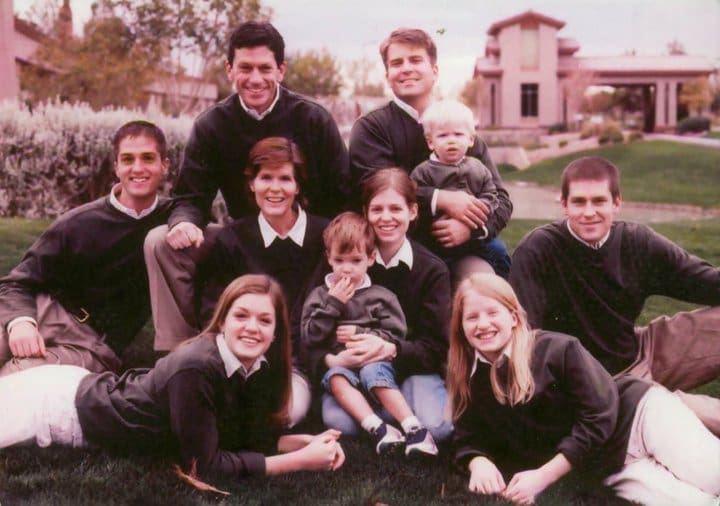
 Christine Jeppsen Clark is a mother of six, a former Mormon Tabernacle Choir member, a Ph.D. graduate student focusing on dementia, and a dear personal friend. She is also the daughter of the late Elder Malcolm S. Jeppsen — former LDS General Authority, personal physician and best friend to Elder Boyd K. Packer, and a GA who was directly involved in the excommunication of Avraham Gileadi (one of the September Six). In this multi-part episode with Christine we discuss:
- What it was like to grow up in the 1950s and 1960s in Salt Lake City as a very orthodox, devout member of a somewhat elite LDS family.
- What it was like to grow up the daughter of an LDS General Authority, who was both a physician to, and best friends with Elder Boyd K. Packer
- Elder Jeppsen’s personal and direct involvement in the excommunication of Avraham Giliadi — one of the September Six
- How such an orthodox, committed LDS family including Christine (the daughter of a General Authority), her husband David Clark (former bishop of eight years, recent Stake Presidency member) and four of her six children could ultimately decide to leave the LDS Church, and
- What it’s like to leave the LDS Church as a grandparent in your 50s and 60s.
Below are excerpts from “Up Close And Personal: The Life History of Malcolm Seth and Marian Jeppsen” relating to Avraham Giliadi (pages 433 – 437), shared with permission of Christine Jeppsen Clark (editing for spelling/grammar by Christine). This excerpt describes how Elder Jeppsen was directly involved in the excommunication of Avraham Giliadi — a member of the September Six — all while the LDS church was claiming that the September Six excommunications were local matters (see here for the history surrounding the denials of high-level GA involvement in the September Six). As the LDS church claims that the disciplinary councils of Kate Kelly and myself are local matters — this provides important insight into how LDS General Authorities influence local leaders in such matters (acknowledging that my disciplinary council is not yet a foregone conclusion).
“A Widely Known Priest Crafter.”
“In October of this year another challenge presented itself concerning a brother who lived in the Salem Stake. His Stake President was President Randall Gibbs, an oral surgeon. The man had studied for a year in Jerusalem and then placed himself up as a “Jewish Scholar,” and became a true priest crafter. He would go up and down the state giving lectures on the end of the earth, etc., for $50 admission fee. He wrote a book entitled “The Last Days,” and that’s how I got involved. The Ensign was going to print a chapter of his book, which became immensely popular, as an article in the magazine.
I was serving on the Correlation Committee of the Church at the time, and our committee looks at everything the Church publishes, even music it sings or letters written by headquarters or anyone else, etc. The chapter was obvious false doctrine. We disapproved it, and even contacted the members of the Twelve whose responsibility was Deseret Book, and they agreed it was false doctrine.
…
His stake president was not interested in doing much about the problem. I prodded him two times and actually gave him a copy of a report from the correlation committee outlining his false doctrines that he was teaching. On his third visit to my office he thanked me for my counsel and was leaving when I put my arm around him and said “We’re short on counsel in this office but long on direction. I’m directing you to take action to correct or else excommunicate this man. He cannot be allowed to be teaching what he is teaching and remain a member of the Church.”
Still nothing happened, so he was released as a stake president. The new one called was a professor at BYU by the name of Leaun Otten. He was appraised of the problem, and moved to correct it quickly. I gave him permission to use his regional representative in any fashion he wanted, to cross boundaries of responsibility, and gather whatever evidence he felt he needed.
…
Let me just tell you what happened on the other side of the telephone call I made. President Otten came home from work that day really troubled about this disciplinary council he was going to conduct on this brother the following evening because of only having one witness. He even said to his wife I’ve had the feeling that my Area President is going to call me with another witness, and had barely said it when the phone call from me rang through. When I went to talk to President Otten on the telephone he didn’t answer. I was wondering what was the matter, when it finally dawned on me that he was in tears. He finally got out, through his crying, the statement :” President Jeppsen, we know who runs this Church don’t we”? To which I agreed we did.
I went to the meeting of the First Presidency and the Twelve that morning being held in the upper room of the temple where we were always invited to meet with them, also the first Thursdays of each month, and reported directly to them what had happened. They were most interested in learning of this incident.
The brother was excommunicated, and immediately the next day other dissidents who heard about it came to him wanting him to sign on to a full page ad in the Tribune blasting what they were calling religious freedom. He would have none of it. Telling them he had made a mistake, but he still loved the Church immensely and would stop his seminars, etc., and do whatever he needed to do to get his membership restored. This he was faithful in doing, and in about 18 months he was rebaptized into the Church. I sent him a letter of congratulations when that happened and called it to the attention of the First Presidency.”
Episode Transcript
Host: John Dehlin · Guest: Christine Jeppsen Clark
This transcript is machine-generated and lightly edited for readability. The audio is authoritative. Please excuse occasional errors in names and spelling.
Introduction and Pioneer Ancestry
Part 1 of 4 · Ep. 483
Christine Jeppsen Clark [00:00:00] 1, 2, 3.
John Dehlin [00:00:07] Mormon Stories Podcast is a production of the Open Stories Foundation. All donations to Mormon Stories are fully tax deductible and go directly towards keeping the podcast alive and towards building a community of support for Mormons like you. To support the podcast or to join the community, please become a monthly subscriber today@mormonstories.org.
John Dehlin [00:00:30] hello and welcome to another edition of Mormon Stories Podcast. I'm your host, John Dehlin, and today I am. I say this every single time, but I mean it. I am so incredibly excited to have with me a dear friend. And it's one of the only times, I think, in Mormon Stories history that I've interviewed someone who is actually a close friend.
John Dehlin [00:00:56] The friend's name is Christine Jepson Clark, and Christine has a really, really, really interesting story to tell. Just to give you a little bit of an overview of what this podcast is about. Christine is a super smart woman. She's finishing her PhD right now up here at Utah State. She's emphasizing Alzheimer's and dementia in her research, and she would be interesting just in and of her own right. But that's, you know, this podcast is about much more. Christine Jeppsen Clark is the daughter of a former, very prominent general authority named Malcolm Seth Jeppsen. And so, you know, this is the first time, other than when I interviewed Ed Kimball, the son of Spencer Kimball, this is the first time that we'll be interviewing sort of the child of general authority here.
John Dehlin [00:02:00] But it's, it's, it's going to be much more of an in depth interview. And Malcolm Jeppsen is particularly important, in my opinion, for kind of 20th century Mormonism because he grew up with Boyd K. Packer, and, and he considered himself to be one of, if not the best friend to Boyd K. Packer. And so imagine a man who grew up with Boyd K. Packer who considered himself to be best friends with him and then who served under Boyd K. Packer as a general authority.
John Dehlin [00:02:36] And it just so happens that Christine's dad, Malcolm Jeppsen, was actually directly involved in dealing with apostates in the 1990s. And this included Avram Gileadi of the September Six. And what's significant also about this interview is that Christine has Malcolm Seth Jeppsen's sort of memoir or personal history.
John Dehlin [00:03:03] And so he wrote in sometimes exquisite detail about what it's like to be a general authority, what things he was asked to do, how he approached things. You know, how there's so much interesting detail in this journal that Christine has allowed me to look at and that she'll be quoting from. And so this is going to be a fact. And because Malcolm Jeppsen was Boyd K. Packer's kind of best friend, I mean this is, we're talking boy K. Packer spoke at Malcolm Jeppsen's funeral as the keynote speaker.
John Dehlin [00:03:40] We're going to get a special insight into what Boyd K. Packer is really like. Not in a way to try and tear him down, but just to give honestly through not only his best friend, but through a very faithful man, perspectives on what President Packer was and is like. But the story doesn't just end there because Christine and her wonderful husband David and her entire family, to be honest, over the past five or ten years has gone through a pretty significant crisis of faith. You know, David served in bishoprics, he's served in stake presidencies.
John Dehlin [00:04:25] You know, Christine sang with the Mormon Tabernacle Choir and has served in probably every significant church calling. And they had five children, is that right, Christine?
Christine Jeppsen Clark [00:04:36] Six.
John Dehlin [00:04:36] Six children. And so part of this is to understand what a general authority was like. Part of his understand what it's like to be the child of general authority. Part of this is about what Boyd K. Packer is like and how the church deals with apostates and discipline. But part of this is about how a very prominent and committed LDS family could experience a crisis of faith, even the daughter of a general authority. We're going to look at how that's possible.
John Dehlin [00:05:08] But then something that's really near and dear to Christine's heart is to talk about the difficulty of experiencing a crisis of faith in your 50s and 60s while you have children who are also still in the church. And so this is just going to be a lot. And I'm just going to warn my listeners up front, we're going to be, this is not like going to be a punchy, let's get to the facts sort of interview. This is going to be a multi hour interview where we really understand what it was like to grow up in Salt Lake at ground zero during the sort of heyday of Bruce R.
John Dehlin [00:05:45] McConkie, Joseph Fielding Smith, Boyd K. Packer kind of Mormonism, what it was like to, you know, what the late 60s and early 70s were like. There's going to be some cultural analysis here and, and we're going to be digging into all the things that we've already talked about.
John Dehlin [00:06:01] So you know, don't expect this to be just sort of all in a 45 minute time span. This is going to be a Multi hour interview covering multiple topics, as much for the history books and historians as it is for the listeners. But I can promise you that Christine has so many amazing, she has an amazing memory and she has so many amazing stories that if you bear with us and marinate in what Christine has to tell us, I think by the end you're going to just feel like you learned a lot and gained a lot of perspective. So with all that, Christine Clark, Christine Jepson Clark, welcome to Mormon Stories podcast.
Christine Jeppsen Clark [00:06:46] Thanks, John.
John Dehlin [00:06:47] Is that an intimidating introduction?
Christine Jeppsen Clark [00:06:48] That's fairly intimidating, fairly intense, but I will enjoy the conversation.
John Dehlin [00:06:55] Did I miss anything?
Christine Jeppsen Clark [00:06:57] You got it.
John Dehlin [00:06:58] Did I get it all?
Christine Jeppsen Clark [00:06:59] I think so.
John Dehlin [00:07:00] I'll just say that one really important part of this interview is going to be how the Brethren dealt with the September six, because there's a lot of, you know, the Brethren don't tell priesthood leaders what to do. The priesthood leaders are allowed to, you know, locally decide what they do. And, and we've got some information from Malcolm Jeppsen's journal that, you know, that show at least with the September six, how things, you know, went down, at least with, you know, with one of them. So that's going to be a pretty interesting reveal, but I'm going to make you all wait.
John Dehlin [00:07:34] So, Christine, let's start because we always kind of like to start with our pioneer ancestry. So I know that, I know that there are at least two figures in your family history which end up playing very prominent roles in how you sort of set things up from an early age as sort of light and darkness, good and bad.
John Dehlin [00:07:56] And I don't want you to give the alternative perspective for these interviews, but talk about your two ancestors as you would have looked at them in your childhood, teen years and early adult years as a way to frame your background in the church, pioneer wise.
Christine Jeppsen Clark [00:08:15] Sure. Well, I was always very aware of one ancestor in particular. I was very proud of this woman. Her name was Emma Emily Bravant. She was born in 1837 in Denmark and she crossed the plains with the Willie Handcart Company. I think most LDS people would relate to that tremendous story of faith and perseverance and the trials they went through. And faith in every footstep was the theme of the, what was it, the sesquicentennial, I guess, not too long ago, where these pioneer, brave pioneers were honored. And I was very proud to have that in my ancestry to be a product of her courage and faith.
John Dehlin [00:09:15] And she is. Tell us just a bit about the trials that she experienced coming over. So she converted in Europe with her family. Right.
Christine Jeppsen Clark [00:09:27] Well, there's not that much known about her family. Apparently she and her older sister joined the church together with her father. He met the missionaries and became very excited about the church and converted the two girls. But then when she was just 16, her mother died and then we kind of lose track.
Christine Jeppsen Clark [00:10:00] Apparently all three, her father and her sister and herself, were heading for Zion. But something happened. We think maybe her father and her sister went first, he died. The sister is kind of lost to us as far as what happened to her. But Emma ends up going by herself.
Christine Jeppsen Clark [00:10:21] So she gets on that ship and heads out into the unknown as an 18 year old. It's interesting too, because my husband Dave also had a relative in the Willie Handcart Company and it was. It's interesting to us to think that they knew each other and his was with a family. I don't know that much about his family story as much as I do with Emma, but if Emma was 18 and Dave's direct ancestor, I believe was 9 or 10, I'm sure they all knew each other and interacted. So.
John Dehlin [00:11:04] But she lost pretty much all her family as they converted to Mormonism and then by the time she's meeting up with the Saints, she's alone as an 18 year old woman.
Christine Jeppsen Clark [00:11:17] Right. So I'd love to know if she pulled the hand card herself. I'd love to know more about her individual experience relative to that pioneer trek. For reals. The real she made it all the way to Salt Lake through all that. We know about what they suffered.
John Dehlin [00:11:39] And the Willie Hankard Company was controversial. Why?
Christine Jeppsen Clark [00:11:44] Because they left so late in the season.
John Dehlin [00:11:47] Right.
Christine Jeppsen Clark [00:11:48] I think they had a strict rule that no handcart companies were to leave. Was it winter quarters past July and they were planning to leave in late August, I think so.
John Dehlin [00:12:04] Leaving way too late because that could expose them to the, to the elements.
Christine Jeppsen Clark [00:12:08] Right, right. Yeah, they, they left Florence, Nebraska on August 12th. So that was way too late and they all were worried about it. But.
John Dehlin [00:12:24] And there was. Wasn't there a prominent. Was it Levi Hancock?
Christine Jeppsen Clark [00:12:29] Levi Savage.
John Dehlin [00:12:30] Yeah. Levi Savage, Yeah.
Christine Jeppsen Clark [00:12:33] Yeah. That's an interesting story. Do you want to get into that now? What they had to.
John Dehlin [00:12:38] Not your conclusion, not your current conclusions about it, but just set it up. Because.
Christine Jeppsen Clark [00:12:42] Just set it up. All right.
John Dehlin [00:12:43] Yeah, because I think it frames some of the main questions we're going to be discussing.
Levi Savage and the Willie Handcart Company
Christine Jeppsen Clark [00:12:46] Okay. All right. Yeah, yeah, I would agree with that. Apparently. And you can find this information. Levi Savage's journal, by the way, is on a BYU website. Handcart BYU Edu that's a fascinating day by day chart charting of everything that this company experienced. That's where I got this information and it says, because I think some of it is worth reading as far as what Levi Savage says in his own handwriting, in his own words, he says
John Dehlin [00:13:25] who made, who made the decision to leave late?
Christine Jeppsen Clark [00:13:29] Oh, what do I remember? There was the, it kind of evolved like the handcarts weren't ready when they got off the boat. They were still being made. The. There was a delay there. There were just were a series of delays that weren't expected in this company of what, 600 people. I think it was between the Willie and the Martin group really were.
Christine Jeppsen Clark [00:13:58] They wanted to get to the, to Zion. They considered this to be Zion and were frustrated at the delays. But at some point there was this decision that had to be made. And Levi says they called this meeting and they said, all right, we've got to know who is going on and who is going to stay and see. Growing up, I didn't realize that they had that decision to make.
Christine Jeppsen Clark [00:14:28] Apparently over 100 people that were supposed to keep going to Salt Lake decided to stay. They turned back, they said, you know, I think we'll just stay here. So rather than going too dangerous, too dangerous, too dangerous. And that's what Levi says in his journal. He says, today we commenced preparing for our journey and ascertaining who wishes to go on this fall and who wishes to remain here. Many are going to stop, so interesting, huh?
Christine Jeppsen Clark [00:15:00] Others are faltering, in other words, trying to decide. And I myself am not in favor of, but much opposed to taking women and children through when they are destitute of clothing, when we all know, which is interesting, when we all know that we are bound to be caught in the snow and severe cold weather long before we reach the valley.
Christine Jeppsen Clark [00:15:23] I think that is fascinating. In other words, they all knew that they were going to, that there was a really high probability that they would be caught in the snows in the mountains.
John Dehlin [00:15:32] And so what do you think? What do you think led those who continued on? What do you think the main influences were for people to go ahead and continue long after the date that they should have?
Christine Jeppsen Clark [00:15:43] That is an important question, John. And again I'm thinking of my relative, this 18 year old girl traveling alone. Emma. Here's Emma, she's with this group and they have this meeting. So it says August 13, 1856. This evening we held meeting in camp. This again is Levi Savage's journal.
Christine Jeppsen Clark [00:16:10] Now here's the next Thing he says is Brother Willie exhorted the Saints to go forward regardless of suffering, even to death. So here's this man who is just fired up now. Elder Richards. This is Franklin D. Richards in another source, I am told, promised this group that it would snow on the right, it would snow on the left, but they would go forth to Zion on dry ground.
Christine Jeppsen Clark [00:16:41] Now, that's. I don't. I don't have the verification of that in front of me, but I know I have read that before in another source. So here are these people who know, again, to quote the journal, that they are bound to be caught in the snow and severe cold.
Christine Jeppsen Clark [00:16:59] And yet here are the brethren urging them forward to have faith in the promises of God through his prophets. Now, that is a critical piece of information, I think, that everyone should consider. It's almost like the scriptures. Consider yourself in this situation. You know, what would you do? What would you be feeling?
Christine Jeppsen Clark [00:17:24] And then Levi goes on to say, after he, meaning Brother Willie, Commander Willie, Captain Willie, I think they called him, after he had spoken. He gave me the opportunity of speaking. I said to him that if I spoke, I must speak my mind. Let it cut where it would. He said, certainly to do so. I then related to the Saints the hardships that we should have to endure. I said that we were liable to have to wade in snow up to our knees and shovel at night, lay ourselves in a thin blanket and lie on the frozen ground without a bed. I said that it was not like having a wagon that we could go into and wrap ourselves in as much as we like and lay down.
Christine Jeppsen Clark [00:18:03] No, said I, we are without wagons, destitute of clothing, and could not carry it if we had it. We must go as we are. The handcart system I do not condemn. I think it preferable to unbroken oxen and experienced teamsters.
Christine Jeppsen Clark [00:18:18] The lateness of the season was my only objection to leaving this point for the mountains at this time. I spoke warmly upon the subject, but spoke truth. And the people, judging from appearance and expressions, felt the force of it. And then he says, elder Willie stands up again and spoke in reply to what I had said, evidently dissatisfied. He said that the God that he served was a God that was able to save to the uttermost. And he spoke in favor of proving that they had faith in the promises of God by going forward. Yeah, and that's critical.
John Dehlin [00:19:01] Now, do we know how many people died?
Christine Jeppsen Clark [00:19:05] Yes, I wrote it down. And I believe it was like 85 out of 600.
John Dehlin [00:19:16] Yeah, and. Yeah, and we all know that there were People who lost, you know, as I understand it, lost, you know, toes or feet or, you know, a lot of tragedy. And now, of course, this isn't so much about, like, condemning anybody or picking an historical instance where some mistakes were made and then trying to paint this broad brush. Of course, good things came from even a very tragic thing like the William Martin Handcart Company. Right. So good things came from it. And sometimes leaders make mistakes. Tell us how this is relevant as a framing.
Christine Jeppsen Clark [00:20:02] Yes.
John Dehlin [00:20:02] For your story.
Christine Jeppsen Clark [00:20:04] Well, the key to what you just said, the key to my story is in the next paragraph because there's. Of Levi Savage's journal, because there is a brother listening to this exchange between Captain Willie and Levi Savage. And, and he said that he exhorted the saints to pray to God and get a revelation and know for themselves whether they should go or stay, for it was their privilege to know for themselves. And everybody said, that's a good idea. He says the meeting was dismissed. All manifesting a good feeling in spirit. And so the decision that they had to make individually was, was, are the brethren speaking for God?
Christine Jeppsen Clark [00:21:00] Can I, can I trust that what they're telling me is what is the same as if God were speaking, which is what the scriptures say, whether by my voice or by the voice of my spirits, it is the same.
Christine Jeppsen Clark [00:21:14] It's all over the scriptures. DNC1. I mean, it's everywhere. So they had to make the same decision that we do. Meaning, is this person speaking for God? In other words, do I need to listen to him as if he were God talking to me?
Christine Jeppsen Clark [00:21:35] And that's still the challenge. In fact, Brigham Young said. Something to the effect, don't take my word for it. You need to find out if I am leading you correctly. In fact, here's the quote. Do you know whether I am leading you right or not? Do you know whether the wisdom and the mind of the Lord are dispensed to you correctly or not through me? And he challenged the saints. You'll have to find out. That's what God wants you to do, is to find out if you, if, if in this moment in time with this thing that I'm saying, is this really coming from me? And I think that's the challenge that we have still today.
John Dehlin [00:22:26] And I'll just say that there's something like, cool about that, right? Because the brethren aren't saying just blindly obey us. They're saying you need to know for yourself. And in reality, that's what this. In the story, the brethren kind of said, this is the way it should be. But go, you know, go pray and see if you agree. And some went and some stayed behind. And so this isn't so much, again, an exaltation or a condemnation of the Brethren or of the model.
Christine Jeppsen Clark [00:22:53] No, it's a system.
John Dehlin [00:22:55] It's a framing of the system that you, Christine Jeppsen Clark, struggled with throughout your life.
Christine Jeppsen Clark [00:23:01] Right, absolutely. Trying to understand how that works from a position of faith.
John Dehlin [00:23:06] Right.
Christine Jeppsen Clark [00:23:07] Because here's the flip side of that or here's the challenge or the complicating factor into what you just said and what I just described as, again, dramatized or evidenced in what happened to the Willie handcart Company. Because the next day, Brother Richards, Franklin D. Richards, was going through on a light wagon or a light carriage or something and heading for Salt Lake. He was. He was planning to get there before the Saints arrived and let everybody know they were coming.
Christine Jeppsen Clark [00:23:40] And he heard that in the meeting the night before that Levi Savage had spoken negatively about the Brethren. And here's the challenge. Here's the complicating factor. Quote, Brother Richards reprimanded me sharply. And Brother Willie had said that I had manifested a bad spirit all the way from Iowa City.
Christine Jeppsen Clark [00:24:09] In other words, and I'm thinking now of Elder Oaks, never criticize the brethren. Have you seen that clip? Even if they deserve it. Okay, so then one of the other questions that I've had my whole life is how do you question or ask questions with the spirit of honestly wanting to understand how this system works? How do you get revelation that you know you can trust? Will somebody please help me figure this out? And. And I constantly went to my father to ask him questions in my life as they came up relative to that.
John Dehlin [00:24:47] Y.
Christine Jeppsen Clark [00:24:47] Is this from God? Is this from God? Is this from God? We'll get to that, to Elder Packer and ask him. And I would get advice directly from Elder Packer himself. And it's in his book all over.
John Dehlin [00:24:57] So we'll. So we'll totally get to that.
Christine Jeppsen Clark [00:24:59] Okay.
John Dehlin [00:25:00] Okay. So. So that's an. So Emily Bravant. Excellent. Sort of. Sort of one side of the pole. Tell us quickly about William Davis.
Christine Jeppsen Clark [00:25:11] Yeah.
John Dehlin [00:25:11] Okay. Wait. How is Emily Bravant related to you?
Christine Jeppsen Clark [00:25:14] She is my great grandmother.
John Dehlin [00:25:17] In other words, take us through your. It's your.
Christine Jeppsen Clark [00:25:19] Yeah. She makes it to Salt Lake. She marries Rasmus Nielsen Jeppsen. J, E, P, P E, S E, N. Okay.
John Dehlin [00:25:29] Okay.
Christine Jeppsen Clark [00:25:29] They settle in. In Manaway, Utah.
John Dehlin [00:25:32] Right.
Christine Jeppsen Clark [00:25:32] And they have Conrad, who is my grandfather.
John Dehlin [00:25:36] Right. And this is important because Manaway, if, for those of you who know, kind of Brigham City, Cache Valley, Manaway is just on the. On the other side of kind of the mountain or the canyon to Brigham City. And that's become significant because Malcolm Jepson, growing up in Manaway, ends up becoming friends with Boyd K. Packer, who famously grew up in Brigham City. Right?
Christine Jeppsen Clark [00:26:00] Yeah. They went to high school together, knew each other really well. That's where he met my mother. She grew up in Brigham City as well.
John Dehlin [00:26:08] And so Emily. Emily marries the first Jepson who becomes. Who's your father's grandfather, Is that right?
Christine Jeppsen Clark [00:26:14] My father's. Yeah. Grandfather.
John Dehlin [00:26:17] Okay.
Christine Jeppsen Clark [00:26:18] And. Yeah. And then they have Conrad, and Conrad is my grandfather. And he was the bishop, a very faithful bishop in manta way for 25 years straight. Then he has my father, who has that same faith. So here's a legacy of unquestioning follow the brethren, keep the doctrine pure. You know, very orthodox, fundamental view of Mormonism that. That I admired growing up.
John Dehlin [00:26:49] And so the Jeppesons became the icons of obedience and faithfulness for you. Let's talk about the Davises.
Family Background on Both Sides
Christine Jeppsen Clark [00:26:59] Yeah. So my mother's family in Brigham City, her maiden name was Davis, and my grandfather was a lawyer there in Brigham City. I didn't know him at all, virtually. He died when I was just young. But. He and my grandmother were less active to the point of perhaps being called even anti Mormons. He had very strong feelings, and so did my grandmother, against the church.
Christine Jeppsen Clark [00:27:43] Meaning when I'd go visit my grandmother, she was the only grandparent I ever knew. She would say things like, if. If so. And so down the street is a Mormon and he's going to heaven, then I would rather go to hell.
Christine Jeppsen Clark [00:28:00] I don't want to have anything to do with that person because he has done this unfortunate thing or this unethical thing, and. And yet they tell me he's going to heaven. So I don't want anything to do with that or the people or the system. She was very vocal about her anti Mormon sentiments. And so I don't think she appreciated the fact that my father married her only daughter and then basically took her away from Brigham City.
Christine Jeppsen Clark [00:28:40] I don't get the feeling that mom had that much to do with her family because she was so tied up in mainstream active Mormonism, and Grandma had very little interest in that.
John Dehlin [00:28:56] So in your family, your mom's side of the family, which was not active or faithful, LDs were kind of held up as the bad guys.
Christine Jeppsen Clark [00:29:05] Definitely. Especially when my grandmother would come to stay with us and visit us. My mom had Some instant coffee in the cupboard, and she. Grandma would help herself to her cup of coffee in the morning. And I remember looking at her one morning as a little child and thinking, oh, my gosh, my grandma's gonna go to hell. I'm not gonna see her after this live. I better go in and visit her now while I can.
John Dehlin [00:29:28] While she won't see her.
Christine Jeppsen Clark [00:29:29] No, she'll be long gone.
John Dehlin [00:29:33] But did your mom still. Did your mom still love her, you know, parents and respect them or.
Christine Jeppsen Clark [00:29:39] I think so. And I think they were really fine people. I mean, my grandfather was known as a very honest lawyer, from everything I can find out, very trusted. And. And they love their children. I. I think they were certainly wonderful people who I saw through the lens of
John Dehlin [00:30:05] the faithless.
Christine Jeppsen Clark [00:30:06] Faithless. That's the word. Faithless individuals who didn't love the Lord, who didn't. And, you know, that was colored again, by my dad's perception of them because I think they kind of looked at him as a little bit. Well, not just a little, as a fanatic. So they had this perspective of each other that were. That was probably opposites, extremes.
John Dehlin [00:30:29] And we all know that there are good and bad Mormons and there are good or bad. Good and bad non Mormons. I just think for me, the way I was raised or what I took for my upbringing, I think I emphasized too heavily the goodness, by default, of Mormons. And I emphasized, I think, by default, the. The inadequacies of non Mormons. And we can come back to these two stories later and talk about how you see them now much differently. Yeah, yeah. But it's fun. It's. It's important to see that you had those two different polls to frame. So talk just briefly about your dad, Malcolm Jepson, just about his upbringing and his relations to Boyd K. Packer. Real quick.
Father Malcolm Jeppsen's Early Life and War Service
Christine Jeppsen Clark [00:31:15] Yeah.
John Dehlin [00:31:16] In his childhood, he.
Christine Jeppsen Clark [00:31:20] Dad was the sixth and last of. In his family. And an unusual aspect of the Jeppsen. Conrad Jeppsen family was that his older brother Ernest, I think, was 22 years older than dad was. The family stories of the. Of the written histories that we have actually that his. That dad and his siblings put together say that when my grandmother found out she was pregnant with dad, that Ernest, the oldest, who again was 22, got mad at her and said, mom, what are you doing? What are you. And apparently made her cry.
Christine Jeppsen Clark [00:32:10] And. Part of the problem was that she had kidney problems and this pregnancy compromised her kidneys to the point where she ultimately died. Dad says he remembers her legs swelling up with Edema and that they used to play a game, if you can imagine, where he'd push his thumb into her calves. And the thumbprint would stay there because they were so edematous. And she would laugh and try to reassure him that it was not that serious. Even though he was too young to understand. Her kidneys were gradually failing. And it would ultimately kill her. So he, after he went through medical school, realized that his.
Christine Jeppsen Clark [00:33:07] The pregnancy that she had carrying him probably weakened. And then ultimately led to her kidneys completely failing and she died. She was determined to live until he was baptized. She wanted to see him be baptized. So she hung on until the day he was baptized when he turned 8. And then she went into a coma and died three days later. The next oldest.
John Dehlin [00:33:34] So his mom died when he was eight.
Christine Jeppsen Clark [00:33:36] Yep, eight years old. The next oldest sibling was eight years older. So he was raised more or less as an only child by Conrad, I believe was 50 something when he was born. So dad grew up kind of lonely. He talks about having a dog, Poochie, that he palled around with. And he said as a small child, since Manaway is just in this mountain valley that is completely surrounded by mountains. I mean, you know, that's not an understatement. It really is. They're just. There's a road that leads away and on either side of the valley, but what is it like two miles in length? It's just this tiny little town.
Christine Jeppsen Clark [00:34:26] And growing up, he said he thought that was the world. He didn't realize there was anything outside of that valley. He went to high school at Box Elder High in Brigham City. And that's where he became acquainted with Elder Packer. They double dated together, they hung out, they went to dances together. This is in his memoirs and also Elder Packer's as well. They both talk about how much fun they had as kids.
Christine Jeppsen Clark [00:35:04] And he also met my mother in junior high. They had a stenography class together. I guess that's shorthand. And he was planning to use it in medical school. And she was taking it. And that's where they became acquainted in.
Christine Jeppsen Clark [00:35:25] Then, of course, he went on to medical school. And she went on to the University of Utah, where she studied music. She always wanted to play the piano, but during the Depression, her parents couldn't afford it. But someone, from what I understand, gave her father a violin in trade for his services as a lawyer.
Christine Jeppsen Clark [00:35:48] And so she started learning the violin and eventually supported herself for a time after she graduated in music as a violinist with the Utah Symphony Orchestra.
John Dehlin [00:36:07] Nice.
Christine Jeppsen Clark [00:36:08] Yeah, but Then when she married my dad, which is the custom of the day, this strict division of responsibility in the home, breadwinner, homemaker, she gave up any ambitions she might have had and became a full time homemaker. Emphasis on the home.
John Dehlin [00:36:28] Real quick, before we get there, talk just briefly about whether or not your dad served a mission, talk about the war and talk about his reflections on, on Elder Packer pre and post war.
Christine Jeppsen Clark [00:36:42] Yeah, that is an interesting story. Dad started actually at Utah State and then this was towards the end of the war when they had a real need, urgent need for physicians. So he was funneled into kind of an accelerated program at Baylor University so they could produce more MDs.
Christine Jeppsen Clark [00:37:08] So he never served in the war. World War II, it was over by the time he got his training. However, not too long after dad and mom married, he was, let's see, we rolled right into the Korean War and he knew that he would be called up for that since he had, since the military had paid for a portion of his medical training.
Christine Jeppsen Clark [00:37:33] So not too long after they were married, just a matter of months, he had to report for duty and ended up on a ship as the ship's doctor. And then he finished his tour of duty at a naval base in Bremerton, Washington, which is where I was born. But in the meantime, mom had their first child, a girl named Julie Ellen, because she went back to live with her parents in Brigham City when he
John Dehlin [00:38:06] got, when he was in.
Christine Jeppsen Clark [00:38:07] Shipped off on the ship. Yeah, and that baby died just after three days. She had a heart defect of some kind and so he never saw her, wasn't able to be there. He always felt bad about that.
John Dehlin [00:38:21] So you came along there, your parents first child?
Christine Jeppsen Clark [00:38:24] Yeah, she died and then they were glad to get me. So I was their first surviving child. And then they had four more after that.
John Dehlin [00:38:34] So he did not serve in World War II, but he did serve in Korea.
Christine Jeppsen Clark [00:38:37] He didn't serve in World War II. He did serve in Korea as, again as the ship's doctor for nine, ten months. Something. But he talks a lot and it's even in his book about Elder Packer. And by the way, he calls him Elder Packer too.
Christine Jeppsen Clark [00:38:52] He never would allow me to say Boyd Packer because that was a sign of disrespect. And I'm interested that even he says Elder Packer, not my friend Boyd throughout his book and he mentions Elder Packer a lot. Elder Packer had a huge influence on him, which he acknowledges in his memoirs.
Christine Jeppsen Clark [00:39:12] He said that before Elder Packer went to was it The Army. I think it was the army in World War II. He went into the army, he was happy, Go lucky. They had fun, they laughed, they did all the normal things. By the way, Elder Packer was the 10th of 11 children, mostly boys.
Christine Jeppsen Clark [00:39:37] His father owned a gas station in Brigham City, and apparently the Packer family was well known. But when he came home, he, meaning Elder Packer, from the war, he was changed. And that he told of an experience that he had where he should have died, meaning he was sure he would have been killed had it not been for some kind of a.
Christine Jeppsen Clark [00:40:13] It almost sounded like a near death experience. To the point where to show his gratitude for being kept alive, he dedicated the rest of his life to the service of God of Christ through his, you know, any way that he could show his gratitude because he was convinced he should have been killed and he would never say the details of that. Dad said that several times.
Christine Jeppsen Clark [00:40:42] They don't know exactly what happened, only that when he came home from World War II, he was a completely changed individual where he was very serious and very committed, very directed at serving the Lord for the rest of his life. And he went right into the CES program as a seminary teacher.
Christine Jeppsen Clark [00:41:01] And then, I'm sure many books have been written about him since then. But that was my dad's experience that he was changed, he was different. He suddenly was much more directed towards church service than he had been.
John Dehlin [00:41:18] So President Packer must have experienced some very probably violent and traumatic things, number one, during World War II. And, and, and that must have been traumatic. But then also, he clearly leaves World War II with the commitment to serve the Lord.
Christine Jeppsen Clark [00:41:38] That's right, yeah.
John Dehlin [00:41:40] Lifetime of service. Okay, so let's talk about you growing up now. This is a fascinating thing for me because we, you know, I grew up watching Leave it to Beaver and, you know, My Three Sons and these types of shows that sort of really tried to capture, I think, what, what the 50s, growing up in the 50s was, was like as a young child. And, you know, that's a very different thing than actually living it. And I think it's fair to say that. Talk a little bit about your neighborhood and what, what, you know, what growing up as a child in the 50s and early 60s was like as it relates to these stereotypes.
Growing Up in 1950s and 60s Salt Lake City
Christine Jeppsen Clark [00:42:26] Yeah, it's interesting. First of all, I grew up in an area of Salt Lake on the east Bench known as Mount Olympus Cove. And whoever developed that area, I don't know if he was LDS or just knew about it, but he grabbed a Book of Mormon, opened it up and started choosing names for the streets from the Book of Mormon. So I grew up. My address was 4187 Abinadi Road.
John Dehlin [00:42:58] That's awesome.
Christine Jeppsen Clark [00:42:58] And you could always tell who knew their Book of Mormon when you. They'd say, what's your address? And you'd say. Or they'd look at it written, you know, abba what? Abenatti. What now, what's that? So I just automatically said, 4187 Abinadi, Abi Nadi. You know, you just spell it out because. And then you could see if someone went, oh, yeah, I know Abinadi. Since most of the people that I've heard on your podcasts, I think, are of a younger generation, I do think that it's important to bring out this aspect of the culture of this time, the 60s. It goes back to what I was talking about before this. This strict division of responsibility in a home between the bread maker or breadwinner
John Dehlin [00:44:01] and homemaker and the bread maker, the breadwinner and the bread maker.
Christine Jeppsen Clark [00:44:07] The mom was the bread maker, breadwinner. This is a phenomenon that I've studied since just recently as part of my PhD coursework. In fact, Betty Friedan was really instrumental in articulating what happened during this time. She called it the Problem with no Name, because everyone just rushed back from the war. They were so anxious to settle down. And there was this glorious period of 10 or so years where people started having families and organizing their family structure around this.
John Dehlin [00:44:57] Was there a book she.
Christine Jeppsen Clark [00:44:59] Yes, she wrote a book.
John Dehlin [00:45:01] Fascinating Womanhood.
Christine Jeppsen Clark [00:45:03] No, no, her book was called. Ah, some book. It's a book about the phenomenon that I'm trying to describe. Meaning everybody was so excited.
John Dehlin [00:45:17] Feminine Mystique.
Christine Jeppsen Clark [00:45:19] Thank you. The Feminine Mystique. Meaning everyone was just thrilled to do the Leave it to Beaver thing. Meaning the father went off to work and the mother stayed home and with the kids and she cleaned and she. In her dress, with her pearls, she. And the whole point was focused on when the dad came home. You know, I'm so glad when Daddy comes home. It was very much, here he comes. And all the children would gather around, there he is. It's our father. And you'd get his slippers and you'd have a wonderfully prepared dinner for him, and it was all focused on him and.
Christine Jeppsen Clark [00:46:04] And you were there to facilitate the home and the. It just everybody was doing it. It's not just Mormons. This was the way you organized your family and you fulfilled yourself personally. Individual fulfillment was based on how well, you performed this role that you were given, your role as breadwinner, your role as homemaker.
Christine Jeppsen Clark [00:46:31] There was an interesting discussion on Facebook the other day about the iron, right? I don't know if you were a part of that, because somebody brought up that they'd heard that women used iron rights. This machine that had a big roller on it, and these women, including my mother, would sit there and you'd roll your sheets through and you'd iron all of your, your clothing on this machine. This was like the latest and greatest invention to help women with their job, strictly defined as homework, housework, childcare. You know, that's your job. And somebody on this Facebook thread said, well, why didn't the men just iron their own shirts?
Christine Jeppsen Clark [00:47:15] What's the deal? That's crazy. Why? Where did this get started? But why would a man buy his wife an iron, right, and say, here, woman, do my ironing, iron my shirt, when he could have just done it himself? But see, that's looking at a cultural phenomenon through a lens of our culture today, where that makes sense. And you go, yeah, that's a good idea. Why didn't they do that? Well, I'll tell you why they didn't. Because that was the woman's job.
Christine Jeppsen Clark [00:47:44] It would be like saying to her husband, you aren't making enough money. I'm going to go out and make some too, because you're failing in your job. He would never dream of going to her and saying, you're doing a lousy job of ironing. Here, let me. I'm going to do my own. That would be hurtful.
John Dehlin [00:48:05] It would be to her, right?
Christine Jeppsen Clark [00:48:06] To her. Painful? Yes. Like, oh, my goodness, are you saying I'm not doing my job? Well, I mean, that's how you found your self fulfillment again, through your role, through the performance, successful performance of your role. And that's what I don't think people understand in our culture today how strictly these roles were separated and sustained, supported by everyone in the culture. But that's where Betty Friedan comes in. Because after not too many years, women started going, wait a minute. And especially where they'd had such a vital role in the war effort. You see that picture of Rosie the Riveter, and they were out there doing things, and all of a sudden they were strictly at home and they became isolated and depressed.
Christine Jeppsen Clark [00:48:59] And that's where this first wave of feminism started, was women looking around and going, wait a minute, I don't like this. I need something more. I'm going crazy. And that's why Betty Friedan put name to it in her book that has become famous.
Christine Jeppsen Clark [00:49:20] The problem that has no name, because these women were. It was almost like they couldn't identify what they were feeling and what went wrong. And she identified it, described it, and then that. And she kind of sparked the whole women's live movement in the 70s. However, now we go back to me, immersed in this culture. My mother and everyone I knew were strictly homemakers. It was. It was considered wrong, like something's wrong. If the woman worked again, it was an admission that the wife or that the husband wasn't able to.
Christine Jeppsen Clark [00:50:02] He wasn't doing his job. He was failing somehow in his role as a provider. So that's why the story of Alice Beiner has such relevance, because it's such a perfect descriptor of this whole phenomenon of a woman's role as a homemaker, a housewife, a caretaker and all of that.
Christine Jeppsen Clark [00:50:29] Alice Beehner lived just up the street from. From my family. Her family was on Zarahemla Road. And I used to tend for her. So I would have been, what, 12, 13ish? Well, in fact, I think I have the date on that. This was 1965. I remember going to 10 for her one day, and she said, guess what? I've decided to enter the Mrs. Utah contest. And I said, oh, that's great, Ms. Sister Beaner. I'm so excited.
Christine Jeppsen Clark [00:51:03] And she said, yeah, we've got this. I'm kind of nervous about it. You know, the. We've got this contest coming up, and I've got to do this and this and this and. And sure enough, she told me the next time I attended, I'm if they're going to televise it. I remember running home and telling my parents, guess what, Mrs. Beaner, Sister Beiner is going to be on TV. And so we sat down, my whole family, and we watched Mrs. Sister Beaner on TV because she made it to the final five contestants.
Christine Jeppsen Clark [00:51:35] And oh, my gosh, it's just crazy to think now of how none of us saw anything wrong with this. Because the camera switches over to these five finalists, and each one of them is standing by an iron. An ironing board with an iron in her hand.
Christine Jeppsen Clark [00:51:59] And there's a man's dress shirt on the ironing board. And the woman's got her hand around the iron. And I remember seeing Sister Beanor, she's just looking so intense. Okay, I can do this. I can do this. I think they actually fired a gun, like, go.
Christine Jeppsen Clark [00:52:22] And then they start playing the William Tell Overture. And she just Went crazy. And she told me that she'd been practicing ironing a man's shirt so she might have a chance to win this competition. And so sure enough, she whips that shirt off the ironing board and holds it up with a big smile. And she won the ironing competition, which was supposed to show off her skills at homemaking.
John Dehlin [00:52:56] Right.
Christine Jeppsen Clark [00:52:58] And she went on to win the Mrs. Utah competition as well.
John Dehlin [00:53:01] The national Mrs. America.
Christine Jeppsen Clark [00:53:05] Oh, sorry, Mrs. America. Yes. Which I looked it up. The skills that they were competing against each other to show that they had a real expertise in were. What did they say? Party planning was one of them. Ironing was a big part of the national. Yeah, ironing, cooking, and party planning. I think that was it. And again, to give you a feel for the culture of the day, this is. This is what everyone agreed made a woman
John Dehlin [00:53:51] of worth.
Christine Jeppsen Clark [00:53:52] Of worth. Exactly. Her. Her role was so important in that regard.
Ideals of Womanhood and Domesticity in the 1960s
John Dehlin [00:54:00] And I liked what you said about the Fascinating Womanhood book and what it meant to be the ideal woman. Talk about that. I mean, the phrase that you use is really good.
Christine Jeppsen Clark [00:54:13] Well, fascinating Womanhood. I'm not even sure if it was an LDS woman who wrote that. I don't think it was. This came out in 1963. But my young woman leader, I remember her actually using it as one of our lessons when I was in Young Women because she was so impressed by it.
Christine Jeppsen Clark [00:54:36] The whole premise of this book is that you seek to become the ideal woman from a man's point of view. In other words, kind of like the Stepford Wives. What can I do to keep my man? What can I do to make him happy? Because if you look at it from a sociological perspective, you could see this as a social exchange. Meaning, I will take your paycheck, I will get the benefits of your paycheck, and in return, I will give you sex and childcare and take care of your house.
Christine Jeppsen Clark [00:55:15] That was pretty much the understanding at that time. And part of that was to be the ideal wife. Like, what is it that a man is looking for? And the whole book was about, oh, gosh, if you look it up on the Internet, it's just crazy. Like, how to. Like June Cleaver portrays how to be at the door smiling with and looking stunning, like somebody that he would be attracted to. And don't tell him all about your problems of the day. Give him a chance to unwind for at least an hour before you talk to him about anything that you're concerned about. And, gosh, just a whole list of rules for how to Be the perfect woman from a man's perspective with the little caveat like it says on the book jacket, because my mother had one.
Christine Jeppsen Clark [00:56:13] I think every woman in the Relief Society had one. How to prayerfully live your God given role as homemaker. And that was pretty much it there to aspire to. Anything outside of that paradigm was going against what God wanted you to do. Again, this perspective of trusting the brethren to be giving you the word of God as to how you should organize your life and make your life decisions.
John Dehlin [00:56:46] Right. And so, and so do you remember thinking of your mom as being happy and fulfilled in a role like this is a way to raise a family and to be a mother and a father. Right. And how do you reflect upon the happiness levels of your family? Was it a disaster or was it actually worked pretty well?
Christine Jeppsen Clark [00:57:12] Yeah. And that's an interesting question because I don't think that generation worried very much, at least my parents didn't. About the emotional aspects, the psychological aspects of your children or even their own interaction. Aren't they called the greatest generation? Because they just did. They didn't think about why. They just did what they had to do and didn't stop to think about the, again, the psychological implications of anything that they did. And it's just so interesting to me that with two parents who never asked why, why do I feel this way? Or how do my children feel about whatever I come along? And that's all I ask. Oh my goodness. I've always wondered why, why, why, why, in fact.
John Dehlin [00:58:07] But, but, but before, before we get to that, I just. And this will be. We'll kind of close part one with this question. Do, do you have any reason to believe that within their frame that wasn't a happy and a good experience? In other words, is there any downside that you experienced or that you observe looking back to that approach, or was it just a, a perfectly legitimate and valid way, valid way of living? What was the downside or the cost to that Beaver Cleaver kind of lifestyle? From your perspective, what was the benefit and what was the cost?
Christine Jeppsen Clark [00:58:43] Yeah, well, the benefits.
John Dehlin [00:58:46] Everyone knows their role. Right. And it's efficient.
Christine Jeppsen Clark [00:58:48] Everyone knows their role. It's efficient.
John Dehlin [00:58:52] I mean, coming home, I mean, if I'm the dad, I'm coming home, somebody's taking off my shoes, I get the paper, I get a good meal, but my wife looks hot. You know, everything's in order. Like that's not a, that's, that sounded pretty good to me as a man. Right.
Christine Jeppsen Clark [00:59:08] Yeah. Again, I've studied this somewhat in classes since then. And so, because I never thought about it. I don't think any of us did. You just did it. That's just. That was the culture that you accepted, or at least I did. This is the way it was supposed to be. I never sat down to think about, is there a better way?
Christine Jeppsen Clark [00:59:30] But it seems like now what you give up with that is intimacy. I mean, one social psychologist calls this phenomenon, that way of structuring your relationship and your family as a companionate marriage, as opposed to institutionalized marriage from years ago. Meaning the man. It was kind of modeled after a king.
Christine Jeppsen Clark [01:00:01] The man was the king, the wife and the children his subjects. He ruled. They were his property. And then it switched to this companion marriage where you were friends. But now it's shifting to an individualized marriage. I'm fascinated with that. I think that's what this younger generation is moving more to. Meaning there are no external forces on a couple anymore. No family, no church telling you how you should feel, what you should do, and how you should interact. Like it was more in the 50s, which I think the Brethren institutionalized that model and have been ever since, actively working against any change in that. That's why that model is so important, because the Brethren keep going back to that. This is the way it should be. But now, so.
John Dehlin [01:00:57] So wait. So let's not talk about now because we're. We're still back in the 50s and 60s. We can save now for later, if that's okay. What I'm hearing you say is that there wasn't an emphasis on developing one's own awareness of one's own psychology, one's own interests. It's more, you're part of this machine system. You know your place. You're productive. You're like a bee in a beehive. Right. Which fits the Utah motto. You're filling your role, doing what you do for the betterment of the society. But there's not a lot of individual self development, self awareness, and there's certainly some type of privilege that the male gets where they're out making money, exploring the world, conquering things, being leaders. And what's left for the woman? Just fill in that blank, Christine, back in that model. Well, I think we get a sense it's. It's irony.
Christine Jeppsen Clark [01:01:57] Yeah, the emphasis. Right. Well, it's. It's homemaking. I mean, we had homemaking lessons in Relief Society.
John Dehlin [01:02:05] Right? Yeah, that's.
Christine Jeppsen Clark [01:02:08] That's it. Women, this is your role. Let's make the best of it, which I tried very hard to fulfill. I baked 100 million loaves of bread. I sewed everything we ever wore as a family. I mean, I put all my energy and focus into homemaking as it was presented to me. This is what God wants you to do.
John Dehlin [01:02:27] And since. And since we're wrapping up this segment, we're going to get to your story. But the potential risk of that or the problem with that is what. Just summarize that.
Christine Jeppsen Clark [01:02:39] So I think one of the problems with this, with trying to find self fulfillment by the successful completion or your life being dedicated to these stereotypical roles, is really well described in a book that had a big impact on me called A History by Stephanie Koons, who is a researcher at the Evergreen State College in Olympia, Washington. And she has researched this subject for a long time, specifically how a woman feels.
Christine Jeppsen Clark [01:03:22] Kind of like what Betty Friedan did in this system, this kind of a system where you have to be perform in a certain role. She said. In the 30 years that I've been researching family life, I have read many women's diaries written over the last 400 years.
Christine Jeppsen Clark [01:03:44] Reading these records of women's lives and marriages, I was struck by how often entries focus not on the joy of their marriages, but on wives struggle to accept their lot. Many women did write about their love and respect for their husbands, of course, but many others filled their diaries with reminders to themselves to cultivate patience, self restraint and forgiveness. One woman's refrain was that her husband's behavior was the cross I have to bear.
Christine Jeppsen Clark [01:04:12] Another, the reminder that her husband had never beaten her and that she should be more grateful for what I have. Others would pray for the forbearance to put up with a husband's drinking or foul temper. Give me strength. Make me realize how fortunate I am. Help me not to provoke him. Give me patience. And she said those please recur over and over as they struggle to accept the role. And that this is like she said, the cross I have to bear. This is the sacrifice I have to make in order to have someone support me. Because they were completely dependent on the resources that a man could provide. So that's the downside, in my opinion.
John Dehlin [01:04:54] It leaves women very vulnerable.
Christine Jeppsen Clark [01:04:56] Yes.
John Dehlin [01:04:57] And it leaves them potentially very underdeveloped in terms of the type of person they can become.
Christine Jeppsen Clark [01:05:05] They are very restricted and they're. Since they have no access to resources except through a male, and this was my mother's case and even my case, that means that you, in the social exchange perspective, you better make sure that you have access to the resources by making sure your man is happy. And that was the whole premise behind Fascinating Womanhood. And it's limiting for women, and that's fortunately changing. But that's how it was in the 50s.
John Dehlin [01:05:43] And it maybe felt good for the men, and it might have been good in some ways for the family. But I think the reason why feminism emerged so strongly in the 60s and 70s was because it didn't always work out so well for the woman.
Christine Jeppsen Clark [01:06:00] Exactly right. They wanted more. They wanted to have more access to the resources that would then allow them to make their own life decisions. And the way you do that is you have some kind of means of support for yourself. That was Stephanie Coons. Whole premise of that book was, why are things changing? And is this a real change? Or is it just a repeat of a phase of another phase in history that is just repeating itself? But no, she says this is really different because for the first time, women can support themselves and they don't have to stay in abusive marriages, or they don't choose to stay for the sake of the children. They are now able to support themselves through employment. And that has that, she feels, is changing the world. Come, come, ye saints no toil nor labor fear but with joy when you're with.
Religious Upbringing and Life in a General Authority Home
Part 2 of 4 · Ep. 484
Christine Jeppsen Clark [00:00:00] 1, 2, 3.
John Dehlin [00:00:07] Mormon Stories Podcast is a production of the Open Stories Foundation. All donations to Mormon Stories are fully tax deductible and go directly towards keeping the podcast alive and towards building a community of support for Mormons like you. To support the podcast or to join the community, please become a monthly subscriber today@mormonstories.org hello and welcome to part two of our interview with Christine Jeppsen Clark, daughter of Malcolm Jeppsen, general Authority, and best friends with Boyd K. Packer.
John Dehlin [00:00:43] In part one, we talked a lot about sort of Christine's pioneer ancestry. We talked about her dad, her dad's early friendship with Boyd K. Packer. We talked about kind of the culture of the 50s and 60s, not just in the church, but just broadly about the roles of gender roles of men and women and how that kind of played out in Christine's early family experiences. And now we're going to dive more into Christine's own story.
John Dehlin [00:01:16] And so I guess where it picks up, I think, Christine, is that you were a little girl with lots of questions, Is that right?
Christine Jeppsen Clark [00:01:25] I had a lot of questions, yes. In fact, one vivid memory that I have of my father as it when I was a young child is we moved from our old neighborhood when I was seven, the summer when I was seven, to that Mount Olympus Cove area, and it had a wonderful view of Salt Lake City from a balcony.
Christine Jeppsen Clark [00:01:59] I remember sitting one night after we had moved there, looking at the lights that were so sparkly and pretty and sitting next to my dad on that balcony. And I remember asking him questions, in particular about my sister who had died and what happened to her? Where did she go? Will I see her again? What, you know, how is, how can she learn all the things that are so important for us to learn? I remember just peppering him with question after question, and then of course, he always had an answer. So we sat there for several hours and he gave me all the answers, which is basically the plan of salvation.
Christine Jeppsen Clark [00:02:48] And this is again, I'm seven years old and I'd already had deep thoughts about do I have a spirit? Who, who am I? Why am I here? Why is there air? Why is the sky blue? That was just the way I'm wired.
Christine Jeppsen Clark [00:03:05] And in fact, my mom tells the story of my kindergarten teacher coming to her and begging her to please get me to stop raising my hand. I guess I was driving her crazy as a kindergartner. So this is just, again, the way I'm wired. I've always had questions, And yet it's interesting to me Looking back, that when it came to cultural aspects of my life, especially like we talked about before, these roles, particularly for females in this patriarchal culture, I never questioned that. So I had a lot of questions, but they were always within the context of how does this fit with the way things work with the Gospel, with the overall paradigm of salvation?
Christine Jeppsen Clark [00:04:09] In fact, salvation was one of my biggest concerns. As a child. I had seen this painting that I believe now hangs in the foyer of the Washington D.C. temple. You may have seen it, John.
John Dehlin [00:04:33] Yeah, yeah, I remember that.
Christine Jeppsen Clark [00:04:34] Yeah.
John Dehlin [00:04:35] I was married in the Washington.
Christine Jeppsen Clark [00:04:37] Oh, you were?
John Dehlin [00:04:37] Yeah.
Christine Jeppsen Clark [00:04:38] Okay.
John Dehlin [00:04:38] It's got. It's almost like a John McNaughton painting. It's got Christ. Why don't you describe it?
Christine Jeppsen Clark [00:04:45] Yeah. And it's more of a mural, isn't it? I think it's huge. It takes up the whole wall. It's very impressive. There is Christ in the middle with the people on his right hand who are looking up at him with a joyous expression on their face. And then the people on his left hand who are looking away from him. They can't bear to look at him. They want the rocks to fall on them. They are so horrified at their guilt. And the dichotomy is very impressive, this huge, huge disparity between the two groups.
John Dehlin [00:05:20] People with their hands in their face, with their clothes ripped off their body.
Christine Jeppsen Clark [00:05:26] Exactly.
John Dehlin [00:05:27] They have soot on their faces. They're, you know, harlots and materialistic people. Just. It's. It's almost like the people that. If you think about Lehi's dream and the people, you know, who. Who are being scorned. Right. Who are, you know, turned away.
Christine Jeppsen Clark [00:05:45] Well, there's this. This image always in my mind of the Second Coming, when people will be burned.
John Dehlin [00:05:52] Right.
Christine Jeppsen Clark [00:05:52] Where the force of his person will. His. He. He's like the sun. And they just cremate. Or you. You. There's the Rapture you lift off the planet and you escape the burning, so.
John Dehlin [00:06:04] Or the plagues with the locusts and, you know, maggots eating your skin and.
Christine Jeppsen Clark [00:06:10] Yeah. If you're an anxious person to start with. Yep, yep, this gets to you. And I became obsessed with finding out not how my friends defined righteous and wicked, but I thought I better turn to the Scriptures and figure out how God, or at least Christ, the person in charge, defines wicked and righteous.
Christine Jeppsen Clark [00:06:39] That became very important to me, especially when I read the Book of Mormon. And again, this is just. I'm just young. When the. When the Savior comes to the people in the new world, in Third Nephi, you'll remember that.
Christine Jeppsen Clark [00:06:59] While there's this joyous part of Third Nephi with the angels that come down, the children surrounded by a ring of fire, all this. People love that part. And I did too. But I was more focused on the first part of that chapter where the Savior is coming down and he is explaining why these cities were destroyed, why he had to destroy them. Actually, he doesn't really say why they were so wicked, but he does detail how he killed them.
Christine Jeppsen Clark [00:07:33] He sunk the city in the depths of the sea. He. The rocks fell on this one, they were so horribly wicked and the fire consumed this one. So you have this graphic illustration of people who were wicked. So wicked that they had, they were ripe in iniquity. They had to be destroyed.
John Dehlin [00:07:53] And it wasn't just a few people, it was entire cities.
Christine Jeppsen Clark [00:07:56] Men, women, children, like in the Bible.
John Dehlin [00:07:59] Babies, right?
Christine Jeppsen Clark [00:08:00] All of them.
John Dehlin [00:08:00] Babies, Everyone. Yeah.
Christine Jeppsen Clark [00:08:02] They are now gone. They are taken off this planet. I tried to find out where they went, like a reeducation program. What were they
John Dehlin [00:08:14] slaughtered by the Lamb of God? Basically.
Christine Jeppsen Clark [00:08:17] He basically killed them off. That's what he says. I killed them because they were wicked. And you are still alive because you're righteous and come to me, come feel the wounds in my hands. You get this personal one on one experience with the Savior to reward you for your righteousness. Therefore, the biggest question of my life is how does the Savior define righteousness and, or wickedness?
Christine Jeppsen Clark [00:08:47] And it's funny if you were to ask anyone on the street, everybody knows what's righteous and what's wicked, but it's completely different. Each person will have a different list of what you can't do, or you will be wicked in what you can do. So you can be righteous. That's where it becomes very individualized.
Christine Jeppsen Clark [00:09:12] So I didn't get very far with asking friends, but my dad, that's a different story. He knew. And if he ever had any question or if I had a question, he could ask Elder Packer. And, and he was the ultimate authority in my world, in my mind, as someone who the Savior himself had chosen because of his righteousness. So that was kind of the paradigm that I operated in at the time.
John Dehlin [00:09:44] And so in some ways you've, you've, you've had this, you know, Emily Brevant is the good woman. William Davis is the bad guy. Now you've got this painting of Christ with the good people on the right and the bad people on the left. You've got this. These archetypes of good and evil that are now defining your life. Are you going to be righteous? Are you going to be wicked? And you as this child, are kind of terrified that you don't want to end up eating with maggots or have
Christine Jeppsen Clark [00:10:12] your flesh burned, burned up or.
John Dehlin [00:10:14] And instead you want to be one of Christ's chosen, but you don't know how to make the decision so you don't end up on the wrong side.
Christine Jeppsen Clark [00:10:23] And.
John Dehlin [00:10:24] And you turn to your father.
Christine Jeppsen Clark [00:10:28] Exactly.
John Dehlin [00:10:29] And what you are kind of led to believe is that if you obey your father, who is in the priesthood line of authority for where you get your answers, that you will become righteous, that you will be on the right hand of God, which in some sense almost makes your father what, oh, my God, right?
Christine Jeppsen Clark [00:10:54] He is my God. He. In fact, I know there are studies that have been done that indicate your perception of God correlates very closely with your perception of your father. If your father has been, you know, kind, loving, warm, friendly, non judgmental, so is your God.
Christine Jeppsen Clark [00:11:21] And conversely, if your father is more of an authoritarian type, your God tends to be the same. And in my case, I loved my father dearly. I worshiped him. I hung on every word. There were times when I actually grabbed a notepad and took notes as he said things because they seem so profound. Like every word that came out of my father's mouth, mouth I had to consider seriously. And he spoke for God, so that made sense.
Christine Jeppsen Clark [00:11:51] He had the priesthood and the keys through his callings. That gave him an inside view of. Well, I mean, of course I thought that because he constantly said when that he could tell the difference between his own thoughts, between satanic thoughts and revelation from Christ himself. He had no question of that in his mind. Your dad knew my father. He knew when he was speaking for Christ. And so.
John Dehlin [00:12:33] And do you get the sense that he learned some of this or from Elder Packer that somehow they talked about knowing the mind and will of God and Jesus Constantly.
Christine Jeppsen Clark [00:12:46] He took lessons, almost private lessons from Elder Packer. In fact, here's page 201 in his book. He titles this section Boyd K. Packer and His Influence upon Me. In fact, he's talking about in this section that dad delivered Elder Packer and Sister Packer's last child at the beginning of his.
John Dehlin [00:13:07] Okay, so your dad was. I didn't mention this. Your dad was a physician to many general authorities, is that right?
Christine Jeppsen Clark [00:13:13] I don't know how many. I think the two that I know for sure were President Benson, Ezra Taft Benson and Elder Packer. There may have been others, but Those are the only two that I know for sure.
John Dehlin [00:13:25] Your dad was Elder Packer's doctor and Ezra Taft Benson's personal physician.
Christine Jeppsen Clark [00:13:30] Yes.
John Dehlin [00:13:30] Okay, excellent.
Christine Jeppsen Clark [00:13:31] And. And he talks about in this section while they were waiting for Sister Packer to have their last child, Nathaniel. They talked, you know, in the waiting room while they. While she's in labor. And they talked constantly. And anytime dad had a question, he would check with. I mean, he just. Elder Packer was his mentor. He admired him immensely. He modeled his life after Elder Packer in the sense of how he was so dedicated. And the thing that he said over and over was he was so impressed by the way Elder Packer, again, knew that it was the Savior speaking through him and that he didn't ever bend on that.
Christine Jeppsen Clark [00:14:23] Like the whole world could come against him and say whatever they wanted to say. But when he was sure that it was the Savior speaking, he didn't budge. Nothing was going to convince him otherwise from what he knew he had received as pure revelation from Christ. And dad tried to model after that,
John Dehlin [00:14:44] and I'll just say, just as commentary, you know, there's one perspective which is that Elder Packer speaks with Christ. And if, you know, that's the. If you believe that and that's the case, then, you know, that's fine. That's one perspective. There's another perspective, which is that, you know, that either we all struggle to know God and Christ's will, or in a secular view, that there is no God or Christ and that this is just a set of thoughts or beliefs that someone convinces themselves of. And if so, if any of those two latter scenarios are the case, which is that they're actually not directly discerning God in Christ's will, but instead they're what?
Christine Jeppsen Clark [00:15:31] Well, it could be their egos.
John Dehlin [00:15:33] Right. What else? It could be confirmation bias.
Christine Jeppsen Clark [00:15:37] Right, Absolutely. Confirmation bias. I didn't even know that term until recently.
John Dehlin [00:15:43] Or it could be their cultural upbringing or their biases or what they've been
Christine Jeppsen Clark [00:15:46] taught, or, you know, confounding factors.
John Dehlin [00:15:50] Yeah, right.
Christine Jeppsen Clark [00:15:50] They only considered one possible point of view, and that is this is God talking to me. It could be. Now, I understand a myriad of reasons, right? All connected with the brain and the way you see things. Psychology, I mean, it's very complex. But they only saw one possibility.
John Dehlin [00:16:07] And I don't want to dissect it now. I think that's good for a final discussion. But I'll just say this, you know, as I'm sitting here waiting to hear back from my stake president about whether or not, he's going to hold a disciplinary council on me. And I think he's a good man and I respect him.
John Dehlin [00:16:20] You know, his comment was, well, I need to go talk to God and find out what God wants. I'm like, wow, you know, if God's really communicating with him, that's awesome. But if he just somehow thinks that God's communicating with him, that's an incredible amount of uncertainty or hubris. I don't know exactly what the word is to think that you just have a direct bat phone line into God and Christ's will. Like, I would never want to make anyone think, yep, I think or feel this. And by the way, God in Christ told me so. That's a pretty serious thing. And yet what you're saying is you were raised as a child to not question whether your dad or Elder Packer knew the direct will of God in your mind, what was it for you as a child?
Christine Jeppsen Clark [00:17:08] There was no question that they spoke for God. Well, here's an example on page 347 of his book. This is, this is critical to understand my dad's perspective on what you just said. How he knew he was getting revelation from God in his callings, and he never doubted that. And here's this young man who left the MTC because he had a personal revelation. And see, this is the, the, the, the conflict, the tension between personal revelation and revelation that comes through someone who is exactly what you're talking about in your case. Someone who has priesthood authority and stewardship over you and is supposedly able to get revelation for and about you in your behalf.
Christine Jeppsen Clark [00:17:56] So here's the perfect illustration of that very thing. This young man decides to leave the MTC to go get married. And so he obviously felt good about that and inspired personally to do that. Well, dad feels inspired to punish him for not following the brethren. And this is just the facts as he himself describes it. He says.
Christine Jeppsen Clark [00:18:31] That they had gone to their, their bishop for a temple recommend. And then the bishop contacted me, dad said, and asked my opinion. Now this is where it's so interesting to me. I told him that I didn't think he, the young man who had left, was worthy of a temple recommend at that time, for he certainly hadn't sustained those in authority over him.
Christine Jeppsen Clark [00:18:56] Now isn't that interesting, John? He's saying he felt impressed to tell this young man that he should have followed the brethren who gave him a mission call and wanted him to go preach the gospel. And so he says this caused them to meet with us as A stake presidency to see if they could get us to change our minds. And the way he phrased that is interesting to me because even before they sat down and talked with them, that was the framing that my dad was using. Okay, they just want to come and try and get us to change our minds. But I know I have received revelation in behalf of this couple and he says this was a very spiritual meeting and we considered all of the implications.
Christine Jeppsen Clark [00:19:40] His girlfriend was there with him and we talked at length. Now listen to the next paragraph. I found myself saying towards the end of the evening after a long discussion, words that I didn't play place in my mouth.
Christine Jeppsen Clark [00:19:55] I said that for at least a three months period of time, you are not worthy of a temple recommend. After I had said that, I told them that I hadn't said that. Those were the words of Christ. And he says, I told them that. I said, listen to me, you are now hearing Christ. This is what Christ would tell you if he were here.
Christine Jeppsen Clark [00:20:19] And he says they were not very happy. Yeah, I'll bet. But they did wait the three months period of time before going ahead and getting married. What choice did they have? They couldn't get a temple recommend. Therefore they had to. Whether they believed it or not, my dad had power over them and authority over them according to this very strict order of priesthood line of authority that, that is in place.
John Dehlin [00:20:49] And to me, and this goes back to the William Martin Hankar Company and your life and everything else, if it's true that the brethren are channeling the mind and will of Christ directly. Yes. Well then the William Martin Hancar Co. Was awesome because it led to great stories and important things. Even though there was tragedy. God's way is higher than our way.
John Dehlin [00:21:11] And that's all good because in God's own wisdom, even difficult things accrue to the good. Right. You know, like your, you know, your, your dad's mom dies when he's eight. But it's good that your dad was born because he wanted to do awesome, righteous things. And so yeah, it's, it's a sacrifice, a holy sacrifice that your, that your grandmother made so that your dad could, or your great grand, you know, your grandmother made so that your dad could go on and be a stalwart member of the church. And now, however, if in fact that's not what's going on exactly, if instead it's exactly, it's a man's own psychology, his own biases, his own opinions, then what you're doing is you're directly influencing people to make sometimes damaging and even catastrophic decisions because of their trust in you. Right?
Christine Jeppsen Clark [00:22:06] Yes.
John Dehlin [00:22:08] Or your father or an Elder Packard.
Christine Jeppsen Clark [00:22:11] Pick any leader. Pick your stake president who's going to now pray and get. And he's sure he can channel the words of the Savior that he will then give to you. It's the same process. It's the same question that you're bringing up and that I have pondered my entire life. Is this person really talking for Christ? How can I know that?
John Dehlin [00:22:35] And they. They're convinced. They are. And I think it's absolutely. That we understand the mindset because.
Christine Jeppsen Clark [00:22:40] Yes.
John Dehlin [00:22:41] You know, when Kate Kelly, you know, tells the brethren, you guys need to go ask the Lord, they're like, listen, Kate Kelly, we know the mind and will of Christ because we're receiving it all the time. It is not yours to be telling us, you know, how and when and why to communicate, you know, because the mindset is just so foreign. Right.
Christine Jeppsen Clark [00:23:04] Oh, my word.
John Dehlin [00:23:05] Yeah.
Christine Jeppsen Clark [00:23:05] Here's. Here's Elder Packer. We who have been called to lead the church are ordinary men and women with ordinary capacities struggling to administer a rapidly growing church. We seek for inspiration in the same way that you do, and we must obey the same laws that apply to every member of the church. Yet in the end, what is given comes because the Lord has spoken it. And whether by his own voice or by the voice of his servants, it is the same. And then he bears his testimony. This is in a talk, in conference. We know his voice when he speaks.
John Dehlin [00:23:41] Yeah.
Christine Jeppsen Clark [00:23:41] Okay.
John Dehlin [00:23:42] Now, now, I don't want you to give away how you feel about that, because we're going to. We're going to say that to the end, right?
Christine Jeppsen Clark [00:23:48] Well, yes, except that it's. It also informs my mind for the last.
John Dehlin [00:23:55] Yeah, yeah, yeah, yeah.
Christine Jeppsen Clark [00:23:56] So let's talk in a faith paradigm. I was honestly trying to figure out how this works. How could I know that this person was giving me direction that is coming straight from Christ?
John Dehlin [00:24:07] Right. And so as a child, as a young girl with lots of questions, you basically say, my, My way of discerning truth isn't to figure it out for myself.
Christine Jeppsen Clark [00:24:18] No, no.
John Dehlin [00:24:19] It's to go ask Daddy. Elder Jepson, you know, President. Bishop Jeppsen. President Jepson. Elder Jeppsen. Or, or, or. Or Elder. Elder Packer. Right.
Christine Jeppsen Clark [00:24:31] Absolutely.
John Dehlin [00:24:32] No.
Christine Jeppsen Clark [00:24:32] Dad asked him in my behalf several times, so. And yeah.
John Dehlin [00:24:37] Okay.
Christine Jeppsen Clark [00:24:38] It would come back directly from God, so. Not my parents or my father.
John Dehlin [00:24:43] So let's talk a bit about the 60s as you experience them and get into your High school years and beyond. So real quickly, was your home as far as the church goes? Was it like family home evening and scripture study? Like, talk a bit about what it's like to grow up in the home of a man who becomes a general authority back in the 60s. Is it strict Nazi? Like, is it loving? Is it, you know, what is it?
Christine Jeppsen Clark [00:25:12] Oh, my parents were. They were very loving and, and as far. But you have to understand that my dad was 100% committed to the church. So again with this paradigm of breadwinner, homemaker, he kind of left it to my mom to run things at home. And he was busy doing the work of the Lord. So that's just the way it was. He was a high counselor, a bishop, a stake president, a temple sealer, a 70, a temple president. I mean, that. That was his focus.
John Dehlin [00:25:57] And interestingly, I remember a part in your journal where Elder Packer really struggles with calling. Your dad's a stake president. Why is that?
Christine Jeppsen Clark [00:26:05] Yeah, why is that? That's an interesting question. And again, it reflects the absolute certainty with which these brethren operate.
John Dehlin [00:26:19] Someone who gets called as a stake president, mission president, general authority is a friend or a family member of a higher level leader. Right?
Christine Jeppsen Clark [00:26:27] Yeah. And I think it's important to understand that the brethren are aware of that and they don't. Well, in fact, dad tells in his book that his name had been submitted to be a stake president at the University of Utah over the student stake. Single student stake. There were only two.
Christine Jeppsen Clark [00:26:45] One was married, one was single. And Elder Packer told him that he wanted to know that it was the Lord's will, not his own will, since he and dad were friends. And so he went to the temple and apparently. And see, again, this reflects the certainty factor.
Christine Jeppsen Clark [00:27:05] Elder Packer told Dad that while he was in the temple, quote, it was made known to him, meaning Elder Packer, very forcibly, that this was the way the Lord wanted him to go. And again, no consideration of any confounding factors whatsoever. No where before he wasn't sure, suddenly something happened.
Christine Jeppsen Clark [00:27:30] It could. Confounding factors now are as more of a part of the way I approach things. So I think there could have been confirmation bias. But he didn't think so. That's the point. He knew that the Lord had spoken and that the Savior wanted my dad to be the stake president, not Elder Packer.
Christine Jeppsen Clark [00:27:49] So in fact, he says, as an apostle, I listen now to the same inspiration coming from the same source in the same way that I listened to it as a boy. But the signal is much Clearer now. He says he's really gotten good at differentiating between the Savior's voice and Satan's voice or his own.
John Dehlin [00:28:16] So as a young girl and as an adolescent, was your dad, was it fair to say he was around or not around that much? Talk about how you would, how you would meet with him if you wanted. Dad, you know.
Christine Jeppsen Clark [00:28:30] Yeah, he wasn't around very much and he even says that he regrets that now. But especially in my teenage years, if I had a question or a problem, I would make an appointment, I'd go see him in his office and he would counsel me, which he again, with this patriarchal paradigm.
Christine Jeppsen Clark [00:28:59] That was his role and he was very willing to do that. And again, he was loving, kind, generous, really a wonderful person. But to understand him and thereby understand Elder Packer and I think Elder Oaks, a lot of them have the same paradigm. To understand the person, you have to understand the patriarchal system, the order of the priesthood and their constant concern that they be magnifying their callings. And that just doesn't go away. That's a part that's eating, breathing, sleeping, patriarchy. And how can I fulfill my calling and my role? And that's.
Christine Jeppsen Clark [00:29:43] I fit into my dad's worldview, which I just tried to describe by accepting him as the patriarch with a capital P of our home and then functioning, I guess, as with him being my, my guide, my advisor, my. Right, my patriarch.
John Dehlin [00:30:15] And he would literally meet with capital F and he would meet you in his stake president office when you had
Christine Jeppsen Clark [00:30:21] questions or bishop's office or whatever my age was with what that matched up with whatever calling he had.
High School Years and Early Adulthood
John Dehlin [00:30:28] So talk about your Now. Now when I think about, when I think about the 60s, I'm a huge Beatles fan. I'm thinking 1964, the Beatles come to America. You know, talk a bit about the contrast between what type of kind of the counterculture that starts emerging in the mid-60s with your kind of high school years and. And what sensibilities regarding the counterculture you were developing.
Christine Jeppsen Clark [00:30:57] Yeah, that's an interesting question or an interesting observation as I look back now.
John Dehlin [00:31:03] Did your parents celebrate the beatles Arrival in 1964?
Christine Jeppsen Clark [00:31:06] Oh, heavens no. They were long hair hippies, which is so funny to think about with the pictures that you see of them with their, yes, they had longer hair but
John Dehlin [00:31:16] their mop tops in the 64 mopts.
Christine Jeppsen Clark [00:31:18] Yeah, they were, it was carefully coiffed and they, you know, they were anything but straggly.
John Dehlin [00:31:27] But the Beales were feared in Salt Lake City in the early 60s.
Christine Jeppsen Clark [00:31:29] Well, in my home. They were. Yeah, you didn't. That was something to be avoided because they represented the world. Right. And this. Appearances were really important back then, I think an example again from Dad's book. But I was aware at the time because I was part of his stake.
Christine Jeppsen Clark [00:31:51] I started at BYU in music, but then my second year, my sophomore year, I stayed at the University of Utah to study and live at home. And I was part of Dad's stake when he was the stake president. So he told me about this event that happened that illustrates the Brethren's concern that their youth looked clean cut.
Christine Jeppsen Clark [00:32:21] Long hair became a sign of apostasy, very literally. And anyone who let their hair grow. Well, this is males at the time. Any male who let their hair grow longer and, you know, the longer sideburns, that was. We're losing them. We're losing them. Elder Sill came to speak at a regional fireside.
John Dehlin [00:32:41] This is Sterling W. Sill.
Christine Jeppsen Clark [00:32:42] Sterling W. Sill. What's that?
John Dehlin [00:32:44] He wrote a book called Leadership, which really inspired me on my mission. It was well written, it was interesting, and I. I know nothing about the man. So you actually know a little bit about him.
Christine Jeppsen Clark [00:32:55] I.
John Dehlin [00:32:56] Well, from at least the story, at
Christine Jeppsen Clark [00:32:58] least how he felt. How he felt in this incident represents the Brethren's advice to the youth of this era. Meaning stay clean cut. Look like a missionary. Do not let yourself young men, you know, youth of the noble birthright. Look the part be different than the hippie culture that was coming in, which, frankly, the Beatles represented. That was kind of the beginning. And then it got really long and hair.
Christine Jeppsen Clark [00:33:33] And that was a real problem for the Brethren. They felt very strongly that this couldn't be allowed in their youth. And I mean, this is just shocking to review this event, but it's indicative of the culture at the time and the Brethren's view on it. This young adult president was conducting the fireside and had actually gone to pick up Elder Sill and bring him back to the fireside.
Christine Jeppsen Clark [00:34:01] And I knew this young man, he was amazing. He was in medical school and he had the most gorgeous voice I've ever heard. I love to hear him sing. Just an incredible instrument that he was developing or had developed because he loved to do musicals. And the musical they were doing was Carousel. And so he was. The main part required him to have a beard, a full beard. So he had grown the beard and was rehearsing for the musical. And dad came in late because he had a medical emergency at the hospital. And he found out later that Elder Sill had made a Big scene.
Christine Jeppsen Clark [00:34:45] And he had announced that he was going to go home. He'd just get his hat and his coat and he would leave before he'd sit on the stand with someone who looked like that, meaning this young adult president because of his beard.
Christine Jeppsen Clark [00:34:59] So he, this young man agreed, okay, fine, I'll sit in the congregation. And he, and apparently Elder still had also refused to ordain a bishop earlier in the week because he had even a smaller beard. But as always, dad called Elder Packer and said, whoa, what's going on?
Christine Jeppsen Clark [00:35:21] And Elder Packer had told him, well, I would have handled things differently. I wouldn't have made a big scene like that. But he acknowledged that the brethren did feel that this type of appearance was representative of so many of the appearances of those who followed Satan. Isn't that interesting?
John Dehlin [00:35:39] It's so bizarre because Brigham Young had a beard. And every, every prophet from Brigham Young until whoever came before David O. McKay had beards. And it was, you know, it would have only been 10 or 20 years ago that they would have had a prophet with the beard. And Jesus, you know, Jesus we depict with the beard. And all of a sudden the beard is like satanic.
Christine Jeppsen Clark [00:36:03] Well, because to them now, and this is, this is why you have a living prophet. Come on, John, you know that there. A living prophet now says. He pronounces the fact that because those who follow Satan are growing beards and having long hair, therefore we have to stand for truth and righteousness and we need to look like. Well, in fact, that's what Elder Packer told dad, especially in leadership positions, the young men ought to look like our prophet who was then president Harold B. Lee. No beard, no facial hair at all.
John Dehlin [00:36:42] Crew cut.
Christine Jeppsen Clark [00:36:43] Crew cut.
John Dehlin [00:36:45] Absolutely. Short hair. Short hair.
Christine Jeppsen Clark [00:36:47] Short hair. Clean cut. Appearance. Yeah. And that was just drilled into us at that time. Oh, my gosh.
John Dehlin [00:36:55] So talk about, talk about when you're in high school, the, you know, the organization you led and. Yeah, and skirts and all that.
Christine Jeppsen Clark [00:37:03] Well, it's a carryover from what I'm describing, describing for the young men. Young women were supposed to be ladylike, proper primary. I'm actually not even sure where that came from, but I never questioned it. Meaning we were not allowed to wear pants. That was apparently not in keeping with.
John Dehlin [00:37:25] In your high school. Right?
Christine Jeppsen Clark [00:37:26] In my high school, in my entire school experience, no pants. From the time I started in kindergarten to the time I ended. Well, till my first year at byu, no pants for females, which would have been what year?
John Dehlin [00:37:42] 71.
Christine Jeppsen Clark [00:37:43] I started at BYU in 71. And so pants were the culture, the customs of our community dictated that young ladies to be a young lady with, I don't even know, like I said, I never thought about it, never questioned it. You just. It would be somehow very unladylike to wear pants. So I was elected to be the president of the Girls association at Skyline High School when I was a senior. And it's so ironic to me now that we had this Girls association and a Men's Association. Why didn't I see that disparity? It's, it's again indicative of the culture that I just accepted what was given to me. This is my role, this is how you should feel and think.
John Dehlin [00:38:44] So there was a Men's association and
Christine Jeppsen Clark [00:38:45] a Girls Association, a girl's association I know of which I was the president. Why didn't I see that? But of course I didn't because I was taught not to question. So this was the 70s, early 70s, 1970 I guess.
Christine Jeppsen Clark [00:39:10] And I remember that there were a group of girls, now this, my graduating class was 950something kids. So this was a huge high school, 3,000 kids. But there was a group of girls in that school that of course I didn't know personally. No way would I associate with anyone that didn't have the same view that I did, because that would be bad. So they got together and it was customary in the politics that were raging outside of Utah, of which I carefully avoided, you know, the 70s, LSD, free love, psychedelic everything, hippies.
Christine Jeppsen Clark [00:40:00] That was not a part of my world and I scrupulously avoided it. But here are these girls that were picking up on these demonstrations that were common on university campuses called sit ins, where groups of kids would just sit outside of the administration building and refuse to do anything until their, their demands were addressed. So these girls got the idea, hey, let's do that here at Skyline High School because we want to wear pants to school.
Christine Jeppsen Clark [00:40:31] And so they did. They staged a sit in Skyline Host High School. I remember walking past this group of girls in their Levi's, sitting in the halls, refusing to move. And I'm in my little dress or skirt or whatever I was wearing and looking down on them and thinking, wow, you are evil, you are inspired by Satan. And I reflected all of this paradigm view that the brethren had that you are of the adversary. I mean, that's what they said over and over. And I bought into that.
Christine Jeppsen Clark [00:41:12] And now it's funny that why shouldn't we wear pants? And then someone, some other Girls association president down the line, changed the name to Women's association to match the men. But it wasn't obvious to me that there was any kind of a disparity with that at all.
John Dehlin [00:41:30] And I just have to note that when I think of sit ins, I think of like college students, you know, sitting in like Berkeley college students doing sit ins as ways to protest things like the incredible carnage of the Vietnam War or the civil rights movement, you know, people doing sit ins and protests to help blacks, social causes, social justice. Right. And this for me, it's a bit of a. It shines a light on as the, as Mormon people, how we can be decades behind the sensibilities of the prevailing culture. Because the sit ins that were happening in Utah in the early 70s were just around women to be able to wear pants.
Christine Jeppsen Clark [00:42:20] That's right. All this other ignoring culture swirling around was completely ignored, at least in my world.
John Dehlin [00:42:26] So we're in these bubbles where we think today whether your shoulders are covered is this phenomenally big deal while the rest of the world is legalizing same sex marriage.
Christine Jeppsen Clark [00:42:37] Exactly, exactly. So it fits, right? It fits.
John Dehlin [00:42:42] And it shows how the bubble of Mormonism can sometimes shelter you or shield you from concerns that are much more significant in the lives of human beings. Right?
Christine Jeppsen Clark [00:42:54] Absolutely.
John Dehlin [00:42:55] Yeah.
Christine Jeppsen Clark [00:42:55] And I think my life is a good example of that. That's. That speaks to me, what you just said.
John Dehlin [00:43:01] Yeah. Okay, so. So let's talk about, let's talk about what comes next for you. So you, you know, you graduate from high school, you know what, you told an interesting story about, about Diag and Packer and you being invited to a luncheon. I don't want to miss that one.
Christine Jeppsen Clark [00:43:24] So, yeah, when dad was a 70 and he had an office downtown in the church office building, he frequently ate lunch in a lunchroom just for general authorities. I'm assuming it's still there. Was catered by the Lion House and he invited me several times to go.
John Dehlin [00:43:50] And how was the.
Christine Jeppsen Clark [00:43:51] Join him for lunch.
John Dehlin [00:43:52] How was the food?
Christine Jeppsen Clark [00:43:53] Well, if you like Lion House food, which I did, it's great. And they just, they would cater to the, to the brethren and during. And I happened to be. I got a chance to play the tabernacle organist or organ as an, as a, what they call a guest organist during that same period when dad was the 70 and so I'd be down there playing a recital and he'd say, hey, while you're there, come on over. Plus he'd been telling some of his general authority friends he was proud of me and he wanted them to go hear the recital this is just a noon recital for the tourists that they have every day on Temple Square.
Christine Jeppsen Clark [00:44:35] And I was helping out with those. So I'd go over and we'd sit and be chatting in this lunchroom. And one day Elder De Jager came in. Jacob De Jager, wonderful man from the Netherlands, I think also was 70. And he was known for being outgoing almost to a fault, extremely personable individual. He walked in the lunchroom and he came right over to our table and he said, oh, you must be Christine and I've heard so much about you from your father and tell me all about yourself and how amazing that you get to play this tabernacle organ. And he just went on and on.
Christine Jeppsen Clark [00:45:20] Very nice guy. So we chatted for a few minutes and then he went to get his lunch. And right behind him Elder Packer came in. And dad was the one that pointed this out because Elder Packer smiled at my dad, hello Malcolm. And kind of nodded at me and then went and sat down and he said, dad said, isn't that an interesting contrast as far as personality goes, that Elder Packer is more reserved. He is not known for his.
Christine Jeppsen Clark [00:45:56] For having an outgoing personality. He's very serious minded and he kind of keeps to himself as far as the Brethren go. And I always thought that was an interesting description and manifestation of personality types.
John Dehlin [00:46:11] And for your dad, he was, was he describing that as a virtue or as a.
Christine Jeppsen Clark [00:46:16] Just a fact? Just an observation. Like, isn't it interesting how those two personality types are so extreme on both ends of the spectrum?
John Dehlin [00:46:28] Right.
Christine Jeppsen Clark [00:46:29] One very reserved and one very outgoing
John Dehlin [00:46:31] and he wasn't saying one is the preferred way to behave.
Christine Jeppsen Clark [00:46:34] No, just that's. Yeah, that's the way they are. When I just thought it was interesting because you assume that the Brethren are all like, we want to perceive Christ, meaning I love you. I, I like that's a Christlike attribute that everyone should have at that level. Meaning personable and interested and in others. And just tell me all about yourself. You think that the Brethren would be following that model, but they're just humans with personality types that the way, you know, the way their brain works is the way it works. Yeah, like the rest of us.
BYU, Marriage, and Mission to Uruguay
John Dehlin [00:47:17] Okay, so. So let's talk about, you know, BYU years and then your adulthood. So, so where do you go from? Olympus High School.
Christine Jeppsen Clark [00:47:28] Skyline High School.
John Dehlin [00:47:29] Skyline High School.
Christine Jeppsen Clark [00:47:30] Olympus was our rivals.
John Dehlin [00:47:31] Yeah, sorry.
Christine Jeppsen Clark [00:47:33] Yeah, I went to BYU and majored in music. And the reason I majored in music is interesting. And again, this is my paradigm. I know. I realize that not all Women of this age made this choice, but I can say that most of my friends did, and that is if they finished college at all, which most of my friends did not. They got married and just left the whole college scene. And most of what we chose in that generation to study, if we did go on and have a university education, was definitely couched in terms of what will be best for you as a mother, as a nurturer, what will help you take care of your family, educate your children. It was couched most definitely in those terms. More of the care, work fields, nursing, education,
John Dehlin [00:48:53] music.
Christine Jeppsen Clark [00:48:54] That's about it. Or music. Yeah, those were. That's about it. No one ever considered any of the professional degrees, medicine, law. I mean, pick one. Those were not available. I mean, I guess technically they could have been available, but not in this paradigm, right? Not when you're going to be a homemaker and that is your God given role.
Christine Jeppsen Clark [00:49:19] So I was thinking seriously about nursing, but I was helping my dad in his office as his assistant, and I had my little uniform on that he gave me to wear. And I was holding the, the head still of a, of a young boy who would come in with a laceration on his forehead. And I was watching dad as that curved search suture noodle went in and out and in and out. And I was thinking, oh, isn't that interesting? Yes, nursing, nursing. And then before I knew it, I had passed out.
Christine Jeppsen Clark [00:49:50] I was on the floor going, what just happened? And then I thought, maybe music. I play the piano, I think I'll go into music. And I play the organs. So.
John Dehlin [00:50:03] And where did your dad want you to go?
Christine Jeppsen Clark [00:50:04] I don't know how much thought I gave to it.
John Dehlin [00:50:05] By the way, where did he want you to go to school?
Christine Jeppsen Clark [00:50:07] He was, He said, you can go to school anywhere that you want, but you need to understand that I will only finance byu. And I thought, I think I'll go to byu.
John Dehlin [00:50:25] What's up with that? Did he say why?
Christine Jeppsen Clark [00:50:29] Well, it's reflected in my patriarchal blessing, because I got my patriarchal blessing just before I went to byu. And I, and Dad mentioned to the patriarch that that was my plan. I was thinking of going there. And the, the patriarch says in the blessing, I'm pleased to hear that you are planning or you're thinking of going to byu, that great institution of learning that is presided over by the priesthood of God.
John Dehlin [00:50:55] Wait, this is in your patriarchal blessing?
Christine Jeppsen Clark [00:50:56] This is in my patriarchal blessing, yes. I'm quoting it. Yes. He says the Lord's truths are part of the curriculum at this great institution of learning and cannot be gained at any other institution of learning. That's pretty much a word for word quote. Wow. So I'm thinking, okay, I want an education that will combine the truths of God with a regular curriculum. I think I'll go to byu. And I had a scholarship. Of course, that's the only place I applied. So that's where I went. Because. Yeah, why not? It's interesting. Well, I won't go there, but that was basically my only choice.
John Dehlin [00:51:49] Right.
Christine Jeppsen Clark [00:51:50] I had no means of support and wouldn't have been motivated or means of financing an education anywhere else and wouldn't have been motivated to look for that anyway. I mean, this was God's plan for me. It said in my patriarchal blessing, you should go to byu. So my youngest brother somehow talked my father into letting him go to love, to know how he did that, into George Washington University in Washington, D.C. to get a law degree.
Christine Jeppsen Clark [00:52:26] And he went there faithful, wearing his garments, returned missionary, and then left the church through reasons I won't go into. But my dad was devastated by that and always said, if only we could have kept him here, that wouldn't have happened.
Christine Jeppsen Clark [00:52:48] I never should have allowed him to go away to school because we weren't able. You know, we lost our son. If he could have been educated here in Utah, he could have stayed in the truth, in the true gospel, in the true way, in the Lord's way and so forth. So as the oldest child, there's no way that he was going to finance anything but byu.
John Dehlin [00:53:14] And that just goes to show why BYU and BYU Idaho and BYU Hawaii are such an important part of the church's emphasis. You have to. And to me, it speaks to why they've lowered the missionary age.
Christine Jeppsen Clark [00:53:30] Yes.
John Dehlin [00:53:31] You've got to get them committed young. You've got to keep them in the bubble during those educational years.
Christine Jeppsen Clark [00:53:38] Absolutely.
John Dehlin [00:53:38] So that they can marry in the temple, make those covenants, start having kids. And in a sense, you kind of lock them into commitment before they have a chance to discover what's outside of the bubble, to think. To think for themselves, to learn information. And it shows how our culture can really have a lock on our minds. To lock us into a specific track, I think.
Christine Jeppsen Clark [00:54:04] Oh, absolutely. Never once, until just a couple of years ago, not once did I ever consider looking at another source of information for any question that I had. As much of a questioning person as I am. Never once did I look at a source that was not produced by the church. And that's kind of A sad comment
John Dehlin [00:54:26] to me now, up until what point?
Christine Jeppsen Clark [00:54:28] Two years ago.
John Dehlin [00:54:31] So that's 2012.
Christine Jeppsen Clark [00:54:32] Yeah.
John Dehlin [00:54:33] So from the 60s until 2012, only official sources.
Christine Jeppsen Clark [00:54:38] Absolutely, because God decrees that. I even had a friend that tried to get me into looking into Buddhism. She was active lds, but she liked this whole mindfulness thing. Her father was a psychiatrist who had a completely different point of view, worldview in general. And she said, come and look at this. And I was just like, no. What do you mean no? Why would I want to look at anything but what the prophets say? Because they are speaking for God and that's all I care about. So it makes sense. I mean, intellectually speaking, like you said earlier, if this is true, then forget Buddha, gee, let's just, let's see what God says, because that's actually very logical.
John Dehlin [00:55:29] So, so I want to talk about your dad's time as a general authority. But, but I want to, you know, that happened in about what year of your life. Like, you would have been married with kids by the time your dad was a ga. Right?
Christine Jeppsen Clark [00:55:45] Let's see. That's a good question. I was trying to do a little timeline. He was called in 1980. Wait a minute, 89 to 94.
John Dehlin [00:55:58] Yeah, you would have been married. You would have married when?
Christine Jeppsen Clark [00:56:01] 75.
John Dehlin [00:56:02] Okay, so do this. Take us through whatever stories in your life. You know, you obviously go on a mission, you get married. Take us through whatever stories in your life. Take us up to the point where you're. That are important to you, that take us up to the point where your dad is called as a general authority, and then we'll, we'll dive into that part separately. So tell us about anything from byu, mission, marriage, through, through that point so we can catch you up in your life to the point where we then talk about your dad's time as a ga.
Christine Jeppsen Clark [00:56:36] Okay, well,
John Dehlin [00:56:44] You go to byu. You go to byu.
Christine Jeppsen Clark [00:56:47] And just trying to think where to start with all that. The decision to go on a mission is, I think, something worth describing because it goes back to this idea of how do you know that you are receiving revelation from God? Or is it your own mind or is it from even an adversarial source, you know, from a negative satanic source. And, and that's important because Joseph Smith says, and I had known this early on, some revelations are of God, some are of man, and some are of the devil. That's from Joseph Smith himself.
John Dehlin [00:57:29] Therefore, as a scrupulous child with anxiety.
Christine Jeppsen Clark [00:57:34] Yeah.
John Dehlin [00:57:35] You're always. Every decision you make. Is that Satan? Is that Christ, is that myself? How do I know?
Christine Jeppsen Clark [00:57:40] How do I know? How do I know to which source I'm listening? Especially because even Joseph Smith himself had questions about that. He was very worried about, quote, be ye not deceived. And a lot of the sections of the DNC are, you know, 50, 46, 28, 1, 21, 28. In fact, in 128, Joseph is listening to a heavenly messenger on the banks of the Susquehanna River. And Michael himself comes down and taps Joseph on the shoulder and says, joseph, he's not one of us. He's not. He's an angel posing. Or he's a satanic entity posing as an angel of light. Just thought you'd like to know that. And when I read that, then I'm like, even more determined. Okay, I gotta figure this out.
John Dehlin [00:58:35] Yeah. Cause if Joseph can be deceived and be talking to a satanic angel, then what does that. Where does that leave us? Right?
Christine Jeppsen Clark [00:58:43] Exactly. And that's why to make the decision to go on a mission. That was the first experience that I had in my life because, by the way, I had already determined that I wanted to go to Vienna and study music. There was a semester abroad that I had gotten. Become interested in and I had figured out how to get the financing for that. And I went to my dad and said, guess what? I get to go to Vienna. I'm excited. Look, I can do this and that and get this credit and it'll help my degree program and so forth. And he just looked at me and he said, have you asked the Lord if he would want you to go on a mission?
Christine Jeppsen Clark [00:59:22] And I'm like, ah, no, no, I don't want to go on a mission. And then he just said, why don't you ask him and see what he wants you to do? So it was like, okay. But then that was one of the first critical times in my life when I had to know how I could tell. Okay, so how do you ask? How do you receive? By the way, I have notebooks, binders full of talks by general authorities on those subjects. I became obsessed with finding out what they said about how to ask and receive. And they have all kinds of advice and they all know that they receive the revelation from God.
Christine Jeppsen Clark [01:00:15] But anyway, this was my first personal experience with it because going to BYU was a non issue. A non. You know, that was just accepted and assumed. So now it's my first real experience with this process. And I won't go into detail other than I thought I thought I got an answer. And in being new in this process. And it seemed to me like the Savior was saying, yes, absolutely, I want you to go.
Christine Jeppsen Clark [01:00:49] So I sent in my papers, said goodbye to Vienna, and started that whole process of going on a mission. I was called to the Uruguay Paraguay Mission. Those two countries were combined at the time. And I left in January of 1974, just after I turned 21.
Christine Jeppsen Clark [01:01:11] Yeah, I don't regret that time. It was certainly interesting in the same sense that any missionary could say that it was interesting to learn another culture, to learn another language. But the whole time, again, I was still immersed in trying to find out, is this the Lord today? Is that thought coming from him? Or is it me or Satan? And so in reading the words of the prophets, I found that one of the critical aspects of finding out who to whom you are listening was worthiness.
Christine Jeppsen Clark [01:02:03] To be worthy of the revelation from the Savior, personal revelation, you had to keep all the rules, keep all the commandments. And so then I shifted into this not even Once club, like Sister Nelson just came out with this book you may have heard of, written for children, how to join the not even Once Club. Well, I was a charter member of that club. And on my mission I became even more determined in a pharisitical way, I think now. But then it just seemed like this is the way to be sure that you're receiving revelation from God to be worthy of that revelation. And that's all over through the writings of the brethren, by the way.
Christine Jeppsen Clark [01:02:49] Elder Oaks, as a matter of fact, 1983, June Ensign, you know how they used to have that? I have a question. Section of the enzyme. Here's his question, or here's the question that he answered. How can I distinguish the difference between the promptings of the Holy Ghost and merely my own thoughts, preferences, or hunches? The very first answer to that question is the test of receptivity. Are you worthy?
Christine Jeppsen Clark [01:03:17] Anyway, so my companion and I at one point decided that we were going to keep every single mission rule, every single one of them, with exactness and honor. This sounded good to me because we wanted to be the Lord, to be able to bless us with people, to teach. I mean, that's why we were there.
Christine Jeppsen Clark [01:03:39] So we would leave on exactly the. The minute, practically that, or sometimes even earlier than the mission rules required. You had to be out the door at what, 8:30 or something like that. And we wouldn't come in until 9:30 at night.
Christine Jeppsen Clark [01:03:53] And we just sit out on our bikes, just sitting in front of the. Our apartment, waiting until 9:30. Okay, now we can go in and it didn't matter if it was raining or. In other words, you get the point. We're going to show the Lord that we really want him to be able to bless us with people to teach and to show him that we're serious about this. We. We want to magnify our callings as missionaries. And that included.
Christine Jeppsen Clark [01:04:18] Oh, gosh, you weren't supposed to read your mail from home until preparation day. And all the mail would go to the mission home in Montevideo. And then the elders in the office would package it up and put it on a bus and send it to.
Christine Jeppsen Clark [01:04:40] By bus to the different cities in Uruguay at this time. And. And then on Sunday, the elders would give you your mail. And then Monday was preparation day. So we would all just hold our letters up to the light and shake our packages. And it's like Christmas. And you couldn't open it until Christmas day.
Christine Jeppsen Clark [01:05:03] So every Monday was like Christmas morning where. But we couldn't. We couldn't even think about opening it earlier than Monday because the remission rule was, you read your mail on Monday, Preparation day. So we would every Sunday night, stay up till 12:01. And then we'd look at our watches, all right, it's 1201, go. And we just rip our letters apart, which is crazy to me now. Like, ah, what were we thinking? But the point being, you needed to be worthy. And how could you show them? How could you quantify that? Well, the commandments, the rules, the things that God, through his servants, has asked you to do.
Christine Jeppsen Clark [01:05:47] If you love me, keep my commandments. So it makes total sense in a weird, psychologically warped way. Come, come, ye saints. No toil nor labor fear. But with Jo.
Part 3 of 4 · Ep. 485
Christine Jeppsen Clark [00:00:00] 1, 2, 3.
John Dehlin [00:00:07] Mormon Stories Podcast is a production of the Open Stories Foundation. All donations to Mormon Stories are fully tax deductible and go directly towards keeping the podcast alive and towards building a community of support for Mormons like you. To support the podcast or to join the community, please become a monthly subscriber today@mormonstories.org hello and welcome to part three of my Mormon Stories interview with Christine Jeppsen Clark.
John Dehlin [00:00:36] We've talked about Christine's background. We've talked about her childhood, adolescence and early adulthood a bit. Talked a bit about her mission. Now we're going to jump back to talk a bit about her dad. We mentioned how important it was for Elder Packer to feel like your dad was being called by Christ and how he received a witness in the temple that Christ himself was calling your dad to be a Stake President. Let's talk about what was it about your dad that you think made him, you know, of interest to the Brethren? What was the personality type of your dad that, that you think made him valued by Elder Packer?
Malcolm Jeppsen's Callings and Role Among the Brethren
Christine Jeppsen Clark [00:01:18] There's no question in my mind now that he was considered by the Brethren to be someone that they could count on to do whatever they told him to do, to be obedient to their instruction, their direction. He had proven that over and over through his other callings.
Christine Jeppsen Clark [00:01:44] And I really believe that that's why Elder Packer, I think, kept and others, his name kept coming up and he was given increasingly more visible, I guess you could say, assignments in the church. It's interesting to note that Elder Packer, in fact, when I called him to tell him my dad had passed away, Elder Packer told me directly, he said, I want you to know that your father was my nearest and dearest friend.
Christine Jeppsen Clark [00:02:22] And at his memorial service, when Elder Packer spoke, and this is in the church news, I mean, this, this, he made a big point about this. He said, Malcolm Jeppsen, quote, was as near perfect of a man as I have ever known. And I thought about that afterwards, like, what did he mean by perfect? I mean, obviously my dad wasn't perfect. Wonderful man. I loved him dearly, but he wasn't perfect.
Christine Jeppsen Clark [00:02:50] But now I understand, especially reading through Dad's book, that he was perfect in his obedience. I think that's what President Packer meant. He would obey the brethren, follow the brethren was his mantra. And he really excelled at that. And the Brethren knew that. And they used him at several critical points in the history of the church to deal with people who had differences of opinions, slash dissidents.
John Dehlin [00:03:33] And as we think about stake presidents and general authorities now, is it fair for us to extrapolate that the primary criteria that they would use to select these men would be the same?
Christine Jeppsen Clark [00:03:45] I would think so, yeah. In fact, seems like I remember him saying that the second quorum of 70s was kind of a trial period for some of these men who were called. And since that was just a five year stint, five year calling, then they kind of vet them and if they met that standard, they would be sometimes moved over to the first quorum which had a longer term of service.
John Dehlin [00:04:15] Yeah. Now, now until they're 70, right?
Christine Jeppsen Clark [00:04:18] Well, yeah, the other one was till 70, but I think at the time
John Dehlin [00:04:24] that wouldn't have been at the time
Christine Jeppsen Clark [00:04:25] it was different for the first quorum, if I remember right.
John Dehlin [00:04:28] Yeah, yeah, yeah. That's a newer thing. Yeah, yeah. And so I can imagine these crazy head games that apostles and members of the first quorum of the 70 might play on members of the second quorum of the 70 to test their obedience. Just like when Joseph would ask a man for his wife. Right. It's, it's. Let's do all we can to see if they'll obey no matter what. Right.
Christine Jeppsen Clark [00:04:52] I don't know if I would go that far, John. I. And again, I only know my father's experience and the others general authorities may not have that orientation to the degree that he did, but there's no question that my dad grew up with that. This absolute obedience, almost like a soldier never questioning his superiors. You just do what they tell you to do and don't, don't think about it. The military model really fit his, the way his mind worked. And I, I wouldn't necessarily say that's the same for other.
John Dehlin [00:05:28] Right.
Christine Jeppsen Clark [00:05:28] General authorities.
John Dehlin [00:05:30] So, so talk a bit about some of your dad's early callings that, you know, he was stake president for a while and some of the experiences he may have had as a stake president at the U of U.
Christine Jeppsen Clark [00:05:46] Right, that's right. Well, one of the interesting mindsets that he had, which again is reflective of the Brethren in general who were very concerned with appearance and looking clean cut like we've discussed. But there was another paradigm view that was very important to the brethren and that was moral worthiness. Especially again in the culture. It was free love.
Christine Jeppsen Clark [00:06:23] Premarital sex was rampant at the time that people were experimenting all over with sexual interactions. And so the Brethren clamped down on that sexual worthiness. Moral worthiness in the sexual sense was absolutely important. So when dad became the stake president at the university he says that he realized that no one had addressed moral worthiness and moral transgressions in this subpopulation. These students at the university.
Christine Jeppsen Clark [00:07:00] And it was at this time that he told me, which again, you can find all kinds of talks by the brethren on this topic, that he would rather see me in a coffin than lose my virtue and have sexual interactions. Premarital sex, that was second only to murder. And he. He said that in his talks. And I must. I'm a member of his stake. I'm sitting there listening with everyone else. And plus, he told me many times in person that you can swear and drink and break almost any other commandment, but fornication is next to murder. So he started a policy, and it's in his book, of calling the students, the young people, to repentance.
Christine Jeppsen Clark [00:07:55] And he feels very well. In fact, he says, I felt very strongly that the Lord wanted instituted in this stake the court's discipline system for its members. And before he came, he says there had never been a court of any kind held in the entire stake. And he. He held approximately 300 church courts in the time that he served as stake president. And that.
John Dehlin [00:08:26] Ten years or how long?
Christine Jeppsen Clark [00:08:28] I was wondering that too. I don't think it was 10. It was eight.
John Dehlin [00:08:31] Okay.
Christine Jeppsen Clark [00:08:33] That's a lot of courts.
John Dehlin [00:08:34] Yeah, yeah, yeah.
Christine Jeppsen Clark [00:08:37] He says moral transgression was.
John Dehlin [00:08:39] That's about 40 a year, which would be about. For a month. Right. I mean, that's just my back of the envelope estimate.
Christine Jeppsen Clark [00:08:48] Yeah, Well, I thought it was more than that. Anyway. It was something that he took very seriously. And he says in his book, we studied the Scriptures in depth to find out how to approach this. And he discovered that those who had. Had repeated the offense when they'd been warned and those who had taken out sacred covenants of endowment in the templ.
Christine Jeppsen Clark [00:09:13] They were to be treated differently than somebody who didn't really know or understand how serious this infraction was. And it's indicative of how the brethren looked at this sin of moral transgression and how much it was impressed on me, since this is my story, that that would be such a grievous sin that you just better stay far, far away from that.
Christine Jeppsen Clark [00:09:49] And it affected my relationships and how I viewed myself. And I think I wasn't alone in that. Very, very serious. To stay far away from any expression of sexual feelings that could be considered inappropriate, which was basically no serious kissing. I mean, you were told to kiss each other as if you were kissing your mother or your father and just the bear Then were very worried about this. And it was.
Christine Jeppsen Clark [00:10:28] There was a lot of shame and guilt and connected with it. I think for all of us that we're really worried about being righteous.
John Dehlin [00:10:38] Right. And. And you, you tell a few stories about, about the being the LDSSA priesthood advisor and what was advertised. You know that story?
Christine Jeppsen Clark [00:11:00] Yeah.
John Dehlin [00:11:01] And then a psychology professor. That comes later.
Christine Jeppsen Clark [00:11:05] Yeah, this. The LDSSA had their fraternities and dad was considered by virtue of his position as the stake president over this stake. He was also considered to be the LDSSA priesthood advisor. And so even though the fraternities elected their own president, the priesthood through dad was still in charge.
Christine Jeppsen Clark [00:11:31] And so he ran across a young man who didn't want to take counsel and advice even though he was elected to be the president of the ldsa. He had a difference of opinion with dad. And so dad just released him. And he said, but I've been elected. And dad said, well, that's.
Christine Jeppsen Clark [00:11:56] You are under the direction of the priesthood authority whether you're elected or not. So if you don't want to follow what I tell you to do, I will just see that you are no longer LDSA president. And he released him even though he'd been elected, which I thought was interesting, because the priesthood is always in charge. And that's important to understand because even though my dad's deceased, all of his friends are still in power. In power in the sense they run the church and this is the way they view things. The priesthood authority. The priesthood line of authority. And trumps all that. Trumps all always.
John Dehlin [00:12:37] What about this professor of psychology?
Christine Jeppsen Clark [00:12:45] Yeah, this was our neighbor. His name was Charles Ewell. He was a faculty member in the psychology department of the University of Utah. And this came at a time when President Packer, Elder Packer, was trying to make the leaders of the church understand that the father was preeminent. The father was. Was the leader of the home. And he needed to be.
Christine Jeppsen Clark [00:13:18] He needed to be taught that he was the patriarchal authority in that arena. So the bishopric was going to each of the fathers in the home to make sure that they understood how important it was that they take on that role.
Christine Jeppsen Clark [00:13:44] And so Dad's just going down the list. This is when he was bishop of our ward and he ran into this brother who was relatively new in the ward. Sister Yule had. Her husband had died and so she had married this Professor Yule and he had taken over as the father for her. I think it was four children.
Christine Jeppsen Clark [00:14:26] He was a non member and he didn't like the church in Fact, he hated the church. He thought that the church was just horrible for many reasons. And dad tells of a case where Mr. Yule had brought his kids to the church for a scouting event. And dad had gone up to him and put his hand out and said, welcome, neighbor. And Mr. Yule refused to shake his hand. He just said, I will not shake hands with a racist and your church is racist and I will not shake your hand.
John Dehlin [00:15:14] Wow.
Christine Jeppsen Clark [00:15:15] That didn't go over with my father very well. In fact, it got so bad that. That this animosity between them and he only lived two doors down from us on a Binna Dai road that. Well, in fact, I just found it in Dad's book. He said.
Christine Jeppsen Clark [00:15:36] When I became stake president at the University of Utah campus, rumbling still came to us that Mr. Yule was actively preaching anti Mormonism to his classes on campus. I wrote a letter to the University of Utah president telling him of this problem. I made it clear that on our High Council we had three brilliant attorneys who were itching to be told to file a suit against the university relative to their professor Yule and his anti Mormon preachings.
Christine Jeppsen Clark [00:16:02] After this, we no longer heard anything more about Mr. Yule or his rantings. He really. In other words, he threatened to sue the university. And I don't know if they told Mr. Yule to calm it down, but that was kind of an intense
John Dehlin [00:16:22] period
Christine Jeppsen Clark [00:16:22] for me personally, because anyone that threatened the church was or was perceived to be an enemy of the Church. Any anti Mormon individual had to be dealt with harshly. And that was not just dad. That was, like I said, there were. The whole mindset was to protect the church from these outside entities that were trying to destroy it. And that was. That had a big effect on me. I became afraid of non Mormons.
John Dehlin [00:17:03] Right, right. It makes sense. Okay, so at some point your dad's no longer a Stake President, he becomes a regional rep, Is that right? Mm,
Christine Jeppsen Clark [00:17:17] he did. He had. He tells an interesting story about someone that was a Stake president under his jurisdiction as a regional representative, who he says loved to hold church courts. I thought this was so interesting,
John Dehlin [00:17:46] especially
Christine Jeppsen Clark [00:17:46] given the fact that he had helped 300 of them just before that. But in his mind, those were directed by the Lord and he felt the Lord's influence working through him to help bring these people, these young people, to repentance through their moral transgressions so that they could then be forgiven and move on in their exaltation towards their exaltations. So now he came across this Stake president and this is Quoting dad again.
Christine Jeppsen Clark [00:18:19] He would hold a church court every Sunday morning at 6am and he loved doing it. He would come prepared with the letters of decision, all made out so that he could, in almost every instance, excommunicate the person so accused.
Christine Jeppsen Clark [00:18:32] I tried unsuccessfully for months to change some of his patterns of administration. And at this time, Elder Paul Dunn was his direct line of authority. He was an assistant to the 12. And he would call me at least once each week saying, malcolm, our friend is at it again. And I would say, tell me what it is this time. So I just. And he recommended that this man be released. And I just thought it was so interesting that it seems that it's kind of Russian roulette who. When it comes to church administration. I think that's a good example of what we're finding now where if your stake president or bishop is kind and forgiving and loving and generous, you have a.
Christine Jeppsen Clark [00:19:20] Then he responds to you on that level. And if he's more like this individual where let's excommunicating so that he can start over, or whatever was in that man's head. To put it on a local level, like the brethren say they do is problematic.
Christine Jeppsen Clark [00:19:48] For them to administer it from the top is problematic. And I'm looking at it just strictly as an organizational issue, like how do you manage a system of determining worthiness when it's so complex and there are so many individuals with so many personalities that are at play here, all thinking that they are receiving revelation from the Lord, which this stake president apparently did. This was the way the Lord wanted him to manage his stake and to help people understand how important it was to keep the commandments or however he was perceiving his role and magnifying his role. That's. That's what I saw with my dad in the.
Christine Jeppsen Clark [00:20:39] In this calling, in all of his callings. He felt like he had to bring these leaders to. He didn't call it to repentance, he just called it correcting them. I had to make corrections and make sure they understood that they needed to.
Christine Jeppsen Clark [00:20:56] They're off track. They've got to come back to where it should be. And then he would explain what that should be. But yet they were receiving their own personal revelation of how to manage their calling and their. Their stewardship. Which brings us right back again to how do you know when the voice you're listening to is from the Savior?
John Dehlin [00:21:22] Right.
Christine Jeppsen Clark [00:21:23] Another example of that constant problem in the church.
John Dehlin [00:21:27] Right?
Christine Jeppsen Clark [00:21:27] As a. As a believing, faithful member.
John Dehlin [00:21:31] Right. So. So maybe we. Maybe we should Start talking about your dad being called as a general authority.
Christine Jeppsen Clark [00:21:48] Yeah, why don't we go there? He, He talks about early on in his calling that he has. Well, let's see. It's interesting what assignments he was given, what committee assignments as a 70 he was given. He was on the correlation committee and he was chairman of the, what he called the RNC Committee, which is Cancellation of ceilings and Restorations of Blessings Committee.
Christine Jeppsen Clark [00:22:37] That's an interesting committee because I didn't even know it existed until he started talking about it. He had to read every one of the letters that came in from bishops, stake Presidents, former spouses, etc. Applying for the cancellation of their sealings.
Christine Jeppsen Clark [00:22:59] And he, he said There were about 75 of them each week and it was just a sheaf of letters and they all needed to be read through and it was usually thicker than three inches. And so he had a whole staff of seven. He was the chairman of this committee. So they had to make recommendations as they read through all of these letters explaining why the person wanted to be.
Christine Jeppsen Clark [00:23:24] Wanted to have their sealing canceled. And he made a form that he could more of a synopsis of all of this, just a one page form that he would then send to the first presidency. And they could look it over a lot faster. Just he put it into something that was easier to manage and then they could make the recommendations and send it back to his committee.
Christine Jeppsen Clark [00:23:51] And then he was in North Utah area presidency and also he was the president of the South Utah area. And he thought it was unusual that while he was the chairman of the RNC Committee, which normally is a full time job and they hadn't ever given another assignment. On top of that he was asked if he would become involved as the area, the president of the South Utah area. At the same time, with the admonition, the instructions that he was to quote, I'm reading it again, clean up the apostate groups that were forming in southern Utah and eastern Utah.
Christine Jeppsen Clark [00:24:42] So with that assignment, he says that one or two of the 12 gave him some hints about how to go about taking care of these apostates, so to speak. So he was armed with overhead slides, he says, and audio tapes of what had been said about following the Prophet at the last general Conference. And he gathered all of the stake presidents and he told them there's this problem that we're having with people who are questioning the brethren. They are, they have the brethren worried and we've got to do something about that.
Christine Jeppsen Clark [00:25:32] So he says that people can believe anything they want and remain a member of the church, but they cannot teach false doctrine and do so as a church member. And so I always thought that was interesting, because that's what you're being accused of, or not so much you as Kate, I guess she's being accused of teaching false doctrine. And I'd love to know if these people at this time were also just trying to explore issues in church history or if they really were teaching false doctrine as much as questioning.
John Dehlin [00:26:14] Now, I got the sense that some of these people in southern Utah were actually polygamists. It was like the Manti group, wasn't it? And people who were trying to bring back polygamy. Am I wrong there?
Christine Jeppsen Clark [00:26:27] It seemed to be two different groups, from what I can find out. And I'm. The reason I say that is because I talked to a woman who was living in Manti during this period. And the reason we were friends and talking a lot, this was a couple of years ago, was because she also had an interest in the same things that I did, answering these very same questions, and because she had been wondering how this whole thing works as far as how do you know who you're listening to? How do you, you know, how do you get answers to prayer and know that it's the right source?
Christine Jeppsen Clark [00:27:07] That also was her obsession. And because she had been asking those kinds of questions, she got lumped into the whole dissident classification, along with Jim Harmston and others who were going back to fundamentalist Mormonism and. And yes, starting their own polygamous groups. But I just thought it was so interesting that because she was faithfully questioning the same kinds of things that Kate is like. But, but wait, what about this? Is there more? Can we explore this? That's what she was also doing. And she apparently got on the same list with all. With these others, more strident ones, and had to explain why she wasn't an apostate.
John Dehlin [00:28:02] And so there's this group of Jim Harmston, and it mentions a Jeff and a Ron Garf in southern Utah. Then it also mentions a pilot in American Fork who had gained quite a following. And then it mentions Avram Gileadi. So these are three. Who is one of the September six. And so it mentions kind of three different groups or, you know, kind of areas or regions or figures that your dad was sort of asked to deal with. Right. As apostates.
Christine Jeppsen Clark [00:28:36] Yeah. And the way he went about that was so interesting to me. And he told me about that at the time, too. He. In fact, I'll just read it. He said, I worked closely with the regional representatives there. And they reported to me weekly on the progress.
Christine Jeppsen Clark [00:28:56] I devised a form that indicated who was being worked with by whom and what kind of progress was taking place. In other words, he showed me the form. This is back in the day of. Well, like he said, eventually some 40 to 50 persons in the Manti area alone were. Were excommunicated.
Christine Jeppsen Clark [00:29:17] And he says about 100 persons were eventually guided back into the church's folds. So the stake presidents and bishops were working with these people individually, one on one, and sending dad weekly their progress, which he kept track of on a kind of an excel sheet.
Christine Jeppsen Clark [00:29:42] And then they reported weekly what kind of progress this is a quote was taking place, and what were the chances that they could be turned around with proper guidance? And if not, what was their church membership disposition? What did the stake president think was actually going to happen to them? Would they be able to be brought back to the fold and leave their apostate ways?
John Dehlin [00:30:09] And so just like, just like now, the, the church seem. And I don't. I don't even know how much this matters, but the church seems to want to heavily emphasize in these cases, like with me and Kate Kelly and others, that all the decisions are made locally and that the church doesn't direct.
Christine Jeppsen Clark [00:30:24] Right.
John Dehlin [00:30:24] And you know, I've spoken. You know, I spoke with my stake president, and he says that, that he has been given full power. He's not been directed on what to do or what decisions to make. And that may or may not be true. I take him at his word. But what, what your dad's journal talks about is how closely these stake presidents were corresponding with their area authorities or the general authorities above them. There certainly is considerable collaboration. And we would expect there to be collaboration, right?
Christine Jeppsen Clark [00:30:58] Well, absolutely. And again, knowing that my dad was so compliant and so obedient to the brethren, I don't think there's any question that that's why he was assigned to this case. In fact, he says. That some of these people in Manti went to the media and told the like. He says the t told the TV audiences that I was behind a big purging of dissidents in the area.
Christine Jeppsen Clark [00:31:31] And he said at a football game in the Rice stadium, someone plastered leaflets on all the parked cars telling them to call the office of the first presidency and demand that Elder Malcolm Jeppsen be released. Flyer was headed, your church membership is in jeopardy unless you get rid of this out of control general authority. But what he says after that is critical to, I think, even understanding the situation with you and Kate quote, that was so inane since I wasn't doing anything that I wasn't instructed by that very first presidency to do.
Christine Jeppsen Clark [00:32:02] And it may be that, that in high profile cases such as yours and Kate's the brethren said do what you feel is the Lord, you know, do as you feel inspired by the Savior. But there's no way that they aren't aware of it. And there is no way that they aren't concerned about keeping the doctrine pure, which was my dad's mantra from President Hinckley and. Having a unanimity of faith and comportment in the members which is not represented by these movements. Like this. Very much like this.
The September Six and Church Disciplinary Actions
John Dehlin [00:32:53] And as we learn about Denver Snuffer's case and my case and Kate Kelly's case, a mid level general authority that has been implicated in all three cases is this L. Whitney Clayton gentleman who with Elder Ballard, we understand we're both very closely behind Proposition 8 in California. Elder Clayton is an, is an attorney from, I understand Southern California. He, he, according to Denver Snuffer, he directly instructed Denver snuffers. Well, well, we have a. We. Denver Snuffer says that his former stake president wouldn't take action.
John Dehlin [00:33:32] Denver Snuffer makes it sound almost as if his former stake president was released. And then when a new stake president was implemented. Which is the guy who's the hunt I think is his name. He's the CEO of New Skin. He was the one who was put in possibly by Elder Clayton. And that's, that's when the excommunication ultimately happened against Denver Snuffer.
John Dehlin [00:33:56] I know that in my case I was working with, with President Jensen who was my stake president. He exonerated me and everything was fine.
Christine Jeppsen Clark [00:34:07] He.
John Dehlin [00:34:07] I know he had some interactions with, with Elder Clayton but then my stake president was, was removed. A new one was put in. Who's Brian King? And he told me that he, you know, he, he was put in by Elder Clayton and, and he's the one who's been taking action against me. And we know that Kate Kelly that I think it was Ballard himself and, and Clayton who shows up in Kate Kelly stake a few weeks before Kate received her letter. And I think they even went on record in a meeting as saying that Ordained Women was an apostate group.
John Dehlin [00:34:47] And so we see and I'm not saying this is bad or good. This is just the way, I think this is just the way the church seems to work. There are these mid level general authorities who who clearly have influence who are assigned to Deal with apostates just like your father was. And then while they very well may empower local leaders to make their own decisions, there's also clearly coordinating and corresponding regularly with the local stake presidents, getting feedback. And the point I tried to make with my stake president clearly wielding influence.
Christine Jeppsen Clark [00:35:23] Absolutely.
John Dehlin [00:35:24] As to what ultimate decisions are made.
Christine Jeppsen Clark [00:35:27] Absolutely.
John Dehlin [00:35:27] And in fact.
Christine Jeppsen Clark [00:35:28] Yeah, go ahead.
John Dehlin [00:35:29] Go. No, go ahead. What were you saying?
Christine Jeppsen Clark [00:35:30] No, no, finish your thought.
John Dehlin [00:35:31] No, I was just gonna say. And I think. And what I think is, I don't know if this is a bombshell, but I found it to be highly significant. I think we should read from your dad's journal about what happened with avram Gileadi the September 6th.
Christine Jeppsen Clark [00:35:45] Absolutely. That's where I was going next.
John Dehlin [00:35:47] Okay, so, yeah, let's talk about that, because that is a bombshell, I think. I think it's a. I think so, too. Yeah.
Christine Jeppsen Clark [00:35:52] And. And I think it needs to come out that. That this happened and why and to understand, and not even in a vindictive way, just to understand how the brethren work and how this system works, because it is a system. It's an organization like any other, and it and the brethren are trying their best to administer a system. And sometimes, since this system, unlike any other organization, is claims that it's the Savior making the decision and inspiring, like you said, the leaders on every level, then we need to understand that that's how they think. And let's look now at this particular incident. That, to me was, like you said, shocking and yet important to understand.
John Dehlin [00:36:58] So I wouldn't mind if you actually just slowly read from his journal, starting on page 433 of your journal. The subtitle is A Widely Known Priest Crafter. Okay. And this is talking about Avram Gileadi, who's one of the September six. Go ahead.
Christine Jeppsen Clark [00:37:17] He tried to redact the names. He didn't want to put Brother Gileadi's name in this, but he left a couple out.
John Dehlin [00:37:25] Yeah, yeah, he forgot.
Christine Jeppsen Clark [00:37:26] It's in. It's in there. I mean, obviously. But I thought it was so interesting that he said he was serving on the Correlation Committee of the Church at the time that this issue came up. And just an aside, he describes the Correlation Committee, which he loved. He loved the Correlation Committee, where he said that some general authorities kind of chafed and didn't want to have to run their talks and so forth through the Correlation Committee because. But he loved it. He said, then I know that what I'm preaching is, you know, true, meaning I can be assured that it's from the Savior. So that was his view. And he said, the correlation committee looks at everything the church publishes, even music it sings or letters written by headquarters or anyone else. And so they were looking. This committee was looking at something produced or wanting to be carried by Deseret book by Brother Gileadi.
John Dehlin [00:38:38] Let me read the background that your dad wrote.
Christine Jeppsen Clark [00:38:40] Yeah.
John Dehlin [00:38:40] He said. In October of this year, another challenge presented itself concerning a brother who lived in the Salem stake. His stake president was President Randall Gibbs, an oral surgeon. The man had studied for a year in Jerusalem and then placed himself up as a, quote, Jewish scholar.
Christine Jeppsen Clark [00:39:00] I was avoiding reading that because my poor dad didn't do his homework. He didn't vet this very well. And he used to tell me this back in the day. In fact, he says it on the. On the next page. He was far from being a Jewish scholar. His history was that of a rock singer. And he kept telling me that he's a rock singer, Chris. And now he's trying to pass himself off as a Jewish scholar. And I don't know why he said that, because Avram studied in Jerusalem. He has a PhD. Hugh Nibley wrote the. The preface to some of his books. I don't know where dad got this. That he wasn't.
John Dehlin [00:39:41] He was not a fake scholar.
Christine Jeppsen Clark [00:39:43] No, he wasn't a true. He somehow he got it in his head that he wasn't. He was passing himself off as a scholar when he really wasn't. He was just a rock star. But again, now you're talking about personality types and hearsay rumor that informs decisions without being vetted. And my dad's not the first one to fall victim to that. He says he changed his name while he was in Israel to make himself sound Jewish. He taught one quarter at BYU before they let him go. Now, see, that's not true.
John Dehlin [00:40:16] Right?
Christine Jeppsen Clark [00:40:17] Well, he was a graduate student, right, at byu. So they let him go because he finished his degree. I mean, you know what that's like. So do I. Your. You're being paid. You're on the. You're. They're paying you to be a graduate student. And then they stop. And so he just didn't know that part.
John Dehlin [00:40:36] And he wrote. So he made big bucks teaching false doctrine to whomever would come to his seminars to the tune of $50. So your dad's got this impression, and maybe he was making big bucks, although it's hard to imagine making big bucks in the Mormon circus.
Christine Jeppsen Clark [00:40:51] I know. You know, I don't really understand this part of it, like, but at Any
John Dehlin [00:40:57] rate, so here's the.
Christine Jeppsen Clark [00:40:58] Dad wasn't the only one that thought that he was, quote, a priest crafter. You've got to go back to the paragraph before here. His book the Last Days is now being vetted or passed through the correlation committee that dad was on. Quote, the chapter was obvious false doctrine. Oh, I'm the one. Is he talking about a specific chapter?
John Dehlin [00:41:21] Oh, one that was going to be running the Ensign.
Christine Jeppsen Clark [00:41:23] There it is.
John Dehlin [00:41:24] They were going to run a chapter of Gileadi's book.
Christine Jeppsen Clark [00:41:26] Yeah, in the Ensign book. In the Ensign, because it was immensely popular as an article in the magazine. So that's how it got to the Correlation committee. The chapter was obvious false doctrine. Now I have that book. I looked at that chapter and it's talking about the last days in terms of what's it called? Ancient Hebrew, Hebrew Hebraic traditions. What's it called? Kabbalism, in other words, how the Jews traditions informed their scriptures and so forth. It's actually really interesting. But to this correlation committee, not just dad, it was obvious false doctrine. We disapproved it. Or disapproved. Disapproved it. Yeah. And even contacted the members of the 12 whose responsibility was Deseret book and they agreed it was false doctrine. So it's not just my dad. False doctrine. In what context? I am not sure. But it doesn't matter because the brethren disproved it. Disapproved it.
John Dehlin [00:42:39] But what was. What's interesting about the parallel between September 1993 and now is that just as they've gone after maybe some progressives like Kate and myself, they've also gone after some fundamental, you know, sort of at least very orthodox and some would say fundamentalist members like Denver snuffer Rock Waterman and others. So they're with somewhat of a purge. They're making sure to purge both sides of the ideological spectrum. Right. The progressives and the two conservatives.
Christine Jeppsen Clark [00:43:13] Right.
John Dehlin [00:43:13] And that's what they were doing with Gileadi because Gileadi was a true believer. He was like all about the second coming and the signs of the times and Isaiah. And he was just trying to talk about the end is coming.
Christine Jeppsen Clark [00:43:26] Right. Not unlike Denver, where he just saw this, the signs that we needed to pay attention to and. Yeah, let's.
John Dehlin [00:43:36] Okay, so. So do you want to read? Do you want to read or do you want me to read the start? Because this is the big part right here.
Christine Jeppsen Clark [00:43:43] This is the big part. This is. I have it starred and underlined because to me this was extremely significant in light of what you're talking about?
John Dehlin [00:43:52] Yeah, because it's happening at the time, you know, as the September 6th unfolded, as I understand it, the church was on record saying that these were local decisions. I think it was Elder Oaks and Elder Packer who insisted that these were local decisions, right?
Christine Jeppsen Clark [00:44:10] I believe so.
John Dehlin [00:44:12] And that this is not something that was coordinated from above. But here's how your dad.
Christine Jeppsen Clark [00:44:18] That that was not true.
John Dehlin [00:44:20] Yeah. So here's your dad saying how he was involved as the mid level, sort of potentially, you know, L. Whitney Clayton of his time. Right, right.
Christine Jeppsen Clark [00:44:29] Exactly.
John Dehlin [00:44:30] Yeah.
Christine Jeppsen Clark [00:44:30] So dad says his stake president was not interested in doing much about the problem. The problem being Gileadi.
John Dehlin [00:44:39] Gileadi excommunicating him.
Christine Jeppsen Clark [00:44:41] Exactly. Being a priest, Crafter, whatever that definition was at the Correlation Committee level. They did not approve of what he was doing.
John Dehlin [00:44:51] Okay.
Christine Jeppsen Clark [00:44:52] And he was apparently assisting in doing it. They took his book off the shelves of Deseret Book, by the way.
John Dehlin [00:44:59] Okay, so keep.
Christine Jeppsen Clark [00:45:01] I prodded him two times and actually gave him a copy of a report from the Correlation Committee outlining Gileadi's false doctrines that he was teaching. And again, this wasn't just my dad. On his third visit to my office, he.
John Dehlin [00:45:16] He.
Christine Jeppsen Clark [00:45:16] This stake president. Did he say who it was?
John Dehlin [00:45:19] He did. He wrote earlier. Yeah.
Christine Jeppsen Clark [00:45:21] Oh. President Randall Gibbs.
John Dehlin [00:45:22] Yep.
Christine Jeppsen Clark [00:45:25] Thanked me for my counsel and was leaving when I put my arm around him and said, we're short. Quote, we're short on counsel in this office, but long on direction. I'm directing you to take action to correct or else excommunicate this man. He cannot be allowed to be teaching what he is teaching and remain a member of the church. Still nothing happened. Yeah. That's end quote of what he told President Gibbs. And so President Gibbs apparently was getting personal revelation within his calling that Brother Gileadi was not. Didn't deserve excommunication. Whatever his communication was and interaction with Brother Gileadi, it wasn't the same of my dad's. However, next paragraph. Still nothing happened. So he, meaning President Gibbs, was released as a stake president. Okay.
John Dehlin [00:46:28] In other words, very causal. We released him because he was not
Christine Jeppsen Clark [00:46:32] doing what your dad wanted him to do or excommunicate. It's not just my dad, though. This is the Brethren.
John Dehlin [00:46:41] Yeah. Probably Elder Packer. Right?
Christine Jeppsen Clark [00:46:43] I wouldn't be surprised.
John Dehlin [00:46:45] Yeah. Because Packer's thumbprints were on the other September 6th as well.
Christine Jeppsen Clark [00:46:49] And dad told me in the day during when this was all happening. The Brethren have their hands full with things that are going on at BYU and Dissidents and apostates there that they're handling. But then this was in his area. Therefore, he was the one to deal directly with this. Right.
John Dehlin [00:47:06] Okay, keep going.
Christine Jeppsen Clark [00:47:07] So he says the new one, the new stake president was called or called. The new one called was a professor at BYU by the name of Leon Otten. He was appraised of the problem, and he moved to correct it quickly. I gave him permission to use his regional representative in any fashion he wanted to cross boundaries of responsibility and gather whatever evidence he felt he needed. Ah. So I don't know how much we want to get into how it all went down, because he's quite detailed in.
John Dehlin [00:47:44] I think it's kind of crazy. I mean, I know.
Christine Jeppsen Clark [00:47:46] I do, too. I don't know how much time you want to take on why dad knows that the Lord's hand is involved. Why how he. The signs that come to him that tell him he's on the right track. I don't know. Do you want to read the whole thing?
John Dehlin [00:48:04] Well, whatever you think is interesting.
Christine Jeppsen Clark [00:48:10] Well. And given that this is Brother Gileadi's personal story that he's probably never heard, I don't know how much I want to go into it.
John Dehlin [00:48:20] Yeah. So I guess we can just say he was excommunicated.
Christine Jeppsen Clark [00:48:24] I think so. Dad felt strongly about this and gives a lot of detail, which probably we should share with Brother Gileadi, but.
John Dehlin [00:48:32] Yeah, it's crazy stuff.
Christine Jeppsen Clark [00:48:33] Yeah, it's crazy stuff, but crazy in the sense of signs that show dad that he's on the right track and show President Otten that this is what the Lord wants them to do. And that, again, goes back to how do you know you're really being led by the savior or. Or some other influence on you? And, yeah, we. That's a question that everyone needs to answer for themselves. We can read the next. The last one, I think. The last paragraph.
John Dehlin [00:49:06] Yeah.
Christine Jeppsen Clark [00:49:06] The brother was excommunicated because he forgot that he hadn't redacted the name.
John Dehlin [00:49:12] Okay. What do you mean by that? What do you mean by that? Oh, right, right.
Christine Jeppsen Clark [00:49:15] The brother. Yeah, he. He thinks that he hasn't said the name, even though he needed an editor. This book, by the way, is 600 pages long. Yeah, it's a huge tome, very lovingly put together and crafted.
John Dehlin [00:49:31] But he does mention Gileadi previously.
Christine Jeppsen Clark [00:49:33] Yes, he does. He forgot to take it out.
John Dehlin [00:49:35] The brother was excommunicated.
Christine Jeppsen Clark [00:49:36] Brother Ex. Gileadi basically was excommunicated. And immediately, the next day, other dissidents who heard about it came to him wanting him to sign onto a full page ad in the Tribune blasting what they were calling religious freedom. He would have none of it, telling them that he had made a mistake. But he still loved the church immensely and would stop his seminars, et cetera, and do whatever he needed to do to get his membership restored.
Christine Jeppsen Clark [00:50:02] This he was faithful in doing. And in about 18 months he was rebaptized into the church. I sent him a letter of congratulations when that happened, and I called it to the attention of the first Presidency. If you go on Brother Gileadi's personal website right now, he keeps saying, I am not a part of the September 6th. Don't include me with what was going on. And, and he says on, on his website, this excommunication has now been deemed to be a mistake. It has been expunged from my records, my church records.
Christine Jeppsen Clark [00:50:36] And unfortunately we see my father as a well meaning individual who, who thought he was acting with the approval and at the impetus of the Savior, along with general authorities who were encouraging him. And yet it seems to have been not the Savior.
Christine Jeppsen Clark [00:51:03] And I'm sorry that it caused so much pain and grief to Brother Gileadi, but I think you could find other examples of this in, in the history of our church, well meaning men who thought that they were being inspired by the Savior. But it's apparently not that easy to determine what is the Savior and what is some other source of information. And this is a classic example of that.
John Dehlin [00:51:35] You, you talked about the other committee that your dad served on, the one about all the cancellations that were being
Christine Jeppsen Clark [00:51:43] requested, the RNC committee.
John Dehlin [00:51:46] Yeah. Did you decide if you. It was a pretty large number of cancellations that, that the, that they were reviewing every month. Is that right?
Christine Jeppsen Clark [00:51:58] Well, he, he says there are about 75 applications, this is back in 1990 per week.
John Dehlin [00:52:05] 70.
Christine Jeppsen Clark [00:52:05] So that would be 300amonth.
John Dehlin [00:52:07] 300 ceiling cancellation requests a month.
Christine Jeppsen Clark [00:52:11] That's what he said.
John Dehlin [00:52:12] And that, and that's just kind of, you know, it's. Of course, we all know now that Mormon divorce rates are comparable to, you know, nationwide divorce rates, or at least some slice or subsection of, you know, that Mormons get divorced kind of like everybody else. There are reports it's a little bit more frequent, a little bit less, but certainly a lot of divorces happening all over. But it's just kind of crazy to think that marriages are eternal. But they're processing, you know, up to 300 or more. I'm sure it's more now. Right. I would think ceiling cancellations a month. Like that's just.
Christine Jeppsen Clark [00:52:46] Isn't that kind of mind blowing?
John Dehlin [00:52:48] Yeah. It makes you wonder like what temple marriage means if you can just get divorced, you know, just like anything else. Right.
Christine Jeppsen Clark [00:52:55] You know, if you can cancel your ceiling. Yeah. Apparently the gospel in action might not be working as well as the Brethren would hope. Meaning the happy families that we sell with our missionaries aren't coming to pass.
John Dehlin [00:53:18] Yeah.
Christine Jeppsen Clark [00:53:18] And I'm sure that the Brethren are worried about that and, and are trying to. Yeah. Help us to live more righteously perhaps in order to have the blessings of the Gospel more effective in our lives.
John Dehlin [00:53:45] Right. And so, so to bring it back a little bit to, you know, to, to what's going on now. Nobody really knows whether Elder Clayton is directly involved or not, whether stake presidents have been given direction or influence or not, whether stake presidents being called or released has anything to do with any of this. You know, what we know is that back then top church, top level church leaders denied having involvement. I think Elder Oaks had to actually admit that he wasn't truthful when he claimed that Elder Packer and others weren't involved in these excommunications.
John Dehlin [00:54:23] And now we're left with the same murkiness. And it doesn't. We don't know for sure, but I think it's fair to assume that there's a lot of interactions between quorum of the 12, mid level general authorities and Stake Presidents in terms of being updated, in terms of being trained, in terms of influence. And that's exactly as we would expect it to be. It doesn't necessarily have to be pernicious. It's just, you know, the church cares about who's an apostate and who's leading people away according to their view.
Christine Jeppsen Clark [00:54:53] Absolutely.
John Dehlin [00:54:54] There's a lot of communication and coordination to arrive at these decisions, you know.
Christine Jeppsen Clark [00:54:59] Well, as a 70, dad would meet weekly with the first presidency in the 12. And he said repeatedly that President Hinckley told them that as they went out all over the world as on their assignments to please keep in mind one thing. This was his mantra. He repeated it over and over as he got it from President Hinckley himself, quote, keep the doctrine pure.
Christine Jeppsen Clark [00:55:28] That was weighing heavily on President Hinckley's mind. Keep the doctrine pure. Which then meant that dad's mission for those five years was to correct, well meaning individuals, priesthood brethren, leaders who were going astray, who were not, who were off track, who were not.
Christine Jeppsen Clark [00:55:53] And it was on assignment in order to, in fact, the excommunication letter for Kate didn't it say something about that's part of our responsibility is to maintain the purity of doctrine that is so important? I think that was part of what she was told she was excommunicated for. She was, she was. Bringing something into the doctrine that hadn't been there before. Therefore we had to keep it pure, which is don't even talk about ordination
John Dehlin [00:56:27] for women, which is weird. You know, there is a noted, you know, element to all this, which is that there actually is no doctrine that women can't hold the priesthood.
Christine Jeppsen Clark [00:56:37] I know.
John Dehlin [00:56:37] And there's actually good indication that Joseph Smith was sort of moving in that direction before he was assassinated. And so it's actually not false doctrine to ask the brethren to pray about this because it very well may be where the church is going. And I think that's why when Kate received her excommunication letter, it actually wasn't apostasy that she was charged with. It was more sort of behavior that isn't becoming of a member sort of thing. And that brings it back to authority, which is coming back to what your dad was called as a general authority for it's not about doctrine and theology in many instances. It's about following the brethren today.
Follow the Brethren and Prophetic Obedience
Christine Jeppsen Clark [00:57:21] Exactly right. Following the brethren today. They'll let you know. They will tell you, you don't question them, they'll let you know. If the Lord says, hello, let's include women now. More in our, in our, in the way we make decisions. No, they'll let you know. And in the meantime, follow the brethren. If there are three words that sum up my father's life, it's that.
John Dehlin [00:57:53] Yeah. And that's, that's really what the church is about in 2014. It's follow the prophet, follow the brethren.
Christine Jeppsen Clark [00:58:00] Absolutely.
John Dehlin [00:58:01] Does it matter if we taught the polygamy was essential for salvation? That's something we're saying now. It doesn't matter if we taught that blacks will never see the priesthood because they were less fly in the pre existence. That's not what we're teaching now. No, but this begs the question, and it goes back to the very first point you made as a child. It goes back to, to Levi, you know, savage. Savage. It's the central question.
Christine Jeppsen Clark [00:58:26] Yes.
John Dehlin [00:58:27] Do the brethren really know the mind and will of God and Jesus? Because if they do, then you should follow them. Right. But if they're. But if they change the doctrine over time, if they change their policies over time, if they in fact issue, you know, historical statements in 2014 that say we were wrong back then, but you know, follow us now. Anyway, then, then it's a totally different ball game because they've set it up to where it's all about following them. But is their track record of doctrine and theology and policy, is it solid enough to warrant blind obedience?
Christine Jeppsen Clark [00:59:10] Well, here's how my dad personally dealt with this issue that you're describing. And I think a good way to introduce that meaning, you know, what about when the Brethren change their mind? And it's beautifully illustrated with my great grandfather, Richard Davis, because that's the side of my family that, you know, the inactive side that I look down on my whole life. But as I found out the rest of their story, it turns out that my great grandfather was sent on a mission to Wales under just deplorable conditions for his family. Now that I'm a wife, a mother, a grandmother, I just can't even imagine what my great grandmother had to deal with because she had.
Christine Jeppsen Clark [01:00:02] They had just buried their six year old son. I don't know why he died, but they just had the funeral, put him in the ground and she had a two month old, two month old baby. And he gets this call to go to Wales on a mission. What? You know, like, wait, no, wait, wait, go back. Your family is. This is a critical situation for them. But, but in true sacrifice brings forth the blessings of heaven style and follow the Brethren. This great grandfather of mine accepted the call and went to Wales, leaving his family in really a critical situation, even financially.
Christine Jeppsen Clark [01:00:52] Our family records include this just poignant letter from my great grandfather Richard to his sons that he wrote from the mission field. And I think it's worth maybe looking at that because what he says is so indicative of where his head was, which is just like my father, which is just like the Brethren.
Christine Jeppsen Clark [01:01:18] This is a call from God, not just the Brethren. This, he had to go on this mission. And this was his framework, his orientation and paradigm view too. So he sends these two boys a tie each. He says, you will find enclosed a tie each for you, which I send you as presents. William, who was my grandfather, my mother's father. Yours on your 17th birthday, which is coming up, George, yours to remind you that your 16th birthday will soon be there.
Christine Jeppsen Clark [01:01:47] And then he says, when you have on these ties, will you please think of me? I will ask you that you ask yourself this question, Would I like Pa to see me in this way or hear what I am saying?
Christine Jeppsen Clark [01:02:03] And this is the part that just choked me up, I would remind you that though I am out preaching the gospel and trying to bring souls to Christ that I am very much interested in your spiritual welfare. And I would consider my time lost if through my going away you boys would take a course that would put you farther from salvation than the people to whom I am trying to give the gospel.
Christine Jeppsen Clark [01:02:26] Because the sad part is. Or from his perspective, both my grandfather and his brother left the church. This was such a traumatic experience for them that my grandfather didn't want to have anything to do with it. See, that's the rest of the story behind my grandparents unwillingness to be a part of the church culture because my, my grandfather was scarred by this experience.
Christine Jeppsen Clark [01:02:55] Now to connect that then to how my father dealt with this question that you're bringing up. You know, what about when the brethren change all over the place? They don't. They're not consistent. Is this God changing his mind? What so here's dad's comment about this very thing. About this, this situation where they sent the men on missions, the heads of families on mission. Here's dad. He said sometimes it takes a long time for us as leaders to figure out what the Lord wants us to do.
Christine Jeppsen Clark [01:03:26] In this case, send the young men instead of the heads of families. So see, he's thinking because he can't think of anything other than the brethren are inspired, but they just have a few problems figuring out what the Lord wants them to do. Okay. The Lord gives us a lot of leeway to figure out what he wants us to do. That's what he always said. But it's still him directing it. He's just having to work with men that don't always get it.
John Dehlin [01:03:56] And wasn't there another instance with Elder Packer where he acknowledges that the brethren get it wrong and that sometimes they mess up. I remember a story where, where it illustrates the exact opposite of what we're talking about. That, that the brethren often get it wrong and, and that, and that sometimes things are being taught that that aren't in. In will with, with God in Christ. Right
Christine Jeppsen Clark [01:04:27] out of my dad's book. I don't remember that. I, I know there are many other sources where it says you are blessed for following the prophet. Even if he gets it wrong, you'll. You'll be blessed for it.
John Dehlin [01:04:41] Right.
Christine Jeppsen Clark [01:04:41] Right.
John Dehlin [01:04:42] And so what was it, what was it that scarred your your was a grandfather.
Christine Jeppsen Clark [01:04:47] Grandpa. My grandfather.
John Dehlin [01:04:48] What was it specifically the scarred him?
Christine Jeppsen Clark [01:04:51] That how they had to struggle while his father was gone? I mean, they.
John Dehlin [01:04:55] Right.
Christine Jeppsen Clark [01:04:55] They were destitute. This was. He was 16.
John Dehlin [01:04:59] Yeah.
Christine Jeppsen Clark [01:05:00] And his father was gone for two or three years. Whatever it was and, and he, without the perspective of faith and that they had to sacrifice for this, it had the opposite effect on him. And he went, if this is really God behind this, then I don't want anything to do with God. It's that simple. If he cares so little about me, then I. I want out of the system. I'll just figure things out for myself. I don't want to have anything to do with a system that would be that cruel to me and my family. And my mother, I could just imagine she was probably depressed, struggling with this infant, having just lost her six year old.
John Dehlin [01:05:54] What?
Christine Jeppsen Clark [01:05:55] Anyway, it wasn't a healthy situation for my grandfather and he. He opted out. He just said, you know, thanks, but I don't want anything to do with this.
John Dehlin [01:06:06] Yeah, and that goes back to the beehive. I mean, in the beehive metaphor, it's all about the hive, right?
Christine Jeppsen Clark [01:06:12] Yeah.
John Dehlin [01:06:12] It's all about protecting the queen bee. And if a drone or some bee falls sick or gets injured, it's not like let's all stop and mourn. It's like let's throw them off the hive and let's keep doing the work. You know what I mean? In other words. In other words, we're taught from a young age to blindly obey. I mean, maybe not blindly. We're told to get confirmation, but then all the social pressures quickly and fastly can override any personal opinions or biases that we may have or want. Like you wanting to go to Vienna. That gets overridden by the counsel of the brethren and our conditioning to obey. And so we. We give all our time and our money and our efforts to the building up of Zion because we believe that our leaders are telling us that they know the will of God in Christ.
Christine Jeppsen Clark [01:07:00] Yes.
John Dehlin [01:07:01] And so we're following it. And then all our efforts. What are they towards? They're towards building up and strengthening Zion. Right.
Christine Jeppsen Clark [01:07:07] The system. The beehive.
John Dehlin [01:07:08] Building up the system, the beehive, the structure. Zion. And so. And so, yes, whether it's the William Martin Handcart Company or your grandpa, great grandpa, whatever, leaving his family to go be a missionary while the family is destitute. Yeah. There's. There's casualties along the way of people having limbs amputated or dying or losing their entire families. But the way the church. But the way the church narrative spins, it is how glorious and wonderful that is because it helped the cause of Zion go forward. And these people just become human casualties in the wake of this system.
Christine Jeppsen Clark [01:07:50] Exactly. I mean, think about, again, Levi Savage and that critical decision point, they all sleep on it, they pray about it. They try to get their personal witness that what the brethren had told them was true, that they would be safe, that they would journey, no problems. Exactly. And they trusted in that. But. But look at the social pressure to do that. Look at how hard it is to stand up and say, you know what? I don't believe the brethren are inspired. I'm going to stay here. How hard is that? When the whole point is to follow the brethren, to follow the prophet.
John Dehlin [01:08:32] Follow the prophet.
Christine Jeppsen Clark [01:08:34] Oh, my gosh.
John Dehlin [01:08:34] Follow the prophet.
Christine Jeppsen Clark [01:08:36] Follow. Exactly. He knows the way and he's telling you, you're going to be fine. And so this is what Levi Savage said when they came back the next day, Quote, the most of them determined to go forward if the authorities say so. And the social pressure, the pressure to say that and do that would be intense. Otherwise, you're saying you don't believe in God.
John Dehlin [01:09:02] Right.
Christine Jeppsen Clark [01:09:03] Your testimony would be questioned because it's.
John Dehlin [01:09:05] Whether by the voice of my servants or me, it is the same.
Christine Jeppsen Clark [01:09:08] It is the same. Same. And they were compelled to say, I, let's go forward to Manifest to demonstrate my faith in the prophets. And in the words of the prophets and the fact that they are coming from Christ, I now choose to head west. Let's go to those mountains. But then I've read other accounts where they get to Salt Lake finally, and they were even wondering why the snows came even earlier that year. Like, what was this supposed to teach them? And even when I was more faithful and believing in my orientation, I decided that for me personally, this was a warning. Like, you better be sure that you know that that leader is speaking for God. It's really important to your life that you know that. But then how do you know that? That's the problem. Even the brethren don't understand that.
John Dehlin [01:10:10] And so, on the one hand, we're told that we need to find a witness for ourselves. On the other hand, the social pressure and the punishment of not obeying the brethren is overwhelming.
Christine Jeppsen Clark [01:10:20] Absolutely.
John Dehlin [01:10:21] And then if. If everything happens as prophesied by the brethren, well, of course, it reinforces the idea that the brethren are inspired. But if everything turns out disastrous, then the way the narrative is rewoven is these people sacrifice their heroes because they sacrificed for the cause. And we shouldn't be ones to doubt or question whether the brethren were inspired. So either way, the brethren and the story and the narrative comes out as a winning narrative.
Christine Jeppsen Clark [01:10:50] Accountability.
John Dehlin [01:10:51] Yeah, there's no accountability.
Christine Jeppsen Clark [01:10:52] It drives me nuts. There's no accountability. They win either way. They're gonna spin it. So it's always,
John Dehlin [01:10:59] and to be fair, there's people who benefit from, from, from following, and then there's people who suffer. And the people in, who suffer either be held up as mar. Er, held up as martyrs, or they're held up as apostates because they, they, they ended up being frustrated that they were sort of used as, as casualties and that they're, they're held up as, as like your. Your grandfather was, which was kind of the evil, wicked apostates.
Christine Jeppsen Clark [01:11:27] Right, exactly. And, and the. For the people that did make it to Salt Lake after that horrifically tragic experience of these two handcart companies, you never hear about the people that got discouraged by that experience and left, which there were apparently plenty. There's the record, even in, I think, this journal, someone by the name of Chilcott, he says, you're kidding. We were promised that we'd get here safely. I'm out of here. And they take off. So, again, the way you frame is really important. The way you see it, whether it's from a perspective of faith and you're going to fit everything into it and it's going to be positive no matter what happens, or a realistic approach like, hold on, I'm going to now make my decisions not based on narrative and myth and testimonial.
Christine Jeppsen Clark [01:12:26] I'm through with that. And now I'm going to make my future life decisions outside of that paradigm, like Chilcote did, like my grandfather did, like many others.
John Dehlin [01:12:36] And that can be its own form of heroicism, which is absolutely withstanding. And this will lead in our next segment. We're about to end this segment. This will lead to your segment about how you and your husband David could ever as sort of elite royalty in the church in some ways, how you could ever end up struggling with your testimony. But, but, but it, you know, it just sort of, you know, for me, for me, it sort of speaks to this. If, if it's true, it's. I'd say if somebody wants to believe the Brethren are inspired, that Christ and God lead the church and that.
John Dehlin [01:13:13] And that they just need to get in the bubble, get in the beehive and dedicate their money, 10% of their income, their time and their efforts to the building up of Zion, fine. You know, that's a perfectly valid way to live, if that's the way you want to live. And lots of good comes from living in the beehive, right? I mean, it's true. But if the Brethren are not truly speaking from God and Christ, if, if they're actually instead being informed by their bias and being products of their time and culture and pressure and, and other types of things, you know, even bigotry, you know, then the sacrifices, financial, monetarily, health, family, social, all those sacrifices that are being made become much more significant and potentially tragic if people are obeying the system under a false perception of reality or under false pretenses.
Christine Jeppsen Clark [01:14:22] I would agree 100% with what you just said.
John Dehlin [01:14:27] And that's what everybody's got to figure out.
Christine Jeppsen Clark [01:14:29] That's what everybody's got to figure out.
John Dehlin [01:14:31] Is Thomas S. Monson or the Brethren today, do they have a track record with social issues, with historical issues, with integrity issues, with management issues that, that provide sufficient evidence to believe that they're truly led directly by God in Christ, as they claim? Yeah. And if they are, follow them.
Christine Jeppsen Clark [01:14:54] Absolutely.
John Dehlin [01:14:55] And if they're not,
Christine Jeppsen Clark [01:14:58] then make the decisions of your life using other means. In other words, take in the data, form a mental model, and make decisions that are based on logic, reason, science, evidence, science, humanitarianism, humanism, all kinds of other potential paradigms through which to make important life decisions besides prophets who are
John Dehlin [01:15:31] speaking to Christ for Christ and to Christ. And that's what, that's what our next sections are going to talk about is how your day, your journey and Dave's journey as the daughter of a general authority, as a former bishop, stake presidency member, how you guys have have navigated all this since.
Reflections on Leaving the Church
Christine Jeppsen Clark [01:15:51] Yeah, and I'm, I'm grateful for the chance to do that because we've had so many people wondering how we could have left after all we know, after all that has been revealed to us, after all the experiences that we've had that are, that are so sacred or that were in that previous paradigm, you know, how could you turn your back on that? How could you turn your back on your heritage and so forth.
John Dehlin [01:16:10] And that will be next.
Christine Jeppsen Clark [01:16:12] Stay tuned.
John Dehlin [01:16:13] Mormon Stories. All right,
Christine Jeppsen Clark [01:16:36] Come, come, you saints. No toil nor labor things, but with joy when you're with.
Part 4 of 4 · Ep. 486
Christine Jeppsen Clark [00:00:00] 1, 2, 3.
John Dehlin [00:00:07] Mormon Stories Podcast is a production of the Open Stories Foundation. All donations to Mormon Stories are fully tax deductible and go directly towards keeping the podcast alive and towards building a community of support for Mormons like you. To support the podcast or to join the community, please become a monthly subscriber today@mormonstories.org hello and welcome to part four of our interview with Christine Jepson Clark, daughter of Malcolm Jeppsen, general authority, best friend to boy K. Packer.
John Dehlin [00:00:43] In, in our previous episodes, we've talked about Christine's background or pioneer heritage. We've talked about her childhood and adolescence and what it was like growing up in the 60s in a, in kind of ground central conservative Mormonism. We talked in segment three about her dad and being a general authority during the time of excommunications and apostasy and how he dealt with the September 6 and Avram Gileadi and just about the narrative of obedience and patriarchy in the church.
John Dehlin [00:01:18] And now we're going to really kind of change a bit because a lot of the focus has been on Malcolm Jeppsen and Boyd K. Packer and, and the church leadership and stuff. But now we're going to try and make things a lot more personal because, you know, Christine and her husband Dave have served in very high levels of, you know, kind of, let's just say, stake leadership. Christine sang for the Mormon Tabernacle Choir.
John Dehlin [00:01:47] I knew her husband Dave when he was in the stake presidency. And again, there's this question of how could a, how could a daughter of a general authority, especially one so conservative and well connected, ever end up doubting or questioning her faith? And so we're going to pick up on, you know, Christine, we had hoped to weave in your story as we talked about your dad, but I think we just kind of decided in section three just to kind of talk about some of the highlights of your dad's experience as a general authority. But the last time we kind of talked about your story, you had served a mission and were trying to be this, you know, perfectly obedient missionary.
Married Life, Family, and Faithful Devotion
John Dehlin [00:02:30] So let's just, we can't go into too much depth just for the sake of time, but let's talk about, you know, post mission marrying Dave and give us a sense for your levels of commitment to the church and how you raised your family and what decisions you made before we then start talking about what, whatever caused you guys to question.
Christine Jeppsen Clark [00:02:53] Sure. Well, right from the beginning of our marriage, we were, we were married in 1975 in the Salt Lake Temple. And from the beginning, as everyone has to do you, we had to make the decision on birth control and whether or not we were going to use that or with this other faithful paradigm, were we going to let the Savior take that over? In the sense of.
Christine Jeppsen Clark [00:03:30] That's how my parents chose to approach it, was we'll just let the Savior send them when he thinks we're ready. Because if you have that paradigm and he's very much a part of your life, then you kind of turn that over to Him.
Christine Jeppsen Clark [00:03:45] That was supported by the Church Handbook of Instructions, which said, those who practice birth control will reap disappointment. And I took that very seriously and very literally, of course, like everything else. And so we didn't even consider using birth control. And as a result, we had three children in less than three years, and our first two were barely 11 months apart. Eleven months and three days, to be exact.
Christine Jeppsen Clark [00:04:22] So then we had to kind of regroup and think, well, maybe we should consider using birth control before I have a nervous breakdown. Which, it was close. And after that, we took matters into our own hands because it seemed more prudent to think that on second thought, maybe the Lord wants us to take. Make that decision. Put it into the face.
John Dehlin [00:05:01] You had three kids in three years, less than three years, and you're thinking, like, wow, if I keep doing this, I'm going to have 20 kids, right?
Christine Jeppsen Clark [00:05:08] Yeah. Which some people do. My brother, this. This woman that crossed the plains had a baby every year, right? Eight children in 15 years. And then she died with the last one at age 37. So.
John Dehlin [00:05:18] Yeah, well, what's wrong with that? Why didn't she just. I mean, you kind of caved. Why'd you cave?
Christine Jeppsen Clark [00:05:24] It's a good question. Because.
John Dehlin [00:05:26] Especially with the dad you had, right?
Christine Jeppsen Clark [00:05:28] Yeah. Well, even my father, by this point, I mean, he is a physician, and he's practical, and he's. In spite of what he counseled me, he's thinking, maybe we should look at this again. I mean, that's where it gets interesting, because, as always, there's this tension between what the brethren say is coming from Christ to you and your own personal revelation. Sometimes they. They don't jive. They don't always agree. And so in this case, no matter what I thought before, I knew very well. And then there was the caveat, I think, in there that the health of the mother needs to be considered. So that was my lifeline. And I realized that I would basically go insane if I had another baby. So that made the decision relatively easy, especially with this out that the health of the mother needs to be a part of this decision. And so there you go.
John Dehlin [00:06:25] And of course, that caveat came, I'm sure, after thousands of women took the Church's advice and had probably very difficult, if not disastrous consequences, leading the Brethren to then add that caveat in the rule. Right.
Christine Jeppsen Clark [00:06:40] Well, actually, they just took the whole thing out. It's not in the handbook anymore.
John Dehlin [00:06:44] Exactly.
Christine Jeppsen Clark [00:06:45] Yeah.
John Dehlin [00:06:46] So think of all the generations of women that followed that, thinking it was Christ's own words. And now all of a sudden, we're not taught that at all.
Christine Jeppsen Clark [00:06:55] Yeah. And I. I've had other people tell me, well, we didn't. We never. We always use birthing trouble from the beginning. And. And I would look at them like, well, how could you? I mean, it says right there that you. You basically would be sorry if you did. You would. You would be. You would live to regret it. At least that's how I interpreted it. And now I understand that everybody had a different interpretation of what that meant, if they even bothered to look at the handbook at all. And I didn't understand that you could have a different interpretation because mine was so oriented towards this literal interpretation of everything, the Scriptures, the Brethren. Part of. It's just me, but yet
John Dehlin [00:07:47] it was kind of the Joseph Fielding Smith, Bruce McConkie, Wood K. Packer kind of mindset. Right.
Christine Jeppsen Clark [00:07:52] Literalist.
John Dehlin [00:07:53] Yeah.
Christine Jeppsen Clark [00:07:54] And. But it affected all of my friends. Most of my friends had six children as kind of the unspoken agreement that that's what the Lord would consider. You've fulfilled the measure of your creation and well done, thou good and faithful servant. And now I'm hearing from the younger generation that unspoken number is four, maybe three.
John Dehlin [00:08:17] Right. So it's going down.
Christine Jeppsen Clark [00:08:20] Okay.
John Dehlin [00:08:20] So you and Dave start having lots of kids and, you know, so talk to us about. Paint us a picture of what type of, you know, Mormon family you tried to have.
Christine Jeppsen Clark [00:08:32] Yeah. Well, first of all, we rarely, if ever, missed church because that was the Lord's Day. And you showed him your devotion by attending church. Even when we were on vacation, we always found a church to attend, at least sacrament meeting.
Christine Jeppsen Clark [00:08:52] We had scripture study every single morning. And our kids will attest to that. With all of the children, before school started, we all met together and we opened our Scriptures and read together, and that was just part of our family culture.
Christine Jeppsen Clark [00:09:08] And then we encouraged personal Scripture study every day individually for all of our children and ourselves, and prayer at least twice a day, morning and night. But if you start reading the Scriptures, and I did a little Personal study on prayer.
Christine Jeppsen Clark [00:09:25] You're supposed to pray always. So I tried to have a prayer in my heart and all day long think, is this thought coming from God? Or always this question, where is this thought coming from? So that was very much on my mind all day.
John Dehlin [00:09:42] Now, were you trying to be June Cleaver? Were you trying to follow your mother's example and be that, you know, housewife with the perfect hair and the, and the dress and the iron tablecloths, etc.
Christine Jeppsen Clark [00:09:58] Not to the degree of perfection of that model, meaning the pearls and the dress and all of that. By then my culture, my, my cohort, age wise, had kind of shifted into a more casual appearance. But my problem was my brain.
Christine Jeppsen Clark [00:10:26] I call it a monkey brain, this questioning. There's no off switch. And so I had to feed it constantly with information. So. Because what I really wanted to do was have a career. I really, really, really wanted a PhD back then. But that wasn't open to me. That was not what God wanted for me. He wanted me to be a full time mother. So I had to fill this need some way or I would have literally, I think, gone insane. So I threw all my energy into cooking. No, not so much cooking as sewing. I sewed everything we ever wore.
Christine Jeppsen Clark [00:11:19] I canned food, I baked bread. I kept busy in the homemaking arts even though I really didn't enjoy it. But at least I was home and I was interacting with my children and I wasn't working because we all knew that when the mother left the home, Satan moved in. That was what the prophets said at that time. And I took that very seriously and literally.
Christine Jeppsen Clark [00:11:46] So we never went shopping on Sunday. We never spent any money for any reason. An innate place of business. These were, you know, no tea, no coffee, not even a drop ever. And again. Alcohol, tobacco, no way, no way.
Christine Jeppsen Clark [00:12:05] Stay far away from that as you could. No gambling. And my dad had had a. What he called a vision, not a dream, a vision about how Satan, he, he feels like he was given this vision to warn him and us that it wasn't safe or right as bearers of the priesthood, to cross the threshold and even walk through a casino to get to the buffet, which we were in the habit of doing when we went on vacation in Lake Tahoe.
Christine Jeppsen Clark [00:12:43] And he felt like the Lord told him, no, that is not right. Satan's spirits are influencing. He could see satanic spirits hovering above each person playing at the slot machines. And when. And he imagined himself with his family coming through the door of the casino. And all these evil spirits turned and looked at him and he got the message, don't have anything to do with that. So that was also on my radar screen of have nothing to do with gambling. Don't even go near Las Vegas because it's Satan's realm. And be a missionary to my neighbors. I mean, I was a gung ho missionary to the point that I had one of them move away from me.
Christine Jeppsen Clark [00:13:27] I feel bad about it now. Like, I was so, so worried about her joining the church and I had to share this with her. And. Yeah, in fact, follow the Brethren was such a part of my paradigm that when we lived in Urbana Champaign, Illinois, where Dave was getting a master's degree, the Brethren came to us in Relief Society and said, there's this Equal Rights Amendment and it's going to destroy the family, and we need you to go to Springfield, Illinois and campaign against it. And so I got in the car with a bunch of my Relief Society sisters and we drove there. And I realized now I never even ran it.
Christine Jeppsen Clark [00:14:21] I didn't even know what it said. I had no idea what the ERA was even about. And yet the Brethren said it was going to destroy the family. Therefore, that's all I needed to know. And we.
John Dehlin [00:14:35] I understand it. All it said is that men and women should be treated equally, Right?
Christine Jeppsen Clark [00:14:39] I don't know. I still don't know. I think it was something like that. I don't think it was that. It was pretty innocuous, but. But the Brethren said it was bad. Therefore, that's all I needed to know. So, again, very devoted, very dedicated, very anxious to prove to the Lord that I was going to follow every commandment and follow the Prophet in everything that they told me to do. And Dave was right there with me. And we raised our children in our definition of righteousness as much as possible.
John Dehlin [00:15:11] All the area said is, equality of rights under the law shall not be denied or abridged by the United States or by any state on account of sex.
Christine Jeppsen Clark [00:15:21] That's it.
John Dehlin [00:15:22] And then it. And then it said, congress has the right to enforce this. And then it says, it'll. It'll take effect two years after ratification. That's all it says.
Christine Jeppsen Clark [00:15:31] Wow.
John Dehlin [00:15:34] Yeah, that's all it said.
Christine Jeppsen Clark [00:15:35] Kidding. How about that? Well, the Savior was against it for some reason, and that's all I needed to know.
John Dehlin [00:15:43] Okay. All right.
Christine Jeppsen Clark [00:15:47] So, yeah.
John Dehlin [00:15:47] So in some ways, you were fighting against yourself and you just didn't even know it.
Christine Jeppsen Clark [00:15:51] I think that's a good representation of what was going on in my mind because I had to keep busy And I had to keep having more children, and I had to raise them in righteousness and focus on raising them up to be. To have strong testimonies.
Christine Jeppsen Clark [00:16:09] And what I really wanted to do was what I'm doing now. Study in an academic setting and take classes. I loved classes. I loved school. I loved getting the syllabus and having somebody hand you the syllabus and say, this is what you need to do to get an A. And then working and learning and achieving the A, that was fun. Still is. And I think in my life overall, I've always been searching for that syllabus. Would somebody please give me the syllabus for this class that we're in, this test that's coming up? I've got to find out what to do to get an A. And it's hard to find that without it. There are so many different opinions as to what that syllabus actually contains.
John Dehlin [00:17:05] Now, you canned your own food, is that right?
Christine Jeppsen Clark [00:17:07] Oh, yeah. Peaches, pears. And I sowed and sowed and sowed. I had to do something to keep my mind active because I was isolated. We lived away from. From Salt Lake. We were in Urbana Champaign for a while and then up in the Northwest. And Dave is really busy now.
John Dehlin [00:17:31] He's serving in callings right off the ground. What callings is he experiencing during all this time?
Christine Jeppsen Clark [00:17:37] Well, we figured out the other day he has been in either a bishopric or serving as the bishop or in a stake presidency or on the high council for. What did we decide, 20 years.
John Dehlin [00:17:52] So was he bishop at least once?
Christine Jeppsen Clark [00:17:55] Yes, he was bishop for seven years, I think. And when we lived in Sandy, because we came back to Salt Lake after we lived away and. And we're in Salt Lake for then most of the rest of our married life until we moved up here.
John Dehlin [00:18:10] Yeah. And. And he has served in state high councils and stake presidencies, right?
Christine Jeppsen Clark [00:18:15] Oh, yes. And in. And he traveled a lot for his business, too. But in the spirit of my ancestors, the time that he sacrificed to be in church was just part of the overall sacrifice which would then bring forth the blessings of heaven. He'd get off the plane. He has 2 million miles on Delta and traveled to New York and Washington, D.C. mostly New York so many times for his businesses that he worked for that it wasn't unusual at all for him when he was bishop and we were living in Sandy to fly back home. And he'd drive home, I'd meet him at the door with a plate of food, he'd gobble it down. Then he was already in a suit. So he'd just grab his church briefcase and head for the church. And that was just our life.
John Dehlin [00:19:16] Like the busy bees serving the hive.
Christine Jeppsen Clark [00:19:18] Right, ZB Serving the hive. And he did, and we did, and I supported him in that because we would then receive blessings for his service, even though, frankly, I was kind of struggling psychologically with the six children that we had. Yeah, that's hard.
John Dehlin [00:19:39] Yeah. So how would you describe your state of mind as you were canning and baking bread and serving and sewing and raising six kids while Dave's either working hard, traveling the world, or serving maniacally in his church callings? What was your state of mind? How would you characterize it, looking back?
Christine Jeppsen Clark [00:20:06] Well, I was trying to be faithful, and I felt like this is what the Lord wanted me to do. But to keep my mind busy, I studied the Scriptures, probably incessantly again, still trying to find the answer to how do I know when I personally and the brethren are being inspired by the Savior himself? I do not want to be deceived.
Christine Jeppsen Clark [00:20:39] And that became the focus of every spare minute that I had, especially when my daughter Jennifer, our third child, was diagnosed with cancer in 1986. And then. And that had a huge impact on me for a lot of reasons, but as you can understand. But she was.
Christine Jeppsen Clark [00:21:04] We were back in Salt Lake by this time, hadn't been here too long with Dave's employment. And it was actually my dad that diagnosed it, that discovered it. She'd been throwing up all weekend. And, you know, you just think the flu, but she kept throwing up and throwing up and throwing up. And it turned out that she had a huge tumor emanating from her kidney that was blocking her bowels, so she was throwing up bile. And I knew something wasn't normal. This was not just the flu. So I took her into my dad early one Monday morning, and he sent me to a radiologist friend of his where they diagnosed what's called a Wilms tumor.
Christine Jeppsen Clark [00:21:47] She was 5. 5 years old. And so that started a process of chemotherapy, surgery, the whole thing. She lost her hair, radiation. But it also moved me into this realm of what are priesthood blessings. Then how does that work?
John Dehlin [00:22:17] Did she have a blessing?
Christine Jeppsen Clark [00:22:18] Oh, yeah.
John Dehlin [00:22:19] So talk about that.
Christine Jeppsen Clark [00:22:20] Yeah. And that's an interesting discussion, because Dave and others, I think my dad. I think she had several blessings. They placed their hands on her head, and through the power of the priesthood, she was blessed that she would be healed and that she would survive this. And so we had great hopes that that would be the case. And it did indeed turn out that way. The tumor responded amazingly well to the chemotherapy. It was inoperable at first and she had lesions in both lungs, lemon sized lesions in both lungs. I mean, her chance of survival was, I think they quoted me like 5%.
John Dehlin [00:23:07] So she was, Is she alive today?
Christine Jeppsen Clark [00:23:09] Yeah.
John Dehlin [00:23:10] So she was healed.
Christine Jeppsen Clark [00:23:11] That's, that's the point.
John Dehlin [00:23:12] Well, what the freak is your problem? You have got her healed by priesthood power.
Christine Jeppsen Clark [00:23:17] Why are you complaining? Well, you think that I would just be grateful, but with this kind of a brain, are you kidding me? That just made it worse. It was like, oh no. Because now this is important to know. As we were finishing up this 18 month course of chemotherapy and when she had done so well, the oncologist actually asked me if I would please go in and talk to a couple who were, they were actually from Brigham City and driving down to Primary Children's Hospital in Salt lake with their 5 year old son who had the same tumor, Wilms tumor, stage 4.
Christine Jeppsen Clark [00:23:57] Also LDS, also traumatized by this as I had been. And he asked me to go talk to them and give them hope because our daughter had done so well. And so I did, I went in and talked to them. They'd just been diagnosed. They were hopeful he had been given a blessing by their stake president that he would live. And they were hanging onto that for dear life. And I said, oh, that's, you know, that happened to us.
Christine Jeppsen Clark [00:24:24] It's been a really positive experience. She's done really well in spite of the surgeries and, and the effects of the chemo and all of that. So they thanked me and they were tearful. And then the next time we came back for our chemo, I asked about her or about him.
Christine Jeppsen Clark [00:24:41] And I remember the nurse saying, oh, I was kind of hoping you wouldn't ask because last week they were on their way from Brigham City and he passed away in the car before they even got here. So that was really hard for my mind to deal with because. Wait a minute, go back, rewind.
Christine Jeppsen Clark [00:25:12] Okay. And again, from a faith perspective, how does this really work? Will somebody please tell me how does this work? How does the priesthood work? How is it supposed to, can you use it to heal people or not? How do you know when the brother who's pronouncing the blessing is inspired of God or not? How can you trust this when you are promised you will live and they die? So help me, somebody help me. And so of course I owe to my dad.
Christine Jeppsen Clark [00:25:48] He's always the first level of information that I feel like I have access to, with the experience that he has. He was in the north area presidency at the time. And he said, well, interesting you should ask because an apostle came to this, to a stake president in my area, and the same thing happened. He blessed him that he would be healed and he passed away. And now all these members of the stake are coming to me and saying the same thing you are asking, you know, how does this work? What happened?
Christine Jeppsen Clark [00:26:26] And so he says that he went to Elder Packer and asked him that question, as always, his good friend and mentor. And that Elder Packer had said, well, that the way he approached it was to say to tell the Lord, this is what we want to have happen. This is what I feel should happen, however, thy will be done. And that he always approached the blessing of the sick in that manner.
John Dehlin [00:27:07] So, and this was, and this was what I was referring to in the last episode about. On the one hand, the brethren want us to believe they know the mind and will of God in Christ. On the other hand, what was it that Elder Packer or your dad said about apostles and blessings?
Christine Jeppsen Clark [00:27:26] Well, when I said, dad, I'm so desperate to know how this works, he looked at me and he said, what makes you think that you can understand how blessings work, how the priesthood is supposed to be used when even the apostles don't understand it? So I thought, okay, that's really helpful. Thanks.
John Dehlin [00:27:44] This is in the 80s, right? Yeah, yeah. Because apostles, probably for the history of the church, have promised people that they'd be healed and probably some got better and some didn't. Right. And again, we've got this circular reasoning a bit of, of the way it's set up, because if they get the blessing and the person gets better, well, then what's the conclusion?
Christine Jeppsen Clark [00:28:10] It's God's will and it's a miracle. And the priesthood power was. Was called upon and the effect was.
John Dehlin [00:28:21] And if they.
Christine Jeppsen Clark [00:28:22] Dramatic and miraculous. Yes.
John Dehlin [00:28:24] And if they don't get healed, then what's the conclusion?
Christine Jeppsen Clark [00:28:27] Well, if you look in section 46, they apparently didn't have enough faith to be healed or they were appointed unto death by the Savior. I mean, there are lots of explanations for that.
John Dehlin [00:28:42] God needed them, God took them. It was God's infinite wisdom. So in either case, the blessing happens and either the priesthood gets glorified or God's higher wisdom prevails.
Christine Jeppsen Clark [00:28:53] Right, right. And that was a problem for me. I really struggled with that because I want to know. I want answers, people.
John Dehlin [00:29:03] Yeah. Because if either result could happen, no matter what, then how do we know Whether the priesthood blessings are doing anything at all.
Christine Jeppsen Clark [00:29:10] Exactly. And I want to know. Wanted in.
John Dehlin [00:29:14] Because people without priesthood blessings get better. It's not like the only people in the world who have cancer and get better are the ones who get Mormon priesthood blessings. Right.
Christine Jeppsen Clark [00:29:23] And then my basic question was, okay, well, what can I count on? What can I count on the Savior to do for me? What can I count on with the Word being, What can I have faith in that he will, that I can? That's not coming out very well. What can I trust him to do for me? And the answer was nothing, because it's completely up to Him. And you just have to be okay with whatever happens.
John Dehlin [00:29:55] Yeah. The answer to everything is follow the
Christine Jeppsen Clark [00:29:57] brethren, or just whatever happens is what the Savior wanted to have happen, no matter what it is.
John Dehlin [00:30:06] In the meantime, follow the brethren.
Christine Jeppsen Clark [00:30:08] In the meantime, follow the brethren. Because in this, there is safety and peace, just like we sing.
John Dehlin [00:30:14] Right.
Christine Jeppsen Clark [00:30:15] And so I went back to following the brethren and just hoping that the Savior had my best interests in mind, which you want to think that he did, but you kind of. On the other hand, I was itching to sort of take control of my own life because I didn't know if I could trust him to do what I wanted him to do.
John Dehlin [00:30:38] Which now you, at this time, mid-80s, you wouldn't have been thinking of yourself as a doubter, Right. Or a questioner or a skeptic or any of that, right?
Christine Jeppsen Clark [00:30:49] No. And that's an important point because I see this happening now with Kate, where the Brethren are saying, yeah, Kate Kelly, it's okay to question, but the way you question is really important to us. And this is why it goes back to all these questions that I had then, because I looked up exactly that.
Christine Jeppsen Clark [00:31:12] What is the proper way to question these important things without moving into the direction of apostasy. You know, how did the Brethren define questioning? And I came up with many references, many teachings by the Brethren on that very subject, including, like, the one that I found in my files.
Christine Jeppsen Clark [00:31:42] The article is titled what to do when youn have Questions. That's Helpful. So the distinction that they make between questioning versus asking questions is important because, again, I think this is maybe how they're looking at Kate Kelly. She's not asking in the right way. And they talk about tone of voice, they talk about intent.
Christine Jeppsen Clark [00:32:06] But I think this little article kind of puts it into a format that I hope is easier to understand. So it says your attitude and your motive in asking a question can make all the difference in where it will eventually lead you.
Christine Jeppsen Clark [00:32:26] For instance, if you're studying the Scriptures and come across a passage that seems to contradict a church teaching or a scientific or a historical fact, then there's a big difference between asking how could the Scriptures or the church possibly be true? If.
Christine Jeppsen Clark [00:32:42] And that's questioning or asking what's the full context of this passage and what does it mean in light of. And that's asking questions. Do you see the difference? One is questioning, hey, wait a minute. And the other is how do I fit this into a paradigm of faith and seek answers that will enlighten me and help, you know, give me further light and knowledge on this subject? That's a whole different thing to the brethren.
Christine Jeppsen Clark [00:33:10] And I mean here's President, should doubt knock at your doorway, just say to those skeptical, disturbing, rebellious thoughts. See, that's how he defines doubt. I propose to stay with my faith, with the faith of my people. I know that happiness and contentment are there. And I forbid you agnostic doubting thoughts to destroy the house of my faith.
Christine Jeppsen Clark [00:33:39] My faith did not come to me through science and I will not permit so called science to destroy it. So when you ask questions, it has to be within a certain paradigm, it has to be a certain way. It has to be with faith, it has to be with the idea of understanding better how your question fits into the overall perspective or paradigm. And that is exactly what I tried to do for my whole entire life, which is why there's no way I would even dream of looking at a source of information that wasn't put out by the church. Oh my goodness, that's huge.
Christine Jeppsen Clark [00:34:20] Never ever look at anything. Yeah, that is not. That doesn't have the prophets or the word of the Lord through the prophets behind it.
John Dehlin [00:34:31] And that's, that's been one of the hardest parts about my interaction with my leaders over the past several years. It's been that I'm like, they're like, well you're not a believer anymore. And I'm like well I still believe in like what I think are the central teachings of, of Christ like charity and service and humility and faith and patience and love. And that never, that, that doesn't connect. Because what they end up saying is, is yeah, but, but is your attitude towards the church.
Christine Jeppsen Clark [00:35:05] Yes.
John Dehlin [00:35:05] What it needs to be.
Christine Jeppsen Clark [00:35:07] Exactly.
John Dehlin [00:35:07] I'm like well that's. And I keep, I keep going back, yeah, but, but I believe in charity. And Christ says if you have not charity, you have nothing. And, and, and I believe in service and mankind and the vibe I always get back is you're missing the point. And what I, what I almost tend to feel like is that the church says that Christ is at the center, but really how do we know Christ's will? Well, it's the brethren that tell us Christ's will.
Christine Jeppsen Clark [00:35:39] Exactly.
John Dehlin [00:35:40] And so Christ gets booted off to the side. And really what the church centrally is about is obey and follow the brethren. And so absolutely, it doesn't matter how much you follow Christ, it doesn't matter how much you believe in Christ. No, what matters is do you have a good attitude about the brethren? Do you obey the brethren? Do you speak ill of the brethren? And that is the core of 21st century.
Christine Jeppsen Clark [00:36:04] Absolutely.
John Dehlin [00:36:04] Mormonism. It's, it's, it's, it's authority and obedience to the brethren and attitude towards the brethren. And that is the gospel.
Christine Jeppsen Clark [00:36:14] That's the gospel of Jesus Christ.
John Dehlin [00:36:15] Yeah.
Christine Jeppsen Clark [00:36:16] As. No, in fact, something dad always used to say informs what you just said in light of humanitarian causes because the church took some heat about not caring that much about humanitarian issues. And yeah, they've got this arm of the church that does do definitely humanitarian service, but it's not the primary purpose for the church. And dad used to tell me, oh, over and over. The reason is because that's not the mission of the church.
Christine Jeppsen Clark [00:36:51] It's not to, you know, these Christ like virtues that you just said, bless, heal the. Or what am I trying to say? Feed the poor and the hungry. No, he said the mission of the church is to bring souls to Christ, period. And that's what the church is going to put its resources towards.
Christine Jeppsen Clark [00:37:18] Just that. He used to tell me if the church wanted to do humanitarian causes, they would. But they would easily use up all of their resources in just a month. The church would be broke if they really tried to address all these issues. That's not the purpose of the church. It's to bring souls to Christ. And even though originally what brought my ancestors to this country, why they left Denmark was because of Zion, they really thought they were going to build Zion in the sense of if you build it, he will come, meaning the Savior will come. That's what sold them on the whole thing.
Christine Jeppsen Clark [00:37:54] It wasn't the three degrees of glory, the celestial kingdom, all of that is new. What they came for was building Zion and then also the spiritual gifts that apparently were that Joseph Smith restored. They wanted access to that too.
Christine Jeppsen Clark [00:38:13] But that's again the purpose of the church. Even now the Brethren are going to spend all their resources on temple work. Building temples, in other words, preparing people for the second coming, preparing them to abide the day. It's not Christ centered in the sense of any other religion out there.
Christine Jeppsen Clark [00:38:38] And if that's really what you want and if that's what you're tuned into, then I almost think you have to go to another church and, and join with that cause.
John Dehlin [00:38:51] Because if you read, if you read Christ, I mean, let's just say, what's the purest thing? It's got to be Christ's words, right? And if you read what Christ was about, he wasn't about ordinances, he wasn't about church affiliation. He wasn't about, you know, all these rules and regulations. He was like, no, that's the problem. You know, he's like the Pharisees and the Sadducees that are so stuck on all these rules and regulations and strict obedience to the commandments. That's the problem. Right? What was Christ about? Serve, love, charity, feed the, feed the hungry, clothe the naked, serve the poor. Right. Love everybody. Don't judge if somebody appears with a, with a woman caught in adultery.
John Dehlin [00:39:39] Don't throw the stone. Right? Ask yourself if you, but if you look at the threefold mission of the church, right, the threefold mission of the church is, well, preach the gospel. Why? Well, it's not necessarily so that the new converts can become more Christlike. It's so that they can start paying their tithing and build up the kingdom of God, fill their callings and build up.
Christine Jeppsen Clark [00:40:05] Think of, think of the, what we covenant in the temple. It's to build up the, build up
John Dehlin [00:40:10] the kingdom, which is the corporation, which is the church.
Christine Jeppsen Clark [00:40:13] It's the structure and established Zion.
John Dehlin [00:40:15] And if you, if you think about perfecting the saints again, it's about get them in their callings. It's what your, you and your husband did. Get them in their callings, have them serving churn and become those drones in the beehive that, that build up the hive, Right?
Christine Jeppsen Clark [00:40:29] Absolutely.
John Dehlin [00:40:29] And members say it's all about Christ, but really it's about obedience to authority, following the rules and building up the kingdom, which is the corporation. Right. And then if you think about work for the dead, right. Again, we can't make our ancestors be more Christ. Like it's more about authority. It's saying, well, they're or they weren't baptized by the right authority. So we're going to make sure they get all the ordinances by the right authority. Because in the end, it's all about authority. It's not about all about authority.
Christine Jeppsen Clark [00:41:01] Priesthood authority.
John Dehlin [00:41:02] Yeah, it's key patriarchal priesthood, which is what makes Kate's things so just controversial to the Brethren. Because she's messing with keys, she's messing with authority. Right.
Christine Jeppsen Clark [00:41:15] Yeah. And how would you even structure that you can in another church? Because they're not worried about the authority and the, the patriarchal order of things and the, the line of authority that goes along with that. That's a whole different system where a bishop. It's the. The idea of feeding the hungry. I mean, a bishop could be either male or female to administer that.
John Dehlin [00:41:43] Yeah. To feed the hunger.
Christine Jeppsen Clark [00:41:44] Not in our system. Not this patriarchal system that nobody really appeals.
John Dehlin [00:41:48] You don't need male based keys to feed the hungry.
Christine Jeppsen Clark [00:41:51] No, no, no, no.
John Dehlin [00:41:53] Right.
Christine Jeppsen Clark [00:41:54] No. This is a whole different structure and it's really important to understand that so that you see why the Brethren are making the decisions that they are. It goes back to this very deliberately.
John Dehlin [00:42:07] Yeah. So how do you and Dave, when do the questions start coming, like the serious questions, you know, when does it turn from you just having your own kind of scrupulous doubts and thoughts and obsessions with making the right decisions and following the. The Brethren? When is it. When do cracks start appearing in the foundation?
Encounters with LGBTQ Issues and Feminism
Christine Jeppsen Clark [00:42:29] Yeah. You know, I think one of the experiences that I had that opened up maybe not just a crack, but a chasm, was when I decided to go back to school when my kids were old enough to be left alone more than I had done before. It was in September of 2003 when I decided to go back to the University of Utah and get a master's in choral conducting.
John Dehlin [00:42:57] And this is after you had worked, served in the Mormon Tabernacle Choir, right?
Christine Jeppsen Clark [00:43:01] No.
John Dehlin [00:43:01] Oh, you hadn't served there yet before. Okay, keep going, keep going.
Christine Jeppsen Clark [00:43:04] Yeah. This is. I've always wanted to go get a master's at a PhD. I mean, like I said, that was. I had to give that up in order to be a homemaker. So finally I got the chance to go back and Dave was, as always, wonderfully supportive.
Christine Jeppsen Clark [00:43:24] So I was able to work with a young man, younger man than I was, who was just coming back to Salt Lake after having got. He was on the faculty of Duquesne University in Pittsburgh, and he moved to Salt Lake with his wife and four children, Daughters, and took over the position at the University of Utah the same year that I decided to go back. So it was a really interesting opportunity to help him set up his program there at the University of Utah as his graduate assistant.
Christine Jeppsen Clark [00:44:07] But that experience was huge for me because as I went to school Every day and, and sang in this choir, the a cappella choir from the University of Utah and worked with Dr. Allred. And as I got to know these young men in the choir, I found that many of them had same sex attraction. They were gay. They were struggling Mormon boys who in the same sense that you have studied with your PhD, really torn with trying to figure out what they were going to do with that.
Christine Jeppsen Clark [00:44:53] And I got to know them well, I mean, every day hours for at least a whole school year, if not more, plus then traveling with the choir while we entered competitions in France during the summer. So what? This is what shook my faith because up until this time I had thought that. Homosexuality was a choice. That's how it had been presented to
John Dehlin [00:45:31] me, even under evil choice.
Christine Jeppsen Clark [00:45:36] Yeah, because homosexuality is a sin, quote unquote. That was my paradigm view before. It's in the scriptures, the prophets have stated such. Therefore it had to be a choice. Otherwise, like Elder Packer has said in conference, you know, God wouldn't do that to you otherwise you couldn't choose.
Christine Jeppsen Clark [00:45:59] And if you can't choose, if God's the one that made you that way, so to speak, then that just destroys your whole concept of God giving people their free agency. That it messes with that whole system of agency, period. I mean, that's really problematic, which is why poor Elder Packer cannot.
Christine Jeppsen Clark [00:46:28] In his mind, it has to be. It has to be a choice or else his God blows up and he has to start over, which obviously he's not going to do at age 90. However, back in 2003-2005, I am discovering that through the personal experiences of these young men who confided in me, oh my gosh, it's really not a choice. This is the way they are wired.
Christine Jeppsen Clark [00:46:58] They can't help this. They're struggling. They're just in agony about now what do I do? Now what do I do? So that's when I started questioning what the brethren were saying. Maybe it's not inspired in this case. Maybe I should rethink this.
Christine Jeppsen Clark [00:47:19] And. That's sort of what started the whole idea that maybe the brethren aren't speaking for the Lord or maybe there's more to it than I thought.
John Dehlin [00:47:38] So you saw enough of these men who were either single or married to women desperately try and fight and deny their sexuality. And you saw that, that this was not a choice, that this was how they were wired. Is that right?
Christine Jeppsen Clark [00:47:56] This was how they were wired. God made them this way. And you know, such thing I had never supposed.
John Dehlin [00:48:07] Right.
Christine Jeppsen Clark [00:48:08] The scriptures yeah.
John Dehlin [00:48:10] When I met you guys, I wouldn't have, you know, and that would have been in, what, 2000? What? When would we have met?
Christine Jeppsen Clark [00:48:17] Eight.
John Dehlin [00:48:17] 2008. I would not have. I would have not pegged you guys as LGBT friendly, necessarily, or progressive, you know, so, I mean, that was a crack. But I. I think you guys still continued as very faithful members. Right?
Christine Jeppsen Clark [00:48:36] Yeah. Because it's really difficult to. When that's been your whole life and your whole orientation, that doesn't just change overnight. You try to put it in terms of. Well, there must be some other explanation that will be revealed to me in the future, I hope. But then I started taking classes up here and that had a huge effect on me.
Christine Jeppsen Clark [00:49:09] I took a feminist theories class. Yeah. And that kind of opened up my mind to this whole idea that patriarchy doesn't just exist in the church, that it's actually been inculcated into our laws as a country. And yeah, I started exploring the idea that maybe women should have a voice in a greater voice in the laws of the country as well as the laws of the church, because they haven't had before. We haven't had. We had all of the decisions. All of the decision making power has been closely guarded by the males in almost every arena where decisions are made.
John Dehlin [00:50:19] Military, government, political, church, the home. Yeah, right.
Christine Jeppsen Clark [00:50:25] And yes, and I hadn't been aware of that.
John Dehlin [00:50:27] Men have fiercely guarded their power and ability to make the decisions.
Christine Jeppsen Clark [00:50:32] Absolutely.
John Dehlin [00:50:33] In every, Pretty much every US Sort of structure.
Christine Jeppsen Clark [00:50:38] Worldwide.
John Dehlin [00:50:39] Worldwide. Yep.
Christine Jeppsen Clark [00:50:41] And then you get these patriarchal religions that guarded even more fiercely.
John Dehlin [00:50:47] Okay, so we see you getting sympathy for the homosexuals, sympathy for the feminists. All we need is you getting sympathy for the intellectuals. And you're sort of. You've completed Boy K. Packer, Bingo. And you've checked off all the bingo boxes for apostasy. So did you start getting sympathy for intellectual issues at some point in your journey?
Christine Jeppsen Clark [00:51:10] Well, I'll tell you what happened was I became acquainted with the scientific method. Oh, my goodness. Whoa, big light bulb there. The Scientific method. I had a class on it. Like I'm sitting there.
John Dehlin [00:51:27] This is why we don't want women going to college, by the way.
Christine Jeppsen Clark [00:51:29] Well, yeah, as a matter of fact. Because one of the reasons I went back to school in a more academic sense, was because I was still looking for proof. Okay. I'm not getting satisfactory answers with my priesthood brethren sources.
Christine Jeppsen Clark [00:51:50] So let's switch to science. I want proof. I want to know what's going on. And then I found out that it's actually A matter of theories and hypotheses and whether or not those theories are supported and the observations that you make and, and how you try to make systemic observations called empiricism.
Christine Jeppsen Clark [00:52:13] And then you make those observations and you throw them out to the public. You say, okay, everyone look at what we've come up with and tell us what you think. You try it. You see if you can replicate this, and the more the merrier, and let's go for it and let's see if we can't solve these problems that we have.
Christine Jeppsen Clark [00:52:34] And then I started comparing that way of making decisions, as opposed to my previous paradigm, where you made decisions on the basis of a narrative, what Christ
John Dehlin [00:52:53] told the men in your life you should do.
Christine Jeppsen Clark [00:52:56] Well, exactly. Somebody's narrative, a story, this. Like testimonials, somebody bears their testimony. And then your stories, you know, your customs, the traditions, the culture, all of these things are what inform then your mental model that drives all of your decisions. And just to be exposed to this completely different paradigm of observations and hypotheses and testing and to make it revolve around solvable problems. I mean, half the problems that you're talking about in the religious paradigm are did God put dinosaur bones into the rocks to.
John Dehlin [00:53:53] By Satan, you know, to tempt us,
Christine Jeppsen Clark [00:53:55] you know, to test us. And that's. You can't. That's not a solvable problem that you can then test through empiricism. So it's unverifiable. Not. It's not falsifiable. Was there death before the fall? You know, Joseph Fielding Smith. Absolutely no death before the fall. We know this. We do. You know, how do we know? And then the whole thing just kind of blew my mind because I found out that a hypothesis must have the potential to be found false before you can even start discussing it.
John Dehlin [00:54:37] And the church sets us up with unfalsifiable assertions, right?
Christine Jeppsen Clark [00:54:42] Absolutely.
John Dehlin [00:54:44] And you can't ever prove that God doesn't exist. You can't ever prove that Joseph didn't see an angel. He can't ever prove that Lamanites didn't exist. And so the circular logic always brings it back to belief.
Christine Jeppsen Clark [00:54:57] Exactly.
John Dehlin [00:54:57] Because none of it's falsifiable.
Christine Jeppsen Clark [00:54:59] You just have to believe it or not, have faith or not. None of it's falsifiable. Versus the scientific realm, where you also have to consider misses as well as hits on what you're observing. Where in the religious paradigm you can accept a single occurrence.
John Dehlin [00:55:17] Oh, look, you embrace the hits, but
Christine Jeppsen Clark [00:55:20] you completely embrace the hits and you can ignore the Mrs. Because.
John Dehlin [00:55:23] Or just write them off to God's wisdom.
Christine Jeppsen Clark [00:55:26] Right, Exactly. It's not satisfying at all when you're trying to get information from which to make important life decisions. I keep going back to that, but. But that's what happened to my ancestors on the Willie Handcart Company. That's what happened to them when they were leaving Denmark. They were using testimonials and narratives to make these decisions. And now I just feel strongly that there's a better way to make important life decisions than stories.
John Dehlin [00:56:07] Talk about we're going back to the choir a bit. But talk about the woman that you met in the choir that confided in you something pretty earth shattering because I think it ties into this question about how we rely on emotion.
Christine Jeppsen Clark [00:56:20] Yeah.
John Dehlin [00:56:21] To. To be our testimony and how. Because that's what it comes down to with my leaders. You know, when I talk to them, they're like, I may list off all the things that I am struggling with about the Book of Abraham and Book of Mormon historicity. And what they come back to is say, yeah, but I've had emotions. Testified the spirit, testify to me that the church is true. So I don't need the evidence. So talk about this woman that you met in the choir and how it opened some light bulb, turned on some light bulbs for you.
Historical Questions and Faith Crisis Begins
Christine Jeppsen Clark [00:56:50] Yeah, it really did because this was in the university choir, University of Utah, and we're traveling in Europe. And she was my roommate. And it's a young woman who confided to me one night as we were talking. And she was. We were getting ready for bed, and she said her prayers and she had her scripture. She had a quad or. Yeah, quad. And she was reading the scriptures, as was I. And I just assumed that she was a faithful member of the church.
Christine Jeppsen Clark [00:57:23] And then as she got to know me better and decided she could trust me, she admitted that she was actually a polygamist. It wasn't at all obvious. And I don't think any of the other kids in the choir knew that. You couldn't tell by the way she was dressed.
Christine Jeppsen Clark [00:57:37] She didn't have the pioneer garb, which she informed me that was actually a apostate group of polygamists. Her polygamous group was the true group. And she told me that her last name was Allred, and her grandfather, I believe it was, or great grandfather was ruling. Must have been grandfather Rulin Allred. Do you remember that polygamous sect who had another. Who had some kind of a conflict with another polygamous sect? Do you remember that at all? They. Her grandfather had been assassinated by another
John Dehlin [00:58:16] back in the early days of fundamentalism. There were some schisms, right?
Christine Jeppsen Clark [00:58:20] There were some schisms. And her grandfather had actually been assassinated in the same sense that we look at Joseph Smith. He. He was assassinated for what he believed, which was. And this is where it got personal, because as she opened up her scripture, she showed me documents that her family kept sacred and held close from John Taylor to her grandfather, who said, or great grandfather, I guess it's up to you to keep polygamy alive, because we're going to have to stop practicing it as a church. The government is going to shut us down officially. But I'm passing the torch to you. I'm giving you my authority from Christ himself to keep this going until he returns in his glory.
Christine Jeppsen Clark [00:59:09] And she was committed to that cause. She was as committed to that as I ever thought I ever could be to what my father told me, you know, the cause of Christ through the mainstream Mormon Church. She was every bit as determined to sacrifice for that cause, for her family's cause.
Christine Jeppsen Clark [00:59:36] And she also had a sincere testimony of Joseph Smith and the restoration. Like I said, she read her scripture, she prayed at night, was faithful and true. It's just that she happened to be in a completely different paradigm. She. She explained to me how they chose who they wanted to be married to, that she could either approach someone that she wanted to become a polygamist wife to, and then he. Or no, she approached her father to go talk to the person that she had her eye on. She said, this is how it works. Or that man could come to her father. Interesting. They had the same patriarchal orientation that we do.
John Dehlin [01:00:21] Exactly. Yeah.
Christine Jeppsen Clark [01:00:23] And then he would ask her, because I said, how's this going to happen? She wasn't married. She was getting her degree in music so she could go back to her community, her polygamous community, and be the music teacher for that group. And she was telling me about her sister wives to her mother that she considered her aunts and how they were all related and interacted.
Christine Jeppsen Clark [01:00:48] And this whole idea that she could be as committed and as sure that she was being led by God through her priesthood line of authority, really bothered me. I thought, wait a minute. What about this whole polygamy thing?
Christine Jeppsen Clark [01:01:04] Especially since it's in my family. Emma Emily Bravant, the ancestor that made it to Salt Lake after the William Martin Hancock disaster, I found out that, you know, they thawed her out. She stayed in Salt Lake for two months, and then she was married to a man twice her age, this Rasmus Nielsen Jeppsen in.
Christine Jeppsen Clark [01:01:36] She became his plural wife. And I'm not even sure she had a clue that polygamy was even part of the church. That was probably the first time she ever heard that. Oh, by the way, did we forget to tell you that this is what you have to do to make it to the celestial kingdom? If they were even talking about that by then, I guess they were.
Christine Jeppsen Clark [01:02:01] So polygamy started to be a real problem for me, and especially since if this was true, it was supposed to be kept alive until the Savior came, then that would indicate that that might be in my future, if not in this life. Well, definitely in the next life.
John Dehlin [01:02:23] Right.
Christine Jeppsen Clark [01:02:27] So.
John Dehlin [01:02:27] So here you have a woman who is. She's a woman. She's a devout believer in many of the same things you believe in based on emotion or spirit or whatever you want to call it. And she's. You see her sort of from your perspective, trapped in a patriarchal order where she has male leaders interpreting for her what the mind and will of God in.
Christine Jeppsen Clark [01:02:51] Yeah. And how she should organize her life and what decisions that she should make for her life, too. What she should do for. What she should study in school, where she should go to school. I mean, who she should marry, when she should marry, who she should. How she should organize her family. That was all dictated to her by a line of priesthood authority that I had considered apostate. But yet here she was telling me with feeling, with fervor, with testimony, with tears, that this is what the Lord wanted her to do. And I was really bothered by that.
John Dehlin [01:03:32] Yeah. Okay, so what are your. How are you dealing. So is your testimony and David's testimony. Well, how did this affect your marriage with Dave, First off? Then talk about how it affected parenting kids who you had raised to be devout. Right.
Christine Jeppsen Clark [01:03:53] Yeah. Well, part of my journey, I guess you could say, was that my kids started bringing me. Historical issues which I had never really looked at seriously before.
John Dehlin [01:04:13] Where were they getting them?
Christine Jeppsen Clark [01:04:16] Well, the Internet. Welcome to the world of the Internet. Where in my day, if you. I mean, you had to go to the Tanners, and who would even consider doing that? I mean, obviously they were Satan incarnate. Sorry, Sandra, but that's how you were presented to me, and I totally bought into that. That was the only place you could really get that information.
Christine Jeppsen Clark [01:04:42] So now my kids had discovered it, and one of my daughters. Was. She just brought it all to me and said, what am I supposed to do with this? Not all of it, but A lot of the historical issues that so many people struggle with, in particular Joseph Smith and the coming forth of the Book of Mormon, which I might add emphatically, that was the foundation of my testimony.
Christine Jeppsen Clark [01:05:18] I was totally convinced, 100% convinced, that he could not have written the Book of Mormon on his own. It had to be from God, therefore he had to be a prophet, therefore I needed to listen to the prophets. And the whole thing, you know, my whole life was tied up in that one fact. In fact, as a missionary, we had flip charts. And one of the flip charts that I can still remember flipping this down and it said, escrito este libro hombre alguno. That's could any man have written this book?
Christine Jeppsen Clark [01:05:53] And my emphatic answer to that question as I presented it to these people in South America was obviously, no. Nobody could have written this. But I didn't know that he didn't even use the plates. He didn't even have them nearby. That was just shocking to me. What? And then you go into the problem that everybody has with you see the pictures, the artwork, with Joseph running his fingers across the hieroglyphics, you know, writing down the translation. And so to find out that he had his head in a hat and was using a peep stone and didn't even need the plates, then started a chain reaction of, wait, wait, go back, start over, say that again.
Christine Jeppsen Clark [01:06:43] You know, like, because. And especially when you see side by side documents such as the late war and other things that I'd never looked at before that read almost the same then, since that was the keystone and foundation of my testimony, It's almost like President Hinckley used to say, that led to this question of, wait a minute, if Joseph could have written the Book of Mormon, if that was produced by him, even if, wow, it's an amazing accomplishment. I don't know how Shakespeare wrote his plays either, but somehow Joseph produced that. If that's the case for me with the paradigm that I had, then the whole thing collapses, like overnight.
Christine Jeppsen Clark [01:07:49] Like President Hinckley said, either the church is true or it's a fraud. There's no middle ground. It's the Church and kingdom of God, or it is nothing. And if the Book of Mormon, if there's, if there's anything wrong with that narrative and that whole paradigm of that stands supreme as he could not have written that book.
Christine Jeppsen Clark [01:08:10] If he could have, then awooga. I mean, the alarms go off and you're in a crisis the likes of which I can't even describe. But Dave is also going through that, too. And.
John Dehlin [01:08:29] And he's. He's. At some point, he's in a state. Stake presidency.
Christine Jeppsen Clark [01:08:33] Right, exactly. He's in a stake presidency now, interviewing young men, because it was a single stake, who are going on missions and going through all of the questions that are asked over and over and over. And he suddenly starts, I guess I shouldn't be speaking for him. He needs to tell his own story. But I'm sure he wouldn't mind my sharing that as he was requiring of these young men to say, they know, you know, I know the church is true. I know the Book of Mormon is what it claims to be. He realized that he couldn't say that. He could no longer say, I know.
Christine Jeppsen Clark [01:09:10] With that fervor that comes, you know, people will tell you, like you just said, my neighbor just told me this the other day as I was explaining that we were not active in the ward anymore. She looked right at me and she said, well, I know.
Christine Jeppsen Clark [01:09:25] I know the Book of Mormon is true. And I stopped her and I said, nora, could you just tell me what you mean when you say that? What is it that you're feeling? I respect the fact that you feel that, but can you go a little deeper?
Christine Jeppsen Clark [01:09:40] Is this an emotion or what? What are you just trying to describe? And she said, it's experiences that are too sacred to share with you that inform that statement, you know, but that's where you get into confirmation bias. There are a million confounding elements to that that I understand now that also are a factor in a statement like that.
Christine Jeppsen Clark [01:10:12] And it's really important that we understand our emotions, that we understand our thought processes in the context of the fact that we are biological machines who are. And we're subject to all kinds of influences, not the least of which is cultural. And in high fiving each other every Sunday at testimony meeting, this is what we believe. Yes. Right? Yes. Yes. High five. High five. Spiritual experiences. Testimonials. Yes. Reinforce that need to believe. That's not necessarily healthy, or so it appears to me now.
John Dehlin [01:10:55] Yeah. And so the model is, you know, notice all the hits that confirm your bias and catalog all those hits as evidences that the church is true. Pair profound emotional experiences that people experience in every culture, in every belief system.
Christine Jeppsen Clark [01:11:16] Absolutely.
John Dehlin [01:11:16] Pair those with the hits that you embrace as. As additional evidence that the spirit, you know, again, an un. You cannot. You cannot falsify, you know, a feeling as. So you've got this. You've got these unfalsifiable feelings that you have that you pair with the hits that you recognize as all confirming it as true. And then any of the misses you either don't ever notice because you're not even willing to ask the question, or pursue the possibility that it isn't true. That just means a mountain of misses that you ignore.
Christine Jeppsen Clark [01:12:01] Exactly.
John Dehlin [01:12:02] Or when a blessing happens or some prophecy doesn't come true or somebody makes a mistake, you write that off as Satan or as God's infinite wisdom. But there's no way that a miss can even register because you're either going to ignore it by default or you're going to attribute it to either God's infinite wisdom or Satan's attempt to deceive. Right.
Christine Jeppsen Clark [01:12:29] Exactly. The need for confirmation bias, the need to have it be true and is intense. It's huge. I don't think we appreciate how important that is to make it so. It has to be true. Otherwise your whole life is in jeopardy. Your whole, your whole mental model, your whole worldview is going to be upset. And very few people in any culture, in any place in the world in can look that in the face and say, I may have been wrong. It's almost impossible.
John Dehlin [01:13:13] At a certain age you disappoint your parents, your siblings, your spouse, your children, your ward community, your subdivision, your workplace. It's just catastrophic disappointment in your society. You could be branded as an apostate, you could face church discipline like, yes, it's huge.
Christine Jeppsen Clark [01:13:36] We need to look at that seriously because, and I guess there are many people who do, but when you do, it's eye opening, the pressure to conform, the pressure to say, you know, the pressure to stand up and share your own faith promoting story. In fact, that reminds me of when I was going through my files in preparation for this. I found a booklet that we were given when dad was called into the 70s quorum. They invited all of the wives of the 70s to come to a luncheon so that we could get to know each other, share in the sisterhood.
Christine Jeppsen Clark [01:14:21] And they passed out a booklet. But I still have with the testimonies of the women who the wives of the brethren. And it's just so interesting to read through that. The testimonies and faith promoting experiences, including Sister Oaks, Sister Ballard, Sister Scott, Perry Packer, Monson Holland Nelson, all of them bearing their testimony, sharing faith promoting experiences in the same sense that we're talking about.
Christine Jeppsen Clark [01:14:59] And they all say that they're grateful for their husbands, they're grateful for their children, gratitude for miracles and God's hands in their lives. God's hand. But I was Just struck by the similarity of every one of them of each vignette. It was like carbon copy, stamp, stamp, stamp, stamp, stamp. When you just turn the page, page after page after page of their faith, a statement of their faith.
Christine Jeppsen Clark [01:15:27] And I don't think we appreciate how important it is for us to conform, all of us, to this very tightly controlled aspect of who we should be and how we should express ourselves.
John Dehlin [01:15:46] Yeah, yeah. And it comes down to the script, the testimony, the beliefs that the Brethren have crafted for us that they claim comes from Jesus.
Christine Jeppsen Clark [01:16:00] It doesn't really matter what age you live in. Whatever the current prophet and apostles say is this is how you need to be. That is what you do. You can forget the history.
John Dehlin [01:16:13] Yeah.
Christine Jeppsen Clark [01:16:14] Who cares what a living prophet means?
John Dehlin [01:16:16] Who cares if someone said that the polygamy is a requirement for exaltation?
Christine Jeppsen Clark [01:16:21] Doesn't matter.
John Dehlin [01:16:22] That's not relevant to today. Right. It doesn't matter. If someone swore the blacks were less valiant in the priesthood and that it doesn't matter. For first presidency statement was signed in the 50s saying that that was doctrine that the blacks won't receive the priesthood. It doesn't matter.
Christine Jeppsen Clark [01:16:35] Irrelevant.
John Dehlin [01:16:36] It's totally irrelevant. Right?
Christine Jeppsen Clark [01:16:38] Absolutely.
John Dehlin [01:16:39] Yeah.
Christine Jeppsen Clark [01:16:39] It's, it's whatever the culture is determined to be now by the brethren who are in charge. And in this case, it's the 50s model, it's the June Cleaver model. That's what they define as traditional marriage. And that is what we should all be and do and how we should organize our lives still.
Christine Jeppsen Clark [01:17:06] And that's not going away, and I can't imagine what. Well, if you understand that this is the way they think and this is what they say comes from Christ himself, then you would never dream of approaching them, no matter how humbly you say you, you mean to be and how believing you are. Kate Kelly's whole mission is to just. In this paradigm, absolutely unthinkable to anyone who grew up with this other authority, authoritarian view like I did.
Christine Jeppsen Clark [01:17:45] It would just be like shocking, like pass out level of. Are you kidding me? What are you thinking? Even though I actually support her cause, but only because now I do see the Brethren as just men who are trying to hold tight to this culture that they have created. And I think she should shake it up. I think she's absolutely right. It's not coming from Christ is what I'm saying.
John Dehlin [01:18:14] Yeah. And that's. And I, you know, I thought this really hit me hard when, when the, the circuit court just recently, in the past week.
Christine Jeppsen Clark [01:18:23] Yes.
John Dehlin [01:18:24] When they, when they basically Said same sex marriage should stand in Utah. And the church issues this really short statement. And it basically says, you know, we've always, we've always been supportive marriage between a man and a woman. And I'm like, what, we used to be polygamists and fighting for it. Right. And, and I just thought about it. I thought, 50 to 100 years from now, will the church, will the church accept, you know, gays in, in the church as active members in good standing? Of course. Of course they will. And in 50 to 100 years, even though they just issued a statement this week saying that the priesthood keys are for men, will.
John Dehlin [01:19:09] Will women be more participatory in the priesthood? Of. Of course they will. But what won't change. What won't change is two things. They won't have apologized for any of the errors that they had committed before. And what won't change is that whatever they're saying then 50 or 100 years from now, they'll be excommunicating people for disagreeing with that.
Christine Jeppsen Clark [01:19:36] Sure.
John Dehlin [01:19:37] And they'll be ignoring all the changes that they made that they once, you know, held different positions on. Because what's at the center of the gospel is not charity. It's not love. It's not serving humanity. It's, it's, it's obeying, following the brethren. Yeah.
Christine Jeppsen Clark [01:19:56] That is the gospel that matters.
John Dehlin [01:19:58] That's, that's the gospel.
Christine Jeppsen Clark [01:19:59] It's not the doctrine Church of Jesus Christ.
John Dehlin [01:20:01] It's not the history. It's not the doctrine.
Christine Jeppsen Clark [01:20:03] No, no, no, no.
John Dehlin [01:20:04] It's, it's following the brethren.
Christine Jeppsen Clark [01:20:07] You got it. And that is the way they see it. It really is.
John Dehlin [01:20:12] Yeah.
Christine Jeppsen Clark [01:20:12] That's the way I grew up. That's the way I was taught. That's what my father lived and died for. And that is the way the brethren see it, who are his same age.
John Dehlin [01:20:24] Yeah.
Christine Jeppsen Clark [01:20:25] You got to remember, two thirds of the brethren are in their Perry Nelson.
John Dehlin [01:20:34] Right.
Christine Jeppsen Clark [01:20:34] Absolutely. 90, 90, 86. 90, 90, 90. I mean, they're all right up there with my dad.
John Dehlin [01:20:41] And that's, that's the way.
Christine Jeppsen Clark [01:20:43] That's, that is the, that is the true order of things, the true patriarchal order as it exists in the Mormon Church today.
John Dehlin [01:20:55] And that's why like four of the six September 6th people were feminists or they were talking about female ordination. Because that, that is, you know, women in the priesthood is the one sort of deeply threatening element to what is the true core gospel of Jesus Christ of saints, which is patriarchy.
Christine Jeppsen Clark [01:21:21] Absolutely. And they are not going to let go of that easily because that's the gospel. That's the gospel. You change that and then you really do have to follow the RLDS church and just, let's just, just throw the whole thing out and start over.
The Family's Faith Transition Unfolds
John Dehlin [01:21:35] Okay, so, so how does it unravel for your family? What's it like to experience, not just experience a crisis of faith as the daughter of a general authority and is the wife of a member of a state presidency and blah blah, blah, former Mormon Tabernacle Choir, all that. What's it like to have your testimony unravel with children and grandchildren? Right? Is it, is it different?
Christine Jeppsen Clark [01:21:59] Well, you know, that's an interesting question. And. For me I was so focused on the truth that in some ways it made it easier. I was never in the church for humanitarian reasons or even cultural reasons, even though that had a huge effect on me, obviously, or reasons of community, friends and so forth. As much as I enjoyed their company, it was all based on this is true.
Christine Jeppsen Clark [01:22:40] And so it was an either or proposition. Oh my goodness, maybe it's not true and then everything just collapses and now I'm starting over. But it helped to be removed from my former friends and ward and so forth where we'd lived for a long time. It helped to have moved up here and it helped that our children started going through the same process for the same reasons where we had presented to them the church as being true and literally true and all the truth claims were true and so their testimonies were similarly formed.
Christine Jeppsen Clark [01:23:26] So you again remove that keystone of the Book of Mormon and they start looking into it themselves and then basically that has it. The same process has occurred for them. So that made it a lot easier. As far as my immediate family, my extended family is pretty mad at us and my father in law has gone on record as saying that he's very disappointed with my husband and. Yeah, and worse.
John Dehlin [01:24:05] Well, I mean it's, there's almost something probably beneficial about all. Like how many of your children now would you say are active in the church? Out of six,
Christine Jeppsen Clark [01:24:19] Two of them are active.
John Dehlin [01:24:25] But it's a, but they're different than they were.
Christine Jeppsen Clark [01:24:28] It's a different form of activity than what I described earlier with Letter of the law.
John Dehlin [01:24:34] Right.
Christine Jeppsen Clark [01:24:35] They, they are working it out with their spouses who both come from very strict long time Mormon families as well. They're, no matter what questions they may have individually, these are my two children who are still attending church. They're working it out and we have a good relationship and we, we're working it out Too, as we kind of change our lifestyle. The other four, I think all four of them have actually removed their names. Yeah, they have.
John Dehlin [01:25:18] And that's crazy.
Christine Jeppsen Clark [01:25:19] And their children's names.
John Dehlin [01:25:20] These are. You're. You and you. And, you know, you're a daughter of a general authority. Your children are grandchildren of a general authority. Four out of six have removed their names from the records of the church.
Christine Jeppsen Clark [01:25:30] Yeah. And my youngest brother that I talked about before, who went to school at George Washington University, left young, left early in his twenties, and married a gal who was not a member. He said recently something that.
John Dehlin [01:25:48] Yeah. Of your parents, children, how many are active? How many are believing in Active?
Christine Jeppsen Clark [01:25:54] There are five of us. Two of us are active.
John Dehlin [01:25:58] Okay. And then. So three have left the church.
Christine Jeppsen Clark [01:26:02] Three have left. If you count me.
John Dehlin [01:26:05] That's some pretty bad success.
Christine Jeppsen Clark [01:26:07] I know, it's. Although, see, they both left a lot younger.
John Dehlin [01:26:10] Yeah, yeah, yeah. But that's still three out of five, right?
Christine Jeppsen Clark [01:26:13] Yeah. And I had a tendency to look at them and think that, well, I'm Nephi and they're Layman and Lemuel. So, you know, it made me feel better about.
John Dehlin [01:26:22] Yeah.
Christine Jeppsen Clark [01:26:23] My relationship with my father and so forth. But my brother said. Brother Dave said something that I thought was interesting just recently. He said, chris, if the young people now have sources of information that we never had, and they're using it in a different way than we ever did, meaning, he said, can you imagine if we'd have had our iPhones in our hands when dad was telling us the things that he believed and the things about the church and, you know, that are more verifiable now than they were then? Because he said, just think, he would have told us something and we would have said, hang on, dad.
Christine Jeppsen Clark [01:27:06] And we'd go grab our iPhones and jump online and go, I'm just checking a few facts here, dad. Hold on, hold on. And then we would have come back to him with a whole different set of questioning. Like, wait, it says here. In other words, it would have been much more interactive than it would have.
Christine Jeppsen Clark [01:27:26] Than it could have been back then. And I just thought that was such an interesting way to look at it. In other words, the younger generation coming in has. They have their iPhones in their hands
John Dehlin [01:27:37] and they're not afraid to use them.
Christine Jeppsen Clark [01:27:38] No. And they're not. They use the information so differently.
John Dehlin [01:27:41] The brethren don't have the patriarchal lock on the younger generations that they had on us.
Christine Jeppsen Clark [01:27:47] No, exactly.
John Dehlin [01:27:48] We're like, you know, we're. It's more. Younger generations are More skeptical, they're more courageous, they're more.
Christine Jeppsen Clark [01:27:54] They check.
John Dehlin [01:27:56] Yeah, yeah.
Christine Jeppsen Clark [01:27:57] They can fact check in their hands. Oh, me. I mean, that's. That's just phenomenal. Like I said, the only way to check facts I would have had is to go to Sandra Tanner. And there was no way I could. That would just. That wasn't even possible.
John Dehlin [01:28:11] Now the church is publishing the facts on its own website.
Christine Jeppsen Clark [01:28:14] Right, Exactly.
John Dehlin [01:28:16] Yeah. Which Joseph Smith Papers Project and Rough Stone rolling. And the church is putting out the information finally after it's sort of been forced to. Right.
Christine Jeppsen Clark [01:28:26] But there's a spin on it, as we both know, even still. Yes, it's the facts, but yet it's couched very carefully to not panic people, but to just kind of inoculate them as. As they've said they're going to try to do now with the younger generation. So it's not the shock on our systems that it is for my generation.
John Dehlin [01:28:45] Right, right. And so. But I was just going to say, in some ways it's good that you and your, you know, four of your six children all experience this together because it's not like all your kids are mad at you and, and you, and you and Dave are off on your own doubting, you know, why your kids are all still staying in. It's more like it's. You're all experiencing it together as a family affair. Right.
Christine Jeppsen Clark [01:29:11] It kind of is. As the family that reads anti Mormon literature together stays together. Right.
John Dehlin [01:29:20] Anti Mormon literature.
Christine Jeppsen Clark [01:29:23] I was just gonna say that's what it's more like.
John Dehlin [01:29:25] Factual church history.
Christine Jeppsen Clark [01:29:26] Yes.
John Dehlin [01:29:27] And past teachings.
Christine Jeppsen Clark [01:29:30] Yes.
John Dehlin [01:29:31] Yeah.
Christine Jeppsen Clark [01:29:32] It's information. It's further light and knowledge.
John Dehlin [01:29:37] It's evidence, you know.
Christine Jeppsen Clark [01:29:39] Oh my gosh. And I had been so afraid of that before. It's almost like that kids movie Tangled where Rapunzel is in the tower and her mother tells her, you're safe here. You can, you know, trust me. You're. You don't want to go out in the world. It's scary out there and bad things happen. Stay here where it's safe and I'll protect you. But it's almost like a prison too.
John Dehlin [01:30:06] Yeah. The problem is you're stuck in a tower.
Christine Jeppsen Clark [01:30:08] Exactly. Okay. Thanks, Mom. Thanks. I think. And I had that. I thought the movie illustrated it so beautifully. I came down out of the tower and then, just like Rapunzel does, she's got that moment there where she's like, mother's gonna be so mad at me. And then. But I have to do this. Oh, no. But you know, she Goes back and forth. It's a, it's a funny scene, but I think anybody who's gone through this faith crisis can relate to it because you're just torn, like, oh no, oh no. And yet, like in the movie, she goes forth, she has adventures, but she's.
Christine Jeppsen Clark [01:30:51] There's all this discovery happening and oh my goodness, there's a whole world out there that I didn't know existed. And she wants to be a part of it and to have experiences that will, that eventually take her to places that she never could have even dreamed of. And in some ways I feel like that's where I am now. That's where we all are now. Now we're out in that big scary world that we were told to avoid and we're. In fact, my youngest daughter said it really well. I think she's.
Christine Jeppsen Clark [01:31:28] She, because she's only 24, just barely turned 24 a couple of weeks ago. And she's observed her siblings as they've all married young. Her sisters, her four sisters, they or three sisters, they married young and started having children right away. They followed my example, they didn't finish their education. They. And she, like she pointed out,
John Dehlin [01:31:57] she
Christine Jeppsen Clark [01:31:57] always felt like our emphasis on educating our children focused on my sons because they were the ones that were going to be in charge of families and they needed to have a good career path. And she couldn't see the point of really getting in there and learning math or any of the hard sciences because she was just going to be a mother. She already was buying into that, a stay at home mom. So I guess she could help her kids with math if she studied math, but she couldn't see the point and so she didn't even try. And so we thought that, well, I guess she, she's just bad at math and she thought so too.
Christine Jeppsen Clark [01:32:41] But now she's love. She's taking a calculus course this semester, Loves it, is into it, is excited about it, is for the first time in her life realizing that she's good at math and she likes science again, which things she had never supposed, you know.
John Dehlin [01:33:01] And for her, breaking free from what she would have probably called the patriarchy freed her up to believe that she had more potential than she might have otherwise saw in herself.
Christine Jeppsen Clark [01:33:12] Absolutely. She's now studying computer science and she wants to program. She has. She's always liked video games, but that was not cool in our culture. You were supposed to not admit that she has loved video games and anime and things that were not church approved. And now she's going, oh, My goodness, this has the potential for a career I'm choosing now. A career path that I would have been afraid to even try before because.
Christine Jeppsen Clark [01:33:47] And she says, now, mom, for the first time, I'm in charge of my life and I'm responsible, I'm accountable, and I'm not afraid to learn. By trial and error, I can determine. You know, maybe I'll go this way, and if it doesn't work, I'll go the other way. But it's up to me. And I don't have to constantly ask, is this okay, God? Is this right? Am I doing what the Savior wants me to do? Am I?
Christine Jeppsen Clark [01:34:12] Or like she was saying, she was just telling me this this morning. Am I choosing the wrong. She says, I used to worry so much, mom, about this whole frog in the pot thing.
John Dehlin [01:34:24] Yeah, you're in evil and it's boiling and you won't even know you're in
Christine Jeppsen Clark [01:34:27] evil swimming in this pot of water that's getting increasingly hotter. And how will I know? And maybe that's what's happening to me now. And my patriarchal blessing says I'm supposed to be a mother in Zion and I don't really like children, but I guess I'll go into teaching because, I mean, she did the whole thing. She actually started off and got. Was headed for a degree in early childhood education because, like her mother before her, you know, that's. That would fit in well with being a mother.
Christine Jeppsen Clark [01:34:59] And now she's thinking that maybe she's. Her talents and her gifts and her personality type is better suited and she can explore it freely. Computer science, game programming, I mean, she'll find out. Yeah, but it's a discussion that we can now have because, like, she just told me this morning, I'm the happiest I've ever been because I'm not afraid to talk to you about anything that concerns me. Before, I might have been afraid that you would be concerned and worried about me if it was outside of the good Mormon girl paradigm. And now she says we can talk openly and share without being afraid of being judged or punished.
Christine Jeppsen Clark [01:35:50] And we can give her our honest opinion that she'll seriously consider. But it's a discussion. That's the critical point. We're discussing it openly, and she's got a boyfriend and she's excited about that relationship and we're excited for her.
Christine Jeppsen Clark [01:36:05] And she was afraid that we'd ground her if we. If she told us any of the things that she's telling us now. But I think that's a much more healthy relationship that we have with her and with all of our children, really. But that wasn't our family culture before. Just the opposite.
John Dehlin [01:36:23] And so what. What about. I mean, and so here we're talking to that. That grandmother in, In Midway or Heber or Park City, wherever it is, that kind of inspired your desire to want to do this podcast, which is to say some woman in her 50s and 60s that's terrified of. Of changing how she or he views the church and, and frankly, terrified of stepping out of the tower. Like Rapunzel. Like, what about. What about, you know, the tower provides safety and security. You know, it's a prescribed method that's got walls and bricks and protection, and you leave that tower, you could be hurt. Right.
Christine Jeppsen Clark [01:37:05] That's exactly what she said. And she's worried for her children who might fall into forbidden paths and get hurt and get with. In fact, this woman said the church tells us how to be safe and the path to stay safe.
Christine Jeppsen Clark [01:37:31] But my children now are experimenting on their own, and they tell me, and in some ways, we're joining that process. Trial and error. Try it out and see if this works for you. If not, pull back. But without the fear of one drink of alcohol, that. That's a sin and you're going to have to repent. And the Lord is displeased with you. He disapproves of that. You shouldn't even be thinking of that.
Christine Jeppsen Clark [01:38:10] There's a whole world out there, and instead of being fearful and thinking you're going to get hurt, look at it as an opportunity to explore cultures of. That have been going on for eons, that you've been cloistered and restricted and isolated from that is now open to you. And you get to make the decisions as far as what works for you, what works within the paradigm of your personality type.
Christine Jeppsen Clark [01:38:49] And it's actually exhilarating. And. And then you can make choices that fit more with who you are. In fact, you can even find out who you are. How can you know who you are when everyone has to be the same person?
Christine Jeppsen Clark [01:39:08] You have to fit a certain prescribed model. That's who you are. Here. Here's the model Mormon woman. Now, be like that. No matter who you are inside or what inclinations you have or what your sexuality is, you have to be like this. This is the standard. Now. Whatever you do, you conform to that.
John Dehlin [01:39:33] Yeah. You're the drone to build the hive.
Christine Jeppsen Clark [01:39:36] Yeah. And that especially for my oldest daughter, she describes how that trying to fit into that paradigm just about destroyed her. That's not who she was. That's not how she felt. And the more she tried to make herself fit that model, the more depressed she got, the more anxious she became because she realized she would never be that way. She would never be that person. And now she's free to explore who she really is and. And.
John Dehlin [01:40:12] But also free to get hurt. Free to make bad decisions.
Christine Jeppsen Clark [01:40:14] Hurt. Yeah.
John Dehlin [01:40:16] It's almost like the war in heaven all over again, right?
Christine Jeppsen Clark [01:40:18] Yeah, it kind of is.
John Dehlin [01:40:19] Do we give them the freedom to potentially hurt themselves or do we keep them in the bubble or the hive where they really don't even have the awareness that could lead to them, you know, making a serious mistake?
Christine Jeppsen Clark [01:40:33] Right, Exactly. And when we say choose the right and we sing it. Choose the right. You know, when the choice is placed before you, this is the only choice you have to make. Anything else, you'll be condemned.
John Dehlin [01:40:45] So you're not really choosing, right?
Christine Jeppsen Clark [01:40:48] No, there's only one choice.
John Dehlin [01:40:49] You don't have all the information and you're presented with really only one choice.
Christine Jeppsen Clark [01:40:54] Follow the brother, follow the brethren. Choose the right. And this is the right. This is the right choice. Therefore, choose this right. You know, this is the right. We've defined it, now choose it right. And if you don't, you're in danger of hellfire. You need to repent. If you even think that this isn't for you, think again. Because the brethren have spoken. And it psychologically. Could anything be more damaging? I mean, honestly.
John Dehlin [01:41:23] Okay, so. So. So I guess I have two questions. The first is. The first is you are the daughter of Malcolm, elder Malcolm Jepson. Right. You are of a royal lineage. You were chosen. And now you have. You have taken your entire family almost completely out. Of what? Of the heritage that your wonderful parents left for you.
Christine Jeppsen Clark [01:41:53] And I hope my ancestors are up there applauding like, well, you're not showing
John Dehlin [01:41:59] the remorse and the sadness that I would expect. This is a serious deal.
Christine Jeppsen Clark [01:42:07] Well, that's how my father in law views it. Although guess what? Even though he thinks that I enticed or, you know, his son wouldn't do that on his own, he must be going this route just for the sake of his marriage. It's still Dave's responsibility according to his father's perspective. Dave is the one as the patriarch who has let the whole extended family, all of the ancestors down. You know, he has failed in his patriarchal duty to get his family to those celestial kingdoms. So that's the beauty of the female. I'm scot free, you know. Woo hoo.
John Dehlin [01:42:53] Right. Plus your dad.
Christine Jeppsen Clark [01:42:54] Much is not given, much is not required.
John Dehlin [01:42:56] Plus your dad has passed away and your mom is experiencing dementia. So you don't have the parental pressures that Dave does.
Christine Jeppsen Clark [01:43:03] No. And even if I did, again, I'm not the patriarch. I'm not the one responsible for my family salvation. So it's not my problem. It's his.
John Dehlin [01:43:13] Right. And it should be asked question to
Christine Jeppsen Clark [01:43:15] him in the church paradigm. You know, get your wife back in order and let's get this going.
Life After Mormonism and Finding Happiness
John Dehlin [01:43:21] So the last, I guess I, you know, I guess the last question I have, and, you know, I think this has been super valuable, is are you guys happy now? Like, wickedness never was happiness.
Christine Jeppsen Clark [01:43:36] Right, right. That's what I always thought.
John Dehlin [01:43:39] And you're not going to church now. My guess is you may have even tried alcohol, which is something I haven't done, you know, and. And you're. You're being wicked in every sense that your father would have condemned. Right?
Christine Jeppsen Clark [01:43:54] Yeah. I'm laughing about the alcohol part because I've been so afraid of that myself. I tried it for the first time just recently, but with this academic mind that I'm cursed and or blessed with. I had a breathalyzer. I'd recommend this. I had a breathalyzer with me and I did a little study to see, okay, when. When does my blood alcohol go up and when does it come down and how long did it take? I made a little chart. You know, I have to be in control of that if I choose to go that direction. I don't even know that I will, but, yeah, that's how I approach everything.
John Dehlin [01:44:33] Are you happy? I'm deluding yourself that you're happier.
Christine Jeppsen Clark [01:44:39] Well, that's what my TBM friends would say, and that's what I, my former self, would say. Of course you're deceived by satanic influences. You made the mistake of looking at anti Mormon literature. What did you think was going to happen?
John Dehlin [01:44:52] You probably. I bet. I bet you stopped reading the Book
Christine Jeppsen Clark [01:44:55] of Mormon and I stopped.
John Dehlin [01:44:57] Stopped playing.
Christine Jeppsen Clark [01:44:58] Absolutely. And those are the two things that keep you in line. So.
John Dehlin [01:45:02] So you brought it on yourself.
Christine Jeppsen Clark [01:45:03] I absolutely. I let go of the iron rod.
John Dehlin [01:45:06] No, no, no, honestly, what's your response to that?
Christine Jeppsen Clark [01:45:10] Well, it's. It's tough to even describe when you're still thoroughly in that paradigm of, now Satan is controlling you. You've let him take over and you're following his promptings. That has to be the paradigm. That has to be what somebody thinks of me now.
Christine Jeppsen Clark [01:45:33] You allowed Satan to control your life. Which reminds me of my brother's patriarchal blessing, which actually says Satan was his best friend in the pre existence. And Satan vowed when Rob turned against him and decided to follow Christ, that Satan vowed he would destroy him when he came to earth. And anyway, that's on the side. But again, narratives are important, stories are important, and I would totally expect someone who was or is still in that paradigm, the true gospel paradigm, to think that's what's happening to me.
Christine Jeppsen Clark [01:46:19] My perspective now is I have further light and knowledge. I mean, literally, I have more information available to me. I have. I have. Now I'm able to make decisions going forward based on rational thought, on humanistic values, on I can see people differently. Meaning I don't have to worry about standing for truth and righteousness and worry constantly about, am I being a good example? Am I letting my light so shine, you know, so that I could connect with a person in this missionary orientation. Now I can actually connect with the person on the basis of their humanity, on who they are, on their personality, the essence of their humanism that informs them, that defines them.
Christine Jeppsen Clark [01:47:29] I can connect with that, with my own Persona. And I don't have to worry about being a missionary and being an example. That's exhilarating. I can't tell you how wonderful it is to not to just leave that whole missionary perspective out of my life. I love that.
John Dehlin [01:47:56] You're getting a PhD. You're finally getting that PhD.
Christine Jeppsen Clark [01:47:59] I'm finally realizing that dream. Yes. And. And that's at age. What blessing. I'm 61.
John Dehlin [01:48:07] That's awesome.
Christine Jeppsen Clark [01:48:09] Well, I. It's been a wonderful study and I've really enjoyed it. I see the world now as fascinating, not scary. And I'm discovering that there are great organizations that are working together to solve social problems, and I want to be a part of that. I want to be invested in the here and now instead of worrying so much about the next life.
Christine Jeppsen Clark [01:48:40] That's a huge thing for me to be released from the what ifs. And I've got to be good enough. I've got to make it to the celestial kingdom. I've got to be an example to my family. I've got to take them all with me.
Christine Jeppsen Clark [01:48:52] What a relief to not have to worry about all that when you know something as thoroughly as I did and as we do in that church paradigm, you know, and you bear testimony of that. It stops all discussion, it stops all conversation. What do you say to that? Oh, okay. And then you just. Your conversations are all about confirming that testimony, testimony, meeting is all about affirmation. And yay, high five. We all know, right? Right, Right. You don't discover, you don't explore, you don't compare. You don't find out what other people think and why.
Christine Jeppsen Clark [01:49:34] And now I can do that. Logic, reason, humanism, rationalism. These are wonderful things to me now. And I can really find out who I am, not tied to the stereotype that I was handed, and my children can do the same. It's actually exhilarating and enlightening and wonderful in the sense that we can move forward with a completely different paradigm. And we're fortunately able to discuss things.
Christine Jeppsen Clark [01:50:12] As a family in ways that we couldn't before. And my relationship with Dave, my husband, is. He's opening up to me in ways that he wouldn't have an eye to him because you're always afraid that that might rock the boat. And. And you don't want to rock the boat.
Christine Jeppsen Clark [01:50:33] It's got to work as it is structured. And now we're free to say anything and to share our thoughts and our feelings, which we never did before, never could. That's a beautiful thing, a wonderful thing.
John Dehlin [01:50:56] Are you worried about your model now?
Christine Jeppsen Clark [01:50:57] Is.
John Dehlin [01:50:57] Are you worried about your kids and your grandkids? What if they. What if they. What if they fall in really hard times because they don't have the community or the rock of the gospel to. To guide them?
Christine Jeppsen Clark [01:51:12] Well, that's saying that only Mormon families can be happy, and I don't believe that anymore. There are lots of amazing, wonderfully happy families out there.
John Dehlin [01:51:22] And
Christine Jeppsen Clark [01:51:24] I want to explore what they know, how they feel, who they are, and not be bothered by how they look. And I would offer that to my grandchildren. I want them to explore in ways that I was never able to explore.
Christine Jeppsen Clark [01:51:50] Meaning, just that. Really explore, question without fear of how they need to question. And is it the proper question and does it have the right tone and is it questioning with faith? No question. Ask questions. Learn everything that you can learn. One of my brothers has a daughter who's been accepted to Princeton, and this is the one that lives back East.
Christine Jeppsen Clark [01:52:21] And I. And another brother has a daughter that was just accepted to byu. And I keep thinking of those two girls in this paradigm, like one is going to have. I mean, Princeton. What opportunities does that give you to explore and to learn and to philosophy, the world of ideas, as opposed to my other niece who will be. I mean, like. Like I said, that's. That curriculum is overseen by the priesthood of God.
John Dehlin [01:52:49] Going to byu, you mean?
Christine Jeppsen Clark [01:52:51] Yeah, byu. And she will be Told what I was told, she won't have the freedom of my other niece to explore, to learn, to grow, to feel, to know, to investigate. No, this other niece will be Follow the brethren.
Christine Jeppsen Clark [01:53:10] Like I said, my patriarchal blessing says it so well. This curriculum is infused with the knowledge of God. Now I can't remember how I said it before, that was the quote, but you get the point. The priesthood of God oversees this curriculum and its a part of every class. In other words, you will only learn about the world through this lens, through the lens of the priesthood, the lens of the brethren as they defined whatever they want you to know, that is a part of our school's curriculum and it can be had in no other university on this planet. And that's absolutely true. Absolutely right.
Christine Jeppsen Clark [01:53:56] So these two nieces are going to have completely different experiences about how they observe the world, about what choices they make for their lives, about who they are. And you can certainly do that within the parameters of I'm thinking of my niece going to Princeton, of still what works and what doesn't as far as drugs, alcohol. I mean, just because you're not LDS doesn't mean that you wouldn't want to approach that cautiously. That you want to be sure you understand what you're getting into. You know what I mean? It's not just because the prophets tell you not to do it, that you shouldn't make that decision, that maybe I don't want to do that.
Christine Jeppsen Clark [01:54:45] There are lots of other reasons. Because, because God, I mean we always fall back on because God, because God doesn't want you to. Therefore just trust me on that and don't look any farther. No, in fact that reminds me, as a missionary I came across a man who identified as an atheist and this was just at the door. And I've never forgotten this man. He said girls, I don't want to hear your message because I'm an atheist. And it was the first atheist I'd ever talked to. And I said, well how can you be an atheist and not just be out, you know, carousing around and sex all over the place and how can you be a moral person?
Christine Jeppsen Clark [01:55:26] Why do you have a family? And he looked at me like what? And I'll never forget this, he said look, just because I don't believe in God, doesn't believe I don't have morals. And I was thunderstruck. I thought, you're kidding.
Christine Jeppsen Clark [01:55:44] How can you say that? He said, I'm faithful to my wife, I don't want to go to jail. You know, I Think there are good reasons for living a moral life besides that God wants me to. And that was the first time I'd ever come across that idea that maybe you could have an internal compass, an internal guide for what?
Christine Jeppsen Clark [01:56:07] For how you want to live your life based on kindness to others, based on the golden rule. I don't know what works, because it works, because it works. Not because God said it's going to work, but because generally speaking, if you're nice to someone, they'll be nice back.
Christine Jeppsen Clark [01:56:29] And that's what this man said. He had based his life on principles of humanism, on rational thought. And I walked away from his door going, dang, that makes a lot of sense. I'll have to think about that. Maybe I'll pray about it. Oh, no, wait.
John Dehlin [01:56:47] And that's where you are now?
Christine Jeppsen Clark [01:56:49] Yeah.
Closing Reflections and Farewell
John Dehlin [01:56:50] All right. Well, this has been just kind of, for me, fascinating and epic. And if, if there are listeners that have made it this far, I, I hope they, I hope they feel rewarded because I feel like your story is an important one and I feel like it's taken a lot of courage for you to prepare and to, to share with this because I imagine a lot of fear comes up when you think about, about this kind of thing. So I guess I'll just end by saying, you know, Christine Jeppsen Clark, you've shared a lot with our listeners. If you had to, you know, speak to that woman in Park City or Midway, if you had to speak to young families or middle aged families or old families or individuals about their future, I'm sure your advice isn't leave the church.
John Dehlin [01:57:43] I mean, you know, I think we all believe that people should do what's best. But as people are figuring out what to do with their lives, what, what truths or testimony or advice do you want to share?
Christine Jeppsen Clark [01:57:56] Yeah, I would say make your decisions based on rational thought, on observations that you've made on, not on narratives, not on testimonials. I just can't emphasize that enough. Read sources of information that are not produced by the church. That's really important.
Christine Jeppsen Clark [01:58:28] You need to know both sides of an issue before you can actually choose what you're going to do. And I don't know one person in my age group, not one who has dared look at other sources of information that are not church approved.
Christine Jeppsen Clark [01:58:46] And I would highly recommend that they do that. That it's an important part of becoming an informed individual and it then gives you a better platform upon which to make important life decisions. I don't know. In sum, I guess I would just say my goal now is to create a sense of. Of home, where everyone can be appreciated for who they truly are and not be judged by the color of their skin or their gender or their sexual orientation or their social standing. Any of these.
John Dehlin [01:59:30] Or their church affiliation.
Christine Jeppsen Clark [01:59:31] Or their church affiliation. Exactly. But by the content of their character,
John Dehlin [01:59:38] how they treat people.
Christine Jeppsen Clark [01:59:39] Mm. That's all that matters to me now. And I'm going forward with faith in that. And that will inform every decision I make from here on. From now on, I will accept all, but revere none. No more prophet worship in my life. And I really think it's a better way to live, better way to make decisions.
John Dehlin [02:00:10] Do you want to quickly tell our listeners about your study? Or I guess you've already recruited all you need for it, right?
Christine Jeppsen Clark [02:00:16] Yeah.
John Dehlin [02:00:17] Okay.
Christine Jeppsen Clark [02:00:17] It is an interesting study. It's basically an intervention designed to help people reduce their Alzheimer's risk. Yeah, it's been really interesting.
John Dehlin [02:00:31] So if any of our listeners care about Alzheimer's, have questions or concerns, Christine might be able to field some of your questions.
Christine Jeppsen Clark [02:00:39] Absolutely. It's a fascinating subject, one that is very relevant and timely because the baby boomers, my generation, as we age, we are going to overwhelm the health care system that exists now with the increased incidence of Alzheimer's that the statistics say will happen. Everybody kind of knows this silver tsunami is coming. And to reduce our risk and hopefully buy us some time for somebody to come up with a cure is all we've got right now. There is no cure. There is nothing. Even in the works as far as the pharmacological aspect of it, so.
John Dehlin [02:01:19] So you're spending your post Mormonism dedicated to helping the world deal with the Alzheimer's crisis?
Christine Jeppsen Clark [02:01:25] Pretty much, yeah. I think it's a good cause, and it's been a fascinating study. I'm working with a woman who was the lead investigator for a 14 year longitudinal study that happened here in Cache Valley. And she's been wonderful to work with. She's my age and we're good friends. I love her to pieces, and she's been giving me some awesome opportunities to be the study coordinator. And, yeah, it's fun. It's great. I really enjoyed it.
John Dehlin [02:01:55] Well, Christine Jeppsen Clark, I treasure our friendship. I treasure the wisdom you've shared, and I'm just so grateful you came on Mormon stories and had the courage to tell your story and your father's story. Is there a part of you that hopes that your dad's smiling on you? Is it hard to even imagine that maybe he's proud of you now in the decisions you've made? Or is that stretching credulity?
Christine Jeppsen Clark [02:02:22] To be honest, it's hard for me to imagine him as Malcolm Jeppsen without the surrounding context. If he still exists in some spiritual format or form, I just don't see how he could be Malcolm Jeppsen again without the context that made him who he was, that his history represents, how he evolved and why. And you take all that away, and even if you're thinking of a next life in the future, it certainly isn't going to be in the same context that we have here. I can see why there's a new name that needs to happen and a whole new person that emerges in the sense of a butterfly coming out of the chrysalis.
Christine Jeppsen Clark [02:03:22] He's not going to be the same person that he was here. So in that sense, I'm just focusing, like I said, on this life, which is all that I can know and observe, and I will let the rest be whatever. It's what it is. So I don't. I don't think of him approving of me or even disapproving of me.
John Dehlin [02:03:46] He.
Christine Jeppsen Clark [02:03:47] Malcolm Jeppsen, has ceased to exist in that sense, at least who he was here. So, yeah, that's. That's kind of the way I'm viewing everything. It's. It's just the here and now. The now. The idea of now is where I'm going to focus my attention and my relationships with my family, how I'm going to interact with them. That's what matters to me. And we'll see what happens after that. But I no longer. I refuse to think that I have to constantly be asking, am I okay? Is this righteous? Is this from God? No, that's. That's no longer a part of my life. And I'm so relieved. I feel so much better and feel like now I can really explore. It's not too late. And we'll. We'll see where I go from here.
John Dehlin [02:04:44] Beautiful. Christine Jeppsen Clark, thanks for joining us on Mormon Stories.
Christine Jeppsen Clark [02:04:47] Thank you, John. Come, come, ye saints. No toil nor labor fear. But with Jo.
Transcript © 2026 John P. Dehlin. All rights reserved. Brief quotations are welcome with attribution and a link to mormonstories.org; all other use requires written permission.



254 Responses
Very cool John, Malcolm Jeppsen is an interesting individual. He was the clean-up guy from Utah county, and south. He went after the right-wing political folks and the people who had fundamentalist leanings, often these were the same folks. I am excited to listen, thank you for doing this. I have a talk he gave sometime about 1993 “We Shall Not Be Led Astray-III,” which was part of this clean-up effort.
Joe,
I’ve looked a little bit online to see if I could locate the Malcolm Jeppsen ‘We Shall Not Be Led Astray-III” talk but haven’t been able to find it. Any chance you would share it?
Yes Kay. If John is okay with it, I can put the talk on dropbox and share a link. Is this okay with you John?
I would love to see this if it’s OK with John & Christine.
Of course!
I just recently stumbled on Mormon Stories. I’ve only seen a few, but all are so interesting. I am a practicing Catholic and find the LDS church so fascinating. It’s truly an American religion. I’ve researched them for the past 15 years or so. I’m glad these men and women have found freedom from this church and I hate that just leaving is so hard to do. It’s interesting to me how most of these people have completely sworn off religion all together. I can’t lie, I do find that sad. But then, my faith has always been a comfort to me and something that makes me happy. I’ve never had a question that couldn’t be answered, even with research. But I can imagine how coming out of an almost cult-like church with so much patriarchy would deter you from being under any sort of spiritual direction. I hope Christine and all of these men and women find peace. Thank you for the podcasts. 😊
The Catholic Church is full of patriarchy as well. I’m a lifelong Catholic but I don’t attend church anymore. I attend LDS services with my husband and I see many similarities in the religion. I find both religions comforting yet cultish.
Maybe this is way more than people are interested, but I have also scanned and pdf’ed all my old newspaper clippings from the 1980’s to the Internet age that covers a great deal of this time period, but with a little about Gileadi. The Sunstone news feed I link below is the most detailed on Gileadi and this matches with friends of mine who lived in Utah county and what they told me at the time. If I recall correctly, Otten was Patriarch at the time, and then made Stake Prez.
This too. :)
I hope people enjoy. I spent hours making these article into pdf. So I am really hoping people will find them useful. There is a goldmine here, there is all kinds of stuff about how the excommunications of 1993 were a coordinated effort. The evolution of how things developed is quite interesting. enjoy!
https://www.dropbox.com/s/sflc2ahxvsaztm4/We%20Shall%20Not%20Be%20Led%20Astray%20Malcolm%20Jeppson.pdf
https://www.dropbox.com/s/vcisk1dn0nfuue3/News%201980-1999.pdf
https://www.dropbox.com/s/ndi0mvfib6vvmk3/News%201990s.pdf
Thanks Joe. If we don’t know our history how can we learn from it?
thanks for this. this is a powerful document of the modern lds church.
It makes my heart happy that you folks found this work helpful. I find it satisfying to help others learn about our past, just as Jess commented, we need to learn from our past. Plus, Mormonism has such a rich and powerful history, it is quite addictive.
WOW !
Joe,
Thank you for all the work you’ve done to share it with us !
I totally agree that Mormonism and it’s history is addictive ! Like John and Kate say: you just don’t wash it off and leave behind !
It’s part of our mindset and thinking and interpreting the things one sees and faces. Joseph Smith truly did a great job ! I hope The Brethren start seeing this too and get some confidence to let go, so, it can be investigated from many sides and insights. The Theo-ry [Theo=God] is strong enough to handle this and invites us and wants to be explored.
Now our Leaders ? Will they step in the footsteps and vision of Joseph Smith and celebrate ? Or will they keep on serving us milk instead of a tough piece of meat to chew on ? I would ask: make our brains work, don’t keep them lazy !
Joe, thank you for so much food for thought !
Peace,
Adrie de Jong
The Netherlands
Thanks for the links — does anyone have the full transcript of the section about Gileadi from the Malcom Jeppson book? I tried to get the digitized copy, but The Church History Library response was that they could not, they did not have copyright permission. The only way to read it is by going to the Library. Anyone have that to share? Just the pages on Gileadi, that Christine did not read on the podcast.
What is it about Americans and family photos where they all wear matching clothing?
Anyway, I look forward to listening to another success story. I hope the 2 remaining kids wake up and escape too
Why the hate bro?
We had our kids each wear something that represented a part of them. One had her cello, one wore her PJs because she was pregnant and always sick in bed, one wore her ski duds, one had his golf clubs…..get the picture?
b0yd:
Talk to any professional photographer, it is recommended to wear clothing in the same color scheme.
Is it possible to get a full copy of Up Close And Personal: The Life History of Malcolm Seth and Marian Jeppsen” and if so, how?
I’m one of Chris’ “apostate” children. I’m extremely proud of my mom for doing this interview and think she’s brought a lot of important information to light. I also appreciate John’s efforts to have these conversations about difficult subjects. It’s crucial for members of any organized religion to become educated about the tenants of your belief systems, regardless of what they may be.
yeah, dick, but what about your matching shirts??? lolzzzz.
Richard — I agree that you can be rightly proud of your mom, and no doubt your dad too. You may have had a big role in facilitating their awareness — at least that’s how it turned out in our family. Our adult kids were the first among us to be ‘brave.’ That may also be a generational thing…
I also join you in thanking John for hosting this important interview and so many other pod casts that have helped so many clarify thoughts and feelings on this journey to wholeness.
@Richard… if you could kindly show this to your Mom that would be Great!
Christine,
First, your story is inspiring to me as I see many corollaries to my experience growing up in the church and being a TBM for years. I suspect that your TBM years and successive faith crisis strikes a common cord with many people who listen. I believe that I too have a similar brain to you… it never shuts off. It is a brain that remembers very thoroughly the statements that have been made in church, whether by leaders, or by reading the curriculum. The incessant dogmatic iron rod statements that are subsequently counteracted by other more reasonable Liahona statements becomes an all too frequent thing to hear from our leaders over time. Leaving us often with the conclusion that hardly a person in leadership since the beginning can be trusted to know what is correct.
Lastly, you mentioned that your brother Rob was given in his Patriarchal Blessing the knowledge that he was the best friend to Satan in the previous life and that Satan would love nothing more than to lead him down the incorrect path. I find that interesting because shortly after getting off of my mission when I was a young man my Bishop gave me a short blessing during a setting apart in front of my family (young men’s leader). Afterwards, I was called in to talk to him where he let me know that he could not say it in front of everyone but that it was revealed to him that I was one of the Elect of Father’s children because I was best friends with Satan! I was told that I was one of the first persons that Satan tried to get to go to his side and that all the way up to the bitter end… he was still trying to persuade me most of anyone! Also, I was told that out of all people on this Earth, Satan was trying to get me the most. So, if you could kindly let Rob know that Satan had more best friends than just him I would appreciate it… I don’t think Rob should be going through this life not knowing that there is someone else that Satan wants (in case he felt like maybe he had a special relationship with Satan exclusively as best friends). I know I feel kind of jealous now knowing that I was not Satan’s only best friend. It shouldn’t surprise me though… after all, he is SATAN! Double crossing two timing best friend jerk! With Regards and all the best! – Brian C.
Satan’s best friend. There’s a new one. Most likely thrown around by priesthood leaders who knew each other and had heard it through the grapevine.
Pure nonsense and I know… Because I WAS SATAN’S BEST FRIEND.
What are going to do with these priesthood leaders?
Brian C., this is both the most disturbing and the most entertaining thing I’ve read in a while. Although I’m feeling super left out that I wasn’t Satan’s BFF!
@Aaron
Yes… talk about an elite crowd… BFF with SATAN! The ultimate circle of distrust. I always wondered though if I walked by Michael Ballam, would he still recognize me from the previous life? If you want, we could be best friends? and then you could say that you are best friends with the best friend of Satan. :O
Richard:
Your Mom is one amazing woman! Tell her THANK YOU for sharing her story!
Hi Richie,
I have the highest respect and love for you and your family. Your home was always my second home for many years growing up. I do remember your mom sewing all of the time and constantly making crafts. She was also an amazing teacher as I sat in several scripture study mornings after a sleep over or monday night FHE with your family. The fresh baked bread was awesome, but I still can’t eat fried zucchini fries to this day after I gorged myself on Chris’ new fried zucchini recipe. They tasted great going down, but terrible coming back up.
You were an awesome friend during those late elementary and early middle school years. I learned a lot from you and your family and after listening to this Podcast, I am still learning so much from the Clark family.
I wish you all the greatest of success in this great journey we call life. Thanks for the goodness you shared with me and how it helped to shape who I am today!
I am Christine’s former mission companion. Tell her I love her and support her, she is a brave and strong woman.
Hey John,
It would be nice if you could set up a torrent seed for downloading files or, even simpler, set up a BitTorrent Sync (BTSync) folder and just post the read-only key. Then we could all download at once, the more people that want to listen the faster the download! Also, your hosting cost would go way down.
It will be nice when the internet finally evolves to a distributed internet.
The dialogue between you and Christine is so rich in the last segment. As soon as I realized that the church that I have loved and defended and trusted was NOT the church that Christ patterned… that is when I knew I would have to leave Mormonism. Thanks for excellent podcast!!
I was moved and awakened when I read the following:
> When I went to talk to President Otten on the telephone he didn’t answer. I was wondering what was the matter, when it finally dawned on me that he was in tears. He finally got out, through his crying, the statement :” President Jeppsen, we know who runs this Church don’t we”? To which I agreed we did.
I am now in the second hour and as Christine discusses the obedience mind set, the excommunication of young people, and the focus on it being better for people to be dead than “immoral” brings back a flood of memories. I knew Kimball and Packer were the significant players in this horror filled movie, but I had no idea Malcolm Jeppsen played such an important role.
What I find most amazing, we had the story right in 1993, even with all the Church secrecy. Now we have public confirmation by one of the GA participants. Really quite amazing, and a wonderful podcast:
https://www.sunstonemagazine.com/wp-content/uploads/sbi/articles/092-65-79.pdf
I really want to listen but it keeps cutting out!!:(
Awesome Interview! Thanks Christine!
I just listened to the 4th segment. Incredible. I loved it!!! I’m so moved and happy for Christine and for her family. Thank you for your courage. Thanks for sharing.
I have listened to the 4th segment 3 times now. I love it!! I am talking to my Bishop tonight about the issues I have and this segment gives me confidence going into the meeting. Thank you both for the great conversation.
FYI…download problems should all be fixed now — and forever going forward. Sorry about the trouble!!!
As I am wont I had my desert first and started with the last segment of the interview. Your story encapsulates so many of the patterns that John has identified in working with folks who question and leave, Christine. By your own telling, you of all people might have been expected to press forward, striving to embrace the traditional narrative of your Mormon forefathers. I found nothing unreasonable in your questions and concerns–they’re the same ones revealed in John’s landmark survey. Your courage to leave the Rapunzel’s tower of the beliefs of your heritage, however, is remarkable; you sound happy to be out in the sunshine. You sound like many of the great women–in and out of the Church–that I’ve met in my life. Surely God has a vital work for you wherever your path leads.
This is a lively, rich conversation, John. Thank you. I felt the friendship you and Christine share. Your mock devil’s advocate questions made me smile every time. I couldn’t help but thinking you’ve laid down a challenge for who commands allegiance for the heart and soul of the Church. With information increasingly outside of the control of the central hierarchy and so much of the focus of the Church devoted to corporatism instead of Jesus’ charge to care for the poor and needy, will leadership follow the spirit or follow the latest, most successful pilot studies? What will the membership choose to follow?
While I’m personally inclined to stay I’m intrigued that you’re inclined to stay also. I have no problem with Christine and her family choosing another path. I hope you, Waterman, Kloosterman, Malone and all the other heretics on the hit list are allowed to stay. A church open to its honest questioners will be open to growing into whatever God has in store for it. OK, I’m ready to go back and eat my salmon steak, baked potato and peas.
Christine, John, et al,
I’m in the same age group as Christine. I grew up in the 50’s and 60’s. My dad wasn’t a GA, is was a drunk for many years, never a member of the LDS church, but to his credit in later life he changed and turned out to be a successful businessman.
My heart ached as I listened to Christine’s deconversion. I guess it is happening a lot nowadays. I would probably be there myself if it wasn’t for the fact that I, how shall I put it; I have been given a gift by Heavenly Father that makes it impossible for me to doubt or disbelieve. I’m believe I’m in the position Nephi referred to in 2 Nephi 31:14 because having been baptized by fire and the Holy Ghost.
Having stated this so those who read my comment will understand, as best they can, my perspective I will add the following.
I believe church leaders are in a difficult position. I believe they would like to speak frankly about many things but they fear the cost would be higher than the benefit.
I think there have been many errors made by church leaders. They are not infallible, and tell us this is the case. But just how fallible they are is coming more and more apparent, not only to church membership but to themselves.
The Book of Mormon makes this clear about the prophets and church members from the Nephite culture. Alma the older’s experience when they formed the first church and built up the city of Helman clearly teaches that the Lord will allow his prophets and followers to be tried in tested in the most severe ways imaginable (Mosiah 23-24)(see also Alma the younger’s experience in the city of Ammoniah).
I believe Latter-day-Saints in our day are going through a trial of like dimension. The solution is to turn to God with full purpose of heart and ask for a manifestation of the Spirit sufficient to put you in a position where you can’t doubt the claims of the church.
I find no deconversion testimonies that even mention an Enos like effort to know God before they leave the church.
@Jared
I appreciate you sharing your perspective. You mention that you have not seen any “Enos like effort(s) to know God before (a person) leave(s) the (C)hurch.” Perhaps you have not looked at our stories too deeply? Or maybe you have struggled to really hear/listen to us?
I can guarantee/testify that many of us struggled for months/years trying to sort through the historical information we were discovering. Many of us spent huge amounts of time and effort attempting to contextualize our “spiritual”/emotional feelings with the information we were learning.
I would bet every one of us could tell you the very moment when we allowed a single thought to enter our mind: “Maybe The TOJCLDS isn’t true?” It is at that very moment–the moment when we allow our minds to entertain that thought–that our minds became clear. It was at that very moment we all realized that the Church is NOT true!
There is a reason why the LDS Church cannot be open/honest with the facts. There is a very specific reason why they rationalize their “lying for the Lord!” That reason is because the evidence is so overwhelmingly against the Churches truth claims that no rational person can believe the narrative when it is shared with honesty/integrity.
Joe-
I accept that it is difficult to learn the issues of church history and not be tested severely.
I learned nearly all of what is on the internet in our day about church history and doctrine when I was a student at BYU in the early 1970’s.
Because of the life changing manifestation of Spirit soon after my mission, I was hungry to learn all I could about doctrine and church history. I dug into the special collections material and prayerfully sought out religion teachers who would answer my questions-Hugh Nibley, Hyrum Andrus, and others.
After a few years of study,including both BYU and all the anti-mormon material I could get my hands on, I was astonished at what I learened.
I knew then, that the day we’re in would come: a day of doubt and apostasy. But I also knew that Joseph Smith was a prophet and the Book of Mormon is what it claims to be. My experience with the Savior followed the pattern taught in the Book of Mormon.
Based on my experience, I encourage those who are in a faith crisis to take the time to test the power of fasting and prayer and the promises Heavenly Father has given about answering prayer. I know by experience that it takes an effort far beyond what church members typically think it will take to obtain an answer.
The Book of Mormon teaches that we need to wrestle with God, plead and repent in order to obtain the kind of manifestation needed. I’ve read many accounts in the last 8 years about people leaving the church. Mighty prayer is absent in their testimonies.
Best to you.
Correlation-deep roots do no produce spiritual depth.
Service in the church can refine, but it doesn’t produce knowledge.
A good church pedigree bestows little more than pride.
The Book of Mormon only condemns Mormonism. 2 Nephi 28, for example. But it also gives the remedy: Go to God yourself for light and knowledge. He does give.
When God speaks to me, it is not with emotion, but by “pure intelligence”. It is light and truth as tangible as anything one can experience through the scientific method.
It is important to put one’s faith in Christ, NOT the Brethren.
I rejoice gratefully in my loss of faith in the church. So I know what that sense of liberation is. But my distancing from so much “false and vain and foolish doctrine” has only brought me into greater use and reliance on the Book of Mormon and the revelations of Joseph. This is where real depth and tangible light and knowledge can be found.
David,
I agree with most of your points. Great post.
And I definitely agree that the Spirit speak by ‘pure intelligence’ not by emotion or warm fuzzies, for everyone in every church or religion is just as sure as any Mormon that God has told them that their particular church or doctrine is true.
Everyone in and out of the church is so easily deceived by false inspiration & revelation from the Adversary or from their own mind and heart yet most never think they are, they think it’s all from God.
The only way we can know truth is to ‘prove’ it by comparing prophets, precepts and practices to what Christ taught, if it is contrary then it is false, no matter who teaches it.
Christ warned us to beware of false prophets who look and act just like true ones. And it seems everyone is fooled by them, at least for a while.
Unfortunately you are going to find that even Joseph and his Book of Mormon taught things contrary to Christ and thus prove that Joseph was not a true prophet even if he may have been a good man who really was innocent of polygamy as he said he was and you will find that the Book of Mormon could not be true scripture either, nor it’s prophets true prophets, for they and it teach so contrary to Christ.
The Book of Mormon even leads all LDS astray by teaching them to base their testimonies of truth on emotion through the Holy Spirit rather then on concrete evidence by comparing what people do and say to what Christ taught, that way we can’t be led astray if we are truly following Christ’s teachings, for we will know if people are following Christ or not. Whereas, if we think the Spirit is telling us something is right or not, we can be and usually are easily deceived, to believe false things are true.
The Church Christ set us never left the earth. There was no need for a restoration, for nothing had been lost. There have always been obscure prophets roaming the earth since Christ’s day, teaching those who have ears to hear truth, Christ’s Gospel and Priesthood have never left the earth, they have been in the New Testament all along for all to read and follow.
Joseph proved he was a false prophet by establishing a Church that didn’t even follow Christ, then Brigham Young was even worse, preaching whoredoms and pinning them on Joseph, and preaching and practicing completely contrary to Christ’s teachings, as the Church still does today.
The truly Christlike have always been so rare to find and they wouldn’t have anything to do with the LDS Church in Joseph’s day or Brigham’s or today, for they follow Christ and would easily see through Joseph’s, Brigham’s & today’s leaders falsehoods, pretenses and false scriptures.
The words of Christ in the New Testament are the only scripture we need to gain eternal life, it’s all there, but no one follows it because it’s too hard. They would rather accept new scripture that is not so hard like the Book of Mormon, D&C or today’s weak conference talks.
“When God speaks to me, it is not with emotion, but by “pure intelligence”. It is light and truth as tangible as anything one can experience through the scientific method.”
Then Mr. S, man, put it to use! We have starvation, war, genocide, disease, torture, rape and pillage. So much of the world lives in squalor, disease, ignorance, illiteracy, and lack of clean drinking water. And to think we have people receiving “pure intelligence” to put forward, even to work with and show the godless secular scientific heathens how to relieve the suffering of millions! Please show its effectiveness through usefulness! Man, this world needs your gift. Otherwise, what is its value? If the only thing you can credit is another smiley religiously/missionary agenda guy, with an attending value a cocoon like insulated projectile using obedient righteousness as rocket fuel to your heaven while depriving us mere gentiles of such “pure intelligence”, then you’ll have to forgive our reluctance and answer the question; What did this “pure intelligence” do for you that cannot be done by somebody else that is not of the same belief? Seems to me like a lot of people have done far more for the betterment of humankind that have not claimed the “pure intelligence” angle that some do. What’s the gift and subsequent contribution that goes beyond your own world, other than your belief and written opinion?
@ Jared
You keep using the term “anti-Mormon literature.” I served a mission in a Southern State, and I saw (and even read) a bunch of “anti-Mormon literature.” It is easy to get past cheesy anti-Mormon documents/books/pamphlets. They clearly misrepresent facts. It is easy to debunk them.
For many of us who have left (or are in the process of leaving), we are NOT leaving because of “anti-Mormon literature”. Not unless you count ORIGINAL LDS Churches SOURCE DOCUMENTS as “ANTI-MORMON” materials.
In short, your claim that we fall away because of “Anti-Mormon Materials”… well, it seems like a straw man argument to me.
Let me share my personal experience. I was teaching Sunday School or Priesthood (I won’t get too specific regarding which). Anyway, I decided that I would “magnify my calling” by looking up the original source documents for every quote in the correlated lesson. I would use the citations to find the original quote (I usually had to travel back three to five books to find the original materials). My thinking was that these lessons would be far more impactful if we could discuss the context behind each quote or experience. Why was the talk given? What was happening socially or environmentally? How can we apply the experience and the related quote to us today?
This effort failed big time. Nearly every time I located an original source… well, I became increasingly disenchanted. The quotes/citations in our current materials are NOT honest. These quotes/histories have been severely re-written to create the current spiritual and historical narrative that that you find in a correlated manual. But the narratives are NOT TRUE.**
In short, everything I believed about The LDS Church was proven false. And I discovered a lot of nasty stuff in early church history. Sadly, I would find something that seemed off. “That cannot be true,” I would tell myself. Then while trying to disprove this new, ugly fact as “Anti-Mormon” I would find three LDS sources that confirmed it as true. But during the process I would typically find two or three new dirty little issue. It was a vicious cycle.
What are we to do when we look at the original church narrative, and we discover a pile of heaping crap? What are we to do when we realize that the LDS Church is NOT HONEST? What do we do when we discover that the history we have been taught really didn’t happen?
PROBLEM/INACCURATE HISTORY:
• Joseph Smith Jr no Saint (treasure seeking, etc.)
• First Vision (changes based upon JS’s social issues)
• Translation of BOM (problematic)
• Translation of BOA (debunked)
• Kinderhook (the smoking gun)
• Kirkland Pentecostal Experience (Fake/misrepresented)
• Kirkland Bank Fiasco (proof of JS character issues)
–> I could go on and on and on. I ignored a bunch of items that are extremely troubling up through Kirkland. And I didn’t touch on a single item after (except Kinderhook).
The bottom line is I KNOW that Joseph Smith, Jr was a fraudster. I KNOW he was a religious con-man. I KNOW that the current LDS narrative is fake or at least intellectually dishonest. I DO NOT TRUST the institution. And I DO NOT TRUST the current LDS Leadership.
The sad thing is, just like John Dehlin, I like bits and pieces of the community. And I am good with the Gospel of Christ… so long as we are talking about HOPE and LOVE. A little girl from my ward came by to visit a few weeks back. I love the family, and I love this little girl. The people (on a local level) make the LDS Church almost bearable. But SLC keeps screwing it up.
By that I mean that it is clear that the LDS Church does not want to carve out any room for literal non-believers. Kate Kelly, Rock W, John D, etc. all prove this. The LDS Church preaches a gospel of OBEDIENCE and FEAR. This isn’t the Christianity I believe in, nor is it the Christianity that I want to subscribe too. I want HOPE and LOVE. So why should I stay? WHY SHOULT ANYONE LIKE ME STAY?
_______________________
**I discovered fairly quickly that Joseph Fielding Smith was probably one of the worst offenders. He re-wrote/changed a lot of LDS Church history (with every book he wrote). He rewrote the history to make every person a saint. And he redefined even the most benign experiences into these incredible, spiritual experiences. But he was NOT honest with his works.
Joe, that was awesome! Very well thought out and very well written and exactly where I am at. Thanks!
Joe,
I don’t see how you could stay. I don’t think you should stay. If you truly believe in and follow Christ you wouldn’t stay, for he warned us not to support or follow false prophets and false churches.
It’s not just what’s in the history books, and the unrighteous preaching and practices of all the church leaders from Joseph to today, it’s also in what they Book of Mormon, D&C & BoA teaches, full of false doctrine, contrary to Christ.
If we go back to Christ’s simple words and not allow anyone to add or take away anything from them, then they are our sure yardstick to measure all truth and so-called prophets and churches.
Clearly a true church is not on the earth at this time and hasn’t been since Christ’s day, but his Gospel has never been lost, it’s all in the New Testament for anyone who wants to read and follow it.
No one needs to attend a church in order to follow Christ, even his followers in his day didn’t go to a ‘church’, but they met in homes with like-minded family and friends.
It’s ‘how’, ‘who’ & ‘what’ we follow & worship, not ‘where’.
@ Lilli
Just as I am appreciative of Jared’s response and insights, I want to thank you for your thoughts. However, just as with Jared, I am not sure you totally understand the issue.
Lilli: You don’t need to attack the LDS Church using evangelical arguments or ideas. Specifically, your premise (as presented in your comment) appears to be based upon Revelations 22:18. But your usage of NT scripture is not intellectually honest.
If you look at Chapter 1 and read the first 15-20 verses, it is clear that an angle appears to John and tells him, “John, I am about to show you some really amazing things. You need to write these revelations down in scrolls (books) and send them to the various Churches.”
Then as you finish up the Book of Revelations–assuming you start on verse 6 in Chapter 22–the same angel again appears to John and says, “John, this is the end of the Revelations that God has asked me to show you. Praise to God. Now John, write these amazing things down in a book. And if any man changes the things you have written in this book then…” and we finish verse 18.
Your interpretation is not exactly correct. There is nothing in the Bible that says revelation to man has ended. That argument is a fallacy.
That said, I KNOW that The LDS Church is not what it claims to be. Simply stated, you don’t need to misquote scripture to try and prove a point (that point being that the LDS Church is NOT true). You need only to study/read that actually LDS source documents.
If anyone is still reading this thread, this is what I said earlier when I mentioned that it is easy to discredit anti-Mormon rhetoric. It is not honest. My problem has been with actually LDS Church documents. It becomes clear–really fast–that the LDS Church is dishonest about their authority claims. :(
This is also my big takeaway from religion in general. People misquote and misuse scripture for their own purpose and gain. And this makes me sad.
_______________
Matthew 22
37 Jesus said to him, “‘You shall love the Lord your God with all your heart, with all your soul, and with all your mind.’[d] 38 This is the first and great commandment. 39 And the second is like it: ‘You shall love your neighbor as yourself.’”
Jared,
Your position and questions posed are totally reasonable and understandable based on your frame of reference. I am not of the same generation but not far behind you and Christine having been born in 1960. At age 54 my crisis of faith stared with discovering the “Race and the Priesthood” essay on lds.org and realizing that in my judgement the “Brethren” could not possibly be in direct communication with Christ as I had been taught. I see no other explanation for how previous Prophets could have led the Church astray for a century and a half on this issue. And with this poor historical record, how can I trust what the Prophets are saying today?
I have found that my concept of God and Christ are so tied to Mormon theology that, like a house of cards falling when one part is removed, the rest falls so quickly behind it. I like many others who question, are left trying to pick up the pieces and reconstruct a faith and belief in God.
To expect many of us who feel duped by the Mormon Church and it’s leadership, to turn to the God of that faith like Enos in the Book of Mormon, would be like an abused spouse turning to the abuser for understanding and counsel. When in an abusive relationship, it is impossible to gain a true, objective view of that relationship…you must have distance from it to do so.
I like most who struggle, do not want for you to agree with me and abandon your faith. To wish the earth-shattering emotional and spiritual pain that I have experienced these past 4 months upon anyone else would be the opposite of Christ-like behavior. If your faith in the LDS Church and its leadership is as firm as you say, then I am happy for you, and believe that your life will be fulfilling as you continue on your present path. Also know that if that were to ever change, that there is a community of people waiting and willing to offer you love, support and understanding.
I’m interested in your outlook moving forward, Jared. Thanks in part to Mormon Stories I’ve been exposed to the length and breadth of perplexing details about the Church™. At least for now, staying makes sense to me, but I’m wondering if one can or would want to remain in our proud and arrogant Gentile church without the baptism of fire. What do you think? If the Book of Mormon is to be believed the Church™ will probably continue to devolve instead of evolve. If the D&C is to be believed we’ll remain in a spiritual pickle until one mighty and strong comes to set the Lord’s house in order. Do you remain active while simply believing–in your case knowing–a different narrative? What keeps you loving and friendly in the face of turmoil?
You remind me of Rock Waterman in that he also experienced the baptism of fire and found himself increasingly loyal to Jesus Christ while increasingly less enthusiastic about the church that bears his name. Like you, he feels compelled to share what he knows in a quiet, friendly manner. Hopefully unlike you, Waterman is on the hit list for excommunication. If you’re not familiar with his work you might find it interesting.
Jared, it is not even argued anymore that the Book of Mormon is or is not an historical account. You can use it as metaphor, but don’t come here and say “the Book of Mormon makes it clear” as if the BoM is objective truth. The BoM is describes a subjective narrative with a small following that accepts it as an actual historical account.
Helaman, Enos, Alma are fictional characters, that only in theory gives us a metaphorical moral account that can be considered suspect based on the givers biased account. I know you think you are arguing in behalf of those present, however that’s not accurate. The BoM is a claim about the natural world and can be examined and evaluated by natural means, and it turns out is absolutely falsifiable as an historical account of the Americas. Let’s go beyond as I won’t even waste time otherwise and talk BoM as a valued mythological yet moral based and valued account of the Americas.
Remind me how we get around the unsavory racism of the “dark and loathsome”, and “a filthy people” = black skin account of the Book of Mormon? Remind me how we get around the obvious cultural imperialism claimed by the Book of Mormon, robbing the descendants of the Mayan, the Aztecs and Inca their rightful heritage telling them it was white skinned Hebrews that built the great societies, cities and cultures. The same cultures giving rise to maybe the third or fourth only original written language and not their dark skinned barbaric forefathers?
Let’s turn to god for the answer………………………………………………………………. Let us know when we have an answer. Don’t forget when humankind turned to god about a flat earth, about earths position in the universe, and about our position in creation seems like god is 0, scientific method of falsification and confirmable observation is 3. Let’s not even get into the big bang, star formation, galaxy formation, solar system and planet formation, and life before the fall. Or maybe Kokaubeam really does signifies the firmament. Should we doubt hydrogen really does convert to helium? Of should we accept the Sun reckons its light from Kolob? The Book of Mormon makes it clear as much as the Book of Abraham makes it clear. Are you hitching your wagon to that?
Love the part about priesthood blessings! I don’t know what to make of it. If someone is healed then it’s God’s will they are healed, but if not then it’s not God’s will, the recipient doesn’t have enough faith or the priesthood bearer has no faith or little or something. Then I heard that if you are getting a blessing God will honour the blessing regardless of the person giving the blessing-so what is the point of being worthy then? If God doesn’t honour the blessing due to your or the giver of the blessing then you can be believing a lie and Elder Scott told everyone to write out blessings so you can in essence be believing something, a promise that God will never honour
This issue is a simple matter of statistics. If every priesthood blessing given says the person will be healed then some of them are going to fail by chance alone. You can’t cry foul when chance happens.
Stake President Leaun Otten = Pawn?
Ne4 Pe4
Thanks so much for your story and sharing it. The Tangled movie reference was spot on. Though still difficult and challenging, being of the world is much better when we can be who we really are. To love and live minus the thinking we are more special than those who are not in the church. What a concept.
The 3rd part of this interview, I would like a deeper dive.
John – IMHO this is your BEST PODCAST EVER!!!!! Christine Jeppsen Clark, I am 60 and can almost 100% relate to everything you’ve shared. Your words have resonated deep into my core. Oh how I wish you lived near me so we could talk, talk, talk. Even many of the phrases you use, I have said also. My “eyes were opened” when I divorced Mr. Righteous Mormon Man after nine children and 29 years of temple marriage. Then I went to college and later married a NOMO. All my life I have loved to learn – I love your analogy of wanting a “syllabus” for life. Birth control (lack of) was a huge part of the sexual abuse my X did to me, using the temple as his justification. In my deepest heart I feel so cheated that the best years of my life were spent raising children, being all that you were too, when I wanted to keep learning. Guilt was woven into my being, for everything I did or didn’t do as a mother/wife – that was my sole identity in life. I cringe now when I think of how judgemental I was over the years. Thank you for sharing your transition out of MOrmonism. Are you still a member? Three of my kids had their names removed, three are not active at all, two still attend (one is TBM and the other is liberal, thoughtful and questioning) and my youngest is 17 – for now she’s in the church bur I suspect she’ll make different choices later. John Dehlin, this podcast series is a breath of fresh air for me personally because I can relate so well. So much of what I was taught damaged me later in life. I tried so damn hard to be a righteous “mother in zion” doing the things Christine did too. Guilt and fear ruled my life but I kept them carefully hidden. Not to mention the hideous abuse X heaped upon me that was ignored by p-hood leaders for deacdes. I’m still searching my way forward, no longer am active in the church. I am however, close to all my children no matter their beliefs. My NOMO husband is 100 times a better man then my x ever could be. THANK you BOTH from the bottom of my heart…..sending many blessings to you :)
Glad you are having some happiness now. I was not a Mormon, but was influenced by my Mormon relatives and, interestingly enough, the “feminist” Mormon young women my uncle was dating (while at BYU). I was incredulous at the stereotyped vision of “the perfect wife”, and learned a great deal from those Mormon women who were troubled by the script for their lives created (even then), by old white men. It was these young Mormon women who awakened me to feminism while still in high school. I too love learning… even to this day it is my biggest thrill. I did not have children because I was 1) never terribly interested in being a full time mother, 2) more interested graduate school and a full time career, and 3) never had any successful role models of working mothers. I wish you the best!
A powerful paragraph. Brought tears. Love.
Sherry, your from-the-heart paragraph was overwhelming. My comment below was to you but somehow got misplaced. Love.
I have a small point to make. I also graduated high school in 1971, from a high school in a working class suburb of Los Angeles. Girls were not allowed to wear pants to school at all until my junior year when there was a small change where girls could wear pants only if it rained. In my senior year, the district dress code changed to allow girls of all ages to wear pants to school. Therefore, that Ms. Jeppsen Clark was not allowed to wear pants to school through all of high school was not specific to Utah, it was pretty much all over. It was right about then that things started changing for girls very fast, with the passage of Title IX a year later.
Fascinating! Thank you for the info, Haika!!!
Haika,
That was my experience too in Sacramento, California. In 1970, I was in Jr High and we could only wear pants on Fridays. The rules changed the next year.
@ Christine
Wow. Just wow! I can only hope to one day have a partner who is as articulate, sharp, and charming as you. You are a breath of fresh air, and you give me hope.
@ John D
As always, terrific podcast. Thank you.
@ Christine
I finished the final episode, which was incredibly insightful. Maybe you can offer some insights.
I love my wife. I would love to salvage my marriage. However, my faith crisis has just about ruined it. My wife refuses to look at any evidence or history. I am willing to comprimize. I will support her with attendance. But I just want her to understand where I am at. She refuses.
Is their any hope for my marriage? Will my wife ever open up her mind? Can you offer any insights or hope? Is their anyway to convince her to open up her mind?
Joe, I’m not Christine, but here’s what little advice I can offer:
Just be the best person you can be. Love your wife with all your heart, accept her for who she is, and don’t try to change her. If you do this, just being yourself will cause her to have some cognitive dissonance. People are taught all the time in church (especially this year) that people who leave the church lose all of the light in their lives and become dark, bitter, angry people. You might be amazed at how pushing back against that stereotype will open someone’s eyes. They’ll hear all of this nasty stuff about people like you at church, but it won’t compute because they’ll know what a wonderful person you are. Then if by some chance they get the courage to push back against the stereotype at church and reap the hailstorm that will surely come from fellow ward members, it might cause them some deep reflection and possibly an opening.
I’m also not Christine but I admire your resonance with her, Joe. I resonate to her as well. I’d also add that we all change over time. If you can continue loving the changing person your wife will become she will feel your devotion to her and reciprocate. I listening to the interview I would guess Christine and her husband have experienced this. It really is quite remarkable.
Joe,
I have recently left the church with my beautiful spouse joining me. We have both held many church callings including bishopric for me and stake young women president for my wife. One of the key things that changed her view and mine as well was a couple of books that i am sure you are aware of. Rough Stone Rolling and In Sacred Loneliness. Both are written by members so it is not on the anti list which helped in getting my wife to read. These books planted the seed as Alma put it and allowed for some dialog. Very guarded difficult discussions early on mind you but discussions nonetheless. The abuse of young women was the final nail for me and my wife. Patience my friend.
@ Johnny
At one point, my wife told me she would read one book. I purchased her In Sacred Loneliness. She reneged. She then made it clear that she doesn’t want to know if TSCC is not true. And she made it clear that she picks TSCC over me.
I love her. I tried doing the NOM thing, but it didn’t work out. It is too hard attending a Mormon Church once you see it for what it is.
Thanks John and Christine for sharing this story. It underscores so many of the same issues (man-made) which trouble me. For example, when God answers our prayers with a positive outcome, the prayer was successful and is often shared in church meetings. But when the outcome isn’t positive, oh well, God had something “greater” in mind. It is hard for me to accept a God that can stand by as 1.5 million children are killed in the Holocaust (oh, but they’re in a better place now) while Sis Brown’s prayers are answered as she finds her pearl ring. I remember when Pres. Hinckley was interviewed by Larry King and asked a question about inspiration and Pres. Hinckley just mentioned receiving answers through prayer. Though I really didn’t expect him to say anything different, the thought crossed my mind–Pres. Hinckley uses the same fallible method the rest of us use.
Another, leaders who blindly follow those above them, because if there is a mistake, they won’t be held accountable for following their leaders (which is precisely what I’ve heard from leaders) Holy cow, does Mountain Meadow Massacre ring a bell? How does one know whether they were “called” to a position to right a wrong, correct a disastrous course set by higher ups?
Lastly, knowledge should inform all our choices and even when/if we use prayer, it should be used in conjunction with knowledge we’ve gained in the secular world. The internet is a fantastic tool we have today but it is only as good as the high standards we put on the quality of research we rely on, being aware of confirmation bias etc.
As a woman, the Church’s support of the Hobby Lobby case adds tremendously to the things I’ve set on the “shelf,” now near the breaking point.
I was trying to find information about Mrs. Utah, and Mrs. America. The Mrs. America contest has not been around since the early 1960’s. Anyone know how to find out more information about Mrs. Alice Beaner (Beener)… the neighbor who excelled in the ironing competition.
I was in junior high in 1968-1970. We had casual day Fridays… occasionally, and on those days ONLY, we could wear pants. That changed when I went to high school in the fall of 1970 (San Diego, CA).
Well into my 50’s now, I still suffer from the cognitive dissonance created by growing up in the sexist, “Beever Cleaver” 50’s-60’s, but awakened by feminism in the late 70’s.
Debbie — I was in high school, not far from Christine’s school the year Alice Buehner won the Mrs Utah pageant (1965 — I remembered the spelling of her name and just checked Wikipedia). There was huge pressure for young women to conform to the impossible ideals of Mormonism mingled with beauty pageants back then.
As ‘luck’ would have it I later married the son of another Mrs. Utah (who reigned before Alice) and while I’m not at liberty to reveal her name or mine, that family also includes more than one storied member of Mormon Royalty. So I totally relate to everything Christine described — excruciating, impossible standards of perfection.
And for what it’s worth, I believe today’s young Mormon feminists have it much easier, by comparison, than we did during the 50’s-70’s. The movie Stepford Wives rings painfully true to that era, but for Mormon women it was even worse than in the movie.
Hi Debbie,
Here is a Google link to Alice Buehner. https://news.google.com/newspapers?nid=336&dat=19680824&id=DMlOAAAAIBAJ&sjid=YkkDAAAAIBAJ&pg=5127,5437057
Part III: Christine’s grandfather. Of course he thought “if this is God’s will, I don’t want anything to do with “him.” It made me cry thinking of him, and his parents.
Still listening. Part three has really made an impression on me more than 1 and 2 and those two parts affected my dreams last night.
Every time I think John will never top the podcast he just produced (Sandra Tanner, etc.) I get sucked into another and find it FASCINATING!!
I can’t explain why they’re so gripping. Is it so many years of deep commitment with no one to talk to, only to find out all these years later that other people were going through the very same things and thinking the very same thoughts as I was?
Christine’s interviews took me back to when Stephen Covey was our Regional Rep, Jon Huntsman our high councilman, Cecil Samuelson our Stake President, Spencer Kimball our Prophet, and Paul Dunn the most popular General Authority. Such heady days. We thought we were setting the example for all the world to see about how virtuous, industrious, and inspiring a people could be–and how much joy it brought.
To hear Christine’s patriarchal blessing, filled with so much belief in the mission, and her dad thinking he was speaking the very words of Jesus through him… I remember those heady days, so thrilling.
How unexpected to have it start to unravel like this in the most unexpected way. I thought people would fall away due to their unrighteousness, not that the righteous be driven from the church due to its unsavory past & present.
We must be close to th4e same age because I remember those men too.
Thank you Christine and John for your openness. I also appreciate all of the family support that stands behind you.
“Follow the Brethren” is the top & bottom line and the everywhere in-between of The Church of Jesus Christ of Latter-Day Saints. This is all well and good when there is evidence to back up the belief they are the mouthpiece for Christ. When there is not that evidence all we are left with is a resounding WHY?!
Man, did I get lucky as a convert! I joined the Church in college, surrounded by intellectual liberal Mormons. When I’d hear things about not using birth control or having to stay home with kids, etc., enough people around me would say to pray about it and do what I felt is right for *me*. (And that’s what I’ve done unabashedly ever since!)
I must say that as someone who grows her faith, in part, with science and intellectual reasoning I didn’t like the comments in this podcast about how the Church must not want women to get educated. I’m calling that one out: BOGUS DUDE.
@ Monique
I agree. Both of my parents are converts from the middle 70s, die hard Republicans, and TBM, but all three of my sisters were still encouraged to get an education. Personally, I never remember hearing that women shouldn’t get an education. If anything, Mormons are over the top when it comes to wanting people to get educated.
Bogus in the sense that the church does teach and encourage women to be educated. However, the challenge comes in that women were highly discouraged back then to be professionals and use their education… and that is the difference. Education has always been encouraged… working and being a professional has mostly been discouraged for a woman raising children, which is the “highest and holiest service.”
No wonder most women in the Church have felt that their education is only valuable insofar as it makes them better mothers and fill the measure of their creation as mothers. No wonder men and women in the Church have given a double take when young women would seek a degree in something professional, like science, law, or medicine. The question has been, “aren’t you planning to be a mother?” The assumption is that if you study something like that then you don’t value motherhood and you only care about the vain things of the world like money or prestige.
So I think it is a bit more complex and I think Christine’s experience is authentic. The pressure was huge in those decades for women to study something like music or early childhood education. I think that pressure is still there today, but not as strong and that is changing and will continue to change the more professional and graduate school women we have in the church.
I agree with others here too that John Dehlin tends to polarize the issue and make things into a false dichotomy. Either the church is true or it is false. Either the brethren are inspired or not at all. I think religion, truth, and people are much more complex.
That being said, I highly appreciate that these stories are being told and that these perspectives are being raised. It is vitally important for us all to hear them. I myself struggle deeply with the other either/or mindset held by those obedient 100% without question.
Pacumeni,
Thanks for your wisdom. All who comment here need to hear the importance of intellectual maturity, lacking in many of these discussions, but not all, on both sides.
> No trace in either John or Christine of the deeper sophistication
> one finds in Fowler stage 5 Mormons like Richard Bushman
When I taught High Priests quorum, I sometimes read passages from Rough Stone Rolling that shed interesting historical insight, but our High Priests Group Leader–who was a returned Mission President and twice a Bishop–said he felt a dark spirit reading the book.
I’m surprised by how many strong, faithful Latter Day Saints say their faith crisis began with Rough Stone Rolling.
>I’m surprised by how many strong, faithful Latter Day Saints say >their faith crisis began with Rough Stone Rolling.
I think it’s great that Rough Stone Rolling is out there (at the BYU bookstore and Deseret Book no less!)
My kids will be more informed because of growing up with the book, and if they remain in the Church will not have that feeling that they were “deceived” when confronted with complexity.
Less “internet” shock value faith crises as the next generation will be “hardened” to it.
You inspire me with your confession of quoting from ‘Rough Stone Rolling’ in HP lessons, Chris. I’m always trying to poison the well of our collective complacency in my group with interesting, relevant insights. It’s a pity your group leader felt the need to protect the well. How can the promise of Article of Faith #9 possibly bloom if we believe we know everything?
Not sure if Christine will be reading these comments or not (I hope so). Just wanted to let her know how much I appreciated her willingness to share this stuff, make herself vulnerable and talk about her life, her dad, the brethren and her faith transition. She is so down to earth and easy to listen to and you get a great sense of her desire to understand some of this as she goes through her life.
My question for her is this….how did she and her hubby handle sharing some of this information with their adult children who were active and married? Did you share what you were thinking, reading, discovering and your faith transition? How open were they in doing that….did they say nope we don’t want you to talk about the church? We are struggling with this situation right now as we have two adult married children who are very active and are really pulling back. They are afraid – they are getting messaging from extended family that they should not discuss this stuff with us. That they should draw a clear distinct line about church discussions. It’s very painful for us as we have always been very close. We are watching our relationship become more superficial since we can’t discuss anything that bumps into something the church has a stance on (which is almost impossible anymore). Can you share how you did this with your adult kids?
Thanks
I haven’t listened to everything yet, and I really appreciate her forthrightness and the thoroughness of the story.
I found parts of it frustrating, that there’s no room for the middle ground. Either the brethren are prophetic and unerring and blindly followed, or they should be dismissed and ignored. Either you have faith in God and ignore science, or you disregard faith and it’s just reason and science.
I”m not sure that’s what the church should be about. We need to stand on our own two feet, but we also need to be checked by religious leadership. We need science and rationale thought, but we also need religion and faith.
It’s easy to blindly follow or completely reject, but it’s better and perhaps harder to thoughtfully and prayerfully follow but also to recognize your own power to make your own decisions. I think this is where the church actually wants us to live – at least that’s been my own personal experience.
I happen to be listening to the portion of the podcast where she’s talking about science.
Totally Scott, that part really got to me, too! Ironically, I recently discussed how my understanding of the temple endowment is *enhanced( by science here: https://ohwellmormon.blogspot.com/2014/07/my-take-on-temple.html
Totally Scott, that part really got to me, too! Ironically, I recently discussed how my understanding of the temple endowment is *enhanced* by science here: https://ohwellmormon.blogspot.com/2014/07/my-take-on-temple.html
@ Scott
I couldn’t agree more. When I hear those comments made, I wonder if they would say the same thing to the Bushmans or the Givens. I’m not sure either one of those couples could be classified as “blindly” obedient.
There are some other books regarding the different types of marriage written by Judith Wallerstein and Sandra Blakeslee called “The Good Marriage” which talks specifically about why people get married…the companionate marriage…the rescue marriage and others. The restrictions of the old model of marriage are compounded by the restrictions of the Church. Having the means of support for a woman gives her some options she didn’t have before. Wallerstein and Blakeslee wrote other books “Second Chances” and “The Unexpected Legacy of Divorce” which show the effect of broken homes and marriages can be very difficult on the security and well being of all the family members, not just the wife who has now opted to change things. Women, who initiate 80% of the divorces in America, do so without the couple ever getting any marital education (not counselling which doesn’t work. It’s interesting too…if a bishop or stake president is taking a long time to decide what to do with the John Dehlin’s in the Church, the longer they take to decide, one might wonder why so? Very interesting to hear about the backstage life of general authorities. Amazing and educational podcast. I’ve learned a lot.
I prefer the term, “logistics” or the “order of operation” rather then gospel, the gospel is that of Jesus Christ. Way too much focus on human faults with this podcast. Still waiting for a response from my question on why no focus on Adversary or Agency within podcasts, way to much finger pointing.
After finishing the whole broadcast It seems by your explanation that a lot of what you believed about being LDS was structured on the cultural facade which is a major detriment to the LDS church along the Wasatch front. Its a slippery slope to accept these cultural practices as the gospel. I call it the zoobie effect, which is a whole other podcast topic.
I have to disagree, Deven. Repeatedly, John and Christine bring the conversation back to a central epistemological question: How can we know that the brethren truly speak the words of God and Christ? That is not cultural, and they site numerous examples that should, in my opinion, fan the flames of that very question. I feel like both J and C arrive at the conclusion that, if you feel like the church is your spiritual and cultural home, that’s perfectly fine. But that is not the premise on which the brethren lead or on which Joseph Smith founded the church. We have been told time and time again that the Book of Mormon is an accurate historical record; that the church and gospel are unchanging; that the brethren act with absolute authority from God. The facts support none of those claims.
yes that was the question posed but the examples given were a good part based on Mormon cultural nuances not necessarily established as church doctrine. Look I didn’t drink caffeine growing up because my mom gave us that rule at home growing up, as an adult I do. I’m not blaming the church for that I blame the culture influencing my parents at that time. We must be wise enough to distinguish between the two, both powerful influences on belief.
As far as what the facts show they show we should all be agnostic because at the end of the day all the information we have in one form or at one time or another is contradictory, we as humans get to decide what the cumulative result means. I choose faith to fill that void.
I am only through hour two, but my experience mimics almost exactly what John says here: “You’ve got to get them committed young. You’ve got to keep them in the bubble during those educational years so that they can marry in the temple, make those covenants, start having kids … and, in a sense, you kind of lock them in to commitment before they have a chance to discover what’s outside of the bubble, to think, to think for themselves, to learn information …” This is spot on. When I left the mission field, my mission president told me my next task was to marry and start a family. I think he meant as soon as physically possible.
“…if we have not the truth it ought to be harmed.” How the hell would a lay member, or perhaps even a general authority, ever figure out what the truth is if they don’t know what the alternatives are?
What a great interview! I also went to skyline high school and went on my mission to Uruguay.
What incredible courage! I would do almost anything to have parents like you! The ability to change paradigms as an audult is incredible! Thank you so much!
So many thoughts. I really identify with Christine so much, I converted in grad school, but I too have a “monkey brain” and really like the syllabus paradigm. Tell me what I need to do to show you I’m best… Now I write syllabi.
Anyway, very awesome interview. It’s so interesting to hear about being a child of a very obedient GA. it is interesting to me, that perfection is defined as obedience. I don’t think that has changed. There really is no hope or help for those of us with busy, considering minds.
John. I’m not sure what’s next for you, but for whatever reason, I feel compelled to give you a virtual hug.
I’ve been listening to more of this podcast…it’s like taking a drink from a fire hydrant. What the Church has done and is doing is so incredibly similar to what the Nazi’s were doing with all their propaganda to influence the citizens of Germany to follow their plans to take over the world…which is exactly what the Church wants to do.
The circular reasoning…the devotion to the empire, obedience no matter what…the pressure to follow… the fanatical level of dedication and complete indoctrination.
The internet has clearly leveled the playing field. The Church can no longer pretend and hide as the members are now capable to “share notes” about their experiences.
The idea of a Stake President holding a disciplinary court every week…I had no idea.
The secrecy around the Church…it’s activities leads me to believe that the reason the Church doesn’t want “transparency” is because they no doubt have something to hide.
I think they ought to put the Church on lockdown while someone goes through their vaults and examines everything before the Church can destroy an incriminating evidence. Just as they tried to buy the Mark Hoffman documents, they had no intention to displaying the artifacts. Just as they don’t display the rock Joseph used to “translate” the Book of Mormon. If the stone was so critical, wouldn’t they have it for people to see?
You can always tell about someone’s true beliefs by what they do. That a Dallin Oakes says for members never being critical of the leaders is telling. The expectation for the members to follow willingly like sheep is also telling. People who are honest and forthright don’t have secret police…spying on their members…and using the threat of excommunication to keep their members in line.
Again John, thanks for your efforts. Kate Kelly represented a change in theology and recruiting people to follow her.
What you represent is bringing to light information and real experience. The leaders must dread waking up with each new podcast revealing more and more of what’s really going on. Their power is in being the guardians of the flame. When people look at them and discover they’re no better than me, or even worse for misleading us, we’re not as much in a hurry to follow their lead.
Good interview. I enjoyed it. I am aware of the issues, have read the books both faithful and otherwise and like most here can see the view point of the tbm and those who have left. Even though i am far from a tbm these days i still attend. I admit part of it is because i know it will crush my extended family but i genuinely enjoy the social aspect and many of the members.
In your ballanced efforts do you have anyone that is making it work? Anyone that is saying “yeah, i am not going to contribute 10% , support the extreme conservative views, send my kids off to preach 1/2 truths etc. Etc. And having it work for them? Does this model exist somewhere and is working or am i setting myself up for disappointment? If you have someone on your interview list like that it would be great to hear from them.
I fear i am only delaying the inevitable.
Pete, my ward is thriving in the San Francisco Bay Area where most are shrinking, and I know about 20 people in it who don’t believe but don’t tell their spouses or children, they hold callings, do baptisms, etc. Most of them are happy.
They simply say they can’t be locked out of the temple for their children’s weddings and they can’t crush their families. And most of them like the youth programs, values, social life, etc.
They don’t deep end on church history like I do because they don’t want to know. They already have a sense. They don’t feel good about the temple interviews but have found a way to answer the questions so they don’t feel terrible.
Far as I know, I’m the only one in my ward who couldn’t do it anymore because my conscience got to me. And that is why they will talk to me when they won’t even talk to their spouses. I used to be their Bishop and they didn’t mention their troubles with faith to me then.
Pete, I am in a Spanish ward and most of the people in my ward are converts. They don’t really care about church history. They like the church’s emphasis on family and clean living. I still go to church for my husband and his family but none of my kids (all adults) are active. I stay away from Sunday School and Relief Society by helping in the primary. No one brings up politics in our ward, which is a refreshing change from the English wards. I don’t have a temple recommend (because I don’t want one) but many people in our ward also don’t have a TR (usually because of issues with tithing).
Our ward is held together by a common language, friendship and fun, clean activities. Deep doctrinal discussions are discouraged and support for one another (by attending ward activities) is highly encouraged. I imagine many wards outside of Utah and especially outside of the USA are like this. It’s more like the early days of the church when the members were trying to build Zion.
I suppose you could say that I no longer believe in the truth claims of the Mormon Church but I know my Ward is true. :-)
Thanks. I truly hope this “middle road” works for me. MT is pretty orthodox and conservative.
Pete,
I left about a year ago and while it is hard on my children, who are mostly young adults, they are slowly processing it and accepting it and realizing things are not right in the Church and someday they will have the courage to face the truth too.
If I had stayed in and go along quietly then my children would probably never had questioned things either. I believe we have an obligation to stand for right, even though it may upset family for awhile. Christ said he came to divide families, not bring peace, for he knew that those who accept his Gospel would upset their families and create divisions.
The podcast only confirms more that belief I have that church leaders try to only all ‘yes men’ to high callings, so we never get truly righteous men who are willing to stand for truth, but who will go along with anything because they pridefully just want to be accepted, like and praised, no matter the cost.
I believe all members today know deep down that the Church is not true and that the leaders are corrupt and not following Christ. It’s just too apparent in what they do, like not helping the poor more with the tithing and living high off the hog on the widows mite and supporting past and present polygamy in the church (serial polygamy today) and supporting other things contrary to Christ like divorce and remarriage, etc.
But it seems most members don’t come to church to follow Christ but instead to be part of a social club and be accepted and to look good, so they don’t really care that the church isn’t following Christ or that the fatherless are being neglected and ignored.
I don’t attend any church today, I study and follow Christ on my own, just like people in Christ’s day did. They met in homes with family and friends of like mind, they did’nt attend ‘a church’ on Sunday.
I have studied church history and I now understand why I never had faith or like Brigham Young, I believe he was worse then Warren Jeffs and just made up all the temple stuff to try to give legitimacy to his whoredoms. But few want to know the truth, they seem afraid of the truth, for then it would make them feel they have to change, stop supporting evil and repent.
I don’t believe Joseph was a prophet anymore, he was probably a good man who was innocent of polygamy as he declared, but a true prophet would not have translated the Book of Mormon with all it’s falsehoods, nor would a true prophet have done what prophets did in the BoM, nor would true prophets had compiled such stories in the BoM either, they would have left them out. So the BoM proves false to me, even though it does teach some good things. The D&C proves false also in many places, for it teaches contrary to Christ.
There was no reason for Joseph to restore anything, for nothing had been lost. The Gospel and Priesthood of Jesus Christ was never lost, it has always been on the earth since Christ’s day, for all to read, study and follow if they wanted. So the fact that Joseph tried to start a church with exclusive Priesthood, etc, proves he was a false prophet, for anyone can gain the Priesthood, male or female, as long as they gain Charity, which is what the Priesthood is anyway.
And according to Christ, true prophets would have charity, and no prophet or church leader I have every known of had true charity, certainly none from Brigham Young to today.
True prophets would not support of believe in things like polygamy and the inequality and submission of women, or divorce & remarriage, using tithing for buildings, churches or paid ministry, or neglect the poor & fatherless (which Christ said is the main reason for religio), etc.
I have found much more light and knowledge and Spirit now that I have left the dark oppressiveness of the Church and it’s false prophets and it’s vile teachings and practices.
It’s so sad to see the Church teach and depress people with the idea that only righteous or active or member families who have been sealed in the temple will be eternal. When the truth is all families and 1st marriages are eternal no matter if they are righteous or not.
Great podcast John and Christine!
I think it’s cool that Christine is doing her PhD work in dementia. Several dance teachers I’ve had have said dancing helps slow the onset. Maybe her and Benji could hook up and compare notes.
I don’t really get LDS culture, even though I been somewhat in it for a long time. I can see how freeing it can be to be not tied up in it. My dad was always in leadership positions too and very authoritarian.
Re: Part 4 discussion, BKP says we should approach priesthood blessings as “thy will be done.” Sooo…why even pray to begin with (vs meditation)? Seems there really is no need to burden God with requests. Makes the most sense to just give thanks and take what comes. Mindfulness wins.
I really enjoyed getting acquainted with Christine Jeppsen Clark. I am about her age, and when she related the birth control issue, I wanted to jump into the interview and talk with her. Yes, in fact, a few years prior, I believe the message in the Bishop’s handbook was stronger. I had my first child in 1977. When discussing birth control, an active topic back then, our bishop read from the manual, and there was no doubt that preventing children through artificial means was a sin. I left a great job to be a full time mother, and my dear husband supported us on less than minimum wage. I was thrilled to have a child, but could not handle another right away. I still remember sitting on my obgyn’s examining table, at my 6 week exam after delivering, telling my Dr. that my church would not allow any forms of birth control. He was astounded, so, draped in the little robe, I called our bishop (he worked for the same company I left- he had a great job), and asked if I had ANY options. He once again stated what was in the manual, and reminded me that it came from the First Presidency, which meant it came from The Lord. My Dr. acquiesced, I went home angry and frustrated, and told my husband that we would not have relations until we were prepared to bring another child into our family. A year or so later, I ‘heard’ The Lord tell me it was time. Nine months after that, we had a brother for our daughter.
NO church should dictate such a personal and private decision, but I was a fairly new and naive convert, and I believed they were inspired. So, our relationship suffered as a result.
The current generation has received no such dictates— they act shocked that our leaders interfered in our lives like that.
Miraculous stories of God saving prayerful people during natural disasters, overshadow all the prayers He ignored.
Awesome!!! Loved it. This is one of my favs now. Good work
The discussion of the Willie and Martin handcart companies along with the Hodgett wagon train seems to assume that if they all had simply heeded Levi Savage rather than following Captain James Willie all would have been well.
In my study of this epic struggle I believe the situation was more complex than that. The problems for this group started with the fact that they were the poorest of the poor. They had precious little resources to begin with and had no means to recover from the many delays that came their way. The schedule problems started in England and got worse the entire way.
A number of historians have concluded that by the time they reached Florence the group was ill equipped to either go forward or remain in Florence. They were in trouble either way. There were only about 100 people living in Florence at the time. There probably wasn’t going to be enough food, fuel, shelter or employment in the area to support them through a harsh Nebraska winter. There was enough for some of them…but not all of them. In fact it is likely that the loss of life would have been even higher if they had all stayed.
An additional fact missing from this discussion is that the immigrants themselves were anxious to push on and get to the Salt Lake valley. This is independent of anything any of their leaders had to say.
In short, it is likely that the only way to have avoided the tragedy would have been to have never left England that year in the first place.
Thank you, David. I did not know those details before. It’s nice to get both sides of the story.
I haven’t studied it and i am sure there would have been consequences for staying as well but it is a tough sell to convince me that staying and using 8 weeks to build shelter and prepare for winter wouldn’t have produced better results.
The food problem by itself would have been a disaster. By the time they got to Florence it was too late to plant, grow and harvest any crops. Additionally the harvest that year from the locals was poor. Food was thus already in low supply. The area simply didn’t have the food resources to support an additional 1500 immigrants. If you want to see how that works out for an entire winter look at the Jamestown “Starving Times”. Only 60 of 500 colonists survived that winter (1609-1610). Evidence of cannibalism was recently discovered.
Levi Savage was right about the trials of continuing on but there never was a choice for all to stay in Florence.
When you discussed the framing of authority and started with the Martin Willie Handcart Co., I was a little overjoyed. My first reading of the journals from the Martin Willie Co. was one of the first (of many) moments where I really saw for the first time this conflict between authority, promises (prophesy), and reality. Levi Savage became an instant hero to me for his willingness to go forward. Its possible he did it out of duty or obedience, but I sense he felt the need to support the people. He knew they were going to be in trouble before they even left, and he went anyway. But another individual that also kept an account was 24 year old John Chislett. He was just as willing to help people, but was more blunt in his observations of the situation and those in authority. The company had already suffered a lot up to this point in September 1856.
Here is one of his memories of the trek…
John Chislett’s First Hand Account
“One evening, as we were camped on the west bank of the North Bluff Fork of the Platte, a grand outfit of carriages and light wagons was driven into our camp from the East. Each vehicle was drawn by four horses or mules, and all the appointments seemed to be first rate. The occupants we soon found to be the apostle F. D. Richards, elders W. H. Kimball, G. D. Grant, Joseph A. Young, C. G. Webb, N. H. Felt, W. C. Dunbar, and others who were returning to Utah from missions abroad. They camped with us for the night, and in the morning a general meeting was called. Apostle Richards addressed us. He had been advised of the opposition brother Savage had made, and he rebuked him very severely in open meeting for his lack of faith in God. Richards gave us plenty of counsel to be faithful, prayerful, obedient to our leaders, etc., and wound up by prophesying in the name of Israel’s God that ‘though it might storm on our right and on our left, the Lord would keep open our way before us and we should get to Zion in safety.’ This assurance had a telling effect on the people—to them it was ‘the voice of God.’ They gave a loud and hearty ‘Amen,’ while tears of joy ran down their sunburnt cheeks.
“These brethren told Captain Willie they wanted some fresh meat, and he had our fattest calf killed for them. I am ashamed for humanity’s sake to say they took it. While we, four hundred in number, travelling so slowly and so far from home, with our mixed company of men, women, children, aged, sick, and infirm people, had no provisions to spare, had not enough for ourselves, in fact, these ‘elders in Israel,’ these ‘servants of God,’ took from us what we ourselves so greatly needed and went on in style with their splendid outfit, after preaching to us faith, patience, prayerfulness, and obedience to the priesthood. As they rolled out of our camp I could not, as I contrasted our positions and circumstances, help exclaiming to myself: ‘Look on this picture, and on that!’
From: John Chislett, “Mr. Chislett’s Narrative,” in The Rocky Mountain Saints, T. B. H. Stenhouse (New York: D. Appleton and Company, 1873), 319
Thanks for this, Lance. Leadership believing they are smarter and more deserving than ordinary folks sometimes has profound results greater than just hubris.
Oh my. I had known that these “leaders” met up with the handcart company, but I had no idea their entitlement and cruelty in exploiting these poor souls went so far. That account is heartbreaking. I believe this action, among so many other unsavory facts in Mormon history, plainly shows how many Mormon leaders use the membership to satisfy their own lusts for money and power. It reminds me of the quote in the Dec. 2012 Ensign that you should pay tithing even if it means you cannot buy food, clothing, or pay for your shelter and heat. What kind of people do and say these things all while they are paying themselves (I’m sure in their opinion well-deserved, modest living stipends) generous salaries and perks from the very money people suffered to give?
I simply cannot understand people who would do this. I left the Mormon church more than 2 yrs. ago, but I still struggle with the betrayal of the general leadership and esp. the top 15. Before I learned of all the historical issues, I never would have believed these men were lying and conniving. Never. As I was learning the truth, it began to dawn on me that these men must know the truth as well. The correlation, the words “sometimes the truth isn’t very useful,” the fact they have access to all the original documents but have blocked anyone else clearly demonstrate they know what they are doing. They even intimate and allow many members to believe they speak to God, at least in a more clear sense than the lowly member does. When I saw Mr. Holland lie to the British reporter, I was finally and fully convinced of their natures. It still blows my mind that they would call upon the name of God to witness their words and deeds. I guess it shows that human beings have wildly effective self-justification skills that allow them to do whatever it takes to get what they want.
@ Lori
As a believer, I admit that this story about Elder Richards is heartbreaking. However, to assume his grave mistake was intentionally lying and deceiving is going too far. I’ve heard many individuals on this podcast admit that they believe the leaders are good men with the best intentions and truly believe they are trying to do what is right. Assuming Elder Richards did not believe what he said (that they would arrive safely while it snowed all around them) is quite a leap.
We have to be careful when we claim to know the mind of someone else (especially when they’re not even alive anymore).
Lori,
I agree, the top church leaders have to know the Church isn’t true and that Brigham and the early leaders were the vilest of men, and that they all are just deceiving the members.
In fact, the leaders, from Bishop on up, are supporting, preaching and practicing such vile evil, past and present, that I believe all members know deep down that the Church isn’t true, but they don’t care, for they want to be part of the social club and look good, rather then really follow Christ.
John Chislett had been ex-communicated by the time this was published. He was quite bitter about it.
Just for reference and a very tragic read, here are the day to day journal accounts of the Willie Handcart Co. The suffering was much worse than I ever imagined. Be sure to click VIEW ALL so each entry for the specific day appears.
https://handcart.byu.edu/
I am a never Mormon whose son converted in college and just got married in the temple where his father and I were not welcomed. I’ve been reading Mormon information on the internet for a few years now and listened to lots and lots of Mormon Stories. If my son would ever allowed me to suggest to him ONE no-longer-Mormon story, this would be the one, hands down.
@ Haika
Your story is one which haunts me. People I love were not allowed to attend my wedding because I married in a Mormon Temple. I wish I could go back and talk to myself as a kid… to tell him about the pain he was inflicting on people he loves. I am so sorry this happened to you as well.
Don’t beat yourself up. We live and learn. The good news is that the girl is wonderful and loves us like her own, and we her. Who knows what the future will bring. Perhaps they too someday will see the light.
Listened to this episode, very interesting! I still maintain that one thing I notice amongst all of you is a lack of personal responsibility. Take Mrs. Clark for example. She does allude, though barely glancing over it, on the possibility she could have done what other LDS women were doing during her college years and majored in something of her choice, and she does mention her father left it open to her to study whatever she wanted, yet in retrospect she chooses to blame her father, the patriarchal nature in her home. As a general note, most parents (LDS and non-LDS) try their best. Lets say her dad was Buddhist instead of LDS, or Chinese instead of American. Her experience might not have been too different. Fathers being a dominant figure in the home, community etc is an almost universal human experience, with the exception of actual matriarchal societies.
Her views on marriage: Again, more personal responsibility. The book she mentions that she read, and her comment about the man goes to work, the woman is just there for sex etc., I have to admit that was almost comical. I hope for her sake her husband treats her in a manner that doesn’t make her feel she’s just there for sex, but that sounds like a personal problem, something between her and her own husband, it really is her own view.
“Following the brethren…don’t question…” That’s something she needs to know how to process on a personal level.
“Do the brethren really know the mind of God?” – does it warrant blind obedience? – There are probably people who blindly follow (I personally don’t recommend it, but it probably happens). This is a theme that I think you sensationalize to justify your problems, I notice Mrs. Clark does the same thing. How do you know it’s just blind obedience? While I admit to knowing a few members who just might be going along blindly, I can say the vast majority of LDS family, friends that I know personally all have questions as I can’t count the many discussion, both in formal settings in church, and informally as friends shooting the breeze where we’ve discussed most any gospel topic you can think of. As I listened to Mrs. Clark’s interviews, it confirms (sadly) my own stereotypical view of the Utah Mormon culture (I’m not from Utah) where people like Mrs. Clark much later in life are becoming sort of late bloomers, but in a backwards kind of way. I am an active LDS, I did see the bubble when I came to Utah, and the blind obedience is something that I notice is a Utah Mormon paradigm, whereas those of us who had the challenge of growing up in societies/communities where you’re the weirdo as a small minority, I can assure you blind obedience is not a very good coping tool, matter of fact, you won’t survive long with blind obedience. I can see though how in the Utah Mormon culture stretching back to the pioneer heritage how the bubble lulls you to a sense of blind obedience, where when the safety of the bubble bursts, even the most petty of grievances which I think Mrs Clark’s and your grievances are, then are blown out of proportion the way you, Kate, and now her are doing.
Interesting episode, Mrs Clark and your view that the brethren make mistakes is something known to many of us, and yes, do we follow them still is the great burden, and, I suppose you guys have chosen to pick and choose when and when not to follow. I would caution against labelling a willingness to follow regardless as “blind obedience.” That is false, and if you didn’t know it previously, I’m telling you now you are lying. If my experience is similar to the millions of faithful LDS, I can assure you it’s not blind obedience, we ALL have questions, we just have faith that with the brethren’s human nature, the flaws of human nature, the Lord will guide, counsel, correct. I agree it’s a lot to ask, but stop lying to people about the members’ blind obedience. There may be some that do, but most any LDS I know are not blind followers, they read, they study, they ask.
General comment on not knowing people have left: something else you guys sensationalize. People who saw visions along with Joseph Smith like Sidney Rigdon, the three witnesses etc., left the church. Over the history of the church, higher level general authorities have left the church. You know, each person (and maybe the church needs to do a better job of teaching this), is eventually individually responsible for their own faith/salvation etc.
The dichotomy you identify is spot on regarding whether they are prophets, seers, revelators or not? Joseph Smith is either a prophet, or he’s the biggest fraud ever, that is the question everyone has to settle for themselves. Where we part ways is where you and Mrs Clark start to say we need to test it against science, logic etc ONLY (I mean how do you test the burning bush Moses saw against that). I don’t necessarily disagree with using ones learning in science, logic etc, but faith must always be a part of the process. This is where apostasy creeps in, when you justify discarding faith and prayer in the process. Some of the most profound discussions I’ve ever had were with a branch president that is a zoology professor, a scientist!
@Jon
“Where we part ways is where you and Mrs Clark start to say we need to test it against science, logic etc ONLY (I mean how do you test the burning bush Moses saw against that). I don’t necessarily disagree with using ones learning in science, logic etc, but faith must always be a part of the process. This is where apostasy creeps in, when you justify discarding faith and prayer in the process.”
This is where I notice a lot of members miss the mark. This idea that faith is somehow lacking and that is what leads to apostasy. The reality is leaving the church requires a lot of faith. I would even say it requires more than staying in the church.
I’ll give you an example. I was conditioned to pay tithing since as early as I can remember. I paid tithing on birthday money, my mission allowance, and ever since I had a job as a paperboy starting at 10 years old. I never questioned the law of tithing. I just knew I had to do it and it was easy for me. I never missed for the 30+ years I was a member.
When I left the church and stopped paying tithing, that required more faith than anything tithing related I had paid previously. Why? Because I had been conditioned my entire life that people that don’t pay tithing are missing out on blessings from the Lord. I struggled with the idea of missing out on blessings. It wasn’t until I exercised faith in my new understanding of God and stopped paying tithing that I realized the teachings of the Mormon church with regards to tithing were completely wrong. I say that again, I exercised faith in stop paying tithing. Faith that God wouldn’t punish me. Faith in God that I wouldn’t lose my house. Faith in God that I wouldn’t lose my job. The windows of heaven were not closed on me simply because I stopped paying tithing.
The same thing for taking off my garments. That required more faith. Faith in God that he would not punish me for going against a “covenant” that I previously thought was between me and Him. No punishment was placed on me. But it required a significant amount of faith on my part and my new understanding of God that he would not punish me for something the church clearly taught I should be punished for.
That is the very definition of faith. Believing in something that is not seen, but which is true. My Faith carried me through those tough early days of questioning the teachings of the church. That requires faith. It just happens to be the opposite of what the church teaches.
My comment on advocating an abandoning of faith: that was taken from this particular interview, but my critique of it has to do with the inconsistent nature of the questioning that takes place on this site and by friends of mine who have left—one of them because of this site. For example, a criticism of what a church leader may have said somewhere some time where the person asks, how can that be true, Joseph Smith or whoever can’t possibly be a prophet then. Afterwards, they do a Sandra Tanner and say, but I still believe in the Bible with its burning bush, and its prophets which include a prophet who decapitated a King the Israelites were supposed to kill but left alive and another who turned a staff into a snake, not to mention an earlier talking snake. Are people applying the same personal standards of truth in all cases? That is what I wonder when I’m listening to some of the episodes.
I’m willing to admit or ask that if I believe in the possibility of a burning bush that wasn’t burning, a God who came in mortal form, died, and resurrected after 3 days and still lives, who when mortal was even visited by Moses and Elijah in some supernatural form as they had been dead for a while prior to that visit—why exactly would it be impossible for me to believe a 14 year old boy in America saw God? Is the difference time? Joseph Smith perhaps just isn’t ancient enough as Moses?
Jon,
First off, before addressing Jon, i just wanted to say that i absolutely loved this podcast. Thank you John Dehlin, and Christine Jeppsen Clark for being great role models for greater communication, and facilitators of differing perspectives and experiences.
Jon, I usually do not comment on the internet, but i have to disagree and express it publicly. Do decisions ultimately come down to us? Yes. Do our parents and peers influence us to make decisions in our young adult life? absolutely. Does the LDS Church influence and encourage certain decisions within their control? undoubtedly and unequivocally yes.
Lack of personal responsibility? That really has nothing to do with anything, I’m not sure why you bring it up. I would expect you to acknowledge, as you seem to do when you eat your own words of how Christine discussed how she could have made any decision, but that ultimately her Father and the church influenced it greatly. The only point being that The Church, and the way it has affected its culture, (believe it or not in and out of Utah) does bode a large sway on decisions. I think you can agree with that.
The church does teach parents to obey the prophets and to look up to them as amazing individuals. And trust me its not just the Utah Culture of where this is coming from, it comes strait from the Top 15. The Church wants this ingrained in younger minds, and its occurred.
“Yet, if our children do not know the names of the members of the First Presidency and the Quorum of the Twelve Apostles, they most likely will not know their messages either. Others might say there are so many General Authorities that our children cannot know them all. However, our focus must rest with those we sustain as prophets, seers, and revelators.” – David B. Haight
“In the future, a discernable distinction of the true followers of Christ will be the heed and attention they give to the living prophets and Apostles. As our children listen to these men, they will find their way….How do we help our children to love the modern prophets and trust in their words? To love the prophets and seek their counsel is more than silently accepting them from a distance. It is different from being attentive to their teaching in only the most general ways.”- L. Tom Perry
– These all come from an ensign issue one of the first search results for Obedience: https://www.lds.org/ensign/1996/04/teaching-our-children-to-love-the-prophets?lang=eng&query=obedience+to+the+prophets
“youth may have an opportunity to meet their Church leaders, which can create a lasting positive impression on a young mind.” ….. Impress on a young mind? in other words get em while they are young, and ingrain this because we really want you to obey.
If not telling people to blindly follow, they certainly do use scare tactics in almost every talk you hear in conference. i.e ; the world is so scary and evil and thats why its important that you listen to the lords servants cause then you’ll be safe…
One more thing. you say that John and Christine are picking and choosing what to follow. Ok, you pick and choose what you believe in the Bible, The church picks and chooses which doctrine to disavow (blacks and the Priesthood, adam god, polygamy, temple ceremony). Your zoology professor believes in evolution, which goes against Joseph Smith, and I’m sure you would concede that the world is older than 7000 years old according to the D&C.
John and Christine are picking and choosing morals, decisions, and conclusions (as we all do) based on their own merits, mind and good will not on the church; something, i expect, you can not say for yourself.
Personal responsibility: it’s one thing to say, hey Mormons this or that is just bogus because of carbon dating and that’s why I’m out of here, it’s another to say look Mormon church you ruined my life—yet you’re quite established or accomplished socially, economically, professionally etc., and maybe did most of the establishing and accomplishing while you were a ‘believing’ Mormon.
What I think of what Christine mentioned on going to college was petty considering many other experiences from those in the Mormon culture that differ from hers. She ought to be glad her dad offered to pay for college at all, many Mormons didn’t and still don’t have this luxury. She should be glad, that even though her dad made BYU the most affordable option, she still had the choice to major in most anything else. Yet, she chooses to portray this whole thing as being suppressed by patriarchy. Really? Your dad offered to pay for something that to this day is still too expensive for most any other Mormon parent. Many Mormons worldwide can only dream of going to a school like BYU, what you complaining about?
I mention in my comment that the claim that all that’s going on is blind obedience is simply false. It is not indicative of the norm, is contrary to what I think this site tries to portray and I hold this view regardless of whether the claim is made by disaffected Mormon ‘intellectuals’ or critics in general. I can probably accept that Mormons blindly follow, or that the brethren breed it if we were talking about tens, hundreds or even thousands…but a membership of millions worldwide across different countries and languages? I mention almost every LDS I know reads, studies, asks, and if Mormons in other countries are like the ones I know, it makes the blind obedience argument a stretch. Then you factor in the doctors, PhDs/academics, lawyers, scientists who are faithful members worldwide—are they not capable of critical thinking, or can no longer be considered intellectuals because they continue to acknowledge a role for faith in their thought processes? If the typical Mormon was a middle school dropout I can kind of see your point.
Jon,
Look up the appeal to authority logical fallacy. You seem to like other fallacies as well, i.e. hasty generalization, ad hoc, etc.
It is difficult to have a meaningful discussion when you are considering arguments that are poorly constructed and fallacious.
Finally, if you are not a woman, you cannot credibly address patriarchy and how it affects your decision making.
Speaking from my own experience, it is very painful and unfair for people who are believing members to critique the journey of someone who had walked away from active participation. For me it was by far the scariest decision I ever made, but it was by far the best and most healthy one for me. My husband is still a devout, believing member. I respect him for that. That is the language he speaks in order to understand/commune with God. The Church makes him very happy.
I recently attended Church with him for several weeks with an open heart. What I observed and felt were a lot of very good people. I also noticed that there is a pervading feeling of judgmental superiority. Some of the comments I heard were ones that I agreed with when I was active, but now, having gained a different perspective from personal experience, I am very ashamed that I thought I knew so much. “You cannot know a man unless you’ve walk a mile in his shoes.” Who am I to question someones faith or lack there of? I can only ever know my own experience. If I really am a disciple of Christ and profess to take his name upon me then it is my duty to love my neighbor as myself. On this hangs all the laws and the prophets. I think that an essential part of loving people is listening to them not preaching to, criticizing, or condemning them.
@ j
I agree 100%, but the sympathy door needs to swing both ways. If sympathy needs to be shown for those who have left Mormonism (which I believe it does) then sympathy should also be shown for President Packer, Bruce R. McConkie, Elder Oaks, etc.
Bruce, Dallin, Boyd, et al. are the perpetrators of a fraud, whether knowingly or not. The victims of said fraud deserve sympathy. So I respectfully disagree that the perpetrators deserve anything other than contempt. Geez, especially Boyd.
@ Macejackal
I appreciate the time you took to respond, but in my opinion presuming to know their intentions shows hubris.
@ Jon
I grew up outside of Utah too and I agree that blind obedience does not work when Mormonism is the minority in the local society. Blind obedience was never a part of my faith.
I grew up outside Utah in a smal branch and although i dislike the term “blind obedience” , it is probably the closest term to accurately describe the environment. Not saying that is how it is everywhere but i would say in the 5 wards i have been in over my life that mind set has dominated the ward.
I loved the section, in part four, where Christine talks about her “eyes being opened” to a big wonderful world once she was able to shake the Mormon curtain. She described many of the same feelings and experiences I am going through, I am just not able to voice them as well as she did.
I know quite a number of people in this position. She is very courageous. I’m glad her marriage and relationships with children have survived. There are so many in which that is not the case. What struck me was not just obeying the brethren — I can actually understand that if you believe they are prophets, seers and revelators and you are not or not at that level. But the arbitrariness of decisions at the stake level surely causes one to doubt that stake and bishopric leaders don’t have the phone line to God. The SLC U of U student stake didn’t have one disciplinary council in years. Then they had 300 in a few short years. Did God’s will change all of a sudden and then change back when he left as Stake President? Was the former stake president just a heretic or apostate? The pendulum swings, especially at the lower and local levels evidence something else at work. Anyone with a brain can figure it out. Some leaders are more flexible, softer, not hard ass, more willing to engage in counseling, give multiple chances, focus on forgiveness and others throw the book at you. That’s all that’s going on. And at the local level you likely know all these people and their different temperaments, personalities, proclivities, etc. If it God’s will, then all of it is God’s will. Or God constantly changes God’s mind back and forth. I’ve seen this in my mothers ward and stake which for many decades has waxed and waned from lax to strict among the bishopric, stake presidents. Its so obvious. Some Mormon leaders emphasize compassion and others the rulebook.
It would be interesting to learn how the experience of being ex’ed affected those 300 kids at UofU. If done in love, the process can lead to growth. If down in a spirit of spiritual domination, results may vary dramatically.
In part 4 at about 13:45 Christine Jeppsen Clark talks about how the brethren said “there’s this Equal Rights Amendment and it’s going to destroy the family”. Does anybody know why the church would have said something like that?
The idea of submission of women to men/husbands, destroys families just as much or far more then the Equal Rights Amendment. Women are of course completely equal with men, but I can see why the Church leaders are afraid of that fact, for they don’t want to respect and accept women’s true equality and power in the home, church or society.
Church leaders prove their pridefullness and disrespect for women and unwillingness to share power when they ex women like Kate Kelly, who are only asking for what is their right and a righteous desire. The problem is Kate Kelly is going to the wrong person for Priesthood power, the Church never had any Priesthood power to begin with, let alone to give men or women today.
Only God can give Priesthood power and does to all men and women who are truly righteous.
What I am deeply touched with by Christine’s sharing her experiences and observations is the sincerity and eloquent nature of her words. All the respect in the world to you Christine and your family for letting the truth set you free…
Thanks John and Christine. I enjoyed every minute of all four podcasts. I love Christine’s joy and enthusiasm.
Another installment in the library of information available by which we then access as we work out our own salvation…whatever that might mean to us personally. I think that it is important to remember that when we learn and listen from each other, whether it be an Elder Jeppsen or his daughter, or anyone else, we are then left in a place where we then turn this way or that. Faith or unbelief… or somewhere in between. That place can lead us to stay active in the church or to find ourselves outside of its precincts. We can be happy in either place…obviously.
But that may not be THE point. What may matter is whether we are open to the possibility, that the church holds any necessary keys that it purports to hold. If it does, then the church matters. If it doesn’t, then the church really doesn’t matter. It really all comes down to that, IMO. Does the church, with all of its human nature being acted out on stage, have something “special” going on within its walls? I’m open to that being the case. Not that I KNOW…but I’m open to the possibility. There seems to be a perfect storm of reasons to believe and/or disbelieve in the mission of the LDS church. Flip sides of the coin to choose to have reasonable faith…or not.
I’ve listened to almost all of the mormon stories podcasts over the years and am acutely aware that the evidences for belief vs. non-belief seem to be somewhat equally balanced on the scale. Belief…through hope and faith…is a choice. As is non-belief through skepticism and/or doubt. I think there is a place in the church for both ways of approaching the world/gospel/church. At times I find myself rather agnostic to all things mormon. At other times I find myself marveling at the wonder of it all. How did Joseph get so much content into his theology that brought many of the world’s upper tier truths compiled into “one great whole”?
I’m open to God pulling the strings and pushing the LDS church along just as He may be pulling the strings behind the scenes for all the other stuff going on in the world. Other religions, other political systems, philosophies, scientific endeavors/theories, etc. Could it not all be part of one great big matrix/test/program by which human beings are being pushed along to a better place in the breadth and scope of a very large cosmos? Is the CofJCofLDS part of that “program”?
It’s not improbable. And if it’s possible, one would expect the fingerprints of both man and God scattered all over the place.
Anyway, good interview. More food for thought. Best wishes to the Jeppsen family in their own journey of faith and/or exploration of this interesting and wonderful world.
“More food for thought.”
Whoa. It sounds like you’ve got plenty to chew on as it is.
“Belief…through hope and faith…is a choice. As is non-belief through skepticism and/or doubt.”
This may be the most accurate and true (if I can use that word, fraught as it might be in this context) comment anyone has posted here. I am an ex-Mormon because I choose to be. And yet, I also choose to believe in something that has been described by another better than I am able.
“The world is so exquisite with so much love and moral depth, that there is no reason to deceive ourselves with pretty stories for which there’s little good evidence. Far better it seems to me, in our vulnerability, is to look death in the eye and to be grateful every day for the brief but magnificent opportunity that life provides.”
– Carl Sagan
Thank you so much for sharing your story. I agree with you, especially the part about establishing “testimonies” by repetition. Unforunately, “truth” established by repetition and emotional reinforcement, in a climate of emotional arousal is much stronger than facts established by scientific methods. Technically, testimonies are not facts but feelings. The scripture, Mormon or other, provides no valid method for verifying experiences.
I agree with you too, on how the church is really not based on the
teachings of the name of the person on their building. His main theme was love, forgiveness and equality. But the church has become obsessed with missionary work, temples-tithing (a great system of extortion) and better fits the program of a money-making corporation). I think much of temple ritual was one of Joseph’s methods of controlling and manipulating other. It seems to me that temple ritual was part of Joseph’s sexual pattern, promising a women that she and her family would be together with him in the hereafter, which of course, required that she be quickly railroaded into the temple, without knowing before hand that she would be making death-threatening, horendous vows of secrecy. The Mormon Inquisition and excommunication thing is totally out of place and fits a totalitarian hierarchy with a chain-of-command rather than an institution based on love.
Love you, my friend.
Always wondered what happened to Avraham Gileadi. I met him and read his books and found him to be a very devout believer. I always thought that if he was told to desist from teaching whatever the church leaders found objectionable at the time that he would do so without argument and there would be no need for excommunication. It seems that he wasn’t given a chance to desist before being excommunicated in a rather hasty manner, which is contrary to the recent claims of church spokespeople that local leaders excommunicate “apostates” only after a period of counseling fails to persuade them to change course.
I don’t mean to diminish the experience of the other members of the “September six,” but Gileadi’s case may be the most outrageous. I doubt whether he had the slightest idea that any church leaders found his teachings objectionable right up until his excommunication. If I’m not mistaken, both his books were published by Deseret Book.
Thank you, Christine Jeppson Clark, for sharing your story! It was beautiful and moving!
I always had a hard time accepting the fact that my bishop counseled my mother strongly against getting a divorce. He warned her that if she does, then it would be her fault because my father was a sick man. This was a great bishop, and my mom really respected him. Because of this counsel, my mom never again thought about a divorce. And because of that, my father was able to sexually abuse me and my older sister. My sister got the worse end of the deal because she was raped for years while I was just molested. I think that my father had already begun doing it to her when the bishop counseled my mom against a divorce. While this never bothered my sister, it bothered me very much. I thought about this experience as I listened to Christine Jeppson Clark’s grandfather’s story (I believe it was her grandfather)…how God could call his own father on a mission while the family was falling emotionally apart. I related very much with that story…but I haven’t yet left the church, though I am thinking about it. Yes, how could God allow this to happen to me…to my sister…to my mother…to my brother? For years, I figured that maybe something worse would have happened if my mom did get a divorce. But still, there really is nothing rational about that counsel.
A. R. Vapor,
I believe God never requires or wants any woman to stay in an abusive relationship if she could leave and protect her and her kids. Often though she can’t get herself and the children safely out and away.
But God expects mothers to protect themselves and their children as best they can, especially from abusive husbands and fathers.
I don’t believe in divorce or remarriage, for Christ taught against it, but separation for safety is perfectly fine and often vital.
God would have blessed your mother for leaving and trying to protect herself and her children and he would have helped her, not condemned her.
We must listen to Christ’s teachings over any church or church leader, if we don’t want to be deceived to do wrong.
I have left the Church because I finally realized that it and it’s leaders don’t follow Christ and never have, like in protecting and providing for women and children who have been abused and abandoned, which Christ said is the reason for religion in the 1st place.
I have great respect for everybody’s opinions and points of view, but this interview was so dry, and without any substance. When we position ourselves as judges of any religion supported with facts that have to do with human beings, it’s such a waste of time. I have found that inside religions is where you find the most fanatic, arrogant, nuts, hypocritical, and complicated people ever. I don’t care if you tell me you’re the son, the daughter, the friend or whatever of a general authority, that, does not make me respect your opinion more.
John, when I listen to your podcast I can feel a tremendous effort on your part to convince yourself that what you’re doing is right. I say this because it’s intriguing to me how you can say you love the church if you think the Book of Mormon is false, and badmouth all that is precious for some of us. I respect your free will, I respect your legitimate right to look for the truth. But the truth, dear John, you will not find merely in documents, interviews or facts. Spirituality it’s a concept that has been misunderstood, especially in our western culture. The beauty of it comes when your own spirit trembles with eternal truths. Patience, a calm spirit, compassion with, no ego involved will bring a joy that is experienced only by the ones who want to walk the walk and not only talk the talk. Each of us have the responsibility to find the truth and live it. Don’t let your heart be troubled, make a choice and stop being a Mormon, stop putting hymns in the background to make yourself feel better. Don’t feel guilty to think different, you have all the right, but please be up front don’t hide and feast on the mistakes of human beings. They will never be perfect. Take what serves you best and keep walking your spiritual path and I wish you the best in your journey.
Montserrat, that was quite judgmental of you! So basically, “if you don’t like it, leave,” “… stop being a Mormon”? Wow. That’s what you’re telling John and many others in his situation. It’s not that easy. You are not showing any empathy and understanding. Where is the inclusion that Elder Uchtdorf talked about in his “big tent” talk in General Conference? There’s room for everyone in the Church, isn’t there?
It was a great podcast. As usual, John interviews everyone on coming from different points of the faith spectrum. John interviews believers and nonbelievers alike. I’ve been listening to him for a number of years. I respect him. No one was demanding more credibility or respect for being related to a GA or anything of the kind. I’m sorry you took it that way. But it is interesting to note, however, that someone with such Mormon connections and roots now thinks very differently about the Church.
I’m a lifelong member of the Church and I can respect where John is coming from. The Church needs to come clean of many aspects its history and doctrines. There are too many contradictions and sticky points. The Church teaches many good things, but it all comes down to whether it’s true or not. We shouldn’t follow the leaders blindly because they tell us so without questioning anything. At the same time tell us that they are not infallible. Which is it? Are they true leaders of God or aren’t they?
Are they true leaders in the present and ignore past leaders because they were wrong then? That’s basically what the Church is doing today with its continuous essays and revised stories and teachings while throwing early leaders under the bus.
However, I do agree with you that our spiritual path is unique and individual. We all must follow what we must. But don’t tell anyone to stop being a Mormon, or anything else. John and everyone will follow that individual path that they must follow. Ultimately, we all follow our hearts and pursue the quest for our own personal spirituality.
By, the way, do you have Catalan ancestry? “Montserrat” is Catalan. Best regards, Sara.
Thank you so much for this podcast, John and Christine. This is by far the best podcast I have listened to so far. And I thought I’d been fooled a long time at 41 years. Those posters who think both of you are apostates or unthinking nut cases, have no idea what sort of religious organization they seem to be supporting. I, like Christine, watched the bubble burst upon finding that there were so many flaws with the Book of Mormon and how it was supposedly translated. My heart was broken and it has taken around two years to get over most of my anger. I hope you keep doing these podcasts, John, regardless of what disciplinary action is taken. Both of you are my heroes.
That was awesome and so fulfilling. It really is the backward confirmation bias! But it has been so helpful. So amazing to me to see how many of your siblings and the next generation have left. When will the geriatric leadership wake up? Never! We have to wait or the next generation!
I have just discovered the Mormon Stories Podcast and am looking forward to–over time–hearing them all. As a young British convert, I came to Utah in the late 1960s and married a wonderful Mormon return missionary in the Salt Lake Temple. We were counseled at that time to multiply and replenish the earth, because choice spirits were waiting to come to us and if we used birth control they could possibly go to other families. Being good and faithful Mormons and listening to the Brethren with absolute obedience, I gave birth to five children in 9 years, in poverty and with no family help. The point of this little explanation is it show that faithful Mormon women in the 1960s and 1970s blindly followed the Brethren, even at the expense of their own sanity.
For the last 30 years we have been secretly questioning various doctrinal problems. Like Lori, we watched BBC interview with Apostle Jeffery R. Holland. This was during the time that Mitt Romney was running for president and there were many interesting things discussed about Mormonism. However, what completely shocked us both was when Elder Holland lied on the video interview, denying that there were any signs and penalties showing how your life would be taken.
In conclusion, this illustrates how the Brethren can misconstrue the truth. A that little thread of hope that I had was cut off that day!
Hi Patricia,
I have only seen the 10-minute excerpt from the BBC interview on YouTube, so perhaps you are referring to the entire program and the Holland interview in context. While Holland does not come of particularly well, he does concede that the self-evisceration (yikes!) rituals were at one point part of the temple ceremony but have been removed. A detailed discussion of why those rituals were ever necessary and why God requires us to know a secret handshake to gain entry would be good, and perhaps that is part of the complete broadcast.
Of course, Holland also wants us to know that he’s smart and has chosen Mormonism for himself so we should put a lot of stock in hsi commitment. And he doesn’t belong to a cult. So … there’s that.
Cheers, David
I wonder when the next “faith promoting” stories are coming? Not much of that on the homepage (though a lot about John Dehlin though that was reshuffled to the top)
The “bridge” aspect of John Dehlin’s website and podcast are fading away. Exmormon stories indeed.
John Dwyer, I am one of the many who still attend church and try to magnify my callings because I met John and listen to his podcasts. I have visited the exmormon.org Web site to which you refer (?) and the tone there is multiple magnitudes more “negative” than it is here. I do not think your attempt at humor or sarcasm is appropriate.
I live in Utah County and have, for years, resented the many voices telling me, every day, how wonderful the Church is and how wonderful it is to be a member. All this, when I knew, for me, it was not. Mormon Stories has given be a “balanced” safe place where I learned, for the first time after 50 years of difficult membership, that there are people in the Church just like me. It may not be balanced for you, but for me it offsets the pro-Mormon “cultural noise” from my family, ward, workplace in just the perfect way.
I assume from the implications of your post that you do not like John and the http://www.www.mormonstories.org Web site. If that is the case, please leave it alone. The medicine that is good for me may not be good for you, but please don’t push to have my medicine taken away.
Exmormon to me is somebody who is an ex mormon – nothing more. This site is becoming an ever greater voice for ex mormons.
When nearly every post is either John’s anti-testimony (not to mean anti-mormon just his statement of belief/testimony/mission statement that every fundamental pillar that a “TBM” would believe is false.) or an interview with somebody who has left the Church, John is going to lose the “stay lds” the “want to believe” crowd.
If John serves a niche for ex mormons or mormons who are primarily social mormons that’s fine. But let’s be very clear that faith and spirituality is being completed cored out of that version of “religion” here. The website wasn’t always like that but has shifted to this version.
I guess I’m fortunate to have better resources available where I live?
There are plenty of people in my ward and community (including professional psychiatric counselors) who are loving and tolerant and inclusive but have come to different conclusions than John.
There are also hundreds of thousands of great non-lds people where I live who would be happy to include my family and which would serve all of the roles a social mormon seems to seek, if my family were to conclude that the church did not serve an important spiritual role. We do not face a dichotomy of either “putting on a brave face” or being shunned by the community.
That said anybody who attends our ward whether adulterer or non-believer has been warmly welcomed as best as I can tell. I know teenagers have a hard time with all of this stuff (being included fear of being shunned) and I would definitely agree that they can face a hard time. They seem to have more issues with who is hanging out with whom than the kinderhook plates though.
All that said I feel like I’m a bit on the fringe on a few things – fortunately where I am I’m just not at all alone. (These “fringe” folk I know who also happen to listen to mormon stories all see mostly the same problems with mormon stories that I do.)
I understand and appreciate your response. Thank you.
John Dwyer – you are 100% correct: John is fading this podcast away from the center. While I don’t believe in Mormon doctrine or theology, I do miss John’s balanced approach.
John Dwyer, It’s not John Dehlin’s job to deliver “faith promoting” stories that just so happen to fit your specific paradigm. The internetz is a wide world, I’m sure there are many stories, steeped in feel good faith promoting correlated history just ready for your consumption. May I suggest lds.org?
I admired John’s initial “staylds.com” mission. I’m simply saying it shifted. If you’re saying that this site isn’t meant to be inclusive anymore I’d say, I agree!
Staylds.com hasn’t been updated in 2 years and there are 5 year old posts on the front page!
I so love it, in fact, find it delicious when John Dehlin gets your goat. When do realize that you so come off as a sore loser?
Come back when you can empathize with those that do not think like you (thank god) and need this space to not slit their Mormon membership.
Excellent podcast, John & Christine. Thanks so much for making it!
Clark mentions some books, I believe in the first podcast. Did anyone catch them? One was on marriage, another was the journal of … (I forget the name but he was in the trek headed west and was critical of the leaders) I believe she said this one was online. Was there another one?
I always listen while I’m doing other things so can’t take notes when I need to :-/ .
Thank you Chris and John — I can’t even tell you how much healing I have received with this conversation today. I was especially moved with her story of her young daughter’s illness. When my husband died from cancer despite numerous blessings and promises, I had a real glimpse into “mormon-think” on this topic. I was a young, uneducated widow with 5 school aged children, and yet I was subject to extreme shaming from my ward — and why, why, why? Chris explains it beautifully.
I had members come to me AT HIS FUNERAL and tell me how if I had just prayed more, or had more faith, or paid more tithing, or any number of blaming statements, that he would have been saved, when the truth was that he had terminal cancer and he just didn’t survive… plain and simple. Not because he was not a good enough Mormon, not because he was “needed” in the kingdom, not because he didn’t believe enough, but because cancer invaded his body and he was not cured. It wasn’t my fault at all, nor was it his. If they had thought about it, why would either of us not want him to survive? But they didn’t think.
My non-member friends and neighbors couldn’t believe the sentiment buzzing around the funeral coming from church members. I’m sure these members thought they were right, but it was so cruel – even my bishop joined in this “you could have done more to save your husband” bandwagon…. I am fairly sure he was the instigator of most of this sentiment from others. People in my ward had a hard time making sense of my husband’s death when we had all fasted and prayed so very much and it didn’t save him. It was easier to just blame my quantity of faith on the failure of everyone else’s prayers…. (however, 8 years later, this bishop did come to me and apologized for his unsupportive behavior – he saw people treating his widowed mother in this same manner and realized he had harmed me – I’m sure that was hard for him to admit)
I guess I didn’t realize that I was *still* carrying this lack of faith guilt around even after all these years. I know this was only a tiny part of your conversation and you probably thought it was insignificant in the bigger picture of the whole interview, but listening to someone else lovingly say exactly the thing I have been thinking all these years has really comforted me…. Thank you!
I know I only touched on one little thing, but honestly, this whole interview was wonderful. Many good points and observations… Blessings to you both
Wow, VLD–sorry you got that kind of response from fellow ward members at such a vulnerable time. Good that the bishop later apologized. Take care.
VLD you are a champion ! SO harsh to hear those things from members of the church.
Very glad that something in this interview helped you. I too have struggled with something for a few years, to hear someone say the thing that connects with you is truly relieving.
This is a fascinating interview.
Is Christine related to Buckley Jeppson? Just curious.
While initially intrigued to hear this story, I’m saddened by the amount of personal privacy that has been irresponsibly compromised. God help those who’s names have been exposed without the opportunity to defend themselves, especially those who are no longer alive. Uplifting and of good report, this is not.
PJ, how long should someone wait to publish a loved one’s journal? Particularly if that loved one is a person of widespread societal interest?
The family of President Warren G. Harding stipulated to the Library of Congress that Harding’s love letters to his mistress could not be released to the public for fifty years after his death. In his case you can see why–he wrote some pretty racy letters to his lover.
https://www.nytimes.com/2014/07/13/magazine/letters-warren-g-harding.html?_r=0
Mark Twain stipulated that his autobiography could not be published for one hundred years following his death. He blunted criticized fools and tyrants in public office. He castigated US imperialism that resulted in the genocide of native peoples in the Phillipines.
I’m also intrigued by this story, PJ. I would disagree with you on those God needs to help, however. I say God help those men who exercise unrighteous dominion over their brothers and sisters in the name of God. As the Lord himself says, ‘Amen to the priesthood or authority of that man.’
Only God can say with certainty who is or has exercised unrighteous dominion but the Lord also observes that ‘almost all men’ are prone to this self-delusion once they get a little power. I see no reason to wring our hands over those in the story losing their anonymity to exercise unrighteous dominion.
I just finished listening to this podcast and was so impressed. Thank you both! In the 4th podcast, Christine says she now finds the world fascinating not scary. I wanted to share an experience I had just today: I was in the Vincent Price Art Museum in East Los Angeles viewing the Richard Valverde “Experimental Sights” exhibit. As I walked through the exhibit, the thought struck me that “Old Jeff (aka TBM Jeff) would have been put off by this art and would have said ‘It’s amazing what people who don’t have the truth will do.’ but then I immediately thought ‘But New Jeff (aka no-longer-TBM Jeff) now just says “people are amazing.” Like Christine, I also now feel free and fascinated and happy.
Jon/Christine,
Just wanted to give you both a huge big thanks for making this! It relates with me on MANY different levels. Christine, thanks for giving me hope about life after Mormonism. As a young adult and aspiring academic who has yet to come out to his family about his disbelief, I’m always glad to hear uplifting stories about post-Mormon life and the great joy you’re finding there. I’m looking forward to the time when I can finally get there! Thanks again for both of you two for the great episodes!
John, a thousand times “thank you!” I’ve been a consumer of MS for about two years now, and this is by far the most impactful podcast you’ve put out. What a wonderful woman!
Bravo to Christine for not only having the courage to make such significant changes in her life regardless of consequences, but also for pursuing her dreams going forward! It would be easy for one to pity themselves after experiencing a faith crisis (as I have been prone to do), but instead she gets out there and looks for opportunities to better herself through her PHD and others through her work with Alzheimer’s research
How much greater is her path now relative to her previous paradigm, where she’d likely be planning the props for her next Relief Society lesson?
Thank you John for your continued work.
I realized last year that mormonism is like any other if not worse than any other religion
For the record, Fascinating Womanhood was written by Helen Andelin, who was an LDS author. There’s a fascinating (no pun intended) 8 part web documentary that was recently released about Helen and the book. It’s available at:
https://fascinatinghelen.blogspot.com
Steve, A roommate at BYU in the early 80s had Fascinating Womanhood on her bookshelf. I picked it up and read parts of it and thought it was a parody. “This book is hilarious!” I told her as I read aloud the author’s advice to sew ric-rac on your sweatshirt if you absolutely had to wear one so that you’d still look feminine. At some point I realized I was the only one laughing . . .
When I was single at BYU I loved and embraced ‘Fascinating Womanhood’, but then when I got married and started applying the principles I quickly realized that while the book has many wonderful, true and helpful ideas that do work, it was mostly a book written for women with abusive husbands who didn’t respect their equality in the marriage. The book unfortunately does not teach women to expect respect from their husbands and expect and encourage him to respect her equal position, power and voice in the marriage.
The book teaches women to accept and deal with and even like an abusive husband. But to a woman with self respect the book is repulsive in many respects.
But I can see why the book was popular back then, for spouse abuse was not even understood and it seems most husbands were abusive to some degree, if just in their attitude towards the subservience of women, especially in the Church, where men were falsely taught that women should submit to them but that they didn’t have to submit to their wife, even 1st. This attitude was started by the likes of Brigham Young and thus was very strong in the Church, so I’m not surprised that an LDS woman ended up writing such a book to unknowingly deal with such abusive husbands.
It’s sad to think of how women just went along with abuse back then and catered to such men and their abusive attitudes instead of standing up to them and expecting respect.
Today self-respecting righteous women would not even stay with such a man who had these attitudes and wanted such a subservient wife if he wasn’t willing to submit to her 1st and foremost.
@ David
I couldn’t agree more. It never ceases to amaze me how everyone is so sure about the thoughts and motives of others.
John is practicing censorship on this site and is not allowing me expression of my contrary views to this podcast. He is repeatedly deleting my original post on this thread. He is also deleting any post where I point out this censorship.
This post is not likely to last through out the day either. I’m quite surprised by this given the stated nature of the site.
If John or Christine is reading I am curious about Christine’s current religious beliefs. I assume from the references to humanism that Christine is a secular humanist and or atheist.
Interesting podcast and I too have had similar experiences and questions. For me, it is not a question between provable and unprovable truth as the podcast seems to try and insinuate. I was bit troubled with John spending too much time leading to the conclusions vs. allowing the discovery of Christine’s. A bit of his own confirmation bias. Maybe due to the stresses being experienced at the moment. Anyhow, it must be tough for John right now and the bitterness maybe too close to the surface. Nontheless, what is missing is how powerful myth has been for the human experience. Myth, literially true or not, is real. My spritual experineces are real and provable for my life. Being mormon is also real and it does not need to be literal to create reality. What is real to the brethern is not always real for me. The LDS Church is real and has real influence. I am real and have real influence. But, they do not always agree nor have to agree to be valid.
We have a TBM family. Into our family came a lovely daughter. As she grew it became apparent to us that her personality could be described as a “rule follower”. Among other children we also have a son. He was not rebellious but you would not describe his personality as a “rule follower”. These two children both grew up in the same home and the same religious environment. Yet they experienced our religion quite differently.
During middle school our “rule follower” began down an unhealthy path. By the beginning of High School our concerns were large enough that we started her in therapy with a wonderful TBM family counselor in our Stake (in California). We learned about what is called Cognitive Behavioral Therapy (CBT). It is the only psychological therapy that has been shown via scientific methods to be effective.
We learned that our wonderful daughter was suffering from a “cognitive distortion” (a distortion in thinking) known as “Should Statements”. Much of what she did, she did because that is what she thought she “should” do. A corollary is to do things because you think you “must” do them. These were statements that she made to herself. They weren’t coming from us. For example, she would attend the temple once a week because she felt that’s what she “should” do. Many other things in her life were motivated by this pattern of thinking. Some of them religious in nature but others related to school, career choices etc. She was a higher achiever..4.0 GPA etc. She wanted an “A” in everything and wanted to do everything the way it “should” be done. Sound familiar to anything in this podcast?
We learned that this cognitive distortion leads to guilt, depression, resentment and a feeling of pressure. All things she was suffering from.
Now can we rationally blame the Church, the Brethren, a GA, a bishop or Stake President etc.? No. Why not? Because that would be a miss-attribution of the problem. The problem wasn’t with any of these external things. The problem was in *her* thinking patterns. She needed to “own” her own thoughts and her own choices and learn healthier ways to think. She didn’t need changes in any Church or any leader or anything external to herself.
She has made significant progress with adjusting her thinking patterns…but it’s not easy and it has taken time. It’s something she works on regularly. She does not need to reject her faith, her religion or her beliefs to correct this distortion. In fact rejecting these external things wouldn’t fix the root cause of the problem anyway. Because the problem is not found there.
Dear Mom,
It is so good that you are able to observe your daughter and get help. And that you and your daughter, are working together on her problem and making progress. Being a teenager in today’s society, especially someone with your daughter’s personality, is not easy. They face so many problems where they take themselves too seriously–self-image, self-acceptance, group-acceptance, self-worth, body image, the development of sexual feelings. The cognitive therapy she is receiving is good to reduce and disconnect the anxiety associated with the things she worries about. I know you know your daughter better than I or anyone else. Your daughter is never going to be a bad girl. Find ways to reward her when she expresses an independent or creative idea. And I know you are already listening to her in a non-judgmental way, especially listening and showing your understanding by asking in a loving way if this is what she is feeling. I know I am not telling you anything you don’t already know. Just trying to be understanding and supportive. But anyway. Love you.
You assume that the problem with the ‘should statements’ developed independent of anything outside of your daughter. That it was all an internal thing. But how can you know? How can you know that your daughter’s personality wouldn’t have developed differently had she had a different social structure besides the church in the earliest years of her life? I too have seen therapists and clinical psychologists. One of them introduced me to the ways in which I was telling myself I “should” do this or that, and how destructive it could be. It is certainly within the realm of possibility that when the Church and certain personality types collide, that personality type is poisoned, and the result is mental illness.
We are taught in the church that we “should” be behaving in a certain way, dressing in a certain way, speaking in a certain way, believing in a certain way, thinking in a certain way, etc. It is not at all difficult to see how some personality types will internalize this message during the earliest years of their existence, only for it to show up with nasty results later in life. Does this mean the Church isn’t true? Not necessarily. It just means that it possibly isn’t going to be the wonderful thing for everyone.
She is lucky to have you for parents who realized something was wrong and got the appropriate help for her. But what about another child who hears all the shoulds, especially from the church, believes them all, and proceeds to try to follow them all? Much better for church leaders to simply not pronounce every thought they have as words from on high. I was much like your daughter and tried to follow everything exactly. It is a recipe that will fail.
Does anyone know when and where the Elder Jeppsen talk was given? Thank you!
I thought this was interesting: https://avrahamgileaditestimony.blogspot.com/ Here’s the back story since from Avraham’s own blog.
Christine,
I agree with some things you’ve said. I think it was David O. McKay that said “Women aren’t baby machines. We should space our children. He, Heavenly Father gave his daughters brains and wants us to get an education or whatever we need to do to take care of ourselves. We shouldn’t EVER rely on someone else to do that. My mom was of the same era as your dad. She was a nurse, and she felt like Pres. McKay was CORRECT!!. She never sacrificed the church for a career, she INCLUDED it. She worked 11P-7A to incorporate all that she wanted to do. Because of her desires, Heavenly Father blessed her to do that. She would STILL go to church at 10A on Sunday after working on Saturday night, go to Relief Society on Tuesday after working on Monday night, whereas other stay-at-home mothers wouldn’t go to any extra meetings during the day because it interfered with their days work at home (HA, HA, HA). The stay-at-home mothers aren’t making any sense. In fact they are selfish and judgmental. A person should follow the bretheren/priesthood as long as they are righteous, not follow them to hell!! Just because my husband who is a priesthood holder doesn’t pay his tithing, it allows me not to. I don’t think so. I’m accountable for myself. I wouldn’t leave the church over any priesthood holder either. I’ve been offended my several “Priesthood Holders”. So what. They are just assholes, arrogant assholes!!, but thy aren’t about to run me off from something I love. Just because they are a Bishop, Stake President, General Authority, or even the Prophet, does NOT, does NOT allow them to be abusive. Heavenly Father is NOT speaking through them when they are talking like that. Pres. Benson said some terrible things about women working outside the home. He was WRONG to talk like that. He’s NOT speaking for The Lord AT ALL!!–Pres. Oaks. Pres. Oaks is wrong to talk the way he does too. The church is true, the bretheren aren’t always on the right track.
Christine,
I agree with a lot of what you say, but not all. I wouldn’t leave the church over the brethren or anyone!! It’s YOUR responsibility to learn for yourself what’s right. The BRETHREN may be offering their own opinion. A person is NOT an apostate because they disagree with the BRETHREN!!. Even the prophet has his own opinion. Unless the prophet says “Thus saith the Lord”. , we aren’t obligated to follow. Any person (even the BRETHREN) says different is WRONG!!. Pres. Benson was VERY VERY VERY offensive and abusive towards women in his views. He was a PIG!!! I would NEVER leave the church over a big ass PIG like him–NEVER!!! Don’t leave the church because of the stupid views of the BRETHREN, do what you think Heavenly Father wants.
Christine, when is the last time a Mormon prophet has gotten up and said the words; “Thus saith The Lord”? Thomas S. Monson? Nope. Gordon B. Hinckley? Not once. (In fact, on one occasion Hinckley went out of his way, when talking about emergency preparedness, to state that he WASN’T prophesying.) I believe you’d have to go back to Wilford Woodruff to find a prophet willing to speak the magical phrase that removes all doubt.
On the bright side, using your exacting standard, members are to give no heed to counsel regarding gay marriage and women obtaining the priesthood. After all, if “Thus saith The Lord” isn’t spoken, it’s merely opinion.
The mental gymnastics required to believe in prophetic revelation as taught (or not taught) by the LDS church is astoundingly great. It’s sad really, to see unwitting members grasp at any straw or morsel in an attempt to justify and make sense of the Church’s core teachings. Plain and precious? Hardly.
The above comment was meant for Penny, not Christine.
Sean, and anyone else that cares,
I hope you aren’t making fun of me. That’s unkind. Bottom line is that an individual should always get their own testimony of what’s right, and perform accordingly.
Christine’s comment that her father had heard that Avraham Gileadi had been a “rock star” prompted a memory: My very first class ever at BYU in Spring 1981 was a 7 a.m. BOM class taught by Brother Gileadi. (Actually, we spent most of our time on Isaiah) He told us about his life, and it was a fascinating story. He said he was in a popular rock band in New Zealand when he was younger. But at some point, he became convinced that rock music and his participation in it was “carnal and devilish,” and he voluntarily gave it up. Music was still important to him, though. We had a piano in the classroom, and we started each class with a hymn. I was shocked when I heard in ’93 of his excommunication. It just didn’t make sense. Your story provides missing pieces of the puzzle. Sad for the heartache it caused him and his family.
John and family,
I hope you got your special recipe and are enjoying it. I keep praying you DON’T get excommunicated. Please post when results are made known. Your friend and supporter.
I was amused by the comments about Gordon Hinckley talking about keeping the doctrine pure. Funny that rule didn’t apply on TV.
I loved this entire interview!! I related to so much of her story, and the part that I didn’t relate to (being Mormon in the 50’s and 60’s) was fascinating.
Confirmation bias was a theme in these four episodes. Have you talked much about cognitive dissonance? Part of this interview reminded me how after I left the church when I was 30 I realized I’d been living with enormous amounts of cognitive dissonance. For example, I had my own sets of beliefs that were in conflict with teachings of the church. But because I was a full, faithful believer, I somehow forced myself to live with both and not see that I was in conflict with myself. Or really, that my true beliefs were in conflict with my forced beliefs.
On top of that, there is so much that members have to ignore and shove away in order to continue believing. Once I left the church my mind felt lighter, not having to harbor so much cognitive dissonance.
I know that many people fear how they will raise “good” children if they don’t have the church. I had that fear, too, and continued to attend for 6 months after I was convinced it wasn’t true because I thought my kids would need it. That’s when I realized the Church actually undermines the family if the parents are not 100% on board with everything (and, often even if they are).
I walked away from it all with a bit of fear for my kids when they were 3 and 5 years and and I was pregnant with a third. We are atheist. I focused on helping my kids develop empathy, and now I am convinced that empathy and helping children see the natural results of their actions are the real key to morality.
My kids are now almost 17, 15, and 11. They’re amazing, intelligent, and compassionate people. They’re not distracted by dating but are focused on developing their careers. My daughter has been baffled by her few LDS friends and the cruel things they say to others — without swearing, of course. I have so much respect and admiration for my children and who they have became. I am glad I did not allow the fear to keep me at church. I think they are better people without it. I just wanted to share this for anyone else who may currently have the same worries.
She talked about how hard it was for the Willy handcart company to go against social pressure to not go and to believe the leaders that all will be well, but we must realize that these people already chose to ignore Joseph’s & Christ’s teachings against polygamy, the vilest of evils, and they did not have charity, and thus had already decided to follow Brigham and his vileness, which was probably very talked about in Nauvoo. So since they chose evil and rejected truth, they were very easily deceived to go along with all other wrong choices.
These people chose to believe in Brigham instead of Joseph and Christ and the scriptures they had, which were all totally against polygamy.
So they had already chosen to follow a false prophet, so that was the problem, not their inability to stand up to social pressure. Once we lose the Spirit we easily go with every wind of opinion and pressure.
May God show you more mercy than you afford these poor immagrants, most who i am sure were unaware of polygamy. Cold Lilli, cold.
Pete,
I believe they were very aware of polygamy and it was very much talked about back then among them, there were probably many who tried to talk them out of following Brigham and going west, for many Saints could see through Brigham and didn’t follow him, and Joseph had preached so strongly against polygamy to the whole church for years and years that it was unmistakable how wrong it was.
And if they would have had the Spirit they would have been warned about Brigham Young and not followed him, for polygamy was hardly the only evil he was involved in.
We must learn from history if it’s going to be worth talking about, not gloss over it so we repeat the same mistakes, like most are doing today in the Church, continuing to follow false prophets who take advantage of them. That is what is cold, to watch that go on and not say something.
I had relatives who fell for Brigham too, but it was their pride that caused them to fall and be deceived, they did not have charity or follow Christ.
Those people are now looking down on us all hoping we realize and learn from their mistakes and not think they were right. It would be a disservice to their suffering if we didn’t learn from it and awake.
And her grandfather was right, God would not ever want or ask a man to go on a mission and leave his wife & family, let alone leave them desolate. Such would be one of the worst of sins to do that to your wife & family. God knows a man’s 1st & greatest responsibility is to protect and provide for and love his wife and children and do all he can to make his wife happy, secure, safe and loved above all else.
But false prophets always want us to put them and their agenda over a spouse or children’s welfare.
Here it is 8 days since the podcast. I wish I had posted my comments much much sooner. I can see that many related subjects have been covered so far, but I’m not afforded the time to read them all. If I write something that someone has brought up already, I apologize.
On the subject of following your leaders vs. following your own best logic, my mind ALWAYS goes to this Levi Savage story. Thanks so much for starting off this way. Spot on! Were you reading my mind? It’s a very good example of the LDS member’s dilemma/conundrum.
Over my years in the church I’ve heard numerous Elders Quorum lessons about “obeying” church leaders. However, it’s usually presented to you in a way to say that the reason of your disagreement is because of the “inconveniences.” In other words, you would be “put out” in one way or another. But this is a gross oversimplification, a straw man logic. There is more to it than that.
Hearing these kinds of instructions over the years has compelled me to gradually make sense of it all; to come to my own terms with the teaching. I have concluded that if a leader were to tell me to do something that I had good reason to believe would be extremely detrimental (like tearing up my marriage), I would be right in bringing this to the attention of the leader. If they would not listen, then I believe I would still be in good standing with the Lord if I did not obey my leader.
I joined the church in 1977. I used to hear church leaders in those days say, “Make your choices based on faith and wisdom.” I am not hearing that any more. Is it just me, but these days I only hear the word “faith” promoted, and I don’t hear the word “wisdom” used.
Let the children flow? In my freshman year at BYU, I met a lovely, petite girl from Laramie, Wyoming. A nice healthy girl. I ran into her again after serving a mission. She was overrun with children, and looked like a wrung out rag! I mean it–she looked like she was on the verge of death! I can’t express how very sad I became with this discovery.
So this experience and others compelled me to work out my own wisdom about following the generic (faith emphasized) advice that we often hear. I will carefully weigh the consequences before jumping into an action.
Sorry for my ramblings, but one more thing:
Part of the account of the Willie and Martin handcart story tells of the new Saints arriving in Far West area (I think it was Far West), tired and hungry and worn out. The local leaders decided to test their faith by having a big meal, of which the new Saints were not invited. One of the new immigrants said, “Can you believe this?!” Check me on this story.
Great episode. John, thanks for all the work you do. The raw honesty you exhibit in your own investigation of faith are heartening and inspiring.
Christine, I appreciate a lot of what you share in this interview, but I think you are undervaluing the importance of narrative as a legitimate structure to human knowledge. I appreciate your drive to “know” and agree on the importance of the scientific method in achieving that kind of understanding. But I think many scientists then take the knowledge achieved and convert it into a narrative form in order to make it intuitive and something that can generate additional hypotheses. For example, it’s much easier to understand the relationship between space and time when you have a story about someone travelling on a rocket at the speed of light. The narrative makes room for additional questions that aren’t immediately apparent in the proof of the equations. I bring this up because I think it’s one of the great treasures of the gospel that is often neglected. Our narratives’ synthetic adaptability to adopt alternate and sometimes seemingly contradictory story lines, many of which contain the kind of truth you crave. For me, that is what makes the gospel exciting.
I also wanted to comment on both John and Christine bemoaning the core of the church’s doctrine centering on following the brethren rather than the example of Christ. It’s a valid point, but I think it’s also an indication that you may be living in an area where you are under-utilized. I recently served as bishop in a ward on the east coast where I was putting 30 hrs/week into my calling and 95% of that time was fairly evenly divided between welfare issues, humanitarian aid, and teaching Christ-like love in a ward with serious socio-economic rifts. Re-enforcing the patriarchy was the last thing on my mind. I think the whole Ward Council felt the same way. While it was completely exhausting, I’ve never been happier or felt closer to the Savior.
David,
As I look back to my lifetime in the Church, now having left, I realize that we can easily ‘confuse’ the good feelings we get from serving others and teachings them about Christ (like on a mission or in a calling) with thoughts that the Church is true.
But I now realize that people in all religions have the same good feelings from serving others in their churches & callings as LDS do, but that doesn’t mean their church or the LDS Church is true.
Not that I think ‘you’ equate those 2 things, but your comments reminded me of that idea which I learned, as I looked back and wondered why I was so happy serving others even on my mission, even though I know now that the Church isn’t true and never was.
I didn’t have good feelings on my mission because the church was true, but because the Gospel of Jesus Christ that I was living and sharing was true.
Lilli,
I have heard this kind of criticism before, but I’m not sure that’s an adequate enough reason to dismiss those good feelings. I have felt good feelings in all kinds of contexts – at concerts, with my family, at work, with friends, serving. Instead of using that as a reason to diminish my experiences, why not go the opposite direction and recognize that God is in all of these experience. God’s hands are in many churches working with many good people. And you feel good when you feel like you’re on the path that God wants you to be on. Simple as that.
Hooray! This was most wonderful. Thanks both John and Christine. What an inspiration. I had to agree that the “tower” of safety is really only keeping us from escape, and maybe the only thing it keeps us safely in is the institution, but is in reality very dangerous to ourselves. I’m sure you’d find Rapunzel very depressed, involved in cutting, and drug addiction (found in the cupboard of her very safe tower, remember her “mother” was a witch) had she followed the advice of her “protector”. Free the birds!
I listened with interest to Christine’s story as I am a product of the same era and culture she grew up in. We grew up in the same area both going to Skyline H S and I was only 3 years younger. In fact she probably knew my older sisters. Although I only started my faith crisis about 1 year ago, I can relate to so many of the feelings and questions she had about the teachings and doctrines of the church. I worked for the Postal Service for many years and I remember so well the treatment I received by so many men in and out of the church who believed I should stay at home as a house wife instead of work outside the home. The pressure from even other sisters was intense. I never fully felt accepted by them for many years. Thank heaven things changed!
I am a nevermo…however, I study new religious movements (NRM’s). More specifically, I study religions founded in 19th and 20th century America. John’s podcasts have been a wonderful tool for me, in my study of Mormon culture. Thanks.
As an outsider looking in at differents religious groups all claiming to be god’s true church/organization…the similarities I see among all of them are astounding!
Wow, I’d be interested to hear what you’ve learned, June. I’m fascinated by the Seventh Day Adventists because there are so many parallels with us.
My understanding is when their prophetess Ellen White’s writings didn’t hold up too well with time, they had their crisis, but they seem to have arrived in a very good place: focusing on the teachings of Christ and their mission in the world, building schools and hospitals in countries where they are badly needed, being transparent and honest about their finances and membership, adapting with the times, and seriously outgrowing us.
I wish we could just admit that Joseph Smith had his issues but that the church has a real place in the world for its family orientation and strong social programs. And focus more on the teachings of Christ and less on Joseph Smith.
And I wish John would interview a Seventh Day Adventist.
John Dehlin,
With most men and leaders in the church disrespecting and fearing women’s equality in the home & church, it is so wonderful and refreshing to hear you speak so respectfully and acceptingly about women and their total equality, not only in the home but also in the highest positions of Church leadership if leaders would let it be thus.
Would that all men (and especially church leaders) were as humble as you.
I just listened to this at the advice of a relative. I left mormonism over a decade ago a couple years after serving a mission in East Africa. I’ve had quite a long and interesting spiritual journey at which many of you might raise an eyebrow, I’m a bit of a wanderer in that respect passing through buddhism, the pentecostal church, united church (basically methodist for Canadians), atheism, asatru, the anglican church. These different traditions have helped to give me insight on subjects like morality, ethics, obedience, the idea of righteousness.
Every once in a while I check in with the mormon world to see what the latest embarassment is. In the last few years I’ve learned German, and in doing so, I’ve done a lot of research on national socialism and the psychology of the leaders of the third reich. It struck me early on how their personality profiles lined up with those I had encountered among mormon leadership – their eagerness to demonstrate the integrity of their affiliation to the leader through absolute obedience, their ability to accept the leader as defining truth, their ability to cope with a truth that was not absolute but flexible depending on the leader’s pronouncements. In short, they were all yes men. They were men of a hierarchical mindset. They were not men of originality. While many of them were of over average IQ’s, they were not moral, spiritual innovators. They were simply men who measured well on a particular system, in their case an insidious system which glorified violent struggle above all else. Mormonism, let’s be frank, differs only in the degree to which physical violence is prescribed as redemptive. There is violence however, social, emotional, spiritual, aimed at keeping the herd in line. Many Germans viewed Hitler as a warm Santa Claus type figure, certainly as a redeemer who would rescue Germany from decadence and moral pollution, and yet he was a monster. I find the similar affectionate characterizations of general authorities and apostles likewise distasteful.
I have to say that I have only the highest contempt for the individuals like the GA Mr. Jeppsen described at length in these interviews. Men such as he are not men of moral stature, or great character. They are yes men. If Jahweh says go and sacrifice your son (your onely son whom you love etc.), they’d do it, if the führer says go and sacrifice your son to the cause, they’d do it. If they’d been born Muslim, and subjected to the preachings of a malignant Imam, they might commit a terrorist act. They have no inner moral compass. Instead, they have obedience. These are not the Sophie Scholls of the world or the Dietrich Bonhoeffers or the Mahatma Ghandis or the Martin Luthers (not ignoring his failings). No, these are men whose moral contributions to the world are eminently forgettable. The best that can be said of them is that they clung to a code for security. As if inflexibility were a moral virtue. A code one might add whose veracity and ethical value are highly suspect.
I’m glad Mrs. Jeppsen Clark has found her way out of the mormon religion. I wish her well in her intellectual, emotional and spiritual journey. My only advice is to not be afraid of wandering a little, seeing what there is to see. Don’t underestimate your own moral compass. That is not to see we are infallible, but as you know, defaulting to spiritual authority is a moral failing. Compassion and wisdom are fairly simple and don’t require all the trappings, undergarments, secret handshakes to clutter them up.
I wish you well and remember “Not all those who wander are lost.”
I just have to say that I keep thinking about this podcast all the time. It gives me so much excitement and hope, esp by the end where Christine tells about her current life. This makes me feel like life can be a good thing, that it’s not too late to have a happy fulfilling life. Christine in her current life reminds me of Barbara Kingsolver, the award winning author. You should write a book about this!
This helped me better understand most of the behavior we see in the membership of the church.
https://en.wikipedia.org/w/index.php?title=Belongingness
The fear of losing our connection to others drives us to accept bizarre beliefs.
Ryan, in a few simple words, I think you define one of the basic controls and motivations among Mormons. Love.
This was great. Even though I was raised in the 80’s/90’s, I feel like my upbringing was so similar to hers (as I imagine many others feel). I had to laugh, though, when I was literally ironing my husband’s dress shirts while listening to podcast #1.
Chris, I don’t even know if you remember me or read the comments but , I also moved to Abinidi at age 7 but you were a little bit older. Between my sisters age. Jill Christensen was my maiden name and I was so thrilled to hear your podcast! I felt like you were speaking about my life! I’m listening again to the part about beards. My dad has had a beard forever and I remember me worrying about that! I started doubting on my (first) marriage day when my parents couldn’t see me get married in the temple. My mom has passed but my dad is still alive. I couldn’t understand why these wonderful, honest, kind people couldn’t see me get married. Your sweet dad brought them in and told them if they would just accept everything, go to the temple etc. and he would give them temple recommends. They had integrity and gratefully said no even though I knew they were much worthier to be there than many that “stretched the truth” to come to the wedding, even my own grandmother. Your dad was also my physican and always so sweet. My mom had high regard for your mom even though I didn’t know Marion well. She was probably home ironing! I was so proud and grateful to hear your podcast! My question to you if you ever read this is how to you handle loved ones and friends that don’t even ask why I left. I did have a few friends that basically yelled and screamed at me. Most have been great but when I’m around them, 80% of them end up talking about church and act that what they are saying is god’s truth.! I try to be interested and polite but it gets overwhelming. Thanks again and p.s. I did graduate in Elementary Education so I could be the best mother ever!!
I am now 61, 55 when I knew I would not stay in the church, and my children were also the catalysts over about 10 years. I remember that, in “Mutual” the YM/YW stood and recited the MIA Motto, which was: “As man is, God once was; and as God is, man may become.” Imagine my surprise when that “motto” was disavowed by President Hinckley.
John, you handled this interview beautifully. Listening, I wondered whether you truly believe there is a chance you will be allowed to remain a member. I admire you for being so honest in this interview and in your responses to the printed questions on the site.
Christine, our experiences have been very similar except that the father of my children was a gay RM who felt he had nowhere to turn but marriage… so divorce came after 5 children because, as you said, birth control was completely out of the question according to the GAs. I feel I may not have understood something you said in the interview, which was, “What will Christ do for ME?” To me, that question was fully answered in the doctrine and I know you knew the doctrine. I am wondering what you mean by that.
Good interview. Thank you.
I’ve been listening to quit some podcasts now about mormon history, the indians, the women, September 6, the spending of income of thithing.
Every time I see Jesus Christ is inspiring someone to do something to happen for the good, I see how things get twisted and turned around and the action stops. Pres. Kimball puts his effort to live up to his patriarchal blessing by helping the indians. He is sent to England for two weeks and the whole thing that was built up was put down and gone when he returned. Something strange was going on ! I heard about mormon hospitals being sold and ofcourse women’s rights in the church diminishing with the years, even marriage becoming a dangerous place.
I don’t know much about the person, but somehow his name came popping up everytime a Christlike action crashed: Elder Boyd K. Packer.
I don’t know much about Elder Packer. I know a little about Near Death Experiences [NDE], and beside meeting The Light, there are also a few negative experiences, while the greater group of people don’t recall anything at all, like nothing is there !
You talk about Elder Packer having had a NDE and he hadn’t shared much about it. Even though it made him run to the church fanatically and get him high in the LDS organisation, as is said: to serve The Lord.
I rememeber having a testimony of Pres. Kimball, when I was a member, he had the right mindset and a true heart. I also remember seeing Brother Hinckley and immideatly knew that he was not a chosen one. I felt warned ! I left church in 1986 and got excommunicated, very much in the spirit of Elder Packer, in 1989 for doing a Christlike deed: let’s say I was feeding the hungry and helping the poor.
I don’t know what kind of NDE Elder Packer had, but somehow it didn’t inspire him or made him inspire the church leaders to follow Jesus Christ.
Patriarchy doesn’t only have the hierarchy problem, that creates situations as exclusion and one being more important than the other. A scan has been made of men to see where the hearing parts of the brains are active in his head when he hears a sound. When he heard a female voice, he heard it as a sound in the same place as where nature, music and birds are singing. But when he heard another man speaking to him, he heard the sound in the same place where his thoughts are.
I interpret this as a physical lack as follows: when he hears a man speak he might have not the abillity to see the words as from another man, but just solely as his own thoughts and might include the thoughts sooner as if it came from his own mind. So, when a man speaks he considers it sooner as true and feel less need to question it and ponder if it is righteous. Therefor men are easier to brainwash, as we see in the army, in top of business class, leadership of countries or churches and terrorist or criminal organisations.
The fact that they hear women and animals in the same place where they hear music may couse the effect that they don’t take serious what they hear, like it is entertainment. In our patriarchy world we see women are used for entertainment in advertising and for the use of sex. Next we see men hardly have any understanding in righteous treatment for women, animal and nature, but to exploit and use, without mercy, but concidering themselves to be more important than the non-male. A woman’s voice will allways be overruled by the male voice when two men are talking to one woman.
And when I look how men act toward animal and nature, it is clear they have not any communication abillity or understanding: not noticing anything, not hearing, just exploit !
This is how our patriarchy world is build up: money is easily made if you don’t care about any of individual needs of any living being.
Now we only have men in the top of the church, and there is ranking and one is more important than the other and isn’t Elder Packer who’s a special counselor because of his age and ranked higher than the others ? His voice will be heard as most important !
John told once he talked with a church-leader having a most warm and friendly talk, but when this man spoke at the conference he was a completely different person, like there had never been a talk between him and this man.
Even though I love the romantic idea of church leaders being men who seek to be inspired by God, the only thing I only noticed when men comes around, cling together as leaders, is their own importance and keeping the spirit low, when it comes to building up a world of living together in peace: it simply doesn’t have their interest.
They brainwash each others brains and can’t step outside the circle to be critical, especially when one leader needed to be followed. According to me at the moment we don’t have a Church of Jesus Christ of LDS on earth, but according to me we have a Church of Boyd K Packer kicking out Jesus Christ while misguiding the LDS on earth. Luckely enough, Jesus Christ has life forever and Boyd K Packers body isn’t without end !
However, men together brainwashing each others mind into the wrong mindset is a serious thing we need to look at. If we truly care about the quality of life and care about each individual person, animal and any living thing on earth, we need to realise we need a solution to this problem.
Jesus speaks to men as man, from His heart with words of wisdom. I pray that every man may take His words seriously and see past barriers build by patriarchy limited thinking and break them down ! It’s up to men to heal the world by correcting their limited thinking !
Peace,
Adrie de Jong
The Netherlands
I appreciate Christine’s evolution as a person intellectually and spiritually. As I listened to her speak about her awakening, I compared my experience to hers. I grew up LDS in So. CA in the 1980’s and as my mother was the breadwinner for several years in her marriage to my father, and as I watched half of the women in my ward work, it was never a question that a career was very important to pursue, despite being female. Getting a graduate degree (M.S. in Marriage and Family Therapy at BYU in 1999) wasn’t a novelty. What might have been a novelty in the LDS paradigm for me, was that I didn’t meet my spouse until age 30 and it gave me pause to question my value and worth as a person in the context of being an LDS woman. I remember hearing for years that us single women just needed to keep improving ourselves as we went along our path as single sisters. I agree with that because it’s always great to strive for more improvement in new areas that might bring richness to our lives, but there was an implication that maybe as we kept improving, we might be worthy of attracting a partner into our lives. Finally around age 27, I looked around and embraced reality instead of a fairytale: the reality that the single sisters in our Sugarhouse singles ward outnumbered the straight males by about 4:1 and that most of the single sisters were far more polished and successful than our male counterparts. It was so liberating to figure out that the advice of the brethren was limited in scope and that I could fashion a richer and more rewarding life by letting go of the quintessential wife and mother Mormon paradigm and embrace other aspects of life: hiking, the Sundance film festival, hip hop tap dancing, throwing fabulous dance and foodie parties with my gay roommate, travels with other single friends, home ownership and intellectual pursuits like the study of literature, art, etc. We all need to find authenticity in life. How beautiful that Christine’s daughter is now loud and proud about her love of anime, video games and computer programming. She probably would have been bored silly trying to live a life of teaching young kids. Leave that to those who feel a passion for it. I have chosen to continue to be a part of the LDS faith, but I try to use discernment as I go down that path. I am so grateful for Mormon Stories and all of the chances I have had to resonate with other fellow Mormons to fill in the gaps for the times when I haven’t had that experience at church. How beautiful and astonishing. What a gift John provides to us, and thanks to Christine for sharing her story!
This was a great one John. Episode four just flowed perfectly and articulated so many points that are not easy at times to articulate. As this journey progresses we find ways as a community of square pegs to put to words what seem like simple thoughts, but difficult to clearly communicate. Christine brought so many of my thoughts to words. I love the hammering of the main question throughout all four episodes, that being our interpretation of the emotions we claim as guidance from on high.
Christine, thank you for your story here. My journey is so similar to yours, almost boringly similar. My wife however continues to believe and is saintly in her living. We have two completely different brains. I was the one lying awake in the middle of the night trying to square evolution and the plan of salvation, whereas Mrs. Rude Dog with her liberal sensibilities has no problem and as an educator even understands evolution better than most, sleeps like a baby next to me, not even considering the need for dissonance. There lying in the same bed, are two completely different approaches to thinking, and thinking about religion. It sounds like you and I think a lot alike. The same sharp razors of Occaam and effective tools I dismantled Mormonism with I could use to dismantle all belief structures. There was no way to unsee what I had seen, and no going back. I too found empiricism, the philosophy of the scientific method, and humanism as easy paths to walk. It seems like the liberal religious here that comment are not keen to realize that the church they describe, the one with good but fallible leaders who don’t always get things right but are trying hard, and that this church is still a great way to raise a family and find community, they don’t realize how far down the “humanism” road they already are. Thanks Christine.
Dear John and Christine,
This is was such a heart-breaking interview, I just had to comment! It was so sadly devoid of the Spirit. It is only the second MS podcast that I’ve heard, (the other being the interview with Benji Schwimmer which was also terribly sad) but I have to say that I really don’t think these podcasts are positive or helpful! :'( (I know I’ll get slammed for that.)
I just want to tell you both that you are in my prayers. I am sorry that you both have allowed yourselves to lose your testimonies of the true gospel. The 12 are apostles of Jesus Christ. They are prophets, seers, and revelators. They know how to lead this church. I am so sad to hear you critique them. They just don’t want us to delve into things that make us confused. They want us to stick to the basics. Those basics brings us happiness! I know Joseph Smith was a prophet. And I know he was commanded to practice polygamy just as in ancient times. Read Fair Mormon, it is so clear. Today, President Monson is a prophet. He preaches love and kindness, to be like the Savior. Please recall the feelings of the Spirit that you once felt and knew. Living the gospel brings peace and joy!
The most painful part of this interview is when you both talked about stopping reading the scriptures and PRAYING! And you were both laughing about it! :'( Prayer and the Spirit are what guide are lives to the truth! Those feelings are REAL! The gospel only teaches people to be happy. Are you guys really happy out of the church, critiquing it, and without prayer, and the Spirit? I honestly love and will pray for you both and your families. I pray for all those you influence. God bless you both. <3 <3 <3
Dear daughter of god…..takes courage to come in this setting and respectfully give a different prospective.
Thank you, Zack. Love to you.
Dear daughter of God,
My dear loving sister, I know you are a very loving and caring person. And love is above all, above everything else, more important than anything else. I am also sad, that I can’t enjoy the full impact of your loving personality. But unfortunately to be where you are (which I was) I would need to compromise my intellect and reasoning. But to
experience the loving interaction of loving people like you, I believe I would do just that. But this is the point that I want to make with love. It is for you and I to be able to sit together happy and comfortable in the same meeting hall and enjoy each other’s loving companionship. Please pray that the powers that be will grant us this.
Love you so much, my sister.
Tropical Animal, I do believe that the powers that be would grant us this! God is LOVE. He knows our hearts and will bless us accordingly. Love you too. God bless you. <3 <3 <3
I listened to the whole thing. I really feel for this family. The overriding thought I kept having was it must be really hard to live in Utah. I think a lot of pressures people have there are not the same everywhere else in the church.
Just finished listening to Chris’s story! WOW- it is so much like my own. Makes me wonder how many of us there are ‘out there.’ Like her I have been a lifelong, very active, faithful member- holding many leadership callings (my husband, too.) I too lost my faith in the divinity of ‘inspired’ priesthood leaders. . .having a gay son was the start and seeing how the church actively worked against equality with Prop 8. Further ‘forbidden’ reading (I strongly recommend “Mormon Enigma: Emma Hale Smith”) and struggles with polygamy, blacks and the priesthood, and women’s issues lead to my eventual departure.
Thanks Christine and John. This was extremely enjoyable and the insightful. So very happy your children are all with you in various stages and admire your courage to follow the truth wherever it leads. Your thoughts around priesthood blessings hit very close to home. Wishing you all the best.
I grew up in a Utah Mormon community about 5 years ahead of Christine Jeppsen Clark. Her descriptions of the roles and expectations of girls and women that existed in the Mormon culture, and also in the greater American culture, were very familiar to me. However, something that was not familiar was the statement she repeated many times through the podcast :”We do it because the Lord wants us to.” While it seemed to be almost a mantra of her family, I don’t remember my own parents ever saying anything like that. This isn’t to say that my parents didn’t think God was important, but rather that God is most pleased with us when we make decisions using judgment based on the best that we find inside ourselves, using rational thought, personal conscience, and the teachings about love that came from Christ. Our family accepted doubt and questioning as natural, rather than fearful, and from my youth, I knew I could choose which parts of the rhetoric, folklore and Sunday School lessons were believable. I’m sure that her family had higher status and confidence from the “brethren” than my family did. My father was a Sunday School teacher, not a Bishop. My mother directed the road shows, rather than leading the MIA. But I think it is interesting that, all these years later, Christine and her family have basically left the church, while I and my family are still in it. I stay in the church, not because I believe everything connected with it to be flawless and true, but because I find much there that makes me a better person.
As I’ve heard many stories on this podcast and other places of people in faith crises, I’ve observed that those who have suffered the most are those who have had the most uncompromising testimonies. It reminds me of the old Chinese proverb ‘A tree that is unbending is easily broken in the buffetings of the wind’.
Perhaps the future of the church depends not on families who teach uncompromising testimonies, but on families which allow openness and flexibility.
This story spoke to my heart. Christine’s experience and thinking is similar to my own and it’s refreshing to hear such an articulate account. Thank you, John and Christine for supporting me mentally emotionally while I transition out of the Church
Thank you for your poignant discussions which I listened to in their entirety. I was especially moved by the final segment in which you grappled with a definition of Mormon doctrine, eventually coming to the conclusion that it was to obey church authority. When I realized how my mind and will were being forced into a mold many years ago, I decided to leave the Mormon church. It broke my heart to lose the church community in my life, but that was better than losing myself! Today, as I listened to your discussion, I really got it that the Mormon Church is a cult, a very subtle cult, with many positive qualities that attract those who long for community and the safety and surety of having ‘the truth.’ Cults rely on ‘the burning in the bosom’ for proof of the truth they preach. But this burning is only an illusion of confirmation. Reading descriptions of cult characteristics helped me to lay to rest this one last concern I have had about my departure from the Mormon church. It had troubled me for years. No longer. Peace and blessings to all who struggle with this!
I just want to say thank you to John for doing these interviews and sharing them. Found some of your videos on YouTube a couple weeks ago and they have given me a lot of hope and strength that I am not alone in this journey. Thank you Christine for sharing your story. I’m only 27, but grew up as a literal TBM. After years of doubts and struggling with a spouse that no longer believed, I finally got the courage to study Joseph Smith and church history a couple months ago and quickly discovered all of the truths that I had never learned while in church. Anyway, I recently told my parents that I no longer believe in Joseph Smith and can no longer trust church leaders. I am the 3rd of my 6 siblings to leave the church. My parents are still unyielding. Christine, your story gives me hope for my parents who are in their 50’s, and your story also resonated with me and my experiences while growing up in the church. Thank you so much for sharing.
This podcast really helped my Mom. She spent her life serving the church and raising 10+ kids in the gospel faithfully. She didn’t finish her college studies but devoted herself fully to raising a righteous family in the church for almost her whole life. This podcast was really encouraging to my Mom and I am sure it was to other older women who have found themselves out of the “religious-matrix” after a half century of complete devotion and at a time when they feel like most life opportunities have past them by! Thank you, thank you, thank you so, so, so much Christine Jeppsen Clark for doing this interview! God Bless~
It is about trusting in yourself! Congratulations Christine! Life is good!
Christine,
I want to sincerely thank you for your story! I was born in 1954 and was raised in a Church culture that taught me to seek for all truth and that if there was “anything virtuous, lovely, or of good report,” to seek after those things. There was nothing I was afraid of discussing with anyone because I was wired to accept all truth. I freely shared the gospel with my friends. I was confused when friends would refuse to take a Book of Mormon and to just find out for themselves. I wondered how people could be so closed to the message of the Gospel! Years later after serving in many ward callings, a member of the high council, executive secretary in two bishoprics and one stake presidency, a counselor in the bishopric for 5 years, a bishop for six years, a seminary teacher for 3 years, facilitator for the Addiction Recovery Program for 3 1/2 years, and now serving in the nursery with my wife, I find myself trying to navigate a culture in the Church where we cannot openly talk about truth and difficult issues. The restoration of the gospel is not something I talk about anymore. For me, there is a big difference between talking about the Gospel of Jesus Christ and its message of kindness, non-judgement, and unconditional love and talking about the Restoration of the Gospel of Jesus Christ in “these latter days.” In my opinion, the “Restoration” story has a whole lot of un-Christlike things going on. The fact that the Church only “kind of” talks about these things in hard-to-find Church Essays tells me that the culture of the Church is no longer interested in seeking for truth where ever it can be found, especially if it’s in the Tanner’s bookstore, in the CES letter, or on Google. I listened to your story 4 years ago and again this past week. I think your story has become one of my favorites. It is helping me navigate my next steps in Mormonism so that I can remain authentic and also be respectful to the people that I love. The chances are slim that you or anyone will even read this because of the 237 comments on your episode, all but one was written back in 2014! The last and only comment written later was posted in May of 2018. It’s just healing to share a little of my story on the world-wide web, even if it is embedded deep in the comment section of a 4 year old Mormon Story. (It’s clear that I’m not as authentic and as open as I’d like to be, but I have to take baby steps!) If someone who knows me listens to your story and happens to be led to read the 238th comment, they will have a pretty good idea who I am and that I might be a “safe” person to reach out to. It’s amazing how fear-based the Church culture is! I’ll be coming back periodically to this comment section to see if someone I know may be reaching out. It will be another Mormon Stories Miracle!
So, Christine, if you do, by some remote chance, read this, thank you for having had the courage to go on Mormon Stories 4 years ago! It helped me back then, but even more so this past week!!!
Thanks to you, Christine, to your husband, and to all of your children, and thank you John, Margi, and all of your children for your time and sacrifices to make Mormon Stories possible.
Garth
Hi Garth,
I read your comments! Can totally relate, except that I haven’t had your extensive church callings. It amazes me how someone can have all that and walk away: (i) confirms how ‘Yes, yes’ and superficial the environment and meetings are, and (ii) the courage it takes to move away and forge your own path. I think there is a significant percentage of TBM’s that are similar to us but cannot handle / don’t know how to go about moving away from the ‘safety’. Going to church is simply a habit.
Like you I don’t know if I can talk about the restoration now. I do still believe this – that because Christ was baptised by someone with authority that seems to be a requirement.
Thanks,
Paul
I don’t expect anyone would ever see this comment, buried deep here in a years – old comments thread. That’s not really the point. This is just a place to break the silence.
I’m relating keenly to the story of Christine’s insular, Pleasantville-style formative years. Only, the embarrassing truth is, I gobbled up that way of seeing the world and my identity in it, through the writings of Spencer Kimball, Joseph Smith, James E Talmage, quite deliberately in my teen years, as antidote to the unsafe environment of home. I could’ve chosen to claim my life. In a way, I did; willingly handing it over to authoritative god-men.
I wanted them to explain and define and solve the suffering. And they did it so well! Just diced everything into tidy, understandable blocks of right and wrong. All I had to do was stack them up properly, and my life would become peaceful and joyous. They promised it. I believed it as hard as I could. Faith!
I dont blame them for my willingness to be blinkered and hogtied. I think it’s possible they were in much the same state, really. In their own ways.
The next step in this decades-long journey to remove the blinkers and untie myself, is to stop allowing fear to drag me into church on Sunday. I’m not sure how that will look. Ideally, it will look like my husband creating some emotional space for it to truly be my choice. I expect even that will involve a very messy, human process. I can no longer swallow the bitterness of resentment, ostensibly to keep some semblance of “peace” . Its a dishonest way to live. The stories on this podcast have helped me locate my courage to show up fully, and live with what comes of it.
Thank you for your heartfelt, heart wrenching comments. They are so beautifully and truthfully expressed and right on target when I consider my own experience with the Mormon Church. Leaving it broke my heart, but I could not stay and be true to myself. It was a fairy tale. Impossible promises were made and we humans who long for stability, safety, consistency and permanence are easily lured by these promised “blessings,” but they are all illusions. When I left the Mormon church and stepped out into this extraordinary world in which we live, I learned that the only blessings we are promised are those that life brings, an entire spectrum of experiences, which I have learned not to label good or bad, for they have all guided and taught me precious truths. Though I feel much more vulnerable not bound to a church, I have also learned that my true power resides in that vulnerability, and I choose to step out into the fullness of the adventure The richness of life comforts, blesses and sustains me and ‘all is well.’
Thank you for your heartfelt, heart wrenching comments. They are so beautifully and truthfully expressed and right on target when I consider my own experience with the Mormon Church. Leaving it broke my heart, but I could not stay and be true to myself. It was a fairy tale. Impossible promises were made and we humans who long for stability, safety, consistency and permanence are easily lured by these promised “blessings,” but they are all illusions. When I left the Mormon church and stepped out into this extraordinary world in which we live, I learned that the only blessings we are promised are those that life brings, an entire spectrum of experiences, which I have learned not to label good or bad, for they have all guided and taught me precious truths. Though I feel much more vulnerable not bound to church promises, I have also learned that my true power resides in that vulnerability, and I choose to step out into the fullness of the adventure, open and aware. The richness of life comforts, blesses and sustains me and ‘all is well.’ “Bless us all everyone!” Patt O’Neill
To you four who wrote in 2018, I read your comments! I scrolled down to the end to see if anyone had written lately, and there you were.
I loved this podcast. I related well because I grew up and married in the same time period as Christine. Our family looked at the church in the same way–tried to follow EVERYTHING the prophet said no matter what. “When the prophet speaks, the discussion is over” was our motto. I began questioning some of the teachings 30 years ago, but I didn’t dare explore for the truth. When my husband passed away, I allowed myself to read anything and everything about the church. Initially, my intent was to strengthen my testimony. I am a fairly young widow and saw a life ahead of me filled with missionary service and temple work. But, I wanted to make sure my testimony was strong since I would be devoting the rest of my life to the church. Well, you know where that got me! The more I studied, and this includes daily scripture reading, the more the untruths became evident. At one point I decided I would only read LDS-approved sources–a decision that really opened my eyes! I admire Christine and others for having the courage to openly express how they feel. I have been honest about my feelings with my children and a few close friends, but have not totally escaped the grips of the church just yet.
Thank you John for organizing this information. Thank you Christine for sharing. I was truly inspired.
Hoping Christine can let her hair down and know that she couldn’t separate herself from God if she tried —- no one will deceive her beyond God’s ability to straighten out the situation with love and warmth. God is so much more powerful, wonderful, balanced, and lving than the Mormons teach.
I am blown away today. April 19, 2020. I finished the 4th episode here and you and I are equals in the timeline. I recognize so much more of myself in this discussion than ever before. I sent this to my son, Jordan West who introduced me to the CES letter and John Dehlin about 5 or 6 years ago and also 22 years after my excommunication. Another story for another time.
I find myself understanding why I believed as I did and why I comported the way I did. I also recognize more and more the short comings I offered my family back then. Ducking my head and plowing forward in my callings as ECP and SHC and on the way to becoming a bishop in the neighborhood. I left my family with little support in the way they really needed. Gawd… it is so crazy to recognize this today. Thanks for your help. I loved your statement about “what if’ we had our I Phone during the time we were indoctrinated and forming our own paradigms for moving ahead in life.
Thanks for this great episode. Especially enjoyed hearing about “Fascinating Womanhood” — my grandmother had a copy of this book and I now have it as an ironic coffee table book. It’s fantastically cringe-worthy.
Thank you for your honesty about how blindly you followed what the men of the LDS Church told you to do. It’s fascinating how many people have blindly, truly blindly just believe what they’re told to do. Prop 8, the ERA, the evils of drinking coffee, voting a certain way… The LDS Church banks on its members not researching or educating themselves but following along. Hopefully people listen to your interview and understand they are accountable, in the end, for the things they do. Being racist, a bigot, homophobic or judgemental, those are choices individuals are making. Your honesty is refreshing, and I’m happy for you that you’ve moved through this and gained your own voice!
WOW! I am continually amazed at how different my upbringing in Northern California (Santa Clara Valley, ie; Silicon Valley – Go Niners!) was, compared to individuals who grew up in Utah. When I listened to certain words coming out of Christine’s mouth, my jaw dropped. Growing up, my home was considered orthodox Mormon, but I had a very different outlook on so many things, from my goals in higher education to birth control. I am in Christine’s age group and I grew up reading many different publications not from the church. I think that, given the Utah culture, Christine’s upbringing was very unhealthy, and it really saddens me. The fact that up until 2003 (through no fault of her own) she never considered sexual orientation to be a choice is shocking! It would be interesting to compare her viewpoints (as a result of the Utah bubble) with mine, having grown up in California. I am so glad that she has discovered a whole new way of looking at things. I wish her every happiness!
Just listened to Episode 3. Totally get why your focus was on Avraham — that’s and important tale that needs to be told — but I was hoping to hear more about “The Manti Group”. I was one of the first people excommunicated down there, under the direction of Malcom Jeppsen. We knew he was driving things as the GA in charge of our area. We had friends who were in high enough places to know what was going on and who were willing to tell us. But we also knew he was just following orders. For example, when my Stake President first called me in and began to question me, he recoiled in horror at one of my answers and exclaimed, “When the First Presidency hears about this, they’re going to come down hard on you!” He then told me that he was in contact with them weekly. (I later learned that the Secretary to the First Presidency had been his college roommate.) Things went downhill fairly quickly after that, and I was soon summoned to appear before a disciplinary council. But no, we weren’t practicing polygamy. At least, not then. It was more than a year later that Jim Harmston and his followers went off and started their own church. By then the sane ones among us had already separated from the likes of them. Good times! ;)
I was delivered by Malcolm Jeppsen! He signed my birth certificate. I heard family folklore that as a young bachelor, he was very sweet on my grand aunt Ramona Rasmussen. And I gather that my grandmother Vesta Rasmussen Lee, and grandfather Ralph Lee were right in that circle with Malcolm Jeppsen and Boyd Packer, to the extent of having family dinners together now and then back in the day. It blows my mind, as an ex-Mormon for 21+ years now.
Malcolm was my Uncle. He was such an important figure in our family…he stepped in and helped raise my father after his dad died.
I remember Mal talking to me about his “clean up” duties. He met with me when I was a missionary in the MTC. He even sealed me in the SLC Temple.
While I no longer identify with the faith he was part of, he most definitely was an awesome human being. I’ll always love and be grateful to him.