
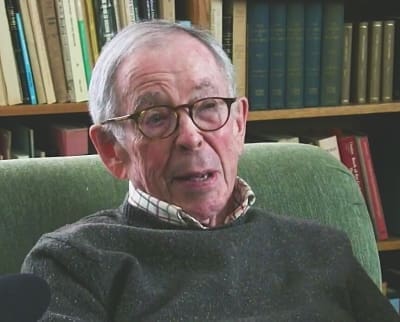
We are excited to revisit Dr. Michael Coe at his home in New Haven, Connecticut, to discuss some of the challenges facing Mormon archaeologists attempting to prove the historical truth of their central scripture.
Dr. Michael Coe is the Charles J. MacCurdy Professor Emeritus of Anthropology at Yale University and Curator Emeritus of the Division of Anthropology at the Peabody Museum of Natural History. He is an expert on the Maya, who inhabited the same part of Mexico and Central America where Mormon scholars say the events of the Book of Mormon took place.
Show Notes:
- “Dr. Michael Coe, An Outsider’s View of Book of Mormon Archaeology,” on Mormon Stories
- FAIRMormon’s response to Dr. Coe’s interview on Mormon Stories
- FAIRMormon’s Open Letter to Dr. Michael Coe
- Mexico: From the Olmecs to the Aztecs by Michael Coe
- Angkor and the Khmer Civilization by Michael Coe
- “LiDAR,” Book of Mormon Resources, February 2, 2018
- “Laser scans reveal Maya ‘Megalopolis’ below Guatemalan jungle,” by Tom Clines, National Geographic, February 1, 2018
- “History and the Mormon Worldview,” Michael Quinn on Mormon Stories
- “An Open Letter to Dr. Michael Coe,” John Sorenson, Interpreter, 2012
- Incidents of Travel in Central America, Chiapas and Yucatán by John Stephens
- Views of Ancient Mountains in Central America, Chiapas and Yucatán by Frederick Catherwood
- “The Book of Mormon as a Mesoamerican Record,” Book of Mormon Authorship Revisited: The Evidence for Ancient Origins, by John Sorenson, Ch. 15
- Images of the “Dresden Codex,” an 11th-century Maya text preserved in Germany
- “Challenging conventional views of metal,” Pressing Forward with the Book of Mormon: The FARMS Updates of the 1990s, by John Sorenson, Ch. 43
- Metals and Metallurgy Relating to the Book of Mormon Text by John Sorenson
- The Hill Caves of Yucatán: A Search for Evidence of Man’s Antiquity in the Caverns of Central America by Henry Mercer
- “La Entrada del Hombre a la Peninsula de Yucatán,” Orígenes del Hombre Americano, by Peter Schmidt, Ch. 25 (download available in English)
- “Late Pleistocene extinction and radiocarbon dating,” by Jim Hester, American Antiquity, 1960
- Aztec Warfare: Imperial Expansion and Political Control by Ross Hassig
- “Looking Over vs. Overlooking: Native American Languages: Let’s Void the Void,” by Brian Stubbs, Journal of Book of Mormon Studies, 1996
- “The significance of an apparent relationship between the Ancient Near East and Mesoamerica,” by John Sorenson, Man Across the Sea: Problems of Pre-Columbian Contacts, Ch 10
- MormonThink
- The CES Letter
- FAIR
Episode Transcript
Host: John Dehlin · Guest: Michael Coe
This transcript is machine-generated and lightly edited for readability. The audio is authoritative. Please excuse occasional errors in names and spelling.
Introduction and Welcome Back to Dr. Michael Coe
Part 1 of 3 · Ep. 905
John Dehlin [00:00:31] Hello, everyone, and welcome to another edition of Mormon Stories Podcast. I'm your host, John Dehlin. It is April 9, 2018, and we are doing something we've never done before, and we're super thrilled. We are broadcasting to you live from New Haven, Connecticut.
John Dehlin [00:00:48] Yale University is right down the road, and we are here because we are here to interview again. We're bringing back to you on Mormon Stories podcast. We're bringing Back to you Dr. Michael Koh. Many of you will remember many years ago, we interviewed Dr. Michael Koh for Mormon Stories. And for those of you who don't know, Dr. Ko is the Charles J. McCurdy Professor Emeritus of Anthropology at Yale University.
John Dehlin [00:01:21] He is the curator Emeritus of the Division of Anthropology at the school's Peabody Museum of Natural History. He's an expert on the Mayas who inhabited the same part of Mexico and Central America where Book of Mormon scholars say the evidence, the events of the Book of Mormon took place. So we interviewed Dr. Koh back in 2011.
John Dehlin [00:01:45] It has been rated one of the top three Mormon stories podcast episodes of all time. And that's saying something because we have now over 900 episodes of Mormon Stories podcasts, and this is one of the top three. And so many of you indicated that Dr. Koh's interview from back in the day was critical and essential to helping you understand reality, understand the Book of Mormon, understanding, understand what it is, what it isn't, understand the church's claims about the book of Mormon, etc. And so what we've thought about, you know, on Mormon Stories is how do we do new things that add value? And one of the recommendations we received from many of our supporters was why don't you bring back on people that you've interviewed in the past?
John Dehlin [00:02:35] We just recently brought back on Greg Prince, we brought back on Carolyn Pearson, and today we're bringing back Dr. Michael Koh. Dr. Michael Koh is 89 years old. And you would think that someone would slow down or maybe even dull a little bit when they reach the age of 89.
John Dehlin [00:02:55] Not the case with Dr. Michael Koh. My buddy Travis, if it's okay to say. My buddy Travis and I have spent a little bit of time with Dr. Koh this morning, and he's as sharp as ever. He's still doing research. He's still publishing books, academic, scientific books, well into his 80s. He's almost 90 years old.
John Dehlin [00:03:16] And so we just want to welcome all of you who are joining us today live on Facebook. We want to get your questions and comments. We're going to be covering a few topics. Some of you will know that recently, let's just say, over the past 10 or 15 years, this new technology called lidar has developed for archaeologists. And basically lidar, I think it's these airplanes that fly by and shoot laser beams down, and it allows them to create these sort of topological maps that allow them to understand excavation sites or historic sites with much greater detail. And as National Geographic and other places have released lidar photos of Central American Mesoamerican digs or geological sites that sort of animated and excited many Mormons around, whether that sort of further proves the truthfulness of the Book of Mormon or not.
John Dehlin [00:04:14] So we're going to be talking to Dr. Koh about LiDAR. He knows a bit about it and has been working with it, and he can talk about to what extent lidar provides further proof that the Book of Mormon is true or not.
John Dehlin [00:04:28] Also, within a certain amount of time. After releasing our interview with Dr. Michael Koh, FairMormon released a response to my interview with Dr. Michael Koh. It has an introduction by Greg Smith, and then what it has is an open letter by Dr. John Sorenson, basically responding to my interview with Dr. Michael Koh in detail. And so we are going to also be giving Dr. Koh a chance to help us understand John Sorensen's response to my interview with Dr. Koh.
John Dehlin [00:05:07] And we'll also be taking questions from you, our listeners. I've pasted into my document several questions that many of you provided ahead of time. And if some of you want to provide comments or questions as well during this live interview, we welcome your comments or questions. So without any further ado, Dr. Michael Koh, welcome back to Mormon Stories. It's a deep honor to have you here.
Michael Coe [00:05:31] Thank you for having me. Incidentally, I'm not quite as old as you said. I'll be 89 in one month.
John Dehlin [00:05:40] My apologies. He's 88 years old, not 89. All right, thanks for the clarification. All right, Dr. Koh, well, welcome back. How have you been since our last interview? Since. Since 2011?
Michael Coe [00:05:54] Same as ever. Yeah, just running along now.
John Dehlin [00:05:58] You know, a lot of people, when they retire, they kind of move to Florida and sunbathe and, you know, whatever, drive around in golf carts. I get a sense that's not what you're doing. You live like a block from Yale University.
Michael Coe [00:06:11] That's correct. I'm really fortunate to have Yale there. I still use older facilities that I'm able to use and meet with the students and listen to lectures and staff with what's going on. There's some wonderful students there now, graduate students. I attend their weekly lectures which have been wonderful. No, I stay up with the field and thank goodness for the Internet. I stay up with my colleagues all around the world. It's enabled me to thank goodness to revise two of my books with new co authors and that's made all the difference. I've had them do all the work and it's been amazing what I've learned from them. LiDAR being one of the, one of the things that one of my co authors brings that I've learned a lot from. So I stay up with things so far, thank goodness.
John Dehlin [00:07:20] And as I understand it, you just published, you're just finishing a couple books, is that right?
Michael Coe [00:07:25] Bringing new additions to old books.
John Dehlin [00:07:28] So what are the two books?
Michael Coe [00:07:30] One of them is called Mexico and it's one of the first books I ever published with Thames and Hudson publishers in England. Back when they took a chance in asking me to write such a book I thought I could write a book on the Mexican part of Mesoamerica and I talked my way into that with the publishers and this is now going into its 8th edition and I have now two co authors who are helping me bring it up to date. The other one is one of my real interests, long term interests, most people don't know that which is the Khmer civilization of Cambodia, the people who are responsible for the famous Angkor and Angkor Wat.
Michael Coe [00:08:27] And I wrote a book about that and that's going into to its second edition in which my co authors, one of the world's experts in the LIDAR technique of surveying. This is going to be almost like a new book and that is in the hands of the editors right now and I expect it will be out, I hope or we hope by next sort of next fall.
John Dehlin [00:08:55] That's so great. So you actually do research work with LiDAR.
Michael Coe [00:09:00] This isn't just something I'll tell you. LiDAR is incredibly expensive to do and I haven't applied for funds to do my research for a long, long time. But my co author who's been working with the University of Sydney University in Australia, he's an Australian, he has managed to round up incredible amounts of financial backing to have this done and it's been revolutionary. I mean what has been seen really, it's an entirely new world. So I haven't flown with those airplanes or drones or helicopters that have done that but, but I'm profiting by it.
John Dehlin [00:09:53] Yeah. And the publishing you're doing does involve absolutely.
Michael Coe [00:10:00] I mean, we're going to be publishing lidar images that have never been published of these Cambodian sites and cities. And we had no idea even that they were cities. So we're learning a lot from them. And now it's something spilled over into Mesoamerica, into Mexico and Central America, but it's just starting there. People are getting now wise to the idea that they really should be surveying some of these Maya sites. And it's been very exciting to see what's come up. But that will be for my next edition of my Maya book.
John Dehlin [00:10:42] Yeah. So you're going to keep going strong. All right, Dr. Koh. So I think the best place for us to begin is to just talk about lidar. And if it's okay, I'm going to share from a blog called bookofmormonresources.blogspot.com I'm going to share just sort of one of the articles that's been passed around and talk about what I perceive to be kind of the main arguments of the article and then maybe give you a chance to respond. Is that okay? Okay, first, can you explain what lidar is to our listeners, just generally speaking, and why it's helped with advancements in the field?
LiDAR Technology Explained
Michael Coe [00:11:27] Lidar is really laser assisted, serving from the air, shooting hundreds of thousands, even millions of laser beams from an aircraft of some sort, either helicopter, which is what they've been using in Cambodia, or from actual life planes, or even from drones.
Michael Coe [00:12:01] Of course, what this does is what the result is is a topographical image of what's actually on the ground. It's used in areas that are heavily vegetated, like for instance, the Maya area, which has got a tall tropical forest over a great deal of it, or even scrub forest. And it works wonderfully across the Pacific in Cambodia, which is also a heavily vegetated area.
Michael Coe [00:12:34] So it shoots these beams down to the earth. Most of them are going to bounce right back once they hit the leaves of these trees and shrubs or what have you. But if you've walked in the densest forest and looked up, you can see that there are holes in the forest where light does come through open to the sky. Well, some of those lidar beams are not bounced back. They actually reach the surface of the ground through those breaks in the leaf cover.
Michael Coe [00:13:13] They've got a computer program that can take into consideration the leaf cover, those ones that are bounced back, and remove it done on a computer. So what you're left with once you've gotten rid of that vegetation is digitally you're left with this amazing three dimensional looking map in black and white on the ground.
Michael Coe [00:13:48] You can take and move the sun around even there digitally to have it pick up shadows on one side or shadows on another side, according to how much is shown by this. You can see all sorts of things. Mound sites, you can see living sites, you can see fortifications, you can see vents. Cities sprang up where nobody thought there was an urban population at all. This is particularly true in Cambodia with the great ancient city of Angkor. Nobody ever knew the amount of urbanization that was there until this happened.
Michael Coe [00:14:34] And everybody says it's revolutionary. It's just something that you cannot do on the ground. You have to have do this from the air and you can, for the first time, see what is actually there.
John Dehlin [00:14:49] All right, and so you're a fan of lidar and its applications?
Michael Coe [00:14:55] I am a total fan of it, truly. And as I say, expensive though it may be, it's also, you have to consider replacing also expensive things to pay ground surveyors to go with their instruments overland, watching out for snakes, getting eaten up by ticks and bugs and mosquitoes who do this the old fashioned way, and now this new technique. So it really is cost effective. You can get almost instantaneously what it would take months and sometimes years to do if you were walking this stuff out on the ground.
John Dehlin [00:15:43] Beautiful. Okay, so now what I'm going to do. Thank you for that introduction to LIDAR. We've got the thumbs up from Dr. Ko in terms of LIDAR as a technology. Now we're going to be discussing its application to Book of Mormon. And specifically, what I want to do right now is ask any of my listeners who feels bold and confident in their interest in these sorts of issues to consider sharing right now this interview live on their timeline. Because if, let's just say 100 of you were able to share or 50 of you were able to share this interview, the network effect of that sharing would be quite significant.
John Dehlin [00:16:24] And I know for many of you, because of the way Mormonism structured, many of you are petrified even to, like, you know, the Mormon Stories podcast page or to like a comment or to make a comment. For those of you who it's not safe to, you know, let people know that you think about or learn about Book of Mormon archaeology. Don't do anything. But for those of you who are confident and able, please do share right now this live stream. And what you can say is, hey, we've got one of the world's experts in Mesoamerican archaeology who's going to be commenting on the true. Well, on archeological finds as it relates to the Book of Mormon.
John Dehlin [00:17:01] And hopefully a lot of friends and family and ward members will all be able to learn more from an expert who has no real particular skin in the game. I think a scientist is open to data wherever it comes from. So Dr. Koh is just kind enough to care about Mormons, to care about us in our lives, and to help us understand what's true and what's not.
Dr. Coe's View on Book of Mormon Historicity
John Dehlin [00:17:26] And that's kind of a way that I want to begin the framing of this interview. Dr. Koh, we're not asking you to argue with anyone. We're not asking you to even tell people what they should or shouldn't believe per se. I just want to say that the purpose of this interview, from my perspective, there are so many Mormons right now that are trying to decide what is true and accurate and what is not true and accurate. And because they are, you know, asked to give 10% of their income for their whole lives to the church, they're asked to give two years of missionary service. They're asked to give five to 20 hours a week in their callings, they're asked to give their name and their time and their reputation to the church.
John Dehlin [00:18:06] And, you know, many of the past prophets and even the current ones have said that the truthfulness of the Book of Mormon sort of is, you know, Mormonism is the keystone of the religion. The truthfulness of Mormonism rests on the truthfulness of the Book of Mormon. And we're not even asking you to tell us your opinion about that per se as much as it is. We've done this interview with you where you've given us your views on the historicity of the Book of Mormon. And then we get other, you know, from what weird understand, very reputable archeologists responding to you sort of, you know, shooting down some of the things that we learn or we learn about this LiDAR stuff.
John Dehlin [00:18:46] And we hear apologists telling us that this is like proof that the Book of Mormon is true. And what we just want is your help in understanding what is sort of reliable science and what's not and how to make sense of the science. Does that make sense?
Michael Coe [00:19:01] Sure.
John Dehlin [00:19:02] Okay, so we've got this article called bookofmormonresources.blogspot.com called LIDAR, published February 2, 2018. We've posted a link to it in the show notes, and basically it says, hey, National Geographic broke this amazing story about the lost treasures of the Maya Snake Kings. And it shows all these Maya, these lidar images of Central America, Mesoamerica, Guatemala, etc.
John Dehlin [00:19:31] And it says the details in the story, including those shared in the television special, explicitly corroborate dozens of verses in the Book of Mormon that describe dense populations, sophisticated economies, road networks, large scale agriculture, intensive land use, disaster prone landscapes, and prevalent warfare.
John Dehlin [00:19:54] This blog article says this is a paradigm shifting event for LDS scholars who have tended to dismiss Book of Mormon phrases such as the whole face of the land as hyperbole. If the Mayan lowlands were part of the Book of Mormon world, as we believe they were, then these grandiose descriptions are not far fetched at all. Respected archaeologists are now comparing the Maya with the ancient Egyptians and Chinese. And so basically they're saying the Mayan civilization is far much more massive than we ever understood, and that that makes the Book of Mormon even more true. So without asking you necessarily to opine on the truthfulness of the Book of Mormon, do you have an initial response?
John Dehlin [00:20:38] We're going to go into the details of their argument. Do you have an initial response to sort of that setup in this blog article?
Cities and Urban Centers in Mesoamerica
Michael Coe [00:20:45] Well, let's take the word city or urban center. It is true that in Cambodia, in the Cambodian lowlands, where Angkor is on the other side of the Pacific, it's been increasing our knowledge of urbanization there without any question that there are big cities with streets and avenues that we never realized were there until lidar came along. If you look at the lidar that's been published so far that's available of these Maya cities, they're totally different.
Michael Coe [00:21:30] There aren't any streets or avenues. There are some roads or causeways connecting sites. But as far as dense urbanization, they're very scattered, these sites. I mean, there's no overall planning. There's only one city in Mesoamerica that looks like an Old World city, like the kind we would expect, let's say, in Europe or China, and that's Teotihuacan, which is up in the Valley of Mexico, way away from what the Book of Mormon is talking about.
Michael Coe [00:22:09] You're up in the area that was later of course, controlled by the Aztecs. But Teotihuacan is fully urban, there's no question about it. We knew that before lidar was invented. I mean, there's nothing like this in the Maya area. They're very dispersed settlements. And to call them cities, you know, they had probably power structure in there, religious structure, royal structure. But you know, once you take a look at this, it's very loosely organized. And even with the best LIDAR images, there isn't any dense urbanization going on.
John Dehlin [00:22:56] Maybe let me back up and just ask you, have any of the LIDAR images that you've reviewed in Mesoamerica made you more interested in the Book of Mormon as a historical document?
Michael Coe [00:23:10] Do I think. Let's put it another way, do I think that any of the images that I have viewed back up claims about the Nephites? And the answer is no, no, no. I've never seen anything that really pertains to what we're being told in the Book of Mormon about big high cities with dense occupation. They never had that.
Michael Coe [00:23:38] I mean, you take Tikal, which is one of the really largest cities. It wasn't part of the famous Snake Kingdom, but they were a rival. We had the LiDAR images now for it and we had a very good mapping of it.
Michael Coe [00:23:58] There's no way that this compares with the old world cities. If you compare it to the city that I know, Angkor and Cambodia, archaeologically it's a shrimp. It doesn't amount to a pile of beans. No. Right. Thinking Cambodian would look at it and think it was a city, nor would a Roman. I mean, they're very lightly occupied. And the entire population of say, Tikal, you couldn't imagine that there's more than at the most, maybe 90,000 people living there at its height. Whereas an old World city in China, for instance, a contemporary one in China or in Cambodia at Angkor, you're talking about cities that had 750,000 to a million people.
Michael Coe [00:24:55] That's totally different. So the old sort of Zarahemla territory did not have urbanization of this sort. Lidar has not shown that. It's been extremely interesting. We found things there in the Maya area. I showed you some this morning on my computer where an amazing batch of fortifications has shown up from the period about AD 200 to 400, that was a response to the Teotihuacan invasion of the Maya area. They took the whole area over. And Maya cities don't look like that.
John Dehlin [00:25:38] Okay.
Michael Coe [00:25:39] To call them cities is an exaggeration.
John Dehlin [00:25:41] Okay. So, you know, one of the points they make is 65,000 previously unknown structures speaks of large cities and villages in all quarters of the land. Basically that's from Mosiah, chapter 27, verse 6. So he's basically saying the. The Book of Mormon in 1830 basically claimed that there were large cities and villages in all quarters of the land and that the lidar now backs that up. And your view on that piece is not so much.
Michael Coe [00:26:10] Well, if you look at that big LIDAR survey that's now just beginning to be studied and published, I showed you part of that this morning on desktop. Once you move away from, let's say, Tikal west, you get maybe a couple of people here, family there, it sort of peters out, you can survey yourself. So you're walking the whole area that was covered in jungle and so that jungle didn't exist. It's actually, it doesn't show this enormous population at all.
John Dehlin [00:26:55] Let me ask you, just like it
Michael Coe [00:26:57] doesn't change our ideas that we've had all along about dense populations or lack of things.
John Dehlin [00:27:04] Okay, let's just say, let's just say Joseph Smith, when he authored the Book of Mormon or when he produced the Book of Mormon, would have made these sorts of claims that they were cities and civilizations and roads. What keeps you in your mind from saying, whoa, he must have been a prophet if he could foresee, you know, the book must be an ancient record because it's foreseeing roads and buildings and cities and civilizations way back in the 1830s. Does that just in and of itself speak to the truthfulness of the Book of Mormon or Joseph Smith as a prophet to you?
Michael Coe [00:27:40] It speaks a lot about Joseph Smith. I mean, he had a wonderful imagination, there's no question about it. He was raised on the Bible, which talks about these things, the Old Testament. So if I were Joseph Smith in those days, I would think the Bible was the truth. And to base yourself on, I mean, after all this came from, the Bible was written by people who were urbanized early on in the near east and the Old Testament. And he just transferred that, I think by wishful thinking to these so called Nephi cities.
John Dehlin [00:28:24] So he over urbanized his, he over urbanized over the Native Americans by projecting what he knew about the ancient world into Mesoamerica.
Michael Coe [00:28:35] As I say, there's only one area in Mesoamerica not far from Mexico City, which was fully urbanized. It looks a lot like a Near Eastern, ancient Near Eastern city, and that's Teotihuacan, which has been fully mapped now. But there was never anything like it either before or since. And even though they took over the Maya area, they didn't transfer their urban ideas with streets and avenues laid out on a grid, nodal points, clear cut marketplaces. Even the Teotihuacan overlords who took the Maya area over, let's say in the 4th and 5th centuries A.D. they could never make the Maya want to live in a place like that they never did.
John Dehlin [00:29:28] Does do the lidar sort of images around Teotihuacan make you more inclined to think the Book of Mormon might be a historical record or Joseph Smith, to
Michael Coe [00:29:39] tell you the truth, I don't know that they've ever done lidar.
John Dehlin [00:29:42] Okay, well, the discoverment, I'm sure they're
Michael Coe [00:29:45] going to do it Right.
John Dehlin [00:29:46] But of the cities, the discovery of these vast cities, does that make you think about Book of Mormon archaeology or historicity?
Michael Coe [00:29:55] Well, if Joseph Smith had talked about the Valley of Mexico as it was, let's say, between 200, the Valley of Mexico was the valley surrounded by volcanoes where you find modern Mexico City. Modern Mexico City, built on the old Aztec capital, Tenochtitlan, which was fully urbanized on that island, had streets and avenue and a dense population. And its predecessor, Teotihuacan, there's no question it's one of the great cities. It's the greatest city in the New World. But he didn't know about the entire Wakand. He was looking to the area that his hero, John Lloyd Stevens, who discovered, according to Smith, these Nephi cities, that is Maya cities, those people did not have big cities in the sense that we're thinking about. If he confined in his ideas that, oh, in central Mexico is where they were, then there might be something in it, but he's in the wrong area.
What Joseph Smith Could Have Known in 1830
John Dehlin [00:31:13] Okay, is there anything that Joseph Smith of the Book of Mormon revealed about Mesoamerica in 1830 that wouldn't have been generally perceived or known about or understood? In other words, had Mesoamerica been explored and was there general understanding about what Mesoamerica was like and even some of the ruins that might have been there?
Michael Coe [00:31:37] Well, as I say, this American diplomat, Stevens, and his English sidekick, that artist, Frederick Catherwood, until they went to the Maya area, nobody knew anything about it. Basically, there was nothing scientifically known about those things. Of course, when their books were first published in America and England, Smith had those. I mean, he was talking to that.
Michael Coe [00:32:13] But archaeologically, we knew nothing about it. Nobody had ever dug these sites, had no idea what their dates were, who lived there. Stevens, however, very definitely in several places, said these cities that we've discovered, he called them cities, but were made by the ancestors of the people we see around us, the Maya, and not by any other people.
Michael Coe [00:32:40] He was refuting ideas that were all over the place in those days, especially in the US Eastern US that white people had come from the Old World somewhere, Europe or the Middle east, come over and say, built a Mound in the Midwest, all the scribes, Welshmen, Phoenicians, anybody but the actual Indians who lived there. And Stevens was refuting that idea.
John Dehlin [00:33:13] So there was an idea going around in the early 1800s that white people, that there were white Native Americans.
Michael Coe [00:33:21] Very definitely there were ideas about that.
John Dehlin [00:33:25] So Joseph didn't. So Joseph could have gotten his idea
Michael Coe [00:33:27] about Nephew certainly did. I mean, it was part of the mindset of those days. Looking down on the native peoples as degraded examples who never could have built, let's say the great mountain groves that we know were at one point were all over the midwestern United States and southeastern United States. They'd look and say, well, that this grunting Indian, he could never have possibly his ancestors had built this stuff. That was big stuff in those days. Many books, not just the Mormons or Book of Mormons, but many. There was in the air that white Americans could not believe that dark skinned Americans could do anything like this. But Stevens did not. Stevens didn't follow that mindset. He refused to believe it.
John Dehlin [00:34:21] That's nice. So Joseph Smith would have heard about the reports or the maps of Stevens expeditions. He would have known there were temples and ruins and that would have made him have the idea that there were cities in ancient America.
Michael Coe [00:34:40] Yeah, Stevens, his books were never rare. They were published in huge editions, went through many editions actually. Both sets of books that he and Catherine Wynne published, everybody knew about this. They were wildly popular. He was one of the most popular travel writers of all time. I mean, got reviewed by people like Edgar Allan Poe and other contemporaries. I mean, what he did was well known. And both of them had been in the old world civilizations knew something about them. Catherine had been in Egypt for quite a while. So they knew what they were talking about. And they said, this stuff is not from the old world, this is autochthonous. And the ancestors of the people who live there today, the Maya, were the people who made these things.
John Dehlin [00:35:39] Okay. So recently we've been covering a discussion that the Maxwell Institute. The head of the Maxwell Institute, Spencer Fluman, had with another one of our guests. And he basically called Joseph Smith sort of a jazz artist. That Joseph Smith would take kind of like a soup. He would take cultural artifacts, ideas, books, and he would synthesize them into his, what he would call revelations.
Michael Coe [00:36:15] It's an amazing job he did. I mean, really. I mean, it's an incredible work that he put together to make this non existent civilization sound real.
John Dehlin [00:36:29] Okay. And if you were to sort of cast your mind back to 1826 into what the general perceptions were about the time period, the general myths, the general prejudices, the fables, the questions. Would you think of the Book of Mormon as a book that would be produced as a sort of an amalgamation of all the rumors and myths and understandings about Native Americans at the time it was written?
Michael Coe [00:36:59] That's exactly what I would think. Okay, John, I've got to go on.
John Dehlin [00:37:03] Okay, so while we're going to. We're going to give Dr. Ko a break for just a second, and we are going to. We're going to go ahead and invite questions or comments from our listening audience. Dr. Koh is going to step out for just a second.
John Dehlin [00:37:23] We want to welcome everyone who's been joining us today live. Want to thank you for joining us. We have some comments that we're going to try and address while we're waiting for Dr. Ko. So Mark writes. So he made it all up.
John Dehlin [00:37:39] Well, Mark, that's what some people conclude. Thank you for asking that question or sharing that opinion. Josh writes, stop living the fairy tale life. It's a book created by man. Not one person traveled the earth with all these Bible characters and weighting down each one's stories. Whoever created the Bible had a good idea to cause false hope. Thanks, Josh. I'm not sure what that has to do with this interview, but we appreciate the comment Paul's asking. Could Dr. Koh comment on the claim of the lidar discovery of ubiquitous fortresses, ramparts, and defensive walls?
John Dehlin [00:38:19] Interestingly, Dr. Koh did just show us some images that included fortresses and defensive walls. We'll ask him when he gets back. But my sense is that there was definitely tribal warfare going on between ancient American civilizations. He confirmed that to me and Travis just previously. And so, yes, there would have been all the sorts of, you know, walls and fortresses and military outposts that you might expect in a, in a militaristic civilization. But we can, we can ask Dr. Koh about that when he returns. Courtney writes, I loved your original interview. Dr. Koh, thank you for sharing your thoughts and talents with us. Thank you, Courtney.
John Dehlin [00:39:05] We're really grateful for that. Tim writes, my experience with academics is not good. They limit many avenues of discovery that don't fit their understanding. There are many genuine artifacts they reject. They just call anything they don't understand frauds.
John Dehlin [00:39:23] Okay, so, Tim, we appreciate that perspective. When Dr. Ko comes back, we're gonna share with him. In fact, he's just rejoining us now. So, Dr. Koh, welcome back. And we have a statement from one of our listeners that we thought we'd run by you.
Academics, Artifacts, and Stephens's Influence
John Dehlin [00:39:41] Tim Reese writes, my experience with academics is not good. They limit many avenues of discovery that don't fit their understanding. There are many genuine artifacts they reject. They just call anything they don't understand frauds. How would you respond to Tim as he makes an indictment of academics?
Michael Coe [00:40:01] Well, we're human too. We have our likes and dislikes and we've been fooled like anybody, by frauds or not fooled actually. I'm sometimes called upon by U.S. customs to actually decide whether things being brought in are fraudulent or not or whether they should never have been trafficked anyway. That's of course a problem. But as far as the idea that we recall something fraudulent that didn't fit in with our preconceived notions, that could happen. But I hope it hasn't happened to me. I try to keep an open mind about all these things.
John Dehlin [00:40:52] All right, Michael Ashe. We're very excited to have Michael Ashe joining us as one of fair Mormon's arch chief apologists. Michael's asking you a tough question, Dr. Kohler. He's saying that Stephen's widely read books were published in 1841 and 1842, 11 to 12 years after Joseph published the Book of Mormon.
Michael Coe [00:41:16] Well, Joseph Smith's comments about Stevens, of course are ex post publication. This is what I understand from the history of all of this, that he decided that those were the Nephite cities after he had read, I suppose, the first two volumes that came out and they could never have stimulated while he was actually putting the Book of Mormon together, they could never have stimulated Joseph Smith because it hadn't come out yet. But there was a lot in the air about that.
Michael Coe [00:41:57] There were explanations, I mean, who actually had made, say Cahokia or some of the mountainsides of the eastern US There was really a background to all of this going on among the white settlers in these areas who come in.
Michael Coe [00:42:19] And of course he had the background of the Bible, I mean, especially the Old Testament. I mean the way he. When he. Even the language used in the Book of Mormon is really based upon the Bible I was raised on, which is the King James version of the Bible, down to small details, I mean about.
Michael Coe [00:42:47] How his narration took shape. It was in the language of the Bible. So he was imbued with the Bible. I mean there's all kinds of descriptions of Nineveh and places of that sort in their old world cities. So he had plenty to base this stuff on. He didn't have to have Stevens. But after Stevens came out, he said, yes, obviously Those are the Nephite cities that I was being told about by the angels who gave me this stuff.
John Dehlin [00:43:16] So Stevens writing didn't influence the authorship of the Book of Mormon. They influenced Joseph's commentary.
Michael Coe [00:43:23] That's exactly right.
John Dehlin [00:43:24] About the Book of Mormon geography. After Stevens published his works, would there have been expeditions to Central America that would have been known about prior to 1826?
Michael Coe [00:43:37] I doubt if Joseph Smith knew about the efforts by the Spaniards by the Spanish King Charles iii, who was the most enlightened of all. The Borman came in the 18th century. He was interested in New World antiquities in the Spanish dominions, and he actually had sent somebody to look into Palenque, which is a famous Maya city, Circle City, and Copan over in Honduras. But I doubt very much whether Stevens would have known anything about that. I mean, we've resurrected all of that stuff historians have from the Spanish record, but those weren't real expeditions, and there were no archaeological expeditions at all at this point.
John Dehlin [00:44:37] And I guess what we're wondering is, I guess we know for sure that the Spanish conquistadors would have conquered Central America, Mexico and South America. So they would have seen ruins. And so at a minimum, the word would have gotten back to New York definitely by the early 1800s that there were civilizations with ruins all throughout Central and South America. Am I right or not?
Michael Coe [00:45:03] You're absolutely right. And as I say, somebody like. I mean, the Spanish authorities in those conquered areas had to write regular reports back first to the Council of the Indies in Seville in Spain, and then eventually to the Spanish court in Madrid about what's going on. But I doubt whether Smith knew about those. I mean, he didn't read Spanish as far as I know.
Michael Coe [00:45:38] Those were only published long afterwards, but they certainly did know. Everybody knew about these places. Bishop Landa, who went to Yucatan in the 16th century, the first bishop, he was a Franciscan bishop. He describes in his relation the story of the things of Yucatan, a lot about Maya culture in Maya city. But that post dated Smith actually, at least not the report, but rather the discovery of that in Spanish archives. Justice Smith would not have known about that, but he would have known that there were such cities. Yes, that was general knowledge.
John Dehlin [00:46:24] Okay, so that. Michael Koh, if you have other questions, we welcome them. I hope that satisfies your response. Okay, so I'm going to go through this list of LIDAR findings that this author thinks bolster the validity of the Book of Mormon as a historical document. And you just comment as to whether or not you think it does. That is that. Okay, yeah. So he's saying third Nephi 6, 8, talks about many highways cast up and many roads made. And he's saying that lidar has found roads and highways. And so that could prove that the Book of Mormon is true.
New LiDAR Findings and Their Significance
Michael Coe [00:47:05] Well, I agree that there have been highway causeways discovered by lidar that we did not know about. That's something new. I mean, that's a good point. But if you want to interpret this as backing up the Book of Mormon, that's fine, but that part is true.
John Dehlin [00:47:27] Do you also just find roads and highways with advanced civilizations? Is that just sort of. Do you expect roads and highways when you have towns or cities or large groups of people?
Michael Coe [00:47:39] Well, what were roads used for in the Maya area in the old days? I mean, the road that have been found, I mean, we've long known about these roads which go for miles and miles and wild. Up in Yucatan, for instance, I've traveled myself. Look, so many.
Michael Coe [00:48:03] And they're built of limestone, they're beautifully made. They run straight as an arrow. There's one that runs from a city called Yeshuna, recite called Yeshoonab, from miles and miles and miles almost to the east coast of Yucatan. What were they used for? These people had no wheeled carts to haul stuff. They did not use.
Michael Coe [00:48:39] Everything that was hauled around in the Maya area for the last several thousand years was holed on the backs of people. Human change, same way with the rest of Mesoamerica. In Mexico, that's not what the roads were used for. I mean, you need roads like the ones in Europe or the near east or China, if you've got wheeled carts to haul stuff and people.
Michael Coe [00:49:09] And they never had that. It was all footwear. So what were the roads used for? And we know, for instance, the ones, the causeways in Tikal, they were used ceremonially. There were ceremonial pathways. So you're walking down the center of a church from one end of it, entrance up to the ATS at the end. They're ceremonial completely. And we know from Bishop Lauda they were used that way, having to do with the new year ceremonies each year. And they come to a different point in the compass. They'd have a road built to that. Each year would be in Aone year would be east, the next would be north, the next would be west, the next would be south.
Michael Coe [00:49:58] And they would have ceremonial processions. He describes them very well. And they were completely ceremonial. They played no part in the economy, let's put it that way.
John Dehlin [00:50:12] And I'm just thinking, even if there Were roads. Are there civilizations without roads? Like, I don't know that Joseph Smith saying that there were roads in an ancient civilization is an act of prophecy. It seems like an act of common sense. Does that make sense?
Michael Coe [00:50:30] Well, yes, but there are roads elsewhere in the New World, an ancient New World that now we're beginning to track some down in the Amazon with lidar, amongst other things. And we know about the Inca roads. I mean, these were some of the best roads in the world. Those were used for communication. The empire was held together by runners. It isn't that they were moving goods over the manopol. They were for political and perhaps religious reasons only. The Inka ruler could send rudders out over a thousand miles of roads to bring messages and orders and report back. So if you're talking about comparing those to the Old World roads, the New World ones really were not to move goods or even people, but for other reasons.
John Dehlin [00:51:41] Got it. Another thing that the Book of Mormon mentions that the lidar, you know, images apparently have unveiled are fortresses, ramparts and defensive walls. So, you know, in Alma 4913, Alma 4918, it's talking Alma 50, Alma 52. It's basically talking about towers and strongholds, defensive walls and fortresses. Now again, yeah, I kind of, the way I think about it is any, anytime there's a civilization, there's going to be warring factions. They're going to have military sort of components. And as long as you have military, you're going to have fortresses and walls. So, and especially if the Old Testament had fortresses and walls, and Joseph Smith's projecting the Old Testament onto the New world, that could be where he gets it.
John Dehlin [00:52:36] But I think what they're basically arguing is if Joseph foresaw fortresses and defensive walls and towers, that must have been a miraculous act of prophecy or it's an ancient record. One of the two. Your response to that?
Michael Coe [00:52:51] Well, your questioner is right. They certainly have found, I showed you some this morning on my computer that they found in the petan in northern Guatemala one but it isn't everywhere. It's long been known that there was a, a defensible or offensive wall between Tikal and the next great Maya center to the north, Washactun, that was discovered on the ground by people sliding through the jungle not so very long ago. But recently, from the lidar of this part of Guatemala, they have picked up a set of fortifications that nobody knew about before. Absolutely nothing we can date it.
Michael Coe [00:53:44] And it's apparently in response to an invasion from Teotihuacan that I was telling you about. That's certainly something completely new. Your correspondent is right, but they're not everywhere. I mean, probably every city did not have it, but there's a lot of fighting.
Michael Coe [00:54:04] There was something like, what, 19 or 20 independent Mayak kingdoms there, small scale stuff. And they were fighting with just about everybody else. I mean, there were allies who would fight together and then enemies who were permanent enemy. Tikal had a permanent enemy in the Snake Kingdom.
Michael Coe [00:54:29] It will be. You know, we're going to find more of those fortifications without any question. Maya archaeology went through a long period in the 1920s, 1930s, 1940s and 1950s saying that the Maya never went to war. They were peaceful people. Well, they were like everybody else. They had their wars, plenty of them. We know that that whole model that our challenges built up was based on nothing.
Michael Coe [00:55:01] We do know that they had wars. Absolutely. So if the Book of Mormon says that they had wars, that's correct. That's exactly what happened.
Responding to Pro-Book of Mormon LiDAR Arguments
Part 2 of 3 · Ep. 906
John Dehlin [00:00:31] I guess if I were to summarize what I'm reading as a group of arguments, it's that this author seems to be stating that if, you know, if these lidar images find stone quarries, animal pens, irrigation systems, public works, military fortresses, if the Book of Mormon predicts, describes those things in 1830, and if LIDAR images in the past 10 or 15 years show that those elements of a civilization existed, that in some ways that demonstrates the historicity of the Book of Mormon, I think that's
Michael Coe [00:01:19] a valid statement. But in the last 20, 30, 40 years, ever since the discovery of the famous Bonampoc murals, with their tremendous amounts of battles and wars going on there, people have known that this old faithful idea about the Maya was malarkey, baloney and should be discarded. Nobody ever thought that they were anything but warlike ever since then.
Michael Coe [00:01:51] If Joseph Smith really wanted something comparable to in the New World, comparable to what the Bible talks about, for instance, not just the Book of Mormon, but if he wanted the Book of Mormon to say this, then he had plenty to go go on at this point. But the archaeology hadn't been done at this point in the New World, but he was projecting the Old World on the New World, then it turns out that part of that is correct, especially the warfare part of it.
Michael Coe [00:02:27] Maya archaeologists, for some reason they wanted the Maya to be faithful. They had a lot of royal ideas at that time, I'd say one thing that Joseph Smith didn't get was the Maya inscriptions. When Stevens first published his books, Stevens and Catherwood Stephens said, there are all these amazing Maya and scriptures everywhere. If only there was somebody like Champollion who cracked the Egyptian code. Wouldn't it be wonderful if somebody would do this for the Maya? And it's been done and they're all over the place and these wars are described in these Maya inscriptions, but they're not in an Old World language at all. They're in a language still spoken today.
Michael Coe [00:03:28] You've been in Guatemala. If you travel from Guatemala City to, say, Copan, Honduras, you want to get over the border. You pass through a section of the Maya area that is lived in by the Chorti Maya Indians. C H O R T I We know that their ancestral language, which we call Choti, we know for sure that that's the language of the Maya hieroglyph. It's been worked out in great, great detail.
Michael Coe [00:04:04] Why, among other people, a BYU linguist, and there's no question about it, it's not in any Old World language anything that was ever heard of In Egypt or the Middle east, it's in native Maya language. The Mayans have been there for thousands of years and they all adopted this one particular branch of the Maya language as the language of the inscriptions. The way in India the civilized people of India adopted Sanskrit, one particular language, as the language of their script.
Michael Coe [00:04:46] Egyptians did the same thing. They picked one particular language which we know is an African language as the language of their script. All of this stuff is in actual Maya. It's not in Nepal or anything from the reformed Egyptian.
John Dehlin [00:05:03] It's not in reformed Egyptian or from
Michael Coe [00:05:05] the Egyptians or Hebrew or. Yeah, we have thousands of these inscriptions. It's not just one or two sort of odd finds. There are literally probably 10,000 inscriptions, plus four Maya books that have survived the destruction of the Spaniards. They're all in Chulti Maya. So if you come across the chorti there, they're not Lamanites, they're Myers and they made that civilization.
John Dehlin [00:05:41] I think a lot of the arguments are that these days, when Joseph Smith and subsequent prophets were talking about the Book of Mormon lands, they tended to say it was covering all the lands north, south and central. I think what apologists are doing these days, Mormon apologists, they're retreating, saying that number one, the Book of Mormon verbiage doesn't preclude other peoples, you know, from within which Nephites and Lamanites dwelled. So they're basically trying to claim that the reason why we don't see reformed Egyptian or Hebrew or whatever in Mayan or Incan or Aztec civilizations is because they all existed separate from Nephites and Lamanites. And so the language of the Nephites and Lamanites never crept into these other civilizations because those civilizations were pre existing and the Lamanites and Nephite influence was relatively small.
Michael Coe [00:06:52] These explanations are so involved there to, I mean, who were the people who were living in Yucatan at the time of the conquest? All of the peoples of the Maya area spoke different Mayan languages, a very compact bunch. It isn't that they're spread all over the place. They're all basically at the southern Gulf coast of Mexico, the Yucatan Peninsula, the highlands of Mexico and Guatemala and the Pacific coast. And that's where they, that had been Maya for thousands of years. I mean, we know this from what historical linguists tell us.
Michael Coe [00:07:45] It's the only civilization in the entire New World that was fully literate, that could write anything they wanted to do in their language. This is why all of these inscriptions, as I say, it's not just one or two or chance discoveries.
Michael Coe [00:08:07] These are the people, these were literate people. And this was written for the benefit of the social system of these Maya kingdoms. The stories about their kings, about their queens, about their wars, they're all in there. And they've got nothing to do with the Book of Mormon. A totally different world.
John Dehlin [00:08:35] So for you, you're not seeing Hebrew traces of Hebrew traces of reformed Egyptian in any of the Maya writings that you've reviewed?
Michael Coe [00:08:45] None. Absolutely.
John Dehlin [00:08:47] What if John Sorensen says he's found a lot and he's even published articles saying he found a lot?
Michael Coe [00:08:51] No, no, that's a fantasy. I'm sorry. And it's an insult. Furthermore, to the people who lived there, who made all of these inscriptions. I mean, I say we stay true to them. The only foreign type stuff you see there in the Maya books or in scriptures is in very late, for instance, the Dresden Codex is a beautiful Mayan book that's been preserved in Dresden, Germany. There's some influence from Malhuatl, which is the language of the Aztecs and probably was a language that of Teotihuacan. There are some words in there that are, and even a couple of gods that relate to the Aztec Nahuatl one, but that's it.
Michael Coe [00:09:45] We have thousands. What the first modern inscriptions begin 100 BC and we had them up until the Spanish conquest. I mean, that's what, 15th century of Maya writing, I'll say thousands of examples. And there's not one thing in there that reflects either Hebrew or any kind of Egyptian, whether Middle Egyptian or Neo Egyptian or anything like that. It just doesn't occur.
John Dehlin [00:10:21] If I'm going to summarize my concern about this argument around lidar, it's the following, and we've been exploring this, but I'm just going to summarize, basically what it's saying is because Lidar found certain descriptions of civilization in the Book of Mormon, such as roads, aqueducts, irrigation, military, fortresses, public works, farms, highways.
John Dehlin [00:10:54] It must show that Joseph's a prophet because lidar images have discovered these things in the Book of Mormon. And my reaction is, number one, these are things that show up with civilizations. You can't have large groups of people without irrigation, roads, buildings, walls, defensive walls, fortifications.
John Dehlin [00:11:19] And it's more likely that Joseph learned about those artifacts of civilization from the Old Testament, from his reading of the Old Testament, which also has walls and fortresses and irrigation systems and public works and animal pens and stone quarries or whatever. And he basically projects that into his writings in the Book of Mormon versus it being Prophecy or. And evidence of a historical book that, you know, that the lighter images reflect these sort of artifacts of civilization.
Michael Coe [00:11:55] That is exactly what I would say. You said it better. Okay, exactly 100%. I mean, you know, all civilizations have things in common. And for instance, I've been working a lot with Angkor in Cambodia, in Southeast Asia, thousands of miles away from the Maya area. Yet there are many, many similarities. In fact, there are some really interesting similarities between the civilizations of East Asia and South Asia and Southeast Asia and Mesoamerica, including the American Southwest, that are difficult to explain.
Michael Coe [00:12:47] I tell my friend John Sorensen that if you really want to look for overseas connections, look to Asia, where these people came from in the first place, not to the Middle East. I mean, there's amazing similarities there that I can't go into here.
Michael Coe [00:13:06] And if I publish this, I'd be considered a nutcase. Why? Well, because archaeologists don't, you know, they had their fingers burned with hyper diffusionism. People who want to bring all this stuff from somewhere else. And there are some cases where there are some really similarities. I don't see any with the Old World, the western part of the Old World, but with East Asia.
John Dehlin [00:13:37] Yeah.
Michael Coe [00:13:37] So if the whole idea of color directions, but the different directions have certain colors. You go among the Navajo, for instance, to a Navajo Singh, what's making a sand painting there to cure somebody? They've got the color direction concept. Each direction has a color, has a plant, has a bird that sits on top of it, a different bird each time, associated sometimes with a different domestic plant. And the idea of spreading things to the four directions is ancient. In the New World, the Maya had it. The Maya could tell you, well, north is such and such a color. This is a peculiar concept. I mean, not something that you'll find in the Holy Bible or anything like that.
Michael Coe [00:14:29] I've got. Why is it that the. For instance that in East Asia, when they look at the moon, full moon, East Asians don't see the man in the moon the way we do. You know, somebody's face up there, they see a rabbit, and sometimes the rabbit's held by a woman who's got. Who's also a weaver.
Michael Coe [00:14:55] You find exactly the same thing in Mesoamerica, exactly the same thing. You ask an ancient Maya, what's in the moon? He'd say, right away, it's a rabbit. And there's a woman holding that rabbit. If you look yourself, if you're told to look for a rabbit, you'll see the rabbit up there. I should point this out, you can't tell me that that isn't connected.
John Dehlin [00:15:22] And so if it's true, what pretty much all of science tells us, which is that Central Asians migrated to North Central and South America through the Bering Strait and that's why all the DNA points to Central Asia.
Michael Coe [00:15:38] It certainly does.
John Dehlin [00:15:39] You know, languages, archaeology. It would make sense that there are similarities between ancient Central Asian culture and Native American culture.
Michael Coe [00:15:49] When they crossed through Beringia into the New World and just so much Paleo Indian evidence, DNA evidence and whatnot, that's where they came from. They didn't go with empty minds. I mean, some of these people who you might think are really primitive, they've got incredibly complex thoughts. You don't need sort of enlightened white folks coming from the near east or Europe into the New World to give these terrible dark skinned people civilization. These people started from Asia and came across and they probably had very complex ideas in their heads how the world operates.
John Dehlin [00:16:38] Okay, this article goes on. This article from bookofmormonresources.blogspot.com it goes on to basically make the argument that because these LiDAR images show very large cities, that supports the idea that the Book of Mormon advances that there were populations, quote, as numerous, almost as if they were the sands of the sea. So Mormon 1:7 talks about so many Nephites and Lamanites that it was almost as numerous as the sands of the sea. It also maybe speaks in other parts of the Book of Mormon about, I don't know, hundreds of thousands or even millions of people in battles. And this is something I don't quite understand. If
John Dehlin [00:17:25] apologists simultaneously want to argue that there were very large civilizations of Nephites numbering in the hundreds of thousands or millions, but at the same time they want to argue that it's so small that the influence of Nephites and Lamanites both genetically, linguistically, archaeologically, would not have spilled over into surrounding civilizations. I guess I'm struggling with the paradox of that.
Michael Coe [00:17:52] But you can't have it both ways. No, this is a just a guess somebody's making here. We don't know what the population was, we never have. But it was never a really dense occupation the way you have. We know in Central Mexico there were a lot of people living in the great city of Teotihuacan, but not in the Maya area. They were scattered. There was a scattered bunch of people and can't compare, I mean, Tikal can't compare to a Chinese city or even to a Cambodian one, to Al Gore these are all, you know, these were tiny, these kingdoms and you could walk to the frontier of, let's say the kingdom that was represented by Tikal. You could walk to the frontier in a day in any direction it would take you to get there. Watch it's walking. These things were on a terribly small scale.
Mayan Population Estimates and the Book of Mormon
John Dehlin [00:18:58] So this blog is saying that the population at Apogee could have reached 15 to 20 million?
Michael Coe [00:19:06] No, that's a total pipe dream. Never could have. There's no way it could have done that.
John Dehlin [00:19:13] What do you think the population at Apogee likely was?
Michael Coe [00:19:18] Well, it would have been in the, say 800 A.D. and you know when this is? After the Book of Mormon was first explored by Stephen, well, he never really did explore the southern lowlands. He never entered there. But by the time we knew about this, there was nobody living there at all. In northern Guatemala, let's say, or neighboring part of Mexico, Chiapas.
Michael Coe [00:19:51] Over the years, people have tried to build up a figure. For instance, at Washactun, which is just north of Tikal, the Carnegie archaeologists set out, they had lines that they run out from the site in different directions and then map every mound that they living mound that they came across.
Michael Coe [00:20:18] Now you've got Lidar to do this, but even then you can't get populations of 10 million into this area. It's just unlikely. The way they lived there and their support, basically scattered farming, what we call Milfa farming, where you cut down a portion of the forest and burn it. I mean that was their main type of farming. You could never build up huge populations that way.
Michael Coe [00:20:55] China had irrigation. There's no evidence for irrigation in the Maya area. I mean very little. I can't think of one. I can't think of a Maya irrigation system. When they built water works to handle the water, it was basically to get rid of the water.
Michael Coe [00:21:16] Elaborate systems for draining off, let's say like the center of Tikal into ponds or let's say dug water basins because their main problem was lack of water. Believe it or not, being able to keep this population going over the dry season when it never rains or hardly at all, they built these elaborate water systems to save water, to get rid of it off of the temples and put it into reservoirs. And you do find that early on that's it unrelated to their farming.
John Dehlin [00:22:05] Melissa writes, I don't understand how these discoveries automatically prove the Book of Mormon is true. Why can't the Mayan people be advanced all on their own without giving credit?
Michael Coe [00:22:17] Right on, right on. Exactly. To me, the idea that these Dark skinned or brown skinned people couldn't do this. This is totally racist. And I think we have to go back to the mindset of white settlers in New England, Vermont if you wish, or upstate New York at that point, or all over the place. They couldn't believe that these Indians call them Lamanites or anything, could not do such things. It was part of the thing, a pre Civil War mindset.
John Dehlin [00:23:03] Now Michael Ash is returning to comment. He's not happy with this Dr. Koh. He writes, It's a shame that neither Dr. Koh nor John Dehlind actually understands LDS scholarly arguments on these topics. Responding to straw man arguments don't adequately address the issues. Dr. Koh's understanding of Mesoamerica and LDS understanding of Nephites, Lehigh in Mesoamerica are not mutually exclusive paradigms. So he's saying, you know Mesoamerica, you don't know Nephites and Lamanites and Lehighs and we're setting up straw men is what Michael Ash is telling us.
Michael Coe [00:23:43] Well, to tell you the truth, when I was asked by Dialogue magazine way back in the Lower Paleolithic years and years and years ago about the Mormons in archaeology, I actually did read the Book of Mormon. So I can't be. I haven't retained it all in my head by a long shot. I mean, there's only so many, so many neurons that you can have operating in your brain.
Michael Coe [00:24:10] I need a whole extra set to do that. I mean, I couldn't stand up to somebody like my friend John Sorensen and argue the Book of Mormon with him because I hadn't been thinking about it really all these years. But I did back then.
Michael Coe [00:24:28] And I just could see no basis at all for either the Book of Mormon or more importantly, the Book of Abraham being anything but fiction. The Book of Abraham, I noticed nobody mentions that here in their comments. It was proved long ago, 100 years or more ago that this was an Egyptian Book of the Dead, one of the most common Egyptian things that you find in the manuscript. It's a Book of the Dead. It was Translated and cracked 150 years ago. Ask John Sorensen what he thinks about that.
John Dehlin [00:25:18] Yeah, so I guess it's not totally fair to expect you to be able to speak really seriously and intensely in detail.
Michael Coe [00:25:31] Not to a room dedicated.
John Dehlin [00:25:33] Yeah, so maybe just to summarize the LIDAR research, because we don't need to keep going into the details about LiDAR. I'll just kind of summarize it and then we're going to move to Dr. Sorensen's critique of my interview with you. What? You know, why has the. To what extent has the lidar mappings of Mesoamerica made you believe more or less in the Book of Mormon or take the Book of Mormon more or less seriously as a historical document? And why?
Five Reasons the Book of Mormon Doesn't Fit Mesoamerica
Michael Coe [00:26:09] Well, to tell you the truth, I don't take the Book of Mormon seriously as an explanation of what was going on in Mesoamerica that just doesn't match. It's something that, you know, if I'm looking at lidar, I'm not thinking about the Book of Mormon. I'm thinking about my archaeology. So I suppose I've got blinders on. I should be thinking. But it's not, you know, I just feel that it's not to me, as a scholar, I'm not inspired to go ahead and say, refute or accept the Book of Mormon as an explanation there. It's just I've got other things to do and think about.
John Dehlin [00:27:01] So if you had to just summarize the five reasons you don't take the Book of Mormon seriously as a historical document, they are what?
Michael Coe [00:27:10] Well, I would say that in the first place, it's basically based on what was going on in the Old Testament. I had a Christian education, I went to a church school. I had to read the Bible probably through my whole career twice. And I even got a prize in sacred studies. So I know something about the Old Testament and I see that as really as a reflection of the Old Testament, not being concerned with the archaeology of Mexico or Central America. It just doesn't ring any bells. As I say, if I have to look to outside, I would look to where these people came from in the first place, to Asia. Much more interesting and much more likely. I don't have to go through five reasons. I just don't accept it. Being an authority on what I study.
John Dehlin [00:28:12] And this is something that can be confusing to believing Mormons because the leaders will actually say, the Book of Mormon is not a history book, it's a religious and a spiritual book. So you shouldn't even expect it to necessarily line up with science and history. And it's tough to, you know, on the one hand, I don't want to put you in the middle of that debate.
Michael Coe [00:28:35] I don't want to get into it.
John Dehlin [00:28:36] I know. On the other hand, so many of us are just trying to make sense of what we're being told by church leaders versus what the text says versus what science and common sense say. And we hear that John Sorensen has a PhD in this or that or all these other archaeologists went to UCLA or wherever they went. And it makes us feel, oh my gosh, well, if these really smart men believe it, it must be legitimate.
Michael Coe [00:29:03] Well, John is a fine guy and we've been talking and arguing with each other for years and years and years. He wants to accept this as a sacred document. That's fine with me. But it has nothing to do with what really went on there. If John can explain, go through and tell me where in all of these written records that were made back then where there's any Hebrew or Sumerian or Elamite or any other Old World language or reformed Egyptian using Smith's phrases. Go ahead. But that's not John's specialty and my writing is one of mine. And I can assure you there's nothing in those writings that reflects in the slightest way what goes on in the Book of Mormon.
Michael Coe [00:30:05] That's where I would start with the whole thing. I mean, why were these people, why weren't they writing in Hebrew, I mean, or in so called reformed Egyptian? Joseph Smith had no ability whatsoever to crack Egyptian hieroglyphs on his own.
Michael Coe [00:30:28] I mean, truly, it's a long process to do this kind of thing. Not easy. We've finally been able after all these years to read all of my ancient Maya writings. We can now read it. Just ask John Robertson, the linguist in byu. I don't want to put him on the spot. He had a lot to do with that.
Michael Coe [00:30:55] There's no evidence whatsoever for any language from the near east or Europe or any other white folks area that would sing with, with a linguist. It's Maya.
John Dehlin [00:31:10] What about DNA?
Michael Coe [00:31:12] The DNA is the same thing. I mean, you know, that's become extremely interesting recently now that they've got the ability increasingly to get DNA from ancient bones. And again, it all points to Central and East Asia where these people came from. Not to the near east, absolutely not.
Michael Coe [00:31:40] There's a lot known about that. The great expert is now this guy at Harvard who's been able to, and also the people in Germany to really get DNA, viable DNA out of ancient forms. And it's just for instance, there were these skeletons that have been found of early, early people coming into the Maya area on the east coast of Yucatan.
Michael Coe [00:32:13] They've gone into these drowned underwater caves that used to be open back in ancient times and gotten these, found these amazingly well preserved skeletons and that DNA again comes out. These are all American Indians, exactly like the Navajo or the, you name it, the Hopi or the, all of Them, they came from Asia, there's no question about it. They were once in the Bering Straits area, what we call Beringia, when the sea was much lower and those were connected Siberia and Alaska. That's where they came in.
Michael Coe [00:32:54] There's absolutely no DNA evidence that backs up the idea that there were people coming, like the Nephites or Jaredites or anybody else from the Middle East. I've got to make another.
John Dehlin [00:33:12] Oh, go ahead, go ahead. So we will. I'm going to read some of the comments and questions while. While Michael Koh takes a quick break. There's a bit of a battle going on between Michael Ash and most of the other listeners on the podcast.
John Dehlin [00:33:32] Let's see. Michael Ash is basically arguing with various listeners. It's getting a little bit ad hominem there on both sides. Daniel writes, why would he give a damn about what the Mormon scholars have to say? The burden of proof is not on Dr. Coe, but on the Mormons. They haven't met the burden of proof.
John Dehlin [00:33:55] Michael Asch writes, why weren't they writing Hebrew, quoting Dr. Ko? Michael says, if Dr. Koh was familiar with all the scholarly arguments, he wouldn't ask such questions. Michael, we invite you to tell us what questions we should be asking Dr. Koh. If you will provide us with a list of questions that you could ask him that validate your position, we would welcome those questions. So we'll just ask you to post those questions here. We will ask Dr. Ko the questions you think we should be asking him. That solidifies your point of view. We're really glad you joined us, Michael Ash, we hope you'll stay for the full program.
John Dehlin [00:34:36] Zander writes, coe does not understand the LDS argument that the Nephites were a small group among the vast Maya, not the Maya themselves. So this is the incredible shrinking Nephite sort of situation we find ourselves in in 2018. Not only are we no longer calling any Native Americans Lamanites because all their DNA goes to Central Asia, we are also seeing the incredible shrinking Nephites and Lehites. In other words, that's this argument that we advanced to Dr. Koh earlier, which is that Nephites and Lehites were subsumed by these larger cultures, and so their DNA and their language didn't spill over. The question that I'll ask Xander and Michael Ash is if Nephites and Lehites populated and Lamanites populated hundreds of thousands, if not millions, as numerous as the sands of the sea in all directions, how is it not possible?
John Dehlin [00:35:33] How is it possible? That their language and DNA wouldn't spread into surrounding populations. And yet we found none of that. So, Xander, Michael Ash, if you have responses to that, we would love to hear it, but so far what you've been asking hasn't been making sense.
John Dehlin [00:35:51] Okay. Rex Shoup is recommending MormonThink as an excellent resource for understanding Book of Mormon archeology, historicity, etc. We do want to give a shout out to MormonThink. That's MormonThink.com we also think CES Letter is a great resource. Cesletter.org and of course FairMormon.org if you want to study up on the scholarly LDS arguments that Michael Ashe is recommending, we consider.
John Dehlin [00:36:20] So again, basically what Michael Ash and others are saying, Dr. Koh, you don't understand that the modern Mormon apologetic, or as Michael Ash likes to say, scholarly arguments basically are stating that Lehighs and Nephites and Lamanites lived in these very small contained populations and the wars and the battles that they had got them all killed off such that their DNA and their language and their history and their culture never actually infected or polluted the surrounding cultures of all those that descended from Central Asia. I think I've already brought this up to you.
Michael Coe [00:37:03] That's a new one. My question would be where have these little small enclaves of Nephites, et cetera, been found? After all, this is not unknown territory here. You're not. This isn't like entering the Amazon, let's say two or three hundred years ago. This is well known. There are archaeologists everywhere. They've combed every square inch of this area, Mesoamerica. Where are these colonies? I have no idea. I mean, I've. I've been reading archaeological reports for the last 65 years, since I got into archaeology, and I have never seen one piece of evidence for what you're talking about.
John Dehlin [00:38:01] And that's Michael's whole point. These civilizations were so contained that no evidence was able to escape the hundreds
Michael Coe [00:38:10] of thousands or millions complete black box. Then I mean, you've got this hypothetical unknown, transparent. They must have been totally transparent because they have no effect on anything else. Nobody's ever seen them. What do they look like? What's their DNA? If you have no evidence, you're making up a new piece of mythology. I mean, I don't even think Smith had that in his mind. You have this bunch of secret people who are unheard of. But Maya, well known, they're still, you know, I mean, these are not an unknown people. There are people all through this region. And none of them sound like what you're talking about.
John Dehlin [00:38:59] No. And in fact, that's another thing the apologists, as I understand it, have had to sort of claim is that is. Is they acknowledged that Joseph Smith saw Lamanites everywhere. He would see a mound of bones and say that was Zelph, the Great White Lamanite or whatever.
John Dehlin [00:39:15] He was seeing Lamanites and the Native Americans in North America and all sort of general authorities of the LDS Church, from Joseph Smith until present, would go to Polynesia and call them Lamanites. They would go to Central and South America and call them Lamanites. They would go to the Navajo reservations in North America and call them Lamanites. And so basically, the argument that Michael Ash and other scholars, or apologists, as they're known, they're basically having to say that prophets, seers and revelators from Joseph Smith, the present, including Joseph Smith himself, who's the author, was incorrectly identifying all Native Americans or dark people from his perspective.
John Dehlin [00:39:57] Incorrect. They've all been incorrectly identifying these people as Lamanites, when in reality, Michael Ash and his friends have what's true, which is that these civilizations were so contained that their DNA, their linguistics, their archaeology had no, you know, has left no traces archaeologically, anthropologically, linguistically, genetically. And it's just a really interesting position. I see it. One of the critiques I have of apologetics and Mormon apologetics specifically, is that they're always shrinking the target. They're always doing whatever they can to introduce enough doubt or questions or, you know, curiosity, such that they're trying to reduce the target so that there's no way for us to ever prove that what they're saying is true or not.
John Dehlin [00:40:56] So if they were able to find DNA evidence that comes from Israel, they would tout it to the world. But if they find out that all DNA evidence comes from Central America, well, then they say, well, these civilizations lived in isolation, and of course, we wouldn't expect to see their DNA residue anywhere. And they do the same thing with language. The they do the same thing with archeology.
John Dehlin [00:41:17] And so I'm just. I'm inviting Michael Koh. He's actively. Michael Ash. He's actively engaging in this conversation. Michael Ash, if we're misunderstanding something, if you have more evidence you want to convey, if you have questions you want me to ask. Dr. Koh, we warmly welcome you to. If we're misunderstanding your arguments, any final thing you want to say?
Michael Coe [00:41:42] Well, the way you've described it, this is totally new to me. I really can't understand. It's not a scientific argument at all. And science has long been proved philosophically that propositions should not only can be proved, but they also shouldn't be phrased so that they can be disproved. And how do you disprove something? Let's say it's so small that we don't see it because it's too tiny to see. You know, ancient people are too tiny to see. I mean, what size are these people? Are they one inch tall? I mean, it's a complete fantasy from beginning to end.
Michael Coe [00:42:34] It reminds me of. I shouldn't make this comparison, but it does spring to mind with. Fanatic Islamites. They're always looking for something. Paradise is going to have all these lovely virgins there. If you blame yourself up and take a lot of unbelievers with you. I mean, total fantasy. I mean, to fantasize something that doesn't exist and it can't be proved or disproved. There's no way if it's so small. You need quantum physics to find these people.
Engaging Mormon Apologist Questions Live
John Dehlin [00:43:22] And we've invited Michael Ash to provide us with questions or evidence for his position. And he keeps just saying that you and I don't understand the LDS scholarly consensus, as if there's an LDS scholarly consensus on these matters. But he won't provide any questions or evidence. So he's kind of. He's saying, you and I need to do homework. And that's really interesting, Michael. And this is an issue with the Book of Abraham as well.
John Dehlin [00:43:48] What apologists might say is something that's fair. You aren't up to date on LDs apologetics and LDs scholarly arguments on the Book of Mormon or the Book of Abraham. And so no outside scientist can opine on these matters unless they're up to date. And the problem with that is. Well, I guess I'll just ask you. Why don't you and other very respected archaeologists and anthropologists and linguists, why don't you get up to speed on the Book of Mormon so that you can. And the Book of Abraham so that you can make super informed scholarly arguments against these things.
Michael Coe [00:44:29] You know, there's only so much time in a person's life and it's got to be budgeted. I mean, I'm now a very old guy, but I, you know, I just can't spend time on something that I think is a will of the wisp, really. I mean, I could spend a lot of time proving that there was direct contact between the civilization of East Asia or Southeast Asia and the New world. But I don't have the time to do that. And I'd rather do something scientifically. I'm a scientist really. And if you don't like science, as a lot of people don't in the United States now, that's too bad.
Michael Coe [00:45:19] But that's my world and I'm not going to waste my time on something that is not going to have a good outcome, even one that would be life enhancing in any way. I'm not going to. It's not worth my while. I mean, it's other really interesting things to do. I mean, and what it's true, true is so much more interesting than what's fanciful. I mean, to study people like the ancient Maya, you learn something about humanity that you can never pick up from something like the Book of Mormon. I mean, how they coped with that environment, which ordinarily you wouldn't think that tropical forest monsoon culture like that could come.
Michael Coe [00:46:04] And they did amazing, amazing things like invent and use a very good writing system. That's what interests me. I just can't spend time on it. As I say, in science we deal with things that can be falsified or verified, but we can't deal with questions of belief. That's your problem, not mine.
John Dehlin [00:46:33] And that seems to be, that seems to be kind of what Mormon apologists like Michael Ash do. They try and reduce the target to something that's completely non falsifiable. And I just think that's dishonest. So someone else said, Evan wrote, John, you're allowing a troll to take control of your interview. Rule number one, don't feed the trolls. That's a fair point. Let me just ask really quickly. Daniel writes something interesting. Hey, Daniel. Archaeologists have found a small settlement of Vikings in Canada. They were there for only a few decades. So science has proven adept at finding small cultures or needles in haystacks. Is that true? If there were a.
Michael Coe [00:47:14] You know, this is interesting because I've been to that place, Lunto Meadows. It's in the northern peninsula, at the end of the northern peninsula in Newfoundland, right on the Straits of Belle Isle, opposite Labrador. Fascinating sight. The guy who found that, Helge Ingstadt, he spent decades looking for that.
Michael Coe [00:47:38] And he was using the, you know, partly the Viking sagas, the Eddas and whatnot in which Vinland is described. And he went and actually found that, there's no question about it. It's about 1000 AD and they only spent a couple of years there. Your correspondent is right about that.
Michael Coe [00:48:07] But it takes hard work, dirt Work. And he went to all these places. He had his own boat and a very smart wife. And they. Between the two of them, it took them decades and decades to find that.
Michael Coe [00:48:23] Now where are your. But still it was found. It's something that's in the ground. They were making bog iron there and they left certain artifacts and they came. You know, these were true Vikings. I've just been up the Norway coast looking at Viking sites. I see the Viking boats. So that truly interests me. But that stuff can be found, but it means scientific work. That man was a scientist and a very good historian. He didn't run around with something like the Book of Mormon. He ran around with something that's describing reality, and he found it. So it refutes the idea about these small people, over a thousand people studying Maya archaeology day after day.
Michael Coe [00:49:16] I can guarantee you there's that many. And where are these little miniature people now who you call nephites or jaredites, etc. You haven't found them.
John Dehlin [00:49:30] So if the civilizations that the Book of Mormon describes truly existed in north, central South America, with roads and towers and walls and hundreds of thousands, if not millions of people and swords and shields and, you know, currency or whatever and domesticated animals, we would have found evidence of that.
Michael Coe [00:49:57] Currency. I'm just saying currency. I mean, not all civilizations had currency. For instance, Angkor, which I study in Cambodia, they did not use money, and neither did the Maya. They used chocolate beans sometimes for marketplace transactions. I mean, that's something I know about. I wrote a book about it. But they had no currency. Where are they? Where are all the cows and horses and so forth? There were horses, all right, in Central America, but they disappeared about 10,000 years ago, slaughtered off by the first immigrants from Asia. So where is all this stuff? There's been huge amounts of archaeology done, and it's going on today in this area that some of these apologists for the Book of Mormon are overlooking. What have they found? They've never. Nobody's ever found pre Columbian cowbones in America, period. You know, all this, you know, cattle, all this stuff that's in the vocal movement.
John Dehlin [00:51:10] We're going to. We're covering that right now. Let me just a couple more quick things. Yes. You know, it's interesting that Michael Ash feels so strongly about commenting here and saying we're not asking or answering the right questions. We've invited Michael Ashe on Mormon Stories many, many, many, many times, and he's declined. So, Michael Ash, again, if you feel so strongly about your arguments, we invite you to Come on. Mormon Stories. And we would love to interview you and we will treat you fairly like we do all the people that we interview.
John Dehlin [00:51:46] So someone else writes, Ted writes the Book of Mormon, up until recently in the introduction said that the Native Americans are the primary and principal ancestors. And then we know that was changed once the church found out that DNA evidence didn't support that. That's another example of the church retreating the target, shrinking the target so that it gets, you know, it gets the question to a position, as you say, a black box, or to a position of unfalsifiability. So that's a really good thing to mention, Ted.
John Dehlin [00:52:19] Okay, so, and thank you, Daniel, for your question. That was super useful. All right, so let's turn. Dr. Koh, you've been really patient with us. Let's leave this Book of Mormon resources lidar sort of question and let's turn to the responses that that Dr. John Sorensen had to my interview with you from so many years ago. Is that okay?
Michael Coe [00:52:47] Yeah. Okay.
John Dehlin [00:52:50] So what I'm going to do is read each kind of issue that John Sorensen responds to. So basically this is an open letter to Dr. Michael Coe that Fairmormon produced. There's no date on it that I can find. It's got an introduction by Greg Smith, who's awesome. And then it's got Dr. Sorensen's open letter and basically he highlights excerpts from the Mormon Stories podcast interview with Dr. Koh and then he gives responses. So I'll just read some.
Michael Coe [00:53:21] John should be here.
John Dehlin [00:53:23] I know, I know. We welcome. We've also invited John Sorensen to come on Mormon Stories multiple times and he's also declined, so we extend that that offer as well. So we talked about in the interview that I did with you that there's been no, there's no evidence of metal or there's no sites that have been located in Mesoamerica that provide evidence for the advanced types of metallurgy that would be required for the types of weapons that many, you know, want the Book of Mormon to have or describe the Book of Mormon having. Has that changed? Are we finding that there was, well,
Metallurgy, Horses, and Anachronisms in the Text
Michael Coe [00:54:06] presumably bronze, bronze weaponry and prior to 16. That hasn't changed. The Classic Maya, which is what we're talking about now during the classic period, which is what, about 150 AD until 900. By 900 they're finished.
John Dehlin [00:54:30] Who's finished? The Classic Maya.
Michael Coe [00:54:32] The Maya. The Classic Maya. Who built those cities and so called cities. And at the very end, some copper metallurgy appears apparently diffused from South America, from Peru and Ecuador. There's no question about that. That's where it came from. They were much more advanced in the Andes than in metallurgy than it was, you know, fancy gold work, how to cast gold, etc. All of this was diffused from South America, but after the decline of the Classic Maya, and you find a little bit of copper coming in, just a little bit as a sort of offering underneath these stone stele, these wraiths, Copan, the site of Copan, for instance, you've got a little bit of gold coming at the very, very end. And during the whole 600 years or so, the Classic Maya flourished. There was never a trace of metal weapons, never a trace.
John Dehlin [00:55:53] So one of Dr. Sorensen's arguments is that he basically says so many sites have only small portions of the sites excavated that it would be surprising if as much as 1/10,000th of the information potentially available or obtainable by studying the materials the material remains has so far been disclosed. So he's basically his first argument, why
Michael Coe [00:56:20] haven't we dug all of these sites? It would take a million years to take all of these sites the way he's describing.
John Dehlin [00:56:26] Well, that's his point.
Michael Coe [00:56:27] It's impossible. I mean, if he could come up with the personnel and the money to do that, fine, but it would go on forever.
John Dehlin [00:56:38] But you're saying maybe that's where every
Michael Coe [00:56:40] time you dig, I mean, John has never been a digger, I think, except in his student days. But when you excavate a site, you have to record the location three dimensionally of every single thing you find on that site and be able to, at least on paper, put it back to where it was to get how long. And it takes, I mean, I've done a lot of digging, but, you know, opened up areas. It takes forever, as any working archaeologist, including Mormon ones could say, to do this work. You have to hit the areas and do it so that what you're getting is a sample, a valid sample of what the entire site is going to be like.
Michael Coe [00:57:30] I mean, this is true all over the world, including the Near East. And it simply can't. What he's asking for cannot be done. So you can say, well, you missed. You probably missed the rockets that the Maya might have had to fire at each other because you haven't dug all of Tikal or all of Wash Actun. It's ridiculous.
Michael Coe [00:57:53] I mean, that's not. I mean, for instance, why don't we understand the human body? You should have dug up every person who's died in the last hundred years and dissect them. If you haven't gotten every last one, you don't have, you know, who knows what might have been there? Might have been Nephites. I mean, that's a ridiculous argument.
John Dehlin [00:58:15] Okay.
Michael Coe [00:58:15] I'm ashamed that somebody like John would ask a question like that.
John Dehlin [00:58:21] Okay, so his second argument was that no metal remains or evidence of advanced metallurgy has not been obtained because they haven't been sought by modern methods. So he says, so ancient remains of metals may leave traces, but can anybody name even a single site where chemical remains have been widely sought, sought by modern methods? So he's basically saying you secular archaeologists don't care about the question of metallurgy. So you haven't taken the most modern methods of detecting to find the evidences of metalwork.
Michael Coe [00:59:01] Well, we haven't done a lot of things like digging a complete site. Now that's another one. I mean, it may be there because you didn't have the right methodology. Well, so what? I mean, it may not be there. I mean, that's not a scientific question. It can't be falsified.
John Dehlin [00:59:20] And that's basically one other thing that apologists do. They try and say, don't apply science or evidence to these questions. This is a spiritual.
Michael Coe [00:59:28] We know in our hearts it's there. We'll go ahead and know it. Right.
John Dehlin [00:59:34] Okay. So he goes on to talk about. Oh, he also talks about metal that has been found but has been ignored. So he's basically saying that there are a lot of instances of metal objects that were found before what he calls the Metal curtain of about 900 AD but have been conventionally ignored in the discussions in the history of metallurgy. Several hundred specimens dating from 400 B.C. to 1900 A.D. he says 153 were excavated by professional archaeologists.
Michael Coe [01:00:11] By who?
John Dehlin [01:00:13] He gives a footnote at the bottom and see, we don't. How do we understand these footnotes? He's basically saying he wrote, oh, he's quoting himself. See my Metals and metallurgy relating to the Book of Mormon text published by Farms in 1992.
Michael Coe [01:00:30] So I guess I've got time to read it.
John Dehlin [01:00:33] Okay, but he's basically claiming that there have been lots of metal objects found that have been ignored. What would you say to that?
Michael Coe [01:00:43] That's again, give me names and dates. I've never heard of it myself. Okay, what he's saying is that, you know, all those archaeologists, particularly Carnegie Institution of Washington archaeologists, have been hiding this stuff or didn't know what they were doing or didn't have the right equipment
John Dehlin [01:01:06] or were so secular that you didn't want to pursue anything that could validate a religious claim.
Michael Coe [01:01:14] A scientist has to be secular. I mean, he's not a scientist. If he goes in, you know, trying to justify faith, I mean, it's a totally different world.
Part 3 of 3 · Ep. 907
John Dehlin [00:00:31] Would you. Would you not pursue an avenue of research because you would be worried that it would substantiate a religious claim? Would you restrain. Would you like, let's say there was an interesting question like, oh, we found all these metal objects. Oops. I'm worried that John Sorensen and the Book of Mormon people will be confirmed if I pursue this research. So I'm not going to pursue the research because I'm concerned that it might validate the Book of Mormon. Would you. Would you think that way?
Michael Coe [00:00:59] No. I mean, I wouldn't even consider such a question. I mean, as I say, I'm dedicated to the truth scientifically, and it's secular truth. It's got nothing to do with religion.
John Dehlin [00:01:14] Okay. Regarding horse bones, he makes the argument that basically horse bones have been found in deep layers of the water hole at Mayapan. Yucatan raised anew an issue that Mercer and Hat had earlier noted with their finds of horse bones in Yucatan caves. So basically the question is, well, I'll tell you.
Michael Coe [00:01:41] There are horse bones in Lultun Cave. The only problem for John is that they're older than 8,000 B.C. horses are native to North America. Horses evolved here. And then when the very land bridges formed even earlier, they moved into Asia. So there were horses here, but they were all killed off about, As I say, 10,000 years ago, they were gone. And the ones in Lultun Cave and Yucatan belong to these early horizons. They were probably hunted by the first native Indians who arrived. Yes, but it's got nothing to do with Nephites or with the Maya cities. I mean, it's infinitely earlier.
John Dehlin [00:02:36] So he's quoting Horsebone artifacts that were from dates thousands and thousands of years before the Book of Mormon claims to take place.
Michael Coe [00:02:44] Well, I haven't read that Mercer article. He did write something called Hill Caves of Yucatan. I have read that and I suspect those are horses that, you know. There's a lot of Pleistocene period Ice age period stuff from the Yucatan caves and that's what he's talking about. Mercer was not really a great archaeologist. He was just there to write this thing up.
John Dehlin [00:03:10] Sorensen writes that the matter was compounded by Peter Schmidt's 1988 work in Loughton Cave that found dead horse. That found horse bones scattered through a number of layers of early pottery burying debris. He observed, quote, something went on here that is still difficult to explain.
Michael Coe [00:03:27] I don't believe this finishment is still going. I think they just ask him.
John Dehlin [00:03:34] All right. There are also further evidences for pre 1500 AD dates of other horse bones including three radiocarbon dated finds from North America. This, like the metals, is an unfinished archaeological story. So basically Sorensen's telling us that horse bones have been found and that that means that the question of whether there were horses in, in Book of Mormon time period is an unanswered question that still needs more evidence. He's kind of creating in us the impression that there's a reason to still believe that. What would your response?
Michael Coe [00:04:12] He's grasping at anything. John is always looking for some little scrap that will refute these secularists like myself. But I'd have to see the evidence on this. This is, this is wishful thinking on John's part.
John Dehlin [00:04:31] Then he asked the question, what is a horse? So this is another thing where basically modern Mormon apologists basically say that when Joseph Smith translated the Book of Mormon, or more like Spencer Fluman says, when Joseph Smith received the Book of Mormon as a revelation where the plates weren't even really involved, he would, even though we're told that he would look at a stone that would tell us the words, tell him the words, and then he would write down those words as the stone appeared.
John Dehlin [00:05:05] Now Mormon apologists are saying that Joseph Smith, the plates were just there to kind of inspire him to channel revelation from God. That really didn't have anything to do with the plates. But then he would have the image in his mind of, of an animal that he was not familiar with. And so he would put the horse label on it when in reality it wasn't a horse. And so John Sorensen writes, what is a horse? Another possibility is that some other species was counted as a horse. So for example, upon seeing Spanish horses, the Aztecs referred to them as the deer that people ride. And there are artistic representations of riders on deers.
John Dehlin [00:05:44] So he's basically saying, even though the Book of Mormon mentions horses, what if Joseph Smith just put in the word horse because he didn't have a word for what these animals really were,
Michael Coe [00:05:58] he should have put in deer. Is this the idea?
John Dehlin [00:06:02] Or there's other types of species that, you know, were used that made Joseph Smith think horse when really there were other types of animal species.
Michael Coe [00:06:13] I think John should have been a Talmudic scholar. You know, they've been spending hundreds, maybe over a thousand years arguing about the meaning of certain words. When is a horse not a horse? I just, that's a hopeless argument really.
John Dehlin [00:06:35] And I just want to.
Michael Coe [00:06:37] He's just trying to put the best possible explanation of what really doesn't need an explanation.
John Dehlin [00:06:46] Isn't it about plausible deniability? They just want to create enough doubt in the minds of a believer about your evidence so that they can say, well, it's an unanswered question yet, we don't know yet, maybe it's possible. Isn't that kind of what they're doing?
Michael Coe [00:07:01] I'm reminded of Islamists, you know, who are coming up. They're trying to tell us that we should all get back to the seventh century or something, that it's all there and what's in the holy book has to be explained. Explain, explained. You don't have to do this with the Bible because a lot of it is really historical. But you can start explaining these things forever and saying that, well, we don't know because they haven't found it. Well, you can say that about anything. As I say, they haven't found atomic reactors in Tikal yet, we haven't dug the whole site, so who knows?
Redefining Words in Mormon Apologetics
John Dehlin [00:07:48] And that's another challenge I have with modern Mormon apologetics. They want to redefine words to the point where words have no more meaning.
Michael Coe [00:07:56] That's right.
John Dehlin [00:07:57] And whether it's translation. Even though Joseph claimed to translate reformed Egyptian into the Book of Abraham, he claimed to translate the Book of Mormon, you know, from reformed Egyptian into the current text. We have, we have an entire day long apologetic workshop with Richard Bushman, Terrell Givens, you know, Jana Rees, you know, Patrick Mason and other scholars who are trying to redefine what the word translation means. And they spend a whole day on it trying to talk about how translation doesn't mean translation. What it really means is revelation. And that's how we're able to sort of still hold on, cling to a belief in historical Book of Mormon or in a Book of Abraham, because really when Joseph Smith said translation, he meant revelation.
John Dehlin [00:08:45] And so the scroll and the plates were just used to inspire Joseph to then get a direct revelation from God. And you know, when really it wasn't a translation, even though Joseph called it a translation, at some point it becomes a little absurd.
Michael Coe [00:09:00] It's such a colossal waste of time, really. You know, I'm not about to sit down and go over each one of John's objections because I just don't have the time to do this. Okay. It's just, I mean, John is a very intelligent, well educated guy. There's a reason he got a PhD. But to spend so much of your life doing something like this is, I feel it's sort of tragic. It's just a big waste of time. You could be doing something positive about the Maya and Maya archaeology instead of sitting and over and over going over the same stuff again. And it's just. I don't know, I won't say it's pathetic because it's not, but it's to me. It just strikes me that there are other more important things to do in this world than that.
John Dehlin [00:10:03] He challenges your statement that the Nephites were highly civilized people by basically saying by the time they traveled from the Old World to America, they became so haggard and deculturated and frazzled that we shouldn't expect the Nephites to have been a highly civilized people.
Michael Coe [00:10:25] It must have been some voyage. There's a lot to say.
John Dehlin [00:10:29] It sucked the civilization out of them.
Michael Coe [00:10:31] Yeah, that had perfectly good ship, supposedly, but I'd never heard of this. We have lots of accounts of long voyages that people have made, like Captain Bligh's 3,000 mile journey after the mutineers tossed them and other people in a boat, but they never ended up like that.
John Dehlin [00:10:58] Last time I went through a list of all the domesticated animals that the Book of Mormon includes cows, oxes, ass horse, goat and wild goat. That's from First Nephi, 1825. Has anything changed in the field of Mesoamerican archaeology to where you're finding cows, oxes, donkeys, horses, goats and wild goats?
Michael Coe [00:11:20] Nothing. I mean, it's never been found. You know, there's big meetings of the Society for American Archaeology coming up in Washington. I think it's next month. I'm not going. I was invited to give a talk there. But if you look at the list of people that are presenting stuff at that conference, there's, as I say, there's several thousand active archaeologists are going to show up. These are people who work in New World archaeologists, including Mesoamerica, and they've been at it for years. Which one of them has ever dug up a cow bone in a pre Columbian site? They don't exist.
John Dehlin [00:12:14] He says that domesticated barley was discovered. So I guess the Book of Mormon mentions barley or grains or something of that nature.
Michael Coe [00:12:23] Did you say barley or barley?
John Dehlin [00:12:25] Yeah,
Michael Coe [00:12:27] barley has never been found.
John Dehlin [00:12:29] So he's saying domesticated barley was discovered in archaeological sites in Arizona and Midwestern states 25 years ago. So it could have grown in Mexico too.
Michael Coe [00:12:42] I could have, but it didn't. I mean,
John Dehlin [00:12:46] okay, so swords and shields. He's basically saying when the Book of Mormon mentions swords, it means likely obsidian swords. So when all the hundreds of thousands of soldiers were at battle with each other, maybe it wasn't metal swords. Maybe it was.
Michael Coe [00:13:07] Obsidian doesn't make good swords in the first place. It's a glass and it shatters if you try to use it as a sword. It's hopeless. John's got it completely wrong there. Do you know, the only. Talking of domestic animals, there's only been one Old World domestic animal found archaeologically that I know of in a New World site, and that is on the north coast of Chile at one particular site that dates to about 1400 AD. It's pre Columbian, there's no doubt about that, or free Spanish.
Michael Coe [00:13:48] There are chicken bones there. They run DNA on those chicken bones. It's definitely there. We know from the documents that the Inca knew about chickens in Cusco, in the capital. They have documented this. It's radiocarbon dated, and they have run the DNA on these chicken bones, and they're Polynesian chickens.
Michael Coe [00:14:16] One race of the domestic chicken was raised in Polynesia and taken with them on their voyages everywhere, which something they did, certainly it was introduced by Polynesians. We know that they were in contact with New World, certainly with the coast of Peru and Chile more than once. And they took with them a New World domesticate back into the Pacific, which is a sweet potato. And there's all kinds of linguistic and other evidence to back that up, but these are great Polynesian navigators.
Michael Coe [00:14:55] There's definite. Unlike all this Book of Mormon stuff, there's real archaeological evidence for this that stands up to scientists. I just haven't seen anything coming across the Atlantic like this.
John Dehlin [00:15:12] Penny is asking, is it possible? I don't even know that you would be able to answer this, but she's saying, isn't it possible the Book of Mormon took place in North America or South America or even Polynesia and not Central America?
Michael Coe [00:15:27] Repeat that one as well.
John Dehlin [00:15:28] Is it possible the Book of Mormon took place in North America or South America?
Michael Coe [00:15:32] Oh, let's place it somewhere outside of Central America, you mean?
John Dehlin [00:15:36] Yes, that's basically what she's asking.
Michael Coe [00:15:38] Everything's possible in this world. Now you're looking for a place to put the Book of Mormon in, which doesn't exist. So, you know, it's possible. I mean, if you believe this is a true text, that it really is describing something factual, look for a place that it might have occurred in. But I can't think of any. I mean, and Smith himself, having read Stevens and Catherwood, he just said, that's it. That's the place. You know, Zara, Hamlet's down there with those people that John Lloyd Stevens was talking about.
Seer Stones, Coins, Silk, and Chariots in Mesoamerica
John Dehlin [00:16:24] Kim wants to know if an archaeological stone for translating has ever been found in any archaeological sites.
Michael Coe [00:16:32] No. Well, wait a second. That raises the problem about cracking ancient scripts. Most ancient scripts that have been deciphered rely on the presence of a bilingual text. The perfect example is the Rosetta Stone, which has Egyptian hieroglyphic, an Egyptian way of writing fast and Greek.
Michael Coe [00:17:06] And it's bilingual. That is ancient Egyptian and Greek, and that's what got Champollion and other early Egyptian deciphers going. So we're always looking for a bilingual stone. Actually, we got a bilingual from Maya, and that was what Bishop Lana wrote down.
Michael Coe [00:17:34] He had a native noble as his informant. He was trying to find out how did their writing work. Did they have an ABC system or what? This guy gave him wrote down hieroglyphs for each sound which Landa mistakenly thought was an Alphabet. It's actually a syllabary, but that's now bilingual in Maya and Spanish.
Michael Coe [00:18:05] But there are ancient scripts that you cannot crack if they don't have a bilingual. I mean, there's two in Mesoamerica alone that can't be cracked because we have no bilingual. And there are some in the Old World, like along the Indus river in what's now Pakistan, A lot of inscriptions from there in the Indus script. And we cannot read it because we never found a bilingual. So if that's what she's talking about, you know, a stone with two writing systems on it. That's an interesting question.
John Dehlin [00:18:47] All right, thank you, Kim Turner, for that question. We love you, Kim. She's on our board of directors, and she's awesome. So one of the things that John Sorensen was a little bit hard on you. Oh. He basically claims that there have been a lot of shields found. Basically. What does he say about shields? He says a large variety of shields is known to have been used by Mesoamerican warriors from pre classic times onward. But helmets are never mentioned in the Book of Mormon. Are shields. Are you finding a lot of shields?
Michael Coe [00:19:25] Oh, yeah. But they're not made out of bronze or metal. I mean, they're. Yes. The shields go way back. Yes. I mean, Teotihuacan, which. These guys who actually conquered the whole Maya area, they used shields. The Mayas had shields. They had several kinds.
John Dehlin [00:19:45] So shields are okay. Just not metal, as you're saying.
Michael Coe [00:19:47] But they're not metal.
John Dehlin [00:19:48] Okay. One of the things that many of us mistaken. Some people are asking about coins. One of the apologetic responses that I'm familiar with is that the Book of Mormon text doesn't actually Mention coins. It mentions currency of some sort. But it was the heading that mentions coins, and the heading was written by, like, Rusar Maconki or whoever it was that wrote the chapter headings. So it's. You know, apologists have told us we shouldn't expect necessarily to find, you know, Mesoamerican coins because the text doesn't require us to find that, but it does require us to have currency. Is there evidence of currency? Cocoa beans or whatever?
Michael Coe [00:20:31] Cocoa beans, Chocolate beans.
John Dehlin [00:20:33] Okay, we talked about that in our first interview.
Michael Coe [00:20:35] They were used for minor transactions, not for the really big ones. You know, we have the Aztec tribute lists, two versions of them, because the Spaniards wanted to see what they could get out of these people. So they grabbed their tribute lists, which were in manuscript on deer skin.
Michael Coe [00:21:02] The amount of stuff that was demanded by the empire in the way of taxation and tribute from its provinces is all listed there, province by province by province. But they had their own number system for recording that. But they don't mention chocolate beans, except something that had to come in by tribute.
Michael Coe [00:21:28] But we do know from the Spanish sources that in the marketplace for minor transactions, you wanted to buy a chicken. I won't say a chicken. You wanted to buy, let's say, a turkey or a duck or something like this. You could pay in chocolate bins, which were worth a lot because they did not come from Aztec country. They came from the Lulu tropics, from the Maya area, from the Gulf coast, and had to be hauled in on the backs of porters up to Mexico City, up to Tenochtitlan, the capital.
Michael Coe [00:22:07] But it was just for minor transactions. You know, if you wanted to buy a dish to grind mole on, you might be able to pay with chocolate beans there. But it was not a national currency.
John Dehlin [00:22:25] Have golden plates or metal plates with engravings on them ever been found in the history of Mesoamerica?
Michael Coe [00:22:32] No. Period.
John Dehlin [00:22:33] Okay, so another. Another one that we talked about was silk, and he says the Spaniards described at least five Mesoamerican varieties of what they termed, quote, silk or its equivalent. None of them used the species of silkworm that prevailed in East Asia. So he's saying Spanish described varieties of material that they termed silk silk or its equivalent.
Michael Coe [00:23:00] Well, is he trying to get this stuff out of Asia?
John Dehlin [00:23:03] No, no, no. He's saying that Spaniards said they found five different varieties of materials that they referred to as silk, just that it was silk like material.
Michael Coe [00:23:13] But it didn't, obviously. Yes. The thing is, with the Maya, for instance, there's no preservation whatsoever of things like clothing Anything that's organic is gone because of the tropical area disintegrates fast. And the Spaniards always described the Maya weavings in superlatives. They'd never seen anything that good. And they thought a lot more of that than the Spaniards did of, say, Peruvian weavings, which we have a lot of because of the desert environment in which they're found. Apparently they had cotton weavings that were that fine, really. But silk is not native to the near east or to Europe. It's, of course, native to Asia. The silkworm technology came right out of China. So if John is arguing for Asiatic influence, I'm not going to refute that as he knows we've corresponded about this.
John Dehlin [00:24:32] Yeah, I think he's saying silk, like materials, that Joseph Smith is a superlative. Okay, chariots zero, he's basically saying, but. So his answer is, it may be that. It says, it may be that chariots had never been found. But the meaning of chariots mentioned in the Book of Mormon text remains mysterious. They are mentioned only on two occasions in very limited geographical areas in connection with horses. And by the way, no chariot has ever been excavated in Palestine, despite documentary statements implying that they were very numerous. So how about that Dr. Michael Coe? We've never found, you know, Judah Ben Hur's chariot. So if we haven't found Ben Hur's chariot, why should we find Nephi's chariot?
Michael Coe [00:25:19] Well, plenty of chariot burials have been found in the Near East. And, you know, I mean, this is pretty well known what's going on there. They didn't find, of course, Ben Hur's chariot out of that great novel by General Wallace, but nobody's ever found anything. There's nowhere is there proof that they used for transport of any kind, human or otherwise, wheeled vehicles. The only wheeled vehicles, the only wheeled stuff that we have is toys.
Michael Coe [00:26:00] They use them for toys. We've got them of clay from the Gulf coast, for instance. Wonderful ones that the kids could roll around. It's true. And they knew the technology of the wheel because in Yucatan, the native way to make pottery is to turn something called a cabal, which is they sometimes use their feet to turn it to make wheel made pottery, still in use today, actually, among potters. But the wheel was basically not used for transportation. They use the backs of porters.
John Dehlin [00:26:36] So what if someone were to basically say, well, you admitted that they haven't found Mesoamerican clothes because it deteriorated. Maybe they had chariots, but they deteriorated.
Michael Coe [00:26:47] Well, we have found fragments of Maya or Southern Mesoamerican clothes.
John Dehlin [00:26:54] I'm just saying, could it be that these chariots just deteriorated?
Michael Coe [00:26:57] So there's no, there's a lot of stuff to deteriorate. I mean, these chariots were big to make them and you know, it's unlikely they had metal fittings back in the Old world. Nothing has ever been found by any archaeologist. Maybe we're all just bad archaeologists, but we have not found chariots.
John Dehlin [00:27:25] Okay, here's one where I think he has you. Okay. He says to the. You said that there have been zero pigs found in pre Columbian excavations.
Michael Coe [00:27:35] Yeah.
John Dehlin [00:27:35] He actually says, oh, come now. Peccaries were hunted, kept and even herded. And they surely are pigs now. I actually googled peccaries and they certainly are sort of a version of pig.
Michael Coe [00:27:51] Oh, yeah, they're wild. They're a wild cousin. The Latin word for the Old World domesticated pig. Nobody's ever found suskropa bones there.
John Dehlin [00:28:05] But maybe they used peccaries as their pigs, as their domesticated pigs. No, seriously, what would your answer be to that?
Michael Coe [00:28:13] Well, they don't domesticate. Well, unfortunately, this isn't something that they might take a baby pig and have a baby peccary and have it as a pet. They do exist. You can see the Maya today, sometimes who have peccaries in the area will have a pet peccary around. But they do not exist as a domesticated animal. They're wild. And it's like saying it's like the difference between a wolf and a dog. They're very closely related. But nobody's ever had a domesticated dog. It's just too wild.
John Dehlin [00:28:55] A domesticated wolf.
Michael Coe [00:28:56] Wolf. Domesticated wolf.
John Dehlin [00:28:58] Okay, okay. So with elephants, you know, in our interview, you'd claim that the clovis people, around 10,000 B.C. killed them all. He's saying he's finding mastodons around 5,000 B.C. great Lakes 4,000 B.C. mississippi Valley 3,300 B.C. and he says perhaps near 100 B.C. near St. Petersburg, Florida. So he's claiming mastodon remains in 100 B.C.
Michael Coe [00:29:25] petersburg find. There's a lot of. There's some interesting stuff in sort of sinkholes in Florida, but it's Pleistocene or just end of Pleistocene. All kinds of stuff has come up there. The last mastodon was on a little island, I think it was Wrangel island off of Siberia. It was a pygmy mastodon because there wasn't much to eat on this island. And they lasted up till about 100 BC but not in Central America. If there are mastodon bones and they have been found in association with artifact. It's all Paleo Indian. They killed them all off, the natives did.
John Dehlin [00:30:16] But if there could have been elephants in Florida during the Book of Mormon times, why couldn't there have been elephants in middle America during Book of Mormon times?
Michael Coe [00:30:26] Well, his date of 100 whatever is 100 BC that's completely unlikely. I think this, he's got. It's got the zeros. Too few zeros there.
John Dehlin [00:30:39] So you're questioning that date?
Michael Coe [00:30:41] Yeah.
John Dehlin [00:30:41] Yes, obviously his reference is Jim Hester. Late Pleistocene extinction and radiocarbon dating from ancient and American antiquity.
Michael Coe [00:30:55] Well, Hester's a well known archaeologist. Texas. I don't know. I'd have to look that one up. Okay, but there's nothing in Maya. The Maya. You know, Maya art has all kinds of things in it, but there are no Macedons. I mean, classic Maya pottery is often pictorial. That book that's by your side there, I wrote and it's got a lot of. Was the first publication to come out and show these things fully rolled out, these amazing Maya pages. I've never seen a mastodon on one of those.
What Should Be in the Record but Isn't
John Dehlin [00:31:34] This brings up something that we discussed in our original interview that many people are mentioning here. One of the things we need to look for isn't just all the things that the Book of Mormon mentions that didn't exist. We, we also need to think about all the things that should be in the Book of Mormon that aren't. Can you quickly just remind us what are some of the things that were so ubiquitous in Mesoamerica during the time periods of the Book of Mormon that they should have made their way necessarily
Michael Coe [00:32:06] into the Book of Mormon and all of Mesoamerica? Well, what about the description of the Maya writing system? The Maya wrote on everything. I mean, they stuck on buildings, writing. They had monuments out in their main plaza to celebrate their kings and queens. They were beautifully polychrome, these stones were. They didn't look like they looked today. They had books which they read constantly with this Maya hieroglyphic system. Where's the description of that writing system?
John Dehlin [00:32:53] But you also mentioned things like chocolate.
Michael Coe [00:32:55] Chocolate. There's a good one. Chocolate is an excellent one. Chocolate goes way, way back. In fact, I think I found some of the first evidence for chocolate on the Pacific coast of Guatemala and neighboring Chiapas, the Olmecs, which is one of my specialties. People who made the colossal heads, the multi ton heads, Very, very early people, about 1400 B.C. to about 900 B.C. at least the ones that I was studying. They were Big chocolate eaters. Chocolate was domesticated in that part of Mexico and probably the Gulf coast, where, as a matter of fact, the New World Archaeological foundation has come up with some of the really early evidence right over the border from where I was first dating. All of the subsequent cultures over several thousand years were heavy chocolate. Chocolate was a really important substance of these people. Now, why does he describe chocolates? That's a very good point. I thought about it.
John Dehlin [00:34:10] No, he doesn't. But I think you mentioned it in our interview years ago.
Michael Coe [00:34:14] Yeah, I should have done it.
John Dehlin [00:34:15] You did. You also mentioned turkeys. We should see turkeys pop up with that one. Sorry, go ahead.
Michael Coe [00:34:21] Turkey's. Yeah. From Classic Maya times on had domestic turkeys. Absolutely. They had a kind of a domestic duck. The Muscovy duck is another thing that they had. They had, of course, dogs, which are in the Old World also. But where is some of that stuff? Absolutely zero.
John Dehlin [00:34:49] Yeah. And jaguars and.
Michael Coe [00:34:51] And jaguars, which are really important to the Classic Maya because the kings identified, obviously, with jaguars. Their thrones were covered with jaguar skin. They wore jaguar skins, you know, clothing. And this goes all the way back to the Olmecs and beyond. Where are these. And these are big, large, important cats. They're the largest of all the spotted cats and formidable and important to the culture there. Where are they? That's a good point.
John Dehlin [00:35:29] One criticism he has of us is that there's too much gratuitous Mayanization going on through our discussions, that the Book of Mormon text isn't about Mayans, it's about Nephites. And so they weren't Mayan and they weren't, you know, they were Nephites and Lamanites. So we shouldn't be projecting Mayan civilization into Nephite and Lamanite civilizations, that they were separate civilizations.
Michael Coe [00:35:57] I mean, they can't be ignored. I mean, there were several million Maya. Not several. Yeah, probably about a million, million and a half Maya living all through those lands. Do you shove them aside and say, oh, no, these Nephites are all we're concerned about. How is it that there's no mention in any of these multiple texts of these different people coming in? There's nothing about them, you think? I mean, we can read this stuff. You think the Maya would kind of PO'd at seeing this bunch of upstarts arriving by boat? Who the heck were they?
John Dehlin [00:36:41] We talked about how the Book of Mormon mentions, I guess, armies in the size of hundreds of thousands and that we basically said that, you know, Aztecs or Mayans never had armies in the size of hundreds of thousands.
Michael Coe [00:36:58] That's correct.
John Dehlin [00:36:59] He says the K' iche force opposing the Spanish Spaniards numbered 232,000. Despite the fact that some groups abstained from the alliance, the Aztecs mustered a force of 400,000 in a fairly routine campaign against the nearby kingdom. More problematic is Alba, someone whose name I can't pronounce. Account of central Mexican history, according to which a combined Aztec army at one point consisted of 700,000 men of the Hazier past. The historian said that in the last war of the Toltecs, which lasted three years and two months, a total of 5,600,000 persons were slain.
Michael Coe [00:37:38] That's an exaggeration.
John Dehlin [00:37:40] So he's basically saying he's citing instances of armies in the hundreds of thousands?
Michael Coe [00:37:47] I'd say in the thousands, yes.
John Dehlin [00:37:50] So is he making this up? Where is he getting these numbers?
Michael Coe [00:37:56] Who's giving us these numbers? I mean, you can't always rely, you know.
John Dehlin [00:38:00] Oh, he's saying, don Domingo Juaros, a statistical history of the Kingdom of Guatemala, 1823.
Michael Coe [00:38:13] I don't know. He may have a point. I don't know. I'm not going to argue on that one.
John Dehlin [00:38:17] Okay, all right. So, I mean, I think we're getting the sense. Oh, okay. When you said there were no Semitic words whatsoever in Mayan. He basically says you're not qualified to speak in absolute terms on this abstruse subject.
Michael Coe [00:38:41] It's abstrusal. Right.
John Dehlin [00:38:45] He said Brian Stubbs, a leading.
Michael Coe [00:38:46] Why is John qualified? He's not a linguist.
John Dehlin [00:38:50] No, he says Brian Stubbs, a leading scholar of the UTO Aztecan language family, has shown that languages of that group show major similarities with Hebrew and Egyptian.
Michael Coe [00:39:01] Well, well, he should consult the BYU linguist John Robertson on that, who. Who really is a specialist and a great authority on Mayan. He can argue that with John.
John Dehlin [00:39:18] So overall. Overall, how would you characterize John Sorensen's attempt to provide evidence as a response to my interview with you, if you had to sort of characterize your assessment of his evidence?
Michael Coe [00:39:35] Picking out stuff out of the air which he thinks all adds up to a big argument, and each one of them is pretty darn weak. I'd like, you know, he sends me all this stuff. You know, I don't read everything. I mean, the last one was really a long tome. But he's grasping at little things here and there and elsewhere and thinking they form some kind of a pattern to fit in with this story.
John Dehlin [00:40:10] He said you might plead ignorance of any purely Mormon efforts to demonstrate a relationship between Mesoamerica and the Near East. But how could you not be aware of his 1971 article that discussed this very point?
Michael Coe [00:40:23] Whose article?
John Dehlin [00:40:24] I think that's Sorensen.
Michael Coe [00:40:25] He's saying himself, not mine, I hope.
John Dehlin [00:40:30] He's basically saying he's published an article on the relationship between the near east and Mesoamerica.
Michael Coe [00:40:35] Well, it didn't sink in to me. They're just totally different in a way that they are not different from Asia. I mean, I've told John this. I said, why don't you turn to Asia? Because there are so many fascinating things there.
John Dehlin [00:40:52] He says the striking nature and number of the correspondences make it so certain that there was a direct diffusionary event that anciently linked the two areas.
Michael Coe [00:41:03] Well, if that's what he wants to believe, that's fine, but it's not scientific. It's not scientifically established.
John Dehlin [00:41:09] Okay. He ends by saying, I choose not to go further with this commentary. It has become rather tedious.
Michael Coe [00:41:17] Don't say that's the last word as far as I'm concerned.
John Dehlin [00:41:23] He said, my intention has been to inform you about your errors in your statements in the podcast. I'm sure you would not wish to continue saying what is not factual.
Michael Coe [00:41:37] Well, it's true. I only want to say what's factual. It's right there.
John Dehlin [00:41:42] Well, he's basically saying you're misrepresenting the facts. You're misleading people and deceiving people.
Michael Coe [00:41:48] Beliefs, not facts. Something quite different. That's what John wants to believe. More power to him. But don't say that these are scientific facts, because they're not.
John Dehlin [00:42:01] And that's kind of what this really comes down to, is it? None of us care what John Sorensen believes. None of us care what Michael Ash believes. And honestly, I don't think we care what you believe. What millions of Mormons are trying to figure out is, are they part of a church that's told them the truth? And if their religion's built on the Book of Mormon as the keystone of the religion, can we rely on the Book to be authentic?
John Dehlin [00:42:32] And so what would you. Let's just say someone isn't asking you to opine about spiritual or religious matters. They're basically saying, Help me, Dr. Code, to decide whether or not I can rely on the Book of Mormon as an ancient record, because my entire life and my children's lives and my grandchildren's lives are going to be based on this religion. And if the Book of Mormon isn't what it claims to be, then I Don't want to build my life and my children's life and my grandchildren's life on this book. But if it is what it claims to be, then it's the most important thing I could ever build my life on. What counsel would you give these people
Michael Coe [00:43:12] if that's what it rests on? It's not resting on, on a firm foundation. I mean, as an old guy who's in a lot of the world and who once had a big Christian background, if you believe that the Mormon religion gives you a set of values that you and your children and grandchildren profit by, for God's sake, don't leave it. But the whole idea that it's all going to depend on the truthfulness of the history, so called history in the Book of Mormon is that that's a bad foundation. If the Book of Mormon and its interpretation and the way of life that's come out of that in Utah and other Henley Mormon areas is a good one, stick to it. But don't hang everything on the truthfulness or untruthfulness of that document because in the long run you'll be sorry.
John Dehlin [00:44:26] So you're saying stay Mormon if it makes you happy.
Michael Coe [00:44:29] Exactly.
John Dehlin [00:44:30] And if it makes you a better
Michael Coe [00:44:31] person and makes your children and grandchildren better life, Sure. I would never criticize that. But to tell scientists that they're all wrong, that this thing is, in spite of what you people say, is that it's not the right thing to do. There's a lot of anti science feeling in the United States right now. We've seen this in the last election where a big portion of the electorate thinks scientists are a waste of time, that what they say happened didn't happen, etc. Etc. Etc. And it's going to be the death of the country if they don't wake up sometime. These things are going to happen that the scientists have said, like it or not, that's truth.
Michael Coe [00:45:25] But if you have a set of values, stick to that. It's like Islamists and the Koran. You know, if you did everything that the Koran tells you you should do, you should keep slaves, you could do anything you wanted, you should mistreat women, you should do all of these things that are really bad values in any society.
Michael Coe [00:45:54] But that's what they're trying to force these people to do it. But if there are values in Islam, we'll follow them, that's fine. That are good for humans. And the same way I feel about the Book of Mormon, instead of doing all this kind of nitpicking explanations of what's in the Book of Mormon. That's a total waste of your time and their time because it just didn't happen that way in what I know I spent my life working in that area and I can't say anything in it, but don't ever give up the religion for that reason. That's my saying as an old guy.
Dr. Coe's Motivations for Engaging These Questions
John Dehlin [00:46:41] So what's made you willing to sort of over different points in your life talk about these issues? Why has it been important enough for you to sort of be willing to.
Michael Coe [00:46:52] You know, when I first ran across the first got an interest in Mormon history was when I was a kid. I used to go out every summer to my grandfather's ranch in Wyoming, wonderful place that he bought from Buffalo Bill.
Michael Coe [00:47:07] And he had a really nice library with a complete Encyclopedia Britannica. And there was a discussion one day at the dinner table about the Mormons, etc. And I think I've been reading Sherlock Holmes and I just read A Study in Scarlet, the first Sherlock Holmes story that Conan Doyle had. And I said this is really interesting. So I looked up, I think it was the 11th edition of the Encyclic Theatre Britannica, had a great article on Mormons and Mormonism.
Michael Coe [00:47:45] I was just hooked. I was fascinated with that as a totally different culture and yet American at the same time and super American, as some people have said. Then of course, when I was a PhD candidate doing my research on the Pacific coast of Guatemala, really, really early stuff there was the New World Archaeological foundation had just been really brought together.
Michael Coe [00:48:19] They had wisely decided to bring in non Mormon scientists to be on their advisory panel. They got Dr. A.D. kidder, the top Carnegie Institution archaeologist who was, I think the, the greatest of all American archaeologists ever. I was in his orbit. I told him what I'd been finding on the Pacific coast. He said, I want you to go across the border and visit the New World Archaeological foundation and compare what you've been finding to what they've been finding and tell me what you think about them.
Michael Coe [00:48:59] Was it a nut outfit or were they really doing good work? And I did. I spent a week or 10 days over there, met all people like Gareth Lowe and others like that. And I was really entranced with what they had done.
Michael Coe [00:49:20] And I told Doc Kater, said, these people are good, but God says continue to support them. And I've been hooked ever since. So it's impossible because I have so many friends and people I've worked with no longer living like Gareth Lowe, that we used to talk about. These things all the time. He was a bothered Mormon. That is.
Michael Coe [00:49:46] I mean, Gareth was an old time Mormon. He actually had three different families. I knew that, that he was supporting. I mean he believed in, what is it, divine marriage or whatever it's called celestial marriage.
John Dehlin [00:50:03] So you knew a Mormon archaeologist that had three families?
Michael Coe [00:50:06] Oh yeah.
John Dehlin [00:50:06] He was a polygamist.
Michael Coe [00:50:08] That only came out when he died because there were these other two wives.
John Dehlin [00:50:13] Really?
Michael Coe [00:50:14] Oh yeah.
John Dehlin [00:50:15] So he would have lived in the 60s then. You would have known him in the 60s.
Michael Coe [00:50:18] Yeah.
John Dehlin [00:50:18] Huh. Was he working for BYU
Michael Coe [00:50:23] for the New World, which was part of NYU? Listen, there were plenty of polygamous Mormons at that point.
John Dehlin [00:50:30] Plenty who were mainstream Mormons just quietly practicing polygamy.
Michael Coe [00:50:34] Yes. Really? In Mexico especially. Gareth had two Mexican wives down there. Oh, a very nice family too. One of the daughters, don't quote me, she's a well known archaeologist now by one of the Mexican wives.
John Dehlin [00:50:56] Wow. Okay.
Michael Coe [00:50:57] Very well known archaeologist.
John Dehlin [00:50:59] That's really interesting. Okay.
Michael Coe [00:51:01] But don't put this on.
John Dehlin [00:51:03] Oh well,
Michael Coe [00:51:06] McArenth was a wonderful guy and you know, he was fathered first by evolution, being the son in law, a notorious evolutionist. And I argued with him and he finally saw the light and I think at the end he pretty much lost his faith. He had to have.
John Dehlin [00:51:29] So you've interacted with Mormon archaeologists that
Michael Coe [00:51:32] were character's a very close friend of
John Dehlin [00:51:34] mine that were perplexed by these issues.
Michael Coe [00:51:36] Yes.
John Dehlin [00:51:36] And in the end.
Michael Coe [00:51:37] Yes, yes, yes. Dee Green was another one at BYU and he came under a lot of fire from some of those people.
John Dehlin [00:51:50] Okay.
Michael Coe [00:51:51] So I'm going to make one quick detour here.
John Dehlin [00:51:55] Okay. All right, we're coming up to that
Michael Coe [00:51:58] damn pill that I took. Unbelievable.
John Dehlin [00:52:04] So we want to thank everyone who has been joining us today. We've had so many, so many wonderful comments. I'll just read a couple. Penny writes, the LDS scholars and leadership should be completely honest. I think we agree.
John Dehlin [00:52:24] Leslie Ann has been writing that the church should focus more on the narrative of the Book of Mormon being sort of an inspiring document that teaches morals and values and back off the Book of Mormon as a historical document. I think the church is very much doing that. I don't think they're abandoning the Book of Mormon as a historical document, but when you see the neo apologists that we've covered, Terrell Givens and others, Richard Bushman, Patrick Mason, Spencer Fluman, they will tell you that to them it doesn't matter whether the Book of Mormon is historical or not. It very well may not be.
John Dehlin [00:53:00] Or maybe partially historical, but what matters is the spiritual truths that you can learn from it. So Leslie Ann, I think that's the direction the church is going. Win writes another home run with this podcast. Dr. Koh is brilliant. Thank you Wynn for sharing.
John Dehlin [00:53:18] Jennifer writes TL Dr. So you're saying there's a chance. So she's basically summarizing this interview as still supporting the idea that there's a chance, however remotely, that the Book of Mormon is historical. Let's see, Daniel writes, ancient visitors frequently exaggerated the numbers that are defeated foes.
John Dehlin [00:53:43] And that's true. And so I think many Old Testament scholars claim that the numbers in the Old Testament even of the military battles there were exaggerated. And I think that's true. So we are really grateful. Juliet does a shout out to cesletter.com she wants people to read CES letter. We also want to do a shout out to MormonThink and to Fair Mormon. Please check out all these different sources.
John Dehlin [00:54:14] Josh wants to remind us about the anachronisms in the Book of Mormon which we've been talking about quite a bit, and he wants to point us to a Wikipedia article on anachronisms in the Book of Mormon. And then Rex writes, Joseph was presented a travel book that described the great cities of Mesoamerica and identifies them as proof of the great civilizations in the Book of Mormon. But most every prophet and apostle since has described the Book of Mormon in the Lamanites covering all indigenous from Baro to Tierra del Fuego. It is most likely and evidence points that all prophets, including Joseph, had a hemispheric interpretation of the Book of Mormon.
John Dehlin [00:54:57] The text of the Book of Mormon points that direction as well, as does a discount the melding of the Nephites and Lamanites being subsumed into larger populations. I've read it over 20 times. To me and being tutelage by the church education system, I was taught that the Jaredites and Lehi came to an empty continent preserved specifically for Lamanites and Nephites. And I think that's true. And Rex, I think even Mormon scholars or apologists would admit that Joseph Smith and all prophets from then till now misspoke when they talked about a particular land where the Book of Mormon happened or you know, who they called Lamanites that what we know now is that even though the Book of Mormon was expressly written for Lamanites in the modern times, now we have no idea who the Lamanites even are or were and that if they existed, they existed in such small populations or isolated remote populations, that there was no genetic, linguistic, archaeological, any sort of tainting or infection into the surrounding population.
John Dehlin [00:56:10] So again, thank you, Rex, for reminding us that even the church leaders have gotten us all wrong. But we have Fair Mormon and Michael Ash and Daniel Peterson to help us consider other alternative viewpoints. All right, Dr. Koh, you're back with us. You have been so generous with your time.
Reflections on a Life Well Lived
John Dehlin [00:56:28] Let's end. As we tried to end our last interview. You have led. I mean, I'm sitting here. You're 88 years old. You. And there's. You're in this beautiful home that you've lived in for how many years?
Michael Coe [00:56:38] Over 50.
John Dehlin [00:56:39] Over 50 years. You are a distinguished professor from Yale University. Let's just say that there's a young 20 something here who's listening to us today, who is trying to figure out what to do with their life, trying to figure out where to go. What wisdom do you have on how to live a life well lived, that you would share, Mormon or not, with those who are sticking with us to the end of this interview?
Michael Coe [00:57:04] Become an archaeologist.
John Dehlin [00:57:06] Okay. Is there still work to be done?
Michael Coe [00:57:08] Yes. Yeah. Become an archaeologist. Find out what's a good school for this and stay and be a professional. Eventually go on to a PhD. You'll never make any big money on that. If money is what you want to do, don't ask me, because there's none in archaeology. But that's a lot of satisfaction. Go into a teaching career, too. If you do that, that's even better.
Michael Coe [00:57:40] Really. I mean, I live through my students, through my own children, but then my students, my students, they have their students, and those students are getting their students. So it goes through the generations. And I look back on that and I have no regrets whatsoever that I did that.
Michael Coe [00:58:02] As I say, if you want to make big money, Wall street or going to Silicon Valley and whatnot, go ahead and do it. But I have no advice to you for that one. But to live the life of a scientist or teacher, that's a really good one.
John Dehlin [00:58:21] All right. And what about just generally living a good life? What are some of the values or principles that you have held dear that have served you really well in your life?
Michael Coe [00:58:31] Well, don't follow bad politicians. I'd say, first of all, okay, no matter how wonderful they look, you're after a false God there. At any rate, and I tell you, what I learned in going to a church school and being totally indoctrinated as a good Episcopalian, which I no longer am, is follow the golden rule and follow the Beatitudes what Jesus actually did say, you know, do to your Bible. Do to your New Testament what Thomas Jefferson once did. Take out all the miracles and all the rest of this stuff and just have what Jesus actually said. I think that's a course for everybody, actually, no matter who they are or what religion they follow.
Michael Coe [00:59:29] Follow that one and you'll be all right. And it's not what you hear about religion today at all. Religion has turned sour. Follow Jesus. I mean, I sound like I'm preaching to the, you know, to the choir here, but you'd be surprised the people who claim they're Christians who are not actually.
Listener Gratitude and Closing Remarks
John Dehlin [00:59:56] Well, the way that I would like to end is with people thanking you. Anne writes. Please convey to Dr. Koh the message that his Mormon Stories interview from years ago was pivotal in easing and really erasing my nagging fear. What if it is all not true? Or what if it is all true? So Ann wants to thank you for helping her sort of direct her life in a course that was more healthy for her by being willing to consider the idea that it's not true.
Michael Coe [01:00:28] Well, I say thank you to her.
John Dehlin [01:00:31] Matt writes, I'll tag along with Anne's comment. I'm still married. Thanks in part to Dr. Koh's statement in your earlier podcast that There is a 99.99998% chance that the Book of Mormon is not an accurate depiction of new world history. That pinged for my wife and she no longer believed I had, quote, gone off the deep end. Just celebrated 20 years in January. Thanks, Dr. Koh. So Matt's saying you saved his marriage
Michael Coe [01:00:59] again. Thank you.
John Dehlin [01:01:02] Another writes, I loved his representation of science and his humility that new information can be found at any point. Basically that what he cares about is truth. I also love to hear his position about separating the life improving principles that Jesus taught from all the mystical expectations, how one can still be a good person. He seems like a great man. Lots of people are crediting you with helping them live happier, healthier lives because of your willingness to come on Mormon Stories podcast.
Michael Coe [01:01:35] I say again humbly, thank you.
John Dehlin [01:01:39] Melissa writes, Dr. Koh, you're a beautiful person. Thank you for sharing your knowledge and time with us again. And Becky says, excellent interview. Rob says, great interview, John. Thanks to Dr. Koh for his time. So there have been thousands of people tuning in today to this interview and so many of them are just thanking you for your willingness to help them see their religion more clearly.
Michael Coe [01:02:02] So you made my day.
John Dehlin [01:02:05] All right. I want to thank Travis for navigating the technology. I want to thank all of you who joined us today live. I really want to thank Michael Ash for tuning in. We don't want Mormon Stories to ever be an echo chamber. We're disappointed that as soon as we were asking him to provide us with valid questions for Dr. Koh, he disappeared. But we just want to always extend to Michael Ash and and any apologist for fair Mormon or neo apologist to come on Mormon Stories and to present their point of view because we love it. But we want to thank everyone who joined us today for their comments and questions.
John Dehlin [01:02:39] You made it very interesting. We also want to thank everyone who is joining us asynchronously through itunes, Through Android, on YouTube later on or on Facebook later on. We're so glad you joined us today. We want to thank everyone who makes the Opus Stories foundation and Warmer Stories podcast possible. Everyone who donates. Your donations are really valuable and everything we do is tax deductible. We're transparent with our finances and everything we do goes to support the mission of the Open Stories foundation, which is educating people, helping them see their life more clearly, providing them support in their transition away from orthodoxy or fundamentalism into a more healthy form of either religion or post religion.
John Dehlin [01:03:22] And we do, of course, workshops and retreats. You can learn more about those on MormonStories.org events. But we just want to thank everyone who supports the Open Stories foundation to make everything we do possible. We couldn't do this without you. I want to thank Tim Corey who helped us with the technology for today's episode. Want to thank Amy Grubbs and Cody Layton who are always so helpful with the Open Stories Foundation. And we want to thank the members of the Open Stories Found Foundation Board of directors Craig Woodfield, Kim Turner, Nadine Hanson, Roger McComber and did I say Steve Holbrook. All those people have been super helpful in keeping the Open Stories foundation alive.
John Dehlin [01:04:03] So thanks to all our listeners. Please forward this interview to others out there so that they can learn from Dr. Koh. Please like the Mormon Stories Podcast Facebook page. Please give us positive reviews on the Mormon Stories Podcast Facebook page.
John Dehlin [01:04:18] Please follow us on Twitter and on Instagram @MormonStories. And finally, please go to itunes and give us a positive review on itunes. Those reviews are really helpful to keep us alive, to help people be incentivized to listen. So thanks everyone again. Thanks for your time and please join us again soon for another episode of Mormon Stories Podcast. Take care, everybody.
Transcript © 2026 John P. Dehlin. All rights reserved. Brief quotations are welcome with attribution and a link to mormonstories.org; all other use requires written permission.
Part 1:
Part 2:
Part 3:
Part 1
Part 2
Part 3

27 Responses
Well John, all I can say it it’s a good thing we’re not living in the inquisition era, or you’d either be rotting in a dungeon or tied to a stake.
Enjoyable podcast, thank you.
Coe is obviously not current with the latest apologetic arguments. I can understand that as reasonable considering his age and professional standing. Nevertheless, he was very inconsistent in some of his statements. First, he claimed that every inch of Mayan land was looked over and understood. Later he says such would not be possible and how ridiculous to even consider so. Huh? Coe’s use of Stevens work, that was published in early 1840 a decade after the publication of the BofM, and the basis of how supposedly Joseph Smith’s use of such in the BofM, was a real miss! . If Ash didn’t expose that little fact the listeners would have had the wrong impression. Also, Coe’s using the excuse “I don’t have time” to spend the energy of exploring seriously the claims in the BofM was not too encouraging as a response if we are to give credence to the subject at hand. Also, the giggling and mocking by both Coe and Dehlin, at least for me, was rude and unprofessional. At least use some decorum if you want to be taken seriously in a serious matter.
There were some interesting points but nothing new under the sun. Still the same old debate using outdated critique of BofM apologetics when there have been great shifts in current understanding. DNA is not even an issue if a group of 30 old world Israelites entered into an indigenous population. The text in the BofM shows in clear terms the distance of travel we are dealing in points to small geographical areas. Using the old paradigms on large geography and empty continent models that were taught in the past by non revelatory sources is just another example of the disingenuous tactics that are still being used. I would hope Coe and Dehlin would be beyond such.
It is time to catch up with new understandings and quit cornering the new light and understanding that science and LDS faithful should all be afforded with. Why is only science given such consideration???
Very much agreed. The original podcast was perhaps Top 30, not top 3.
But he didn’t add much perspective beyond LIDAR which I had already fully understood previously from other sources.
I do agree that the revelation of ancient structures isn’t automatic proof for the book of Mormon, but my perspectives on the Book of Mormon are that it’s in an inspired production. Joseph felt he produced something from God, and the plates were only to be seen through spiritual eyes. In a very real way he believed in his on imaginations and fantasies, and in doing so he was able to draw from the the Divine even God. Joseph Smith was so impressed with it’s production and creation that he called it the most correct book on earth in the process. Sure it has anachronistic things within it a 19th Century world view and understanding, but that is to be expected when it is a product of his time, but with it there are also many things that he got right and the paradigms that it creates and leaves behind are amazing in of itself as it breaks the mold of traditional Christianity.
I wonder if bringing these perspectives in to the Church can create an explosion of inspiration and creativity. Hopefully we can bring back some of the original power that being Mormon had minus all the negative stuff. Mormonism has potential for something truly beautiful and this is something we should putting our efforts into bringing about.
But remember that B.H. Roberts, one of the 7 presidents of the Quorum of the Seventy wrote in a book, “Studies of the Book of Mormon”, that he felt it very likely that Joseph Smith had written the Book ob Mormon. And he reported this opinion, after much in depth study, to the 12 and the First Presidency. And had they felt he was incorrect and had apostasized, why did they not excommunicate him?
Great interview, John!
I will need to investigate this deeper. Good point.
I have currently been watching the series Lost Treasures of the Maya on National Geographic. The new LiDAR technology is amazing! Archeologists have been finding many new cities they never knew existed and hundreds of new buildings in sites they thought they had already thoroughly excavated. They say the previous calculation of the total Maya population is only a small fraction of what it probably was. Although I still cannot explain some of the arguments against the historicity of the BoM, I believe the possibility of the smaller Nephite/Lamanite population not infiltrating the already existing Mayan population is now a more plausible theory than Dr. Coe believed. It will be interesting to see what archeologists find in these new sites (whether or not they prove or disprove the historicity).
I’m sorry you’re offended by the so called giggling and mocking. In my opinion you’re drinking the Kool aide if you don’t understand the humor in Sorenson’s obtuse nature of defending the Book of Mormon with archaeology evidence.
Doesn’t the Book of Mormon say that a promise was given regarding the Book of Mormon people’s place in this promised land and that “none other shall possess it”? That would seem to rule out the possibility of Lehi’s people coming here and blending in with indigenous people, but never mentioning any such interaction anywhere in the book, wouldn’t it? It seems that the Book of Mormon commits irrevocably to a position that no one else but the Book of Mormon people were in America.
If nothing new under the sun then I assume a small number of Mormon apologists will continue to be the only scientists studying mesoamerica that will take the Book of Mormon as as ancient history seriously.
If LDS apologists were as intellectually honest as scientists, accepting new evidence that changes the accepted theories amd hypotheses, then perhaps they would also be given such considerations.
As it stands, you have misunderstood what Dr Coe said and are taking things out of context. Perhaps you could share some of these “new understandings” if you believe they are of value.
I liked the interview. I found Dr. Coe to be entertaining, thoughtful, and knowledgeable. I’m still a bit confounded as to how a people would use the wheel to form pottery and create toys but never conceived the idea of building a simple carriage which would attach to an animal (dog?) to transport merchandise and food.
In the words of Jim Carey in the movie Dumb and Dumber
“ so there’s a chance “
How about a podcast from the Maya at the Lago event? See the blurb below….
M@L brings some of the worldís top Mesoamerican archaeologists together to share their experiences and current research with colleagues, students, and the general public. The research is fresh and the delivery is easy to digest. Regardless of your experience, Maya at the Lago has an offering that will pique your interest.
https://www.mayaatthelago.com/
Excellent! Dr. Coe’s original interview is one of the best, and it’s great to hear from him again.
The interesting irony is the apologetics keep trying to minimize the size of the nephites and their abilities — yet they are excited to hear about the LiDAR findings of Mayans civilizations size and complexity and somehow think this data may support their beliefs? Seems illogical… when it seems they now believe it was a small, genetically lost population – When the B of M talks about how many there were – This conversation keeps getting more convoluted!
John,
Please interview Dale and David (commenters above) so they can provide the “new” information that Ash and Sorensen will not.
I would like to hear about any/all new evidence that science is obscuring and hiding and the apologetic arguments that authenticate the BoM.
Great podcast. Just like geologists don’t study Noahs’ Flood (because there is no evidence of a worldwide flood), there are no real archaeologists that study the B of M because there is no evidence of Nephites etc . There is also so much other information showing the B of M was made-up by Joseph Smith that it seems unnecessary to even bring up archaeology, but I am glad for these types of post-casts showing how far fetched the arguments of apologists have to go. I agree with Ray, how about an interview with an apologist and an archaeologist – my guess is the apologists would be very embarrassed.
I have a comment about barley, which was mentioned in the podcast. Here is a quick run-down. In the book of mormon, barley is mentioned a number of times, however from my memory it is not claimed that the barley was brought by the nephites. there is no archaeological evidence of a large American culture during BOM times using a Hordeum species. There are a number of New world species of ‘barley’ (Hordeum). One of these, Hordeum pusillum (little barley), evolved and was domesticated in the new world. Its closest ancestors are not other North American species or old world species – its closest ancestors are south american species. Little barley diverged from old world species approximately 12 million years ago. Little barley with characteristics that show evidence of domestication has been found in various places in the US, but not northern Mexico, and definitely not in the land of the Maya.
When Dr. Coe was talking about JS’s projection of Old Testament history to Book of Mormon I thought about other things that JS projected his world view into the Book of Mormon. Pilgrims came to North America on ships. The Nephites and Jaredites came to the Promised Land on ships. The actual inhabitants of the ancient Americas migrated by the Bering Strait.
Joseph Smith. The Donald Trump of early 19th century New England.
Dave, in a way geologists have studied floods such as Noah’s. There is a book out there, written by two geologists called “Noah’s Flood”, and it describes a giant flood at about the correct time as the one in the Bible, and Russian geologists looking for oil in the Black Sea, have discovered signs of civilization 400 feet below the bottom of that sea. But this flood was a very large regional flood and fits the Bible story very well.
Excellent interview. Sounded like Sorensen may have had a point or two but overall seemed to mostly nit pick. I can see why a professor in Coe’s position would not have time to stay up on the current Mormon apologetics and found his humored reaction to it quit entertaining. I think it would be great if Michael Ash would come on, my past experience with Ash has taught me he is a decent and kind human being and believe a discussion with mutual respect would be good. I know John Dehlin would be respectful, sometimes even frustratingly respectful (I would have grilled Brant Gardner and Shaw
McCraney far harsher). So I think It would be a good discussion between them without it getting too heated.
At the time Lehi is said to have left Jerusalem, that “city” may have had around 3,000 people. That is one pertinent frame of reference for what the word “city” might mean in the Book of Mormon. In the U.S. today, there are many places that are self designated cities that have a few thousand inhabitants. So to suggest that the urbanization in the Mayan areas was insufficient to sustain claims that there were cities there is to attack a straw man. Archaeologists working in the pre-Classic Mayan Mirador Basin who combine Lidar evidence with the magnitude of the pyramids there estimate that one city may have had as many as a million inhabitants and may have been the largest in the world at the time. Given its size, one pyramid discovered there would have required about 3,000 workers working on it full time for 30 years to complete construction. Clearly, only a large surrounding population could support that number of workers, and that is just one structure among the thousands found there. So a community doesn’t have to be all that large to warrant being called a city, and there is evidence, at least in the Mirador Basin, that there were communities that meet almost any standard one might reasonably set for the word “city.” These discoveries are not proof of Book of Mormon historicity, but at least in his discussion of urbanization, Dr. Coe’s critique lacks substance.
Here we have the Mormon connection to Pacumeni’s comment. https://www.weeklystandard.com/king-of-the-jungle-the-mayan-empire-of-archaeologist-richard-hansen/article/2010638 . Richard Hansen is associated with providing scholar support in archaeology for the movie Apocalypto. The movie has been taking flak from certain sides of the Archaeological world for allegedly misconstructions of Maya culture. The movie is set in an immediate time prior to first contact. I’m not sure if Hansen expertise is in Post Classic Maya period but he certainly has studied Maya culture with rigor. His work in El Mirador basin is of course well known. EL Mirador appears from the start to be a complex of sister cities states . The article does not set a strict time of construction progress of the cities. The pyramid refer to by Pacumeni is only slightly higher than Tikal’s main temple. Tikal’s time line by many archaeologists, including BYU’s Mesoamerican Studies do not depict Tikal as a 300,000 plus area, but the environment is of course, different. The interesting connection is the association of certain interest in re-enforcing the BoM historicity in the Maya area and Hansen himself who seems to be a bit off-side from the mainstream academic world. The writer of the article is, of course, clearly biased. Although Maya culture made use and perfected the Long Count calendar the 63 million year quotation is a bit “extensive”. And the consensus is that the Maya as we define them today from language and anthropological findings did not create the Long Count calendar. That is attributed to the Olmec, which in some archaeology circles are considered pre-maya people. The term empire, used in the title is also a bit difficult to swallow. To our humble knowledge there is no empire in Mesoamerica. There are cities states that have influence and difficulties with one another. The only civilization that eventually took the mantle of Statehood is the Inca. There u can see a definite political and religious State organization. I would search in Academia if there is some more rigorous papers on El Mirador. keep u posted.
If Joseph Smith’s translations related to horses, textiles, and chariots are so inarticulate, what other misunderstandings might he have introduced? Wouldn’t there instead be some infallibility to his divine translation?
If the faithful have investments alone in excess of $30 billion—married to the intense effort at apologetics—why not devote, say, 1% ($300 million) to Mesoamerican studies?
As Carl Sagan said, “Extraordinary claims require extraordinary evidence. “
No central American evidence because you’re focused on the wrong part of the Americas.
Startlooking in north America, Florida to Canada.
This was an outstanding interview, I only wish that Dr Coe were still around to thank! What a great example of a life well lived!