
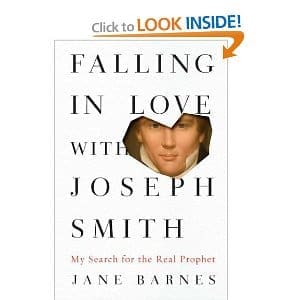
 As the 3rd feature of our Mormon Stories Book Club series (organized by Heather Olson Beal), we feature Jane Barnes and her new book Falling in Love with Joseph Smith,accompanied by the following readers: Rob Lauer, Erin Hill, Cheryl Bruno, John Dehlin, and Dayna Patterson. Please click on the link to purchase your book through Amazon. A small amount of the proceeds go to help support Mormon Stories.
==============
Title: Falling in Love with Joseph Smith Author: Jane Barnes Publisher: Tarcher Genre: Non-fiction Year: 2012 Pages: 304 Binding: Hardcover ISBN-13: 1585429252 Price: $16.85
Support Mormon Stories by purchasing Falling in Love with Joseph Smith through this link.
Book Description from www.amazon.com:
When award-winning documentary film writer Jane Barnes was working on the PBS Frontline/American Experience special series The Mormons, she was surprised to find herself passionately drawn to Joseph Smith. The product of an Episcopalian, “WASPy” family, she couldn’t remember ever having met a Mormon before her work on the series—much less having dallied with the idea of converting to a religion shrouded in controversy. But so it was: She was smitten with a man who claimed to have translated the word of God by peering into the dark of his hat.
In this brilliantly written book, Barnes describes her experiences working on the PBS series as she moved from secular curiosity to the brink of conversion to Mormonism. It all began when she came across Joseph Smith’s early writings. She was delighted to discover how funny and utterly unique he was—and how widely divergent his wild yet profound visions of God were from the Church of Latter-day Saints as we know it today. Her fascination deepened when, much to her surprise, she learned that her eighth cousin Anna Barnes converted to Mormonism in 1833. Through Anna, Barnes follows her family’s close involvement with Smith and the crises caused by his controversial practice of polygamy. Barnes’ unlikely path helps her gain a newfound respect for the innovative American spirit that lies at the heart of Mormonism—and for a religion that is, in many ways, still coming into its own.
An intimate portrait of the man behind one of America’s fastest growing religions, Falling in Love with Joseph Smith offers a surprising and provocative window into the Mormon experience.
Book Club Resources:
- Click here to listen to the Mormon Stories Podcast with author Jane Barnes, John Dehlin, Erin Hill, Dayna Patterson, and Cheryl Bruno
- Reviews of Falling in Love with Joseph Smith
https://www.tarcherbooks.net/qa-with-jane-barnes-author-of-falling-in-love-with-joseph-smith/
https://www.salon.com/writer/jane_barnes/
https://www.huffingtonpost.com/jane-barnes/
https://www.tarcherbooks.net/fun-fact-four-things-you-didnt-know-about-joseph-smith/
- Podcasts re: the book:
https://wmra.org/post/jane-barnes-fascinated-mormons
https://wamc.org/post/falling-love-joseph-smith-jane-barnes
https://www.wnyc.org/shows/lopate/2012/aug/21/falling-love-joseph-smith/
- Other Mormon-themed resources/writings by and about Barnes
https://www.cultureshocks.com/shows/2012/08/24/jane-barnes/
Episode Transcript
Host: John Dehlin · Guests: Cheryl Bruno, Erin Hill, Heather Olson Beal, Jane Barnes, Rob Lauer
This transcript is machine-generated and lightly edited for readability. The audio is authoritative. Please excuse occasional errors in names and spelling.
Welcome and Book Club Introductions
Rob Lauer [00:00:00] 1, 2, 3.
John Dehlin [00:00:07] Mormon Stories Podcast is a production of the Open Stories Foundation. All donations to Mormon Stories are fully tax deductible and go directly towards keeping the podcast alive and towards building a community of support for Mormons like you. To support the podcast or to join the community, please become a monthly subscriber today@mormonstories.org hello and welcome to another edition of Mormon Stories Podcast. I'm your host, John Dehlin. Co host, I should say, because I have with me the ever witty and insightful Heather Olson Beale. Hey, Heather, how are you?
Heather Olson Beal [00:00:46] I'm good, thanks.
John Dehlin [00:00:48] And this is, I don't know, is this edition three of Mormon Stories Book Club?
Heather Olson Beal [00:00:54] Yep, I think so.
John Dehlin [00:00:55] Yeah. We've done Joanna, we've read Joanna Brooks, and we've read the Brigham Young biography. And now it's time to review Falling in Love with Joseph Smith, My Search for the Real Prophet by Jane Barnes. And before we introduce Jane and our other co panelists, let me just talk briefly about Mormon Stories Book Club and then I'll turn it over to Heather. For those of you who haven't caught on yet, what we're doing is we're having a monthly book club. If you go up to MormonStories.org and click on Book Club, you'll see a list of books that we've got in the pipeline. What you do is you purchase the book however you want to purchase it. We have a link to help you purchase the book through Mormon Stories. We'll get a small, you know, little contribution for this or any other Amazon purchase you want to make
Rob Lauer [00:01:50] if you
John Dehlin [00:01:51] click on the link and purchase this or other things through us. That's not what this is really about. It's just about helping to promote great literature and discussions about great literature. So what you do is you get the book, you read it, you can listen to the podcast interview that we have with the author, and then we're encouraging people to hold book clubs in their cities with friends, ward members, other Mormon Stories listeners. Encourage lots of people to buy the book and talk about it. And in the past, we've actually brought on authors. Authors have been willing to actually Skype into some book clubs and actually participate in local question and answer sessions. And we'll find out from Jane in a bit whether that's something she might or might not be able to do. We also have a Facebook group called Mormon Stories Book Club on Facebook where you can actually go up, interact with other book club listeners and interact with the authors. And so that's kind of how the book club goes. The next book that we have on schedule is called A Short Stay in Hell by Stephen Peck. But today we're focusing on Falling in Love with Joseph Smith by Jane Barnes. So, Heather, is there anything I left out?
Heather Olson Beal [00:03:11] Nope, sounds good.
John Dehlin [00:03:12] All right, well, Heather, you're joining us from Huntsville, Texas, which is where I first met you and your wonderful family back in the day. But why don't you take over and introduce our special guest and all our co hosts.
Cheryl Bruno [00:03:27] Okay.
Heather Olson Beal [00:03:29] So we have today with us, we're just going to kind of do a roll call, some of my favorite people in the world. I'll just say your name, and if you guys can just tell us a thing or two about yourselves and we'll kind of just go around a circle. So let's start with Rob Lauer. You there, Rob?
Rob Lauer [00:03:45] I am here, yes.
Rob Lauer [00:03:47] I produce and host two television shows in Southeast Virginia. And I'm a Mormon playwright.
Rob Lauer [00:03:54] And I'm a Mormon.
Heather Olson Beal [00:03:57] Okay. Cheryl Bruno.
Cheryl Bruno [00:04:01] Hi, I'm speaking to you from Washington State, where I teach swimming and lifeguard and write poetry.
Heather Olson Beal [00:04:09] Cool. Erin Hill.
Guest [00:04:12] Hi there.
Erin Hill [00:04:13] I'm in Bryan, Texas. I'm an English teacher, mom of two, and big fan of this book.
Heather Olson Beal [00:04:20] Dana Patterson.
Guest [00:04:22] Hi, I'm in Bellingham, Washington. I also write poetry, and I am on the staff of Exponent 2.
John Dehlin [00:04:32] Nice.
Heather Olson Beal [00:04:34] And our special guest, of course, today is Jane Barnes, who's the author of this book. Jane, you want to introduce yourself to Mormon Stories listeners?
Rob Lauer [00:04:42] So, hi, I'm Jane Barnes and I'm a writer. And I've been a writer all my grown life with other day jobs. One of my day jobs which was most writerly is that I was a writer for Helen Whitney, and we did PBS documentaries together for about 20 years. And the last documentary we did together was the series on the Mormons, which aired in 2007.
Heather Olson Beal [00:05:15] Okay, great. I wanted to start out by reading a little snippet from your publisher about the book, just to kind of introduce the book, if that's okay. Okay. Despite its presence in popular culture from Big Love to Broadway's the Book of Mormon, Americans still don't know what to make of Mormonism. According to a 2011 Pew forum, half say they know little or nothing about mormonism. Meanwhile, a June 2012 Gallup poll found that bias against a Mormon presidential candidate hasn't budged in 45 years, with 18% of Americans saying they would not vote for a well qualified candidate who happened to be Mormon. Given these statistics and the current presidential landscape, the time is ripe for Jane Barnes falling in Love with Joseph Smith, My search for the real Prophet. In Barnes own words, the book bridges the gap between the scholars who have squeezed Joseph into so many ill fitting boxes and the general public who should know more about this American religious genius. A timely and important literary work, Falling in Love with Joseph Smith offers a unique perspective, that of an outsider peering in and explaining the allure of what she finds. Indeed, the book serves as a counterpoint both to the popular critical works on the subject, like John Crack, Hours under the Banner of Heaven, as well as to the more complimentary conversion memoirs. It is an exploration that will fascinate anyone interested in the Joseph Smith and the truly American religion he founded. So, Jane, just to start us off, I'm assuming you've had a lot of people ask you what the book is about.
About the Book Falling in Love with Joseph Smith
Rob Lauer [00:06:50] Yeah.
Heather Olson Beal [00:06:50] So I'm kind of curious because I've had people ask me too, like, hey, what, Seeing me reading it, hey, that looks interesting. What's it about? Right. And so I'm kind of curious to know how you answer that question if people ask you what it's about.
Rob Lauer [00:07:03] Well, I say that it's a spiritual memoir wrapped around Joseph Smith's biography. And I don't know if that makes it clearer or not. I just mean that this is about my kind of amazing and unexpected reaction to him, but out of a kind of a history or staggering around in a spiritual way and then trying to show that person myself, responding to Joseph, who is so complex and also a character now in history on the page. So it's not enough just to say, gee, he's great, he's wonderful. Look, he's got black hair and blue eyes. Those are things we can't see. I really. So it's about me studying Joseph Smith and studying what I think about him.
John Dehlin [00:07:56] Hey, Heather, do you mind if we ask Jane just to tell us a little bit about her kind of spiritual biography, just to give us a sense for how she was raised religiously or spiritually, and then have her tie that into how learning about Joseph Smith played into the unfolding of her religious and spiritual life just as a background.
Heather Olson Beal [00:08:19] Yeah, great.
John Dehlin [00:08:20] All right, Gene.
Rob Lauer [00:08:23] My family was not religious. My parents weren't, and they never talked about it. But they did send us to church when we were little children. And I liked going. My sister and brother, my older sister and brother did not like going. We went to an Episcopalian church and I was old enough, so I guess I was 6 or 7 or something where I got very interested in this idea that God loved us all. And I Couldn't figure out how he could love us all at the same time. And so that was a preoccupation of mine. And at that point, just as that was coming up, we moved and we moved to Washington, D.C. and my parents just lifted the kind of rule that we had to go to church. But I did keep going. And actually I took a taxi to church and, you know, was an earnest little eaver, evil beaver and kind of memorized verses and won a Bible and did stuff. But it was getting thinner and thinner for me because I felt sort of like an outsider in my tribe. And I also. I did feel weird flying, you know, paying. I was not paying my own money, but, you know, getting a taxi and paying someone to take me to the source of the meaning of life and death. And so I quit. Then I stopped going. And as an adult, a young adult with children, I came back to the interest in religion and tried to get my kids to go to church. And they just hated church and thought God was boring. And I did not have the kind of enough authority or. I just. I mean, I didn't even really know what I was trying to get them to do. So I couldn't get them into church. But at that point, I did start kind of, as I say, staggering around. And I went, you know, I went through to Episcopalian church and I went to Unitarian Church. And I actually got fascinated by a channel. And I'd never seen anything like it. I didn't see the channel herself, but I went to this group who followed her works, and she was. It just. That actually was sort of the most interesting but sort of hilarious thing to me. I just could not figure out how they got where they were. But somehow where they were seemed like a tender and really believing place. And I think at about that point, I did start meditating, doing Zen meditation, and I did study that for some years and did meditate. But the longer I wanted to meditate, the more I wanted to pray. And the more I wanted to pray, the less I had to say. And somewhere after that, at that impasse, is when I encountered Joseph and sort of just had this explosion of understanding and wanting to be connected to the story he tells and the story that is his story, too. Did I lose you?
John Dehlin [00:11:35] No. No.
Rob Lauer [00:11:35] That's.
John Dehlin [00:11:36] No. Do you want to take it, Heather?
Heather Olson Beal [00:11:38] Yeah. Well, Jane, do you want to read that little excerpt at the beginning of the book? I think that kind of sets it up, kind of your take. Your take on it really well.
Rob Lauer [00:11:48] Okay. Well, let me go. Let me pick up the book and read it to you. Joseph reawakened religious feelings I thought I'd lost forever. Not since I colored religious pictures as a child had I felt so close to a divine presence. His exuberant arc from boy conjurer into frontier prophet with gold plates gave me the most intense delight of which I was capable. Meeting the early Joseph, fresh in middle age, was like drinking from the fountain of youth. I was smitten by the boastful boy who looked into the magic stones to track treasure chests zooming around beneath the earth. I loved the same boy for being filled with earnest wonder when the angel Maroni came to his bedroom one night and told him about the great work God had for him. Joseph's holy fairy tale seemed like a gospel written by Mark Twain. His story gave me the delight of reading Twain, but more so like the delight of human love, but different. We do not normally think of God as tickling us until we break into helpless tears of laughter. But this was the God I felt in the early Joseph. A God with a touchingly, meltingly, divinely irreverent sense of humorous. Here was a God who dared to clown around with his own image. He had created a story so comic, it defied disbelief.
Cheryl Bruno [00:13:18] Great.
Jane Barnes on Writing the Book
Heather Olson Beal [00:13:20] Okay, so I'd like for us to talk a little bit about what kind of book it is and kind of how you wrapped your experiences around with his. I read somewhere online, or maybe it's actually in your book, where it says it's an autobiographical biography.
Rob Lauer [00:13:37] Well, then that actually was another way of saying that. I mean, I was trying to explore myself and understand myself in this response to Joseph, but going back and forth between my, you know, searching my soul or searching myself and studying him, because what was it? I mean, you know, there was, as I say, I mean, I had a very vivid reaction and one that, you know, kept coming back and coming back in different forms and seemed like this unbelievable opportunity to find religion, to be connected to God, to explore these mysteries. And I kept wondering, where was it coming from Joseph? What was he doing to me? Why was it he. Why was it his story that was so inspiring to me in that sense? I was, as I say, looking at my. Studying myself and then trying to study him to find out, studying myself to see what I was going through, and then studying him to see how he produced it.
Heather Olson Beal [00:14:41] Yes. Well, a couple of the readers that we have here, I think, had a question that they wanted to ask you about that. Cheryl, you want to take a shot at it?
Cheryl Bruno [00:14:50] Yes, I just wanted to say that I found the book absolutely delightful, especially when you're speaking about the young Joseph and how you place Joseph in the Tom Sawyer and Huck Finn story to give his youth some context. I'm wondering why you chose these two fictional characters to introduce this concept that there's something about the finding of the Book of Mormon that might be beyond our understanding or that might just not be as fictitious as we think it is.
Rob Lauer [00:15:22] Well, Tom and Huck were just incredibly important to me as giving me a voice, giving me a way of trying to tell people, tell the world what they were missing about Joseph Smith. And part of it actually had to do with a joy and a very joyful period in my childhood that was not church related. It was actually a joyful love of the country where we went when I was a child and the freedom we had and this sense of incredible irreverence and also just a feeling that the grownups were fine and they were very dear, some of them, but they just were hopeless and didn't know anything real. And that we as a little gang, you know, were in touch with the mysteries of the world. And it was a sort of period of childhood where there was this sense of angelic presence in nature and in our little friends and the things we did. And I always associated that as I grew up with Mark Twain's portraits of Tom and Huck. And when I met Joseph, he just raised it all to another level. I mean, it was the magic of childhood and the magic of an irreverent American childhood. And he took all those things and wrapped them in this story about that started in magic. And so sympathetically, I mean, you know, those peep stones just. I felt if only I had peep stones, my life would have been perfect. And that no wonder he could see things with the peep stones. I mean, if I had peep stones at the right age, I would have been able to see magic things with them. And of course, there was also his way of connecting with the invisible world. So the invisible world was real to him from the beginning of working with magic and going on to meeting Moroni and being told about the plates. And I felt, when I tried to think of how I would write about Joseph, that there was this breakdown. People either it was hagiography or it was criticism. And for me to stand in the sides and say, you don't understand Joseph Smith. He's hilarious, he's funny, he's wonderful, he's rich, he's poetic, he's. And when I thought, well, if I could find a way to get at least American readers to understand what I was trying to say, I could put him into Mark Twain's world, as strange as it might seem to put a Mormon prophet into, or the Mormon prophet into Tom, Mark Twain's world, because Twain was famous for making jokes at the Mormon's expense. Nonetheless, Joseph had that poetic element that Tom and Huck had. And I felt if people could see that, you know, he's. He's one of Twain, he's part of the pantheon, and that it would. It would. It would give them a sense of, you know, the wonder of this guy and his American ness. But I.
Cheryl Bruno [00:18:45] Yes, it really. It really did. It really did that for me. Just to let the readers know real quick, she sets up this little scene where Joseph meets Tom and Huck, and he plays a little trick on him, just like Tom Sawyer would do, and tells them all about the plates and how he's going to bring forth these golden plates. And then they go up the hill, and Tom and Huck kind of feel like, well, you know, this is a great joke. This is wonderful. They love Joseph, but they realize that he's going to fall flat on his face if these plates don't appear. So they conceived this little plan to go and plant some plates up on the hill so Joseph can find them and so he won't have to pray a lie. So in the end, though, when they go up the hill to plant these plates, they come screaming back down the hill because they've had an encounter with a giant toad with a rusty sword. So I feel that this is kind of a nod to the fact that there's something about the Book of Mormon, there's something about the plate story that, you know, is just magical, that we don't understand, that we might have it all figured out that it was a big fraud on Joseph's part, but then we find something in his story that really just doesn't make sense, and that is magical. So that's what I really loved about your. Including Tom and Huck. I think Dana had another question about Tom and Huck as well.
Guest [00:20:12] Well, I think that she pretty much answered my Tom and Huck question. But I do want to ask about. I read Rough Stone Rolling earlier this year, and so I was a little wary to read another biography of Joseph Smith. But you really approach it in such a fresh and new way. And I found the spiritual memoir parts of it to be really compelling and really interesting. And I wonder, do you think that more biographies and autobiographies should be written this way? Because clearly you acknowledge your background and your bias coming into the Joseph Smith story. Did you have any models for this or is that all?
Rob Lauer [00:21:02] No, I didn't. I mean, I didn't, but I did. I mean, I think at the back of my mind is a kind of common sense. You know, it's like the thinly disguised autobiographical novel people. And in fact I think we have more memoirs now because people got to a point where they thought, oh, this is, you know, this is just him talking about the affair he had with so and so and so basically. And then I think also when, even when people write critical works and especially biography, there is a sense, well, you know, it's really that authors take. And actually for me it was not far from knowing that about our reading culture to the next step, which was sort of going, you know, mano a mano with Joseph. I mean I. And I did think it was a very pleasurable way to write. And I also thought that having to come to terms with history, I mean especially the history of Joseph, which was far vaster than I could really come to grips with, but that having, having a factual focus for your own self searching actually was a useful and productive way to approach a biographical subject. That would be great if there were more.
Guest [00:22:26] So do I. I thought it was really honest and really refreshing.
Rob Lauer [00:22:31] I really enjoyed it. Thank you.
Joseph Smith as Humorous and Human
Heather Olson Beal [00:22:34] Okay, so I have kind of a follow up question related to that for the readers. I'm curious to know how you guys reacted to seeing Joseph Smith described as hilarious, irreverent, hysterical, delightful. Because that's definitely a very different description of Joseph Smith than the one that we usually get at church. Right? Did you guys like that? Did you react to it in any way? Or did it, did it resonate with you?
Cheryl Bruno [00:23:03] Oh, you know that I loved it. I described Joseph the same way myself and in addition, passionate and virile and all those things. I love the stories of him wrestling and lifting children out of the mud and just especially these folk characteristics that she describes in the book. Those are the things I love about Joseph as well.
Erin Hill [00:23:26] I really liked it too. Oh, sorry, go ahead. I liked the honest, non whitewashed version. And one of the things that I wondered related to a different passage in the book. Jane Barnes wrote that about her own life. The only redemption was to be accountable. I actually thought that in some ways that official portrait of Joseph Smith that is kind of PR prevents people from being able to enjoy that real person. And because we don't see the flaws or don't acknowledge them, we miss out on Some of that joyful irreverence. And I wonder if we need more of that dark to enjoy the obvious lightness that he contained and portrayed as well.
Rob Lauer [00:24:24] Okay. Yeah. No, actually, let Rob go. Let's. Let's hear from Rob.
Rob Lauer [00:24:27] Let's go back to Heather's question. I really. This was the Joseph Smith that I first encountered at age 16 in American history class, running to the library and reading all I could find on him. I wasn't raised lds. I came to the LDS Church several years later because of this Joseph, only to find him not present in the LDS Church. So for me, Jane's book, after, you know, 37 years in Mormonism, this was like, finally somebody else gets it.
Rob Lauer [00:24:59] Well, I'm happy to hear that. And actually, I was. I loved meeting Rob because I did feel that we had a lot in common. And it made me feel. I mean, there had been times when I was writing the book where I thought, you know, this is fine. I'm having a great time. I. I have this to say, but who in the world is going to understand it? So it was nice to talk to Rob.
Heather Olson Beal [00:25:20] Yeah. So for those of you guys who don't know, Rob and Jane were at a book club meeting or something a few weeks ago and were able to meet each other in person. So related to that, there's a place early on in the book where you say, jane, Joseph Smith was everywhere and nowhere in mainstream Mormonism. So we kind of heard from Rob a little bit on that. But I'm wondering if others feel like, you know, how is Joseph Smith everywhere? Where do we still see evidences of him or of his influence? And are there obvious holes or places where he seems absent, where he should be, or just to kind of get some people to reflect on that, maybe. Can anyone weigh in on that?
Guest [00:26:03] Well, I think that we've been accused enough times as Mormons of Joseph worship that we're very wary in the mainstream church about saying too much about him. That sounds like praise. I mean, I remember taking investigators to church that would wonder about the hymn Praise to the Man. They're like, where is Jesus in this hymn? Do you know what I mean? So I think some of the way that Joseph is not as present in the church is part of that. Hmm.
Heather Olson Beal [00:26:37] Yeah. My dad said the first time he went to church, they sang Praise to the man and he was a convert. Praise to the man In Utah we love thee. And that was in Southern California. And I think he was very much like, this is a really weird place. Like, what are we we're singing this strange song praising this prophet and we're singing about Utah, but we're in la. It's really strange. Anybody else want to weigh in on that? Joseph Smith is everywhere and nowhere in mainstream Mormonism.
Rob Lauer [00:27:07] I agree with her. And I think that actually the church's focus on Jesus since the mid-1980s, when the theology of the Book of Mormon really became the focus of many talks and lessons and things, is really, it's running from Joseph. I see it as trying to put Jesus at the center of everything and we're sort of stripping what makes Mormonism unique. And to me, Joseph, Joseph has become even more distant from mainstream LDS culture and thought than he was 37 years ago.
Heather Olson Beal [00:27:42] So Rob, then, does that seem like a loss to you?
Rob Lauer [00:27:45] Yeah, I pretty much left the church and joined another denomination of Mormonism just because the LDS hearse doesn't speak to me, because I don't find Joseph present there anymore.
Cheryl Bruno [00:27:58] And this is why I feel also attracted to fundamentalism, because as she noticed in her. As she noted in her later chapters, the fundamentalists seem to have this Joseph more central than the modern church does. And that attracts me about fundamentalism. I like the way they cling to the Joseph that she shows to some of his foundational doctrines, to some of his innovative works in a way that the modern church doesn't.
Erin Hill [00:28:30] I think too, there's a messiness to his story that is irreverent and fun, but obviously is at odds with kind of the corporate, button down contemporary church. So in some ways it's just like an aesthetic mismatch. And perhaps a greater focus on the real Joseph Smith would prompt people to get to know the real Joseph Smith. And that might lead to some problems.
Rob Lauer [00:28:54] I had sort of the impression that the reason Joseph was so distanced in the mainstream contemporary church was polygamy. I mean, and people just don't know what to do about it or how to talk about it or how to. And I think actually it is a problem. I mean, I think it's hard to kind of really get relaxed and say, well, and then Joseph, you know, really decided he had to have 38 wives. But I think it would actually be an incredible thing if the church would take up the study and then trying to understand Joseph in the second half of his life. I don't know if it can. I don't know what you all think about that.
Cheryl Bruno [00:29:45] Well, you know, Harold Bloom likes that Joseph too. He loves that. He said that if the church had that early Joseph in it that he would join the church as well. And I did want to ask you a little bit more. The way you describe polygamy, you say that polygamy is essential to Mormon theology. And I think you get this in a way that many Mormons don't, that Joseph polygamy was a big part of the way he was intending to break social custom and make this web of connections and build a kingdom. So I was interested to read that you said on page, I guess it was 248, you said I was too old to take up polygamy. But I wondered if I could learn something about holding onto Joseph from the way that the fundamentalists did. So I wanted to ask you, if you weren't too old, would you be tempted to try the Mormon fundamentalist brand of polygamy?
Rob Lauer [00:30:47] Well, I can tell you a funny story about this and about myself. When I was visiting the family, the fundamentalist family who were so hospitable to me and I felt they were, I really became, they became friends. They're wonderful, they're very interesting. I mean they take their religion so seriously. And so the conversations we had were pretty intense. And at one point I was talking to the patriarch who's a very attractive middle aged man. And I said, well, you know, if I weren't too young, I would be willing to try polygamy or I might try polygamy. And I realized I had said the word young instead of old. And I could see his eyebrows flying up, I think because he thought he doesn't look too young. But I felt, I thought why did I say that? And I think I said it is because I felt, you know, God, if I were young enough, I'd try this. And that came out as that Freudian flip. I mean, yeah, I came of age in the 60s and all this, you know, there were. I was not very experimental myself, but I was very fascinated by the experiments that people had in group marriages and communes. And I felt that and strength to say ultimately Gay Tales wrote a famous book, a famous scandalous book called Thy Neighbor's Wife. And it was about the sexual revolutions of the 60s. And he focuses on two groups of adults who begin first as a couple experimenting and then growing into a larger group. And they're very serious people and they're very fascinating and they change a lot as they experiment and they matured a lot. And I think actually that in some way you might say that. I think it's possible to say that Joseph actually in his kind of revolutionary vision for the sexual marital relations actually was seeking Sanctified, grown up experience that would have helped everybody grow not just as human beings and people, but also have made them more exalted and more suitable to Godhood. Can I talk to everybody?
Cheryl Bruno [00:33:27] Love that. I love it.
Rob Lauer [00:33:28] Oh, good.
Guest [00:33:29] Okay.
Heather Olson Beal [00:33:30] Yeah. No, sometimes on these podcasts it's hard for me because people say things and then like, I feel like I need to just think about it. But we can't have long, awkward pauses. Recording recorded on the podcast.
Polygamy, Emma, and Joseph's Personal Life
Rob Lauer [00:33:43] But did have any of you, I mean, thought. I mean, you maybe some of you have polygamous ancestors and you wondered how they did it or you wondered if you would have done it then? I mean, did any of you have any feelings about yourselves and polygamy?
Cheryl Bruno [00:33:59] Well, I don't have.
Rob Lauer [00:34:01] Sorry, go ahead, Cheryl.
Cheryl Bruno [00:34:03] Oh, I don't have. I don't have polygamous ancestors, but I did write a blog post called why I Would Totally have Slept with Joseph Smith.
Rob Lauer [00:34:15] Okay, I. Can I hear you? I mean, I think actually I had much more the feeling that, you know, I had this kind of feeling, I've got to figure out who he is, that it was like being a. Having a tomboy relationship to him. I mean, that sort of a totally. I mean, I was trying to study him and I was trying to get him. I was trying to understand that, you know, the idea that he was fantastically attractive and that I would feel that attractiveness just seemed too threatening under the circumstances and also, you know, blinding in some way.
Heather Olson Beal [00:34:53] Rob, what were you going to say?
Rob Lauer [00:34:55] I was saying polygamy was the one thing that I never had any problem with, and I'm gay, so it's not like I was going to run out and marry a lot of women or any woman. But I thought that Joseph came to have a very realistic view of human sexuality, realizing that it is not monogamous. Your lifestyle may be monogamous, you may commit monogamously, but, you know, sexuality overruns those traditional boundaries. And I think he was really trying to deal with the reality of human sexuality.
Erin Hill [00:35:28] Something that I thought you did well was bring Emma to life in a couple of spots. Of course, the main point of the story is Joseph. I know that for me, my appreciation of that joyful, irreverent Smith is sort of at odds with his deception and the way that he told or didn't tell Emma. But I liked the way you handled that and framed some of those final months of his lives in terms of his interactions with her. And in some ways, it's a very flattering portrait of her. It's also, it seems like a very poignant, painful portrait as well. Particularly those last eight months that you addressed in kind of the middle to second half of the book.
Rob Lauer [00:36:16] Actually, you know, one something I wanted to bring in and I felt that I didn't do it as well as I wanted to. And that is to compare this period when he was marrying many women and finally being honest with Emma. I wanted to compare it to actually the relationship between John Updike's narrator in his stories about the Maples. Because there was a couple also striving to kind of come to terms with their unhappiness. I mean, they were not, you know, having affairs because they were trying to be more exalted in the. In the eye of God. In fact, I think there's a lot in Updike's work about how the disappearance of God led them to sex and to having sex, adulterous affairs. But the spirit between the man and wife, the honesty in the Maple story reminded me of what seemed to be the honesty between Joseph and Emma. And I think it was of interest that. Joseph and Emma had this modern truthfulness of a high degree. Maybe not entirely because maybe she never knew everything that Joseph was doing. But there was a willingness there and maybe an inescapableness too, for them to know each other completely. And I think it's actually one of the hardest things in any relationship. But I think it's extra exponentially difficult in a marital relationship for the man and the woman to really know each other. Especially when it involves knowing about their attractions to other people or their need for other people. So I could see Emma and Joseph as part of our world. And that was something that drew me into sympathy with because I felt that we live in a world where there's supposed to be great sexual freedom and that we don't even. I mean, in the modern world where there's so much supposed sexual freedom, there really isn't very much sexual happiness or completeness. And I think Joseph was trying to bring that into that world along with all these other elements. The religious element, which I believe was real, the community bonds, which I also think was real, and the gathering of the group and making their community whole. So, I mean, he was trying to do a lot of things at the same time. Explicitly at the basis of the. All the efforts he was making were these changes in sexual arrangements which were, you know, very explosive.
Heather Olson Beal [00:39:43] Can I ask a follow up question? Yeah, but so you're talking about Emma and Joseph and kind of having some high degree of truthfulness. Or openness. But it seems like, correct me if I'm wrong, but that. That was after quite a lengthy period of some pretty serious deceit, right?
Rob Lauer [00:40:01] No, no, that's right. That's right. That's right. Yeah.
Heather Olson Beal [00:40:04] Yeah. So for me, it's interesting, just the whole polygamy question, I mean, because I have a more difficult time with the deceit aspect of it and the manipulation that seems to have taken place not just with Joseph Smith, but with other, you know, men who participated in it with the ages of, you know, some of the young girls and kind of hold. I would. I mean, I see it as kind of holding some real power out over these women's heads, and they didn't really have too much agency in. I have a more difficult time with that than I do the actual. The fact that, you know, that people were marrying, you know, more than one person. So that's. I mean, so then when we were talking a few minutes ago about Joseph being not very present in the church or how sometimes maybe church members are ashamed because of what Joseph did, and we've kind of moved away from that. Like, for me, I feel like, yeah, okay, let's move away. Because that's something that I don't get. Like. And that doesn't seem like. Like a quality of someone that I would want to be a prophet that would engage in so much deceit. I mean, so that's the kind of thing that I've. I've tussled with for about 25 years, I guess, trying to figure out what to do with that as a. As a Mormon. Right. What do you. What do you. What box do I put that in, basically?
Rob Lauer [00:41:17] Well, I know. I mean, actually, I. You know, I sent you all those questions. I actually still. I mean, I don't feel that I came to some peace, really, with this part of Joseph's life. I think it is very complicated. And it's hard for me because I feel like the boy Joseph really has this whole nature and honest nature. And although, I guess, yes, I do feel he had an honest nature and a life loving and. And family loving nature. And he was religious in this very unorthodox way. And then his coming as an adult to this period in Nauvoo, you know, I think his behavior is problematic. And I think, as always, I mean, here in Charlottesville, where I live, we're now going through this big discussion because a journalist has published a book showing definitively and very lots of justification how racist and in what cold way, Jefferson was racist. So now how do you talk about a Declaration of Independence when you know that Jefferson was such a cold racist. And how do you hold on to the religious inspiration and insight and vision of Joseph Smith when you know that he really was breaking all the rules in Nauvoo? And there obviously was part of him kind of somehow like, I am entitled to try these things in this way that may be painful for other people. I'm not quite sure how to deal with it either, although, I mean, I feel I understand a lot of it, or I sort of have ideas about a lot of it. I guess my question is, how can the church deal with this? How can it be dealt with in your community? How would you do that? I mean. And I hear a silence.
Heather Olson Beal [00:43:32] Well, I would say how we deal with it is by not dealing with it. I mean, I just went for the first time this summer to Palmyra with my family, and I was struck there by how different the portrait that was painted there of Joseph Smith was from what I've understood from a fairly limited, you know, reading of church history. I mean, so we've kind of chosen to present, and I think this has to do with kind of some political things, and now such a big focus on the traditional family and, you know, the church, not church, being against gay marriage. So that now we've created these prophets and we want to show them as if they were living in 2012. So we see a movie that has Joseph Smith and Emma, and it looks like it's date night. You know, I mean, Joseph's out swinging one of his kids, and they're, you know, I mean, it looks like, oh, it's dad time, you know, and they tell you this story there in Palmyra about how Joseph gave Emma this pearl necklace. And I mean, it just looks so modern to me. And so. So very traditional, very husband and wife, one man, one wife. You know, that it seems like such a contrast. I mean, it was jolting to me to see all that in Palmyra and feel like, wow, we're really not. This isn't real. This is not. Or Maybe that was one story of 50 that we could tell about Joseph Smith, but we're burying all of the rest, I guess.
Joseph Smith's Theology and Religious Vision
Rob Lauer [00:44:53] One thing I feel where it would. There could be exploration of Joseph that would be less controversial and hot to handle than polygamy would be what be his theology and the way his theology developed. I mean, for me, the Book of Mormon is really this amazing scripture, and I feel it's a divine scripture, but it brings this whole. It brings Christ out of the Bible and once he's out of the Bible then he's going to have to be redefined. And I feel it's very that actually Joseph proposed in the Book of Mormon that Jesus we know in our world, I know that, I mean the whole world, so that there's the Mormon view of Jesus now and the very Christ centric Christianity of the church, but there's also the Unitarian Church where Jesus is a teacher. Jesus has to be redefined after the Book of Mormon and Jesus can just be a friend or Jesus can just be a brother. And I don't think Joseph really knew what he had written and I think that one of the first things he writes after the Book of Mormon is the doctrines and covenant which is an attempt to re establish the authoritarian Jesus. But I don't know that it really works and I don't know that it's really working on Joseph's mind. I think you see somebody who begins to live his individual freedom and that he actually at the end of his life is coming up with this fantastically interesting theology about progression towards godhood which is a version in my mind of kind of self actualization and the realization of human potential, but in a religious way. So I think it's, and I think it would be, I mean a valuable, I mean, I think it's, I mean just more work needs should be done about the Joseph's theology because it is fascinating and as I say, I don't know that he knew exactly what he had brought forth.
Cheryl Bruno [00:47:12] I really enjoyed your treatment of the Book of Mormon in that way where you talk about how he frees Jesus from the constraints that you know, the Christian world has. And I really think it's so ironic that that's exactly what we do today. We build up these romantic notions around Joseph Smith and we're putting him in the same box that we have Jesus in that he was trying to break us out of. So I just, I really loved that discussion all around the Book of Mormon and how you were able to find some meaning in what he did there. That was a great part of the
Rob Lauer [00:47:45] book and I agree.
Rob Lauer [00:47:47] Cheryl what always struck me when I visited Temple Square for the first time in the late 70s, early 80s were all the new paintings at that time, the new murals of Joseph Smith. He seemed blonder, more blue eyed, more fair skinned and he was all these Christ like poses. There's one famous picture that's been on the ensign probably just a dozen times over the decades of him sitting by the Mississippi river on a log, an axe or like an Abe Lincoln pipe next to him, a child on one knee and pioneers gathered around. He even has his hand lifted in the air in this very stereotypical Jesus Sunday school art fashion. And we've made Joseph into Jesus. But what strikes me is that Joseph made everyone in his theology. Jesus became an archetype for every human being. It wasn't just Jesus that was pre existent. Suddenly everyone was preexistent. It wasn't just that Jesus was uncreated. Suddenly everyone was uncreated before the world began. Jesus isn't just divine. We're all, you know, have the potential to be gods. And that's, you know, I would love for more Mormons to get into that. That is the theology that when you view everything in terms of eternal progression, that all the dark stuff in Joseph's life, the real stuff can be used within your own spiritual journey. You can contemplate why did he do this? How could he do this and still be good? The dark stuff, the messy stuff becomes fodder for spiritual growth. And that's what Jane has done in her book and that's why I appreciate it so much.
Cheryl Bruno [00:49:23] Yes. Now speaking of the pre existence and the afterlife as well, Jane, you seem to enthralled with Joseph's visions and the angel, the plates, the hat and reformed Egyptian. And to me the pre existence kind of fits in this folkish mold. And I wondered what disturbed you so much about the specific doctrine. You talked in length about how disturbed you were by the pre existence.
Rob Lauer [00:49:50] I think it looked a lot like death to me. I mean I just couldn't figure out, I feel like somehow, I mean I, I feel I had some growth in relation to death thanks to Joseph Smith, but that dying is like one of my least favorite things, my most, I mean my most unfavorite thing. And the pre existence, the idea of being in the darkness without knowing just really makes me uncomfortable. But I don't mind going, having been through life and actually what Rob is saying I think is really a great way of expressing why the progression to Godhood is so exciting and that that is both, you know, you, I mean that the dark side, I mean to grow up everybody has to come to terms with their dark side and the darkness that is there. And I mean it's a goal that is doable. I mean but it takes a lot of work and it takes a lot of. And the honesty to be, to face yourself is a really enormous thing. And I think once you have though that there are ways of integrating it and progress progression towards God. Is one of them. But I think also that for me, I think the progression towards godhood means that you're accumulating these layers of life you're getting. When you, I mean, for instance, at this point in my life, when I'm older, it's much easier for me to think, well, I may die or I will die because I've had the fullness of life. But when I think of that, pre existence is like being pre dead, I guess, but. And that's that just, you know, But I. Anyways, I appreciate what you're saying that it's like in the folkloric place. But it would be interesting to hear other people say how they feel about, about the theological Joseph and how, I mean, he could be introduced into the discussion of the church in a way that, well, actually could help open him up as a creative thinker and a creative religious genius. I don't know if you all.
Erin Hill [00:52:11] I think maybe one of the problems in the Mormon model perhaps is that Joseph is seen as like a conduit. But I don't know that we give him a lot of credit for being creative. One of the things I really liked about your book was that I saw something I've liked about Joseph for a long time, that he's a gifted writer. And you don't hear people say that in the Mormon Church because I guess there are implications there that would be a little bit troubling. And I'm not sure if we see him as a conduit or more a conduit, unless a creator, just to keep later prophets sort of in this line. And again, maybe there are troubling implications with the Book of Abraham, what have you. But if we were to open up and talk a little bit more about like who he really was in terms of creating this theology, I think it could lead to some interesting discussions. But I don't know that people are. I don't know that the church is ready for those implications. You talked. Let me say another thing. You mentioned in the book too, that the Book of Mormon was this Declaration of Independence and obviously Joseph was kind of this theological revolutionary. But maybe the problem with embracing that too much then is that people start to get ideas about their own creative potential, following in that path, having visions in the same way that he did. And the institution would want to kind of keep a lid on that sort of thinking. Maybe.
Rob Lauer [00:53:37] I think that's. Someone said a moment ago they don't think that Jones realized what he was unleashing. And I think that that's it. The Theology. Joseph, you know, said that he wanted his followers to have access to be endowed with power on high, to experience the same things he had experienced, to have the calling, election made. Sure. And that's great if you have a religious community that embraces religious individualism, but if you have an institution, and the idea is everyone is a part of an institution, upholds an institution, that becomes very troublesome. And I think that that's. Joseph the organizer, I think, was several steps behind Joseph Smith, the theologian.
Rob Lauer [00:54:21] Well, I think it is very hard for a church to, you know, balance between the wild creativity of a radical prophet and nurturing a church organization. And I don't know, I really would on how advise the Mormon Church. I did find it. I felt that as somebody who actually wanted, actually I would have liked to convert, that it was hard to come up against these very rigid formulations that couldn't be changed. And actually I myself thought, well, if Joseph were the prophet of the church, and not so much Christ, I thought, or not even Christ, I mean, if Christ, if Christ were the great prophet before Joseph and then Joseph had been the new prophet to create this church, I think I wouldn't have had a problem joining it. There was something I was going to say about running how a church can manage the, the existence of its creative profit. But I'll turn it back to all of you who've had the experience. I mean, how do you all deal with the limitations of the church knowing who Joseph is?
Heather Olson Beal [00:55:45] Well, are you.
Erin Hill [00:55:46] We wait for books like yours.
Heather Olson Beal [00:55:50] Yeah, I feel like I'm okay, you know, with historical figures, knowing about, you know, I'm not bothered to learn about Thomas Jefferson or whatever. But for some reason it is bothersome to me, or it has been in the past because we're not just talking from the Mormon standpoint about just the leader of an organization. We're talking about people who we say have a special and unique and singular connection to God. So, like, I wouldn't mind to be like, oh yeah, Joseph Smith. I mean, I've told my own kids who are 9, 12 and 15, I'm like, man, he had some big ideas. He was trying to sort of make this whole societal transformation, create this new crazy thing. And it was messy. I mean, so part of me can look at that and think, hey, that's cool. That's, you know, that. That's awesome. He had all these really big ideas, big personality. But then what that means for me, like from a contemporary perspective is it feels like, okay, well, but what that means is that. And for Other church members, I think maybe then these people aren't infallible, which means that what they're telling us now in some cases could be wrong or could be incorrect. And so that introduces a real problem that I think that it's probably in the church's best interest to avoid. I mean, I wish that weren't the case, but once you open up that can of worms, okay, Joseph Smith did all these things, you find out about. You find out about polygamy, and there was lots of deceit. Same thing with Brigham Young. Then if you take that and put it into 2012, I think it does create a problem for the institutional church,
Rob Lauer [00:57:26] but not a problem for individual Mormons. That's the thing.
Heather Olson Beal [00:57:31] What do you mean, Rob?
Rob Lauer [00:57:33] Well, I mean, for an individual who is converted to a religion and who is committed towards spiritual growth, eternal progression, whatever, none of those things are bad. I mean, that's what I'm saying. Individuals, the Mormon view, the LDS view, tends to be that people are here to serve the institution. They're here to be part of the church, the one true church in the rest of the world. Religion exists to serve individuals, to facilitate personal growth, spiritual growth, ethical progression, whatever. And the reverse seems to be the case in LDS culture. And so anything that throws the institution into question has to be tossed out, ignored, rephrased some way. And too often, I think we have not approached Joseph Smith as an individual, as a human being, but he is merely sort of the symbol, the introduction to the institution of the LDS Church.
Erin Hill [00:58:34] I see a kind of redemption of Emma in the past, maybe 10 years as a movement in a good, healthy direction, but I think a sign of that unwillingness or inability to wrestle with the real Joseph. I mean, our treatment or perception of her in earlier decades, I guess, is a symptom of that inability to deal with the real man. That in some ways, she kind of was the fall guy. And I can remember growing up and hearing kind of negative comments and then hearing various people from the pulpit say, like, it wasn't Emma's fault, as though such a thing had to be stated. It's almost like the building has to be burned to the ground and then rebuilt. But I think, like you're saying, Rob, it can be done on an individual level as members meet Joseph and decide whether or not they really want to become acquainted.
Rob Lauer [00:59:21] We talked about things that weren't talked about at one time. The very fact that Jane uses the whole peep stone, the hat, the folk magic, that is something that, you know, in the late 70s, early 80s when I first joined the church and was going to byu that the church was still officially denying. So the fact that that is now just discussed openly by everyone is, I think, is a huge sign of progress in that direction.
Heather Olson Beal [00:59:50] But would you. I wouldn't say it's discussed openly by everyone. I mean, neither would I. I've said it in a conversation or two, and people look like they're about to fall out of their seats. And then I either feel like, now I now look what I've done, or I feel like, I mean, I don't know, I've had that experience. And as soon as I say, you know, hey, we had this interesting lesson in primary where we did the thing where we put the sheet in between two people and one of the kids pretended that some, you know, one was the scribe and one was Joseph. And, you know, and I'll, you know, make a wisecrack about how no one had a hat, you know, for him to put his head into. And then I'm like, whoa, I can see that that joke was very much not well received and that I'm now considered, you know, as having introduced some anti Mormon theme or topic into the conversation. So I think a lot of people either don't know about it or they put it in the catego of anti Mormon kind of rumor mill stuff. Still, I don't know. That's been my experience.
Barriers to Belief and the Book's Honest Limits
Guest [01:00:43] I only found out about it. Oh, sorry.
Rob Lauer [01:00:47] Oh, I'll bridge what I said then and say that people can. Scholars can talk about it. We can talk about it on a podcast like this without the fear of being called into the bishop over it.
Heather Olson Beal [01:00:59] Yeah, Dana, what were you going to say?
Guest [01:01:01] Oh, I was going to say I only found out about the Peep Stones this year. So I'm 32. I read about it in Rough Stone Rolling. I graduated from seminary and institute and served a mission, and I had never heard of it before. So that's kind of sad, right?
Rob Lauer [01:01:16] Well, I wrote a play about it in 1982 that was produced at BYU, and it was just funny that it was accepted by everybody. The play was. And I was showing Joseph Smith on stage, looking in a hat, making up stuff, lying. And yet people were still moved by the depiction of Joseph. And he actually won an award from byu, the play did. So I just think we just have to rethink the way. I think there's a way to approach the real Joseph and take in all the darkness and not turn people off, actually build people's faith.
Rob Lauer [01:01:50] Jane, go ahead.
Guest [01:01:52] Don't you say somewhere in your book, Jane, that Joseph said that sometimes he's speaking as man and sometimes he's speaking as a prophet.
Rob Lauer [01:02:03] I think it's something he said very frequently. And I think he had a sense himself more and more as he got older, that he did have a gift, and he was. It was a religious gift. But he also, you know, had dark sides as a man and complexities that, you know, made him weak and flawed and all of those things. The one thing I feel about Joseph's youth and the folk elements of the peepstone and the hat and the sort of speed at which he's moving, religion and art and theater are all very linked. And I feel that he's like a modern artist in the way he recreated this Christian story for a new country, and that there's so much to celebrate about his talents and intuitions about how people in the future are going to communicate. And I think one of the reasons I was aware of this or sensitive to it is that I had led such a secular kind of art bum life and was not. I mean, but also had modern art. I mean, abstract art, happenings, all the different kinds of movements in art and theater had meant a lot to me. I mean, they meant a lot in terms of how they told any story in a world where. And this is the secular world, you know, where. I mean, the more kind of abstract art, bringing together pieces of. Of the world and even sometimes in a canvas that might not make perfect sense, nonetheless helps to see and to be able to envision what your experience is like as somebody who's crashing from a subway into a job that's underground and all the kinds of contrasts that exist in the subject in the modern world. I think Joseph's way of dealing and moving from magic and using things from magic and then moving to the angel and hearing the angel and knowing about the gold plates and then his way of translating the Book of Mormon was inspired. And I think it was inspired in ways that actually people could be proud of in the Mormon Church in terms of seeing it as a true modernism of imagination.
Cheryl Bruno [01:04:42] Yeah.
John Dehlin [01:04:43] Yeah. Jane, I'm interested in you following up on this idea about what your barriers were to actually joining the church. You mentioned something about Joseph's connection with Jesus as actually being a barrier to you. Is that. Is that right?
Rob Lauer [01:05:00] No. Well, no. I mean, Jesus. Jesus was so especially emphasized in a particular way that, I mean, I couldn't agree with it partly because of the way I read the Book of Mormon. And so I was in the position of saying, well, you Know, I think Joseph's book in scripture that. And actually I mean I had the experience of believing that he had received it from God in the sense that he couldn't have written it himself. I mean because of the devices that were set up in such a logical way that I mean I had the experience that he had taken Christ out of the Bible and once Christ is out of the Bible then you know, he hadn't put him back into the Bible and there were. So I felt that Christ was, you know, to be redefined. But I felt in the church and in the missionaries message that Christ was the figure you had to obey and the figure who made your life complete. But I just didn't believe that. And though I wish if Joseph had been the prophet of the church and Christ had been seen as his great teacher or the prophet before him, I would have been comfortable with that. But I also realize it is sort of unrealistic to talk this way when the Mormon Church is of long now have has a long history as an institution and has been very successful and has done marvelous things with its communities and families. And so I don't actually have a. I have a sort of home sickness for a place to be because of my Mormon, my love of Mormonism, but it won't be the Mormon Church, but it doesn't make me hate the Mormon Church or anything like that.
John Dehlin [01:07:11] Interesting. So you were looking. So are you kind of saying that the Christ of the Bible is a Christ that you aren't able to fully support but that you received enough inspiration or motivation by Joseph Smith that if he could have reframed Christ for you in a more palatable way, you might have been able to accept the whole endeavor. Am I restating correctly what you're saying?
Rob Lauer [01:07:44] Yes, although I just make this one other point is that I feel to my astonishment that the Book of Mormon was a revision of Christian history. I mean it's like a back to the future where you start 600 years before Christ's birth and everyone knows he's coming and there's prophecy, prophecy, prophecy. So you've gone back there to find out that this is the person who's dominated, who's ruled. But when the story is told in the book, you never see his birth, you never see his crucifixion. What you see is when he's alive, still alive during the resurrection in Central America. And for me this is like a conscious narrative device to say he's still alive, he's not finished. There's more to Christ to find out his story is not finished. And how is his story going to finish? Well, that is a big question that's raised by the Book of Mormon. So, to me, I felt that actually, for me, one of the things that's essential to Joseph's Mormonism is this potential to redefine Christ as part of the Christian narrative and Christian story. So that we are now in a phase when we would be rethinking Christ. And we could say, well, you know, I mean, I would go probably too far for everybody, even possibly on this panel, but by saying, you know, we could say that Christ is an idea whose time has really changed, that he's not. He's not. To me, Jane Barnes, the supernatural son of God. He served a great and heroic role in the history of Christianity and our vision of ourselves religiously. But that is now passed, and we're trying to figure out who the living God is. And. But I couldn't. I mean, when I said that, I mean, it was quite hard to say to the missionaries. And when I found ways to say it, you know, they basically said, no, you can't. That's not what we believe. And so I think if I felt that my reading of the Book of Mormon had had more of a place in the church and people could be comfortable with the idea that Christ was no longer what he had been and that I would have felt better. I felt, as I say, that there were certain things I was not allowed to believe or not. Yeah. That I shouldn't believe or couldn't believe, that there were very specific points of belief. And I also thought if I'd been born into the church, I could probably have this idea and think about it, and it wouldn't matter because I would just be folded into the community. But as an outsider coming in, you know, there was a kind of point to point, check, check up, and I couldn't. I didn't check up.
John Dehlin [01:10:56] Got it. Well, I bet those missionaries were bummed out.
Rob Lauer [01:11:01] Well, you know, we really had these fantastically intense meetings, especially towards the end, because I felt that, you know, we were just totally reaching for each other. We wanted this connection. I felt they had this belief that was unbelievably beautiful and rare and that they, you know, that they. And they were so darling and they made so much effort, and I think they really also truly wanted to express who their Christ was and why that Christ was the true one. And so it was sort of a heartbreak. It probably happens more than people realize. I mean, go ahead.
John Dehlin [01:11:38] And. So you're still searching.
Rob Lauer [01:11:41] I am Although I have found a church called the United Church of Christ that I go to. And I'm very interested in Rob's reform Mormonism, which seems very open minded and actually gives someone like me, it sounds like it gives someone like me the chance, as I say, to take my homesickness home. I mean, it's very hard. I'll have to try and write something about this because there is this feeling of having, you know, seeing this glimpse of home in Mormonism and it, you know, it's a wonderful thing and it radiates out of so many aspects of Mormon life, both conventional and traditional, but also, you know, dialogue and sunstone. And that's my story and I'm sticking to it.
John Dehlin [01:12:32] All right, Heather, why don't you jump back in?
Final Questions and Reflections from the Group
Heather Olson Beal [01:12:36] Yeah, so let's kind of take. We've sort of been all over the map. I'm going to give everybody a chance for us to kind of do a final segment and ask one more question of Jane or to the group, I guess. Who wants to start with that?
Erin Hill [01:12:50] I'll jump in because I don't think my question is a good final question. I mean, we don't want to end on that. I was interested in part of the book. You described other people's reactions and I imagine that would be a really interesting cocktail party piece of conversation that, you know, you're falling in love with Joseph Smith. You use the phrase aesthetic snobbery to describe your brother's reaction and kind of people like him of a certain class, a certain level of education, and you reference or use the term campiness and not in a pejorative sense to describe kind of the energy of Joseph Smith's world. And I wondered how much you thought this high low church conflict or class issues sort of stood in the way of a perception of Mormons as normal in contemporary America. And of course then the irony is that maybe the most prominent Mormon is so incredibly affluent that Romney in many ways is. Is atypical. But it does seem like there are class issues at the heart of this unease or distrust of Mormons. Just wondered if you could speak to that a little.
Rob Lauer [01:14:01] Well, let me start by saying, you know, recently I saw Romney kind of written off as another WASP in the press somewhere. And I thought that was funny and interesting because I thought the person was needling him, you know, in a sense by saying, you know, you're so wealthy and live in such a bubble, you might as well be a wasp. And I think an interesting fact about Romney's run is that last year in the fall there was as he arose again as a candidate for the second time, there was this outpouring of anti Mormon Mormon stuff that is the, the stuff that just should have no place in the discussion. The mention of the holy underwear, the problem of the Mormonism being a cult. And I know that Joanna Brooks wrote pieces sort of saying this has got to stop, this is just not part of the discussion. But it didn't seem like it was going away. And when Romney arose as the candidate, finally, you know, he had this position, he was just not going to talk about his religion. And I thought he was making a mistake. I thought, well he, you know, here's his chance to take hold of the narrative. But in fact, I think he, it was a successful gamble. I mean, Mormonism has just gone away. And I think there was this, when we worked on the film and there was this kind of default Mormon snobbery. I mean you couldn't figure out where this anti Mormon was coming from. From liberals and academics and people who just didn't know a Mormon and didn't. Just didn't know anything and all they knew was just sort of come. I don't even know, you know, where they're. I mean, maybe it was Fawn Brodie. I mean maybe that was sort of the last thing that anyone had read from academia, but that, you know, people had not been reading up on the Mormons. But so it was very, it was sort of leftover, leftovers. And I mean, I think it's sort of amazing that people were invested enough. I mean this is again, academics and liberals and sort of educated people. I don't know that they, that they felt permitted to have this anti Mormon prejudice, but it has disappeared. I mean you don't hear people talking about this. There's been a variety of mainstream articles. The last one was in the New Yorker by Nick Lemon about Romney. And it's a. Not a single anti Mormon dig. And it's quite astonishing actually. And I felt, you know, this is fantastic, this is great. This is acceptance. Acceptance has really crept in through this election period. And so I think that, I guess it would be called a. You know, it's mysterious to me because I think I did see it as a class issue in my waspy family that where I thought people, I thought how can, where does this come from? Who gives you the right? You don't know anything. How can you have this prejudice? But I think they too have been. Have just sort of had this exposed to themselves in the course of this election. So if it was, it Certainly was there a year ago and I think much less here now.
Erin Hill [01:17:33] Good to think about. Thank you.
Heather Olson Beal [01:17:39] Rob, you want to take a go at a question?
Rob Lauer [01:17:42] Well, I was going to ask about the Jesus thing, but you talked about it at length just a moment ago, Jane. But okay, I'll sum it up. This in your view, is Joseph's Jesus different from the Jesus that you met through the LDS missionary discussions and through the LDS Church?
Rob Lauer [01:18:00] Well, I would say yes, in the sense that I don't. I mean he, the Christ, he doesn't really portray Christ in the Book of Mormon except in a pretty kind of. Well, formulaic is not the right word. Exactly. But you know, Christ is a savior. He's coming. He's going to be all things to all people. He's going to renew man's contract covenant with God. And then when he comes during the resurrection, he's. It's not a very. I guess he does portray himself. Actually. He is portrayed during the, when he comes during the resurrection as the suffering Christ. He lets people feel his wounds. But I mean, as I say, I am so riveted on this, the possibility of seeing his narrative as taking Christ out of the Bible, that these reminders that Christ has been a suffering figure until that moment are to me, reminders. I'm thinking, you know, he's out, the Christ is out now, how is he going to be redefined? And I don't think the Doctrine and Covenants really, it's dictated by Christ. I know, but I don't think we really. I think Christ is actually just a kind of user friendly kind of advisor there. It's not that he isn't a holy or a figure of respect, but his nature is not particularly crafted. So I would not say I feel that Joseph for me had a vision of revising Christian history, but that the church, current church, does have this very profound emphasis on the Christ of atonement and forgiveness. And I think that, I mean it's so articulated that it contrasts to Joseph's portrayal of Christ by being so particularly one thing and so particularly a certain aspect of Christianity, which is the need to have forgiveness, to go to Christ for forgiveness. Now, I also may be wrong. You all probably know better than I how Christ is portrayed by the Church. What do you think?
Rob Lauer [01:20:34] I agree with you.
Rob Lauer [01:20:36] Okay, thank you.
Heather Olson Beal [01:20:43] Does anyone else want to weigh in on that?
Guest [01:20:48] No.
Cheryl Bruno [01:20:49] Okay.
Heather Olson Beal [01:20:50] Cheryl, you want to ask a question?
Cheryl Bruno [01:20:54] Well, I guess going along with the shift that you have in reading the Book of Mormon and how it changed Jesus for you, I just wondered. I Think the Book of Mormon really encourages us having an experience with the divine in a way that you had. You have to. Each individual has to find a way to engage with the text in a way that would be personally meaningful for them. And so I wondered what personal benefit you derive from the Book of Mormon as an inspirational text.
Rob Lauer [01:21:27] Well, I was inspired, I think, during the whole experience of. Well, starting with this experience. Am I echoing, by the way? I can hear my echo. But anyway, at the end of the movie, I had this experience which I. Which was kind of a very intense encounter with God on the road to Richmond. And suddenly the words lost and found and lost and found were going through my mind. And I had been lost in terms of the directions to Richmond where I was going for an interview. And then suddenly I realized from the directions I'd been given that I'd come to the right place. So then my mind lost and found, lost and found, lost and found. And then I just began to sob. I felt like lightning had struck my brain. It was a very unpleasant experience. And I had to drive off the road because I couldn't keep my. Couldn't steer right. And gradually I realized it was not a horrible experience. I actually was having a reassurance in a language from a voice that was not human, but I could understand it. And the reassurance was that everything here was a half finished sentence that would be answered on the other side. And it was really an amazing experience. I had never had an experience like that. And actually I was scared right then and there that I was going to go to Richmond and go into this church and become a Mormon. I was terrified I was going to become a Mormon then. I just hadn't sort of thought anything through. But that was one of the encounters with God that I had during the course of the film. And then as I became engaged with trying to study Joseph, I had another one. When I read the Book of Mormon and saw that this was a narrative about narrative and in that sense, you know, something very modern, or at least that a modern person could read. And finally at the end, when I found my companion of the last 10 years or 12 years, and he was dead and he'd been sick for a long time, but when I went to him and looked at him and looked at his face, his dead face, his living face came into his dead face, and I could see his eyes were alive and I could see that everything was forgiven, that he was like this magnificent person. I could see his divinity. And that was so. All of these experiences were so Tremendously powerful and new in my life. I feel that this is something to do with my connection to Joseph Smith, that I have been given this fantastic mystical experiences which are so encouraging and so amazing. And I don't think I would say I draw inspiration from them all because it gives me this. It really energizes or propels me to try and find a coherent or a palpable belief that I can hang on to that the and have as a nurturing guide. Because these experiences, I remember them and they have much of the same power when I remember them. But they aren't the same thing as having a day to day, moment to moment to belief. So they are a guide in terms of helping me search for belief.
Cheryl Bruno [01:25:04] Well, that's great because I feel like Joseph Smith would was really all about bringing us to personal encounters with the divine and even more than that is to bringing us to becoming divine ourselves.
Rob Lauer [01:25:17] Well, you know, I agree and he is the inspiration that has inspired me further and further along these experiences. But I also like so much what you say, that this is my living out the influence and the inspiration of what he was really all about. That's beautiful.
Heather Olson Beal [01:25:42] Dana, you want to ask a question?
Jane Barnes [01:25:45] Yeah.
Guest [01:25:47] As a writer myself, Jane, and I think there are other writers in this book club, I'm interested to hear about your habits as a writer, what your writing process is like, and specifically what your writing habits were as you wrote this book.
Rob Lauer [01:26:05] Well, you know, I have been lucky enough to be a writer and to have had time to write long things in my life. Though the longest writing work I did was in these movies with Helen over about 10 years or so, actually 20 years. And that was kind of off again on again. I mean, I would be doing different jobs on the films. I mean, I would be interviewing, I would be traveling, I would be, you know, writing treatments, I'd be writing grants. I mean, they were all different things. But then the things that I was writing that related to the content of the film would be things I sat down every morning at when I woke up. And it's very important to me to start when I wake up somehow. And I think that's been my discipline always and my understanding always that I'm fresh then and have my best ideas and feelings. And my feelings are most available for in images and that kind of thing. And I, you know, this book, I have to say, is better than anything I've ever written. And I'm not sure, I'm not kidding and I'm not sure I'm going to be able to write anything this good again. And it was a miraculous experience. I had been thinking about it for years. I mean, I first encountered Joseph when I read Fawn Brodie and like Rob Lauer, I didn't realize it was a critical book. I thought it was a book about this incredibly interesting, inventive, creative character. And then Helen and I tried to pitch a movie about his life, and it wasn't for hbo, and that was not accepted. And we tried to pitch some other ideas for documentaries about Naboo and that they weren't accepted, but they were. You know, I was thinking about this. I was thinking. I kept thinking, you know, I have this feeling about Joseph that no one else has around me. I mean, Helen was very admiring of him, but she didn't have this feeling. And then. And we proposed the series after the Olympics when PBS was interested in doing a national series about the Mormons. And as I worked on that, I did have deep. I began actually to try. And I mean, my own sense of, what is this? Why am I so drawn to him? What's happening? That deepened in my knowledge, deepened. And. And it was rolling over constantly. It was marinating this whole experience of what he was, the influence he was having was marinating in the study of it. And also a sense of, well, wait a minute, why doesn't anyone. What is it that. Why doesn't anyone talk about this this way? And so when I sat down, I actually had a deadline. And the deadline was a year. I had a year to write it. And I was worried about that because I actually am a slow writer. And then it was just very. I wouldn't say ecstatic because I thought. I don't. I mean, I was even afraid of ecstasy entering in because I felt it would just throw me off. And it had to be a. It was a narrative of some length, so it had to have some through line. And I was afraid ecstasy would just sort of toss me off the horse. But it just was. It was very enjoyable. It was calm and it was day after day after day. And actually Toby died during the time I was writing it. And I was. And I couldn't read anything, and I couldn't. And I thought, well, and I understood that, you know, your brain just is. Death is the opposite of your brain. There's just nothing your brain can say. And I was worried that I would not be able to get back to work. But, you know, in a way, I was. Had some inspiration from this experience of finding him and having him come back to me. And, you know, with this Amazing message. So I kept going and I finished it in the year. And that's wonderful. It was wonderful. And as I say, it was better than anything else I've ever written. And I'm not sure I'll ever be able to match it. So thank you for asking.
Erin Hill [01:30:31] It's an amazing book. Can I add one silly last question or interject a very silly question? I actually thought about typing this up ahead of time and then thought it was too silly. But you just referenced that you had tried to pitch Joseph as a film treatment or the story of Nauvoo. And I've certainly heard that bandied about in certain Internet Mormon communities. The idea that this story actually would make great drama. If you had to cast Joseph Smith. Do you think there's an actor who captures this complexity, the irreverence, the joy, the dark side, all of that? Or maybe you've been too busy writing to think about film stars.
Heather Olson Beal [01:31:06] Just curious.
Rob Lauer [01:31:07] Well, actually, one person who comes to mind is Sean Penn. How do you feel about that?
Erin Hill [01:31:16] I think he could do it. I don't know if he's as handsome as Joseph Smith.
Rob Lauer [01:31:21] You know, I don't think handsomeness.
Heather Olson Beal [01:31:24] Right.
Cheryl Bruno [01:31:25] I've thought about that a lot, too. And you do have to have someone that's really charismatically, maybe not so handsome, but just very attractive, but also someone that has the depth, that could play the inner Joseph.
John Dehlin [01:31:38] I know that Richard Dutcher had Val Kilmer tapped as Joseph Smith.
Rob Lauer [01:31:44] That could be good, too. That could be good, too. Someone who. I mean, actually sometimes I've thought of Joseph in his second half of his life as a kind of prophet noir. And I've thought of sort of like a kind of a Humphrey Bogart could play the later Joseph. But the youthful Joseph is. I mean, the joy in him and the fun of him. I mean, the sort of. I think his leadership, his charisma must have been a lot, you know, kind of. Come on, let's try this. Come on. This is amazing. Look what's happening. Look where we're going. Look what's gonna. How God is answering us with and speaking to us in our time. I mean, I think. But I think it would have been a kind of Pied Piper exuberance.
Erin Hill [01:32:34] I think film could capture that. I would love to see that treated.
Rob Lauer [01:32:37] You know, I think it will. I think actually there is going to be a big culture change whether or not Romney wins. I think that there's been this. I think it's been an amazing change for the Mormon community and its place in the Country. And I think you'll see a lot more Mormon subjects coming forward.
Rob Lauer [01:32:56] About 20 years ago, Harold Bloom did predict, and I totally think he's right, that at some future time there is going to be great literature, great plays, great films made about Joseph smith. In the 19th century Mormons, he tended to think it won't be LDS people making gumbo.
Rob Lauer [01:33:15] I can imagine that. Yeah. I mean, I think. Yeah. You know, actually it. Was it Hawthorne or who said that? You know, Hawthorne. Nathaniel Hawthorne. I think this is an interesting detail. Was contemporaneous with Joseph. He was born in 1804 and Joseph was born in 1805. And both of them had ancestors who were part of the witches, the witch trials in Salem. Hawthorne had a relative who was a judge, and Joseph had a relative who was someone who testified against a woman who was found guilty of witchery. And I think it's like such a borderline of sort of Nathaniel Hawthorne sinking into the deeps of guilt of Puritan America and Joseph throwing that guilt and that gloom away and being the new American. But he said that he felt that the. Hoffman said that he thought that the literature of the country could not be written in his time, although, of course, he did write these beautiful and classic works, but that it would have to. It would take. And he wasn't saying it would take an outsider. I think he was saying more that it would take a longer experience and a greater contrast between dark and light. And so I'm not sure how that. Yeah, I'm not sure how that relates quite to the Mormon community and what they will write. But there are great and wonderful subjects here. And I do think it's going to be like a matrix. I feel like the Mormons have this incredible history filled with value and filled with richness and filled with a kind of depth of experience and dramatic events that the rest of our groups in America are sort of played out. And the Mormons are coming up with this great, just cornucopia of things to explore.
Erin Hill [01:35:31] I think your book will go a long way toward helping people be inspired in that direction.
Rob Lauer [01:35:38] Amen. I agree. I agree.
Heather Olson Beal [01:35:42] So, John, do you have. I have one final question, but did you want to ask anything before I throw out that last one?
John Dehlin [01:35:48] No, no, no, Jane, I just want to. I'll just do my part of thanking you for. For coming at us with an outsider's perspective on Joseph Smith. I think that in some ways, you know, there's a group of Mormons that, you know, and I used to be one of them, and I may be coming back around a bit. But, you know, there's a group of Mormons that just sort of viewed Joseph just ideally with almost rose colored glasses. And then there's this process that many of us go through where we learn things that trouble us or that we didn't learn before. And it makes us take kind of a cynical, skeptical and critical view of Joseph Smith a little bit. And so it's really mind blowing to hear and learn of someone who's an outsider sort of quote, falling in love with Joseph Smith and actually being spiritually impacted by him and having interesting and even favorable things to say. And, you know, it just, for me, it says, hey, maybe there's more here than what you thought and there's some value here. And so I just want to give you my thanks of helping me maybe consider giving Joseph a second look.
Rob Lauer [01:37:03] Yeah, give Joseph a chance. I mean, I listened to your interview with Grant Palmer recently, and he was talking about William Law and that period in the church and Joseph then. And I have to say, hearing it, I thought, you know, this is really tough stuff to incorporate. And yet, you know, and I'm not sure I can articulate this, I'll go quickly, that I felt that the facts as they've been uncovered about the laws in this period of the end of the. At the end of the. The church in Nauvoo and Joseph's behavior and the whole First Presidency's behavior, the facts are too harsh when you just have them. I mean, I don't think it's the same as the truth. When you get these black nails in the character in the coffin of Joseph, it's not enough. This is a narrative, this is a story, this is an epic. And the facts are so important, but somehow they're too bleak, they're too black.
John Dehlin [01:38:20] Right.
Rob Lauer [01:38:21] And there we are. So you'll find your own story of Joseph. You'll put them all together. And someone asked a question about whether there shouldn't be all these different portraits of people that you encourage of Joseph. Because I think that's true. That Demi, there's so many different ways to see these facts and to live with them and to story them, dramatize them.
John Dehlin [01:38:44] Right. Yeah. Well, thank you. Thanks again. All right, Heather.
Who Should Read This Book
Heather Olson Beal [01:38:48] Okay, so I just wanted us to finish out and see if anyone would like to share what kinds of friends or family members or ward members you would recommend this book to. Or if someone were to ask you, you know, hey, what are you reading? What would you tell other Mormon or non Mormon folks about the book?
Erin Hill [01:39:07] This May sound strange, but I have some Mormon family members and friends who've read the work of Jan Shipps.
Guest [01:39:15] Right.
Erin Hill [01:39:15] The friendly historian. And I feel like, even though this is not entirely the kind of work she does, I would definitely recommend this to those people with whom I've spoken about her work, because to me, it seems to fall in a similar vein. That friendly, warm and insightful perspective. And I actually brought the book with me to church today, had it open in my scripture case, and it seems like something similar happened to you, Heather. People are looking at the title and people who asked me about it. Then I pulled it out and showed them. So maybe I'm waiting for that Golden Contact, but I definitely can think of lots of. Lots of Mormons in my circle that I would be willing to tell about. And I think that they could get
Rob Lauer [01:40:01] something from it I would share with anyone. Lds, non lds. I think it's a great introduction for someone who has no experience with Mormonism, particularly if they have some sort of past religious discipline they have followed. But I would give it to anybody in the LDS Church. I really would. They might struggle with it, but I think it would be a good struggle. I don't. It would destroy anyone's faith. I think it would really enhance their faith.
Cheryl Bruno [01:40:29] Well, I love to shock people. And so I would recommend this book to any of my Mormon friends, although I think that they would be absolutely appalled. I really do. I think that some of the things, some of the ways she sees Joseph are going to really shake up the Mormon community.
Guest [01:40:49] I think it would be great to recommend this book to missionaries, people who are about to go out on a mission so that they can see some of the complex issues that they might get asked about and also the level of potential converts that are out there. Like you, Jane.
Rob Lauer [01:41:07] I know.
Cheryl Bruno [01:41:09] Well.
Heather Olson Beal [01:41:10] And I also really liked when you described going to church the first time you went to church and seeing the primary program. I thought that was a really beautiful sort of snapshot. But it was intrigued to see what that might look like because that's not even something. I mean, that's like oxygen to me. Like. Right. I don't even notice those things. So it was really neat to see how that. How that looks to, you know, to someone who's. Who's not a Mormon. Yeah.
Rob Lauer [01:41:34] Good. I'm glad I said I'm glad you all read the book and wanted to discuss it. It's a very, very. What's the right word? It's just. I can't. It's great. I hate the word Great. I say it all the time, but, you know, it just. There are not that many people out here who are disinterested in Mormonism. And knowing that you're Mormon and knowing that Mormons have an interest is just very nourishing.
Heather Olson Beal [01:42:05] Yeah, I would definitely tell people. I mean, I thought it was just. It's totally unlike anything I've ever read. I mean, so, yeah, it's got biographical elements and memoir and autobiography and then fiction and doctrinal kind of meditations. I mean, so, I mean, I would recommend it to people. And just maybe with the caveat, if I was worried about maybe, you know, the Relief Society present or whatever, I would say it's not, you know, you're going to encounter some new things and it's unorthodox. But I thought it was just such a fascinating and fun and really thought provoking read. So I hope, I hope lots of listeners here go out, go out and get it because it's really just really great. John, you want to close us out?
Closing Thanks and Outro
John Dehlin [01:42:50] Okay. Well, I'll just thank Rob and Dana, Cheryl Aaron for joining us. I want to thank Heather Olson Beale for organizing this thing. Heather, you're doing great work with the book club, so thank you.
Heather Olson Beal [01:43:04] Thank you.
John Dehlin [01:43:06] And Jane, thank you so much for the gift of this book. I have to add my recommendations to everyone else's that this book is definitely worth reading. A great read and fascinating. I loved your and Helen Whitney's documentary on the Mormons, the PBS documentary. I can't recommend that enough as well. So, Jane, thank you so much for coming on and for being willing to talk about your book.
Rob Lauer [01:43:35] Thank you for the opportunity. All right, terrific.
John Dehlin [01:43:39] So just again, to close, I want to encourage listeners to go up to MormonStories.org and make comments about this episode. You can also go to the Mormon Stories Book Club Facebook group, join it and comment there. Jane, do you have a Facebook. Do you have a Facebook account?
Rob Lauer [01:43:58] I do, I do. It's a, you know, Jane Barnes.
John Dehlin [01:44:01] Okay, what I'll do, Are we Facebook friends yet?
Rob Lauer [01:44:06] I don't think so, but can I write an app?
John Dehlin [01:44:09] Yeah, yeah. Add me as a friend and then we'll get you in the group and we'll make sure that you can be there to answer people's questions. Yeah. So if you guys. Again, if listeners want to, they can purchase the book through MormonStories.org, there'll be a link to the book there. They can ask questions of Jane through the Mormon Stories Book Club group. And it may be that if you guys hold your own book clubs regionally. If you contact Heather, we might be able to get you in contact with Jane and maybe even have Jane appear via Skype at one of your book clubs. What do you think about that, Jane?
Rob Lauer [01:44:49] I'd love it. I think it'd be really neat.
John Dehlin [01:44:51] All right. All right. So thanks again for joining us Again. Thanks to the listeners, thanks to all the participants. And we'll see you guys in another month with another exciting Mormon Stories book Club offering. So thanks again. Talk to you guys soon.
Heather Olson Beal [01:45:06] Good night.
John Dehlin [01:45:10] Thank you for joining us today on Mormon Stories. Music today was provided by the Saber Rattlers. Check them out@sabre-rattlers.com the Mormon Stories logo was generously donated by Studio Case.com thanks for listening.
Jane Barnes [01:45:25] Come, come ye saints no toil nor labor fear but with joy wend your way though hard to you this journey may appear Grace shall vain as your day Tis better far for us to strive Our useless cares from us to drive to the San Jo hearts will swell oh, all is well all is well. Why should we mourn? I think our lot is hard Tis not so all is right why should we think to earn a great reward if we now shun the fight? Gird up your lo fresh courage take Our God will never us forsake soon we'll pass have tail it tell oh, all is well all is well oh, all is well all is well. Sam. Satan for our journeys through happy days all is well we then are free from toil and sorrow too with the
Erin Hill [01:48:42] just
Jane Barnes [01:48:44] we shall dwell. But if our lives are spared again to see the sa the rest obtain I will make this chorus well oh, all is well all is well well all is well all is well all is well oh, all is well. All. The way All.
Transcript © 2026 John P. Dehlin. All rights reserved. Brief quotations are welcome with attribution and a link to mormonstories.org; all other use requires written permission.

4 Responses
A very interesting podcast.
Did one of the panel actually say “I would have slept with Joseph….”? HA! I laughed out loud! Fantastic! JSJ wouldn’t have passed up that deal. You’d have had to marry him first though.
Also, what specifically do you find inspiring about the book of mormon? How is it anything but a constant unimaginative drumbeat of “believe in your own inadequacy, so that the atonement (a solution in search of a problem) can save you”? Where does it EVER teach “trust yourself!”?
In the end for us in industrialized lands of opportunity, doesn’t it all come down to how well we use our resources? Peep stones and sexy JSJ are fun to talk about, but we can make a difference in the lives of the less fortunate. When I can I attempt to push the institution to fulfill it’s “true religion” promise. Otherwise the institution isn’t worthy of my attention.
Not your regular sunday school fair. Well done guys!
-matt
I had to quit listening when Jane started talking about how she might have considered the fundamental life and polygamy. Clearly she knows absolutely nothing about the horrors of modern day polygamy and the spousal and child abuse that is endemic in those communities.
I agree. The author appears to believe that Joseph Smith was an abusive liar his whole life, abusing Emma in the worst ways with polygamy.
When actually, Joseph constantly told the truth about polygamy, preaching that it was always the evil whoredom that Christ and the Book of Mormon Prophets said it was. He testified over and over that he never lived it or believed in it. And he warned the Saints to not fall for the rumors that he did.
But sadly it seems most people would rather believe perverse hearsay, even about prophets, than the righteous truth.
Joseph warned that all those who fall for polygamy will be damned. But few listened to him, then or now. Most leaders of the Church back then fell for polygamy and threatened the women to go along with it, saying that if they didn’t they wouldn’t make it to heaven. Nothing could be farther from the truth.
Even today most everyone in the Church, including all leaders, appear to easily be deceived to believe in polygamy and the vile rumors and hearsay that Joseph Smith lived it, when there is no proof of it, only solid proof that Joseph valiantly preached & fought against it continually.
This is why the Church seems to be stagnant, if not in decline. It’s because they run from the core identity and uniqueness of all things Mormon, and what we have to day is a Mormonism 2.0, corporate and sterile. Modern Mormonism is not very inspiring. I think Mormonism could get a restart if they came out with a few “thus sayeth the Lord” prophecies, and worked their way back to the fundamentals.