
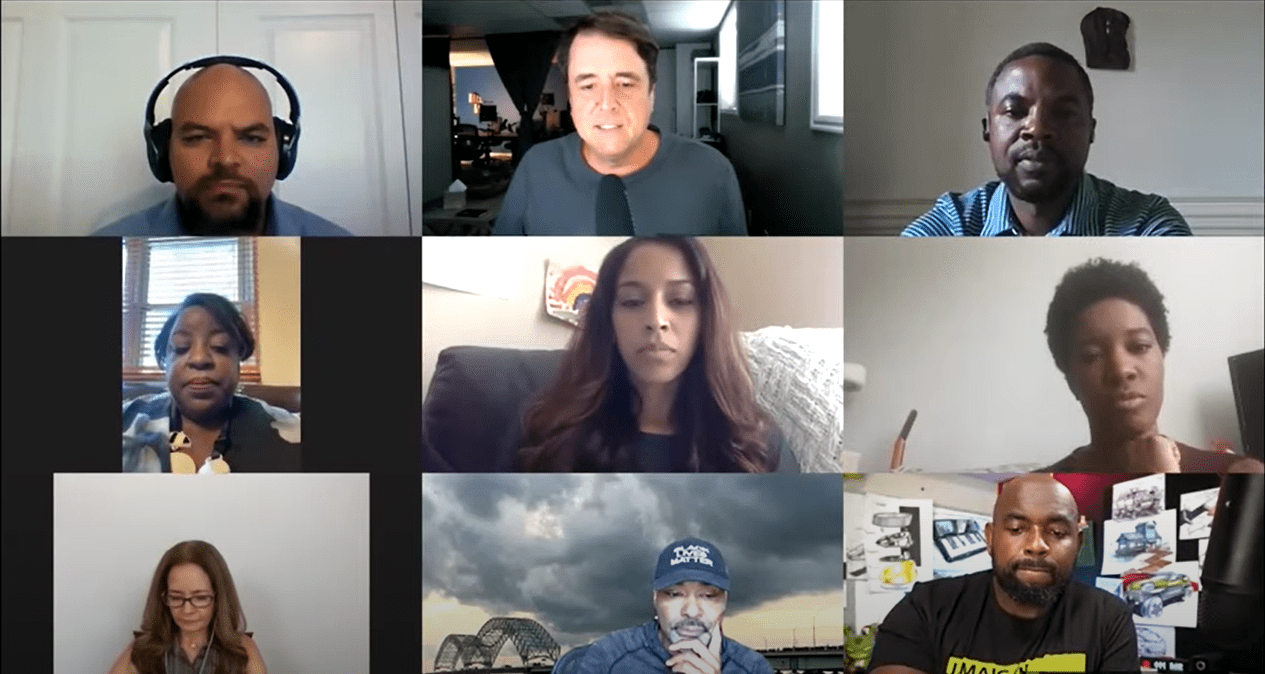
 On 6/2/2020 I sat down with eight super-thoughtful Post-Mormons of color to discuss the unlawful killing of people of color by law enforcement officers and white citizens in the United States of America.
While these killings happen on a monthly basis in the United States, and have been occurring for centuries — three of the 2020 killings that seem to be invoking particularly strong reactions are those of:
- George Floyd (46) – Killed in May in Minneapolis by police officer Derek Chauvin, while fellow officers watched.
- Ahmaud Arbery (25) – Killed in South Georgia by Travis McMichael, while his father watched.
- Breonna Taylor – Killed in March in Louisville by narcotics detectives after they knocked down her apartment door
We are aware the killings of George Floyd and Ahmaud Arbery only because they were recorded by smart phones. As summarized by actor Will Smith, “Racism isn’t getting worse. It’s getting filmed.”
These killings have led to numerous public protests throughout the United States, including this past weekend in Salt Lake City. In some instances, it has been reported that white supremacists have infiltrated some of the protests to stoke violence and disorder.
We also discussed LDS Church president Russell M. Nelson’s recent statement in reaction to the killing of George Floyd, and the corresponding protests surrounding public awareness of Floyd’s death.
Our panelists included the following: Cecile Shellman, Spencer Nugent, Darron Smith, Jason Ball, Kimilyn Poulson, Mark Nugent, Solange Renfroe, and Victoria Denise.
A few resources recommended by panelists include the following:
- A list of Anti-Racism Resources
- Harvard’s Implicit Bias Test (a SUPER powerful exercise to understand our own biases)
Part 1: Introductions of Panelists, Discussion of Racism in America
Episode Transcript
Host: John Dehlin · Guests: Jason Ball, Mark Nugent, Spencer Nugent, Victoria Denise
This transcript is machine-generated and lightly edited for readability. The audio is authoritative. Please excuse occasional errors in names and spelling.
Introduction and Welcome
Part 1 of 2 · Ep. 1319
Mark Nugent [00:00:00] One.
Guest [00:00:20] Come, come you saints. No toil nor labor fear, but with joy when you're away.
John Dehlin [00:00:34] Hello everyone, and welcome to another edition of Mormon Stories Podcast. I'm your host, John Dehlin. We are recording this episode June 2, 2020, and we will be releasing it on June 3, 2020. Today we have a very somber episode. We will be discussing at least two things. One, we will be discussing again on Mormon Stories, unfortunately, the unlawful killing of people of color by law enforcement officers and white citizens in the United States of America. We've unfortunately had to cover this topic several times on Mormon Stories over the past few years. We are also While these killings happen on a monthly basis in the United States and have been occurring literally for centuries, two of the 2020 killings, or three that seem to be invoking particularly strong reactions are those of George Floyd, age 46, killed in May in Minneapolis by police officer Derek Chauvin while fellow officers watched Ahmaud Arbery, 25, killed in South Georgia by Travis McMichael while his father watched and Breonna Taylor, killed in March in Louisville, Kentucky by narcotics detectives after they knocked down her apartment door. We are aware of the killings of George Floyd and Ahmaud Arbery only because they were recorded on smartphones, as summarized recently by actor Will Smith, quote, racism isn't getting worse, it's getting filmed. These killings have led to numerous public protests throughout the United States in the past week, including this past week in Salt Lake City, Utah. In some instances, it has been reported that white supremacists have infiltrated some of these protests to stoke violence and disorder. During this episode, we will also be discussing today LDS Church President Russell M. Nelson's recent statement in reaction to the killing of George Floyd and the corresponding protests surrounding public awareness of Floyd's death. Today we have the following post Mormons of Color here on Mormon Stories podcast to discuss their reactions to all of these events. Our panelists include Cecile Shelman, Spencer Nugent, Darren Smith, Jason Ball, Kimmy Lynn Poulson, Mark Nugent, Solange Renfro, and and Victoria Denise. So what we're gonna do to begin is allow each of our guests today to introduce themselves briefly. Just tell us a bit about yourselves and your connection to Mormonism. And let me just say thank you so much for coming on Mormon Stories podcast at a very sensitive and I would say, important time. So let's begin with Jason Ball. Jason, tell us a bit about yourself.
Guests Share Their Mormon Backgrounds
Jason Ball [00:03:39] Hi. I grew up around the church from a very young age in middle school and ended up joining the church as A teenager, went to EFY and a lot of youth programs, went to byu, served admission two years, got married in the temple, sealed in the temple. Raised my family, for the most part, in the church. Stopped attending a couple years ago. And I'll mention that as it's relevant. The day that my wife and I decided we were not going back, the third hour lesson was a lesson on blacks in the priesthood kind of thing we'd had before. And it was just kind of a final straw in the reaction of the members. In part, I saw that there's really no place for me here anymore. So that's why I'll mention I work professionally as a trainer and management consultant, and a focus of my work is on diversity and inclusion.
John Dehlin [00:04:30] Thanks, Jason. Nice to have you. What year was that that you stopped attending?
Jason Ball [00:04:34] 2017.
John Dehlin [00:04:34] Okay, so just three years ago. All right, welcome, Jason.
Jason Ball [00:04:38] Thank you.
John Dehlin [00:04:40] Mark, you're next.
Mark Nugent [00:04:45] All right. Hi. Hi, John. Hi, everybody. Thanks again for inviting me. Never really pictured myself here, but I think this was a. It's a very important time in the country, I think, around the world. And I think it would probably help for me to. To contribute in some way. So hopefully what I have to say helps. About myself, I was actually born in the church. My parents were the first members of the church in Jamaica. First converts in Jamaica. They converted back in 1974. That was a couple of years before I was born in the church. It was always a great legacy to have pioneers in my family, especially when you're pioneers before the revelation on the priesthood. So they and I had some time in the church before black fur able to have the priesthood. I grew up in Jamaica, went to school in Jamaica. I went on a mission. I went on a foreign mission. Foreign speaking. I went from Jamaica to the south, Atlanta, Georgia. So I had to speak Southern, I guess, and it took a while for me to pick up the language. But I'm just kidding, kind of partially because you had the Southern drawl and you have a thick Jamaican accent. That was kind of hard. After my mission, went back home, came back to the US again, went to school, went to byu, studied civil engineering. I lived in LA after that, Los Angeles, practice as a civil engineer for a couple of years. Went back to byu, got an mba, and I've been in corporate America doing finance and strategy. M and a corporate development. And many different states, including, well, I guess a few different states. I've lived in Utah, Michigan, Indiana. Now I live in Alabama, on the Gulf coast, near the beaches. Within the church, I've had lots of callings as a young man. I was a ward clerk at the well, I was financial clerk at the age of 16. Stories behind that. I've had every calling from gospel doctrine teacher. I've been in Sunday school and towards the end I've been in bishopric a couple of times. And so here I am, I married, married in the temple. Beautiful wife. Today or this year is our 20th anniversary. A couple of teenage boys, which is kind of difficult at this time, and a teenage or a preteen girl, 11 year old girl who's becoming 12. So it's always interesting having kids at this time. And so I guess that's my story, my intro.
John Dehlin [00:07:43] Thanks for joining us, Mark. Great to have you. Victoria, why don't you go next?
Victoria Denise [00:07:52] Unmute myself. There we go. My name is Victoria. I grew up in Oceanside, California. My family converted to Mormonism when I was 12. So that was about 1992. We grew up as an active Mormon family, although my father was a pedophile. That will be relevant later. But I met my husband when I was 22. I think I was studying nursing at the time. And we got married in the San Diego temple. We've got four kids and we raised them to be Mormon. About 10 years ago I started actually looking into some of the questions that I had. And then about five or so years ago I stopped attending. My husband still goes, my children still go, but that's where we are. I'm excited to be a part of this conversation. So thank you for the invite.
John Dehlin [00:08:50] Great to have you. Victoria. Kimi Lin,
Mark Nugent [00:08:56] hi.
Guest 2 [00:08:58] So I was born in Atlanta, Georgia and adopted, raised LDS in a small town here in Utah. And you know, always had always stood out as one tends to when one is black in small town Utah. And so always felt different. And I had a lot of questions, did a lot of research on my own into apologetics about race in the priesthood and black people in the church. Throughout my teenage years I went on a mission to the south also. I was in Mississippi and but I ended up coming home about four months early due to mental health struggles, challenges. And just last year I ended up officially leaving the church. In October I made a Facebook post kind of announcing it because I didn't want to have to tell everybody over and over again. So yeah, I guess that's kind of my journey in a nutshell.
John Dehlin [00:10:21] Great to have you, Kimalin. Thanks for joining us.
Guest 2 [00:10:24] Good to be here.
John Dehlin [00:10:26] So l'. Ange.
Guest 3 [00:10:35] Yes, hello. I am on, I think.
John Dehlin [00:10:39] Yep.
Guest 2 [00:10:40] Okay.
Guest 3 [00:10:41] Hi guys. Well, I am the Brazilian of the group I was born in Sao Paulo, Brazil and my parents baptized in the church when I was five years old. That was in 1970. I am the second oldest of a big family of 10 kids. In 1978, I was 14 years old when we were beyond excited to receive news that President Spencer W. Kimball had received a new revelation from God where now the ban on the blacks and the priesthood was going to be lifted. And so we were going to be able to also go to the temple. So my story is the following. From my father's side side of the family, everybody is pretty much Portuguese. From my mother's side is a little bit more mixed. And I have a great grandmother who was black. And so our family were under the one drop rule that Brigham Young also declared as policy for the church. And in October of that Same year, in 1978, the first Brazilian temple was scheduled to be dedicated. And also younger brother, who is actually next in line to myself, was going to be turning 12 in October of that year as well. And he would not be able to receive the priesthood. So because of all of that, obviously we were very, very happy, feeling super blessed that the ban was lifted in June, just in time for our family to be able to enter the temple and for my brother and then the other ones who were also becoming of age and turning 12 to be able to receive the priesthood. I was a very devoted LDS member throughout all my life. I actually left the church in my life. I mean, as a member. I left the church in my late 20s, not necessarily because of any of the problems with early history and doctrines, because in Brazil actually we did not have access much at all to all that became now so prevalent in the Internet. But after two years of being inactive, I met a very cute guy at work who is nowadays my husband Mark. And through him I actually had access to the work of the Tanners from the Utah Lighthouse ministry. And that is the first time that I came faced the quote. Shall I tell you what the law of God is in regards to the African race? If the white man who belongs to the chosen seed mixes his blood with the seed of Cain, the penalty under the law of God is death on the spot. And this will always be so for me, I could not reconcile that to any aspect of the gospel that I thought was the one that I believed in and that I was actually being taught in the church. And from there I began my search. Nowadays I have been a biblical Christian for 20, more than 20, a little bit more than 20 years. And yes, that's I guess in A nutshell.
John Dehlin [00:15:23] Thanks, Solange. Great to have you.
Guest 3 [00:15:25] Sure, thank you.
John Dehlin [00:15:27] Cecile, welcome.
Guest 4 [00:15:30] Thank you. It's great to be here. Thanks for inviting me. I'm honored to be among such a great group. And I'm actually tearing up because I never would imagine, I never would have imagined 17 years ago when I left the church that not only would there be a group of African descended people talking about race and the church, but also that two members of my own family would be here with me on this show. And I have to say that, wow, I'm just honored and very grateful to be here. I was. I grew up in the church in Jamaica. My parents joined in 1974 when I was just a small child. And my older brother, who is not here on the program, was baptized. I was only four years old at the time, but I say that I grew up at the church. But what that meant was at the time, there were a number of expatriate families who would come together and they would worship together as mostly American and Canadian workers living in Jamaica. And they all, of course, were white. They had been told not to proselytize because they would not be able to either successfully baptize or of course, give the priesthood to any members who joined in Jamaica because we all were black or mixed. There are a few other ethnicities in Jamaica, but for the most part we're all mixed. And so it just wasn't. We didn't have missionaries there. So a couple years or about a year after my parents were baptized, all of those families left. There was some unrest on the island. And so we were left alone. And we would have church faithfully in our living room every Sunday. And I remember this. And as an older sister to Mark and Spencer, who are on this broadcast, I have had experiences that they didn't share, including that day. I remember that Sunday when my father received a call that now all members of the church could have the priesthood. And I remember the elation and joy he felt because he was extremely dedicated. He had joined at a time when he would sit outside, even if there were four elders meeting for a priesthood meeting at the time. They interpreted the practice to mean that he should sit outside and not even be among them when the priesthood matters were being discussed. So here we were in our little family. So we developed a lot of closeness, as you can imagine. And we shared some sweet memories just being the four of us at the time. An older brother, myself and my parents. So then a few years ago, along came Mark, who was on this broadcast here. And later A sister, and then my brother Spencer, also on this video. And then I became a teenager. I was always in leadership positions by then. The church grew and grew because we were able to baptize increasingly more people. And I always had leadership positions. People looked up to me. I went to Brigham Young University. Actually, I went to Rick's First. I was one of very few Mormons there in the 80s at Ricks College. Actually, Tina Turner's sister was there with me. Believe it or not, she was Mormon. We then transferred after only a semester to Brigham Young University. And actually, well, after about a year, I met Solmanji. So it's been about 32, 33 years since I've known Solmanji. We were in an apartment together and we became fast friends. But I had many firsts and many terrible experiences with race at byu. I was very isolated, as you can imagine. It was, you know, incredibly, you know, just. It was a very lonely experience. I had some, you know, there's some wonderful memories that I had, and I made some good friends. But I left the church in the mid 2000s after graduating from BYU, working for the church, being a member of the Mormon Tabernacle Choir, being not only a temple worker, but I attended the temple. I think I must have had some scrupulosity. I attended the temple several times a week for a very long time. And I was considered one of the most faithful people anyone knew. So when I moved back east to attend Harvard for museum studies after having worked for the church museum and the church history department, people predicted that I would leave. And I didn't think I would, but I did. And I did study my way out of the church. And I remember saying at one point, I am not going to study myself into a straitjacket. I have to leave this church. And so I did. And it was very lonely, and I didn't connect with my family much. And so that's why I'm so overcome today. A little emotional. Over the years, I have repaired relationships with all my family members, and I love them dearly, and I'm grateful that. I'm just grateful for everything I've learned from all of them, both those still in the church and those out of the church.
John Dehlin [00:21:27] So glad to have you, Cecile, and great to learn a bit about your story. All right, our final two guests are our repeat guests on Mormon Stories podcast. We'll start with Spencer Nugent. It's so great to have you back, Spencer, along with two of your siblings.
Spencer Nugent [00:21:46] Thank you. Like Cecile said, it's kind of wild Seeing everyone here. But, you know, it's not really my place to say that because she blazed the trail. We've patched up a lot of things over the years. And just by way of introduction, very quick. I was born into the church, so I've known nothing else. Don't identify as being aligned with any religious sect at the moment or philosophy. Left in 2000, 15, 16amidst a tumultuous, somewhat tumultuous divorce and transformative period of my life. And I have two boys, I'm a single father full time. And this week's just been. Just been very heavy for me as far as the catalyst for leaving. I would surmise it as just a combination of study. I actually blame you, John. And life experience as well. So, yeah, just excited to be here and contribute to the conversation.
John Dehlin [00:22:51] Great to have you, Spencer. And of course, last but not least, Dr. Darren Smith, one of the most frequented visitors on Mormon Stories podcast to date and one of my very first guests. Darren, welcome back.
Guest 5 [00:23:04] Hey, how's it going? Hey. I was just, I just wanted to sit back and just catch the vibe. I was just feeling all y' all listening to you, share your stories about your journeys out of the church where you are kind of in your. What brought. Led you to here. It's really powerful, this stuff. Me, likewise. I joined the church in the 80s, late 80s, and just kind of hung with it, you know, that was one of the, I guess one of the first, I guess during that time period, from the 70s, 1970 to the 85, within that 10 year span to come in after that period of time when the church had finally sought wisdom to give black people what they should have had long before then. But nevertheless, I hung in there because I believed it was true and all the other stories and stuff like that. So I, you know, but like Cecilia, you said, you sort of, you educated your way out. Yeah, I mean, I was feeling you on that. I was like, damn, yeah, I feel the same way. My first great awakening was an aerobics class I was teaching in Salt Lake City. And one of the professors that later became my good friend and mentor, dear mentor, came up to me and said, how come you never talked to me? These black guys, how come you never talked to me? And it never dawned on me that there was something about the way he said that to me at the time and how deeply engrossed I was in the church and probably had much more conservative thoughts in my mind and my political persuasions and I was aware of. So the scales had to fall off. I had to learn how to be black when I moved to Utah, which was interesting because it was thrown in my face.
John Dehlin [00:24:55] Are you saying that was internalized racism? Maybe, Darren?
Guest 5 [00:24:59] Absolutely. No question about me. It's very hard to not live in a racist society and not have scars and wounds. And we all manifest it differently, right? We all show our pain differently in different ways. But as we try to make sense of this day, the last eight days, which have been absolutely horrendous, I think we should keep that in mind, that, you know, and celebrate our humanity and, you know, in our listening to the newsians talk about your story. And may I ask a question of Kimi Lynn real quick? I'm just so asked, Kimi Lynn, you was like. I was like, did I interview your pet, your family? I did a study on transracial adoption and I interviewed a lot of folks down in the smart in these little small towns in Utah. And so one of my. And that was over 10, over 15 years ago. And I was thinking to myself, I'm like, whatever became of those kids who grew up in those communities? And so hearing you tell me, or hearing you tell us as a group, some of the things that you were going through, you know, I was just. I was. I mean, I don't know if this is appropriate to ask you, but maybe we can pick it up after. After, after the show. You know, I heard a lot of trauma there, you know, traumatic experiences. And I was wondering if you experienced any of that just being in that area, just being cause some of those. And this is the reason why I'm saying this because not only the church and its ideas about blacks, but the conservativism, which is an expression of that. Right. So oftentimes the conservativism and the religion conflate. You don't know which one is which. The lines are blurred. So I just was wondering, do you. I mean, could you say something? I'd just be so curious about that. I'm doing a study on this, actually. That's why I'm curious about it.
Guest 2 [00:26:51] No. Yeah, it's definitely been very interesting as I've just grown up trying to figure out who I am separate from not only the church, but also my family and what my own beliefs and, you know, I guess political persuasions are. And it's definitely been a process. I am very glad that I grew up in an age with the Internet, because that has been an absolute lifesaver being able to see that I'm not the only one experiencing the things I experience. And being able to get more information about things I had questions about.
Guest 3 [00:27:37] So, yeah, I don't know.
Guest 5 [00:27:40] I want to ask you more questions later. But anyway, I've been around, Dr. Smith,
Spencer Nugent [00:27:43] just piggybacking on something you said earlier when you said when you moved to Utah you had to learn how to be black. I mean, 100%, I was like throwing my hands up in there. Hallelujah, 100%, because, and I was gonna get to this later in the podcast, but Mormonism itself and Christianity, you could argue in a lot of ways is imperialistic. Like, they come into a country, present you this, this idealized white God send, say you're less than, and present that as the ideal. And of course, it messes with your head. You doubt yourself, you think you're less than. You're constantly in this pursuit of this whiteness. And there's almost a certain deference that's bred into you and you don't realize it until you're with your people. You know, you talked about your friend, how you weren't, you know, you didn't know how to talk to him or you weren't talking to him. I 100% relate to you on that one.
John Dehlin [00:28:36] Beautiful. Thank you. Okay, so thanks to everyone for their introductions. And again, Darren, it's great to have you as well. Now, let's have each of you as part two. Now we've done introductions. Part two is going to be each of you to spend, let's just say, two minutes just sharing how you think and feel about the events of the past week. Generally. We're not going to talk about Russell M. Nelson's statement yet. We'll save that for the next part. But I just want to hear how each of you are feeling about living in the United States right now and, or, you know, as being Mormons or post Mormons. Just general reactions. And let's start with Cecile.
Reactions to the Events of the Past Week
Guest 4 [00:29:27] Yes, as I'm sure you all can commiserate, the events of this week have been harrowing, certainly, and I am feeling them deeply on many levels and for many reasons. I actually professionally am a diversity and inclusion trainer and professional, working with primarily museums, working in the museum field since the mid-90s. And I'm working with a lot of white organizations who have not done the work they need and who don't understand how to relate to black audiences in their very communities. And in many respects, some of these arts organizations remind me of living and being in the church. A lot of, you know, we're trying to do anti oppression work with people who think about racism just as a personal, personal experience rather than the totality of white supremacy and of, you know, of racism that's institutionalized and systemic. So I'm just feeling the weight of the world on my shoulders. I've been helping organizations write statements. I didn't sleep through the night. I had a four hour conversation with someone who insisted on saying that, you know, this person wanted to continue to use words that I kept explaining were harmful. And so there's so much pain and there's so much anger and I'm angry at people who aren't angry. I'm very grateful that I have a caring and loving husband. His name is also Spencer and he's an ex Mormon as well. He left the church in 2001, two years before I did and two years before we met. He was a PhD student at the U of U. And interestingly, we were both at BYU at the same time many, many years before. Neither of us had ever married before we met each other on match.com but he has been an incredible support. He's a white American. He actually served a mission in Brazil, but together. And we have no children, but we have been able to support each other through this. And yeah, I'm just feeling, I'm feeling heavy. My heart and my soul and my bones are very heavy.
John Dehlin [00:32:11] Thanks, Cecile. Darren, why don't you go next?
Guest 5 [00:32:20] Sorry, I'm, you know, I'm not angry anymore. I've lost the anger over this. I think the reason why I say that is not to disrespect the lives that have been lost over the, you know, over centuries because of this. Not just the recent deaths that we've had with George, Floyd and the others that have died in the recent weeks as well. So I mean, because if I let that, if I, if I get, let white folk get, if I let that get, get in to me, then I'm not gonna live very long. Right? I'm already, you know, black people already live shorter lives than white people anyway, you know, simply because we have to deal with more racism, more stress than white folks have to deal with. And so I just don't want to, I don't want to accept that, accept that system, let that system define my
Victoria Denise [00:33:12] own
Guest 5 [00:33:14] personal uplift and my own personal self love and self worth. Because it doesn't matter if we say, if black people say, you know, how high, it's low, no matter if we say it's fat, it's skinny, no matter if we say up, they say down. It don't matter. We don't matter what we do as people of color, to try to find some inclusion, to try to find some justice in this place, it always ends up falling on deaf ears or our needs aren't met. They never have been met anyway. But if you look at the history of the United States, that was the intention to begin with. It was never the intention to give ordinary citizens any real power. The only power that we really have in this nation state is largely due to the fact of African Americans and the push for justice and the push for equality. I mean, so, you know, so this dual system is playing out. But what I will say though, that the heaviness in my heart has been replaced by acceptance. I have found that to be somewhat freeing, accepting what is. Accepting that racism is a reality that I live with as a man of color and that I'm going to deal with it for the rest of my life. And that's held up pretty true. You know, you, from the sounds of everyone that I've heard today, along with myself, we're all professional black folk, we all educated black people. So we deal with a different type of racism, you know, than what the ordinary person on the street that doesn't have these credentials to protect them to some extent deal with.
Mark Nugent [00:34:49] Right.
Guest 5 [00:34:50] I think what you're seeing on the street, this is not to say that this wouldn't happen to any of us because no one would know these things because looking at us at face value, you don't walk around with a certificate on your head that says you graduated from this school or that school. People see you as black and they treat you appropriately. But the issue is that the worlds that we walk around in are different. Right. We're somewhat. All middle class. We went to a middle class institution, we all joined a church that is extremely corporate and as a result we got an extremely good corporate education out of it. Right. One that's somewhat protective. Somewhat protective, right. So in saying that I'm past all that, for me it's about healing. People say, well, how do we. We can't even heal yet. We haven't fully understand the problem. We understand the problem. It's called racism and it's been around forever and it's never ending. And every institution has a role to play, including the church. So I'm past angry, I'm just past that. I mean, I just can't. I was that way maybe 10 years ago, maybe 20 years ago, I was that way. But I think I've. Maybe it's just a function of getting older and getting Covid Gray. Maybe it's that, but I just feel like, you know, I guess the other question I'll say, and that's the last thing I'll shut up after this, is this. How would white people know any different? How would they know any different?
Mark Nugent [00:36:14] You feel me?
Guest 5 [00:36:15] Who would have taught white people this? Who would have taught white people about racism? They don't know any more than black people or other people of color know about racism. They really don't. You know what I'm saying? So because the system says one last thing. The powers that be have suppressed real transformative educations in this system, in this country. We, where we really have true, equal American history represented equally in these schools. We don't have none of that. So I'm just saying, where would people have learned this from? We learn it through live the lived experience. But even how we interpret our experience is going to be very different. Based upon your class standing, your gender, your religious affiliation. There's a lot of things that influence that. Right? So I'm saying that in looking at the average demographic and so on and so forth, we run in different worlds. It's not to say that others don't. But all I'm saying is that I'm not letting white folks off the hook because I still think they're racist as hell. And I say that they. And I say they're racist as hell in the sense that they benefit from white supremacy. Whether they like it or not, they benefit from it. And I need them to say that. Right? And so when I look at them and see all these people out there marching and stuff, I'm seeing. This is the first time I've ever seen this kind of multiracial coalition fighting for. At least. At least, it depends on what shift, if you're on the day shift or the night shift. The night shifts. Different. The night shift should be moving in here real soon if they're not already in right now. Right. There's a difference there. All I'm saying is that what I'm seeing today, and I'm sorry that George Floyd had to lose his life and others have lost their lives in the cause of social justice, but maybe something might. This looks like something different than I've ever seen before. And, you know, and I just, you know, I'm not going to be. I'm not going to be. I'm not going to take on that anger. I'm not going to do it.
Race, White Voices, and Allyship
Spencer Nugent [00:38:20] I feel you, brother. I just wanted to share something that was shared with me by another black friend of mine. He said, I hope I don't regret saying this, but I've been highly impressed by how white folk have stepped up during all this. Racism was birthed by their doing, and they hold the keys to undo it. Our actions are merely reactionary to that systematic programming they put in place. And as you were sharing about this concept of education, and how would they know any different? I feel like this moment has been this education by force, Right? It's not that it wasn't happening, like John said in the introduction, it's we are seeing it now. And even I myself, as a black person coming from another country, I was insensitive at times to the struggle, because growing up, for me, everybody else was black, and it was different. You know, you had discrimination based on the shade of your skin to an extent. There were white people in Jamaica. They speak just like Jamaicans, and you wouldn't think any different. I mean, it's a place of love for the most part. But I came here and I was just sideswiped by this force of racism in subtle and sometimes overt ways. And for me, it was a swift education. But I think, like you, I've been impressed at the multiracial just movement to say, no, enough is enough.
Victoria Denise [00:39:41] I like that, too.
Guest 5 [00:39:43] Spencer. I was gonna say, just to follow up to your question, I'm still hoping that this is actually a movement and not a moment, you know, and given the. Given the duration of this thing, what, eight days now it is. And some of the crowds are getting bigger and bigger and bigger each time. So not to mention, the COVID is spreading all over the place. So, you know, time will. And time will tell. Sorry, I didn't mean to cut anybody off.
John Dehlin [00:40:06] Victoria.
Victoria Denise [00:40:07] Oh, I was just thinking. I thought, well, I grew up in a pretty much all white area, and I never even considered myself being the only black person in a room until somebody started complaining about being the only white person in a room because we were at a funeral of one of my family members. I just feel like. I mean, at the time, I felt like we're all just people and we love each other and we're just one unified people. And I never had a hard time fitting in with most of my peers. The only thing that I would get is I get most of the black people around me saying that I think I'm white because I'm articulate or I'm trying to take their man or something ridiculous, right? In a room with my family. And we're all black, and it's just we're all we all love each other. And then I hear somebody make a comment is like, wow, I'm the only white person in the room. This is uncomfortable. It kind of clicked for me. Like, is that something that should be uncomfortable? I don't. It just didn't make sense to me because I just wasn't raised that way. But I feel like, to what Dr. Jaron was saying, what Spencer was saying is that we need to have that conversation that tells other people how. How the abuse felt, how it feels, because I feel like nobody's. I mean, and that's the. That's the whole point of protesting, is to get somebody to listen. And we want to hear. We want to be heard. And I feel like we're stuck in this. I don't know, I guess this gridlocked, perpetual problem with. And every time there's some kind of a racial injustice or a hate crime, it restarts that cycle of pain. And it. I think today it's uncomfortable to be anything, to be normal, whatever that is, and to be. Or to be gay or to be black or to be white, Just anything. I feel like everyone's walking around kind of uncomfortable and with a chip on their shoulder. I think as black Americans, it's good to speak up because we've been dehumanized and embarrassed and treated poorly since, what, the early 1600s. But we're not allowed to talk about it because it's uncomfortable for the abusers to hear, and especially if it's unintentional racism or abuse, and it's uncomfortable for us to talk about, and it puts us in this place of shame. And I think that that just needs to stop being the cycle that's accepted by people. It's just gonna perpetuate the cycle over and over and over. And I'm not. I'm not shocked when a black man gets killed by a police officer or when a black woman gets killed by a police officer. And it's kind of pathetic. I feel like that should be shocking. That should be horrifying, but it's not. It's devastating. It makes me feel angry. It makes me feel sad. But I'm not surprised anymore. You know, I feel like, especially in the church, I've experienced a lot of, I guess, manifestations of bigotry, and I feel like that keeps that cycle going of. There's a trauma bond that we can't let go of. They can't let go of. We experience ptsd. We walk around with dysphoria that we are not sure how to cope with because we're not really taught how to cope with these things until we're at the rock bottom. And like I said earlier, that's what I see these protesters doing. I see them imploring America to see that we're opening up a door and we want to be heard. We want them to just let us have that conversation that is going to be healing. If we can have the conversation the right way, if we can talk about our opinions and they can actually listen to them. And I feel like that's really where we are right now, is there's people who are desperate to be heard.
John Dehlin [00:44:25] Thanks, Victoria. Jason. Yeah, Jason.
Jason Ball [00:44:29] Three points. Because something that Victoria just said is relevant. I remember sitting in the Riviera apartments in Provo, 1993, watching the LA riots, and my dad's family live in la. I was born in la, my sisters live in la. And I am seeing some of these same overhead shots of LA from helicopters and seeing all that. I was shocked at the physical reaction I was having. It was like it was taking me back. I could remember sitting there watching it back then because of the emotion involved. And so, you know, to the point of what she just said, too, it's like, we're not. I mean, numb. Numb is the word, in a way. I'm so glad that it's all getting filmed. If you remember, Rodney King started 93 riots because of Rodney King, because some guy had a video camera on his balcony two blocks away, and the cops weren't used to that. That started with a camera, too. It changed some things. Not enough. One of the struggles. Second point is one of the struggles we're facing with the pandemic is when is it going to be over? When's going to sight. My work requires travel and being there in person. So even as much as everybody's transitioning, they're talking sometime next year before I can quote, unquote, go back to work. How do I feel is I'm grateful that this is an election year, because at least we have an opportunity in November that all these other white and gay and all these other folks are coming out to these protests can also do something in a few months. I think we can continue this kind of energy for a few months. If this was last year, trying to get it for a year and a half, I think it'd be lost. So at least there's that horizon in sight that we can see that could affect some change. And people like George Will are making his commentary like he did, saying clear house of all of them. It's not Just us. One other thing that's kind of related to the conservatism of the church is. Let's talk about the Boston Tea Party for a second of how that was destruction of private property. That was rioting. And it was called rioting when it happened, was called destruction. It wasn't until a generation later that we gave it this pretty name. And I know Mormons love to talk about the founding of this country. And we've got the photo. Actually, not photo, but the artistic drawing of the Founding Fathers in the temple over their shoulder, which included John Hancock, if I understand it right, was at the Boston Tea Party. And I was always taught this, and I found pictures of it, that they were depicted as Native Americans. They dressed up like people of color. To instigate others. Yeah, to instigate the. Instigate the destruction. And we look at what's going on now, where we've got videotape and we have examples of. There are white people instigating the violence at these protests, and people act incredulous that it's happening. That's how this country was founded. Some things haven't changed. Someone said, don't call this a riot. To earlier point that language matters. Call it an uprising. And then I heard somebody use the term fed uprising because we're fed up. And that, I think, encapsulates how I'm feeling right now. I'm just fed up. And I live outside of Chicago, and I'm part of the theater community here, and I'm encouraged and strengthened by the comments from my white and LGBTQ and other friends who aren't black, the incredible support and outpouring. And I'm finding I'm having to snooze a lot of my Mormon friends for 30 days because, again, unintentionally, they're saying things that I have gotten into it with a few of them in a respectful way, but you don't even realize the institutional racism you're reflecting. And it's common. So we'll talk about. When we talk about somebody else's statement from yesterday.
Protests, Police Brutality, and George Floyd
John Dehlin [00:48:02] Kimmy Lin.
Guest 2 [00:48:07] Yeah. So it's been very emotional, I'll say, for sure.
Guest [00:48:15] I.
Guest 2 [00:48:18] It's. I don't know. So I. Most of the people that I know, like, on my friends list on, like, Facebook and whatever, are white because of, you know, the environment I grew up in and everything like that. And so I feel like I've been lucky to. Have people that are supportive of me and are listening to things I say. And it's really. Honestly, it's been kind of uplifting in a way, just to see how many people that like I grew up with or family members, friends that, you know. I think that if it weren't for knowing me and my sister, who is also black and adopted, that they wouldn't have any interaction with any black person ever. And that by knowing me, they have the opportunity to look at things in a different way than they would have otherwise. I've been very glad that I've had that opportunity to kind of be a voice where maybe there wouldn't have been one necessarily. But it's definitely exhausting because I feel like I'm the only voice that they're hearing. And so there's definitely been a lot of like tears, a lot of arguments. Well, and a lot of just. Oh yeah, anger, all of the, all of the things. And so, yeah, I'm. I feel like the best way to describe this last eight days has been just drained. I've. I've been drained.
John Dehlin [00:50:18] Thank you, Camille. Mark.
Mark Nugent [00:50:25] Yeah. So I think it's been really hard if you think about what the country has been going through. I think it's been hard for a couple of reasons. I think we all live today in an illusion, right? We have kind of a curtain over eyes. We don't really see what's happening in the background. I'm going to take a step back and think about when I was a kid. First time that I got to really experience over racism was ironically a Disney World, right? I was six years old, 1982, went on a vacation from Jamaica to the U.S. i'm at Disney World and I remember this vividly because this was the craziest thing I've ever experienced in my six years of life. But there was this racetrack at Disney World. You go into some cars and you're driving the cars around the track, if you remember something like that. And it's got these bumpers so you don't run off the track and kill somebody. But I remember coming in at the end of that racetrack and again, these are stories I don't normally tell, but I remember coming in a six year old. I heard some looked like men to me. They could have been teenagers, young men up on the bridge up above, if you look up when you're coming in. And as I looked up, I felt like a splash, a warm splash on my face. And within like a couple of seconds I realized what had happened. But somebody had spit on me from the bridge. So it spit kind of on my face. If you remember. You can imagine that. And the Guy's up there laughing at me. And I was devastated as a six year old and that was so hard for me. I tried to explain to my mother what had happened and well, that was just a one time thing, right? Things are getting better. You don't necessarily see it. I said that I was on a mission in Atlanta a couple times actually. Once somebody else spat on me from a bus on a bicycle so I couldn't catch him. Spat on me. At that time they said they don't like black people or go back to Africa. I'm thinking, okay, this is, this is America. But over the years, right, you kind of feel things are getting better. You kind of see it on, on TV and then you see, obviously you hear about Rodney King and you hear about these other things, but they're in the background, they're on TV and we're getting better. Everybody kind of protested about it. It's gotten better. And you hear about someone, an unarmed person, black man, getting shot. It was a big shock. Everybody got up in arms, they talk about it, but no, things are getting better. Then you hear about Tamir Rice, who was a 12 year old kid with a toy gun playing with it. Cop car pulls up, shoots him within two seconds and kills him. That was kind of shocking to me. So I'm thinking, are things getting better or not? What's going on? At the same time each of these events happen, people are so quick to kind of push it behind them. They don't want to care about it or talk about it. By people, I mean, whether it's non black people, right? People who are not impacted by it, they don't want to see it, they don't want to look at the mirror. So they continue to put this illusion in front of them. I remember as a father, my son at the time was probably turning 12 and all his little friends, they have airsoft guns and they'd play with them at that time, they run around and shoot at each other and have a fun time. And I remember for birthday present I got him on airsoft gun. Then when Tamir Rise happened, talked to him and said, hey, your, your white friends can run around, they can play with airsoft guns. But this is what happened. Got to be very careful about who you see or who sees you playing with a toy gun outside. And he put that toy gun down and he never picked it up again. And if you think about it, all his friends could play with an airsoft gun, but he could never play with it in his mind. I was so upset, not just Because I paid a bunch for that airsoft gun, but because he doesn't have the same chance to play as his friends could. Then another event happens and another one happens, and eventually somebody said it kind of become desensitized to it. That illusion became thicker. You don't need to think about it. Protest for a second becomes thicker. And as a black man, if I talk about something that happened, people will say, oh, you're overreacting. You're being overly sensitive. And I just hate talking about it. I hate posting about it. There are so many things that have happened that people don't. Just a few months ago, in my own neighborhood, I came out of my front door, opened my front door, going over to my neighbor's house for a beverage. And my neighbor lives literally across the street. You can look across the street and see them right there. I opened the door. Through the corner of my eye, I saw a cop car at the corner of the street. I'm in a pretty nice neighborhood. It's no big deal. Walk across the street. The car drives past me. I walk up to my neighbor's door, look down the other side of the street. The cop car stops. I ring my doorbell. And within, like, 20 seconds behind me, the cop car pulls up. And I'm thinking, this is strange. Maybe he's talking to my neighbor, too. While I'm waiting for my neighbor to come out, the cop comes out and asks me what I'm doing here, if I live in that neighborhood. And I'm thinking, does everybody get stopped as soon as the cop sees them? All I want is a world that I can live in where I have the exact same right to be there as anybody else. I mean, if they stop everybody, I'm okay with it, but I didn't feel like I have that right. So that illusion was a little bit fuzzy for me, but it's still there. Until eight days ago when I forced myself to watch a video with a cop kneeling on somebody's neck, pleading for his life. And I could see the life leave his eyes. You could see him die and the cop kneeling on him long after he was dead. And again, I don't like to talk about this stuff, but the only reason I feel compelled to do so is because there is something. There is a system. There is something that would not just allow a policeman to kill somebody, but to do it in broad daylight. And it's not. I don't want to say it's not a big deal, but that's not the point. It's in broad daylight. With a camera running. And that's not the point either. In broad daylight with the camera running. And he thought it was okay. He thought that he would be fine afterward. And policemen stopping people from helping, Nobody could help. And they all thought it was fine. They thought that there was nothing that would happen to them. And that's because there's a system that exists, whether or not we believe it. You can say I'm overreacting, but there is a system that exists that could deprive me of my life and could deprive my children of their lives. My sons, my daughters. My sons are cute little boys. Everybody loved them. Like, oh, they're so cute. Look at them. They're so cute. They're teenagers now, so now they have a sharper jawline, they've got more muscles, a little bit taller, and have a deeper voice. So they go from somebody who was safe to someone who could lose their life in the wrong encounter. And I can't avoid an encounter with a policeman by staying in my neighborhood, by dressing as nicely as I can, by getting as much education as I can. That illusion kind of went away for a lot of people. They could not ignore it anymore. So that's why you see all the protests, and that's why I kind of feel frustrated. That's why I feel upset. But the silver lining is, as somebody mentioned, there are so many more people who. They're moving from that middle ground where they have to be quiet. They're not overtly trying to kill black people. And before, they probably overtly, weren't posting on social media and saying, and defending my right to live. They were just quiet. They didn't want to speak out. Those people are now saying things, at least on social media. They're all going out and doing something. I think that's the silver lining. We just have to be careful to keep this alive and not destroy it. But that's kind of how I feel.
John Dehlin [00:59:31] Beautiful. Thank you, Mark Solange.
Guest 3 [00:59:38] Listening to the words of Mark, it's. I really have no words, guys. Watching this video that I also made myself watch of George Floyd being slowly killed as the oxygen to his brain became cut off with that officer kneeling on his neck. And then in other later videos, we saw the other officers that are also kneeling on him. It is devastating. It's heartbreaking. There is really no words that we can describe that kind of act. That as a follower of Christ, I see that as the extreme of what is called moral failure. For us to talk about moral failure and moral law, we also have to Talk about a moral law giver. I think there is something very, very wrong with the world that we live in today. I do not understand this type of hatred towards someone that in many cases you do not even know personally, but you just have a hatred towards them because of the color of their skin. It's incomprehensible to me and I will not pretend to say that I can, that I understand or that I know how you guys who have had personal experiences of discrimination like this feel or anything like that, because I have not. In Brazil I would say that there is. And then again in Brazil I'm considered kind of a lighter colored person and I would say that perhaps I have suffered discrimination more towards the social status, which is something that I would say my opinion in my perception or my experience that tends to be more prevalent over there because, well, I don't know if you guys know, but Brazil is a country, a country of 212 million people. And just last year when I was preparing a video for my YouTube channel talking about race and priesthood gospel topics essay, I was doing a little bit of research and According to the LDS Church, they have 1.3 million members in Brazil. I don't know if they count as I think some people say that they count, even the inactive people. If you have not, I guess send in your resignation letter, you are still counted on the rose, be as it may, but Brazil right now, last year, the percentage of mixed race people have for the first time become more than 50%. So for Brazil it is very common to have that type of interaction. And I don't know, I don't see it as a problem as it happens here in the United States. But anyhow, for me it is, yes, it's something that obviously it's just horrible. There is no other way to put it.
John Dehlin [01:04:13] Thanks so much. Let me ask all of you and just jump in when you feel ready. I want to have you follow on Mark's comments. I apologize for not asking you to prepare for this, but I'm interested to know for any or all of you, any quick examples you would like to share about ways that you have felt unsafe, ways that you feel unsafe, ways that you have experienced overt racism, even microaggressions and passive racism just to give people a sense or a sample for the sorts of things that each of you carry each day, much like Mark shared. And I don't, you know, I don't want any of you to feel like you have to share, but if any of you feel inclined to share, I would Just like to hear others of you express experiences or feelings or fears that you have had.
Being a Parent During Racial Unrest
Spencer Nugent [01:05:15] I'll go just to. Just to piggyback off what everyone's sharing and their feelings this week. It's been very heavy, and I feel as though being a father has added this whole new dimension. And I will answer your question, but it's added another dimension of just reality to this. I feel as though oft times, you know, Darren mentioned it, a lot of us here might be in a different class of blacks than a lot of other black Americans. And I admittedly, at times have been distant from the struggle. And if, were it not for a few friends who have called me out, I would not be aware and in tune, particularly as an immigrant who lived a different life and experience. But the reality is, you come here and it doesn't matter because they don't care. They don't care if you have a degree. They don't care where you've been. They don't care what you've done. You're just black. And in Utah, it's interesting because we have this majority Christian population. You make a lot of. At least I made a lot of assumptions. I made a decision to avoid seeing you in this discussion because we all have different experiences. But I've noticed that I have a. Or I had a hope. I had a hope that I would be treated with a certain amount of respect. And in my experiences, I was consistently disappointed, right? Consistently disappointed in the way I've been treated. And to someone who doesn't feel these slights and these little quote unquote little things, they think that you're just making stuff up or a big deal out of things, or you're just in the victim mentality. But when was the last time you went to a gym and had to run out? You come back in and they're like,
Guest 4 [01:07:25] hey, whoa, whoa, whoa.
Spencer Nugent [01:07:26] I need to see your. I need to see your past. And you see your idea. I'm like, why? I've got my headphones on. I've got my clothes on. I'm ready to go. I was literally just here. I'm here every day. And the words that came out of this man's mouth shocked me so much, I didn't even know how to respond to it. And again, to someone who doesn't experience racism, it might seem like a small thing. Oh, you're making a big deal out of this. You don't look like everyone else here.
Jason Ball [01:07:52] Okay.
Spencer Nugent [01:07:54] I didn't know what to do. I couldn't even respond to the Man, I mean, I couldn't. And I, I wish I had the words at the time to say something, but I couldn't. And this relates to another experience I've shared on the podcast before. But they try to patch things up by offering, oh, here's a free membership, or here's this. I've always said, no, you know, that's not solving the problem. It's not. I don't want, I don't want your handouts. I don't want any of that. The other experience, and this is what just completely destroyed me about George Floyd, you know, I feel as though, I feel as though the last few experiences that have happened, and I say experiences using that word generously, but the murders that have occurred, I felt numb to them and distant because I'm here in Utah and quote, unquote, safe. I'm keeping the law, living my life. And George Floyd, as far as I know, I wasn't there, but as far as I know, was making a purchase, he presented currency of one form or another that was perceived to be fraudulent, and he lost his life for it. And I can't tell you how many times, John, I've been to a grocery store and I've been in line behind white people who give their credit card, they give cash, and it's never scrutinized. And every time I go up, I get the UV light treatment, I get the, can I see your signature? Can I see your id?
Guest 4 [01:09:25] I'm like, what's going on here?
Spencer Nugent [01:09:26] But I don't tell people. I don't tell people because I,
Guest 4 [01:09:32] I've
Spencer Nugent [01:09:32] been accustomed to the response. You're making this up. It's not a big deal. But literally, George Floyd, I could have been him. That's what rocked me. I could have been him. I could have been dragged out of a store and strangled on the street, and that would be it for my boys. I'm a full time single father, okay? That's what wrecked me. That's what wrecked me this week. And, and those are just two experiences of very, very many. So, yeah,
Guest 4 [01:10:11] I mean, Go ahead, Mark.
Mark Nugent [01:10:14] Well, you, you go ahead, Victoria.
Victoria Denise [01:10:20] I was just going to say it to what Spencer was just saying.
Guest 2 [01:10:23] We do.
Victoria Denise [01:10:24] We're so conditioned, and I'm sure Kim and Lynn has experienced this, too, that we're conditioned to kind of go along with what our friends are saying or what our white friends are saying or what our peers are saying and kind of laugh it off and dismiss it. Because if we don't, and we say, don't talk to me that way, or however you want to respond, then we're being. We're contributing to the problem. We're the ones who are being racist because we're calling.
Spencer Nugent [01:10:52] Sensitive.
Victoria Denise [01:10:52] Yeah, we're being overly sensitive.
Jason Ball [01:10:56] Contention is of the devil. So now you're being contentious because you brought it up.
Victoria Denise [01:10:59] Exactly. And I've been told that. I've been told that by authority, or somebody who I held as authority at the time, a bishop, telling me, well, you're adding to the problem, because they didn't mean it that way. And I remember the very first time I gave a talk, I was so terrified. I'm super awkward anyway. And I'm standing in front of all these people sharing my heart, and the first thing that someone says to me when I get down is, wow, you're really well spoken for an ethnic girl. It was like, what'd you think about what I said? You know, and that's. That's the feedback that I got. And then just the little irritating jokes that people say, you know, I had. I had a guy in college come up and ask me out, and his. He told me that his. One of his goals was. Has always been to date a colored girl. And what. You know, it was so inappropriate. And. Let me share an experience with you guys I had. Yesterday, I went to my doctor's office. I live in Temecula, California, and there are some protests that were planned for yesterday. And so I walk into my doctor's office, and there's only about five people there. And everyone just stops and stares at me like deer in headlights. I have my mask on. I didn't blow dry my hair, so my hair is curly, and it's up, you know, and they're just staring at me and for a super awkward, like, solid five seconds. And so, you know, I said, I have an appointment today, sort of should sign in or something. And so she said, oh, I'm sorry. You scared us. We. We thought you were maybe a protester, because there's supposed to be protesters coming. And it's those types of things, you know, Like, I. It was. I don't know, it's just shocking, and I'm not sure how to respond to it. And I'm very conditioned to respond with it and internalize it in a way that's not healthy. And I know it's not me. I know I'm not the problem, but I'm the one who's suffering from it. I'm the one who gets an autoimmune disease from suppressing all of these really Hurtful feelings that I just can't get any validation for.
Guest 5 [01:13:27] Let me interject. That's why you don't suppress it, right? That's why you accept it. That's why you accept it. You know, I mean, that's why you have to in order for your own health. Your own health.
Jason Ball [01:13:38] These people.
Guest 5 [01:13:38] Listen, like I said before. I've said this before. I've said this before on John many a day on John's podcast. I believe fundamentally that all white people are racist. I really do believe they're racist. Not in the way that you think. You're thinking about racism. If you've been conditioned to think that racism is about individual acts of meanness only, then you're sadly mistaken, because I'm not talking about that type of racism. I'm talking about privilege, institutional privilege and benefits, the goodies that whites have been given through unjust and unearned means. That's what I'm talking about.
Spencer Nugent [01:14:11] And just to add to that, I feel like you say, oh, you're racist. And they think, well, I'm not.
Guest 5 [01:14:16] You know, they do.
Spencer Nugent [01:14:17] I'm not in the kkk.
Guest 5 [01:14:18] That's the point, Spencer. That's precisely the point. Because I want them to feel the weight of it. If Dr. King did nothing more than to spark a conversation, right? One or two make white people very particularly educated. Whites or whites who think they know, you know, they think they got a little hoardy torty, you tell them they racist. They got to think about that for a minute, right? And so, and I say that not to, you know, use word games. I believe that if you look at how racism is, formula is established, has been established, and the number one way it gets taken up in the dominant discourse is through individual acts of meanness, because that's how we interpret it. So if I'm not doing anything mean to you because of your race, then I'm not a racist. That's how people get off the hook. But yet racism still exists, which you said earlier, Mark. It still exists. It still goes on.
Spencer Nugent [01:15:11] And to bring it back to Christianity a bit, I mean, if Christ is this, you know, master teacher hyperbole was one of his most excellent mechanisms of exposing the underlying rot in a situation, Right? And even if you call somebody racist and they're white, I think it's a mechanism, a means of conjuring conscious thought, having them consider their place.
Jason Ball [01:15:34] Whoa.
Spencer Nugent [01:15:34] I've had so many people contact me, apologize, and say, hey, I didn't realize. I did not realize your struggles. You know, I've Shared videos, I've shared stories. I have an online platform. And I've frankly taken a risk because I've made a lot of people uncomfortable this week. But I'm also impressed at how many people have reached out and said, hey, we're gonna do better.
Guest 5 [01:15:58] May I say one more thing?
Spencer Nugent [01:15:59] Yeah.
Guest 5 [01:16:00] And then, Cecile, I've been hearing from people I had heard from in years.
Guest [01:16:06] I know.
Guest 5 [01:16:07] I'm like, I've got tech. It's incredible.
Mark Nugent [01:16:12] Yeah. I've got texts from people and calls from people. People just trying to say, hey, are you okay? Are you okay? And I tell you what that means. That means a lot to me. Right. Just going back to the conversation we were on. I'll try to tie it back, but I remember when I went to byu. So I'm in Utah, black guy in Utah, walking down the sidewalk. And I'm sure a few of you are going to say, yep, this happened to me. I'm walking down the sidewalk at night and I'm just a normal guy thinking I'm safe. And you hear these sounds and the car is beside you. I'm like, what's going on? I look around, people are pushing the automatic lock button on their tires. They're kind of afraid of me walking down, so they lock their doors. Just walking down the street. And I'm definitely not a dangerous guy. I try not to be. I'm going to tell another story. I moved to LA and I remember going to la. Never been there before. I've heard all these stories about la and see this, this Mexican guy, I don't know, maybe he's from la, I don't know. But in my mind this is a Mexican guy, got a T shirt on. His hair is kind of cut like a buzz cut, almost a little bit of stubble on his head. He has these long shorts and the shorts come down to like mid calf. And he's got these, these long white socks and these big shoes. And I'm like, whoa, who is this guy? I walked to the other side of the road. I tell these two stories for a reason, because I didn't know this guy. And I'm thinking something is really scary. So I'm moving to the other side of the road. That was kind of dumb of me because I didn't know him. I'm sure a lot of people choose to dress however they want to dress, but I was making judgments based on some kind of implicit or unconscious bias that I had. Now, the first step in being able to address anything is to realize that, yeah, I Guess naturally I had some unconscious bias and maybe the people in the cars in the middle of. They had some unconscious bias. Where you get into trouble is when you refuse to acknowledge that you even have it in the first place because you're not going to try to address it. And I think that's part of the frustrating thing with this. Everybody says, no, I'm not racist. Okay, can you say three words, say black lives matter? No, no, no, I don't want to say that. Those are bad. I don't want to say it. Why? Oh, no, I'm not racist. I don't want to say it. I think every single person needs to realize that they do have some kind of implicit bias that's kind of the foundation of many of the systems and the things that keep building up to get us to the point that we are at now. Until and unless everybody can acknowledge that, especially those who are white, who've been built on and benefit from systems that, that allow them to have success and which unfortunately results in me not feeling that I have the same right to life that everybody has, until we address that, we won't be able to get to where we need to be.
Racism in Utah and the Church
John Dehlin [01:19:11] Thanks, Mark. Cecile?
Guest 4 [01:19:14] Yeah, thanks. I was just thinking that it was impossible to grow up Mormon as a black person in the 1970s, and to not prize whiteness, right, to not value whiteness and count it supreme. So frankly, to not be a white supremacist. Because I was told up to the time I was in my 30s that once I died, I would turn white, I would be white in the next life because white was the goal. Whiteness, not blackness, not this beautiful skin that I'm in is what God himself wanted for me. And so I, you know, and as much as we all have bias and we all need to work to eradicate these biases, I would say that, you know, racism is inbred, racism is inculcated in Mormonism in many religions. You know, the slave trade was justified by many folks because of what they read in biblical texts. And we cannot escape that fact. And I know that, you know, to Dr. Smith's point, for our own health and sanity, for emotional and our physical well being, we need to let things go. But I have to say it's that this is why I'm so passionate about teaching anti racism and anti oppression. Because it's the systems, it's the systems that strangle us. It's the systems that make us not breathe and not allow us to enjoy the same air as everyone else. I mean, can you Imagine as a little girl growing up, I'm an artist. I have an art degree from byu, and I ended up working in art galleries and then in museums. I would draw white people thinking that was me. I would look at a drawing of a white girl, and I saw me in that drawing. I mean, this is. This is. This is not. I have no words. I have no words now. For now. When I look in hindsight and I see that attending BYU as one of a handful of students, I think at one point there were nine of us. And at the time, I was the only Nugent in Utah. I had a brother in California, and the rest of them were in Jamaica. And I had almost no one to turn to strangers. I had bishops who would tell me, you know, you just need to fit in.
Guest 3 [01:21:50] You need.
Guest 4 [01:21:51] Pretty much, you need to be white. You need to act like, we're all white. What's wrong with you? And, you know, you just don't move away from that very easily. And I don't think it's acceptable to just say, this is where we are in life, and we'll just, you know, the next episode will teach us more, and we should. You know, I think that the time. The time is now, with the Internet, with the, you know, knowledge that people have and with the ability we have to band together. And I, too, am grateful for all the people, you know, in the. In my city and the country who are. And then in the world who are making. We're taking action. That's what it will take. I think that silence isn't, you know, isn't just complacence. It's violence is violence. That's also violence. Not speaking out and not taking it to action. It's also doing violence and allowing situations like what happens to my brothers when people look at them and they see a weapon, when they see black skin and especially in a black male, they see danger is dangerous just because of the armor skin.
Spencer Nugent [01:23:05] Oh, man. I do YouTube. And you wouldn't be. I mean, if I shared some of the comments I get from people that are just so racially insensitive, you guys would just. Maybe it'll blow your mind. Maybe it would be harrowing, but it's terrible. And I just want to echo what Cecile said, because I'm a creative type, and oft times, I found myself doing exactly what you said, Cecile, drawing those white figures and these ideals. And it's so, like, bred into me that I've had to consciously change my approach to my art. You know, what is it for Me as a creator to actually express myself and not what do they expect of me.
Mark Nugent [01:23:45] Right.
Spencer Nugent [01:23:45] And that's been a positive and productive shift for me personally, is to just discover my blackness and own it and move forward. But it's also a painful process because you're releasing a lot of this conditioning and training. And I want to give Kimalin, Victoria and Solange a chance to pitch in here. So I'll be quiet for a bit.
John Dehlin [01:24:08] Kimberlyn, I was gonna. Yeah, I was gonna ask you to. If you wanted to comment before we got to the statement.
Guest 2 [01:24:13] Yeah, I. There's. I don't know, just a lot of thoughts running through my head right now, but kind of going to. Talking about seeing whiteness as an ideal to aspire to or whatever, something that I've had to make an effort to do in my own life is because, like, I realized at one point that I was so surrounded by white faces and white people, and it was getting hard for me to see the beauty in my own blackness. So I started making an effort to search out blackness in other ways. So, like, on. I made an effort to, like, on my social media feeds to look for black art pages, black photographers, black models, like, looking for people who are black and are living in their blackness or who are portraying blackness in their artworks so that I could see it more often and that it could become more of a natural sight for me that I wasn't just seeing whiteness, but I was seeing the beauty that humanity comes in. But talking about, I guess, back to the issues of, I guess, microaggressions. It's like a list. I mean, everyone. I'm sure everyone here is aware of all the things
Victoria Denise [01:26:00] I remember.
Guest 2 [01:26:03] Foolishly, I guess. When I went on my mission to Mississippi, I was excited because I was like, oh, I'll see a lot more black people, and it'll be a lot. I'll feel a lot more comfortable in my skin as a black person. But when I got there, like, it was not because most of the members there are white, and they. The black people and the white people down there are so segregated. And it was really interesting. I remember often that we'd be told to go to a black person's place specifically because I was black and I could relate to them better. And I would. I remember many white members being like, oh, I. I know this black person, but they're so nice.
Guest 4 [01:27:00] Yeah.
Spencer Nugent [01:27:00] As if we're not nice by default.
Guest 2 [01:27:02] Exactly, exactly. And I remember also there was one point that really just blew my mind. I was a new missionary in the area. And my senior companion, she told me that there was a member that she had gone to visit or not a member, a former member that she'd gotten to visit previously. And I was like, oh, okay, cool. Interesting. And talked to me about him, and turns out he had been excommunicated or I can't remember if he had been excommunicated. No, he had left the church. That's what it was. He had left the church because his friend had been excommunicated for being a member of the kkk. And I was like, yeah, no, we're not going there. Like, we're not. I don't want anything to do with any of that. And she's like, why? Why not? Like, she did not get it. And I just had to put my foot down and be like, we're not. That's not a thing that is going to happen with me. Like, you can go with somebody else, but no, it's not going to happen with me. And I just realized how much ignorance there really is about black issues and black people in just such very white spaces.
Spencer Nugent [01:28:18] It's like Dr. Smith said, it's. It's just their. Their existence. It's. It's been frustrating having these conversations. Like, don't say all lives matter right now. I mean, time and place.
Mark Nugent [01:28:33] Okay?
John Dehlin [01:28:35] Lives matter.
Guest 4 [01:28:36] Yeah.
Spencer Nugent [01:28:37] You don't understand because you haven't lived this existence. Yeah.
Victoria Denise [01:28:40] That reminds me of my. My children when one jumps high and I'm like, wow, you jump so high. And the other one's like, well, I can jump high, too. And I'm trying to explain to them, well, yeah, but you're not the topic right now. I'm sure you can jump plenty high, but the attention doesn't need to be on you right now. And I feel like it's the same thing.
Spencer Nugent [01:29:00] It is. Certainly not to put your kids down or anything, but it is a childish approach to say, well, all lives matter too.
Mark Nugent [01:29:07] Everyone jumps high. Yeah.
Jason Ball [01:29:12] The statement I saw about that on Facebook was, it's like comparing it to the fire department and saying all houses deserve to be sprayed down with water right now, but only some of them are on fire. We'll get to yours later. How about we focus on the ones that are on fire? The fire department will serves everybody when needed.
Victoria Denise [01:29:29] Yeah.
Humor, Coping, and Cultural Identity
Jason Ball [01:29:31] Let me jump into about a comment on the humor and making jokes part of. Here in Chicago, I studied, you know, comedy. I've been doing comedy since I was at byu. And it breaks down to one very simple formula, and that is that you have to set up tension and then break it. That's every single joke. That's the secret to comedy. And so when people say things that are. That are racist or about color, there's tension there. And to the extent that they'll admit that there's tension or they'll say, I was just kidding, as a way to try to diffuse something that they meant seriously is hiding behind those jokes. And to the comment about microaggressions, I did stand up in Provo. I had seven minutes of my act that was just about being black. In Utah, that was seven tight minutes. I had so many jokes about that. And, I mean, there's too many examples.
Guest [01:30:40] Come, come, ye saints no toil nor labor fear but with joy wend your way Though hard to you this journey may appear Here grace shall be as your day Tis better far for us to strive Our useless cares from us to drive to the San Jo. Hearts will swell oh, all is well all is well. Why should we mourn? I think our lot is hard
Spencer Nugent [01:31:45] Tis
Guest [01:31:45] not so all is right why should we think to earn a great reward if we now shun the fight? Gird up your lo Fresh courage take Our God will never us for sake soon we'll have tale to tell oh, all is well all is well oh, all is well all is well. And should we die before our journey's through happy day all is well we that are free from toil and sorrow too with the just we shall dwell but if our lives are spared Again to see the saints their rest obtain I will make this glory swell oh, I'll is well all is well all is well all is well all is well oh, is well. All is well all is away.
President Nelson's Statement on Racism
Part 2 of 2 · Ep. 1320
Mark Nugent [00:00:00] One.
Guest [00:00:20] Come, come, you Saints. No toil nor labor fear, but with joy when you're away.
John Dehlin [00:00:34] Well, I've loved everyone's contribution so far. If it's okay, I want to go ahead and jump to the statement by Russell M. Nelson and get everyone's reaction to it. Yesterday I was surprised to see that the LDS prophet Russell Nelson gave a statement in response to the situation. I don't know that in the past hundred, two hundred years of Mormonism that the Mormon prophet felt compelled to make statements when important racial news events were occurring. So on the one hand I thought, well, that's interesting, possibly positive. One of my believing family members reached out to me and said, oh, this is so amazing. The prophet made a statement. John, you need to make sure and give the prophet lots of credit for making a statement. I thought, okay. And then I decided not to write about it and not to even really pay a lot of attention to it. I just wanted to hear what you guys thought. I wanted to hear what people of color felt. So I haven't even really thought about it or done a lot of analysis, but what I'm going to do right now is read it and I'm going to invite you guys to pause me at any point and just say, hey, I want to say something about that. And it can be positive or negative. So this isn't just like a, you know, tear the prophet to shreds kind of thing. Even though we're all, or most of us, we're all post Mormons, but have whatever reaction you have, I'm certainly not going to try and moderate or filter your reactions. So just pause me as I'm going and give your reactions. This is Russell M. Nelson, current president of the church Jesus Christ of Latter Day Saints. His statement June 1, 2020, in reaction to the news of the past week or two, he writes, we join with many throughout this nation and around the world who are deeply saddened at recent evidences of racism and. And a blatant disregard for human life.
Jason Ball [00:02:49] Okay, stop.
John Dehlin [00:02:50] Okay.
Jason Ball [00:02:54] It's like musical chairs. The fact that he had to add in recent evidences is trying to box this entire conversation with ignoring the history of racism in the church, ignoring the systemic racism that exists. And the fact that he adds recent is trying to say we're not going to talk about any of that because heaven knows we don't want you thinking of looking up and seeing how racist the church was. We're just talking about what's happening right now. So I'm a little offended by the by that Addition of recent. Because you could take that out and it still flies.
Guest 2 [00:03:25] Well, I'm talking about it, but in a disconnected way. There's no specific people mentioned. There's no specific acts mentioned. It's just disconnected. It's like an empty sort of. I'm sorry if I ever did anything that may have offended anyone. I mean, it needs to be connected and specific.
Spencer Nugent [00:03:44] You know, not that this is humorous, but you talked, Jason, about humor. Jokes about breaking tension, building tension. You're 100% right. I think another element, timings. It's like timing and tension. The timing of this is like. I'm not buying it because I've seen so many corporations come out before the church even did. And I mean, but the church owns
Jason Ball [00:04:07] all those corporations and sign advisors.
Spencer Nugent [00:04:09] The church is a business. And that business decided it was in the interest of that business to speak on this matter. It's not about revelation or feeling inspired. If you were inspired, you would have spoken up. Right when Ahmaud was gunned down, chased and gunned down, you would have spoken up on that.
Jason Ball [00:04:28] Okay, why is this coming out now instead of, I don't know, two months ago when he was addressing the entire
Guest 3 [00:04:33] world in a public forum?
Spencer Nugent [00:04:35] Financial and corporate interests of this organization. Not buying it. Personally, I'm not speaking for the rest of you guys. I'm speaking on my own feelings. And Dr. Smith, I'm not angry and passionate, but I feel as though it was in the interest of the church to speak up before they upset the populace or whatever membership of the church. But that's just my two cents, so I'm not bothered.
Mark Nugent [00:05:01] Yeah, I think it's interesting that it came out after. First of all, I'll say. I'll say one thing. I'm really happy that they came out with a statement and really happy that they were trying to do something like you said, John, I don't remember too many times they made a statement about something like this which is current. So I'll definitely give credit there. I think as Spencer mentioned and others, they came out with it after everybody else came out with a statement. And I would love if they were on the forefront of some of this. They're not always. The church that is coming out early on, whether it's with civil rights or women's rights or anything like that. We cannot wait to see what everybody else says. And I think they're trying to appease too many factions within the church. I don't think they need to do that if they are the Church of God on the earth. They need to, to lead with some of these things. And they do go out and they say that they're basically saddened by everything. What I would like to see more of. And they talk about racism. I think during this statement, I think you'll get to this. And those attitudes. What I would be happy for them to do is not just talk about those attitudes within the world generally, but within their membership and also talk about, and get to an apology, I guess, or really address what has happened over the history of the church. Where the church did say something was doctrine and the church said that this is what they believe. And they said this is what people like us really are. And some of those attitudes exist, which even today, and it permeates throughout the organization, which could lead to situations, maybe not as drastic as this, but throughout the church. And the reason I said that, and I wanted to mentioned this in the previous segment was like, Cecilia, I remember when I was six years old, and I'm very embarrassed to say this everybody, but I remember saying to my mother, I wish that I was white, right? And she said, what? Why would you say that? And I was a six year old. I said, well, all the white people are rich and they don't get in trouble. The black people aren't rich and they don't seem like all the missionaries are white and the people who are leaders in the church are white and people who run the world are white. And she kind of set me straight. I'll thank her for doing that at the age of six. And I think I really appreciate my blackness. Not completely, not until recently. Because even within the church, if you're in class with somebody who's older or even younger, and I've watched on Facebook and heard people say this, but they believe that God cursed people to look like me. They said, no, no, we retracted that. And I said, okay, where have they officially retracted? They say that we could go to the temple and we can have the priesthood, meaning black people can go to the temple and go to the priesthood as of 1978. But even in their essay on race on the priesthood in 2013, they just said that God changed his mind. They don't say that it was a mistake. They said that men made mistakes in interpreting why God took away the right for black people to have the priesthood. So for me, from the beginning of my life through 2013, when I kind of had enough cognitive dissonance to leave, I believed that I was not quite at the same level as white people who always had the priesthood. I was kind of down here, they always had that right because they weren't cursed like I was. And I think where I really got cognitive dissonance was having to tell my. Or read the scriptures to my kids, right? Reading the Book of Mormon, where in Second Nephi it says that they were cursed because of their skin so that they won't be delightful to their companions, or reading in the Pearl of Great Price where they had those curses, or reading Brigham Young saying things about the black person and their curse. I didn't believe I was quite on the same level as a white person. And I know for a fact that white people in the church didn't. Even though they love me. And I'll say this, and you probably don't believe it, but I love my white brothers and sisters that were in the church with me. They've told me that they love me. They've. But I don't believe that they thought I was on the same level. I don't believe that. And I refuse to read those verses to my kids. I had enough cognitive dissonance from there to actually do the research and educate myself out. But until they make some kind of statement that addresses that, and they don't need to do it right now, but they need to do it at some point until they do something like that and say, we made a mistake, it has to come from the top, otherwise people don't believe it. But I gotta say, we made a mistake that was never true. Black, white, they were always equal. God did not curse them. God does not think of you and never has as less than somebody else. So white brothers and sisters, you should not think that way. Until they do that, until we have a statement like that, it doesn't mean as much. And the reason is you always have. People like in my, when I was in high priest group, I've had people who felt brave enough to talk about fence sitters in heaven, black fence sitters in heaven, they still believed it. And I would say, wait, wait a second, there was an essay. And they said, what essay? I've never heard of it. And even when they do, well, they're afraid to read the essays, for one, because they feel that they'll leave the church. Maybe they will, I don't know. But they're afraid to read the essay. So they don't know. And even when they do read the essay, they would say, that didn't come from the prophet, he didn't say it. And even when they do read it and they do believe it, they say, well, they just say that there was Incorrect theories of men which explain why God cursed people. So there is always that belief that there's white people here, black people, or brown people down below. Until that's addressed, the same format as this just doesn't mean as much. As much as this means to me. Won't quite mean the same ever.
Contrasting Church Leadership Responses
Spencer Nugent [00:11:56] Yeah, I feel you, bro. Like, until. I mean, I just want to share with you guys. And this didn't take much effort. Just a simple contrast in the approach to addressing the issue from another church. All right, let me see if I can find this real quick. My bad. I had it up. Let's see. The killing of George. This is from the US Bishop's President Catholic Church on the killing of George Floyd. The killing of George Floyd was senseless and brutal, a sin that cries out to heaven for justice. How is it possible that in America a black man's life can be taken from him? And while calls for help are not answered, I feel like that's very pointed and direct.
John Dehlin [00:12:41] What do you like about it?
Spencer Nugent [00:12:43] Yeah, I like that it addresses the issue head on. We're not mincing words. We're not pretending we're above the fray. They are leaning in and saying, we should understand that all the protests we're seeing in cities reflect the justified frustration and anger of millions of our brothers and sisters. And I read that. I thought, wow, this is refreshing. This is cool. This is inspired. What I read from Nelson. President Nelson, my apologies, or Mr. Nelson, I'm probably getting ahead here. Felt like a corporate press release. This was not something imbued and woven together with empathy or consideration for people. I felt that's just my opinion. I just want to address a couple of things. Mark kind of touched on the Negro in the church that is acceptable. Is the good Negro the one who doesn't complain or protest or any of that stuff. And I live this life like that was me. I didn't complain. I read all sorts of crazy stuff. Can I swear on the show, I don't know. I read all sorts of crazy stuff, and I thought, oh, okay, cool. I'm gonna be resurrected white. Awesome. I'm gonna work double hard on my mission because that's what I want. Like, that's how messed up in my head I was. And white people do not understand this. This is my existence. This was my life. I feel like I was brainwashed and a brain got put into my head that was entirely not me. I was colonized through and through, top to bottom, side to side. And after shedding that, I've realized that this was really. And Cecile and I have talked a little bit about this. Just internalized racism. I hated myself because I wasn't enough. And I couldn't ever be enough because I wasn't gonna be white.
Guest 3 [00:14:21] Jesus. Okay?
Spencer Nugent [00:14:23] Like, that is. That is just fundamentally messed up. So I know we're talking about Nelson, President Nelson's statement, but it's hard to even get past the fact that there wasn't a direct mention of this man. And the ears name wasn't even mentioned.
John Dehlin [00:14:40] Say his name. Say his name.
Spencer Nugent [00:14:41] Ahmad's name wasn't mentioned. Brianna's name wasn't mentioned. All these black brothers and sisters names were not mentioned. And that is disgusting to me. It really is.
Guest 2 [00:14:52] I'm breadcrumbs for everyone.
Spencer Nugent [00:14:54] I'm gonna bear my testimony that I'm so grateful I'm not a part of that anymore and I'm free. Because that is just fundamentally messed up. It's so messed up. It feels like a corporate response to a situation like Nike did and other companies. And people have been calling them out. People have been saying, hey, Nike, where's your black board members? I want to say to the LDS Church, where are your black board members or people of color at the highest levels? Where are your women that are leading, that are advocating for change? Because it's not there. Until then, it's just words, okay? Until then, it's just words. We need action. We are watching and we are listening.
Jason Ball [00:15:32] Let me jump into this point as well, because you're talking about how pointed this is and how specific it is. A lot of us mentioned we went to byu. So let me ask you this. Read this letter from the point of view that you turn this into English 101. And what would your teacher say? There's no point of view.
Guest 3 [00:15:46] There's no.
Jason Ball [00:15:47] You're not even specific to name the subject of what you're talking about. And a half that doesn't say anything. So that's part of the issue, is we expect better.
Spencer Nugent [00:15:57] And again, here's the difference. We join with many throughout this nation. No, I join. I take responsibility for the racist history of this church. We disavow entirely. Like, that's direct, that's actionable. Put together a plan. Say what you're going to do. Like this is just.
Jason Ball [00:16:15] You're jumping ahead now?
Spencer Nugent [00:16:16] Sorry. Yeah, I am jumping ahead.
Jason Ball [00:16:17] Let's get to the end of the letter.
Guest 2 [00:16:19] Yeah, I think I was about to go.
Spencer Nugent [00:16:20] Jeremy, first sentence, first stanza.
Victoria Denise [00:16:25] A lot to go over.
Jason Ball [00:16:27] We're fed up.
John Dehlin [00:16:28] Okay, second sentence. We abhor the reality. Should I read the whole thing? Just read it all the way through?
Guest 3 [00:16:35] Yes.
John Dehlin [00:16:36] We abhor the reality that some would deny others respect and the most basic of freedoms because of the color of. Of his or her skin. We are also saddened when these assaults on human dignity lead to escalating violence and unrest. The Creator of us all calls on each of us to obtain to abandon attitudes of prejudice against any group of God's children. Any of us who has prejudice towards another race needs to repent with an exclamation point. During the Savior's earthly mission, he constantly ministered to those who were excluded, marginalized, judged, overlooked, abused, and discounted, and his followers as his followers. Can we do anything less? The answer is no. We believe in freedom, kindness, and fairness for all of God's children. Let us be clear. We are brothers and sisters. Each of us the child of a loving father in heaven and his son, the Lord Jesus Christ, invites us all to come unto him, black and white, bond and free, male and female. It behooves us, each of us, to do whatever we can in our spheres of influence to preserve the dignity and respect every son and daughter of God deserves. Any nation can only be as great as its people. That requires citizens to cultivate a moral compass that helps them distinguish between right and wrong. Illegal acts such as looting, defacing, or destroying public or private property cannot be tolerated. Never has one wrong been corrected by a second wrong. Evil has never been resolved by more evil. We need to foster our faith in the fatherhood of God and the brotherhood of man. We need to foster a fundamental respect for the human dignity of every human soul, regardless of their color, creed, or cause. And we need to work tirelessly to build bridges of understanding.
Guest 4 [00:18:37] Rather.
John Dehlin [00:18:38] Rather than creating walls of segregation, I plead with us to work together for peace, for mutual respect, and for an outpouring of love for all of God's children. End of statement. Let's ask some of the women to opine, and then we'll come back to the men.
The Church's History of Racist Doctrine
Victoria Denise [00:18:57] One of the things that drives me crazy about this statement is the zero acknowledgment of the history of the church. You know that. End of that first paragraph. That some would deny others respect in the most basic freedoms because of the color of his or her skin. Like, look in the mirror, you know,
Guest 3 [00:19:18] the.
Victoria Denise [00:19:19] The history of the church isn't even. It's not that far back when that was a church policy, literally. And again, they haven't ever come out with, like, an official explanation or apology or anything like that. And I feel like that's just completely hypocritical and unacceptable.
Guest 2 [00:19:45] Yeah. And it kind of bugs me when he says the creator of us all calls on each of us to abandon the attitudes of prejudice against any group of God's children. Why does it always have to be some outside deity? Why can't we just say as a human being, as a person, we need to not be racist. We need to love each other, which is what they teach over and over and over? I mean, how many times have we sang the song love one Another or taught that to our kids or taught that in a lesson, but until somebody tells us that we need to, then we don't. You know, like, we have to wait for somebody to speak for the masses so that we can have keep our herd mentality. And that bothers me. It bothers me the way that he worded that. And it bothers me that it's not prevalent in any. Any ward I've ever been in. And I lived in Utah for seven years. I think I experienced more racism in Utah than anywhere else. And not even until I. After I joined the church. I mean, that's where. That's where it started for me. And I don't like this disconnection, like I said before, where it's them, there's no names. And the fact that he uses we and them, that's more divide. There's no. For some marginalized humans, like that is so disconnected, and that's so dismissive of any pain that we've gone through. And not only that, but it's dismissive of the racism that's been taught in the church. There are so many people who are white who are really angry and upset and feel betrayed by the things that they were taught because on some level, they were taught to be this way. They were told that the seed of a black person, that's like instant death, game over. You stay back. And they should be just as angry. They need, you know, like, there should be an apology for all of us. I don't know. I have a lot of thoughts on that, but I will talk too much. So.
John Dehlin [00:21:59] No, it's good.
Guest 4 [00:22:03] Well, I would say that even worse than all the horrible things we have seen on TV for these past weeks is in regards to racism, is the older racism doctrines, teachings that have been taught in the LDS Church as God's law, his will, his doctrine, where someone just based on the color of their skin are cursed by God for sins that they committed even before they were born. And therefore they are in this life with the curse placed on them, they cannot enjoy the fullness of the blessings of the gospel due to that. And we have even the. The teachings that someone who would be very, very devoted to the church as a black person would only make into the celestial kingdom as a servant to the other white gods.
Victoria Denise [00:23:31] Okay?
Guest 4 [00:23:32] And so this was all taught from behind the Mormon the tabernacle pulpit by someone who was standing there and addressing the entire church as the only living mouthpiece for God, speaking for God in place of God. Nowadays, they are trying to disavow all of this and brush it off and walk backwards from that, saying that, well, Brigham Young was wrong. It was only his opinion. And there are a thousand explanations or justifications that you can find if you are, you know, participating in forums online and whatnot. On that. And the other thing that called my attention in this is that not only President Nelson, but other members of the church that I have been speaking with in, in regards to racism, they love to quote second Nephi 26:33, that is super inclusive, which for me is just pretty much a paraphrase of Romans 10, 11, 13, saying that Christ invites all. Doesn't matter if you are black or white, slavery free, male or female, all are invited to come to Christ. But in that same book, people
Victoria Denise [00:25:15] who
Guest 4 [00:25:16] should be reading the Book of Mormon every day, if you are in second Nephi 26:33, if you go back to chapter five, you find verse 22 that says, God did cause the curse to come upon them. They were white. God did cause skin of blackness to come upon them. And verse 23, and curse shall be the seed that mixes with their seed, for they shall be cursed with the same cursing. Which obviously sounds very much like the statement that Brigham Young said himself. Shall I tell you what the law of God is? It sounds very, very alike. There is no way to deny that. And people will say, well, this is just. Was just his opinions or it was not Revelation. It was never canonized. Well, this is right here. It is part of the canon, guys. It is in the Book of Mormon in several places. It is in the pearl of great price, Moses 7. And there you go. So it is part of the canon. And so for the president of the church to have the right to opine on the. That is, that would be my perception, for him to have the right to opine on the extreme racism situation that we have happening right now in the country and the one, you know, in the, in the highest position in the church as the prophet, seer and revelator and the President of the organization. He should be. If you want to address that in a genuine form, then please address these deep issues in your own church first, and then you will have you earn the right to speak about it elsewhere.
Guest 2 [00:27:26] Yeah, definitely. Just in the sphere of influence. I'm so sorry.
Guest 3 [00:27:29] Go ahead. I'm sorry. I just want to say, you know, there are some very skilled writers and communicators in the church, obviously. And I used to work for the Church History Department. I worked for the Church History Museum back many years ago. Solange came to visit me after not seeing each other for several years, and she showed me some of these quotations and documents that I hadn't seen that, you know, should make any person of color really concerned about being a member of the church. And I remember approaching, you know, people within the organization, my bosses and some general authorities, and, you know, they said, oh, it hasn't been revealed. You know, they just didn't have any answers. And so for this to come out, for this message to come out as a way to maybe, you know, soothe the spirits or whatever it was intended to do, and to sound pretty much like a jumble of Mad Libs, right? I mean, just snippets here and there. I mean, you know, just almost, and I hate to say meaningless, because someone wanted to put out a statement, but I know that there are very excellent writers. I know the process of writing six sentences of exhibition text and how many eyes have to see that and to, you know, to approve those. But this, I mean, not only did it sound like Mad Libs, there is a phrase there, the brotherhood of man. Okay, that's almost laughable because it comes from a Broadway musical called how to Succeed in Business Without Really Trying. I mean, that's really funny when you think about that, but it just makes very little sense. It is not heartfelt. It's not personal. It doesn't mention the word killing, murder. It doesn't mention George Floyd's name at all. It doesn't talk about in real terms as human being to human beings. It's really very one, and it's very lackluster. And when I think about these, you know, whether it's corporate statements or statements that nonprofits, museums, you know, others are writing and they are. They're laying themselves bare and they're saying, mea culpa. We have not paid this enough attention. We haven't done due diligence, and we are sorry, and this is how we're going to change. This is what we're going to do in the future. And we have enjoined, you know, whether it's me or others, to help them. And we have, you know, this is what we're going to be doing. That is true humility. And for a church to preach humility and to preach repentance, it just really. It struck me and pierced me deeply. And that's why I wrote that. I wrote something on the Facebook page. Exactly.
Spencer Nugent [00:30:29] I think calling people to repentance without offering any contrition or owning your stuff from the past, it just screams of hypocrisy to me. And I really struggled with it. I've done. Just as everyone's been sharing their experiences, just a little quick research, looked at a few different religious responses and everyone, everyone's mentioned George Floyd's name, they mentioned other instances, they've mentioned the struggle, they've mentioned the pain and suffering. The Mormon Church, for lack of a better phrase, did not give a crap about anyone in this fray. And that's why I feel like it's a corporate boilerplate type statement to say, hey, we see you, but we're not really offering anything here, you know?
Mark Nugent [00:31:18] Yeah, the word repentance.
Victoria Denise [00:31:21] So now we can stop talking about it.
Repentance, Reparations, and Accountability
Mark Nugent [00:31:24] Yeah, the word repentance is what really got me because I think we've kind of. We can't ever be this harsh to this day. But the church for years and years said and did things which hurt thousands of. I mean, I can relate to it because I was a teenager. As a little kid, I did not feel like I was valuable. And I know that there are thousands and thousands or millions of people who are white who probably didn't feel that I was as valuable as them or how could they, right? Because they know that God valued me more. And I was willing to accept it because God himself said it. And I was willing to say I'm not as valuable because God doesn't think I am as valuable. Now, it might sound cute and happy and everything, but the thing that we're seeing is just the tip of an iceberg. And what happens underneath those waters, it's thoughts, thought processes, its systems, its behaviors, its patterns, things that are built on an idea of supremacy, which is what the church hasn't done in the past, in which the church has not yet apologized for publicly in a way that everybody in the church can agree with, because even on Facebook, and I'm seeing people go back and forth and. And so many people are still bringing up, well, God did it, so we don't really know. And people who read them read the church's essays, not this statement. But their essays said, no, God didn't do it. But the essay never said that God didn't do that. So the church is perpetuating that system of belief that I'm. And brown people aren't as high as white people. I'll mention, since we're talking about quotes, I'm looking at one from Malcolm X. If you stick a knife in my back nine inches and pull it out six inches, that's not progress. If you pull it all the way out, that's not progress. The progress comes from healing the wounds that the blow made. And they haven't begun to pull the knife out. They won't even admit that the knife is there. So unless you admit that knife is there, you don't start the process of removing that thought process of supremacy which is below those waters, which leads to the tip of the iceberg. It's still there. And I think they definitely need to address that in order for them to have a strong statement and a strong response to what's happening today. Again, I'm happy that they made the statement, but it's just really hard to get past that. I can't imagine how many little kids went through what I went through. I mean, that hurts me. And I think I'll leave it at that. I'll address some more later on.
Guest 2 [00:34:19] And I like that. Mark. I feel like that kind of goes back to that conversation. I was saying that we need to have their. That is the only way to get past that kind of a trauma is to have that conversation, just to really talk about it, to actually apologize for specific things. Just like the repentance process, you need to. You need to apologize for the specific things to the people that you trespassed against. Right. I mean, that's how we have healthy relationships. And it's that same term that John and Julie Gottman use. Gridlock, Perpetual problem. It's because everyone's uncomfortable. Nobody will talk about it. Nobody will apologize for specific things. And it creates this trauma bond. But the. Pardon me for saying this, but the cowardice behind it won't allow for that. Because it. First and foremost, in my opinion, is that it's a business, it's an organization. And they can't stir the pot. They'll lose people. And they're not. They want to have as many people contributing as possible. And there's a huge lack of vulnerability. There's a huge lack of intimacy. Not only that, but we're taught from an early age that we are the natural enemy to our creator. So the things about us, even if we weren't black, we would still hate ourselves because we were taught to. All of my white friends, they have extremely low self esteem. They don't feel like they have any place in the world. They don't know how to actually connect with people on a deep level. Vulnerability isn't standing up once a month reciting the same fundamental beliefs. And speaking of fundamental, I feel like in that statement he suggests that skin color is a fundamental difference. I disagree. I don't know if I'm the only one that disagrees, but that's not a fundamental difference to me. We're humans, we have the same feelings, we have the same experiences. We act and grow because of the experiences that we've had in our lives. And especially talking to black members of the church who are devout members, the only fundamental difference that he could be talking about is the color of our skin. But that's not a fundamental difference. You know, like, I can go in the sun all summer and I can get very, very dark and I can stay out of the sun and I can get pretty light. It doesn't change who I am.
Spencer Nugent [00:37:05] I agree. I don't know how many of you guys have been through a temple divorce and remarried, but as soon as you mentioned repentance, I thought about this whole process. Because when you get temple divorced as a Latter Day Saint Mormon and you want to remarry, you have to bring to the table a full and complete confession of every sin you have committed.
Mark Nugent [00:37:28] Right?
Spencer Nugent [00:37:28] Every single thing. Like my ex wife, she had to write a letter and say everything. And I don't mean just sexual transgression, any and everything. The church has offered no such thing when it comes to the racial injustices we have felt and suffered. And our people and people before us have felt they've offered none of that. So I'm just going to call it out as complete and utter hypocrisy and boilerplate language to say it's time to repent. Where is your repentance? Where is your full confession? Like, literally you demand this of people and it's completely traumatic for people who are remarrying. Like it's, it's a traumatic retelling of everything you've done. Again, coming back to this place of perfection and this white Christ figure and trying to show, like, here's the example, the model. Where is your contrition? That is the question. When are you going to offer something to us to show us that you're serious? Because otherwise, if you're buying into this. Well, I shouldn't judge these people, but for me personally, I couldn't buy into it because it's a presentation of complete and utter hypocrisy on their part.
Mark Nugent [00:38:40] And I love that they did the letter. There's two things that I really didn't like.
Spencer Nugent [00:38:45] You were in a bishopric. This is what happens.
Mark Nugent [00:38:48] I know, I know. I know how it works. Two things that I really hated. Right? So there was a repentance when they don't repent. But the thing that I didn't like, and I don't know, we might talk about this later on, but I kind of felt that over the past eight days, countries kind of going through this whole process. At first there was shock and everybody was up in arms, and then everybody started getting distracted. It's like America is as a cat and there's a laser going around because you had this one horrific thing that's happening. And then people started to say, but wait. Normally you'd say, but he was a criminal. But he was. He looked threatening. Now they're saying, but there are riots over here. Oh, now the riots. People were silent about the whole thing. They're thinking, oh, this is terrible. There was a couple riots. They're like, oh, wait a second, let's talk about those riots. I'm like, no, no, no. Why aren't you talking about what happened? No, the riots. Riots. Riots. Riots are bad riots. They can't say black lives matter because they're ignoring.
Spencer Nugent [00:39:57] Focusing on the smoke.
Mark Nugent [00:39:58] They're focusing on the smoke. They're focusing on the forest behind them. They're not even looking at the fire. Right. The riots. And then disappointing thing was that the letter had to jump in and start talking about the riots. What does it have to do with what's going on? It's a distraction, which I didn't like that they included in the letter.
Jason Ball [00:40:18] Let me jump in with a couple specific points about the letter that, Mark, you just reminded me of. First of all, one of them is whenever they list a group of people, any of God's children, all the sons and daughters of God, and we have to treat them fairness. Be sure that you write in, in parentheses, unless you're gay. Because if you read this whole letter and then remember it sounds florid and beautiful, we treat everybody the same. And this same letter could have been released about the 68 watts rights, and that still would have been under the priesthood ban, so it wouldn't have been true. So there's a bit of hypocrisy and insincerity there with all this beautiful language of this is how we treat people and we see everyone the same when we know it's not. Second thing is that point too about the smoke and the fire. There's a meme going around Facebook that I'm going to paraphrase and it's in this letter where it says we're saddened at recent evidences of racism. First of all, I love the phrase evidences of racism. Like we weren't sure it was there or acts of racism. But then we're saddened at these assaults on human dignity and you drop to the end of the page. But destruction of property cannot be tolerated. Now flip that around. Wouldn't you expect from a Christian church leader to say it is horrible and we're sad that property that can be replaced is being destroyed but the murder of innocents cannot be tolerated.
Spencer Nugent [00:41:40] Mind you, a multi billion dollar organization, not just a Christian church.
Jason Ball [00:41:46] I'm trying not to go there. That's a whole other podcast. But even think about the language and way this is presented. You know, it's too bad somebody got killed but we can't have money being ruined and that's not what we expect from our church leaders. So the next point is the last part. We need to foster faith. We need to foster respect. We need to work tirelessly. Gee, Russ, any ideas? Victoria, I think you were going to talk about this a second ago earlier. It behooves each of us to do whatever we can in our spheres of influence to preserve dignity and respect. I remember being taught that my bishop was not the bishop of the 400 people in my ward. He was the bishop of the 70,000 people in our ward boundaries. My stake president was not the stake president of the 4,000 people in our stake. He was stake president of the quarter million people that live within our state boundaries. President Nelson represents himself as not as the prophet of the church but as the prophet to the world. And he ends this by saying we need to do better. He cites that Jesus spent his ministry caring for people fighting against injustice. You talk to him? He got a message for us.
Personal Experiences of Racism in the Church
Guest 2 [00:42:51] Yeah.
Jason Ball [00:42:52] Is he quarantined? There's no sports. I know he's not helping people get home runs. Like yeah, let's say something as a, I think I'm a neo fundamentalist Mormon. I don't know if that's the right phrase. I, I'm like I kind of believe in the church like pre correlation but I respect what they used to say things they used to speak with a finality whether what they said was right or wrong. I respect the fact that they had statements of meaning. And this is so vanilla. This is so boilerplate. This says nothing and in doing so contributes to the silence of not making a choice. One of the lies of correlation. Everything's binary and even says in here there's right and wrong. We must distinguish between right and wrong. And Joseph Smith, Orson Pratt, Rudyard Clausen. There used to be duality. There used to be complexity in the church. And they're trying to paint this as there's right and there's wrong. And it is much more complicated. There are systems, racism, there are history here. And to just say it's right or wrong is too simplistic. I expect better from LDS leaders, especially men who claim to speak with the divine power.
Mark Nugent [00:44:00] Something just came to mind. Right. While you're talking, I think we've all agreed that letter lacks directness. It's not addressing the issue. I think if I was to guess, I'd say maybe they didn't want to offend people. Maybe they don't want to offend people who are just a little bit sensitive about being called racist or sensitive. I don't know why they're not being direct, that they brought back something that heard that said that the reason why blacks couldn't hold the priesthood. And I keep bringing this up why. Anyway, the reason why was because I didn't want to offend the members of the church who would leave or be very upset. So that's why it took so long. Maybe that's why they didn't apologize ever. And maybe that's why they didn't try to highlight it as part of the curriculum or over the pulpit or whatever reason. Right. But it's. And this is going to sound petty, but when it came to other topics, they were not afraid to offend people. They were not afraid to offend America because they said, well, it was popular to be racist and you don't want to, like, shake the boat too much. Well, it was not popular to have multiple wives. Right. And they almost fought to the death to keep that. They were not afraid to stand for that cause. I need them to not be afraid to stand up for this cause. I need to be more direct. They need to not be afraid of offending racist members or people in society. They need to be as brave as they were back then with addressing this issue.
Victoria Denise [00:45:43] I can't count how many times growing up when you'd hear talks or, you know, over like, read articles or whatever about, you have to stand, you have to speak your voice and tell the truth, even, you know, if it's not popular. And, you know, it doesn't matter what anybody else thinks, it matters what God thinks and all that. And you know, reading this letter, it's like, well, you really think God would be satisfied with that letter going out in his name? Like, looking at everything that's going on, that he would be like, yeah, yeah, I said that. That's cool. Like, that's good enough. We don't have to, you know, give any more on that. But it's just, I don't know, it's just the dissonance between, you know, what is taught and what is modeled is so frustrating.
Spencer Nugent [00:46:40] Feels like a spineless, flaccid, gelatinous response to a time of crisis in which people are hurting and suffering. Now, objective lesson here or object lesson? The Church of Jesus Christ of Latter Day Saints single handedly almost put a stop to the passing of laws that would enable gay marriage to happen in California. Single handedly. Like, they mobilized, they did some stuff. Why can't we have the same help?
Guest 3 [00:47:10] Why?
Spencer Nugent [00:47:11] It's a simple question. Are we less than human? Like, what's going on here? I don't understand it. So what is the issue? I don't know. It just boggles my mind that there is this presentation, this press release, I'm just gonna call it a press release. And there was no offering of support or help or acknowledgement of these human, like literal, direct, specific acknowledgement. Again, I looked at multiple sources from other religions. There was a specificity with which they addressed the situation and acknowledgement that personally made me feel more heard than I have by this mouthpiece of God. And that is upsetting.
Jason Ball [00:47:56] This is no standard of truth. You talked about sending out letters and not offending people. The center of truth has been erected. Mobs may combine, calumny may defame. We used to stand for something. What is this?
Guest 3 [00:48:14] Oh, frankly, a lot of people, a lot of Mormons, don't believe that racism exists. They just don't believe it and they refuse to. And I think that the church kind of wants to walk a very easy line of not coming down on the fact. And not only does personal and casual racism exist, systemic racism is allowed to flourish.
Spencer Nugent [00:48:39] Those who benefit from the system are not quick to denounce the system. And I'm going to say something somewhat controversial here, but even some of our brothers and sisters that look like me and Cecile and look like Victoria and Kimlin, they don't acknowledge this because they benefit from the system. And it's a tough thing to talk about because we all want to stand together and be together. But that's honestly been a little bit disappointing for me in seeing this. And particularly it's come from people who still affiliate with the church and seek to excuse this absence of a response. And personally, I don't know quite how to respond to it, but I do want to call it out that we're not all on the same page. We're all hurting, but we're not all on the same page.
Guest 2 [00:49:27] Oh, I'm sorry.
Guest 3 [00:49:28] Go ahead. I'm sorry, too.
John Dehlin [00:49:32] Cecile's and Victoria.
Guest 3 [00:49:33] Okay, thank you. Back in the 80s and 90s and early 2000s, when I was still trying to find my eternal companion and have people say, why are you in that church? And, of course, I would always, you know, want to date only Mormons. And most of them didn't want to date me. They'd be friends, or else I would date gay men who would later reveal that they were gay. And, you know, at one time, I even discussed marriage with someone who was gay. And he said, you know, in the next life, I'll be straight and you'll be white. And, you know, maybe this is what's supposed to happen. I mean, it was. That was one of the moments that made me realize I need to leave this church immediately. But, you know, I just think there are just so many ways in which these philosophies and ideologies harm us, and we deserve an apology. I mean, there are people who actually ruin their lives. There are people I know who are still single at late 50s, 60 years old, waiting for an eternal companion because they are not supposed to date outside of the church or, you know, believing so deeply in these doctrines that, you know, either go away and they're never spoken of again. You know, they're never disavowed. You know, I've had grown men tell me my mother says I shouldn't be dating a black woman, so, you know, we're gonna end this relationship. And it all had the imperator and it had the, you know, the blessing off the doctrine of the church. And, you know, that's just unconscionable. And so to have read that very, you know, that very basic, you know, letter with just absolutely no mention of any of the harms that racism as a system and a structure, not just individual acts of racial hatred and murder, and they couldn't even say murder or killing, but just all of those structural and systemic harms, not even mention that I'm holding Here, a book that I have, this is one of I actually donated. I left on the steps of my last chapel in Cambridge, Massachusetts, I left six boxes of books of LDS related books, including some books that probably would go for a pretty penny now, but a lot of books about race in the church. And you know, people still have these. These are still, you know, never ever disavowed. And people could quote these, like Soanji was saying. And that's what I want to hear. I want to hear someone say this was never true. I want to hear this was just, you know, we are very sorry. We. Anyway, I'm sorry.
Mark Nugent [00:52:24] That's funny.
Guest 4 [00:52:28] And Cecile, for me, the reason why we won't be able to see President Nelson standing up in our general conference and addressing the church as a whole and making that kind of statement where we are retracting from all of these teachings, because as I said, they are not as what the gospel topic essays on this subject want us to make believe. That is just theories that church leaders believed or began to spread or teach. We see that the problem is not only isolated with Brigham Young, who, yes, who did make it official in 1852, but obviously it goes prior to his presidency in the person of Joseph Smith himself. He is the one who wrote for whatever you wanted to say, God inspired whatever, but he was the one behind the Book of Mormons and Pearl of a great price. So for the church to address that and have that type of public apology or public repentance, and in any way that they do this, they will have to automatically address what is written in their canonic books. And they cannot do that. Otherwise we don't have a church anymore.
John Dehlin [00:54:21] Real quick, Victoria was gonna speak and then we'll have Mark talk.
Guest 2 [00:54:26] Oh, you know, I think my. Whatever I was gonna say, it's kind of been lost. It was specifically addressing something that Spencer said. And I. You know what? I can't even really remember.
John Dehlin [00:54:39] Okay, we'll have Mark go and then if you think about it, Victoria, we'll come back to you.
Mark Nugent [00:54:44] Yeah, I was going to say I've literally tried to beg people to read some of these essays from the church because partially it helps them to understand that some of these things that you used to think or you do think aren't real. Right. And they won't even do it. And the ones who do, they won't believe it. And another reason why it's important to me is I remember I mentioned that it's my 20th year of marriage this year, middle of this year. I'm going to be married for 20 years, and it's an amazing thing. And my wife, she's wonderful. She's white. And being at BYU is where we met and got married. She didn't tell me this until after we were married, but apparently while she was dating me, a whole bunch of people, friends, family, they gave her these statements, whether it was from Brigham Young or many prophets after him. Prophets were apostles, people who were alive in writing. They gave her letters and statements, explained to her what a mistake she'd been making to marry me, talked about the kids, obviously the. The seed of the mixed couple will be cursed, and all that. Other statements from modern day prophets that she had been given, and they were pretty scary. They told her that she'll be passed over for callings at church. And she had a much bigger, tougher decision to make than I knew about. So, so happy that she loved me enough to ignore all of those different statements and still choose to marry. But she had a pretty steep hill to climb. Now, I keep bringing this up because a whole bunch of the church still believes that people who are savvy enough to comment on Facebook, some of them don't believe it. Maybe they just don't feel it's true. Maybe some of them are brave enough to read the essay and believe it, but it's never been really said in general conference over the pulpit or in a letter like this that that was a mistake and it's not true. They said, oh, we don't know the reasons why, but this is what God did. They don't say it. They just need. They need to say it. I don't know why they won't say it.
Guest 2 [00:57:08] I feel like that goes back to that lack of transparency, the lack of vulnerability, the lack of intimacy. It's frowned upon and they won't say it. And I, I shared some of the things that my family members said to me before I got married. We're so excited and we got engaged and we were sat down and told the same things. I was asked, well, what are you doing? He's not going to ever be called to be a bishop, and that's what he's always wanted. How could you do this to him? And he's saying this right in front of me. We're both sitting there and he's saying, you're forfeiting all of these callings by marrying a black girl. And where are your kids gonna fit in? They're gonna be too white to be black and too black to be white. You guys are really good individually. But as a couple, no one will respect you. You won't fit into this community. And it's kind of broken my heart. We've been married for 18 years now, but unfortunately, some of the things, Quite a few of the things that he said have actually turned out to be true. And so I was so hurt, and I was so frustrated. But then I think about it, and my kids have been left out because, you know, I've got two brown kids with brown hair and two white kids with blue eyes and blonde hair, and they're just not quite sure where my kids fit in. But if they stop that ridiculous notion that your skin color stigmatizes you, then they would get to know my kids and they would understand that they're amazing people, you know? But I was told the same things, everyone. Like, what are you doing? I wasn't told that. I was listening to that in front of my future husband. Like, what are you doing? You're ruining his life. You're ruining our lives.
Mark Nugent [00:59:08] I mean, I can't believe that you went through that, because fortunately, I didn't. Fortunately, they just told my wife it didn't. Didn't happen to come back to me until afterwards. But you were really brave going through that and experiencing that and still moving forward. And I think I have to give credit to many people within the church who still express love to me and people of color. It's almost like they want to try extra hard in many cases to show that they're good guys and show that they do love us. But I just still think that underneath all of that is this unspoken, unsaid. Well, sometimes unspoken or unsaid belief or feeling that is going to continue to fester and it will never change. I don't think anything will happen for it to change until you have something, some kind of letter or statement signed or said by the people at the top.
Closing Statements from the Panel
John Dehlin [01:00:06] Let me go and ask you guys to each kind of come up with a closing statement. So each of you kind of think about some final things that you want to share. Either. Either things you haven't shared before or just kind of. To summarize, we're coming up on about two and a half hours, and. And I want to make sure we keep it at a length where people don't get turned off and kind of tune out. So it's been so wonderful, so many insightful comments, so much wisdom here, so much power. I am just floored and honored that I could just be a part of just observing this dialogue. So I want to thank you all for that. And so now what we'll do is we'll will give each of you a final, kind of a final say, hoping that we'll also bring you all back at other points for other types of topics, too, not just this. So let's go and start with Jason. Jason, do you have any final thoughts you want to share?
Jason Ball [01:01:11] Yeah. Two things to the comment earlier that, you know, people individually don't see themselves as racist, but the system is. I kind of have that feeling about the church and that people need to be sure and be careful that they don't try to excuse it and say the church isn't racist because I know people in the church who aren't or I'm not racist. We're not saying all members are racist. Some of the most beautiful, wonderful, loving, incredible, Christlike, gorgeous people in the world that made me the good person I am are members of the church. I'm proud to be an American. America's racist. The church has racist, a racist past, a racist history. They perpetuate a racist system. And I thought I just had a moment ago to finish up about the letter. I would be interested in comparing the language that Russell Nelson used in making this turn to make sure we don't say LDS anymore because LDS is wrong, and to see how strongly he spoke about that subject and compare it with what he said about race and equality. And I'm pretty sure he spoke more stringently and stronger about the first one. That's what they're busy doing is making sure that nobody says lds.
Spencer Nugent [01:02:16] It was interesting you said that because I saw something floating around social media, someone saying, you know, being called Mormon now is equivalent to being called the N word. And I was just like, what are you talking about? Like what? Anyhow, I'll have to find the friend reference and send that to you, John. But yeah, it was a wild time.
Jason Ball [01:02:35] Well, we get called both, so what does that mean about us?
Mark Nugent [01:02:38] Yeah, true.
Guest 3 [01:02:40] Good point.
John Dehlin [01:02:43] Solange, do you want to go next?
Guest 4 [01:02:46] Yes. Well, I will say that I thank you, John, for inviting me to be part of this panel today. And, well, you know, looking at all of the things that are taking place in and outside of the church, and as a biblical Christian, I think I'm the only one in the panel that professes belief in Jesus Christ as my personal Lord and Savior. I see all of this, and for me, it is impossible to look at all of this situation without thinking about the priceless value that the human life has because we are all image bearers of God and we have been created in his image. And so all of us are the same. All of us are equally valuable. And I'll just say that Jesus Christ came to die and pay for the sins of all of us. And he says that Paul, who believe him, he has given equally the right to become children of God. And so any differences based on anything like racism has no place in the Gospel of Jesus Christ and no place in the Bible either.
John Dehlin [01:04:35] Thanks, Solange. Victoria.
Guest 2 [01:04:43] There we go.
John Dehlin [01:04:47] Just a closing. Any closing statement you want to make?
Guest 2 [01:04:49] Yeah, I. Well, first of all, I'm really grateful to be sitting here at this panel. This is really neat. It's really awesome to talk to people
Victoria Denise [01:04:59] who
Guest 2 [01:05:01] have some of the same issues and the same experiences I've had. I've never, ever been able to talk to this about anyone other than my two brothers and left the church before I did. And even though I've been married for 18 years, we still can't talk about this. It's too awkward for my husband. We don't talk about it at all. So this is really, really neat. It's so. Thank you so much. As far as you know, that letter goes, I feel like. I feel like it's empty. But I'm in no way bashing Nelson or the church. I am with Mark when I say that I love all of the members who I've connected with and I've genuinely felt their love for me. I've noticed saying that these are, you know, these are inherently bad people or anything like that. But I do think that in an organization where they're constantly teaching that we need to love each other. I firmly believe that you cannot love anyone without intimacy and vulnerability. You can't genuinely love someone without listening to them and without allowing them to share their story, even if it's something that is abrasive to us. I think that there needs to be some kind of an address to all of the followers about listening to this need that we have to be heard and the racism to be addressed and acknowledged and admitted. Admitted to. And a lot of the things that Nelson was saying were things of the past, you know, past racism. It's just as strong now. And, you know, and it's just. It's being videotaped. It's out there. We have access to the Internet now. We know what is happening in people's lives. And so they can't really hide behind that anymore. I know there was a statement that was put out saying to stay away from media. Right. Don't go looking for things. Don't read anything unless it was put out by the church. Basically, keep your head in the sand and don't listen to truth. Don't listen to experiences. But I think that. I think that now more than ever, we need to just listen to each other because if we. If we don't, it's never. It's never going to change. We need to have that uncomfortable conversation. We need to have that awkward apology. And it may not change all of the beliefs. It definitely just. That in itself wouldn't bring me back because there's. It just runs too deep for me. I've studied too much. But there. I don't know, I feel like there's a lot of hearts that can be healed and that there's a lot of suffering that can be stopped if there's at least just a specific acknowledgment of the pain that's been caused by the teachings of that organization.
John Dehlin [01:08:33] Thank you, Victoria. Mark?
Mark Nugent [01:08:40] Yeah, sometimes. Well, one thing that I didn't mention, I always felt like I was the ultimate minority. I think what Victoria said triggered that. Right. I was in Jamaica. One, a black Mormon in Jamaica, which unheard of. And moving to America, where the black Jamaican Mormon, who was Republican, but now I'm independent and let me see now ex Mormon. So there's just not too many people in the entire universe within that category. So thank you, Victoria, for helping to think about that. There's just not many people we can go to to talk about and share it with where everybody else in the world can say, hey, this is our community. This is what's happening. How many people were black, raised Mormon, maybe lived in the Western United States now? Probably ex Mormon, just not that many people out there. Humans need to share their pain. They need to share their happiness, they need to share their sorrow. And in this time of great pain, it's really hard for us to share. So if you do hear us, if you're a white Mormon, white ex Mormon, or anybody else and you hear us sharing or talking, that's us processing and being human. Don't think that we hate you. Don't think that we're ungrateful. Don't think anything. We just can't really share with too many people out there. So definitely, I appreciate you mentioning that, Victoria. The letter, again, might be different from the group, but I was happy that they did it. I don't think that I didn't really have high expectations, but I did it. It was pretty brave of him to fire up the PR department to write the letter. It's something. It's not the letter that we wanted, but it's the letter we have. I think it's okay. So thank you to the Mormon Church for doing would mean a lot more to me as a former Mormon. And I can guarantee you they won't say it, but I'm pretty sure that many black members of the church would want something more. And we talked about it at length, but actually repenting of what they've done in the past and said in the past. And even though it's just words, to some people, it has real meaning. I hope I communicate to that. But really what they have said in the past really has impacted or impacts the lives of children and people within the church who are my color. Talking about America, I'm sure just like many of us here, I've been walking on the street in front of my nice neighborhood and have a guy in a pickup truck drive down the street and yell N word at me. Or I could see people saying, well, it's just our culture. So here we have Confederate flag up here and a bumper sticker or something. To me, I don't know if that means that they have capacity to kill me when nobody's around, but that's part of America. I had a cap that I had that had a picture. It had an American flag on it had the Jamaican colors. Somebody from a friend from Jamaica who lives in Canada now said, hey, why are you wearing that racist flag? And I thought, what, did I mess up the flag? Now they're referring to the American flag. So outside of America, it sounds like the perception is that that flag represents racism. And I thought about the response. I went, I was doing yard work, came back and I typed up a reply. I said, well, this is before, before this whole situation, the Floyd situation. And I said, I guess the flag could be racist. If you're a racist and you want a symbol to stand behind you, use that flag as a racist symbol. But I don't want to, as an American, cede any ground to those people. I want that flag to represent the people who are not racist. In fact, the people who fight for my rights, and they have fought for my rights over the past couple hundred years, I want that flag to represent those people. So until those people who have been quiet are in the middle, stand up and say, this is my symbol and this is what I'm doing, what I'm saying, to fight for the rights of all those who have been disadvantaged people, racists will continue to take that plug on. I've had lots of people call me, sit me Down, Ask me, hey, what can I do? What can I do? And whether you're a soccer mom or somebody in a position of power, I think bravest thing that you can do is let people know where you stand. Because I know it's kind of not popular to even say certain things. You don't want to be a rebel rouser, but if you are brave enough to put on your Facebook a statement of support and even say that my life matters, it's not a bad word. Come on, guys, let's say that my life matters. You become somebody that, that I can look over and say, oh, that person supports me. Maybe I was afraid to lean on someone, but I can see your. Where you stand. Tell me that you support me. And other people who say, well, hey, that sucker mom over there is okay with saying something. Maybe I can do it too. Let that fire start to spread. Take back the symbols that you think mean something and make it actually, actually mean something. Then the last thing, please, please, please. And I stole this from Facebook, but it means a lot, right? Make sure that you're raising kids who won't kill my kids. And the reason I say that is you don't even know what your kids are picking up on. But I've had my sons, when they were in elementary school maybe five years ago, four years ago, during a political campaign, start using N word derogatorily. And I'm thinking, where the heck will they learn that? They learn it from what their parents say at home. So maybe you think you're just keeping things in, but if you're saying things that your kids are picking up on, make sure you're not teaching them things that will let them eventually kill my kids. And in the years to come. So again, final, final words, say thank you to everybody who was here. It's been pleasure to be in the company of such smart and articulate people in my very, very, very small community. Hopefully we're saying things that help others as well.
John Dehlin [01:15:42] Thanks, Mark. Kim. Lynn, Did I get you? Did I get you in? Are you next? Okay. Yeah. The images jumbled around and I've lost track.
Guest 2 [01:15:56] Yeah.
Talking About Race With Children
Victoria Denise [01:15:56] So I guess one thing kind of piggybacking off of what Mark just was talking about with your children. You know, race wasn't a topic in my home growing up, and everything I learned about race, I had to learn on my own because my parents were like, oh, you know, race doesn't matter. Everyone's the same. Even though that was completely opposite from what I experienced in the outside world. You know, all the Comments and little and stares and that kind of thing, you know. And so I came to realize that I couldn't talk about race with my parents because it made them uncomfortable. But as the years have gone by, I've been able to understand that people are uncomfortable because of themselves. And that's not my problem. Like I can only speak about what I need to say. I can only say what is important to me to say. And if other people are made uncomfortable by that, that is something that they need to deal with, they need to face on their own. And that the younger you talk to children about these things, the less uncomfortable they'll be about it in the wider world and the more they'll be able to have these important conversations with those around them. And that's how change happens. And so to me, for parents to speak about tough topics with their kids and help them understand
Guest 4 [01:17:36] that there are
Victoria Denise [01:17:38] bigger things going on in the world that may not affect you directly, but affect others. And by affecting others, it does affect you because we're all connected, we're all brothers and sisters. I think another thing just to finish off is the importance of validating other people's experiences. I realized that that's one of the most important things for me when it comes to discussing these things with other people is that if they validate where I'm coming from, then, and if I validate where they're coming from, then you're. It's so much easier to have like a meaningful, civilized conversation. You have to be aware that everyone is coming from a different place and that if you don't understand where they're coming from, you have to listen and you have to try to understand where they're coming from because you can't just assume that you know everything that they're dealing with because you don't and they don't know everything that you're dealing with. So it's, it's a, it's a give and take. But just the importance of validating others experiences is something very important to me as well.
John Dehlin [01:19:04] Beautiful. Thanks. Kimi Lin Spencer.
Spencer Nugent [01:19:13] Sorry.
Guest [01:19:14] Yeah,
Spencer Nugent [01:19:17] I appreciate the opportunity to be like Mark said, just among so many, I think, experienced, brilliant, smart, inspiring people. I think you alluded to this in the beginning, John. There are a lot of stories here and I hope you're able to bring people like Kimlin and Victoria. I'd love to hear their stories and experiences. Solange as well. And hopefully you have the opportunity, opportunity to do that. It's just been a heavy time. I like to think of myself as A not a tourist, but an immigrant to the struggle. Like this has been something that's come to my attention and something I've had to just learn to be a part of and support and not criticize and just listen. Right. And it's been eye opening to just see all these injustices perpetuated out in the open. But also it's been eye opening and frankly, you know, if this is any sort of testimony, reaffirming about and reassuring about my decision to part ways with the Mormon Church because Mr. Nelson's statement didn't offer me any sense of contrition or being Christlike in the sense that, hey, I'm gonna own my stuff here and call out oppression. You know, Christ is a figure, as far as we understand, was a rebel. And this feels just so boilerplate and spineless and not courageous at all. And it's frankly depressing to me as someone who doesn't necessarily associate with the Mormon Church in terms of affiliation or membership. But I feel for my brothers and sisters and I don't just mean people look like me, like everyone. We deserve better. We deserve an acknowledgement by name of these people who have been dealt injustices. And that's frankly, for me, what's been just so upset, upsetting rather that they're, you know, it. Maybe this is controversial, but I've been thinking through this whole process that maybe if we were property too, again, y' all would care. Maybe, just maybe, maybe you'd listen a little bit more. Oh, you know, our property, they're crying out for help like it's uncomfortable to hear. And it should be uncomfortable because if it's not uncomfortable, nothing will come of it. It's hyperbole. Yes, right. It's an extreme example. But you know, historically speaking, when we were property, there was more care and concern than there has been now. And that's for me, what's upsetting and you know, being a father, like I said, and just realizing this could be me, that I've been, you know, I've been comfortable, like Dr. Smith said, in my middle class ness in my recognition that I've had opportunities and things afforded to me and I've. I've unfortunately drowned out the cries and voices of my own brothers and sisters, but no more.
Guest [01:22:29] I've.
Spencer Nugent [01:22:29] I've gotten questions from a lot of white friends. I will say, you know, what can we do? What can, you know, I posted a few videos about my own experience and I've gotten these questions and I didn't quite have a good answer until today. Where I saw a friend of mine who is white, write to their representative. And I thought, okay, you know, I've never done this, maybe I should do this. And I did it. And it felt so empowering. If you want to do something, here's the message. Turn your privilege to power. That's what I'm asking for. Turn that privilege that you have to power. If I go alone and speak to my representative, the odds are it will be ignored. But if we all go together and say, this is a problem, we demand police reform, we demand to be heard. And this goes for the institutions of government, but also our religious representatives. We demand change. This is unacceptable. Let's go. That's what I want personally. I want to feel like I'm in this fight with you. And we are watching, we see you like, time's up, speak up. That's the other thing that stuck in my mind. Time's up, speak up. I'm not okay with this personally, you know, John and all of you whom I consider to be family and friends. Now, I had a conversation with my children that I never thought I'd have to have. You know, my boys are nine. Sorry, it's even hard to talk about. My boys are 9 and 7. And I said to my 9 year old, I said, I am sorry, I'm sorry. I thought that we were past this. I'm sorry. And I need to let you know what happened. And I had to tell him that there are people out there that hate him because of how he looks. You know, my kids are different, they're mixed. So one has my hair, one doesn't. And that's besides the point because. And even speaking with my other sister, just about this concept that it doesn't matter if you're mixed, people will see you as black, they will see you as these things, and that is our burden to bear. I had to tell my nine year old, nine years old, this is his burden to bear, that when we get pulled over, we sit palms up, hands out. I actually had this experience with a cop in Utah. I got pulled over, hands up, palms out, licensed between my thumb and my palm. He says to me, you don't have to do that. I just shake my head. I don't even. I can't even bring myself to speak because of the terror that I feel. And people don't understand that. And I'm just saying, hear us, listen to our stories, walk with us in lockstep. Enough is enough. It's not enough to just say, I'm not racist, I'm not this. I'm not that. That's not enough anymore.
Mark Nugent [01:25:25] Okay?
Spencer Nugent [01:25:28] We're human. I just. I just want to. This is gonna sound weird. I don't want to be seen. I don't want to be observed. I just want to be a part of all of it. And enough of it. Like, enough. I hope to God, the universe, whatever, is responsible for all this, the simulation,
Guest 3 [01:25:49] that
Spencer Nugent [01:25:52] this all has a purpose, that we can just move beyond this pain right now. We are hurting, and we just want to be heard. In the name of the universe. Amen.
John Dehlin [01:26:07] Thank you, Spencer. Cecile.
Guest [01:26:12] Yeah.
Guest 3 [01:26:13] So, wow. I'm just so grateful that we have this platform today. Thank you so much for allowing us to speak, to tell our stories and to share our pain, to speak our hopes. It really is meaningful, you know, and it was just wonderful to have two of my brothers here tonight. I love you, and thank you so much. Spencer spoke about the fact that, you know, if we were machines, you know, we'd be loved more, and that's really coincidental. This week, I wrote a poem called Back When We Were Dishwashers, and I published it on my blog because it's true. We were stolen from the African continent as heavy machinery to do labor. We were looted from Africa. We were looted. And there are people who would rather see us, if they see us at all, as things to be used rather than as people. And I spoke earlier about people asking me, well, why would you stay in that church that, you know, treats you like that? Or it has those principles or doctrines or dogmas that, you know, that dehumanize you? And, you know, I've thought about all kinds of systems of oppression, and I think about people who are in the LGBTQ community, you know, and even at byu. I thought of myself as a feminist. I drew for the student review back when it was, you know, subversive, you know, but all of these systems of oppression, and people say, why do you stay? I have to look at them and say, why do you stay? You might not be like me, but if you're not with me, I don't know if you're for me or not. A few years ago, I went to dinner at the home of a friend here in Pittsburgh, and my husband and I were invited to have dinner with her husband. And after the meal and a really relaxing time, we were leaving her house, and she said. She was laughing. She said, you know what? We have some KKK members on our street. And she left. And, you know, as you can imagine, she's no longer my friend. I Don't know if I can trust people, and I don't know if I can trust being safe if people don't speak out. Silence is violence. And so that's why that message hit me so hard when I read it. And I thought, well, of all I've given to the church. I was a member for more than 30 years. I have been reading from the time I was 3 years old, and I devoured church books, manuals, everything I could get my hands on. I wanted to know doctrine. When I was a child, I gave everything I could to the church. I should tell you, too. There was a point in my life I went to the temple several times a day. I was the most difficult person most people knew. I mean, it was weekly on a normal schedule. But there was one point when I was just aching for answers. And, you know, of all the tithing, of all the hours, of all everything that I could give. If people don't stand with you
John Dehlin [01:29:32] and
Guest 3 [01:29:32] if no action is taken, I don't know. As wonderful as some Mormons are and the members of the Church of Jesus Christ of Latter Day Saints, and as much as the church has given me, I'm grateful for some of the experiences, but I just cannot trust that in the end they will not be against me. So I just want to say, stand up, speak up, do something, because it could be a matter of life or death.
John Dehlin [01:30:01] So beautiful. Thank you, Cecile. Thank you, Spencer. Thank you, Solange. Thank you, Kimmy Lynn. Thank you, Victoria, Jason, Mark and Darren that had to leave us. What a powerful and meaningful and sacred three hours we've spent together. I hope to meet you all in person if I haven't yet. And I hope to bring you back more of my stories for your stories or for other topics. So thank you. It's been a wonderful time. I hope, listeners, you've enjoyed this as much as I have. I have to say these names before we end. George, Floyd, Ahmaud, Arbery, Breonna Taylor, and the hundreds and thousands and millions of others who have experienced systematic racism throughout our history. Wish we could say all their names. I want to say Black Lives Matter. I want to say those words. I want to say I'm sorry for. Participating in the system and for not even understanding it. When I was at BYU in an American Heritage class back in 87, I had a professor play some rap music and talk about how the anger there just. And the violence that was portrayed there just wasn't a good representation of how we should speak and act in the public square. And that was 40, you know, 30, 30 years ago. And I was just reflecting today. I pulled up Spotify and I pulled up a Black Lives Matter playlist, and I was listening to the music and as some of those rap songs came on, I thought, for 30, 40 years in the history of rap, I've always thought about rap music as being too angry. And then I just thought back in the 80s, they were singing about cops killing. Killing people. This has been going on for decades, and there's a real reason for this anger. And this is not new. We just have cameras. And I just felt. I mean, intellectually I knew that this has been going on, but emotionally I just didn't understand. And I'm so sorry for not understanding for so long and not doing what I needed to do. So I will try to do better. And thanks. It's not your jobs to teach us, but thank you for being willing to share and for teaching us anyway.
Final Reflections and Farewell
Spencer Nugent [01:33:00] I appreciate that a lot, John. I mean, real talk, they're in certain circles, you kind of have had a reputation for being a little bit tone deaf. So I will say for me right now, this moment is good. And I think you're being exemplary and just saying, hey, you know, I may not have listened, I may not have seen. Tell me what to do or just like, like, I think this is great. I love this. You know, I'm impressed by. By your willingness to just be open and listen and giving us this chance to share our stories and experiences. So thank you.
John Dehlin [01:33:41] My pleasure. Thanks again for the trust and for everything you guys have shared. So you guys take care. Hang in there and stay as safe as you can. And let's all do our part. Listeners and everyone, thanks so much.
Guest 4 [01:33:59] Thank you.
John Dehlin [01:34:00] Thank you.
Jason Ball [01:34:01] Have a great evening.
Mark Nugent [01:34:02] Take care.
John Dehlin [01:34:03] Can't wait to meet you guys all in person.
Guest 2 [01:34:06] Likewise.
John Dehlin [01:34:07] Thanks, everybody.
Guest 4 [01:34:08] Have a good evening. Bye bye.
Guest [01:34:31] Come, come, ye saints no toil nor labor fear but with joy Wend your way though hard to you this journey may appear Grace shall be as your day Tis better far for us to strive our useless care from do the San Jo your hearts will swell oh, all is well all is well. Why should we mourn? I think our Lord is high
Spencer Nugent [01:35:35] Tis
Guest [01:35:35] not so all is right why should we think to earn a great reward if we now shun the fight Gird up your fresh courage Take our God will ever us forsake soon we'll have. Oh, all is well all is well oh, all is well all is well.
Mark Nugent [01:36:50] Sam.
Guest [01:37:24] And should we die before our journey is through Happy day. All is well we that are free from toil and sorrow too with the just we shall dwell but if our lives are spared again to see the saints their rest obtain I will make this chorus well. Oh, all is well, all is well all is well all is well all is well. All is well, All is well all is away.
Mark Nugent [01:38:58] It.
Transcript © 2026 John P. Dehlin. All rights reserved. Brief quotations are welcome with attribution and a link to mormonstories.org; all other use requires written permission.
Part 2: A Review of Mormon Prophet Russell M. Nelson’s Statement in Response to George Floyd’s Killing and the Subsequent Protests
Part 1: Introductions of Panelists, Discussion of Racism in America
Part 2: A Review of Mormon Prophet Russell M. Nelson’s Statement in Response to George Floyd’s Killing and the Subsequent Protests



9 Responses
Just posted on https://www.reddit.com/r/exmormon/comments/gwubms/mormon_stories_13191320/
I just watched this podcast.
Everyone should invest 3 hours to deepen your understanding and empathy for our brothers and sisters not born into the exclusive “white and delightsome” club.
You will hear heartfelt responses to what the Spokesmodel for Jesus published to the world in response to the protesting and rioting happening as we speak.
Here is the link. Please click, watch and listen with your heart.
https://www.mormonstories.org/podcast/george-floyd-the-protests-and-president-russell-m-nelson-reaction/
Many thanks to u/johndehlin and his brave guests on the panel for sharing their personal experiences as second class less-thans … not only in the world at large, but also as members of the Only True Church.
Thank you so much for inviting this panel! I am a Hispanic “post-Mormon” who grew up in Mesa,Az circa 1970’s. My family were the only POC in the ward, maybe even the stake now that I think about it. We moved from Phoenix to Mesa for better schools when I was 10 so I primarily grew up with a more diverse population both in our neighborhood and in our ward in Phx. The first Sunday we attended our new Mesa ward we were told that the Spanish ward met at a later time and in another building. I looked at my mom questioningly because the person telling us this information was trying to speak to us in Spanish We are not a Spanish speaking family. My mom answered (in English) that we were in the right place and this was our new ward and introduced all of us. I remember the look on the persons face because she had no excuse to send us away to another ward building. I have never known racism outside of the church. I am of mixed heritage( primarily European and Native and a sprinkling of North African) so some people outside of the church think I’m Italian or maybe Persian or maybe an Islander or Native. But in my Mesa ward, I was stamped as a Mexican ( because anyone with brown skin must be Mexican,right?) I actually tried to correct someone once by telling them my grandfather was Puerto Rican to which they responded, “same difference”, and had endured endless micro aggressions until I left the church at 23. My heart is bursting after watching this panel sharing their stories because I can empathize so well with some of their experiences. The fact remains, and I have argued this with family still active in the church, that racism is so absolutely prevalent within the church because NOBODY in any leadership role denounces it or makes a plan of action to change things. And maybe this is a case of Conservatism and church dogma being so intertwined like one of your panelists mentioned. I have lived all over this country and have never met the kind of insults I have as in the church, especially in Mesa. I feel validated today after watching this panel because I feel like someone final heard us. Thank you! ❤️
The cultural ignorance of church members never ceases to amaze me. True experience:
Soon after moving into a new ward with a very homogeneous racial demographic, one member asked me why I was of a darker complexion than my wife since we were both of Latin American descent. I paused in disbelief for a moment, then began by explaining that I spend more time in the sun, and then proceeded to show him my (fairly white) ass.
Thank you all participants, that was just excellent. Since hearing from Darron explain on a previous podcast how I am racist, i have reflected a lot on this, and I see things differently. Thanks again everyone.
A brilliant panel that spoke their truths. I have watched many Mormon Stories and this one resonates. Thanks to all panel members and John Dehlin for bringing us into the light. Communication is power and the base for change. I will share this.
What up big D ehlin,
You commented on rap that has inspired you, who are a couple of your favs? Ghostface Killah, NWA, and Scarface are a few that you, and the fam should check out. Like scripture you gotta get into the right espirt de corps to really ga ga-get the inspiring message.
Keeps it real dawg, peace,
S P Ditto
In reply to Victoria’s last statement, the church will never admit they have endorsed racist teachings. To admit that would possibly cause a loss of members which equals a loss of money. Victoria, you said it wouldn’t be enough for you, even if the church did apologize, so of course they aren’t going to risk bringing down the church with admittance of racism and harmful teachings. They are thinking, they will cut their losses short by losing a few people of color, rather than losing an entire flock of 10% /plus paying followers.
Thank you all for sharing your hearts stories love to read them. Glad to have the chance here as l have been thinking of what is going on in our Beautiful world created by a loving Savior Jesus The Only true Chist. I am a Black woman and a member for almost 35 years.I first experienced racism when we moved to Sweden in Church, then it got worse when l was called as a relief society presdent. Even in the Temple, the house of the Lord as a shiftleader! But you know what? The Church is true, l love the Lord and my faith in Jesus Christ and my strong testimony about His holy work on earth has given me comfort and power to overcome all these challenges l went through. I have come to understand that the members are not perfect, but the Church is! I pray that the Good Lord who knows our hearts will help those who have hatred towards others members just because of where heavenly Father Placed them on His map for His purpose that they will be blessed with the knowledge given to Paul, Ammon and his brothers and Alma the younger that there will be no more pain and sorrow in the Church we come to Church because we Beleive it a Place to find peace and joy, one heart, one mind! Not where someone wants to put us down.our kneels are for prayers not to kneel on someones neck! Please to all those who have left the Church please come back for the sake of your salvation please dont let someone take from you what you know its true! Thank you all, May God’s will be done, love you.
It was wonderful to hear the 3 Nugents from Jamaica. I have great respect for their parents and it was very special to hear them. One of my earliest memories I questioned was the discomfort I felt when I went to BYU. My roomates educated me on racist doctrine that I was not aware of. One response I made still resonates with me today. I am Jamaican and I am not related to Cain.