
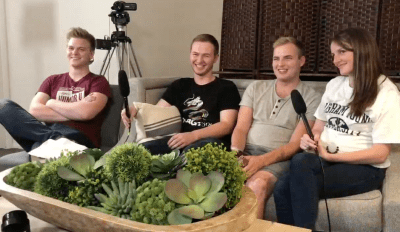
 Join us now for our Mormon Stories Podcast series on “How to Survive BYU as an Unorthodox or Non-Believing Student.” We will be interviewing Bradley, Alana, Jared, and Andrew—co-founders of the “BYU Survival Guide”—a survival guide for “Ex-Post-NOM-Never-Mormon” BYU students.
We first interview each former student one-on-one to get a sense of their Mormon story and how their faith changed—inevitably impacting their experience at BYU. We learn how each navigated their unique experience and what advice they have to offer students who are now in similar situations.
Our final episode includes a panel discussion with all 4 students as they share their motivations behind creating the BYU Survival Guide.
Please share this info with anyone who you think might benefit from it, including any past, present, or future BYU-Provo, BYU–Idaho, and BYU-Hawaii students.
Part 1 – Bradley and Alana share their story: This transcript is machine-generated and lightly edited for readability. The audio is authoritative. Please excuse occasional errors in names and spelling. Bradley Butters [00:00:00] Foreign. John Dehlin [00:00:10] Stories is a production of the Open Stories foundation and relies solely upon the support of people like you, its listeners to help keep the podcast alive or to become a member of the community. Please become a monthly subscriber by visiting MormonStories.org and clicking on the Donate button on the right side of the page under support. All contributions to Mormon Stories are completely tax deductible in the United States and go towards producing the podcast and building communities and programs of support for Mormons like you. Thanks for your support. Alana Butters [00:00:53] Cry baby cry. Everything is gonna be all right. You gotta. John Dehlin [00:01:08] Hello everyone and welcome to another edition of Mormon Stories Podcast. Maybe today I should say rise and shout. The Cougars are out. I'm Dr. John Dehlin. It is August 23rd, 2019 and we have a very special multi part series that we're going to be covering today. Today is BYU Cougar Day. Does BYU Idaho have a mascot? Are they cougars too? I don't even know. What's that? Bradley Butters [00:01:38] I would assume so, yeah. John Dehlin [00:01:39] Okay. Well it is back to school week in the United States and lots of the children of Mormon and post Mormon adults are going to be attending byu, whether BYU Idaho or BYU Provo or BYU Hawaii. And so we are really excited to be bringing to you today a series on how to survive the BYU's or BYU Provo. BYU Idaho, BYU Hawaii. As either an unorthodox Mormon student or as a non believing student. Margi and I went to byu. My faith crisis really started and heated up there. So this is a topic near and dear to my heart. But every single year we have students reach out to us either privately or on Facebook or on Reddit and they share that they've lost their faith at BYU and what do they do? Because their academic career can be in jeopardy, their standing at BYU can be jeopardized. They're, you know, they can be turned into the honor code office. But more importantly, how do they find friends? How do they find community? How do they find support? How do they deal psychologically with sort of the difficulties and the perils and the dangers and the traumas of losing your faith at BYU or just being unconventional at byu? We know that, you know, worst case scenario you can, you can lose one to two years of your academic work and a lot of money and a lot of time, not to mention the psychological harm that can come about when you're trying to navigate a very conservative religious and academic environment and a sincere faith crisis. And so we're going to be talking about it today and our goal is to Number one, provide support for students who are there to help them make it through unscathed or minimally scathed. But also, we know that church headquarters pays attention to Mormon Stories Podcast. We know that our efforts, combined with others, helps, you know, helps the church change its policies. And there's this amazing BYU Survival Guide that's been written and is being maintained by the people that we'll be, or at least some of the people that we'll be interviewing today. And so we'll be promoting the BYU Survival Guide as well as part of all of this. And so we have three individual interviews that we're going to do, each to kind of profile a different student, or in this first case, a couple. And then we'll be bringing together a panel of all of them to do a final sort of breakdown and discussion. We really do. We are live streaming all of this, hopefully, if technology allows. And so we are welcoming comments and questions and stories if people want to share that we can add to the discussion. So that's what. What's about for today. If you have. If you're listening now to the live stream and you have family or friends who are past, current, or future BOU students, please share this with them so they can watch it and share it on your walls however you want to share it to get the word out. And we'd love to have as many participants as we can. That'd be great. So without any further ado, our first. Our first discussion today is going to be a fun one. We are interviewing Bradley and Alana Butters and. Hi, guys. Welcome to Mormon Stories Podcast. Hello, Alana. I see you've got your BYU T shirt there. Alana Butters [00:05:33] Yes. This is a nonverbal cue that we like byu, and this is not a hate podcast. John Dehlin [00:05:42] It's not. It's a love podcast. Alana Butters [00:05:44] So this is. This is for students. This is for the university. This is for. This is for that. John Dehlin [00:05:50] So, yeah. And I loved my time at byu. So did Margi. There were hard things, but there were amazing things. So, yeah, this won't be a trash fest. No, no, no, no. Alana Butters [00:05:59] Yes. John Dehlin [00:05:59] But also a deep dive into how we can help people. Alana Butters [00:06:03] Yes, yes. John Dehlin [00:06:04] All right, so let's begin with your guys's story. And then, you know, we'll kind of do the background stuff, and then we'll get to the BYU experience. Is that all right? Bradley Butters [00:06:13] Yeah. John Dehlin [00:06:14] Who wants to go first? Alana Butters [00:06:15] I'll go first. John Dehlin [00:06:16] Okay. Take it away, Alana. Alana Butters [00:06:19] Okay, so what's your maiden name? Peters. John Dehlin [00:06:23] Okay. Alana Butters [00:06:23] Yep. Bradley Butters [00:06:23] Peters. Alana Butters [00:06:25] Yeah. So, yeah, I'm the oldest of six kids. Great, great family. I was raised and just did all of the LDS things and loved it. Absolutely, absolutely. Still do. Really, really love the. Yeah, the LDS faith, the. The church, all those things. I was baptized at 8. We were really good about doing family home evening every Monday. I loved family home evening. John Dehlin [00:06:59] Where were you, what you grew up in? Alana Butters [00:07:00] So I was born in Provo. You know, my parents were in Wymount. John Dehlin [00:07:04] Really? Yes. Probably maybe 10 years after me. Do you know what years they were there? Alana Butters [00:07:10] They were. Yeah. Like 90 to 95ish. John Dehlin [00:07:14] Okay, so we overlapped. Alana Butters [00:07:15] Yeah. John Dehlin [00:07:16] That's awesome. Bradley Butters [00:07:17] Yep. John Dehlin [00:07:18] I ended in 93, so. Bradley Butters [00:07:19] Okay. Alana Butters [00:07:20] Yep. Bradley Butters [00:07:21] Yep. John Dehlin [00:07:21] That's awesome. Alana Butters [00:07:22] So. Yep. Had my roots there. Bradley Butters [00:07:23] Her dad taught at the MTC for while. Alana Butters [00:07:25] Yep. John Dehlin [00:07:27] And you guys are making me feel old, by the way. Alana Butters [00:07:31] Yep. Yep. And yeah, he moved around for his job. We moved to Texas and then back to Logan, Utah and then Amarillo, Texas. But I mostly was raised in by. When I was 10, we moved to Washington state, which is actually where Bradley's family lived. That's where we met was in Washington in fifth grade. In fifth grade. So that's where I claim being raised was Washington. But. Yeah. Bradley Butters [00:07:58] Yeah. And then I was born in Salt Lake at. My dad was going to the University of Utah. John Dehlin [00:08:03] What? Bradley Butters [00:08:04] Yeah, we've got a really fun rivalry that goes with football and everything. All of my siblings ended up going to byu, so we outnumber them. Yeah. So I'm the oldest of five siblings. I've got all sisters. I'm the oldest and I was baptized at 8. Family's super active in the church. We did scripture study, family home evening. We're always on time to church. Sat towards the front. Just a really, really solid. Yeah, really solid core family in our ward in Washington. So we moved there when I was like five. It's a pretty small town, which was a lot of fun. There's like 5,000 people in town. And growing up there was just one ward. So we were in the same ward for most of our youth activities. And then the word split later on when we were in high school and we ended up in different wards. Yeah. So all my life I was preparing for a mission, saying I hope they call me on a mission in primary. Both my parents families were members. Have some inactive family. But yeah, it was really, really great and made me who I am today. So I'm really grateful for that and to my parents for that. Yeah, we really enjoyed the small town community. Alana Butters [00:09:33] We had a really tight youth group too. So like everyone in our Age level. Like got personal progress, Eagle Scout duty to God, like mutual all the time seminary. And we were really, really, really close. I remember once we were. There was a snow day and no, it was a two hour delay from school. And I thought, oh, we have two hours in the morning. And we were in high school. And instead of thinking like, oh, let's sleep in and drink hot chocolate, look like our friends, I was like, it would be so fun if we all went to the church and watched the testaments. And I remember calling everyone and our whole Semin class showed up. Yeah. And that was. And like we were always doing stuff like that. Like we'd watch church movies on Sunday evenings together. We'd go to all the dances. We really made an effort to like try and invite everyone to the dances. And I remember. I remember singing like we are the army of Helaman. That song. And like crying in high school because I just felt like everyone in our. In our group was so solid and we were so blessed by the gospel. We were so happy. Bradley Butters [00:10:50] Yeah. There's a lot of good camaraderie. I had a lot of really good friends in the grade older than me and in my grade. And we were kind of the golden generation of our ward. I felt like there was good grief, like an eight year period, I think before us at least maybe 10 years where there was maybe one missionary that left the ward. And a lot of the older kids went inactive after leaving high school. And then we came through and we were just like totally solid. Alana Butters [00:11:17] Yeah. Like the year we graduated, There was like 13 people on missions. Bradley Butters [00:11:22] Yeah. Alana Butters [00:11:23] Yeah. Bradley Butters [00:11:23] And I think that a lot of the ward members kind of appreciated that and we kind of changed the feel of mutual and of the ward because it instead of being something that you did begrudgingly, like, we really enjoyed it and it was a lot of fun. Alana Butters [00:11:38] Yeah, we von. Yeah. I remember going and like putting pass along cards in people's high school lockers like during lunch. And that was a fun thing that lots of people did. And yeah, we had a really good time. John Dehlin [00:11:52] We in high school. Bradley Butters [00:11:53] Yeah, in high school. Yep. Alana Butters [00:11:55] And then we'd see, you know, the high school quarterback has like a picture of Jesus on his binder. And I was like, put that in your locker. Yep. Bradley Butters [00:12:03] We ate together at lunch. So everyone knew us as the Mormons. There's not a lot of members in our town in Washington. So that was kind of our identity growing up and who we were. I wasn't super enthusiastic about like putting pass along cards in people's Lockers and being, like, super missionary at school. But I wasn't, like, afraid of it and, like, was willing to talk about it, so. John Dehlin [00:12:27] Okay. Alana Butters [00:12:29] Yeah. John Dehlin [00:12:30] Any. Any experiences kind of as Mormon teens or youth that kind of feed into what ended up happening at byu, just in terms of seminary or bishop's talks or family dynamics or any of that. Bradley Butters [00:12:45] So my dad was called as counselor in the bishopric before the ward split, and then the word split when we were freshmen in high school, I think, or in eighth grade. And then he was called his bishop after the word split. And so that was a big change for our family and that it just kind of really changed the spirit in our family and how. Yeah, in a positive way, like, we felt like we had to step up. You know, dad was at church all day on Sunday and in the evenings, and it was just this family sacrifice that we did. And, you know, mom had to get us ready for church by herself because he was there early. And it was this. I don't know, it was just kind of this big thing for our family. Like, we're doing this, and it's. Yeah, it's big. It was. Yeah, it was great. Um. Yeah. Alana Butters [00:13:42] Um, did you have something else you were gonna say? I can talk about how I got a pretty strong testimony. John Dehlin [00:13:48] Yeah, sure. That'd be great. Alana Butters [00:13:49] Yeah. John Dehlin [00:13:50] So you guys in seminary together, right? Bradley Butters [00:13:52] Yeah, yeah, early morning seminary. Alana Butters [00:13:54] Early morning. Yep. Yep. Bradley Butters [00:13:56] I was seminary president. Alana Butters [00:14:00] So when I was 10, 11. What was the year that President Hinckley asked all the families to read the Book of Mormon by the end of the year. And it was the first time a challenge like that had been given and, like, everyone was doing it. John Dehlin [00:14:15] I was in Logan. I remember I was in Logan at the time. Alana Butters [00:14:17] Yeah. Bradley Butters [00:14:17] Yeah. John Dehlin [00:14:18] Sometime between 2004 and, I don't know, 2015. Alana Butters [00:14:22] Yeah. Anyway, so we did it as a family, and I was, like, 10 at the time, and I had, you know, like, four younger siblings reading the Book of Mormon. And when we were done, my dad really took the time to talk about John Dehlin [00:14:34] how, you know, Cody says it was 2005. Alana Butters [00:14:37] 2005. Okay. John Dehlin [00:14:38] Thanks, Cody. Alana Butters [00:14:39] Yep. How like you. There's the promise and Moroni's promise. And you. You know, if you read these things, I would exhort you that you should ask God, the Eternal Father, in the name of Christ, you know, if these things are true. And then if you ask with a sincere heart, real intent, having faith in Christ, manifest the truth unto you. So my dad said, you should do that. You know, we just finished. You should go pray and. And See what happens. And so I did. I just remember the spot. It was like behind my bedroom door. And I, like, opened the door, so. And then like, hid in the slot and knelt down and prayed. And I just remember, like, it was like warm and tingly all over. And I just, like, knew the Book of Mormon was true and. And I tried reading after that. I read it again by myself on like the top bunk, I remember. And then I did it again two years later and the same thing happened. It was like, so powerful. I just. I knew the Book Mormon was true and. And then we read it again in seminary. I read it again a couple times in high school and I just kept doing it every time because I thought, you know, every time I can get the same answer. And. And it really happened every time and I just. I really knew it was true. And. And then I think a big thing for me too was like, by their fruits you shall know them. And like, the fruits of my life were so good. Like, I had a really beautiful family. Like, I was so happy, like all the time. And high school, just looking at my friends, I just felt so much happier than they were. And I was like, I want to share this with them. And so a lot of it was like a really practical outlook too. Like, look at what it's done for my life. This is something that's so valuable for me and I would just love for everyone to be happy like this. And so, yeah, that's. That was big for me. Bradley Butters [00:16:45] And that's a lot of what attracted me to her was seeing that positive outlook and seeing how she was just so happy and loved the gospel and was preparing to be a great wife and mom. And that was a lot of the focus with young women's, you know, and. Yeah, and I felt a lot of the same way. I. I didn't have a lot of spiritual experiences growing up. That was just kind of the nature of my faith and how I felt the spirit. It wasn't a constant thing, you know, it wasn't like I read the Book of Mormon and prayed about it and like, I felt, you know, Moroni's promise. But there were a few very powerful moments growing up. My baptism, you know, I felt great. There was, you know, doing home teaching with my dad. There was a couple times the Alana Butters [00:17:42] man Bradley Butters [00:17:43] we would be in the car, like, on the way to help, like some widow or some family that was struggling activity. My dad and I kind of got. Well, my dad, he was really giving and selfless and hard working in the ward, which is why he Ended up being called his bishop, I'm sure. And so we had a lot of really hard families to home teach some inactive members that, you know, hadn't opened the door for a while. Families that were going through divorce and infidelity and widows and things like that. And so there's a few of those, like, really special, powerful experiences that I felt, like, really served me later on to prepare me for a mission and, like, really strengthen my testimony. There's a few times in, like, Sunday school, as a young teenager, we watched the. What's the movie? It's not 17 miracles. It's another pioneer one where they're going across the plains and dying. It's really hard, and they have faith. And I remember, like, that was one of the first times I really felt the spirit really strong, and I was crying. And so Legacy. John Dehlin [00:18:51] Legacy was like, in the. Was it in the visitor center? Bradley Butters [00:18:55] I don't remember. It was a little bit older, maybe like a 90s film. Okay. And I was crying, and it was embarrassing, and it was the first time, like, I'd felt like that as powerfully. And so I left and went to the bathroom, and my mom was out in the hall and saw me crying. And we went outside, and she just gave me this big hug and said, you know, that's the spirit. And. And it just felt really good. And that's something that I reflected on for a long time. Yeah. So I think that's kind of what Drew Alana and I together was we were both really strong in the church, and we really respected each other's values and what we were preparing for, my mission and her being a wife and mom and active in the church, and I guess this kind of gets into our love story. She moved in in fifth grade. And again, what city is this? Prosser. Washington. Okay. And that's near Tri Cities. Yeah. So Tri Cities area. And there's quite a few members in the Tri Cities area. They built a temple there when, like, early 2000s, I think. And I remember that my parents were really excited. John Dehlin [00:20:00] What are the three cities that are part of the. Bradley Butters [00:20:02] It's Kennewick, Pasco and Richland. And so we were in the Kennewick stake. Alana Butters [00:20:07] Yeah. And then it switched. Bradley Butters [00:20:08] And then we switched. John Dehlin [00:20:09] Centralia near there. Bradley Butters [00:20:10] Centralia Central is a little farther up in Washington, in the center of Washington. So. John Dehlin [00:20:14] Okay. Bradley Butters [00:20:17] Yeah. So Alana moved into our school in fifth grade. There's only one. You know, there's one elementary school, one middle school, one high school. Alana Butters [00:20:26] So one ward. Bradley Butters [00:20:27] One ward. So it was a small Town, so she moved in. And I remember. I don't remember if I saw her in primary for the first time or if I saw her in fifth grade for the first time, but both times I noted, like, oh, man, who's that new girl? Like, she's cute and bubbly. And so I remember it was like the first day of sixth grade because she moved in towards the end of fifth grade. And we did a few things, I think, over the summer with our families. Our ward was really good about, you know, we had a lot of close family friends in the ward. My parents were friends with several other. There were several other really big families. And so we would go over for family dinners and my dad was hunting buddies with this guy. And so we became really close with them. And so there's just a really good ward community anyway, going back. So, yeah, beginning of sixth grade, she really caught my eye. And I just was, like, infatuated, head over heels, and a lot more gutsier then than I am now. And so I started writing secret admirer notes and sticking them in her locker and just little, like, I love you and some little praise things, but not giving away who I was. And so that went on for, like, all of sixth grade and. Alana Butters [00:21:46] And most of seventh and most of seventh grade. I didn't know who it was. Bradley Butters [00:21:48] Yeah, she didn't know who it was for a long time. And. Yeah, I don't know how you felt about that, but. Alana Butters [00:21:57] Yeah. Well, I ended up figuring out it was him because he was always, like, looking at me and I was like, I think it's him. I wrote back, I'm like, I think I know it's you. Put it in his locker. And then, yeah, I would, like, hang Bradley Butters [00:22:13] back at recess to hold the door. Alana Butters [00:22:14] And he was always holding the door for me. That was a tint. Bradley Butters [00:22:18] Yep. Alana Butters [00:22:19] And. Oh, and when he was passing the sacrament, he would, like, when he was waiting, he was always, like, looking at me. And I thought he was pretty cute. Passing the sacrament. John Dehlin [00:22:29] Yep. Bradley Butters [00:22:29] I'd always try to sit where the deacons line up so that I would pass the sacrament to her family. Alana Butters [00:22:33] Yeah. Yeah. So then I found out it was him. Didn't like him back at first, but then very soon after, well, he was really quiet. I hadn't totally noticed him before. Bradley Butters [00:22:44] Very introverted, so. Alana Butters [00:22:46] But then I started paying attention. He was always doing the right thing the right time. Like, very quiet, very humble about it. He was just always, you know, with his family, holding his little sister on his lap in sacrament meeting. And I just thought, like, wow, that is everything I want. And he's not, like, prideful about it. And so, yeah, it didn't take very long. I thought that I liked him back. And so it began. Bradley Butters [00:23:12] We both excelled in school. And so we were in the honors classes and the advanced classes, which there was only one of those classes for different subjects. And so we were always in the same class. And so. Yeah, that was nice. And so after she decided she liked me, then eighth grade, we weren't 16 yet. And so we had, you know, we stuck to all the. For the strength of youth. Youth standards. Alana Butters [00:23:34] Very strict. Bradley Butters [00:23:35] Yeah. Very strictly. Didn't kiss and didn't hold hands and weren't really seen together in public that much. Yeah. But we started to develop a relationship in 8th grade. Wrote notes back and forth, and we're just praising each other for what we respected, you know, like, me being a worthy priesthood holder was a big thing to her, and her doing well in young women's was a big thing for me. Yeah. And then high school rolled around. I was in sports. She was active in, like, school leadership and like, really, she memorized every single person's name in our grade in school. There's like 180 people in our grade, I think. Wow. Yeah. So just really outgoing. And I think that kind of pushed me to be more outgoing and helpful and positive too. I got involved in student government because she was. And so then we turned 16 and started dating. Well, I guess first we started going to stick dances. Alana Butters [00:24:41] When is that? Bradley Butters [00:24:41] 14. Alana Butters [00:24:42] That was the romantic tag. Bradley Butters [00:24:43] Yeah, that was. Finally we could dance with each other and hang out. John Dehlin [00:24:49] But at least a Book of Mormons. Alana Butters [00:24:51] Oh, it was like this. Bradley Butters [00:24:52] Oh, yeah. It was the awkward, you know, stiff arms, sweaty hands. Yeah, classic. And. And that was a big thing for a whole core group of friends. Before, no one from our ward had gone to steak dances. Like, our ward didn't really know about him. And then me and my best buddy in junior high and high school just like, got up the guts and were like, man, there's these steak dances and we've never been. And I was, let's see, I'm about a little less than a year older than her. We're in the same grade. But I turned 14 and him and I went to this first date dance together and we were just wallflowers. But then, yeah, we were super excited for other people to join us. And then it became this core group of our friends that would, you know, we'd carpool and there would be. Alana Butters [00:25:34] I had to set up a carpool because we had, like, 22 kids going. Bradley Butters [00:25:38] Three out of a single board. Alana Butters [00:25:40] Yeah. Bradley Butters [00:25:41] So we really kind of just. Our core group of friends really were really close. And so we would carpool and there'd be, like three or four vans of us, and that was a lot of fun. And we started dating and. Alana Butters [00:25:53] Well, dating. Bradley Butters [00:25:54] Dating. Yeah, we. Alana Butters [00:25:55] So I turned 16. We went on a date. But you're not supposed to steady date. John Dehlin [00:26:00] Right. Alana Butters [00:26:01] So it was like, we went on a date, and then it was like, well, we'd have to go on a date with someone else first. But there's no one else in this small town, and we don't like anyone else. So it was like, we didn't really date. We went on, like, five dates total by the time I graduated high school. Bradley Butters [00:26:14] But we hung out at, like, official dates. Yeah. Alana Butters [00:26:16] And everybody knew that we liked each other. So it was like. It was this really awkward thing where we weren't supposed to study date, we weren't going on dates. But it was like, we hung out every lunch. We hung out every lunch. And it was. But we were really trying to, like, really trying to follow the standards. Bradley Butters [00:26:34] Yeah. John Dehlin [00:26:34] And I think about that a lot, like, when I see students here in high school, because my kids go to Mormon high schools, and it. And there are all these homecoming and Sadie Hawkins or, like, girls choice or prom or whatever. There's this weird thing in Utah where you can't ask the same person to a big formal dance. Alana Butters [00:26:56] Yeah. John Dehlin [00:26:57] And, you know, it's obvious what they're trying to do is to not have kids become sexually active. So you kind of have to choose carefully if you have a special someone, which dance you ask, invite them to. So on the one hand, I could see how, from the church's perspective, that's good, because in their mind, that'll keep kids from having sex. On the other hand, I kind of feel weird about that because, number one, it makes kids have to ask people to dances that they really don't want to go to with. But then also, like, it kind of discourages emotional intimacy. And on the one hand, I can see why the church wouldn't want sexual intimacy. But on the other hand, I think the church would want people to develop emotional intimacy. And so why would they want to stunt that? And so, you know, I'm not criticizing. It's just like, it's a weird thing. Alana Butters [00:27:43] Yeah. It was a really tricky line for us for a long time, and then Bradley Butters [00:27:46] we can get into this later. But kind of on that, like, then you go on a mission and you're totally isolated and that's frowned upon. Then you get to college and then it's just open door, you know, like, have at it emotionally and. Yeah, but we. Alana Butters [00:28:00] I would have to say we did, like, a really good job of following the standards for the. I mean, we. Bradley Butters [00:28:09] Yeah, yeah. And my parents were a little stricter about it. They kind of went above and beyond, like, for the strength of youth. And so they were kind of the ones that were encouraging me to date other people and maybe discouraging from, like, going to school dances. We went to like one or two state dance or school dances. Alana Butters [00:28:26] Well, we went to all of them. Bradley Butters [00:28:27] I didn't. Well, not four. Just proms. Not like the other dances, like homecoming. Alana Butters [00:28:32] Oh, yeah, we didn't go to those. Bradley Butters [00:28:35] And then. Yeah, there was like. There was a lot fewer young women in our ward than young men. And so if I wasn't interested in the three or four other young women then that were my age then. John Dehlin [00:28:45] Because you can't date non Mormons, right? Bradley Butters [00:28:47] Yeah, yeah, yeah. Non Mormons were out of the question. Alana Butters [00:28:49] So remember when we spent. So we were on leadership. We spent a year planning junior prom and. And then we left early because the music was vulgar. Bradley Butters [00:28:57] Yep, yep. John Dehlin [00:28:58] What was it? What was the music? Do you remember? Alana Butters [00:29:00] I don't remember. Bradley Butters [00:29:00] Or just like rap or something. Alana Butters [00:29:01] But we. Yeah, we planned prom and then left early. Bradley Butters [00:29:05] And she was student body president and I was student body vice president. And so senior year, junior year for junior prom. Cause junior prom's like the big one. Then when you're a senior, you go to the junior. You know, the dance the juniors planned. So like, we planned the biggest foul standards. Yeah, we left the thing that we Alana Butters [00:29:21] spent hours, like, raising money and this. John Dehlin [00:29:24] Tell us for the. Who knows when someone's listening to this, how the strength of the youth pamphlet will change. But what were the big standards? Just list them out. Bradley Butters [00:29:32] Yeah. So don't date till you're 16. Alana Butters [00:29:36] Don't study date after that. Bradley Butters [00:29:38] No petting. John Dehlin [00:29:39] Meaning? Alana Butters [00:29:41] Well, yeah, yeah. Bradley Butters [00:29:42] Groping, whatever. John Dehlin [00:29:43] We have non members who listen, so. Bradley Butters [00:29:44] Oh, yeah. Oh, okay. So, yeah. Touching each other. Clothes on. Private parts. Yeah. Passionate kissing. I think it specifically says no laying down with each other. Alana Butters [00:29:56] Obviously no sex. Bradley Butters [00:29:58] Yeah, obviously no sex. John Dehlin [00:30:00] Did we say our movies? Did you. Was that in there? Bradley Butters [00:30:03] Yeah, yeah. So those are just the physical intimacy and then. Yeah, yeah. Alana Butters [00:30:07] Music. Your music with your modesty. Bradley Butters [00:30:10] Modesty is a big one for. John Dehlin [00:30:12] What does that mean, girls? Alana Butters [00:30:13] Modesty means wearing, you know, a dress to prom that has a sleeve instead of, like A tank top or low cut or wearing shade shirts underneath. Like everything you wear, just in case. I still love those things. Bradley Butters [00:30:27] Yeah, no, I do. John Dehlin [00:30:30] I still love. Alana Butters [00:30:31] I still am like a very conservative, modest personality. Bradley Butters [00:30:34] And then. And now it's. I mean as a young man, like you're obviously attracted to girls and so there was this like. Well, I respect her because she's this good strong young woman, but I mean, wouldn't it be nice? Right? And so. And then moving to Utah for school. It was a weird thing to see these high schools. John Dehlin [00:30:51] Was there a porn masturbation emphasis in. Bradley Butters [00:30:53] Yeah, so that was big in strength of youth and bigging young. Young men's and in priesthood session of conference. And so that was really like beat to death and like I was coming up in a really strict. So let's see. John Dehlin [00:31:08] Just don't. Don't do it. Bradley Butters [00:31:09] Yeah, don't do it. And it was started really early in like as soon as you're in deacons and out of. Out of primary, when they start splitting the young men, young men and young women's on Sundays and you have separate classes, then that's when it starts. And my. Oh, my dad was. John Dehlin [00:31:26] How do they say that? Alana Butters [00:31:28] My dad taught you that lesson? Bradley Butters [00:31:30] Well, later on in. No, he was our priest quorum advisor. Advisor. My dad was our deacon's quorum advisor forever for like five years when this core group was going through. So my dad was really close to the youth and, and to my friends and really like a counselor and father figure for us. And so he was in there in Sunday school when it. The first time it came up and they said like, well, you know, don't have sex with yourself. And I was like, what does that mean? John Dehlin [00:32:00] Because they don't want to say the word masturbate, right? Alana Butters [00:32:02] Yeah, I was like, what does that even mean? John Dehlin [00:32:04] So they say don't have sex with yourself. Bradley Butters [00:32:07] That's how they would. Well, just that first time. John Dehlin [00:32:10] Did they say self abuse? Did they ever say that? Bradley Butters [00:32:12] No, they didn't say that. And later on, you know, it got a little more explicit and so in obviously like in the locker room and whatever. Like outside of church is where most of my. And outside of church and outside of my family is where most of my sex ed came from. So. Yeah. And obviously, you know, a lot of young men struggle with that and I did too, you know, off and on. And so that was a large source of guilt and shame and. John Dehlin [00:32:42] And your dad was your bishop, is that right? No. Bradley Butters [00:32:47] When was he. Alana Butters [00:32:47] Because he was called when we were in college. John Dehlin [00:32:49] Okay. Alana Butters [00:32:50] He was a counselor, so you didn't have to. John Dehlin [00:32:52] So did you have to talk to your bishop? Bradley Butters [00:32:53] Okay, so they split the word. When we were in high school, he wasn't the first bishop. He was counselor. And then after I got home from my mission, he was called his bishop. Alana Butters [00:33:01] Yeah. Cause we were in the BYU lesson found. Bradley Butters [00:33:03] That's right. That's right. Yeah. So I never had my dad as bishop. John Dehlin [00:33:07] Okay, so did you have to talk to your bishop about that kind of stuff? Bradley Butters [00:33:12] I mean, I should have. And that's what a lot of the guilt and shame was from. But then I was scared and I did later on in high school because, I mean, it was like very young age. And so. Yeah. And I was. I mean, other than that, like, straight laced, you know, did everything right. And so that was kind of the one source of like, man, I'm going to hell and I'm not good enough. And like, man, if my parents found out and this, that kind of guilt and shame, you know, that comes from beating that to death. You know, Elder Holland's talk in that one priesthood session where he said, you know, buckle up or whatever, I'm going to send your eyebrows. And then he talks about. He compares it to playing football or whatever. You can't suit up for Satan's team. And then come mission time, expect to play on the Lord's side. And that was, you know, it was fire and brimstone and just had a profound effect on me. But. And I mean, obviously, like, I was trying and repenting and yeah, off and on thing. John Dehlin [00:34:22] So how does that affect a kid profoundly? Bradley Butters [00:34:29] Well, I. We can get into mental health a little bit later, but yeah, depression, anxiety is kind of a family history thing. And we didn't talk about it growing up, you know, and I respect my family's, you know, whatever they don't want shared, but yeah, my mom in particular struggled with it, but it wasn't something we really talked about in our family growing up at least. And I think our family kind of. Well, I'm not really sure. I was young and so I wasn't privy to my parents, that kind of relationship. But at least in the. We were really conservative, I think. And so the. It was kind of the suck it up and get over it type feeling is what I got. And so I didn't know what depression was through junior high and high school. It became a bigger issue later, but I had some, like, really down periods. And I think that, yeah, that guilt and shame was part of that. Just one factor that Obviously, you know, it's a genetic, like, illness and stuff. John Dehlin [00:35:39] So did you feel like you kind of had to lie at least at some point? Bradley Butters [00:35:42] Yeah. John Dehlin [00:35:43] I mean, what does that do to kind of put a kid in a situation? And that's every kid I've ever talked to. Bradley Butters [00:35:48] Yeah. Like, what do you do? Do you tell your bishop and then you don't have a temple recommend? And we're youth temple trips every single month and that's what our core group of friends does. And we're all active and strong and like, I know that other people struggled with it and so. But like, am I going to be the only one that doesn't go to the temple with my friends because I don't have a temple recommend? And then it's. Yeah, it's like passing the sacrament. Yeah, it's a small ward, it's the only ward and there's like, relatively few youths. And so if I. We had to have Melchizedek priesthood holders sub in to pass the sacrament because sometimes there weren't enough deacons. And so. Yeah, yeah. If I'm sitting out and whatever someone comes and says, like, hey, can you pass the sacrament today? Like, if I say no, then that's a big public shaming thing. And everyone, you know, everyone notices when my friends, you know, if someone didn't pass the sacrament, you know, we knew and it was kind of. Alana Butters [00:36:49] And they were talked about negatively. Bradley Butters [00:36:50] Yeah, not. Not amongst my friends, but just in the ward, you know, I'd hear, you know, oh, so. And so didn't pass the sacrament. Oh, you know, I heard it was this and that. And so. But overall, we were like really core good, strong group. John Dehlin [00:37:05] So is. Is it hard to kind of learn to lie early? Is that. Bradley Butters [00:37:09] Yeah, I mean, I felt really. I felt really bad about it and I didn't really think it was fair sometimes because it was such a hard thing and we didn't talk about it in a positive way. Right. Like sexuality and. And I think I in particular maybe was more sexually driven than a lot of average young men. So. Yeah, like, it was a big. It was a big thing. And like, lying wasn't something I was comfortable with and. But it was. It was really tough and that was something that I beat myself up over. Like, well, you weren't brave enough and willing enough to do the right thing and, you know, come clean to the bishop or whatever. And. And when we'd go to temple, youth temple trips, then, you know, you're sitting there thinking, man, am I worthy to be here? I'm not actually worthy to be here. And so temple trips and passing the sacrament and stuff, sometimes it would turn into this self beating up session of, you know, I shouldn't be doing this and I'm not good enough. And so, and I wouldn't say that I questioned the gospel a lot, but I was afraid of, I was afraid of two things. Maybe I was afraid of it not being true and missing out on, you know, like I was afraid of it not being true and following the standards and sacrificing a lot of things and working hard for the church and everything. And I was afraid, you know, I didn't think I was gonna go to the celestial kingdom. Like I just kind of given up on that, I guess. And so that was kind of a sad thing. But I don't know, it's kind of the cognitive dissonance, I think it's hard at the same, you know, I'm not worthy and stuff. But at the same time, like, well, I'm trying my best and like, what do you do? And like, it's gonna work out, whatever. Like I'll get married and then it'll be better. I'll go on my mission and it'll be better. John Dehlin [00:38:59] And so yeah, and just, just, you know, just to pause for just one second. Like it's. What's insidious about this is that the kids that are honest about it get punished. Bradley Butters [00:39:12] Yeah. John Dehlin [00:39:13] Because they get, they're the ones who get the shame. And so somehow we're punishing the honest kids and then the kids who lie about it, well, you know, they're not punished but then they are taught to lie. Bradley Butters [00:39:22] Yeah. John Dehlin [00:39:23] So it's kind of a lose, lose for everybody. And it's super painful and shameful. And for those who care about this issue, Margi, my wife and I and Natasha Alford Parker recently did an episode called A New Approach to Pornography and Masturbation. It's both on Gift of the Mormon Faith Crisis and on Mormon Stories. But if you or your spouse or your child or whatever are struggling with how to deal with pornography and masturbation, we offer kind of a mental health informed, better approach. So check that out. But this is, this is tough stuff. And, and, and Alana, we, we always kind of assume this is a male problem. And you know, statistics show that over 90 of men masturbate. But, but women are over 50%. And I, I'm not interested in like details for any personal reason. Mark, one of our listeners writes, I've yet to meet an honest, active Mormon male who didn't struggle with porn growing up. And that's kind of what's ironic is these bishops and stake presidents and, you know, they're all doing it, and yet these kids are being kind of held over Iraq. But, you know, is this something that, from your experience, either personally or other girls, you know, that girls struggle with or. Nope, nope. Alana Butters [00:40:46] It was not part of my experience. It wasn't something that I struggled with. John Dehlin [00:40:50] So it's less common. It's less common with. Alana Butters [00:40:52] We didn't talk about it. So if my best friend was doing it, I had no idea. Bradley Butters [00:40:55] And they didn't talk about it in young women's. Alana Butters [00:40:57] And we didn't talk about it in young women because it was kind of assumed no one was doing it. Bradley Butters [00:41:00] Yeah. And that was something that I felt was unfair. Later on when I was more aware of things, was in priesthood, you're beat to death over it. But then in young women's, it's not mentioned. There's no, you know, sexuality lessons and shaming and guilt with respect to that. So. John Dehlin [00:41:16] Yeah, and it's, you know, we're drilling into this, and this is really about byu. I'll be curious to hear if this all flows into your BYU experience or if not. But. Bradley Butters [00:41:26] Yeah, well, obviously, you know, in high school, we had to interview. Get the ecclesiastical endorsement to apply for BYU and interview with the bishop, interview with a stake presidency. And so, yeah, I mean, it's. It was an issue with that. And I think that was one of the times that, you know, I kind of came clean. And. And the other thing is, it's totally bishop subjective. You know, some bishops might. John Dehlin [00:41:51] Oh, don't worry about it. It's totally fine. Bradley Butters [00:41:52] Yeah. Or, you know, try your best. John Dehlin [00:41:54] Keep you, like. Keep you from going to BYU or keep you from a mission. Bradley Butters [00:41:57] Yeah, yeah. You know, well, you can pass the sacrament, go to the temple, you know, just repent on your own and, you know, try not to do it or whatever. And then others would. You might get publicly shamed. And the other thing was, like, I didn't know those statistics. And so I thought that, well, maybe all my friends aren't. And then I'm just the only one. Alana Butters [00:42:12] And. Bradley Butters [00:42:13] Yeah. John Dehlin [00:42:13] So you don't admit it. Bradley Butters [00:42:14] Yeah, yeah, yeah, yeah, yeah. John Dehlin [00:42:17] So that's super hard. Okay, well, I'm sorry. Thank you for being honest about that. Bradley Butters [00:42:20] I haven't really talked about it. John Dehlin [00:42:22] It's pretty much every kid, you know, 90. I'd say 98%. So boys, you know. Alana Butters [00:42:30] Yeah. John Dehlin [00:42:30] But girls struggle with the two. So what else is kind of Crucial to both of your stories prior to the BYU experience. Bradley Butters [00:42:39] Yeah. So we'd kind of, you know, not dated through high school. Didn't kiss for a long time and then finally did. And then from there, you know, sparks flew and it was a volatile, dangerous, you know, walking the line sort of thing. And I, you know, I think that people were rightly worried about the risk of having sex and things like that, but I always had a curfew and we were encouraged to do things with friends. But, you know, if we went out for lunch together, then, you know. Yeah. Making out. Alana Butters [00:43:13] And a lot of people didn't trust us. Bradley Butters [00:43:17] Yeah. Alana Butters [00:43:17] Like, I'd go babysit for someone in the ward and she said, well, my mom said, you guys aren't gonna make it. I was like, thanks. You know, like, I'm doing everything I can. And she's like a. Assuming we're not going to make it. And by the way, we did. Bradley Butters [00:43:30] Yeah. Alana Butters [00:43:30] You know, like, we were chased all the way through. And, like, we did get married in the temple Chaste. And so. John Dehlin [00:43:36] But even that. And I'm not asking details, but there's this. I lived it. Margi and I lived it. It's like, what. So what can you do short of actual intercourse that, you know, still will allow you to be worthy? Bradley Butters [00:43:51] Yeah. John Dehlin [00:43:52] So there's kind of that making out as a Mormon teenager where you're trying to figure out what you can get away with versus not what you have to confess about. And what you don't. Is that. Is that weird? Was that hard? Alana Butters [00:44:03] Yeah. John Dehlin [00:44:04] And that's a BYU too, right? Bradley Butters [00:44:05] Well, yeah, and it was a super small town, so. Alana Butters [00:44:08] And every leader will tell you you have to confess about something different. So some leaders are like, you kissed passionately for more than, you know, 10 seconds. You need to go talk to your bishop about that. Bradley Butters [00:44:19] And. Yeah, so being a small town, this is kind of a funny thing, but we went to lunch, came back, and I drove my dad's truck and we were like, making out in the truck or whatever. And my mom just drove by the school and. Small town, right. From a doctor's appointment or something like that. And she looked and saw us making out in the truck and there was hell to pay when I got home. And, yeah, that was not okay. You know, I broke the law of chastity and I had to go talk to my bishop, actually, my stake president. It was during my mission interviews, and it was a big deal. And so. But, you know, the standard wasn't the same for. From her family, maybe. And so yeah. It's just really. And my family went above and beyond the strength of youth and so which is good. I mean, I, you know, I broke curfew sometimes, but I knew that. I knew the expectation and I think that did, you know, protected us. John Dehlin [00:45:07] So what's hard about all this is that there's probably an argument that kids delaying sexual activity might. Might be good for some kids. Right. Bradley Butters [00:45:16] So that's. John Dehlin [00:45:17] That makes this complicated. Bradley Butters [00:45:18] Yeah. And maybe that even helped us, you know, actually make it and get married later on. And so just because we couldn't date a lot. So. John Dehlin [00:45:26] Yeah. Bradley Butters [00:45:28] Yeah. So high school was wrapping up and I was getting ready for a mission. It was always expected and I'd always been getting ready for it. But then when the time came, you know, there's this massive hesitation or worry kind of man, is this really what I want to do? And you know, there's whatever unrepentant things and two years is a long time. Am I going to be good enough? My dad served in the London England mission and loved his mission and tried to talk about it. And I remember when I was getting ready, he pulled out his mission things and was trying to like share his mission experiences with me and I wasn't really interested. I just had this like aversion to talking about it and you know, I wish I had when I got back, that was. And had my own experiences and it was something we could bond over. But it was scary. And so. But you know, I started going through it and kind of the. Not fake it till you make it, but you're just kind of swept along in the current in the church, I think as a youth sometimes and the testimony comes after the trial of your faith sort of thing. So, you know, I started the mission papers process and I. John Dehlin [00:46:38] Weren't you. Were you in the time when you'd go to BYU for a year and then go on the mission? Bradley Butters [00:46:42] No. So. Oh yeah. So we were 18. Alana Butters [00:46:44] The age was his wave. John Dehlin [00:46:46] Okay. So you were right there. Bradley Butters [00:46:48] The H. The H change effectively. John Dehlin [00:46:49] Thomas S. Monson. Bradley Butters [00:46:50] Yep. So it only affected that. Yeah, I was actually. I was actually a. It was on a Saturday, so I was actually at a cross country meet. So I didn't hear it. I wasn't listening to conference, which is kind of some of the kids. There was a couple other members on the cross country team and they had it on their phone listening and you know, being let your light so shine to the rest of the cross country team or whatever. And then yeah, I heard the announcement, word of mouth And I think Alana called me at the cross country meet. John Dehlin [00:47:17] Or were you junior or senior? Bradley Butters [00:47:20] Senior. John Dehlin [00:47:20] Okay. So that's intense. Bradley Butters [00:47:22] I was intense. Alana Butters [00:47:23] My SAT test, because. John Dehlin [00:47:24] Were you planning on going to byu? Bradley Butters [00:47:25] No. So I was planning on leaving. Yeah. I turned 18. I was going to turn 19 the fall after graduating. So I would have, okay, you know, four months to leave. And the age change only affected me is that I got to leave after graduation in the summer. John Dehlin [00:47:40] You were older in your. In your. Bradley Butters [00:47:41] I was, yeah. I was like, one of the oldest in my grade, so. But I'd applied and deferred BYU acceptance. And so it was surreal, you know, like, wow. I thought I had all summer and part of the fall to prepare, and now I can leave in a month or two and I don't know if I'm ready and I don't know if I want to do this. And, oh, I should mention one of the most powerful recent spiritual experiences was feeling that kind of apprehension and coming home from home teaching with my dad one Sunday and had a really good experience. He said some really powerful things to me when we were just driving. You know, he was talking about just being a good man and being a good priesthood holder and helping people and being Christ, like, you know, rescuing the lost sheep kind of thing. I don't remember if it was that day or shortly afterwards, but I came home and I went to my room and I spent quite a bit of time in my room just reading and things. And so I remembered thinking, you know, I. I need to ask God if this is what I should do and get that testimony for myself because, like, you know, I'm scared. And so I knelt down by my bed and I prayed really hard. My prayers, you know, were out of habit and things up and so. But this was a really sincere and inquisitive prayer. And I cried while I was praying. And then I laid down on my bed and I picked up my scriptures and I kind of thought, like, you know, I'm just going to open to something. And I mean, I kind of guided where I was opening to, like, well, open to, you know, the later part of the New Testament when the apostles are proselyting or whatever, or the missionary sections of the Book of Mormon. But. And so I flipped open and the. Oh, one of the other things was I was. I'd been accepted to a couple universities and got a really large grant to University of Montana or Montana State, and they weren't going to hold it. And so I was thinking, man, like, I'm losing a lot of money going on a mission and. Alana Butters [00:50:01] And you didn't have enough money for your mission? Bradley Butters [00:50:03] Yeah, well, I had saved up. That was the other thing. I didn't spend a penny of the money. I worked every summer, like, harvesting onions. Worked my butt off and saved up close to 10. Close to the $10,000, actually. I think I had a little bit over the $10,000 to save up. And I was. Yeah, I was going to pay for it with all my own money, and. And my parents encouraged me to save up. And then right before the mission said, you know, we'll. We'll pay for half of it or whatever. But, yeah, there's a lot of concerns. And so when I prayed, that was part of my worry. You know, should I do this? And the verse that I flipped open to, the first one was, when Jesus is calling his apostles and he says, take no thought for your purse or script. You know, just go with the cloak that's on your back and it'll work out, because God's aware of the lilies of the field and the sparrow, so how much greater are you? Or whatever it says. And that was just huge for me. It was directly answering my prayer and just this overwhelming, like, I'm gonna do it. Like, this is what I'm supposed to do. And from then on, the fears kind of washed away and. And it was pretty soon before the mission. You know, I think I. I hadn't got my call, but my papers were pretty close to being done, and. And it was huge. And then I just spent the rest of the evening, you know, hours reading about the apostles and in the Book of Mormon, reading about the later, and you find lehi and missionaries, and it was really huge. And that was something that lasted all the way up until, you know, my faith crisis later on that, throughout my mission and first years at byu. So. Yeah. Is there anything else you want to add about high school? Alana Butters [00:51:54] I was going to go on a John Dehlin [00:51:55] mission too, once the age change. Alana Butters [00:51:57] Yeah. Because it changed. And so I. John Dehlin [00:51:59] Women, 19, right? Alana Butters [00:52:00] Yeah. And so I was like, I can do this. And I felt really strongly that I should. John Dehlin [00:52:04] Should. Alana Butters [00:52:05] And I told him that. And because of that, I was hoping he would delay going for a little bit. We could spend some time after high school, then we could both go at the same time and, like, both go John Dehlin [00:52:13] to BYU for years. Alana Butters [00:52:14] No go. No, like, Yeah, I guess. And then both go on a mission at the same time, kind of. Bradley Butters [00:52:19] It was. It was. She wasn't planning on going before the httage, because I'm a Year older than her. And women go at a later. At a later age. And so I would be getting back for my mission, and then we were going to get married, so. And we'd been planning our wedding, you know, all through high school. So when the age changed, it was like, well, man, like, now we can overlap and girls should serve a shorter mission. So. Alana Butters [00:52:40] So I was hoping he would not go right after high school, but he did. He's like, no, I got an answer, and this is what God wants me to do, and it's going to be okay for us. And so he went, yeah. Bradley Butters [00:52:50] And I don't know if you want to talk about your dad. He had his own faith crisis. You can go into that. Alana Butters [00:52:54] Oh, yeah, right. Yeah. My dad had a hard. Was starting to struggle with his faith, and I knew that. And he said. He kind of said he had. He had me watch a presentation that you gave that was. It was like an hour. Bradley Butters [00:53:12] And it's understanding. Alana Butters [00:53:13] Understanding why people leave. And it's pretty much just like, don't think they're dumb and stupid. And it was really good. So I had some exposure to that. And so I thought, okay, my dad's okay. John Dehlin [00:53:23] So your dad was a Mormon stories listener? Bradley Butters [00:53:26] Not. Well, I don't know if he was. I don't know if it was more of his stories. Alana Butters [00:53:28] But anyway, yeah, yeah, my senior year. And anyway, so he was saying he John Dehlin [00:53:33] was like, that's multi generational Mormon stories listeners. Alana Butters [00:53:38] I'm having a hard time, you know, just so you know, if you don't, you know, if Bradley doesn't serve a mission and you guys don't get married in the temple, I'm still gonna love you no matter what. That's what he says. And so I called Bradley and was like, are you sure you want to go on a mission? And I said, are you sure? Sure this is true. Bradley Butters [00:53:56] And that was. John Dehlin [00:53:56] I mean, you started to wonder. Alana Butters [00:53:58] Well, I was pretty sure I knew, but suddenly my dad didn't know. And I was like, what the heck? You taught me this. And I was. I just checked with Bradley because I was like, you know what? I'm. My life with my dad is almost. I mean, like, I'm almost gonna move out. I'm planning with Bradley. Like, what matters is, like, what page we're on. And I called him and I was like, are you sure it's true? Bradley Butters [00:54:17] And we were the closest people in the world. And I remember that phone call. And this was, you know, I still had apprehension, and there was still the fear of, what if it's not true. And the guilt and shame sort of thing. And so, I mean, internally, I maybe hesitated a little bit, but, like, I knew it was true and I said yes. And looking back, like, and talking to her now and seeing how big of a deal it was to her, it Alana Butters [00:54:41] was a rush of relief. I was like, yes. Like, we've got our future still planned out. He's still going a mission. We're still going to the temple. Like, it's gonna be good. Bradley Butters [00:54:49] And so. But just remembering how I felt as a high schooler, that it was maybe not as a sound answer as she took it for. Just because, you know, everyone has doubts and is on, you know, worries and stuff. So. Yeah, so I think that's it. Alana Butters [00:55:05] Tell you what I mean. Bradley Butters [00:55:06] Yeah, pretty much wraps it up. I got my mission call. So, yeah, my. My generation of our core friends were the first ones to go out on a mission. The age change was our generation. And was I the first one to get my call out of our group? Alana Butters [00:55:21] I think so, maybe. Or one of the first. And then it was like, bam, bam, bam, bam. Oh, yeah. And we were all going. John Dehlin [00:55:27] I remember that. Bradley Butters [00:55:27] Yeah. Alana Butters [00:55:28] Everyone was getting. It was so exciting. We're just. I'm baking brownies for everybody. John Dehlin [00:55:32] And boys and girls, right? Alana Butters [00:55:33] Oh, yeah. Bradley Butters [00:55:34] There weren't any girls in our ward. John Dehlin [00:55:35] I'm just one for us. It was. Bradley Butters [00:55:38] Yeah, yeah. John Dehlin [00:55:38] An avalanche. Of all the youth going on, there Alana Butters [00:55:41] were about three that went a year later. Bradley Butters [00:55:42] Yeah. Alana Butters [00:55:42] Yeah. Bradley Butters [00:55:43] So, yeah, it was big. There was this flood of. I was the first one that turned in my papers from our ward in a long time. And then my friend turned in his. He got his call before I did, and then I got my call, and we all went to everyone's calls. You know, it was a big deal for our friends. And so when I opened my call, that was when you still got them in the mail. Everyone was there and family came into town and. Well, I guess we Skyped. Anyway, ward members were there, and it was a big ward family thing. Alana Butters [00:56:15] Yeah. Everyone was crying. Bradley Butters [00:56:17] Yeah. And I opened it up and, man, I wish I had it here. Said, you know, elder brothers, you are hereby called. And I'd been set apart at this point, had I? No, no, you get set apart later on. Yeah. You get your call then. Yeah. Anyway, but it's. Did it say Elder or Bradley? Anyway, it says you're hereby called to serve, and the area you'll serve is the Spain Malaga Mission. And then it goes on about, you know, the language you'll Serve is Spanish, and then it's. There's paragraphs about serving the Lord. And it was a really emotional, just powerful thing. And, you know, to have the call like, this is it. Like, I'm called, and the field is white and ready to harvest. And so once I got the call, it was like, full steam ahead. And my mission president had a mission blog. And so, you know, we got on and we're reading the mission blog and looking up things about Spain, and we were really excited. And I had studied Spanish in junior high and high school, and so I was, you know, proficient. I could say sentences and understand quite a bit. And I didn't take AP Spanish, but I was. I could communicate pretty well. And so, yeah, so then I went to this. The Madrid mtc. So I had to fly down. It was to the Provo MTC like, a month before to get my visa. I think there's a Spanish ambassador or whatever who came to do a big batch of visas. And that was the first time I met everyone who got their call to the Spain Malaga Mission, or, well, to the. There's three. There were three Spain missions at the time. And so, you know, I met some of my companions there for the first time, and it was kind of a dry run for going to the mtc. I flew out and I had to stay a couple days here, and then, you know, ate lunch in the MTC with the missionaries, and it was a cool experience. And then I went back and had, like, a month or whatever to leave, went to the Madrid mtc. Alana Butters [00:58:31] I just have to say, Bradley leaving was the hardest day of my life, probably. I was so proud, but it was a big. I mean, I felt like I was giving the other half of my soul and my love. And, I mean, we'd grown up together. He was like the other half, and it was really hard to let him go. But I was so proud of him, and I just knew that was the right thing. And it was a really, really deep love. Bradley Butters [00:58:54] Yeah. Alana Butters [00:58:56] Yeah. I was so proud of him. Bradley Butters [00:58:57] And part of the, you know, discouragement from dating is that it's a distraction for young men from going on a mission. And so that was kind of. You know, she wasn't supposed to be at the airport when I left because it's emotional distraction. And so she wasn't, to my knowledge, but her and her mom had driven to outside the airport and watch the plane take off. So I flew out to Spain with a huge group of missionaries. Alana Butters [00:59:29] It was the biggest troop they'd ever Bradley Butters [00:59:30] gotten, the biggest group that Spain MTC had ever got because there's this huge swell of. This massive swell of missionaries. We were the biggest group to ever go through, I think, because the groups after us were smaller. We were. The people graduated from high school, and it was like the. The first batch of missionaries leaving or second batch of age change. And so the Spain MTC had been having, like, 20, 30 missionaries, and it's on the temple compound. And so there's, you know, the distribution center on the first floor, the classrooms on the second floor, and then the dorms on the third floor. And it's a small MTC. They only had, like, 20, 30 missionaries there at a time from all over Europe. And we got there, and there was over a hundred eventually. And so the church was renting hotels and putting us up. Like, I was. I was on the. Living in the. One of the dorm rooms, and. But it was. We. It was a great experience. Everyone was just new and like deer in the headlights. We had a senior couple of missionaries that were working the MTC who were in the tabernacle choir. And every Sunday, we would. The whole MTC would go out and stand on the steps from the temple compound onto a busy Madrid street, and we would sing medleys of, you know, the army of Helaman and things like that. And I remember it was just this powerful spirit, just. We felt like God's army, and people treated us like that. You know, the MTC president and it was like, wow, this is a massive group, and you guys are going to change the. The world. You know, the mission and you're called to do this. And it was. It was huge. On Saturdays, we would leave the MTC and go proselyte in the. There's a huge central park in Madrid. And we would go out and contact people in the mtc, which was, like, awesome experience. Like, real people were like, oh, it's going to be fake and whatever, but, like, it was real. And there was a lot of experiences that it was great. And then those people we contacted would be references for the Madrid missionaries. And I tried really hard and had really good contacts. People in MTC were like, wow, Elder Broder's like, he gets more contacts than a lot of people. We would partner up with a different elder every Saturday. And I was doing a good job. You know, I was really proud of what I was doing, and I spoke a lot better Spanish than most of the other people. And so there were some really touching experiences that I had. So Spain is. There's kind of this dichotomy of beliefs There was a dictatorship, Franco up until it was like 1975, I think, and it was a far right Catholic dictatorship. And so the older generation was raised super, super staunch Catholics, like nationally. So it was national religion, still is, I think, officially. And then in the 90s, I guess, Spain, the younger generation kind of swung the other way and joined the rest of Europe. And so the younger generation is atheist and not interested in religion, clashes with the older generation. And then Spain in particular, with being on the Mediterranean coast, which I served in Malaga, which is the southern third of Spain. So we had the, you know, the, the Spanish Riviera. Lots of parties, lots of discothecas, lots of college students. And anyway, so in this park, I remember contacting like my first experience with an atheist and it was this older guy actually, and he talked about the suffering in the world and he talked about, I think he like lost his wife to cancer and had hard financial times. And I was just speechless. You know, I had these canned answers and preach my gospel textbook things. And it didn't like I had nothing to say. And so I went, I went back to the MTC thinking about that. And we would go to the Madrid temple once a week while we were in the mtc. And I remember praying in the temple because my life had been, you know, perfect up until then. I hadn't really experienced any suffering. No family members had died. And I did, I felt like I couldn't relate. And so I prayed and I said, you know, please God, give me some sympathy. And I remember asking for a trial. Asking for, yeah. And the temple ceremony was I'd gone to the temple, I'd been endowed in high school and I guess shortly after graduation and had gone over this the summer several times. We had a temple nearby and we went to the temple on p days in the MTC and emailing my family later on that day, I found out that my grandma had cancer, pretty advanced. And it was this massive, like, be careful what you wish for. You know, I'd wish for this trial. And. And so I remember crying and you know, wow, I'm leaving on my mission and I don't know if I'll see my grandma again. And you know, she'd been less active and never been, you know, were not sealed. And so I was worried about that and. But it was this massive, like, wow, God answered my prayer and this is a trial of my faith and it's going to help me. And she. She had surgeries and got better. But it was really scary. Then, yeah, I went out on the Mission field. And I loved my mission president. He was and still do, he was one of the most Christlike people I'd ever met and his wife. And we were the biggest group to hit the mission. We took a train down from Madrid and my trainer was amazing. I just really looked up to him. He was the hardest working missionary in the mission, hands down. He was legendary. Like everyone was like elder Elson is Unamakina. And exact obedience was really huge. You know, there weren't a lot of, I didn't think there were a lot of jack missionaries, you know, that disobeyed rules. My trainer later went on to be AP and was just this legend. You know, it's hard to baptize in Europe. It's hard to baptize Spaniards. So a lot of most of our baptisms were South American immigrants. And you know, I, we were the John Dehlin [01:06:08] South American or South African. Bradley Butters [01:06:09] South American. John Dehlin [01:06:10] Okay. Bradley Butters [01:06:11] Yeah. So a lot of Bolivian, Peruvian, Ecuador, Ecuadorian immigrants that would come over because the euro was stronger than anyway and so I don't know, you know, the average baptisms for a missionary in Spain, but we were the second most baptizing mission in all of Europe. And I think particularly for that reason because there was a lot of South American immigrants that were more open to proselyting. And so I think missionaries maybe on their mission would, you know, baptize. I don't know, maybe five was, I don't really remember a lot, but I think like five was a lot or six or whatever. And my trainer was baptizing like 20 people in each area and just made me the missionary that I was. Let's see. And one thing he told me was we were talking about how disappointed I was with some of the missionaries that were in my dorm in the MTC and some of the missionaries that were in our district. Once I saw that there are missionaries that don't obey the rules and that like don't work hard. And he told me be the kind of missionary that you thought missionaries were before you were a missionary because the missionaries, you know, in wards are just looked up to and respected and really well taken care of. Less so in, in Spain at least because well, they're, they're honored in that way, but there's just fewer members. And so you know, we didn't have a lot of member males and things like that. And it's harder to work with them, to take people with you. And so planning was huge, goal setting was huge. We were driven by numbers and John Dehlin [01:07:56] really Bradley Butters [01:07:56] worked hard to reach those maybe to A fault sometimes, but it was always to reach more people and to be more effective and to plan more effectively. We were preach my gospel missionaries. And, you know, my trainer did a really good job at going through the first. What is it, the first six weeks program or whatever. And we did language study perfectly. And we were, you know, I can't think of anything we did wrong. We were always on time for everything. Pretty much the only time we wouldn't be on time was we would teach so many lessons. We would have lessons going late, and the Spanish schedule's different. You can stay out later because we have medio dia. So you go up back during lunchtime. And we would have to sprint home because we were teaching lessons and try to make it on time. And we were frequently late getting home. But to us, it was worth it, you know, and God was blessing us with all these lessons. We opened a new area. My first experience in the mission was opening a new area. And, you know, we didn't really have a great area book and there weren't, like, members, and so it was awesome. And we baptized in this new area. It had been part of a sister's area, but it was hard for them to get to. And so they passed a couple investigators to us, but we tore it up. It was. It was awesome. And we worked super hard. We would work through. We'd skip meals. We would literally run. We'd use personal money. So you get your. Whatever it was, 200 or €400. I don't remember what it was. It was quite a bit. And we would use personal money for travel and then not reimburse it because it was hard to collect receipts and send them in. And so it was just a personal sacrifice. And it was above and beyond what a lot of people did. John Dehlin [01:09:34] What. What were some of the. Just for the sake of time, like, what were the parts of your mission that you think were kind of most essential to the stories that leads into byu? Bradley Butters [01:09:45] Yeah, there was. So in that first area, we were attracting. Knocked on a Catholic priest's. No, an evangelist pastor's door, looking for less active. And he's like, oh, yeah, elders, I know who you're talking about. Whatever, come on in. And then he wrecked us with the New Testament. And it was all about authority to preach about the apostasy. And he was speaking in tongues. And it got really weird. And I felt like the presence of Satan was in the room. But he totally owned us with the scriptures, with, you know, Bible bashing. We weren't bashing. And my trainer was Frustrated. So we just kind of walked out and I went back and I read the New Testament. I read the New Testament probably three or four times on my mission. And that was something I was known for, was, you know, I, I knew how to. I was like a lawyer or an attorney and so. And I was pretty proud of that. And I'm a little bit of an aggressive, you know, driven person. And so I'd get sucked into Bible bashing sometimes. But I knew the church was true logically, like A plus B plus C. Given all these scriptures like the apostasy, the restoration, it was true indisputably. And I was really effective at communicating that. And people would, wow, I didn't know the New Testament was, you know, that's the way the church was set up. And like, yeah, there has to be a continuous priesthood line, things like that. And so I could throw it down with, you know, Catholic priests, evangelical pastors, Jehovah Witnesses, would always snag us on the road. And if you're not a Catholic sect in Spain, you have to be really scrappy. And so, yeah, I had a very, very strong testimony of the restoration and scriptures. Had some hard experiences, companion pull a knife on me and just really abusive companionship for a while. Tried to get emergency transferred and it couldn't happen. We were just isolated, you know, hours away from anyone else. And there was a whole year that I didn't baptize. We baptized in my first area and then I was working really hard, being perfectly obedient. Went a year without baptisms. And then finally it broke and I was sent to a lot of the hardest areas, whitewashing, opening new areas, training areas that hadn't baptized in years that were on the verge of being closed down. I didn't like be zone leader or anything like that, but I knew the president trusted me to like, get the job done and work hard. And then on my mission I sometimes I would feel just woefully, like unworthy. And looking back, it was severe depression. But my companion would go to bed and I would stay up praying and just sobbing for repentance and, or for forgiveness and just this dark pit of despair. And sometimes it would get so deep that I would feel this like kind of light thinking about the atonement. And so that was a big testimony to me of the atonement. A lot of dysfunctional branches working with church leadership. And in my patriarchal blessing, it said, learn the workings. I don't remember exactly wording, but learn the workings and administration of the church because it'll come to serve you later on. So I thought, like, I'm going to be a bishop or, like, stake leadership later on. Like, you know, that's who I am. I work hard and I love the church. And so. And so I played a big hand in some of these small, struggling branches. And then towards the end of my mission, Alana waited for me for like a year and a half. You can talk about that maybe. John Dehlin [01:13:23] Yeah. Alana Butters [01:13:23] What was like. Bradley Butters [01:13:24] Yeah, after graduation, Alana, while he's on John Dehlin [01:13:26] his mission, what are you doing? Alana Butters [01:13:28] So I went to byu. John Dehlin [01:13:29] Provo. Alana Butters [01:13:30] Provo. John Dehlin [01:13:31] Okay, so let's talk about. Alana Butters [01:13:32] The reason why I chose it was because that's where he was going, but it was also where my parents had gone, and it's very affordable and had all the programs I wanted. John Dehlin [01:13:42] And were you excited to go to byu? Alana Butters [01:13:44] Yep. John Dehlin [01:13:45] Was the ecclesiastical endorsement an issue for you? Alana Butters [01:13:48] Nope. John Dehlin [01:13:49] And what were your visions of byu? Like, what was it going to be like? Alana Butters [01:13:54] I think I was. I don't know. John Dehlin [01:13:57] I guess. You weren't excited. Like, I was excited to date. But you wouldn't have been excited to date. Alana Butters [01:14:01] No, I was really worried that I was going to get a lot of pressure to date, and I was, like, getting ready to, you know, and you John Dehlin [01:14:08] should be able to, your freshman year, like, date up a storm and all these Mormon boys and new experiences. Alana Butters [01:14:13] There was a ton of pressure from the YSA Ward to do that. John Dehlin [01:14:17] Were you not in a dorm at BYU your freshman year? Alana Butters [01:14:19] Because the dorms were too full because they were using dorm rooms for MTC missionaries. Bradley Butters [01:14:24] With the age change, it was a huge surge. Alana Butters [01:14:27] So they were using freshman dorms for missionaries. So. Yeah, there were no dorms. John Dehlin [01:14:30] Oh, you were deprived of the BYU dorm experience. Experience. Bradley Butters [01:14:34] I wouldn't say deprived. John Dehlin [01:14:36] Hey, as someone who is in a BYU dorm, Chipman Hall Honors dorm. I'm pointing to the camera. We had a great time. But anyway, you didn't get that. Okay. Alana Butters [01:14:45] Yeah, but I had awesome roommates. I mean, we like all about Disney princesses and Nacho Libre and conference comes and we build a fort and we're eating popcorn, watching conference. Like, so fun. John Dehlin [01:14:57] Yeah. Now we're getting into the real deal at byu. Alana Butters [01:15:00] Yes. It was so, so fun. And, And, Bradley Butters [01:15:07] And. And I think that was kind of hard for me to hear. She wrote me really well, because here I am, like, busting my butt and, like, giving everything, and then it's just a party. And, like, I don't know, like, I felt like there was maturity that I got in the Gospel on the Mission. That maybe was lacked by students. John Dehlin [01:15:26] You know, you're like all those immature being students. Bradley Butters [01:15:28] Yeah. Anyway, so. John Dehlin [01:15:29] And you're. You're. But you're really just jealous and envious. Bradley Butters [01:15:31] Yeah, yeah, it was real. It was actually jealousy. John Dehlin [01:15:34] So did you. So tell us about just what you loved about your time at BYU as, you know, that freshman year. Like, what are some of the things you loved? Alana Butters [01:15:42] Yeah, so I loved going to devotional on Tuesdays with my best friend. John Dehlin [01:15:46] Do you remember any speakers that you loved? Bradley Butters [01:15:49] You don't have the young woman's. Alana Butters [01:15:51] Oh, yeah, I met Alana Stalton at a. It was a dance devotional. And I hugged her and cried. She was my hero. John Dehlin [01:15:59] Okay. Bradley Butters [01:16:00] Elder Holland. John Dehlin [01:16:01] Yeah. Alana Butters [01:16:02] I mean, so if there was anything with an apostle, I was like there. John Dehlin [01:16:06] And there's that buzz of like, an apostle's coming once he touched your. Brushed your arm. Bradley Butters [01:16:11] Yeah, you were. Alana Butters [01:16:11] I was holding the door for. And well, we can talk about this later. But yeah, I saw him. Bradley Butters [01:16:17] And you went to a thing with Elder Oaks. That was a big. Alana Butters [01:16:19] Yeah, well, that was later too, but Studied elementary education. Loved. John Dehlin [01:16:24] Why? Alana Butters [01:16:25] Because I love children. Want to. It's notorious for being the major that LDS girls choose when they don't know what to do. But like, I knew that that's actually what I wanted to do. Like, it legit is what I wanted to do. John Dehlin [01:16:39] But not full time as a career, right? Alana Butters [01:16:41] Not while my kids are little. No. I have a little. We have a little boy right now and another one on the way. So when they get back, like into kindergarten, maybe I'll go back. Right now I'm teaching dad's part time, but yeah, minored in dance. I loved how kind all the professors were. I was really shocked. How kind. I remember my first Thanksgiving, several professors invited students had this open invitation that anyone that didn't have a place to go for Thanksgiving could go to their home. And I thought that was really nice. All the boys would get the doors for all the girls. And I thought, oh, like, they're just trying to get me to like them. But then like, no, they're getting it for old ladies, they're getting it for pregnant ladies, they're getting it for moms. Like, there was this really nice culture. Bradley Butters [01:17:27] Chivalry's not dead. Alana Butters [01:17:28] Yeah, it was. I felt that was very alive and well. And I had some. Several professors that were just so kind to me. I had this one professor, she was a dance professor, and she canceled class once and brought loaves of baked bread. And she's like, Jesus broke Bread with his apostles. So I'm going to break bread with you and we're just going to talk and I'm just going to love you today. And I was like, only at byu, you know, and maybe that's not only at byu, but I think we have to give credit to the fact that lots of people are really inspired by the faith to do really, really beautiful things. I love my time at BYU there. And then I heard about this opportunity. Well, yeah, I heard about this opportunity to do an internship in Romania. And I knew that I had to do it before I was going to go on my mission. And so it was a last minute thing. I signed up and I. And I went and it was like volunteering in orphanages. And this was like my dream. I'd always wanted to do it. So I went and did that. And before I went, I got all my mission papers ready to go and I had my wisdom teeth taken out. So I was just ready to like push the button and go and went to Romania. Had a beautiful, beautiful experience there. Like, I consider those my first babies I just absolutely loved. We'd go and play with them and teach them how to walk and visit them in the hospital because they get sick all the time. They don't have parents there. Bradley Butters [01:18:55] And she wrote me and that was kind of her first exposure to like real suffering and real hardship because birth control was banned under the Soviet Union, like, dictatorship. That was. Alana Butters [01:19:09] There was. Bradley Butters [01:19:09] Yeah, yeah, it was. And so they have this massive dysfunctional. Yeah. Orphan problem and gypsies and babies dying in the orphanage. Alana Butters [01:19:21] Yeah. So I went and had a really good time. But that was when I started having a really hard time, like, reconciling my faith. Do you want me to start talking about that? John Dehlin [01:19:32] Yeah, sure. Alana Butters [01:19:33] Okay. So I was in Romania, ready to push the button, ready to go on a mission. I was reading preach my gospel in Romanian, reading the Book of Mormon. Romanian, like, ready to go. And I had a really hard time with a few things. One of the things was suffering. Like, how would God, like, how would he do this to his babies? Like, I love them and like, how. And I kind of thought, like, well, I'm his hand, so he is taking care of him because I'm taking care of them. But it was like, how. And it was really confusing because in Alma there's a scripture that says, like, that same spirit which inhabits this, which doth possess your body at the time that you go out of this life, that same spirit will possess your body in that eternal world. So I was like, whatever happens to you in this life, it goes with you. So I'm like, these babies, like, they're having severe attachment disorder. They don't have the ability to feel or perceive love. Like, really bad things are happening. How could God want to send that into the next life with these, these babies? And like, how, yeah, how. How could he not plan for that? And sometimes it's like, oh, well, you. They have candy caps because they were so righteous in the pre existence. But I was like, well, I was righteous in the pre existence too. And that's why I got a good family. It's like, why do they get no family? I had a really hard time trying to think about that. And then also, like, looking at gypsies, like gypsy families, the parents would. You could see them in the street coaching their kids how to steal. And I'm like, how? Why would God do that? Like, send kids down to earth and have their parents teaching them to steal? Like, how does that get reconciled? Like, are they supposed to not steal or listen to their parents? So that was really hard. And then like, another thing that was really hard was looking at the members in Romania and seeing like all of the joy that I got from the gospels because I had my family and like, I knew it was true, but also like, I had tons of fruits in my life, but I just didn't see any fruits in the Romanians lives. Like, no one came with their family. They were all single because their family were Romanian Orthodox. I was like, how could I get ready to go on a mission and tell these people that they need to come to this church when, like, I've been to the Romanian Orthodox churches too. That was part of the experience. I'm like, everyone there seems like, happier because they're like, with their families. So like, how could I do that? And then the missionaries were really jealous of what we were doing because no one was letting them in. But like, we were actually like, being able to serve and like, do something kind of productive. They're like, oh, I just wish we could go to the orphanage or I wish we could go to the hospital. And so, long story short, I was like, I started feeling really uneasy about going on a mission and I didn't like, push the go button when the date came that I was going to be old enough. John Dehlin [01:22:35] Because you were kind of doubting your testimony a little bit. Alana Butters [01:22:37] Because I was kind of doubting. I wasn't saying I was doubting my testimony, but I was doubting that. Like, it worked for everybody else. Like the gospel works for Me, but it doesn't seem like it's working for the orphans or the gypsies or the. I was just like, kind of separating myself from everyone else and being like. It works for me, but I'm not so sure that I want to impose that on other people. John Dehlin [01:22:59] Yeah, yeah. And just to kind of. I think I understand that, like, gypsy isn't a great term these days to use. Bradley Butters [01:23:08] Is that true? John Dehlin [01:23:09] But, I mean, you're referring to them how you refer to them at the time. Bradley Butters [01:23:14] Yeah. John Dehlin [01:23:14] And I mean, I just like to be sensitive to that. Bradley Butters [01:23:17] Yeah. Alana Butters [01:23:17] Thank you. Bradley Butters [01:23:17] Politically correct. Yeah. John Dehlin [01:23:19] Indigenous people. Like, I don't even know what an alternative. Bradley Butters [01:23:23] We had a lot of gypsies in Spain and the Spaniards were really racist towards them and they were just isolationist. Anyway. Yeah. I mean, I don't know. They called them Roma because they came from, like, Romania, whatever. But. Alana Butters [01:23:36] But Romanians don't want them to be called Roma because ethnically they're different. Bradley Butters [01:23:39] They're darker skinned. And anyway, yeah, it's not super, but it's sensitive. Is on the brink of perforation. Alana Butters [01:23:50] You think you're losing your religion. You second guess your own existence. John Dehlin [01:24:00] Thank you for joining us today on Mormon Stories. If you enjoyed this episode, please help us make more like it by becoming a monthly subscriber. Subscriber@mormonstories.org. Rabbit Hole. An album chronicling the heartaches and rewarding discoveries of her Mormon faith crisis. You can purchase her album on itunes or by visiting mindygledhill. Do. Alana Butters [01:24:32] Everything is gonna be all right. Bradley Butters [01:24:36] You gotta live a little.
Episode Transcript
Host: John Dehlin · Guests: Alana Butters, Bradley ButtersIntroduction and Welcome
Setting the Tone: A Nuanced View of BYU
Guest Backgrounds and Growing Up in the Church
Faith, Friendships, and Teen Years in Mormonism
Sexuality, Shame, and Church Culture as Teenagers
Deciding Whether to Serve a Mission
Mission Experiences and Their Impact
Arriving at BYU and Early Campus Life
Part 2 – Bradley and Alana share their story, continued:
Part 3 – Jared shares his story:
Part 4 – Andrew shares his story:
Part 5 – Our panel discusses their motivations behind the “BYU Survival Guide”:
Part 1
Part 2
Part 3
Part 4
Part 5

13 Responses
This couple of course are like babies to me, being that I am 74 and I might not be interested except as to where they lived in Washington. My wife and I joined the Church in S.E. Idaho two years after we were married in a Presbyterian Church in Granger, Washington. We moved to another place but since my wife’s family was prominent in the eastern part of the Yakima Valley, we would visit often and eventually I would return to teach in Granger. While in the Valley, we resided about 8 miles west of Mabton, meaning that we lived about 18 miles from Prosser. Since we were in the Yakima Stake, Toppenish Ward, we would do things in Yakima rather than in the Tri-Cities. In those days there was no interstate going by Prosser.
And John, you asked about Centralia. It is on I-5 halfway from Seattle and Portland and before I got old enough to not like driving I would visit my branch president in that area.
Looking forward to more of the podcast.
You asked if BYU-Idaho has a mascot: no, they don’t now. It used to be the Vikings when it was Ricks and they had sports teams, but now that it is a branch of BYU, there are no sports teams and no mascot.
As a side note, when we did a campus tour for my daughter and someone asked this question, the tour guide said that the mascot “is the Holy Ghost.” So, “Go, Holy!”???
The sports teams were the Ricks Vikings but the mascot was actually (ironically) Thor. There used to be a giant Thor statue in the foyer of the Hart Auditorium. The school remodeled the Hart building in 2012 and donated the statue to a local high school. You can find an article about it here https://byuiscroll.org/thor-donated-to-nearby-high-school/
John I have a question. Is it understood if experiences like a faith crisis, mission trauma or social isolation due to faith transition cause or enhance depression or are they independent of one another.
Basically if none of this Mormon induced trauma ever happened would a person be mentally more healthy?
The flagrant use of gypsy really shut me down, and them. A longer descriptor would have been better than repeating the term. Hard to know who they meant. Thanks for saying something, John.
Same as Pish mentioned below, the term gypsy is used among themselves liberally and with pride. It’s a vague description that fits many different groups and cultures, but as mentioned here it’s something those in many countries, and certainly Spain, self identify as and is used like “Latinos” or “African Americans” to describe a people and culture. (Though they suffer a great deal of racism regardless of nomenclature, just like many minorities)
The only other term I’m aware of is Roma, which is used mostly by those specifically having come from Romania, but is much less pc and accurate to use for all generally.
Just give a listen to some flamenco for a little ‘gitano pride’
As an ex-Mormon who left the Church decades ago after losing his faith on a mission, then had to navigate 2 more years as a non-believer at BYU, I very much identified with these young folks’ stories. I was struck by how much some things have changed and how much some haven’t.
Similar to Jared, my faith crisis happened at the 5 month mark on my mission but in many ways it was LESS traumatic than those described by your panel because I felt my range of choices was narrowed down to only one option — I felt I had to fake it until I got home with honor. Kicking against the pricks or having the courage to come out and declare I didn’t believe were not on the table for me, both would have been cultural suicide. And so with no options seemingly open, I didn’t stew over what to do. I faked it and I was actually very successful in my remaining 18 months, finishing as DL, ZL, and traveling AP. Turns out belief in your product is not essential to success as a salesman.
After returning home, I then made a big mistake… I should have immediately transferred to the U, and I didn’t. I had a full ride at BYU and I chose to stay for the money. If I had transferred at an early stage, I would not have been so deeply vested and the psychological stress that your panel talks about would not have been allowed to build up to such extremes. I fell for the “sunk costs” fallacy and I stayed. Every semester my stress built and my grades got worse. IMO, the first line of the BYU Survival Guide should be “transfer quickly, if you still have time”. For those Juniors and Seniors who have no choice, the rest of the guide may then come into play.
John, you were right about the 7th East Press, I was at the Zoo in the early 1980’s when the 7th East Press was active. It was bold, it was scandalous, and we devoured every issue. I was a total non-believer working as a cartoonist for the Daily Universe at the time, getting in minor trouble for drawing satirical cartoons about the football team, but I NEVER once considered outing myself by working for 7th East. My thought was, “The Honor Cops are going to catch them all and throw them all out of school.” We had no bravery like these young folks have today. We would have never dared march in protest against Honor Code Office offenses or publish secret survival guides. We lived in fear of the HCO and we knew that they had spies everywhere… especially among your roommates and ex-girlfriends. The only way to keep a secret was to tell it to no one.
But at the same time, it was much easier to hide and dodge back then. One ecclesiastical endorsement to get in, and you’re done. From then on you could just ward-hop, no one was taking attendance. If you started ward-hopping right at the beginning of the semester, you didn’t get a calling, and you could skate by the rest of the year. I never once had a bishop’s interview in any student ward I attended so I didn’t have face any awkward questions. I think I attended 2 devotionals my entire time at BYU. If you wanted to fly under the radar back then, you could do so pretty easily. No one ever asked me if I believed in the Church my entire time at BYU.
The final thing that struck me while listening to your young folks’ faith crises was how frequently issues that I consider to be minor (Church finances) proved to be sore sticking points for them. Frankly, I still couldn’t care less how the Church spends its money. $2 billion on City Creek Center instead of helping the poor? Whatever. Lots of gardening to dress up BYU’s bland, utilitarian campus packed with concrete office buildings? Hell, they have to do something to make it look nice. The things that rocked my faith, the absurdities of the origin story and the lack of historicity of the Book of Mormon, Book of Abraham etc. … are all old, old issues that were obvious to all who looked way before the 1970’s and 80’s when I found them, they didn’t need the CES letter or the Church essays to find their way to the surface. And yet for your young crew they seem to be less jarring to their faiths than some other things that I find inconsequential.
Which goes to show you can never tell which straw it will be that will break the camel’s back.
The contact I have had with the people, they refer to themselves as Gypsies. I think I only hear of racism associated, but I do believe that is the term they would use. I could be wrong, but when we have provided services at weddings they have always referred to themselves as Gypsies.
John,
The discussion of the topic of suicide (especially the graphic details) needs a trigger warning, and (in my opinion) was treated too casually. I felt one of your “therapist moments” after the attempt in the car was certainly warranted to help this couple and the listeners handle the sudden reveal… just sharing honestly.
For what it is worth…from a listener who has family members who struggle with depression and suicide ideation from time to time…
The entire run of the 7th East Press is available as a free PDF download from the Signature Books Library.
https://signaturebookslibrary.org/seventh-east-press/
The Seventh East Press was actually sold in the BYU Bookstore. After a fairly lengthy run, it was banned from being sold on campus, and that led to its demise. The reason for the banning was “officially” stated to be the interview with Sterling McMurrin, where he candidly expressed his views. That, however, was the second to last issue sold on campus. the feature article in the final issue, I suspect, had an even stronger influence on the decision to ban the publication – the article was an in-depth study of BYU faculty salaries, a taboo topic. Anonymous surveys revealed that BYU salaries had actually pretty much caught up with the competition, coming squarely in the middle of the various schools surveyed. I suspect that this article was the actually grounds used to ban the Seventh East Press.
But the revenge for the banning was a stroke of genius – a final, free, Parody of the Dailey Universe was the final issue published, and it was distributed by leaving stacks in the Dailey Universe slots across campus. It was absolutely hilarious – for example, one of the articles covered the ban of shoe mirrors – and on the following page, the Bookstore add listed a close-out on all shoe mirrors.
Take some time and peruse the PDF from Signature books – you won’t be sorry!
John, thanks for your incredible, educational podcasts. I, too, was a student at BYU when my faith crisis began. Fortunately, I was able to graduate with my degree before the throes of my crisis reached a depth that I felt I could no longer maintain my integrity in the ecclesiastical endorsement interview. I didn’t experience the level of pain that a lot of these students experience, and I support the aims of organizations trying to influence BYU to allow students who lose their faith to remain at BYU as non-believing students.
Couple of questions. We know that a student can, essentially, be expelled from BYU for not believing by virtue of losing their ecclesiastical endorsement. There were a couple claims made during these interviews that I have not seen evidence for to date despite searching the internet for quite a while.
The first is that it would be harder to transfer to another school if you lose your ecclesiastical endorsement due to losing your faith because a note is placed on your transcript that indicates that you left in bad academic standing. What is the evidence for this claim? I have not seen any statements by school officials that say this, nor have I heard any case where a student who lost their faith and their ecclesiastical endorsement showed concrete evidence (note on transcript, statement from BYU records, statement from new school admissions office, etc.) that they struggled to transfer to a new school for this one reason.
The second claim mentioned, that I have heard quite a bit on social media, is that if you lose your ecclesiastical endorsement due to loss of faith then you can potentially “lose 1 to 2 years of credit”. How does this happen, and do we have any evidence for this claim? Again, specific cases, statements by school officials, etc. are helpful.
To be clear, I am not saying what was said is not true. I hear some of these specific claims thrown around on social media quite a bit but I have never once seen concrete evidence for them. It seems that BYU, essentially, kicks you out of the university, kicks you out of student housing and any university job, and prevents you from enrolling in and graduating from BYU or any church-owned school. These consequences do not include those two claims referenced above, though.
If anyone responds to this comment, like I said, concrete evidence (link to document, statement by school official, even a link to a primary source anecdote with as much info as possible, names, dates, etc) would be most helpful. Thanks!
For those looking for an anonymous forum that caters specifically to church school Alumni, and current students that are Exmmormon, non-believing, nuanced in faith, unorthodox in faith, going through a faith/truth crisis, etc, there is a new subreddit that has been created recently called r/BYUExmos. The purpose of the subreddit is to provide Alumni a place where they can provide advice to current students seeking help, participate in the usual subreddit ways, and provide a sense of community. In addition, for current students that count themselves apart of the groups previously mentioned, the forum provides several materials to help understand how to keep them safe from the honor code and to embrace online anonymity to find a sense of community, when a current student at a church school that is exmormon or going through a faith crisis can feel alone, isolated, and afraid. The goal of r/BYUExmos is to be a safe online community that helps mitigate some risk associated with having an exmormon community at a church school.
Also, this community was created due to the inspiration provided by this specific podcast, so thank you for the inspiration.
https://www.reddit.com/r/BYUExmos/
Due to having to rush my description of the r/BYUExmos community, I’ll be leaving a link to a subreddit post here that does a better job describing the online community. Sorry if I did a poor job describing it in the previous comment.
https://www.reddit.com/r/exmormon/comments/enfw12/follow_up_post_to_the_i_was_thinking_about/