
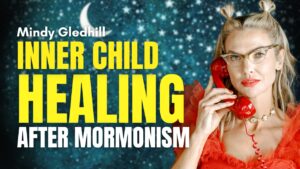
 We recently visited Provo, Utah and were treated with a live interview and performance featuring Mindy Gledhill, including acoustic renditions of many songs from her brand new album “Rabbit Hole.” Listeners of Mormon Stories Podcast may remember our earlier interviews with Mindy and we were very excited to get an update on her faith journey, and to hear the inspiration behind her latest project.
Her new album, appropriately entitled “Rabbit Hole,” is the breathy confessional of a rapt soul who slipped down the curious tunnel of experience, landed in a hall of locked doors, and refused to be contained. In “Rabbit Hole,” Mindy confronts the challenges of life—all its unfulfilled expectations, sudden detours, and existential wounds—and presents us with a silver lining through bouncy rhythms and ballads of unabashed optimism. In spite of life’s crucibles and crises, she reassures us that everything is going to be alright, and that “To be upside down is a fine way to be.”
________________________________________
Previous Mormon Stories episodes with Mindy:
- 597-598: Mindy and Dustin Gledhill, and their New Project — Hive Riot
- 599: Mindy Gledhill Discusses her Mormon Faith Transition
A Thoughtful Faith interview with Mindy:
________________________________________
Part 1 – Inspiration behind “Rabbit Hole”: This transcript is machine-generated and lightly edited for readability. The audio is authoritative. Please excuse occasional errors in names and spelling. Mindy Gledhill [00:00:02] Light fabricated to flight. John Dehlin [00:00:09] Mormon Stories is a production of the Open Stories foundation and relies solely upon the support of people like you, its listeners to help keep the podcast alive or to become a member of the community. Please become a monthly subscriber by visiting MormonStories.org and clicking on the Donate button on the right side of the page under support. All contributions to Mormon Stories are completely tax deductible in the United States and go towards producing the podcast and building communities and programs of support for Mormons like you. Thanks for your support. Hello everyone and welcome to another edition of Mormon Stories Podcast. I'm your host, John de lynn. It is February 12, 2019 and we are very excited to be recording this episode in front of a live audience at, I don't know, I'll call it the Mindy Gledhill Studios. What is this place called? Mindy Gledhill [00:01:21] It's called the Forge Collective. John Dehlin [00:01:23] The Forge Collective in downtown Provo, Utah. Can we have an applause everybody? Yeah. Live audience and we are here to celebrate and explore this incredible album that we've been waiting for for years. Whether we knew it or not, the album is called Rabbit Hole by Mindy Gledhill. And Mindy Gledhill is no stranger to Mormon Stories podcast. We did have Mindy on a few years ago to talk about her faith journey. Up until then, Gina Colvin also had her on for kind of a second part to that interview on a thoughtful faith. But between the two, if you want to go back and really dig deep into the story of Mindy Gledhill between those past episodes, you can geek out all you want. Today we're going to do kind of a summary. We'll get you up to speed. For those of you who don't know who Mindy is, for the three of you who don't know who Mindy is, we'll do a overview of her life. But Mindy is an amazing human. But she's also a singer and a songwriter and a musician. Some of you who followed, I don't know, Mormon efy music in the what, 2000s would have would have heard some of her music maybe on an EFY album or two. She also has several albums just as a solo artist. Some of the albums are Anchor is Mindy Gledhill [00:02:56] probably my most well known album. Pocket Full of Poetry, Winter Moon and Rabbit Hole. John Dehlin [00:03:02] And I remember Sparks. What's her name in Dancing with the Stars? Mindy Gledhill [00:03:10] Oh, Lindsey Sterling. John Dehlin [00:03:12] Sterling. She even chose your song for one of her dances. Mindy Gledhill [00:03:15] Yes, she used the anchor song for one of her dances. Yeah. John Dehlin [00:03:22] Mindy's a world class artist You've also done some collaboration with the pop electro music guy, Cascade. Cascade. Cody will know who Cascade is. So Mindy is a world class musician and performing artist and raised LDs. And today we're going to be celebrating her new album, which is in and of itself is a marvelous work and a wonder. But also it at least one of the themes from the album is exploring her faith journey and her experience as she's grappled and struggled with her faith. But it's about much more than that as well. And so we're just thrilled to have you guys with us to share in this story. Is there anything else we should add at the beginning before we jump in? Mindy Gledhill [00:04:13] I think you nailed it. John Dehlin [00:04:14] Did we nail it? Mindy Gledhill [00:04:15] Yeah. John Dehlin [00:04:15] All right. And what we're going to do, and we're super excited about this, we are going to be having Mindy and a few of her musician colleagues do performances of her songs in sort of an acoustic, minimalistic sort of arrangement to supplement this interview. So we'll kind of go interview song, interview song, interview song. We'll do some Q and A at the end and we reserve the right if there's some technical difficulty, to just plug in songs from the album if necessary. But I just want to cover the bases in case that. But I don't think that'll be necessary. But is that all right? Mindy Gledhill [00:04:55] That is all right. John Dehlin [00:04:55] Okay. All right. So without any further ado, Mindy Gledhill, welcome back. Let's give Mindy a warm Mormon stories welcome. Mindy Gledhill [00:05:05] Thank you. John Dehlin [00:05:08] All right, well, Mindy, there are going to be people that haven't heard our original interview, so let's just spend a few minutes giving them kind of the 500, you know, foot view of your early story as a Mormon. Just a quick overview. Mindy Gledhill [00:05:25] I grew up in a really awesome devout LDS family. Nine kids. We grew up on the north coast of California until I was 13, and then my dad got called to be a mission president in Madrid, Spain. So I lived in Spain for three years from the age of 13 to 16 and then moved to Provo and went to Provo High my junior and senior year. John Dehlin [00:05:49] And you're a winkle, right? Mindy Gledhill [00:05:50] Winkle is my maiden name. Mindy Gledhill [00:05:52] Yeah. John Dehlin [00:05:53] And that I'm sure that Spanish that you learned comes out a bit in the Adios Carinho song. Mindy Gledhill [00:05:59] Yes. Mindy Gledhill [00:06:00] One of the last track on the album is. Is in Spanglish. John Dehlin [00:06:03] Yeah. No, you have good Spanish and you did a Spanish song just recently, Right? Mindy Gledhill [00:06:07] I did a cover of Despacito that was awesome. John Dehlin [00:06:09] So check that out. That was really good. That was really good. And we got applauses already for that Despacito song. Okay, so your. Your final couple high school years were here in Provo. Mindy Gledhill [00:06:19] Yes. John Dehlin [00:06:20] And what. What. What did the church mean to you and your family growing up? Mindy Gledhill [00:06:24] Yeah, it meant everything. It was a part of just our everyday speak. Just everything that we did. It all revolved around the church. It was. Yeah, I mean, I'm sure, like a lot of people here, it was very central to everything we did. John Dehlin [00:06:40] So the typical family prayer, scripture study, family meeting, all that stuff. Mindy Gledhill [00:06:44] Yeah. And I think from the time I can remember, my dad always had callings that demanded a lot of his time. He was a bishop and then a stake president and then a mission president, and then got called to be in the second quorum of the 70 and was a temple president after he did that. John Dehlin [00:07:02] Your dad was a temple president? I'd forgotten that. Wow. Mindy Gledhill [00:07:05] Yeah. John Dehlin [00:07:05] Okay. Which temple? Mindy Gledhill [00:07:07] Sacramento. John Dehlin [00:07:08] Oh, cool. Okay. Mindy Gledhill [00:07:10] Yeah. John Dehlin [00:07:11] And how would you have described your. Your faith, testimony slash devotion in high school? Were you one of those rebellious kids? Were you like, Bali Mormon? Were you somewhere in the middle? Mindy Gledhill [00:07:23] I was very dedicated to the LDS faith. It was super important to me. And I just have a lot of, really, for the most part, a lot of good memories, like, of that being a part of my life and my upbringing. But, yeah, I wasn't a rebel in high school. It was, for the most part, just really important to me to follow the rules. And I was, I think, pretty good at being a rule keeper. John Dehlin [00:07:52] Okay. We're good at that sometimes. Mindy Gledhill [00:07:55] Yeah. John Dehlin [00:07:56] And what, what was your relationship to music? And as a high school kid, I Mindy Gledhill [00:08:04] was a late bloomer in music from, like, a technical standpoint. I took some piano lessons in elementary school, on and off, but that was the extent of my musical training. But there was always music around me. I just feel like music is such a big part of church. And so that was, you know, I think that's where music really entered into my life, is through religious worship. And I could hear music in, like, everyday little things, like the honking of the family van. I would, like harmonize, you know, like an interval with that in my mind or the frequency of the microwave, you know, just little things. So I feel like music was a part of me naturally. But again, just technically, I didn't have a lot of training, but my dad would always ask us to sing, like for zone conferences when we lived in Spain. And was it a musical firesides? My sisters all, I think, sing really well. And a lot of them took piano lessons. So in that way. Yeah, we were musical, but it never. Like, we never competed. Yeah. John Dehlin [00:09:14] Okay, so in high school, were you dreaming of becoming kind of a pop star or a Mormon pop star or whatever? Mindy Gledhill [00:09:21] Yeah, like, from the time I was 13, I remember I had, like, a little Walkman and I would make cassette tape recordings at the piano, and I listened to all of, you know, the. The LDS artists of the time, Michael McClain, Julie DeSavedo, who's in the audience, by the way. And. And, yeah. And loved all of that music. And just. I don't. John Dehlin [00:09:48] What about Afterglow? Did you listen to Afterglow? Mindy Gledhill [00:09:49] No, I didn't. That one was a little hard. John Dehlin [00:09:51] Anyone remember Afterglow? It was like Mormon's version. Mindy Gledhill [00:09:54] I think it was a little bit before. John Dehlin [00:09:57] What was the group? The Air Supply. It was like Mormon Air Supply. Was Afterglow okay? No, After. No Afterglow. Mindy Gledhill [00:10:03] No. Okay. John Dehlin [00:10:03] But Michael McClain, Julie Desvit. Yeah. Mindy Gledhill [00:10:06] And that was Efy Tapes that inspired. Yeah. Me to sit at the piano and wanna write. John Dehlin [00:10:11] So did you start writing songs? Mindy Gledhill [00:10:12] So I started. Yeah. And again, not much training, but just me, you know, plunking around on the keys and trying to figure things out. Okay, so. John Dehlin [00:10:22] Yeah. And so you always wanted to be a pop star. Did you think it would happen? Like, did you know it was gonna happen or. Mindy Gledhill [00:10:28] I think in my brain, I couldn't compute how people actually got there or did that. But I, like, really remember just in. I enjoyed the connection that I felt when I would sing with people, you know, at Firesides or at Zone conferences, when my dad would have us sing. And I enjoyed the feeling of sitting at a piano and, you know, playing and singing. I don't know, I just felt a connection in that and just felt so drawn to it, and that never left me. John Dehlin [00:10:58] So if I'm remembering our interview, you ended up at BYU and you ended up in the music program, which is super competitive, and you didn't have kind of that formal training that probably other talk about that really briefly. Mindy Gledhill [00:11:13] I got in, I think by sheer accident. You have to take a written exam three times to get in, and you have to audition. And I. Well, to back up just a little bit to give that some context, when we moved to Provo from Spain, I went to Provo high. I was 16, and I wanted to try out for everything. I tried out for the school musicals. Never made it. I tried out for the chamber choir. Didn't make it. I tried out for dance company. Didn't make it. And so I just thought, I can either Let this dictate my path for me and make it mean that I'm no good at this. Or I can let it feed a little fire inside. So I decided to let it feed a little fire inside. And I just kept auditioning for things, so. And I started to create opportunities for myself where I wasn't getting into anything. So I got an internship at a recording studio. I started a band, and we signed up to sing at the assembly. So I started to just do things on my own. And then when I graduated from high school, same story. Like, I tried out for women's course at byu. Didn't make it. John Dehlin [00:12:17] What? Mindy Gledhill [00:12:18] I tried out for Young Ambassadors. Didn't make it. I tried out for those singing and dancing shows at Lagoon. Didn't make it. John Dehlin [00:12:27] I love those. Mindy Gledhill [00:12:28] I even tried out for this group called the Latter Day Sounds. It was a fireside group, and I didn't make it. So that's a lot of. John Dehlin [00:12:36] I mean, failure. That's a lot of rejection. Mindy Gledhill [00:12:38] So all of that preceded auditioning for the music major at byu, But I think I had auditioned for so many things at that point and maybe built up, you know, a little bit of just resistance to being afraid of standing in front of a panel of judges because I'd done it so many times. So my audition went well, and I think I had things for my resume. You know, I was high school band, internship at a recording studio. So that looked good. But then the test. You have to take a written exam. They give you three chances. I took it the first time and failed. I took it the second time and failed. Just guessing on everything because I didn't have a music theory background. I took it the third time, guessing on everything, and I passed it by one point. So if I hadn't passed by one point, I wouldn't have gotten in, I think. Yeah. John Dehlin [00:13:28] So, yeah, that's amazing. It's a really competitive program. Mindy Gledhill [00:13:31] It is. Yeah. John Dehlin [00:13:33] That's a lot of resilience. Is that just how you've always been, or did you have to develop that? Mindy Gledhill [00:13:39] I don't know why, but I think I've always been a pretty driven person with the things that I want to do. Yeah. I don't know. Why John Dehlin [00:13:52] do you have that moment of discouragement? That story about, like, this moment of discouragement where you, like, you know, overcame it? And there's been a thousand of those along the way? Mindy Gledhill [00:14:02] I think a thousand of those along the way and still, like, for any aspiring artist. Yeah, I'm an independent artist right now, and, yeah, there are constant setbacks and challenges, and sometimes I'm just like, what am I doing? But again, that. Just that connection that I feel with people has never left me. John Dehlin [00:14:24] And at your core, what has music been about for you? Why do you do music? Like, do you have a core reason other than just love for it? Mindy Gledhill [00:14:31] Yeah, again, it's that connection. I just feel like music is this universal language that has the ability to transcend our borders and our languages, and it has this power to heal people. And it's a real therapy for people. And it's my therapy. It's how I process all of my life experiences. So every album that I've ever written is really just a reflection of what I was going through at that time in my life, including Rabbit Hole. John Dehlin [00:15:01] So. So tell us really quickly, kind of how you got into the. The business after graduating from BYU and. And talk a little bit about the connection between your early career and the church. Mindy Gledhill [00:15:15] So I. When I got into the school of music at byu, you know, things started to. The ball started to roll for me a little bit. I went to a workshop one day and played some of my music that I had recorded. And for the most part, the panel of judges that were critiquing songs kind of like picked it apart and kind of ate it alive. But there was one person afterwards who approached me and said, I thought that was really great. And his name was Jeff Simpson. He was the. The CEO of a company called Excel Entertainment at the time. And so I started to meet with Jeff and then Kenneth Cope, who produced my first LDS album. And yeah, they. They released my first record, so. John Dehlin [00:16:05] And what's it like to be a Mormon sort of pop music musician in terms of fans or listeners and reputation and place in the culture and in the community? Give us just a small. Are there, like, everyone thinks you're super righteous. Everybody tells you you save their testimony or you strength, you know, just what's that like, other expectations. Mindy Gledhill [00:16:32] I think I always viewed it as like a real honor. Like, I took it really seriously and tried to let it be something again that was about serving people and about just helping people through hard times. I. Yeah. So, I mean, I mean, I still, even now, like, I will meet people that will say, like, oh, you got me through my mission. Like, I listened to your music throughout. We burned your CD for our whole mission. And you know, like, it actually, like, that means a lot. You know, I don't take that for granted. John Dehlin [00:17:13] And. But it. But it seems like after that, maybe after the first album, you didn't want to be niched into Mormon pop music. Is that right? Mindy Gledhill [00:17:23] Yeah, there were some things that started to, like, I think, happen internally for me that just didn't jive with being signed to an LDS record label. And there was a bit of a. Like, a transition there as well. I was signed to Excel Entertainment, and then they merged with Deseret Book and kind of took over their record label at Deseret Book. So I was sort of grandfathered into Deseret Book's record label called Shadow Mountain. And I had started to record my second album with them and just kept feeling like. Yeah, just some dissonance with that. And I just. I think in that process, no one had noticed that my contract had lapsed. And when I noticed, I just asked could I pay for what we've recorded so far and take this music? And it wasn't really sounding like church music anyway. I just felt like this sounds a little more like indie pop music. It doesn't seem like it's gonna work anyway. And there were things that were difficult for me about working with that record label. I'm sure anyone could say that about any record label in the world. John Dehlin [00:18:28] And we talked about that in our interview. Some. So those who want the skinny in the details can refer to that episode. What are just a couple of the songs, the churchy songs from that first album that some of our listeners may have heard or may remember just to kind of jog their memory. Are there some biggest things. Mindy Gledhill [00:18:44] It's been so long, I'm having a hard time. Anyone in the audience know the Sum of All Grace is the name of the album. John Dehlin [00:18:49] Okay. Is that. It was the title track. Is that a tattoo on your wrist? Mindy Gledhill [00:18:54] Yes. John Dehlin [00:18:55] That's awesome. Okay, we'll get to that. We'll get to that. Sum of All Grace. Mindy Gledhill [00:18:59] Yeah, it's called the Sum of All Grace. A lot of the songs were actually cover songs of other Christian artists, like, who had had music careers in evangelical. You know, like, corners of the music market and the LDS music market and the other Christian music market really don't mix. I think they just. Again, there's animosity towards LDS because we're John Dehlin [00:19:21] not Christian to them. Mindy Gledhill [00:19:22] Yeah. You know. John Dehlin [00:19:23] Yeah. Mindy Gledhill [00:19:23] Anyway, so for. For some reason, I covered, like, a lot of those songs because people in the LDS market weren't familiar with them. So Small Enough by Nicole Nordeman was one on the album I Will Rest in you by Jackie Velasquez, I think is her name. Anyway, those were some of the popular. John Dehlin [00:19:46] Okay. All right, so let's kind of. So you did A few albums. A couple, two, three solos after that or two solo. Mindy Gledhill [00:19:54] I just did one album with Excel John Dehlin [00:19:56] Entertainment, but after that. Mindy Gledhill [00:19:58] Okay. Yeah. Then after that I bought my way out of, you know, that deal and just went independent in 2007 and released my first indie album called Feather in the Wind. And I've just been an indie artist ever since. John Dehlin [00:20:14] And then the other albums again are. Mindy Gledhill [00:20:16] It's been almost 12 years. John Dehlin [00:20:17] Yeah. Yeah. That's amazing. Mindy Gledhill [00:20:18] Yeah. John Dehlin [00:20:19] So Feather in the Wind, then. Mindy Gledhill [00:20:20] Feather in the Wind, Anchor Anchor, Winter Moon, which is a Christmas album. Pocket full of poetry, Rabbit Hole. And I did a Hive Riot. Hive Riot is a project that. It's an electronic kind of 80s throwback project that I did somewhere in there, John Dehlin [00:20:35] and that's what we featured. Yeah. So buy all those albums, listeners. I. I command you. And okay, so along the way, you married Ryan, right? Mindy Gledhill [00:20:48] Yeah, I married Ryan before, like somewhere along there. I was 19 when I got married and shortly after got that first record deal with Excel Entertainment. John Dehlin [00:20:56] And children. Mindy Gledhill [00:20:59] Yeah, we had our first son when I was 20, and then second son when I was 22. So I had two kids by the time I was 22 and then 30 when we had our third son. So we have three boys. John Dehlin [00:21:10] Three boys. Okay. And they're darling. Okay, so let's jump right into now the. Kind of. One of the main themes. How did the Mormon dream start to fray? Like, what happened to that EFY pop Mormon star? Like, what happened? Mindy Gledhill [00:21:30] You know, I think that there are an array of things that kind of happened. And fray is a great word, like little things that started to come apart one by one. And I think for me, like my original trip through the temple had some things that were really hard for me to swallow, things I wasn't prepared for. John Dehlin [00:21:50] But I think things, they've changed or. Mindy Gledhill [00:21:52] I don't know, I haven't. I haven't been in a while, in maybe five years. John Dehlin [00:21:55] For those who don't know, they've made a few changes recently, but okay, yeah, Mindy Gledhill [00:21:58] things that have changed. Yeah. So that was hard for me, but I just resolved to just, you know, I'll understand later. Just gonna be patient with this and have faith. John Dehlin [00:22:10] Probably some of the patriarchy or male female kind of things. Mindy Gledhill [00:22:14] Yeah. I didn't realize all of the little things that really made me feel like a second class citizen. And I would go out to my car after temple sessions and just kind of slump over the steering wheel and just weep and just ask God why it was so hard for me to go through something that I was raised to view as the pinnacle of my whole life experience and form of worship. And I just couldn't understand it. Why there was just so much dissonance there. So that just, like, kind of sat with me for a long time, but I kept going, just kept trying to understand. John Dehlin [00:22:59] Were you able to talk to Ryan about that at the time, or were you scared? Mindy Gledhill [00:23:01] Yeah, he kind of just didn't understand either, but. And he didn't. I think just because it was also kind of hard for him, he didn't go very often. So I would. I would just go on my own, usually, and. Yeah, just try to understand. John Dehlin [00:23:16] Okay, so that was where it started. Mindy Gledhill [00:23:19] That's where it started. Yeah. And so I remember going to the bishop and talking to him and just saying, why am I having such a hard time with the temple? Like, why does it make me feel terrible inside? And it seems to make everyone else feel amazing, you know? And he just said, I don't think you have to go to the temple. Just don't worry about it. And that also, like, didn't sit well with me because I was like, but my whole life I've been singing songs, like, since my childhood about going to the temple. I've had stake presidents that say, get to the temple. Get to the temple. How is it all of a sudden, just don't worry, don't go if it's bothering you. So I was like, something's just not adding up. But I think, yeah, I think that there were other things that I started to see that I just was blind to before, with inequalities, with men and women. And I think one time I was out to lunch with some friends who are both active in the church, and one of them said, do you know who Fanny Alger is? And I was like, no, I've never heard of her. And she said, well, sit to tea with this, Mindy. And then she told me the story of Fanny Alger. And I was like, okay. John Dehlin [00:24:40] For listeners who have never heard of Fanny Alger, give them the 15 second version. Mindy Gledhill [00:24:44] Okay. Not a historian. Forgive me if I get a few facts wrong. Fanny was 14, maybe 15, we aren't totally sure. She was kind of like a foster daughter to Joseph and Emma Smith. She lived in their home, helped out with their children. I think she was orphaned, but had an uncle and a brother. Maybe. Again, facts missing here. But living in Nauvoo. But Joseph. John Dehlin [00:25:16] I think it was before Nauvoo. I think it was. Mindy Gledhill [00:25:18] Oh, before Nauvoo. John Dehlin [00:25:19] Yeah, I think it was. Yeah, but that's Fine. Mindy Gledhill [00:25:21] It's all fine. Okay. John Dehlin [00:25:21] Anyway, 1834, 1835, something like that. Mindy Gledhill [00:25:25] Yeah. Just to make a long story short, Joseph married her in secrecy. Oliver Cowdery is quoted as calling it a dirty, nasty, filthy affair. And he was punished for that. John Dehlin [00:25:38] He was excommunicated, right? Mindy Gledhill [00:25:39] He was excommunicated, yeah. But I think what was really hard for me, I mean, that was hard for me because you just. None of this information is in the correlated materials of the church. Like, I just hadn't really thought about it. I just hadn't thought about Joseph Smith's wives. But after Emma found out, she was very upset and basically made Joseph annul the marriage. And Fanny was sent away to live in another state. And I just remember thinking for a 14, 15 year old girl how traumatic that must have been on top of the trauma of her life. You know, like getting to that point and just thinking, how is that from God? And I think that just initial question, like, when I really thought about that, I literally felt like this hole in the ground open and I felt myself fall. Like I felt like the rug had been ripped out from under my feet. Like just this house of cards, just. Yeah. And I think a lot of people know what I'm talking about when you come to those conclusions that like, this whole thing you've built your life on is suddenly, like, not true. And I was probably 30 or 31 when this happened, so I also felt like this sudden. Like I just was so acutely aware of myself as a grown adult woman having this experience, and somehow I felt shame or embarrassment like, that I hadn't seen this before. Like, I was just like, how can I be an adult and not have seen any of this? So that's. So I sat to tea, literally sat to tea with that and wrote an album with lots of Alice in Wonderland themes. John Dehlin [00:27:38] Because there's tea in Alice in Wonderland, right? Mindy Gledhill [00:27:40] Yes. Yeah. John Dehlin [00:27:41] Well, this seems like the perfect place to sing. Rabbit Hole. What do you think? Is that D? Is it all right? Is that all right? Mindy Gledhill [00:27:47] Yes. John Dehlin [00:27:48] All right, so we'll invite the musicians up. Mindy Gledhill [00:27:51] Okay. Mindy Gledhill [00:27:59] Little one, little one, you're on the run Like a flickering shadow in the sinking sun you've covered many miles now too many miles for being so terribly young. Little one, little one you hear the call of the wild in the woods when the darkness falls you take a tumble Clumsy lane it's nobody's fault you couldn't see sing now you're falling down. Terrifying and wonderful. Little one have a peek through the door and see to be Upside down is a fine way to be Mindy Gledhill [00:29:21] Come Mindy Gledhill [00:29:21] sit to tea drink your fears Swallow the river of your tears While there falling down rabbit Holy. And beautiful. Even when you're broken there are always doors to open new dimensions to explore. But you won't know until you a thousand pieces on the floor and your falling down the rapid holies Terrifying and wonderful. Thank you. John Dehlin [00:31:26] So beautiful. Mindy Gledhill [00:31:28] Thank you. John Dehlin [00:31:29] So beautiful. Thank you. Not to belabor the point, but just to touch briefly on Fanny Alger. And this is just insider detail, but part of what's troubling about Phani Alger, for me, it's her age. It's the position of power he had. But also what people don't understand is that the polygamy revelation didn't come until the Nauvoo period, which is in the 1840s. But it's even a little bit more complicated than that. The sealing power didn't come until years after. So if he indeed was sealed to her, he somehow did that without the sealing power and without the revelation that actually revealed the law of, you know, eternal marriage or whatever. Then you add the fact that Emma. He lied to Emma. And it's just. There's no. There's nothing redeemable about that story. And that must have been really hard for you to read. Mindy Gledhill [00:32:35] Yeah, it was. And I think even at that time I was like, I am only going to read, you know, LDS historian sanctioned, you know, pioneer journals or articles or whatever about this. I. I never read anything by anybody, but I think it was. FairMormon.org is where I read all of those journals. And yeah, those were really hard for me. And yeah, there are a lot of aspects of the story that are hard, but I think it was like that opened the door to, like, that's just the tip of the iceberg. John Dehlin [00:33:08] So where did it. Like, the rabbit hole is such a great metaphor. So how did it. How did it continue falling down that hole for you? What. What came after? Mindy Gledhill [00:33:16] Oh, so I just started to research all of Joseph Smith's wives and just had no idea that there were sisters, mothers and daughters, women who already had husbands. You know, like husbands who got sent away on missions and then he married them while they were away. And I was just. John Dehlin [00:33:33] And more 14 and 15 years old. Mindy Gledhill [00:33:34] Yeah, I think all of the distance that I had felt with just living in, within a patriarchal structure all started to make sense. I just think I felt like, oh, like this has been foundational to, like. I think a lot of just how the patriarchy started out and then the way that women are handled and treated, even today. So. John Dehlin [00:34:02] And around what year did that start? Do you remember? Around what year for me? Yeah, Mindy Gledhill [00:34:09] let's see. It would have been 2012. John Dehlin [00:34:15] So that's like. That's probably right before CES letter came on, before the church essays, long after Mormon Stories have been around. But you were learning about all this stuff, completely independent of all this stuff. Mindy Gledhill [00:34:29] Yeah. I had never heard of you. I had never heard of anybody doing a podcast or anything. I just felt like I was on my own on this journey, and I was, like, the only person in the world going through it. And this went on for a long time. And I had a friend. I only had a few friends, maybe two women, like, who I think I felt close enough to, like, reach out to. Well, that's not true. I had some sisters who had. Had gone through this journey, but I, again, I resolved, like, I actually am not going to go to my sisters to talk about this. I want this journey to be totally my own. I don't want anyone to ever say, oh, your sisters, like, were influential. I didn't tell them about it. I just kind of carried it on my own for a long time. But reached out to an artist friend of mine who you've also interviewed, Sarah Sample. And I just said, I'm. I am going through this thing. And I kind of get the feeling that you have, too. John Dehlin [00:35:28] You guys were on the Lower Lights together. Did you meet her before that even, or. Mindy Gledhill [00:35:33] Yeah, I knew her before Lower Lights. Okay. But anyway, yeah, she said, have you ever heard of this podcast called Mormon Stories? And I was like, no, I've never heard of that. So, anyway. But yeah, it was like, for me, it was. It really just saved me through that time of feeling like I was the only person just to hear, like, oh, there are other people who are asking these same difficult questions and who are. Yeah. Who are also going through this. John Dehlin [00:36:07] So how did you communicate this with Ryan? And what was that like? Was that hard? Mindy Gledhill [00:36:11] Well, he came home from church when I. After I had read the first article on Fair Mormon about Fanny Alger, and I was literally in a pile on the floor of the kitchen. John Dehlin [00:36:22] Literally? Mindy Gledhill [00:36:23] Literally, Yeah, I was on the floor. I felt like I couldn't even hold my body up, like, because I think just the realization of what this meant, like, just hit me that hard. So he was. I mean, he was really scared at first. Yeah. Just because it wasn't a story. It wasn't something that he wanted to, like, confront in his own life and think about, but he Held me and just, you know, comforted me as best he could. John Dehlin [00:36:54] And what. I guess everyone's devastation is similar and different. As you were feeling like everything was falling apart. What were some of the pillars of the, of those feelings of devastation or your fears or your regrets or. Can you. Mindy Gledhill [00:37:13] Yeah. John Dehlin [00:37:13] Describe. Mindy Gledhill [00:37:14] Yeah. Like you, when you're with operating within that paradigm, like, the first thing I went to was like, is this gonna affect my marriage? Like, will this like, turn my kids against me? Like, well, you know, you think you're gonna lose your family? And that's like, I can't think of a greater fear for anyone that has a family. So, yeah, there was that fear and then the fear of community. Like, how do I find my place in this community? I lived, lived and still live a few blocks east of BYU campus. Still don't know a single family that doesn't have some kind of LDS background in that neighborhood. I mean, there are some families that have gone through this journey as well, but like, I don't know, one family that comes from a different religious background or a different. Yeah. Different cultural identity. John Dehlin [00:38:07] Yeah. Mindy Gledhill [00:38:07] So, yeah, this fear of losing your community. And also I was a public figure to so many LDS people, so there was that component of it. Like I'm, you know, I'm kind of like have been in the spotlight and have been a poster child to LDS people in so many ways. So there was that fear also. John Dehlin [00:38:26] And with your, with your dad having had such a high profile position, that too. What was it like to contemplate having to tell your parents? Mindy Gledhill [00:38:37] That was also just so terrifying to me. And I, I just couldn't even do it for the longest time. And I think my dad started to notice, like, you know, and he's a very, he's a very soft like and soft spoken person. We don't like, get into super like, meaty conversations or anything. But he just asked me, you know, one day, like, I noticed you're not wearing your garments anymore. And he got emotional. And so it wasn't really. We didn't really, you know, talk about it much, but yeah, and that, that was huge for me, like letting my parents down. Super terrifying. I'm like shaking right now just thinking about it. You know, it's like. Mindy Gledhill [00:39:23] Yeah. John Dehlin [00:39:24] And some people kind of peek out and just say, I can't deal with this and want to just go right back kind of stuff. The genie back in the bottle. Mindy Gledhill [00:39:33] That's a good metaphor. John Dehlin [00:39:34] Did you think about that? And what kept you from being able to just go back in the shell? Because the risk and the pain is too great. Mindy Gledhill [00:39:45] You know, I think I've just always been a person that has. I have to live authentically. I have to. Maybe it's because I'm an artist personality, but I feel like I have to live my feelings out loud or I feel like I can't function. So I knew it was something that I wasn't going to be able to just step back in and just put a smile on my face and walk the walk and talk. The talk like that felt so painful. But again, I also didn't know how to move forward. So it was just sort of like shedding these layers, little by little of this identity that I had held my whole life. John Dehlin [00:40:28] So the. The next song that we have kind of on the list is called Icarus. And I. If I'm allowed to say this, I think it's my favorite song on the album. Although there's four or five that I adore it at a minimum. And that's just with, you know, five or 10 listenings to the album. But why don't you set Icarus up for us? Mindy Gledhill [00:40:49] So I think during this whole journey, isolation is like a huge part of it. So I think while I was trying to figure out how I would move forward and find my next steps, I felt really isolated. I felt like there weren't very many people I could talk to. I felt like I couldn't. You know, just even walking down the street, I. Even though maybe people wouldn't know what I was going through internally, I sort of felt exposed. You just go through this whole weird psychological thing. And so I think Icarus is kind of about that isolation. It's about. Well, it's about the. The story from Greek mythology where I can't. I'm gonna get all of my names and facts wrong. But Icarus's dad. Does anyone. Can anyone tell me. Daedalus. Thank you. John Dehlin [00:41:43] Got an English teacher over here. Mindy Gledhill [00:41:44] Yeah. He and Icarus went to prison because Daedalus wouldn't invent something for. Do you know the story now? I'm gonna forget the whole story I wrote the song about. Anyway, long story short, they were in prison and were trying to figure a way to get out. And Daedalus created these wings for Icarus, but made them out of wax and feathers. And he told Icarus not to fly too close to the sun. And so Icarus did fly too close to the sun, and the wax melted and he fell into the sea and he died. But I think that that story, I don't know, for me, I felt like there was a really beautiful imagery in there that I could relate to with falling into this ocean of questions and drowning in it. Just this ocean of, like. And just feeling so helpless and alone in that experience. So I just. Yeah, I felt like I related so much to that story. But then also there's a real element of the song that talks about carrying people when they go through this experience and carrying them when they fall into that, you know, ocean of questions and mystery. And so I feel like there's also, like, a hopeful element of the song. It's not all sad. John Dehlin [00:43:07] All right, we bring you Icarus, everybody. Video Clip 1 [00:43:17] What are those wings? What is that rust? What are those tied up things that make you look like Icarus? Somebody stole your fairy dust and now the weight inside your chest betrays your wonder lust so you fall into waves of a thousand questions asked but none explained and now all you can do is to trust that I'll be waiting here to carry you I will carry you Spectators come from far away like they have tickets to the circus on a Saturday caught like a child in a parade you spread your arms but when you wounded you can't fly away so you fall into the waves of a thousand questions asked but unexplained and now all you can do is to trust that I'll be waiting here to carry you I will carry you Smoke and fer moving through the sky Video Clip 1 [00:45:45] like Video Clip 1 [00:45:45] the tears that you. So very tired so you. Explain. Trust that I will be waiting to carry you carry you I will carry you, carry you what are those wings? What is that rock? John Dehlin [00:47:04] Icarus. So beautiful. Thank you. The next song on our list is called Lines, and we talked a little bit about before, kind of what that song means to you. And as you've described it, it talks a little bit about scripts. So why don't you talk about how maybe your life was scripted before and after and kind of what inspired this song? Mindy Gledhill [00:47:27] Yeah, so I feel like I was handed this script, like, from the time I entered this world, and a lot of parts of that script were really beautiful and great, but I. I just really went through this process of after, like, going down the rabbit hole, finding, writing my new script and realizing, like, how much I had not developed, like, my own, just skills of, like, authenticity and what's the word? Maybe differentiation. Autonomy. That's the word. When I was suddenly, like, I had to, like, come up with, well, if this script isn't working out for me, what is real, what is true? You know, basically just had a little existential crisis and so this song is really about, like, me writing my new script and like, also just kind of saying, like, don't. I don't want to be fed my lines anymore. I don't want, you know, my lines written for me. I want to. I want to write my own lines now. And it also, like, goes along with the whole. The same theme of sitting to tea with these difficult subjects. It's kind of my Mad Hatter tea party song. John Dehlin [00:48:43] All right, so lines is next. Video Clip 2 [00:48:59] Fabricated to flight airlines. Within sewing patterns pin and in their places, words blend them into a platter Words on a fanciful platter served Video Clip 2 [00:49:31] where Video Clip 2 [00:49:31] the matters to hide while we fake our faces but it doesn't matter now it doesn't matter now it's our just poison in disguise. Poison in disguise Cheek ups for love Candy coated lights. Shapes oh, society loves their shapes Cookie cut lights all have made, manufactured and sent through quality inspection two or maybe three or four times. The fun could be had if we only come to the tape to feast. I are imperfections but it doesn't matter now it doesn't matter now it's all just poison in disguise Teacups for love Candy cool. Poison in the skies Teacups full of candy coated Poison in disguise Teacups full of candy Co in po. Love can't decode it Poops for love can't be cool. Thank you. John Dehlin [00:53:03] So now I'm just super curious. Are there some particular lines that have been particularly hard for you to have absorbed and now to have to deconstruct and rewrite for yourself? Mindy Gledhill [00:53:14] Yeah. My role as a woman, what it means to be somebody's wife, a mother. All of those things that were scripted for me, I've had to reconstruct. Yeah. And just the way. There's just so much. I don't even know how to answer that question, but that one's really pivotal. Yeah. For me. And then just. Yeah. Thinking about, like the. The life after this, if there is one, just all of the script for what comes next after this existence. I think that one is really hard because this great plan of happiness is handed to you Mindy Gledhill [00:53:56] and. Mindy Gledhill [00:53:56] Yeah. And so then when you have to start over with that, what is the script for that? You know? And so I think for me, I've. At first that was a really terrifying thing. And now I think it's a really beautiful thing to live in the questions, to not have the answer to everything. That we're all in this together, that none of us really has the answer. Even the most spiritual beings on this planet just don't know. John Dehlin [00:54:24] So really quickly with. One very common thing for people to experience in a faith crisis is you kind of look over at your partner and you're like, wait a minute. I married you with the completely. With a. With a worldview that now is completely no longer any part of me. You know, number one, would I have even married you if I had a different worldview? And then, number two, do we even want to remain together? Because the pillars upon which our relationship was built have now kind of crumbled. Mindy Gledhill [00:54:56] Yeah. John Dehlin [00:54:57] How's Ryan doing? And have you guys had to kind of decide if you wanted to have a, you know, a renovation of your relationship kind of in this process? Mindy Gledhill [00:55:08] I think that the renovation of our relationship just kind of came naturally with the process. We didn't, like, sit down and, like, plan it out. It just kind of happened. But, yeah, I think for anybody in this situation, it would be terrifying and difficult, and it was for both of us. But we have, like, a better marriage and relationship than we ever had prior to this. John Dehlin [00:55:34] Now someone's gonna say, how's that possible with the gospel and its supportive families? And I know this because I counsel a lot of couples, but how in the world can a marriage improve after a disillusion of faith? Mindy Gledhill [00:55:50] Yeah, that's a great question. When I first started going through this, I actually went to see a therapist about this, and I actually felt like they gave me some really bad advice. But the therapist had also gone through this process, and they told me after I. At the very end, as I was leaving, they said, you know, I don't want you to leave on a downer note. But just. I also want to prepare you for the, you know, very great possibility that your marriage might not survive this. And. And a lot of people's don't. And I just. I don't know. I'm not. And maybe that's true. I don't know. But I don't know that that was a very fair thing for her to, like, somehow prep me as I left, like, that thought. And. And maybe it goes back to that thing about me where I have this drive and I'm so driven. When someone tells me, no, you can't do that, or that won't work, I'm like, yes, I can, and yes, it will. So I think I left more committed to my marriage than ever. And I think when you go through the trenches with somebody, you know, it can't always work out for everybody. And, you know, there are good reasons for that, but if it can, if you have to go to hell and back together. I think your relationship is stronger because of that. So I think that's what we've been through. John Dehlin [00:57:09] And what are a few ways that the relationship is better now than before? Just a few dimensions. Mindy Gledhill [00:57:14] Oh. Just so much less judgment, so much less shame. I just feel like I can say anything. And, you know, I don't think I felt like that before. I don't. Yeah. I definitely couldn't say exactly what I was thinking or feeling in our marriage prior to that. John Dehlin [00:57:32] So better communication, authenticity, which leads to vulnerability, which leads to better emotional intimacy. Mindy Gledhill [00:57:40] Exactly. Yeah. John Dehlin [00:57:42] That's awesome. I'm so happy for you guys. Mindy Gledhill [00:57:44] Thank you. Mindy Gledhill [00:57:47] Shapes. Society loves their shapes. John Dehlin [00:58:00] Thank you for joining us today on Mormon Stories. If you enjoyed this episode, please help us make more like it by becoming a monthly subscriber@mormonstories.org. Rabbit Hole an album chronicling the heartaches and rewarding discoveries of her Mormon faith crisis. You can purchase her album on itunes or by visiting mindygledhill.com. Mindy Gledhill [00:58:46] Candy cool.
Episode Transcript
Host: John Dehlin · Guest: Mindy GledhillIntroduction and Mindy Gledhill's Background
Mormon Pop Music Career and Early Success
Performing Rabbit Hole and Beginning the Faith Journey
Deconstructing LDS Identity and Navigating Change
Rewriting the Script and Marriage During a Faith Transition
Part 2 – Faith journey and more songs from “Rabbit Hole”:
Part 1
Part 2
27 Responses
Wow! I relate so much as a musician, teacher, and owner of Kaysville Piano Academy.
I teach and perform because I love music, and believe it is a universal language and an inspiration that gives meaning to my life!
Love, love, love this music! Thank you for performing for us!
Ditto to the above comment. Well done Mindy!
I’ve only gone through the first segment so far, but am very impressed. I have never heard music like you play, Mindy. I’m a 73-year old who plays, guitar, mandolin, electric bass, and banjo and have performed for audiences from 10 people to 1500, but usually as part of a band playing bluegrass, old country, etc. and sitting at home, I am now working on blues and jazz. I enjoyed the third number on this first segment and was able follow, playing lead on the mandolin. I had never heard a guitar player who muted his string so much. Tell your guitar player I liked his orchestral chording. And to your violin player, I won a fiddle (Still a violin but played by ear rather than note.) at a bluegrass festival raffle, took a few lessons, learned to play “Faded Love”, but decided to stick with what instruments I had and I gave it to another beginner.
It seems to me that this continuing faith journey is the most difficult in a sparsely populated rural area, since these areas are both more politically conservative and more religious. My wife and I still feel alone. I am within a mile radius of 5 active LDS, including a bishop. Yesterday I talked to a 44-year old doctor of mine who is still on the journey. His wife knows, as does his bishop. He lives in a neighboring ward, 25 miles from the ward where I used to attend, and still attends the temple, though he doesn’t believe in most doctrine. He told me that he still listens to Mormon Stories. He said he liked the John Hamer one. It helps to talk to him, but I could sure use more friends like him.
When active, I taught a 15-year old boy how to play guitar and became very close to him and his family, encouraging him to go on a mission, helping him to get his friend to marry him, by writing a song for him using his feelings toward this girl, and then singing it to her over the phone. And eventually after helping him meet a man who helped him get to Nashville, he returned to our area, and began a small kind of tour where I backed him and his wife, whom I also taught guitar and electric bass. Later we performed in front of 1500 people in California where he sold $4500 word of CD’s in 2 hours. I asked his wife recently why he rarely spoke to me in the past 6 years and she told me that he will never forgive me for dropping out of Church, I being his mentor in both music and the Gospel, and he will never forget. That was hard and still is and I can see his place from mine. I play music nearly every day, using You-Tube as my accompaniment. I, like you, feel music is such an important part of life. It helps with my daughter.
Sorry I am so long here. You look like you are near the age of my daughter, a still very active TbM, a piano teacher, guitar and cello player. She is my greatest loss, along with my 5 grandchildren. When she was in her last years of high school, our family played music together at very small venues, her on the keyboard, my wife on the auto-harp, and me singing and playing banjo or guitar. After high school, she went to Ricks, got married, helped put her husband to school, and eventually graduated from BYUI. But after I learned what I did, I told her first. Bad mistake! I forwarded a few Mormon Stories to her. Thought it would helped. Sure helped me! Since 2012, it seemed our relationship had strains. We used to be so close, canoeing and camping and hiking wilderness areas together, just her and me and occasionally with her mother. In December, she phoned, and was very upset, and hung up. Later I phoned her husband and he told me to try in a week. I did but her phone had a lock on it saying that my number could not go through. So I waited a week and wrote her a 3-page letter, sending it certified mail. No answer. I read that letter to three still friends and active LDS, and they approved of it. In it I told her I had told her of my faith crisis first due to our closeness. She was our only child and we adopted her from the Church at ten days old.
John, I still listen to many of your podcasts because they help with loneliness, especially in a rural area. Thanks! And thank you, Mindy, for being a musician and a fellow traveler.
Great interview! Awesome music!
Love Mindy’s laugh!!
“Down the Rabbit Hole” brought tears to my eyes! It expressed my feelings and experience so well. I just bought tickets to the Seattle concert. I, too, love Mindy’s laugh!
Mindy, if you can keep a 73-year old bluegrass-old country performer listening to all your songs here (The Bluebird Song, I liked best.) you are really doing something! Than you so much for your words telling of your experiences. It has really helped me.
Mindy
I’ve watched enough Mormon Stories Podcast videos of people who have left the LDS faith to know that it is an extremely difficult transition. It seems to be much like the grief process experienced by those who divorce or lose a close loved one. There seems to be a tremendous sense of loss that is part of the process. Some people also experience divorce or other family separation as an additional loss during the process. I am sorry you and others reading my comments had to experience that difficult process during your transition.
Another aspect of leaving the LDS faith that I hear about commonly is a loss of belief in God. Like you, a number of others who have left the LDS Church turn to love as their new position of faith. The words of your song put into words what others have not been able to express as well as you did. “Different names for God above, but they are all the same to me when we worship love.”
If you are going to worship love, you first need to know what it is. Based on your interview with John, I assume you are saying through your song that we don’t need God to be loving to others …that we can simply love each other without needing God. While that sounds good in a song, how do you eliminate God and still have any type of transcendent love? Without God, love is a pleasant delusion. It is simply our brain chemicals reacting in a manner that produces an emotional feelings. It has nothing to do with any real or meaningful transcendent relationship with another person. Love in a world without God is nothing more than a biochemical reaction in our brain.
If you want real love, you need a real God. I think Jesus represented real love better than any other human. That is because He was God in human form while he lived on the Earth. He is not our spirit brother, He was God when the universe began. He did not have to earn godhood, He was and is God from all eternity. The first chapter of the book of John in the New Testament tells us about the eternal position of Jesus.
I would like to encourage you to read the New Testament like a child. That will help you to understand who Jesus really is. He is not the person the LDS Church has taught you about. He is the person who is worthy of your love because of His love for you. His suffering and death on the cross paid the penalty for your sins, and for mine. There is nothing you or I can do to earn our salvation except to accept the payment he made when he died for us on the cross.
Ephesians 2:8-9 King James Version (KJV)
8 For by grace are ye saved through faith; and that not of yourselves: it is the gift of God:9 Not of works, lest any man should boast.
As a result of receiving salvation by grace, a saved person will demonstrate his or her love of Christ by the things she or he does and the way they live their life. Good works are a demonstration of our love for and appreciation of what Jesus has done for us. They flow naturally from a life lived for Christ.
I wish you all the best as you continue your journey through life.
Bill, the reason why many ex-Mormons don’t just change to mainstream Christianity is that after researching in depth and finding flaws, then the obvious thing to do next is to research other religions in a similar way. I did. After Mormonism, I felt that Jesus was the way until I researched Christianity in depth, the history of Christianity, The New Testament, The Hebrew scriptures, Judaism, and it didn’t take long before I found the same believed legends in Christianity that I did in Mormonism. I have found that mainstream Christians know no more of their history than the Mormons do about theirs. If a Mormon wants to remain true to their faith, they should never read, study, and research in depth. This is the same advice I would give to any of the thousands of Christian faiths or Muslims, or Jews.
Great podcast, John and Mindy!
ROMANIA IN THE SPRING
Before I address your comment I would like you to know that I try to reply to people in a gentle and respectful way. Based on your earlier comment about your daughter and grandchildren, as well as your other comments, you have had an extremely difficult journey. I can’t even imagine how difficult that must be to experience. I have said in other comments on this site that I don’t have all the answers. I’m not an apologist. I’m just a regular mainstream Christian who became interested in the Mormon people after being approached by and having discussions with a number of LDS missionaries.
I am sincerely interested in what you believe and what evidence you have for what you believe is true at this point in time so that I can better understand your world view when I answer your questions. I am very interested in knowing the truth. Once you tell me what you believe and why you believe it, perhaps we can discuss our differences.
It is a disorienting feeling having your spiritual foundation pulled out from under you. Out of the rabbit hole can truely be wonderful. Leaving Mormonism happily did not take my faith in Christ it just provided for a deeper and ongoing sense of His unique position in the universe and our relationship has grown. I found getting back to the ancient Christians and Biblical roots before the reformation most helpful in establishing the teaching of authentic Christianity. A little Gregorian chant also helps sooth the soul.
I’ll tell you some of the books and/or courses. I have taken a few of the Great Courses online college lecture series: “History of the Bible”, by Bart Ehrman, “Beginnings of Judaism” by Isaiah Gafni, “The New Testament” by Ehrman, “The Old Testament” by Amy–Jill Levine, “How Jesus Became God”, Ehrman, “The Darwinian Revolution”, “How The Earth Works”, “Cultural Literacy For Religion” (comparative world religion).
Books: “Muhammad” by Juan Cole, “Faiths of the Founding Fathers” by Holmes, College of Wm and Mary religious studies, “The Triumph of Christianity” by Ehrman, “Restored New Testament” by Barnstone, Tyndale Translation. “Religulous” by Bill Maher, “The God Delusion” by Richard Dawkins, “The Jefferson Bible” by Thomas Jefferson.
Watched many online debates: Harris, William Lane Craig, Dawkins, Lawrence Krauss, and many I can’t remember.
Watched many BBC “The Big Questions” discussions in Britain, with participating audiences made up of Anglicans, Muslims, African fundamentalist Christians, female Rabbis, agnostics, atheists, Catholic priests on all subjects relating to religion and morality, LGBT.
I am currently taking a lecture course on the First Amendment which will discuss the meaning of the establishment clause concerning religion in a country not founded on the Christian religion.
As for my belief, I cannot prove that the Christian god does not exist but I cannot prove that the god, Zeus does not exist. I would be an agnostic in that I find no evidence that a supernatural being exists. For a while I believed as did many of our country’s Founding Fathers such as Washington, Franklin, Monroe, James Madison believed. They did not believe Jesus was divine, but as I studied evidence, I came to my opinion.
And as for knowing the truth, there is no such thing as universal truth because truth is defined differently by different cultures, nations, and religions. I have a close neighbor who believes in absolute and universal truth and he is a strong Mormon. I have a friend who is an evangelical fundamentalist Christian who says his truth is the absolute and universal one. And I get the same thing from my Jehovah’s Witness friend. And I have been talking lately to my internet repair man who says that Messianics have the truth because he follows Jesus of the Bible and observes the Law of Moses.
Many religions seem to help their members better face death.
ROMANIA IN THE SPRING,
Thanks for the informative reply. You seem to have a Significant amount of Ehrman and other very skeptical individuals among the people you have read or watched. I can understand why they might influence you away from a belief in God. If you haven’t yet seen the Mike Licona and Frank Turek Mormon Stories Podcast, that might be a place to start for another perspective. If you read the comments section of that podcast you will see a number of comments and linked videos that I provided. That will give you a good starting point for understanding why I think it is more reasonable to think there is a God who is responsible for creation.
https://www.mormonstories.org/podcast/defending-christianity/
I don’t think I linked this video in that podcast. It is by Michael Kruger. He is specifically addressing many of the issues Ehrman has raised about the New Testament. Someone has added some rather melodramatic interludes between segments, but otherwise it is a video that will at least show you that others have different opinions than Ehrman.
https://www.youtube.com/watch?v=J5AkDOsc4fA
As far as universal truth, there is either a God or there is not. There is either salvation or there is not. Jesus either rose from the dead or He did not. In each case one of the two is true and the other is false … whether we can prove them or not.
If there is no God, the atheist position begins with absolutely no intelligence on the primitive Earth and rapidly progresses to the most complex coding system we know about in the universe … the DNA code in the first reproductive bacterial organism. Rapidly (from a naturalistic time frame perspective) developing that level of complexity (the DNA code and a bacterial cell) without any external intelligent input seems totally illogical to me. If you read the comments and watch the linked videos in the podcast I linked you will have a much better idea of why I think atheism is much less reasonable than a belief in God. Thank you once again for your reply.
The problem with trying to prove the divinity of Jesus is that your exclusivity is no different that the other Abrahamic religions. I don’t have to prove that your god does not exist. The burden of truth falls on you as well as on other religions. I’ve listened to Mice Licona on other debates besides the Mormon Stories interview and I, today, am watching a “Big Questions” discussion. I study science and I have listened to young earthers like Kent Hovind. I find no evidence in their bizarre ideas. I study geology enough to see evidence of what I believe, even though agnosticism is not a belief. Most Christians I have talked to “Know” there is a god because they have felt him or they talk to him, just like Mormons “know”. Rather than feelings I use evidence or the lack thereof.
I studied Amy-Jill Levine of the Vanderbilt divinity school, and Judaism under a professor at Hebrew University in Jerusalem. And I study National Geographic archeology.
And if you get your ‘truth’ from the Bible, and the Bible is the source of truth, then why do Jews not believe in Jesus as the messiah?
If you believe that the Christian god is the only god as opposed to Greek gods or Roman gods or the Muslim god or the Summerian gods, where is your proof? And your use of the Bible is no better than using the Qur’an. The burden of truth is with you. I am not an atheist in that I “know” that there is no supernatural invisible deity. So far as I can tell there is no scientific evidence of one or more than one.
I am not opposed to others believing in a god as long as they don’t try to use government in this country to force me to believe or practice the doctrines of their religion. Our Constitution is a secular document for a nation that was not founded on the Christian religion.
ROMANIA IN THE SPRING,
IF you study science and like evidence, please read the links I provided and watch the videos. Once you have done that we will have a place to begin a discussion.
I may have time to look at your videos sometime, but you sound identical to the evangelical I conversed with by e-mail over 2 years. We finally figured we weren’t going to change each other’s minds. And we traded many, many links. And while I watched most of the videos he sent on science, how evolution has been disproved, how there is proof of his god and how inerrant the Bible was and how he had learned a lot from his trips to the Holy Land, he rarely looked at what I encouraged him to watch. He kept telling me that I could not recognize truth because my many years as a member of Satan’s church (Mormon) had blinded me.
I am not an atheist, but an agnostic and there is a difference.
But you believe there is only one god, though in three parts, but that trinity term, not in my Bible, sort of falls apart if we look at when Stephen was stoned, looked up to heaven and saw Jesus on the right hand of god which would mean that he saw Jesus on the right hand of himself. And why do Christians think that their god is a changeable god? And what do Christians think about the god of the OT? If he is Jesus and Jesus is thought to be a loving god, why do scriptures show him to be a murderous, genocidal, deity?
And I don’t just read Ehrman’s ideas on the NT because he doesn’t talk enough on the OT. I read Dan Barker, Francesca Stavrokopolu, Lawrence Krauss, a theoretical physicist , Neal DeGrass who was too advanced for me. For a while I leaned toward Messianism. I studies eliyehu.com and the Hebrew Roots of Christianity. I read two Seventh-Day Adventist books where the author was the only non-Catholic allowed to study Catholic archives in the Vatican. Here I learned about the Biblical Feasts and YAHWEH’s commandment to observe them forever, and I learned about God’s calendar. I have a close neighbor who began as a Baptist, progressed to being a Messianic, and then to a Karrite. I was invited to go to the Feast of Tabernacles and observe the Day of Atonement and participate in other feasts. I even read an LDS author’s book on why Mormons should know about the feasts, especially the Passover that Jesus observed. And at a quarterly SDA meeting I observed the actual washing of feet. I have attended a Catholic Mass, 9 different Christian churches in my area. And, as to science, I began my college education as a geology major, having collected rocks and studied mineralogy as a high school student. In my earth science class in HS, the instructor used me and my good friend as advisors to him. And through “The Great Courses”, I have completed 2 lengthy advanced geology courses. I study the Bible because of it’s effect on Western Civilization and will continue to study.
I love facts and I study PEW Research a lot on religion, especially noting that all Christian churches in the U.S. are currently on the decline, except Mormonism. And I see how much one group in the U.S. is at 25% and growing rapidly. And I have learned that by the beginning of the next century, Islam will surpass Christianity as the world’s largest religion. I read a lot in the LDS Church but I only read LDS books. Now I read all kinds of material. I’m just trying to get through the First Amendment and finish a book on Muhammed.
And, Bill, If you don’t have the originals to the Bible or of the manuscripts that made it into the Bible, you have no way of knowing whether you version or translation of the Bible is accurate. That is why the first Ehrman book I read, “Misquoting Jesus” , made so much sense. Unless you have the original, then all your points along with the video on the authorship of the Bible, especially the Gospels are moot. And unless you can prove that Christianity is superior to all the thousands of world religions, using your holy book is not based on reality. And for me, I have no need for religion, be it Christianity, Judaism, Jainism, Sikhism, Shintoism, Shamanism, Confucianism, Buddhism, or Hinduism. A lot people in this world seem to need religion, but I don’t.
Truth is not the same as traditions. The Jews didn’t accept Christ as the Messiah because of the pride and sin of that generation. The ancient prophets were stoned for similar reasons. I see little difference in those that choose to turn away from the restored gospel of Jesus Christ in our day. The vast majority of the time, it’s because of some commandment they don’t want to keep and they use some “doctrinal teaching” as an excuse. This has been my experience anyway. Best of luck to each of you on your journey, but I HOPE you’re being honest with yourselves. I say this as one who has struggled with all the noise that is out there, and my own selfish desires to not have to follow the covenant path.
ROMANIA IN THE SPRING
Thanks once again for your reply. I was hoping you would read what I had written and check out the links so that you would have a better idea of what I think about some very important topics. Let me address the first of your two comments initially. I will not change your mind … only God can do that. I am not going to tell you evolution has been disproven, but if you read my linked comments you will understand that there are some serious questions about abiogenesis in particular and molecules to man evolution from a chemical perspective. I linked James Tour who is one of the most brilliant synthetic organic chemists in the world. He has openly challenged his colleagues for over ten years to show him the chemical pathway for molecules to man evolution to occur. No one has answered his challenge. Please do not reply to this comment of mine about science until you have read and watched what I have written and linked. If you want to have an intelligent discussion, you need to understand what I have already written and linked on the other podcast discussion.
Let me give you just one scientific fact to help you begin to understand my position. According to an article I referenced in the links I gave, the interactome of a simple yeast cell is so complex that just the possible or potential protein-protein interactions alone number about 10 to the power of 79 billion. For reference, all the particles in the universe (protons, neutrons, electrons etc) are estimated on Wikipedia to be less than 10 to the power of 90. As I noted in the comment I wrote, even the scientists who wrote the article knew that was far too large a number for the chance assembly of a yeast cell in any reasonable amount of time. If you like science, read and watch what I linked.
Another example of exponential numbers is paper folding. I have seen figures on line that folding a piece of paper on itself about 104 times (if that was even possible and you had a big enough piece of paper) the folded paper would be thick enough to cover the known universe. If I understand the concept correctly that would be 2 to the power of 104 times the thickness of the paper. That is why the number 10 to the power of 79,000,000,000. is such an impossibly large number for our brain to comprehend. The potential number of protein-protein interactions in a yeast cell don’t prove God, but they strongly suggest that there is an intelligence behind life.
I hope I am not the type of person who will tell you that you cannot recognize truth because of your experience in the Mormon faith. As I noted earlier, I have had discussions with a number of individuals who are currently members of the LDS faith. I have found them all to be very intelligent people. I liked all of them very much. Based on what you have written, I think you are also a highly intelligent and well educated individual. As I have written elsewhere, I have a great deal of respect for the Mormon people … both in and out of the church.
Based on your comment about having the long and ongoing discussions with a Christian, I know I can’t answer all of your questions. A person you might find interesting to watch on You Tube is Mike Winger. Mike is a youth pastor who makes many videos and commonly dialogs with and answers the questions of atheists and other very skeptical people during his live stream videos. He has a great many videos about the accuracy of the Bible. He has also appeared on atheist website videos to try to answer some of their concerns.
After your experience with the LDS religion, I can understand why you think you don’t need a religion. In some ways, I agree with you. On the other hand, If the Bible is true you do need a savior. Jesus said “I am the way the truth and the life. No man (person) comes to the Father except through me.” Rejecting the free gift of salvation through Jesus is a very serious matter. I hope and pray that you will eventually establish a relationship with the only person who can give you the most precious gift that it is possible for anyone to give. Eternal life.
Bill, the second that you tell me the almost same thing that Jehovah’s Witnesses, Evangelicals, and Mormons tell me: “only God can convert you”, I wish to go no further. I have a close TbM neighbor who likes to tell me, “Just pray and the Holy Ghost (of the Mormon Church) will tell you the truth (and re-convert you) And I have a JW friend who says basically the same thing. So such a statement makes me think you don’t know what an agnostic is. Online definition is close: “An agnostic is a person who believes that nothing is known or can be known of the existence or nature of any god or of anything beyond material phenomena.” And as for the god of the Bible, to me a deity that is portrayed in the pages of that book, would be a deity that all men should avoid like the plague. You need to try to get your god to convert people who do not study the KJV Bible or else can rationalize like another neighbor who tells me “Murder is not really murder or bad if God commands it.”
But one thing, your encouragement to read your materials has made me put three Richard Dawkins books on my to be ordered from Amazon list.
ROMANIA IN THE SPRING
Thank your once again for your reply. I was trying to show you that it is much more likely that there is intelligence that is responsible for life on the Earth from a scientific point of view. Since you are not interested in reading what I wrote at this point in time, I will try to show you from a philosophical perspective my understanding of your choices.
You wrote that you are agnostic so I would like to offer two alternatives. Either there is a God or there is not. Let’s look at the philosophical implications both positions. I have written elsewhere that (according to the atheist position as I understand it) without God we are nothing more than cosmic debris on an insignificant planet in a vast universe. We have somehow, over millions of years, eventually self organized and coalesced as a result of being complexly and intricately constructed in the womb of another coalesced form of biologically encapsulated cosmic debris that we have labeled human. The cosmic debris that makes us up has mysteriously developed both an advanced form of intelligence … in comparison to the other creatures on our planet … and a higher form of consciousness.
After we are born we continue to grow and exist because the substances we drink or eat are mysteriously converted into various parts of a growing body that is made up of a trillion or more extremely complex cells that have differentiated into various body parts and systems . Philosophically speaking we can assign meaning or value to ourselves or others while we are alive for a blink of cosmic time but, since we are basically cosmic debris at the very essence of our being, whatever we assign is meaningless, purposeless and valueless … just like the cosmic debris from which we originated.
The end of life without God is a process of decomposition and degradation from a more coalesced and biologically encapsulated form to a more basic and elemental form of the cosmic debris from which we originated. In the end, we have accomplished nothing that has meaning, value or purpose because of our basic nature of being a self organized form cosmic debris that is itself meaningless, purposeless and valueless.
These are the philosophical implications of the position taken by any true atheist like Dawkins … as I understand his position. Of course he will not openly state this position, but it flows naturally from the things he has stated he believes. If I don’t understand his position correctly, I am open to having you explain it to me. I am very interested in learning how you can get any meaning, value or purpose if we originated from the cosmic debris that formed our planet and eventually formed humans according to the atheist philosophical position.
It is very different if there is a God. The Bible describes a God who created us with real meaning, purpose and value. We are valuable to Him as his children. Our worth is priceless. He is the one who is responsible for the complexity of our creation and our formation in the womb. He has also provided an eternal home for us if we are willing to accept His free gift of salvation.
I have already made my choice. I believe there is a God who loves me with a love that is real and has real meaning. I also believe your life has real, transcendent meaning purpose and value because God also loves you. I have chosen to love God in return for His love for me. You are still able to make that same choice while you have the breath of life He has given you.
Having written these things, I also know that if I had been dealt the same hand in life that you have been dealt that I would probably have similar thoughts to the ones you have. I experienced a significant loss fairly recently when my wife died of an uncommon form of abdominal cancer. There is a lot of pain that was and still is associated with that loss. Even though I haven’t had your same experience of loss, I do know deep pain. That is why I have at least a little understanding of your position. It is my hope and prayer that you will eventually make a choice to love God in return for the love he has given you through the excruciating suffering He experienced as the result of beating, mocking, humiliation and finally death on the cross. He did that for you and for me while He was on this Earth in the form of the man Jesus.
You have a choice to make ROMANIA IN THE SPRING, you can follow Dawkins and try to find meaning from cosmic debris or you can turn to Jesus. The choice is yours. Based on your age, your time is limited. It is my hope and prayer that you will make the best use of whatever time you have remaining on this Earth. If you understand the Christian perspective at all, I hope that you will understand that I honestly and sincerely want the best in life for you. I write these words from the perspective of true Christian love for you and the many others who read these words on the Mormon Stories Podcast site. As I said, I understand deep pain. I at least know what the deep valley of pain in life feels like. It is not easy and I can’t come close to providing you with all the answers. I hope what I have written has at least provided you with a little more insight into some very difficult decisions you have to make as you continue your journey through life.
That evangelical neighbor, I told you about, sent an e-mail to with another new video that will for sure show me the error of evolution, along with some philosophy and telling me that my time is short and I need t o prepare for the Kingdom of God.
One of my reasons for not getting excited about any of this is because there are so many religions out there with them”knowing” they are correct and have the only true god or gods. Like you they believe what they teach.
Differing from Ehrman on this subject, I can’t be sure from historians of the time (whether their words are accurate or not) that Jesus did actually live. And even if I did, I would have to go against much evidence that he is part of the tri-une deity.
When it comes to Jesus, I have also read and watched videos by Richard Carrier of Columbia University who doubts there was a Jesus. And from reading a fair amount of the OT, I agree with Dan Barker, that scriptures in the Bible only show a deity that had I been a believer, I would want to stay far from.
There are many characters in the OT that I could believe existed as long as I did a lot of rationalizing which I am not prone to do. I also read Online Bible Studies which are varying length of NT studies by scholars associated with Bible scholar Francesca Stavrokopolu, a professor of religion at one of the big British universities, who is an open atheist. And by the way, Richard Dawkins calls himself an agnostic. And I enjoyed the documentary, “The God Delusion”.
As for philosophy, I have watched many William Lane Craig debates and he only uses philosophy. I have watched him debate Sam Harris, Dan Barker, and Lawrence Krauss. This stuff gets pretty boring to me.
At first I was a nominal Christian like my mother, studied with Campus Crusade For Christ, then attended a Presbyterrian Church Sunday mornings and a Baptist Church Sunday nights for a school year, converted to Mormonism for 40 years, then became a mainline Christian for a bit and then leaned toward SDA and then a Messianic and then a Karrite and then a deist for a while and then an agnostic/atheist, and I have never been happier. My marriage is going great now and I think that is what really counts. I don’t care whether most people I meet think I am lost because I do not believe in their god. And now I just like to study all kinds of things and enjoy nature.
ROMANIA IN THE SPRING,
Thank you once again for your reply. I appreciate that you have kept our conversation as friendly as it could be based on the differences we have in our belief systems.
According to this video link from 2013, Richard Dawkins claims to be an atheist. These are his own words. https://www.youtube.com/watch?v=IwcIq42WpjI. Perhaps he has now changed to an agnostic because it is an easier position to defend philosophically. Whatever the case, everything I said in my previous comment still applies. If there is no God we are nothing more than an advanced form of coalesced, biologically encapsulated, intellectually advanced, conscious cosmic debris.
In case you were not aware, Lawrence Krauss, who was mentioned a couple times in your comments, has recently been accused of sexual misconduct and has elected to retire from ASU. He has been dismissed from his former position according to a news article I read. I am simply including this for your information. It is up to the court system to decide his guilt or innocence.
With all your diverse experience in life, I’m sure you know that the truth of Christianity stands or falls on the resurrection of Jesus. I am convinced by the evidence. People like William Lane Craig and Gary Habermas have many excellent resources about this subject. Obviously, you are not convinced that the resurrection occurred or even that Jesus lived. Even Bart Ehrman believes Jesus was a real person. At least according to a video quote he made stating that fact.
One person you didn’t mention is Jim Wallace. Jim is a former cold case detective who was a confirmed atheist for many years. He was convinced by the evidence of the truth of the Bible and the resurrection. In case you are ever interested, I will link one of his many videos. This one is specifically about the resurrection. There is a plug for his book Cold Case Christianity from the 18 to 20 minute mark if you want to skip that part. His homicide detective background gives him a unique perspective for investigating the evidence for the resurrection of Jesus.
https://www.youtube.com/watch?v=QbBVHRcHgx4
There are many, many questions about God that we will never have answers for in this lifetime because God has not provided them for us in the Bible. I can only make sense of some things in the light of eternity. No matter what caused the death of someone during his or her lifetime on this planet, everyone will face a just judge when they die. I believe the God who died for me in the form of the man Jesus will make the correct judgment for every person who faces Him at the end of her or his life. It is at that time that all injustice on the Earth will be resolved. Present and temporary sufferings and difficulties will be replaced with an eternity of joy with the Lord for everyone who is judged worthy of that privilege. Whatever decision God makes, I have every confidence that it will be the right one. Then, and only then, will true justice prevail.
Once again I wish you all the best as you continue your journey through what is oftentimes a very difficult journey through life.
Mindy, Your description of coming out of the temple and just laying your head against the steering wheel in your car and crying… I can’t tell you how many times I did that. The anguish and tears and punishing myself for not having the faith to understand it and feel good about it. And now the church just magically removes the offensive stuff from the temple and will pretend like it was never there. Ultimate gaslighting and so offensive to those of us who suffered with it for so long (almost 20 years for me). If that stuff wasn’t necessary for salvation, why was it there in the first place? Why did I have to suffer so much with it? Anyhow, thank you for your candor. This interview spoke to my soul.
Bill, That evangelical has been working on me like you do, for about 4 years now. And I remember something about the forensic case he sent me. And he said he was a good friend of Kent Hovind and sent lots of evolution stuff to me, and stuff about a guy named Wyatt who supposedly found chariots at the bottom of the Red (reed) Sea, though we only have Ron Wyatt’s proof of that. And I read a lot on Ken Ham at the Creation Museum with the dinosaurs in the Garden with Adam and Eve. But I have also read the book “Noah’s Flood” written by two geophysicists drilling in the Black Sea giving evidence of a large regional flood corresponding closely to the Biblical one. And I have read “The Epic of Gilgamesh”, another flood story before the Hebrew one. I have really read a lot.
The way you talk to me with such surety is very similar to the way I used to talk. I had a tendency to share my beliefs with people I would find wherever I went. In the last LDS ward I attended I was considered a super-missionary. And I would use Biblical scriptures far more than did other Mormons and it was easy to get non-Mormons thinking because very few mainstream Christians new their scriptures. I would shock them regarding three heavens, more than one god, baptism for the dead, Revelation’s statement about not adding to a book, missing scriptures that the Bible talked about, two creation stories, killing of homosexuals, non-believers, people who looked on the arc, people who cursed their father, adulterers, fornicators, and after a war, telling soldiers to keep virgins for themselves. Then I would mention that the Bible is the word of God as far as it was translated correctly. Mormons like to use Exekiel 37 to prove the coming forth of the Book of Mormon (A bit of a rationalizing stretch but no more that the one in Isaiah about born of a virgin and Jesus). I used to go into Christian bookstores and bear my testimony regarding the truthfulness of the Gospel and the truth of the Book of Mormon, being the word of God, or reading the part in 3 Nephi where Jesus comes to this hemisphere. At a bookstore in Sandpoint I mentioned to the clerk that I was Mormon. She then spoke in tongues (gibberish) and I bore my testimony and walked out.
One time while my wife and I were visiting my wife’s parents, their son was home from college. He was acting strange. I later found that he had been through an exorcism and his mother had been concerned about his conversations. That night that son and I talked about the Gospel, with me using Bible scriptures. I felt I had more power because I possessed the holy Melchizadek Priesthood of God. I knew many scriptures back then. The next day I learned from him that he was trying to get out of a Satanic group of some sort. Long story-shortened, he returned to college and I later visited him and introduced him to Mormon missionaries and they took over. He came back to his parents and all was quiet. One day missionaries phoned me from the area of his home and asked for my help getting him to show up for teaching appointments. I did via long distance. No more word for 2 months. Got a call from the son asking me to baptize him. Met with him, drove 30 miles to a stake center, where I was interviewed by a stake president for worthiness and then I baptized this son in a font. I don’t remember everything but I have 500 typed pages of my person history, a recommended procedure in the Church, but few do it. [I tried extra hard in the Church.]
I have had several times when I have cast out what I thought were demons; I once talked to a rebel Catholic priest visiting from Ireland for several hours ending with him promising to read the Book of Mormon I gave him which had my testimony written in it.
And I don’t get startled if you tell me about indiscretions of some scientist/atheist. Whatever you tell me about anybody doing anything, no one, I repeat no one can do the things an evil deity tells his prophets to do and tell others to do in the Bible. I just do the best I can do to help people and be as honest as I can to assist humanity. I once had an active Mormon high priest say to me, “Brother, you are just too darn honest!”
Richard Dawkins told the Archbishop Dr. Rowan Williams that he never said he was an atheist.
With all I’ve told you, and listening to Mindy, you might want to think twice about answering that missionary knock on your door. But if you read on FAIR Mormon, you might even get converted to Mormonism!
ROMANIA IN THE SPRING
Once again, I appreciate your reply and your cordial tone. You wrote the following. “Richard Dawkins told the Archbishop Dr. Rowan Williams that he never said he was an atheist”. No matter what he said to the Archbishop, the first words in the link I gave you were as follows. “I’m Richard Dawkins. I’ve been an atheist since I was a child.” If you go back to my last comment and click on that link you can hear him in his own words say that he is an atheist … at least at the time he made the comment.
I have linked scientific evidence that I think makes it much more likely that there is an intelligence behind life. You wrote that you did not want to look at those links at this point in time. I have given you evidence from philosophy that without God we are nothing more than cosmic debris. I have not seen any evidence that you disagree with the philosophical position that I wrote about if there is no God.
The other thing I wrote about in my last comment was that we may not have answers on this side of eternity. There is a story I heard about eternity. There are variations on this story but the one I heard had to do with a small bird and Mount Everest. As the story goes, the small bird flew to the top of Mount Everest and picked up a pebble in its beak. It then flew out to sea where it dropped the pebble and flew back to the mountain top for another pebble. When the bird died, one of its offspring did the same thing. That happened continuously until the mountain was nothing but a flat plain. As the story goes, all that time for the sequence of birds to flatten Mount Everest represents one day of eternity.
My comment about God, eternity and judgment was intended to suggest that God can do some things that seem to be very difficult to understand … like some of the things you have commented about. When considered from a purely human perspective in the blink of time we have to live, those things are hard to understand. It is only when we look at things from an eternal perspective that the difficulties begin to make sense. I worship a God who was willing to suffer and die for me on a cross. I trust that same God to make things right in the end. In my opinion, eternity is the answer to many of the difficulties you have raised.
It is also my opinion that the two of us have monopolized Mindy’s comment section long enough. She is such a nice person who has been blessed with so much talent that I think it is only fair that we allow others more opportunity to comment at this point in time. I thank you once again for the conversation and continue to wish you the best in life.
Thank you, Mindy, for your music and for sharing your story. I did follow your advice and purchased/downloaded your newest album from iTunes. Thanks, John, for bringing Mindy to us in this thoughtful podcast.