
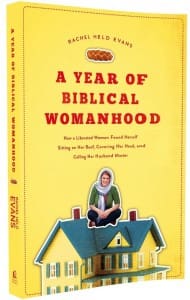
 As the 9th feature of our Mormon Stories Book Club series, we feature Rachel Held Evans and her book A Year of Biblical Womanhood. Rachel Held Evans, from Dayton, Tennessee, is an American Christian columnist, blogger, and author of two books, A Year of Biblical Womanhood and Evolving in Monkey Town. You can read about all of Rachel’s fabulous and impressive pursuits on her blog . I was nervous to reach out to Rachel and invite her to be on Mormon Stories podcast. Rachel’s book is, after all, a New York Times best seller, and Rachel is, well, not a Mormon. Rachel put us all at ease right away, however, and was warm and friendly. For me, talking with her confirmed that we—evangelical Christian women and Mormon women—have much in common. I look forward to having more dialogues like these with our sisters from other faiths.
The first segment features Rachel, accompanied by podcast host Heather Olson Beal and readers Erin Hill and Stephanie Lauritzen. The second segment features just Heather, Erin, and Stephanie talking about Mormon connections, links, and reactions to Rachel’s book. Please support Mormon Stories by purchasing A Year of Biblical Womanhood through this link. A small amount of the proceeds go to help support Mormon Stories.
Episode Transcript
Host: Heather Olson Beale · Guests: Erin Hill, Rachel Held Evans, Stephanie Lauritson
This transcript is machine-generated and lightly edited for readability. The audio is authoritative. Please excuse occasional errors in names and spelling.
Introduction and Welcome
Part 1 of 2 · Ep. 424
Heather Olson Beale [00:00:00] 1, 2, 3. Mormon Stories Podcast is a production of the Open Stories Foundation. All donations to Mormon Stories are fully tax deductible and go directly towards keeping the podcast alive and towards building a community of support for Mormons like you. To support the podcast or to join the community, please become a monthly subscriber today@mormonstories.org. hello, everybody, and welcome to the latest edition of Mormon Stories Podcast Book Club. I'm Heather Olson Beale. I'm the podcast host, sorry to say, hostess. That sounds like a hostess cupcake host. And I'm very excited and nervous today to be here with Rachel Held Evans, who is the author of A Year of Biblical Womanhood. And Rachel is not a Mormon, so she's kind of coming in from the outside. But there's lots of really cool things in her book that cross over, I think, into topics and issues that I think Mormon Stories listeners will resonate with. And I'm here also with Stephanie Lauritson and Erin Hill. So let's just do a quick introduction of the three of us, and then we can let Rachel do a little bit more. So, Erin, you want to give us a little quick intro?
Erin Hill [00:01:23] Sounds good. I'm Erin Hill. I'm in Bryan, Texas, an English teacher and enjoyed the book very much. Excited to hear Rachel talk about it.
Rachel Held Evans [00:01:33] Cool.
Heather Olson Beale [00:01:34] Stephanie.
Stephanie Lauritson [00:01:36] I'm Stephanie Lauritson. I am also an English teacher. Hooray. I'm in Salt Lake City, Utah, and I'm also very excited and kind of fangirling in an awkward way. So, yeah, I'm excited.
Heather Olson Beale [00:01:51] And I'm Heather Olson Beale. Most of the people who are listening to this probably know me from other podcasts and stuff, but you don't. Rachel. I'm from Texas. I'm an education professor, and I've spent almost my whole life in Texas and Louisiana and had many not good interactions with evangelical Christians. I'll just say growing up Mormon, the worst one that I sometimes tell people, if I want to, like, try to show my street cred as having grown up in the Bible Belt, is that I actually was. I got beaten up by two girls in the fourth grade who said that I was. That I worshiped the devil and I was a member of a cult and everything. And so, yeah, I sort of grew up feeling like I hope no one ever finds out that I'm Mormon because it's very not cool in my town and because a lot of people really were, really were mean. So it's interesting to see kind of those dividing lines that we draw. We try to say who's you know, who's. Who's one of us and who's not, anyway. But I actually did love this book and I've loved sort of getting to know you a little bit through this and through your blog. I have a friend who's. Whose husband is a Methodist pastor, and that's how I first even heard of you, because she was posting links on Facebook and I just read and I was like, oh, my gosh, I love this. Who is this person? This is amazing. This is so inclusive and just really, really beautiful. Anyway, so I've been inspired by a lot of your stuff, so I'm excited.
Rachel Held Evans [00:03:22] Well, thank you for having me. I'm absolutely thrilled to be here. And I think it's great that we're going to have this dialogue. And it seems like you're doing a lot of the same stuff I'm doing, but from maybe a slightly different perspective. So I think it's great. I think we have a lot more in common than people might think.
Heather Olson Beale [00:03:39] Yeah.
Rachel Held Evans [00:03:39] Yeah. I'm sorry you had a bad experience with evangelicals. I think all of us have had at least a few bad experiences. Evangelicals. You're not alone.
Heather Olson Beale [00:03:49] Yeah, I'm not alone. And I know that many people have had bad, undoubtedly bad experiences with Mormons too. So I was not meaning to be like, whoa, so sad. Everyone's so mean. I didn't mean that at all. But it has definitely colored sort of my just, just. It's been an important part of my. My growing up experience. And now I'm here in Texas, I have three kids, and. And they have some of that, although it's much less. Much less intense than it was for me. Yeah. Anyway, I wanted to just do a little introduction. You said that you'd read a little bit about Mormon Stories just to kind of frame it for you. So. Mormon Stories is a secular organization that has no official ties to the Mormon Church. There have been people kind of over the years that have tried to say, oh, you people in Mormon Stories are trying to start your own church, which is totally not true. We're not doing anything church like. But Mormon Stories produces podcasts that focus on different aspects of Mormon life, Mormon history, cultural things, doctrinal things. And last summer, John de Lynn, who started Mormon Stories, thought it would be kind of fun to do. To do a book club, a monthly book club. And I sort of signed on and said I would like to do that. So we've done. The other books that we've done have been written by Mormon authors. So you're the first. This is exciting, but Mormon Stories takes in people who are. Well, Mormon Stories is many things to many people. Right. People that are, you know, true believing Mormons, more orthodox, less orthodox Mormons who aren't sure about some historical things or miscellaneous doctrinal issues, but who love the church. Mormons who are not sure about lots of different things, but for whom Mormonism is still a really big part of their families. There's LGBT Mormons, and then all these kind of different Mormons have kind of spun off into different Facebook groups and everything. So lots of the people that we're interacting with, like Stephanie, for instance, I've never met. I only just know her through these kind of Mormon stories themed. It's bigger than Mormon Stories, but Facebook groups, so. And I like to call myself a misfit Mormon. That's sort of my label of choice. But it's kind of a virtual space for people who are wanting to explore sometimes complicated issues like that we can't talk about in Sunday school, basically for miscellaneous reasons. So from having read your book, I feel like that's something you can probably.
Getting to Know Rachel Held Evans
Rachel Held Evans [00:06:18] Yeah, I think we're definitely. We are kindred spirits. It sounds like you're doing pretty much exactly what I do on the blog and with my books. And so I think we're going to have a lot to talk about. And it's encouraging, too, to see that happening in the Mormon community. You know, a place and a space where you can dialogue and talk about things and maybe bring up those questions you feel kind of scared to bring up in Sunday school. That's exactly what I do. And it sounds like that's what you guys do, so I think we could be friends.
Heather Olson Beale [00:06:46] Yeah. Cool. I was going to read a little snippet that I found on your blog that says that you regularly question traditional evangelical stances and that you wrote somewhere, I don't know where. We aren't looking for a faith that provides all the answers. We're looking for one in which we are free to ask the questions. So, yeah, I thought that was very cool. So tell us a little bit about yourself just so we can get a little bit more information about you and then we'll dive into the book.
Growing Up in Dayton, Tennessee
Rachel Held Evans [00:07:14] Sure. I grew up in Dayton, Tennessee, which is home of the famous Scopes Monkey Trial of 1925. It is definitely. It's actually the community where the phrase Bible Belt was coined. So I really feel like I truly come from the buckle of the Bible Belt here in Dayton, Tennessee, and grew up in the church and had always Been known for having a really close relationship with God and was always celebrated for being sort of the Bible girl and the big church girl. I won the Best Christian Attitude award three years in a row at my Christian school, so I was kind of super Christian. And then in young adulthood, I just started having some really serious questions about my faith and started doubting a lot of what I'd been taught growing up and just kind of began this journey through doubt and skepticism and questions. Wrestling with a lot of different issues with faith in science, politics, certain doctrinal things, and certainly women's roles in the home and the church. Began blogging about it and writing about it. My first book is Evolving in Monkey Town, which is kind of a nod to growing up here in Dayton. And then my second book is A Year of Biblical Womanhood. And in that book, I committed one year of my life to following all the Bible's instructions for women as literally as possible, sometimes taking them to their most literal extreme. And that's the book that's gotten quite a bit of attention and everybody wants to talk about. So, yeah, that's a little bit of my story. And I blog@rachelheldevins.com and I love blogging because it gives me the chance to interact with readers and interact with people who are asking some of the same questions that I'm asking. And there's always a comment in the comment section that's significantly more thoughtful and researched and personal than my original post. And so I'm really grateful to my readers just for always bringing something interesting to the conversation. So I spent quite a bit of time on the Internet talking with people and hashing out some of these issues. And I just feel really grateful to get to do this for a living. It's crazy. I feel really, really blessed to do it.
Heather Olson Beale [00:09:30] Cool. Awesome. Yes, Stephanie has. Stephanie has a blog, and Aaron and I write. Ha. I've definitely seen blog posts of yours, Stephanie.
Stephanie Lauritson [00:09:42] No, no, I know it exists.
Rachel Held Evans [00:09:43] It's just.
Stephanie Lauritson [00:09:44] Anyway, sorry, continue.
Heather Olson Beale [00:09:46] I just was gonna say Aaron and I write for a group blog, but also emerged out of this sort of Mormon Internet land a couple years ago, so. So, yeah, we can relate to that. And it being a really cool space, like you said, to talk and hash out, hash out issues. So I really appreciate that. So, yeah, let's just dive in a little bit, and I'd like to have you talk, just kind of explain a little bit more about what you did and maybe kind of what the genesis of that idea was. I mean, it sounds crazy. Like, when I First saw, you know, the COVID of the book, I thought, oh, my gosh. I mean, I've seen the book. Who wrote the Year of living biblically? Yeah.
Inspiration Behind the Book Project
Rachel Held Evans [00:10:28] A.J. jacobs wrote the Year of Living Biblically.
Heather Olson Beale [00:10:31] And that. I also. I haven't read it, but I thought, wow, you know, that's just nutters. But then when I saw this, I was like, well, now this redefines crazy. So talk to us a little bit about. About. About where the idea came from or. And just kind of explain a little bit what you did.
Rachel Held Evans [00:10:49] Sure, sure. Well, growing up in the evangelical Christian subculture, and. And from what I understand, it's not that different in a lot of ways, especially in terms of gender, to the Mormon subculture, I always heard about biblical womanhood and how, as a woman, I should strive to achieve true biblical womanhood. The problem was nobody could seem to agree on exactly what biblical womanhood meant. And in evangelicalism, there's a big divide between Christians about what roles for women are appropriate, what should women be allowed to teach and lead in the church. And so there's a lot of controversy sort of surrounding this idea of biblical womanhood, and nobody could seem to agree on exactly what it meant, even though we were all appealing to the same text. And then secondly, any claim to a biblical lifestyle, whether it's biblical womanhood, biblical manhood, biblical marriage, is inherently selective because technically speaking, it's biblical for a woman to be sold by her father to pay off debt. It's biblical for her to be required to marry her rapist, biblical for her to cover her head when she prays. And that's in the New Testament. So there's all of these elements of biblical womanhood that tend to get kind of swept under the rug. Sometimes people will say, oh, well, just because something is in the Bible doesn't mean it's biblical, which to me is about as clear as mud. So I had all of these questions sort of circling around me growing up in this culture and wanting to do the right thing, but also feeling like I never fit that mold of biblical womanhood. There's a lot of talk about Proverbs 31 and being this sort of domestic goddess, which I am most certainly not. And so I wanted to challenge this idea that the Bible prescribes a single lifestyle for all women. And I wanted to do it in kind of a creative and funny way. So I said, okay, you know what? I'll try it. I will try a year of true biblical womanhood. No picking and choosing, taking every passage of scripture to its most Literal extreme, just to kind of show that none of us are practicing biblic womanhood all the way, and that maybe we should think a little more critically about what we mean when we throw around phrases like biblical womanhood. So I did a bunch of research and isolated every passage that in any way relates to women. I did a bunch of interviews with women who are maybe practicing biblical womanhood in different ways. So I interviewed an Orthodox Jewish lady, and she helped me a lot through some of the Old Testament stuff I was less familiar with. I spent some time in Amish country. I even interviewed a polygamist family, and they're part of an organization called biblicalfamilies.org which I thought totally proved my point. And it's actually an evangelical organization, which I thought was interesting. So I did a bunch of interviews and included a lot of those in the book. And then finally, I tried to observe as many of the biblical instructions that relate to women as literally as possible. So I had to submit to my husband all year. I had to cover my head whenever I prayed. I observed the levitical purity codes, which meant for I only did this once for 12 days during my period, and then seven days after, I was considered ceremonially impure. And I couldn't touch any man at all, not even my husband, which was awkward because we went to a wedding during that time, and everybody was out dancing and having a good time. And they were like, rachel, come up and dance with us. And I had to shout above the music, I can't. I'm on my period. I'm impure. Which, you know, it was one of many awkward conversations that went down during my year of biblical womanhood. So I kind of, you know, I took a page from AJ Jacobs. I loved his book the Year of Living Biblically. And I remember thinking, wow, this would be totally different if a woman did it. But I never had thought to try it myself until I just started getting in conversations about what it meant to be a woman and a Christian. And so many people were appealing to biblical womanhood without, I think, really thinking about what that meant. So I thought this would be a funny, disarming way to have that conversation and to introduce that conversation. So I tried to make it funny, self depreciating, but then also a somewhat serious exploration of the various texts involved. And why do some get more airtime than others? And what is biblical womanhood really?
Heather Olson Beale [00:15:12] Yeah, I thought you did an amazing job of. I mean, yeah, there are parts that are funny. I mean, laugh out loud funny, but then also, really, you Know, serious stuff. I loved the little things at the end of each chapter that kind of dig into a particular story. I thought those were really neat. And, yeah, I just thought it was an absolute, absolute pleasure to read all around.
Rachel Held Evans [00:15:37] Oh, thank you.
Heather Olson Beale [00:15:38] It was very cool.
Rachel Held Evans [00:15:39] Always means a lot.
Heather Olson Beale [00:15:41] So, Stephanie or Erin, does either one of you guys want to ask her anything about what she just. What she just shared?
Erin Hill [00:15:47] Well, let me jump in. One of the things I like about your book is how you pull in your family and especially you pulled in your husband. I loved his little journal entries because obviously, your year of biblical womanhood is gonna impact the people that you're living with and interacting. And early on in the year, you know, you invite your family for Thanksgiving. And a part of that that I thought was really poignant is when you talked about Mary and Martha and how often people like to sketch one or the other as kind of a cartoonish figure, as though there's, you know, one right way, and yet both of them are biblical women. So I was curious about the reaction to your book and project within your family or within your evangelical circles, like, the people who were kind of living this year along with you. What did they say? What did they think? How did they respond?
Rachel Held Evans [00:16:36] Yeah. Yeah, Great question. You know, it was great that Dan kept a journal throughout the year, because what I didn't want to happen was for him to come off as, like, this guy who just kind of went along with his wife's crazy schemes when really whatever I do has a big impact on him. And we did this together as a team, like we always try to do. And so I really wanted his voice to come out in the project. A lot of times people will tell me their favorite part of the book was Dan's journals, and I'm never quite sure how to take that because it's the only part of the book I didn't write. So I'm like, thanks. But I'm so glad he was able to. So you can kind of track. It's fun to see his take on something I did. So you get my take on it first and then Dan's, which is always a little bit different. But, you know, everybody, my friends and family and Dan, everybody was really supportive. My close friends and family. And they really got a lot. I mean, they kind of got the good end of the deal on this because I was making lots and lots of food, and I was celebrating all of the Jewish holidays, which meant, you know, we were feasting and drinking, and they really enjoyed it because I would invite people over for food all the time. And. And that was fun. I mean, I really did come to appreciate more than I had before the benefits of hospitality. Again, I don't think there's just a single right way to be a woman of faith, and I don't think that women are required by the Bible to excel domestically. But there is something to be said about focusing on hospitality and trying to open your home to other people, even if you're, you know what, it's not perfect. And so that was a cool thing that I learned. And my friends and family were really helpful. I mean, there were a lot of questions at first, you know, about what, why is she doing this? But, you know, as soon as I started making the food, everybody was pretty much on board.
Erin Hill [00:18:30] Excellent.
Rachel Held Evans [00:18:31] Yeah, we had a. We had a great time involving them. I mean, there were always. There's always people who are critical of the project, but my closest friends and family are always very supportive, and I'm very grateful for that.
Reception and Controversy of the Book
Heather Olson Beale [00:18:44] All right, so could you speak a little bit? Like I mentioned at the beginning that. Or maybe this was before we started recording that, I had read some. I mean, I went out, I read a bunch of reviews, and there were many that were very, you know, praiseworthy, but there were many that were very angry and critical. And so it was interesting to me to see kind of as an outsider, how different kind of factions were forming, you know, and I'll just share just briefly and then ask you to answer that. I mean, I get that, like, recently in kind of Mormon Internet land, there's a group that has launched called Ordain Women that is saying, you know, we're faithful Mormon women and we love our church and we want to discuss the idea of women being able to be ordained. And it's similar. You can kind of see where those dividing lines start to, you know, where people are saying, well, you know, you can't do that, and you're, you know, you're trying to be God and all this. You know, one of the blogs that I wrote about your book was saying something about how it was clear that the Bible was being put on trial in the court of Rachel Evans, I think.
Rachel Held Evans [00:19:54] Yeah, I remember that one.
Stephanie Lauritson [00:19:55] Do you?
Heather Olson Beale [00:19:56] Okay.
Rachel Held Evans [00:19:56] I mean, always remember, the mean ones are the most critical. The really kind ones. You tend to forget. It's just human nature, I guess.
Heather Olson Beale [00:20:04] And so maybe you don't. Maybe you don't even read them. I don't know. But I'd just like to hear kind of, if you could. If you could talk a little bit about what those reactions have been like kind of outside of your family. So in evangelical circles, whatever that, you know, whatever that might include.
Rachel Held Evans [00:20:19] Well, I knew when I wrote this book that some people were just not going to like it. There are entire organizations within evangelicalism focused around biblical womanhood, and they tend to be complementarian organizations and complementarian authors. And complementarianism is basically the idea that God created men and women for different roles and that men are always called to lead and women are always called to follow. So they would not support women in leadership in the church and they feel that women's main calling is to serve from the home. Whereas I tend to identify more in the egalitarian camp, which is that leadership in the church should be based on giftedness and calling, not on gender. And that women can honor God in a variety of occupations. And it's more about your character than your roles, and it's more about your following Jesus Christ than it is about living up to a certain stereotype or idea of gender. So that's kind of where in evangelicalism people tend to fall. And I knew that this book, because it was sort of challenging the idea that biblical womanhood is this clear cut single lifestyle. I knew that certain people would really not be happy that I'm challenging that idea. And obviously this is an inherently personal topic. You can't talk about women, the Bible and women's roles without it touching on some really personal stuff. A lot of us make big decisions in life based on what we think God has called us to do as men or as women. And that's one of the reasons why I tried to write it with humor and tried to make it more story based because I hoped that that would be disarming and a way to sort of broach this topic without being angry, without being contentious. And for the most part, I think I accomplished that. But then there's always going to be people who, when you start to dissect and deconstruct this idea of biblical womanhood, or biblical manhood for that matter, they're going to have a problem with it because for them, biblical womanhood is about sticking to a very strict list of rules and roles, do's and don'ts. It's about conforming to a single lifestyle. And, you know, so the criticism tends to be clearly, this woman hates the Bible or she wouldn't have written this book. And that's always really frustrating because I wrote the book because I love the Bible so much. And I hate seeing it reduced to an adjective like this. I hate seeing it reduced to a sort of blueprint or a list of rules and roles. And so, you know, the criticism is I knew it was going to be there and so I'm not surprised by it. But that doesn't mean it doesn't hurt sometimes, especially when it gets kind of personal or they make comments about how they imagine my relationship with Dan to be or, you know, but that's. I knew that was going to happen. And I try to, as best I can, graciously disagree with people. I don't always succeed at that. Sometimes I get a little defensive and I think that's normal. But I wasn't really surprised by it. I knew that that was coming and I had kind of prepared myself for it. But the reality is you can't get too kind of cold and closed off. I mean, I'm always tempted to be like, oh, you know what? All these guys are criticizing me and I'm just going to toughen up and get really strong and not let anything get to me. And one time I was giving Dan this whole lecture about how, you know, I can do this. I'm just going to have to toughen up if I'm going to make it in this industry. And I'll never forget he turned to me and he said, rachel, I'm so proud of you for having such thick skin. I'm so proud of you for being so strong. But please, whatever you do, don't lose your sweet tender heart because that's part of what makes you Rachel. And of course then I'm just crying in a big puddle because it's the sweetest thing I've ever heard. So I think it's important when you're criticized to keep. Grow thick skin. Yes, but keep your tender heart. And that's what I've tried to do. I do it imperfectly, but it's important not to become so strong that you lose your sense of vulnerability. And that's a hard balance to strike. But I'm trying and failing at it most of the time, but I'm trying.
Mormon Women Respond to Biblical Womanhood
Heather Olson Beale [00:24:42] Wow. So Stephanie and Erin, as you were listening to her talk about biblical womanhood, were you guys doing what I was doing, which was like saying, oh my gosh, like this is my life. Just.
Erin Hill [00:24:54] Oh yeah, just check, check parallel.
Stephanie Lauritson [00:24:56] Okay?
Erin Hill [00:24:57] Uh huh. Yes, absolutely.
Stephanie Lauritson [00:24:59] Yeah, totally. Because I mean, I think the thing that I related to most was she was growing up in the Bible Belt and talked about that. And I am in Salt Lake City. And not just in Salt Lake City, but in a really conservative part of Salt Lake City. And I teach in, like, you can see three LDS temples from my school. It's like the heart of Mormondom. And I felt that I definitely related to that idea that, you know, you were growing up and you were starting to question things and the reaction from people around you who are maybe more conservative or. And we have the same complementarian. We call it something different or we don't have a name for it at all, but we have that same idea that men and women are inherently different and have these different roles. And when you start to question that, the backlash to that is really strong, especially where I live. Like, people see you as sort of like, attacking their choices if you make a different choice. Not everybody. I don't want to make generalizations. There are lovely people here, too, but, yeah, just totally going down a checklist, being like, oh, we're not that different at all. And my husband's name is also Dan. And so when I was reading the book, I'd be like, dan, she's doing the same stuff. She has the same stuff as me all the time. It was really beautiful because I didn't know a lot about evangelical Christianity at all growing up here, and it was so enlightening to see, like, hey, there are people outside Utah having the same experiences and similar questions and not the same, but very similar. And it was. It was great. It made me feel less alone in the world, if that makes sense.
Rachel Held Evans [00:26:37] Yeah. Oh, and that makes me feel the same. It's encouraging. Every time I hear somebody say, I so related to this. It's exactly my experience. It's like, I feel. It's sort of like the. What do they say you write to feel less alone. It's so great to write something, whether it's on the blog or in a book, and then hear other people say, hey, that is. I am going through the very same thing. It's encouraging both ways, you know, like, it just makes you feel less alone.
Erin Hill [00:27:04] Yeah.
Stephanie Lauritson [00:27:04] I liked.
Erin Hill [00:27:05] I actually really. And I know we're maybe going to talk about this later, but I loved this kind of community, actually community through history, that you're creating these women of valor. And I really loved. At the end, you were reflecting on maybe why you've done it, and that part of it was to gain permission to be a woman is a really poignant part. And then you note that after the end of this year, you already had that. No one had to give you that permission. And I think that that's very empowering for women in a variety of faith traditions to realize there's no external permission that has to be given. You already have it.
Rachel Held Evans [00:27:41] Yeah. And, you know, I really loved looking to the various biblical women to arrive at that conclusion because all the women that are most celebrated in scripture, you look at, you know, Ruth and Mary of Nazareth, Mary Magdalene, Mary Bethany, all the Marys, Huldah, Jael, Junia, Priscilla, all these interesting women who are celebrated and affirmed in scripture and none of their lives looked exactly the same. And I think that's really important to keep in mind. You know, we often use the Proverbs 31. I don't know if this happens in Mormonism as well. I'm guessing it does. Proverbs 31 is always sort of presented as the model for biblical womanhood. And so I always sort of hated that passage because, you know, this is a lady who like gets up before the sun rises and works until the sun sets. She spends hours at the loom, she makes food for her family. She's basically like a Pinterest board come to life, you know?
Erin Hill [00:28:43] Yeah, she's exhausted. I'm tired of thinking about her.
Rachel Held Evans [00:28:46] It's just like, it seems so impossible. And I always felt like I was falling short of this standard. But it was interesting. My Orthodox Jewish friend helped me understand this passage much better as a celebration of what women have already accomplished rather than a to do list for things they have to do. And sort of the first line that carries that poem is, you know, a woman, a virtuous woman who can find. That's how it's usually translated. But the best Hebrew translation is the Hebrew that's used there is eshet, Hail a woman of valor. So it's a woman of valor who can find. And ahava, my Orthodox Jewish friend, was explaining to me that the women in her culture sort of use this as almost like the Jewish you go, girl. So if you plan a birthday party for your 5 year old and it manages to go well without the house burning down, you would turn to your. Your friend would turn to you and say, eschat heil, woman of valor. Or if you want to celebrate a woman who's finished her chemo treatment, you would say, eschat heil. You're a woman of valor. It's meant to celebrate what women have already accomplished and not serve as this sort of to do list. And in fact, the only instructive language you see in the poem is directed towards men and it says, praise her for all her hands have done. And so really, it is not an instructive piece for women. It is a poem of Celebration. And the only instruction is that this is how you celebrate and affirm a good woman. Don't forget to do that, which I think is great. And I think it is interesting, too, that Ruth is identified in Scripture as a woman of valor. Eshet Hyel, the same phrase used in Proverbs 31. And yet Ruth's life looked nothing like the Proverbs 31, woman's life. Ruth's life, it is called a woman of valor. When she was a widow, when she had no children, when she was dirt poor, she wasn't exchanging fine linens with the merchants, she was gleaning leftovers from the field. She was so in such a bad place, and she didn't have children. Rising up to call her blessed, she had no children. So I think it's really interesting that Both the Proverbs 31, Woman is called a woman of valor, and also Ruth is called a woman of valor. And then there are women like Priscilla and Junia and Phoebe and Huldah and Deborah who are celebrated as women of valor in Scripture. And none of their lives looked exactly the same. None of them conformed to the Proverbs 31 standard when it comes to lifestyle, but they conformed to that standard when it came to being women of valor, women of great faith, of bravery, of strong character. So I think that's really important to keep in mind, because we always want to try and take the Bible and turn it into this prescriptive lifestyle that every woman has to conform to. And you just don't see that in Scripture. You see women fulfilling all kinds of different roles, from apostles to teachers to business women, to prophets to military leaders to housewives, to, you know, and everything in between. And many of them are celebrated and affirmed as just being great women of faith. So that was one of the cool things I felt like I took away from the year, especially as I really started studying the women of Scripture. I found it really encouraging to see that no. 2, none of these women looked exactly the same. None of their lives were exactly the same. None of their circumstances were exactly the same. And I found that to be really encouraging, that I didn't have to conform to some sort of idealized standard of womanhood, that what God really wants is to use me as Rachel in all the ways that God made me uniquely Rachel. And I think that's true for everybody, that God wants to use us as God created us. And that means we're all going to look a little bit different. And I think it's a good thing. I think it's something to celebrate rather than celebrating conformity, Really. We're called to conform to the image of Christ, which I think is really important to keep in mind, not conform to the image of a gender stereotype. And I think that's where a lot, at least in evangelicalism, there seems to be a bit of confusion. It's sort of like, well, you're a woman, therefore you need to be this ideal woman. But I'm called to conform to the image of Christ, and we're all called to conform to the image of Christ, not. Not some idealized standard of womanhood or manhood.
Proverbs 31 and the Woman of Valor
Stephanie Lauritson [00:33:21] That's really beautiful.
Rachel Held Evans [00:33:22] Well, thanks for letting me get on my soapbox there. I was getting like, pretty exciting.
Stephanie Lauritson [00:33:27] No, that's perfect. Heather and Erin, when you read that part, this is a little bit snarky. Did you want to almost like track down Julie be Beck's home address and send Rachel's book? Rachel, There was a talk a while ago that was called Women who Know, and it was by our General Relief Society president, who's sort of in charge of like all the women's groups in the church, in charge of the Relief Society. And it's almost like the Mormon version of the Proverbs 31 woman, in a sense, it's like a woman who knows always has a really clean house. And a woman who knows always sends her children on LDS missions and they're always really good and her house is
Erin Hill [00:34:10] always ordered and their hair is styled
Stephanie Lauritson [00:34:13] and their hair is styled and they're at home with their children and they're not distracted by outside influences of the world. And as a working mom, I always like bristled at that talk because I'm like, I'm a woman who knows too. I'm a woman who knows too. Even though I work. And so I promise I know some stuff. So I really identified with that woman of valor idea being like, okay, all right. My house is like a total disaster. My hair is not styled. And I mean, my kid. My kid is really little. So the mission thing is up in the air. But, like, I can still know some stuff, you know?
Rachel Held Evans [00:34:52] Well, that's the thing. Who did Jesus surround himself with? I mean, it was like this idea that. And that's the thing that most of the women from scripture would probably have failed that, you know what I mean? The most interesting celebrated women of scripture usually were doing something a little outside the mold. Like, Deborah was basically the commander in chief of Israel. She was certainly not, you know, a stay at home mom with her hairstyle she was like riding out to meet the enemy. And I mean, it's, you know, there is, there's just no one single mold to conform to. And I don't really know where people get this really. It's. I think it's kind of this idealized picture of sort of the 1950s pre feminist America, which, you know, and a lot of, at least in evangelicalism, a lot of this complementarian literature emerges out of a reaction to second wave feminism. So you see a lot of this kind of coming out in the 1970s, 80s, and then picking up steam as a reaction to the changes that we see in feminism because of feminism. Now, I'm not saying feminism is, you know, this sort of completely pure, nothing wrong with it movement. It's very diverse. And so it's kind of hard to level criticism or praise of it. But I think a lot of this has emerged out of a reaction to feminism. And so what we see is sort of this idealized June Cleaver picture and we just slap the word biblical in front of it, or what is it, a woman who knows or whatever it may be. But that's really more of a cultural ideal than it is a biblical ideal. You know, this idea of a woman who stays home and her husband goes to work. And there's nothing wrong with that, obviously. And if that's what your life looks like right now, well, do it with valor, you know, woman of valor. Eschat Heil. But there's, it's not the only way. And it's certainly more of a that culture. And that sort of post industrial revolution nuclear family is, is definitely an American concept. It's not a. It actually wouldn't have really looked like that in the ancient Near Eastern world of the Old Testament or the Greco Roman culture of the New Testament. So, you know, folks will say, oh well, feminism is just capitulating to culture. But I think that if we say that the only way to honor God is as a stay at home wife with 2.5 children in a suburban neighborhood, that's also a bit of a capitulation to culture. That's also saying that this one particular culture got it right and all the rest have gotten it wrong. So we always have to be careful about how our own culture influences how we read the Bible, how we think of ourselves as women. It's inevitable that it will affect us. But to present that single lifestyle as the only one acceptable to God, I think is really irresponsible. And it certainly doesn't take the Bible and the women who are celebrated in the Bible into consideration at all, but instead sort of idealizes June Cleaver as the ultimate woman of valor, which is just not the case in the Bible. We see a lot of different women celebrated as women of valor, and they weren't all staying home. Some of them were, certainly. And that's why I love the Mary Martha. Martha was a really important disciple in Jesus ministry, and I hate it when people kind of cast her as the villain. But then on the other side, we have Mary, who chose at a time when women were forbidden from studying under a rabbi. One rabbi even said that it is better for the Torah to be burned than to be taught to a woman. And he was a contemporary of Jesus. Yeah. In that culture, Jesus had a woman sitting at his feet, which symbolizes she was his student breaking every rule in the book for gender roles. Same with the Samaritan woman. The longest theological conversation Jesus had with anybody was with the Samaritan woman at the. Well, I think that's. I mean, it's fascinating. Anyway. How did I get to the Samaritan woman? Oh, there's not just one right way to be a woman of faith that God can use women in a variety of occupations. It's not about finding the right occupation. It's about finding God in every vocation. And if we say that the only way a woman can honor God is if she stays home and her husband goes to work and she gets married and has children, I think we're cutting a lot of people off and we're cutting the kingdom of God short. And I think we're idealizing a certain cultural image over what God's called us to do, which is to love the Lord with all our heart, soul, mind, and strength, and to love our neighbor as ourselves. Wow. I got back on the soapbox. Thank you.
Erin Hill [00:39:46] Amen.
Rachel Held Evans [00:39:50] It's encouraging to know it's not just evangelicals having this conversation.
Heather Olson Beale [00:39:55] Well, you know, it's. I would say it's encouraging on the one hand, and I'm listening here, and I've had many moments where I was thinking, I hope some else talks, because I'm. My voice is. Is cracking, which I didn't anticipate. So I'm feeling emotional. So it's encouraging on the one hand because it feels like, yeah, we're not alone. But then on the other hand, I'm like, oh, no more. Communities are wrapped up, embroiled in this because it. It doesn't seem productive to me. It seems, you know, over the years, I've, you know, I'm A, I have three kids. I quote, unquote, stayed home with them one summer.
Rachel Held Evans [00:40:28] And
Heather Olson Beale [00:40:30] I don't want to be hyperbolic, although that is my. My usual mode, but it was the most horrible three months of my life. I would routinely call and I had two kids. Then I would call my husband, like, at 9:30am a.m. so, like two hours after he had left, like, in tears. And I would say, one of us is going to be dead when you get home. I can't predict it's going to be. I just was miserable. And he would say, well, what have you done? Well, we'll do this. And I'm like, we've already run an errand. We've already done play.
Stephanie Lauritson [00:41:00] D'oh.
Heather Olson Beale [00:41:00] We've already taken baths, we've already eaten. And it's 9:30 and I have like eight more hours to go, you know? Yeah. So I've had these conversations with family members and friends who were like, you know, you just need to do what. What works for your family and not worry about what everyone else says. And I appreciate that. And I do, for the most part, feel good about what I'm doing. But. But it is tiresome, kind of. So I'm 39 to feel like my whole life just sort of. Everything I've heard at church is that I'm not doing the right things, even though people will be saying to me, you're fine. It's just that, Norm, what I'm supposed to be doing is, quote, unquote, focusing on my children. And even that becomes weird because I'm like, well, they're in school now from 7:30 to 4, so I don't even know what that would mean to be focusing on my children. Of course, if someone came into my house, they would see that I'm clearly. That I could be spending a lot more time here. But, you know, so it is. I think it just. For me, it has just kind of worn me down to where I feel like, you know, I just. I'm tired of those messages. Even though I feel like I'm okay, it's. Yeah.
Rachel Held Evans [00:42:07] Even when you. When you know in your head that I can honor God, no matter, you know, what vocation I'm called to, no matter what vocation I'm filling, no matter where I am in life, there's always that thing in the back of your mind, in your heart that you can't help. I think all women feel this way, feeling a little bit guilty, like I'm falling short. I think all women struggle with the feeling that they're falling Short of some sort of ideal. Even when we know in our head that we're doing what's right for our family, there's always that guilt that sort of follows us around and kind of nips at our heels. And, you know, I don't know how to beat that because I feel. Still struggle with it all the time. Especially when, at least in evangelicalism, it's often said a woman's highest calling is motherhood. Well, what does that mean for somebody like me who doesn't have children? Do I not have a calling? I try to remember that Jesus said, my highest calling is to follow Jesus Christ. My highest calling is to love the Lord with all my heart, soul, mind and strength, and to love my neighbors, myself. I can do that whether I'm single, whether I'm married, whether I have a family, whether I don't, whether I'm working from the home, whether I'm working outside of the home, whether it's a combination of both. I know that in my head, but I still. And I think this is just true for all women. We have all these images of the perfect woman coming at us all the time, and she's, like, super skinny, and she, like, runs marathons, and she has dinner on the table all the time. She manages to make money while also not being away from the home. You know, it's sort of that Proverbs 31 ideal that we have in our head. And most of us feel like we're falling short of that. And it's tough to believe the truth that we're. That we're already loved, we're already accepted by God just as we are. And I have a hard time believing that, too. And part of it, I blame the culture. Part of it, I think, is just that, you know, that sin nature in us, that tendency to believe the lie that we're not enough, that we're not loved, that we're always falling short, that we can't accept this great gift of grace. But, you know, and I think we all struggle with that. I struggle with that. I've spent a lot of time writing and thinking about this topic, and every week I'm traveling around telling women that God can use them no matter what circumstances they find themselves in, no matter what socioeconomic status there they find themselves in, no matter what vocabulary, location they're called to. And yet I still have trouble believing that myself sometimes.
Defining Faith and Womanhood on Your Own Terms
Heather Olson Beale [00:44:40] Yeah, go ahead.
Stephanie Lauritson [00:44:42] I think it's because I was thinking about this when you were talking about the culture and stuff. People like that cultural idea of June Cleaver. Because it makes people feel safe. Even if they don't fit the mold, it makes people feel safe. And so if you're going outside the mold in some way, it's threatening to them.
Heather Olson Beale [00:44:59] And.
Stephanie Lauritson [00:45:00] But it's. We sabotage ourselves, too, because we want to feel safe also. Like, we're like, yeah, I'm breaking the norm. I'm working outside the home. I'm doing my thing. I feel good. I still want to feel safe. Why can't my community help me feel safe? And I think that's like, when you don't feel safe, it's hard to remember, you know, God loves you as you are. You know, you're good enough as you are. When, I mean, and it's just a battle that you're like, okay, I'm probably not ever gonna fit in to my community in the way that is, I guess, traditional or expected. But, you know, it's trying to make yourself feel safe within your community even though you're different. And that's a big struggle for anybody who's, you know, not June Cleaver. So I guess the other thing is we're all dealing with it. Maybe we're just not all admitting it because, I don't know, the only person who is June Cleaver is Ann Romney. And that's just one person.
Rachel Held Evans [00:45:59] Yeah, I absolutely think. And even among the women who probably on the outside, it seems like they kind of have it all together. You know, I'm sure it's. I think we all wake up feeling insecure in the mornings, and many times we go to bed feeling insecure, too. And it's not as though, you know, I don't want to say that there's, you know, when I say God wants us to use us as we are, it certainly doesn't mean that there isn't refining that needs to happen. There isn't holiness that needs to happen. There isn't growth and challenge and discipline that needs to happen. But it's all towards becoming more like Christ, not becoming more like Gene Cleaver. And that is really important. It seems obvious, but it's a real important distinction to make. Am I becoming more like Christ? This idea of we shouldn't wake up in the morning, am I becoming more like Jean Cleaver or even Ann Romney or anybody? It's, am I becoming more like Jesus Christ? And men and women are both called to that. And when I keep that in mind, it's as difficult as it is to try to become more like Christ somehow when I keep that in mind, I feel like less is a failure because, you know, trying to live with more gentleness, with more mercy, with more love. There's something really positive and challenging about that that doesn't leave you with a sense of hopelessness the way becoming like Martha Stewart or June Cleaver will make you feel.
Heather Olson Beale [00:47:36] Yeah, I loved all your domestic efforts because most of them were failures. That's definitely not. Well, yeah, that is part of the reason why I loved it. But, yeah, I'm like that, too. People are always talking about baking and cooking, and one of my kids, when I can't remember which one it was, I'm getting old. But said something like, mom, sister, in the Mormon Church, we call everybody sister and brother and their last name sister, so and so said, you know, she was making this pie, or sister so and so sewed this thing. Or they know I don't do any of those things. But one of the kids actually said, mom, sister, so and so has a garden and all this stuff and said, you kind of don't really do any of those things. It's kind of like you're more like a store mom. And I'm like, yeah, I'm more like a store mom than a homemade mom. I'm like, you're right, because I just don't do. I just don't do any of that.
Rachel Held Evans [00:48:25] Yeah, yeah, yeah. Kudos. And to the women who do. Do I never want to, like, drift into sort of like, this attitude of, well, then those women who do know those things are somehow less than. Like, I get accused of this no matter what, but I'm often, you know, people will say, oh, well, then you're just, you know, putting down women who choose to stay at home or women who are super domestic. And we certainly don't want to do that because it's. I mean, again, it's not about what vocation you have. It's about finding God in that vocation and honoring God in that vocation. So women who do stay at home and do, you know, make amazing pies every single time, God bless them. I mean, you know, I certainly believe that God can use those women and that God is present in those situations. And we certainly don't want to demean either side. And it's sort of like, I do think our culture does tend to downplay the significance and importance of motherhood, of the home. And so we don't want to drift that way either. It's a tough balance to find. But, I mean, it really just comes down to, are we celebrating our efforts to become More like Christ. Whether that's from the home, whether that's through a really beautifully made pie, whether that's through a completely destroyed pie, which is usually my situation, or whether it's, you know, how are we showing hospitality, no matter what that looks like, from woman to woman to woman. But, you know, it's a. Can be a tough balance to find because it's. It's. You know, I don't want to in any way, demeanor or belittle the women who do excel at those things. I just am not one of them. And I would like to know that that doesn't mean I'm a bad Christian, you know, just because I cannot even. I can't even hem my own pants. You know,
Erin Hill [00:50:18] I use that tape of Proverbs 31, like you were saying. In some ways, it's. Or it should be read as a celebration, like the enemy to maybe the modern woman is this idea that she can be everything at all times. And when we realize, oh, yeah, it takes work to make a pie or go to the store, it's. And. And that our modern woman has limited time, resources, all of that, then that's. That's honest and empowering.
Rachel Held Evans [00:50:45] Yeah, absolutely. Yep. There. And it's this idea. We can have it all all at once. And, you know, and I can blame feminism in some part for that idea that we can do all of it all at the same time. We just can't. All of us are having to make decisions. All of us are having to make, you know, choose some things over the other. And it's. So our lives are just going to look different from woman to woman to woman. And instead of like, fighting against that and trying to come up with some standard we should conform to, I think we should celebrate that because it's like, well, I kind of suck at making casseroles. Good thing. You know, my friend Jill is really good at that because he'll make the casserole for the baby shower, you know, and. But I'm better at this. Or, you know, I don't know. I would love it if we were better at celebrating and affirming one another. For all the little acts of valor that happen in our lives, whether they're, you know, in the area of hospitality, whether they're in the area of career justice, whatever it may be.
Heather Olson Beale [00:51:42] Yeah, I love that I could talk forever, which I want to be careful not to do. And we want to be cognizant of your time, Rachel.
Rachel Held Evans [00:51:51] I'm having a great time. Thank you.
Heather Olson Beale [00:51:53] You're having a great time. Why don't we. Like I said, we're gonna do it. We're gonna do a part two and talk about some more kind of ties over to Mormonism. But why don't we have you, if you're okay, do that reading for us? Is that okay? Stephanie, Erin, you guys want to interject?
Stephanie Lauritson [00:52:12] That's good.
Reading from the Book and Jewish Holidays
Rachel Held Evans [00:52:14] The reading I'll do today is just this is kind of a funny one. I'm not trying to make any major point with this one. This is just about One of the little exercises I did during the year of Biblical womanhood was I had to call Dan, my husband, Master for a week. This is based on a passage in First Peter. Again, this is an example of taking the verse to its most literal extreme. So this is a reading from the Obedience chapter. I spent one month focusing on obedience and submission and how those terms tend to be misunderstood, especially in the New Testament. But you'll have to read that. I don't really get into that in this reading. This is from the Obedience Channel. One week. That's as long as I can bring myself to do it. This translation says Lord, dan offered. Should we use that instead? Well, this other translation says Master, I responded, which for some reason sounds a lot less creepy to me. Or would you prefer to be called Lord? Dan? Looked as though he preferred a lobotomy to this conversation. I'd rather be called Dan because both sound creepy. If you ask me, people are going to think I'm a jerk. Or that we're in a cult or something. We sat at the dining room table eating leftover Papa John's pizza for dinner and watching drops of frozen rain assail the sliding glass door. We were not really mad at each other, just stir crazy and cold and a little on edge, as I expect any couple would be if they were stuck in the house trying to figure out how to apply a 2000 year old letter to their lives. I know, I said. We'll just play it like Larry Hagman and Barbara Eden. I crossed my arms in front of me and with a swift bob of my head issued a cheery yes, Master, then waited for a laugh. Dan, who apparently managed to find his way through childhood without catching an I dream of Jeanne marathon and Nick at night looked at me as if I'd cracked. This seems like it should be a turn on, he said. But it's not. The passage responsible for all of this tension in the Evans home comes from a letter to the persecuted churches of Asia minor, attributed to St Peter. In it, Christian women are admonished to submit to their husbands and imitate Sarah, the wife of Abraham, who called her husband master. I wanted to try to take this passage as literally as possible, so we had some fun with it, working the I Dream of Jeannie bit whenever Dan asked me to pass the salt. Yes, Master. Or beckoned me from the other room. I'll be right there, master. Or requested help in locating his car keys. Well, where the heck did you see them last, Master? We clipped along just fine until day four, when suddenly, while exerting the extreme physical fortitude it takes to pull your pants down, I randomly threw my back out. The pain took my breath away and pulsed through my entire body after even the slightest movement. Somehow, I managed to find my way back to the living room recliner, where I perched like a hen on a nest of pillows for three days, watching the cosmos with Dan and complaining about all the Christmas shopping I wasn't doing. Dan loves watching shows like the Cosmos and the Universe because, he says, the vastness of space and time puts all the little stresses of life into perspective. These shows have the opposite effect on me, however, as I tend to experience a mini face crisis each time. Neil Degrasse Tyson cheerfully informs me that the earth is going to get burned up by the sun someday if it's not smashed to bits by a meteor first. But what was I to do? This year, Dan was in charge of the remote control. Obviously, this turn of events changed the routine a little. Dan remained master in name only, as my frail condition required some assistance. Will you please get the heating pad for me, Master? Master, my water needs refilling. Oops, I dropped my pen. Master. At least we didn't have to worry about getting embarrassed in public anymore. I took some comfort in the fact that the woman hailed as my model for submission wasn't any good at it either. St. Peter chose an unlikely candidate in Sarah, who, in a pivotal moment in Israel's history, usurped the wishes of Abraham and apparently won the support of God in her defiance. As the story goes, the aging Sarah urged Abraham to marry her slave Hagar so that she could bear him children on Sarah's behalf. Abraham obliged, and sure enough, Hagar became pregnant. This created considerable tension between Sarah and her slave, to the point that Sarah mistreated Hagar so badly she fled. However, God intervened, meeting Hagar at a well to tell her that she would soon bear a son named Ishmael, whose descendants would be too numerous to count. Hagar returns and gives birth to Ishmael. Not long after the birth of Ishmael, Sarah herself becomes pregnant and bears a son named Isaac. Concerned about the potential rivalry between the male offspring of the house, Sarah orders Abraham to get rid of that slave woman and her son, for that woman's son will never share in the inheritance with my son Isaac. Genesis 21 reports that the matter distressed Abraham greatly because he loved his son Ishmael and did not want to send him away. But God told Abraham, listen to whatever Sarah tells you. And so Abraham banished Hagar and her young son, who nearly died in the desert before God once again intervened to provide for them. Frankly, the story makes Sarah look more like a potential cast member for the Real Housewives of Canaan county than a dutiful and submissive wife. But a survey of the Old Testament reveals that she was not alone. That when it came to the features of their families, the matriarchs often did whatever it took to get their way. Rebecca tricked her own blind husband into giving his blessing to her preferred son, Jacob. Rachel, despite being Jacob's second wife and childless throughout most of their marriage, ensured that her son Joseph won his father's favor over Leah's sickness. Boys. What went down behind the flaps of the women's tents in Canaan influenced the fate of nations. Sarah's banishment of Hagar, for example, is hailed in both Jewish and Muslim traditions as the moment in which Islam was born. Master, it seems, is a relatively loose term. So that was just kind of one funny experiment we had and one experience we had and calling Dan master and I probably won't be doing it again, but it was. It was kind of funny, and we tried to make the best of. Make the best of it.
Heather Olson Beale [00:58:30] Very funny. So maybe I'll just ask this as kind of a final question. So was there one. One month, or was there one certain activity that sort of was your favorite? Or are there. Are there certain of the things that have kind of stuck with you now, that kind of. Now that the project is over, you know? Did some of them have more staying power than others?
Rachel Held Evans [00:58:51] Yeah, there were several. One thing, I celebrated all the Jewish holidays, which actually, I think is a really great practice, and I wish we did it more often. And I really enjoyed it. I mean, not only because at Passover you're supposed to drink four glasses of wine, but also because they were really meaningful ceremonies and meals, and I really enjoyed that. Let's see, what else? Oh, one month, I focused on silence, and I wanted to look at the ways in which the Bible has both been used to silence women in negative ways, but also look at sort of the upside of silence. And you know what? Because there's a difference between being silenced and silencing yourself before God. And so I tried to practice more contemplative prayer. I went to a monastery for a few days, which for an introvert is like going to Disneyland. And I think silent breakfast should be required, like universally required. So that was really neat. And I've really tried to continue to practice that sort of contemplative prayer and times of silence during the day. And I really learned a lot about that and I needed that throughout this crazy year, that time of sort of anchoring yourself and quieting yourself. So those are some things we carried over one month. I focused on justice. So I looked at ways in which we sort of what we were bringing into our home and what we were throwing out of our home and the ways in which those are affecting people around the world and the planet. So we tried to make some adjustments in what we bought and how we shop and what we throw away and use. And we've tried to keep at least some of those practices in our life. So, yeah, there were a lot of things that I did carry over, but certainly not calling my husband master, certainly not covering my head when I prayed. And a lot of other things were just certainly not going 12 days without touching anyone. So a lot of things were just a one time experiment.
Closing Reflections from Part One
Heather Olson Beale [01:00:50] Wow. Well, Stephanie and Erin, do you guys have any. I'm going to say final question, but I'm going to have in my mind that possibly we'll be able to have some other conversation with Rachel at some point in the future. So maybe this isn't truly our last, only chance to talk to Rachel.
Rachel Held Evans [01:01:06] I hope not. I'd love to do it again.
Heather Olson Beale [01:01:08] Stephanie and Erin.
Stephanie Lauritson [01:01:11] Erin, you go first. I feel like I'm amazing.
Erin Hill [01:01:15] My final thought is, oh, not at all. My connection is a little bit bad. But what I really love, or I'm kind of taking from the book is that, like I was saying, the woman of valor and I loved. You mentioned this kind of passage from St. Teresa and I actually printed that out. That's like a new little affirmation for me. So I know your year is over and I'm certainly not considering embarking on such a literal adaptation.
Rachel Held Evans [01:01:42] Yeah, I don't recommend it.
Erin Hill [01:01:43] You've given me. Yeah. Thank you for doing the work, but definitely something to think about over, you know, the next year or years that I love, all of those, the virtues that you described and really look forward to kind of considering them, thinking about them within my Own life, my own tradition. So big. Thank you.
Rachel Held Evans [01:02:03] Oh, I'm so glad. And I'm so glad you appreciated that Teresa of Avila poem. I say that almost every single day that. Let nothing upset you, Let nothing startle you. All things pass. Only God stays the same. Patience wins all it seeks. Whoever has God lacks nothing. God alone is enough. I say it. It's like a mantra in my life, and I found it to be so encouraging, especially when I'm feeling startled or stressed or upset by something. So I'm really glad that you have found that as helpful as I did, because it's been very meaningful in my life.
Heather Olson Beale [01:02:40] Stephanie.
Stephanie Lauritson [01:02:41] Oh, sorry. I was just. I was listening and I was thinking. It's not a question per se, but I think I just wanted to tell you that my favorite part of the book was when you made that diorama thingy.
Rachel Held Evans [01:02:53] Oh, yeah, yeah. Well, my friend Monica made it. Yes. And that's another reading I often do. It's kind of an intense reading. What we did was we honored the victims of sort of the Bible's text of terror, as they're often called. But it was a way of acknowledging women like the tamar who was raped, the dismembered concubine, Jephthah's daughter, women who, as a result of the patriarchal times in which the Bible was written, were abused, killed, discarded. I didn't feel like we could do a year of biblical womanhood without acknowledging those stories. Those are the stories that are uncomfortable, that are difficult, that upset us, and that we should struggle to read. So, yeah, sorry, I just kind of took over there, but I wanted people to know. But I didn't make the diorama. My friend made it. I call her Christine in the book. That's not her real name, but she made the diorama, and it was beautiful. And, yeah, just kind of a way to. It was an artistic way to honor those women. Yeah, I think I put it. Did I put a picture in the book of it?
Stephanie Lauritson [01:04:06] I think so. You had a picture? I just liked it because I think it helped me at least look for the balance in my own spiritual life that. I mean, Mormonism has a history that isn't always kind to women. And so the fact that I could do both, that I could honor the beautiful things about womanhood that are present in my faith, and I could try and look for those women of valor, like you mentioned, but it was okay to grieve and it was okay to remember the hard stuff about having a patriarchal religion and a patriarchal world and that there's a balance between the two. I thought that was really healthy and really beautiful. So I just wanted to say that I liked that part the best, I think, out of all.
Rachel Held Evans [01:04:50] I'm so glad because a lot of people were kind of upset. Not a lot, but some people were upset that I included those stories in a book about biblical womanhood. But I don't see how we can leave those out. I don't think we're meant to just pretend like our culture, our history as human beings isn't riddled with patriarchy and isn't still riddled with patriarchy or our history as Christians is not. We have patriarchal elements to our history and our past that I think it's important that we acknowledge those and discuss those and wrestle with those and grieve the women who suffered at the hand of patriarchy. Otherwise, I don't know that we will have the mind to address women who suffer at the hand of patriarchy today. So I think that's really an important thing to acknowledge. And I know it makes some people uncomfortable, but I can't be a true. I don't know, I can't engage truly with my heart and mind if I don't acknowledge that there are elements of biblical womanhood that I find disturbing and upsetting and. Yeah. That challenge me a lot and that grieve me a lot. So thank you for mentioning that because usually when people bring that up, they've got concerns. So thank you.
Stephanie Lauritson [01:06:11] No concerns. It was beautiful.
Heather Olson Beale [01:06:13] Yeah, I thought it was. I thought it was very powerful too. Yeah, and I'll just wrap up too. We're kind of having like a thankimony. Mormons have what we call testimony meetings. I don't know if you guys. You probably have something similar.
Rachel Held Evans [01:06:25] Oh, yeah, everybody's got testimony, so.
Heather Olson Beale [01:06:28] But now I'm saying we're having a thankimony because we're saying we're think we're thankful to you for your book. But yeah, for me, it was just so, so affirming. So many interesting things. You know, Mormons don't talk a lot about the Old Testament. I mean, we do consider that a book of scripture, but we tend to privilege. And I personally prefer what's in what's in the New Testament for reasons that should be obvious, but so I feel I've read the Old Testament. I read it all the way through when I was in high school, and since then, only just snippets of it. I really enjoyed learning more about the women that are in the Bible. That are people that I'm not familiar with. And I just, I felt for me, it was really a bridge building thing. Like I said, I've had. I mean, the relationship between Mormons and evangelicals has not been particularly good, I would say, not just in my life personally, but kind of, you know, in the media and in public spaces. You know, lots of kind of name calling and us versus them, which I think is not productive. So I love, I love things like this, books like this and having conversations like this, which feel like, hey, you know, we have a lot in common. Yeah, we do have. You know, my dad has a friend that's not Mormon that says, I don't worry about Mormons because they just have a few more weird stories than everybody else. And I. Yeah, I think there's. I think there's some truth to that. But we do, you know, there is a lot that we share, and it's just always really a positive experience for me to feel like we, you know, we have common, common experiences and that we ought to be trying to build on those and build each other up regardless of what our own unique, weird things are rather than. Rather than tearing people down. So I felt I was very inspired by that.
Rachel Held Evans [01:08:10] And, you know, thank you so much for reaching out too. That really means a lot, you know, because I don't know that I would have thought to even, you know. Oh, I wouldn't have really necessarily thought, oh, would this be interesting to my Mormon sisters? You know, like. And I'm glad that it is. So thank you for reaching out and extending the hand of fellowship, as we like to say evangelicalism. Maybe I'll say that too. But I'm really grateful for that and I hope that it can happen more often. I try to facilitate these kind of conversations on the blog, but it doesn't always happen. And you need. It often helps when people actually do the work of reaching out. I'm really grateful for you guys for doing that and. Yeah. Reaching out and initiating this dialogue.
Heather Olson Beale [01:08:58] Yeah. And to you. I mean, I remember I went and looked at your blog and I was like, I'm gonna try to find a contact person. And it was late one night and I was telling my husband, I'm gonna send this message. And I was like, there's no way she's gonna agree to do this. I thought either because we're Mormons or because, like, this is just sort of small potatoes and you seem like you were. You were in the big leagues and we're like the T ball league.
Rachel Held Evans [01:09:23] Y' all are doing great. I love to see on your site and it seems like you're doing a lot of what I'm doing, but maybe for a certain. Yeah, yeah. So. Oh, no, no problem. I know it took a little while for us to make it happen, but I'm glad we made it happen.
Heather Olson Beale [01:09:37] Yeah, we did. Anyway, so a huge thank you from me on behalf of Mormon Stories and to the rest of our listeners. We're going to continue with some of our weird Mormon pathologies related to this book without Rachel. But Rachel, a huge thank you. I'll send you the link when we get it, when we get it up. And you can sort of join us maybe on some of the blog conversation if some of that takes place.
Rachel Held Evans [01:09:56] Oh, I'd love to. I'd love to. Yeah. Just stay in touch.
Heather Olson Beale [01:09:59] Okay, great. Thank you.
Rachel Held Evans [01:10:00] Great.
Erin Hill [01:10:00] Thank you.
Rachel Held Evans [01:10:01] Thank you all. Talk to you later.
Stephanie Lauritson [01:10:03] Goodbye.
Rachel Held Evans [01:10:26] Come, come, you saints. No toil nor labor fear, but with Jo.
Book Club Discussion Begins
Part 2 of 2 · Ep. 425
Heather Olson Beale [00:00:00] 1, 2, 3. Mormon Stories Podcast is a production of
Erin Hill [00:00:09] the Open Stories Foundation.
Heather Olson Beale [00:00:11] All donations to Mormon Stories are fully tax deductible and go directly towards keeping the podcast alive and towards building a community of support for Mormons like you. To support the podcast or to join the community, please become a monthly subscriber today@mormonstories.org okay. Welcome to Mormon Stories Book Club. The last time we were talking, we were talking with Rachel Held Evans, the author of A Year of Biblical Womanhood. And we talked to Rachel about some of her life experiences, and we talked about her book and kind of what she had learned from it. And then we decided that we were going to do sort of another segment with just us where we were going to talk about how the book relates to Mormonism and what connections there were or what similarities there are and what differences there are. I know. I felt like when I was reading it, there were lots of things where I was like, oh, my gosh, yes, this is just like Mormonism. But then there were other things where I was like, that's totally not like Mormonism. Or we sort of do that, but it's a little bit different anyway, so we're going to tease that out. So I've got Erin Hill here. Erin, you want to say hi?
Erin Hill [00:01:13] Hello.
Heather Olson Beale [00:01:14] And Stephanie Lauritson. Stephanie, say hi. Uh. Oh, Stephanie. Stephanie.
Stephanie Lauritson [00:01:28] Okay. Can you hear me?
Erin Hill [00:01:29] Yes.
Heather Olson Beale [00:01:30] Okay, I can hear you now, but I was saying, stephanie, say hi. And we weren't hearing anything.
Stephanie Lauritson [00:01:34] So I did that thing you told me, but apparently didn't work. But now I'm here. Hi.
Heather Olson Beale [00:01:39] Okay, good. Okay, Stephanie's here. No, we're good. I know. I was like. She was just here. We were talking. Okay. So I wanted to read little thing in the intro. There were so many things, really, in the book. I really hope people read it because it's a really cool. Really not just cool. There's parts of it that are funny, but there's a lot of parts in it that are just really beautiful. So I hope. I hope some people read it. But there's so kind of as an intro into this, Rachel talks about in her introduction why she stays or how she self identifies as an evangelical Christian, even though she doesn't share some of the stereotypical and some of the legitimate things that are associated with evangelical Christian Christianity. And I thought that some Mormon stories, people, myself included, could probably relate to some of her sentiments. So I kind of want to read that to start out because that's what her book is basically about. She's talking about biblical Womanhood and how that fits or doesn't fit with sort of modern sensibilities and the way she sees the world. And so you can see some clashes between those things and evangelical Christianity that I think have parallels in Mormonism. She talks about growing up and kind of what her family was like. And she says she. She's talking about her mother. She and my father both love the Bible, but they seem to know instinctively that rules left rules that left people guilt ridden, exhausted and confused were not really from God. I think this is one of the reasons why, despite the fact that I vote for Democrats, believe in evolution, and I'm no longer convinced that everyone different from me goes to hell, I don't mind being identified as an evangelical Christian. Evangelicalism is like my relig mother tongue. I revert to it whenever I'm angry or excited or surrounded by other people who understand what I'm saying. And it's the language in which I most often hear God's voice on the rare occasion that it rises above the noise. So I related to that a little bit. I've said before that Mormonism feels like my mother tongue and that it's kind of like my go to. Even though I have lots of questions and issues and points of disagreement that it still is like, hey, this is my religious tradition. So I have an investment in trying to just negotiate it from, you know, whatever standpoint that is. But I thought that was a really beautiful outlook. So I picked out. We've picked out three kind of main themes that we're going to talk about. At one point in Rachel's book, she talks about a survey that shows that there's been an 11% drop in evangelical women who attend church, which I thought was interesting in terms of Mormonism. I think we've heard talk also about how young women are struggling and what the church is doing to try to keep young, you know, young women engaged in the church and young single adults. So it seems like there are some clashes between what evangelical Christianity and what Mormonism are saying about women and what women's roles are and what younger women anyway, are feeling like they're willing or interested in doing with their lives, I guess. So I thought that was kind of a parallel. So the first thing we wanted to talk about was what. What evangelical Christianity or what Mormons say about what women's roles are or what a woman's role is in life. And Rachel talks about Proverbs 31. I actually don't have that in front of me, so I can't read from it. But Proverbs 31, I guess, is a whole series of scriptures or verses that talk about what a woman should do and what a woman should be.
Erin Hill [00:05:10] Feel a little, I can tell you some of those. She says that. And she actually, Rachel says in her book that if you visit a Christian bookstore, you find sections dedicated to this. Christian colleges have like P31 groups, P31 Bible studies, so that it's definitely familiar to them. And it looks like some of the phrases that Rachel lists. She gets up while it's dark. She fears the Lord. A p31 woman, sorry, girds herself with strength, makes her arms strong, provides food for her family, watches over the affairs of the home, does her husband good, not evil. Her husband has confidence in her. She does not eat the bread of idleness, and her lamp does not go out at night.
Heather Olson Beale [00:05:51] But. So I was intrigued just in that whole idea, like the fact that I'm ignorant of what actually is in the. In that section of the Bible shows that that's not really. That isn't language that we use. Or, you know, when she said in the book, when she referred to Proverbs 31, I was like, I don't even know what that is. Did y' all experience that or did you know what Proverbs 31 was?
Stephanie Lauritson [00:06:11] No, I was totally surprised by Proverbs 31. I knew, like, I creeped around enough evangelical Christian blogs because usually I have great sewing tutorials that I was familiar with the idea of it, but I thought I'd never read it. And so I thought, like Proverbs 30:1 must inevitably say something like, a good woman is a stay at home mom. And so to read like this long thing about all the things she did, it was surprising to me how we somehow reduced what a Proverbs 31 woman is to a Proverbs 31 woman is this tiny little thing when the whole thing is so large and expansive. And I mean, like, you could, if you like to broadly interpret things, say that Proverbs 31 could be any type of woman, which is what Rachel does, that there's lots of ways to be a Proverbs 31 woman.
Heather Olson Beale [00:07:01] Yeah. And I really like the way she. She says in evangelical Christianity, I think, and I hope I'm not misrepresenting that, that it's treated as a checklist. Like, these are the things which every good woman should do. And I think we have checklists of our own, even though they're not from Proverbs 31. But she says that she chooses to view it not as a checklist of things that you should do, that women should do or be, but as a way of celebrating what women are. Like, we've already done this, or there's women who do this and this and this and this. And so let's celebrate it, which is really turning it kind of on its head.
Erin Hill [00:07:34] She got that idea from her Orthodox Jewish friend, which I loved. It was like she sort of Rediscovers Proverbs 31 through this Jewish perspective. And in the. In the chapter about that, I liked that her friend said, apparently it's a part of the Jewish Sabbath tradition that the husband. Or that this poem is recited as a part of Sabbath, but that in the case of this woman, the husband actually recited it. Yes. As that celebration, instead of the woman reciting it as sort of a. Yeah. A measuring stick that she's not doing a good job measuring up against.
Heather Olson Beale [00:08:13] Yeah. That's really. That's cool. That's cool to me. I mean, that's a very. I think that's a very generous and charitable way of looking at it.
Stephanie Lauritson [00:08:24] Yeah.
Heather Olson Beale [00:08:25] And I'm sometimes not quite so generous. I'm still more feeling like not with Proverbs 31, but what we do in Mormonism, like, it's still.
Erin Hill [00:08:33] I can imagine if I said to. I can picture a group of Mormon women I know, varied perspectives. But if I were to say something like. And I'm not trying to impugn any of these nameless women like, oh, evangelical Christians hold themselves up to this Proverbs 31 standard. And there's books like 90 days to being a Proverbs 31 woman. I can imagine some Mormon women saying, I'm so glad we don't do that.
Heather Olson Beale [00:08:56] Yeah.
Erin Hill [00:08:57] And then me thinking, and we were discussing this earlier, that there are. Yeah. Our own lists, even some. Some sort of unspoken, some directly spoken that we hold ourselves up to that are just as powerful as Proverbs 31.
Stephanie Lauritson [00:09:16] Totally. I mean, I think we talked about how we don't have Proverbs 31, but we have women who know.
Heather Olson Beale [00:09:21] Right.
Stephanie Lauritson [00:09:22] And that's even more, in my mind, restrictive in a sense, because there is. I feel like it's harder to give a generous interpretation of what women know than it was to do a generous interpretation of Proverbs 31. But that's just because I'm a negative Nancy.
Heather Olson Beale [00:09:41] Yeah. Except there were people who liked it, Stephanie.
Erin Hill [00:09:44] Oh, there were.
Heather Olson Beale [00:09:47] And I guess there's people that like Proverbs 31. Yeah.
Erin Hill [00:09:50] Here's, like, going back to what you said with Proverbs 31, that if it's a celebration of what you're already doing, then it's warm and comforting. And in Julie Beck's talk, you know, mothers who know, I'm sure that for women who are already doing that and kind of living their life in that way, it felt very validating. We all want to be validated. The problem is that not everybody is doing that. And if it were just a celebration of people who've chosen this path, then that's fine. But it was definitely presented as this is the path that you should be on. So then, yeah, it doesn't feel so much celebratory as sort of scolding.
Stephanie Lauritson [00:10:31] Right?
Heather Olson Beale [00:10:31] Yeah, like a checklist. Like, you should be doing this, you know, you should be, you should be having children, you should be bringing them to church, you should be doing scripture study, you should be bringing them to church with their clothes ironed. And I mean, yeah, I heard it as a, as a, as a check, as a list of expectations for what a good Mormon woman should do and should should be.
Mormon and Evangelical Expectations of Women
Stephanie Lauritson [00:10:54] Well, it wasn't for me, it wasn't the fact that like a good Mormon woman will bring her kids to church or do scripture study or whatever, even though I don't know, that's not necessarily something that I see as mega important at this point in my life. But that part wasn't the part that bothered me. It was the part that said, and a woman who knows is a homemaker and has a house of order and has a clean house. And that somehow having a clean house was the same as teaching your children the religion of Christ like they were equal. And it was like, okay, a clean house is a bonus if all of your other crap's together, but it shouldn't be put on par with, you know, teaching the teachings of Christ to your children. And I think that's what irked me because I have no problem, like, okay, a woman who knows in Mormon dim is a woman who like, prepares her kids to go to church, but that it's also equally important to have a clean house and to be a stay at home mom and to iron. And that was what just annoyed the crap out of me.
Heather Olson Beale [00:11:50] Yeah, so I wondered about that too, since we, since we were talking about the homemaking thing. Rachel says that an evangelical woman's highest calling is homemaking or that within evangelical Christianity, and I'm sure there's plenty of variety in evangelical Christianity, just as there is in Mormonism, but that the standard is that homemaking is elevated and considered to be A woman's primary objective. So I, when I read that, felt like that's not really the case with Mormonism. But I guess we can discuss whether you guys feel like it is or not.
Erin Hill [00:12:25] Yeah. So when Heather asked the question, do we still elevate homemaking? Question mark, like, oh, you're not being rhetorical. And my response, I actually think that how we define homemaking has changed for sure. Nobody's making macrame owls and we aren't doing great beads made of glass. But the idea of a Mormon woman as a homemaker, I think is still very present and, you know, joking that nowadays a Mormon homemaker has to not only keep her home clean, but wear cute clothes from anthropology. And of course I love anthropology, sells stuff on Etsy, have adorable children and
Stephanie Lauritson [00:13:02] be a very good photographer.
Heather Olson Beale [00:13:06] Oh, that makes me laugh so much.
Stephanie Lauritson [00:13:08] Yeah.
Erin Hill [00:13:08] The pressure is on that she's got to maintain a home, plus look gorgeous with charming children and be quirky and adorable.
Stephanie Lauritson [00:13:19] In the 50s, you had your. Oh, sorry. In the 50s you got your night, you got your washing machine, and that was the sign that you were a real homemaker when you had a washer and dryer in your house. And I think now in Mormon culture, the sign that you're a real homemaker is when you get a DSLR camera that can take really nice photos. But it's like that's the thing. You're not a real mom until you have that camera and you can take blog worthy photos.
Heather Olson Beale [00:13:45] Yes.
Stephanie Lauritson [00:13:46] Did we mention you have a blog?
Erin Hill [00:13:48] You have to have a blog. And then some kind of. And in some ways I love the contemporary trend toward. Yeah. Doing neat arts and crafts and elevating those. But yeah, there. I think there's definitely an expectation that Mormon women are supposed to do it all when it comes to maintaining a home. So in some ways it's harder than just keeping it clean or the clothes clean.
Heather Olson Beale [00:14:10] Wow. Okay, so you guys are saying that this is very curious to me that the role of homemaking has been. It's expanded. I mean, that it includes more things than it used to.
Stephanie Lauritson [00:14:25] Yes. And it even includes like on some expectation, bringing in some type of income, I think for a lot of people without ever leaving the home.
Erin Hill [00:14:33] Yes, exactly. I think it's. That's, that's more pernicious actually, that a Mormon woman is expected to contribute. Yeah. To the income she's supposed to educate her children. She's supposed to have some kind of artistic talent or gift, and yet she never neglects those childrearing duties that probably that, that little. Or this, this archetype, emerging archetype probably applies more to, you know, women in their 20s, 30s, or 40s, but I definitely think it's. It's out there.
Heather Olson Beale [00:15:09] Okay, so this conversation, at least we've got a sample of two Erin and Stephanie, is making me feel very much outside of, or just that I've placed myself in a very tiny little bubble like that maybe only I'm in because I just. That's interesting. I feel like I've just sort of put myself in a little box where I'm like, I don't do any of that. I don't do any of that. And you know, I work, I have a job, so I outsource tons of things that, that are included under that umbrella. So, yeah, when I read it, I was like, yeah, we're not really doing the whole homemaking thing, but I guess that just means I am not doing it well.
Stephanie Lauritson [00:15:48] And it's such a weird cultural thing because when you think about all the things that we're talking about, it doesn't fit the idea of a worldwide church. We're talking about a subset of like middle class or upper middle class women who can afford to maintain this idea of what a homemaker is. I mean, if you. It doesn't apply to everyone. And yet in a lot of ways it's established as the ideal. Yeah. So there's. It's just a weird cultural phenomenon.
Erin Hill [00:16:16] And I don't think that any of this is coming across a pulpit, but in the whole the Mormon mommy blog world, and there are some blogs I love and some women I admire who really are doing neat things, but they, I think, or that that culture is what this is stemming from. And certainly blogs allow mean we can get glimpses into these lives. One of my favorite Mormon mommy blogs, Design mom, actually has pointed out on numerous occasions on her blog, if my blog book looks great, my house is a mess. If my house looks great. I probably haven't done a lot on the blog, but I've seen her comment or post that a number of times as if to remind her audience, Mormons and non Mormons alike, I'm not doing it all, lest we think, yeah, like, oh, you have to have all of it going at once.
Heather Olson Beale [00:17:07] Interesting. Yeah, yeah. For me, I just so clearly don't have all of it going at once. No one would ever think that I did. But yeah, like one of my kids. It was a few years ago, I think it was Maren. I feel old when I can't remember which of my Kids said something, but she was saying different things about all these women that we know at church that. I mean. And my kids actually would love to have a moment that did any kind of domestic things, because they love that stuff. They would love to have a mom that sewed cute things or did quilting or did crocheting. Maren learned how to crochet from my sister. Or who cooked interesting things or baked interesting things. Anything artistic. I just don't do any of that. So they, I think, see that as kind of a lack. Sometimes I'm like, well, I can try to pay someone to help you do that task, but I just don't have any of those skills. So they were kind of going. Maren was kind of. I think it was Marin kind of going through and saying, well, sister so and so is a good at this, and sister so and so is this kind of mom, and sister so and so makes this and cans this and so's this. And then she kind of paused and said, those people are kind of like home moms. You're kind of like a store mom. And I was like, yeah, you're right. My first thing is like, well, where can we buy that? Because I clearly can't make it. But, yeah, even they were seeing some differences between the moms that they see and love. And many of them are just amazing, amazing women. Women that are very talented, kind of like, okay, yeah, my mom's. One of these things is not like the other. And it's.
Erin Hill [00:18:34] Well, the reality is, I think we're all like that in our bubble of one. That's actually one thing I think, that Mormon women would enjoy in Rachel's book, that she really does open it wide and say, you gotta go on your own path. You're gonna be good at what you're good at. I'm sure that there are many Mormon women out there, like, chafing under this expectation that not only do you stay home and raise your kids and all of this, but we've added a whole bunch of other stuff.
Heather Olson Beale [00:19:04] Yeah. Yeah. And she does talk in there about how whatever it is that you're. That you're good at or that you want to be good at, do it and do it well and enjoy it and, you know, kind of trying to find your purpose in that. So, yeah, I did. I did really like that. Let's talk a little bit about what Rachel says about the sort of the separation or the definitions of what women's roles are, because I felt like that that was a point of. I would say, of Similarity. She talks about how in evangelical Christianity, there are separate roles for men and women. She quotes James Dobson and says, you know, according to him, women aren't inferior to men. They're just created for different roles. Which to me felt like, yeah, we've got this. Our ultimate calling, James Dobson said, is in the home where we can serve God and our husbands by keeping things clean, having supper on the table at 6. Most important, making babies. So James Dobson. Well, this is.
Erin Hill [00:20:06] Skipped that page.
Heather Olson Beale [00:20:07] This is Rachel's rephrasing of what Dobson has said. Yeah, so that sounds like Mormonism to me. Although maybe we wouldn't be saying to have supper on the table at six part. We wouldn't say it, but we would think it. I'm not sure. What do y' all think?
Stephanie Lauritson [00:20:25] Well, our separate roles are. So the Mormon Church is so interesting in the fact that we're very literal in our separate roles. Like, we have biological, different functions, therefore we have different roles. So what I hear a lot is that there would not be maybe the emphasis at dinner at 6 or whatever, but the making babies part would be a big part. And then that would be why men have the priesthood, because women have babies, and therefore men have the priesthood. And it's all tied into our anatomy in Mormon Dom. Anatomy is destiny.
Erin Hill [00:20:58] So I also feel like Mormons are very cognizant that that doesn't always sound great in 2000 or 2010 or 2013. And we definitely make more of an effort, maybe not everybody, but to. To frost the cake, as it were, more so than James Dobson. So I feel like Mormon women, or Mormon men and Mormon women are very emphatic that men and women are equal, more so than it seems like some of these evangelical leaders were. But it seems like, yeah, Mormon women want to say we're equal, we're equal. And we're also very, very different. But we're equal.
Stephanie Lauritson [00:21:39] Yeah, there is a lot of emphasis on that we are totally equal. Heavenly Father just created us differently and that those differences are somehow tied to our equality. And I mean, I think this has probably been discussed, you know, forever and ever on any type of, like, Mormon, more leftist, lefty kind of group is that how are you equal but have totally different roles? And then how are you equal if, you know, an essential part of our doctrine is that one person presides over the other person.
Heather Olson Beale [00:22:10] Right? Yeah, yeah, they have that too. She so just. Yuck. She shows a chart that came from some book created to be his help meet. It's like a flowchart. It has God at the top, and then Rachel's husband Dan, you know, with arrows going from God down to Dan, and then Rachel's underneath Dan, which, you know, I feel like Mormons would say, well, that's not really how we do it. And there has been more talk lately. Like, I think there was an article in the ends in I might be wrong about how husbands and wives are equal partners. That language is in the family proclamation. But not really. Like, it's one of those things where it's like, we want to believe. Maybe that's what you're saying, Erin. We know it doesn't sounds terrible to say like, the man is in charge.
Stephanie Lauritson [00:22:55] Right.
Heather Olson Beale [00:22:56] But so we don't say it, but we do it. And in the temple, that is sort of the flowchart. I would say that is what we. That's what women promise to do. So it's there even though. Yeah. Maybe we don't want to own it because it's sounds medieval.
Erin Hill [00:23:12] I think we want to have it both ways.
Heather Olson Beale [00:23:16] That
Erin Hill [00:23:18] we do want to believe that women are equal, and then we also want to believe that men are in charge. We.
Heather Olson Beale [00:23:25] Hello.
Erin Hill [00:23:26] You know, some. But it seems less bald than James Dobson, but in some ways more damaging because of that.
Heather Olson Beale [00:23:35] Right? Yeah, because it's easy. It's easy to hear something like that and just be like, oh, my goodness. We don't think that.
Erin Hill [00:23:41] I've had the same patient with. With a Mormon woman. Like, do you really feel like Mormon women are equal in the church? I know they are. The prophet says so. Like, oh, this seems like circular reasoning. You're saying that a man has told you that you're equal to him, therefore you are. Okay, conversation done.
Heather Olson Beale [00:23:59] It's like Facebook. If we say becomes reality, it's aspirational. This is what we wish something meant or what we wished our lives looked like.
Erin Hill [00:24:08] Yeah, I think too. I was thinking about this earlier that I think, believe me, I think that Mormon women are awesome. I mean, the whole spectrum from devout to questioning, all of that each of us knows amazing, interesting Mormon women. I feel like sometimes the church wants to have its cake and eat it too. I remember when the I'm a Mormon campaign started and. And visiting with somebody in my ward who said, wow, it seems like the only women getting featured are people who've run a company or are a surgeon or mayor of a town. And yet in your actual ward, that's. Or, you know, in the church that's not necessarily promoted, those women are the exception sometimes. And you would not. It would be difficult to Be.
Stephanie Lauritson [00:24:52] Yeah.
Erin Hill [00:24:53] A homemaker and a mayor at the same time. So we like that face of women being equal and interesting and out there doing things, but we also want women to be remembering their biological role.
Heather Olson Beale [00:25:04] Right. Yeah.
Stephanie Lauritson [00:25:05] And that's an issue of, like, private spaces and public spaces, because I would say an article Nanzine or something at church or the things we put out in public, like the proclamation, we are very. Men and women are equal. Men and women are equal. So in public, we're very much like that. But in a private space, like the temple, where we've even been instructed not to talk about too much of what goes on there, you make covenants that are very different than the public message. And I think that's what's so confusing in a lot of ways for Mormon women is that our public and private spaces are so different.
Erin Hill [00:25:42] Right. I think that's really insightful.
Heather Olson Beale [00:25:44] Yeah. Yeah. Why that is interesting, I haven't thought about it in that way. Sort of what we're saying in private or amongst ourselves or in our church services, and that what we're putting out, that there's a big difference between those.
Erin Hill [00:25:59] And it's like a Mormon woman is expected maybe to master both. I mean, and of course, that's what Rachel was speaking of. I mean, everybody understands the mother tongue. Someone who's been raised in the church or has practiced for a long time intuitively gets that. But, boy, it is confusing. There's cognitive dissonance when there is that conflict between the private and public spaces. Which of these am I supposed to really be fallen? Which takes precedence.
Heather Olson Beale [00:26:23] Right.
Erin Hill [00:26:24] Remember, after the I'm a Mormon started hearing from some women, in this case older women, women in their 50s or 60s, who'd reared their families, many of them large families, who felt like, wait a minute, how come none of these moms or none of the women featured in I'm a Mormon stayed home to rear seven kids, it almost felt like it was sort of, you know, swept under the rug a little bit or, you know, you. You did what we asked you to do, but we're certainly not going to celebrate it publicly. And some of them felt, I don't know, overlooked.
Heather Olson Beale [00:26:57] Yeah, yeah. Like they've. They've sacrificed some things and they've done, like, the party line. And then it was like, wait a minute. Our lives aren't being showcased here. So what does that mean? Because we thought we were doing the right thing. And so many class issues there, too. Yes. Go ahead, Stephanie.
Stephanie Lauritson [00:27:16] Oh, I was just saying, like, our message has changed a lot. And I Think that must be so frustrating to women who got Message A and now the message has shifted to Message B.
Heather Olson Beale [00:27:28] Yes.
Stephanie Lauritson [00:27:28] And I think that would make people feel really nervous. And I think that's where we get a lot of issues, maybe of conflict regarding Mormons that followed Message A and Mormons that followed Message B because the Mormons who did, Mormon women who did stay home and raise their kids and value that even women who are choosing to do so today based on one message feel not appreciated and resentful, maybe towards the women who are doing Message B, which is, you know, be everything all at once and, you know, get as much education as you can and if you have a job, you'll be featured on I'm a Mormon. But then they also feel, you know, sort of judged and neglected by those people who made the other choice. And it's this weird. I'm a cynic to the heart, but I'm like, are they pitting us against each other so we can never rise to power and take over? But that's just my silly conspiracy theory in my head that isn't serious. There's my Mormon stories disclaimer, like, I do not believe that the church is trying to pit women against each other, but that's like, the unintentional result is when you have multiple messages, it's going to be really tricky to be unified and to find a common source of power.
Erin Hill [00:28:39] There's resentment, there's judging, there's misunderstanding. Instead of celebrating.
Heather Olson Beale [00:28:45] Yeah.
Stephanie Lauritson [00:28:48] Instead of doing what Rachel said, which is like, everybody is a woman of valor. Like, woman of valor to everyone.
Heather Olson Beale [00:28:54] Yeah. I thought that was really cool. And then that became sort of a mantra that she recited. I don't remember what the words, what the actual phrase was, but woman of valor, if she had done something and done a good job or if she saw someone, a woman who had done something really cool, that she would say, you know, woman of valor. And I thought that's cool because that's a way of kind of expanding. Expanding our view of what a good quote, unquote, good Mormon or good evangelical Christian woman is by just saying, yeah, we all can be that even though our lives look really differently, which is like. That seems like it goes without saying. Like, obviously that's the case.
Erin Hill [00:29:27] But yeah. She mentions, though, in her book, I thought this another going back to the public private space, that she does a little research with the Quiverful movement and speaks with a woman who grew up, I think, the eldest of 11. And that reality was very different than, you know, the Duggar family, 19 and counting on television, and obviously they're running a tight ship. But that there was a conflict there, too, that we see this one family with enough money and means to pull it off. And it looks different maybe than. Well, in the book, she speaks to that woman who lacked indoor plumbing or functional plumbing and. Yeah, very different reality.
Heather Olson Beale [00:30:08] Yeah, yeah. Another issue in terms of women's roles that I felt like another thing was sort of a point of divergence, but then some convergence, too, was where she talks in the book about the. I guess it was Paul who said that women shouldn't speak in church. And she talks about how much. I mean, some really. Some serious vitriol that she has gotten as someone who does speak in church and who has a public Persona because that's considered kind of. She's. Her life is going against that, you know, against that rule or commandment, I guess, that women shouldn't speak in church. So I. Part of me felt like, yeah, we don't have that. Women are definitely allowed to speak in church. I taught for a number of years with a woman who was an evangelical Christian who said that that was an issue that had been hard for her. Her mom was heavily involved in a Spanish speaking congregation, and she said, you know, that her mom really was kind of the leader of that organization. So somehow it was an. It was kind of an independent group that for my friend, she kind of felt like, well, I see all this good work that my mom's doing, but she shouldn't be doing it because women are not supposed to be in that role. So that was kind of some cognitive dissonance for her. So we don't have that. I mean, women do speak in our church and can, you know, be the primary president, Relief Society president, but. Right. Right or not, how do y' all react to that?
Women's Voices and Roles in Worship
Stephanie Lauritson [00:31:33] No, silence. Let's talk about what. Let's talk about the different nuances of the word speak. Yes, women can literally get up to a pulpit and speak in church, but can women speak in a meaning regarding the church's financial resources? Can women speak with the first presidency? You know, like, my mom told me once that a stake president can, you know, has the number to call the church office building at any time. And is there a calling in the church where a woman is afforded the same privilege? Like, again, and I don't mean to harp on this, there's public and private spheres. Women can speak publicly in church, but can she speak privately in meetings where all of the decisions get made?
Erin Hill [00:32:14] Right. I think on the one hand, There's a difference because I don't hear Mormons referencing Paul's directive there. I think when, when Mormons read that part of the New Testament, it's like, oh, that was cultural. You know what I'm saying? Even I wouldn't hear people reference what Paul said. But you're right. Due to the hierarchical nature of our church, it's like it doesn't even have to be referenced. That women are going to be locked out of. You're right. Those private speaking places or kept very tightly.
Heather Olson Beale [00:32:46] Yeah.
Erin Hill [00:32:46] Controlled in some ways publicly, so that such a situation wouldn't arise. That's a good point.
Heather Olson Beale [00:32:53] Yeah, I like that. The idea that women don't actually have a voice, like you said, Stephanie. Yeah, they do. Meaning we hear their voices, although we don't hear them as much. I mean, my daughter sat a year or so ago and actually with a timer, and I know that so many people would think this was just absolutely horrible, but she did it. We were watching General Conference and she was bored because General Conference is boring. Sorry if you're 12 or 13 or 39. And she timed the number of minutes that the one woman speaker got compared to the rest of the men. And she was really disgusted by that. So, I mean, there's that difference. So, yeah, women are silent. The woman might get like a seven or eight minute talk and there'll be one in one conference session and then all the men usually get 20 minutes. So there's actually a quantity difference. But in terms of like in positions of power, do women have a voice? Do they have an official voice in the organization, in the hierarchical organization of the church? Then the answer is mostly no.
Erin Hill [00:33:56] Or a limited one could listen to this and think, but, but wait a minute. Women get to speak a lot at the ward level. And so we have this paradox again. Like anyone knows that in a ward, I think there's more room for people's personalities, what have you. But yeah, that definitely doesn't outweigh the lack of it at the headquarter level.
Heather Olson Beale [00:34:19] Right. Yeah. And I have friends and I have, you know, relatives who feel, who. When we kind of go down this path, and I've talked to plenty of people about it. They resent the kinds of things that I'm saying because that's not the way Mormonism feels to them. That's not their lived experience. They have, you know, they're like, well, I did this. And this was happening when we were in this, you know, ward, whatever counsel, and I said this, we need to do this. And then they were listened to. Although even the fact that it was like, oh, my bishop listened to me makes me cringe, because it's like, yeah, luckily you had a bishop who listened to you. He didn't have to, because that's not the way the structure is set up. But, I mean, I'm just saying. So I think Mormon women at the local level can feel like, hey, no, I do have a voice. I am very, you know, I have an important role. The bishopric and. Or the stake presidency do listen to me. And so it feels like the line that I'm giving or the path kind of, that we're going down right now doesn't really resonate. But it's a difference between. I mean, it's a difference between something like, okay, an individual being racist and like, saying, well, there's institutional racism. I mean, it's bigger than just one person doing or not doing that thing.
Erin Hill [00:35:22] And, yeah, many, many of those women who do have a voice, I mean, they make themselves heard just by force of their own personality, their own knowledge, their own charisma. Structurally, though, that's not there. And then we definitely know. Even recently, I think the. I can't. Anyway, it was a broadcast or some kind of program broadcast to the church showing women in council. And for me, I always know that if the top of an organization is working hard to tell me something. In this case, I think the point of that directive was that women are important. They're counseling, they're listening. Then somebody somewhere is trying to sell me something.
Heather Olson Beale [00:36:03] Right? Yeah. If it needs to get said and if we need to be convinced of it.
Erin Hill [00:36:07] Yes.
Heather Olson Beale [00:36:08] Yeah. It means it's not happening.
Erin Hill [00:36:10] Right.
Heather Olson Beale [00:36:10] In reality or. Yeah. Yeah. Okay, let's move on. Although it's definitely related and talk about motherhood a little bit. Are you guys good with that?
Erin Hill [00:36:23] Sounds good. We're gonna say let's talk about sex.
Heather Olson Beale [00:36:26] No, we can talk about that later. Motherhood. So Rachel also says that a woman, in addition to this homemaking role, I mean, obviously not obviously in this ideal woman or biblical womanhood. And I think we have it in Mormonism. It's not just homemaking. It's assumed that every woman will be a mother. Right. If she can.
Motherhood, Children, and Religious Expectation
Erin Hill [00:36:51] Mothers who know it says faithful daughters of God desire children, period.
Heather Olson Beale [00:36:56] So that was. That was something that I read, and I was like, yeah, we have that same expectation. Although we will. We are. We have become, I think, more careful to say things like, you know, like, sort of give some nods to people who aren't married or who don't have children, but it always feels like a booby prize to me.
Erin Hill [00:37:15] Well, and I don't think we're not giving any nods to people who don't want them. So I definitely think there's genuine empathy and sympathy for. Well, maybe not empathy, but, yeah, for women who don't have kids. But the rhetoric is always, who, through no fault of their own. Women who clearly, as long as you want them.
Heather Olson Beale [00:37:33] Yeah.
Erin Hill [00:37:34] Then we still accept you and you'll get them at some point. But yeah, the idea that there would be room for a woman who didn't want kids. What?
Heather Olson Beale [00:37:43] Yeah, that's like the anti, anti Mormon but anti Mormon woman. Someone who would just not want to have kids. Yeah. And I just. As of the last. I've been at my current job. I'm a professor for five years, and at some point a few years ago, had a conversation with some of my co workers, one male and one female. When each of them said that they. One said I could have had kids or not had or the man actually said it was my wife that wanted kids. And this person is a really great dad. So it's not like he was saying whatever, but he was just saying sometimes he says to his wife, well, you're the one who wanted them, so, like, you've got to do that. Or you, you know, this isn't a Mormon guy. But he was just kind of talking smack. But I was interested that he said, she's the one that wanted kids. And then my other co worker, who's a woman, said, yeah, I could have gone either way. I could have had kids or not had kids. And I was. We were sitting at this, like, birthday celebration. It was almost like a sonic boom settled over that room for me as I heard them. So this is maybe like three years ago. Like, it honestly, this makes me sound ignorant, so I shouldn't maybe reveal it. It honestly never occurred to me that I could just choose not to have kids. I honestly, like, at 36, 37 years old, had never considered that as a possibility. Unless I couldn't. Like, I guess there would be times in my life before I had kids where I would have thought, okay, well, if I don't get married or if I do get married and I can't have kids, then I won't. But the fact that there could just be a nice, good, perfectly good person that would just decide, you know, parenthood's not for me. I didn't even. That wasn't even within the realm something that I even could have imagined, I guess. And now I think how ridiculous. Look at all the people who are not parents who do all these really amazing, cool things with their lives. But that's really not okay. Within the Mormon.
Erin Hill [00:39:26] I remember a similar moment after I was divorced, speaking with a friend who was living in New York City who said, I've met lots of. I guess I was thinking about marriage, remarriage. And she said, I've met lots of people who just never got married or never wanted to be married. And I had a similar thought, like, what are you saying? There are people who've never wanted to get married. After I grappled with the concept, I realized, of course, but you're right. It's so much a part of the air we breathe and the water we drink in Mormonism that you want to get married, you want to have kids, that it's difficult to see beyond that.
Stephanie Lauritson [00:40:01] Totally. I don't think anyone sounds ignorant saying that, because I had the same thoughts. And it never, ever occurred to me that I wouldn't someday have kids. It just. I haven't even imagined, like, an alternate point of view where I didn't. You know, you imagine what your life would be like if you had majored in this or taken this job or whatever. But in any of those, you know, other realms of imagination, one where I didn't have kids. And I don't think that was necessarily me. I think that was totally a social and cultural construct.
Heather Olson Beale [00:40:33] Right. And I think it's larger than Mormonism, actually. I mean, so it's not just us. It's sort of like still the. The quote, unquote American thing to like, you know, high school, college, get married, have kids, buy house. So it's not just that we see it in movies. Look at Disney. You know, everyone kind of does that. But I think there's a lot more pressure.
Erin Hill [00:40:53] I mean, other people, it takes on spiritual dimensions. You're right. Everybody wants it. And in Mormonism, we add to that. And God wants it for you too.
Heather Olson Beale [00:41:00] Right.
Erin Hill [00:41:01] And there. There's one path which gives it a little weight.
Heather Olson Beale [00:41:04] Yeah. It's not just. Yeah. I've tried to explain to people. People are like, well, but it's not just Mormonism. You know, I felt that too. And I'm like, I realize that you may have felt that from the culture, from the media, like I said, but probably you didn't feel it with. As if it came from God. I'm like, because that's what it is in Mormonism. It's saying, this is what. This is why you're. Well, this is why you exist, God wants. God put you here or created you so that you could be this person and become a mother. That's a lot harder to reject than just saying, oh, it's part of our culture, and I'm not going to choose that. Like, for you to actually, for a Mormon woman to decide I'm not going to become a mother is like rejecting the reason for your existence.
Stephanie Lauritson [00:41:49] No, there was that conference talk. It was not this most recent October, but the one before that that said, you know, the commandment to multiply and replenish the earth has not been lifted. And I knew several friends who used that talk as like, well, we decided to have kids then because, you know, we've been commanded to multiply, replenish the earth. And it's not just have kids. It's have kids as soon as you physically possibly can. You know, which was emphasized in a very recent talk where it was like, you know, do not put off having children for selfish reasons. Have kids. It's a commandment. Do it right now. Yeah, don't judge anybody who makes a different choice. Winky face afterward.
Heather Olson Beale [00:42:30] I mean, I've even started with my kids. So my son is 10 and my girls are 13 and 16. After that happened a couple years ago, and I feel like I'm still sort of just tussling with that idea in my head. I mean, I have three kids, so it's not like I'm saying I regret it, but just the whole idea that that was not even something I was capable of, an idea that I couldn't even generate in my own mind. It bothers me. But I have actually started saying to them things like, well, when you grow up, if you, you know, if you have kids, what? You know. So I try to intentionally say if you do, if you become a mom, if you become a dad, if you decide to get married. Because it's just become this thing in my mind where I don't want my kids to think that, like, my love of them is condition is conditional. That or that. I'm assuming this is what you will do. You will grow up, you will go to college, you will get married, you will. That that's what their life path is set out for them, because I want them to figure out what they want to do with their lives. So, yeah, recently I said it, and then one of my daughters said, well, mom, I want to have kids. And I was like, okay, good. You can want to. I mean, it could be that you may not be able to, you know. So I also just don't want them to feel like that's got to be hard enough. Like, if you want to have kids and you can't, that seems like enough of a challenge without feeling like you're letting down your whole religion and your purpose for existence and your parents, you know, so I've tried to say, you know, if you have kids or, you know, maybe you don't want that. And one of my kids says she's gonna adopt. She says she doesn't want to have kids because I've told too many horror. I guess I've told too many childbirth, labor, horror stories. But I just want my kids to feel like they can make their own path as much as they can without having so many of these constraints that they can get from the larger culture also, but then particularly from Mormonism. That's important to me. Yeah. Anyone else want to say anything else about motherhood?
Stephanie Lauritson [00:44:27] I had a snarky thing. Sorry.
Heather Olson Beale [00:44:29] Good. I love it.
Stephanie Lauritson [00:44:30] I feel like I'm just like the negative Nancy of every thing I ever do.
Heather Olson Beale [00:44:35] You're in good company with me.
Stephanie Lauritson [00:44:37] Yeah. Or alternately, like, the Debbie Downer, like, you know, and I don't mean it to come out like I. Because Mormonism is important to me, but for whatever reason, I'm in a negative head space right now.
Heather Olson Beale [00:44:50] Yeah.
Stephanie Lauritson [00:44:51] But I remember, and I don't know, for someone who, like, doesn't. Who tries not to listen to things, I hear things. But I remember there was that training meeting where Packer said the last big training meeting, not the current one, where it was like, a woman's highest calling is to be the mother of his children. And that just rubbed me so the wrong way because it wasn't even the mother of her children. It was the mother of his children. And that our role isn't even to, like, be co parents. It's, you know, the role of motherhood isn't even. It felt like it wasn't even motherhood, that it was important. It was my uterus that was important.
Erin Hill [00:45:31] Being a vessel. And that definitely sounds like a phrase that I think we'd more expect to hear in even more conservative fundamentalist traditions, religious traditions outside Mormonism. And then we realize, no, that's alive. That's present in our tradition as well.
Heather Olson Beale [00:45:48] Right. Or even the fact that we say, I just heard in church this morning something about the family proclamation and mothers bringing Heavenly Father's children, like, to earth. And I kind of bristled because I was thinking, it's so weird that we do that, that we can't even talk about Heavenly Mother. Because as much as we love the family, it seems really weird to me that. That we're not saying parents, because obviously that's part of our theology. So when I hear it, I'm like, okay, so now I've done this great thing, supposedly by bringing three of Heavenly Father's children to Earth. Because it's like, we don't get kids independently. It takes two. That's the way it works. But even when we talk about it in a more abstract sense, you know, it is Heavenly Father, in a sense.
Erin Hill [00:46:32] She then becomes a surrogate.
Heather Olson Beale [00:46:33] And I mean, it's in our songs, you know, Heavenly Father's children kneel down and I mean, all these primary songs, I mean, it's everywhere, just that again. So that's a way in which I guess in terms of Heavenly Mother, that women are kind of silent, at least that, you know, that one particular woman.
Erin Hill [00:46:49] I remember speaking to an LDS friend, this was some time ago, but about some of these same issues, the idea of motherhood as kind of a cultural expectation. And I know it saddened her at first. She said, but I love my kids. I can't imagine not being a mother. And I think maybe that's sometimes what people hear when they hear criticism of this cultural momentum. And that's not the point. There are women who do love being mothers. The problem is when it's, I think, taught that that's. That you must or, yeah, that you have to. And for me, it was just revolutionary to realize. And, yeah, sadly, this wasn't until I was in my 30s. Not everybody has the same experience that you do, Erin. Not everybody has the same desires. And I wish the church taught that a little bit more.
Stephanie Lauritson [00:47:38] Well, and what we're talking about isn't even being a mother, though. And that's what sort of frustrated me, especially because I'm still like a super new mom and I still have no idea what's going on. It's. When we talk about, you know, the highest calling a woman can have is being a mother to his children, what we're really talking about is just the biological function, like, of giving birth. And I feel like we don't give a lot of emphasis on how exactly to be a mother. Like, it's got to be more than like, ironing your kids clothes and taking them to church. Like, how does one. If we talk about nurturing, like, what does that look like? What does Christ like, nurturing look like?
Heather Olson Beale [00:48:17] Right.
Stephanie Lauritson [00:48:18] And I feel like I, you know, in terms of, like, the church giving me resources to fulfill my highest Calling, I feel like that sort of lacked, because they're like, okay, your uterus works. You're a mother. This is your highest calling. Nurture, iron their clothes. And I'm like, but then what? You know, once I get my daughter all cute and ready to go to church, what do I do next? And I know that that's something we all have to figure out as parents. And I'm not saying the church has, like, an obligation to teach me, because I've got to figure it out on my own since, you know, I did decide to have a child. But I do wish there was less rhetoric on, have your kids, have your kids, have your kids. And you know how to. How to actually raise them. Yeah. How to actually do the job.
Erin Hill [00:48:58] My mom is a psychologist and teaches these parenting classes and in some marriage classes as well, in her stake and in her ward. And I've spoken to her before about the materials. Apparently, the manuals are great. There's a lot of meaty stuff, kind of like what you're saying, these conversations about what does it actually look like to teach your kids? How do you deal with conflict? How do you educate them? Developmentally appropriate stuff. But it's interesting to me. Well, stepping back, I know from her that she said there's actually a real hunger for those conversations. People enjoy these classes. They. They want to be talking about that. But then it's strange to me that it doesn't make up our Sunday discussions, because, again, yeah, if this is central to our spiritual mission, then we got an. And it's more than just being, quote, unquote, righteous. You're right. But righteous doesn't mean then you actually know how to be a mother or a father or the rest of it.
Stephanie Lauritson [00:49:54] Well, and it seems so much like our discussions on parenting is raising righteous children, and therefore they are obedient. They do what they are told, and it's a lot of behaviors that they don't do. Like, righteous children, you know, don't drink alcohol. Righteous children wear modest clothing. And I'm like, you're still not teaching me how to raise a kind and Christian, like, person. You're teaching me how to raise an automaton. Yes, but that's not what I signed up for. So the motherhood discussion is so frustrating to me because, okay, I did it. I had a child. Now, what I want her to be more than just a carbon copy. She wears clothes with sleeves on them and doesn't drink alcohol and doesn't have
Erin Hill [00:50:36] sex as a toddler. Excellent, right?
Heather Olson Beale [00:50:39] Yes.
Erin Hill [00:50:40] Great.
Stephanie Lauritson [00:50:40] At 14 months we haven't even gotten to the toddlering, and I'm still lost. You're right.
Erin Hill [00:50:45] We, on the one hand, and this is a part of Mormonism that I love, that really resonates for me. So, I mean, on the books, we do believe in agency, and on some level, you know, we believe that we're here to make choices, but on the motherhood front and in the trenches. Yeah. I don't think we necessarily give a lot of lip service to that. And it is like having compliant children. I'm painting with a really broad brush, but. But I hear what you're saying, and I think. I'm guessing that there are plenty of Mormon moms out there who would also like to be thought of more than just a uterus. A functioning uterus.
Stephanie Lauritson [00:51:20] Yeah, totally.
Heather Olson Beale [00:51:22] I think it's one of those things, though, where, like, we said it. It's like confirmation bias or it feels good to know that whatever you're doing is the right thing that you should be doing. So, I mean, I'm sure lots of people would be like, what? I don't feel like I'm just a uterus. That's not what I'm doing. I'm raising these children. And, you know, we just heard a talk sometime in the last couple months where a husband and a wife were both saying that, you know, the woman was saying, my primary role is to raise, you know, righteous children. That's my primary role. And the husband, in a different talk, was. Was also saying that. And I was just feeling like, wow, I just was really bristling at that because I'm like, that. That. That's a role. I don't reject that role. I mean, I don't want to raise children that are, like, hooligans. I mean, who wants that? I mean, I'm investing a lot of energy and time and effort into this whole Parenthood project. But I also accept that my kids are gonna do. They're gonna make choices. And I don't want to be saying, oh, my kid did this, therefore, it was my fault because I did a bad thing or I didn't do this or I didn't. I mean, in that way, we sort of defy our own belief in agency by making people feel responsible for choices that their kids make. But, I mean, I just feel like, so, yeah, I'm a parent. So, like, like you said, Stephanie, that is a responsibility that I have taken on. I accept it. I want to be a better parent. I know I need to blah, blah, blah. However, that's. That is Only one role. Obviously, that role is more important than the fact that I like to read books or whatever other thing that that might define me, but it is only one role. So when I hear that, I'm like, that's really. You're saying that's my primary role. That's the most important part of, like, my whole life. That just feels like that's a thing. Then in regard to Rachel's book, that I liked, because she was very. She was very Christ centered. And she definitely, at numerous points during the book was saying, you know, a person's primary role is to become more like Christ. It's not a woman's primary role is not to become a mother. It's not to become this kind of mother. It's to become more like Christ and to develop Christ like attributes. And I thought now that I could get behind someone saying, your primary role is to develop Christ like attributes.
Women Profiled in Scripture and Tradition
Erin Hill [00:53:34] I liked in her book. I mean, she profiled, in addition to the various verses about what a woman should be or do, she profiled women in the Old Testament and the New Testament, Ruth and Deborah and others. And I mean, she points out in the. Mary in these stories, actually, that none of these women fits into the same mold. And I really liked that. I loved sort of the patchwork of a biblical woman is lots and lots of things. It's not just one thing. And I would love to see in the church, even if we emphasize that parenting, you know, is essential. And of course it's essential, whatever, like if you have children, but that it is a season of a woman's life and a season of a man's life. I had a moment, kind of like you're talking to colleagues. A couple of years ago, I was at a camp for diabetes and diabetic kids. My child has diabetes. And a woman was discussing her research. She's a medical researcher in Houston, and she shared what she was doing in terms of diabetes. She also shared that she had kids. And I. So this was like a spiritual moment for me because she was describing all of the protocols, the many years of testing, et cetera, et cetera. And I felt like I am so grateful that this woman does not believe that her primary purpose or that the majority of her time should be spent at home with her children. I'm sure she's a good mom as well, but she's actually doing something that is going to benefit my children. And it was like some blinders came off that she's. Her primary role is benefiting all of these children, not just the Ones that she gave birth to.
Heather Olson Beale [00:55:14] That's really cool. I feel like that a little bit. And I don't mean to say make myself sound awesome, because I'm not, but just in terms of different roles, because I'm a teacher, well, all of us are, right? And so. But I feel like sometimes I feel like I'm not very nurturing. I'm really not. I'm glad for my husband because I feel like he is sort of naturally, or maybe he's developed that. I don't know if it's natural or not. For me, it doesn't feel natural. But then I have these moments or like, at the end of every semester, I get. You know, we get student evaluations back. And I just got mine back for my students this semester. And there were just tons of really affirming comments. And I was reading them, and I was thinking, oh, I am nurturing in this space. These students feel like I have helped them and I've taken care of them, and I helped them get through to graduation, and I was helpful with this, or I helped them when I needed them. So it was kind of just cool for me to have that moment. And I was glad I told the kids about it, because I thought, well, I want them to see that I do other things that are outside of, like, our home and outside of our family, that I do that I do some other good in the world, albeit small, you know, for some other people. I want them to think that those other parts of me are also legitimate and valuable. Even though sometimes, often that that time spent is. It's a choice, you know, I only will have two hours or whatever. And so sometimes that means I'm not doing something with my kids because I'm doing something with work. And so sometimes it actually means they're missing a piece of me because I'm using that energy on someone else, on one of my students. But that seems to me uncomfortable with them realizing that. Or maybe my mom is gonna miss this thing. She's not coming to this award ceremony, or she's not doing this. And I do try to come to lots of stuff, but I can't be everywhere. Well, I have class, so I cannot, you know, I can't miss my class or I have this or whatever. I'm glad for them to see. See that those are real kind of decisions that come up in my life. And then I do other things besides just take care of them. And I don't know how other Mormons would hear me saying that. I feel like church culture probably wouldn't appreciate me happily saying that I sometimes choose work over my kids, but that's a reality. I feel like my sphere of influence is bigger than just our, you know, the four walls of our house, so.
Stephanie Lauritson [00:57:36] Well, I like the idea that what you're talking about is you're talking about being a person.
Heather Olson Beale [00:57:42] Yeah.
Stephanie Lauritson [00:57:43] And not just a mother or not just a professor. You're talking about being a person. And secretly I think that's what makes a good parent, is when your children see you as a person and that it's multit's. Multifaceted. You're a person who is a professor and a mother and someone who likes to read books and whatever else you're doing and that they don't have to be separate. I think sometimes we do ourselves a disservice when we separate things. Like I'm a mother and a teacher and they're totally separate roles and never the twain shall meet. I mean, it's kind of been this bizarre experience for me because I teach, but my child's daycare is at my school. And so some of my students actually take care of my child for part of the day. And we're all in this weird web together where it's like I teach my students, then my students teach my child, and then I get my child back and I, you know, and when she's older, I will talk to her about what I taught my students. And we're all in this, like, thing together where we all have to work together in order for things to succeed. And I think that's like this weirdly beautiful symbiotic relationship that lets my students see me as a person. I'm not just their teacher. I'm also a mother to a girl that they know. And, you know, my daughter will see me as not just her mom, but a teacher to the kids, to the girls who take care of her and the boys, because they're boys in the daycare too, that take care of her. And I think, I wish we could start to create those relationships on a more broad scale because it's really effective and to see each other as people.
Heather Olson Beale [00:59:17] That's cool. I just. I'm teaching this mini master class and I have my students read this book called Adolescence at School that's about adolescent identity development. And it talks in there about what the author. I can't remember who it was,
Stephanie Lauritson [00:59:30] what
Heather Olson Beale [00:59:30] the author calls reciprocal transformation, which is kind of what you're saying. The idea that a teacher has influence over his or her students and that the students also influence the Teacher. I mean, it seems like something that doesn't necessarily need a name, but I mean, part of the point of it was to say kids need to have those relationships with adults, and some kids don't. They don't really have adults in their lives, but just that everyone benefits from that.
Erin Hill [00:59:54] So I think that's a beautiful part of a Mormon ward that's working well. Like, that's actually something I'm so glad for certain leaders and other adults, the hold it takes a village. And in this case, I think there's even, like a mismatch sometimes between the rhetoric and the reality. And I wish our rhetoric would change to match the reality that we sometimes do.
Stephanie Lauritson [01:00:16] See?
Erin Hill [01:00:16] And also, I'm glad to know there is such a name for a concept. Filing that away. That's cool.
Heather Olson Beale [01:00:21] Okay. Reciprocal transformation. Yeah. Well, let's segue. We've got one more topic that we can talk about sort of quickly. Modesty and sexuality. I feel like there have been. How many. I was gonna say a thousand. That's my go to number. A thousand blog posts and podcasts about Mormon modesty. So I don't want to get into that too much because I feel like we've talked about it a lot, even though it's nuts and it's fun to talk about. But if we can try to just talk about what kind of. What Rachel says and if there are. If there are similarities or differences. I felt like there was a lot in terms of not just modesty, but sexuality. A lot of similarities between what Rachel describes and Mormonism. I don't know if you guys did. Let's talk quickly about modesty, and then we could talk more about some broader ideas about sexuality. Did you guys feel like what she said about modesty felt familiar?
Modesty, Sexuality, and Religious Culture
Erin Hill [01:01:16] Well, it's interesting because I think one thing she points out, I mean, she visits different groups, different women, talks about various traditions, and that modesty is a thread that sort of runs through all of these religious and particularly conservative religious traditions. I thought it was interesting, and it might be interesting for some Mormons to realize that we didn't invent modesty and that our arbitrary lines are not necessarily the lines that are in other traditions. That God, in fact, did not designate shoulders or he didn't say it to all of his religious, all of his children, but that, yeah, in some traditions, it's that you don't show ankles or you don't show your arms or. So to me, that's interesting. It's like when you're looking at a painting and then you Step back, step back, step back and realize, oh, we're just kind of caught up in what a whole bunch of other people are caught up with. It looks a little bit different, but that control and I'm sorry, like, fear of women's bodies and sexuality is the same here, there, and those other places, too.
Stephanie Lauritson [01:02:20] Yeah. I like the idea of modesty as a. As a universal theme. And then I think it. If we can take it as a universal theme, something that every, Every especially conservative religion is dealing with, then I think it sort of picks the question, is this like a people thing or a God thing? Because I think the point she makes is that modesty is a people thing. We have issues with women's bodies. It doesn't mean that God has issues with women's bodies. And that is fascinating to me.
Erin Hill [01:02:50] When she does some. She quotes from the Bible a fair bit. And in some of the passages that she's explicating, she points out this is her interpretation. And I'm sure that there are plenty of Christians who would disagree with her take. But it resonated for me that she said the thread she saw was that it was blatant materialism that was the problem. Not, you know, showing skin or whatnot. It was just interesting to me that she was having to wrestle with it, too, all the way over where she was, that it was. That it looked different, but it looked the same.
Heather Olson Beale [01:03:25] But, yeah, I mean, she gives some examples of. She says she posted on her blog what first comes to mind when you hear the word modesty and the things that people say to me sounded really familiar. She said. One reader wrote in and said, when I hear modesty, I flashback to my childhood in shorts that came to my knees and a list of things that good girls don't wear. And I'm thinking, yeah, I just signed a paper that says that my daughter is going to go to camp, that says that if she. It's some dumb thing about if you, if you raise up your arms and you see your belly. It's a little riff off the whole if you chance to meet a frown thing. But, yeah, very much focused on the belly and the boobs and the shoulders and the knees. But this writer said. And I think of the freedom of choosing my own swimsuit my freshman year in college and the lecture I got because it was immodest French cut legs, with my mother insisting I purchased it to get men to look at me to look, and me insisting that I got it because it was beautiful with black and turquoise flowers and I felt Good in it. So, yeah, that feels like an indictment, but it feels like something. The writer of that, to me, easily could have been Mormon, because I feel like we. We say that, and we. And we talked in the first part with Rachel, and I said, on the one hand, it makes me feel glad to hear, like, oh, it's not just Mormons. And then the other hand, I'm like, no, I'm not glad, because I don't wish for other people to have to deal with some of this stuff. I wish that it could only be us.
Erin Hill [01:04:42] One thing that I thought was interesting as well, as part of her or one of her experiments, Rachel wears a head covering and a long skirt. I mean, her clothing is chosen to kind of. Yeah. Follow that biblical model. And she says that she's very conscious that people are looking at her, maybe fearing her, judging her, that they're labeling her as some kind of religious fundamentalist. And she says she realizes. I mean, she thinks people are doing that because she herself has made conclusions about people based on. That's actually one of my favorite parts of the book, that she see if they're wearing long denim skirts and tennis shoes or something. Maybe Pentecostals at a park. She thinks, like, controlled. And. Yeah. I realized in the reading of her book that that judgment can go both ways, and I wish we could just be done with all of it. Right.
Stephanie Lauritson [01:05:35] Well, what an interesting idea that there can be too much modesty. Like, you know, don't show these parts. But if you go too far and cover your head and wear always long sleeves and long skirts, then you're too modest. And it's like this idea that we're supposed to be not too appealing to men, but we're not supposed to be completely unappealing at the same time. And it's just. It's always about the male gaze.
Heather Olson Beale [01:05:58] Yeah.
Stephanie Lauritson [01:05:58] We have to fit. It's like Goldilocks. We have to always fit the right amount. And, like, in Utah, there are stores called Sexy Modest.
Erin Hill [01:06:05] Oh, my goodness.
Heather Olson Beale [01:06:06] Yeah.
Stephanie Lauritson [01:06:07] Where you can find clothing that is sexy but also modest because you don't want to be too modest. And that's what was so fascinating to me when she started dressing that way. And people thought it was weird because it's like, well, if modesty is a good thing, shouldn't be a lot of modesty be a really good thing? But it's not.
Erin Hill [01:06:25] You're right. That's worrisome, too, to many people.
Heather Olson Beale [01:06:30] And she talks, too. This was something that I didn't really think we have in Mormonism, but we can talk about it. But this whole idea of women letting themselves go. And she's talking about a couple of evangelical people that are talking about that, how it's important for women to stay attractive for their husbands and kind of what women should do or what a woman's responsibility is in regarding her body with regard to her husband. I don't get that. And I don't know if that's another one of those things that's there. And I've just chosen to ignore it. I don't know. Do we hear that? Do we talk about women letting themselves go?
Erin Hill [01:07:09] That, to me, did not seem. Yeah, I agree. Like, I'm scanning my mind of every ward I've been in, every stake, all of the Mormons I know. And that doesn't. I mean, women may worry about it, but the idea that your husband will stray if you're not. Or like the counsel given to that evangelical couple on their wedding day, that the woman should remain sexy to entice her husband.
Heather Olson Beale [01:07:31] Right.
Erin Hill [01:07:32] That didn't ring through.
Stephanie Lauritson [01:07:34] I wonder if, again, here's my cynicism showing through. I don't think we need to tell Mormon women to stay sexy for their husbands because we're already too busy doing it ourselves. Like putting the pressure on ourselves and competing with ourselves. I mean, it's always interesting to me that Utah, where there's the highest amount of Mormons, also has really high rates of plastic surgery. And it's like we don't even need a pastor to tell us to that on our wedding day or whatever, because we're already doing it ourselves. Like, we've internalized it on our own.
Erin Hill [01:08:09] Wasn't there a talk a few years ago, Jeffrey R. Holland and I think Susan Tanner spoke and actually had to. You're right. Kind of push back against this insane trend toward. Yeah. Having to look a certain way or a certain ideal. But I feel like in Mormonism, and I don't know if it's like this eternal marriage business either, that you're not supposed to be.
Heather Olson Beale [01:08:36] Yeah.
Erin Hill [01:08:37] That the woman. Okay, let me back up and actually be articulate. It didn't seem like women are, in our faith tradition at least, are being blamed if husbands are straying based on their appearance, although they may feel like they need to look good, but that men also should kind of do their duty and be faithful. I don't know. Yeah, I'm done.
Heather Olson Beale [01:08:57] I would. I just was gonna say another thing that we could add to our list of the ideal Mormon woman that we've got the Blog the photography. I would say that running has become one of those things. Would y' all agree or not?
Stephanie Lauritson [01:09:10] Yeah, like doing a thousand million triathlons or something.
Heather Olson Beale [01:09:14] Doing triathlons, doing a 10k, doing whatever. So I'll see like I'm face or whatever or on a blog and I'm thinking, dang, how is that, how's that person running a marathon like with all these other things? But that does seem like. And my husband I have joked about that's another kind of quote unquote disaffected or misfit Mormon thing. You got to get into running or you got to get into yoga. Those are like some other big, big sort of categories that people seem to get into. But that is another real, a real focus on the body. Get into running, get into CrossFit. That's another seemingly kind of big thing that I feel like we have a CrossFit here in our little town. But it seems big. And a lot of people I know in Utah are all into CrossFit. But that's another, another thing that Mormon women are having to do on top of all the other stuff is, is worry about the body. But I don't hear it from church leaders. I don't think.
Stephanie Lauritson [01:10:03] No, I don't think it's from church leaders either. But we take be very, be ye, therefore perfect very, very literally. And it's not a spiritual thing. It is a spiritual thing, but it's also a physical thing like be perfect physically.
Erin Hill [01:10:19] And I think there's lots of then comparison. Part of that probably stems from, yeah, this being a mom, being a wife, being a mother, being a Mormon woman. It's tough to do all these things well. And I think we do compare ourselves to other Mormon women. And then in that, yeah, we find ourselves lacking in those comparisons and think, okay, I've got to add to this long distance running, right?
Heather Olson Beale [01:10:43] Yeah. And then kind of the next step from not the next step, but one kind of final thing that we can touch on briefly is I thought the things that Rachel said about sexuality to me felt very familiar. She talks about object lessons and you know, we've got plenty of those. The nail on the board, the licked cupcake, the smash Snickers bar. I went to EFY and heard the smash. Like we. A big king size Snickers bar was passed around and you were supposed to squeeze it or something. And then it kind of went back to the front of the room. I was probably 14 and the teacher was like, look at this and opened it and it was all nasty. And then the teacher was like, I mean, who would want to eat this? And I remember saying to my friend who was sitting next to me, I want that, like, pass it back. I didn't say it out loud, but I was like, it's still good. All the chop, all the ingredients are still there. It's just melted. That might actually even enhance it. It's melty and gooey, you know? But, yeah, I mean, she mentions that someone said, I was told by my church that having sex before marriage was like buying a car and crashing it and trying to resell it. No one would want me anymore. Because having sex even once meant I was totaled. Yeah, that's. That's pretty harsh. I haven't heard the car one, but they're all sort of on that same. Same spectrum, right? Or like the whole good girl, good girl syndrome. I feel like we have that we don't have. I don't think she talks about chastity pledges or abstinence pledges. I feel like that's. Well, I don't know. I mean, just the public, like, actually that that's a thing that, like, you're supposed to stand up somewhere and kind of swear and make this official promise that you're not gonna have sex. And then sometimes there are rings that evangelical Christian girls wear. And then sometimes even that RA ring is considered something that's like, it's given to them by their dad. So then that's kind of another, to me, super weird element. And then the dad, like, once the girl gets married, then that ring is supposed to, like, go to the husband. Like this transfer of power from the girl's dad to her husband.
Erin Hill [01:12:46] Gollum and Frodo. My goodness.
Heather Olson Beale [01:12:49] Yes.
Erin Hill [01:12:50] That's one of those. Though I think I'm echoing what Stephanie said earlier, where I don't even think we need chastity pledges. In a way, a chastity pledge almost implies that, well, I'm gonna pledge it. Cause there's a chance I might not, but I'm gonna promise. And in Mormon culture, I think it's like, there's no chance you're not. We don't even have to pledge it. That's just assumed that you're not going
Heather Olson Beale [01:13:11] to have sex before marriage.
Stephanie Lauritson [01:13:13] Well, we have really concrete, horrific, in a sense, social consequences for people who do. I mean, we don't need a chastity pledge because I feel like a chastity pledge gives, like, a concrete consequence in a way. Like, I'm pledging not to have sex and I have this ring as A reminder. And if I. You know, so they have to, like, add some, like, physicality to their promise, where we. It's like, if you have sex before marriage, you're not getting married in the temple, and then everyone will know. You know what I mean? Or, like, you'll have to wait, or you'll have to tell your husband.
Erin Hill [01:13:45] Be able to go on a mission. You won't be able to go in the temple.
Stephanie Lauritson [01:13:49] Right, Exactly. We don't need chastity pledges because we have temple recommend interview. Yes.
Heather Olson Beale [01:13:54] Interesting. Okay, that's funny, because that when I read it and I've read other things, and, I mean, I've grown up in the South, I hear that. And that has been a way for me to be like, ugh, at least we don't do that. Like, sort of smug.
Erin Hill [01:14:07] Well, at least we don't have purity rings, purity balls.
Heather Olson Beale [01:14:11] They even have, like, special dance.
Stephanie Lauritson [01:14:12] Oh, gosh, that sounded really inappropriate.
Heather Olson Beale [01:14:17] A dance.
Erin Hill [01:14:18] Purity ball is for sale. Right.
Heather Olson Beale [01:14:21] A dance. That's what it's called, though. Oh, my gosh.
Erin Hill [01:14:24] I thought in reading Rachel's book, she talked about being a young person in church and looking through the Bible during one service and kind of stopping over on the Song of Solomon and thinking, whoa, do my parents know this is in here? And it definitely made me think about the way Mormons deal with the Song of Solomon. I mean, I've taught the Old Testament and gospel doctrine. We skip it. So there was. I mean, there's kind of like this steaminess to it. And Rachel says in evangelical Christianity, there are certain pastors who teach from it, who encourage, who kind of are teaching women from the pulpit that they got to be sex goddesses. And I felt like in Mormonism, we're more buttoned up than that. I don't feel like Song of Solomon is trotted. I cannot imagine, you know, a general authority teaching in general conference from the Song of Solomon. It's more like polite people don't discuss that.
Stephanie Lauritson [01:15:15] Oh, yeah.
Heather Olson Beale [01:15:15] I mean, I've read things where there's pastors that say, like, you know, the husband, wife, pastor team are doing a thing where they're encouraging everybody to have sex every night or every day for 30 days. And, like, that is talked about in some churches, I guess, in a much more public, open way than we. Than we would ever be comfortable doing. So that's funny. Or Aaron and I were talking earlier, and I was saying, sometimes you'll hear people say, well, you know, so we get these negative messages about sexuality. And, I mean, I think a lot of people can agree that they're negative. What would you want. What is something that you would want to hear from church leaders about sexuality? And I was saying nothing. I don't want to hear any advice or whatever. I just, you know. But I guess people could feel like, well, that is a really important part of life, and so it's not something that we should expect. Ignore. So I get that also. But mostly I'm like, yeah, if our. If our church leaders are people that are. That. That don't know anything professionally about human sexuality and they're quite old, then burden
Erin Hill [01:16:20] to place on them.
Heather Olson Beale [01:16:21] Yeah, it's not about that, too. That's not a place. That's not a source that I would look to for information or for guidance. But that's very un. Mormon. I mean, people do that. Everyone wants to know, what did the Brethren say? What did the Brethren say about this? About this? About that?
Erin Hill [01:16:35] Well, there's a pretty popular book that came out a few years ago. Maybe you guys have read it. And they were not ashamed. And I've read through that. On the one hand, I definitely applaud what she's trying to do, which is sort of discuss these subjects that Mormons would rather not discuss, but it's definitely couched in quotes from general authorities, and sometimes those quotes are more smoothly integrated than others, I think. What?
Stephanie Lauritson [01:17:04] She's happy.
Erin Hill [01:17:06] What?
Stephanie Lauritson [01:17:07] Oh, there was the part that I. Because I got. And they were not ashamed. I mean, I got married really young, and I got it and I read it, you know, because it's like, whoa, what am I supposed to do? And there was the part where it was like, how to bring a woman to climax. Are we allowed to say that on Mormon stories?
Heather Olson Beale [01:17:23] We'll see. We'll see when the podcast.
Stephanie Lauritson [01:17:25] We'll see what happens. Anyway, and it was. It was not, like, explicit in a gross way or whatever, but it was very specific and, you know, had anatomically correct terms for parts and whatever. And then, like, one paragraph later had a quote from a general authority. And I remember feeling like reading whiplash, like, what the what? And it was. It was super uncomfortable for me. And. Sorry, I just needed to share that anecdote because I can't even look it. And they were not ashamed without, like, laughing like, it did not do the intended thing for me.
Heather Olson Beale [01:17:55] Very funny. Very funny.
Stephanie Lauritson [01:17:58] Anyway, I'm sorry, Erin. Carry on.
Erin Hill [01:18:00] Oh, no, I'm smiling and giggling. Yeah. Imagining you reading that book and thinking, wait a minute, do I get out my scripture highlighter and mark that passage? Yeah, that I Think for a lot of. A lot of members. And maybe it's because sexuality is complicated and messy and ambiguous. We want to feel like our church leaders, and maybe that's part of it, too. We don't necessarily have to be taught from the Song of Solomon. Evangelical Christians see that God's word is contained in its entirety in the Bible. Instead, we say, oh, God's word is shared with us through our general authorities. But we do still expect that our general authorities are going to speak on sex and all that, instead of maybe leaning on our own understanding. Right.
Heather Olson Beale [01:18:48] Yeah. Kind of that outsourcing, like, rather than me deciding what I want to do on my own, I want to find out what someone else the general authorities have said, and then I'll sort of mold my own decisions based on that. Yeah.
Erin Hill [01:18:58] I'll photocopy this page and present it to my husband on our wedding night.
Heather Olson Beale [01:19:02] Oh, yeah. Yeah. Yikes. Well, I had one more thing that I. That I wanted to read, kind of for us to wrap up, but I wanted to know if you guys had any other thing you wanted to discuss about women's roles or motherhood or modesty thing.
What Would a Year of Mormon Womanhood Look Like
Erin Hill [01:19:19] We were talking earlier. I mean, I was thinking, you know, she's got a year of biblical womanhood. And I asked myself the question. Yeah, what would a year of Mormon womanhood look like? And anyway, my point is that I think that's an interesting conversation to continue having, and I'm going to try to do a little bit of writing on that and even see. Yeah. Within the Mormon Stories podcast community, It'd be interesting to see how women in our faith tradition would answer that. What would our experiments look like? Not exactly like Rachel's, but, yeah, I think it's an interesting subject to contemplate. And what do we say and do think all of that.
Heather Olson Beale [01:19:56] Yeah. What would a year of Mormon womanhood look like if we had to pick 12 things and we talked in the first segment about how Rachel got a lot of kickback. Not. Not everyone. Her book wasn't well received by everyone. So it would, of course, be one of those cases where I might pick 12 things that, to me, embody what a Mormon, you know, the ideal Mormon woman looks like. And someone else might be like, what? No, your pick for June is way off. You couldn't do that. You know, but it does seem like something interesting to contemplate. What would the 12 things that you would really engage in, like Rachel did in her book? What would those look like? Yeah. Stephanie, what about you? Anything else?
Stephanie Lauritson [01:20:33] Oh, I was just Gonna say the thing I liked best about reading the book was that it was nice. I'm trying to find an articulate way to say this, that there are more stories of women and women of valor in our spiritual tradition and even in Mormon Dom because, you know, we believe in the Bible and we believe in those things. And to hear those, because I feel like I don't hear those very often, was actually really faith affirming. It was an interesting experience. Experience. To read a book about an evangelical woman's experiences and then have them reaffirm my own spiritual identity. Like, no, we're there. There are women in the scriptures. There are stories, they do have relationships with God that are meaningful and not superficial. And in a way, it kind of encouraged me to look at Mormonism in a different way because she went through the Bible and found the good stuff. I mean, she was open about the bad stuff, but she found the good. And like, I've already self confessed as a negative Nancy, that was a really valuable experience for me because I started to see the good. Yes, we have all these. We do all that stuff too, or some of it, but we also have some really beautiful stuff. And I really appreciated the insight that the book gave me in that sense.
Heather Olson Beale [01:21:47] Awesome. Stephanie. It's like we planned it because I was just thinking, well, I had decided I wanted to read this part at the end. And then I was like, but it's not really fitting. So I'll just say that it doesn't fit. But then I'll read it anyway because it's so cool. But what you said was actually a perfect, perfect segue. So that was awesome. It's in the book about. I mean, it's in the chapter about for September where she talks about grace and she talks about this whole idea, like you're saying, or the idea of kind of cafeteria Mormonism or cafeteria evangelicalism. She doesn't use that term, but a picking and choosing and trying to look for the good and trying to recognize that our tradition is sometimes bigger than we want to allow for. So I'll just close with reading this little section. When she talks about how she approaches the Bible and kind of we can think to ourselves about whether this is something we could do with Mormonism. So she says, for those who count the Bible as sacred, interpretation is not a matter of whether to pick and choose, but how to pick and choose. We are all selective. We all wrestle with how to interpret and apply the Bible to our lives. We all go to the text looking for something. We all have a tendency to find it. So the question we have to ask ourselves is, are we reading, or I would say for myself, are we sort of experiencing or engaging in Mormonism with the prejudice of love, or are we reading with the prejudices of judgment and power, self interest and greed? If you are looking for Bible verses with which to support slavery, you will find them. If you are looking for verses with which to abolish slavery, you will find them. If you are looking for verses with which to oppress women, you will find them. If you are looking for verses with which to liberate and honor women, you will find them. If you are looking for reasons to wage war, you will find them. If you are looking for reasons to promote peace, you will find them. If you are looking for an outdated and irrelevant ancient text, you will find it. If you are looking for truth, believe me, you will find it. This is why there are times when the most instructive question to bring to the text or to your religion is not, what does it say? But what am I looking for? I suspect Jesus knew this when he said, ask and it will be given to you. Seek and you will find. Knock and the door will be open to you. If you want to do violence in this world, you will always find the weapons. If you want to heal, you will always find the balm. So I just thought that was really cool. And it's not a question I think that we can answer on a podcast, but it's interesting for me as someone, and I relate to your negative, Nancy, and many people in my life would also say, you know, you're looking for the negative. You're, you know, why are you focusing on that when you could be focusing on other things? And I don't. I mean, obviously that's just a balance that every person has to find in his or her own life, but it is a good reminder to think, okay, well, what am I looking for? And I don't know what that is, frankly, I don't know exactly what I'm looking for. So I don't know what I can say that I could find. But I feel like that was a good reminder, too, to think about, am I only seeing the things that I'm seeing? Because that's what I'm looking for. And could I be expanding that and seeing other things? Because I'm looking for other things. So it's a good question. Any final thoughts, you guys?
Stephanie Lauritson [01:24:48] No. I thought. I think you killed it.
Heather Olson Beale [01:24:50] I know I killed it. I'm excited because we'll. I'll get this off to John. And then I think it's cool because I hope that some evangelical Christian women that follow Rachel's blog and that follow Rachel that read this book will listen to both segments and feel, I mean, I feel like kind of we're part of a larger community in doing this. So I'm kind of curious to see if there's some discussion, whatever that takes place online about similarities and differences between Mormon women and evangelical women because I feel like we're in this together.
Stephanie Lauritson [01:25:21] Yeah.
Erin Hill [01:25:22] Very cool.
Heather Olson Beale [01:25:23] Yeah. Anyway, so thank you to both of you guys. Stephanie and Erin and everybody should go out and get the book A Year of Biblical Women Womanhood and think about what a year of Mormon womanhood would look like. All right. Thanks, you guys.
Stephanie Lauritson [01:25:38] Thank you. See you. Bye. Bye.
Erin Hill [01:26:01] Come, come, ye saints, no toil nor labor fear, but with joy when you're well.
Transcript © 2026 John P. Dehlin. All rights reserved. Brief quotations are welcome with attribution and a link to mormonstories.org; all other use requires written permission.

10 Responses
I loved this interview. I love the concept that our relationship with God is more important than our “role” as a woman (Rachel said it better I just can’t remember her phrasing).
My sister-in-law is Russian and a convert. Sometimes we talk about these kinds of issues int he church and she always finds it humorous because these aren’t really issues in the International LDS culture. At least not so much in Europe. I don’t think she ever thought of herself as a feminist or progressive until she moved here to the US and was told she is.
For multiple reasons, mainly cost of living, its just common for women to work. It’s not just Russia either because she has lived in other countries in Europe. That was my experience when I lived in Asia. It’s like there isn’t really a concept of “homemaking”. Just curious if any other non-US women or anyone that has lived outside the US has found this is the case. The “ideal” life for women is to get an education and a career to support the family.
What is the root of this in the US? Is it our Puritan roots? Just that we are more religious/conservative in the US? I think that is the conclusion.
I LOVED this book and was so happy to see that Mormon Stories was featuring it. I so appreciated Rachel Held Evan’s insights and thoughts on the podcast. Favorite part of the book by far was the clarification on Eshet Chayil, which calls us to celebrate the accomplishments and power of woman NOW, as they ARE, instead of what they always “should be”.
However, part II of the podcast was a total disappointment for me. For all the talk in part I of how the panel supposedly supports this notion of celebrating all women in every walk of life, the conversation was quickly reduced to gross over-generalizations and furthering the false dichotomy of “Mormon-stay-at-home-mommy-blogger-type” caricatures versus us “real women”.
The whole conversation revealed more about personal insecurities than it did any service to encouraging fellow women to sound the call “Women of Valor” in ALL roles we assume. Also, why – after all the talk of stay at home moms and “those” type of women who excel at “pie baking”- etc. – could we not have featured one in the conversation? Or is it so embedded in our assumptions that those “types” wouldn’t appreciate this sort of academic, elevated discussion? It seems to me the only women representing some “women’s” perspectives in this discussion were women who work outside the home and don’t have any particular inclination towards domestic endeavors (not that there is any problem with that at all…but I figured that if you’re going to create and discuss these straw-women “others” who bake pies and use a DSLR camera, you might want to find one and actually engage her in the panel?)
I would have appreciated some elaboration on where it is regularly emphasized and preached over the pulpit that a woman must be an anthropology wearing, photographer professional who blogs for a living from home? I heard it multiple times on the podcast that this is the “new expectation” of the homemaker. Even culturally, I disagree with your generalization that this is the new expectation. Two on the panel might FEEL that way, but are feelings and personal anecdotes the only reliable indicator of what is actually occurring? Is that simply what the panelists choose to focus on? Maybe reading one too many of those Mormon Mommy blogs? The Mommy blogger type might POPULAR on a secular level, but it is such a NON SEQUITUR to now assume that it is now the only endorsed position of Mormon culture at large. However, on that note, why wouldn’t you be willing to celebrate the achievements of a fellow woman who excels at photography, has an eye for fashion, connects to society at large (who enjoy her work and expression of self) and as a consequence of her natural talents and abilities ends up getting paid to do it? Why does that then immediately translate to “this is what is now expected” of ALL Mormon women? I don’t follow understand the logic behind this.
Sorry, this lengthy comment is not intended to be some apologetic diatribe for the cultural phenomena coined Mormon Mommy Blogs, but I just cannot help but notice that the panel is obviously projecting personal insecurities onto a scapegoat of a self constructed narrative of an entire Mormon “culture”.
Additionally, I think there is simply a difference of emphasis occurring in the discussion. Julie B. Beck’s “Mothers who Know” conference address was touted by the panel as the poster child example of how it is preached that stay-at-home-motherhood and homemaking are the ONLY acceptable roles in the eyes of God. Again, that was not the message I received from this talk. While you zeroed in and focused solely on one section of the talk and repeatedly dissected the buzz words “homemaking” and “house of order”, a closer look will reveal that by “house of order” she was referring to D&C 109 (which she specifically cited in the talk), which has a much broader and more expansive definition of a “house of order” than what you reduced her words to mean: which was simply equated to, to paraphrase one panelist’s comments, cleaning your home even at the expense of teaching your children about Christ. ? Seriously? Is this the model of thoughtful conversation we women are modeling? Not to mention Beck goes on to say mothers who know are LEADERS, and TEACHERS, etc.
I guess I felt compelled to comment because I cannot help but take issue with the rather snarky, dismissive, ungenerous comments made throughout part II of the podcast that really made all the talk of Eshet Chayil! in Part I seem rather hypocritical.
That is my two cents. I have to finish by saying that I love Mormon Stories and hope you keep up the good work. Even when I do find myself in disagreement with certain perspectives on occasion, I find this to be an engaging outlet. Thanks!
Thank you Elizabeth,
Your post is very insightful, I know very well that the panel really wanted to do express their views and giving voice to the more progressive sisters and I applaud them for helping those of us who really need to hear that voice, yet as you pointed out it came across as dismissive to a more conservative view of those sisters that value Julie Becks counsel. I think their views could be deep and warm and useful even if it does not line up with a more conservative point of view. I value progressive prospective, yet become discouraged when he is presented in the wrong spirit.
My wife fits the Julie Beck model, and loves the Gospel will all her heart and is gentle and loving to all sisters and their varied views of the gospel and womanhood. Hope these discussion brings us together so all will feel welcome and love of the Savior in all sister lives.
I think it would be good to bring this panel together again and invite a more conservative women to participate and talk about bridging the gap we sometimes feel from each side.
(*Edited comment)
I LOVED this book and was so happy to see that Mormon Stories was featuring it. I so appreciated Rachel Held Evan’s insights and thoughts on the podcast. Favorite part of the book by far was the elaboration on Eshet Chayil, which calls us to celebrate the accomplishments and power of women NOW, as they ARE, instead of what they always “should be”.
However, part II of the podcast was a total disappointment for me. For all the talk in part I of how the panel supposedly supports this notion of celebrating all women in every walk of life, the conversation was quickly reduced to gross over-generalizations and furthering the false dichotomy of “Mormon-stay-at-home-mommy-blogger-type” caricatures versus us “real women”.
The whole conversation revealed more about personal insecurities than it did any service to encouraging fellow women to sound the call “Women of Valor” in ALL roles we assume. Also, why – after all the talk of stay at home moms and “those” type of women who excel at “pie baking”- etc. – could we not have featured one in the conversation? Or is it so embedded in our assumptions that those “types” wouldn’t appreciate this sort of academic, elevated discussion? It seems to me the only women representing some “women’s” perspectives in this discussion were women who work outside the home, positively affiliate with the title feminist, and don’t have any particular inclination towards domestic endeavors (not that there is any problem with any of those characteristics AT ALL…but I figured that if you’re going to create and discuss these straw-women “others” who bake pies and use a DSLR camera and are thoughtless subservient puppets to patriarchal authority, you might want to find one and actually engage her in the panel?)
I would have appreciated some elaboration on where it is regularly emphasized and preached over the pulpit that a woman must be an anthropology wearing, photographer professional who blogs for a living from home? I heard it multiple times on the podcast that this is the “new expectation” of the homemaker. Even culturally, as a Mormon woman, I disagree with your generalization that this is the new expectation. Two on the panel might FEEL that way, but are feelings and personal anecdotes the only reliable indicator of what is actually occurring? Is that simply what the panelists choose to focus on? Maybe reading one too many of those Mormon Mommy blogs? The Mommy blogger type might be POPULAR on a secular level, but it is such a NON SEQUITUR to now assume that it is now the only endorsed position of Mormon culture at large. However, on that note, why wouldn’t you be willing to celebrate the achievements of a fellow woman who excels at photography, has an eye for fashion, connects to society at large (who enjoy her work and expression of self) and as a consequence of her natural talents and abilities ends up getting paid to do it? Why does that then immediately translate to “this is what is now expected” of ALL Mormon women? I don’t follow understand the logic behind this.
Sorry, this lengthy comment is not intended to be some apologetic diatribe for the cultural phenomena coined Mormon Mommy Blogs, but I just cannot help but notice that the panel is obviously projecting personal insecurities onto a scapegoat of a self constructed narrative of an entire Mormon “culture”.
Additionally, I think there is simply a difference of emphasis occurring in the discussion. Julie B. Beck’s “Mothers who Know” conference address was touted by the panel as the poster child example of how it is preached that stay-at-home-motherhood and homemaking are the ONLY acceptable roles in the eyes of God. Again, that was not the message I received from this talk. While you zeroed in and focused solely on one section of the talk and repeatedly dissected the buzz words “homemaking” and “house of order”, a closer look will reveal that by “house of order” she was referring to D&C 109 (which she specifically cited in the talk), which has a much broader and more expansive definition of a “house of order” than what you reduced her words to mean: which was simply equated to, to paraphrase one panelist’s comments, cleaning your home even at the expense of teaching your children about Christ. ? Seriously? Is this the thoughtful conversation we women are modeling? Not to mention Beck goes on to say mothers who know are LEADERS, and TEACHERS, etc.
I guess I felt compelled to comment because I cannot help but take issue with the rather snarky, dismissive, ungenerous comments made throughout part II of the podcast that really made all the talk of Eshet Chayil! in Part I seem rather hypocritical.
That is my two cents. I have to finish by saying that I love Mormon Stories and hope you keep up the good work. Even when I do find myself in disagreement with certain perspectives on occasion, I find this to be an engaging outlet. Thanks!
Thanks for listening. I’m glad you liked the first part (and I agree, Rachel is a gem!) and sorry you didn’t like the second. Regarding your critique that we should have had a stay-at-home mom on the panel, all I can say to that is that this is a volunteer gig that I do in the wee hours of the night sometimes, so I’m thrilled to have whatever kind of people I can who are willing to read the books and be on the podcast with me. I love Erin and Stephanie and don’t at all agree with your descriptions of and reactions to them (or to me), but I would also have been happy to have had a stay at home mom on the podcast. Alas, no one volunteered so we went with who we had!
Keep listening! And, if you want to suggest a book or want to be on a panel, email me, please!
I agree with the previous comment. The author was gracious and emphasized the importance of Christian discipleship. The second portion came across as snarky and self-absorbed. With all of the criticism of patriarchy, it really seems that most of the issues/criticism come from other women. I don’t know if I have ever heard a man complain that his wife doesn’t have a blog.
I think it is great to reach out to similar believing cultures in and see the similar issues. The Sisters in the second part of the discussion can learn a few things about presenting this subject in a respectful way rather than lowering the value of the discussion, due to their obvious disdain for more conservative culture represented by “Julie Beck”. The church I grew up in always encourage independent prayerful thinking, testing by personal revelations by the sisters of the church. I always find it interesting to see how the more progressive thinks they have “right thinking patterns” vs. the More conservative counter part. I find these podcast to be over all good and healthy, I as a more traditional Mormon learn to see different angles, views and thinking, discard some respectfully and rejoices in the progressive thoughts that inspire me to be more thoughtful an accepting, truly a Christ like prospective that progressive thinking brings. I also rejoice in my more traditional, conservative thoughts to grounds me to a more solid footing that keeps me from destructive winds of a more permissive culture.
Thanks for the delightful interview! I read Rachel’s first book a year ago and found her thoughts well articulated and easy to relate to.
To All: thank you for your words and clear expressions. As an LDS man, you gave me more to think upon.
Stephanie: I heard you speak at The 2012 MS Conference, Wasatch Presbyterian, SLC UT; and I am still thinking about what you said and how you said it. Kudos again.
This was a fantastic interview. I haven’t been able to read this book yet, but I really appreciate the discussion on Women of Valor! What a beautiful idea. It is powerful. Thank you!