
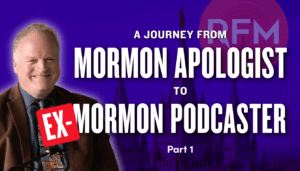
 While in Seattle, Washington this past week, we were excited to finally put a face to the voice that so many in the post- and progressive-Mormon world have come to know—by interviewing the host of the Radio Free Mormon podcast of the family of Mormon Discussions podcasts. While we still do not disclose his name, we are confident that after this 7-hour journey with “RFM,” you will come away with an accurate depiction of the man behind some of the most informative and entertaining podcasts in the Mormon community.
Broadcasting behind Enemy lines, Radio Free Mormon tackles the difficult subjects in Mormonism like no one else. Dissecting things like a surgeon, RFM gets to the crux of the issue, exposing all the connections and subtleties that lie below the surface. His unique sense of humor, his knowledge of Mormonism, his displaying of the data. If you haven’t yet listened, you likely could use some Radio Free Mormon in your life.
Part 1 – Convert to the LDS Church: This transcript is machine-generated and lightly edited for readability. The audio is authoritative. Please excuse occasional errors in names and spelling. John Dehlin [00:00:06] Mormon Stories is a production of the Open Stories foundation and relies solely upon the support of people like you, its listeners to help keep the podcast alive or to become a member of the community. Please become a monthly subscriber by visiting MormonStories.org and clicking the Donate button on the top right side of the page. All contributions to Mormon Stories are completely tax deductible and go towards producing the podcast and and building communities and programs of support for Mormon like you. Thanks for your support. Hello everyone and welcome to another episode of Mormon Stories Podcast. I'm your host, John de Lynn. It's November 8, 2019 and we're continuing our two day series in the Pacific Northwest. We're in Seattle, Washington. Actually, we're we're in Kirkland, Washington. Yesterday we did several hours with Mike Brown dealing with his amazing work around Mormon truth claims and the Mormon Stories podcast Billboard Project and just interviewing a thoughtful human, thoughtful, courageous human. We continue our little two day series today, interviewing someone that I know, many of you, many of my listeners, very, very excited to hear from. Today we're interviewing Radio Free Mormon. Okay, that's not his real name, but Radio Free Mormon is a podcast that many of you are familiar with. It's a Mormon themed podcast that emerged out of Bill Real's family or library of podcasts. And Radio Free Mormon is a podcast dedicated to talking about important issues within Mormon history, Mormon culture, Mormon leadership and the like. And the host of Radio Free Mormon, for reasons that we'll probably discuss, chooses not to use his his real name commonly on the podcast. And we'll talk about why that is his name is out there. So it's not like we're pretending that it's not, but we're just not you using it based on his request and out of respect for that, because this is a messy business that we're all in. But we're really excited to sit down for several good hours with Radio Free Mormon today to talk about his podcast. So before we actually dive in as normal, just a couple quick announcements. We do have the Thrive Beyond Mormonism event coming up November 17th. We're bringing Amber Skora from New York. She's an ex Jehovah's Witness. We're going to do a book signing with her Saturday night, November 16th, and we hope you guys will all come to that. It's the Community of Christ building 7pm and just support an amazing author who is doing the good work that we all should appreciate, which is helping awaken people to organizations that are unhealthy. And helping them transition in a healthy way. And that's what the Open Stories foundation about is about. That's what Mormon Stories is about, and that's what Amber's about. So come support us there. But then November 17th is the thrive Beyond Mormonism Conference, which is a conference for post Mormon. We're not going to be attacking the church or criticizing the church. We are going to be talking about healing, growth, and community beyond Mormonism. And we have a ton of amazing speakers lined up, including Wayne Sermon, the lead guitarist for Imagine Dragons, Natasha Alford Parker, Lacy Green, Stephanie Sorensen Larsen, and just an amazing list. So go to thrivebeyondmormonism.com this event is guaranteed to make a loss. We already know that the expenses exceed what we expect the revenue from ticket sales to be. But we're doing this. We're pricing at 15 bucks a person. We're doing this just because we want as many people as possible to benefit from it. So that's what we're doing. And join us if you can. It's going to be great and I'm really excited about it. So thrivebeyondmormism.com check it out. And I don't think I have any more announcements. So without any further ado, Radio Free Mormon, it is super fun to have you on Mormon Stories. Radio Free Mormon [00:04:21] Thank you so much, John. I've been waiting forever for you to ask me. John Dehlin [00:04:25] Forever? Radio Free Mormon [00:04:26] Well, a few years. John Dehlin [00:04:27] Forever's a long time. Radio Free Mormon [00:04:28] It's a very long time. Especially when I'm waiting on you. John Dehlin [00:04:32] Well, here we are. And this is your kind of neck of the woods, right? Radio Free Mormon [00:04:35] It is. I live up here in Washington. John Dehlin [00:04:37] Yeah. Near. Kind of more north. North of Seattle. Right. Radio Free Mormon [00:04:40] Hey, now you're already giving away too much, John. Ixnay on the directions. John Dehlin [00:04:44] I've got friends up there and it's fun. Okay. So, yeah, so your podcast, and I love it when Mormon themed podcasts do well. You know, Bill Real has done an amazing job with Mormon discussions, podcasts. He spun off or supported Marriage on a Tightrope, which is an amazing podcast by Alan and Katie Mount. That's. That's a podcast supporting mixed faith marriages. We're a huge fan of Alan and Katie. We've had them on Mormon Stories. Big shout out to them. Radio Free Mormon [00:05:15] We. John Dehlin [00:05:15] We feel like we partially are responsible for discovering Bill Real in the sense that we interviewed him way back in the day on Mormon Stories when he was a still a presiding bishop or sitting bishop. And we've interviewed him several times as well. He's a great thought, thoughtful Guy, he's done great work and one of the great things Bill Real has helped do is help nurture and discover you. And over the past year or so, more and more and more people have reached out to me just saying they love Radio Free Mormon and really appreciate what rfm, which he's belovedly known as, love the work that RFM does. So today we're gonna be learning a little bit more about the man behind the podcast. His history, his story, why he does what he does, what led to him doing a podcast. We've got a bunch of questions from listeners that I put together that I'll be asking. We do have people joining us live on Facebook and we really do welcome questions and comments from our listenership. That always makes things more interesting. We do invite our listeners to please share this episode on your walls, Instagram, Twitter, you know, whatever social media feeds you have. Yesterday we had over 200 people joining us live contiguously over the sustained period of the interview. It'd be fun to have as much or more for rfm. So please do your part to spread the word and let's, let's have as many people learn from a thoughtful, effective communicator as is possible. And of course, we'll be talking about the modern Mormon Church and the church leadership and the strategy and direction of the church as well towards the end of the interview. So that's what we have in store for Dave. It'll likely be a multi hour interview. And of course tonight a bunch of us are getting together in Seattle just to get to know RFM and to spend some time together. So if you happen to live in the Seattle area, reach out and we'll get you an invite to the event because we like to build community wherever we go, when we travel, and that's why we do it. All right. Rfm. So I know that you're a convert. Radio Free Mormon [00:07:25] Yes, I am. John Dehlin [00:07:26] So I normally begin by, by asking my listeners to give their Mormon bona fides. Bona fides or how do you pronounce that? Radio Free Mormon [00:07:33] As a lawyer, you can pronounce it differently. I hear bonafides sometimes. I'm not sure that's correct. John Dehlin [00:07:38] You're not. You're not going to be able to give us your Mormon bona fides. Radio Free Mormon [00:07:42] Why not? John Dehlin [00:07:42] Because you don't have any. Radio Free Mormon [00:07:44] I don't have any. John Dehlin [00:07:45] Do you? Radio Free Mormon [00:07:45] I've got a few. I've got a lot of Mormon street cred. Was it Bob? Yes, yes. Mormon scale. I went on a mission, for crying out loud. John Dehlin [00:07:55] Well, let's start so go back. Were your parents. Your parents weren't Mormon, right? Radio Free Mormon [00:07:59] No, no, because I was a convert to the church. Right. John Dehlin [00:08:01] So tell us about your parents. Radio Free Mormon [00:08:02] My dad. John Dehlin [00:08:03] How you were raised. Radio Free Mormon [00:08:04] Oh, very well. I was raised extremely. My mom tried her best with me is all I can say. So she tried to teach me manners. She tried to make me couth. Most of that I rejected. I said, no, that's not for me. Youngest of three boys. That's me. I'm the baby. Gotta love me. And my dad was a. An aeronautical engineer and an avowed atheist. He did not believe in God. He wasn't militant about it or anything, but he simply did not believe in God. My mom was a. Oh, I'm sure she was a Protestant of some sort. Never went to church or anything, or took us boys to church, so just a sort of nominal belief. I remember once when I was a kid asking her what religion we are, and she thought about it and said, well, I guess we're Protestant. So that was about that. John Dehlin [00:08:56] What are you comfortable saying? What kind of city or region you grew up in? Radio Free Mormon [00:09:00] Yeah, as a kid, I grew up in Waco. John Dehlin [00:09:03] Waco. Radio Free Mormon [00:09:03] Waco. I'm the Waco kid. John Dehlin [00:09:05] So when. When the Branch Davidian stuff happened with David Koresh, was he there? Radio Free Mormon [00:09:10] No, this was in the 1960s that I was a kid in Waco. John Dehlin [00:09:14] Okay, okay. And that happened in. Radio Free Mormon [00:09:15] When, the 90s, the mid-90s. John Dehlin [00:09:17] Okay. But I. I grew up. I grew up in Houston and I knew Waco to be this super Baptist town. Radio Free Mormon [00:09:24] Baylor that. John Dehlin [00:09:25] Yeah, Baylor. Baylor University's there. But, you know, because the God Makers was a thing when I was growing up in high school, all that kind of anti Mormon stuff and, And Baptists tended to hate Mormon. Did you. Did. Did you have any exposure to those Baptists growing up in Waco and. Radio Free Mormon [00:09:43] No, but I wasn't a. John Dehlin [00:09:44] Have you ever heard of Mormon? Radio Free Mormon [00:09:45] But I wasn't a Mormon then, anyway, so. John Dehlin [00:09:47] Right. No, I know that. Radio Free Mormon [00:09:48] No, no, I didn't hear. No, no. Who hears of Mormon in Waco? John Dehlin [00:09:52] Okay, but. But what about Baptist? Were you Baptist? Were you. Did you. I mean, did you have friends that were Baptist? Radio Free Mormon [00:09:57] Not that I knew. Not that I knew. John Dehlin [00:10:00] Okay. Radio Free Mormon [00:10:00] Yeah. Religion wasn't something it was talked about among the kids. John Dehlin [00:10:03] You. What? Radio Free Mormon [00:10:05] Religion wasn't in your high school. John Dehlin [00:10:07] Kids didn't talk about religion. Radio Free Mormon [00:10:08] Now, if we'll go back here, 1960s, I'm born in 1960. Right. John Dehlin [00:10:12] Okay. Radio Free Mormon [00:10:12] So I'm just a kid. We're trying grades. John Dehlin [00:10:14] You're four. When The Beatles come to America. Radio Free Mormon [00:10:17] Yes. John Dehlin [00:10:17] Okay. Radio Free Mormon [00:10:18] Right. So you got it figured out. 1969. We moved from Texas up to Washington, though. Okay. John Dehlin [00:10:25] So, yeah, up to Washington state. Okay. Radio Free Mormon [00:10:29] So, you know, junior high school, high school years. I'm up here in Washington, not down there. John Dehlin [00:10:33] Okay. In the Seattle kind of region. Radio Free Mormon [00:10:36] Yes. For people who are not from around here, that's the easiest way to think of it. John Dehlin [00:10:40] Okay. Okay. And so your. Your parents were not religious. Radio Free Mormon [00:10:44] Correct. John Dehlin [00:10:45] Okay. And anything interesting, noteworthy about your upbringing as. As a child or. Or youth that you want to say that helps would help people understand your story and who you are a little bit. It's happy. Were your siblings happy? Did you guys get along? Was it a Leave it to Beaver kind of family? Was it a dysfunctional family? What? Radio Free Mormon [00:11:05] It was a very odd family in retrospect, but I didn't know it was odd at the time. I mean, give you one example, we had a couple of horses that were kept out on somebody else's property. And so my dad had to get a horse trailer to drive the horses around. Well, instead of getting a pickup truck, he got a hearse. Now that's odd, isn't it? John Dehlin [00:11:27] Yeah, yeah. What was he thinking? Radio Free Mormon [00:11:28] I have no idea, but it was his. John Dehlin [00:11:29] Like he was a quirky guy. What was your dad. Radio Free Mormon [00:11:30] No, he didn't seem quirky, although it sounds strange in that context, doesn't it? But he got a hearse and so it was like a station wagon. He could stick us three boys in the back where the caskets used to go. And then he had a trailer hitch on the back and he would put the trailer on it and drag it around. John Dehlin [00:11:50] Okay. Radio Free Mormon [00:11:51] It was all normal to me at the time. John Dehlin [00:11:52] What was his profession? His. Radio Free Mormon [00:11:54] He was an aeronautical engineer. He worked a lot with wind tunnels at the time. John Dehlin [00:11:57] Was it Boeing kind of stuff then? Because that's up here in Seattle when Radio Free Mormon [00:12:01] he took his job in 1969. Yes, that was a job at Boeing. John Dehlin [00:12:07] Okay. How did you. Did you get along well with your parents and siblings? Radio Free Mormon [00:12:13] I think as well as normal. Certainly not Leave it to Beaver, which I think itself is probably unrealistic in the first place. I came along late in life for my parents. They were old enough to be my grandparents, so they actually grew up in the Depression. My dad was born in 1919, so actually in December will be. Would have been his 100th birthday. So that's how old my dad is. He was 40 when I was born. So a much it's an older generation. Children are to be seen and not heard at Least as far as he was concerned. John Dehlin [00:12:43] My dad literally said that all the time. Radio Free Mormon [00:12:45] Really? John Dehlin [00:12:45] Yeah. Radio Free Mormon [00:12:46] My mom was much more the nurturer. My dad was the aloof punisher when it was necessary, he was the sheriff in town. John Dehlin [00:12:54] Okay, what did you do? How did you grapple with. You know, when you're raised Mormon, it's like you're part of the chosen people. You know who you are, you have an identity, your church hands you your morality, your spirituality. You've got a set community, you've got all these friends. Like being Mormon, there's just this template. And because we're conditioned to think that sometimes there's no health or happiness or joy outside of Mormonism, our Mormon brains go, how in the world could you ever have a happy, healthy childhood or upbringing without religion? So, like, how. How did you piece together if. If it was even a problem? Morality, spirituality, community, sense of meaning and purpose and identity? Did you feel lost? Did you feel like a super happy as a kid and a teen? Talk about being raised in a. In a secular world in the 70s, you know, late 60s, early 70s, and what that was like for you as a kid? Radio Free Mormon [00:13:54] It was fine. It was great. I had a great time. It was a wonderful time to be alive, had fun friends, we did great things together. But this whole idea. I know what you're talking about. About how some people who are within a certain system. Excuse me, who are within a certain system, like Mormonism, cannot conceive of a fulfilling life outside of Mormonism. By the way, that's generally while they're ignoring the fact that their life is not fulfilling inside Mormonism, they're just following the template and the script that they're supposed to say, pardon me if there's any of you out there that I am misjudging. I'm just speaking for myself. And I think that I'm probably not the only one who felt that way when I was doing the same thing. So you're talking about, how do you be out there? That reminds me of this joke. Somebody just told me this the other day. I don't know if it was you. There's two fish swimming along in the ocean, and this big fish comes swimming by, and the big fish, as he goes by them, says, how do you like the water? And in the big fish goes by, two fish look at each other and say, what's water? Yeah, it's just the water I swam in. Yeah, yeah, yeah. It's not like I'm thinking, oh my gosh, I'm missing out on something over Here. That's so wonderful. John Dehlin [00:15:01] So what were your hobbies or interests as a kid and as a teen? Radio Free Mormon [00:15:04] Okay. Mainly magic. I got into magic when I was 10 years old through a Scholastics book that dealt with some magic tricks. So I started learning magic, and by that I mean, you know, magic tricks. Right. Did that for a number of years. Continue to be somewhat of an amateur. I don't put on shows. I will do a trick now and then if I'm forced to. John Dehlin [00:15:30] Do you want to do a trick now? Radio Free Mormon [00:15:31] This would really be a bad place in a bad position to do a trick, I think. But. And also then When I was 16, I started studying dance, and dance was very much a love of my life. I just loved dance. And what got you theater and musical theater? Probably Gene Kelly. John Dehlin [00:15:51] Wow. Like. Like Singing in the Rain or. Radio Free Mormon [00:15:53] Yeah, Gene Kelly. Paris, whatever those movies were that were on tv, you know, back when we had three channels, plus PBS and commercials. During all the movies. Yeah, absolutely. Oh, yeah. He was just very masculine in the way he danced, and I was just very drawn to that art form. So I started taking tap class at a local studio when I was 16. Then I ended up watching the other kids who had been there longer and watching them, and they were good. And then I started realizing that in order to be good, you had to not just take tap, you had to take ballet, and you needed to take jazz. And so I started doing that, and I took that for a number of years, actually, three years. And by then. And in the course of that, I ended up joining the church and going on my mission to Japan in 79. John Dehlin [00:16:38] Okay, so you're going to high school. Where? Radio Free Mormon [00:16:40] Sumner High School. John Dehlin [00:16:41] Okay. And how in the world did you. Did you have any favorite Broadway musicals? Because I love Broadway, so. Radio Free Mormon [00:16:48] Oh, yeah, sure. Music Man. John Dehlin [00:16:51] Yeah. Radio Free Mormon [00:16:51] That is almost a perfect musical as far as I'm concerned. I was fortunate enough to get to play the lead role in a church production. John Dehlin [00:17:00] A Mormon church production? Radio Free Mormon [00:17:01] Yeah. John Dehlin [00:17:01] Of the Music Man. Radio Free Mormon [00:17:02] Yeah. Back in 94. John Dehlin [00:17:03] Back when Mormon did musicals. In 94? Radio Free Mormon [00:17:07] Yes. John Dehlin [00:17:08] Oh, what? In Washington? Radio Free Mormon [00:17:10] Yes. John Dehlin [00:17:11] That's cool. Okay. But not as a teen. Radio Free Mormon [00:17:13] No, no. John Dehlin [00:17:13] Okay. Radio Free Mormon [00:17:14] No. You see, the deal with me is when I'm doing productions that have, if I can just say it, people who are generally talented as opposed to a church production. Okay. Not trying to offend anybody here. There are talented people in church productions, but if. If I'm in a basic production. Right. And I've been in a number of them, I am chorus material. Okay. That's where I am. I'm in the chorus. I am the guy in the sailor suit with all the other sailors tap dancing on stage, and anything goes. But if you go to a church production, I can be the star. John Dehlin [00:17:42] Yeah, that's awesome. Okay, I get it. I get it. I think of myself similarly. Radio Free Mormon [00:17:47] Yeah. John Dehlin [00:17:48] So Music man was one of your favorite inspiring musicals. Any others? Radio Free Mormon [00:17:52] Oh, Guys and Dolls, Oklahoma. John Dehlin [00:17:54] South Pacific, that kind of stuff. Radio Free Mormon [00:17:55] Yeah, I really don't like South Pacific. We don't need to get into that. John Dehlin [00:17:59] But okay, so, all right, so you were kind of a musical theater guy. And what in the world led you to want to join Mormonism? Radio Free Mormon [00:18:11] What led me to it was my best friend, Bruce. Bruce Hawks. I'll go ahead and give his last name now. But when we moved, we moved around a lot, because my dad and his job and everything, and even when we were up here in Washington, we moved around a lot. And finally we moved to Sumner in ninth grade, and I met up with Bruce, and I fell into his group. Bruce was a Mormon. He was very energetic, very charismatic Mormon, Kind of a leader, kind of Mormon. And people. He was sort of the center of a group of people, and I fell into that group. And Bruce was very energetic in trying to expose people to Mormonism and get him to be baptized. And he tried on me for four years, and I resisted it at every turn. And then finally, right when the senior year was just about to end, all of a sudden that changed. And I guess if you were to use missionary language, I was prepared by that time. John Dehlin [00:19:09] And so what happened? Radio Free Mormon [00:19:11] What happened? You know, I just told this story. By the way, radiofreemormon.org has all my podcasts on it. I'm up to, I think, 94 now, if you can believe that. John Dehlin [00:19:19] That's amazing. Radio Free Mormon [00:19:20] Very recently, I did a Halloween special on which I told a lot of creepy, crawly stories about experiences I have had with the darker, negative sides of the spirit world. Because even though I am no longer a believer, an orthodox Mormon, and I certainly have my questions about God, questions about Jesus, through my experiences that I've had, it's hard for me to deny that there are things beyond what we see and things that we can experience from time to time, I certainly have. Not everybody has. A lot of people have experienced things, too. Some more than me. But where were we? Oh, yeah. I told the story. I told the story. So let me try and give it a different spin for your viewers here today, which is that I go over to Bruce's house to hang out. There's Two friends of ours that I know. There's Barbara Freeman and there's Jay Simmons, and they are sitting on a couch, and it is nighttime, and all I want to do is hang out with Bruce, but there's nighttime. And sitting across from them on two chairs are two Mormon missionaries. And they've got their flip charts out, and they're teaching them a discussion. And of course, now I'm using all this lingo now that I know they're teaching them a discussion. They have flip charts out. They're Mormon missionaries. But I've got to hang out now because Bruce is sitting right next to Barb and Jay, and these are two friends that he's having over to his house to have the missionary discussions, just like we were all taught we were supposed to do, right? Optimal for conversions. And indeed, Jay ended up getting baptized. Barb did not. But I have to sit down. I have to kill time while I'm waiting for this missionary discussion to be over so I can hang out with Bruce. So I actually. I think I. I know I lie down on the floor, and if I'm correct, I may have actually lied down on the floor between the missionaries and the couch where Barb and Jay are sitting. And I'm just sitting there, killing time. Killing time. But I'm also having to listen to what they're talking about. And I was really interested in what the missionaries were saying. What they were saying was really speaking to me. I can't tell you which discussion it was at this point, but they were saying things. And I'm thinking, that's interesting. And I'm feeling this tugging within me, you know, this warmth. And. And they're asking the questions. They're asking the Mr. Brown questions, right? Which are just like the dumbest questions ever in the world back in the rainbow discussion days and leading questions, you know, and they're asking them to Jay and to Barbara, and they're not asking him to me, because I'm not part of this. I'm just hanging out. And I kept thinking, man, I wish they'd asked me that question. John Dehlin [00:21:49] What are the Mr. Brown questions? I don't think people know what those are. Radio Free Mormon [00:21:52] Oh, I'm sorry. Back with the rainbow discussions, back 40 years ago, they were called the rainbow missionary discussions because there were six or seven missionary discussions, and they were. Each had different colored paper so that when you looked at it from the side, you know, you'd have it in the binder. And then they looked like rainbow. So the rainbow discussions, and they were memorized. The missionary had to actually memorize them word for word, all six discussions. And in the. In the context of each discussion, there were certain questions that you were supposed to ask the person that you were teaching. And while you're memorizing the discussions because you don't know the name of the person you're going to be talking to, you just memorize the name. Mr. Brown. So, Mr. Brown, why do you think God would want to have prophets on the earth today? Right. They're very, very simple, simplified questions, and they're basically designed to have people regurgitate what you just told them. So that's the Mr. Brown question. Sorry. John Dehlin [00:22:43] No, that's good. And so you wanted them to ask you those. Radio Free Mormon [00:22:46] Yes. John Dehlin [00:22:46] But they weren't. Radio Free Mormon [00:22:47] No, no, because I'm not part of it. But I really had things that I felt like I wanted to say to it and. But finally they left. And I'm not going to go over what happened up on the roof. Okay, that's back in the Halloween special. You can go there and listen to that. But what ended up happening is that over the next two weeks, let me back up there and say, I have been going to church dances, like, every week with Bruce and friends. So I've got all these friends now who are in the church. Right. Some of them go to the high school, some don't, but I got all these friends in the church. And so one night, shortly after that, Bruce is giving me a ride home. And I say to him, out of the blue, bruce, what does it take to get baptized into your church? Can you imagine? John Dehlin [00:23:33] Yeah. Radio Free Mormon [00:23:34] I have been giving him crap for four years about this church. John Dehlin [00:23:36] You're golden. Radio Free Mormon [00:23:37] At this point, I'm golden. And so he tries to, you know, not veer off the road, I'm sure. And he talks about the missionary discussions and explains that there's like six of them and you got to take those and, you know, you can get baptized. I said, okay, set me up. And there was a deadline also, because my family was moving, they were planning on moving that didn't end up actually happening. We don't need to go into the details, but from my mind, there's also this perceived deadline of about two weeks that we've got to work in between the time I'm graduating from high school and the time I'm going to be moving out of state back to Texas. John Dehlin [00:24:10] Why? Radio Free Mormon [00:24:12] That is a long and messy tale involving my parents. John Dehlin [00:24:15] Okay. Radio Free Mormon [00:24:16] Okay. So it may come up from time to time, but yeah, okay, so. But we ended up moving back after a month, but, yeah, we're going to be gone. So I have Bruce get the missionaries out to his house and I take all missionary discussions and I get baptized within about 10 days. John Dehlin [00:24:36] Wow. Radio Free Mormon [00:24:37] I've got them out there on their P day and they didn't even want to be out there on their P day. I could tell. There's Elder Timothy Shanson and Elder Leland Christensen or Christianson. I remember their names. And Leland had. He had one leg. He had a wooden leg. And he'd had some kind of terrible accident, a vehicle accident, not long before he went on his mission, but he wanted to be on his mission. So he's out there with a wooden leg and God bless him. But no, let me ask you this. John Dehlin [00:25:02] So I. I have this theory that most people that get baptized in the Mormon Church in the modern era either are from third world countries, which means often they have lower than average education, lower than average socioeconomic status. Radio Free Mormon [00:25:17] I lived in Waco. John Dehlin [00:25:18] Yeah, right. Radio Free Mormon [00:25:20] That's a joke. John Dehlin [00:25:21] Yeah, no, I get it, but. Or they are raised by secular parents and they aren't raised with the clear sense of identity and have a sense of meaning and purpose. Or they were raised in a very dysfunctional family where their parents were mean or they had bad marriages, or they were financially destitute in some way, and they're just really, really seeking for some sort of structure, some sort of theology, some sort of doctrine to make life worth living, to make sense, and basically just to bring. Upgrade their happiness. Because oftentimes they're sad and isolated and depressed and when they see that perfect Mormon family or they see, you know, they visit that Mormon ward and everybody's smiling, happy, it's like, man, I want some of that. And boom, they join. Did any of that apply to you or not? Radio Free Mormon [00:26:15] I think some of that applied to you. John Dehlin [00:26:17] What applied. What part of that applied? Radio Free Mormon [00:26:18] Oh, probably structure. And, you know, I'm certainly very, very happy dancing, going to high school. But there's. There's no real structure, there's no real path that I have. There's no real meaning or purpose that I have. So, yeah, I could see that as possibly. And you know, my parents had a rocky relationship. That's why we, you know, were either. There were times when my parents were separated. They never divorced, but they were separated when I was a kid. And worst summer of my life, bar one, which we won't get into, but worst summer of my life was the summer of 19, and that's was spent at Rockport, Texas. And that's me, my mom and my. The middle Brother Cam. Right. And my dad, he's got his job. This is during the summer. Right. So what would end up happening is we'd all go as a family. Every summer. We would drive down the coast down to Texas. We'd visit people in California who were family, go down to Texas. And then when it was time to leave, my mom would make her last stand, is what my dad would call it. It's like, I'm staying here. She really hated the clouds in Washington. I don't know if it really actually depressed her. I don't think she went to a doctor for it. But, yeah, she hated the weather up here. And she was a Texas girl. She was born and raised outside Abilene, and. But she'd go down there and then she'd make her stand, and then the boys had to decide who they were gonna go with. John Dehlin [00:27:42] That's awful. Radio Free Mormon [00:27:43] Yeah. So I decided I was gonna stay with mom. I was 12 years old at the time. John Dehlin [00:27:47] It was awful. Radio Free Mormon [00:27:48] Yeah. Especially because I don't want to be in Rockport, Texas. I don't know anybody in Rockport, Texas. It was a miserable summer. And the big. The big brother, Mark, he went with my dad back to Washington. That's where I wanted to go. But I stayed with my mom. And that wasn't the only time it happened. But there was one time when I was in 10th grade where it happened, and I just said, mom, I want to go to Washington. You know, I'd stayed with her on two occasions for multiple months. Obviously, this happens repeatedly. So they get back together, she comes back to Washington, they patch things up. She tries to stay up here as long as she can, but there's going to be something else that's going to break later on. John Dehlin [00:28:26] So. Radio Free Mormon [00:28:27] So, yes. So am I fitting your theory? John Dehlin [00:28:29] Well, I mean, it. First of all, this touches a place in my heart because my parents got divorced and both have been married several times. My dad doesn't like it when I. When I talk about that in too much detail, so I won't. But it's very hard for a kid to see your parents split up or to get back together to. To ever feel like you have to choose between parents. Like, whoever wants to feel that way. But. But it just sounds like you had such a tumultuous family that. A family preaching eternal family. That a family teaching. That a church. Sorry. A church teaching eternal family. A church teaching families can be happy. Our Heavenly Father's happy plan. Families are the most important thing. That's got to be an appealing message to an 18ish year old boy whose family had been so tumultuous. So rfm, tell us about. I'm more curious about your conversion. Was it an intellectual conversion? Was it an emotional conversion? It sounds like it was both. Can you tell us about what intellectually converted you to Mormonism and what emotionally converted you to Mormonism? Radio Free Mormon [00:29:43] Sure thing. Well, intellectually, honestly it was probably more spiritual. But during the missionary discussions it seemed like these two missionaries who even though they're missionaries, they're really only maybe a year or two older than I am and, and yet they seem so much older, they're so wise, they have all this knowledge, right. And I don't realize they're just parroting a script to me, but they're very, very smart and I would ask them some questions and one of the things I remember the most had to do with the Trinity, right? Because I sort of have a knowledge of the Trinity only because I grew up in a Christian country and most Christians believe in the Trinity. So they're talking about the nature of God and how God isn't the Trinity, it's, you know, three separate beings. And I asked him about that and I said, well, doesn't the Bible teach the Trinity? Of course, I've never read the Bible in my life. I've hardly ever touched the Bible before then. And they explained to me, no, they go to the baptism of Jesus, of course, in Matthew chapter three, I believe it is, and talk about how the three different beings in the Godhead are manifested at his baptism. And I just went wow, that makes so much sense. That makes so much sense. And I remember being impressed by that. So there were a number of other things. I will tell you though, there was one moment in the missionary discussions where I kind of went whoop. And that's where they're telling me about the apostles and the prophet and the prophet who leads the church today. And they've got their flip charts out and they flip over to a picture to show me. And there of course there's President Kimball and his two counselors which would have been in Eldon Tanner and Marion Romney I believe at the time. And then the 12 apostles, there's these old guys with white shirts and ties in business suits and I cannot tell you what it was I was expecting, but it wasn't that. That really brought me up short. And I think I corporate like what? You know, I wouldn't have even known what the heck corporate was at the time, but it certainly wasn't what I was expecting. When they're telling Me about a prophet who walks and talks with God. And I remember talking, I think, to Bruce after that. Or maybe I just thought about it myself and chided myself thinking, well, what did you really expect? Did you expect that they were going to be wearing, you know, look like something out of the Old Testament? John Dehlin [00:31:56] Robes with. Radio Free Mormon [00:31:57] With. John Dehlin [00:31:59] Yes, like she cats or something or whatever that is. Sandals. Radio Free Mormon [00:32:03] What's a she cat? John Dehlin [00:32:04] I don't know, like imagining like. Yeah, Bedouins from Saudi Arabia. Radio Free Mormon [00:32:09] Yes, I know. So I'm thinking, okay, now, is that what you were thinking? Because I think somewhere in the back of your head that's what you're thinking. And if they had really shown that these are the guys who lead your. And you know, Spencer Kimball dressed in. In Arabic clothing, no, that would have been even worse. So. But I do remember being jarred by that a little bit. But we went on. I got baptized emotionally. John Dehlin [00:32:31] What do you think? Emotionally pulled you in? Radio Free Mormon [00:32:34] Emotionally is hard to say at that time. But I do want to tell you about my testimony that I gained of the Book of Mormon. That wasn't at that time. All right. John Dehlin [00:32:42] No, but. Okay. So I just. I also have this theory that like, so the elders thought they were cool. You had some friends. Was it a social thing? Was it a family thing? Was it a community thing? Was there something emotionally that converted you? Just. Just around a social or emotional conversion? Radio Free Mormon [00:33:01] Well, I had friends who were in the church. I had been going to church dances for a number of years, pretty much every weekend. And Bruce had been asking me out to little social activities at the church. He was always trying to do what he could. Oh, by the way, Bruce had at his house a gathering of friends every Friday night where we would play this game called pounce, which is a card game, but it is not a face card game, John, because face card games. No, the devil likes face cards. John Dehlin [00:33:29] This is Bruce, Armor Conkey, Mormonism. Radio Free Mormon [00:33:31] Absolutely Mormonism. Yeah, absolutely. God does not like face cards. But God does approve of rook cards. John Dehlin [00:33:39] Yes, I love rook. Radio Free Mormon [00:33:40] Yes. So rook cards, if anybody doesn't know what rook cards are, kind of like uno cards except different. In other words, there's no faces on them. They're just numbers in different. Four different colors. Right. So it's just a team game. It's kind of like spoons. It's very fast paced and you play it. John Dehlin [00:33:54] And spades, right? It's kind of like spades or hearts. Well, without the vase cards. Radio Free Mormon [00:34:00] Oh, rookie is. But this is a separate game, right? It was called Pounce, but rook cards were Used instead of face cards. John Dehlin [00:34:06] Yeah. Radio Free Mormon [00:34:06] So it's a very fast pace, and you do all the stuff and you have championships and everything. It would take a couple hours every Friday night, and then we'd all hang out together. I found out only later that this was not only a good idea and that Bruce's mom approved of it because she knew where her son was on Friday nights. And also there was a safe place and a wholesome place. And that's not a bad thing. John Dehlin [00:34:26] No, it's great. Radio Free Mormon [00:34:27] Have teenage kids go to on a Friday night, and they could be out doing other things. But also, that was very much a missionary opportunity. John Dehlin [00:34:38] Sure. Radio Free Mormon [00:34:39] And Bruce used it like that. John Dehlin [00:34:43] And so. And so, in some sense, you. There was a social conversion. You had friends, you had models of families that seemed happier. And you're like, my family was kind of rough. These are nice friends. They seem to have happy families. I want me some of that Mormonism, I think. Radio Free Mormon [00:35:02] So there seemed to be a stability now, frankly. Bruce's dad had left his mom before I think I joined. Came to 9th grade before I knew him. John Dehlin [00:35:10] Oh, wow. Radio Free Mormon [00:35:11] Yeah. He actually was, I believe, in the bishopric or the bishop, who literally ran off with the primary president. One of those stories that you hear about, and they actually happen. So that was one thing that happened there. And she had. She was just by herself. John Dehlin [00:35:24] Oh, so it was a single mom. Radio Free Mormon [00:35:26] Single mom, yes. John Dehlin [00:35:26] That's cool. That's still cool. Yeah. Awesome. Okay. Okay. So you convert at again, what age? Radio Free Mormon [00:35:33] 18. John Dehlin [00:35:33] At 18. And where did you go from there? Radio Free Mormon [00:35:37] Well, I hung around because now I've just graduated from high school. I really had not been making a whole lot of plans for college. It was just sort of the strange idea in the back of my head that maybe I should go to college. But it seemed like school counselors were not necessarily, at least not in my school, doing everything they do today to help kids out and give them that plan. So I'm just sort of hanging out there. But now that I am a Mormon, now I have plans, I have goals, I have a path, and it is the path that the church gives me. And you know what the next thing is I got to do. John Dehlin [00:36:10] Yeah. Serve a mission. Radio Free Mormon [00:36:11] Got to go on a mission. Absolutely. I'm a guy. I got to get the priesthood. I've got to go on a mission. So that was my goal, and I've got to work to earn money for my mission. John Dehlin [00:36:20] Would you have. Would you have said at that time that you had had a conversion, that you'd had the Holy Ghost Bear witness to you. The church was true. That you knew the church was true. Kind of like Saul on the road to Damascus or whatever. Alma the younger. Or was it more like. I'm going with this. I'm not sure if it's true, but it feels good. So I'm going with it. Radio Free Mormon [00:36:42] Sorry. Can I tell you this? I have gone back and back and back, and I've tried to analyze my progress in the church, through the church, and finally basically out of the church, and tried to figure out where are these key moments along the way that led me. And I've been able to identify a number of them, except for the fact that for everyone that I find. I can also find a counter example occurring, like, at the same time. And I don't know if it's because I'm a Pisces. My birthday is March 10th. Presents are appreciated. March 10th, Pisces. You got the fish going this way and the fish going this way. That's the sign, right? Because there's things that are going opposite directions all the time in a Pisces. I don't know if there's any truth in astrology like that, but it does seem to be that way. I cannot plot a direct course in my life in the church because every time there's something going this way, there's something going this way. John Dehlin [00:37:38] So you're saying you weren't sure you were totally converted? Radio Free Mormon [00:37:40] There were, yes. And you see, I would say that I absolutely was sure. Not at that time. It felt right. It felt right. Okay. But I hadn't had any giant experience. I'd had a few weird things happen, but. But really, when I read the Book of Mormon, and that was not before I joined the church. John Dehlin [00:37:57] After. Radio Free Mormon [00:37:58] Yes, it was after I joined the church. So I am wanting to get my patriarchal blessing because Bruce has mentioned he's going to get his patriarchal blessing. I say, what's a patriarchal blessing? He tells me what a patriarchal blessing is. I said, wow, that sounds cool. I want to get me one of those. So I go to my bishop, Bishop Murphy, and I say, hey, I'd like to get a patriarchal blessing. He says, okay, well, let's. He wants to do a little test on my gospel knowledge at the time. He says, okay, so can you tell me what the four standard works are? And I say, well, there's the Old Testament, there's the New Testament, there's the Book of Mormon, there's the. See, I've already. I'd already goofed it up. I split the Bible up, which is one into two, the Old Testament and the New Testament. And I'm starting to come up with five, right? So I start slowing down and it's like, oh. And he looks at me and he kind of smiles and he says, have you read the Book of Mormon? No. No, I haven't. Well, here's the deal. You read the Book of Mormon and then come back and we'll talk about you getting your patriarchal blessing. That's what I needed. I needed that carrot at the end. So I'm working at the time and trying to save up money for my mission, still living at home. And I would come back from work and then I would get ready for bed. I must have gone to dance class a number of times, but I'd come back from that and I get ready for bed very quickly, no tv, and just get in bed. And I would read the Book of Mormon. But I remembered what the missionary told me. That would be Timothy Shanson. When you read your way through the Book of Mormon, he says, you always pray before you read. And he suggested to me that I ask God to know if it's true. Just like Moroni's promise, right? But he also said, keep in the back of your mind while you're reading it. The question, could any man have written this book? And I did that. So this must have taken at least a month and probably more than a month, reading every night for an hour or so. John, I had the most amazing experience doing that as I prayed my way through the Book of Mormon at the age of 18. Every time I was reading, I would pray. And every time I was reading, it was as if, you know how it is that you walk around and you've got. You've got the eyes in the front of your head. You've got obviously cranium here, cranium back here. You can only see to the front with a little bit of peripheral vision, right? It was as if the walls of my mind fell down and I could see to eternity in all sides. 360 degrees at once. It was absolutely incredible. And this happened every single time. Every single time I'm reading the Book of Mormon, I had this experience, kept wondering, well, is it going to happen again? It happens again. I've never had anything like this happen again. By the time I'm done with the Book of Mormon, my thought was this. I cannot really remember a whole lot of the names or a whole lot of the stories that happened in the Book of Mormon. I've only read it once through, but the one thing I know is that every word in it is the word of God, because the Spirit has borne testimony to me that that is the truth. So I would say that would be my Damascus conversion, is reading and praying my way through the Book of Mormon when I was 18. John Dehlin [00:41:12] Yeah, that's a pretty dramatic experience. Radio Free Mormon [00:41:14] Yeah, it was amazing. John Dehlin [00:41:17] Yeah. Radio Free Mormon [00:41:17] But, you know, I also thought, this is Moroni's promise. This is what everybody experiences. This is a common thing. And it was only as I sort of got older in the church and talked with other people that I started realizing that it really wasn't that common. So I kind of kept it to myself, if you know what I mean. John Dehlin [00:41:37] And I want to come back and ask how you make sense of that now, but I don't want to do that now, so. Radio Free Mormon [00:41:44] Right, okay. But here's the other fish. The other fish, right? John Dehlin [00:41:47] Yeah. Radio Free Mormon [00:41:47] I'm getting ready to go on my mission. It's now November or October of 2000 of 1979. And I've had this experience. I've had other experiences. The heavens were open around me during this year and a half or so between my baptism and going on a mission. And even after going on a mission, there were some amazing things that happened. But I remember that my friend, by the way, Bruce Hawks, he had already gone to the mtc. He went in there, like three weeks before I did, and he went to was Austria. But there was another friend of ours who was converted through Bruce, and his name was Don Capel. And he was going to go up to, I think it was Norway someplace. Yeah. Really cold. Or Finland, regardless. But I remember talking with him. Bruce was already in the mtc, and I was talking with him at Bruce's house. It was just me and Don. I wasn't really close with Don like I was with Bruce, but I remember talking to Don, we're going on a mission, and looking at him and say, it's true, isn't it? And Don looked at me like, yeah, of course it's true. So this is what I mean. If I'm going to be honest with myself and really open about everything that happened, there's massive experiences that would tend to convince anybody that the church is true. And yet there are doubts and concerns and worries that I had even then, of course. John Dehlin [00:43:15] Yeah. So you got your patriarchal blessing. Radio Free Mormon [00:43:19] Yes. John Dehlin [00:43:19] And you went on a mission. Radio Free Mormon [00:43:21] Yes. John Dehlin [00:43:21] Where'd you go? Radio Free Mormon [00:43:22] Japan. John Dehlin [00:43:23] How was that? Radio Free Mormon [00:43:24] Oh, it was great. It was great. John Dehlin [00:43:26] Was it two years? One and a half years. Radio Free Mormon [00:43:28] Did I answer that like a Mormon or what? It Wasn't great. It was not great. There were. There were good things about it. It was a very good growing experience. Let me tell you how I found out about my call. Okay, here's how I found out about my call. I went to the Kobe Japan mission. We would probably say Kobe here in the States as Kobe and say Kobe in. In Japanese. But I'm down in California. So it's the summer of 1979, and we're visiting family. You know, there's always this. The stress and everything, but I had been out. Where was it? It was. Was it Malibu or someplace on the beach all day trying to do. To ride these waves. Not surfing, but just body surfing, you know, And I had. I'd been out in the sun all day, and I was. I was kind of sick. I was not feeling too good. And I'd gotten pounded into the sand a number of times by some big waves. So I am in a dark bedroom at my cousin's house. My dad's not with us, of course. He's up in Washington. Okay. And my mom comes into the darkened bedroom. I'm still feeling bleh. And she says to me, do you know where Kobe Japan is? And I said, no. And she says, oh, well, that's where you're going. Slam. John Dehlin [00:44:46] She had written, open your letter. Radio Free Mormon [00:44:47] My dad. This is the great announcement of my mission by my mother, who was not happy at all about me going on a mission and her baby going overseas. Yeah, my dad was much more supportive of the. Of that idea, but no. So it comes to the address up there in Washington. Obviously, what had happened, I had to piece it together. Later. My dad gets it. He opens it up, he calls my mom, he says, here's the mission. Call Kobe, Japan. And so my mom then comes into the room where I am in Southern California and says, do you know where Kobe Japan is? John Dehlin [00:45:21] Not the way every Mormon kid wants to find out about their mission. Radio Free Mormon [00:45:24] No, for crying out loud. I leave from Washington, I go to Japan for two years, and I come back to Austin, Texas, because my family had moved. John Dehlin [00:45:35] Now, Japan has a reputation of not having a lot of baptisms. Radio Free Mormon [00:45:39] Japan, at least at the time, was kind of in the middle, you know, at the time, South America, Latin America is going great guns. Of course, we found out later that maybe that was more form than substance. John Dehlin [00:45:51] Yeah. Radio Free Mormon [00:45:51] But, yeah, it was going crazy. Thousands of. Of baptisms. And I think that you were involved in that, though, a little bit later than 1979, but still then. And of course, over there in Europe, like Germany or Whatever. It's death. You know, you might have an average of 1/2 baptism per missionary. John Dehlin [00:46:10] Right. Radio Free Mormon [00:46:11] For their entire mission. That's the average. But in Japan, it wasn't that bad. Now, as a good missionary, I did not really keep track of the number of people I baptized. 33. It was 33 people that I was involved in baptizing. So that's certainly much better than Germany. John Dehlin [00:46:30] That's great. Radio Free Mormon [00:46:31] Yeah, it was okay. Had a good time. John Dehlin [00:46:33] Were you AP or zone leader, any of that stuff? Radio Free Mormon [00:46:35] Oh, heck no. Well, I. I was a zone leader eventually, but I was never an ap. You know how you call those apes? So for whatever reason, they didn't call it AP in my mission. It was an MA Mission assistant. John Dehlin [00:46:49] Okay. Radio Free Mormon [00:46:49] I don't know. Maybe they didn't want to be called apes. I didn't even know about an AP until later on. But they were mas. No, I was never. I was never that good. I was a district leader, but a district leader, you know, and you're on my mission, it just means that you're in charge of the apartment bills. That's all you do. John Dehlin [00:47:07] Did you have to battle, like, all these Utah Mormon that were pioneer stock? Did you have to battle kind of inferiority complex of like, you had just read the Book of Mormon, you didn't go to seminary, you weren't really raised Mormon. And here are all these kids that are pioneer stock and have been lifelong church members and had been studying this stuff since they were young kids. Did you have to battle with any of those insecurities? Radio Free Mormon [00:47:31] You know, I don't remember that at all. I don't think I did generally when I was. When it came up, the fact that I was a convert, that was like something that was put up in kind of esteem. And I remember there were at least a few people, few missionaries, who would say, wow, that is so cool that you're a convert. I wish I could have gone through that experience, that I had something that they were missing because they were raised in the church. John Dehlin [00:47:53] That's cool. Yeah. Had you loving musical theater? Had you seen Saturday's Warrior, the musical? Had you listened to the album? Did you love that? And by the way, that Todd, I think, is the hero of Saturday's Warrior. He's the convert, right? He's the guy who sings Paper Dream or what any paints the painting of himself and he ends up getting converted. So in the late 70s, early 80s, the investigators were the heroes of Mormonism? Radio Free Mormon [00:48:20] Yeah, I think so. And yes, I did know about Saturday's Warrior, and actually we even attended a production of it that Japanese members put on over there. John Dehlin [00:48:29] In English or in Japanese? Radio Free Mormon [00:48:30] Japanese. John Dehlin [00:48:30] Really? That's fun. Radio Free Mormon [00:48:32] Yeah. So you definitely knew that. So maybe that has something to do with it. John Dehlin [00:48:36] Okay. Radio Free Mormon [00:48:37] But yeah. Paper dream what I take, I take John Dehlin [00:48:40] some paper in my hand and with a pencil, pencil draw a man a dream of what I really, really like to be right. Radio Free Mormon [00:48:50] Man with courage in his brow who's licked his doubts and fears somehow a warrior of great nobility. John Dehlin [00:48:58] We go big in Mormonism, but who am I? Just a wandering kid. Cipher on the wall. Radio Free Mormon [00:49:07] Yeah. What is it with Mormon and ciphers? John Dehlin [00:49:09] I know. Ciphers in the snow. Radio Free Mormon [00:49:10] Yeah. Ciphers on the wall. Ciphers everywhere in Mormonism. You know, I think that might be symbolic. There are ciphers everywhere in Mormonism. And the, The. The difficulty, what they don't want you to do is decipher them. Yeah. John Dehlin [00:49:27] Okay, so. So you get off your mission and what happens? Is your testimony stronger than when you went in? Radio Free Mormon [00:49:35] Well, is it? I think so. John Dehlin [00:49:37] Okay. Radio Free Mormon [00:49:37] Yeah, I think so. I want to get back to dancing. By the way, can I go ahead and tell you this story on my mission? John Dehlin [00:49:42] Yeah. Radio Free Mormon [00:49:42] I mean, I just heard the voice of God is all. It's not really much. John Dehlin [00:49:44] Yeah. Radio Free Mormon [00:49:45] I kid, so, no, I've never had this experience before. I haven't told this on the podcast, by the way, though I think I've alluded to. To it. Strange, strange experience, which is where we're outside, we are street contacting, and there is. There's a bus stop here. It's basically a train station. So I'll try and keep in the screen here. There's a train station here. There's a train line that runs along it. Lots of trains in Japan, of course. Lots of travel by trains. And over the tracks from the train station is this long bridge. So of course, you can go over the tracks and then come down some stairs, then down some more stairs, and then there's a big bus station, an outdoor bus station. So there is a constant flow of Japanese people going up these stairs and across the bridge and coming back across the bridge and down the stairs all the time to catch bus. We are. At least I am positioned. This is the summer of 1980, by the way. The town is Oji, Japan and back. And I'm down at the bottom of the stairs, and I'm just trying to contact people. Okay. And the goal is to find somebody who has like 10, 15 minutes, long enough to hear the Joseph Smith story. And we take them over to a bench that's over here. And then we teach it to him with our little tiny flip charts, right? Because we've got portable flip charts. And then we try and make another appointment. So I'm doing this. I'm feeling pretty good about myself. It's a beautiful day. It's nice and warm out. I've got the short sleeves on and. But there are people just. I'm like kind of a bear in a stream with all these salmon going by. And I'm just trying to contact here. Excuse me, do you have a sec? Excuse me, do you have a minute? Excuse me, do you have a minute? Would you like to talk for a minute? Right. All these things in Japanese, of course, and basically, you know, no, no, no, no, no, no, no. So, but you've got to understand, there's just extreme. There's all these Japanese people go by. And at one point, I'm looking over here, and of course, people go by this way. But there's one person who goes by out of the side of my eye, and I turn around, he's already gone. And other people have taken his place. And a voice I hear distinctly as I'm talking to you right now in my head says, get him. And that's all it says. And I know exactly who it's talking about. It's talking about this kid who went by on my left. And I look back and he's heading up the stairs. There's people all around. I stick out like a sore thumb. I mean, I'm a big guy, Gene, right. These other people are much shorter than I am. And I don't want to really go up after this guy. There's plenty of people here. So I decline. And I'm saying, hey, do you want to talk? Do you want to talk? Do you want to talk? The voice comes a second time. Get him. And I turn back and I look, he's halfway up there now. And I'm just going, I'm not going to do this. This be a scene by now. So continue. Boom, boom, boom, boom, boom. Voice comes a third time. Get him. And it seemed like there was a sort of. Or else part of it, too. John Dehlin [00:52:44] Like an angel with a flaming sword. Radio Free Mormon [00:52:46] Yeah, yeah, now. But seriously, to be accurate, no flaming sword. There was no or else. It just seemed more insistent is probably the best way to put it. And I turn around, and this guy is now at the top of the stairs, and he's actually made the turn, and he's heading across the bridge. So he's gone out of sight, and I just go Crap. Okay, So I turn around and I go bounding up the stairs after this guy. And there's hundreds of people around, but I still know who it is. And so I come around the corner. Now he's halfway down the bridge. I go running after him, and I'm running after this guy, and I come running up to him. I'm going to tap him on the back of the shoulder. And immediately I think, what if he says, no, thanks? What if he says what basically everybody else says, you know? But I didn't have much time to think about that, so I tapped him, I said, hey, do you got some time? You know, we'd like to tell you a special story about Joseph Smith. Oh, okay. So grab him, bring him back down, down the stairs, sit him down. We teach him the Joseph Smith story. And he wants to hear more because that's the next big thing, right? Would you like to hear more? Yeah, sure. Super nice kid. And, of course, base. Most of them are, you know, and we make another appointment, and then he doesn't show up. So, lost track. I would love to be able to tell you. He became a stake president. Now he's a general authority, but we lost track of him. John Dehlin [00:54:12] Oh, now, that wasn't the ending I was expecting. I was expecting a golden convert. And you feeling really reinforced that you had not only heard the voice of God, but obeyed the voice of God, followed it up and brought this guy to the church. Radio Free Mormon [00:54:27] Yeah. John Dehlin [00:54:27] So was that a bit of. Was there some cognitive dissonance there for you? Radio Free Mormon [00:54:31] What there was. Well, yeah. I mean, it's like, why did you go to all this effort, which I've never experienced before since, to point this kid out to me and have me go get him if he's not going to follow up and keep the second discussion. And this is back in 1980. It's in Japan. You know, there obviously there's no cell phones. We have a phone, but fell through. I felt bad about it. I felt like it was my fault. I blame myself. John Dehlin [00:55:00] That's not fun. Radio Free Mormon [00:55:01] Yeah. John Dehlin [00:55:01] I mean, Mormon easily make sense of that. They just say you planted important seeds and who knows when they're going to sprout later. Radio Free Mormon [00:55:06] And that's what I did. Yeah, that's what I did. Who knows what he's doing now? He's probably a member of the church, other missionaries, blah, blah, blah. John Dehlin [00:55:13] Yeah, okay. Radio Free Mormon [00:55:14] But if I were a leader in the church or a certain kind of leader in the church, that story would have a very different ending because I just make it up the Reason that it has an ending that's different than what you expected is because I'm just telling you the truth. John Dehlin [00:55:30] Got it. Radio Free Mormon [00:55:30] Yeah. John Dehlin [00:55:31] You're referring to Paul Dunn, basically. Radio Free Mormon [00:55:32] Paul Dunn and President Nelson. John Dehlin [00:55:34] He lies. Radio Free Mormon [00:55:35] Yeah. John Dehlin [00:55:36] Oh, we'll get to that. We'll get to that later. Radio Free Mormon [00:55:39] Does the Pope wear a funny hat? Does Spock beam up? John Dehlin [00:55:44] Wow. Radio Free Mormon [00:55:45] I did a whole podcast on that. I think it's called the Miracle Making. John Dehlin [00:55:48] He'll be here all weekend, ladies and gentlemen. Radio Free Mormon [00:55:50] Absolutely. Try the fish. No, I did. That was until it was called the Miracle Making of President Nelson. And the idea is that he just makes up miracles. John Dehlin [00:55:59] All right, we'll get to that. Radio Free Mormon [00:56:00] Three examples. Go ahead. John Dehlin [00:56:01] Okay, so you. So you get off your mission. Oh. Any. Anything else formative or really important about your mission you want to share? Radio Free Mormon [00:56:10] Yeah. I learned how to work. John Dehlin [00:56:12] Okay. Radio Free Mormon [00:56:12] I learned discipline. I learned how to make a list of things and then accomplish them. I learned how to study. I learned a lot of really important things in my mission. I say that during the last year of my mission, there were a number of months when, looking back on it, I suffered from depression because, honestly, a mission is going out there and just getting rejected over and over and over again. That's what our mission is. And they didn't prepare me for that at the mtc. And after a while, it just began to wear on me. Now, it never affected my ability to get up in the morning, but there were certain times when we would come back for dinner and my companion had to make dinner. You know, you'd switch it off between companions when it was your turn, and I would just go and. I don't know, I just go and lie down. Just wanted to be alone and asleep. So I think there were times. I think there were times that that happened. John Dehlin [00:57:07] Okay, so. So you get home from your mission. What's next? Radio Free Mormon [00:57:13] What's next is getting back to dance, because that's what I had to put on hold while I went on my mission, and I didn't want to have an idea. John Dehlin [00:57:22] Did you want to be a Broadway star? Did you want to be a Broadway dancer? Like, what. What were your ambitions? Radio Free Mormon [00:57:28] I wanted to be a dancer in musical theater. Yeah, I did. John Dehlin [00:57:32] You wanted to be Gene Kelly? Radio Free Mormon [00:57:33] Yeah, sure. John Dehlin [00:57:34] Okay. Radio Free Mormon [00:57:35] I don't know if that was that certain, but, yeah, that was the area I wanted to go for. And I had some aptitude, by the way. I. I went ahead and studied dance after I got back from my mission. I remember going to my bishop before my mission because I'd heard somewhere Something about, like, you could do a genealogy mission. Okay. And some people did that. They would just sort of take part time. They'd stay where they lived, and they would, like, look up names. Right. And submit them to the temple. I went to my bishop and I asked him if maybe I could do that, you know, because I wanted to continue. And look, dancing. You only have a very few years. That's a young person's game. And. But he kind of smiled, said, no, you got to go on a mission. So. Okay. Gotta go on a mission. John Dehlin [00:58:24] Tammy's wondering. Tammy wants to know, and I think you've referenced this a bit, but she wants to know what your parents thought of the church, what your parents thought of you serving a mission. You talked about this a bit when you got your call, but Tammy wants to know, how are your parents feeling about you serving a mission and getting sucked into what for them may have been an organization that doesn't have good intentions? Radio Free Mormon [00:58:50] Okay. Hi, Tammy. Thanks for the question. There's a number of things I can say about that. First, first off, they already had their toe dipped big time in that water because my brother had become a Jehovah's Witness. John Dehlin [00:59:00] Ooh. Radio Free Mormon [00:59:01] So my brother Cam is a Jehovah's Witness, and he had been for maybe a year before I joined the church. I knew I would drive him over to his little study sessions on Saturday morning, and I'd usually wait out in the car. Sometimes I go in with him and listen to what was being said. Because actually, they have to study for a year before they can get baptized, right? John Dehlin [00:59:21] Yeah. Radio Free Mormon [00:59:22] Yeah. It's quite different for. For Jehovah's Witnesses. John Dehlin [00:59:24] Yeah. Radio Free Mormon [00:59:25] So they knew that already. They had Cam in there, and then I come along and I become a Mormon. Well, my mom was. They kind of flipped over time. My mom was in favor of my being baptized. She thought religion was a good thing for me. My dad didn't think it was that great a thing. He says it's okay for you to be baptized. Radio Free Mormon on one condition. Don't try to convert me. John Dehlin [00:59:49] Yeah. Radio Free Mormon [00:59:50] Okay. But of course, I was still going to try because I'm a good Mormon. Right. We'll sneak it in around the edges. John Dehlin [00:59:56] Well, do they feel like they were losing their son? That their son was getting sucked into a. Radio Free Mormon [01:00:00] No, not at all. John Dehlin [01:00:01] Or anything. Radio Free Mormon [01:00:02] I mean, they knew Bruce, they knew the kids, and they were good kids. Yeah, they're good kids. And so then I go ahead and I join the church and. But then when it came time to go on, my mission. That's when they flew. If they flipped because my mom did not want me to go on a mission. She did not want me to be far away. And my dad, however, is very supportive of that. He thought it was a very good idea for any young person to spend two years, especially overseas between high school and college, just getting some life experience. So he was very supportive of that. John Dehlin [01:00:40] Thank you for joining us today on Mormon Stories. If you enjoyed this episode, please help us make more like it by becoming a monthly subscriber@mormonstories.org.
Episode Transcript
Host: John Dehlin · Guest: Radio Free MormonIntroduction and Welcome to Radio Free Mormon
Growing Up Outside the Church
What Led to Joining Mormonism
Intellectual and Spiritual Conversion Experience
Conversion, Baptism, and Early Faith
Serving a Mission and Its Impact
Life After the Mission and Family Reactions
Part 2 – Longing to be an Apologist:
Part 3 – Apologist Work:
Part 4 – Recent Changes in Faith:
Part 5 – Beginnings of RFM:
Part 6 – Questions from Listeners:
Part 7 – Navigating Relationships with Family:
Part 1
Part 2
Part 3
Part 4
Part 5
Part 6
Part 7
39 Responses
I went to the same Young Adult dances in the greater Seattle area. They had a lot of them, well attended, many of them, in the early to late 1980s. They went down hill after that. I did not know him then (by name). Knew him by sight. I think I know this guy, who I worked with a little as a self-appointed Mormon apologist (long before FairMormon), but we had a falling out. I won’t name him. I highly suspect he is the voice behind “Black Pigeon” a very successful well-known YouTube channel, that is watched by millions every month. Not sure about the Black Pigeon thing, but I highly suspect it, because his voice is very unique. Black Pigeon claims to live in Japan, and this guy went on a mission to Japan. Black Pigeon’s YouTube videos are damn good, and highly professional, as well as very popular. His videos critique politics, culture. immigration, mostly (but not always) from a conservative viewpoint. Quite good. His “Radio Free Mormon” is quite good too.
Darrick: Rational Wiki claims Black Pigeon is Felix Lace, based on a video (which they link) where he allegedly outs himself. Don’t know if it’s true. But it’s good to see you posting. (I dunno, maybe you post all the time, I can’t keep up!) I remember and enjoyed your book “Gainsayers” and how you were later attacked for the crime of changing your mind. And your even worse crime of not having black and white views. So it’s good to see you still do your own research and sharing what you find. Keep up the good work!
Excellent podcast- enjoyed every minute of it- thank you RFM and john dehlin.
Part 4 is a new Mormon Stories classic! My wife came in part way through and started to really get engaged around that section. She related to RFM’s comments about thinking you’re in the deep end of the pool when you’re actually in the shallow end, you’re speaking truth! ;) She wanted me to pass on to RFM that she’s also been amazed by the wealth of knowledge, research, and literature outside of the Mormon world; our family is overdue for yet another bookshelf in our home! One of her first eye-opening experiences came from Robert Barron. Barron was on some talk show called the Rubin Report in 2017 which was a hit with Protestants, Catholics, agnostics, and atheists; nice to have another intellectual that relates to a wide audience; Now she’s in the middle of a great books series reading Summa Theologica and Love and Responsibility, and doctoral dissertations like Kinship by Covenant.
I screamed, “Thank you!” when RFM explained his bold stance on Dahlin H. Oaks and shared his counter example about how Oaks’s position was incompatible with the teachings of Jesus. One of many great insights that so many people miss! Same goes with RFM connecting the dots between Tom Phillips not seeing Jesus during/after the second anointing and how Oaks and other imply that they have seen Jesus. I hope more people see (and recognize) the conflicts with many of Oaks’s talks.
Thanks for coming on to Mormon Stories RFM, looking forward to your next RFM podcast, hope this Mormon Stories episode helps others find it!
Ah! nailed the Radio Operator. He was doing fine until he acknowledged certain associations with our lysergic brother Denver and Waterman. At minute 36:20 Part 7 The Radio Operator states a joke about Thor’s God. Thor, of course, had no God. He sort of revered his father. His father hung from a tree for 9 days in the Tree [not really mentioned by name in the Nordic Sagas] Yggdrasil as a self sacrifice. So in a convoluted way Thor’s Father hung from a tree as opposed to being nailed to a tree. Highly recommend that the Radio Operator reads The Nordic Sagas, specially the Poetic Edda. Also the Popol Vuh just for completion when mentioning Meso-American matter. No cigar here Senor!
RFM-I just went to BYU Studies and searched for the subjects you talked about and found your name. I guess you didn’t really intend to hide it, but just wanted to advertise RFM. I think you said as much.
I listened to 5 of the 7 parts. I recognized many, very many parallels between your experiences and mine. I really enjoyed much of what you had to say. You’re articulate and fun to listen to. However, we part company on the most important part of the journey Mormons can have. When you read the Book of Mormon as a teenager and felt something very special and powerful each time you read from it over a period of a month or so–you referred to your experience as coming from the Holy Ghost.
That is where we part company, I’ve had the same experience, but I kept going, and now 53 year later I have grown in the gift of the Holy Ghost. I know all that you and John know about the messiness of church history and etc.
Long before the internet came into being I learned many of those hidden things from research I did as a student at BYU. Like you and many others, I felt betrayed and wondered why church leaders were hiding the real history of the church. I turned to the Lord and plead with him for help. After doing this for a week, each day, for many hours a day, I was given an incredible experience that changed my life forever. I won’t say any thing more about that experience than it was Enos like. That occurred a nearly 50 years ago. Since then, I continue to have a closeness to things of the Spirit.
When I visit Mormon Stories and hear all the things you, Mike Brown, John D., and others have learned and how it has destroyed your faith I know where you’re coming from. If I hadn’t turned to the Lord for help as I did, I would be probably be where you are today.
I believe those who have lost their faith will have the opportunity to change course in the days ahead. As we move closer to the 2nd coming of Christ things are going to get very, very difficult. When that happens you and others who have made covenants will turn to the Lord because there will be no other place to go. It doesn’t matter which side of the veil one is on, the pressure and misery that comes will cause knees to bend and healing will come to nearly all because of Christ atonement–just as it is taught in the Book of Mormon–offering up a broken heart and contrite spirit.
Until then, the best to you and your family. I hope your daughter is doing well. The one who was on a mission when you started RFM.
Teancum + perhaps Jared below. My thought is this. Do you look at ex jews or ex JW’s or Ex Scientologist or ex muslims or ex Christians or ex _________ – and supposing you know that religions context, blessings and promises – do you get bothered by them leaving that religion. My experience has been I see more Ex’s are sympathetic to believers of whatever to stay then the believer is accepting of the faith transitioning person. Example is the believers need to state “those who have lost their faith will have the opportunity to change course in the days ahead….” or to testify “Book of Mormon. . . Book of all books.”
To me it more confirms the sunk cost / fear of being wrong theory – that is to say for a believer to allow or recognize the ok-ness of another to leave or no longer believe or flat state mormonism is wrong is to acknowledge that as an actual option with validity. Which in turns means if there really is a different answer on the test of life then there is the possibility the believer picked the wrong answer on the test. Being wrong is uncomfortable.
I completely welcome the discussion between the believer and myself (I have a small set of believing friends that can handle that). I think that in itself says something about the ego of believers. I have been kicked off the faithful subs a few times. Some for angry post. (i’m sorry) and some for posts that were just not … “faithful”. You won’t get kicked off r/exmormon or r/mormon for telling your love of the BoM. But i can say the joe was making it up on the faithful sub. Its not a field for open discussion – rather is a narrow farming canal with the flow only one way.
It is subtle but there is still gas lighting / victim blaming. “If I hadn’t turned to the Lord for help as I did, I would be probably be where you are today.” Or If you pray with real intent you will get [the same answer as the rest of us – the one you are supposed to].
Remember Russell Nelson words from March 2005
Each religion should be free to propagate itself among present and future generations, so long as it does not use coercive or fraudulent means. Its practices should not interfere with the peace of society. Each religion has a right to present its message in an orderly way to all who are interested.11 How can we have freedom of religion if we are not free to compare honestly, to choose wisely, and to worship according to the dictates of our own conscience?12 While searching for the truth, we must be free to change our mind-even to change our religion-in response to new information and inspiration. Freedom to change one’s religion has been emphasized in the Universal Declaration of Human Rights and the European Convention for the Protection of Human Rights and Fundamental Freedoms.13 One’s religion is not imposed by others. It is not predetermined. It is a very personal and sacred choice, nestled at the very core of human dignity.
Think about the application of that statement. What if you are using this statement to crawl out of that narrow canal to explore the field of options and ideas. Or perhaps his statement was not meant for an audience of mormons.
Change of beliefs – – Mormons need not apply!!
Ricardo, reading your comment tells me that you are making assumptions about my intent that I need to explain. Believing Mormons, meaning those who try their best to follow the teachings and doctrine of Christ, accept the principle of agency. To me, that means RFM is welcome to believe as he likes. I am not trying to put him down. I respect his decision and think he is a quality person. Yet, at the same time I think he made a mistake. Why? Because of my experience, I turned to the Lord and received answers. Should I be kicked out of Mormon Stories for relating my experience?
I’ve watched many Mormon Stories guests relate why that lost their faith. Hardly any of them talk about prayer after experiencing a faith crisis. They shed tears, were angry, hurt, and pained, but where is the “crying unto the Lord”, fasting and prayer, and diligent effort to obtain an answer from Heavenly Father? It is absent for the most part in the many accounts I have heard over the last decade I have been following faith crisis testimonies. I suspect this is an indication that prior to their faith crisis they were active in the church but not too active in applying gospel principles to the extent that they had obtained solid testimonies.
To see if I am correct, listen to a dozen or so podcast and report your findings. Case in point, I listened to 5 plus hours of RFM. I didn’t hear him tell about turning to Heavenly Father for answers. There was no mention of fasting and prayer and going to the temple to find help and guidance of the Spirit. I also listened to Mike Brown many hours. Didn’t hear any statements about turning to the Lord with full purpose of heart to find an answer when his faith crisis was underway.
Teancum- so many issues with how and what you say but I’ll try to contain myself and respond this way: You say RFM made a mistake and those like him will have an opportunity to correct course and eventually believe as you do- the reason you give for RFM’s mistake? “Because of MY experience, I turned to…” is how you start- and unknowingly display the actual problem here: expecting others to see and experience things the same way you do. Because YOU had a different experience than RFM, that means he must have made a mistake. That’s what is so hard when talking to believers- when it works for them, they can’t understand many of the problems non-believer have or why it doesn’t work for other people. Because it works for them, they fit the mold, it makes them happy. Fine. But they can’t wrap their head around the idea that not everyone is the same as they are, people are different and it doesn’t work for everyone, and that’s OK.
You argue not enough people on Mo Sto turn to prayer and fasting while experiencing a faith transition? Your case in point? 5 hours of listening to RFM. That’s one person out of literally hundreds, so not a very solid case. I would suggest that you listen to more people’s stories. I’ve listened and can say people turning to God in prayer is NOT uncommon in the slightest- these people’s stories are full of real, honest and sincere struggle- often looking to church leaders and God for guidance. Because they had a different experience or came to a different conclusion than you, I suppose you’d argue they weren’t contrite or broken-hearted enough? That mindset reeks of arrogance, which naturally comes from members of a church that looks down on everything and everyone else as the one and only true and living etc…. That being said, I’m not sure I agree that prayer and fasting is always a requirement before making an informed and correct decision. Scripture says that it’s wrong to rely on a sign from God before believing in Him, I would say that it’s wrong to bother God for a sign while attempting to maintain belief in a church that is so obviously not true. But, to each their own.
Thank you for your reply. I have been listening to MS for 2 years now. Whew – wow. Even after I stated real intent [Moroni 10] you repackaged it and sent it back to me. I have heard many talk about their wrestle with god and pray and fasting and struggle for answers. I can remember a story of a bishop praying in his bedroom many times and finally drawing a line with god that its time for an answer or he was done. I can remember the story of Anthony Miller similarly he prayed and wrestled a lot. He told of a specific example that to him was a confirmation – and still now is un explainable. I too have prayed. I have read about prayer. I have journaled about my prayers struggling to make them better. When My dad told me of his cancer I prayed. When he died I prayed, I begged, I pleaded for comfort, for a voice, for something. When my mom got cancer I repeated it all over again. My heart broke when in her last months she said she never felt the return or voice or peace of my father. She agonized with the fear he had already moved on and had polygamous wives.
I really struggle and feel hurt when told you didn’t try hard enough or have real intent or have a strong enough testimony or full purpose. I’ve had some spiritual experiences – none at the temple. I saw others but never for me. I always felt out of place. To my wife out biggest “we’re meant for each other” was at the temple. In short we took a week off of not seeing each other – 7 days laters we both walk into the same session at SLC temple. To her it was a sign. Maybe to me also at the time. Not any more. I see now that we don’t have a monopoly on spiritual experiences and thus those cannot be concessionary to ones beliefs – otherwise it is confirmation bias. You and your JW neighbor and muslim neighbor all pay in the woods and each have a spiritual experience – How are you going to discount their experience? Praying to the wrong god? faceing the wrong direction, not real intent.
I look back and I realize for too long I was trying to make it work. Man was I trying. Skip – I was going to do some back story but not here. Basically i was good at doing mormonism. Then I realized I have always felt distant to prayers – like I’m praying / talking to an empty room – I cried. the pleadings I have done HURT. My dad was a pillar in our town. The stake Pres, bishop, neighbor Home teachers all parroted and copied the blessing a GA 70 gave him to be healed – later when he saw death close but still not coming soon enough he asked me to pray to god – then give him a blessing to “untie the lords hands from all the prayers and blessings” given to him and for him so he can pass. I had at the fantastic opportunity to un commit god to the contract the GA and others bound him too.
If mormonism works for you – awesome. I mean that. Personally I can’t reconcile many things – top of the list are the penalties that were in the temple pre1990 [still there in form with out the words]. I can’t accept that – And worst I don’t have parents to sit with and discuss this with. That hurts the most. Its now 1am I need to end and go to bed.
Hi Teancum,
Not to jump on the bandwagon, but in my experience with close friends and family going through faith crisis, every one of them were fasting and prayer warriors before their shelves fell down, and fasting and prayer warriors to an extreme degree during their faith crisis. I’ve been listening to Mormon Stories for 7 years (and have reached far into the archives before I started listening too) and it seems like prayer comes up a lot. Usually there are multiple descriptions about seeking counsel from Bishops, Stake Presidents, and sometimes even general authorities and apostles. Sometimes prayer lives continue or expand for some who leave the church (although who they’re praying too can change, or at least the concept of the nature of the God they pray to can change). I can understand how your hypothesis could be developed, but I wonder if your sample size is wide enough or if you had a good enough view of the hearts of many of the people you know who have left the church. That’s pure conjecture on my side though! My experiences are almost exclusively with people who were primarily little Nephis who have left the church and your experiences may be very different.
I think RFM’s journey is very unique in that he was actively fighting for his religion until all of a sudden, he realized that he didn’t believe in it anymore (I know that apologists often end up leaving the LDS church, but I’ve not known of one who left in this particular way before). I’ll also say that RFM’s and Mike’s Mormon Stories interviews were not your typical Mormon Stories in that Mike was talking more about his essays than his faith journey and RFM is a bit of a celebrity which naturally points interest towards other parts of his story.
Hi Peter,
I don’t want to add more other than to say those who are “fasting and prayer warriors” but don’t get an answer have done the best they could. I also wish them the best in their journey through this fallen world.
Watching the YouTube “Spiritual Witnesses” illustrates how reliably unreliable it is to use that burning feeling or internal certainty to discover and discern truth. That are almost limitless examples in Church history of leaders relying on inspiration for truth, only to be wrong. This is especially true when Church leaders are dishonest about its history that they depend on to confirm their claims.
It’s all a lie and I am kind of wondering why you are listening to Mormon Stories since you have a testimony of mormonism. I was in the church for 45 years…put tons of stuff on my shelf and it finally broke after being lied to by a general authority and a seventy. No, it is not true, but I can understand why you want to hang on. Your life experience is very different than those that have left the church. I have not been deceived in leaving the church..I was deceived when I joined and remained a member for over 45 years. Sad waste of time. Best to you.
John, thank for for your time with RFM. I loved hearing the intellectual exchange between two men whom have been through the Mormon gauntlet and came out the other side with honor, humor, and a new and refined understanding of how to love and serve mankind, This series has been wonderful, and I was sad to hear it end. Keep up the GREAT work!
Wanted to weigh in quickly on something that came up at the end of Episode 4… about the Wizard. It was suggested that everyone wants a wizard, so therefore, it is impossible to eradicate religion from our midsts.
I would like to suggest that the reason so many people are religious, or have trouble leaving religion, is that they are raised with religion (not that religion is a necessary part of human existence). True, some people seek it out for themselves, but most people are thoroughly indoctrinated into religious beliefs and practices before they are old enough to reason!! Before they are old enough to question, and before they are old enough to compare one religion with the thousands of others that exist. All of their initial associations to religion are emotional, and tied to a very strong, almost overwhelming need, to be accepted and loved by parents, community, and society at large. When they are old enough to reason, and begin to encounter doubt, other cognitive tricks come into play – compartmentalization, rationalization, denial, confirmation bias — anything to diminish discomfort. And of course, the fear of rejection (disfellowship) is quite real, and keeps plenty of people “active” in their religious communities.
May I suggest that all of you consider just how much you worry about not being a faithful, observant Muslim? How much anguish do you experience through rejecting the four pillars of Islam? Is your life poorer because you do not kneel toward Mecca to pray four times a day? That is how much I worry about not being a Christian, or a Mormon, or …
I agree with the comments from RFM that the present-day leaders have little to offer compared to Joseph Smith. They (and basically all of the predecessors going back to Brigham Young) are the administrators of Joseph’s legacy, but they are really only administrators, despite taking on the formal title of prophet. They achieved their positions by being “company men”, which is usually the exact opposite of the charisma, vision, and creativity that Joseph showed (for all his faults). I suspect some of them wring their hands over how to deal with all of the problems that persist to the present day due to our polygamous past, for example, but really dealing with those problems requires bold new doctrine and possibly getting rid of old doctrine (maybe delete section 132?). I don’t see any of them being that bold. President Nelson has made many welcome changes, but they are mostly the easy low-hanging fruit.
Lot’s of examples of personal anecdotal experience being projected onto the rest of the Church body. Just because you were prideful, doesn’t mean everyone else was. Just because you thought you were smarter then everyone and part of a special inside group, doesn’t mean everyone else was. This seems to be a recurring theme in your story.
I echo ALL the expresions of TEANCUM, and share how it all started for me some 25 years ago:
My parents divorced when I was 10– resulting with my Father choosing to be absent from our lives. Regrettably, I chose to use my agency poorly in my teen years. Tragically, mom was diagnosed with a terminal cancer when I was 14. She was told that with chemotherapy and radiation she could possibly live 8 months. She explained to the doctor that she had faith she would live long enough to see her last children off. Very shortly after this, she was given a priesthood blessing that told her as much. Miraculously, her bone cancer multiple myeloma, went into remission. My sweet angel mother was about as perfect as mom (Child of God) could be. She was a fervent/faithfull follower of Jesus in word and deed. There was no duplicity in her; truly, this elect woman was without guile and was wonderfully filled with and emanated the pure love of Christ. Miracles too, were ubiquitous for this saintly woman.
So many over cast times in my life I would be healed mentally, emotionally, and lifted spiritually just being in her righteous presence. I will never forget a time in my life when I was 16 watching “Geraldo” (a tv talk show) downstairs in my room. The theme of the show that day was: people who were abducted by aliens and returned. Sounds so comical now, but, at that time of my life– it created a faith crisis. Geraldo’s guests were most convincing. As the show progressed, I became increasingly convinced these folks –had– been abducted. Panic filled my heart. The thoughts that raced through my mind were “how could the gospel of Jesus Christ be true– why would God allow these things to take place–Alien abductions were not supposed to be apart of the Plan of Salvation”!?
I knew I had to speak to the resident- spiritual authority in my home. Hollering to see if my mom was upstairs– She replied that she was. I wanted at some point in my life to embrace the faith that my mother so beautifully reflected. I knew that my lifestyle was practically void of the happiness and serenity she had in abundance. I was feeling very forlorn as I walked up those stairs. I most assuredly hoped, but was not so convinced, that she could pour healing oil on my troubled waters. When she saw me, she asked sweetly what she could do for me. I observed that she was sitting in her favorite dimpled leather chair reading her oh-so-loved-scriptures. Upon being in my mother’s presence I was immediately filled with incredible peace and joy. All feelings of emotional pain, anxiety, and confusion were completely taken from me. So thorough was this cleansing– that I didn’t even ask my mother a single question. Astonished by this beautiful and immediate result– I simply told her “oh nothing” turned around and went back downstairs.
Though I had this profound experience, numbskull me, Still chose to live a life That was unbecoming of a Latter day Saint. The 19th year in my life was approaching fast. I was settling in on the idea that a mission was going to be a part of my future. This was a strong wish and desire of my mothers. My mission call came. The day came for me to leave to the MTC. My angel mother passed that morning. My twin sister had already left the home. Departing to the MTC that morning, I was the last of her 9 children to leave. The power of this righteous woman’s faith, and the power / efficacy of the priesthood blessing she received– resulted in her righteous desire and wish being fulfilled –to the day–
At first, the Lord’s mission I was called to serve to was a difficult struggle. President Ezra T Benson talked about having a vision seeing an army of missionaries that could “match the message,” this–I was not. Growing spiritually during my formative by my choice was largely wasted. The lead surgeon in the county that we labored in — my first area– Invited us over to teach a friend. Introducing my companion and I– he explained in glowing details what a great missionary my trainer was. He explained with an unenthused tone that “Elder Beesley meant well as a missionary but was not quite up to speed.”
I was devastated. No doubt he was right. As we entered our apartment that night, I asked to be alone in the bedroom. Pouring my heart and soul out to Father in Heaven– I cried and cried asking forgiveness for not being prepared and pleading for help. That first area I nearly read the Book of Mormon 3 times. A miracle occurred. Nothing short of the Red Sea parting. Not only did the gospel make crystal clear sense, but my intellect (by my standards) soared! I went from an unorganized somewhat unkempt fella– all the sudden I felt to be organized and precise in my actions. So much fog lifted– my mind was expanded and made much more clear. My previous swollen twisted tongue shrunk to size and was “loosed” I truly was going through a glorious- spiritual rebirth. The last fast and testimony meeting before I was transferred to a new area this lead-surgeon member stood to bear his testimony. He stated that amongst other things helping him to know the truths of the restoration– he testified that another feather in his cap of testimony was seeing a miracle with the transformation of Elder Beesley. He rightly knew that I was a lowly way behind the curve missionary when I first entered the mission field. He also knew that nothing short Of God’s tender mercy and miraculous help could have done for me what had occurred and was occurring.
I know unquestionably, nothing unlocked this door for me so profoundly as did the study of the Book of Mormon. Father in Heaven and my Savior Jesus Christ became so wonderfully real and close to me. I can honestly say that I read a total of 6 books in 19 years of living. The majority of those in the fourth grade. I gave little to no energy in my studies from junior high to high school. Suddenly, to study the Book of Mormon, a book littered with thee thou and thines etc –for it! to come alive! Wonder of wonders…
Studying the gospel, particuarly reading the Book of Mormon, and bringing forth a broken heart and contrite spirit I became infused with the Spirit of God. I truly became a “New Creature in Christ” (2Corinthians 5:17) born of god, having received a mighty change of heart! I do not know how many times I read The Book of Mormon on the Lord’s mission. I do know that it was approaching somewhere around 15 times. I read certain books with in the Book of Mormon a hundred times and more. I love the book of Alma. :) Joy and anticipation came arising in the morning to read the Book of Mormon. I could not wait to come home for lunch to read the Book of Mormon. I truly hungered and thirsted for the glorious affects that came into my life reading the great “Stick of Joseph” (Ezekiel37:19)
When you are near SPIRITUALY–blind, lame, deaf, and dumb and you discover sooner than later your relationship with deity/God and Jesus becoming so real and sacred for you–and you are suddenly given beautiful gifts and your known talents heightened–beautiful spiritual vistas are opened up to you–the voice of the Lord (via the Holy Ghost that blessed “Comforter” (John 14:26,27) is heard and obeyed–when great clarity of thought and speech increase and all of this from these fruits given through sincere study and application and prayer from reading a book! Incredible! What amazing love and appreciation fills your whole being…I always knew my mother “knew it” she truly was a mother “who knew” (Alma 56:47,48) I testify that to become a person “who knows” the expedited path is the path that leads you to the unending feast, even the great spiritual banquet –which is– the BOOK of MORMON–book of all BOOKS!
https://youtu.be/p8X8a7DtwUI
Jared, thanks for sharing your story and the YouTube link. I think the speaker in the video you shared is right, the Book of Mormon is a very Baptist and a very Protestant book. That’s actually a source of faith crisis for many people because when you read the writings from the first 100 years of Christianity (e.g., Didache, Ignatius of Antioch, Clement of Rome, Justin Martyr), they aren’t very Baptist or Protestant; it’s all very Catholic and Orthodox. That – and many other things – often point to the Book of Mormon being a book written in the 19th century since the Book of Mormon’s theology seems to have been highly influenced by Second Great Awakening preachers, not the ancient Jews. It doesn’t bother everyone who comes across this stuff, but it does cause a faith crisis in many.
In addition to the texts I mentioned above, you might also enjoy reading another early Christian author named Hippolytus of Rome who was born in the second half of the 100s. His best known writing, “Apostolic Tradition,” gives great insight on early Christian worship and liturgy. The Didache also gives great descriptions of how the earliest Christians worshiped and what they believed (some fascinating stuff about baptism in the Didache and Apostolic Tradition). Sometimes ancient documents can be tricky to read so commentaries can be helpful, especially if you want to compare what they’re saying with the Book of Mormon and the beliefs of the Church of Jesus Christ of Latter-day Saints.
No worries if you don’t want to read those early texts, just thought I’d share since I find them very insightful and interesting.
John Dehlin always does such a good job of getting additional details out that would otherwise be missed opportunity within the interview. This interview with RFM is no different. I echo’s RFM’s recommendations to delve into bible and especially New Testament scholarship. There is an amazing library of information to learn and no better person to deliver it than Bart Erhman, who RFM also recommended.
Peter, I cant speak for the books you reference, but I can tell you Christ and his disciples very much taught the significance of being redeemed through being born of God. The Book of Mormon is the companion reflection of these truths.
The answer to this question is vital to our approach for processing and assimilating the unparalleled truths of Christ: Is our search for Jesus based on this criteria? —-“For it is life eternal to *know* God the eternal father and his son Jesus Christ whom he has sent”
Peter, If we are not willing to be healed by Christ through knowing him by excercizing our faith in him unto repentance than the power of gaining a wittness that shatters the doubts leveled at him will not win the day.
Every sincere truth seeker desiring to be redeemed by Jesus, in their fallen flesh, will see and rejoice in the clarity and direction the book of mormon offers. If one fundementaly does not want and desire to grow in perfection of the Meek Christ through being converted / healed by and through him —than the appeal to gain a unshakable wittness will never be greater than the allure and attraction that springs forth from doubt. Our motives manifest the results.
Agreed – our motives manifest the results. Tons of self fulfilling prophecies around us. While mountain biking the phrase is “don’t look where you don’t want to go.” If you keep looking at that big rock in the trail – likely you’ll hit it. Crash.
Similarly I heard a story. A man left town. A visitor approaching the town asked the man about those living in the town in question. How were the people where you just came from. Visitors response was “I was happy to leave – they were selfish, mean and un-pleasant to be around.” The man replied – well you’ll find them here too.
Next person to come upon this man as he approached the town also asked about the people of the town. This man again asked, “How were the people where you just came from.” The second visitor replied, “I was sad to leave. They were some of the most kind, generous and loving people I’ve ever met.”
The sage replied, “You’ll find them here too.”
One more story – If you meet an A-Hole in the morning – you met an A-Hole. If you met A-Hole’s all day long – guess what – You’re the A-Hole !!
Whats the point. The point is there are good people all over. There are mean people all around us. Some will say you’re just looking for ways that mormonism is wrong and the next will say you’re just looking for ways that mormonism works. Both are right. This also works for Jehovah Witness and christianity and muslim and one chess club versus the next chess club and my college versus your college or basketball vs football vs hockey vs basket weaving.
I’m speaking of the power of Jesus to intervene and confirm.
I’m not refering to ones capacity to deliberately create the desired outcome.
Sorry Jared, I think we might be speaking past each other. I’m not trying to dismiss or shoot down your testimony. I was just looking for an engaging discussion about the writings of the first Christians since they were so connected to the twelve; the video you had posted prompted me to share. And, in that context, I was hoping to help give some perspective about some of the things that can be challenging for members of the Church of Jesus Christ of Latter-day Saints that are going through a faith crisis. Not that the first Christians and their writings should be scary (they’re actually very wonderful!). Studying the faith, beliefs, and worship of the first Christians can be oh-so enlightening; I think that they offer great insights to any Christian. The texts are free online too.
Hi Peter, no worries. One thing is for certain, it does not take long for truths to become corrupted. 100 years past the time of Joseph Smith and one can see the evidence of this. I’m of the conviction that Joseph as was Christ, they were “Dispensation Heads”
Truth as close as it sprung from them and other dispensation heads is what I wrap my mind and heart around. I have found that my faith has been rewarded by drinking from the original sources of water / knowledge vs down stream stuff where bacteria grows.
Justin Martyr writes towards the 100 year mark from the death of Jesus. The Didache, Clement of Rome, and Ignatius of Antioch would fall in the first 50 years of Christianity. Clement of Rome was one of the first bishops of Rome. Peter and Paul would have almost definitely conducted church in Clement’s home (you can still go to the house too, pretty cool) before they were martyred. Ignatius was one of the first bishops of Antioch (in modern Syria) which was the central hub of Christianity that we read about in the New Testament. Ignatius received instruction from John the Apostle and was so close to John that he has been referred to as a disciple of John. The Didache (and possibly the writings of Clement and Ignatius) was almost certainly being written at the same time as the New Testament. Probably shouldn’t infer that they’re “down stream stuff where bacteria grows” unless you also view Brigham Young, John Taylor, and Wilford Woodruff the same way. You’re opinion of these works is held by select scholars, but it falls on the very extreme minority position which would be based on pre-existing theological beliefs rather than evidence-based research.
The findings of what we might think is empirical proof is not with out merit. However, I’m after the evidence of excercized faith proof. The heavens do open to the broken heart and contrite spirit- Enos seekers. And yes, the waters have been muddied down stream since the time of Joseph.
“Joseph … Christ, … Dispensation Heads.” “Truth as close as it sprung from them…”
Interesting – in order of mention:
Joseph as close to his original items – question – does that mean you mostly read from History of the church, Lectures on Faith, School of the prophets, Book of commandments, and the original printing version of the BoM.
Christ – good luck with those close to the source documents. Everything we have is 70-110 years [ish] later. Its a major result of the telephone game. Scholars of the bible seem to have a common agreement that the names attributed to the book names were likely not the real names of the book authors. I have never been to BYU other than to drop off a daughter of a member from my mission when she flew back to school after vacations. However in some interviews on MS and other podcast I have heard a handful of stories of the person in conversation with byu professors of the bible talk and admit the pseudepigrapha problem of the book author names.
So to me there are some quick cognitive problems – love to hear your “work arounds.”
• The words of Christ in the bible are scores of year old. I can’t accurately quote my wife from yesterday / week ago let alone 15 years ago. I struggle with the treatment of Christs words as if they are verbatim statements.
• If the book author names are understood to be different than ascribed / pen names then who really wrote it. What does that then do to the story of Joseph receiving the priesthood from John the Baptist, Peter James John or perhaps it was Darrel Tom and guy named Patrick [his friends called him Rick and his mom called him Patty]
• However we NEED the above story and names to fit in the current story or the priesthood doesn’t work. Speaking of which, confirmed by Richard Bushman in Rough Stone Rolling [p75] there is evidence that the priesthood story was created after the fact [paraphrased by me] Its not mentioned until 1833 I think. In fact some close to the original source [joe] state they never heard of the priesthood or first vision until 1833,1834,1835. The priesthood isn’t mentioned in the Book of Commandments – That is interesting its not mentioned there. Hmmm mind pretzels
What are your close to source documents you value and what are your work arounds
In this fallen tellestial exsistence messiness is every where. What is truth what is not? Is this person’s research right or is that person’s research more accurate? Deception is so easily found. My parting advice to you is to have complete fidelity in Jesus. That which is right will remain . That which is wrong will fall away. If you desire to be born anew in Christ—than take the book of mormon as your guide. Don’t stop where others have. Allow Christ to confirm efficacy of this path. Ether 12 “Faith is the substance of things hoped for and the substance of things not seen wherefore dispute not because you receive not, for you receive no wittness until after the trial of your faith.”
All the best and God bless, Jared
Oops I botched a scripture. Here is the copy and paste:
And now, I, Moroni, would speak somewhat concerning these things; I would show unto the world that faith is things which are hoped for and not seen; wherefore, dispute not because ye see not, for ye receive no witness until after the trial of your faith.
I enjoyed everything here except for the speculation about McKenna Denson. I don’t see how that could be helpful to anyone. Certainly Dehlin should know that dealing with people’s public questioning of one’s methods and motives runs in a range of unhelpful to harmful. Dehlin expressed fear of personal danger when he was named as an enemy of the church in the infamous chart, so why this “do you think it really happened” speculation? RFM’s statements of doubt in a podcast would seem to me to render hypocritical his comforting phone call to her.
I’m on episode three. Thanks for the great conversations and information.
You mentioned Jacob de Jager speaking to you on your mission. When I was in the MTC in 1981 he came and spoke – he told the “Parable of the Popper” and we all were head over heels full of the spirit of prophecy hanging on his every word. He even had people passing the parable out after his talk so we could hang them on our walls and refer to them when we felt weak. Now I read it and just laugh. Of course now it’s easy to see it’s a simple shaming mechanism to get one to work harder for free. Aftrer all, who wants to be thought of with “hardness and disgust”?
Here I present to you his prophetic utterances (although I’m not confident it was originally his work):
The Parable of the Popper
Behold at the time of harvest, the ears of corn did bring forth kernels which were dried and prepared for the Popper’s hand. And then it was that the Popper did take the kernels, all that did appear alike unto Him, and applied the oil and the heat.
And it came to pass that when the heat was on, some did explode with promise and did magnify themselves an hundred fold. And some did burst forth with whiteness which did both gladden the eye and satisfy the taste of the Popper. And likewise some did pop, but not too much. Behold, there were some that did
lie there, and even though the Popper’s heat was alike unto all, some did just bask in the oil and keep everything that they had unto themselves.
And so it came to pass that those which had given of themselves did bring forth much joy and delight to many munchers. But those which kept of the warmth and did not bring forth were only cast into the pail and thought of with hardness and disgust.
And thus we see that in the beginning all appear alike, but when the heat is on, some come forth and give all, while others fail their purpose and become as chaff, so as to be discarded and forgotten
I’ve read a lot of the comments here and it tells me that Truman madsen sold way too many talk tapes and books and that the undoing of correlation is 30 years too late the things we have to accept as truth must be backed up by some sort of action. If you were raised Mormon you have a way better chance of having been exposed to spiritual relevance. In other words you do spiritual things and you find them to be helpful in your life or you find them to be distracting . You either find yourself following the path or choosing a different one we all gravitate and we settle in . Many are content. Many find questions and stay even when they know that as pres neilson recently stated that truth is truth .what part of the book of Abraham is true ? What part of section 132 of the d. And c are we really finding to be true. Again we find that truth to those of us who are here is not as important as relevance. So now we must move forward as saints and when we bare our testimony s we must change the I know to I hope and we must look at these things as relevant in our lives not as bedrock truth. This is very hard for those of us Who were taught that truth reins supreme . And we would never testify Falsely under any circumstance so we must replace a tiny bit of our faith each day with relevance . Do we really think that you can change relevance for truth ? Only if we separate the things we find relevant in our own life. And in our individual journeys. I’ve attended the temple quite often in my life especially when I was going through tough times and I studied the basis upon the teachings of Christ found in the endowment. One thing stands out to me that if we don’t stand up to the covenants made there we are in lucifers power . Now I’ve been told that has been watered down and it’s been modified . Umm sounds like relevant has won another round over truth . Now in 55 years of life holding very steady to all the things I’ve learned and all of the experiences I’ve had in Mormonism. I look back and since 1964 look at the changes the modifications if you will that our church has gone through. I want I mean I need my truth back . As a matter of fact I want my life back . But that’s the relevant part those of us who are trying hard to stay and are finding that truth is much more important than relevance . In the same breath I’ve had a great life I’ve been married to the same women for 34 years we’ve raised 4 exceptional children and I’ve served in just about every calling you could imagine other than bishop and higher . I’ve been a pretty good home teacher as well I’ve made it to the 21 mile point and the 26.2 is loosing relevance. Umm yea but man have I ever enjoyed this race but fatigue is wearing me down and there are fewer supporters cheering me on all I seem to be hearing is come on you’ve gone this far you can make it ! Doesn’t anyone out there feel the way I do ? Come on this isn’t some taffy pull this is our one race .( Mindy thank you ) Mrs Soffe your freedom song plays endlessly in my mind thank you ! John your podcast all 1000 or so of them has made me believe in the power of relevance . Thank you to Grant Palmer his transition to the prison system showed me that like Grant did ,we can finish our race on our own terms and if we have to crawl or even stop and rest a moment it’s ok . The glory in all of this is that someone or something created this course for us to run . And like a marathon . Mormonism is not for the faint of heart . But the bedrock is in our savior. Even RFM has felt his presence and his guidance. We are all watching his race and he may not be in front , but man is he fun to watch. My hat is off to anyone who can endure two divorces and alienation of offspring. The thing I like most about him and Bill is they are running Their own race . And that to me is relevant . (Now that was cathartic. ) I make a few comments now and then they only seem to print the ones that are watered down . No one is really very impressed by those who crawl to the finish line. Or even the 4 th place finisher I get it ! But if God sent us here to learn the difference between truth and relevance Mormonism is an excellent place to run . And though we really have to wonder just what the heck is at the finish line this experience we are having is in fact relevant . And as we participate we come to terms with the importance of respecting the journey of our fellow runners. Our pain is their pain . And that brings us understanding that an observer cannot have unless he has run .( I would now like to quote Plato but in the internet age he is no longer relevant) But each of us are in fact relevant we hold more keys than the s p and all the G a ‘s Put together when it comes to our lives and if we miss out on milestones because someone told us we didn’t have proper keys we are in fact the biggest loosers so what the heck . Respect the story if you can’t respect the teller . That seems to be the message in Mormonism these days. If that is relevant to you pay your respects our prophet killed Mormon. (I mean the word) In his first few months. Now that is relevant ! Sorry I know I’ve overused that word but next time you go to testimony meeting see how many times it is used vs the I know Words I know I know I know . Did you ever hear that from your kids when you told them to eat their cold green beans, or they wouldn’t get dessert. As adults we learn to to eat them when they are hot . The essays have really cooled my beans though so it looks like it’s no dessert for this kid ! At least I’m not like the poor Ethiopian that didn’t get to eat RIGHT. Now that’s relevant.
Hello RFM,
I have a question regarding Part 7 of the interview. If we assume that no King James Bible was used during the Book of Mormon “translation” process, how did Jospeh add all the bible chapters ? Was he a genius who was able to dictate them from memory ? What’s your opinion on that ? As you mentioned, no witness including Emma ever mentioned the use of a bible.
I discovered RFM earlier this year and have become an avid fan. As for favorite episodes, #2 The Reluctant Revelation, was the most thorough and erudite smack down of how revelation works in today’s church I’ve ever heard. So much was covered during this interview that I could write my own 200 page essay in response so I’ll stick to two basic thoughts.
First, at the end of the day every single one of us wants a Wizard, a Santa Claus and/or a God. It’s just that the desire for truth leads some of us to follow the facts no matter where they lead and, sadly, there is no evidence, emperical or otherwise, for any of these imaginative fantasies. Second, RFM you are definitely a nerd of the highest order. I don’t know anyone in my personal sphere that thinks or expresses themselves quite like you but I wish I did. Keep up the good work!
I’m surprised neither of you mentioned, or maybe haven’t heard of, president Oaks admitting he’d never seen an angel or anything like it, and he didn’t know of any in the first presidency or quorum if the 12 who had either.
He said this at a youth fireside in Bellevue WA a couple years ago. You can hear him say it if you start this recording at about the 30 minute mark: https://youtu.be/bOse9xDPwso
Part 4
John
Your comments to RFM were confusing
Please explain
You said the cult leaders should not tell the truth?
Of course the cult leaders cannot tell the truth. That would be the end of the cult. If they want to survive it is essential that they not tell the truth
Is it important for the cult to survive? Is it good that people continue in ignorance so that they have a cult to belong too?
Is it a good thing for the cult to continue based on the lies. Or It is it better to tell the truth snd let informed members choose
I’m confused on your thinking about encouraging the cult to continue with the lies so that it can survive?
You might want to be more careful with some comments that can be misunderstood
Please explain your comment
It is the lies that make it what it is. A hurtful cult Right?
Super entertaining and informative sorry there was an end to the interview
RFM When you brought up McKenna Denson You pointed out how the church ignored certain facts that condemned Joseph bishop and I appreciate you doing that at first you said these recent allegations McKenna had against the church were not true but then you seemed to soften the stand and say it could be true —but you don’t know
Also you brought up the point that the church is powerful and has a way of silencing people which seems to apply in this situation
I appreciate you both wishing her the best she has been through hell and whether or not the recent things happen to her it’s obvious that Joseph bishop is a sexual predator and she knows it and she was hurt by him
I personally believe that all the claims against Joseph bishop are true and that the church is powerful and had a way of silencing her
This is what makes the cult scary. The danites were essential to JS