
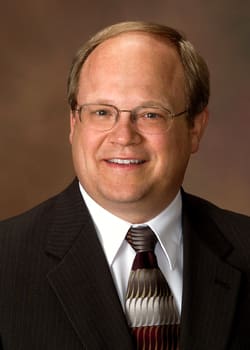
 In this three-part series I interview Community of Christ Prophet-President Stephen M. Veazey. Community of Christ is the new name of what was formerly known as the Reorganized Church of Jesus Christ of Latter Day Saints.
According to his bio:
Stephen M. Veazey is president of Community of Christ. Prior to his ordination on June 3, 2005, he served as a member of the Council of Twelve Apostles, the leading missionary quorum of Community of Christ. He is the eighth president of the church and the second who is not a direct descendant of church founder Joseph Smith Jr. He was ordained as president of seventy at the 1988 World Conference and as an apostle at the 1992 World Conference. In April 2002, Steve was set apart as president of the Council of Twelve and was the director of Field Ministries. His responsibilities also included Church Planting Ministries and Young Adult and Campus Ministries. His past assignments include missionary and administrative work in the Southern USA Mission Field; the Africa/East Central Field; the Ontario, South Central, and East Central Regions; apostle for SPECTACULAR; Outreach Ministries commissioner; the North Central Region; Advanced Leadership Studies at International Headquarters; and African American Ministries.
Born in Tennessee, he received a bachelor of science in biology from the University of Tennessee, and a master of arts in religion from Park College, Parkville, Missouri. Steve was an executive minister to the Fremont Congregation in California, and was in charge of a missionary development project for the San Francisco Bay Stake. Steve’s other church activities include serving as young adult minister to the Pacific Northwest Region; director of youth camps and seminars; field associate for a young adult campus ministries office; presiding elder; and counselor to the pastor in Paris, Tennessee.
Community of Christ has 250,000 members in more than 60 nations. The church’s mission is to “proclaim Jesus Christ and promote communities of joy, hope, love, and peace. Community of Christ International Headquarters is located in Independence, Missouri.
For current and former LDS Church members interested in Community of Christ, check out the Latter-day Seekers program.
Episode Transcript
Host: John Dehlin · Guest: Stephen M. Veazey
This transcript is machine-generated and lightly edited for readability. The audio is authoritative. Please excuse occasional errors in names and spelling.
Introduction and Welcome
Part 1 of 3 · Ep. 590
Stephen M. Veazey [00:00:00] Sam.
John Dehlin [00:00:26] Hello and welcome to another edition of Mormon Stories podcast. I'm your host, John Dehlin. It is October 20, 2015. We're recording today thanks to Terry Wittenberg. And we're recording from 99 West South Temple, which is the address for the City Creek Condominiums. We're very delighted to be here today, and it's a really special Mormon Stories episode because we have the great pleasure of interviewing President Steven M. Veazey, who is the president of Community of Christ.
John Dehlin [00:01:00] And it feels weird to say Community of Christ and not the Community of Christ. But before we began this recording, I learned that actually the church is not referred to as the Community of Christ, it's referred to as Community of Christ. And so that's an important thing to note just at the outset, something I should know but didn't. So again, you know, President Veazey, or Steve, as he prefers to be called, could also be referred to as the Prophet or the Prophet President of Community of Christ.
John Dehlin [00:01:32] And so it's a real honor to be able to spend a few hours with him. I'm really delighted this interview came about thanks to the good work of John Hamer. Many of you will remember John Hamer from past Mormon Stories podcast episodes.
John Dehlin [00:01:50] We've discussed the history of Community of Christ extensively in video and in audio with John Hamer. So I'll refer listeners to those episodes to really go into depth on the history. But we're grateful to John for arranging this interview, along with Seth Bryant, who is with us today. And he also was recently sort of called to be the replacement pastor, I'll say, for the Salt Lake City congregation of Community of Christ, because their current pastor was just called to be an apostle for Community of Christ. So super exciting stuff in Utah related to Community of Christ. And we're just really honored. President Veazey, or as you prefer I'd call you Steve. We're grateful to have you on Mormon Stories.
Stephen M. Veazey [00:02:40] Well, thank you. It's a real privilege to have the opportunity to sharing conversation and tell us
John Dehlin [00:02:47] real briefly why you're here in Salt Lake City.
Stephen M. Veazey [00:02:51] Well, the primary purpose is really twofold, and that is to be involved in some Community of Christ church activities. But that was related to the Parliament of the World's Religions, which was held just recently completed here in Salt Lake City. So we had a good Community of Christ contingent at the Parliament of the World's Religions.
John Dehlin [00:03:20] And as I understand it, there was a life size cut out of Joseph Smith III that people could actually pose with to take pictures.
Stephen M. Veazey [00:03:25] Yes, it's part of our story, our memory that Joseph Smith III attended the first Parliament of the world's Religions in Chicago in 1893. And so we've tried to keep that tradition going, including participation in the most recent one.
John Dehlin [00:03:47] Wonderful. Well, I have to admit that it's a little bit strange for me to have a chance to interview the president or prophet of a church, mostly because of my background in the LDS church, where I could probably have a hard time getting an Elders Quorum president to do an interview with me. And yet in your tradition, you're comfortable having sort of a largely unscripted interview for multiple hours with some random podcast guy like, is there anything you can tell us just about the culture or the leadership of your church that would make this something you'd even be interested in wanting to do? Why are you here?
Stephen M. Veazey [00:04:30] Well, first of all, I'm here because there was a gracious invitation to participate, and I wanted to respond to that. I think inherent in Community of Christ's mindset is a willingness to engage in discussion and conversation as people are seeking to find truth in the world and in their lives. And I think we also have a value as a church that we want to be transparent. So wherever church leadership travels in the world, it's not unusual at all to have just a question and answer session. And members, local leaders, seekers, inquirers, can ask questions. And in community, we try to be open and honest and responsive to those questions.
John Dehlin [00:05:33] So you actually speak to your members?
Stephen M. Veazey [00:05:36] Yes.
John Dehlin [00:05:37] And you meet with them?
Stephen M. Veazey [00:05:39] Yes.
John Dehlin [00:05:40] And you actually field open questions and answers with them?
Stephen M. Veazey [00:05:44] I do the best I can with the questions that are asked, even if the best I can do is just engage in discussion and conversation. But it seems to be something that's really valued among our members throughout the world. I think it reflects our understanding of community and the worth of all persons.
John Dehlin [00:06:12] Do you speak to media?
Stephen M. Veazey [00:06:14] Yes.
John Dehlin [00:06:15] You do media interviews?
Stephen M. Veazey [00:06:17] Yes. Yes.
John Dehlin [00:06:19] Isn't that scary?
Stephen M. Veazey [00:06:21] Yes. In the Kansas City area, in Independence, where our church headquarters is located, the Community of Christ would be more known and prevalent. And when we have a world conference or a major event, the local media are interested in that, or if we're considering particular issues or topics at our world conference that relate to national or international issues, there's interest in that. And occasionally the national media makes inquiries.
Growing Up in the RLDS Church
John Dehlin [00:07:01] All right, well, it's a pleasure to be with you today.
Stephen M. Veazey [00:07:05] Thank you.
John Dehlin [00:07:07] We always begin Mormon stories by having the guests speak a bit about their childhood.
Stephen M. Veazey [00:07:12] Yeah.
John Dehlin [00:07:12] And I'm just really interested in kind of where you grew up. What, you know, what your parents did for a living and what role, assuming it was called the rlds, the Reorganized Church of Jesus Christ of Latter Day Saints when you were growing up?
Stephen M. Veazey [00:07:28] Yes.
John Dehlin [00:07:29] So what role the church played in your life growing up?
Stephen M. Veazey [00:07:32] Well, I was born and raised in Paris and usually I pause at that point and then I had Tennessee, a little town in northwest Tennessee named Paris. In terms of my family life, I had an older brother who's passed away now, mother and father.
Stephen M. Veazey [00:08:01] My mother was many generations of the RLDS church. That is my grandmother, my great grandmother. So on the maternal side, I was shaped in the RLDS faith community. My father came from an interesting Baptist tradition called Primitive Baptist.
Stephen M. Veazey [00:08:26] And so on occasion, out of respect to my grandparents on the veazi side, we would go and share in the Primitive Baptist church services. And I was shaped by both, but predominantly by the RLDS Church. My, my mom was a stay at home mom who nurtured her two boys and was very active in the church and in the community.
Stephen M. Veazey [00:08:56] My dad worked at a manufacturing company in Paris that made the old Holley carburetors and he was a computer specialist on the front end of the. The evolution of computers for inventory control and process management. So I grew up primarily in the RLDS tradition and fortunately, from my perspective, there was a fairly large population of RLDS members in my home county. We had two congregations
John Dehlin [00:09:39] near Paris, Tennessee,
Stephen M. Veazey [00:09:40] one in Paris and then one about eight miles to the north. So in western Kentucky and western Tennessee, there's a line of RLDS congregations and quite a history of early church missionaries, both from the original church and also from the reorganized church, who came down from Illinois through southern Illinois and dipped down into western Kentucky and western Tennessee and planted churches. So I actually have in my possession some old letters that trace that history and where they had the first baptisms, down on the Tennessee river, which is near where I, I grew up. Fun, but generally had a normal growing up in terms of school, public schools, participating in athletics, highly involved in the congregation, the local congregation.
John Dehlin [00:10:50] What were your sports?
Stephen M. Veazey [00:10:51] Football and track.
John Dehlin [00:10:52] Really? What position in football?
Stephen M. Veazey [00:10:54] I played fullback and linebacker. Played runner? Yeah.
John Dehlin [00:11:00] And stock trey.
Stephen M. Veazey [00:11:01] Yeah.
John Dehlin [00:11:01] And linebacker.
Stephen M. Veazey [00:11:02] And linebacker. Wow.
John Dehlin [00:11:04] I didn't know linebackers could become prophets. Well, you would think those temperaments are irreconcilable.
Stephen M. Veazey [00:11:13] Yes. There are certain things I've had to lay aside.
John Dehlin [00:11:21] So I think someone, let's just say in the LDS Church, which is primarily my audience, or someone who comes from the LDS Church, might not have an idea of what it's like or what it might have been like in the 50s and 60s to grow up in community of Christ. Maybe just spend a minute speaking very briefly about some of the main activities or beliefs or experiences that might be considered highlights to your childhood growing up in the church.
Stephen M. Veazey [00:11:49] Sure. In terms of the community of Christ congregational experience, a lot revolves around Sunday morning activities. We had a fairly typical period of time, Sunday school, age appropriate classes, and we studied a variety of topics and then we would have our worship service.
Stephen M. Veazey [00:12:15] And typically the worship service involved a lot of singing. Community of Christ loves to sing, preaching or testimonies. Our sacrament service that we call the Sacrament of Communion or Sacrament of the Lord's Supper occurred once a month on the first Sunday of the month. And that was a very special time. And usually the highest attendance was on the first Sunday, as people referred to, was a time to, to feel the strength of the community.
Stephen M. Veazey [00:12:56] We had youth activities for teenagers their junior high and high school years as well as younger. Our youth group was called Zion's League and we had a cycle of fellowship, recreation, study and service. So we would do a service project in the community as an expression of our understanding of what the kingdom of God is all about or Zion is all about.
Stephen M. Veazey [00:13:31] We also had potlucks or dinners where everybody brought their favorite dishes and that was a highlight. Some people in the RLDS Community of Christ tradition call potluck one of the other sacraments of the church because people so enjoyed it. And we came together multi generational and had food and fellowship and just visited and enjoyed telling stories and connecting with, with each other.
John Dehlin [00:14:05] Was Jello involved?
Stephen M. Veazey [00:14:06] Jello was involved all right. Was always there and, and usually casseroles, all kinds of casseroles.
John Dehlin [00:14:15] All right.
Stephen M. Veazey [00:14:18] In the summertime we had youth camps for youth, different ages. But the highlight of the summer was what we called reunion. And that's a family camp. And we all came together for a week and we would have fellowship and worship services, classes, recreation, just time to visit that was devoted to being together. And a real strong sense of community developed because the participants in reunion came from congregations in a multi state area in that part of the country. And people really look forward to that as the time of renewal and revival. So our priesthood structure by office it's the same as in the LDS tradition. So there were priesthood meetings and a lot of the priesthood work just focused on pastoral care, visiting or outreach with families that were interested in the church.
Priesthood Structure and Offices
John Dehlin [00:15:32] So would you have, you know, in the LDS church when you're a 12 year old male. You become a deacon and then a teacher at 14 and then a priest at 16, and you're first passing the sacrament, then preparing it, then blessing it. Would it have been comparable for you at that time?
Stephen M. Veazey [00:15:49] No, it's not comparable in that sense. The two priesthoods, Aaronic and Melchizedek, would be used in the same sense of groupings of offices and the same priesthood offices. But in the RLDS tradition, there's a great deal of emphasis on the pastor or presiding elder, discerning calls for individuals according to their temperaments, their gifts, their life experience.
Stephen M. Veazey [00:16:30] So someone could be called to be a deacon at any point in their life, and they might remain a deacon and be fully devoted to that service, or they might be called to be a priest or an elder.
Stephen M. Veazey [00:16:44] Some people might be called to one office for a period of time and then to another office. The key was the discernment of spiritual call for the person and then getting that approved in a supervisory line and then going to the individual and sharing testimony of the call and inviting them to consider the call and taking time with that, and then, if they choose to respond, presenting that to the congregation so that the congregation can also bear testimony in support of the person. And when I say bear testimony, it's personal experience of discernment of the call for that person. And it becomes a very rich experience.
Stephen M. Veazey [00:17:39] It's not just routine. It's actually a worshipful experience. And then the congregation voting to support that person in their ministry, and then they're ordained.
John Dehlin [00:17:52] And so if there were to be an average age that someone might be called to be a deacon, that age would be what?
Stephen M. Veazey [00:18:01] It's not really an average age.
John Dehlin [00:18:02] Could it be 12?
Stephen M. Veazey [00:18:05] Very rarely would it be 12. There are some young people called in their teenage years. I was called to be a deacon when I was 16. That was considered a little unusual. It wasn't typical at all. My grandfather was called to be a deacon as an adult, and he was a deacon his whole life. And so it's hard to talk about what is average or typical because it's seen as very individual and personal.
John Dehlin [00:18:44] And do deacons pass the sacrament?
Stephen M. Veazey [00:18:46] Is that their main job in rlds community of Christ? The main focus of the deacon is the physical preparation of the facility or the setting so that the event or the worship can occur without having to be concerned about those kinds of details.
John Dehlin [00:19:12] And I think that's what our Doctrine and Covenants actually says. And I remember reading that and thinking, well, we don't totally do that, but yeah, okay.
Stephen M. Veazey [00:19:19] We would also expect deacons to teach principles of stewardship of one's life. So the deacon relates the physical to the spiritual is one way to describe it, and shows the spiritual that's in the physical in terms of very practical things. Like recently I was baptizing some people in Michigan, and there was a deacon there who was just making sure that everything was going well and that people understood where they could change clothes. And so you weren't worried about all the physical aspects of what was happening. And everybody could focus on the sacrament of baptism.
John Dehlin [00:20:10] Beautiful. So real briefly, what does the teacher do?
Stephen M. Veazey [00:20:13] The teacher in rlds community of Christ is a peacemaker, a reconciler. So the teacher is to be aware of the dynamics of relationships, individuals to the church, families within families, families to each other, and is to work to help people resolve and manage conflict in just and peaceful ways.
John Dehlin [00:20:44] So if there's a Hatfield McCoy dynamic, they would try and diffuse that.
Stephen M. Veazey [00:20:48] The teachers would go in there first. Nice, love that. And then call for reinforcements.
John Dehlin [00:20:54] That's beautiful.
Stephen M. Veazey [00:20:55] As needed.
John Dehlin [00:20:56] And then priests.
Stephen M. Veazey [00:20:58] Priests can baptize and serve the sacrament. So they are also focused a lot on what we call the ministry of presence. So if we think about the Aaronic priesthood, deacon, teacher, priest, we describe the ministry of physical presence, so that people are beginning to understand the nature of God's love and concern and teaching the basics of the gospel and home visiting as pastoral care. How are you doing? Are there needs? And sometimes visiting with other priesthood members, depending on the situation.
John Dehlin [00:21:44] Beautiful.
Stephen M. Veazey [00:21:45] Yeah.
John Dehlin [00:21:46] And when you were growing up, women were not allowed to hold priesthood offices, Is that right?
Stephen M. Veazey [00:21:52] When I was growing up, they were not. It was beginning to be discussed.
John Dehlin [00:21:57] Discussed. Okay.
Stephen M. Veazey [00:21:58] Yeah.
Sexual Ethics and Adolescent Faith Formation
John Dehlin [00:21:59] So really briefly, in. When an LDS person is growing up, sort of two really significant sort of teachings or doctrines are always kind of on their mind. You know, one is the word of wisdom. Do they try alcohol or do they abstain? Do they smoke or not? Do they try drugs or not tobacco or not? Like, it's, you know, it's a real. For me, it was a huge emphasis. I'm going to make it through high school, never try alcohol, never smoke and never do drugs and stay clean that way. And then with the law of chastity, as we call it, you know, you gotta not pet and not go past kissing and never have sex.
John Dehlin [00:22:40] And like, if you do, you know, you worry about a bishop maybe punishing you or telling you you can't take the sacrament and having to tell your parents and, like, that's a pretty significant challenge or opportunity. Or blessing or whatever you want to call it for an adolescent Latter Day Saint. And then there's the issue of sort of sexuality and masturbation.
John Dehlin [00:23:06] Would you have. Would those things have been on your mind? Was there the same sort of pressure or expectations or obsessions around those things, or not so much?
Stephen M. Veazey [00:23:18] Well, I think they were on our minds as young people, and we were experiencing both the culture of the church, the larger culture, which was somewhat in transition, but also I grew up in the Bible Belt. So the influence of evangelical Christianity was very strong in the local culture, too.
Stephen M. Veazey [00:23:49] And our challenge was to try to sort all of that out and understand what it meant. Now, an interesting part of the RLDS community of Christ experience was there is and was. There was and is a traditional dimension of the church that would have emphasized the word of Wisdom and certain ethical teachings as they were understood.
Stephen M. Veazey [00:24:21] I don't remember this, but people tell stories about how dancing used to be viewed as a sin. And so that didn't happen at church camps or reunions. And then that changed over time. There wasn't a sense of somebody always looking to see if you were obeying or disobeying.
Stephen M. Veazey [00:24:48] There was an understanding of certain ethical standards, especially if you were in the priesthood. There was more emphasis on human agency and our responsibility to make responsible choices. And people also can make mistakes. And so the response was usually more graceful and forgiving and restoring than it was finger pointing and being critical of you.
Stephen M. Veazey [00:25:26] It was more, the person is more important than other standards that may be there. And everybody, as human beings, we may not get it right all the time.
John Dehlin [00:25:44] Was there the dynamic of saying if you went too far with a boyfriend or girlfriend, that you couldn't take the sacrament? That sort of public shaming?
Stephen M. Veazey [00:25:53] No, that would be considered private and. And personal. There were standards like that that were taught, but there's.
John Dehlin [00:26:04] What were the standards?
Stephen M. Veazey [00:26:05] Oh, no smoking or using tobacco, no drinking. What you're describing, as I heard you say, the chastity was taught, but it was understood in general that not everyone lived up to all of those standards. And so the attempt was to hold up certain guidelines for ethical choices as understood at the time, but to emphasize that the good news of the gospel is that sin is more of a human condition of separation from God. It's not a listing of certain vices. That's a very shallow understanding theologically, but that it is the direction of one's life. And the mission of the church is to bring people into closer relationship with God and each other. And that was the goal no matter
John Dehlin [00:27:15] what, you're not just giving us the favorable interpretation. That was your experience.
Stephen M. Veazey [00:27:19] That was my experience. And yes, that's all I can speak to now. If a priesthood member was a drunkard, there would be administrative sanctions and they could be removed from the priesthood. And so if it became something that was a poor representation of the church or really out of bounds, there were certainly responses to that. But we always tried to maintain relationships with people. So even those actions of administrative sanction on someone's priesthood or removing priesthood authority or authority to represent the church was always couched or nested in pastoral concern and the hope that someone could be restored to their ministry in the church or leadership position in the church.
John Dehlin [00:28:22] So if an elder had a beer discreetly, there wouldn't, or even people knew that he had a beer, that wouldn't.
Stephen M. Veazey [00:28:30] That's where the human nature comes in. Probably depended some on the area, the congregation, who's in the congregation, but it probably wouldn't have been a big deal. But they would have been told, you really shouldn't continue to do that. That's not a good reflection on priesthood ministry. And so if they had persisted in something that wasn't considered to be in the best interest of the well being of the congregation, then there would have, there would have been guidance given, you know, and support given and then a line drawn at some point.
John Dehlin [00:29:16] So there sort of was a cultural expectation that priesthood holders wouldn't drink alcohol.
Stephen M. Veazey [00:29:22] That's right.
John Dehlin [00:29:23] Premarital sex, Same type of thing.
Stephen M. Veazey [00:29:25] Same type of thing.
John Dehlin [00:29:26] Okay. Adultery, right? Definitely. That could get you what?
Stephen M. Veazey [00:29:32] That could get you removed from, from priesthood.
John Dehlin [00:29:35] Okay, how about your membership? No, not your membership.
Stephen M. Veazey [00:29:39] No, it doesn't impact membership in good standing at all.
John Dehlin [00:29:42] Okay, okay.
Stephen M. Veazey [00:29:43] And I, I remember an experience where one of the priesthood members was engaged in an affair. It became common knowledge. Priesthood was removed, but ministry was offered. That individual eventually was restored to ministry after a time of not being in ministry with the support of his family and the congregation.
John Dehlin [00:30:21] And would the issue of sort of homosexuality, as it would have been referred to back then, would that have even come up in your childhood or adolescence in your church experience?
Stephen M. Veazey [00:30:30] It wasn't really coming up, but I think that was more a part of the local culture because as I reflect back, I remember in elementary school a young boy who was very effeminate. I don't know if he was homosexual or not, but he was taunted and bullied and I couldn't understand what was all going on. And that was like second or third grade. But I remember I Remember him just standing there weeping. And I just felt a lot of empathy for him, but I wasn't understanding what was happening. So it wasn't discussed a lot in families or the church. It was there in families and in the church, but people just didn't talk about it.
John Dehlin [00:31:36] Okay, that makes sense.
Stephen M. Veazey [00:31:37] Yeah.
John Dehlin [00:31:39] Real quickly is sort of, you know, in the LDS Church, used to be 19, now it's 18. You get called to serve a mission. Is that how it worked in your tradition?
Stephen M. Veazey [00:31:50] No, that's not an assumption. And it's not automatic for a lot of people. There are opportunities for young people in high school and in college to be a part of what we refer to as the World Service Corps. And it's not so much proselytizing as it is going to different places in the world and volunteering a summer or a year or several years and being of service in the congregation and in the community. But it's not a high expectation across the board for all young people.
John Dehlin [00:32:32] And you're saying your missionaries focus more on service than on conversion?
Stephen M. Veazey [00:32:36] Well, no, we have missionaries, but we consider our chief missionaries to be the members of the quorums of 70 and also the 12 apostles who are to lead the missionary or evangelism efforts of the church throughout the world. The 70 would especially have responsibility for evangelism. But a focus of the 70 is to train the membership in how to share their faith if people are interested in inquiring. Okay, so the 70 and the 12 help the whole church be outreaching and evangelistic.
Education, Testimony, and Faith Development
John Dehlin [00:33:19] Okay, so when you graduated from high school, did you go to college?
Stephen M. Veazey [00:33:23] I went to college.
John Dehlin [00:33:24] What'd you do?
Stephen M. Veazey [00:33:25] I went to the University of Tennessee.
John Dehlin [00:33:29] You're a volunteer?
Stephen M. Veazey [00:33:30] I'm a volunteer in a number of ways, but I'm a volunteer. This is a very interesting story. I did my undergraduate work in natural resources management with an emphasis on wildlife biology. So I was very interested in the environment and natural systems.
Stephen M. Veazey [00:33:54] I thought that's where I was headed after I graduated. Now, during that time, I had also been asked to be a pastor of a small group near where I was going to college. So as a college student, I had been called to be an elder in the church and was serving as a pastor.
Stephen M. Veazey [00:34:18] But after college, as the church was beginning this experience of opportunity for young adults to be of service, that was offered to me, and I decided to respond, and I was sent to the Pacific Northwest of the United States and Canada to work in youth ministry and evangelism and community service, and I never went back after that.
Stephen M. Veazey [00:34:50] Another period of time I went to the San Francisco Bay area and worked for the church full time and was supported by the church so that I could work full time. And then I've been working for the church in various roles ever since. So since college I've been working in a full time capacity for the church.
John Dehlin [00:35:12] So you've been an employee, sort of full time employee of the church since graduating from University of Tennessee?
Stephen M. Veazey [00:35:18] Yes.
John Dehlin [00:35:18] So no graduate school?
Stephen M. Veazey [00:35:19] No grad? Well, as part of my church leadership training, I completed a Master's of Arts in religion from Park University, which is in the Kansas City area.
John Dehlin [00:35:31] Okay. Yeah, excellent. Okay. Okay. So you're sort of a lifelong church employee then?
Stephen M. Veazey [00:35:37] Yes.
John Dehlin [00:35:38] Okay. As you know, another sort of main experience of an adolescent young adult LDS church member is sort of gaining a testimony. Right. And for us it's about believing that there's a God, believing that Jesus is God's son and the Savior of the world, believing that Joseph Smith was a prophet, that the church is true, you know, the LDS Church is true, that the Book of Mormon is true, and that the modern prophet kind of leads, you know, find a testimony glove, as they call it. Those would kind of be the main fingers on the testimony glove. And some just sort of pick that up as a child and that's just those are the things they believe in.
John Dehlin [00:36:21] Others sort of at various times in their life struggle with the digits on that hand. But the goal is to sort of have a firm conviction of those things by the time you're an adult. What would have been on your testimony glove growing up? You know, how would you have. Is there a comparable bearing of testimony that's a tradition within yours? And if so, what would be on the glove? What fingers would be on the glove?
Stephen M. Veazey [00:36:50] Well, in terms of testimony, the RLDS conception of that would be more. What is your ongoing personal experience? So in many congregations, when I was growing up, we had Wednesday evening prayer and testimony services. The prayers were spontaneous.
Stephen M. Veazey [00:37:16] The testimonies might be. Here's an experience with the love of God I had last week or tonight. I'm remembering this experience that I had, you know, several, several years ago. So the, the testimonies are very personal and they're not so much point by point.
Stephen M. Veazey [00:37:40] Typically now in Sunday school, what we memorized were the six principles of the gospel. So I guess that would kind of be the testimony. Testimony glove, faith, repentance, baptism, laying on of hands for the reception of the Holy Spirit, eternal resurrection, eternal judgment. And so those were considered kind of the basic principles of the Gospel.
Stephen M. Veazey [00:38:13] But most of our focus was life as a disciple of Jesus Christ, as a. As a member of the church. So testimony flowed out of our growing experience with our best understanding of the living Christ in the world and the love of God and how we were experiencing that and trying to express it to others. And what happened.
John Dehlin [00:38:42] And so what. What did you think about or what role did Joseph Smith play in your adolescence and adulthood? What about the Book of Mormon? What about the Doctrine and Covenants? You know, the. The notion of authority, you know, exclusive authority, Book of Abraham, all that stuff.
Stephen M. Veazey [00:39:07] Wow.
John Dehlin [00:39:08] Yeah.
Stephen M. Veazey [00:39:08] That's a.
John Dehlin [00:39:09] Was that even. Was that part of your upbringing? Not like.
Stephen M. Veazey [00:39:13] So I'd need to set the Book of Abraham aside. I didn't become aware of that till later in life.
John Dehlin [00:39:20] So that's an LDS thing.
Stephen M. Veazey [00:39:22] That's. No, we recognize it in history, but it wasn't a part of what we talked about at all or discussed.
John Dehlin [00:39:31] It's not in your canon?
Stephen M. Veazey [00:39:32] No, it's not in the canon. And I think to help everyone understand. So I grew up in a period of transition and in the RLDS Church community of Christ. So I was taught the basic story of church history. And there was a lot of focus on the founding experiences of the church.
Stephen M. Veazey [00:39:56] We had plays and dramas, and we took a tour of historic sites to Nauvoo and Kirtland and other places to learn the history. So we. We talked about it. But I grew up during a time when the church was saying, our history is precious.
Stephen M. Veazey [00:40:19] It's a sacred story, but it's a journey. And our history does not dictate or is not the gospel. It's our story, but it's not the gospel. We understood what we believed because we taught others what we believed. But it wasn't something that we were seeing as just propositional. You know, believe all these statements and you have the gospel.
Stephen M. Veazey [00:41:00] Our understanding was these statements point us towards God and God's revelation in Jesus Christ and what the church is to be all about in the world. But we're growing in our understanding of that. So they're pointers. They point us to the truth.
RLDS Identity and the One True Church Question
John Dehlin [00:41:22] Would you have thought of the RLDS Church as the one true church growing up?
Stephen M. Veazey [00:41:27] Initially, Originally, yeah. That's what I was taught.
John Dehlin [00:41:31] Okay. Okay.
Stephen M. Veazey [00:41:33] And in the missionary presentations of the church, not only were we the one true church, but we had to distinguish ourselves as the one true church in relation to the LDS Church. So that was part of the burden, if you will, of being rlds. So you had to take the story not only from the founding experiences, but then you had to show how that truth continued in the RLDS Church. So yeah, I was taught that there are still members of Community of Christ who would hold that position. The majority of the church would not hold that position.
John Dehlin [00:42:16] Now, would you have read the Book of Mormon every day as a young adolescent boy?
Stephen M. Veazey [00:42:22] I can't say every day. We, we studied in Sunday school and I read scripture. Not every day, but I mean, was
John Dehlin [00:42:33] the Book of Mormon like the central scripture that you look to?
Stephen M. Veazey [00:42:40] I wouldn't say it was the central scripture. It was more of a focus on biblical scripture first and then in the RLDS Community of Christ experience, the Book of Mormon and the Doctrine Covenants as witnesses of support of the biblical scripture and all of them pointing to God's self revealment in Jesus Christ. And in the RLDS Church, the idea of continuing revelation in open canon of scripture was very dynamic. So every two or three years the prophet president perhaps or would offer inspired counsel to the church that was included in the Doctrine and Covenants at the World Conference. So that was a very dynamic and living book in the life of the church. So we referenced it a lot to be in touch with our own journey as a people.
Book of Mormon Historicity and Polygamy
John Dehlin [00:43:50] Would you have even ever considered like the historicity of the Book of Mormon back then? Like, is it true, is it not? Were there really gold plates, you know, or would you have just accepted that narrative as factual and not even really
Stephen M. Veazey [00:44:03] thought about it as a child or adolescent? As an adolescent, I pretty well accepted the historicity of the Book of Mormon and that it was true because that's what this loving faith community had taught me at the time. And then during the late 60s, especially in the 70s, as I was moving along in my education in terms of school and learning to inquire and question and look at multiple sources and so forth. And then in college and beyond, those questions began to emerge, but they were being raised by the church itself. The church historians and other scholars started raising questions and that created real tension in the RLDS Church.
John Dehlin [00:45:03] So tell me when and how. I mean, I'm aware of the issue of polygamy being really central to the evolution of the community of Christ. The matter of sort of blood succession. I don't know if that's how you describe it of your prophet president. Eventually, you know, women and racial minorities as being important things, and then also the historicity of Scripture and Joseph Smith, etc. Maybe talk about how those matters presented themselves to you and then what your memories are of how the church grappled with those during your. During your adolescence or adulthood?
Stephen M. Veazey [00:45:48] Yeah.
John Dehlin [00:45:49] Were you, like, were you aware that those questions were being bantered about? Do you remember hearing about it, struggling with it, and how were you. Were you worrying about the church and what would happen to it?
Stephen M. Veazey [00:46:00] Like, I was aware more as a college student. Young adult, early 70s. Yeah, early 70s. Through the 70s. Early 80s. After I graduated from college.
John Dehlin [00:46:18] Okay.
Stephen M. Veazey [00:46:19] And gone to work for the church. I first heard about it through local members kind of grumbling about it.
John Dehlin [00:46:29] Which issues?
Stephen M. Veazey [00:46:31] All the ones you've mentioned. So through some of the church's curriculum for education of young people and adults, a certain view of history that was broader and looked at historical events more in context of the time those began to surface.
Stephen M. Veazey [00:46:53] Members of the church who were academically trained began to write articles and papers, and those papers were circulated. And so people began to question and. And there was a segment of the church that was interested in exploring those topics. Others wanted to retrench and affirm the faith as they understood it and had accepted it.
Stephen M. Veazey [00:47:29] Later on, especially when I went to work for the church and went through some training, we called it temple school. I had an opportunity to interface with the people and interact with the people who were writing the articles and doing the research. And I was in classes on restoration, scripture and church history. And all of these issues were thoroughly explored and discussed without being forced to take a position, but being encouraged to become more informed. And people moved along at various rates with that. And then since then, I've just continued to read and both Community of Christ resources and resources from the New Mormon History School, and just continued to stay open to all of the questions and continue to explore? What do I understand? What do I affirm?
John Dehlin [00:48:43] Is it sensitive and difficult for you kind of in your position to talk openly about things like polygamy and succession and Book of Mormon historicity and like, is it the type of thing where when I bring up those topics for you, is it like, oh, my gosh, if I talk about this, it could, you know, it could be problematic for lots of my members. Like, you know, I mean, cause obviously in our tradition, again, I couldn't even get an interview from Neldeshkorn president, let alone the president of the church. Church. Here you are not only taking interview, but I'm bringing up what I'm guessing might be some of the most sensitive issues your community has faced and maybe is currently facing. Does that. Like, is there a bit of that. That strikes a bit of the fear into you of like, let's not even go there because it's too controversial and too difficult.
Stephen M. Veazey [00:49:41] No, I. I think I'm not. Think I'm comfortable talking about those issues. My concern for some of our members is more pastoral because I know they would disagree or not want to explore issues that could become upsetting to their understanding of the Church's history or its faith. But as a general principle, we. We believe in honest theological. Honest, open theological and historical inquiry. And we believe that that's far more healthy for individuals and for a faith movement than not. And so as a leader in the church, I need to demonstrate my willingness even to wrestle with the questions in a more public way. Now, I am a bit cautious because people can take things out of context. Sure, they get on the web and. And. And then it may be upsetting to people.
John Dehlin [00:50:51] But so just. We'll do a couple minutes on this, and here's how we'll do it. I'll relate my understanding of what your history has been, and you can correct it or not, and then you can just focus on what it is now.
Stephen M. Veazey [00:51:06] Okay.
John Dehlin [00:51:06] Is that all right?
Stephen M. Veazey [00:51:07] Sure.
John Dehlin [00:51:07] Okay. So my understanding is, is that one of the main differentiators between RLDS and LDS historically was that originally the RLDS Church believed that the president or prophet of the church should sort of be a descendant of Joseph Smith or of the Smith family. And that at some point there's a perception that you ran out of, like, descendants of Joseph Smith, although John Hamer, I believe, has told me that that's not true. You've always had people that you could have tapped, but that at some point you decided that that didn't make sense. Correct me if I'm wrong, and then talk about maybe now.
Stephen M. Veazey [00:51:47] Well, I think in general, that's correct. But let me bring some refinement of understanding to that. In the RLDS community of Christ experience in the earlier years, forging an identity as the successor to the early church in terms of up to the time of Joseph and Hyrum's murders was very important to us.
Stephen M. Veazey [00:52:25] So a lot of the energy was focused on the reorganized Church, its legitimacy, its authority in relation to those who had migrated west and other groups and what became the Mormon or LDS Church. So Smith family lineage, and in the earliest years, oldest son was a way of understanding, a way for leadership succession without getting into a lot of arguments or controversies or counterclaims. So that provided stability to the movement.
Stephen M. Veazey [00:53:11] But then there came a point where it was not the oldest son, but a direct descendant. And so that Continued for a while, the Smith family, and that provided identity and stability.
John Dehlin [00:53:29] So it was not a constant succession
Stephen M. Veazey [00:53:31] problem, not a constant succession crisis, because we came out of that, and we were a dissenting group in those days that chose not to follow the migration west. So it served both a spiritual need as well as a practical need. But then there came a point, and this was Wallace B. Smith, in the 80s and early 90s, began to signal that the Church had been served well by the Smith family. And from the RLDS perspective, Community of Christ perspective, that's true. But that a time had come where there was a large pool of potential leaders and that the key factor in presidential succession was calling through the spirit of revelation. And so he was involved. He was the one who called his successor, Grant McMurray, who was the first president of the Church, who was a direct descendant or of the lineage of Joseph Smith.
John Dehlin [00:55:03] Is he still alive?
Stephen M. Veazey [00:55:04] Grant is still alive, yes. Yeah. And so. And that came through continuing Revelation, which was canonized in the Doctrine and Covenants. So now it's part of the Church's understanding. It wasn't imposed, but the Church supported that and had that included in the Doctrine and Covenants of the Church.
John Dehlin [00:55:28] There's a quote I once heard, I think, attributed to Martin Luther King Jr. Which is that power never relinquishes itself voluntarily. It must be forced. And I'm. I'm wondering whether. Was it Wallace B. Smith, Is that right?
Stephen M. Veazey [00:55:44] Yes, Wallace.
John Dehlin [00:55:45] I mean, he sort of really, on behalf of the Smith family, relinquished power.
Stephen M. Veazey [00:55:50] Yeah.
John Dehlin [00:55:50] And I'm wondering. I'm like. The skeptical side of me is like, someone must have made him do that. But he did it, and so he did it.
Stephen M. Veazey [00:56:01] And I would say in the councils of church leadership, there was some very open discussion of leadership succession. There's a part of the Church to this day who yearns, perhaps, or yearns for a Smith to be leading the Church, because they draw a sense of legitimacy out of that. But that's primarily in relation to other expressions of the restoration. Most of the Church would not be at that point at all. There are some groups that have broken off of the RLDS Church who would still hold that.
John Dehlin [00:56:48] But to me, that's a remarkable occurrence.
Stephen M. Veazey [00:56:51] Very courageous. And if you knew, we lovingly called him President Emeritus.
John Dehlin [00:56:57] Smith still alive, too.
Stephen M. Veazey [00:56:59] He's still alive. He's in his 80s, a very gracious and caring person who is fully supportive. He was of Grant and he is of me, and he doesn't intrude and. But he's always there. To just be an encourager.
John Dehlin [00:57:20] Beautiful. The next main. The main issue. I hear the story that Emma Smith denied that polygamy happened and that for many years a main distinguishing factor between RLDS and LDS is that the RLDS church sort of denied that Joseph ever practiced polygamy and. And didn't practice polygamy. And then at some point, I've heard, you know, in the 60s, maybe researchers started going, whoa, I think maybe he did. And then at some point, you guys sort of had to do a public. We got that wrong, and we admit it now, but we're not going to do it. Correct me if I'm wrong.
Stephen M. Veazey [00:58:03] Well, that's one way to describe it. Yeah. In the early reorganization, the official position of the church, the teaching, a lot of what the missionaries did, especially out west, was to draw distinctions between the two churches. And we were not polygamists. And we also asserted strongly and consistently that Joseph Smith Jr. Was not a polygamist.
Stephen M. Veazey [00:58:37] Although, if you read the history carefully, there were members of the reorganization or the reorganized church who had been with the church through the Kirtland and Nauvoo eras, who were writing to Joseph Smith III and saying, you know, you better be careful with that.
Stephen M. Veazey [00:59:06] But publicly, the position was, no, he wasn't. No, we're not. And that's a part of our identity. And that was carried on for quite a while, especially as the LDS Church grew up in national prominence and visibility on the religious scene. It was one of our distinguishing teachings.
Stephen M. Veazey [00:59:35] Yeah. During the 60s, there was the openness. I think some scholars before that were talking about it. But at that time, the questions began to surface more publicly in discussions and classes. But it still took a long time for there to be more acceptance in the church.
Stephen M. Veazey [01:00:09] And today there are still church members who would insist that that's the case, that he was not involved in any way in the beginnings of celestial marriage and polygamy. And of course, the community of Christ was never involved in that. So more recently, as. As the church in its own works have tried to be more honest about history as it was being understood,
John Dehlin [01:00:51] a
Stephen M. Veazey [01:00:51] lot of us were just taught that that was the truth. But as additional inquiry occurred, then there began to be in academic papers, in scholarly journals, more recognition of that and a gradual acceptance to the point that the RLDS Community of Christ position is in general on history.
Stephen M. Veazey [01:01:26] We don't legislate or mandate an official version of. Of church history. We encourage people to look at all good works, all scholarly works, and come to their own conclusion. So in The RLDS church, Community of Christ. You can be on a spectrum of understanding about that issue of polygamy and celestial marriage.
Stephen M. Veazey [01:01:52] As president of the church, in an article in our official church publications called the Herald, I was interviewed and I felt it was appropriate and responsible for me to say on this journey of understanding our history that I had had to go through some personal changes in my understanding and that I had, by reading the historians persuasively come to. They had persuaded me to come to the conclusion that Joseph Smith was involved in the development of those doctrines. But not everybody agrees with me, but that's part of the dynamic of the community of Christ.
John Dehlin [01:02:41] So was there ever a moment where the church felt the need to sort of say, we were wrong, we apologize, you know, this happened, or did the church not feel the need to do that?
Stephen M. Veazey [01:02:50] Kind of really haven't felt the need to do that because we've tried to be responsive, but we haven't done that. It's never really been presented to me as a need to do that.
Approaching Scripture and the Book of Mormon
John Dehlin [01:03:05] Okay, and then I'll just say about the historicity of the Book of Mormon, I'll just. I don't know what the history might have been and how the church has approached that. Did it have a similar sort of moment or phenomena where that became a big issue and the church and its leadership had to grapple with it? And then at some point, same time
Stephen M. Veazey [01:03:34] period, Same time period, late 60s, especially the 70s, 80s and even today. But again, the positions we take are do honest inquiry and study and in the community of Christ. Belief in the historicity of the Book of Mormon is not a test of fellowship or membership. It's not a litmus test. So that's where we are today. And you would find people at different points of understanding.
John Dehlin [01:04:15] So could. Could somebody say, you know what? I think Joseph used his creative mind and, you know, sources available to him, and it was sort of a work of fiction that we respect. Could somebody have that point of view?
Stephen M. Veazey [01:04:30] Yes.
John Dehlin [01:04:30] And be an active member, may even be a leader in the church?
Stephen M. Veazey [01:04:35] Good. Yes.
John Dehlin [01:04:37] Would you say that amongst the leadership that would be a. That. Could you even give sort of an estimate of, like, what percentage would view the Book of Mormon as delivered by golden plates and translated by the power of God versus sort of something different from that? Would you even have a sense for.
Stephen M. Veazey [01:04:55] Yeah, I'm not sure I could. We haven't had a conversation. As church leaders, we respect each other's journeys in that regard. We expect our church leaders to affirm the basic beliefs of the church in relation to scripture. And what we say is the Bible is our foundational book of scripture, and we use the Book of Mormon and the Doctrine and Covenants to support the witness of biblical scripture and to help us understand who we are and how God has been active in our own movement.
John Dehlin [01:05:43] There's something really, maybe this just reflects me, but there's something extra significant about the Book of Mormon to me and to many people who listen to the podcast. Because, you know, whether or not Joseph saw God, no one could really say, and he could have some sort of emotional or dream state experience that could really not ever be fully conclusive. But, you know, there's something about the materiality of gold plates where, like, either an angel delivered them or an angel did not deliver them. And if an angel did not deliver them, then Joseph made up a story that, you know, some don't like the word fraud, but that, you know, one could reasonably say that's fraudulent to claim that you got golden plates when you didn't and then to claim to produce this text as a translation when it wasn't.
John Dehlin [01:06:39] And, of course, there's all this conversation now about the seer stone and the method of the translation. But, you know, a believing. You know, there's all sorts of crazy beliefs out there. So a believing person could just very easily say, oh, I believe it. An angel delivered golden plates, and we have the Book of Mormon. It's a translation. But I imagine you could have sympathy for someone who goes, you know, there's enough problems with the Book of Mormon that I don't really think it's a translation, which means that plates really weren't delivered, which means that Joseph Smith. Smith kind of made it up, which means that that kind of book isn't.
John Dehlin [01:07:14] It's kind of based on, to put it kindly, untruths and to put it sort of harshly, a fraud. How would you, let's say a member was coming to you saying, I kind of am in the fraud camp, or a leader. Like, let's say an apostle came out and said, I think Joseph made that up. Now, I respect the text, but, like, what would you say? How would you respond? Would that be grounds for excommunication? Would that be like, oh, no big deal, we don't care?
Stephen M. Veazey [01:07:42] Well, it's certainly not grounds for excommunication
John Dehlin [01:07:44] or removal of office or priesthood.
Stephen M. Veazey [01:07:48] It's not grounds for removal of priesthood. As a leader of the church, then we would have to explore, you know, what are the implications of that in terms of how people view you in your leadership and role of ministry, we would have conversation about it, but I. I could be understanding of the questions, the dilemma that people would have, because it's like many things in religion, it ultimately comes down to a matter of faith.
Stephen M. Veazey [01:08:31] Now, it's helpful when there's evidence there that can support you, but ultimately there is this dimension of who you are that we describe as faith, and it goes beyond just human reason. And so that's how I tend to have conversation with people and focus more on what has been the value of the Book of Scripture.
Stephen M. Veazey [01:09:07] Because Scripture has all kinds of types of literature in it, poems and hymns and references to other passages of Scripture and metaphor and symbol. And it's an attempt to communicate truths that are really beyond the capacity of human words to express. So has Scripture helped you in your understanding of God, or what parts of Scripture have helped you?
Stephen M. Veazey [01:09:44] I often hear our members talk about certain parts of the Book of Alma where it says, you know, awaken your faculties, arise, awaken. Even if you have a desire to believe, then let that desire work in you, because that's a seed and they can relate to that as devotional scripture that has value in their lives.
Stephen M. Veazey [01:10:12] So we talk about Scripture more in those terms. We're interested in the scholarly studies and what's being found, but that's not necessarily the final word to a person of faith.
John Dehlin [01:10:32] Was that question of the Book of Mormon's historicity ever important to you? And did you at some point come up with a conclusion? And have you talked about that, or.
Stephen M. Veazey [01:10:42] Oh, I've stayed informed. The question was somewhat important, but not one of primary importance to me because I've experienced the Bible, the Book of Mormon and the Doctrine and Covenants as scripture in my understanding of Scripture. It's had an inspirational effect me. So in my context of Scripture, questions of historicity are interesting and somewhat important, but I primarily look to my understanding and experience with Scripture itself.
John Dehlin [01:11:28] Okay, so you maybe don't feel the need to sort of conclude for yourself whether or not there were plates or whether or not it was a historical book.
Stephen M. Veazey [01:11:37] Well, I don't think, at least based on my current understanding, that final answers can be found because comes out of personal accounts and testimonies. So what we have is Joseph testified. Joseph reported that Joseph indicated that. So not a lot of it was observable as historical event that others fully participated in or saw. And that moves it in then into the realm of what do I believe? Where do I ultimately put my faith? So it's not a primary question for me.
John Dehlin [01:12:19] And if you had to grapple with sort of the DNA evidence and the, you know, the. The anachronisms, the archaeological sort of. Have you had to grapple with that?
Stephen M. Veazey [01:12:28] I have.
John Dehlin [01:12:28] Okay.
Stephen M. Veazey [01:12:29] Yeah. And I've read all the articles from various sources, and I find it interesting. I think we're in the midst of an explosion of knowledge, and I'm going to follow that knowledge and I'm going to listen to people and hear their perspectives. And I don't feel personal pressure to give answers of yes or no or ultimate certitude on these questions, because they aren't ultimate questions for me in my faith.
John Dehlin [01:13:02] So for you, the evidence is inconclusive, and so it doesn't force you to sort of take a stand one way or the other, you're still waiting for more evidence.
Stephen M. Veazey [01:13:18] Let me put it this way. In the community of Christ, I'm much more interested in elements of the Book of Mormon that speak to our mission today. I'm very interested in what the Book of Mormon says about how you're to treat the poor. I'm very interested in how the Book of Mormon speaks to some social justice issues and what happens when people move towards peace instead of war. So I think we need a new reading of the Book of Mormon to find what is its message for today. And that's when the scripture speaks. So that's where my focus is.
John Dehlin [01:14:08] Do you have favorite parts of the Book of Mormon?
Stephen M. Veazey [01:14:10] Well, the one I quoted from Alma. From Alma is a favorite part. I like the story of the baptisms where they talk about now, if you're willing to mourn with those who mourn and comfort those who stand. So it's talking about the relationships in the body. If you're willing to be in that kind of community, then what do you have against being baptized that's there by the waters of Mormon? So that, to me, is powerful truth. No matter what the historical roots may be, it is communicating truth that's in harmony with my understanding of what it means to become a disciple of Jesus Christ, and that it's not just my relationship with God, but it has a lot to do with my relationship with others in society and in community. So that's an important story for me from the Book of Mosiah.
John Dehlin [01:15:19] My memory associates the community, associates community of Christ with a dove. A dove and peace. And I'm mindful of there are messages of peace in the Book of Mormon, but there's also a lot of war. How do you think about all that war in the Book of Mormon? And then the overall book's message about peace, because I sense that peace is really important to community of Christ and even maybe even being opposed to war.
Stephen M. Veazey [01:15:48] It is a very important part of our identity as we have come to understand the mission of the church in relation to the reign of God, which we see as a peaceable reign, even as the Old Testament prophets described it as a time of harmony and beating, swords and plows and so forth. Our church seal is a depiction of the Isaiah vision. The lion, the Lamb lying down together, and a child. Right, and a little child shall lead them. That's right out of the prophetic writings of Isaiah who foresaw this peaceable kingdom that's coming. So we understand the mission of the church in relation to that. And that would be part of our understanding of Zion or the cause of Zion in terms of all the war in the Book of Mormon or Laban
John Dehlin [01:16:48] losing his head, you know. Yeah.
Stephen M. Veazey [01:16:50] So all the violence just begets more violence. When are we going to learn? Can we take that from the Book of Mormon? No matter. And when there were these rare times of peace, there was prosperity, there was well being, there was harmony.
Stephen M. Veazey [01:17:11] So there is an alternative to all that war. So why do we keep following the pathway of all that war? And we can read about it here, here in terms of all the suffering and the strife and so forth. So if we can draw that out of the Book of Mormon, that's a relevant message for today.
Stephen M. Veazey [01:17:31] And in some ways I think Joseph coming out of his own situation of poverty was very sensitive to the plight of people in poverty. So there's the sermon by, by King Benjamin. We're all beggars when it comes down to it. And that gives you a perspective on your relationship to the poor. So there's solid message there. Ever how it came about. It spoke to a 19th century world in certain ways, answering certain questions. But it can continue to speak
John Dehlin [01:18:13] in
Stephen M. Veazey [01:18:13] relevant ways, just like Old Testament, New Testament can continue to speak in relevant ways, but we have to responsibly interpret it. So that would be my position and I think a position of a number of people in community of Christ as
John Dehlin [01:18:33] I think about how I internalize the messages of the Book of Mormon. Growing up in my church, I didn't get a real sense of, you know, I got a sense that like we're a patriotic church and we're the first to sign up, you know, if there's a conflict, we'll defend. And I don't remember any real conversation, high middle level about how war might be a bad thing and how we might want to stay away from it.
John Dehlin [01:19:04] And then I remember as I read the Book of Mormon, these messages about the poor and the needy and Zion. It's a very communalistic sort of message from the Book of Mormon about no poor among you. And yet I seem to have experienced a more prosperity sort of message in my tradition where making money is great and being wealthy is great, and if you make a lot of money, you can pay more tithing and City Creek Mall, you know.
John Dehlin [01:19:37] But it just seems like for LDS Church members, many of the central messages of the Book of Mormon have kind of been lost. And really, it's like the book is true and that's the deal. Right. But as far as, like all those messages about the poor and materialism and people peace. Well, maybe not so much emphasis. And it sounds like even though maybe some would say the community of Christ has de. Emphasized the Book of Mormon, it sounds like many of those central messages you still hold as very important.
Stephen M. Veazey [01:20:16] Yeah.
John Dehlin [01:20:16] Is that fair?
Stephen M. Veazey [01:20:18] I think that's fair. And they're not only messages from the Book of Mormon, but also, as we understand biblical scripture and then our own Doctrine and Covenants has increasingly emphasized certain themes in relation to peace, reconciliation, healing, generosity as a lifestyle. Not something to just respond to, because tithing is a law, but generosity is response to God's grace. God is generous. So those have been emerging themes in our church, and now they're being clarified and understood better.
Theological Evolution Within Community of Christ
John Dehlin [01:21:07] Okay, so now this macro topic of evolution, I just want to. This is going to be a compliment and us setting you up for a response. So I remember hearing a sunstone presentation by Bill Russell. Right. That's his name.
Stephen M. Veazey [01:21:23] Yeah.
John Dehlin [01:21:24] I love that man. And he sort of traced a lot of this history of learning and how the RLDS Church, community of Christ grappled with these changing issues and maybe had the option of hiding things or suppressing things or avoiding things and knew that there was probably a lot at stake by letting that genie out of the bottle or opening that can of worms of like really confronting and facing these issues. And my guess is these. This new Mormon history that started emerging with Fawn brody in the 40s, but then really escalated with, you know, the, you know, Mormon History association and Leonard Arrington and all the historians on board sides of our traditions through the 50s and 60s.
John Dehlin [01:22:14] My guess is this new Mormon history wasn't lost on our leaders as it wasn't lost on yours. But I just. As I heard Bill Russell talk about that evolution, my interpretation was our churches took two Very different approaches that while, you know, my church flirted with transparency and openness by installing Leonard Arrington in 72 or whenever it was and having this sort of Camelot years of history that very quickly the leaders got really uncomfortable with the implications of facing our history. And so not only did they sort of, you know, extinguish that 10 year church history initiative and sort of farm out those historians to BYU and sort of of quietly release Leonard Arrington and act as though he never existed and then started actually excommunicating scholars and activists who talked openly about these issues and just sort of said, we're going to do a hard line, we're going to retrench and we're going to even, we're going to discourage people from learning.
John Dehlin [01:23:26] We're going to call any source that raises any uncomfortable question anti Mormon and we're going to excommunicate or punish or marginalize anyone who talks about these things for a matter of decades, which you know, lasted in some ways still exists, but lasted in a very significant way through the early 2000s, it seems like. And I just remember, like being, you know, we talk about Gandhi and Martin Luther King or Mother Teresa as heroes in modern Western civilization.
John Dehlin [01:24:03] I felt that same level of respect for the RLDS church or community of Christ because my interpretation of the history is that your leaders said, and I don't need you to talk about the LDS Church. Not interested. But what I do want to sort of share my interpretation and see how you feel.
John Dehlin [01:24:25] It seemed like a real act of integrity and wisdom for your leaders to say, yeah, it's going to. It might hurt us to admit that Joseph was a polygamist. It might hurt us to talk openly about the historicity of the Book of Mormon. It hurts. It might hurt us to change how we handle succession in the church. It might hurt us to allow people of color to participate in the priesthood. It might hurt us to change our church's name. It may hurt us to allow women to participate and it may hurt us to have an open dialogue.
John Dehlin [01:25:08] But we're more interested in doing what's right than in money or numbers will take the route of integrity. We'll do what is right. I don't know if this is a song that you guys sing, but we sing a song that says, do what is right, let the consequence follow.
John Dehlin [01:25:31] That's how I perceive the choice that your leadership makes. And to me that's incredibly inspirational. And I'm wondering, is this a softball? I'm wondering if you perceive your history similarly and view it with maybe even more pride than I view it. Or do I have it wrong?
Stephen M. Veazey [01:25:58] Well, I appreciate very much hearing from you your perception of that time. Sometimes inside the church, we don't see ourselves as well as others who are observing from outside the church see us. So it's always interesting to hear the perspective of others.
Stephen M. Veazey [01:26:23] I would say, yeah, generally and consistently what you're saying is true, based on how I see our history and also church leaders who preceded me that I know and I know the quality of their character. And there were pivotal times that decisions had to be made that we knew that they knew would not be popular even in the RLDS church.
Stephen M. Veazey [01:27:02] But they chose a trajectory that they had concluded was the best and the healthiest and the most honest for our particular faith movement. I'm remembering a story that I've heard various church leaders point to, and this would have been in the presidency of W. Wallace Smith, who preceded Wallace B. Smith. He would have been president 58 to 78, so 20 years, basically the time period we're talking about.
Stephen M. Veazey [01:27:42] And there was a seminar on various topics, doctrinal, historical, and so forth. And some scholars from other traditions had been invited to be at the table with RLD as church leaders to explore these topics. And at one point, one of the scholars who was a professor turned to President W. Wallace Smith, and he said, before we can continue, I just need to know one thing.
Stephen M. Veazey [01:28:17] And so as it's been described to me, the rooms became very quiet. And this professor said, if this group has to choose between something Joseph Smith Jr. Said, and our best understanding of the teachings of Jesus Christ, which are you going to choose?
Stephen M. Veazey [01:28:41] And W. Wallace Smith said, we would have to go with Jesus Christ. And it was just like there was a transition in the leadership group. Now, I don't know if it was as pivotal as it is now viewed, because a lot went on before that and a lot went on after that. But at that point, I think there was an understanding. Let's get first things first.
Stephen M. Veazey [01:29:09] God's revelation in Jesus Christ and our best understanding of that and the mission of the church. And let's see how our sacred story contributes to that, helps us understand that and what our particular witness is in relation to that. But we are now focused on Jesus Christ and God's revelation in Jesus Christ.
Stephen M. Veazey [01:29:36] The church is not the gospel. The church points to the gospel. So if that speaks to your question also, in the midst of that, there were times that church leaders had clay feet as humans, because people say you do that, you know, we're not going to support the church anymore or we're going to leave or we're not going to financially support the church. But I think the record shows when the big choices had to be made, that the choice was always for honesty, transparency, truthfulness as we understood it.
John Dehlin [01:30:19] And I'm just trying to imagine behind the scenes conversations. If we make this choice, if we let women have the priesthood, if we let blacks have the priesthood, if we change our church name, if we change succession, if we acknowledge polygamy, if we allow open conversation, it might destroy the church. It might, it might cause a large percentage of members to leave, it might dramatically drain the contributions, and it might even kill the church.
Stephen M. Veazey [01:30:50] Yeah.
John Dehlin [01:30:50] And I'm wondering how the leaders responded to those hypotheticals during those moments, like
Stephen M. Veazey [01:30:59] really well, in reading some of the oral histories that are available from the leaders of the church during those times where they're pretty open and frank, they knew what was at stake, but they felt they didn't have a choice because of their focus on faithfulness to their best understanding of the Gospel of Jesus Christ and the nature of God as we had come to understand it in the community of Christ journey.
John Dehlin [01:31:33] So the guide really was what does God want? And what is our understanding of Christ and his message and what Christianity is? And that will be our guide.
Stephen M. Veazey [01:31:48] Yeah. And remember, we have a very dynamic doctrine and practice of continuing revelation. So the prophet, president after prayer, reflection, listening to the church, but can gain broader, deeper, wider even new perspective on God's nature and will and share that with the church. And the church has the opportunity to discuss, discuss that debate that, ask questions, have dialogue about it, and then come together in conference. And we call it corporate discernment of God's will. And in a very prayerful attitude, the church is able to say, we embrace this as continuing revelation. And now it helps us understand all that has been and it also points us to the future. So that allows the community of Christ to breathe in the midst of difficult and complex issues and not just be tied to what has been said before or our history. It.
Part 2 of 3 · Ep. 591
Stephen M. Veazey [00:00:00] Sam,
John Dehlin [00:00:25] What, what was the impact of sort of all these cumulative decisions? What was the membership sort of at its peak of our LDS community of Christ and where is it today? And if you had to describe the consequences of all these changes, what has it done to the church positively and negatively?
Stephen M. Veazey [00:00:48] Yeah, well, that, the answer to that has several elements to it. The community of Christ has continued to grow membership wise throughout this whole time, but it's been growing internationally. So the primary growth has not been in the Western world, but it's been in other parts of the world. So overall the membership has continued to increase.
John Dehlin [00:01:21] So you've offset domestic losses with international conversions.
Stephen M. Veazey [00:01:25] If you're just looking at numbers of members, it's very different realities in some ways. In the United States, Canada, Australia, British Isles, the membership has slowly declined, kind of following the track of some mainline churches and were impacted by some of the same cultural factors. We did have several migrations of members out of active participation in the RLDS Church following the approval of the ordination of women to the priesthood. Now that was kind of a culmination, in my opinion, of a lot of the issues that had been discussed in the late 60s, the 70s and the early 80s. But that kind of became the breakpoint for some people, women in the priesthood.
John Dehlin [00:02:29] And around what year was that?
Stephen M. Veazey [00:02:31] 84. That was approved. And about a year later, first ordinations of women to the priesthood. The experience in the church that I think has been most difficult is that of people choosing to develop what they call independent branches or congregations of the RLDS Church and wanting to take the name of the church with them, rlds and that has split families and congregations. And those groups say that they are wanting to be the RLDS Church with its original doctrines as during the time of the early reorganization.
Schism, Separation, and Fundamentalist Offshoots
John Dehlin [00:03:34] They're kind of fundamentalists.
Stephen M. Veazey [00:03:35] They're fundamentalists, RLDS Community of Christ, who got to a point that they felt they needed to separate. Some are still formally on the church's membership roles, but they participate in these groups where they say they're not under the auspices of Community of Christ. And I've heard various estimates of the number of members, but given our relative size, it was fairly significant.
John Dehlin [00:04:12] So you're in the hundreds of thousands, is that right?
Stephen M. Veazey [00:04:14] About 250,000 worldwide worldwide members with a nose count. We know a lot more people are in church than that, especially in places like Haiti or Africa. But they're not just haven't joined the church or our records haven't caught up to what's happening in those Congregations.
Stephen M. Veazey [00:04:37] So there was a departure from the church 80s and 90s, but at the same time we experienced some people becoming more active in the church and new people joining the church because we made the decision to ordain women. But overall there was an impact on numbers of members and church finances from that decision.
Stephen M. Veazey [00:05:05] Recently, when in some nations we approved the ordination of homosexuals in same sex relationships and marriage where it's legal, or a covenant ceremony where marriage is not legal, it was predicted that we would have another mass migration that would put the church in a very difficult situation.
Stephen M. Veazey [00:05:34] That has not happened. Some people have left and there's been some impact on church finances, but not as much as some said it would be if we made those decisions. But it's mainly relational hard feelings from people who felt.
Stephen M. Veazey [00:06:00] They basically say, you know, I didn't leave the church, the church left me. So they understood the church in a one true church model and as being very static and just persisting no matter what the circumstances may be.
Stephen M. Veazey [00:06:21] And they feel hurt. We have made very, several very sincere attempts to reach out, to reconcile. Some have reconciled, but it's usually on an individual and family basis, not on a congregational basis. So there has been pain. Now, how we've been blessed is this whole cadre of gifts and sensitivities in ministry that women have brought to the church.
Stephen M. Veazey [00:06:58] And they've become pastors, they've become jurisdictional leaders, what we call mission centers, groups of congregations. They're in every leadership group of the church. And the perspectives they bring have, in my opinion, given us a better understanding of the full depth of the gospel, the nature of God. And it's helped us grow and be better in our understanding of what God's about in the world.
Women in Leadership and Priesthood
John Dehlin [00:07:33] So talk a bit more about how having female leaders and pastors has benefited the church. Well, do you have stories, examples?
Stephen M. Veazey [00:07:45] Sure. I have a counselor in the first Presidency who's. Who's female. She is very sensitive to individuals or groups that may feel excluded. And so in the presidency, whenever we're discussing an issue, be it pastoral or practical, administrative or doctrinal, she's always bringing a perspective of what it's like to be the minority or to be the marginalized, or what it's like to be female in a world where patriarchy is still dominant. In a lot of ways that enriches our discussion. And as much as I, as a male would try to be sensitive, I think only a female could really bring that perspective and that experience.
Stephen M. Veazey [00:08:42] Same thing in the council of 12 in the bishopric of the church pastors. There's a type of sensitivity and compassion that I think has really helped us with the issues related to homosexuality that maybe a lot of men didn't have the capacity for. But the female perspective has really helped us on issues of sexuality and sexual orientation and deep sensitivity to relationships. And so we've been enriched by that in all aspects of the church.
John Dehlin [00:09:34] So the church has been enriched by having female leadership at all levels?
Stephen M. Veazey [00:09:38] Yes, it has. And even in countries that are still strongly male dominated and Christianity is clearly male dominated, to have an alternative there among those expressions of Christianity is extremely valued. So I've traveled to Haiti and Africa and in Asia, and I talk to our members. I just ask them, why are you a part of this movement?
Stephen M. Veazey [00:10:16] And some of them are new members who have come from other religions, some have come from other churches. And they list several things. They talk about our emphasis on the worth of all persons. So they're coming from societies where females are subservient or there's a strong caste system which we would not recognize in the church and that is so valuable to them as human beings. And that the notion that they could become an ordained minister is just phenomenal to them and extremely freeing in terms of fulfilling their potential as children of God.
Stephen M. Veazey [00:11:07] So that's very important to them. The way we express it is all are called according to their gifts, worth of all persons, unity in diversity, not to do away with diversity. And that is picked up as a very life affirming person affirming, community affirming message throughout the world.
John Dehlin [00:11:35] Is there anything that would preclude a female from being called as president, prophet at this point? Do you envision that that might happen at some point?
Stephen M. Veazey [00:11:45] Yes. Yes.
John Dehlin [00:11:46] Okay. Would you like to see that happen?
Stephen M. Veazey [00:11:48] Yes.
John Dehlin [00:11:49] You would?
Stephen M. Veazey [00:11:49] Yeah.
John Dehlin [00:11:50] Okay. All right.
Stephen M. Veazey [00:11:52] I think even though a member of the presidency is a female, that when a female becomes prophet, president of the church, that will truly signal that there's no role, there's no office, there's no responsibility that's not open and available to anyone according to their gifts and desires and God's call. So again, in community of Christ, it's its emphasis on who is God calling. And God can call people from very surprising life circumstances to serve in ministerial roles.
Racial Diversity and Inclusion in Leadership
John Dehlin [00:12:39] Okay, what about people of color in leadership? Is that. Is that a reality in community of Christ? Is that. How is that. How has that been for the church to have diversity of leadership?
Stephen M. Veazey [00:12:59] Well, it's certainly a reality.
John Dehlin [00:13:01] Talk about the racial composition of like the quorum of the 12 or the 70 or First Presidency or whatever.
Stephen M. Veazey [00:13:09] In the Council of 12, we have an apostle who's African, a very good friend of mine. He's from Zambia. We also have an apostle who's from Central America, Honduras, we have an apostle who is from French Polynesia, a woman.
Stephen M. Veazey [00:13:36] So the spectrum of color is in the leadership councils of the church, in the presidents of 70. Right now, we have 10 quorums of 70 organized around the world. There are presidents of the missionaries of the church who are from Africa, Asia, Central America.
Stephen M. Veazey [00:14:03] When we meet as church leadership, we use three languages, so everything's being translated. French, Spanish, and English so that we can communicate with each other. And I expect that that diversity of culture and races will just continue to occur.
Stephen M. Veazey [00:14:27] Of course, we have male and female in the leadership council sequorums of the church throughout the church. We have congregations, excuse me, that are diverse in terms of cultural makeup, depending on where they're located. We have congregations that are all Hispanic or all African American.
Stephen M. Veazey [00:14:54] We have congregations that are all Anglo. It kind of reflects the local culture. But we encourage all of our congregations to reach out to include diversity as a positive expression of the church. So that's a value that we hold.
Stephen M. Veazey [00:15:15] In terms of racial issues. Just after the Civil War era, Joseph Smith III indicated through revelation that we shouldn't be hesitant in ordaining people using the term of the time of the Negro race, when a lot of people were saying to him, don't move too quickly on this. There's a lot of tension in the country, and there had been African American members of the church prior to that, certainly.
Stephen M. Veazey [00:15:50] So in terms of racial issues, our people are human. So there were struggles. There were struggles in the Deep south during the civil rights era. But we as a church tried to be prophetic in our stances and then help the church align with the vision of racial equality and inclusivity.
Stephen M. Veazey [00:16:21] Now, the human nature still comes through, and people struggle with that. But overall, that's the trajectory of the church. And we have evidence of we're moving more and more in that direction.
John Dehlin [00:16:36] So for our traditions, 1978 was the big year for you. Was there a big year? Was it just post Civil War? It kind of.
Stephen M. Veazey [00:16:44] Right after the Civil War.
John Dehlin [00:16:45] Okay.
Stephen M. Veazey [00:16:46] Yeah.
John Dehlin [00:16:46] Nice. Nice job. So, you know, as you may have heard, there were three vacancies in our quorum of 12 recently. Many of us were hoping that the church would see that as an opportunity for some people of color to be called. That didn't happen. Not only did that not happen, it was three white males from Utah and honestly, I was very surprised. Like, it felt such a bold thing in 2015 with the church that's so global, to continue on that trend of only calling white males from Utah, Idaho, sort of into the quorum of the 12. Can you talk a little? And this maybe for you, this is an obvious question, but can you just talk about the importance of having racial diversity at the highest levels of why is that valuable? How has that enriched community of Christ?
Stephen M. Veazey [00:17:58] Yeah, Broader perspective and greater understanding helps us better understand God's nature and will. So we would believe that the diversity that is evident in creation is a reflection of God's nature. And so having diversity in the church and having diversity in the leadership of the church helps us draw closer to understanding God's nature and will. So there's blessing in there, their struggle to understand issues from various perspectives.
Stephen M. Veazey [00:18:41] But I understand that as a white male, I am privileged in society and in the church in ways that I don't even fully comprehend. And it's only when there are people from other experiences who are given the opportunity and empowered to speak and share their perspective and their truth from their life experience do I get a much better understanding of the nature of God, what the focus of ministry should be.
Stephen M. Veazey [00:19:23] We need to listen to the marginalized people. That's where Jesus would be. That's who he would be having food with. That's who he would be talking to. So they actually help us grow closer and understand better where Jesus is at work in the world today from their life experience.
Stephen M. Veazey [00:19:49] But the richness of cultures and languages that help us see issues from various perspectives is so much better than just being monolithic or monochromatic or homogeneous. Well, in nature itself, I mentioned I was initially trained as an ecologist biologist.
Stephen M. Veazey [00:20:20] Diversity is considered to be a healthy ecosystem because it can survive and thrive in changing circumstances. It's when there's too much sameness that systems get in trouble. So even from a practical, scientific perspective, perspective, diversity is a strength and a blessing. But most of all, I sit in church leadership meetings and we're talking about issues.
Stephen M. Veazey [00:21:01] And my African friend Bunda Chibwe, who's an apostle in the council of 12, he'll sit back and listen because that's important in his culture. And then he'll begin to speak from an African perspective. And I'll say, I never understood life that way, and I never understood that dimension of the gospel in that way, and I've been blessed.
Stephen M. Veazey [00:21:31] Or Moreva Arnaud APOSTLE FROM French Polynesia to speak from an island culture and to talk about Their sense of community and generosity, which is so different than Western individualism and greed. I'm blessed. I'm enriched. The church is blessed and enriched.
John Dehlin [00:21:55] So someday a president, prophet who's a person of color as well.
Stephen M. Veazey [00:21:59] Yes. Oh, yes.
John Dehlin [00:22:01] I just assumed that you would, you would welcome that.
Stephen M. Veazey [00:22:05] Yes, yes.
John Dehlin [00:22:06] Okay.
Stephen M. Veazey [00:22:07] Oh, I think that would be great.
John Dehlin [00:22:08] Okay, great. So there's. I really want to get to what it means to be a prophet in your tradition and what revelation means and what scripture means in your tradition. Before we do that, I want to briefly touch on just some high level matters of doctrine. And I want to do it in this way. There's a. So, you know, we know that, you know, you're going to have whatever birth rate you have and whatever, whatever conversions you have, domestic and international, you'll have that. And your church will hopefully grow at some growth rate, maybe 1 or 2% a year. Does that sound right? Yeah.
Membership Challenges and Church Growth
John Dehlin [00:22:58] But there's this broader world out there, right. And the broader world is within the LDS Church. There are high numbers of people disaffecting from the church. There's still a decent growth rate because of birth rate, but there's a very low retention rate internationally. And some are wondering whether within a good 10 to 20 year period that growth is going to sort of flatten. It's definitely slowed already for us.
John Dehlin [00:23:28] Some are saying it's going to flatten and maybe even start decreasing within a 20 to 30 year time period. And you know, internationally, of course, as long as we have money, we could send out missionaries and grow the church internationally. But what we know is that in the Western world, in Western Europe and in developed Asia, and definitely in the United States and Canada, outside of sort of restoration sort of discussion, there's a broad trend towards secularization. While the Catholic Church may still be slightly growing because of birth rate and immigration, we know that mainline Christianity is in trouble, as I understand it, in terms of membership decline.
John Dehlin [00:24:12] We know that from the Pew foundation that those who no longer affiliate with any religious tradition are the largest and the fastest growing group of any religious group. We call those the nones, N O N E. And just as we've seen in Western Europe, sort of churches on the decline, that's the environment in the United States and in developed Western world.
John Dehlin [00:24:42] So it's a tough time to be a church, a Christian church. And then add to that, you know, my understanding of the LDS tradition, which is that over half of those who leave the LDS Church end up becoming identifying as atheist or agnostic. They don't even like, just go, okay, well, we'll put the Joseph Smith in the Book of Mormon aside. They put the whole enchilada aside and it's like atheism and secularism and Jesus is just, you know, maybe he lived, maybe he didn't. Bible is just as fallible as the Book of Mormon. And, you know, it's very common for there to be just sort of a complete dismissal of religion altogether, almost an allergic reaction, where it's like, I'm never stepping in within the walls of a church again.
John Dehlin [00:25:34] I'm not interested in anything, and especially not building on a restoration tradition when I know so many unpleasant things about Joseph. So, you know, that's, you know, a lot of my listeners are in this boat, just lost all appetite for religion.
Core Beliefs and What Community of Christ Offers
John Dehlin [00:25:52] So I'm going to ask you at just a very high level, I'm going to go through some major religious beliefs and ask what community of Christ has to offer in 2015 about some basic teachings that context. So, for example, many are atheists today, and if not atheist, definitely a very small G sort of version of God, which is maybe there's some energy or power or force in the universe, call that God or not. But sort of the anthropomorphic idea of a God is certainly losing favor amongst the people I talk to and sometimes the idea of any God whatsoever. What does community of Christ have to offer about a view of God that could speak to a millennial or a disaffected Mormon in 2015?
Stephen M. Veazey [00:26:46] Well, I think our conceptualization of God, which we always speak of in very humble terms because we recognize the limits of human language and understanding, would be one that affirms God as spirit, light and truth and love. Now, there are elements of that that can be integrated with what is emerging in some of the new physics understanding of the nature of reality, that everything is energy and in relationship.
Stephen M. Veazey [00:27:35] So we offer an understanding of God that is experienced in relationality with others, in community. That's part of the reason for our name. So I think it's a God that is not in combat with findings of science, but actually provides an opportunity for integration of knowledge and faith in a healthy and productive way.
Stephen M. Veazey [00:28:10] We also affirm a God who, who is a suffering God. So we take seriously the human reality of suffering in the world and God's intense involvement in that suffering. So it's not so much a vertical theology as it is a horizontal theology, theology of God, if that makes sense. And not a. A physical God, a body, especially not a male physical body God.
John Dehlin [00:28:58] So someone who's Like, I'm not going to be behind a male God. I'm probably not going to be behind an anthropomorphic God. But I'm down with there being life, and I'm down with the possibility of some type of power, energy or force,
Stephen M. Veazey [00:29:14] a ground of all being, ultimate truth, the holy other who is not me.
John Dehlin [00:29:26] Yeah, all is one in some sense. All is part of this life. And certainly love is a good thing. So if somebody's like, that's as much as I can offer in terms of. That's as much form as I can put to God. Anything else is. I just. I can't go there because it's just too specific for something that's unknowable. If somebody just. That's as much as I can give in terms of God, the response would be what?
Stephen M. Veazey [00:29:52] You'll certainly find language, symbols, testimonies and understanding of that experience and people who share that perspective.
John Dehlin [00:30:03] And would that person be viewed as inferior or lesser than in the community, or they're not a real believer?
Stephen M. Veazey [00:30:10] Well, one of the phrases we use a lot is all truth and that we're always open to exploration, more understanding. So it's the honest searching that is really valued in community of Christ, or in many parts of community of Christ.
John Dehlin [00:30:33] Okay, likewise with Jesus. Jesus is under assault in some sense. Did he really exist or not? Is there historical Jesus? And then even if there was a historical Jesus, which all reasonable people hold different views on, that whether or not a real literal resurrection happened is sort of something that some people maybe aren't prepared to go that far. It's like some people might believe that, but who knows whether he really was resurrected or whether we will literally resurrect. What does community of Christ have to offer in terms of sort of those questions or sensibilities or concerns?
Stephen M. Veazey [00:31:19] And when you're asking these questions, you're talking about what's more normative. Because one response is always going to be, there is a spectrum of belief in the church. All are valued. We view the church as a tent, a large tent. There are some boundaries out there, but people have to decide what their relationship is to the basic beliefs or or affirmations of the church. And there's freedom and space to do that. But what's normative in the church is, yes, there was a historical Jesus.
Stephen M. Veazey [00:31:58] There's also the Christ of faith that began to be the understanding of the church. As the church reflected on the life and ministry and the death and the resurrection of Jesus as it had been experienced in the community.
Stephen M. Veazey [00:32:17] Something happened that indicated that death was not the final word on the matter. And the church called that resurrection. And you have the testimonies of people who say, we saw, we heard. That moves into a matter of faith then. So you would have a spectrum of belief from resurrection as literal, bodily, resurrection
John Dehlin [00:32:48] on an individual basis.
Stephen M. Veazey [00:32:50] On an individual basis. Or for Jesus, Jesus, resurrection, a glorified body, a resurrected body. That's different than the physical human body, body. The gospel witness, don't touch me. You know that Jesus said to those who see resurrection as a principle that God is always bringing life and new life out of that which appears to be dead and lifeless. And that that's the most important truth that comes out of those scripture passages and stories ever, how you view them. So throughout the church, there would be a variety of beliefs and people would be respected with those beliefs. The boundary, if somebody said basically there was no Jesus, we're not going to reference Jesus, forget Jesus, that would be a boundary. I mean, when you're called community of Christ, obviously you're focused in a certain direction.
John Dehlin [00:34:05] What if somebody is saying, I don't believe in God? I identify as an atheist, and I tend to think that Jesus may or may not have been historical, But I don't believe in the literal resurrection. But I like the teachings of love. So it's just sort of. I'm okay with believers. I'm not necessarily identifying as one, but I really love the teachings of Jesus and I like being in a fellowship where those sorts of teachings are encouraged. Can that person be baptized?
Stephen M. Veazey [00:34:40] Yeah, that person could be baptized because we understand the conditions of repentance as being part of baptism. But repentance is.
John Dehlin [00:34:49] Is.
Stephen M. Veazey [00:34:50] Are you searching? Are you looking towards the truth, or are you in rebellion? So we tend to look to the possibilities in terms of a person's ongoing journey, and we want to preserve those opportunities with them. Now, in some specific congregations of the church, that might be viewed differently, but in general, I would say that individuals with that perspective would be welcome to participation, wouldn't be preaching every Sunday because the community itself would have certain expectations in terms of what's proclaimed in terms of the public message or the public theology of the church.
John Dehlin [00:35:51] I was listening to a podcast recently about the United Church of Canada and how at least one female pastor began identifying as atheist and is now under review by the church, and her sort of ministry is in jeopardy. Could someone who self identifies as an agnostic or an atheist publicly become a pastor, do you think? And if a pastor began identifying as atheist or agnostic, could that jeopardize their ministry, their office.
Stephen M. Veazey [00:36:27] I think honestly, it could jeopardize it, but not out of any desire to be legalistic or to discipline, but because of the expectations and shared beliefs of the faith community. That person would not be selected or supported to be in a leadership role. They would still be welcomed and encouraged to be part of the fellowship. And people would listen seriously to their questions and think about it and respond. But I think the community itself would take a position on that as a faith community.
John Dehlin [00:37:13] But not excommunicated.
Stephen M. Veazey [00:37:14] Not excommunicated.
John Dehlin [00:37:15] Okay. What does it take to get excommunicated in community of Christ?
Stephen M. Veazey [00:37:20] Well, officially, it takes murder or second offense. Adultery.
John Dehlin [00:37:32] Okay. Or
Stephen M. Veazey [00:37:37] unchristian conduct that is so blatant the person themselves has, in effect, removed themselves from the church. Now, at this point, I probably better check. Excommunication to us means a member not in good standing, not able to take the sacrament of the Lord's Supper. Expulsion means removal of membership.
John Dehlin [00:38:10] So those former things were the grounds for exposure.
Stephen M. Veazey [00:38:12] Those were some expressedly stated grounds for expulsion. Yeah.
John Dehlin [00:38:19] Okay.
Stephen M. Veazey [00:38:19] But there would be a process.
John Dehlin [00:38:22] Excommunication means can take communion.
Stephen M. Veazey [00:38:24] Right.
John Dehlin [00:38:24] Okay. For you. Yeah, got it.
Stephen M. Veazey [00:38:27] In the community of Christ tradition.
John Dehlin [00:38:29] Okay.
Stephen M. Veazey [00:38:29] And that person can be reinstated. So, again, the focus is always towards reconciliation of the person with the community. And to be. It is very, very rare. It can be appealed all the way to the First Presidency, but it's very, very rare.
John Dehlin [00:38:53] Okay.
Stephen M. Veazey [00:38:53] Hardly ever hear of it.
Scripture, the Bible, and Doctrine and Covenants
John Dehlin [00:38:56] Okay, really quickly, your position on the Bible. And there's a lot of modern historical criticism that's actually lasted for over 100 years about, is the Bible really the Word of God? Is it just passed down through oral tradition? There are contradictions in the Bible. There are questions about its historicity as well. What does community of Christ have to say about the Bible and all the atrocities in the Old Testament?
Stephen M. Veazey [00:39:22] Yeah. Wow. So we're getting into major topic, so I can just respond. At a certain level, we have a statement on scripture that we distribute throughout the church. And it has certain principles that we uphold and affirm. And again, then people have to decide, where are they in relation to that principle?
John Dehlin [00:39:46] And is this doctrine and Covenants 163?
Stephen M. Veazey [00:39:49] No. The statement on Scripture is in a resource called Sharing in Community of Christ, which contains various foundational statements about the beliefs and mission of the church. And it's the primary reference for current church articulation of basic beliefs and the sacraments of the Church and Scripture and so forth. That statement affirms scripture as inspired.
Stephen M. Veazey [00:40:21] Affirms the role of Scripture as indispensable as long as it's faithfully or responsibly interpreted. And that interpretation includes availing oneself to the scholarly information about historical context and meanings of the Scripture as it was understood at the time, how it can be understood and applied. Today we see Scripture as a collection of books of many, many voices that recount human encounter with the divine and the human response to that to describe the experience of encountering the divine.
Stephen M. Veazey [00:41:13] We do not affirm Scripture as literally infallible. So we don't see hold Scripture as the words of God, but within Scripture you can find the living Word of God through the inspiration of the Holy Spirit. All Scripture falls under the lens of God's revelation in Jesus Christ.
Stephen M. Veazey [00:41:45] So we would look at the Old Testament through the lens of Christ and through the New Testament, the Book of Mormon, the Doctrine and Covenants, because we believe that God's most decisive revelation was in Jesus Christ, a life.
Stephen M. Veazey [00:42:06] So we don't equate the word of God with words, but the words point us to encounter with the Word of God. And the Word of God is the livingness of God in creation, creating still, and God's revelation in Jesus Christ. And then how we continue to encounter that so indispensable, we would affirm it as inspired, indispensable, not literally inerrant or infallible in every detail.
Stephen M. Veazey [00:42:51] As a collection of books with many voices that have to be understood both in their historical context and then responsibly interpreted for application in life today. And the Spirit helps us do that.
John Dehlin [00:43:09] You'll have to forgive me for quoting your scripture, but I, you know, this is. This is Doctrine and covenants, section 163 of Community of Christ Scripture. And it's amazing. So this is verse 7, is that how you'd say it? Section 163, 7B. Any idea when this was given, when this was made Scripture? I'm looking if your heading has like a year where it was. I don't know. I'm not going to put you on the spot to give a year, but I don't see a year here, but decade approximate. Any idea?
Stephen M. Veazey [00:43:48] About five years ago.
John Dehlin [00:43:49] About five years ago. Were you president, prophet?
Stephen M. Veazey [00:43:52] Yeah.
John Dehlin [00:43:52] Yeah. Oh, this came out through you.
Stephen M. Veazey [00:43:54] Yeah.
John Dehlin [00:43:56] This guy's a prophet, seer and revelator. Okay, here we go. It says scripture is not to be worshiped or idolized. Only God, the Eternal One of whom Scripture testifies is worthy of worship. God's nature as revealed in Jesus Christ and affirmed by the Holy Spirit, provides The ultimate standard by which any portion of Scripture should be interpreted or applied. That's beautiful.
John Dehlin [00:44:24] C. It is not pleasing to God when any passage of Scripture is used to diminish or oppress races, genders, or classes of human beings. Much physical and emotional violence has been done to some of God's beloved children through the misuse of Scripture. The church is called to confess and repent of such attitudes and practices.
John Dehlin [00:44:49] Scripture, prophetic guidance, knowledge and discernment in the faith community. Community must walk hand in hand to reveal the true will of God. Follow this pathway, which is the way of the living Christ, and you'll discover more than sufficient light for the journey ahead. Now that inspires me.
John Dehlin [00:45:08] Like, that's. That's amazing. Like, I like. It feels like a hot shower on a. After a long day's work to read Scripture that is informed by. I don't know if you would characterize it this way, but it's informed by modern or even progressive sensibilities. And again, I don't know if you're allergic to those adjectives, but for me, it's like, I like this. Like, I don't know what I think about God or religion or Jesus, but, like, that is good. That is wholesome and noble and worthy and revealing and enlightening and inspiring.
John Dehlin [00:45:45] And I'm thinking. I'm thinking two things. I'm thinking holy moly. Like, what was the beautiful thing that Joseph Smith revealed? This notion of ongoing revelation. Yay. But because the doctrine and theology he was facing, children don't go to heaven if they die before 8. And, you know, animosity between church, so much exclusivity, like racism, like, yeah, he moved the ball forward about how people talk about Christianity from my value standpoint. And part of how he moved that forward is by saying, hey, not only can people receive personal revelation, but churches. And a prophet can receive modern revelation and new light knowledge. Like, that's the whole selling point of the LDS sort of missionary program.
John Dehlin [00:46:37] And yet I don't know if we've had like one or two sections added to the Doctrine and Covenants after Joseph died. And they were just. Most of what was added was declarations, sort of undoing, sort of lame teaching or lame practices of the past, polygamy and racism. But, like, where is the further light knowledge added to the Scriptures? So that's my bias. But I'm going to ask you to respond to what I see as the beautiful thing about what you're doing, which is like, there is. There are new sections added to your doctrine and Covenants, sort of every decade. Average of. How many new sections do you think?
Stephen M. Veazey [00:47:19] Several.
John Dehlin [00:47:20] Several.
Stephen M. Veazey [00:47:21] One or two.
John Dehlin [00:47:23] Yeah. And. And they're beautiful. So, you know, how many sections, if you even have the number, how many sections have you been responsible for adding?
Stephen M. Veazey [00:47:36] 163 and 164, which follows. And currently I have shared some words of counsel with the church that will be considered at our world conference coming up in June of 2016 for inclusion in the Doctrine and Covenants. And now that I have my years straight. That was in 2007.
John Dehlin [00:48:00] Okay.
Stephen M. Veazey [00:48:01] 163.
John Dehlin [00:48:02] Okay.
Stephen M. Veazey [00:48:02] Yeah.
John Dehlin [00:48:03] And you would describe 163 as being generally about what?
Stephen M. Veazey [00:48:13] One of the challenges of speaking about revelation is finding the words. But what it is about is a living God who is wanting us, the human creation, to be vulnerable to God's grace and to be transformed by it.
Stephen M. Veazey [00:48:45] And whatever it is in our lives that causes us to put up resistance or shields or defensiveness to being touched and blessed by God's grace can stand in the way of what God really wants us to have and experience in our lives.
Stephen M. Veazey [00:49:12] I was fairly new as president of the church, having been only ordained in 2005. But that. What became Section 163 became a powerful experience for me in my own understanding of God, when. When I encountered that kind of love and light that I always believed in. But it became even more real through the experience of shaping words and speaking words that the Church considered to be worthy of being included in the Doctrine and Covenants as part of the church's understanding of who God is.
Stephen M. Veazey [00:50:04] The one on the nature of Scripture was particularly profound because for me, in my experience, because it spoke to so many issues that people are in conflict about, and there they're hitting each other over the head with their Bibles, assuming a particular way of reading the Bible and doing a lot of emotional and relational violence and allowing a lot of physical violence to occur.
Stephen M. Veazey [00:50:47] And that's just not right. And. And it became. I knew that, but it came very clear to me when God said, that's not right, if I can use those terms.
John Dehlin [00:51:02] When God said, what's not right?
Stephen M. Veazey [00:51:04] To use Scripture that way.
John Dehlin [00:51:05] Yeah, yeah, yeah.
Stephen M. Veazey [00:51:06] To dominate, oppress, do violence. And so you go back slavery and how people used certain passages in the Bible out of context as a support for the institution of slavery and proved it from certain biblical texts was wrong and misinformed. The oppression of women using certain texts, especially Pauline text or from the Apostle Paul, is a misunderstanding and a misuse of Scripture that totally ignored or Historical context and other writings of Paul. So, yeah, if Scripture is to speak to the nature of God and the living word, then it should never be used in ways that are so contrary to our understanding of the nature of God and who Jesus is. We are the ones who have misunderstood and misapplied.
John Dehlin [00:52:20] And so, and I wanted to ask this earlier, but it's a, it's an okay time, I think. So similar to read the, the principal narrative of the Book of Mormon that says that God turned people's skin dark because of their wickedness. How would you look at that? How would you justify it?
Revelation, Humility, and Common Consent
Stephen M. Veazey [00:52:36] Yeah, I've read various apologetics and justifications, but I think it's a scripture we need to understand in its historical context and set aside and move on with the broader witness of Scripture, as I understand it, the more universal passages that speak to truth across time and, and culture. And I've been sad with some of my African American friends and associates that those passages in the Book of Mormon have been a barrier to their relationship with God. And so when I have to choose, I move to my interpretive lens, which is God's revelation in Jesus Christ, and interpret scripture through that and I'm able to sort things out.
John Dehlin [00:53:43] So maybe that teaching, maybe it was prejudice on the part of the Nephites, or maybe if it was something that maybe Joseph, it was a product of his environment, something other than really what God did.
Stephen M. Veazey [00:53:56] Right, True.
John Dehlin [00:53:58] Yes. So God did not curse people with dark skin in your belief?
Stephen M. Veazey [00:54:02] In my belief, no.
John Dehlin [00:54:03] Okay, so the Book of Mormon gets that wrong and that's okay because Scripture doesn't have to be right all the time.
Stephen M. Veazey [00:54:09] And scientifically there's a lot of evidence that we all descended from an African woman.
John Dehlin [00:54:18] So you're okay with evolution?
Stephen M. Veazey [00:54:21] Well, we can get into quite a discussion of different schools of evolution, but yeah, there's certainly space in my understanding of how creation comes into being and unfolds. That includes principles that are described by evolutionary science. But you have to be careful totally identifying with certain schools of that, because I believe there's a creative impulse that is God that's involved in all of that.
John Dehlin [00:54:58] But certainly not a 6,000 or 7,000 year old Earth.
Stephen M. Veazey [00:55:01] No.
John Dehlin [00:55:02] And certainly not an adam and eve 6000 years ago being the first humans.
Stephen M. Veazey [00:55:06] No, that would be a literal understanding of scripture.
John Dehlin [00:55:12] And that's in your doctrine of Covenants too, right?
Stephen M. Veazey [00:55:14] Yeah.
John Dehlin [00:55:14] Okay.
Stephen M. Veazey [00:55:15] But it reflects a type of, of scriptural literature that included stories about creation. So I need to look deeper in that story to understand the truth. That's being communicated.
John Dehlin [00:55:34] Okay, so at a higher level, I think LDS folks are raised to think that sort of the prophet picks up a telephone and talks to God almost audibly, that it's a very direct communication with, with very concrete language and that. And for us, that's it. It's that the prophet talks to God and Jesus. They get that personal.
John Dehlin [00:55:59] See Jesus, you know, talk to God like, oh, you want, oh, this is the revelation. Okay, let me write that down. You know, okay, church, here's the revelation. You know, even though that's not happening a lot these days, in theory, that's supposed to be what we believe in.
John Dehlin [00:56:14] And it's a very direct thing. And the prophet is like the most righteous person maybe on the earth. And again, God's buddy, you know, co managing God's children together in a very verbal and direct way. What is it like to be prophet? Is it like that? Is it something different than that? Is there any of that going on?
Stephen M. Veazey [00:56:40] It's not like that. So revelation, it's our belief, our understanding and our experience that God is self revealing. So that's the core of the doctrine of revelation. That's an expression of love and desire for relationship with creation. Revelation, from my experience and also my study, but especially from my experience, is encounter with the reality of God.
Stephen M. Veazey [00:57:26] Light, truth, love. At that point we begin to try to describe that. We use our human language, we use symbols, we use stories, we use metaphors, we use every. Use poetry to try to explain that. And the Holy Spirit inspires that.
Stephen M. Veazey [00:58:01] But it is not just being the recipient of nouns and verbs that you automatically write down on paper. So that is my experience with, with revelation. It's a. I would describe it as a heightened sense of encounter with God and then using every fiber of one's being to communicate that with the help of the Holy Spirit.
Stephen M. Veazey [00:58:43] But it is communicated in language, through a human being, in human culture. And so we believe that the Holy Spirit helps others through those words to have the same encounter. So the written record of revelation is an attempt to describe the experience.
Stephen M. Veazey [00:59:15] But in some ways it's always limited because human mind and human being has been involved in it. It's both has been my experience. My experience of revelation is you don't schedule it, you don't turn it on and off.
Stephen M. Veazey [00:59:39] That your responsibility in this kind of role is to be prayerfully open, aware, observant and listening. And over time you have moments of encounter with God when certain truth, certain themes begin to emerge, like this paragraph on Scripture.
Stephen M. Veazey [01:00:11] And then what I do is spend Time with that to make sure it's not Steve. And it's not just an expression of my emotion. It's not my agenda for the church. And if there is a persistent prompting over time and then a peace at the core of one's being that frees you to proceed, that's when I proceed with sharing such words with the church, with my testimony of the need to share these words at this time in the community of Christ. Then the whole community becomes involved in mutual discernment. At that point, I hand it to the church and say, I trust the church in its capacity to come to understand what the status of these words should be.
Stephen M. Veazey [01:01:20] And then after time of prayer and discussion, there's very open discussion at our world conference where people ask questions, they push back, they affirm.
John Dehlin [01:01:34] Do they recommend edits?
Stephen M. Veazey [01:01:36] They can, but edits don't happen in the integrity of the document itself.
John Dehlin [01:01:44] So by the time you submit it for consideration, there's no editing, not from
Stephen M. Veazey [01:01:50] the body, but it's considered carefully. And at any point I as prophet President could withdraw it or the conference could not approve it.
John Dehlin [01:02:08] Has that ever happened? Something been withdrawn or something been rejected?
Stephen M. Veazey [01:02:12] The Prophet President has been asked to take matters back to the Lord and bring some additional explanation and guidance. But the original document as well as additional counsel were eventually were brought to the World Conference.
John Dehlin [01:02:30] So things have been added to based on questions. But it came from the prophet.
Stephen M. Veazey [01:02:35] Right. If the conference were to not accept words of counsel for inclusion in the Doctrine and Covenants, then the Prophet President would decide what to do. And most typically, it would be okay. The church wasn't ready. We need to spend some more time with this. There are questions that need to be answered so you stay in a fairly dynamic process. Or you could decide you were wrong and need to step out.
John Dehlin [01:03:19] I perceive you and I perceive your church's approach as being one of a very large measure of humility. And indeed you mentioned humility as one of the very first words you wrote referenced when you were speaking about Scripture or revelation. I believe if my memory is correct. And yet the idea of someone speaking for God or even attempting to discern God's will would be one that I think could easily cause someone to sort of shrink in out of a desire to not have any hubris, to avoid hubris, to avoid arrogance, to avoid the presumptiveness of really knowing God's will. Right?
Stephen M. Veazey [01:04:12] Yes.
John Dehlin [01:04:14] Do you resonate with any of those fears or concerns or hesitancies and how have you coped with them?
Stephen M. Veazey [01:04:22] Yeah, I struggle with that all the time in my humanness and in my understanding of God, I really struggle with that. I cannot deny that there have been times when I have been touched or inspired or blessed by something outside of me.
Stephen M. Veazey [01:05:00] And so that's been there, and that's through the grace of God. I also believe very strongly in the church's responsibility to journey with the prophet president in discerning the call of God. So there have been times as I've approached sharing documents with the church, the human part of Steve going, what in the world am I doing?
Stephen M. Veazey [01:05:38] And then with the nudges of the spirits saying, present it and trust the church in its discernment of the word. So your role is to remind the church of its prophetic responsibility. And when it's a shared responsibility, it's not just one person speaking ex cathedra or infallibly or with all authority.
Stephen M. Veazey [01:06:13] So we would hold in relationship prophetic guidance and common consent, what we call common consent in the life of the church. And that is, it has to be affirmed, embraced, discerned by the Church before it's included in the Doctrine and Covenants as authoritative and normative for the Church.
John Dehlin [01:06:37] Is that just majority? Is that majority rule? Like when they do the vote on section 163? Is it just 51%? Yes. Then it's in.
Stephen M. Veazey [01:06:46] Well, that would be the minimum.
John Dehlin [01:06:48] Okay, but that's enough.
Stephen M. Veazey [01:06:50] Hasn't been. That's enough.
John Dehlin [01:06:51] However,
Stephen M. Veazey [01:06:54] in our journey with what is really consent, we are experimenting at our World Conference with a different kind of process that would require a higher level of common consent of the delegates in order to make certain major decisions as a church. And so we're growing in our understanding that sometimes 51% in the majority doesn't represent really the consent or the support of the. Of the whole church. But right now, that would, that would be the minimum by a majority.
Part 3 of 3 · Ep. 592
Stephen M. Veazey [00:00:00] Sam,
John Dehlin [00:00:26] A quick micro question about revelation. So I can imagine you authoring some draft based on conversations with the members and your own reflections and feedback from leadership and your own sense of history. But I could imagine if I'm in that role, having a close group of trusted friends where I could say, well, here's the draft. What do you think? Oh, let's fix some, some grammatical syntax stuff and oh, maybe you've given you some things to think about or some feedback. Maybe some of the apostles, maybe some of the members of the first presidency. And having that be a bit of a collaborative process before it's ever formalized and presented to the church body, does that in any way reflect what happens or not? Or are you comfortable even talking about that? I'm just curious. That's what I would imagine happening.
Stephen M. Veazey [00:01:22] Well, I, again, speak from my experience. I think it may have happened in various ways with previous presidents of the church. I have two counselors in the first presidency, and I involve both of those counselors in reviewing what I have written as what I understand to be words of counsel to share with the church. And they very prayerfully reflect on that and share comments, typically affirmation, or sometimes they encourage me to go to say more. They feel like maybe I haven't expressed everything that needs to be expressed. So often the encouragement is continuing in the process and reflect more on that. There are a few other trusted colleagues that I may share a portion with
John Dehlin [00:02:33] or
Stephen M. Veazey [00:02:35] the whole text, and I listen to their counsel. The reason I do that is, is that I feel again, very strongly that what is shared in that mode is not being driven by my emotion or my particular priorities. And I think the best way to be accountable in the revelatory process is to involve others with you in the journey to the point at which you have to decide as prophet president, whether to present it as revelation or continuing revelation to the church or not. And then the interesting part is you're this has become a part of who you are, but then you have to let go of it and give it to the church.
Stephen M. Veazey [00:03:38] And you can feel particularly vulnerable at that point. On the human side, you know what's going to happen from this point on. But yes, I ask others to do that to help me be assured that what I'm presenting is of the quality and of the nature and worth that kind of consideration by the church.
John Dehlin [00:04:12] What I'm sort of hearing is that when you seek for feedback either from trusted colleagues or the church membership, that either the feedback comes in the form of affirmation or please Expand. Right. And that you may even get feedback that expresses disagreement or concern. But there's never a process of the words coming from others into the document. It sounds like it's pretty important from what I'm hearing, that the actual words come from you, the final words, that others aren't crafting the words, you're crafting the words. Is that true?
Stephen M. Veazey [00:05:00] That's true.
John Dehlin [00:05:01] Okay.
Stephen M. Veazey [00:05:02] Now, in my understanding of human nature, I may be impacted by what I've heard from others or ways of expressing something. But when it's presented to the church, I include an introductory preface that presents it as what I am presenting to the Church in my role as prophet president, with the Church's understanding of what that role means and that I am presenting it. It's not the First Presidency presenting it or a select group of people presenting it. I am presenting it, and that's my understanding, and that's the Church's understanding.
The Prophet-President Role and Personal Revelation
John Dehlin [00:05:51] Okay. So the way that we're taught about Joseph Smith, a physical appearance of God and Jesus was like, a really crucial part of the story. And even as I. As I think about the rustiness of my church history, something about Kirtland and the appearance of Elijah or the appearance of celestial beings and angels, and there's something. There's something bold about the claim of physical manifestations. And, you know, Book of Mormon has the finger of God touching the stones with the brother of Jared and Moses flaming, burning bush. Like, it seems like the beginning of the restoration. There was a real materiality to it, specifically in terms of God appearing to the prophet. And I'm wondering whether that's like, has that continued at all with your predecessors or with you? If anyone's comfortable talking and if it hasn't, have you ever thought about why?
Stephen M. Veazey [00:07:04] So you're asking about that kind of encounter or how we would understand that
John Dehlin [00:07:09] Joseph would say God and Jesus appeared to me.
Stephen M. Veazey [00:07:12] Yeah.
John Dehlin [00:07:13] Modern LDS Church members would say, yeah, God. The prophets, all the LDS prophets have probably had that experience. Now. No one's ever said they have, but I think as members, there's a general assumption that that's what's going on. The Thomas S. Monson goes to the holy of holies. You know, there's a chair there. God or Jesus comes and sits down and they have that conversation. You know, I'm. I'm exaggerating, but there's a materiality to the appearance of heavy, you know, Peter, James, and John in our tradition, laying the hands on the head of Joseph and Oliver or whatever, John the Baptist laying his hands on the head to deliver the Aaronic priesthood.
John Dehlin [00:07:49] Right. So you know, do you know, to what extent do you think that's the experience of your predecessors or review? Or is that not how you understand what being a prophet's about? And if it's not, how do you explain it? So I guess the short way is, you know, to be crude. Have you seen God? Have you seen Jesus? But I don't, I don't want to be that crude, but I think you can see where the question's coming.
Stephen M. Veazey [00:08:16] Yes, yes. In general, I believe that God reveals God's self to persons, especially in initial or originating kinds of experiences, in ways that a person might expect or could best under. Understand. To me, that's another expression of the, of the grace of God.
Stephen M. Veazey [00:08:48] As I travel in other cultures, I hear people talking about experiences in with God that have elements of their unique culture in it. So I understand the time in which Joseph Smith Jr. Lived, grew up, the types of religious experiences that were going on, and that's the kind of experience that various persons were having.
Stephen M. Veazey [00:09:18] So all of that's working together in his experience of encounter with the divine. My experience of encounter with the divine has not been in material or material like form or image. My experience, the best way I can describe it, is a thrust of light and intelligence experienced as light love.
Stephen M. Veazey [00:10:00] But it has content that comes into my being and I recognize it as beyond me. And that has been the most typical kind of experience that, that I have had. I understand that to be an expression of the being of God.
Stephen M. Veazey [00:10:34] I understand that to be an expression of the living Christ and eternal Christ, and those are the words I use to describe it. But that's more the nature of my experience with it.
John Dehlin [00:10:53] And for someone who, for someone who would say, well, you know, if the Book of Mormon got it wrong on skin color, and if, you know, a previous section of the Doctrine and Covenants said polygamy was okay or not okay, or if Scripture can be fallible, if the Bible has things that are wrong about race or gender or whatever, why should we listen to you now? What would you say?
Stephen M. Veazey [00:11:29] Well, I probably wouldn't try to convince them, but if there was something in them that was responding to what I was saying, I would encourage them to give attention to that and to see where it might take them. But also, again, it's a very important principle in community of Christ that no one speaks infallibly for God, including you, including me. And that's why it's very important to me to be accountable to others and the church. And The Church is involved in discerning what goes into the Doctrine and Covenants, which is the living, open part of the Church's canon, which can provide perspective on the Book of Mormon biblical literature, as well as perhaps open some new dimensions of understanding.
John Dehlin [00:12:38] I think there's probably an assumption or perception in our tradition that Thomas S. Monson is the most righteous person on the planet and that he has a connection to God that no one else has, that there's something special about that. Is that how you, you know, do you have a sense of your own worthiness or righteousness or worth relative to others? Is it. I mean, you encouraged me to call you Steve, like within 10 seconds of meeting you. I don't know if people stand up when you walk into the room. In your tradition, that's how it is. When the prophet walks in, do you think that your worthiness is greater than others? And do you feel like the revelation that you receive is in some way privileged versus the revelation that just an average member of your faith might receive or someone who's Buddhist or, you know, Muslim?
Stephen M. Veazey [00:13:38] Yeah. No. I don't perceive my worthiness or righteousness to be above anyone else in the church or in the world. What I perceive and experience is that in the church there is this role of prophet president. And the function of the role is to hopefully keep the church prophetic as a faith community and growing in its experience with God. And so out of God's grace, God blesses the human being that is in that role for a particular time. Others could serve in that role and God would bless them in that role. So do I try to live an ethical, moral life, a righteous life, as I understand it? Yes. Do I make mistakes? Yes. Am I fallible? Yes. But to me, that makes the Gospel's message of grace and forgiveness and reconciliation more real and more believable, not, not less. So
John Dehlin [00:14:59] what's the difference then between what you might perceive as revelation and what an average member or a non member might? Or is it all from God?
Stephen M. Veazey [00:15:08] I think the difference is what is its scope? So over time, throughout its history, the church has established the understanding that the prophet president is the one who speaks to the whole church. Others speak within the context of their lives and their situations. So we certainly affirm that anyone can have encounter with God and that connection with God is very. It doesn't have to be mediated by anyone or anything else. At the same time, we're all fallible as human beings. So not everyone can speak for the church or to the church. So there is a designated person and process for the health and well being of the church. Or one can envision how it could get chaotic at times with many people claiming to have that responsibility to speak to the whole church.
Community of Christ's Mission in the World
John Dehlin [00:16:31] What is the role? How do you see the role of community of Christ in the world? So in our faith tradition, it's really clear there's one true church. It's the Church of Jesus Christ of Latter Day Saints. We have exclusive priesthood authority. We are God's only church, only true church, period. Our prophet speaks for God and he's the only one. And every other church is illegitimate in its authority and errant in its doctrine. It's pretty simple. Are you guys the same or is it different? And the flip side of that is, are you just one of many churches all doing your best and you're called to your people, but other people are called to their people and there are many paths up Mount Fuji. I know it's a long question, but I think you get the sense of what I'm asking.
Stephen M. Veazey [00:17:28] Yeah, we wouldn't see ourselves in the description that you gave, although there would be some members who would find a lot of comfort and affinity with those statements. But as a church, that's not where we are. We understand our mission in the world in terms of proclaiming Jesus Christ as evangelism, but particularly promoting the expression of the Gospel in communities of justice and peacefulness, which we would equate with the hope the cause of Zion seek to establish bring forth the cause of Zion, which is very much a part of the vision and spiritual impulse of the early restoration church.
Stephen M. Veazey [00:18:34] So we have understood the Zionic cause in terms of community transformation throughout the whole world and that the community of Christ is to be leaven salt make sure that that dimension of the Gospel is not lost. Because so much of Christianity, especially in the Western world and some other religions, is all understood in personal, individual terms.
Stephen M. Veazey [00:19:14] It's just about me and my salvation. But we understand the gospel not only in terms of individual salvation, but social salvation through the transformation in community and also including concern for the earth, environmental salvation. So we believe that within the spectrum of Christian churches, community of Christ has a particular role to play in holding up those themes of the gospel and making sure they're not lost, that they're very important to the coming reign of God on earth. And we have been established and entrusted, shaped through our history and sacred story, to be the voice of witness for those dimensions of the gospel.
John Dehlin [00:20:20] Would it be an inappropriate analogy to say that God's orchestra of churches has many instruments A tuba and a trumpet and a trombone and a timpani. And community of Christ is one of God's instruments in his orchestra of churches.
Stephen M. Veazey [00:20:38] We would probably say, yeah, we're in the orchestra and we have several instruments that are essential to the overall music and sound because of who we are, because of our history and our understandings. So, yeah, I think that's a good description. We would understand our role as presenting an alternative to judgmental religion and Christianity, rigid religion and Christianity, condemning religion and Christianity, while still being very serious about what it means to be disciples of Jesus Christ and how we live in the world. We would especially see our role in emphasizing how the gospel is lived out in relationships, in community, and how Christ can be experienced in those community relationships.
John Dehlin [00:21:57] Okay, are your finances public?
Stephen M. Veazey [00:22:02] Yes, they're very public.
John Dehlin [00:22:04] Why is that important?
Stephen M. Veazey [00:22:06] Well, that goes back to our desire to be transparent and our desire and willingness to be accountable. And so it's a part of being responsible. It's a part of an understanding of the stewardship of church leaders to be accountable to the church through whose generosity the church finances are being, church funds are being financed. So it's kind of in our DNA. It's probably also a part of being a movement that comes out of questioning. So it's okay to question leadership, it's okay to question those who have responsibilities, and that's considered to be healthier for the body.
John Dehlin [00:23:10] How do you think about. Okay, so in the LDS Church, we seem to pay a lot more attention to later kind of Navuire Joseph Smith and sort of Kirtland Joseph Smith. It's maybe oblivious to many of us that he actually did experience a transformation, that it wasn't just one monolithic gospel from start to finish.
John Dehlin [00:23:31] But I think people who have read the history realize that there was an evolution there and that, you know, Book of Mormon, Kirtland Joseph Smith maybe had a trinitarian view of God and Jesus and a more traditional Protestant sort of theology.
John Dehlin [00:23:48] But then, you know, we. We see that in the Nauvoo time period, things like celestial marriage, eternal marriage, you know, Melchizedek priesthood, proxy work for the dead, three degrees of glory, man becoming a God someday. Like, we. I would characterize that as sort of Nauvoo era theology.
John Dehlin [00:24:13] And it just seems like Community of Christ has just sort of said, yeah, we kind of like we're going to draw a little line. And like, you know, around this date, anything that Joseph said or revealed or did or believed afterwards, we're going to kind of ignore. And we're Going to kind of stick to a prior, earlier versions. How do you just kind of embrace early Joseph Smith and sort of ignore later Joseph Smith?
Stephen M. Veazey [00:24:43] Well, I think it's through an understanding again of both human nature and how God interacts with humans. And so for us, church leaders don't need to be perfect or infallible. They themselves can be evolving in different directions. And we believe within the church of today there are checks and balances that maybe weren't as present in the embryonic church or the church that was emerging as the restoration. So yeah, I've heard it described as, you know, Nauvoo era, Kirtland era.
Stephen M. Veazey [00:25:30] RLDS is more the Kirtland Church. LDS is more the Nauvoo Church. In my study of history, to me, it's very hard to distinctly draw those boundaries because I see the evolution in thinking and there are some beginnings of the Nauvoo period in Kirtland.
Stephen M. Veazey [00:25:56] So it's hard for me to distinguish the categories that way. So we have to look at our whole journey and so we learn from the Nauvoo era and we look at it honestly and we understand the dynamics that were going on.
Stephen M. Veazey [00:26:19] Joseph Smith iii, who eventually became the leader in the reorganization, was greatly impacted by that era. Not by embracing all of it, but seeing where maybe there needed to be some adjustment and moderation. Staying true to his understanding of the earliest tenets of the movement, like open canon of Scripture, continuing revelation and the cause of Zion.
Stephen M. Veazey [00:26:51] But learning from the history, he charted a different course for the reorganization and eventually the community of Christ. So with theological reflection, honesty, accountability, learning, the movement can be self correcting, if you're open to that. And that's our story.
John Dehlin [00:27:21] A maybe less diplomatic way of putting that is that at some point Joseph kind of went off the rails and made a mess of things. And you had to go through a filtering process of discerning when Joseph was speaking as a prophet and when he was kind of speaking as a crazy person. Is that a totally unfair way to characterize in more, less diplomatic terms, which
Stephen M. Veazey [00:27:48] is really certainly less diplomatic terms? I would say that my understanding, as I view the history is that the founding Prophet Joseph Smith Jr. And associates were involved in very speculative theological explorations and trying that out, testing that out, and also trying to reconcile it with previous pronouncements, but also being willing to just be wide open in terms of how to understand God and how it all felt together or how it all worked together in terms of life on earth and life in the hereafter.
Stephen M. Veazey [00:28:42] So Yes, I would say there was a point at which things began to take a turn. But I also look back in Christian history and I can see similar tendencies. I can see very fallible people and prophets in the Old Testament.
Stephen M. Veazey [00:29:03] But to me, that makes the whole history become more believable because I see it as the human story of encounter with God and then how God's grace hangs in there with us as human beings over. Over time. So I look at David, the writer of the Psalms, and I see tremendous moral flaws in him. And yet he wrote some of the most beautiful expressions of praise and repentance that continue to inspire us today out of his own experience.
Stephen M. Veazey [00:29:48] So that's a way I view it. And I view Joseph Smith Jr. In the same way. I also recognize his religious genius in terms of how he was trying to respond to the pressing questions of the day and the skepticism towards any continuing revelation.
Stephen M. Veazey [00:30:13] That's where I really relate to Joseph Smith Jr. And he challenged that skepticism. His witness was a response to a lot of the skepticism of his day. And that launched a whole new kind of religious movement that has various expressions. Today
Latter Day Seekers and the Future of the Church
John Dehlin [00:30:40] I want to move to talking about the latter day Seekers movement, but this sort of is a bit of a bridge to that. You know, if I were to summarize what I hear you say about Joseph is a lot of brilliance and inspiration, and he was God's prophet. He did a lot of good things, mistakes were made, and, you know, it's our job to sift, you know, and you've. And your church has worked hard to sift.
John Dehlin [00:31:08] There's a. There's a type of person who sort of experienced within the LDS tradition, this sort of deep disappointment and disillusionment where it's not just, you know, there's a threshold of like, yeah, made some mistakes, maybe had an affair or maybe, you know, swore or maybe had a revelation, you know, claimed a revelation that really wasn't, you know, that's maybe within the realm of sort of acceptable foibles for a profit, you know, but then sort of when there's. When it gets to the level of, you know, marrying underage girls and pressuring them and pressuring their parents and, and offering salvation exchange for what ultimately was likely sexual experience with, you know, teenage girls sending, you know, sending men on missions to marry their wives while the men were on missions marrying, you know, women who were married to other men, and financial improprieties and open lying and denials about those practices.
John Dehlin [00:32:20] For many, it reaches this point, and this is. I'm going to Tie this into the LDS Seekers initiative. For many of us it's sort of like leaves us with this pit of sickness in our stomach where it's beyond the made mistakes, still a good guy. It goes to sort of deeply flawed, tragically flawed and egregious.
John Dehlin [00:32:46] Egregious behavior. By the end of his life, stomach so sick that I would never want to build any sense of belief upon anything tied to the name Joseph Smith Jr. Again. Have you ever had to wrestle with that level of disappointment or disillusionment in Joseph?
John Dehlin [00:33:08] And what could you offer to someone who feels that about Joseph, who loves Steve Veazey, who loves Community of Christ in 2015 the messages but is stuck with that deep sick pit in association with Joseph Smith Jr.
Stephen M. Veazey [00:33:32] That's a question for many.
John Dehlin [00:33:35] That's the question to whether the LDS Seekers initiative is even viable for them. It's like new wine, old bottles, like if we're going to build, let's not build on Joseph.
Stephen M. Veazey [00:33:47] Yeah. Again, I have to speak out of my own experience. So I've been shaped by RLDs Community of Christ experience where we did not view Joseph Smith Jr. In that way.
John Dehlin [00:34:06] So never viewed him as idyllic. Is that what you're saying?
Stephen M. Veazey [00:34:09] Idyllic?
John Dehlin [00:34:10] So always viewed him as human and flawed.
Stephen M. Veazey [00:34:15] Yes. Now again, individual people would look at that to various degrees of affirmation about the characteristics of Joseph Smith Jr. And early in my life that would have been the image that was presented to me. But in the RLDS Community of Christ experience, there is room to explore and question and then find the best in the restoration movement that is not all dependent on one person or the founding prophet of the movement.
Stephen M. Veazey [00:35:09] But there are principles that can be enduring, principles that are very important to one's faith journey, that are valuable and that are a blessing to people. So in our experience it's not focusing on the person of but it's drawing out of the history, out of the journey.
Stephen M. Veazey [00:35:39] What are the principles that help us relate to God and be faithful to God. Now the experience you're describing is not an experience I've had because I didn't start at the same place in the LDS Church. I'm a child of the RLDS Community of Christ experience.
Stephen M. Veazey [00:36:05] So I for such persons I would want to listen to where they're coming from and understand that pain and understand what that must be like. But it's not just our LDS seekers. There's a whole world of hurting people out there that are questioning some of their original understandings of gospel and church.
Stephen M. Veazey [00:36:41] And so they're moving beyond what was presented to them. And in fact, there's research on the stages of faith development that include as an individual pushing against what you've been presented as truth and then determining what you accept as into your life as truth and continuing to develop as a human being of faith and spirituality. And. And so to that degree, I can understand how difficult it must be when truth has been presented in that way and then there begin to be legitimate questions and an eroding of some of that in the person's mind and experience.
Stephen M. Veazey [00:37:37] So I would assume that's an experience that has a whole range of emotions with it. I think what community of Christ offers is a community of compassion and understanding where there's room to. To continue that journey. And there's understanding and there's acceptance of where a person may be in their faith journey and a willingness to offer what our experience has been out of the same soil and to understand that, that there are expressions of the restoration movement that don't carry with it some of the things that may be causing them the most trouble in their lives.
John Dehlin [00:38:41] And so you would not look favorably upon those actions of Joseph that I mentioned?
Stephen M. Veazey [00:38:47] True, I would not look favorably on those.
John Dehlin [00:38:51] Yeah, no. But it sounds like what you're saying is for community of Christ, it's never really been about Joseph as the center. It's about God manifesting his spirit and the spirit of Christ in the restoration. And that that's your focus, not the individuals involved.
Stephen M. Veazey [00:39:11] I would say that the RLDS church may have been at a similar place. Place, but out of our journey in response to the continuing revelation. We are now at a place where that's not the concern. Our concern is how can we be faithful to the life and mission of Jesus Christ today understood in a restoration context, which includes continuing revelation, an open canon of scripture, lay priesthood, or a priesthood that is not just professionalized in a few people, all of that that's recognizable from the early days of the church and that were beginning to be expressed. We may not express it in the same way. The cause of Zion is there in the movement.
John Dehlin [00:40:16] So tell us briefly about the Latter Day Seekers movement and for there will be tens of thousands of progressive and post Mormons who listen to this podcast. I know it's not in your sensibility to poach or to, you know, make hard sells, but, you know, there's a lot of people without a spiritual home. Tens of thousands, if not hundreds of thousands, if not millions of xlds who are without a spiritual home. What is the Latter Day Seeker Initiative offering?
Stephen M. Veazey [00:40:53] Well, actually, I'm just learning about the Latter Day Saint Seeker Initiative. And I do want to, you know, emphasize what you already so graciously lifted up is it's not the intention of the community of Christ to be arm twisting or proselytizing or sheep stealing, ever, how you might want to phrase it.
Stephen M. Veazey [00:41:19] So as I understand it, there are those from the Latter Day LDS Church who are searching out community of Christ because of what they've heard or what someone has said about our movement. And we are being asked questions about who we are.
Stephen M. Veazey [00:41:44] And so we're responding to questions and overtures to the community of Christ as we would to anyone who is inquiring or seeking. And we're going to be honest and open about who we are. If that's helpful to some people, then that's great.
Stephen M. Veazey [00:42:11] But we're not saying that we're trying to extract people from another church or from where they are on their life journey right now. But if we can offer perspective or if we can offer a congregational and church experience that's helpful to people in their ongoing journey in relationship to God, then we're going to do that as a loving, compassionate people who affirm the worth of all people.
John Dehlin [00:42:50] Do you have a sense for, whether in Utah or Arizona or California, former lds, you know, who attend a community of Christ service, that maybe there will be innovations in those services that would be more resonant to someone coming out of an LDS tradition, such that in some ways they can feel a bit more familiarity? Do you have a sense for whether you're trying to innovate or experiment or harmonize what that Sunday experience might be so that it would feel more like home to someone coming out of the LDS tradition? Or has it even been thought through that way?
Stephen M. Veazey [00:43:39] There may be some people thinking about that, but it's not an overall church strategy that I'm aware of. But it wouldn't surprise me because as a church, we are very creative in our worship. We try to express the gospel in ways that are relevant to people, in language and symbols and music and art that may be helpful to them and meaningful to them.
Stephen M. Veazey [00:44:17] So we are not so rigid in terms of our worship experience or even how we organize our congregation so that there wouldn't be opportunity for some of that to occur. At the same time, we're called to be who we are.
Stephen M. Veazey [00:44:36] And so we're very used to saying, you're welcome, come and see, come and experience. Hey, this is who we are at our best, at our worst with all of our blemishes and our struggles, as well as our highest aspirations and our best experiences. And you're welcome to be a part of that to whatever degree you want to be a part of that.
John Dehlin [00:45:03] Are there specific cities or geographical regions or congregations where you've seen an infusion of former LDs where you're sensing sort of a critical mass of former LDS sort of starting to congregate? I don't expect you to know about every congregation in your fold, but do you have a sense for where there's some energy of former LDs sort of really starting to join and affiliate? Because if there's listeners out there, they're going to say, well, how do I, where do I go and how do I do it? And where are some places where I with other former LDs and find some people who kind of get where I'm coming from and where I won't feel so alone with this Missouri church that is totally culturally different. Where can I find other people like me to at least partially commune with? Do you have a sense for where those places might be, even generally?
Stephen M. Veazey [00:45:56] Well, generally, and this won't be a surprise, it seems to be where there are the largest concentrations of LDS members and congregations. So in this area.
John Dehlin [00:46:11] Salt Lake City.
Stephen M. Veazey [00:46:12] Salt Lake City and environs and western parts of the United States. But again, we don't have a stated strategy of strategically going to areas and targeting. Targeting in terms of that we would be doing here what we're doing anywhere, which is presenting the community of Christ as who we are. And that attracts people from various backgrounds and life experiences. And that's how we are all over the world. We are who we are.
John Dehlin [00:46:57] Yeah. Okay. Well, I've heard about critical mass in Salt Lake City. I've heard about Phoenix. I've heard about Oakland and there may be others as well. But we can even maybe post some of that@mormonstories.org and some links to some of the congregations. Maybe a little congregation finder for those who are interested in maybe attending a local service where people live?
Stephen M. Veazey [00:47:20] Well, the best way to identify community of Christ presence is through the Community of Christ World Church website.
John Dehlin [00:47:30] And you have a congregation finder?
Stephen M. Veazey [00:47:32] We have a congregation finder. Locate a congregation.
John Dehlin [00:47:35] And you're in every major city? Pretty much most major cities. Most.
Stephen M. Veazey [00:47:39] Most major cities, but not necessarily all of them.
John Dehlin [00:47:42] Okay. Okay, last two questions. This has been wonderful. I've really enjoyed your spirit, your temperament, your wisdom, your knowledge. I'm just really inspired and grateful for your time and grateful for your insight. I have Two questions, and I'm just going to throw them both out, but they're really quite separate. The first is, again, Christianity is in decline in the Western world, especially Protestant Christianity.
John Dehlin [00:48:12] So what's your. I mean, I know it's your job to be optimistic, but do you have an outlook for the future of community of Christ and its vitality? And you know how it's. If it's like under attack, under assault, thriving, like, how do you see the future in the face of so much decline?
John Dehlin [00:48:38] That's going to be the first question, and I can guess what the answer is going to be, but I'll ask it anyway. And then what we always do with Mormon stories at the end is have people bear their testimony, which is how we describe sharing just a summary of your beliefs and a final message with the audience. So I'll leave you with those two questions.
Stephen M. Veazey [00:49:00] Well, in terms of the future and the viability of community of Christ, I'm very realistic about the challenges we talked about earlier where people are questioning organized or institutionalized religion and churches, and that's impacting community of Christ in this part of the of the world.
Stephen M. Veazey [00:49:26] But as I'm reading the times and the culture when I say the times, the nature of what's going on in society and in cultures, and even recently here at the Parliament of the World Religions, I keep hearing themes as what people desire that are very much a part of what community of Christ is attempting to achieve and has some degree of experience with continuing revelation.
Stephen M. Veazey [00:50:05] How do we understand Scripture? What is the role of every disciple, believer, member? Is there place for, for me, justice, peace, environmental issues, spirituality. That's not just individualistic, but as that's in community. So I keep hearing these words, justice, peace, spirituality, community.
Stephen M. Veazey [00:50:37] And I'm thinking, well, you know, we've come this far and we're used to challenges. We're used to being on the edge that portends well for community of Christ experience and message in the future. Our challenge is to present ourselves in a way that people can come to know us.
Stephen M. Veazey [00:51:11] I recently shared in the baptisms and confirmations of three new members who are older adults. And after the service, one of them asked me, why did it take me so long to find the church? But that wasn't an expression of this person's sincerity. And it was, you know, why weren't you accessible to me?
Stephen M. Veazey [00:51:40] And that really went to the core of my being because what I heard was why did it take community of Christ so long to present itself in the world? And that's a question that I want to continue to think about and find ways to creatively increase the visibility of community of Christ, not in a prideful way, but as an invitation to this kind of experience. So I think with some of our enduring principles drawn from the early days of the movement, but refined over time through history, expanded, broadened, deepened, but still very important.
Stephen M. Veazey [00:52:28] There's a need, a desire, a yearning for the kind of experience and message that we present in our understanding of the gospel. Personal testimony. I would hope that my testimony is heard through everything been able to share through your questions and our discussion, which I really appreciate.
Stephen M. Veazey [00:53:06] My core testimony is when I was a young pastor, when I was in college and I was working with a group of average, ordinary human beings who were trying to figure out who they were and how to relate to God and what to do and what's the church.
Stephen M. Veazey [00:53:30] I entered that experience thinking I had all the answers and I was preaching all the answers and then came to a point where I ran out of all of that. And I remember crying out to God, what do you want me to tell these people?
Stephen M. Veazey [00:54:00] And even in the way I put that, it describes how I was kind of viewing the situation. And it was one of those pivotal experiences in my life of the thrust of light and truth that really got my attention.
Stephen M. Veazey [00:54:24] And what formed in my experience was tell my people just how much I love them. And that's when I as a person, when went from a gospel of law to a gospel of grace. And that has been an experience that has been foundational to everything else that follows, because that's what I did.
Stephen M. Veazey [00:54:59] And when I did that, all the problems didn't go away. But there was some healing and reconciling that began to happen in the lives of people. So I. My experience is people don't need to be told how wrong they are or how bad they are.
Stephen M. Veazey [00:55:26] What they need to understand is how precious they are and how gifted they are. And that's the creation that God is wanting to bring into greater expression in the world. And that's where I line up. And that's where the best of community of Christ lines up.
John Dehlin [00:55:54] I'm going to get skewered if I don't ask one final follow up question. LGBT friendly. Yes, the community of Christ.
Stephen M. Veazey [00:56:00] Community of Christ in the nations of the Western world and Western Europe, the issues are still being worked out in other nations and we're giving those nations latitude to continue to work on it. There would be compassion and understanding in some of those nations, but not full access to ordination and marriage. But in the United States, Australia, Canada, British Isles, Norway, an increasing number of nations policies are reflecting full inclusion and
John Dehlin [00:56:40] welcoming, including priesthood and marriage. And someday maybe an apostle
Stephen M. Veazey [00:56:49] God calls.
John Dehlin [00:56:51] There's no, there's no, there's nothing that, that organizationally would prevent that.
Stephen M. Veazey [00:56:56] There's nothing that organizationally would prevent that.
John Dehlin [00:57:01] We're rooting for you, John Hamer. Beautiful. Well, Steve, easy, I think the best compliment I could pay you is that you make me want to be a better human.
Stephen M. Veazey [00:57:17] Well, thank you.
John Dehlin [00:57:18] So thank you for joining us on Mormon Stories.
Stephen M. Veazey [00:57:21] My pleasure. And thank you for the invitation.
John Dehlin [00:57:24] So with that, again, thank you so much. President Prophet Steve, Stephen Veazey, or as you prefer to be called Steve. Thank you for joining us today on Mormon Stories. It's been a pleasure. I also just want to thank Terry Wittenberg for allowing us to be here today in this beautiful place. I want to thank John Hamer and Seth Bryant for helping to organize this.
John Dehlin [00:57:52] And I want to thank Ken Sorensen and D. Michael Martindale for doing all the video and audio that you see before us and want to encourage listeners to please join us@mormonstories.org if you have questions or comments or feedback. I think people from Community of Christ will be willing to sort of entertain some of those questions or comments.
John Dehlin [00:58:13] Please check out their website, C the letter c of christ.org cofchrist.org please check them out as well. And please, please join us again for another Mormon Story soon. And all the best to Community of Christ.
Stephen M. Veazey [00:58:34] Thank you, Sam.
Transcript © 2026 John P. Dehlin. All rights reserved. Brief quotations are welcome with attribution and a link to mormonstories.org; all other use requires written permission.
Part 1:
Part 2:
Part 3:
Part 1:
Part 2:
Part 3:
26 Responses
As a longtime friend of the Veazey family, I can vouch for their genuine kindness and devotion to the ministry of Christ. I was a devoted Latter Day Saint in those days and entirely obnoxious about the LDS claim to truth—-Steve and wife Cathy simply had nothing but love and patience for me. Salt of the earth people!
Is there a way to download the video as there is a way to download the audio? I want to take clips from the video to share on Facebook. Is this something you allow/encourage?
Thank you, John and Steve, for a most enjoyable podcast. This one left me with the same impression I had after hearing the MS interviews with John Hamer, that Community of Christ is what a church SHOULD be, what churches should have been all along. Be well.
It seems to me that the Community of Christ is to mainstream Mormonism something like what Unitarian Universalism is to the Judeo-Christian tradition. This from an ex-Mormon turned Unitarian Universalist, who is still married to (and still in love with) a diehard 150 percent devoted LDS wonderful man.
Now if only there were a CoC congregation meeting regularly in Anchorage Alaska where we live, and if only my TBM husband could become convinced that Joseph Smith III was the rightful successor instead of Brigham Young, then we might actually have an opportunity to share the same religion again. I’d certainly consider joining the CoC if my husband would, especially after hearing this (Thank you Dr. John and Prophet-President Steve). Oh well…
EDiL13 (Elohim’s Daughter in Law)
Masterfully done, John. You asked all the pertinent and hard questions very respectfully. i was impressed with Pres. Veazy, the focus and approach of the Community of Christ, its efforts to be transparent and inclusive.
After hearing these videos, I really wish I had joined Community of Christ instead of the LDS. Too bad I didn’t seriously consider it as a youth.
I deeply appreciate the insight into CoC. While I am active LDS with various faith challenges, I feel a great jealousy for the spiritual maturity reflected within your faith community. I see it lacking in mine.
Pres. Veazey, you strike me as a wonderful representative for your faith. Thank you.
Wouldn’t it be something if the general authorities of the LDS church were this open and honest. I think they have the capacity, but would probably see it as a sign of weakness.
Thank you jon and steve for being so honest and open and really interesting, l enjoyed hearing about steve’s version of the Coc gospel, it does seem so much more simplified which is how is see Jesus being, l would have liked to hear about how the Coc church feel about the plan of salvation and baptisms for the dead in more explanation and the use of the temple also how they regard the wearing of garments and how that would relate to the church’s principles and beliefs, it seems the Coc is far more clear in it’s ideas and thinking and that perhaps these issues are of less importance, anyway overall jon very interesting and well put together interviews, hope to see more like these and more discussions on the lds history and transparacy in the mainstream church, well done jon, keep up the good work, you’re helping so many of us struggling with faith,
Thank you jon and steve for being so honest and open and really interesting, l enjoyed hearing about steve’s version of the Coc gospel, it does seem so much more simplified which is how is see Jesus being, l would have liked to hear about how the Coc church feel about the plan of salvation and baptisms for the dead in more explanation and the use of the temple also how they regard the wearing of garments and how that would relate to the church’s principles and beliefs,very good, much enjoyed, thank you.
Thank you for your comments and questions, Beth. As a life-long member of the RLDS/Community of Christ church, I can say that 1) the church does not practice and has not since the time of the Reorganization (April 6, 1860) practiced baptizing the dead; 2) members do not wear special garments, as that is not part of the CofC doctrine; 3) the Temple is open to everyone to enter.
The purpose of the Temple, as articulated in our Doctrine and Covenants section
156:5a “…shall be dedicated to the pursuit of peace. It shall be for reconciliation and for healing of the spirit.
156:5b It shall also be for a strengthening of faith and preparation for witness.
156:5c By its ministries an attitude of wholeness of body, mind, and spirit as a desirable end toward which to strive will be fostered.
156:5d It shall be the means for providing leadership education for priesthood and member.
156:5e And it shall be a place in which the essential meaning of the Restoration as healing and redeeming agent is given new life and understanding, inspired by the life and witness of the Redeemer of the world.
There are no sealing ordinances performed in the Temple. So members and nonmembers of the Church are welcome to enter all parts of the Temple as we understand it to be a House of God for all peoples and a place of preparation, worship and healing; 5) historically the RLDS/CofC church taught the three glories (Celestial, Terrestrial, and Telestial). Those teachings are not as prevalent today. The church is very much committed to helping the cause of Zion and take seriously that part of the Lord’s prayer that says, “Thy Kingdom come, thy will be done, on earth as it is heaven.” As members endeavor to be faithful disciples of Christ in the here-and-now, many members believe the hereafter will be taken care of and determined by the love, mercy, and grace of God as understood through God’s revelation in Jesus Christ.
I hope this helps answer some of your questions.
Blessings of Shalom!
Hi Mark.
I have a question. Like the LDS church, Joseph Smith Jr is your founding prophet, and you use the Book of Mormon, but there is a point where you reject some of his teachings, correct?
Would that include most of what he taught in Nauvoo?
Hi MrMarkHudson
Thanks for your question. Since I wasn’t 100% certain which teachings came during the pre-Nauvoo and Nauvoo, I had to check with a friend (Blake) who just finished reading a new 2-volume history of the RLDS/CofC. I suppose in one sense you could say many of Joseph’s Nauvoo teachings were rejected. After Joseph’s martyrdom many of the Saints dispersed throughout the surrounding states, with Brigham taking the LDS out to Utah. That dispersal of those who did not follow Brigham remained until April 6, 1860, when Joseph’s son, Joseph Smith III, became the president-prophet of the dispersed Saints and brought them back together. (Hence the name Reorganized Church of Jesus Christ of Latter Day Saints) In that reorganization, teachings such as the practice of secret/sacred rites in the Nauvoo Temple, the huge issue of polygamy, plurality of Gods, sealing marriages in the temple for eternity, and the unquestionable, infallible word of God through the Prophet/President were not included in the Reorganization’s doctrines. We also move away from the storehouse concept and signing over our property and surplus to the church. To this day we do not teach any of those concepts. And since we don’t believe in the infallible word of God through a prophet, we do practice Common Consent, which serves as a kind of Check and Balance. So the church body could vote against any revelation or teaching put forth by the prophet that would be binding on the church. Even now we have members who disagree with some of our understandings and doctrines, such as the affirming same-sex marriage and ordination of LGBT members, but they remain members in good standing as we have no creed for membership.
Hope this helps.
Hi MrMarkHudson,
Thanks for your question. I wasn’t 100% certain on what teaching came in the pre- and Nauvoo periods, so I had to check with a friend who just finished a new two-volume set of RLDS/CofC history. I guess you could say, in one sense, that we did reject some of Joseph’s teachings from the Nauvoo period. After the church dispersed in 1844, those folks who did not head west with Brigham Young kind of scattered until April 6, 1860 when Joseph’s son, Joseph Smith III, was ordained prophet-president (Hence the name Reorganized Church of Jesus Christ of LDS) The church did not bring into our beliefs doctrines dealing with the practice of secret/sacred rites in the Nauvoo temple, the issue of polygamy, a plurality of Gods, sealing marriages in the temple for eternity, and the unquestionable, infallible, word of God through the Prophet/President. We practice Common Consent and so we are able to vote on when or when not to include new words from the prophet in our Doctrine and Covenants as sacred scripture, and many other policies/doctrines that would be binding on the church at large, such as accepting believer’s baptisms performed in other denominations. We have also moved away from the “storehouse” concept and signing over our property and surplus to the church.
Hope this helps!
All the best!
Listening to this interview has brought a renewed sense of lightness to my soul: the fact that the same foundation could give rise to two very different churches – one proclaiming a prosperity gospel and the other a message of compassion and grace – gives me hope for the future. Thank you, John, for arranging the interview, and thanks to Stephen for being willing to speak so openly about the issues.
Linda thank you for expressing your position because it summarizes what I was thinking perfectly. “Who is this man?” When we look for Godly men in the world, this man would qualify for the title.
Everything Steve said seemed to be the opposite of what LDS leaders would say. It truly comes down to the money. The prosperity focus of Mormonism vs. the grace and love of Community of Christ.
Excellent interview.
This is a very interesting interview as it is completely different than the LDS General Authorities. It has been proven time after time the LDS General Authorities…well any LDS leadership for that matter, are quick to punish their congregation, while the CofC is understanding and more Christ like blaming the nature of man for short comings. But what I found most interesting this there is still discipline in the CofC for second offence adultery and a few other sins. Why punish people at all? What are the grounds to punish for some sins and not others? It is clear in the Bible/BofM that adultery is a sin, but what about all of the other sins listed too? Are the sins that are not punishable considered a human error just like text in the BofM regarding skin color? I also get the impression there are not manuals handed out and each congregation can teach what they want which of course is not the same as the LDS church. Would the CofC really be considered an Organized Religion? This was a great interview and the progression the RLDS /CofC has made is courageous.
An ideal solution for disaffected Mormons still clinging to Joseph’s Myth
I am 2/3 through watching John Dehlin’s interview of Stephen Veazey.
https://www.mormonstories.org/stephen-m-veazey-prophet-president-of-community-of-christ-formerly-rlds-church/
Geeze! The solution for many gay Mormons and oppressed female Mormons is now dirt simple:
Join the Community of Christ now!
You get to keep the Joseph’s Mythology you’re not ready throw under the bus yet, PLUS you solve ALL of the annoying, insulting problems that The Brethren hold dear with no sign of relenting … like the following:
= Discrimination against Blacks: RLDS figured that out after the Civil War. One of the CofC apostles is a man from Zimbabwe.
= Ordination of Women: Not sure of the date, but women were given full equality with men decades ago. One of their apostles is a Polynesian female. Stephen Veazey hopes a future prophet-president will be female or Black. One of his counselors in the First Presidency is female.
= Gays are welcomed with open arms, including married gay couples. In venues where gay marriage is not happening yet, the CofC will perform Covenant Ceremonies for gay couples.
Not only all of the above, but Stephen Veazey actually believes the most important thing his church can do is practice the teachings of Jesus Christ above all other considerations.
And not only all of the above, but he says that honest, open inquiry and study of all available sources of information and history is fully encouraged, and a wide variety of conclusions about Joseph Smith, Golden Plates, historicity of the cartoons, etc., is all tolerated. Excommunication (which means ex-communion – no sacrament for you for now) is rare, and ‘expulsion’ from membership is only for murderers and repeat adulterers.
All LDS problems solved! And you still get to keep Joseph Smith while shedding virtually ALL of the uncivilized aspects of Modern LDS homophobics and misogyny.
Of course, the best solution is to just get it done and throw JS under the bus and back over him a few times before leaving him behind as road kill, but if you need a half-way house on the way out of Mormonism, the Community of Christ looks ideal. Their leadership seems to fully embrace the teachings and compassion of Jesus extended unconditionally to everyone, regardless of genitalia or attraction proclivities. And it’s OK to believe that the BofM is fiction and the Golden Plates never existed. You can even toss out verses from the BofM you don’t like, cursing the Lamanites with dark skin, for example.
Seriously, if more disaffected Mormons knew more about the CofC, more would see it as an almost too-good-to-be-true solution.
It healed my soul to hear of other people who could take the same events and writings and be so intelligent and loving in how they implemented them in their lives and used them to bring them closer to God. I would have really liked to have grown up in the version of the gospel. Wow! Thank you so much for sharing.
This interview is absolutely mind blowing. After decades of watching LDS leaders spin and excuse and prevaricate, I was totally unprepared to watch a Mormon-tradition religious leader answer hard questions candidly and directly without showing evidence of carefully rehearsed dodging. Veasey shows it can be done, which leaves LDS leaders with no excuses.
If ever there was a man called by God, it is Seve Veasey. I had the pleasure and honor of having Steve as a teacher/mentoring influence. It is an inspiration to read the comments left here regarding Steve the CofC by LDS and non LDS alike. It affirms my belief in what Steve taught me so many years ago. God bless you richly Steve.
Any chance to get a printable copy of this interview with Stephen Veasey?
If the the oft quoted proverb “By your fruits ye shall know them” has any validity, then what this church has become over time testifies to their humanity and Christianity. I wish I could say the same for Utah Mormonism.
Please don’t hate me, but these interviews felt to me to follow this pattern: 1) interviewer claims “our” church is extreme, and asks is your church more moderate? 2) interviewee responds that we try to be moderate.
Still, I found it enjoyable. Thank you.
Great interview. Thanks for sharing!
I see the possibility to comment are closing … I still want to share my great gratitude for this Pearl of Great Price you gave us, John !
I am glad Pres. Veazy didn’t wear a tie and he sat comfortable and talked freely/unformal. This helped me to see a distance between the LDS Brethren, Pres. Veazy’s formal attitude on the CofC website and how he is as a human person. It broke down the wall of prejudice I was experiencing and I was able to listen without problems.
Just like the John Hamer podcasts, this one is very precious for me and I will listen again and again. It opened a possibility for me to be more open and positive toward CofC.
Yet, I’m not ready. I’m missing The Plan of Salvation in CofC. This is a very important inspirational vision for me Joseph Smith gave us. I think my life is empty without it. It’s a very important tool for me, a frame of thinking that gives me a good feeling. I’m not ready giving it up, even though I’m changing it for myself: kicking out the dirt that happened to have gotten into it, as the terrible ideas about our beloved black brothers and sisters and the lies that sustain polygamy. After cleaning up it’s a beautiful idea, it doesn’t exclude reincarnation, and gives way for beautiful ideas to sustain a positive self image and our relationship with our eternal spiritual self, life and others. This is a great gift Joseph Smith gave us, it’s a pitty it’s not in the CofC, I’m holding on to it. :o)
However, CofC perfectly fits in my idea of Plan of Salvation, time and insight will tell how it will come together. :o)
Thank you both so much for this glorious interview ! It means very, very much for me !
Peace,
Adrie de Jong
The Netherlands