
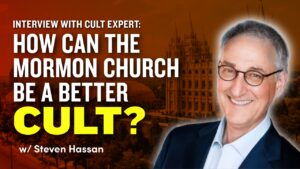
 In this episode of Mormon Stories Podcast, we interview the world’s foremost cult expert, Steven Hassan, to discuss what the Mormon church can learn from destructive cults to do/be better. Steven Hassan is the author of several books including “Combating Mind Control: The #1 Best-Selling Guide to Protection, Rescue, and Recovery from Destructive Cults.”
In part 2 of this episode, we solicit the feedback of some of our listeners as we view Mormonism through the lens of Hassan’s BITE Model.
Part 1: This transcript is machine-generated and lightly edited for readability. The audio is authoritative. Please excuse occasional errors in names and spelling. Steven Hassan [00:00:11] Your mom and me, we've seen this life with eyes that only see in black and white. John Dehlin [00:00:21] Mormon Stories is a production of the Open Stories foundation and relies solely upon the support of people like you, its listeners, and to help keep the podcast alive or to become a member of the community, please become a monthly subscriber by visiting MormonStories.org and clicking on the Donate button on the right side of the page under support. All contributions to Mormon Stories are completely tax deductible in the United States and go towards producing the podcast and building communities and programs of support for Mormons like you. Thanks for your support. Steven Hassan [00:01:03] Tune me out if you must I know you've heard enough But I sing this song just because I hope you'll be wiser than your daddy was I hope you'll be wiser than your daddy all right. John Dehlin [00:01:29] Hello everyone, and welcome to another edition of Mormon Stories Podcast. I'm your host, John Dehlin. It is June 1, 2018. I am so super excited for today's episode. We have some really we have an amazing guest and an amazing topic in store for you today. So today, let me go ahead and switch over to my other screen. Today we are going to be interviewing on Mormon Stories podcast Stephen Hasson. Stephen is the world's expert in cults. He's written a book called Combating Cult Mind Control, and he's going to be joining us in about 23 minutes. But we're really, really excited to be interviewing him. And the reason why I'm doing an introduction before we actually bring him on is because he's only able to give us an hour of his time and there's so much to cover. And so I'm going to be covering some of the material before we actually bring him on so that we can use all of our time with him very efficiently. Let me give you guys just a little bit of a kind of heads up on what you're going to hear today. Just a little bit of background on me. For those of you who don't know, we're anticipating that Stephen's going to be sharing this presentation broader to his network. And so I'm just going to give a little introduction myself. Those of you who are Mormon Stories fans will know this. My name is John Dehlin. I grew up as an orthodox Mormon in Katy, Texas. I served a Mormon mission in Guatemala. I married my wife, Margi in the Washington, D.C. temple after attending Brigham Young University. We raised four wonderful children together and are raising them as progressive Mormons. I had a successful technology career with Penning company Microsoft and the Massachusetts Institute of Technology prior to having a faith crisis. I had my Mormon faith crisis in 2001 while I was teaching early morning seminary for the Mormon Church. However, I loved the church so much and believed in it and cared about it, or at least believed in the goodness of it that for many, many years we remained active and faithful in the church for the next 14 years, actually, with a couple of years off as sabbaticals. But I knew that there was a problem with people in transition. I knew that it was way too difficult to leave the Mormon Church. And so in 2005 I started a podcast, this podcast, Mormon Stories Podcast to improve Mormonism. It's been wildly successful. It's been the successful and longest running Mormon themed podcast in the world. We have over 920 hours of interviews to date, audio and video. We have well over 20 million MP3 downloads and YouTube and Facebook views. And so many listeners reached out to me that I went back to school when I was 40 years old, pursued a PhD in clinical and counseling psychology with a focus on religion and mental health, religious faith crises, religious OCD, which is scrupulosity, LGBT issues, and in that process published 11 peer reviewed journal articles and one book chapter and did all I could to make it so I could do a better job supporting those in faith crisis. In 2015, I was excommunicated for the Mormon Church for my LGBTQ advocacy, but also for my unwillingness to stop the podcast. I also started during my Ph.D. the open stories foundation, which is a nonprofit to support Mormons in religious transition. I do provide, you know, in the Open Stories foundation, we provide workshops and retreats. I also, you know, have a small coaching practice where I coach people who are experiencing a religious faith crisis. You can reach me@johndelin.com for that private practice. But you know, the work that we've done has been featured on in the New York Times, Good Morning America, National Public Radio, HBO Vice News, the Wall street journal, nightline, VH1. I've done a TedX talk and we're super excited that June 25th, the HBO believer movie starring Dan Reynolds of Imagine Dragons and Tyler Glenn of Neon Trees and myself will be premiering. And so we've done our best to help a lot of people in the process. Now I'm going to introduce you to Stephen Hassan. It is spelled Hassan, not Hassan. Stephen is not Muslim. He's Jewish. He grew up in a conservative Jewish family in Queens, New York. He describes himself as introverted in his book. He grew up as Very bookish individual. He loves books. He was an honor student. He skipped eighth grade and graduated early. But while he was a student at Queens College, Steven was recruited into the Mooney's. The Mooney's, or the Unification Church, is a billion dollar organization that Steven refers to as a culture. And he was basically just, you know, he can tell the story, but basically he was just sitting, I think at a table, maybe in a cafeteria. And like three by his, by his report, attractive young women came up and said, hey, come to this thing. And he came to it. And then he got sucked into more little meetings and over time, through pressure, became a cult member in the Unification Church under the Reverend Sun Young, Young Moon. And in a very short amount of time became a high level leader in the church. And he was recruiting for them, he was marketing for them, he was fundraising for them, and he had sort of the highest levels of access in that cult. Now this is in the 70s when Jim Jones was doing what he was doing in Guyana, you know, and Patty Hearst had been abducted by a cult. She was the daughter of a newspaper magnet. And cults were really raging in the 70s. So after two years, two plus years, and Stephen was really plugging, he had this awful car crash and it broke like his legs. And he was paralyzed, or at least he couldn't walk, immobilized. And in that time he reached out to his sister who never made him feel bad about being a member of the Mooney's, never called it a cult, never told him he was part of a cult. And so he reached out to her and she started loving and supporting him. And during that time his parents came and did an intervention and long story short, pulled him out of the Mooney's. And you can read about this in his book. But afterwards he obtained a master's degree in counseling psychology from Cambridge College, became a nationally certified counselor and, and a licensed mental health counselor so that he could help more people and ultimately became the founder and director of the Freedom of Mind Resource Center. And this is an organization that helps people become psychologically empowered. They promote awareness and they expose abuses of undue influence. You can Access them at freedomofmind.com and freedomofmind.com and Steven. They provide training for mental health professionals, educators, law enforcement. I think they've even testified at Congress. And they help families of cult members help get people out of cults. He's got 40 years of cult awareness and activism and his work has been featured on every major News outlet including 60 Minutes, CNN, Fox News, the Today Show. Good Morning America, Larry King Live, the Wall Street Journal, New York Times, NPR, Oprah Winfrey in USA Today, Bill O'Reilly Show. He's been everywhere and he's brilliant and he's wise and he's kind and he's compassionate and he's amazing. He has authored three books that we are going to be. We're going to be talking about one of them. One's called Combating Cult Mind Control. One's called Releasing the Bonds, Empowering People to Think For Themselves. And then another one's called Freedom of Helping Loved Ones Leave Controlling People, Cults and Beliefs. So super well published author, speaks all over the world. And now I'm going to give a disclaimer about the intent of this presentation. We were very careful in how we named this presentation. This presentation is not why the Mormon Church is a cult. And there are lots of reasons that we didn't name it that way. And I think Stephen is going to support these reasons. But we will not be calling the Mormon Church a cult in this presentation. Please don't be disappointed by that. But there are reasons why we are not calling the Mormon Church a cult in this presentation for many reasons. Number one is Stephen will be the first to tell you that it's counterproductive. I went up to a website to find a list of cults, and the leading world organization for cults refused to give a list of cults. And I thought, well, that's kind of interesting. Why in the world would the world's leading organization on cults refuse to give a list of cults? And the reason why is they said that it's counterproductive. It puts people on the defensive. It makes them stop listening. It creates what we've called in Mormon stories the backfire effect. It makes people actually cling more tightly to their beliefs and even their damaging beliefs. And so for that reason, we don't think it's going to be effective to sort of take that approach. In addition, if you read Stephen's book and you read about the criteria of cults, you'll realize that there are degrees of cultishness. And while, you know there are going to be aspects that Mormons identify with, they're going to be aspects that some people find alarming. There are also other aspects that don't meet criteria you're gonna find in there. Some cults physically brand their members with like a cattle prod. Some cults physically beat and abuse their members. You know, some of them engage in sleep deprivation and really egregious forms of, you know, you know, seizing people and putting them in prison or, you know, capturing them and not letting them go. You know, there are degrees of cults and some cults kill people. So for lots of reasons, you know, Mormonism is a complex organization that in some ways will cause alarms and in other ways won't. So, and then finally, the most important thing is that everybody needs to reach their own conclusions on what is and isn't a cult, or what is or isn't cult like behavior. So, you know, you listeners, you be the judge. If you think the church fits this, then you can think about that. And if you don't, we don't want you to run off thinking we're insulting a religion you love. So one thing that I want to emphasize that Stephen talks about in his book is that there are many types of cults. So there are religious cults, there are meditation cults, there are political cults, there are psychotherapy and education cults, there are commercial and corporate cults, there are marketing cults. Utahn should be familiar with multi level marketing. That can be a cult. Families can be a cult, marriages can be a cult, gangs, you know, gangs can be cults, there could be Internet cults. There are lots of different types of cults. And so, you know, we also are not focusing on the Mormon Church being a cult because we don't want you to think too narrowly in this presentation. We want you to become aware, even if you've left religion altogether, we want you to become aware of anything that could be acting like a cult, anything that could be using undue influence on you. All of that you should be aware of. And so we want you to think broader than just Mormonism in this presentation. Okay? All right, so we're going to go ahead and provide definition of a cult so that we can kind of know what we're talking about. Stephen Hasson defines a cult as any group in which mind control is used in destructive ways. Now, mind control may seem scary for some of you. You may be thinking, oh, mind control, that sounds like brainwashing. And Stephen goes into a great explanation in his book about what brainwashing is. What mind control is going to go ahead and give just a brief definition of mind control. Mind control is any system that disrupts an individual's healthy identity development. So if you just think about it, think about your identity, think about anyone who might be in a cult. Think about whether or not they have been allowed to develop, to discover who they are and to develop as individuals versus assuming an identity. And what I've done is I've put together a slide that I'm very proud of. It's very. It's very preliminary, but it's borrowing from some of the things I read in Steven's book. But I want to kind of run it by you. This is kind of what I'm identifying as the core problem. And I haven't showed this to Steven yet. But I believe that, you know, as human beings, we've evolved. We've evolved with DNA, we've evolved with personality. You know, we have the genetic combinations of whatever we inherited plus whatever happened in the womb, plus whatever upbringing we had has given us a personality, has given us a sense of self. And at our core as humans, you know, many would argue we're animals, we're base. If you look 20,000 years ago or 50,000 years ago, think about the caveman. Humans were driven by biological urges for food and shelter, sex and power. I think we have a tendency to want to maximize what I call neurochemical highs. A lot of people get stuck in addictions and drugs and alcohol in unhealthy ways just because they're. Or other types of unhealthy coping, whether it's Netflix or eating or whatever. We like our brains to get feel good. We like that oxygen, we like that serotonin. And anything that we can get sometimes to trigger those chemical highs can feel really good. And I think Mormonism calls this the natural man. And Mormonism says the natural man is an enemy to God. And that makes sense. We don't want to run around having sex with everything, whether there's consent or health or whatever. We don't want to run around killing people and. And being driven by our passions. So just living off of this sort of core native self can be violent, it can be sexist, it can be racist, it can be tribal, it can be uncivilized, it can be addictive, and it can be unhealthy. So what many of us have experienced within a religious context, and specifically within Mormonism, is we joined or were born into a religion, and that religion is less primal. It's. It's more civilized than being a caveman. It's more social, it's more organizational, and it taught us a bunch of values and ethics and morals, gave us community, a sense of identity, a sense of purpose and meaning in the world. It helped resolve a lot of our existential problems in life. There are all sorts of powerful things that this religion has given us. But the downside of any modern religion, if it's based on the Quran, or the Bible is that we're limited by Bronze Age scripture and ethics and whatever the organizational ideal is for the human. And so if the Bible says, you know, if someone interprets the Bible to say that being gay is bad, then we are going to have to follow that. If it says women should stay silent or be subservient, then if we follow the scriptures, we're going to have to follow that. If the scriptures say we can cut off someone's head, if we don't agree with them, well, then we have the right to do bad things. And if it says God's a genocidal maniac, well, that's who God is, because the scriptures say so. But most importantly, religions give us this identity where we feel like we're sort of a square peg trying to fit into a round hole. Because just because a religion tells us who we should be doesn't mean that's who we are. And many religions don't even give us a sense of to identify and discover who we are and to become an authentic self. And so so many of us get to whatever point we get to in our religious development, whether it's healthy or not, but we aren't our fully authentic self. And if we are gay or lesbian or bisexual or transgender, if we are a woman, if we're a feminist, if we're an intellectual, if we are skeptical, you know, if we masturbate, heaven forbid, or have sexual experimentation, that religion can become toxic to us. It could literally be fatal to us. It can become deadly. And so we have the choice. We can either regress to the primal self, and that's what that arrow is on the right. For those of you listening just through the audio, this is all on video on YouTube if you want to see the visual aids. But we have the choice of reverting to our primal self, which is becoming again based and driven by biological urges and instincts and our emotions and neurochemical highs, or we have the chance to progress to a more authentic, enlightened self. And what comes with that is a freedom, an introspection, and self discovery. And I want to argue that the healthy people keep the good of the religion. They keep the good of the cult that they were a part of. But what they then do is they discard whatever is harmful or inauthentic. So they keep the good, discard the bad, do that self discovery, and then they add new, authentic, healthy pieces to their experience. And that is sort of what healthy religions do. And so what we're going to do now is we are going to stop this part of the presentation and I am hoping that Steven is now joining us. So I'm going to look on the participants. Stephen has not yet joined us. So what we're going to do is make sure we get a hold of Stephen and. And while we're doing that, we're going to go ahead and take questions from our listening audience. So we have a bunch of people joining us live. And what I want to do is give people a sense for what the next hour to two hours is basically going to be like. So we're going to bring on Steven and he is going to talk to us for an hour about his book and about these notions of cults. And we're gonna try and apply it. We're not just gonna apply it to ourselves. We're not just gonna. Sorry. We're not just gonna apply it to religions, but we're also gonna apply it to ourselves as liberal Mormons, as progressive Mormons, as post Mormons. All that is legitimate. One of the things that I am very interested in doing and am very motivated to do is also, is also apply this to my podcast, to Mormon Stories, to the Open Stories Foundation. I want to make sure that there's nothing that we're doing within the Open Stories foundation that could ever be construed as cult like or that could ever be harmful to people. And so we're going to talk to Steven and then what I'd really love to do, if possible, is have maybe four or five of you join us after the presentation. And what I want to do is we're going to sort of go through Steven's model for cults, and we are going to do a breakdown of how cults control behavior, control information, control thoughts, and control emotions. And then once we go through that, and Stephen shares all of that with us, then what we're going to do is we're going to do an analysis of Mormonism and I'm even willing to do of the Open Stories Foundation, a Mormon Stories podcast, through the same lens so that we can understand to what degree there are cult like things in the church and to what degree there aren't. But when I do that, again, it's not with some secret, insidious desire to label the church a cult or to make people think that Mormonism is cultish. What we're really trying to do is we're trying to learn and we're trying to help people. And there are a lot of things that we want to try and accomplish in this experience. So, for example, again, I want to find ways that I can improve the Open Stories foundation and Mormon Stories podcast. But we also want to help other Mormons improve their experiences. So if you're in the Mormon Church, if you're struggling, we want to help you understand what might be damaging or what might not be damaging in your experience. We also want to help people who are out of the Mormon Church learn about healthy and unhealthy principles of living, healthy and unhealthy leadership principles, healthy and unhealthy organizational principles, because again, these experiences apply well beyond Mormonism. And then finally, we want to help people understand what the LDS Church is and, and how it can help people. So my technical group, Stephen, is working furiously to help get Stephen Hasson on and he's joined us. So. Wow. Without any further ado, Stephen Hasson, welcome so much to Mormon Stories podcast. It's such a pleasure having you. Steven Hassan [00:24:59] Yeah, thanks for inviting me. I'm excited to do this. John Dehlin [00:25:02] All right, Stephen, well, we're so glad you can join us. We're really honored. What I want to do is begin by plugging one of the most exciting and amazing books that I've come across in my 15 to 20 years of doing what I'm doing. The book is called Combating Cult Mind Control and it's a best selling book. It's a guide to protection, rescue and recovery from destructive cults. Now, Stephen, what we did before you joined us is we took our audience through your history and so we explained your three books, we explained your biographical information at a high level about your experience with the Mooney's. We told everyone about freedomofmind.com and your organization and the sorts of training and consulting and coaching that you do. And we warned everybody that we will not be calling the Mormon Church a cult in this presentation. Can you begin by explaining maybe supporting that strategy? Why is it, you know, there's a lot of listeners who just are mad. Maybe they're in a mixed faith marriage where their spouse wants to divorce them. Maybe they're mad at their church, or maybe their family isn't respecting them for the things they discovered. Why in the world would it be not prudent for them to use the language of cults when they are dealing with their religious family and friends? Steven Hassan [00:26:36] Yeah, so the word is problematic because it has charge to it depending on where you're coming from. And over the 43 years since my rescue from the Moon group, it's used so loosely and in different ways that I've just learned to just think of things in terms of healthy Groups and unhealthy groups and, you know, open groups that are honest and closed groups that lie when they're recruiting and to their members, it's just, it has less of the problems associated with it. You know, when you're in a group that makes assertions that we are the one and only church or we are the only true whatever, you have a kind of a bubble around that belief system that insulates you and makes you feel like you're special and above everybody else who are in other groups. And it's easy for you to call other groups cults, but, you know, don't let anyone call you in a cult. And again, because I've, you know, been a mental health professional and doing this work for four decades, I just think the word is loaded. So why use words if it's going to be a stumbling block for some people? And when they tell me, but I like to call a group a cult, I say, you're, you know, you're an adult, you get to do what you want to do. And, you know, my issue with my book goes back to 1988, which was the 10th anniversary of the Jonestown tragedy, with 913 men, women and over 300 children who died with Sanadlaist Flavor Aid. And my publisher was like, we got to put Cult in the title, you know, so it's got to be Combating Cult Mind Control, not Combating Mind Control. And so when I bought the rights back in 2014, the decision was just keep the title basically the same. So I'm kind of stuck with that word cult in the title. John Dehlin [00:29:06] No problem. Okay, so what we want to do. Steven Hassan [00:29:11] Long winded John. John Dehlin [00:29:12] No, that's great, that's great. Steven Hassan [00:29:13] Try to be more succinct. John Dehlin [00:29:15] No, no, it's really, it's really, really useful. So what, what I've done is I've put together a presentation that outlines what we call the byte model. And while I'm getting the PowerPoint presentation ready, would you mind explaining to us what the bite model is and give it an introduction? And then what we're going to do is we're literally going to go through the B, the I, the T and the E, we're going to talk about each one in detail. And then we're going to end by showing that continuum that you so brilliantly put together, and we're going to maybe spend the last 15 minutes discussing that continuum. Does that make sense? Steven Hassan [00:29:59] Yeah, that's fine. John Dehlin [00:30:01] Okay, so please give us the high level overview of the bite model and then we're Going to go into each Steven Hassan [00:30:07] one specifically, so briefly, I guess you've told your listeners that in my deprogramming Robert Lifton's book Thought Reform and the Psychology of Totalism was used and his eight criteria. John Dehlin [00:30:23] No, no, no, go ahead and talk about that. Steven Hassan [00:30:26] So I was in the moon cult. I didn't think I was brainwashed or under mind control. I was in a van crash, I was in crutches, my family, I was basically in a situation of intervention where my family had hired ex members. And their appeal to me was, look, you're an adult, you get to do what you want to do. But let us at least explain why we've left the church and what brainwashing is so that at least you can know what is known about it. And I was very happy to learn about Chinese Communist brainwashing because that's. That was what Lifton's book Thought Reform, the Psychology of Totalism was all about. He had been an Air Force psychiatrist, military intelligence, studying what was this thing called brainwashing because the term was coined in the 50s. And he came up with eight criteria that any environment may be judged as a brainwashing or he preferred the term thought reform environment. And Lifton is a genius. He's written like 20 plus books. I've read them all. One of the most important people in my career because when I got out of the Moonies, I went and saw him and said, your book saved my life. Kind of a little bit like what you were just doing. This book is really incredible. That's what his book was for me. And he said which book? And I said thought Reform. He said, that old book, why was it so important to you? And I said his eight criteria was revelatory. For me it helped give me a touchstone on what are the characteristics that make up a destructive mind control environment. But the book is very ivory tower. He's a genius. It's not meant for the lay person to read. I had to read it over and over again. I had to look up a lot of words when I was reading it. And as I began my journey of self healing to try to understand everything I could about persuasion and attitude change and hypnosis and everything else. The paradigm that was put forth by a social psychologist named Leon Festinger stood out for me as monumentally important. Leon Festinger wrote a book called When Prophecies Fail about a UFO cult that I believe the book was written in the 50s. And the idea of what he wrote about in this book was that this woman was claiming a UFO was going to land at a mountaintop, and all the followers sold their goods and went up to the mountaintop. And when the UFO didn't arrive, he thought everyone would be disillusioned and leave. But he realized people actually believed more. And he was like, trying to come up with, like, how is it possible that people would believe more? And he came up with this concept that's critical called cognitive dissonance theory. Cognitive dissonance theory is the underlying on all cognitive behavioral therapies, talk therapies, etc. Because he posits we have thoughts, feelings, and behaviors that the human personality, the human mind, likes congruency between those three things. So if we change a behavior, our beliefs shift to have reduced dissonance or to have consistency and our feelings align along those behaviors, etc. So those three things were like, yes, I can take Lifton's criteria, I can take everything else that I've read, and I can make a new model based on those three things to describe mind control. But then as I was going through all of the things like sleep manipulation, dietary manipulation, change of clothing, change of names, rituals, as I was going through all of that, there was a missing element which I realized was information, the lack of informed consent when people are being recruited into destructive groups, whether by lying, by withholding vital information, or by distorting information to make it more palatable, that that was a major feature of a destructive group versus a healthy group. And I know we'll get into the influence continuum later. And then I started thinking about other information, like how my recruiter found out all these details about my background, fed that information to one of the leaders, who then used that information to make me believe that they had mystical powers and could kind of know my spirit. But I didn't understand that this information was being funneled and then used against me, or that they would plant people in small groups who were pretending to be new members, but they weren't. And they were kind of used as spies again, to feed information to the leadership in order to have an impact or to use confessions and to use that information against someone. So the bottom line is I came up with these four criteria. And in the 1988 edition of Combating, it was in a different order. And as soon as the book came out, a minister friend of mine said, you know, if you switch the order, you can make this acronym called BITE B I T E so people could remember it more easily. And I was like, thanks, buddy, that's a great idea. And so the bite model was created and it really is like a laundry list of different variables in these four dimensions that I believe not every destructive group does every single thing. And there are good groups that do some of the things, but they don't do all of the things. But with this lens, the control of behavior, control of information, control of thoughts and control of emotions, one can then have a handy way of sorting. Now I see you have it on the screen. One can have a toolbox for evaluating anything that you encounter, whether it's a relationship with a woman or a man or a work situation with a company or a multi level marketing group, or literally anything. And you can see it later. You'll show the influence continuum. You'll see it's on the unhealthy side or it's on the healthy side. And that's a lot of my hope in doing this podcast and in giving lectures and interviews is I want to empower everyone on the planet to understand how the mind works and how to protect themselves from undue influence, which is a legal term for an exploitative relationship where someone with more power is taking advantage of someone with less power. John Dehlin [00:38:24] I love it. All right, so what we're going to do now is we're going to just dig into, we're going to go deep. Because what I want you to do is describe what cults do. And our intent is for Mormons and post Mormons cults. BUZZER oh, no, listen, I'll use the word because, you know and I know you and I talked about not using the word cult. Here's what I. Here's what I thought about. Steven Hassan [00:38:49] I'm teasing. John Dehlin [00:38:50] Okay, thank you. By framing this as how to help the Mormon Church improve. Learning from cults, the context isn't framing the Mormon Church as a cult, but instead it's like, hey, everyone wants to do better. The Mormon Church can do better. And so here's what cults do now. Mormon Church don't do those things. Right? That's kind of the. That's the context. Steven Hassan [00:39:13] Great. John Dehlin [00:39:14] Also, and I'll share a slide that I shared previously to our listeners is that our intent with this interview is to find ways that John Dehlin and Mormon Stories podcast can improve. We want to help Mormons in their faith transition process their experiences. Because to the extent that they've been exposed, and let's just be clear, theoretically, the Mormon Church could be fine. But let's just say a local bishop, a local congregational leader could run his ward. Like a cult, right? Or a mission president out in the mission field, there could be a ton of great mission presidents, but maybe a mission president runs his mission like a cult. We want to help Mormons process their faith transition in that context, even if we're not calling the church a cult itself. And then we want to help people who've even left the church, in or out, learn principles of healthy living, of leadership, principles of organizational principles. And we want everyone to just see the church for what it is and again, help the church improve. So that's the context of what we're doing. So let's dive in. If you'll talk about. Can I interrupt you for one second, please? Steven Hassan [00:40:32] Just say that over the decades and in my influence continuum, I've gotten to a place where I talk about benign cults or positive cults and destructive cults. So, for example, I was interviewed by a writer who wrote a book called the Cult of Mac. And I'm in that book because since 1982, I've only had Mac computers and I. I have iPhones and everything else. Or some people have talked about my Jewish temple as a cult because we hug people when we see each other and we're close to each other. Not everybody hugs, but we're a tight knit group of people. But people are free to come and go. Nobody tells us what we can read and what we can't read. People often are questioning authority and it's totally cool, you know what I'm saying? So I just wanted to add that little twist in there that the word cult doesn't, for me at least, doesn't always mean destructive cult. So I think what you're saying is you want to explain what destructive cults are about and how the Mormon Church doesn't want to have any of those attributes. John Dehlin [00:41:58] I love it. I love it. That's right. And let me just pause. Stephen, as soon as you're done, I want my listeners to know what we're going to do is bring on a live panel of LDS folk. And what we want to do is. I'm getting an echo. Steven Hassan [00:42:14] Can you mute. John Dehlin [00:42:18] What I want to do is bring on a panelist of other people and discuss Mormonism from this context with me. No, no, no, you have to leave. And so I'll be bringing on other people. Steven Hassan [00:42:37] I want to see the video, though, when you. John Dehlin [00:42:40] Absolutely, yeah. But I want to let people know what they can do. Tim is going to post a link to our Zoom call, and we're going to bring panelists on. So what you have to do is download Zoom, click on the link, and you'll be able to participate in this conversation. So if you want to join the post debrief of Steven's conversation, go to the comments download Zoom us download. Click on the zoom link and we'll have that conversation. Okay, so without any. Oh, go ahead, Steven. Steven Hassan [00:43:15] No, I was just saying what a great idea. John Dehlin [00:43:18] Yeah. And we'll share it with you for sure afterwards. Steven Hassan [00:43:20] Great. John Dehlin [00:43:21] So let's, without any further ado, tell us about behavior control. And you can kind of use this slide as a goal. Now remember, let's try and time our comments so that we go about 30 minutes on the Bite model. So we'll basically have to give about seven minutes to the B, to the I to the T and the E. And I've got a couple slides per. And so, you know, think about that pacing as we go. Is that okay? Steven Hassan [00:43:53] I don't have a watch in front John Dehlin [00:43:55] of me, but I'll help you take. Steven Hassan [00:43:57] No. So I mean, you have it written out. Do you want me to go through each. John Dehlin [00:44:03] Yeah, yeah. Just kind of describe what cults do for behavior. Steven Hassan [00:44:08] So again, so I guess I want to start with just because I want to add to what you already have up and will be presenting. You know, developmental psychology assumes when you're an infant, your parent needs to make all the decisions for you, needs to control everything in order to help the infant grow up. And the assumption in developmental psychology is that the goal is by 18 to 21, you're an adult where you should be able to be thinking for yourself with a locus of control is within you and you have a good relationship with yourself and you have skills to navigate, social skills, intellectual skills, etc. And so when people are hearing about behavior control, understand you need to control your kids behavior. You don't want them running out into the street and they need to eat and they need to sleep and all that good stuff. Where the problem comes in for me with destructive, unhealthy groups is the unhealthy raising of children. Whether it's corporal punishment, which is overwhelming evidence, is not a good thing. It's very traumatizing, does not promote secure attachment or the indoctrination of phobias, which I know is the E, John, in the bite model, but I just wanted to mention it here and you know, ideally the destructive groups. The model of destructive groups in my model was the moon cloud that I was in, but I've since applied it to literally thousands of other organizations that I never knew existed. But people read my book and said, hey, you were describing my group. So these are themes of the bite model. Like regulating physical environment. And just remember there's a continuum. And depending on where you are inside the organization, there can be less control or more control. I have another graphic in combating of a pyramid. And then circles emanating from the base of the pyramid of what I call fringe members. So the control of reality when you're at the base or emanating outside that base is going to be much less extreme than if you're in the, in the pyramid itself or in the hierarchy. There's much more regimentation and much more control. The theme with destructive cults is they don't want you to grow up. They don't want you to be independent, individuated adults. They want you to be dependent and obedient. That's the theme of behavior control. And that's the goal of behavior control, in my opinion, to make. Make people who are suppress their own will, their own conscience, their own heart, their own creativity in service of the ideology and the power structure. So within that there's everything from sleep manipulation. I was sleeping three to four hours a night. I was told Armageddon was going to happen any moment, that we had to harvest the right souls. I was told to drop out of college and quit my job and donate my bank account and move into the center. I was told what I could eat, what I couldn't eat. I had my hair cut off. I was put in a three piece suit, which was not what I was into at 19 years of age in college I was even asked, you know, if I love God more than my poetry. I was a creative writing major in college and they used the story of Abraham being asked by God to sacrifice his son Isaac. And they literally said, we think your Isaac is your poetry, Steven. You love God more than your poetry. And they asked me to throw it out and I threw it in the garbage. And unlike the biblical story where Isaac wasn't killed, I never got my poetry back. But from a destructive mind control perspective, it was a powerful offering up of who I was prior to the group, in submission to the cult identity that was dependent and obedient to the group. And that's another key theme in my work that I describe as a mental health professional, that it's almost like a dissociative disorder is going on with people in mind control cults where they have their real thoughts and then the group thoughts and their real feelings and the group feelings and the group identity suppresses who the person really is. And this is especially true in the case of people who are gay, for example. If they're in a homophobic organization that says God doesn't love gays and it's this abhorrent sex, sin, etc. People are in a bind where they're constantly feeling a pressure to deny their ontological, their existential self, which I think is horrible. John, you know that I'm a human rights guy. I believe in the United Nations Universal Declaration of Human Rights. And if there's anybody in the Mormon church that wants to see a doctrine that Steven believes in, it's like, read the United Nations Universal Declaration of Human Rights. Because that's pretty close to spot on. Everything that I am working towards. John Dehlin [00:50:34] Absolutely. Steven Hassan [00:50:35] How am I doing with the bite model? Do I need to go on? John Dehlin [00:50:38] No, that's good. So let's. So you've talked about regulating the physical reality, financial manipulation. Go ahead and read. You can read through these bullets and talk about that. Just briefly comment about them if you want. Steven Hassan [00:50:52] So I was told who I could live with. I had to ask permission for any major decision. I think that may be the next slide. I was told what to wear, what I could eat. I did a lot of fasts with just water to purify myself from sin. I turned over my bank account. I had no vacation time. I worked seven days a week. I was praying maybe two to three hours a day and reading the Bible and reading the doctrine of the Moonies called the divine principle. And if I wanted to go see my sick mother, I had to ask permission. And if I was told that, you know, you're needed here, Steven, pray for your mom. I wouldn't visit my mother. And that's another consistent theme around behavior control. That you, you can't do what you feel is important for you to do unless you get approval from someone above you. John Dehlin [00:51:58] Right. Okay, so that covers that kind of covers. Slide 1. Steven Hassan [00:52:02] Yep. John Dehlin [00:52:03] Regulating diet and food, regulating sex, regulating Steven Hassan [00:52:07] appearance with hair, sex for a second. So I was 19 years old and I was programmed that all women were evil. I was programmed in my cult that Eve seduced Adam sexually after she was raped by Lucifer and therefore all women were trying to rape me. Any self pleasuring or masturbation was a terrible sin. I never did that. In two and a half years of membership, I had two nocturnal emissions which I had a fast and take cold showers after. And when I tell people I was 19 to 22, like the height of male hormonal activity, I was just suppressing all of that energy. All that natural stuff that was so important in my maturation and it just was so unhealthy and it took me a year after I got out of the group of counseling and therapy to be able to kiss a woman and not have all of the programming from the cult in my head. And it was so liberating to be able to, like, be normal again. John Dehlin [00:53:27] I love it. Okay. And of course, lots of indoctrination and rituals and permission required for major decisions. Let's go to the next slide. I'll read them and then you could talk about them. So thoughts, feelings and activities reported to superiors. Rewards and punishments used to modify behaviors. Discouraging individuals. Huge. Discouraging individualism. Encouraging groupthink. Rigid rules and regulations. Punishment, sometimes even physical punishment. Threatening harm to family or friends. Steven Hassan [00:54:05] When I started helping sex trafficking survivors and labor trafficking survivors, I felt like I had to add it to the bite model, even though I know it. Most of the groups that I work with do not do these extremes. There's a cult that's in the news a lot lately called Nixium, where women were being branded near their genitals with the initials of the cult leader, Keith Ranieri. But that's more the exception than the rule. And then if you leave a pimp or a trafficker or some of these groups, they will literally threaten to harm your family or friends to kill them. In some cases, again, the trafficking is about raping or being raped. The number one thing, as I was saying earlier about behavior control, is to instill dependency and obedience. If you have conscience that says, no, I can't do this, but the rules and regulations say you have to do this in a destructive, unhealthy group, they make you do this. And for me, John, I think we may have touched on this when we chatted earlier this week. For me, in my life of faith, however you want to understand the Bible and the Garden of Eden story of Adam and Eve and God. God didn't make Adam and Eve robots or mind control slaves. Like, if almighty God wanted that, I sure God could have created Adam and Eve to be dependent, robotic slaves. God wanted to give them free will deliberately is my understanding. And therefore any group that comes along that says, we know what God wants and you need to be dependent and obedient, give up your free will is going against the great metaphor of the Bible. John Dehlin [00:56:13] Absolutely. Okay, so we've got, let's see, we've got discouraging individualism, imposing rules and regulations, punishing, threatening harm to family and friends, sometimes rape, either forcing individuals to rape or be raped, dependency and obedience, and sometimes corporal punishment. Steven Hassan [00:56:35] So ISIS does forced people to rape For Allah and just terrible terrorist cult, basically, but different religion, Islam. But as the munis is a perversion of Christianity, ISIS and is a perversion of Islam in life. John Dehlin [00:57:04] Absolutely. Okay, so that covers behavior. Do you feel like we covered it in a good overview? Steven Hassan [00:57:09] Yeah. John Dehlin [00:57:10] Okay. Steven Hassan [00:57:11] I'm open to people, you know, improving this, by the way, if they're absolutely left off or whatever. John Dehlin [00:57:19] So let's do this. I'm going to read the bullets and then you comment about the bullets. Is that okay, great. So the second one's information and we'll do the first slide first. So deception, deliberately withholding information, distorting information to make it more acceptable, systematically lying to the cult member. Steven Hassan [00:57:38] So I just want to emphasize that information is the food we use to think. And if we don't have truthful information, our minds are being controlled, our minds are being manipulated. So this is huge. And I just want to add that in terms of recruiting new members, like, I know there's a big difference between people born into a group versus people who are out doing missionary work recruiting people. But especially if you're recruiting people, the ethical group has an obligation to not do high pressure sales techniques but to disclose honestly what's going on. So to pick the Jehovah's Witnesses for a minute, which is a group that when I wrote Combating initially I didn't think of as a destructive cult. And then I started hearing from hundreds of former members who loved Combating. What I didn't understand is when they go door to door and they say, we'd like to study the Bible with you, they're using their own New world translation of the Bible that no theologian, Christian or Jewish admits is a legitimate translation and an accurate translation of the Bible. So every person that is approached by a Jehovah's Witness is, is being lied to and manipulated, thinking they're following the Bible, but it's hearing what the Watchtower Society wants them to hear. So it's absolutely critical. And I also want to comment and I hope this is okay, John, but a number of years ago I was invited to speak at an ex Mormon foundation conference to present my Bite Model. And I listened to a man who had been teaching at the, I guess the LDS Institute and he taught a class called Lying for the Deception as a Management Tool of the LDS Church. And I listened to his presentation and he blew my mind. He started with Joseph Smith and he ended with a recording where he's saying to his boss, so you're telling me I have to lie to my students and his Boss said, yes, that's correct, otherwise you're fired. And he said, well, then I quit and I'm forgetting the name of the man, but it was the most glaring thing for my education about the Mormon Church of deception. Like if they're, if they're making their teachers lie to their students, is really John Dehlin [01:00:34] something off, that's a problem. Yeah. Okay. Minimizing and discouraging access to non cult sources of information, including Internet, tv, radio, books, articles, newspapers, magazines, other media, critical information, Former members keeping members so busy they don't have time to think and investigate. Control through cell phone with texting, calls and Internet tracking. Go ahead. Right. Steven Hassan [01:01:05] So information, again, is the food, the tools we use to think. And all destructive groups program their members to not trust group critics or former members. Like, in the mind of a good member that's obedient, there's no legitimate reason to ever leave. And so if you've left and you're no longer in the faith, there's something inherently wrong with you. You're being controlled by Satan. There's all numbers of labels, but there's no, like, why don't you hear what they have to say and think about it, whether it makes sense for yourself? And that's really the essence of my work. Helping families to get loved ones involved with destructive groups to take a timeout, step back and actually learn about the bite model and mind control and actually look at the material and listen to the stories of former members and critics and make up your own mind like you're an adult. Make up your own mind whether this is the God you believe in or this is an organization that you believe deserves your time and energy and money or not, so. And then, of course, just keeping people busy is huge. And I'm just seeing a lot of. A lot of mind controllers. And I also work on cases where a woman's controlling a man and isolating him from his family and friends and taking him over, or a man doing the same to a woman and they're constantly texting and constantly tracking where they're going, etc. And it's just not a healthy relationship at all. And that's what we call a one on one mini cult or micro cult. John Dehlin [01:03:04] Yeah. And just this outsider, I think, just this idea of we tell insiders something different than what we tell outsiders. There are different levels where the more advanced you get in the organization, kind of like Scientology, the more access you get to information and leaders kind of keeping things to themselves that aren't generally available outside. Is that right? Steven Hassan [01:03:32] Yes. So it's huge. The insider doctrine and outsider doctrine. I think a legitimate organization, there's one truth. So it doesn't matter where you are in the pyramid or inside or outsider. This is the facts, this is who we are, this is what we believe. This is our mission statement. And we'll tell you what we think you're ready to know or what you're willing to swallow. I have to tell you a quick story in the Moonies because I've heard about this in hundreds of other groups, but when I was being taught to be a lecturer, I was told that, you know, Steven, people are spiritual babies. And you can't feed a baby steak, they will choke on it. You got to feed it formula or applesauce. So you can't tell people that we believe father's the Messiah, you know, because they won't join. So you have to feed them what you think they're ready to swallow. And only when they're ready, feed them, you know, food, you know, more substantive things of what we believe. And of course I believe that when, when I was a true believer. John Dehlin [01:04:48] Yeah, very good. Okay, let's go to the next slide for information control. Spying on other members using cult generated information and propaganda and then unethical use of confession. Talk about those. Steven Hassan [01:05:05] So the characteristics of a destructive group. And I don't know if any of your listeners have read George Orwell's 1984. He was writing about communism, this idea that Big Brother is spying on you or using in the Chinese communist system having spies where everybody is made to feel like if you don't report your brother or your sister, if they're violating a rule, then you're collaborating with Satan. And so people are urged for the sake of God and for the sake of the mother church or the organization. The spy. Of course, in Hitler, political Nazi cult, people were turning in their parents because they were saying bad things about Hitler and other things like that. And then in terms of the extensive use of cult generated information, I mean the wealthier groups can just do amazing propaganda like glossy magazines, TV shows, radio shows, having celebrities they can afford to create the illusion of how wonderful the group is, how it's the fastest growing group on the planet. I know at least 100 destructive groups that say they're the fastest growing religion on the planet. And then just a lot of propaganda where they're taking great sayings of great people out of context for their own purposes, songs, music videos, etc. And then the confession is just about using private information, like part of the healthy thing. About being an adult is that you have different levels of what you're willing to share with others. And of course, if you're an intimate marriage, you want to share with your partner those feelings. But in a mind control group, there's this feeling from the top that we should know everything. There shouldn't be any secrets in people's lives. We should know everything. And it's so unhealthy. I think having healthy boundaries is really important for good mental health. John Dehlin [01:07:37] I love it. Okay, so we've covered information. Now let's go to thought. I'll read the big bullets. And then you just chime in. Requiring members to internalize the group's doctrine as truth. Changing a person's name and identity using loaded language and cliches, encouraging only good and proper thoughts, hypnotic techniques and manipulation of memories. Go ahead. Steven Hassan [01:08:01] Lots there. So again, cognitive dissonance theory, Our thoughts and our beliefs are so. They're kind of the filters we use for how to navigate reality. And the thing about an ideology that says we are the sacred science, we know the secrets of the universe, and if you adopt that as reality instead of this is one theory or the one map, it's really problematic because then you get stuck in that, using that as your filter. The destructive groups often have the black and white all or nothing good versus evil grid where things are very binary and very polarized. Thought stopping is a behavior modification technique that can actually be used to help people in an ethical way or in an unethical way. The way destructive groups use it is unethical in my opinion. And the way it works is this. I'll give. Use myself and the munis as an example. If I would be listening to a lecture or some indoctrination of the munis, and I disagreed with it. I was told that that was an evil spirit trying to invade my mind, it was a satanic spirit, and that I needed to chant, pray, or do something to center myself to get rid of the satanic evil energy that was trying to invade me. So in that process, my cult self was doing this automatic thought blocking and stopping technique. But in reality, I was deprived of the ability for me to make my own decisions and think through a thought analytically and critically. And it's a really big problem when a group programs people with these thought stopping techniques. Some groups will use speaking in tongues, meditation. There's all kinds of different techniques, but we need to be able to analyze and think through and take opposing points of view and listen to the facts and judge them and use our heart and our critical thinking to guide us. Because maybe we need to change our beliefs. Maybe we need to shift and not accept the authority as the ultimate authority. Maybe things are different than we thought. And loaded language is huge because there are terms that only have meaning within the group itself. So they serve a function of making people feel closer to each other because they're using the same loaded terms. But that also is what Lifton referred to in his book thought terminating cliches where the words become like a label where your thoughts stop because, well, that's what that is. Example in the Moonies would be a chapter two problem. What is a chapter? Well, in the Divine Principle, chapter two is about the fall of man and sexual problems. So any issue between men or women or gay or whatever was a chapter two problem. And any problem with relationships, horizontal or vertical, were keen, able relationships. And in the Moonies, you had to submit to your able figure and mindlessly follow whatever they told you to do. Some groups change names. They all change your identity to be that group's identity. In my case, I did not have a name change. Let me just talk about hypnosis for a minute. Hypnosis is not sleep. And there's a lot of misunderstandings about what it is. It's actually a very naturalistic state where we're very absorbed, kind of in the zone where other things are irrelevant. And we're so concentrated in that zone that we're not analyzing what's happening. So when people talk about sports and every shot they take is going in, if it's in basketball or golf or whatever, they're in a kind of hypnotic trance state. They're not thinking analytically about what's happening, you know, in the world. They're like in the game. So the thing about hypnotic states is that very. I can't think of any destructive groups that are. That say, we're gonna hypnotize you now. But they'll often do visualizations or guided visualizations or how do you do deep breathing or have you repeating a phrase or a meditative statement or something like that. And while you're doing that, again, it's your critical thinking goes offline. So your mind is more receptive to ideas being implanted, essentially. I've done many workshops on yes, and I thought about. John Dehlin [01:13:58] Originally, I didn't include this as something that I thought about, but if you're in a. Let's just say you're in a religious experience and there's music or there's a boring talk or there's some sort of Presentation you're watching that lulls you into kind of boredom or a trance like state of just kind of like boredom. That can be what you mean by hypnosis. Steven Hassan [01:14:22] Boredom is a very effective way to induce trance states. By the way, I'm going to take a minute to just, just say a few more things about hypnosis just because I thought of something that is relevant for LDS folks. So with hypnosis you can do we have five basic senses. Seeing and hearing and tasting and smelling and touching. And in hypnotic language, one can have a positive hallucination or a negative hallucination. Hallucination in any of those five senses. What do I mean by hallucination? It means, for example, if I was going to positively hallucinate a dog here in my office, maybe my last dog, Flame, I'm in a mildly hypnotic state because I'm visualizing something that isn't there. That's what's known as a positive hallucination. Making something there that isn't there or hearing your favorite song come into your mind. That would be an auditory hallucination. Negative hallucination is where something is there and you make it disappear, which I frequently have to do when I'm doing media interviews and things. I make the cameras disappear. So and not get too nervous and just talk with the interviewer and such. I'm actually imagining, John, that we're together versus me staring into the camera of my computer. John Dehlin [01:15:58] You're doing great, Steven. You're doing great. Thanks. Steven Hassan [01:16:01] But what I wanted to say about the LDS folks that I've worked with is they talked about a burning in their bosom as a proof experience for them. And I just want to raise the question about hypnosis and experience and is this a sign that the Mormon Church is legitimate or is this replicable in other contexts with other types of phenomena? And I've seen this over and over again with many people from many different groups where they. Where I'll ask someone. So what made you decide that this was the group you wanted to join? Well, I saw the golden light around the guru and I talked about positive hallucination and I talked about how he was listening to meditation tapes that suggested and put the idea in his head that when he met the perfect master, he would see a golden halo around the leader. We can have those types of experiences and attribute them to spiritual causes when in fact they're human. A question that may be humanly generated. So I just wanted to add that one in there too. John. John Dehlin [01:17:25] I love it. Okay, well, we've only Got, you've got seven minutes and you have to leave. Is that right? Steven Hassan [01:17:31] I have another client. John Dehlin [01:17:34] Okay. Steven Hassan [01:17:35] So yes, I'm sorry. John Dehlin [01:17:36] So let's, I'm going to just. So, thought control, thought stopping, which is teaching people to stop negative thoughts, rejecting rational analysis and critical thinking, constructive criticism, forbidding critical questions about leader doctrine or policy, labeling alternative belief systems as illegitimate, evil or not useful. Installing a new map of reality. Those are all elements of thought control. I want to get to the continuum really quickly, so let's just talk about emotion control in two minutes and then we'll talk about the continuum. Steven Hassan [01:18:16] So on the one hand you're made to feel super special, part of the elite, part of the chosen that has this glorious future, whether you're going to heaven or you're going to outer space or whatever. But the reality on a day to day basis, because of the rigid rules and because of the high standards that the group has for people. When I say high, I mean not human standards. People experience tons of guilt and shame and fear. And for me, healthy groups, particularly spiritual organizations, should be based on love, unconditional love, compassion, kindness, charity, peace, and not on guilt and fear programming. So that's the short one. And I'll just say that phobia indoctrination is the universal destructive mind control technique. In my research. Research, it's the implantation in people's minds that if they leave the group, terrible things are going to happen to them. And I have four pages single spaced in my freedom of mind book in Chapter 10 of the Most common phobias. But the gist of it, John, is that when you have a phobia you can't visualize yourself out and happy and fulfilled. You can only generate negative scenarios. If I leave, I'm going to be miserable, a drug addict, commit suicide, become a prostitute, be homeless. You can't imagine, oh, I'm going to be, have a great job, great friends, travel the world, have a marriage, etc. Etc. And the minute people are able to meet former members who are happy and fulfilled and doing all those things, it's an immediate threat to the phobia programming which is cycling back. Why Destructive environments program members against former members, to not trust them, like them, shun them, disaffiliate with them. But I think love is stronger than mind control and I think truth is stronger than lies. John Dehlin [01:20:43] Hopefully. Usually we hope that's true. Steven Hassan [01:20:46] Well, that's my operating belief system. John Dehlin [01:20:48] I like it. Yeah. So extreme emotional highs and lows. You mentioned love bombing praise. Steven Hassan [01:20:56] You mentioned love bombing is about effusive praise designed to flatter the person in order to get them to do what you want them to do. John Dehlin [01:21:06] Yeah. And again, this idea of if you leave, I once had someone tell me a cult is any organization that won't let you leave with your dignity intact. And so scared of leaving, you'll lose your salvation, you won't be able to raise your kids, you won't be a moral person. How could anyone be healthy and. And leave their religion? Okay, so let's end. I love this influence continuum slide. And it's got three for those who are listening. It's got three sort of horizontal columns for individuals, then for leaders, and then for organizations. And I just think this is a roadmap for individual health, for being a healthy leader and, and for being a healthy organization. So would you spend our last few minutes just talking us through this continuum? Steven Hassan [01:22:01] Sure. Again, the healthy side recognizes that people are born with authentic selves and that indeed, I believe healthy parenting is really recognizing your child as a unique being and that you're a steward to help them grow up to be themselves versus on the destructive side, to be an extension of your ego or a clone of who you are. The healthy side of parenting is really recognizing that authentic self. And it's love based. That's unconditional, conditional love is based on performance, doing what the group wants you to do, do. In the healthy thing. I believe we have a conscience that guides us. We know if we're doing something wrong. I mean, an easy guide with ethics is would you want someone to do it to you? And if you wouldn't, don't do it to anyone else. That's a simple one. But in the case of destructive groups, the doctrine is everything you have to believe no matter what, no matter what your conscience tells you. And I did see your TEDx talk, John, and you were talking about your conscience and your crisis of meeting a gay person that you really liked who was very helpful to you. And holy mackerel, I have this doctrine that's telling me that there's something wrong with them, but no, they're real human beings. It was an elegant, for me, demonstration of this point, but going down the continuum, because I know we're running out of time, having free will and the ability to critically think you need to have other sources of information. What I'm seeing now in the Internet is just an incredible amount of search engine manipulation by wealthy groups to shut down negative information or former members or sites are being shut down that wealthy groups try to sue. And the Destructive groups just want to control, control, control, make everybody do what they say is right. And for leaders, they have to be accountable, they have to be transparent, they have to be honest. They need to empower the people around them. And healthy organizations have checks and balances. And that means having outsiders to reality test important decisions and not just having insiders who have a vested interest in the status quo and keeping things going the way they've always done. And in the case of means, creating the ends in the Moonies, I was always told, you know, right now we have to lie because Satan's the God of this world. But later, when we have the Garden of Eden on earth, everyone will tell the truth. But when I got out, I realized you're not going to have a loving, truthful world based on lies and manipulation. And so this ends. Justifying the means is another big reason red flag of a destructive organization. And you need to have the freedom to leave. If a group or situation is stifling you or suffocating you, you need to have permission within yourself and ultimately within the organization to say, we're going to miss you. We wish you would stay, but we wish you well. And the unhealthy groups are, you know, in this black and white, all or nothing. If you're in our group, you're in the truth, you're with God. And if you leave, then, you know, you're lost. So that's my quickie. John Dehlin [01:26:03] I love it. Well, Steven Hassan, it's rare for me to sort of be really overwhelmed with, not just be overwhelmed by someone's brilliance and experience in this domain because I've been doing it for so long, but I've also been very isolated. But it's also very rare for me to be so overwhelmed personally and organizationally. I'm reworking all the content for my workshops and retreats based on just the little that I've learned from you. So I have a request, Stephen. The world needs more of you. And I need to figure out, and I don't mean that to flatter you, I think you've got some answers that can be transformative for our world. And honestly, because the word cult gets used to, I think there's just a lot of people that turn you off. I listened to your presentation at the Ex Mormon foundation years ago, but because the word cult came up, I'm like, well, that's. I don't want to associate with that. That's too insulting. But the truth is, the wisdom in here is profound. So what can people do to help you? And what can we do to get more of you, Steven? Steven Hassan [01:27:12] Well, first of all, I'm very flattered and I was helped 43 years ago to wake up, and I'm honored that my work has helped you and they help many more people. I'm actually in a doctoral program right now because I want to do quantitative research on the bite model and the influence continuum to show it as a scientifically validated instrument. So I have a nonprofit called freedom from undue influence.org so if anyone is interested in doing research or anyone would like to contribute. So we can hire some research assistants to do this, because I really would like to change the legal system and get the concept of undue influence updated to 2018. And other than that, I would love to find young, passionate, inspiration, intelligent mental health professionals and others who want to learn what I'm doing. Because I'm 64 and, you know, there's not enough of hours in the day to do what needs to get done. The work is, as you say, planetarily important. North Korea is the quintessential mind control, dictatorship, political cult, by the way, and the people there are just imprisoned. So the work is great and I'm open to doing teaching with you, John. I look forward to meeting you in person and thank you for all your good work and for this invitation. John Dehlin [01:28:50] I want to hold you to that. So our goal is how do we meet in person? Maybe we bring you to Utah, maybe I come to Massachusetts, maybe both. And let's teach together. Let's do webinars, Whatever. Whatever would be beneficial to you. I'm all in. Steven Hassan [01:29:07] Yeah. And I. People fly from all over the world to work with me for a week intensively to help themselves or their family. So that's how I pay the bills, is my individual therapy work. But I would love to train more people and I look forward to meeting you and working with each other. John Dehlin [01:29:35] I muted myself. Sorry. All right, everyone. The book is Combating Cult Mind Control with Stephen Hasson. Stephen, what's the website again? What are the two websites? Steven Hassan [01:29:43] Freedomofmind.com and freedom from undoinfluence.org and of course, I have Twitter, which is cult expert, and Facebook and all the other things that are on my website. John Dehlin [01:29:58] Alrighty. Thank you, Stephen Hasson. It's great to have you. You can take off and we appreciate it. Thank you for joining us today on Mormon Stories. If you enjoyed this episode, please help us make more like it by becoming a monthly subscriber@mormonstories.org but I sing this Steven Hassan [01:30:22] song just because I hope you'll be wiser than your daddy was. John Dehlin [01:30:30] Wiser is a song written and performed by Mormon Stories listener Russell Ash, A message intended for his children to have love and kindness be their guiding star. Steven Hassan [01:30:46] Sa. Brendan [00:00:11] Your mom and me, we've seen this John Dehlin [00:00:15] life with eyes that only see in black and white. Mormon Stories is a production of the Open Stories foundation and relies solely upon the support of people like you, its listeners to help keep the podcast alive or to become a member of the community. Please become a monthly subscriber by visiting MormonStories.org and clicking on the donate button on the right side of the page under support. All contributions to Mormon Stories are completely tax deductible in the United States and go towards producing the podcast and building communities and programs of support for Mormons like you. Thanks for your support. Brendan [00:01:03] Tune me out if you must I know you've heard enough John Dehlin [00:01:14] But I sing this song just because I hope you'll be wiser than your daddy was I Brendan [00:01:24] hope you'll be wiser than your daddy John Dehlin [00:01:28] we are going to add to our panel at least six people who what we're going to do now is we're going to go through the bite model that Steven just shared with us, but we're going to have people share their experiences, you know, in life or in Mormonism or whatever. But what we've got is we've got a group of panelists who have joined us. We've got Brendan, Heidi, Kara, Paul, and Susie. And what we're going to do is we are going to go through the bite model one by one and we're going to have people share their experiences. And one thing that's important is we want to have a good, healthy disposition as we talk about this. So let's not be mean, let's not be nasty. Let's not use cutting cynical, snide criticisms or potshots at the church. The format is here's what I've experienced, here's what's been hurtful for me, and here's what I didn't love, if that makes sense. And the goal is just for us to process. We want to help post Mormons process what they've experienced. We want to help active and believing or semi believing members process what they're going through. We want to all learn how to have healthy organizations. And those are all sort of the goals for what we're doing. So with that, Paul, I just want to say, Paul, your video isn't showing everyone else. I see your videos. So we're going to bring on Heidi, Brendan and Kara, and we hope that Paul can get video and maybe Tim can help Paul get video. But Heidi Packard, you are a former Mormon Stories interviewee. So welcome to Back to Mormon Stories. Heidi [00:03:33] Thank you. Glad to Be here. John Dehlin [00:03:34] What made you interested in this topic specifically? Heidi [00:03:38] I don't know. I just. I've moved on from Mormonism, but I just. Sometimes things pop up that really kind of resonate with me, and I just think, wow, that's. That's just an interesting thing. I've always been interested in cults and this type of, you know, kind of mind control and how you can get people to believe kind of seemingly crazy things. So I've just always been interested in that. John Dehlin [00:04:06] Beautiful. Well, your interview. For those who haven't listened, Heidi and her wonderful husband did an interview about their faith transition, and it's been amazing. You've probably got some good feedback on that, right, Heide? Heidi [00:04:21] Yeah, we did. Yeah, it was good. John Dehlin [00:04:23] Yeah. Thanks for doing that. All right, well, thanks for joining us. We also have Brendan with us. Brendan, tell us just a tiny bit about yourself. About yourself. Brendan [00:04:33] How's it going? It's great that you guys are able to give a lot of us this opportunity. So thank you so much, John. And thank you so much to everybody there at the Open Stories Foundation. I am just a born and raised Mormon guy. I'm in the middle of a faith transition. I go to uvu, and I'm going to be going to grad school this fall in Mississippi. So I'm excited about this conversation. It sounds really interesting. John Dehlin [00:05:02] Thank you. It's great to have you, Brendan. Heidi, for those who didn't hear your interview, just tell us just a tiny bit about yourself. Give us a quick bio. Heidi [00:05:10] Oh, well, I. My husband and I just both born and raised in the church. My husband's in active duty military. We live out in Georgia. So we kind of talked just about our faith journey and kind of how we found community in the military and just kind of post Mormon life and how to find happiness outside of the church. I think that's what was a lot of what he talked about too, was interesting, this idea of, you know, we can get into it, but happiness, finding happiness outside of the group. So that's kind of what our podcast was about. John Dehlin [00:05:47] So you mean you guys aren't drug dealers and prostitutes in your family? Heidi [00:05:51] Yeah, we're not. John Dehlin [00:05:53] Okay, that's good to know. Heidi [00:05:54] Very happy. Kara [00:05:56] Okay. John Dehlin [00:05:57] All right. And our third panelist for now is Kara. Kara, welcome. Tell us why you're interested and tell us a little bit about yourself. Kara [00:06:05] Hi, John. Thank you so much for inviting us to be on. I was also born and raised Mormon. I'm originally from Utah. Right now I live in Southern California. I'm really interested in this. I'M a social worker, and I just feel like some of the behaviors within the Mormon Church and some of the behaviors that can be controlling can affect mental health so much. And so I'm very passionate about learning more about these things and how we can improve the Mormon Church, hopefully to make those that still want to believe and want to follow healthier have a mental. Healthier mental life. John Dehlin [00:06:46] Thank you. It's great to have you, Kara. And you're lcsw, is that you said? Kara [00:06:51] I just finished my hours, so I'm turning in my application and hopefully will become an lcsw. John Dehlin [00:06:56] Where will you be practicing? Kara [00:06:59] You know, we're actually moving back to Utah, so I'll be in Southern Utah. John Dehlin [00:07:02] All right, well, let's collaborate. Kara [00:07:04] Yes. Thank you. John Dehlin [00:07:06] Okay, so there's four of us here now, and what we're going to do is we're going to jump to the slides and we're going to talk about each of these issues, and we're just going to have each of you share to what extent you experienced any of these things and how it might have affected you. And, you know, we're going to try and do this in an hour, but we also want to invite listeners to share any perspective they have. So I'm going to share the screen now. And what you're going to notice is for each bullet, there's a color. So the color can be either orange, red, or green. And what that's about, I'll just explain it really briefly. What that's about is that is that what I tried to do was to color code it based on my experiences within Mormonism. And green means I really didn't see it as a big problem within Mormonism. Orange means that maybe it is a problem in some context, particularly on a mission. And then red means I think it's a problem within Mormonism. Now, again, the purpose of this isn't to call the Mormon Church a cult. It's to identify opportunities for the church to improve. And I'm just saying these are some areas where the church can improve. But let's see what you guys think, because that's even more important. So the first bullet is regulate individuals physical reality. So, you know, I thought that this mostly applies to a mission. You know, when you come home, when you leave, what your regimen is, who you can talk to, can't listen to the radio, can't watch tv, can't call home, a very controlling environment, can't date people, have to have a person with you all the time. But aside from a mission, maybe at byu, and the honor code, it seems like the physical reality isn't quite as regulated as in some more intense organizations. Now, that's just my experience. Anyone have a thought there? Brendan [00:09:25] I think that's a really good, really good synopsis of it. My whole life, I feel like I was really raised within the church to go on a mission, and that was really hammered in me from a young age. So going on a mission, doing things right, and then getting into an environment where you have to do your home teaching, you have to go to do this ward activity, you have to magnify your calling. Just all of these aspects of the church that are put there almost in order to keep you busy, but also to keep you from thinking of different alternatives and ways of life that you should live. So I think that's a really big one. John Dehlin [00:10:07] I love it. Heidi or Kara, anything to add about physical environment? Heidi [00:10:13] I would just add that I think all of those things, or most of them are, I experienced that, but I wouldn't necessarily view those as problematic to the extent at least I experienced them, because I think those are all things that can help you as a person grow and develop within, like, a structure of, you know, you should be try to do these types of things. It's kind of like that. I know you did a podcast recently, I think his name was Roger Hendricks, and he talked about how for him, the church was this building. It was always about building your making, progressing as a person and building yourself up and building up a community. And I think some of those things can, at least for me, were more a positive thing in my life, and they kind of helped bring structure to my life as a. As a teenager, as an adolescent, and gave me kind of guidance and goals and all those types of things. So although I can see how those could be problematic to an extreme, I thought that they were pretty beneficial to my life. John Dehlin [00:11:23] Yeah. And as a missionary, I dug that stuff. And as long as the rules are good and the leaders are not exercising unrighteous dominion, structure can be really positive. The military can save someone's life, and it's very, very regulated in terms of physical reality. So, Heidi, thanks for bringing balance to this discussion. Carrie, anything you want to add? Kara [00:11:45] I don't know if it would fit under this, but I've always kind of felt like when I was in the church, there were certain ways of living that was expected of me. As far as being a woman in the church, you know, yes, go to school, but really, in the end, you're not going to have a career. You need to Stay home and have children, you know. Does that kind of fit this topic? John Dehlin [00:12:07] Yeah, yeah. Anything that comes up for you? Kara [00:12:09] Yeah. So that was really hard for me and it still is. Now that I'm out of the church, I'm struggling with knowing what I want for myself because I was constantly told, this is what your life is going to look like. This is how you're supposed to behave. And now, listening to myself, it's been kind of. It's a new experience and kind of a scary experience. I feel like I'm deprogramming myself and finding out who I am and what I want out of life, not what an organization expected of me. John Dehlin [00:12:40] I think you've just summarized the battle. That is the battle. It's who are we? What is our identity? What do we really, what's healthy for us, what's unhealthy for us, and what type of life do we want to live? That is the battle. I tried to show that slide earlier on. We have assumed an identity that maybe fit in some ways, but didn't in others. And a really highly controlling organization, you kind of just plug in. That's where the matrix analogy can really fit. And you just got to figure out how to rebuild a new life. So that's really good. Thanks, Kara. Okay, so dictate where, how and with whom the member lives, associates. What do you guys think about that? Do we dictate that? I mean, people move out all over the world that are Mormons and we're not forcing them to be in communes where they can only commune with people in the little city or town that they live in. What do you guys think? Heidi [00:13:48] Absolutely, that one is. That was very much my experience. I was always taught that you should always try to, you know, have those non member friends so that you could bring them to church. And that was the purpose, that was the goal. And it wasn't about having a non member friend that you just was just your friend and they happened to be a non member. And so I grew up in a bubble. I did not have any. I had one non Mormon friend in high school and I mean, that was it. And I think that was once I moved out of the Mormon bubble and actually saw non Mormons who were happy and normal and functional and all of that. It really changed my perception of things a lot. But yeah, I think there's absolutely that element to the church. John Dehlin [00:14:40] So you're basically saying what I think is reality for most Mormons, which is you may live in Seattle, but all your friends are Mormon all your time. Is spent with Mormons. All your time is in church activity or with your family and you just. And there are exceptions to this. I have progressive friends. I have progressive friends who have non Mormon friends and really great friends. So I don't want to make it sound like this is everyone's experience, but I think for the most part, a lot of Mormons across the world tend to make the friends in their wardrobe or with their immediate family if they live near family and they're not getting out a lot and being exposed to non Mormon influences. But it's not the church mandating that. That's what's interesting. Kara and Brendan, anything you want to add? Kara [00:15:30] I think like you said, a lot of times, it's not the church mandating it, but I know personally, within some of my extended family, there was a big fear with those of us that chose to move out of the state of Utah, and I'm sure. And a couple of us that have moved out of the state of Utah have chosen to leave the church. And I have a strong feeling that once they find out that they're going to attribute us leaving to the fact that we moved out of state. I don't know that that's coming from the church, but I feel like some people in the culture feel that way, that Utah kind of Zion is the place to be. And so I think there is some fear and stigma about leaving the Mormon church or, sorry, leaving Utah to the state of Utah. John Dehlin [00:16:18] Absolutely. Brendan, anything you want to add? Brendan [00:16:22] I think just to add to that, I think that that makes a lot of sense that it's not really the church necessarily mandating this, but it's more so the culture. And I would almost add that the culture almost encourages you to marry a member of the church rather than support someone that's a non member just to encourage that same religious vibe within your family. John Dehlin [00:16:47] Absolutely. Okay. So yeah, I think we definitely tend to associate with our own. All right, how about when, how and with whom the members have sex? Anybody want to jump in on that one? Do we do that? Heidi [00:17:05] Yes, it's just so obvious. Of course we do that. Yeah, I mean that's. And again, I mean, I would probably lump this in at least when you are an adolescent or, you know, that's maybe not necessarily the worst thing as an adolescent. I think maybe the guilt and the shame and the, you know, lack of ability to explore your sexuality, those are all things that can be problematic. But yeah, I mean, absolutely no sex before marriage and you are married for eternity. So that is your one and only sexual partner. John Dehlin [00:17:46] And, of course, you know, we must mention that if you are gay or lgbt, you know, lesbian, bisexual, even within the bonds of marriage, somehow we're gonna control that too, right? Heidi [00:18:04] Yeah. I think that's the worst part of it. I mean, I think if I've always felt this way, that if the church. If you fit the mold of the church, then of what their expectations are, then it can be a really great place to live and be a part of a great community. But if you don't, because you're LGBTQ or whatever, I mean, it's. Yeah, it can be horribly destructive. John Dehlin [00:18:29] So, Brendan and Kara, anything you want to add from your experiences about sexual stuff? Kara [00:18:36] I don't think I have anything to add, but I agree. John Dehlin [00:18:39] Kara. You know, I guess there's a lot of people that just have only had sex with their partner, and maybe that's a good thing. Or maybe there are people that maybe wish that they had had a chance to get to know themselves or even experiment sexually that somehow that might have helped them. Even if they ended up in a marriage or a monogamous marriage, maybe they would have gotten stuff out of their system or gotten more experience or just known themselves or their partner better so they could have found a good match. I don't know if Kara, Brendan, either of you want to touch that? It's kind of personal. Kara [00:19:14] Yeah, I think kind of like what Heidi was saying, if you fit that cookie cutter mold, you know, it might not affect you as much. For me, it didn't. It didn't affect me, and it still doesn't. But I can definitely see how, you know, there are people that may have wanted to experience more, Experience more, and that might affect their current, you know, marital relationship, the fact that they didn't get that opportunity before marriage. John Dehlin [00:19:45] Right. Brendan, anything you want to add? Brendan [00:19:48] I think everything that's been said is basically what I agree with. I think it's just such a huge part of your marriage and a huge part of who you are as a couple. And it's really good that you can get that experience before you're married and having just that one and only person, I guess. John Dehlin [00:20:10] All right. And we want to invite listeners to share their comments as we go along, and I'll try and read some of the comments that people are saying. Try to keep your comments respectful if you can. Sometimes that's hard. Ann says sexuality and Satan are so intertwined in the teachings Marcus writes. It's like all of a sudden, you realize the church might be destructive in some ways. I Edited his comment a bit. Jen writes, the culture is just the fruits of the organization of the church. You cannot separate the two. The church tells you who to marry. That's true. Not as directly as, like, Warren Jeffs and Sun Young Moon, where they, like, literally assign marriages, but sometimes it's very controlling. So, yeah, keep those comments coming, everybody. We'd love to share. All right, we'll go to the next bullet. Controls types of clothing and hairstyles. All right, women, tell us about your experiences. Then we'll go to men. Heidi [00:21:19] I guess I'll go. I don't know. It's hard for me to get in touch with these feelings because it's been a while, but yeah, it was really. I think it's very. The church definitely controls the issues around modesty and female sexuality and your body and the messages that you get as a young teen, basically, that it's your responsibility to control boys thoughts by dressing modestly. Those things are all really, really harmful. And. And, you know, and. And to be fair, it's not just Mormons. There's a lot of other religions that are churches and religions that. That have this. These same types of ideas around female sexuality and female bodies in general. So, yeah, Mormons are not unique in that way, but it is very problematic. And I. I think it's one of those areas that they really need to improve on. John Dehlin [00:22:22] Yeah. Whether it's earring number or haircut or beard or no beard or, you know, sleeves or no sleeves, porn shoulders. Carrie, anything you want to add in your experience? Kara [00:22:36] You know, I think it's always frustrated me. I think it's just another way for the Mormon Church to practice control, trying to make us all look the same and behave the same. Personally, I struggled with garments. I couldn't stand them. And it's not that I wanted to necessarily dress a certain way, but my body type, they were always showing, even if I was wearing clothing. And every day, like I put them on, I hated it. And so I definitely agree with everything Heidi said just about the, you know, that we have this responsibility to protect our own chastity as well as the men's chastity. But just to add, I think garments are another way of controlling what we wear. And that was a big struggle for me. John Dehlin [00:23:29] Wow, that's great. Bringing garments in is huge. What a very significant way that we control clothing. Right. Thank you, Kara. Brendan, anything you want to add? You got that beard going on. What's up with that? Brendan [00:23:42] Yeah, Yeah. I was a little discouraged growing up, but I know that be. Yeah. I think kind of what Heidi was talking about, it's kind of a bummer that the chastity and the impure thoughts is solely resting on the shoulders and the responsibilities of young women and women in the church. I think it kind of showcases this culture that men can't control their thoughts and they can't control their own abilities to control their thoughts. Kara [00:24:13] And. Brendan [00:24:14] And you have to fit into this one mold. Lack of individuality. So many things that are kind of discouraged just with this intense view of modesty. John Dehlin [00:24:31] I love it. It's common for so many religions. You know, Jewish people wear the yarmulke, Sikhs wear the. The hat. And they have a certain sword, I think, that they keep in the sash. Like, it's everywhere. Catholics might wear a cross. There are all different ways that the different religious groups are going to control appearance. And it's not just Mormons, and it's not always bad, but it's just something to be aware of. All right, regulate diet food and drink, hunger and. Or fasting. Do we do that? Brendan, you start. Brendan [00:25:14] Yeah, totally. The word of wisdom is really key in this, and within the past couple years or so, I've really understood and came to understand how healthy things like green tea and how healthy things like black coffee are for your diet and how much those are discouraged within Mormonism. So I think they definitely regulate just the things that we drink, things that we eat that we're supposed to eat healthy. A lot of people take it to the extreme and don't eat as much meat, and I think that's kind of. Kind of interesting. Which. Those are probably good for your body in some ways, but, yeah, that control is definitely there. John Dehlin [00:25:57] Absolutely. And I like what you said. It's not that it's bad to have a health code. Right. But you're basing it on what some dude wrote in 1830. Right. And we may have learned a few things since then. I'm surprised at how much the word of wisdom got right, but it got a lot of things wrong or it needs to add some things. Kara, what do you want to add about word of wisdom? Kara [00:26:24] Yeah, I think as far as the diet, I find it, you know, hilarious that, you know, we don't drink coffee, but then we go to work parties and we all bring sugary desserts. You know, like, you know, in Utah, all these soda shops are popping up. And so, you know, yes, I think there is a lot of benefit to following some of the guidelines and the word of wisdom. But then if we just focus on that, we're not looking at, what are other healthy ways of living. Maybe, like Brendan was saying, green tea is healthy. I did want to touch on the fasting piece. I always struggled with fasting. I don't know if I'm hypoglycemic or what, but I remember the first time I was, you know, committed, and I said, okay, I'm going to do this. I'm going to fast for 20, you know, 24 hours. I became so physically ill to a point that I couldn't even eat. It made me more sick to eat. And now I know that about myself. I have to to eat or else I get hangry. And, you know, I get very sick. And I always thought that everyone else felt that way. I always thought that, you know, other people do this every month and you're just a baby and you don't have enough space to live this principle. And then it was in my patriarchal blessing. So then I was like, oh, God knows that I'm not doing this and that this is a problem. So I find that to be really dangerous. Again, there are studies that show that fasting can be healthy for your body, but it's not for everybody. And it definitely wasn't healthy for me. John Dehlin [00:27:59] I love it. Heidi, do you want to share anything about the food and drink? Word of wisdom. Heidi [00:28:07] I disagree with everyone. One thing I just want to add, this is a little bit slightly off topic, but not quite. I think it's interesting how he broke it up into the behavior, information, thought, and then emotional control. Because I feel like for different people, those categories are going to be more important to them. So for me, looking at most of these behavior things, these were not the main problems for me with the church or they weren't the things that I struggled with. But I think it's interesting that, like, for instance, fasting. I never had a problem with fasting. That's what I was saying before. If you fit, if the rules apply to you and they're easy for you, then you can do great in the church and it doesn't bother you. But if you happen to have low blood sugar or, you know, some other thing that makes it difficult for you, there is no. There's no room really to kind of be, you know, to manage that and bring that into the church. And it doesn't really. The church didn't necessarily give people the freedom, doesn't give people the freedoms to make those decisions. So anyway, I just thought that was interesting that I think some people will be more impacted by different categories of the. You know, was the bite Is Bite. The acronym that he used. John Dehlin [00:29:24] Yeah, bite. Heidi [00:29:25] So, yeah, I think. I just think that's interesting that we have different things that we all. That impacted us. John Dehlin [00:29:32] Absolutely. All right, so we do have a few comments on Facebook. They're around sexuality and modesty. Ann says we often hear that women feel they're told that men can't control their reactions and sexual desires. How did this affect men growing up? Did they take that on as well? Yeah, I didn't worry about. I didn't worry about how I dress, but I can tell you that I did sort of. I think women got sexualized for me, obsessing about bodies and appearance and sex and modesty made it so I was probably disproportionately interested in and affected by what a woman wore, how she dressed, what she looked like, and, you know, it took me going to Europe and honestly, just doing a lot of reprogramming so that I wasn't always sexualizing women. It wasn't until my late 40s that I really could just kind of be with a woman or look at a woman and talk to have lunch with a woman. And my mind wasn't thinking, how cute is she? You know what? And I think. I don't know. I don't want to blame, but I just. I do think, Ann, the conditioning that I had around the sexualization of women, their bodies and what they wore really screwed with my mind and made me objectify women and evaluate them based on their attractiveness sexually. And I think I probably fight that every day. Brendan, do you want to say anything about that? Brendan [00:31:08] I think I'd agree with that. What you said also, again, about the beards, I got a lot of flack growing up about having facial hair, and that was kind of a bummer. I had to always say, you know, Jesus had a beard, Brigham Young had a beard. Like, come on. And, you know, all of these kind of things. I also had, like, I went to EFY one year, and I had holes in my pants. They made me patch them up before I could go in. So that's in no way near what women have to go through. But I think in some cases, especially with this millennial generation, that happens with men in a minor case as well. John Dehlin [00:31:52] Yeah. Thanks to Ann, Heidi, and Carrie. Did you want to add anything to that? Kara [00:31:59] I just. Yeah, I think that when. For men, when women are constantly sexualized, that's what's going to be on your mind. I don't know. My husband, he was a lifeguard, and so he saw women in, you know, bathing suits all the time. He went into healthcare, so he took, you know, anatomy courses. So for him, the human body's anatomy. And I think that the church makes it all sexualized, actually creating more high behaviors that they're trying to avoid. Does that make sense? John Dehlin [00:32:31] Yeah, it does. Lindsay writes, I had the experience of my mom buying into the abstinence culture, and she didn't allow me to participate in sex ed in school. Fortunately, I didn't have any issues with risky sex. But research has shown that not having healthy sex education makes those risky experimentations more likely. Again, not necessarily the church itself promoting this, although I think they do in Utah. But I think it is a very common cultural thing. And that's true. Natasha. Alfred Parker tells us frequently that when you have a sex education, you're actually either less sexually promiscuous or at least careless or irresponsible. You're more healthy, and it doesn't work like people fear. So that's great. Good stuff, Good feedback. All right. This is a really great conversation. I don't know that we're going to get this done in an hour. We may have to extend this to other portions as future episodes. But let's look at the next one. Manipulation of deprivation and sleep. You know, I have that as a green because, you know, Stephen talked about getting three hours sleep a day because you were constantly working for the cult. But what do you guys think? Manipulation and deprivation of sleep. Is that something we can associate with the Mormon experience in a way that's meaningful other than just the fact that life gets busy and sometimes being a mother or working hard, you don't get as much sleep? Kara [00:34:04] Yeah, I think it's hard to. I think it depends on the individual. You know, I was in the young women's presidency, and I had a president that, you know, wanted everything to look nice, have all the decorations, and she definitely had sleep deprivation because she chose to take it to that extent. I don't know that it's necessarily the church asking people to do that, but I think it does. It can happen on an individual basis. John Dehlin [00:34:32] Right. Anyone else have a thought there? Heidi [00:34:35] I agree with Kara. I think it's. I think that does happen. I've also known women that I've worked with in the church who have done similar things. And I just think that's. That is a personality trait that they had and that the church kind of was their thing that they were kind of obsessed with at the time or whatever. But I think. I think those people with certain personality traits like that, they're always gonna find something to, you know, be working on that would maybe stress them out or, you know, they would be deprived to sleep for. So I don't, I don't necessarily see that as something that's, you know, really part of what the church is or causes. John Dehlin [00:35:16] Brendan, I see you nodding your head. Brendan [00:35:18] Yeah, I would agree with that. I don't think I really experienced anything of that sort growing up, nor have I really experienced any of that within Mormonism. And I can't remember. Maybe you guys can correct me if I'm right, but I don't know if in the word of wisdom, isn't there something about waking up early and retiring to bed? Kara [00:35:38] No. Brendan [00:35:39] Retiring to bed early and waking up early or something. Is that something in the word of wisdom or might think of something else? John Dehlin [00:35:47] I'm not. You guys know Heidi or Kara? Heidi [00:35:50] Well, I know there's a primary song, early to Bed and Rise makes a man. Right. I'm sorry, I'm singing on Facebook, but. Right. Isn't that a primary song? Brendan [00:36:01] Maybe that's what I was thinking of. Heidi [00:36:03] No, for sure, it's gotta be somewhere in the doctrine, you know, but that's also something that, like I think that's in Poor Richard's Almanac and Benjamin Franklin or, you know, Benjamin Franklin's autobiography. Like that's just kind of an American idea. So I'm not sure that's unique. Mormonism. John Dehlin [00:36:22] Susan writes of one of our listeners, Early Morning Seminary. I was always groggy during that time. That's true for those who don't go to Release Time seminary in Utah or Arizona or Idaho. I woke up as a high school student at 5am so that I could drive to school by 6 to do seminary from 6 to 7. Kids did that in Seattle. Kids do that all over and you know, that's an impressionable age. But I don't think the church is intentionally trying to sleep deprive you. I just think they're trying to help you get the religious education in and where they can. They're doing release time, which is probably humane for Mormon kids in Utah and Idaho and Arizona and wherever else they do it. Jen writes, women are overworked because they have a lot of children and more responsibilities in home. Men are overworked because they have these all consuming leadership callings. Teenagers oftentimes have early morning seminary as a whole, a high demand religion will cause overworking among their membership. Wow, Jen, that was good analysis. I want to be your friend or at least have you on the podcast sometime. Thank you for sharing. Kara [00:37:32] Hey John. John Dehlin [00:37:33] Yes. Oh, Kara. Kara [00:37:35] My brother in law is listening in and he had an insightful comment. He just messaged me missionaries, so I didn't go on a mission. So you're saying that there's an eight hour requirement, but he was wondering, isn't there research that you should probably get more sleep? Because not only are they required to only sleep eight hours, but then they're asked to go, you know, work out in the hot sun in some places and go door to door. So maybe on a mission, like you were saying at the beginning, there's a little bit more control there than the general membership. John Dehlin [00:38:06] Yeah, absolutely. I love it. Okay, let's go to the next one. Financial exploitation, manipulation or dependence. Now I'll just say for those who haven't checked it out, there's a wonderful movie called Wild Wild country on Netflix, which is a six hour documentary about the Bhagwan Shri Rajneesh cult in Oregon. You can also watch Holy Hell on Netflix, which is another wonderful documentary about a cult. You can watch Going Clear about Scientology. You watch the Leah Remini stuff. You know, those organizations have financial exploitation, the Mooney's, where you literally give everything to the church, everything. You just give them your paycheck and they help you survive or take care of you, but you're completely dependent upon the organization. I'm just gonna say right now, Mormonism is not like that, at least to that extreme. But do you guys feel like, should the financial exploitation be red? Should it be orange, should it be green? Who wants to speak up about that? Kara [00:39:21] I think it should be red. John Dehlin [00:39:23] Why? Why, Kara? Kara [00:39:26] You know, I was just thinking, wasn't it, didn't the prophet recently go to Africa and say something about, you know, these individuals who are in poverty, if they would start paying their tithing, that maybe they could break the cycle? He said something to that extent. John Dehlin [00:39:42] Yeah. Kara [00:39:43] And I just, that was disturbing to me. Like what religion, you know, religions are supposed to help the poor and the needy and we're taking money from them, yet we'll give them money at the same time, which is what I think creates that interdependence on one another. Instead of just saying, okay, you're not in a good financial situation, so we're not going to make you pay tithing, we'll help you out. But I think the fact that they're asking for it is part of the cult like behavior of creating that interdependence, if that makes sense. So again, it goes back to what Heidi was saying, you know, for some People tithing is not a big deal and they're financially secure and respect, you know, manage their money well. But for some people, that 10% can be in the red and I think can be a huge problem. John Dehlin [00:40:32] Yeah. I can tell you every other religion outside of like some of these more extreme, say 10% of your gross or net income. That's outrageous. Brendan, what do you, what are you nodding about? Brendan [00:40:43] Yeah, I've had a lot of talks with family members about this, but especially with like the newest revelations that I think Mormon Leagues came out with recently about the church being so involved in the stock market and $32 billion or whatever, it just kind of put it into a whole new perspective for me. And I think a lot of people in the church and just like Heidi was saying, this may be healthy where they associate paying tithing with blessings and they love those blessings and they need those blessings. I think a lot of people also just, it's really hard to pay that money and it's really hard to pay it to an organization that has so much money and says that they need it from you. John Dehlin [00:41:31] Yeah, absolutely. Heidi, you want to. You guys probably paid a little bit of tithing in your day. Heidi [00:41:37] Oh, yeah, I just, I feel like tithing. Okay, I'm going to compare it to. So we live in the South. We, I mean, there is literally a church on every corner and almost everyone that I know goes to church. And I've talked a lot about this with my friends who, you know, not non Mormon, but church going friends. And you know, most of them pay a tithe to their church and they almost view it as like the fee that you pay. Right. Like you're not going to be a freeloader. You're going to go to this church every Sunday and benefit from all the things that they provide, like the nursery and all these kind of things. You should pay something to the church if you can. And I agree with that. I mean, the church is an institution. They have to have money to fund themselves. Right. So I don't really have a problem with tithe in general, but within the Mormon Church, it's problematic for two reasons. I think first of all, you have to pay a full 10% in order to go to the temple, in order to receive the highest ordinances within the church. And so your eternal salvation is dependent upon your ability to pay 10% tithe. So I don't, you know, other churches don't do that. They do not require that level of financial commitment. And then there's this, you know, encouragement for people to go ahead and pay their tithing even when they can't afford it. You know, it's like, well, you can always afford it if you have faith in the Lord and you will be blessed. And I just, you know, you hear all these faith inspiring stories of people, you know, you know, whatever. But I mean, the reality is that sometimes people need that extra 10%, you know, and the church does help. And I think that, like, they do help people who are struggling financially. And I know that they, that can be a good thing. But when you read about how much money the church has and how much money they bring in from tithing compared to how much they give back to the world and to charities and to communities, and I mean, it is. They are rolling in wealth. I mean, they built a mall, City Creek Mall. I mean, there's just so much wealth there. And they're not. I don't see them out there distributing that money to help the poor. And when they do help, mostly it's just, it's other members, it's other members of the church. It's not just the poor in general. And so that's my problem with the tithing. And that's the way that I think it's. It's misused in the church. John Dehlin [00:44:14] Yeah. Oh, go ahead, Brendan. Brendan [00:44:16] I'll just say one more thing. I totally agree with that. And I think that the disconnect is, is that if it was something to where you pay when you have money, when you're able to do it financially, if you want to, just like any other charitable donation, that would be great. But we've had a stake president get up in ward count or in our ward conference and say, this ward isn't paying enough tithing, so we have to get more tithing from other wards to subsidize your ward. And that was just like, mind blowing to me. Like, this should be a personal thing where it's not required of you. This is a church organization that I want to be a part of. So it's like kind of crazy that they would go at it in that kind of a business strategy in that way. John Dehlin [00:45:09] Absolutely. Kara, were you going to say something? Kara [00:45:12] Yeah. Just, you know, as Heidi was Talking about the 10% to go to the temple, I thought, you know, we have to pay 10% to see our loved ones get married. You know, basically we're paying 10% to be able to go to heaven. And if we don't and say a sibling gets married, a child gets married, we're stuck outside the temple. And everybody knows everybody knows we're doing something wrong. Everyone knows we're not king or tithing. So again, I think that's where that control comes and is holding off rewards, these basic needs to see your loved ones get married just because you're not able or willing to pay the 10%. John Dehlin [00:45:52] Yeah. It can be felt very coercive and exploitative. I'll also add that we used to do the united order in Mormonism, which was give everything to the church. So we did do that. We've backed away from that, probably to our own benefit, because so many cults destruct because of that. So in that way, we've become just a lot less that way. And somebody. One of our listeners mentioned sort of an obvious point for those of us who have actually been through the temple. Ann said it a little bit more subtly. She says there are covenants you make in the temple about resources. And I'll just say it bluntly. You covenant to consecrate everything, including your own life, for the building of God. So even though the church hasn't called in on that covenant, they could at any time. And every Mormon who goes to the temple has that covenant in their brain that at any point they will give everything to the church, including their own life, to build the kingdom. That is a pretty. I don't think it gets more heavy than that. Heidi [00:47:09] No, I don't think it does. And I think that is something that I was taught before I went to the temple. I was taught that at home, that. I remember one time we had this family home evening lesson, and my dad kind of was doing kind of an object lesson, and he got, gathered us all around and he said, okay, hey, I've just received, you know, orders or not orders, but, you know, calling from the president of the church or. I think, no, I think he said it was like our stake president and that we had to sell our house and move. I can't remember where. And he had this whole scenario, you know, and we couldn't take any of our things with us. And then it was. And then it was kind of like, how would you respond? What do you guys think? You know, and it was kind of like, well, this is what our pioneer ancestors had to do. And they gave up everything. And, you know, and that's just part of the culture, the identity, the stories that you hear is that our pioneer ancestors were willing to give up everything, sacrifice everything, so that they could build Zion. And so that's just. Yeah, I would say that's not even. You don't even have to go to the temple to experience that that's just there in all of the stories and it's just interwoven. John Dehlin [00:48:23] Absolutely. But I want to just end with that idea that we are all conditioned to give the church everything and that the second coming is coming and that someday we'll have to gather to Zion, which requires total obedience and commitment. So I think we're still primed in that way, even if the church isn't calling us to it. All right, this is so useful. And we're only going to cover behavior. I'm sure you guys have lives, but Heidi, Karen, Brendon, can you stay another 15, 30 minutes? And then we'll just end with behavior and we'll have three more episodes covering information, thoughts and emotions. Is that okay? Brendan [00:49:05] Yeah, that works. John Dehlin [00:49:06] All right. Unless you just want to give us the whole rest of your day. What do you guys think? I mean, we do do ten and a half hour interviews on Mormon stories. Brendan [00:49:18] Let's break the record. John Dehlin [00:49:19] Let's go for 11, says Brendan. All right, the next one is restrict leisure, entertainment and vacation time. And I gave that a yellow or an orange. What do you guys think? Heidi [00:49:36] I think that, that I would agree with the orange because I do think that there's, you see elements of that, again, depending on the level of commitment, maybe from the individual and how seriously they take it. But I see that mostly in terms of fathers and big church callings. Fathers who have to spend a lot of time away from home. A lot of time, you know, at meetings, a lot of time on Sundays where they are gone. When my husband was in the bishopric, he would get up in the morning and leave before church. We would see him during church, but we couldn't even sit with him during church because he was sitting on the stand. And then I would come home with the kids and he would be gone the rest of the evening until dinner. And so it was like a regular work day. And yet this is supposed to be a day of rest, a family day. And so. So I really think this is one of those things that impacts men a lot just because of the nature of the patriarchal structure of things and how the men are the ones that have these big church callings. That's not to say that women don't have also put a lot of their leisure time and a lot of their extra time into their church callings, because they absolutely do. Kara [00:51:08] So anyway. John Dehlin [00:51:09] Absolutely. Kara, what do you think? Kara [00:51:13] Yeah, I agree with Heidi. And I think the orange color, it kind of depends on what calling you have, and it depends on Like I was saying before, on an individual basis, how much you're wanting and willing to put into that calling. I think as an adult, I look back at the youth programs, I can't believe how much time those leaders put into it. Using vacation time from work to do girls camp. I mean, you really do sacrifice a lot of time, time that could be spent with family or on vacation to fulfill your calling, fulfill the duties that you agreed to. John Dehlin [00:51:54] I've even heard of people for their vacation doing temple trips. Like for people who don't have temples in their area, they travel to a temple for their vacation so they can get their temple work in. That's awful. Heidi [00:52:09] You know, a really common one, too, is to go to, when you are a young married couple, to use your date night to go to the temple. And that's what we did all the time was because. John Dehlin [00:52:20] Do you miss that, Heidi? Be honest. Heidi [00:52:23] I missed that we didn't get real dates. I mean, but that's the thing is that you're a young married couple. You. You have to hire a babysitter to watch your kids and you don't have a lot of money because, you know, like, my husband was in school, so we didn't have a lot of extra money. So to go out on a date was so expensive. And then we're like, okay, well, we can just go to the temple because it's free. And so that's often. Yeah, that's often what your date night was, was going to the temple. John Dehlin [00:52:49] Oh, yeah, right. Brendan, you want to add anything to that? Brendan [00:52:53] Yeah, I mean, these are volunteer callings, right. I think sometimes we take them a little too seriously and we maybe do our callings while we're on vacation, just like was said. And we definitely get too engulfed with our church responsibilities where we just can't really enjoy any vacation time. And I think that's totally true. I would agree with that. Heidi [00:53:19] Yeah. John Dehlin [00:53:19] And the last thing, as I was reading Stephen's book, Combating Cult Mind Control, the thing that kept coming back to me is how much the Mormon mission is the most. If we're gonna say cult, like it's the most cult like, probably experience in Mormonism other than maybe the endowment ceremony. And what I mean by that is you basically get one and a half to two years of intense cult like conditioning. And on your mission, your leisure, your entertainment, your vacation time, your dating, all that is severely limited. And of course that lifts when you get home. But it definitely gives you a good year and a half to two years of intense indoctrination. That many people, their whole lives are forged by what that they go into the mission not sure if they believe, not sure how committed they are. But, boy, do some people leave that mission very committed and very devoted. Kara [00:54:24] Right? Brendan [00:54:24] Yeah, I would agree with that, too, John. And I think when Stephen was talking, I associated most of what he was saying with my mission because of the such intense mind manipulate. I don't know. I don't know. I wouldn't call it mind manipulation, but just this. This idea that you have to have the spirit with you and you have to stay out till this time. And if you go in earlier, then you aren't going to have the spirit with you to teach, do anything out of the norm. You aren't going to have the spirit to teach and do what you're there to do. So I think that's what I associated the most of what he was talking about with. John Dehlin [00:55:03] Yeah. All right, the next item is major. Let me see. It's major time spent with group indoctrination and rituals and. Or self indoctrination, including the Internet. All right, guys, guys and gals, what do you guys think about major time spent with group indoctrination rituals? What Was your experience? Heidi [00:55:33] 3 hours of church on Sunday. John Dehlin [00:55:35] Okay. All right. Is that major? That is major, right? Compared to many other churches, that is major. Heidi [00:55:42] That's major. That is a significant amount of time. John Dehlin [00:55:46] What else? Kara [00:55:47] Well, I think on top of that, it's the three hours of church, but then it's activities for youth, activities for Relief Society, activities, you know, with families. Like, there's always something going on during the week. And then when you're not in church, you're expected to be doing your own personal growth, your own personal scripture study and prayer, and then also with your family. So your own family, you know, family, home, evenings. So you're constantly on a daily basis. I mean, they tell you that, you know, that you should always be thinking about God, which I think in the Mormon world means the Mormon Church and constantly indoctrinating yourself. John Dehlin [00:56:30] Yeah, absolutely. Steven or Brendan. Brendan [00:56:33] Yeah. No missions, you know, family, home, evening, three hours of church. Just things constantly going on throughout the week. Like it's been said to keep you in that mindset and personal growth and just constantly, every day doing things to keep you in that. That indoctrinated mindset. I would totally agree. John Dehlin [00:56:53] I have to say. Oh, go ahead, Heidi. Heidi [00:56:55] Well, I just wanted to add one thing just to kind of go back to what I said earlier. All of these things that we're talking about, however, are not. It's only when they're taken to the extreme that they're bad. Because on the one hand, like, all of those, all of that structure and all of that time spent learning and all of that time like family, home, evening, all of those things are so good and there's so many great things about them. And so I don't want to make it seem as if I'm saying that they're not good because I think that there's so many good things about them. I just think it's when you don't have that healthy balance. And I think there's lots of Mormons that do have a healthy balance that are able to do. They can get the positive parts of it. They can have that balance in their life and they, you know, have the great things and then they can kind of keep at bay some of the more negative things. But I think it can be problematic that the time that's spent in indoctrination. But I think that there's also some really good things about it as well. So I just wanted to add that John Dehlin [00:58:00] you're bringing the balance. You're bringing the balance to Mormon Stories podcast. We appreciate it. I'm just going to add that daily scripture study, daily prayer, and then family home evening are also rituals. And family home evening, it's where you're reading constantly the doctrine, studying the scriptures, praying. It is just conditioning your mind more and more and more when people love the Book of Mormon. Think about this for a second. People don't love the Book of Mormon at first. You read that book and it's like Mark Twain. It's like, this book's boring, it's plagiarized from Isaiah. It's a bunch of remix of the New Testament. It's a bunch of stories that are kind of entertaining, but not. And there are a few parts that just on first read were really inspirational for me. I don't wanna, you know, some of the Alma King Benjamin stuff, some of the Messiah stuff, you know, the stuff in Third Nephi, there were beautiful parts. But overall it's kinda. It's biblical remix, it's biblical fan fiction. But you talk to people and they're like, well, there are all these problems with the church, but I can never. The Book of Mormon has just been too powerful of an impact in my life and I just can't. It's so amazing of a book. No one could have. The reason why the Book of Mormon is so amazing to people is because they've read it 40,000 times and they've had throughout their life. They've read it during times of their life of trial and of sadness and of struggle and of. And of adversity and of joy. And so they're just. Every time they read it, they're building these associations of sadness and guilt and shame, but happiness, joy and healing and redemption. And so they're gonna build these positive emotions in association with the book. Same with the temple. The temple. Anyone goes there and it's just like, really, I have to watch this a billion times. But there's the celestial room and there's the memories. And so all these rituals are a form of indoctrination. Like Heidi likes to tell us, that doesn't mean it's bad. But what we're doing, we have to know that when we're reading it, when we're doing family meeting, when we're going to the temple, we're conditioning our mind to end up loving it and to end up feeling deep emotions for it. Because we didn't feel that way when we first went through the temple. We thought it was weird, especially those of us who went through before 1990, super weird and kind of, like, barbaric. But over time, if you do something enough, you'll get used to it and then even learn to love it. Sorry, that was a rant. I didn't plan on that. Brendan [01:00:45] Well, and it becomes associated with, like, your family history, your loved ones, your family culture. And so it becomes so much harder when you decide you're going through a faith transition. It's hard to disassociate those things with your family, people that you love, people that you really care about. So. Heidi [01:01:05] And those are just power. I mean, the power of ritual and the power of building a community. That's something that all religions have in common. That's not unique to Mormonism. And so. And I don't know that. I mean, yes, again, it's one of those things that could be cultish if you take it to an extreme. I'm not sure that I would say that it's at an extreme level in the church. I just don't think that that's. I think the more the behavior parts of it are not nearly as concerning as some of the more, like, emotional or thought control issues. Again, I think a lot of the behavior things can actually be pretty positive, with the exception of tithing, maybe. John Dehlin [01:01:55] All right. All right. Well, Kara, were you going to jump in and say something? Kara [01:02:01] I think just to bring it to, like, the faith transition experience. I think that this is oftentimes what makes it so hard to leave the church and come out to your family. Because I know for some of my extended family and my husband's side, much of their conversation is about the Mormon Church. It's about what callings are you have. You know, what callings are you doing, your experience at the temple. And so I think that can make it challenging from a transitional point of view of how do I fit in the family now that I'm not participating in all of these rituals? You know, I don't really have anything to add to the conversation. I just wanted to add that piece because I know we talk a lot. You know, on your podcast, you talk a lot about the challenge of leaving the church and how do we. How do we finish our families after when we're not indoctrinating ourselves as they are? John Dehlin [01:03:01] Love it. Okay, let's go to the next one. Permission required for major decisions. I'm just gonna. I'm gonna start with this one and just say that there was a time when the church was telling you, you must not. You must have kids immediately, and you must have as many kids as possible. Birth control is evil, and it was forbidden. There was a time when SDF Benson was telling everyone, women's role or in the home, you are to stay home and have babies, and that's your job. So I'm going to start with that. We've backed off on those two things. So that is another area where we have gotten better. What do you guys think? Permission for major life decisions? Kara [01:03:53] Yeah, I mean, in a way, we also ask permission on our marriage. Right. We have to go talk to our bishop when we're deciding to get married in the temple and we need their permission. You know, can we get, are we worthy to get married in the temple? And I think, like you said, the church is getting better as far as controlling, you know, when to have kids, how many children to have. But unfortunately, I think it's still in the culture. So I feel like the church could do a better job over the pulpit, you know, continuing to share with the congregation, you know, that these are personal decisions and that we need to respect each member and what they choose to do with their life. Like they could do a better job there. John Dehlin [01:04:37] Brendan? Brendan [01:04:39] Yeah, I would kind of echo that same thing. I just had an internship with the Gospel Topic Essays at the LDS Church History Department, and I had to go through a couple different screenings, my bishop, to make sure that I could do that. And I think that goes along with temple. Just like was said already, a lot of these things, you need to go and make sure there's no worthiness issues or anything. And that's all in their court based on what they determine is worthy. So I think that's interesting. Right. John Dehlin [01:05:17] Heidi, how about you? Heidi [01:05:20] I guess in my experience, it was mostly not so much getting permission from church leaders as just permission from God. And especially, like with your marriage, you know, praying to know if this is the right one, going to the temple to receive confirmation of that. So, I mean, I don't really believe that anymore. So I don't. I mean, are you really getting permission from anyone, or is that just something that. A conclusion that you already came up with on your own, and then you're attributing that to God? So I guess you think that you maybe were getting permission from someone. I think I was. I came of age right when the church was starting to move away from the whole Mary, you know, you do not use birth control. You should have kids right away. You know, all of that. I think that was because I got. I got married in 96. And I remember they were like. Elder Holland had just been. He like, gave a couple of talks about that were a little bit more progressive about, you know, it's up, it's between you and the Lord, that kind of stuff. So I think I can see that progress in the church. I have no clue what it's like now because I've been out for 10 years, so I don't know how things have changed, but I definitely think that part's getting better. So I don't know. I don't really. I didn't have any experiences personally with having to get permission to make important life choices other than permission from God, which is kind of up to your personal interpretation, I guess. John Dehlin [01:07:05] Yeah, you're reflecting some of the stuff I've thought about, Heidi, because I don't think. I think the church has backed off in so many ways. But in some ways, we are a culture where expectations are learned culturally. And so even though, you know, we don't have to ask permission about whether or not to serve a mission or permission to go to byu or permission to get married or have kids or what career to follow, I think that we've been. Mormons have been doing this for so many decades that, you know, you're giving your patriarchal. You're giving your baby blessing where the father tells you what your life's going to be. You're giving your patriarchal blessing where you're told you're going to get married in the temple, you're going to Serve in the church. You're going to be faithful with the youth. You're going to, you know, raise righteous children. And then there's all this cultural expectation. So it's not like you're going saying, well, should I go to Harvard or should I go to byu? Should I marry young or marry old? It's kind of like built in so that you do that because that's what's expected. So you don't have to ask permission because you already know what you're supposed to be doing. And, Heidi, like, you say that prayer where you're praying to God, well, of course God isn't going to tell you to go join Islam when you're a devout Mormon. God's not going to tell you to, you know, to put off marriage and don't get married and become a professor and become a lesbian, like that. That's not what God tells you. When you're raised Mormon, God just conveniently always tells you what you've been taught and conditioned to do, because that's what God is to you is whatever the church has conditioned you to think of as God, unless you're independent spiritually, which that happens. But I think for most of us, that's not what happens. Any final comments on that? Heidi [01:09:03] No, I agree with all of that. And I think, I guess this kind of could be related to that in the sense that I remember at byu, my husband, well, we were engaged at the time, and we took a Teachings of the Living Prophet class together. And our professor was. I think it was Brent Topp. I think that's who. John Dehlin [01:09:24] I remember that guy. Heidi [01:09:25] Yeah, yeah. And it was a great class. I loved it. We just both loved that class. And I remember this one lesson, he was talking and he said, we were talking about revelation and personal revelation, and we were talking about, you know, the living prophet and how what the living prophet says takes precedent over what, you know, past scriptures say. And. But he made the point. And I still remember he was holding this big quad, you know, scriptures in his hand when he was talking, and he's like, this is the rod. This is the standard. The standard works. This is our standard. And so whatever the prophet says, the way that you can, like, you shouldn't just blindly obey the prophet, whenever the prophet says something, you should pray about it and try to know for yourself, right? That. Kara [01:10:15] That what? Heidi [01:10:16] That God wants that. But the catch 22 is that the prophet will never reveal something that goes against the standard. The standard works. What's in the standard works. And so it's like, really it's okay. Do you really follow the living prophet, then, or do you really just follow what the scriptures say? So that was kind of. I was a little bit confused by that lesson, and obviously I still remember it. So it was powerful in some way. John Dehlin [01:10:45] Absolutely. Karen, Brendan, anything else you want to say about that point? We covered it. Brendan [01:10:52] You covered it. John Dehlin [01:10:54] All right, well, listen, we've gone past our time. My wife Margi is expecting me for an appointment, so we're only going to cover Slide 1 of the Bite model. And what we're going to do is we're going to invite you guys or other people on for subsequent episodes where we're going to process this bite model in depth through a panel of people's personal experiences. But I just want to say you three are lovely. You're smart, you're intelligent, you're insightful. And you found out about this, like, 10 minutes before or after I started, and you were willing to just come on without any priming or prep to be on the panel. So what I'm going to ask is for each of you to give us some closing thoughts, thoughts about where you are now, thoughts about your journey, thoughts about the bite model, thoughts about things you want to share with anyone who's listening, because I think you're awesome and because that's how we like to roll on Mormon stories. So, Brendan, we're going to do ladies last, men first this time. Give them the final word. Brendan, what do you want to say as we've processed the first part of behavior of the bite model and your experience with Steven Hasson and what you've heard today? What do you want to share as kind of a closing thought or comment? Brendan [01:12:12] Yeah. First, thanks you again for letting us be a part of this. This has been awesome. But I think this has been a really interesting discussion. I think there's so many parallels in so many ways. Not to say that Mormonism is a cult, but there's a lot of things that we could work on to make sure that we promote more individuality, more authentic living for each individual member. And I think we have a long way to go before we get there, but I hope that's a position that the church can take eventually where they welcome questions, where they welcome individuality and. And authentic living and encourage people to do so. I think that would be the ideal world for us to live in. So thanks again for this discussion. This has been awesome. I'm glad I could be a part of it. John Dehlin [01:13:07] All right, Brendan, you've been great. Please, I owe you lunch or brunch or something, because you just showed up so spontaneously. So let me return the favor to you. Brendan [01:13:18] Okay, Sounds awesome. John Dehlin [01:13:20] All right, Brendan, you're awesome. Kara, share with us your wisdom, and we'd love to hear your parting comments. Kara [01:13:29] John, thank you so much for having us on. I agree with Brendan. I really hope that the church can move in a positive, more positive direction in encouraging individuality. I also just want to share with listeners that, you know, I struggled myself with mental health concerns as far as I struggled with OCD most of my life and the church. You know, looking at this bite method, I can see how it, you know, it didn't cause my ocd, but it definitely exasperated it. And since leaving the church, I feel like I'm so much happier and my mental health is so much better. And not to say that it was easy to leave, but with time, it's brought me so much more peace. And so just my plugin for that, that if you're struggling with leaving, that it does get better and also seek real counseling. That's my other plug in as a mental health professional. I just, you know, I think that's an unfortunate part of the church is encouraging to go to bishops instead of seeking professional help. So I don't know how much that to do with this podcast, but I just want to put that plug in as well. John Dehlin [01:14:40] I love it. Kara, did you ever listen to the Mormon Stories episodes on Scrupulosity? Kara [01:14:46] No, I don't think so. John Dehlin [01:14:48] Oh, my gosh. So my master's thesis, when I was on my way to get my PhD, my master's thesis for my clinical and counseling psych degree was on obsessive Compulsive Disorder. Religious Obsessive Compulsive Disorder. And scrupulosity is the name of religious ocd. And so that's. I did my master's on, and there's two episodes of Mormon Stories. One where I interview someone who had scrupulosity or religious ocd, and then another one where I release the results of my research. But you ought to check that out. You got to learn that term. Maybe you can become a mental health professional specializing in supporting religious ocd because it's super cool to treat. It's very treatable. Listeners go check out that episode. If you haven't heard it. It's fascinating. Scrupulosity. It's one of my favorite things to talk about, things to treat. And, Kara, you probably had it and didn't even know it. Kara [01:15:42] Yeah. Thank you. Y' all definitely check those out. John Dehlin [01:15:45] Yeah. Thanks for the Shout out. And yeah, we want to have you guys back on Mormon Stories for panels. So, Kara, Heidi, and Brendan, I'm going to give you a second, Heidi, to close, but all of you need to give Tim your contact information because we want to have you back. Heidi, we want to give you the last word. What do you want to share with our audience? And how's Josh, by the way? Heidi [01:16:09] He's doing great. Just thank you, John, for doing these podcasts and recordings. I just think that you're doing important work with helping people navigate this space in Mormon ness, the Mormon land. I just, I think it's really important for people to explore these topics. And I have very fond feelings towards the church, even though I'm so happy that I'm no longer part of it. So I guess I'll give. I'll join Kara in saying that it does get better. It was hard to leave. It was so hard. But life is so much better on the other side. And I. We've raised our family and I just love seeing my kids grow up into young adults and they're just so free and experiencing life to the fullest. So there's my plug for. But I understand if you want to stay. And I think it's great for people to try to find that, to navigate that space of being authentic within the church and trying to be aware of how they can create, you know, these healthy boundaries so that they're not maybe going to extremes in some of these problematic areas that we've kind of talked about. I think just as a whole, I would love to come back because I'm more interested in the other, the thought, emotional and information control. Because like I said earlier, those are the parts that influenced me the most. I'll just say it again. I think a lot of the behavior parts can be very positive in terms of getting people to work hard and have structure in their life and all those things. So. But anyway, I won't go into all that, but that's kind of my perspective about some of the positive aspects of the Mormon Church. And then, yeah, some of the other negative things I think are more in those internal, internal ways. John Dehlin [01:18:08] Yeah. So, Heidi, let's have you back and you can opine on the ite. Heidi [01:18:14] All right. John Dehlin [01:18:15] How's that sound? Heidi [01:18:17] Sounds good. John Dehlin [01:18:17] Okay. Make sure you get Tim your contact info. Kara and Heidi. All right. You guys are wonderful. Thanks to all of our listeners today who shared their comments and perspectives. If you want to appear on Mormon Stories podcast as a panelist talking about the bite model as it applied to your experience, please do join us. We'd love to have you. That would be really fun as well. Thanks to everyone who oh, we want believers. So we don't want the Bite Model discussion to only be people who have left the church. That's just who joined us today. But if you're a believer, if you're a nuanced believer, if you're a New Order Mormon, if you're a neo apologist, if you're an orthodox believer, we want you to be part of these panels. So please reach out if you want to be a part of these panels and we'll include you. Especially if you're a believer or still attending church, we'd love to have you. If you say I won't come on Mormon Stories because it's dangerous or scary, then you need to think about the Bite model and decide if you're being affected by something that is not healthy. Because that's what happens sometimes is people won't come on Mormon Stories because I've been labeled as dangerous. Mormon Stories has been labeled as inappropriate content. And guess what? That's what cults do. So don't fall prey to that. A healthy, confident organization isn't scared of John Dehlin isn't scared of Mormon Stories, isn't scared of podcasts. They're not scared of people talking openly or learning things. They're open to that. So that's my attempt to bait and goad you into coming on Mormon Stories or manipulate you using shame and guilt, which is probably inappropriate. So I need to repent in a secular way. But please join us for a panel. We're going to cover the second half of Bite of Behavior along with information, thoughts and emotions in the coming week. So reach out and we want to have you join us. Thank you for joining us. Thanks to everyone who supports us financially. We could not do Mormon Stories without the donors who support us. Donations are tax deductible. Go to MormonStories.org, click on the donate button. 1050, $100 a month. Whatever you could afford. We are transparent in our finances, like all healthy organizations should be, and we try to live by these principles as best as we can. So please support us. And if you need to attend an intensive workshop or retreat to support you in your faith transition, we're doing Park City next week. In June we're doing Houston. In July, Idaho Falls and what else in August, Portland. In August we're doing In September we're hoping to go to Switzerland and Sweden. In October we're doing the Bahamas cruise and in November we're doing Sacramento and we've got Midwest and Colorado in the works. So Please go to mormonstories.org events and sign up for a workshop or retreat if you think it would be helpful. You guys are awesome. Thanks to Tim Corey for producing, Cody Layton for helping with production, Amy Grubbs, Sharon Price for their work with events and for operations. You guys are awesome. Thanks to Steven Hassan for an amazing book combating Cult Mind Control. It's an amazing book. It will change your life even if you left the church 10 years, 20 years ago. Even if you're an active, believing member. Read this book not because the Mormon Church is a cult, but because it'll teach you to be healthier individually as a leader and with organizations. Take care everybody. Bye bye. Signing off and we'll see you guys again soon on Mormon Stories podcast. Thank you for for joining us today on Mormon Stories. If you enjoyed this episode, please help us make more like it by becoming a monthly subscriber@mormonstories.org. Wiser is a song written and performed by Mormon Stories listener Russell Ash, a message intended for his children to have love and kindness be their guiding star. Transcript © 2026 John P. Dehlin. All rights reserved. Brief quotations are welcome with attribution and a link to mormonstories.org; all other use requires written permission.
Episode Transcript
Host: John Dehlin · Guests: Brendan, Heidi, Kara, Steven HassanIntroduction and Welcome
Part 1 of 2 · Ep. 938
Steven Hassan's Background and His Book
Overview of the BITE Model
Benign Versus Destructive Groups
Behavior Control in Destructive Groups
Information Control and Thought Manipulation
Emotional Control and Cognitive Dissonance
Healthy Identity Versus Cult-Imposed Identity
Resources and Closing of Part One
Part Two Begins With Panel Introductions
Part 2 of 2 · Ep. 939
Panelists Reflect on Behavior Control in the Church
Sexuality, Modesty, and Physical Standards
Diet, Sleep, Time, and Financial Demands
Time Commitment, Permission, and Personal Revelation
Panel Reflections and Closing Thoughts
Part 2:
Part 1
Part 2
13 Responses
Oh my gosh! Anyone who has not listened to the scrupulousity podcasts should go listen to them ASAP! They are my favorites. They have helped me understand myself and helped me to be at peace with my spirituality.
Also, John Dehlin, are you doing more podcasts on scrupulosity? Because I would love that.
A few thoughts:
1. Wards are organized geographically and if you are in a ward that you feel is an unhealthy environment for you, you aren’t allowed to have your records moved to a different ward unless you actually move.
2. Early morning seminary is terrible for the health of teenagers. Research has shown that teenagers need more sleep than adults. I think this can apply to missions too. I’m the kind of person that I really need more than 8 hours of sleep, I always hated and struggled with seminary. I ended up not going my last year. Research has also shown that some people have more creative thinking patterns at night than in the mornings, so being a night person is a legitimate thing. Missions and seminary allow no flexibility for people who don’t fit the mold.
3. Structure is great for some people, but I think the rigid rules of a mission would have been very detrimental to my mental health. It’s one of the main reasons I didn’t go. Structure can be good, but too much rigidity can be damaging and infantilizing. Missionaries aren’t really learning how to be independent adults that know how to make decisions and be their own agent, or even have the flexibility to serve and be a missionary in a way that might be more effective for them and their personality. Also, as a woman I had the freedom to choose not to go on a mission without social consequences in the Mormon community, but don’t have that freedom
If they feel the rigid nature of a mission would be detrimental to them.
“Restrict leisure, entertainment, and vacation time.” From the time I was very young, I could feel the church’s pressure on families not to take weekend trips that might cause them to miss church or do anything on Sunday’s that cost money. That theme of going to church and going straight home and staying there was crucial in our ward. Another point that resonated with me is the example of keeping people in a child-like state. How many times have men been told to be strong leaders in their homes on the one hand but in the next sentence are told to listen to their bishops who will lead them on how they should accomplish this. Of course, there’s always the final authority, which is the SLC leaders who have the final say in how one’s own home should run.
It has long struck me how Mormonism relies so heavily on Joseph Smith and his individual beliefs. Members and potential members are basically quizzed on whether he or she believes Joseph saw God and Jesus. Whether Joseph saw angels and deceased members of his family. Whether Joseph found ancient plates that he used to compose the BOM. If you say yes to these things, you no longer need to question whether God lives, Jesus is the Savior, or if there is an afterlife. By believing Joseph, all of these questions are definitively answered. No problem! But woe unto those who have hardened their hearts and decided to think for themselves.
Hypnotic states? Probably the number one reason I dreaded General Conference (fake laughs right on cue was a close second) was the trained, hearsed, and rehearsed monotone oratories of every speaker. It bugged me to no end and I was recently reminded of it when I watched the LDS/NAACP joint announcement that featured a perfectly trained moderator narrating from the mic.
I believe when you think about it tithing is regressive. I pay within $50.00 of 100% of my discretionary income to tithing. The percentage of a person’s income seems like an amount that is equal across the board, but when your income goes almost 100% to meeting your basic needs the portion of the discretionary income is much larger, thus the sacrifice much greater for families where expenses nearly equal income.
Much of the criteria for being a cult comes down to protecting the “brand.” The distinguishing difference between organizational requirements and cultish requirements seems to lie in what is required when one is away from the group and on their own time and in their own homes.
Hi John, Thank you for this guest and topic. I am still trying to transition out of the church while also going through a separation/divorce, a financial crisis, and learning about some disorders that I and my kids have. The one pertinent to this conversation is Asperger’s. Myself and my oldest have it. It has been enlightening and liberating and hugely frustrating to learn more about autism and how it has been a stumbling block for us. In church, we have always been aware of the illogical reasoning/explanations but we were just trying to fit in so hard. My son has been disciplined, bullied, coerced, shamed, all in the name of the gospel. He was bullied for about a year for having green hair one summer. The boys were callling him gay. While he knew gay wasn’t an insult, he was quite aware that it was intended to be. Or he was too loud, or too smarty-pants for the teacher/leader, wasn’t reverent enough, etc. He and my younger son have been left out of social activities because they were not invited. For myself, I just couldn’t do it. Relief Society was the worst. Everything was about kids, priesthood, service, and self-reliance. When I would struggle and ask for help, I was shamed for needing it. When I wanted to offer another perspective, I was treated as if I had openly sneered or denigrated everyone in the room, like my words were some kind of noxious gas being released on everyone. Aspies are desparate to fit in. It is close to an OCD compulsion. (Incidentally, so is correcting people which is just awful to do at church.) We are extremely literal and logical but find communication and rigidity very difficult to handle. Debating is quite a fun activity but hugely frowned upon. We can’t understand what we can’t analyze. Analyzing is the only way we process information. We always feel like we are doing everything wrong. To toss in moral shame or indignation for our analyzing on top feeds despair and makes it so much harder to socialize which is already so difficult. People with autism are especially susceptible to everything on the lists by Mr. Hassan. We are ridiculously easy to manipulate and shame. I wonder if you could do an episode as it relates to people from vulnerable groups – like those with autism, a disability, those living in poverty, basically those who are desperate.
This was kind of mind blowing. The part about the group making members go against their consciences really resonated with me. In the very few instances that anyone at church mentions polygamy, they make sure to tell the story about how when Brigham Young learned of it, he said he would have rather died than practice it. And, of course, that’s always presented as a faith inspiring story!! How crazy is that? “Hey everyone, Joseph Smith asked one of his apostles to do something that was so abhorrent and morally repugnant to him that the apostle wanted to die instead of do it. But, he did it—so you can do hard things, too!” So, so messed up
I loved listening to this. I downloaded one of his books right after and spent hours reading it and taking notes on any cult-like trait that I see in the Mormon church. I have pages of notes of things the church does that are what a cult does. I had never thought as the Mormon Church as a cult until now. The cult-like traits in the Mormon church are just more subtle than other cults, which in some ways is even more evil because they are harder to see and acknowledge. Just a few of the many cult-like traits our church has (he wan’t specifically referring to our church) that I learned about in this book are: Feel they are chosen people to lead humanity out of darkness, feel they have a special place in history, church gives them really high goals they can’t realistically achieve and make them repent when they don’t achieve, tell members how to dress and eat, leaders are always right, leader has unique knowledge of future, never a legitimate reason for leaving, bad things will happen if you leave, and the list goes on and on. One of the things I liked in this book is that he talks about how a cult doesn’t just apply to a church, it can be a relationship, family or group. I realized after I read this how important it is to teach our children that any person or organization that tries to exercise control over the way you think or your actions is dangerous. He also gives really good information on how to move on from a cult and what you can do to overcome triggers. I would definitely recommend his book, “Combating Cult Mind Control”. He’s doing some really important work!
One day I’d like to join in as a panelist.
It’s interesting how every organization in the world has these cult traits and practices… no is exempt.
So its really pick your poison situation. The problem is a human culture and how much we allow us to make an impact.
Awareness is key, that way we can take the necessary steps to avoid taking in too much of a good thing which can also become a vice.
Being in an interfaith marriage (NTBM vs TBM situation) makes it difficult for me to join in as a panelist at the present.
Mormonism, a cult? [1] Only ‘true’ church. [2] A Prophet who is sole authority to receive God’s revelations [in person] for every human on earth. [3] Book of Mormon translated in the late 1820’s from gold plates that an angel took back to heaven for safekeeping. [4] Sanitized history which includes polyandry, polygamy, discrimination against black Africans, sanctioned killings, misogyny, anti-gay policies, worldwide evangelical outreach, end of world doomsday Messianic policy. [5] ‘Sacred’ temple rituals restricted to tithe paying adherents. [6] Excommunication of dissident free thinking members. [7] Army of apologists employed to refute historical contradictions and inconsistencies. [8] Strengthening Church Members Committee that monitors and reports heretical public pronouncements made by members. Nah. That’s not a cult. Surely?
50. If you think Masonic rituals are a bastardized version of the ritual from the temple of Solomon, you just might be in a cult.
The subtle, destructive forms of control over all details of life, are easy to dismiss and/or disavow, partly because they’re baked into the LDS culture, rather than emanating in overt statements from the Ensign or Conference Center. And yet, they do emanate from the upper-stories of the Church structure. Destructive boundary violations and mind-control is very much an aspect of the belief structure of the Chuch, not anomalies that developed because the members are psychos who decided to create for themselves a CULTure, as some sort of curve-ball to what the leadership intended!
No, the destructive aspects of being a member, ALL arise from a core aspect of the Church’s official doctrinal identity: the belief that the Church of Jesus Christ of Latter Day Saints is God’s one and only “true” church upon planet Earth, the only religion endorsed and authored by God. No matter how you try to slice and nuance your faith, no matter how the church’s public relations and public leadership tries to soften the meaning of that claim, in the end, it’s the one idea that rules everything else in the LDS church. You can’t set it aside and still have the same church. Every other claim, every other doctrinal and theological and programmatical aspect of the Church boils down ultimately to that One Ring belief, and ultimately, it trumps every possible kind of self-actualization. Every independent thought process will, eventually, bump up against this one idea/belief, and beg the question; is it true? Is the Church God’s church? Because, if so, then who am I to question any of the cards in God’s house of cards? This is the power-source for the many, many boundary violations the Church commits on members.
The enforcer agent is fear. Not fear of overt retribution, but worse; the fear that haunts all humans-fear of the Dark. Fear of the unknown. Fear of uncertainty and death (literal and figurative). You can stand up to humans with staves and guns and angry rhetoric, but how do you stand up to your Creator? How do you nuance your way out of your own Salvation (and your family’s)? It’s easier to allow whatever independent thought that’s arisen in your mind, to loop inexorably back into the tangle of “The Church is True”, and escape the fear. This makes it look like a lot of the damage inflicted by membership, is self-inflicted. Culture-inflicted. Unnecessary. But, until the Church as an entity sets down the weapon of Ultimate Truth and Authority, the real truth is that it operates very much in concordance with Hassan’s BITE model.
When the B.I.T.E model becomes action…and the group or person that leads the group become the Oracle, then that group becomes destructive.. then it is a CULT, explained as:
THE AHITHOPHEL SYNDROME
Explained here.
https://www.voy.com/241653/433.html