
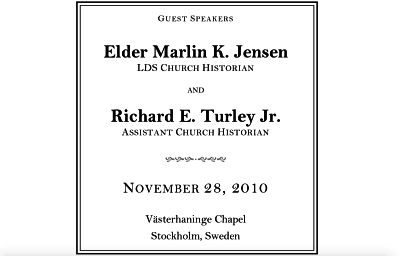
 Please note that the quality of this recording is due to the covert nature in how it was recorded, and has been edited now to eliminate the introductions in Swedish and to optimize volume.
On November 28, 2010, an emergency fireside was held in Stockholm, Sweden by Elder Marlin K. Jensen (Church historian at the time) and Elder Richard Turley (assistant Church historian) to address the faith crisis that ensued among an entire group of members and leaders in Stockholm including a stake president and Hans Mattsson, an Area Authority.
This episode features the actual recording from that meeting.
About 25 Swedes attended this fireside including all the local bishops and stake presidents. Those in attendance were those that were knowledgeable about the Church historical issues that were troubling many Swedes. The Swedes formed their own local Mormon Stories group and had over 600 Facebook members. They would openly discuss these issues amongst themselves.
On September 15, 2018, we visit with many of those who attended the “Swedish Rescue” and hold a 3-part panel discussion surrounding the events of that meeting. You may find those episodes here:
https://www.mormonstories.org/podcast/swedish-rescue/
The “AMindExpanded” Youtube Channel is hosting a video version of this recording that aligns with a typed transcript to help those who may have difficulty understanding the audio version:
Episode Transcript
Host: John Dehlin
This transcript is machine-generated and lightly edited for readability. The audio is authoritative. Please excuse occasional errors in names and spelling.
Welcome and Introduction to the Q&A Session
John Dehlin [00:00:00] Hello, everyone, and welcome to another edition of Mormon Stories Podcast. I'm your host, Dr. John Dehlin. It is December 1, 2021, and I am super excited for today's Mormon Stories podcast episode. So thanks for joining us. The title of today's episode is Mormon Stories and the Open Stories Foundation Transparency Question and Answer Decaffeinated Edition. Basically, to explain what I mean by decaffeinated, I did this almost identical presentation yesterday, but I was a little bit more spirited and I'll even say angry than I wanted to be. And I don't necessarily apologize for anger. And I actually have an explanation for why I was angry. I'm. I'm going to go ahead and save that explanation to the end, but suffice it to say, I want to practice and model mental health and positive emotion regulation, et cetera. So I'm happy to redo the episode. So that's what today is going to be. Just to kind of explain a little bit of what this episode is about, Recently a reporter from the Salt Lake Tribune reached out to me with some questions that felt really suspicious to me and problematic. And I'm going to go into later why I was suspicious and why I found the questions to be problematic. But most importantly, we at the Open Stories foundation and with Mormon Stories, I believe, have a long history, from the very beginning, of really valuing financial transparency and just overall organizational transparency. So it's, it's super normal over the past several years for me to occasionally do an episode that talks about how the Open Stories foundation is doing, how Mormon Stories Podcast is doing, and to address questions and answers and even sometimes criticisms that we receive. Because we, yes, we do criticize the Church of Jesus Christ of Latter Day Saints or the Mormon Church for its lack of transparency, for how it handles criticism and issues. And so we like to model the type of transparency, financial and otherwise, that we wish that the Mormon Church would adopt. And. And so that's what you're in store for today. I hope to keep this to under two hours, maybe an hour and a half if I do a really good job. But the place that I wanted to begin was with kind of giving you all an update of how amazing 2021 has been for Mormon Stories Podcast and for the Opus Stories Foundation. So I put a little bit of a list together of all the amazing things that have happened so far this year. We are on track very easily to exceed over 10 million views and downloads. I'll have those final numbers at the beginning of, of next year of 2022. I am it may be well over that. I am super excited to report that Mormon Stories Podcast consistently has ranked in the top 20 to 25 relig religion themed podcasts on Apple podcasts in the United States. So you think about like Rick Warren and Joel Osteen and a bunch of churches that you may or may not have happy or positive associations with. We're right up there in the top 20 to 25 and I'm really proud of that, especially given our niche audience. We have had so many incredible stories from, from, you know, believing and non believing Mormons over the past years. Year. We literally at Mormon Stories Podcast could not do it without the amazing stories of the people we highlight. So just, just so many groundbreaking stories I'm proud to be associated with. If you haven't noticed, we have tried to dramatically. We have used your financial support, those of you who support us, we have used your financial support to increase and improve our cinematography. And so we've hired Gerardo Simano, a dear friend, to help us with our lighting and our cinematography. And we feel like that has definitely increased the quality of the Mormon Stories Podcast experience and led to increased growth on YouTube, which has become a really important distribution channel for us. We are super thrilled to have hired Kara Burrell, a tick tocker. She also goes by nuance ho on TikTok. She's young, she is funny, she is smart, she is wise, she has a good heart, she believes in our mission. She's been a great co presenter and co host on Warm Stories podcast. And I'm just super happy and honored that we've been able to bring her on and to provide, you know, representation for women on the podcast. I'm also super happy that Gerardo has been able to be a co host. He, in addition to being smart and wise and thoughtful and brilliant and a great cinematographer, he represents the Latino community and people, LGBT community as well. And I'm just really happy that we're working hard to diversify the voices within the Mormon Stories world. I'm super happy. One of the main reasons we brought Cara Burrell on to Mormon Stories Podcast was to launch a Mormon Stories podcast, TikTok Channel. And I'm super happy to report that in just a matter of a few months, we have grown our TikTok audience from literally nothing to almost 80,000 followers. So I'm super happy about that. And, and it's weird, even though I've been doing Mormon stories podcast for 16 years and it's kind of weird that sometimes when people stop me and recognize me in Utah, they recognize me as a TikToker, not as a podcaster. And that just goes to show how important TikTok is. And of course, I don't need to tell you that one of the important things about TikTok and Instagram is that they reach a younger audience. And I mentioned yesterday with Kara that we believe that Mormon teenagers deserve informed consent. And so, you know, we're not trying to take teens out of the church or destroy Mormon teenage faith, but we do know that that teenage years are years where you make very, very important decisions about mission, about marriage, about education. And we want to do our part to make sure Mormon teenagers know the truth about Mormonism and the Mormon Church. And so, yeah, and so TikTok and Instagram, we think, have been important parts of reaching those audiences. Our Instagram Mormon Stories podcast Instagram account is now over 13,000 followers. And we're, we're so happy that we've invested in YouTube as a distribution channel. Years ago, our YouTube audience is growing at over a thousand subscribers a month. We're well over 40,000 subscribers now, and we'll be at 50,000 subscribers by next year if those trends continue. We've also invested in the creation of time codes and show notes with YouTube. And basically what that is is we know that for some of you, are you to our Mormons stories interviews are very long and that many of you would like to be able to jump to different sections of the, of the interviews. And so if you watch or listen to our videos on YouTube, there are these time codes now where you can actually scroll down an outline of the entire interview and jump to the sections that you want to follow or listen to. And I don't know if you guys know this, but you can actually, if you pay for YouTube Premium, it's like 10 bucks a month. You can actually have your iPhone or your Android Android device locked and turned off and you can still listen. So you can use it like a podcast app as well. So all and you. And you lose the ads, which is, which is a bonus. So we are super happy about our time code effort on YouTube. We've had some amazing volunteers and some paid staff help with those time codes. And we're now releasing show notes. So if you think about all of the links and books and podcast episodes and websites that often get, get mentioned in a regular Mormon Stories podcast interview, we are now including those as show notes on the Mormon Stories podcast blog on our YouTube channel and elsewhere so that you can check out the references. And then finally, again, we know that for many people, you know, two, three, four, five, six or 15 hour interviews are too long. Many of you say, please, if you do anything, never make your interview shorter. I think the majority of our supporters love the log form interviews or they wouldn't be supporting us. But there are, there are some who say if either I need shorter episodes or, you know, you might be able to reach more people if you provide shorter form segments. And so we created. Many of you don't know this, we created a YouTube channel called Understanding Mormonism where we just share excerpts of Mormon stories podcast interviews, and we hope to do more with the Understanding Mormonism channel in 2022. That's part of our ongoing strategy. But we want to, you know, we're very proud that that channel, that Understanding Mormonism YouTube channel now has over 10,000 subs and it's only been around for about a year. So those are some of the amazing things that we've done. For those of you who donate and support us, we hope you feel good about the investments you've made to improve Mormon Stories Podcast to improve its reach. And I just get, I get literally 5 to 10 emails a day of people saying, you saved our lives, you saved our marriage. I thought I was dark, sad and lonely and crazy and alone. And your podcast helped me feel like I wasn't so alone. I wasn't crazy. Your, you know, you helped us through hard times. You know, those are the, those, those are the messages that keep me going. Those are the messages that, that make all the adversity worth it. And so I could just say, we believe it or not, mormonstourage Podcast is making a bigger impact and reaching more, more people in 2022 than we ever have. I'm also super excited for several new initiatives that we have started in 2021, including bringing on the amazing John Larsen of Mormon Expression Podcast lore to do a monthly episode. We paid John to do that. We're proud your donations go to support and pay John Larsen. And many of you have enjoyed those monthly episodes with John Larsen. Shout out to John. We love you, John. And also we were really honored to work with John to resurrect the Mormon Expression Podcast from hackers that had taken it down. And so we got onto anchor and Spotify and Apple Podcasts, and I personally submitted over half of the episodes, the title, the description, uploading the audio link so that Mormon Expression Podcasts could be available to the world. And I can say that as of now, over 100,000 downloads have been made of the Mormon Expression Podcast just since we resurrected it a few months ago. So I'm really proud to be associated with John Larsen and Mormon Expression efforts. If you want to donate and support that initiative, you go to mormonstories.org mormonexpression and it will direct you to a link where you can donate to support John Larsen and that effort. Also, I'm really happy that we have launched a new series with Margi Dehlin and Natasha Helfer Parker called the Gift of the Mormon Faith Crisis Series or the Thrive Series on Mormon Stories Podcast. We're going to be talking in a bit about the Gift of the Mormon Faith Faith Crisis podcast that you can find@mormonfaithcrisis.com we'll be talking about that in a second. That's been around for years, but now what we've been doing is bringing on Margi, who, by the way, she receives no compensation for her appearance. She. Well, what I should say, yeah, we don't pay her for her appearances. And we'll talk a little bit more about the compensation of Margi and Natasha in a second. But we bring Margi on and Natasha on to provide Mormon Stories podcast episodes that are focused on healing and growth. And we're really proud to be doing that. And, you know, we like episodes focused on healing and growth to balance out the episodes on deconstruction, on, you know, spotlighting problems with the Mormon Church and its leadership and, you know, all the difficult stories that sometimes can be taxing. So we want to focus as much on light and truth and healing and growth and thriving as we do on some of the more difficult stuff. So I am, I'm super proud for that, for that effort. If you want to support that effort, you can go to mormonfaithcrisis.com and click on the donate button and I'll explain how those donations work. And I'm also super proud to have partnered with Clint and Jenny Martin and Lisa Hacking and Natasha Helfer and others to relaunch the Thrive Initiative. So a couple years ago, we realized that Post Mormons had no annual conference. The Mormon Church had two semiannual general conferences. Post Mormons had had no conference. The Ex Mormon foundation shut its doors years ago. They used to have an annual Ex Mormon conference that got stopped. And my friend Clint Martin and I and his wife Jenny and others just said, hey, what if, what if there was a positive conference called Thrive that was literally just dedicated to healing and growth of progressive and Post Mormons where there was no profit motive, no one was trying to make any money and all we were trying to do is just help, you know, progressive and post Mormons know they're not alone. Find community and heal and grow. That's what Thrive was. We launched that a couple years ago. It was wildly successful. We actually had a 2019 Thrive event in the Salt palace that had one that over 1,700 attendees. As far as I know, it's the largest single one day ex Mormon event in the history of the world ever. But when, when Covid happened, we thought, you know, we wondered if Thrive was going to be able to survive. But because of the amazing efforts of Clinton, Jenny Martin and, and Lisa Hacking and other, we did a Thrive Day for women a few months ago. I think it was in October and it had over 800 women in attendance. It was super successful. We learned a lot from that event. Lisa Hacking and Jenny, mostly Lisa Hacking led that event. Jenny Martin and others helped. It was a great event, super proud of it. And then just a few weeks ago, we held the second Thrive Day for 2021 at the Salt Palace. Again, we had over 1500 in attendance and it was a super successful event. So many people were happy, so many people found it valuable. And we've had so many Thrive communities popping up. Thrive communities in Arizona, in Idaho, in California, in Utah. And these are just communities that are free and they're available to help progressive and post Mormons find friends, find support, find community, figure out that they're not alone and get the. Get hope and get the support that they need to live their best lives. If you want to find a Thrive community near you or start one of your own, if there's not one in your local area, you can go to thrivebeyondreligion.com and you can create or join a community there. And then finally, the last thing I'm super proud of for Mormon Stories Podcast and the Open Stories foundation is that we have a super solid board of directors. We work really well together. That's me, Clint Martin and Jenny. Sorry, Clint Martin and Kerry Whitbeck. And the financials are better than ever for the Open Stories Foundation. We have no debt, we have cash reserves in the bank, and we're slowly figuring out smart ways to invest your donations in making our product better and helping it reach more people. So Gerardo Simone is a part of that. Kara Burrell is part of that. Brooklyn Alden does our editing and we're finding more and more ways. We're going to be actually announcing a new position soon that we want to hire for. So stay tuned if you, if you're interested in working for me in the Open Stories foundation and Mormon Stories will be making announcement about that. Anyway, amazing, amazing year and we couldn't do it without our donors. So thanks to everyone for that. All right, so why, you know, what was the impetus to this episode? Let me go and begin recently right before Thanksgiving. And it's a little bit, Margaret, Margi noticed recently it's a little bit weird that, that these smears and these attacks often come right around Christmas time. And if you look over our lives in the past several years, there always are Mormon stories and John de Lynn smears come that emerge at Christmas time. So it's, it's become part of the Christmas experience for me and Margi and for my family. But basically, a journalist named Tony Simmerad reached out to me right before Thanksgiving and said, hey, John, I'm a reporter for the Salt Lake Tribune and I'm hoping to get, get in touch with you about a story. And basically, you know, he said it was about Thrive and the Open Stories foundation and the gift of the Mormon Faith Crisis podcast. Originally, I was super excited about that coverage because I thought, wow, Thrive and Mormon Stories and the Oba Stories foundation is absolutely newsworthy. So it's, it's, I'm happy to see the Salt Lake Tribune finally giving us some love and some coverage. But when Tony mentioned to me that Peggy Fletcher Stack was cooperating with him on the story, I was concerned. Not because I don't think Peggy is a great reporter. Peggy is in many ways a legendary reporter. And I'm just going to, I created a new slide dedicated to respect and honoring Peggy. So Peggy Fletcher Stack, if you don't know who that is, she is a legend in Mormonism and in Mormon journalism. She is one of the co founders of Sunstone. And Sunstone is an essential organ, was and is an essential organization for the progressive and post Mormon community. And Peggy is one of the co founders of it. She then moved on to become a reporter for the Salt Lake Tribune. And I would argue that Peggy Fletcher Stack possibly has done more than almost anyone on the planet to do solid Mormon journalism and to honestly, candidly hold the LDS Church, of the Mormon Church accountable and to shine a spotlight on them when they do misdeeds. Peggy is often attacked by those in the fundamentalist Mormon crowd as an enemy of the church. So she does not have an easy job. And I would just, I want to say at the outset that Peggy deserves love and respect and, and support. So that's my, that's my stance on Peggy, overall, please love and respect Peggy. She's a legend and she is amazing. Now, I, I also have some personal opinions about Peggy as it relates specifically to ex Mormons and the ex Mormon community that I'm going to share. And part of this experience is from my time with her. Her as a friend. I've been in her home. I've been invited to, you know, at least one gathering in her home. And she used to call. But when I was an active, faithful Mormon, she used to regularly consult me on stories. And so, you know, we used to talk a lot. So kind of what I learned from Peggy as a friend of hers and as someone who talked to her regularly is that Peggy tends to not like dis some ex Mormons, I'll say. And I believe my experience in talking to her is because, because she is a loyal, as I understand, a temple recommend holding liberal, faithful and tribal LDS Church member, much like Richard and Claudia Bushman, much like Patrick Mason, much like Terrell and Fiona Givens. She, she is faithful and loyal to the Mormon Church. I, I believe if you look at her journalism over the past several years, you will see that she has worked super hard to cover stories that cater to the progressive, liberal, but faithful Mormon crowd. And just go back and look at her stories and tell me if you think that's true or not. That's my impression. I, I, as I said in the previous slide, I believe that Peggy is a legend in terms of being willing to hold the Mormon Church accountable. But I believe that her, that there are limits, as there probably should be. There are limits to this. I also believe that Peggy is protective at times. I can, I can think of one story in particular where I was speaking with Marlon Jensen, the former church historian, when he traveled to Oakland and apologized. Personally, as you know, as, as I understood it, a sitting general authority and a church historian, he apologized to the LGBTQ community in the Bay Area for the way the Mormon Church has hurt them. And, and when Peggy found out about that story, Marlon Jensen was going to. Peggy was going to report that story. What I remember Marlon telling me is he asked Peggy Fletcher Stack to sit on that story, and she did sit. She did grant his wishes, and she sat on that story for a long, long time, many months, at the request of a church leader, because I think Marlon Jensen was worried that he would get in trouble with Boyd K. Packer, which he eventually did, and some say that cost him an apostleship, you know, at church headquarters. Now, this is my memory. This is what I remember. Marlon Jensen reporting to Me, and I'm only telling this story as a way to communicate that sometimes I think Peggy has her limits and her loyalties sometimes are, are more with faithful church membership or, or with her allegiances to the church than sometimes being, being an objective, unbiased journalist. Also, in my private conversations with Becky, with, with, With Peggy, I personally remember her expressing sort of distaste for Mormons and ex Mormons that are, let's just say, overly concerned with Mormon church truth claims. My impression that I got from Peggy in my personal interactions with her was that she viewed a concern with Mormon church truth claims as somewhat pedestrian or unsophisticated. My sense from her is that she viewed progressive, liberal, tribal Mormons as sort of the highest form of Mormonism, where you view the church, you know, the view the church stories as myth, you view the church scriptures as mythical, as, you know, having moral value, but it's sort of unsophisticated and pedestrian to expect, you know, Mormon church scripture to be historical or true. And in that light, she, in my view, has always and often disliked or grown, let's just say grown to dislike outspoken ex Mormon critics like me. I eventually became, you know, once the church excommunicated me, I became an outspoken ex Mormon critic. I was before to some extent, but somehow she was okay with me then when I was still in the tribe and faithful. But others like Simon Southerton or Tom Phillips or Grant Palmer, Bill Rio, Radio Free Mormon, she tends to dislike and, or ignore ex Mormon critics who talk about truth claims, which is totally her prerogative. You know, she gets to choose what she covers as a journalist, you know, but, you know, that's, That's a bias that I, in my experience, I've seen Peggy have, and she has genuine, I would say Peggy to me, has shown very little genuine sympathy for the plight of disaffected Mormons. I think it's Peggy's bias that people shouldn't leave the Mormon Church, that they should stay in it, that they should view it in less literal, more mythical framings like Terrell and Fiona Givens and Patrick Mason and others, that they shouldn't focus on the problems with the church and that they can stay in the church and help it succeed. And honestly, I can't falter. I did that. I stayed in the Mormon Church 13 years, 14 years after I stopped believing. And I was an advocate for staying in the church and making it work and fighting for progressive causes in the church. It's a viable, tenable position. And on Mormon stories, we even cover people like that. We recently did an episode, a very, you know, popular episode with Jonathan Westover and others who take this approach. So I'm not criticizing it, it's a valid approach. But my impression is, is that Peggy has very little sympathy, genuine sympathy for the divorces, the, the depression, the anxiety, the family stress, and even the suicidality of people that, that have a faith crisis. I think Peggy's view is you should just stay in the church and, and improve it from within and, and not leave the church. So all of that, you know, is sort of my impression of Peggy. All of those things, you know, give me pause to collaborate with Peggy. But the. Probably the biggest thing that, you know, gives me pause to collaborate in good faith with Peggy was her treatment of me when I found out that I was going to be excommunicated from the Mormon Church. So if we go back about seven years to 2014, Kate Kelly and I received letters from the Mormon Church within a week of each other that we were going to be excommunicated. And we, we put two and two together, reached out to each other and decided that we felt like it was likely that the Mormon Church was going to be initiating a purge, much like September, the September 1993 where it was purging intellectuals and scholars. Back in September 1993, we felt like a purge. Another purge was on again. And so we talked about who should we, where should, you know, we think it's pressworthy. Who should we come out to in the press? And we called a dear friend at the time, Greg Prince. He's kind of like a godfather of progressive Mormonism, a great historian and scholar and a dear friend. And we asked Greg Prince who he thought we should break the story with. And he said, do not break it with the Selling Tribune. You know, it's a local paper, it's not really international, and you know, you'll get, you know, you'll get way more coverage through the New York Times. It's an international, super well respected paper. And sometimes papers like the Trib are less likely to cover a story if it's already been covered by another outlet. So we agreed. I was already friends with Lori Goodstein, the religion beat writer at the time for the New York Times. And we took our story to Lori Goodstein and the New York Times, and it turns out to have been an amazing decision. I think, I think the New York Times did two or three stories on my excommunication alone. They published an entire transcript of, of one of my interviews with my stake president, Brian King. You could Still Google that and. And read the transcript of the recording that I made of why I was being excommunicated and what it was like to work with my stake president at the time. And Kate Kelly got amazing coverage. Her excommunication for her work with ordained women was global news. And I think it was a super wise decision to choose Lori Goodstein, the New York Times. And Peggy was furious. And I remember a specific phone call I had with Peggy. I was in graduate schools in the final year of my PH program, super stressed. I had no support, very little support in trying to manage this excommunication and the PR and the, you know, all the dealings with the excommunication and my stake president and my family. It was just a dark and hard time. And I remember Peggy Fletcher Stack literally yelling at me on the phone, being furious that we would go, that Kate and I would go to New York, the New York Times, and. And Lori Goodstein and not her to break the story. And she invoked, you know, the fact that she had covered us in various stories before. And, you know, that's my memory of what happened. And I felt like, you know, that ruined our relationship. And within, you know, you know, a short amount of time, Peggy Fletcher Stack comes out with this article, and I think it was the very same month of my excommunication entitled, and this is the headline of the SALT LA Tribune article, Mormon facing Excommunication makes his living off his podcast. Can you imagine? Like, you know, mormon journalist Peggy Fletcher Stack makes a living off of being a journalist. You know, Red Cross CEO makes a living off of being a nonprofit CEO. Like, you know, it just felt like an absurd article that was. And actually, if you go read the article, she. She lists my salary and compensation in the article. And, you know, there are some who think I'm making too much of that, or they felt like I made too much of that story. At the time, that. That's fine. It may be true. But at the time, I felt like Peggy was trying to shame me and was trying to kind of like, use her position with the newspaper as a way to push a vendetta, you know, because I. I now had become a critic of the church. Now the church is excommunicating me. And I had broken the story with Lori Goodstein, the New York Times. Now, I may or may not, you know, have Peggy write about that, but that's how I felt at the time. And to be honest, Peggy and I have not had a positive working relationship since. She pretty much stopped ever using me As a source, of course I wrote a response to that article and criticized her and all that may be a reason. But you know, Peggy tends to never, you know, to rarely if ever, you know, get ex Mormons or certainly ex Mormon critics as sources for her newspaper articles. She tends to favor, you know, faithful progressive Mormons and Mormon, faithful Mormon scholars. And that's her right, and that's a prerogative. But that's, I think it's a bias and I think it does not serve the broader Mormon and ex Mormon communities and the broader world. I do not think it serves them well. And I'll talk about that later. And I just want to also just note, you know, what I think Peggy was playing into when she wrote that article and when she tried to shame me by, by publishing my, my salary publicly, I think she was playing into what I think is the brilliance of the, the Mormon Church and its conditioning around Priestcraft. And I, I'm just gonna admit that I, I borrowed this idea from John Larsen because I, I heard him mention it once in a Sunstone presentation he gave. But I just want to note the irony that the Mormon Church is literally a trillion dollar organization. They make, they bring in probably $10 billion a year in, in tithing alone. They have hundreds of billions of dollars in investments and in assets. They are either a trillion dollar organization or they will be soon. We all know about the Ensign Peak case and you know the fact that forever the church has been hiding the fact that it's ha. Has $150 billion in stocks and bonds and real estate and cash that it does, you know, only has done two things with it that we know of to date. Bailed out a failed insurance company and subsidized a commercial luxury commercial shopping mall called City Creek. We know of no charitable efforts that that City Creek, I'm sorry that that Ensign Peak is invested in. But, but isn't it brilliant that the Mormon Church can be a multi billion, multi hundreds of billions or trillion dollar corporation that makes all this money and they have conditioned not only Mormons but, but post Mormons and liberal Mormons and ex Mormons to attack and shame other people who earn a living or try to earn a living cleaning up the messes that the Mormon Church makes? I think it's brilliant. I'm sad that Peggy plays into it. I'm sad that the Sally Tribune allows Peggy to play into it. But that, but that's where we are. And I just wanted to call that out. I, you know, I guess I'll say good job Mormon Church for, for pulling that one over all of our eyes, I think it's brilliant. So when Tony Simmerad, who also I think is a. Is a fine journalist in his own right, he's covered, you know, the James Huntsman lawsuit against the church, the fraud lawsuit that my friend James Huntsman is engaging in with the Mormon Church. He's covered, you know, the ensign peak stuff. I think Tony Simmerad is a fine, respectable journalist as far as I know. But when Tony reached out to me and mentioned Peggy Fletcher Stack, her involvement, I was worried, given all this history and my perception of Peggy's biases against ex Mormons. And so, and so I, I asked Tony to share with me a list of questions in writing that he wanted us to cover. And sure enough, my instincts were spot on. There were zero, you know, zero questions about the amazing Thrive event, the Thrive community, all the people that it's helped, its growth, its success, the 1500 people that are at the Salt palace, all the people whose lives were changed, the relationships that were made, zero questions about that. And the questions, and if you, you know, I've got a screenshot here literally of his text. To me, you know, it was all about sort of like digging into or trying to create the impressions of financial impropriety. So it was questions about, like, what's the relationship between Open Stories foundation and Thrive the gift of the Mormon Faith Crisis podcast and, you know, Thrive in the Open Stories Foundation. You know, is Thrive a for profit or a nonprofit? How many people attended the event? What was charged by the event? And then he mentioned a couple other, you know, he mentioned my life, my, my now retired of Faith. Faith Crisis coaching business that he didn't know had been retired. I've gone on sabbatical with my coaching practice. He asked about that. He asked about my wife Margi's Faith Crisis coaching practice and Natasha Helfer's therapy and coaching practice. You know, I believe trying to snoop around allegations of, or to create the perceptions of some sort of conflict of interest or impropriety, you know, and, you know, and those were the only questions that, that he asked. And so that is what made me, you know, feel like I didn't want to cooperate directly with his stories. And the fact that in my opinion, in my experience, Peggy Flitzer Stack with ex Mormons specific, particularly at ex Mormon critics, has the tendency to misquote or recontextualize statements in a way that put. Put ex Mormon critics in a bad light and that, you know, are more protective of the church and believing members. So I, that, you know, so what I decided to do again, you know, I was just disappointed at zero questions around, you know, positive questions around Thrive. And so what I decided to do was to use our long standing tradition of transparency here with Mormon the Oba Stories foundation to answer Tony and Peggy's questions publicly because we have nothing to hide. You know, of all the reasons I was sad or disappointed about the Salt Lake Tribune, zero of them were because I felt like we had anything to hide or that we've done anything wrong. I love and welcome transparency. We asked the church to be transparent and we're thrilled and honored to be transparent and, and I think you'll see in this presentation where we reach a level of transparency that I don't think the other nonprofits do. Yeah. And so that's what, that's what we're going to do now. I'm going to share with you their questions to me and I'm going to share with you the financial information that they were seeking. And then you and my listeners and my donors and the world and the Salt Lake Tribune can know the answers to these questions. So the first question was, what is the relationship between Mormon Stories, the Open Stories foundation, and Thrive? So they also asked, is Thrive a for profit or a nonprofit? And what I feel like they're snooping around at is they're trying to create some sort of perception around some secret scheme of, you know, for me or for Thrive to profit off of post Mormon pain and suffering or some type of un. Inappropriate conflict of interest interest between Mormon Stories, Podcast, the Open Stories foundation, and Thrive. So here is the answer. The Thrive foundation is a 501c3 nonprofit. It was, it was accepted as a 501c3 nonprofit this year. Actually. It is a complete and total money loser. And ironically, it's a complete and total money loser by design. It is underwritten by the generosity of my two dear friends, Clint and Jenny Martin. And if anything, Clint and Jenny have wanted every single Thrive event to be free. And they've wanted to pay for all the expenses for all the events and all the expenses that we've had so far. But what, what, what we've done for the Thrive events. But basically, partly out of my arguing, because of my experience with non profits in the and knowing the importance of sustainability with nonprofits, I basically said, look, Clinton Jenny, if you guys just pay for every Thrive event, if you guys go away, Thrive dies. So. And plus, people tend to value what they pay for. So I prevailed eventually over Clinton Jenny, and they they're willing to charge a small fee for Thrive events that literally don't cover the expense of the events. To give you an example, they held Thrive for Women in October and that event lost $10,000. So you subtract all the expenses from the revenue. Clint And Jenny paid $10,000 to underwrite that event out of their own pockets. And the same thing happened with Thrive Day 2021. They charged $25 per person, per ticket. We rented out the Salt palace and really expensive AV equipment and Thrive Day 2021 lost almost $20,000. So Thrive is a money loser. It's not a for profit. And I'm hearing some of you say, hey, wait a minute, Prove it. Prove it. John, these are just words. Prove it. So, so here is the, here's the transparency I promised you. This is a reporting of Clint's most recent financial reporting for the Thrive Day 2021 event. These are the, the financials. And, and here it is. 1451 tickets were sold at $25 a piece, which is $36,275 in revenue. Clint accounted for $250 in vendor booths. That was raised donation of $350. At the time of this reporting. I think there have been a little bit of donations, maybe 5,000 in donations since that did not get included in this report. Report. I saw that report get responded to, that donation get made and responded to. And Clint promised my friend who made the donation that, that the, that the $5,000 donated would go to the next set of events. So it's not included here because this was a snapshot of the donations at the time. $36,000, $36,875 in total revenue for Thrive Day 2021. And then the Salt palace cost 11,450 to rent the Encore, the company that does the audio visual. Our latest reporting, because I don't think there's a final bill. Our latest reporting for Encore for the audio visual was $17,518.93. $20,900 were paid to presenters because each presenter received, I believe $1,000. And also there was airfare and, and hotel and expenses for some of the presenters. You know, we flew in Amber School. Sorry, we flew in Sarah Edmondson and Nippy Ames, Ex Nexium cult survivors. They brought down, they helped bring down Keith Ranieri and the Nexium Cult. We flew them here, we put them up in a hotel. We paid Lance Allred, a professional speaker. We paid him a discounted professional speaker fee. And then we paid a lot of the other Thrive speakers a thousand bucks. We, you know, we flew our free or free Mormon here, paid him, we brought bill real down. Anyway, that's, that's what was paid for presenters, $20,900. There was almost $7,000 in ads, design and printing which came out to total cost of $56,816.99, showing a loss of $19,941.99 at the Thrive event. At the very opening, I actually announced that this event was operated at a loss. I think I told the event attendees at the time that the loss would be as high as $35,000. That was based on estimates before we knew how many final people register. It was based on, based on old data, but it was my best understanding at the time. So it wasn't $35,000. It was, you know, close to $20,000. And even if you take the $5,000 in donations that came after, if, even if you take that out, it's still about fourteen or fifteen thousand dollar loss that Clint and Jenny Martin paid. So that's how you know, that's our transparency. I hope you value that level of transparency and I hope that answers the questions from, from the Salt Lake Tribune. I do think it's fair to ask, is this level of transparency newsworthy? When you think about the, you know, eight, nine, $10 billion a year that the Mormon Church brings in, it literally lobbies the federal government and the Utah state legislature to prevent any financial disclosure at all. So the Mormon Church does not have to report a dime to anyone ever. You know, is this level of transparency newsworthy? Should, could you imagine a Salt Lake Tribune story that says, you know, post Mormon nonprofit shows unlev unheard of levels of transparency in its, in its non profit efforts? You know, I, I, I would love to see, you know, maybe there's an article like that that could be shared. All right, so the next question, I think that was, you know, that, that cynics or critics are going to ask is. All right, John. Well, there were speaker fees paid. Did you, John, lug home a hefty speaker fee or any compensation from your efforts at Thrive? And my answer is no. My total compensation for my planning and strategizing and organizing and participation in Thrive Day is zero dollars and zero cents. I received nothing. No cash payments, no behind the scenes payments, no payments, nothing. Not even any donations to the Open Storage foundation that I'm aware of. Although, and you know, if that were to happen, I could see it being reasonable that Thrive would pay a marketing fee to the Open Stories foundation to help market its events. I don't think that even happened this time around. But. But to just be very clear and explicit, I made $0 basically for my efforts in Thrive Day. And if you don't believe me, here is a screenshot of an actual text that I received From Clint. Monday, November 15th at 8:50am Long before I had any idea that the Salt Lake Tribune was going to potentially do a hit piece on me and on Thrive. And let me just read to you what the text says. Wow. We did it. This is from Clint. Wow, we did it. What an epic event. Thanks for your love and support and amazing marketing and powerful communication skills. This event will totally change lives in ways we will never fully understand. It's truly an honor to be involved in such important work. I love and appreciate you, John. We totally rocked it this weekend. Also, I want to pay you the same thousand dollars that we are paying to other speakers. And again, this is still on my. My iPhone. Clint still has these live texts on his iPhone. If any of you want to see the actual evidence, we were happy to provide it. My response was love and thanks to you too, brother Clint. And if it's okay, there's a typo there. If it's okay, I'd like to forego my fee since the event didn't break even. That okay. But dude, super generous. Thank you. This will be my modest contribution to the $35,000 overage, because I thought it was $35,000. Argh. And then Clint says, okay, sounds good. I will compile final numbers and see how it all came out. But whatever the cost, it was worth it. And that's the type of person people that Clinton, Jenny Martin are. They will pay tens of thousands of dollars, if not more, to provide progressive and post Mormons with healing and growth and support. So that's the answer to that question. So the next question from Peggy and the Salt Lake Tribune. What is the relationship between Mormon Stories, the Open Stories foundation, and Thrive? The. The answer is this. And we actually consulted with our. You know, we've. I've hired the best nonprofit attorney in the United in. In Utah that I'm aware of. Not because I'm trying to do any shenanigans, not because I'm trying to cover up any bad work or the board, because I want to make sure I know the level of scrutiny is super high on Mormon Stories and the Oba Stories Foundation. I've known it for years. And I want to make sure we do our Best to never cross any inappropriate lines. So I asked our nonprofit attorney if it's okay, and we have his confirmation that there's nothing wrong with two nonprofits that share the same mission supporting each other. So that's my answer. The Open Stories foundation and the Thrive foundation are two nonprofits who share the same mission, who are supporting each other. There is overlap in the board of directors. Clint Martin is on the Open Stories foundation board, along with me and my dear friend Kerry Whitbeck. And then the Thrive board has Jenny Martin, Clint Martin, Lisa Hacking, Natasha Helfer, and myself. You know, for how many years did the Mormon Church have apostles and general authorities sitting on commercial corporate boards, let alone nonprofit boards? I even think that general authorities or former Mormon general authorities sat on the board of Evergreen, which, which was a. Which was an organization that encouraged LGBTQ Mormons to engage in reparative therapy and conversion therapy and even electroshock therapy. So, like, it's, it's rich that, you know, nonprofit board involvement is being called into questions in terms of its ethics when the Mormon Church has this long history of shady involvement with both corporate and nonprofit boards. But, you know, that's what the Solid Tribune is wanting to cover, and so they're covering it. But that's the relationship between Mormon Stories Podcast, the Open Stories foundation, and Thrive. And so that might, you know, you know, ask some of you to wonder, you know, why create a separate 5:1C3 nonprofit for Thrive? Why not just do everything under Mormon Stories Podcast and the Open Stories Foundation? And so these are the reasons why we decided to create a 5 1C3.4 thrive separate from Mormon Stories and the Stories Foundation. Number one, we wanted thrive to be primarily women led. And if you'll notice, in our board of directors, there are more women than men. How would it be if the Mormon Church or even the Salt Lake Tribune. Maybe it does. I haven't checked their board of directors, but what if more corporate and nonprofit and religious entities had more women than men on the leadership team? That's what we, that's the first thing we wanted to do with Thrive and the, and, yeah, with the Thrive Foundation. Secondly, I don't have time to manage Thrive, so I didn't want to be responsible for it. I was happy to lend my marketing, you know, abilities, my communication abilities, and my strategy, but I didn't have time to manage it. Also, it's just no secret that I am constantly being fair gamed or smeared by the Mormon Church and its critics and ex Mormons. And so we did not want Thrive to be bogged down in the, you know, smears that accompany me being the church's top critic. Because, you know, if you talk to Leah Remini or Mike Rinder of Scientology, you know, Lloyd Evans or Chris Shelton, you know, the Jehovah's Witness, ex Jehovah's Witnesses, you know, ex Mooney's, Steve Hassan of the, the ex, you know, Mooney movement, doesn't matter. If you are a critic of a, of a, if you are, you know, critic of a cult or a high demand religion, you're going to get smeared and the church is going to find ways, either overtly or indirectly, to smear you. And I did not, we did not want Thrive to be taken down in all those smears. Having said that, they insisted that I be on the board and that I participate. I've offered my resignation several times before and after this newspaper event and so far they have, they continue to refuse my resignation. Ironically, if I. No, I'll forget it. So anyway, that's why, that's another reason why we want to Thrive to be independent. And then finally, the truth is that the day to day duties of thrive are 99% Clint and Jenny Martin, you know, with really significant assists from Lisa Hacking, who helped lead up Thrive for Women. But Natasha and I play very backup roles because we're so busy. So those are all the reasons why Thrive is its own nonprofit and is independent. So the next question is why is there a relationship between Mormon Stories or. Sorry, what is the relationship between Mormon Stories, the Open Stories foundation, and the Gift of the Mormon Faith Crisis Podcast? I am so thrilled that they asked this question because the Gift of the Mormon Faith Crisis Podcast has deserves much more attention and support than it is, than it is currently receiving. So thank you, Salt Lake Tribune, for giving me an opportunity to highlight this important podcast. So once upon a time, you know, I started. So I. I'll give you a little background because the Salt Lake Tribune wanted some background. When I started Mormon Stories podcast back in 2015, immediately I was inundated with inquiries of people, you know, who were worried about divorce. They were worried about the destruction of their families. They were experiencing anxiety and depression, eating disorders, quote, addictions, and even suicidality because of either the Church's treatment of LGBT people or the Church's treatment of intellectuals or people who doubted or questioned and, or lost their faith in the church. So I started trying to provide support to these people because there were no experts in navigating Mormon Faith Crisis. The Church has done little to nothing to support people in this realm. And there was just such a huge need and no one was stepping up to fill it after, let's just say, three years of trying to support all these people doing it for free. And as I was trying to figure out what my career would be after I left Microsoft and, you know, a job where I was making over $200,000 a year with stock options with full benefits, 401k. After I had left that to try and be a support to this problem, I realized that one. One way that I could be a important solution and healer in this space was to pursue a PhD in clinical and counseling psychology. So I started that in 2009. Nine, finished that in 2015. And as soon as I was done, I said, hey, I will resume full time, you know, running a Mormon Stories podcast in the Open Stories Foundation. But there's so many people reaching out to me to get help. I will maintain a small coaching practice on the side. I don't think I ever had more than five or six clients a week at the height of my coaching practice, but, but I did that because there was a demand and people were always trying to help me, get me to help them save their families, save their mental health, save their lives, etc. So I did that for years. I also did some workshops and retreats. Most of that was done through the Open Stories Foundation. Some of that was done separately. I did a lot of that with my dear friend and partner, Natasha Helfer and Margi. And of course, Natasha Helfer has been working in this space since the mid, you know, mid 2000s. She does a phenomenal job with Symmetry Solutions. She has many coaches and therapists working under her. And then eventually, just, just a couple years ago, my dear wife Margi, you know, the kids were growing up, she was looking for some sort of profession. She is such a wise and gentle and thoughtful and brilliant and compassionate soul. She decided to go ahead and pursue a certificate as a Faith Transitions coach and as a, you know, grieving coach and just as a coach for women mostly, but some men who are struggling in their marriage, struggling in their life, needing support, struggling with grieving or transition. So, you know, just like Julia Diazevedo Hanks, just like Jennifer Finlayson Fife, just like Tiffany Rowe, just like Janice Spangler, there are just like Marty Erickson, Jenny Morrow, there are dozens and dozens and dozens of psychologists and mental health professionals and coaches stepping up, up to clean up the, the carnage that is left from the way the Mormon Church damages individuals and families. And I'm super glad for it. So. But what does this have to do with the Gift of the Mormon Faith Crisis podcast? One day, literally, Margi, Natasha and I were sitting around, we had more clients than we could ever serve. Our waiting lists were weeks, months or months out. And we said two things. We said, isn't it sad that. Isn't it sad that there's so much need out there for coaches and therapists and there literally aren't enough coaches and therapists to meet all the need? And then secondly, we said, isn't it sad that it's so expensive to get therapy or coaching or support for a faith crisis? I think Natasha charges 250 or 300. $350 per hour. She should. She's worth every penny of it. She's also a licensed sex therapist. Excuse me, you know, I know Jennifer Finlayson, five charges somewhere between, I think, three and $400 an hour for her services. I think Julie Diazevedo Hanks charges three. 350. I don't know. For her coaching services, therapists charge between 150 and $250. Like, it's super expensive to get support. So Margi, Natasha and I said, why don't we create a podcast called the Gift of the Mormon Faith Crisis Podcast and share as much of our coaching expertise as we can for free on the Internet so that as many people as possible could get that help? So that's what we did. We created a podcast@mormonfaithcrisis.com and if you go there now, there's literally over 90 hours of content. Things like, how do I come out to believing family and friends? How do I understand a faith crisis? How do I avoid a lot of the pitfalls, the ways that post Mormons or questioning Mormons ruin their own lives or family relationships? How do I avoid those pitfalls? How do I come out to my spouse? How do we come out to our children? How do we navigate relationships with bishops and stake presidents? How do we get over the anger? How do we process the grief of a faith crisis? 70 hours of free coaching and content. If we were out for the money, if we were selfishly, greedily, financially motivated, we would have put all of this behind a paywall like many of the therapists and coaches I just mentioned do. We would have put it all behind a paywall and tried to charge people for giving away this expertise. We chose to give it away for free. And that's what a Gift of the Mormon Faith Crisis was. Now, we did accept donations for it, but we gave it away for Free. And I'm proud that we did that. And so that's, you know, that's what Gift of the Mormon Faith Crisis was. In addition to giving away our coaching, Clinton and Jenny Martin literally paid us to record an entire retreat, two and a half days, over 20 hours of content of an entire Faith Crisis retreat. They underwrote us to record the entire event and give it away for free on the Internet. So if you Google Mormon Faith Crisis Retreat, we've made that available both on Mormon Stories Podcast and on Gift of the Mormon Faith Crisis Podcast. And you can watch the whole thing for free and never have to pay anything. That's a 2, 3, $4,000 value that we gave away for free. Why, if we were greedy, selfish people, would we be giving away all of our best advice and content for free? And literally 80 to 90% of what we share in our coaching practices and our therapy practices comes out of this content that we give away for free. Just people want personal interaction. I can't always explain it. Anyway, you know, that is what the Gift of the Mormon Faith Crisis Podcast is. I hope that answers the questions of the Tribune and I will just give a little bit more transparency. Gift of the Mormon Faith Crisis Podcast started out as just a private, personal thing that, that Natasha and Margi and I wanted to do to give back to the community. If you, you know, I estimated that each of us took at least 200 hours for our efforts with that podcast. If you just took a round number, $200 an hour for our time, and you added all that together, you know, that's over $40,000 of value of effort that Natasha, Margi and I contributed to that podcast. Once we, we gave it our best shot, we put it out there for free, and it was, it was not, frankly, not being used like we thought it would, like we thought it should. We thought, how can we get more exposure to this podcast and help more people with it? And we decided to take it to the board of the Open Stories foundation with myself recused and say, hey, Mormon Stories Podcast Board, can we offer the Gift of the Mormon Faith Crisis Podcast to the Open Stories Foundation? Audience will enter into a licensing agreement with you where we'll provide it to you for free. There was no payment for the rights to distribute this podcast. It was given to the Open Storage foundation for free. I recused myself from the board in that decision making process, as I always do with efforts involving conflict of interest or my own salary or conflict compensation or that of people, you know, who are in my family like Margi and. Yeah, and what we got in exchange for that licensing agreement is that Margi and Natasha would draw a modest percentage of the revenue that was donated to the Gift of the Mormon Faith Crisis podcast through the Open Stories Foundation. And that is how all of our podcasts work. Natasha gets a percentage of what's generated with from Mormon Mental Health Podcast. Please donate to that. Gina Colvin gets a. I think 75% or 80% of the donations to a thoughtful faith podcast. And then I receive a percentage of the donations made to Mormon Stories Podcast, which is also capped by my board. And then the remainder of the donations to Mormon Stories Podcast Fund, the Open Stories foundation, and my salary to run it as a. As the CEO. So all of that's in our financial disclosures. We've published that on the Open Stories foundation website. It's been published there for years. We publish it in our 9 90s. None of this is secret. And I should say that I draw no direct personal compensation for my participation in Gift of the Mormon Faith Crisis podcast. The 33% of that that goes to the Open Stories foundation funds the general operations. But it's small money, and I'm going to show you how small that money is. And again, our nonprofit attorney approved this, and the Open Stories foundation board approved this. Margi's compensation is reported annually. It's disclosed on our 990 tax form. As far as I know, this is the 202990 that I took a screenshot of. I didn't go back to check to make sure that. That the 2019990 reports Margi's compensation. I assume it does. If it doesn't, it's not because I was hiding anything. It's literally, it would be an error on the part of our. Of our accountants or our finance committee or whatever. But there it is, the public disclosure of Margi's compensation. And I went ahead and calculated what Margi and Natasha are making off of this generous its contribution to the world and its relationship with the Open Stories Foundation. In 2020. My best calculations were that the Gift of the Mormon Faith Crisis brought in $6,860 and Margi and Natasha brought in each 33%. 33% of that, averaging out to my best guess, around 200amonth for Margi and $200 a month for Natasha. If we were to figure out how many months it would take for all of this to be recouped, I calculated that it would take like 200 months. Maybe I miscalculated that. You math experts might tell me that it's 20 months or 100 months, I don't know. But suffice it to say that it's my perception that the people who have benefited from this podcast have benefited way more than Margi and Natasha have been compensated for. And I'm not even sure that's a good thing. But what I can say is that, that hundreds, if not thousands of people have reached out to us and said that the gift of the Mormon faith crisis has saved their lives, saved their marriages, kept their family intact, helped them heal, help them grow, helped them find support and community. And so. So I'm proud of it. All right, that's that question. I hope the Salt Lake Tribune got what they needed there. Next question that was asked. Am I, John, aware of complaints filed with the IRS and the Utah Attorney General regarding both my compensation and the financial oversight of the Open Stories Foundation? And before I answer that question, I want to tell you a true story. Uh, being. Being a outspoken critic of a high demand religion or a cult means that I am always constantly barraged with smears and attacks and unfounded claims. Uh, I, I've been accused of having multiple multimillion dollar homes. Not true. I have one home. We paid what I think is a modest amount for the holiday area. We have one home and, you know, that's it. I drive a 2003 Honda Odyssey. It's an 18 year old minivan. That's my main form of transportation. Margi drives a Outback, Subaru Outback. And we also have a $2,000 Toyota Camry. Sorry, 2,000 year Toyota Camry that has got a couple hundred thousand miles on it. So it's a 21 year old car. So anyway, I think it's been bad how it's been unsafe, how old and decrepit our cars are, and the cars that we've given our children are. We bought such cheap cars for our children that when they got in accidents, the airbags didn't even deploy. I am now regretting how, how long I went with substandard compensation for the Oba Stories foundation and the way that it's harmed my families. Anyway, it's rumored that Margi and I have gotten super wealthy off of the Open Stories Foundation. You know, Mormon apologists that are literally funded by the More Good foundation that's funded by the Mormon Church have tried to smear me and others to say that we, you know, destroy families for profit. All sorts of, you know, sexual allegations that have no basis in truth. So I'm getting smeared all the time. So Am I aware that of one person filing a claim with the IRS and with Utah that if there are financial improprieties. Yes, I'm aware that this person has done this. Absolutely. So is the board. And I would just say that when you publicly fight a high demand religion or culture, this. This comes with the territory. Astley, Remini, Mike Rinder, Chris Shelton, Lloyd Evans, you know, Steve Hassan, Sarah Edmondson, Nippy. You're gonna get smeared with false allegations when you fight occult or high demand religion. And I've actually written an article about this called on attempts to smear or being fair gamed. That's Scientology's term for the way cults and high demand religions smear its critics, both directly and indirectly through nonprofits and through shadow money. And all I can say is that this is the way smear campaigns and fair gaming work. If you can create enough negative associations in people's minds over time. Whisper campaigns, oh, Bob, you know, there are allegations of financial impropriety with Bob and his nonprofit. There are allegations of Bob getting wealthy off of, you know, his nonprofit. There are allegations of sexual impropriety with Bob and his nonprofit. If you can constantly, year after year, drudge up negative associations, even if there's no validity to the claims, what many, many people do is they say, well, whether smoke, there's fire, and they'll keep their distance or withdraw their support or remove their support just to keep it on the safe side or to, you know, to avoid any negative associations, if not outright join the attacks. Which is what many, unfortunately, what many ex Mormons have done for whatever reason. Sometimes not many, but a few ex Mormons have piled on and sort of joined with the Mormon Church and its apologists to smear and attack me in the Open Stories Foundation. I'm not saying we're perfect. Of course we make mistakes. I make mistakes. But I, you know, I'm not aware of there ever being any question of financial impropriety ever with the Open Stories Foundation. I've been transparent about my compensation from the beginning. You can literally read documents that we've published listing my compensation every single year since the beginning. No financial impropriety that I'm ever aware of with the foundation. We once had one of our contractors deposit a donation, a large donation, into their own private bank account. But I discovered that immediately. We got it resolved. We got that money refunded. But I'm aware of any financial impropriety ever in the 11 years of the Open Stories foundation that was material in any way. They're always like, oh, where's that receipt? And oh, did you forget to file that one? Tax reform, that, that tax form kind of thing. No financial impropriety that I'm aware of. But, but, and again, no credible, no credibility to the allegations of sexual assault, sexual harassment, sexual abuse, zero credibility. Again, I'm not perfect. I have had to learn how to deal in this space and I have made mistakes, you know, in my life as I've tried to work through, you know, my own traumas with leaving the Mormon Church and the impact of that on my marriage. But I'll just say it now, zero truth to any of these allegations, financial, sexual or otherwise. But if the Salt Lake Tribune and the Mormon Church and Mormon apologists and, you know, Mormon critics and even ex Mormon critics repeat the accusations, enough people come to start associating there being problems and starting to believe that where there's smoke, there's fire. So. So yes, several months ago, one of these few ex Mormon critics who's tried to launch other specious and fraudulent and false allegations, unfounded allegations against me, did file a report with the Utah Attorney Attorney General and apparently with the IRS claiming financial impropriety. And I will say that in all honesty, we were eager to comply. When the Utah Attorney General reached out to us and said, not, not the Attorney General, but someone in his office, when their office reached out and said, we want to conduct an audit of the Open Storage Foundation, I was actually thrilled. I'm like, hey, get our finances, you know, top notch accounting firm and attorney and board. Let's get them our finances. There's nothing wrong. I was thrilled because I believe in transparency. I love it. And we had nothing to hide or nothing to fear. The only sliver of fear that I had, honestly in my mind was the Mormon Church controls the Utah State legislature. The Mormon Church is a theocracy. Utah is a theocracy, let's face it. And the Attorney General for the Mormon Church, Sean Ray Reyes, not only is a faithful, devout, believing Mormon, but I have been. Personally, I've been publicly critical of Sean Reyes for his support of the Operation Underground Railroad with Tim Ballard because of reports to me, credible reports to me by Lynn Packer and others of fraudulent activities within Operation Underground Railroad, where they claim to be supporting victims of child trafficking. But in reality, the money isn't being used as people think. And there are whistleblowers now leaving that organization claiming that it's engaging in fraudulent or inappropriate activities. So yes, I was afraid that maybe the Mormon Church's influence or Sean Reyes, you know, concern about My criticism of him could taint the audit. But I was pleased and thrilled to get the letter from the Utah Attorney General's office that that literally stated that no wrongdoing was found and that the case was closed. So yes, Salt Lake Tribune, I'm aware of that. One complaint filed and nothing came of it. And we were thrilled to have been exonerated. I would love an article in the Salt Lake Tribune that said, you know, Mormon Stories Open Stories foundation shown to have no financial impropriety by Utah State's Attorney General's Office. Maybe, maybe that article will be shown or maybe it doesn't, maybe it won't be. But that's hopefully answering that question. Kara's saying it still seems like caffeinated. John. Yes, I'm, I'm caffeinated. I, I am excited. I'm hoping that I'm a little bit less angry and a little bit more temperate and kind of measured in my feedback. Maybe I'm not. Maybe it's the same thing as yesterday, but this is my good faith attempt at being fair and balanced in what I'm doing. So another question offered by Solic Tribune, Tony and Peggy is will your partners in Faith Crisis coaching, Natasha Helfer, Margi Delin be continuing, you know, in the meantime, what, if any, will their contributions be to the activities while I'm on sabbatical? And you know, basically all I can say is Margi and Natasha will continue to appear on Mormon Stories podcast. Natasha will continue to lead a Mormon mental health podcast for the Open Stories Foundation. She'll continue to appear on Mormon Stories podcast as part of the Gift of the Mormon Faith Crisis Thrive Initiative. She will continue to draw a couple hundred bucks a month donations from the Gift of the Mormon Faith Crisis podcast. Margi, the same thing. And they will continue their coaching practices. And I can promise you if we cut them off completely, they would have wait lists into eternity and into perpetuity. They're literally volunteering their time to the Open Stories foundation now just to as a public service. And so that relationship will continue. I imagine they'll continue to be a part of retreats and workshops and get paid for it. And I think, I think they should. So that will be the ongoing relationship. I'll also just ask you to look at Mormon Stories and Mormon Faith Crisis website. We not only refer to Margi and Natasha, we refer to other coaches and therapists we have for a long time. We get no monetary compensation from them. Our dear friend Liz Dalton, amazing therapist Marty Erickson, Janice Spengler, Leah Young Jenny Morrow. We charged them $0 to refer people to them. We stand by those recommendations. Recommendations. And we are, we are continuing, we will continue to support them. Maybe, maybe one last thing I want to say is this. Maybe we've done something wrong. Maybe we've crossed some sort of ethical line. Maybe we've, maybe Margi and Natasha's involvement or even Thrive or the Martin's involvement. Maybe we've done something that, that is gray or a conflict of interest. Maybe we have. I'm not even saying that we've never made a mistake. What I'm saying is we've done our best to not do that. We've done our best to do everything by the book. And if we're doing anything immoral or illegal, we are eager to fix it. And, and we'll, we'll. Please email us@mormonstoriesmail.com if you have suggestions. I also want to explicitly state, if it's not obvious and clear, I want to explicitly state what our goals are. Our goals are to alleviate suffering and alleviate unnecessary divorces, alleviate the destruction of families, alleviate anxiety and depression. For people questioning or leaving the Mormon Church, it's to alleviate as much suffering as we can to clean up the damage that the Mormon Church is doing all over, hiding and deceiving people about its truth claims, about its treatment of women of people of color, of LGBTQ people. We are trying to alleviate the suffering and clean up the damage and the hemorrhaging caused by the Mormon Church and its deceptive practices and its harmful practices. In addition to all the good that the Mormon Church has done, the Mormon Church has done a lot of good for a lot of people. We're trying to clean up the harm and the damage to get the church to be better. And we are trying to give progressive and post Mormons hope. Hope. Tell them that they're not crazy, that they're not alone, that there is hope for healing and growth and that they can live a happy, healthy life, be happy, healthy parents. Find happy, healthy marriages or relationships. Be happy, healthy lgbtq, whatever it is, find their true love. You can find that after leaving a high demand religion or the Mormon Church, and I should add, there are thousands and thousands of listeners now to Mormon Stories podcast that are ex orthodox Jew, ex Muslim, ex Catholic, ex evangelical Christian, ex Scientologist, ex Jehovah's Witness, you know, ex Christian. Like, we're not just serving Mormons and ex Mormons, we're serving the world and we're proud of it. So that, you know, Peggy or, you know, Salt Lake Tribune reporters. Tony, will you please state that as our explicit goal? Because that is what we're doing and that's what we're trying to do. And I would love that to be included in whatever article you release. And I will also state that we do not do this for the money. Clinton. Jenny definitely don't do this for the money because they've only lost tens of thousands of dollars. But even Margi and Natasha and I and others, we don't do this for the money. I could have made so much more money working for Microsoft. I had a great job there, great retirement stock options, over $200,000 a year. I would be a. I'd probably be worth five to $10 million right now if I had stayed at Microsoft, given what its stock has done and what my career trajectory would have been. We don't do this for the money. I didn't leave my job and go 10 years without a reasonable salary, benefits, retirement, without health care for my children. We did not. A family. We did in many of those years. We did not do this for the money. Margi and I didn't make these sacrifices for the money. We did this to help people. But I knew that at some point I needed a salary and compensation that was comparable to my market value to be able to continue it. So we need money. We need financial support to do this. And honestly, the moment the financial support dries up, we will go on to do other things. But let me also state another thing very explicitly. Oftentimes, critics, ex Mormon critics, apologists in the Mormon Church, you know, they want to criticize me for the current salary, the current health insurance, the current, you know, compensation that I get. I want to say very, very explicitly that the money that I receive, even now, as generous as the donor, my donors and the Open Stories foundation board are, with my compensation, the money is not worth the stress and the slander. To be. To be called publicly greedy, to be called a sexual predator publicly, to be accused of financial improprieties, to have my wife and children dragged into those types of smears and allegations, to walk around and to be intimidated, where people try and dox you, where they come to your workplace, take pictures of your office and post them publicly on the Internet, or to dox your home, to post pictures of your home, to intimidate and threat and dox you. The death threats that have been made where, where Mormon apologists have, you know, shown pictures of me, my face with a knife or my face with the gun or a video of people bashing my head in and sharing those publicly and then having my kids and my spouse see it, not to mention the years that my wife and me and my, my marriage and my kids went without health insurance, without therapy, without basic medical care, without retirement. It is not worth it. It is not worth the money. If I wanted to get rich, I would have stayed in high tech. I would have stayed with mit, I would have stayed with Microsoft, I would have started my own thing and I'd be retired and wealthy right now. It's not worth it. It's just not. The money makes it possible. Doesn't make it worth it. I should also say that I do think that another thing about my compensation. Yes, I am getting, I am just now, over the past few years, starting to make the money that I made in 2004 when I was at the peak of my career at Microsoft at 31, 32 years old. I don't remember exactly how old I was, but what I'm going to say is this, that, that since making a couple hundred thousand dollars a year at Microsoft, I've obtained a master's to, you know, a master to the equivalent of two master's degree and a PhD. I've worked for companies like Microsoft, the Massachusetts Institute of Technology, and most importantly, three different times the Open Stories foundation board, the compensation committee committee with me, recused so independently went to professionals and experts and did what's called a salary search where they looked at my experience, looked at my background, looked at my qualifications, looked at my education, looked at my track record leading the Open Stories foundation, looked at the success of Mormon Stories podcast, the podcasting, the other podcast, and my market value. They independently established my market value through three independent salary searches, which is what we understood to be is the best practice consulting our attorney is, is the best practice for establishing the compensation of, of a nonprofit executive director. And we've published my compensation publicly every year either through our website or through our public nine 90s. And I've talked about it publicly and oftentimes many years, most of the years in the existence of the Open Storage foundation, we actually publish more financial information that was required. And you can just go to openstoriesfoundation.org, click on Public Statements that we've made and you will be able to see our disclosure. And you can find me, find me any other nonprofit in the Mormon or ex Mormon world or in the nonprofit world that matches or exceeds our level of transparency. And there may be some out there, but I, I, you know, I, I'm not aware and I'd love to see it. So you know, that concludes my answers to Tony and Peggy and the Salt Tribune. With the exception of answering one last question at the end of the text that they sent me, they asked, is there, are there any other points you would like to add? And I will just say, yes, there are a few other points I want to add. We are going to continue to do amazing events with Thrive and with me, Margi, Natasha and others through Mormon Stories, Open Stories Foundation, Thrive and even through an amazing, through an amazing organization. I think it's called Faith Transition Retreats. We will continue to provide workshops and retreats as long as there's demand for them. Even though we give away retreats and workshop content for free, there is this really large demand to get progressive and post Mormons together to support them in their faith crisis and transition. And we're going to continue to do those types of events. So you can go to thrivebeyondreligion.com There's a New Year's Gala, December 30th through the 31st. I'm not sure the exact date of that, but you can find out information@thrivebeyondreligion.com There is another Faith Transitions retreat in Lehigh that I will be helping out with. Maybe Margi will help out with that. If that event comes through. There's going to be this amazing event called Thrive Unite that I'm super proud of. At least 10 or 11 cities all throughout the country on January 22nd. So it's 2022, January 22nd, two 22s. And then we hope 22 cities are going to step up and host local Thrive events. And one of the things that I'm most proud of about the Thrive Unite experiences is I don't even have to speak at any of these events. You know, no more profits, you know, no more patriarchy. We're having people like Colette Larsen and Jesse Funk and Cara Burrell, Nuance Home, my dear colleague Alan and Katie Mount, Matt Easton, you know, others. I think Tiffany Rowe is speaking in Arizona. Like we are promoting and elevating lots of different progressive and post Mormon voices. We're not down to create a new prophet, a new culture, a new patriarchy. We are trying to elevate all the healing and amazing voices. Anthony Miller, my friend Randy Bell. I love those guys. We're trying to promote lots of voices all throughout the community and we're trying to promote local community so that just progressive and post Mormons can find friends, find community and support each other. Sign up for a Thrive event near you go to thrive beyond religion dot com. There's even an event in St. George February 11th through 13th that I'm super proud of. I should be attending that. Sign up for a Thrive Beyond Religion event. Look for more events in the coming weeks, months and years. And I'm proud of these events and I think they're one of the most important things that we do. And sometimes these events are operated as non nonprofit and sometimes they're offer operated as for profit. Sometimes the Open Stories foundation promotes it. Sometimes I promote these events, sometimes I don't. But I believe, you know, these events are excruciating and people like, you know, Natasha Alfred Parker, Tiffany Road, Julie Diazebedo Hanks, Jennifer Finlayson Fife holds these super luxurious, you know, expensive retreats. It's good they're helping people. But if you have gotten a PhD or a sex therapy, you know, license or marriage and family license, if you've dedicated 5, 10, 20 years of your life to developing these expertises and if you're willing to spend 1, 2, 3 days at a private retreat giving personal care to people whose lives are in disarray, you deserve to get paid for it. And and again, this is part of the twisted priestcraft culture that the Mormon Church has fostered while they rake in hundreds of billions of dollars in in non transparent donations to their nonprofit. So anyway, these were not secret about these events. We're not embarrassed about them. We don't plan on stopping them and we hope you'll support them because they're among the most important things that we do. All right, so to close, I hope you guys have appreciated this presentation. We are 100 going to be under two hours which is something I am super proud of. It's a land speed record for Mormon Stories podcast. I am going to share a few final oh and I'm going to share this lovely comment. Cara Burrell has been an amazing addition to our team. I absolutely agree. This blind chick talks. That's her. That's her YouTube channel. She writes. She, she donated through the super chat feature of YouTube. We're so grateful for all the people that donate to our super chats on YouTube and all the people who donate to the Open Stories foundation overall. But if you're on YouTube and you want to support us, if you don't like the Mormon Church and its surrogates smearing and attacking us and you want to see us continue and to be able to fight these smears and critiques, you can go right now to YouTube or to MormonStories.org, click on the donate button, become a monthly donor. Click on the little dollar sign in the comments line of the YouTube channel and you could donate to help support me and Kara Gerardo, Brooklyn, you know, Margi, Natasha and you know, support our nonprofit. We're tax deductible in the US we're transparent in our finances and all of our efforts go to supporting you guys. Anyway, thanks to this blind chick and all of you who are making super chats to donate to us during this live stream. All right, so to close I am going to, I am going to ask Peggy and Tony a few questions and frankly the Salt Lake Tribune, I believe that Paul Huntsman of a faithful believing Mormon, he owns and runs the Salt Lake Tribune. Now I want to see the Salt Lake Tribune continue. I don't want to see the Salt Lake Tribune become a one. I don't want to see Salt Lake become a one newspaper town owned and controlled by the Mormon Church. And so I want to see the Salt Lake Tribune continue. And continue as an independent newspaper that isn't biased towards faithful believing Mormons and that does represent, you know, a massive double the size audience of ex Mormons that are out there in the world and never Mormons that want to see the Salt Lake Tribune cover stories that hold the Mormon Church to increased accountability. So here are some final questions I have to Tony and Peggy. And by the way, I'll just thank the super chat that came in from Jimbo M. He writes, I think John's compensation is fair and he could be worth much more. But Kara needs to be offered a IRA with 3% match so she has retirement. I agree. Donate to Mormon Stories in the Open Stories Foundation. Kara has been an amazing addition. We want to pay Cara more. I want to pay Cara more. I will be paying Kara more if she continues to do the great job that she does. And I want to bring on even more staff as well. So yes, let's pay Cara more and your donations are going to make this possible. So I want to end by number one, if you have any questions or comments you want to make, go ahead and start posting them. I will do my best to answer some questions at the end but I have some questions for the Salt Lake Tribune for Peggy and Tony that I'm going to offer. So here goes, number one, Tony and Peggy, with respect, with humility, with all of the employees of the Salt Tribune which by the way is now a 501c3 nonprofit. What are all your sources of income personally and you know, through your non profit and do you publicly disclose. Are you financially transparent at the level we are? Are you, Peggy? Are you, Tony? Are there others? It's really a rhetorical question. I'm not trying to shame them for what they make. I think they do a great job. But you know, I'm just trying to really rhetorically spotlight, you know, is there a double standard here? I think it's a fair question. Number two, you know, Peggy and Tony, why have you not shown interest in the success, the wild success of Thrive, Thrive Day 2019 with 1700 people, you know, Wayne Sermon, Amber Scora, Lacy Green, an amazing event with, you know, the largest postmortem event in history as far as we know. And Again, Thrive Day 2021 in the Salt Palace. Why were you guys not interested in the positive coverage on that? In the lives that were changed, in the relationships that were forged, in the hope that was given at Thrive Day 2019, 2021? Why did you not ask us, us the co founders, any positive questions about Thrive? Why did it appear as though you were so eager to find dirt and to smear both Thrive and Thrive's associations with me and to perpetuate what I know the Mormon Church loves and what I know Mormon Church apologists love, which are these smears? To what degree? I think this is a fair question and some of you may not like this question, but I think it's fair. Peggy is right now and has been the main reporter for religion for the Salt Lake Tribune. And again I stated at the beginning she's a legend. She does a fantastic, fantastic job. But as the primary reporter for the Salt Lake Tribune to what does and as a faithful, devout, active believing and I, I would wonder even temple recommend holding, you know, I know Peggy Fletcher Stack has made covenants to avoid evil. Speaking of, of, you know, Mormon Church leaders of what, what the Mormon Church called the Lord's anointed. To what degree does Peggy Fletcher Stack's faithfulness and devotion to the Mormon Church and her distaste for and focus distaste for Mormon Church claims, Mormon Church truth claims and ex Mormon critics? To what extent does this distaste for all that, her distaste for all that make her ineffective and unduly biased when reporting on issues that concern disaffected Mormons, ex Mormons or you know, the non Mormon audience? Could Peggy and or the Tribune do a better job creating stories for the ex Mormon post Mormon community and for the non Mormon community around holding the Mormon Church more accountable? And again, does Peggy Fletcher stacks oath to avoid criticizing, you know, speaking Ill of the Lord's anointed. Is that affecting her ability to cover these types of stories? I think it's a fair question. Let's see, Peggy, Tony and the Salt Tribune. Why are you not more interested in the compensation of Russell M. Nelson, Dallin H. Oaks, Henry Eyring, Henry Eyring's son? How about all the Quorum of the twelve Apostles? How about Grant Palmer's reporting that each Mormon apostle receives a sweetheart deal of a million dollars as a signing bonus when they sign up to be an apostle to pay off all their debts to make them church broke or committed, you know, indebted to the Mormon Church. Why, why is there not more investigative journalism on that? What about all the high level executive directors at Mormon Church corporate headquarters? What about all the non profits that the church shadow funds like the More Good foundation, like Fair Mormon? What about, you know, dark money given to many of the church's apologists to do these smear campaigns to hire women to send me pictures and videos, naked videos or pictures of themselves to try and like catfish me into, you know, into kind of responding. I get once a week I have some fraudulent account made up, try and catfish me with a woman posing as a woman sending me naked pictures of herself or videos. I share them with Margi. Every time I get them, we have a good laugh, inviting me into a, you know, a swinging group here, there, everywhere. I guarantee you that the Mormon Church, I believe they send dark money to people or organizations that try and smear me and take me down every single day. Why? Why? Peggy Flitzer Stack in the Salt Lake Tribune. Are you not more interested in investigating financial impropriety on the part of the Mormon Church and, or sweetheart deals and, or the compensation packages of people associated with the Mormon Church? How much does Wendy Nielsen make, Wendy Nelson make Russell M. Nelson's wife? How much is Sherry Dew made over her time with Deseret Book? How much does Jeffrey R. Holland's son, Matthew Holland make as a, as a member of the first quorum of the 70? How much does Gordon B. Hinckley's son Richard get in retirement or benefits when, when the church made him a general authority right before Gordon B. Hinckley died so that he would have a lifetime pension and benefits if that's indeed what he received? Are these stories worth covering, worth doing more coverage of versus covering a small nonprofit that's already transparent in its finances? Why don't you do more stories like that? More questions for the Salt Lake Tribune. Are you aware of the thousands of instances of Child and teen secular sec. Sexual abuse in the Mormon Church. We know that, that the Mormon Church has promised to pay hundreds of billions of dollars to settle sex abuse. You know, over 20,000 as I, as I've counted or estimated 20,000 cases of boy Scout sexual abuse in the Mormon Church by Mormon Church leaders. That does nothing to cover compensation that should be owed to all the young girls, young boys, youth, you know, teenage girls and boys and young adults that were sexually abused by Mormon bishops, by Mormon stake presidents, by Mormon mission presidents, by, you know, leaders in the Mormon Church. You know, almost every month we see a story come out locally where it's discovered that a Mormon bishop sexually abused a teen or a Mormon CES teacher, seminary teacher, institute teacher, director, sexually abused a youth, a teenager, a student. Peggy and Tony and the Salt Tribune. Could you do more stories? How many of those types of stories have you covered? Why don't you cover those types of stories more? Is that not a valuable use of your time? Could you do more? What about the fact that the Mormon Church's law firm, Curtin McConkey, continues to discourage Mormon bishops from reporting sexual abuse of church members by church leaders to local police authorities? Why does the Mormon Church continue to make sure that the Utah state legislature gives an exemption so that Mormon Church bishops and legal counsel from Curtin McConkey, making sure, even counsel to sexual abuse victims that they should not report their sexual abuse to police? Why does the Mormon Church continue to do that? Why does Curtin McConkie, funded by the Mormon Church, continue to pay hush money to silence the victims of sexual abuse by church leaders, by bishops in the Mormon Church, giving them hush money so that they, they don't go public and encouraging them, not even tell local church members? Is that a story? Is that a series that the Salt Lake Tribune might engage in? Not to take the church down just to help stop the epidemic of sexual abuse that continues to plague the Mormon Church and that has plagued the Mormon Church for decades? You know, and going to the faith crisis issue that, that I and Natasha and Kara and Margi and others have given our lives to, you know, Salt Lake Tribune. Are you aware of the tens of thousands of families that have been torn apart, destroyed by the Mormon Church and its culture over issues around faith crisis, over LGBTQ issues and the like? Is there a reason you don't cover these stories more? Make a monthly series until the church stops a culture that ostracizes and estranges people who lose their faith and that that either indirectly or directly shames and or, you know, destroys families over matters of faith crisis. And of course, Salt Lake Tribune and Antonio and Peggy, are you aware of that? There remains an ongoing LGBTQ suicide epidemic within the Mormon Church? While people like Elder Hoax continue to call on. Sorry. While apostles like Elder Holland call on apologists to pick up their muskets, while Elder Oaks continues to deny that he presided over electroshock therapy while he was president of byu, while the church, you know, gets rid of their Mormons and gays website without replacing it. And there's, you know, there's no. Has there been a story about that? There was certainly lots of stories about how progressive the Mormon Church was for launching a Mormon and gays website, even though it was decades late in doing that. Would it be worth it, salt Etrubin and Peggy and Tony to do a story about how the church is continuing to contribute in some so many harmful ways to an ongoing LGBTQ youth suicide epidemic in. In Utah and in the Rocky Mountain area? Not to mention just the anxiety and the depression lately. The Mormon Church even is using its surrogates to deny that the Mormon Church is even a contributor to depression and suicidality amongst LGBTQ youth. And they're trying to say it's either the outside of multitude or that. That inexplicably that the Mormon Church actually contributes to positive mental health for LGBTQ Mormon youth. It kind of blows my mind what the church is doing with its apologetics. Is this a story worth doing more? You know, is this a situation Salt Lake Tribune, that. That deserves more coverage? I think it does. Huge thanks to Marcon29 for your super chat and to Jacob Berg for your super chat over. Over these stories. Okay, I'm almost done, I promise. You know, again, selling Tribune, are you aware that there are two times the number of post Mormons in the world than the number of active, faithful Mormons? In other words, there's a huge audience that looks to you to provide content and stories for questioning and doubting Mormons, for ex Mormons, and for people that are looking for an independent voice, a strong independent voice to hold the Mormon Church accountable. Are you aware of that? And is there a reason why you don't do more stories for that audience and do more stories to promote Patrick Mason, like, like Taryn Givens, Fiona Givens, like Jenna Reese, like, you know, Richard and Claudia Bushman, like faithful, progressive, liberal Mormonism. Not to fault any of those people. I love the Bushman's. I love Patrick Mason. I love the Givens. I respect their work in many ways. Jenna Reese does some amazing work in her. In her essays. I'm surprised they have an excuse. Communicated her frankly. We know they silenced Fiona Givens recently. That's sad. Kicked her out of the Maxwell Institute. But why do you focus on privileging progressive and liberal Mormonism at the expense of stories that the ex Mormon and post Mormon and never Mormon communities would like to see in Utah? Yeah, and just, you know, why don't you do more stories around the hemorrhaging of the Mormon Church, how it's literally shrinking, it's dying in Europe, it's dying in developed Asia, it's hemorrhaging in Latin America in so many areas. Why don't you do more stories about the lives, you know, what happens to the lives of the members there when the churches collapse, when the wards are merged, when the stakes and the missions are closed? You know, why aren't you covering more the, the, the erosion and the death and, and the downfall of the Mormon Church? That seems like a really interesting and important story. Why is it that you fail to cover just the high number of excommunications of critics of the Mormon Church, not just Bill Real and radio, you know, people like Bill Real, people like Lee and Cody Young, you know, my friends, the Pinsons, you know, there's so many people, Mark Oslin, my dear friend Mark Osland that was recently excommunicated by the Mormon Church. Why don't you cover excommunications that are ongoing. People nowadays are being excommunicated literally for telling the truth on Facebook or on Instagram simply saying what the church essays already are, are now saying to people post Mormon critics are just, are just speaking the truth about Mormon Church history and are being excommunicated for it. You know, why aren't you doing more coverage of that? It seems excommunication in 2021 seems like, seems like a barbaric. In a medieval practice. The church has tried to rebrand excommunication to claim that it's just withdrawal of membership and that we love these people. Why don't you do stories on that? And how absurd. Oh, need I mentioned the church? Mormon Church is still excommunicating couples, Mormon faithful Mormon couples who are getting same sex married legally. Think about that for a second. The Mormon Church is still excommunicating faithful, legally married, same sex couples as apostates. Why don't you cover that Salt Lake Tribune and, and Peggy and Tony? There's this burgeoning amazing British ex Mormon movement on social media with people like Nemo my friend Douglas still go and Peter Bleakley and lots of other lovely YouTube channels and and podcasts coming out of the the UK community. Why are you not covering that? Isn't that worth a feature in a story? There are lots of, you know, the TikTok community. Why why Salt Lake Tribune? Have you not interviewed a bunch of ex Mormon tiktokers about why they do what they do or the Amazing ex Mormon YouTube channel? You know, Jonathan Streeter and Exmo lex and Jordan McKay and all the amazing YouTubers out there. You know, why don't you do regular features and stories with them? And again go my my British ex Mormon avengers. We love you guys. Here's a great story idea. Why is the Mormon Church building tens of millions or hundreds of why is the church investing tens or hundreds of millions of dollars in building these McTemples all around the world when the church is hemorrhaging? Why is it building luxury temples in places like Rome when the church is dying in Rome, literally dying? Is it so that wealthy tithe paying, vacationing elite Mormons can have a temple to visit and take photos with for their posterity? Is it so that more second anointings can be secretly done for rich, wealthy, donating, you know, Mormons throughout the world? You know, is the Mormon Church trying to mask its hemorrhaging by building all these super luxurious expensive McTemples? I think it's a good story. I think it's a worthy story. You know, we know that Scientology is shrinking in in membership as its buildings go empty while it gets more and more fabulously wealthy. It seems like the Mormon Church is also shrinking in membership, hemorrhaging, building more buildings that are going to remain empty while it dies and while it it adds hundreds of millions, billions of dollars to its its budget. You know, it's a good story. And then also, you know, Salt Lake Tribune, you know, why don't you do more to cover the fact that the Gospel topics essays are are a form of gaslighting or not honest, that they're being still hiding that most members and most bishops have not even read them yet, that Mormon seminary and institute teachers students are still being somewhat misled or gaslit and are not being taught credible, accurate, you know, understandings of problematic Mormon Church history, the awful book that Saints is in terms of gaslighting its members around problematic Mormon Church history and the fact that now the essays are even harder to find than they've ever been. And there's talk of Mormon Church apostles angry that the Gospel topics essays were ever released and possibly wanting to have them removed. That's a good story. I, I think that's possibly well worth covering. And then I guess to end. Why aren't you interested in these heroic beautiful stories of post Mormons who conquer their anxiety and depression, who conquer their addictions or their eating disorders, who save their marriages through healing and growth, who find support and who find friends in community and who do what is a really difficult thing to do, which is to rebuild your life and heal and grow after leaving a high demand religion or a culture. Why don't you do a monthly feature on heroic post Mormon stories? Maybe more people would sign up and subscribe to the Salt Lake Tribune and fund it so that you wouldn't die, which, you know, some say you're on the path of dying and sort of along that light. Would it be worth studying the historical participation of the Mormon Church in the decline of the Salt Lake Tribune? You know, the, the Salt Lake Tribune seems, you know, Salt Lake City seems to become, coming dangerously close to becoming a one newspaper town that is, you know, the one newspaper is the Deseret News which is owned, you know, by the Mormon Church and that has, you know, faithful only and apologetic Mormon church reporting. You know, that's a problem and that's what we're facing. And I just would ask if two, two thirds of the people in the world that have ever been baptized Mormon have left it and if the Sally Tribune claims to be an independent, you know, newspaper, shouldn't it cater more as an independent voice? I think it should and it may even help it stave off its ultimate demise. But how much has the Mormon Church contributed to the demise of the Salt Tribune? And is it problematic that like, you know, if, if there are leaders of the, of the Salt Lake Tribune or reporters in the Salt Lake Tribune that are, that have made temple covenants to never criticize the Lord's anointed, does that compromise the objectivity in the professionalism, professionalism of that and the long term viability of that media source? I think it's a fair question, you know, and, and do these conflicts of interest contribute to your. What I think is a blatant and obvious neglect of COVID religion coverage that's relevant to ex Mormons and post Mormons. So to close, hopefully I was less angry. I acted less angry today. Hopefully I was more professional. Hopefully I was more calm and reasoned and centered. I'll, I'll rely on your feedback. I don't plan on like, you know, hiding the, the caffeinated version that of it that I plan on keeping that version as still available. I'm this is the one I'm going to be releasing on the podcast because I hope it's more respectable. I'm super sad my partner Cara Burrell or Natasha Helfer or Clinton Jenny Martin couldn't be here with me. I think Kara always makes things more fun and better. But I'm glad we got this done. What I want to close with is even though I was angry yesterday, maybe I was still a little bit angry today. I want to address, as I said in the beginning, why I was angry. I have studied psychology and one of the things that I've learned as a psychologist is that anger is a secondary emotion. And what's meant by that is, is that usually when people are angry, they're angry because they are feeling other emotions underneath. So many people who are angry are actually afraid or sad. And if I'm being honest about why I responded so defensively and potentially angrily with Peggy Fletcher and Tony and the Salt Lake Tribune is because I was feeling sad and I was feeling a bit afraid. And I think a lot of, you know, the people that I work with, my wife Margi, my children, Clinton, Jenny Martin, Natasha, even Kara, you know, there are a lot of reasons why we are sad and afraid. And I'll just give you the main reason why. I mean, yes, it's hard to be smeared constantly, to be fair gamed, to be derided. That's all hard. But most importantly, it is very difficult to stand up against a trillion dollar corporate empire that has millions of devouted, devout and committed members amongst its ranks. And it's very, very hard to do that with precious little support. I have probably less than 2,000 donors to the Open Stories Foundation. We do so, you know, the Mormon Church has hundreds of billions of dollars in assets, millions of members. The Open Stories foundation has less than 2,000 donors. Less than one out of a hundred of our listeners or donors actually donates or contributes. We have less than 2,000 donors, sometimes less than a thousand donors to the Open Stories Foundation. And so yeah, this is hard and it makes me, and it makes us feel sad and sometimes a little bit afraid to feel like in addition to fighting the Mormon Church, its non profits, its surrogates, it's paid thugs and apologists. Not only do we have to fight them, but then we have to fight the one allegedly independent source of journalism in the state of Utah that we thought would, would at least be objective and fair and honest. And that's, that's hard and it makes. I'm not afraid because of. Credible. I'm not afraid of anything that we've done wrong. I'm not afraid of any truth, any. Any of the behavior that I've engaged in. I'm afraid of people believing the smears and the lies and the fair gaming. And I'm. I'm afraid of the constant negative associations that people like you, Peggy, that, that apologists and, and even a few angry ex Mormons perpetuate. I'm afraid it's going to hurt. Mormon Stories Podcast, the Open Stories foundation, the work we do, it already has. Now we're stronger than ever. Partly because we. Because, you know, so many people are leaving the Mormon Church. So there's always a new crop of donors and we've worked hard to grow our influence and audience even outside of Mormonism. But yeah, I'm afraid that at any year we're going to get so much criticism, so many smears, so many attacks that it's just not going to be worth it to me or Margi or my kids or we're not going to be able to financially he. Support and grow. So again, I believe that this is a literal, explicit effort on the Mormon Church to do it. Scientology, the Jehovah's Witnesses, the Moonies, and Nexium with Keith Ranieri, they all do this. They pay money and they pay non profits. They. They secretly fund non profits and they use dark money to fund smear campaigns against their critics. And I believe that's what's going on. I'm sad that it appears like the Salt Lake Tribune is a part of that, either intentionally or unintentionally. And, and that's what makes me sad and happy. But the truth is, I'm not sad. Sorry. Unhappy. But the truth is I am not sad. I am happier than I've ever been. I'm more optimistic than I've ever been and I'm more grateful than I've ever been because of. Sorry, because of you. Because of the support of the people who donate to Mormon Stories and to the Open Stories Foundation. As I mentioned before, we had our best financial year ever. That allowed us to hire Kara. It allows us to pay Gerardo and Brooklyn. It allows us to upgrade our equipment to increase our services to places like TikTok and Instagram and YouTube and other places. I just. If I were a crier, I would cry at how grateful I am for all of our loyal donors and supporters. So thank you for your donations and your support. Thanks for all you do to spread the word. And finally, if if you are not a donor to Mormon Stories in the Open Stories foundation, please consider. And if you value our content and want to see it continue, please become a monthly donor to the podcast or to the foundation. We are 100%, we are transparent in our finances. We always have been. 100% of your donations go towards the work and are tax deductible in the United States. And we'll keep doing this for as long as we have your support. If you have feedback, if you have ideas for things we're doing wrong, things that we could do better, please email us@mormonstoriesgmail.com and we would be thrilled to take your feedback and to do a better job. So again, please support us if you can. That is my presentation. I don't know if there are any questions. We are now over two hours, so I think I, I just want to go ahead and close now. Thank you all for your support. Thanks to everyone who has made all of this possible. Thanks to Margi and my kids. Thanks to Kara, to her husband Aaron, to their kids, to Clinton, Jenny Martin, to Natasha Helfer, to Gina Colvin, to Brooklyn, to. Am I forgetting anyone? Gerardo. Amazing Gerardo and his partner. Just all, all the donors, Kerry Whitbeck, all the people that make what we do possible. We couldn't do it without you. Love you. Thank you. Please stay in touch. Please support us. Please support Radio Free Mormon. Please support Mormonism live. Please support Sunstone. Please support marriage on a tightrope. Support Symmetry Solutions. If you need a good therapist or coach, go to Symmetry Solutions, go to Natasha helfer, go to johndelin.com coaching and find all the therapists that I'm and coaches that I'm referring you out to. Leah Young, all you know, Janice Spengler, Jenny Morrow, you know, Marty Erickson. Just support all the good people out there doing good things. John Larsen with the Mormon Expression Project, all the ex Mormon TikTokers, all the YouTubers out there, support them all. And over time, support the Mormon History association, support dialogue. All these, all these institutions are helping the Mormon Church become healthier and helping people wake up to the undue influence that we all were subjected to, to the lack of informed and lack of informed consent that we all were saying subjected to. It's helping youth and young adults wake up to the ways the Mormon Church has misled and deceived its membership intentionally for over 100 years. And it's helping slow, hopefully the epidemic of LGBTQ depression, anxiety and sometimes death by suicide. And it's helping people not have divorce, have less divorce, less family destruction, more healing and growth and happiness. Thanks for your support. Please stay in touch. And we love you guys and we hope to see you guys all again soon on another episode of Mormon Stories podcast. Take care, everybody. Oh, and check out faithtransitions.com. it's an. It's an amazing source for upcoming events for people in faith crisis. Take care, everybody. We'll see you guys all again very soon.
Transcript © 2026 John P. Dehlin. All rights reserved. Brief quotations are welcome with attribution and a link to mormonstories.org; all other use requires written permission.
Audio
3 Responses
Wow!! What a sh*t show. I almost felt sorry for Jenson and Turley, but they are trying to defend the indefensible. No wonder hundreds of Swedes quit the Church after this. My guess is the Church will not be holding these “in camera” firesides due to the palpable “bs” in the air. I’m so glad I took the time to listen to this missed episode. Thanks John
This is such an embarrassment
There is no substance to their responses