
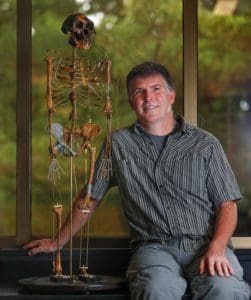
 In 2002 anthropologist Thomas Murphy, Ph.D. published the first peer reviewed academic journal article on DNA and the Book of Mormon, demonstrating that DNA evidence (at the time) did not support the Book of Mormon’s historical claims. Dr. Murphy was subsequently summoned to an LDS disciplinary council for apostasy, but the disciplinary council was “called off” at the last minute, and he has not been pursued since.
In this two-part podcast series, Dr. Murphy discusses:
- His early years in the LDS church.
- His loss of LDS belief as a young adult as a result of military service, demonstrated lack of inspiration on the part of his church leaders, and information he learned as an anthropologist working primarily amongst native Americans.
- His research and publication regarding DNA and the Book of Mormon.
- His work as an anthropologist in Latin America, including field work in Mexico and Guatemala.
To access Thomas’ academic writings on Mormonism, see here.
Episode Transcript
Host: John Dehlin · Guest: Thomas Murphy
This transcript is machine-generated and lightly edited for readability. The audio is authoritative. Please excuse occasional errors in names and spelling.
Introduction and Welcome
Part 1 of 2 · Ep. 638
John Dehlin [00:00:13] Hello, everyone, and welcome to Mormon Stories Podcast. My name is John Dehlin. The date Today is Wednesday, June 8, 2016. I look a little bit different. If you're watching through YouTube, I look a little bit different because I've got my hat on and my headset. We're recording this live in my basement in North Logan. And we're super excited today to have with us someone who I've wanted to interview for at least 14 years. I guess that's not totally true because I didn't have a podcast 14 years ago. Didn't know I'd be interviewing people. But I can say that Thomas Murphy, Dr. Thomas Murphy, was someone who was a really important part of my early journey, sort of to begin questioning and processing LDS truth claims.
John Dehlin [00:01:05] So let me just give you a bit of an introduction to get you really excited about this interview. I'm guessing it's going to be two, two hours, three hours. We've got a lot to cover. Dr. Murphy has a PhD in anthropology from the University of Washington and he is a professor. He's the chair of the Department of Anthropology at Edmonds Community College in Lynwood, Washing, where we're going to talk about all this in depth. But where I learned about Thomas Murphy was along with Simon Southerton in the early 2000s.
John Dehlin [00:01:41] I believe that Mike Thomas was probably, along with Simon, the first to publish about DNA and the Book of Mormon and to begin questioning the possibility that, that what we consider to be Native Americans are in fact descendants of Hebrews or Israelites that traveled to America in 1600 BC.
John Dehlin [00:02:07] So he published what I think was the first peer reviewed journal article about DNA in the Book of Mormon, and it landed him on the hot seat such that he was actually called to a disciplinary court, I believe, in 2002.
John Dehlin [00:02:21] But what was strange about that was that because the press was notified and I believe they even showed up at the parking lot of the church headquarters of the Stake center. The disciplinary council was called off. And to this day, I don't believe he has faced church discipline, even though he no longer believes and has held to his claim that the Book of Mormon isn't historical and all that stuff. But what I've learned is that there's a lot more to his story and even back then there was a lot more that he was trying to do than validate or invalidate LDS Church truth claims. His specialty is in, let's just say, I'll say, Native American anthropology and he's gonna have a chance to correct everything that I say or missay.
John Dehlin [00:03:11] In this introduction. But he has a real focus on what he calls decolonization. And basically we're gonna get into what that means, but it's all about how, you know, Western Europeans came to the United States and colonized the Native Americans in ways that were horrific and abusive and how that legacy of colonization lives to this day and how if we're ever going to find healing and peace and a constructive way to move forward, not just in America, but in the LDS Church and even in Mormon studies, we need to go through the process of decolonization ourselves.
John Dehlin [00:03:53] He has a lot to say about all of these topics, about racism within the church. He's done a lot of great work on racism and ways that we can move forward in a more healthy manner. And so I'm just very delighted to have Dr. Thomas Murphy here with us today on Mormon Stories. I'm super excited. So I'm going to actually turn the camera around now and I'm going to point it back at Thomas Murphy. Dr. Thomas Murphy, how are you doing, brother?
Thomas Murphy [00:04:25] I'm doing very well, thank you.
John Dehlin [00:04:27] All right, well, it's a pleasure to have you with us today on Mormon Stories. Thanks for joining us.
Thomas Murphy [00:04:34] It's an honor. You know, it's kind of neat to be back in Logan. I was here 30 years ago as a student at Utah State.
John Dehlin [00:04:43] Oh, wow. Sir Nagi.
Thomas Murphy [00:04:45] I went for two quarters and then I dropped out of college. But, you know, and then I went back later.
John Dehlin [00:04:50] And where'd you do your undergrad?
Thomas Murphy [00:04:51] I. After Utah State, I eventually returned to school at the University of Iowa.
John Dehlin [00:04:56] Okay, so I was your undergrad. Washington was grad school.
Thomas Murphy [00:04:59] Correct.
John Dehlin [00:05:00] Okay. All right, well, we have a. I'm gonna try and I'm gonna try and make what very well could be a six hour John Dehlin Mormon Stories interview into like, let's just say a two to two and a half hour interview. So I'm going to be a little bit more concise. Is that all right?
Thomas Murphy [00:05:15] That's all right with me.
Thomas Murphy's Mormon Upbringing in Idaho
John Dehlin [00:05:16] Okay, so tell us just a bit about your. Your Mormon upbringing prior to kind of grad school.
Thomas Murphy [00:05:24] Okay. Well, I was actually born in Los Angeles, California, and my family was from Idaho, from Southern Idaho. And my father had moved, taken a job in Southern California to work for this new company called IBM. And his goal was to make enough money to return to Idaho and buy a farm.
Thomas Murphy [00:05:49] And he achieved that within a couple of years of my birth. And we returned to Idaho, which is where my memories start. So I grew up in Southern Idaho. The early years Spent on a farm, and that was near Burleigh and Paul area.
Thomas Murphy [00:06:09] And I don't have a lot of early memories of church. And I think sometimes we were maybe a little bit semi active at the time. I remember more water skiing on Sundays and stuff like that. But after my parents got divorced and I was seven years old, we moved first into to Paul and Rupert and eventually ended up in Burley.
Thomas Murphy [00:06:35] And that's where my memories of the church really start. And my mother dived in quite, quite strongly. And eventually my stepfather was particularly. He was a convert and particularly devout and from a John Birch Society sort of framework, Cleon Skouson, that sort of approach to Mormonism.
Thomas Murphy [00:07:05] And he's the one who baptized me when I was 8 in Burley. And my, you know, early on I was. While we lived in Burley, I was actually probably a little bit more of a rebellious kid. And I remember running around Burleigh and doing things like stealing our dog out of the dog pound and, you know, things that later in life when I got really devout, I wouldn't. I would never have done. But I think the kids I was running around with and I just hadn't, you know, hadn't processed and thought a lot about church issues at the time. But we moved to Pocatello when I was around 10, and that's where I became really uber Mormon.
Thomas Murphy [00:07:52] And, you know, by the time I was entering priesthood, I was deacons quorum president, teacher's quorum president, even priest first assistant, I think that's what they called it. But about the time I was in the priests, you know, kind of my. It was really my sophomore and junior year of high school. I joined the high school debate team.
Thomas Murphy [00:08:23] And in the. In debate, you had to argue both sides of an issue for and against things. And this black and white world that I'd grown up in all of a sudden got really gray. And that's when I started questioning things when I was about 16, 17, and we moved to.
Thomas Murphy [00:08:46] To St. Anthony, Idaho, very close to my 17th birthday. And so right before I started my senior year of high school. And at that time, I was very. Well, I didn't want. As a rebellious teenager, I didn't want to be that involved with the church. Actually, I should say there was a really turning point for me that I should mention that happened in Pocatello. My seminary teacher assaulted a student in
John Dehlin [00:09:20] class, like, beat him up, kicked him. Whoa.
Thomas Murphy [00:09:26] And that really felt to me like that was inappropriate behavior from a seminary teacher.
John Dehlin [00:09:33] Yeah.
Thomas Murphy [00:09:36] And, you know, I came home and talked to my mom about it. And she was actually good friends with the seminary teacher who was in our ward and defended him. And I said, well, I'm not going to go to seminary anymore until he's gone.
Thomas Murphy [00:09:52] And so I stopped going to seminary and I stopped going to church, too. And when we moved to St Anthony, under pressure from my mother, I agreed that I would start going back to church, but I wouldn't do seminary.
Thomas Murphy [00:10:10] And so in St. Anthony, I did attend church, at least for about the first half of my senior year. But pretty soon I was working on Sundays by that time and working at McDonald's in Rexburg. And so that became my excuse for not going to church.
Thomas Murphy [00:10:35] But in Rexburg, I. I met this Rick's college student that was what's now byu, Idaho, and her name was Carrie Sumner. And we got started dating and actually ended up in a situation with the church that pushed us even further away and that it was a. We both were working at McDonald's in Rexburg. And anybody that's lived in that area knows that every now and then you get these big snowstorms.
Thomas Murphy [00:11:14] And we had this very large snowstorm and there were, you know, several feet of snow drifts on the roads for me to get home. I lived in the egin area by St. Anthony, and it was a few miles away from Rexburg to get home, and all the roads were closed. And we got off work around midnight and my brother and I and Carrie and we.
Thomas Murphy [00:11:40] I often took Carrie home to her apartment. And so the roads were clear enough in town we could get her home. But my brother Greg and I had nowhere to go. And she's like, well, you could stay in our apartment, which was, of course, Brooks College approved housing.
Thomas Murphy [00:11:58] And so we spent the night in that apartment. You know that at that point in our relationship, we didn't, you know, we weren't sexually involved or anything like that. And yet I did spend the night in her apartment. And that would lead to accusations by her roommates that led to an Honors Honor code investigation. And that's of course, in the news today. So, yeah, these honor code things. And there's a good example of where honor code enforcement becomes a real problem.
Thomas Murphy [00:12:37] And so Carrie was called in by her bishop and interviewed about these accusations that her roommates had placed in. The only true accusation was that I had spent the night in the apartment and so had my brother Greg.
Thomas Murphy [00:12:50] The rest of the accusations got pretty wild about all this drinking and drugs and sex and just stuff that just wasn't true, that her roommates had imagined that we were doing. And because the bishop had heard these stories from the roommates, he told Carrie that the spirit had told him that they were true and that he had this spiritual confirmation that she was lying, but she was telling the truth.
Thomas Murphy [00:13:20] For her and for me, because it impacted me as well. That really added to the doubts that we already, at least I already was having about the church. And for her, I think it was a big impetus for more doubt about the church because, you know, she was an active attending Mormon at the time, and I was a little bit rebellious. But for her, that was a key turning point because she knew the bishop didn't have an inspiration. Whatever he thought was inspiration wasn't God speaking, or at least God didn't know what was going on.
Thomas Murphy [00:13:56] And so she would end up initially being suspended. And her dad, who worked for the church, the ces, Church education system, I was very upset about the mistreatment that she had had at Rick's and actually came to Rick's and confronted the people involved and got her suspension suspended, or I mean, her suspension withheld, I think, is the technical term they used.
Thomas Murphy [00:14:28] But she'd already missed three weeks of class by that point and ended up being a scar on her academic career and would make it difficult for her to later get back in college. But, you know, we were just dating at the time. But I think that going through that experience really brought us together as a couple because we felt the injustice of it. And, you know, if somebody were to
John Dehlin [00:14:55] try and dismiss that as, oh, my gosh, well, you were just offended and that's why you left, how would you respond? Was it more than just being offended for you?
Thomas Murphy [00:15:05] It was more that. Yeah, in the sense that certainly we were offended, but that wasn't the primary issue. The primary issue was that question of credibility. If the bishop, the person that we thought the way we had been raised, was that he had some sort of direct line to God, this line of inspiration that it was clear that that was not what it was claimed to be. So it was a truth claim that we wrestled with. But even then, we didn't completely walk away from the church at that time. That wouldn't come for several years later. But what we did do at that time was I didn't want to serve a mission. And so our rebellious act is we got married.
John Dehlin [00:15:56] So you didn't serve a mission?
Thomas Murphy [00:15:58] Yeah, so I got married. I was right out of high school, and I had had a scholarship to come to Utah State. And so we got married right before I moved to Logan and began my freshman year of college.
Marriage, Identity, and Early Spiritual Tensions
Thomas Murphy [00:16:14] And that was a way to. You don't think of marriage normally as a rebellious act, but for us it was. And you know, it was a way to say, well you can't tell me that I need to go on a mission now.
Thomas Murphy [00:16:29] And you know, at Utah State I didn't enroll in the institute or anything like that, but we did occasionally attend in our ward, but we didn't feel particularly welcome but we'd go on occasion and you know, again we had doubts but we were still very Mormon and saw ourselves as Mormon and you know, we spent almost a year here before Kerry. In that first year of our marriage, Carrie got pregnant and we decided that we would move to Iowa, where she was from because before she got pregnant I had signed up for the, the Army Reserve and I'd been scheduled for basic training and AIT or the advanced individual training during the summer between what would have been my freshman and sophomore year.
Thomas Murphy [00:17:29] But that would have left Carrie home alone to take care of a brand new baby. So we decided we would move back to Iowa where she could stay at her parents home and have some support. Actually, initially I tried to get out of the bag basic training and I just couldn't. I'd already signed the contract and the army was not negotiable.
Thomas Murphy [00:17:50] And so we ended up in Davenport, Iowa where she was from and she moved back staying with her parents and I was there temporarily and then I went to training and then after my training we lived with our parents for a little while.
John Dehlin [00:18:06] So what did you study in your undergrad at Iowa?
Thomas Murphy [00:18:08] Well, I didn't go back to school immediately. We started businesses and we got involved in marketing. Kerry was a great artist and we did some marketing and graphic design, some merchandising work and worked in the restaurant business and did some consulting. But our business career didn't go a long ways and we ended up getting involved with a con artist basically is the best way to describe it. And unknowingly assisted him in conning a lot of people.
John Dehlin [00:18:48] What was the con?
Thomas Murphy [00:18:50] It was businesses buying and selling of real estate and businesses buying a lot of things on credit and then selling them without paying off the credit and.
John Dehlin [00:19:04] And then going bankrupt.
Thomas Murphy [00:19:05] Yeah.
John Dehlin [00:19:05] And going pocketing the difference.
Thomas Murphy [00:19:09] Yeah. And you know, and he used me for a lot of the handling of the cash which, you know, I was a naive young person who, you know, still believed the world was a great and friendly place. But having.
John Dehlin [00:19:29] How did it feel to be used as part of a conversation?
Thomas Murphy [00:19:32] Rather disconcerting Yeah. I mean, that really. And I think that would later contribute to my doubts about the church is because I saw myself very easily taken in. And with, you know, a little bit of patting on the back and encouragement, I, you know, fell right into what should have been, in retrospect, an obvious facade. And, you know, I can look back and see. I even remember other people in the. That were working for us figuring it out before I did and telling me, and I wouldn't believe them. And I ended up in their positions. I became vice president of these companies, and, you know, that was kind of cool.
Thomas Murphy [00:20:16] I was like, what, 18, 19 years old, and I was vice president of several companies, you know, and so, you know, it felt really cool. Until he ends up, he disappears, and I'm left to file bankruptcy for the companies.
Thomas Murphy [00:20:36] And that's when it really dawned on me, actually, when there were investigators that were hired by, I think it was Bank One, and they started investigating me because I'd handled all the cash. And at that time, we were active in the church, and I actually had gone to an attorney that was in our stake and, you know, said, look, I'm being investigated. And, you know, I don't know what's going on. You know, I talked it all through him, and he's the one who explained to me that, you know, nearly everything that he did was legal.
Thomas Murphy [00:21:15] The only thing he could say that was illegal was using a fake name. And we're fairly certain he was using a fake name, but other than that, it was all legal. And so all this stuff that I had done that I was starting to worry about was all just business.
Thomas Murphy [00:21:32] And that kind of would raise questions for me, too, in terms of really, is it okay just to rob people and call that business?
John Dehlin [00:21:40] Could something be legal, but still unethical?
Thomas Murphy [00:21:42] Right. Yeah. Right. And so that was a relief, though, that I didn't have anything to worry about as far as potential prosecution and stuff. But that would have a big impact on the way I thought about the world. And so after that, business failed, and we were trying to figure, all right, what do we do now? That's when I decided I was going to go back to college. And so I applied for admission to the University of Iowa and the University of Illinois and decided on Iowa and the Hawkeyes.
John Dehlin [00:22:18] Yeah, Hawkeyes.
Thomas Murphy [00:22:19] Yeah. And so at the University of Iowa, I was initially. Was I initially, I think, a botany and political science major. And at Utah State, I'd been in economics and political science. I wanted to be a lawyer. At that point, I started to get this science interest. I think at that time, that's why I kind of combined those two.
Thomas Murphy [00:22:49] That didn't last particularly long. I would eventually, after jumping around with a few different majors, I was pre med for a while. I was pre med and pre law actually. And those aren't exactly majors you still have to choose a major in, in addition.
Thomas Murphy [00:23:06] And I had chosen, well, I should say, while I was pre med and pre law, my National Guard unit got activated for the Persian Gulf War. So this was in 1990. Yeah, 1990. And so in the middle of my semester, I. I get activated and I've got to withdraw from my classes.
Thomas Murphy [00:23:34] And so I go, well, not necessarily withdraw, but at least go talk to my professors because we were more than two thirds of the way through the quarter. So I went and talked to all my professors and they were very generous in just giving me the. Most of them just gave me the grade at the point that I was at. And a few had me do a couple of additional assignments that I could quickly get done.
Thomas Murphy [00:23:56] And my anthropology professor, his name was Mack Marshall, is the only professor who asked me what I thought about being deployed for the war. And I remember telling him that I don't really want to give my life for the price of oil. And that's what I felt like I was being asked to do.
Thomas Murphy [00:24:16] And he gave me some sage advice. He said, you know, anthropologists often find themselves in situations where they don't necessarily agree with what's happening around them, but you can be a participant observer using a little bit of cultural relativism, and you have an incredible opportunity to study human behavior in war.
Thomas Murphy [00:24:38] And so following his advice, I approached it as a research project. And so the study A Soldier's Perspective on the Persian Gulf War became my honors thesis in anthropology at the University of Iowa. So by the time that I was returning to school, I had completely changed my mindset about where I wanted to go with my career.
Thomas Murphy [00:25:11] I was pre med and pre law at that time because I was going to get rich as a lawyer. And if not as a lawyer, I was going to get rich as a doctor and. And I knew I was capable of both. But I started asking myself, well, the greed that I was seeing in the
John Dehlin [00:25:31] war,
Thomas Murphy [00:25:34] do I want that to be my signature in life? And when I had to put my life on the line, what am I willing to die for? And not for what I was being asked, Although I did go, but that's not what I. If I could choose what I would die for, that was not the choice I would make.
Discovering Anthropology and Questioning Bias
Thomas Murphy [00:25:59] And so I came back committed to trying to understand people and trying to build relationships between people and to undo the biases of class and race and gender and the major issues of the day, and to use anthropology as a means to do that.
Thomas Murphy [00:26:20] And so I became an anthropology major, and along the way I started taking a few religion classes. And I remember feeling. When we moved to Iowa City from Davenport, Carrie and I had decided to stop going to church.
Thomas Murphy [00:26:45] I should say that we had when we were in Davenport at the time we were running those businesses, we had gone through the temple and we'd gotten very active. But the temple had been a rather shocking experience for me, and so.
Thomas Murphy [00:27:04] And for Carrie. And so that would play a role in us wanting to stop going to church when we moved to Iowa City, away from where her parents were and her parents ward. But I guess I should talk about what happened in the temple.
Temple Experiences and Growing Doubts
Thomas Murphy [00:27:22] Our daughter Jessica was still nursing at the time. And so we had. We'd been. We did the endowment ceremony, and then we were going to do our sealing. And so Jessica had been in the nursery while we were in the endowment ceremony. And as we go.
John Dehlin [00:27:42] Just for yourselves or for.
Thomas Murphy [00:27:44] For ourselves?
John Dehlin [00:27:44] The dead for ourselves. So you weren't initially married in the temple?
Thomas Murphy [00:27:48] No.
John Dehlin [00:27:48] Okay, got it. Yeah.
Thomas Murphy [00:27:50] And so this was a decision later to get married in the temple. And so we. When we came into the sealing room, they brought Jessica from the nursery, and she was still nursing. And so the first thing she wanted to do when she saw her mother was eat.
Thomas Murphy [00:28:09] And they had no provision for that. And so she started crying, which is a normal reaction for a baby. And they asked Carrie to calm her down. And Carrie took her out in the hall and tried to calm her down. In retrospect, she wishes she had nursed her at that time, but she didn't. She was trying to just calm her down a little bit, bring her back in. So she gets her calm down, brings her back into the room, and immediately when she comes into the room and sees again all these people in white, and it's really bizarre and familiar.
Thomas Murphy [00:28:44] And she starts crying again. And the officiator told me that I needed to hold her down on the altar. And. My stepfather had been very abusive when I was a kid. And when Kerry and I had had child, we both experienced abuse at home. And we had decided we were never going to physically punish our child, that we were never going to use physical punishment.
Thomas Murphy [00:29:23] And that was a commitment we'd made to each other. So here we are in the temple, and I wasn't being asked to strike my child, but I was being asked to hold her down against her will. And I did it.
Thomas Murphy [00:29:46] And after the ceremony, the officiator said to me, said, you know, we don't normally expect people to do things like that in the church, but this is so important. And. I felt like I had violated her in that act of holding her down and that I'd violated myself in my commitment to me. I'd violated my commitment to my wife that we wouldn't do that.
John Dehlin [00:30:22] And.
Thomas Murphy [00:30:29] That really broke the straw of my belief. I just. I should add that there were the other things that there have been things that I'd read when I was in high school from the God Makers book about, you know, some of the temple ceremonies, and I thought they were all made up.
John Dehlin [00:30:50] And the God Maker accusations.
Thomas Murphy [00:30:52] Yeah, we're all made up.
John Dehlin [00:30:53] Yeah.
Thomas Murphy [00:30:54] And I also, going through the endowment, discovered that those blood oath covenants and stuff were not exactly fake. This was before they were taken out of the temple ceremony. So that add to that on the intellectual level, that deeply emotional experience of doing something that I believed was wrong and being asked to do that by the church and not only being asked, but doing it. And I couldn't. I just could not. If I was going to be in a situation where I would be abusing other people because I was being asked to and I would do that. I couldn't live with that. And I had to. It felt like to me that the best way to deal with that situation was to walk away from the church because then I wouldn't be asked to do the things that I thought were wrong. And so when we moved, this is
John Dehlin [00:32:03] just the storyteller in me wanting to connect dots a little bit. Was there any connection in your mind between having helped a fraudster defraud people, being complicit in the fraud? Do you think there was either subconscious or consciously any connection between that and then being a participant in sort of what you felt was a little bit abusive of your child? Did you even draw that connection? Yes, I did.
Thomas Murphy [00:32:30] And particularly during the war, because during the war I had a lot of time to think about that stuff.
John Dehlin [00:32:36] Did the temple stuff happen before the war?
Thomas Murphy [00:32:38] Before the war.
John Dehlin [00:32:38] Okay, got it, Got it. Yeah.
Thomas Murphy [00:32:40] And during the war, I had a lot of time to think about that and I had a lot of time to read. And actually, the book I was reading was the one I saw on your bookshelf, Khayyam Potok.
John Dehlin [00:32:52] Which one?
Thomas Murphy [00:32:53] Khayyam Potok's the Chosen, the Promise. My Name is Asher Lev. My name was Asher Lev, and I read that during the war, and that had a really profound impact on me. And so I had a lot of conversations with friends, and for a while we were positioned near a unit from Utah, and so I had a lot of conversations with Mormons. And so I was processing a lot of this stuff during the war. And that's where I really. You know, when you're asked to place everything on the line, that's when you really start to look inwardly and say, what is it that I really believe? And a lot of that I processed in letters back and forth with Kerry, and. I didn't believe in this whole image of a. Of a Mormon God, this anthropomorphic person. And I should say that another book that I'd read that was quite profound was Elie Wiesel's Night.
John Dehlin [00:34:15] Wait, what did you. What did you take from My Name is Asher Lev. And then tell us what you took from Night.
Thomas Murphy [00:34:22] From My Name is Asher Lev was. The challenge that the protagonist. And now it's been so many. Well, Asher Lev was his name, I guess, but I don't remember all the other characters.
John Dehlin [00:34:40] He's an artist.
Thomas Murphy [00:34:40] Yeah, I remember that. Yeah.
John Dehlin [00:34:42] Jewish Orthodox, Kor, Hasidic.
Thomas Murphy [00:34:46] I resonated with the Orthodox Jewish experience as being similar to my Mormon upbringing. And the kind of gradual, in his case, of starting to question the cultural norms that were associated with that and then having the courage to defy those norms that I admired that, and I resonated with that. And so that struck me very deeply. And then with Elie Wiesel's Night, and these had both been books that had been assigned in a class I was in. In the religion department before. Before the war. And I hadn't finished all of them before I got deployed, but I did continue to read them. And with Knight, that it's Elie Wiesel's account of being in the concentration camps in the Holocaust. Yeah. In World War II. And being abandoned by God. And I felt the same thing. I felt abandoned by God. I felt that God wasn't there when I needed him.
John Dehlin [00:35:58] When did you need him? In the story you've told us so far?
Thomas Murphy [00:36:02] I needed him in the Temple, that's for sure. What I saw was an abusive father. I didn't see. I didn't see Jesus Christ. That's not what I experienced in the Temple. Yeah.
John Dehlin [00:36:21] Is that what you mean?
Thomas Murphy [00:36:22] Yeah. I experienced an abusive father. That's what I experienced.
John Dehlin [00:36:26] Meaning the officiator who told you to be abusive.
Thomas Murphy [00:36:29] Yeah. And to me, that's not what Jesus represents, at least not what I read in the New Testament. That's not what I read in Third Nephi.
John Dehlin [00:36:41] But at the time, would it have occurred to you that people make mistakes and nobody's perfect and you know that, or was there something.
Thomas Murphy [00:36:49] Yeah, but. Yes, it did. But the thing is, at the places where the Spirit is supposed to be most present in a bishop's interview, in the temple, that's where the breakdown was happening. Those were the places that were supposed to be the exception. They were the places that were supposed
John Dehlin [00:37:07] to be most likely that God would be there, right?
Thomas Murphy [00:37:11] Yeah.
John Dehlin [00:37:11] And governing.
Thomas Murphy [00:37:12] Right. Yeah. And he wasn't. Or at least what was there wasn't what
John Dehlin [00:37:21] you thought.
Thomas Murphy [00:37:22] Yeah, I thought God ought to be. And even. Yeah, it wasn't what I expected the church to be and what I believed it ought to be. And so I was let down. But during the war, I made the decision that I was no longer going to be pre law, pre med. And I decided I was going to major in anthropology and I was going to work towards peace.
Thomas Murphy [00:37:53] And when I got back, I took a few more religion classes. And pretty soon I realized if I just took a couple more classes, I would have a religion major, too. And so when I graduated from the University of Iowa, I had a degree in anthropology and religion.
Thomas Murphy [00:38:09] And as part of that, I was a little bit of an overachiever. And I did the paper on the war was my honors thesis in anthropology. I did an honors thesis in religion on this group, a breakaway group from the Native American church, that combined peyoteism, the use of peyote, a hallucinogenic cactus, with the word of wisdom and Mormon beliefs.
Thomas Murphy [00:38:42] And I should say that in my anthropology classes, particularly a class on American Indians, and then doing some archaeological work on some native sites, sparked an interest in the stories that my grandmother had always told us as a kid of an Indian ancestor, an Indian princess is the term she would use, or a Lamanite ancestor, where often the term that was used.
Thomas Murphy [00:39:16] And so as I took these classes, I was like, well, I want to know more about this ancestor. And so when I was back home, I would ask my grandma all sorts of questions about it. And she told me, well, she thought she was Iroquois and, you know, few details that she thought that this story had been passed on by her.
Thomas Murphy [00:39:42] I guess it would have been her grandfather. And he talked about being about his grandmother who was native. And this was back before they moved to Idaho. They lived in Kansas in the late 19th century. And this Indian grandmother would not be allowed in the house and he would end up playing with her outside in the yard.
Mayan Studies and Native Ancestry Questions
Thomas Murphy [00:40:14] And it really troubled me to think that this native ancestor of mine would be treated that way by her own children and in laws. And so that became a question that was stewing. And so I started exploring more my own, the native side of my ancestry as well as the Mormon side of my ancestry. And that began in college.
Thomas Murphy [00:40:44] And one way that I did that was I started looking at where Native American and Mormon ideas came together. And I by chance ran across an article about these peyotists who'd gotten arrested in Texas. And they ran a church in Arizona that combined Mormonism with peyoteism.
John Dehlin [00:41:08] Around what year?
Thomas Murphy [00:41:10] Well, the year that they were arrested or the year, I don't remember exactly the year they were rested generally. I was doing. I was doing this research in about 92.
John Dehlin [00:41:19] No, when was this nativist church doing its thing?
Thomas Murphy [00:41:23] Oh, they are still around.
John Dehlin [00:41:25] No, but when was this getting arrested and when was it forming?
Thomas Murphy [00:41:29] In the 80s.
John Dehlin [00:41:29] Okay, okay, 1980s.
Thomas Murphy [00:41:31] Yeah, okay. And. And well, they had. There's a quite a bit longer history of the connection between peyotism and Mormonism. I would discover, you know, Joseph Smith's grandson, who would eventually become the president of the rlds. RLDS had did a dissertation in sociology on peyotism and had used it quite a bit as part of understanding his prophetic callings.
Thomas Murphy [00:41:57] So there's this whole fascinating combination between Mormonism and peyoteism. And so that became my honors thesis in anthropology, I mean, excuse me, in religion. And two honors thesis weren't enough for me, so I did a third one. It wasn't a honors thesis per se, but I applied for a research grant, an undergraduate research grant to go to Guatemala.
Thomas Murphy [00:42:23] And the grant was for health related research. And because I'd gotten involved with this intriguing interpretations of the word of wisdom in Arizona, I proposed to look at how is the word of Wisdom? How does the word of wisdom change Mayan practices when Mayan people convert to Mormonism? That was my research question.
Thomas Murphy [00:42:53] And so that research was funded and I went to Antigua, Guatemala. And this would have been the summer of 1993 or 92 maybe? Yeah, 92, yeah. And I brought my daughter along and my wife and my mother in law for part of the time and did language study. I think I went there first and they came later, but did language study and then got even though by this time I was a non believer. I did attend church for research purposes and So I was attending this ward that lacked Melchizedek priesthood holders. And very quickly they were like grabbing onto me and like, you know, we need you to do this, we need you to help pass the sacrament and all this.
Thomas Murphy [00:43:47] And I didn't own a white shirt purposefully. And so I remember the bishop lending me a white shirt so I could bless the sacrament. So I was involved pretty heavily in the ward there and conducted this research. And I very purposely in that research, did something that is not often done in Mormon studies.
Thomas Murphy [00:44:10] And I made sure that I included inactive people because, remember, I was inactive at home. And I really felt that if you really want to understand Mormonism, you need to go beyond the people that go to church. And, you know, this peyote group in Arizona were not traditional Mormons. So I was always interested in that non traditional Mormon experience. So in my interviews, I interviewed nearly as many inactive members as I did active members.
Thomas Murphy [00:44:36] And so I had a pretty great data set in that regard. I ended up flipping the research question at the recommendation of my advisor. Nora England was her name's great Mayanist. And she pointed out as we were going through the data in my first practice presentation of it, that the more interesting question was not how did Mormonism change Mayans, but how did Mayans change Mormonism?
Thomas Murphy [00:45:12] What the data showed is that the interpretations of the world word of wisdom that they did that extended beyond the usual things like coffee and tea followed the traditional Mayan concepts of hot and cold medicine. And so the extra things like chili peppers and chocolate, and those were things that they added to the word of wisdom, if you will, in their interpretations. Those followed a logic, a Mayan logic, rather than a North American Anglo logic. And so that ended up being the flipped research question. And I would eventually, in graduate school, publish that research in the Journal for the Scientific Study of Religion.
Thomas Murphy [00:46:08] And I actually published all of the. Well, no, I guess I didn't. Well, yes, I did. I published all of those theses. The one on the war would be published. I won an award from the Elie Wiesel foundation for the essay I wrote about the war and that would be published by Elie Wiesel in an anthology of award winners.
Thomas Murphy [00:46:31] And I published the peyote. Work on peyote was published by the Piayoti Way Church of God themselves and in their. What they called the sacred record. And the work in Guatemala actually produced a couple of different articles. The one for the Journal of Scientific Study of Religion that was on the medicine, but I also published another one that was on Identity issues. And that wasn't an original research question, but it became really a fascinating question for me. And everywhere I'd go in Guatemala, that I introduced myself to Mormons as an anthropologist. The question was, have you read the Popol Vuh? And before that time, I'd never heard of the Popol Vuh.
Thomas Murphy [00:47:16] And the language school I was attending, they had a viewing of an animated version of the Popol Vu by Patricia Amlin. And so I went and watched that and I'm like, what does this have to do with Mormonism? It is pretty bizarre.
Thomas Murphy [00:47:36] And so I was. I added to my research or to my interview questions, questions about the Popol Vuh, because that was the question everybody was asking me about. And what I found that was quite astounding is that these Mayan and Ladino. Ladino are people that they're Mayan in heritage, but they've adopted culturally the dominant mainstream Spanish culture and identify perhaps more with that than their Mayan heritage. But in Mayan and Ladino members of the church, they're applying the Popol Vu alongside the Book of Mormon and seeing it as, in some cases, equivalent to the Book of Mormon. And that was like, wow, this is kind of interesting.
Native American Mormons and the Third Convention
Thomas Murphy [00:48:25] And the other thing that came up in priesthood meetings was one particularly outspoken person who'd lived in the United States for a while, you'd call him probably a Ladino because of his culture. That's the culture. He was more practicing. But he would emphasize that Lamanites and he self identified as a Lamanite, were born into the Covenant of Abraham, where Anglos, and he saw me simply as an Anglo, were adopted into the Covenant, and that Lamanites were destined to be the leaders of the church in the last days.
Thomas Murphy [00:49:17] And that Anglos would be eventually, that they would give up the leadership of the church and that that was prophesied in the Book of Mormon. And they could show me the passages.
John Dehlin [00:49:32] Wow. They were paying attention when they were reading.
Thomas Murphy [00:49:34] Yeah. And so that was like, whoa, this is pretty interesting stuff. And I'd been reading while I was in Guatemala, Lamond Tulis's book, Mormons in Mexico, and had.
John Dehlin [00:49:45] Is it tullus or tullis?
Thomas Murphy [00:49:47] Not sure how you pronounce it.
John Dehlin [00:49:48] Okay. He was my professor. I thought it was Tullus. Tullus. I'm just making sure it's the same.
Thomas Murphy [00:49:53] Yeah, yeah. The same guy at byu. Yeah, yeah. And it was a great book. And he talked about this schism in Mexico in the 1930s called the Third Convention. And I was like, wow, here are parallels to this in the 1990s in Guatemala. And so I wrote an article about that for Dialogue.
John Dehlin [00:50:15] What was the Third Convention?
Thomas Murphy [00:50:17] The third Convention was a group of Mexican Mormons who, about a third of the Mexican Mormons broke away from the LDS Church in the 1930s in response
John Dehlin [00:50:34] to
Thomas Murphy [00:50:36] the church's kind of avoidance, if you will, of the, at least the spirit of the law, which the anti clerical legislation that had been passed in Mexico after the revolution had said that clergy needed to come from within, from within Mexico. They couldn't be brought from the outside. And the church had gotten around that rule by bringing Anglos from the colonies in Chihuahua and Sonora down as mission president in the Mexico City area. And the Mexican members felt like that was, if not a violation of the letter of the law, certainly of the spirit of the law. And so they had petitioned in their first and second convention to the first Presidency to reconsider the appointment of the mission president. And when that wouldn't be reconsidered, they withdrew from the church and started their own wars.
John Dehlin [00:51:42] Wow, Mormon wars.
Thomas Murphy [00:51:43] Yeah. Parallel ran their own parallel church and they ran their own parallel church for a decade. And that would become a research topic of mine later.
John Dehlin [00:51:55] Did they end up reintegrating or just dying out?
Thomas Murphy [00:52:01] Well, I'll tell you how I got to answer that question. I end up applying for graduate school, go to the University of Washington. And while in graduate school at the University of Washington, my purpose was to, or my proposal, my research proposal for graduate school was to investigate Mormon and native relations. I really wanted to know why my grand, my, why my native ancestors had joined the church. But I didn't know how to, how to do that research. I couldn't figure out a methodology to do that research.
Thomas Murphy [00:52:38] So like a typical anthropologist, although now I sometimes think it was a rather naive approach, but it's not entirely wrong. It turned out to be informative. But the idea was, well, if I studied contemporary Native American Mormons, I could better understand why somebody would convert to a church that taught that dark skin was a curse from God.
Thomas Murphy [00:52:58] And so I thought, well, if I look at contemporary Native American Mormons, I'd have better understand my own answer. And that I think as a research, because there's some problems with it from an intellectual level, but that was a very common way for anthropologists to approach these questions.
Thomas Murphy [00:53:16] I started focusing on contemporary Native American Mormons. And so while I was at the University of Washington, I was offered a research assistant position in Southern Mexico in the state of Oaxaca. And it was for a Zapotec ethnobiology research project.
Thomas Murphy [00:53:35] And while I was there, I was curious about what had happened with the third convention, because what Tolus. Is that right? Tolus had said in his book was that after about 10 years in a negotiation, kind of a.
Thomas Murphy [00:53:57] A new mission president that was a little more tolerant and with mediation by the president of the church, brought most of the schismatic group, the third convention, back into the fold. But that there were a couple of groups that. Or some that had stayed out. And according to Tullus, sorry, what. They had kind of fizzled out.
Thomas Murphy [00:54:24] But a big character in this was a man by the name of Margarito Bautista. And so what I did when I had a break on my research project in Oaxaca is I jumped on a train and I went to Osumba, Mexico, and I got a hotel stay for a few days. And I started looking for relatives of Margarita Bautista. And so I first asked the hotel owner and if he'd heard of Margarita Bautista, if he knew of it. And he's like, no, no, there are Bautistas, a lot of Bautistas.
Thomas Murphy [00:55:06] And I said, well, he was Mormon. He said, oh, yeah, we got some of those. We got some Mormons over here. And he said, they're over in this colonia nearby. He actually gave me the wrong name of the colony, but it got me close.
Thomas Murphy [00:55:22] And so I just walked down the street, it was a couple mile walk and ended up in this colonia. And I found the first store and started asking them if they'd heard of Margarita Bautista. And again, it's like, no, there are some Bautistas, kind of that sort of thing. And I said, well, how about Mormons? And they said, oh, yeah, the Mormons, they live over there.
Thomas Murphy [00:55:45] And so I followed their directions and I walked into this really. It was like. I guess the thing that struck me the most is how clean the community was. There were kids sweeping the streets. It was very immaculate. And it was also economically, there was definitely an economic.
Thomas Murphy [00:56:10] There were more cars, there were nicer houses. There was an economic difference between this community and the community surrounding it. And those kind of things struck me right away. It's like, oh, wow, this is different. And so I saw the kids sweeping the street. So I asked them if they knew of any relatives of Margarita Batista.
Thomas Murphy [00:56:31] And they said, wait a minute. And they went and got a woman, and she came over and I asked her the same question. And she says, hang on, the bishop's not in town, but let me go see if this counselor can talk to you. And so she took me to the home of the first counselor in the bishopric.
Thomas Murphy [00:57:00] And I introduced myself to him. And initially, I think there was a little bit of suspicion, but I had a copy of Margarito Bautista's book with me, and I knew a little bit about their history, and I knew enough that they saw me as a credible researcher. And from what I understand, I'm the only outside researcher that ever got let into this community.
John Dehlin [00:57:30] This is reminding me of Colorado City and the LDS Church for some reason.
Thomas Murphy [00:57:34] Yeah, well, they're not associated with.
John Dehlin [00:57:36] No, no, no.
Thomas Murphy [00:57:36] I'm just saying they are associated with the Allred group.
John Dehlin [00:57:41] So they were polygamists.
Thomas Murphy [00:57:42] Yeah. They were polygamous. Yeah.
John Dehlin [00:57:43] And united order.
Thomas Murphy [00:57:44] Yeah.
John Dehlin [00:57:45] And I read that in your article.
Thomas Murphy [00:57:47] Yeah, they were polygamous in the united order. So plural marriages, they called it, you know.
John Dehlin [00:57:51] But were they ethnically Mexican?
Thomas Murphy [00:57:53] Entirely.
John Dehlin [00:57:54] Okay. Wow. Yeah.
Thomas Murphy [00:57:56] And so this.
John Dehlin [00:57:57] Have you talked to Lindsay park about this yet?
Thomas Murphy [00:58:00] This. No, I haven't talked to her about this story.
John Dehlin [00:58:02] You got to get on your polygamy and tell her the story.
Thomas Murphy [00:58:04] Yeah. And we. I established my credibility by knowing a little bit about their history and having Margarita's book there. And so they agreed to some interviews. And I interviewed the first counselor, and I think the other one was the bishop.
John Dehlin [00:58:24] Did you record it? Audio?
Thomas Murphy [00:58:26] Yeah, they recorded.
John Dehlin [00:58:27] You still got it?
Thomas Murphy [00:58:28] Yes, yes, I do. Yeah.
John Dehlin [00:58:30] Okay, cool.
Thomas Murphy [00:58:31] Yeah, they're, like, on those old cassette tapes.
John Dehlin [00:58:33] That's awesome.
Thomas Murphy [00:58:33] And they were some of my first ethnographic interviews. And I had this thing on my tape recorder where it would have a time saver. It saved tape because I was worried I wouldn't have enough tape. So it cut off the first and last words of every question. It was really great learning experience as an ethnographer. But anyway, I did get the interviews, and I kept notes as well, so it wouldn't make a good transcript or audio to share. But it was fascinating to hear their story, and I would later come back in the summer. So that was in 1996.
John Dehlin [00:59:15] And how was Tullis wrong?
Thomas Murphy [00:59:17] Well, he was wrong in that he thought the group had fizzled out. And here they said they had about 700 members in this community, and they had more in other parts of Mexico. They had quite a few in Arizona and some in Utah. And they had some members that were, like, in graduate school.
John Dehlin [00:59:41] I wonder how they got affiliated with the Allred group.
Thomas Murphy [00:59:47] It was partly through the lebarons, which is a whole other story as well. And Margarita Bautista had been. He'd been in the colonies, and he'd lived in Utah, and So he'd had those social connections. And so anyway, here's this thriving Mexican version of Mormonism that very few people knew about outside of their own group.
Thomas Murphy [01:00:23] And so I did get a few interviews. I would later return a couple of times and do some more interviews. And unfortunately, in that case, my video camera that I did a lot of video recording with got stolen on my return trip from the airport. So I lost a lot of the footage. But I was able to incorporate that research, and that would become part of my doctoral dissertation, which was on my doctoral dissertation is called Imagining Lamanites, Native Americans and the Book of Mormon.
Thomas Murphy [01:01:02] And it really, the goal of it was to say kind of two questions. One question is, how have Mormons imagined Lamanites? Where does this ethnonym Lamanite come from? How is it related to cultural ideas at the time of Joseph Smith?
Thomas Murphy [01:01:22] And then how does it get expressed in Mormonism, first by white Mormons, but then most importantly, by native Mormons? And not just native Mormons, but what did Native Americans have to say about this? And again, my personal goal is I wanted to understand why my ancestors would have joined a church that seemed to me to be rather explicitly racist. I wanted to understand in their terms, in the terms of contemporary native Mormons, what appealed to them about the church or what didn't.
Thomas Murphy [01:02:12] And that's where it really. Well, part of it became a significant portion became about Margarita Batista and about another. So he was Nahua, and about another Nahua scholar who would eventually become a stake president and temple president, and I think a mission president as well, and some of their differing views about how.
Thomas Murphy [01:02:42] How to tell the story of being Mexican and being Mormon. And I wrote an article that's in the Journal of Mormon Histories called Other Mormon Histories, and that's by far my favorite article that's in press right now. I have some ones coming out that I think I'm more excited about. But that article really looked at the question of how in new Mormon history can we do justice to the stories of Nahua Mormons?
Thomas Murphy [01:03:13] And there's some fundamental problems with the way we tell history. And even our best historiography today slights and misrepresents and does damage to their stories. And so how do I, as a academic scholar, tell their stories in a way that's both accurate and represents their story?
Thomas Murphy [01:03:47] And so the article is about the dilemma. There's no resolution that I offer. It's just the dilemma, how do we do this? And so I title other Mormon histories. These are ones that don't fit in our regular narratives. And that whether it's the narratives of the church or the narratives of academia. And that is a chapter in my dissertation and would be a journal article and kind of a big centerpiece of it.
John Dehlin [01:04:13] So we're at about an hour for this first segment. I want to talk about. I want to get to the discussion about DNA and your disciplinary council as a springboard into the more important stuff that I know you really feel passionately about. But to close out this segment, is there anything else you need to tell us just in terms of the narrative to get us to the point where next segment we start talking about that just briefly?
Thomas Murphy [01:04:44] Yeah, I think the timing is about right to make that move. Yeah. So.
PhD Research on Native Americans and Mormonism
John Dehlin [01:04:52] So by the time you're graduating with your PhD, you had been focusing on understanding, trying to understand why a Native American in the 19th century would join the church. And you were doing that by, by studying Native American Mormons in the 20th century. And that took you to Mexico and Guatemala and understanding not only the ways that the church, not only the things that the church had done there and the way that the church was experienced there, but the way that the natives had influenced the church back. And then that led also to trying to understand better how the church thought of Native Americans, how Native American Mormons, how Native American Mormons thought about themselves and matters of identity. Is it related sort of bidirectionally? Is that.
Thomas Murphy [01:05:47] That's a very good summary. And yeah, and that was the primary interest of what I was doing up until actually through the first draft of my dissertation. And the first draft of my dissertation had a big section on the Popol Vuh and the use of the Popol Vuh by Mormons and also an ethnographic or ethnohist historical component in the United States of the uses of Black Elk Speaks by Native Mormons. And particularly the idea of using the Popol Vuh and Black Elk Speaks as other Bibles, other scriptures.
Thomas Murphy [01:06:24] Actually, my committee asked me to pull out the work on the Popol Vuh and Black Hawk Speaks and elaborate instead on the work I was doing with Nahua Mormons and the ethno historical look at the church in general of its treatment of Native Americans, because I covered it from before the founding of the church through the present. And they wanted that to be more the focus. That's a good point to pause.
John Dehlin [01:06:55] So in the next segment, what we're going to go to, just to give our listeners a summary, we're going to go to your work in Mormon in Native American DNA the article you published, the how that led to your disciplinary council, what happened there, and then your disappointment in the emphasis on truth claims at the expense of a broader discussion about colonialization. And that can be a platform into talking about the decolonization of Mormonism, of Mormon studies, and of maybe the Mormon Internet as well. How's that sound?
Thomas Murphy [01:07:37] That sounds good.
John Dehlin [01:07:38] All right, listeners, please join us on Mormon Stories if you have comments or questions. And stay tuned for part two of my interview with Dr. Thomas Murphy. Thanks, Dr. Murphy.
Thomas Murphy [01:07:50] You're welcome.
John Dehlin [01:07:51] See you in a second.
Thomas Murphy [01:07:53] It.
Part Two Introduction and Dissertation Overview
Part 2 of 2 · Ep. 639
John Dehlin [00:00:14] Hello Mormon Stories listeners, and welcome Back to part two of my interview with Dr. Thomas Murphy. In part one, we have discussed his early years in the church, his some challenges he faced around abuse of authority and lack of inspiration with leadership that led to he and his wife kind of separating from the church. We learned about his interest in anthropology and his military service that led to his budding career in studying Native American anthropology amongst Mormons in Mexico and Guatemala. And we've learned about some of the research papers that he, he wrote early on on some of these topics. And now we're going to jump to the part that intersects with my personal life, which is his work around publishing a paper on DNA in the Book of Mormon.
John Dehlin [00:01:07] So we've got a lot to cover. We've got about two hours to go. This will be segment two of three. And we want to just be really careful about getting the narrative in getting whatever details important to get the story across but, but not taking, you know, leaving time for the, the rich content that comes after this part of the story. So we'll, we'll balance that together. But so talk about, you know, you, you publish your district, you finish your dissertation, you graduate or whatever. Take us to, through your interest in DNA and the Book of Mormon, the publishing of the article and what happened after.
Thomas Murphy [00:01:43] Okay, well, we got a little bit of that out of order there, so I'll kind of. So yeah, yeah. My first version of the first draft of the dissertation I had, it was a pretty sketchy draft, but I'd given it to my committee and they had redirected me away from looking at the Popol Vu and Black Hawk Speaks as additional forms of American Scripture. And really, you know, that original version would have been called something like blank pages and scriptural tombs and looking at the making of Scripture.
Thomas Murphy [00:02:20] And instead they directed me more towards deeper engagement with the Nahua material that I had gathered in my research and the ethno historical material that I had gathered about Mormons and Native Americans in the United States. And so after that first version there, like make these changes.
Thomas Murphy [00:02:45] I was on the job market already and I was expecting to finish. And of course dissertation committees have this history of kind of making you stop and restart. That happened while I was on the job market and I got a full time job and I was offered a job at Edmonds Community College, which was nearby. It was really great for my family. My daughter was able to stay in the same high school and, and Carrie could continue her job and we didn't have to have that disruption to family. So it was very convenient.
Thomas Murphy [00:03:18] And I actually went on leave while I started my teaching. And it was actually through teaching that I would start to get involved a little more with biological anthropology and eventually with DNA. And so one of my teaching assignments right away in a community college was to teach across the four fields of anthropology. So anthropology has biological biological anthropology, linguistic anthropology, cultural anthropology, and archaeology.
Thomas Murphy [00:03:46] And so I was very quickly assigned to teach biological anthropology courses and in fact, worked in really developing those, both technologically in the online format and technologically in lab content, including eventually working with DNA. And so that would slow down my dissertation. So I had gone back to the drawing board, in essence, on my dissertation, and I'd started working at Edmunds. I'd gone on leave.
Thomas Murphy [00:04:27] I'd been a year or two of leave, and I got a call or an email, actually, from Bitmetcalf. And I had met Brent through Sunstone symposia, and I'd been very involved in the Sunstone Dialogue crowd at that point in my career. And so Brent had asked me for references on someone, and he said, maybe you that would be willing to write an article about the new DNA evidence and its implications for the Book of Mormon. And so in my teaching of biological anthropology, I was familiar on at least a cursory level with that literature.
Thomas Murphy [00:05:14] And from my own classes that I'd had in graduate school, I would not say I was an expert on the issue at the time, but I did know a little bit about Mormonism. I knew a little bit about the Book of Mormon, and.
Thomas Murphy [00:05:32] And I thought it'd be a fun project to take on. And so I offered to do it myself. And there was a small amount of money, a research contract associated with that. And so I accepted that contract myself, put my dissertation on hold.
John Dehlin [00:05:48] Who funded it?
Thomas Murphy [00:05:50] The funder is anonymous, but lds. Prominent LDS member.
John Dehlin [00:05:56] Okay. Was the purpose in. Is the motive of that prominent LDS funder to actually show that there was a connection between Native Americans and Israelites?
Thomas Murphy [00:06:07] I think the funder wanted the truth, really, Whatever that was.
John Dehlin [00:06:12] Really?
Thomas Murphy [00:06:12] Yeah.
John Dehlin [00:06:12] Okay. But it wasn't someone who was trying to take the church down necessarily?
Thomas Murphy [00:06:19] No, I don't think so.
John Dehlin [00:06:20] Or was it.
Thomas Murphy [00:06:21] Well, definitely not, because this person could do that in other ways. Yeah.
John Dehlin [00:06:27] Okay.
Thomas Murphy [00:06:27] Yeah.
John Dehlin [00:06:28] But also, was it someone trying to prove the church is true?
Thomas Murphy [00:06:32] Yeah, I wouldn't say they were trying to prove the church true. I never had a pressure to try to interpret the evidence that way.
John Dehlin [00:06:37] Okay.
Thomas Murphy [00:06:39] It was to follow the evidence where
John Dehlin [00:06:41] it went, and you can't talk about
Thomas Murphy [00:06:41] who it is I can't.
John Dehlin [00:06:43] Okay.
Thomas Murphy [00:06:43] All right.
John Dehlin [00:06:44] It's been a long time.
Thomas Murphy [00:06:46] It's been a long time, but I'm not going to be the one that reveals the name. That person can do so if he chooses to do that. Cool. So I accepted that challenge and I went and read. It was really a literature review is what the article was. I read extensively, pretty much every scientific article that had been written to date on Native American origins and DNA. And the field was still pretty new at the time. So trying to do that now would take a lot longer. And along with that, there were several books as well. And I put it together in an article called Lamanite Genesis Genealogy and Genetics and submitted it to Mormon Scripture Studies, which is an online peer reviewed journal that Brent Metcalf was the editor for.
DNA Evidence and the Book of Mormon
John Dehlin [00:07:45] Now, we've had Simon Southerton on Mormon stories before. Was Simon doing this work parallel to you? Were you guys collaborating at all? Were you unaware of each other's efforts? Did his book come before or after yours?
Thomas Murphy [00:07:58] I did an Internet search as part of my research and I came across a personal story that he had shared about as a Mormon bishop in Australia, coming across the DNA evidence and how it destroyed his testimony.
John Dehlin [00:08:12] Okay, but he had not published Losing a Lost Tribe yet.
Thomas Murphy [00:08:15] No, no, no, no. Not. That was. That was still quite a few years out.
John Dehlin [00:08:19] Okay.
Thomas Murphy [00:08:20] But I was aware of his work and.
John Dehlin [00:08:24] But you weren't corresponding with him.
Thomas Murphy [00:08:26] We did start corresponding.
John Dehlin [00:08:27] But you're not, you don't remember quite when.
Thomas Murphy [00:08:30] Yeah, I don't quite remember when. It might have been before the article came out.
John Dehlin [00:08:33] But he wasn't a co author on the article.
Thomas Murphy [00:08:35] No, no, we did co author later.
John Dehlin [00:08:37] Okay, but he wasn't a primary contributor to that article.
Thomas Murphy [00:08:40] No, he wasn't. But we did co author an article in Anthropology News later. Later. Yeah.
John Dehlin [00:08:46] So. But this. So this became the first peer reviewed, kind of published piece on DNA, the Book of Mormon.
Thomas Murphy [00:08:53] Yes, to my knowledge.
John Dehlin [00:08:54] Yeah. And that's, that's when I heard about you. So. Okay, keep going.
Thomas Murphy [00:08:57] Yeah, so it was. Yeah, Brent had been.
John Dehlin [00:09:01] Brent had been excommunicated maybe 10 years by this point. Is that right?
Thomas Murphy [00:09:06] That sounds about right. Yeah.
John Dehlin [00:09:07] Because I think he was in 1994, excommunicated. So you're working with an excommunicant, he's still causing trouble, and he asks you to write this article. Andy Fund. You know, you get a funder. Okay.
Thomas Murphy [00:09:20] Yeah. And so this was early in 2002.
John Dehlin [00:09:27] Yeah.
Thomas Murphy [00:09:28] And maybe we. I might have started in 2001, but by. I had A draft done by the middle of 2000. It was more than the middle of 2002 because it went through a peer review process. And it was to be released online, which online journals are so much faster than other journals. But it was to be released during the Sunstone Symposium of 2002.
John Dehlin [00:09:56] Okay.
Thomas Murphy [00:09:56] And so I, at the same time, Brent had proposed a session at Sunstone called something like a Galileo event, DNA in the Book of Mormon, something along that line. And he asked, thinking that this would
John Dehlin [00:10:15] be the smoking gun that takes down Mormonism.
Thomas Murphy [00:10:17] Yeah, well, I don't know about smoking guns so much as the idea of a Galileo event that he articulated in that panel was, you know, Copernicus was really the one that came up theoretically with the idea that the Earth didn't revolve around the sun. And it was the evidence that Galileo collected that became the issue. Okay. And so to be a Galileo event is like that. The evidence is now so overwhelming that the Church is going to have to shift its position
John Dehlin [00:10:57] that the Book of Mormon is not historical, basically, or at
Thomas Murphy [00:11:01] least that the Book of Mormon is not a history of all of Native America.
John Dehlin [00:11:06] Okay. All right. So can you summarize for our listeners who may not really know much about science at all, what the main findings of your article were? Were?
Thomas Murphy [00:11:19] Yeah. So the central question is, you know, is there DNA evidence to support the idea that Native Americans came from Israel? And the short answer is no. And the answer is none, in fact, which is quite a strong answer. And of course you could say, well, maybe future evidence will be found, and that's always a possibility. But there's no evidence to support it. And you want to consider with that that the Book of Mormon already has some significant historical anachronisms and the wrong plants and animals and all of this. And so you put that together with the DNA evidence and you really do
John Dehlin [00:12:06] a one minute summary of in what ways the Book of Mormon has the wrong things, both what it includes and what it leaves out. We've done this with the Michael Coe interview. Maybe you've heard it. But I'd love to hear your version in two minutes of the Michael Koh interview where you say, here are all the things in the Book of Mormon that shouldn't be there. And then here are all the things that should be there that aren't. Go.
Thomas Murphy [00:12:30] Okay, so the Book of Mormon claims that there were horses and sheep and goats and grains and barley and oats and steel. I'm working off the top of my head here, you know, steel swords and chariots and so on, and plows and, you know, so these technologies that really were representative of European civilization.
Thomas Murphy [00:13:02] And this is not something I explored that much in that particular article, but I do have an article or at least a conference presentation I recently gave about this question. And in my more recent research, I've actually found out that it was very common for the Haudenosaunee or the Iroquois people to bury European trade goods with the dead.
Thomas Murphy [00:13:33] These European trade goods included virtually all of those things and things. One I left out was glass. Right. And that was a very common thing. So these new technologies that had been coming into new animals and plants that had been coming into Iroquois for now, almost two centuries before Joseph Smith came around, those were preferentially buried with the dead.
Thomas Murphy [00:14:03] Now think about Joseph Smith. What is his main occupation prior to producing the Book of Mormon as a treasure hunter, you know, a digger, and digging up oftentimes burials and ruins and artifacts and involved with a whole group of people who did that, you know, beyond his own, his own actual work.
Thomas Murphy [00:14:29] And we know at least that some of his digs were in known artifact or known archaeological sites. And so very likely Joseph Smith encountered these items. Very likely he saw them. And this is where the apologetic is kind of way off track to say, oh, they were misnomers that Joseph Smith just named, you know, that the Nephites basically named their plants and animals that they encountered by names that were familiar to them.
Thomas Murphy [00:15:04] No, I think a better explanation is that Joseph Smith encountered these items in his money digging, and that the knowledge of those items being there, they were markers of European civilization. And so I think he took what had been buried in the last couple of centuries and projected that back into the ancient past.
John Dehlin [00:15:34] And so one thing that I don't think we can really relate to, it sounds like people running around settling New England would come across burial mounds of Native Americans.
Thomas Murphy [00:15:47] Yes.
John Dehlin [00:15:48] Okay, see, that's something we don't do now. We don't run across burial mounds of Native Americans. So you're saying that you'd be plowing a field or whatever, clearing away, buying some property, and what would happen?
Thomas Murphy [00:16:01] Yeah, yeah. Plowing is a great example. So digging, you know, just the regular activities of establishing new farms. And, you know, you got to consider that when. When Joseph Smith is in upstate New York that he's only a generation removed from the Revolutionary War where this land had been occupied by the Iroquois. So in his parents generation, and certainly in his, this was common experience. And not only that, it was common practice to go hunting for treasure in this land. That had been taken forcibly from
John Dehlin [00:16:40] the
Thomas Murphy [00:16:40] Haudenosaunee or the Iroquois people.
John Dehlin [00:16:42] Because was there occasionally treasure, occasionally there
Thomas Murphy [00:16:44] were valuable things found. Yeah, yeah. And, you know, so. And you know, there were all these stories, of course, of kids, treasures and stuff like that that probably motivated pirates
John Dehlin [00:16:55] that had buried treasure. So pirates that had been tooling around in the Atlantic.
Thomas Murphy [00:16:59] Yeah.
John Dehlin [00:16:59] Is that right? And would have come aboard and buried treasure.
Thomas Murphy [00:17:02] Yeah, there were lots of stories about that sort of thing, too. So it wasn't, you know, it wasn't just Native treasure that probably motivated Joseph Smith, but he may also have been motivated by searching for pirate's treasure and that sort of thing.
John Dehlin [00:17:14] And it's all coming out of being poor and really wanting money to not be so poor.
Thomas Murphy [00:17:19] Right, right. Yeah. And so my hypothesis is that Joseph Smith actually encountered these items and that he used that empirical knowledge in the writing of the Book of Mormon and assumed that that those were markers of European civilization, which legitimately they were.
John Dehlin [00:17:37] He would have seen Iroquois on horses, right? Or.
Thomas Murphy [00:17:41] Yeah, very, very. Yeah, very possibly.
John Dehlin [00:17:44] Or at least. Or at least he would have heard of them on horses. Yeah.
Thomas Murphy [00:17:48] And. Yeah, well, that would very likely would have been. The people that he encountered could very well have been on horses. Yeah. But I think that those items in. In graves as well. I think he's seeing that as European or, you know, as at least Old World in origin. Okay. And he's finding it buried in the ground. And instead of thinking that, oh, there's been two centuries of trade that preceded this and that Iroquois were preferentially burying that stuff with the dead, he assumed that this was more ancient.
John Dehlin [00:18:24] Would there be swords buried with some of these?
Thomas Murphy [00:18:27] Very likely, yeah.
John Dehlin [00:18:29] Swords.
Thomas Murphy [00:18:29] Well, the swords could very well have been also left over on a battlefield. And, you know, these areas of upstate New York had been battlefields for the French and Indian War, the American Revolution, the War of 1812.
John Dehlin [00:18:45] Would swords have been used in those wars?
Thomas Murphy [00:18:48] At times, yes. Yeah.
John Dehlin [00:18:50] Not just gunpowder.
Thomas Murphy [00:18:51] Yeah, well, you know, the musket at the time was. You better have a backup option when it misfires and when people come, it takes too long to reload. You know, you. You gotta have.
John Dehlin [00:19:01] I've never even thought about this, but he was smart enough to not include gunpowder and guns.
Thomas Murphy [00:19:06] Yeah. That's interesting. Yeah.
John Dehlin [00:19:07] I'd never thought of that before.
Thomas Murphy [00:19:09] Yeah.
John Dehlin [00:19:10] And he didn't put guns back in, you know, the 2000, you know, whatever.
Thomas Murphy [00:19:16] Yeah.
John Dehlin [00:19:17] However many years before.
Thomas Murphy [00:19:18] Yeah. I mean, the. The general, I guess from the academic side, I think the general thing is Joseph Smith was ignorant of that stuff. And then the apologetic side is saying, well, they're misnomers that Nephites had. And I'm proposing, no, that Joseph Smith wasn't that ignorant, that he had empirical observations that informed his understanding. But he also had racial prejudices that he assumed that these items meant white skinned people and European civilization. And so he projects that into the ancient past and combines it with the lost Israelites idea and this very prominent idea at the time that there had been white mound builders that had destroyed the ancestors or that had been destroyed by the ancestors of the American Indians.
John Dehlin [00:20:05] White mound builders, yeah.
Thomas Murphy [00:20:07] And so a lot of the earthworks and stuff that were being encountered, the prevalent myth of the day, the story that these European colonists were telling, I think to ease their own anxiety and guilt over the theft of this land, was that they were only doing what the Indians had recently done to an ancient white civilization. And so if you think about how do people deal with atrocity, white civilization. Right, the Nephites.
John Dehlin [00:20:42] Yeah.
Thomas Murphy [00:20:43] So if you think about how so
John Dehlin [00:20:44] they hurt the white guy so we can hurt the red guy. Are you saying that was the logic?
Thomas Murphy [00:20:48] Yeah.
John Dehlin [00:20:49] Really?
Thomas Murphy [00:20:49] I think that that's a fundamental logic underlying the, the, the cultural currents that are incorporated into the Book of Mormon.
John Dehlin [00:20:57] So there were, there were myths at the time of white. Of, of native, Darker Native Americans having annihilated a whiter race.
Thomas Murphy [00:21:08] Yes.
John Dehlin [00:21:08] Really?
Thomas Murphy [00:21:09] Yeah, that was a common belief among what we would. They weren't. Certainly weren't professional archaeologists, but they were more. And antiquarians, you know, kind of the clusters.
John Dehlin [00:21:23] So the basis of the dark skin, light skin narrative and the dark skin killing off the light skin that comes from prevailing myths or legends of the day.
Thomas Murphy [00:21:34] Yeah, Likely, Yes. Well, no doubt.
John Dehlin [00:21:37] Oh, I didn't know that part.
Thomas Murphy [00:21:38] And, and I, and I would add to that that I think that it
John Dehlin [00:21:42] usually sometimes I think people look at view of the Hebrews as the source of that. But is that.
Thomas Murphy [00:21:47] Yeah, well, the view of the Hebrews combined the lost Israel, the 10 lost tribes idea with the white mound builder idea.
John Dehlin [00:21:54] Okay, got it.
Thomas Murphy [00:21:55] So the view of the Hebrews has those both together.
John Dehlin [00:21:57] Got it.
Thomas Murphy [00:21:58] And that's why people often point to the view of the Hebrews as a possible inspiration for Joseph Smith. But the point that I would add is I think that I think Joseph Smith genuinely believed that all are alike unto God, as the Book of Mormon claims, but that he saw all this inequality around him and saw this injustice and the injustice was really what today we would call holocaust or genocide. That what happened to my ancestors, the Iroquois people, was a genocide.
John Dehlin [00:22:38] You have Iroquois blood in you?
Thomas Murphy [00:22:39] Yeah. So that native ancestor that I told you about earlier, my grandmother would say that she was Iroquois. Since that time, I've done. My mother actually has done an extensive amount of genealogical work, and I've used her genealogical work to trace that family back to Susanna Ferguson, who was born about 1786 in the Mohawk Valley in a Mohawk village known as Tiononderogay and known by the English as the Lower Mohawk Castle. And there was also a military fort there called Fort Hunter. I've actually visited the place and seen the graves of her children or one of her children and her husband and
John Dehlin [00:23:27] one of her descendants. What's that?
Thomas Murphy [00:23:31] Yeah, I'm one of her descendants. So her granddaughter joined the church. What was her name was Laura Elmina Cole.
John Dehlin [00:23:41] But that's not the interview you did with Lindsey Hansen park on Color of Heaven.
Thomas Murphy [00:23:47] No, in the Color of Heaven, we talked about my wife's ancestry, her name, Penina Shropshire Cotton. And she was one of the first native converts to Mormonism. And that's great video for somebody that wants to learn about some of the early native Mormons, and particularly, is it
John Dehlin [00:24:04] video or just audio?
Thomas Murphy [00:24:05] Audio.
John Dehlin [00:24:05] Okay. And I do want to just. I always want to plug other podcasts and specifically women podcasts. So please check out Thomas Murphy's interview with Lindsay Henson Park. And.
Thomas Murphy [00:24:16] Well, there were two. And Gina Colvin and Misha mcgriggs. So there's two of them. One called Lamanite DNA and the other called. I think it's Peninus Shropshire Cotton, one of the first Native American Mormons.
John Dehlin [00:24:30] Got it. Okay, so let's loop back because I don't want to lose the story. So now you've. We've gotten some good context for Joseph Smith creating the Book of Mormon. Let's go back to the DNA. You had listed a bunch of stuff that shouldn't be in the Book of Mormon. That is. And you've said that that ties to possibly artifacts, Western artifacts that were buried with Native Americans that Joseph would have possibly associated with ancient Native Americans, even though they were more contemporary artifacts. True.
Thomas Murphy [00:24:59] Right. Yeah.
John Dehlin [00:25:00] Real quickly, what should be in the Book of Mormon that isn't. If it's. If it's truly Native American history. Just talk about some of those things.
Thomas Murphy [00:25:10] Ideas like. Reciprocity, ideas like thanks, thanking. In terms of the plants and animals. They should be the native plants and animals of upstate New York or wherever the setting of the Book of Mormon would have been. There weren't a Lot of domesticated animals in the turkeys, llamas and dogs. Llamas down in South America, alpacas as well there. But in native North America, dogs and turkeys are the domesticated animals. In terms of the plants, corn, beans and squash, of course, there are some references, I think, to corn, if I remember right, in the Book of Mormon, but not to beans and squash and certainly not to sunflowers. And strawberries were such an important thing in Iroquois tradition. So a lot of the plants and animals that are in the native traditions, in the native stories, they just. They're not there.
John Dehlin [00:26:16] And of course, chocolate.
Thomas Murphy [00:26:19] Yeah, chocolate, potatoes, peanuts, those are all Native American domesticates. Not all of those had made it. I don't know that chocolate had made it that far north. But tobacco, I think potatoes.
John Dehlin [00:26:30] We're talking about a Central America setting.
Thomas Murphy [00:26:32] Yeah.
John Dehlin [00:26:33] Then you would have seen jaguars and monkeys.
Thomas Murphy [00:26:38] Yeah. And lots of birds. Birds were important there as well.
John Dehlin [00:26:44] So we were seeing kind of the farm animals that Joseph was working with, basically prominent animals in the Book of Mormon.
Thomas Murphy [00:26:51] And again, if you think about the cultural and ethnic stereotypes of the day, there's the plants and animals that he puts in the Book of Mormon are the same plants and animals that are associated with European civilizations and Old World civilizations. So, you know, certainly the ancient Middle east and near east as well. Those are the plants, animals, and technology that appear in the Book of Mormon. Got it.
Mitochondrial DNA Findings and the Haplogroup X Question
John Dehlin [00:27:21] So back to DNA. Now you're saying your main findings in the article were what?
Thomas Murphy [00:27:28] So I surveyed the literature, and just to give a little bit of a background on how DNA research works is that you can, particularly at that time, most of the DNA research that had been done to date had been on either maternal or paternal lines. And you investigate the maternal line, your mother's mother's mother's mother's mother, through what's called mitochondrial DNA. And mitochondrial DNA exists in the organelle of the cell outside of the nucleus. In essence, every cell of our body has multiple, at least two different sets of DNA in our mitochondria. There are a lot of mitochondria in individual cells, maybe thousands in muscle cells.
Thomas Murphy [00:28:15] And so mitochondrial DNA is more abundant, easier to get to. It's shorter. It's only about 16,000 base pairs. It's a lot shorter and easier to work with. You know, it's a lot of what crime scene investigations work with, and certainly at that time was the predominant way of investigating ancestry.
Thomas Murphy [00:28:33] But it is limited in that tells you just your mother's mother's mother's mother. Mother's line, so on. And in the mitochondrial DNA, four major lineages were found initially in the Americas, and then a fifth one would be found later. And these are known as ABDC and X or A, B, C, D and X.
Thomas Murphy [00:28:54] And these lineages, A, B, C and D are not found outside of north and East Asia. Basically, kind of that north and East Asian populations, X is found a little more broadly. And in fact, when X was so
John Dehlin [00:29:13] A, B, C and D would sort of point to Asians, Mongolians crossing the Bering Strait and settling North, Central and South America. Right. Which would be what anthropology and archaeology would also, in history would also suggest. True.
Thomas Murphy [00:29:29] Yeah. Well, I want to be careful about saying crossing the Bering Strait because. Or coming from Asia. Yeah, yeah. There are two major hypotheses, what's called a land bridge hypothesis and a coastal migration hypothesis. And the evidence is increasingly, in my opinion, leaning much more towards the coastal migration hypothesis and much earlier than archaeologists and anthropologists used to think.
Thomas Murphy [00:29:58] And the DNA evidence was some of the first evidence for that. But we. Well, the first evidence that was widely accepted because there's actually been evidence all along that people are coming back and looking at these archaeological sites that were much older and were being dismissed. But the DNA evidence suggests that natives could have been here much, much, much, much earlier than previously thought, which previously was maybe 10, 12,000 years ago.
Thomas Murphy [00:30:23] And it pushes that possibility to 30,000 to 50,000 years ago, well before the last Ice Age. And so it actually kind of validates a lot of native claims that, you know, we've been here since time immemorial. And the DNA evidence is suggestive of, at a minimum, a separation from other populations very early on, if not an earlier migration. And so certainly well outside of the frame. Time. Time frame of the Book of Mormon,
John Dehlin [00:30:59] because the Book of Mormon ties itself to the Bible. And the time frame in the Bible is in Adam and Eve. That was around 6,000 years ago, and there were the first humans, and there was no humans before Adam and Eve. And because the Book of Mormon is tied to the Bible, then the Book of Mormon is populating the America somewhere between 600 BC and after. Right?
Thomas Murphy [00:31:23] Yeah. And I think if you take the Book of Mormon as history, it assumes a creationist narrative. You know, it assumes the biblical narrative and even assumes that there weren't people here until or after the flood, until the Jaredites came. It's pretty explicit about that, actually, the. In the Book of Mormon. And, you know, so those are well outside of the time frame.
John Dehlin [00:31:51] And so that, by Tens of thousands of years.
Thomas Murphy [00:31:54] Yeah. At a minimum to the 10,000. Yeah. And so that gets the time frame wrong and gets the origin wrong. Now, the X was a little more ambiguous.
John Dehlin [00:32:05] Origin meaning not Middle east, not from
Thomas Murphy [00:32:08] the Middle east, not from Asia. Right. Not from the Middle East.
John Dehlin [00:32:11] So the timeframe's wrong and the origin's wrong.
Thomas Murphy [00:32:13] Right.
John Dehlin [00:32:13] Okay.
Thomas Murphy [00:32:14] Yeah. And the actual apologists would say, we
John Dehlin [00:32:16] don't know what Middle Eastern DNA looked like back in 600 BC.
Thomas Murphy [00:32:22] That's a little bit of tricky.
John Dehlin [00:32:27] Why we don't have samples. There was no 23andMe back then. For them to spit into little vials. Right.
Thomas Murphy [00:32:33] Yeah. Well, you know, so what you. What much of the research at that point in time was focused on was living descendants. And so the people that are living today, there's certainly a possibility that different populations might have lived in the Middle east in the past than live there today. And there's certainly been wars and migrations and stuff that would suggest that there were some differences. There would be differences.
Thomas Murphy [00:33:01] Of course, now an increasing amount of ancient DNA is being analyzed and used, so that's becoming less of a claim that can be easily made. And in the long term, it's an argument that has significant potential of disapproval. But the migrations that would be needed for the A, B, C and D to get over to this area, and those are pretty significant leaps of logic and not very likely and so extremely unlikely, impossibly. Well, you know, what's interesting is if you follow this along multiple lines of evidence, which is the best way to get a more accurate assessment.
Thomas Murphy [00:33:52] The more lines of evidence you look at, the less likely it is to be true. And all the lines of evidence are pretty consistent.
John Dehlin [00:33:59] Which lines are you referring to?
Thomas Murphy [00:34:02] The maternal, the paternal, the nuclear DNA, the DNA of plants and animals. The plants and animals themselves and how long they've been here, their presence, the archaeological evidence, the linguistic evidence, the cultural evidence, and none of those are providing any significant support for the Book of Mormon.
John Dehlin [00:34:25] Does the linguistic evidence tie back to Asia at all?
Thomas Murphy [00:34:29] The linguistic evidence? It's difficult that far back in time to make a tie to Asia. There are some suggestions because it's prehistoric. Yeah, it's pretty early. The best evidence is up in Alaska. And that area of linguistic, and not just linguistic, but there's probably some migrations that were continuing to occur. And that area. Yeah, but a lot of the other. Actually, the linguistic evidence you think about, it's also kind of suggestive of even more ancient origin because it's difficult to tie those languages together. They certainly don't tie to Hebrew languages or Egyptian languages or anything like that. And so let me tackle that X limit.
John Dehlin [00:35:19] Yeah. Because maybe X is our answer, right. Anthropologists.
Thomas Murphy [00:35:22] Yeah. There was a super excitement. There was an excitement among Latter Day Saints when the X lineage data first came out and among people that proposed a European migration to the Americas. And there's kind of a minor smaller group of anthropologists that have advocated a European migration via the Atlantic to the Americas. And so both Mormons in that group got pretty excited over the X lineage because the X lineage is not only found in places like east and North Asia.
Thomas Murphy [00:36:03] And initially I should say it hadn't been found there. Okay. But it was found in other parts of Asia and certainly in the Middle East. It was also found in Europe and it was also found in Africa. And so the excitement was that, oh, well, maybe X, because it is a lineage that is found in modern Israelite populations, modern Middle Eastern populations, and in Native Americans, that that might be a link. The problem with that in the literature review that I did that was already evident at the time I published this in 2002, was that there was a more. The split between the variations in the X lineage that are found in Europe and the Middle east and Africa split way too early, 30 to 40,000 years ago, if I remember right before.
Thomas Murphy [00:36:58] Way too early, before long before the events of the Book of Mormon took place. And since that time, the Ex LNH has been found in Siberia in some of the same populations that have the highest densities of A, B, C and D.
Thomas Murphy [00:37:16] So very indicative of that. X likely came across in the earliest first migrations with ABC and D didn't become as prevalent for some reason across the Americas. And it is interestingly concentrated across North America. And of course, there are people like Rod Meldrum who's using that as. And I kind of predicted this would happen in my Lamanite Genesis Genealogy and Genetics article is that they're.
Thomas Murphy [00:37:48] And in my dissertation, I wrote about this in that dissertation as well. Jaredite. Would they connect with you? They're proposing a North American geography for the Book of Mormon. And I think it's been a real big challenge to the. Those who are proposing a Mesoamerican.
Thomas Murphy [00:38:09] Setting for the Book of Mormon is because, you know, if X is our key, X isn't found in Central America. And so but it is found in North American settings and found even, you know, in the areas near where Joseph Smith said he found the plates.
Thomas Murphy [00:38:25] But again, it's not good evidence because it was way too Early. And there's on a very technical detail. There are differences between the Native American versions of the X lineage and those found in the Old World, Europe, Asia and the Middle east. Or Europe, excuse me, Europe, Africa and the Middle East. Okay, yeah, go ahead.
John Dehlin [00:38:51] No, no, no.
Thomas Murphy [00:38:53] So the other line of evidence, the other significant line of evidence at that time was in the. Or two other lines of. Was in the paternal line. And the paternal line, there wasn't a lot of data at that point. There was a limited amount of data, but that data was also supportive of a similar north or East Asian origin of the ancestors of Native Americans. So it was consistent with the mitochondrial DNA. There's been a lot more Y chromosome or paternal lineage data accumulated since then, and it continues to support that early north and East Asian migration.
Thomas Murphy [00:39:32] And at the time I wrote that article, there's also. There are a lot of different ways of looking at genetics, you know, protein synthesis and some. A little bit of work on different markers that are on the nuclear genome.
Thomas Murphy [00:39:49] And again, the evidence consistently, even at that early date was showing the Asian origin, and it's only increased. And now there's so much more stuff that's out in the scientific literature on the nuclear DNA. And the scientific evidence since the publication of my article in 2002-now is just strongly confirming the conclusions that, that I reached at that time. And that conclusion was that there is no scientific evidence to support the idea that Native Americans came from Israel, and not only Native Americans in general, but there's no scientific evidence to support a small migration of Middle Eastern populations to the Americas at any time in early American history.
John Dehlin [00:40:37] Because that's what the apologists have moved to is to say, well, there was an existing population of people populating Central, south and North America, and the Nephites just became, you know, dwelled somewhere within them and became their, their DNA was swamped and absorbed by the, by the host population. And so we can't find it. It's too small. It's like a needle in a haystack.
Thomas Murphy [00:41:03] Yeah, and that's the apologist line. But there's no evidence to support it. There's no evidence to support that either.
John Dehlin [00:41:09] That's because it's too small. And it got drowned out. It got genetic drift or something, right?
Thomas Murphy [00:41:14] Yeah. So the, the, the apologetic becomes, how did it disappear? Okay. And, you know, so you can look at it in two different ways. You know, is there any affirmative evidence for a limited geography? And the answer to that question is no, why not? And so then that becomes the why not? Question. You could have different possibilities. Well, there never was a migration.
John Dehlin [00:41:40] Oh, you're saying. Because we haven't found even the small amount yet.
Thomas Murphy [00:41:42] Yeah. Okay, so there's no evidence to support the limited migration at all.
John Dehlin [00:41:47] And it's worth noting that the prevailing narrative by general authorities and apostles and prophets for over a century was. It was all Native Americans. North, Central, South America, Right?
Thomas Murphy [00:41:57] Yeah, Right.
John Dehlin [00:41:58] Predominantly.
Thomas Murphy [00:41:59] Mm.
John Dehlin [00:42:00] And that once DNA evidence didn't confirm that, then what? The narrative shifted. To what?
Thomas Murphy [00:42:05] Well, actually, that shift started before the DNA evidence. So that shift. And I. And I traced this in my dissertation. No, earlier than that.
John Dehlin [00:42:13] Okay.
Thomas Murphy [00:42:14] Yeah. Lewis Hill, who was a community, well, relds at that time, scholar in the early 19th century. 20th century. Yeah. Excuse me, early 20th century. Yeah. Was proposing a Middle Eastern. I mean, excuse me, a Mesoamerican setting for the Book of Mormon. So that idea actually started in relds circles. Think about that. Right. Relds were way ahead of the LDS in this.
John Dehlin [00:42:41] You like that as an anthropologist, don't you?
Thomas Murphy [00:42:43] Well, the relds were you.
John Dehlin [00:42:45] How they influenced us.
Thomas Murphy [00:42:46] Yeah. So the relds were way ahead of the Mormons. They were the ones who came up with this. Now, where's relds today? Well, most of them have moved well beyond a limited geography. Where are they today? Well, the 19th century document. And you know, even in, you know, in your interviews, the president of the church is comfortable at least with that as a. As a. As a possibility.
John Dehlin [00:43:10] Yeah.
Thomas Murphy [00:43:10] And, you know, and in fact, during all this controversy, the John Whitmer Historical association invited me to speak and in a meeting right before their general conference, and it was a packed room and included their general authorities or their equivalent of general authorities. And I talked about the DNA evidence and eventually published that talk in the John Whitmer Historical Association Journal in an article called Sin Skin and Mistakes of Men in the Book of Mormon.
John Dehlin [00:43:47] What was this that you presented in front of their leadership?
Thomas Murphy [00:43:49] It would have. Geez. It would have been probably 2004.
John Dehlin [00:43:54] Oh, wow.
Thomas Murphy [00:43:55] Yeah.
John Dehlin [00:43:55] So they wanted to hear it back then.
Thomas Murphy [00:43:57] Yeah. And I think that was published in 2005. And that is actually my favorite article that I've written about DNA in the Book of Mormon. So Sin Skin and Mistakes of Men in the Book of Mormon.
John Dehlin [00:44:09] Published where?
Thomas Murphy [00:44:10] Published in the journal John Whitmer Historical Association.
John Dehlin [00:44:13] And I should say, isn't that amazing that their first presidency in quorum of the 12 and 20 GA's would invite a scholar to tell them a troubling narrative because they're willing to face the truth.
Thomas Murphy [00:44:25] Yeah, well, I shouldn't. I should clarify that it was the John Whitmer Historical association that invited me, but their leadership was in the audience.
John Dehlin [00:44:32] Okay, yeah, yeah. And so they came.
Thomas Murphy [00:44:35] Yeah, they came and they listened. Yeah, yeah. And then they published it, at least. The John Whitmer Historical association, which is
John Dehlin [00:44:40] an arm of the church. Right.
Thomas Murphy [00:44:42] Or I think it's an independent non profit organization, but I should say that it participates in.
John Dehlin [00:44:50] Right. Their leaders engage.
Thomas Murphy [00:44:52] Oh, yes. Yeah, yeah, definitely.
John Dehlin [00:44:54] Instead of marginalizing it and ignoring it and defaming it.
Thomas Murphy [00:44:58] Right, Yeah. I mean, this event was held in conjunction with the General Conference. Could you imagine Sunstone right before General Conference?
John Dehlin [00:45:05] Right.
Thomas Murphy [00:45:06] You know, that sort of thing.
John Dehlin [00:45:07] Yeah, yeah.
Thomas Murphy [00:45:08] And I should say for those who are interested in my publications, that I make nearly all of them available free on my academia profile. So if you look for academia. Edu and search for Thomas Murphy, or we can put the link to the podcast here, people can look up those articles.
Summary of DNA, Linguistic, and Archaeological Evidence
John Dehlin [00:45:28] Okay, so to bring this back to the narrative, all the various DNA strains that you studied, all confirmed, along with linguistic and anthropologic and archaeological, historical, geographical, all sort of pointed towards some sort of migration from Asia that was tens of thousands of years prior to any feasible chronology that the Bible plus the Book of Mormon are trying to present. True?
Thomas Murphy [00:45:58] That's correct.
John Dehlin [00:45:59] Yeah. And so what was the response? How did you hear from the Church? What happened?
Thomas Murphy [00:46:05] Well, let me before the Church. I want to see how that ended up getting in the book American Apocrypha. So it was initially published in the Mormon Scripture Studies, and the publication coincided with the 2002 Sunstone Symposium and this panel that Brent Metcalf had put together with myself, Trent Stephens and Jeff Meldrum, called the Galileo. Galileo events.
John Dehlin [00:46:36] Is he related to Rodney?
Thomas Murphy [00:46:38] They're cousins, yeah. But they do have very differing perspectives on the issue. Actually strongly differing perspectives on the issue. One is a professional scientist and one is not.
John Dehlin [00:46:48] And one is. And one is Rodney.
Thomas Murphy [00:46:50] Yeah. And yeah, Rodney is so far out there. In fact, Rodney just let me say, while his name is up, is one of the more frightening aspects of racism in the Church today. Very explicitly racist and creationist in his orientation and presentation of the data, and not a good scientist at all. But put that aside. And in that session was where we revealed this evidence along with the. The online publication. After that, a representative from Signature Books came up to me and asked if I would be interested in having my article, which had just come out in Mormon Scripture Studies, also appear in American Apocrypha.
John Dehlin [00:47:43] Was this Tom Kimball or.
Thomas Murphy [00:47:45] I think it was Gary Brigeira.
John Dehlin [00:47:47] Ron Predis?
Thomas Murphy [00:47:48] I think it might have been Ron.
John Dehlin [00:47:51] Okay. I'm just curious.
Thomas Murphy [00:47:52] Yeah. I was blanking on who it actually was. I've interacted with all of them since then.
John Dehlin [00:47:56] That's fine.
Thomas Murphy [00:47:57] At least one of them asked me.
John Dehlin [00:47:58] One of those three.
Thomas Murphy [00:47:59] Yeah.
John Dehlin [00:47:59] Okay.
Thomas Murphy [00:48:00] And I said yes. But when I had accepted that research contract, I'd given up the copyright to the article. So I said, you need to talk to Mormon Scripture Studies or Brandt, because they had the copyright. And so with Brent's approval, of course, he was one of the editors with Dan Vogel of American Apocrypha. And so with his approval, that article slightly revised because by the time it got through the publication process, more data was available that I included and corrected minor spelling and those sort of things and worked on tone a little bit. And so that revised version of the article appears in American Apocrypha. That was the article that got the attention of the church.
John Dehlin [00:48:46] Okay.
Thomas Murphy [00:48:48] So I should say that at the time, I was at the Sunstone Symposium there that I had while I was doing the research in that article, I had contacted David Glenn Smith at UC Davis. Again, he's a molecular anthropologist there or biologist, and he had some possible X lineages that might have been found in Central America. And so I was investigating whether or not they were able to confirm whether X had been found in Central America.
Thomas Murphy [00:49:26] And he told me about a documentary film that was in the process of being made by what I would later learn was Living Hope Ministries, And said that he'd just been interviewed for this documentary film because I told him I was working on Mormon topics. And he said, yeah, there's this documentary film they're doing.
Thomas Murphy [00:49:54] And so I contacted the names, and I'm blanking right now. It's okay. Yeah, yeah. And so I contacted them and let them know I was going to be in Salt Lake City. And that I was working on the same topic and I'd like to talk. And they wanted to do more than talk. They wanted to interview me. And so I agreed to an interview.
Thomas Murphy [00:50:19] And I did that interview while I was in Salt Lake City in 2002. So subsequently, the American Apocrypha comes out later in 2002. So I get a call in November, day before. No. Well, the call was in November. I don't remember the date of the call, but asked from my stake president if I would come and meet him.
Thomas Murphy [00:50:41] And the meeting was scheduled for the day before Thanksgiving. And my thought was that he had heard about Well, I thought he'd heard about this Christian ministry because I didn't know they were a Christian ministry doing the film until they set me down with the cameras and everything. And they handed me a disclosure form that identified themselves as Living Hope Ministries.
Thomas Murphy [00:51:10] And that was my first notification that they were associated with Christian ministry. And it was actually a difficult decision at the moment. I was like, should I interview with them or not? Because there's this really strong characterization of them as anti Mormons. And even though I don't like that term myself, I don't think it accurately describes them. I didn't want to be associated with that. But I also felt like in my own faith journey that people like Sandra Tanner had provided resources that weren't readily available at that time. This was before the Internet, and it had really helped me. And so I'm in this quantum.
Thomas Murphy [00:51:49] Do I say, yes, I'll do the interview once they've disclosed to me who they are. And I remember now it was Joel Kramer was the filmmaker. And I made the decision that, yes, I would do that. And that more so than the publication of the article, I think was what I thought would get me in trouble.
Thomas Murphy [00:52:10] So when I get the call from the stake president, I'm thinking, oh, they found out about. And the film hadn't come out yet, but there was Internet rumor going around about it. In fact, they had published in one of the Christian newsletters about Mormons of how miraculous this encounter with me had been.
Thomas Murphy [00:52:36] And so the word was out that. That this film was in the making and that I was involved. So that's what I thought the interview was about. And so I show up and I brought Carrie with me and in fact insisted that she be a part of it. And they were actually quite. He was acceptable to that.
Thomas Murphy [00:53:02] And so my stake president's name is Matt Latimer. And so he said, the reason I've called you in here after a little bit of chit chat was, you know, the reason I've called you in here is because somebody gave me a copy of an article that you've written for this book called American Apocrypha. And he had a copy of the article and he said that who would
John Dehlin [00:53:25] have given him the article?
Thomas Murphy [00:53:28] I still don't know that strictly in
John Dehlin [00:53:30] the members committee, probably.
The Disciplinary Council and Its Origins
Thomas Murphy [00:53:31] Yeah, that seems the most likely. There were a lot of rumors for a while that it had come through BYU or farms. And I actually asked him directly that in a later meeting or actually an email. And he said that it was not anybody from byu. And so he said it came by a more mundane route.
John Dehlin [00:54:00] Snail mail, basically. Right?
Thomas Murphy [00:54:02] Yeah. But anyway, he said he had trouble with conclusions I had reached. And in particular, he read. Probably the most quoted part of that article is a paragraph towards the end where I say that
John Dehlin [00:54:21] from the scientific perspective, the Book of Mormon's origin is best suited, situated in early. Why don't you read it? You want me to read it? Early 19th century America and Lamanite Genesis can only be traced historically to circa 1828. The term Lamanite is a modern social and political designation that lacks a verifiable biological or historical underpinning linking it to ancient American Indians. The Book of Mormon emerged from an antebellum or pre civil War perspective out of a frontier American people struggle with their God and not from an authentic American Indian perspective. As Mormons, we have a moral and ethical obligation to discontinue this view of Native American origins and publicly disavow the offensive teaching that a dark skin is a physical trait of God's malediction.
Thomas Murphy [00:55:18] Yeah. Or punishment.
John Dehlin [00:55:20] All right.
Thomas Murphy [00:55:22] Yeah. That was the party quoted. And he said that that statement was not one that the church wanted associated with a member of the church. And then he asked me if I was willing to reconsider that conclusion. And I said I would reconsider if the scientific evidence changed, but otherwise, no. And it was actually a pretty quick interview because then pretty quickly he went, no, I do remember we discussed some other topics, some other concerns that I had with the church. And I don't remember if I brought that up or he asked me about it, but I talked to him explicitly about the racism in the church, the sexism and the homophobia in the church.
John Dehlin [00:56:11] Homophobia? This is 2002.
Thomas Murphy [00:56:14] Yes. Yeah. But, you know, remember, I'm an educator. I'm teaching about race and gender were major issues in my classes. You know, I was very aware of the scientific evidence at that time that homosexuality was not simply a choice.
Thomas Murphy [00:56:32] And. And the church was already involved in anti gay marriage legislation at that time. So I expressed those concerns with him as well. And then he said that my views were not compatible with that of the church and that they don't want me being a representative of the church and the public holding these points of view.
Thomas Murphy [00:57:01] And that he would like to schedule a disciplinary council to have me considered for apostasy. And I said, well, if that's what you want to do, that's fine with me. You can do that. And so we then talked about what about a date. And he was very lenient there, he says, you know, we can do it right away. We can.
Thomas Murphy [00:57:25] You can have a while to think about this. It's up to you. And I said, well, if you're going to do it, you might as well do it sooner rather than later. And so he scheduled it a couple of weeks away.
Thomas Murphy [00:57:36] And so again, this was the day before Thanksgiving. I come home and I write an email to some friends and family that included, I believe it was Ron Priddis at Signature Books. And Ron asked for permission to forward my email to someone he knew at the Associated Press, and I'm guessing Jennifer
John Dehlin [00:58:03] Dobner, but I'm not. I don't.
Thomas Murphy [00:58:05] Patty Hennett's, I think.
John Dehlin [00:58:07] Okay. Not Peggy Fletcher Stack.
Thomas Murphy [00:58:08] No, because she was at the Tribune.
John Dehlin [00:58:10] Okay. Yeah.
Thomas Murphy [00:58:11] But it was.
John Dehlin [00:58:12] That's fine. It doesn't matter.
Thomas Murphy [00:58:13] Okay. Yeah. And so anyway, he. He asked my permission and I said, yes, you could forward that email. And so again, that was. I don't remember if I replied to him on Thanksgiving Day or that night, but the day after Thanksgiving, I get a phone call from a reporter at Associated Press, and they said, we've heard about this disciplinary action that the church is taking against you, and would you be willing to tell your story?
Thomas Murphy [00:58:40] And I said, yes. And, you know, again, Brent Metcalf was good friend of mine, and I knew that he'd been through this and I'd been talking with him about this, and I'd actually been talking with quite a few others, like Lavina Fielding Anderson was really, really helpful to me in terms of how to process this and how to respond.
Thomas Murphy [00:59:01] And my idea was that something like what happened to Brent would be what happened to me and his. His story. You know, there were news stories about it, but they didn't. They weren't broadly carried, you know, some significant stories. But then it went away. That's all I thought was going to happen.
Thomas Murphy [00:59:21] And so I said, yeah, I'll tell the story. And I told the story. And then I got a call in the afternoon, pretty early in the afternoon, if I remember Wright from Brent. And he said, you need to get online.
Thomas Murphy [00:59:39] The storage broke. So I get online and do a search and it shows up. I forget now in my memory, I remembered it as Yahoo, but now I've looked back at earlier recollections of it, and I said, abc News at that time. So it must have been ABC News website.
Thomas Murphy [01:00:06] And it was the third most forwarded story of the day. And it just come out. And I was like, oh, that was the first hint that it was going to be a big story. And it wasn't as popular as the story about the guy who burned his penis on a laptop.
Thomas Murphy [01:00:21] That was apparently a bigger story. But it came out on the same day. And so the next few weeks were just crazy. And I think you can probably relate
John Dehlin [01:00:36] to the press totally. Yeah.
Thomas Murphy [01:00:39] I mean, my phone at work especially, because that was publicly available. You know, my phone number at work was just ringing off the hook. A few people had my cell phone number and so that was ringing off the hook. And I mean, I would be in talking to one reporter on my office phone and my cell phone would be ringing or I'd have another one in the office.
Media Attention and the Galileo Comparison
Thomas Murphy [01:01:05] And in fact, one of the stories was about that talked about a reporter in my office having all these other people calling and you know, television and radio shows. And it was like. Mind numbing, crazy, exhilarating in some ways, But it was very.
Thomas Murphy [01:01:37] So all this stuff was happening, but I wasn't having time to think about it and process it. Right. But finally getting home at night and getting away from the phones and talking to Kerry, I was like, you know, I could just make all this go away. All I need to do is resign. And you know, we're not active members of the church. What does it matter?
Thomas Murphy [01:02:01] And, you know, I'm not so sure. I mean, it's not like, you know, when people give you attention, you get this kind of, oh, it's nice that people are paying attention, but when it's too much attention, you're like, that's enough.
Thomas Murphy [01:02:16] I need my space. And I was at that place, I was like, I don't need this kind of attention. And I'm like, I think I'm going to just resign and just get this over with. And Carrie looks at me and she says, don't make it that easy for them.
Thomas Murphy [01:02:38] Whoa. And I'm like, okay, you're right, I shouldn't. If I'm going to go down, I'll go down in a fight. And about that time, I was also getting a lot of requests. They started from my students and kind of the, kind of the Sunset Dialogue crowd and then the ex Mormon crowd were all contacting me about what could they do on my behalf.
Thomas Murphy [01:03:14] And in fact, they wanted to organize these protests. And at first I asked my students, I said, well, you go check with the city to make sure that you can legally organize where you can legally hold a protest. And if, if it's legal what you're proposing, then I'll support you.
Thomas Murphy [01:03:35] And I said the same to the other groups. And ironically, speaking of legality, this would be just after the ACLU had sued the city. I think it was the city of Salt Lake over there. It might have been the church. I don't remember who the suit was against. But the church had acquired that property street, what had been a public street, and they had acquired it and incorporated it into this greater Temple Square sort of downtown.
Thomas Murphy [01:04:05] And so the ACLU was suing for the right to hold public protests on that street. I forget now what the name of that street is, but this coincided with that. Okay. And so it had just been legalized to be able to protest on, you know, now where you can't, because that decision would later be overturned. And so. Right by Temple Square.
John Dehlin [01:04:39] Okay, yeah, yeah.
Thomas Murphy [01:04:40] I don't know what they call it now, but the news got out the, that all these events were being planned. And so there were several stories breaking about that. But the story that really would change the tide was Bill Lobdell's story in the LA Times.
Thomas Murphy [01:05:01] He was, I think, the lead reporter. There were some other reporters on it. He's the one who interviewed me. And when he called me, the one of the questions that he asked me was what does it feel like to be called the Mormon Galileo?
Thomas Murphy [01:05:19] And my recollection of what I said was something along the lines that I don't think that's an appropriate description of what is happening. He didn't quote me saying that. Instead he quoted somebody from BYU saying that I wasn't the real Galileo.
Thomas Murphy [01:05:40] And he quoted Maxine Hanks saying that I was the Galileo for Mormons or something like that. And it wasn't though the interview of me that turned the tide. It was his interview of my stake president. So he actually got the stake president on the phone somehow and asked him, what does it feel like to be the Inquisitor?
Thomas Murphy [01:06:09] And I know this because later the stake president disclosed this to me and as the reason, or a significant reason for him changing his mind. And he basically. Well, what he said at that time was that he was worried about my.
Thomas Murphy [01:06:32] I think you framed it as like my mental well being or emotional well being or something like that. That was kind of inflammatory and that it was clear that I didn't want to leave the church and that disciplinary actions were intended to be helpful, not harmful, and that it appeared to be harmful to both me and the church and that that's why he was stopping the disciplinary council.
Thomas Murphy [01:07:00] So he called me the night before it was scheduled and did that. The protests went on on my behalf, many of them there Was one here in Logan. There was one in Salt Lake and there was one in my. The people that were going to protest in front of the church. I just invited them over to my house and we had a big party.
John Dehlin [01:07:19] Who's leading these protests? Do you know?
Thomas Murphy [01:07:23] My students were some of the big organizers and then.
John Dehlin [01:07:28] Were they Mormon?
Thomas Murphy [01:07:30] No.
John Dehlin [01:07:31] That's weird.
Thomas Murphy [01:07:32] They were the local organizers.
John Dehlin [01:07:34] What about Salt Lake?
Thomas Murphy [01:07:35] Yeah, in the ex Mormons and I'm. Oh, geez. What was his name? It was the same name as the aclu.
John Dehlin [01:07:44] Rocky Anderson.
Thomas Murphy [01:07:45] Lawyer.
John Dehlin [01:07:45] But not Rocky Anderson. Not Paul Toscano.
Thomas Murphy [01:07:48] No. But I bet it wasn't him. It was somebody else. Geez. He'll be when he sees this. He'll be disappointed that I don't remember.
John Dehlin [01:07:56] Maybe it'll come.
Thomas Murphy [01:07:57] Yeah.
John Dehlin [01:07:57] So the stake president calls it off and blames it on caring about your emotional well being.
Thomas Murphy [01:08:04] Yeah.
John Dehlin [01:08:06] And you don't buy it. What do you think he was calling it off for?
Thomas Murphy [01:08:09] Well, he also acknowledged that it was harmful to me in the church, which was true. And so that was the more believable part. I would later ask him more directly because he'd later call me in for a follow up. And at that time he said he had indefinitely postponed it. And it was a few months later and it was during sweeps week and Fox News wanted to carry a special about it. And, and that's when the TV cameras showed up at the church that you mentioned earlier. It was during the second meeting. And so
John Dehlin [01:08:49] was the second meeting supposed to be a disciplinary council?
Thomas Murphy [01:08:52] It wasn't. No, it wasn't supposed to be a disciplinary council. It was supposed to be a follow up to the postponement of the earlier disciplinary council.
John Dehlin [01:09:02] So a meeting between you and your stake president.
Thomas Murphy [01:09:04] Yeah, and I'm sure that Fox News had contacted him too. So he knew that they were on it and that they were going to do a story. And I think he wanted to preempt the story. And I told him I was going to the meeting and I don't think they quite expected that. So Fox News showed up with me photographing me going in and they waited for me to come out.
Thomas Murphy [01:09:30] And so that was a little, I could tell they were, they were quite, you know, visibly bothered by that. And but you know, I went in and there were no protests. It was just a few close friends in FOX News.
Thomas Murphy [01:09:48] And so I go in for that meeting and in that meeting he tells me that he wants to call it off altogether. And I asked him, I think it was at that meeting or it might have been another time. But I think it was at that meeting I asked him if he had felt any pressure from the church to pursue disciplinary action against me.
Thomas Murphy [01:10:13] And he said no, quite the opposite is true. And so I pushed, I said, well, what do you mean by that? And he then said, I was always told it was my decision and I was encouraged that whatever decision I made.
Thomas Murphy [01:10:36] Would have the support. And it seemed to be backing off from that. The church had pushed him to halt it. My first impression was, oh, the church was pushing him to halt it. And then he kind of backpedaled from that. And then he did tell me that interview from the LA Times was critical in his thought process and his processing of it.
John Dehlin [01:11:06] So what do you. Do you have a sense for what you think happened or do you just don't know?
Thomas Murphy [01:11:12] Yeah, I mean, I really don't know at a level beyond speculation.
John Dehlin [01:11:17] And if you're just having to try and guess what would, what are you, what do you, how do you put it together in your mind?
Thomas Murphy [01:11:23] I, I suspect that the church informed him that the evidence was pretty solid.
John Dehlin [01:11:29] Evidence of what?
Thomas Murphy [01:11:30] The DNA evidence.
John Dehlin [01:11:32] And why would that lead to a calling off?
Thomas Murphy [01:11:35] Because they don't want to draw attention to that. And that this was not, you know, this was not a good political PR move for the church because if they
John Dehlin [01:11:43] actually carry through with it, then there are all these stories about.
Thomas Murphy [01:11:47] Yeah. And it makes the church appear anti science and of course it brings to light and to public discussion the fact that the Book of Mormon is not a historical document.
John Dehlin [01:11:58] And in fact to this day we have all these gospel topic essays. What gospel topic essay do we not have?
Thomas Murphy [01:12:06] No, there's one on DNA in the book.
John Dehlin [01:12:08] Oh, that's right, we do. Wait, what do we not have? So they have addressed that.
Thomas Murphy [01:12:12] Yeah.
John Dehlin [01:12:12] Oh no, we don't have Book of Mormon historicity.
Thomas Murphy [01:12:14] Yeah, we don't. That's true. Right, right.
John Dehlin [01:12:17] So we have DNA but not Book of Mormon history.
Thomas Murphy [01:12:19] Right. And the DNA ignores everything but DNA. Right. It ignores all the archaeological, the cultural. Yeah, but it, you know, in that, interestingly, in that DNA article, they are. The DNA essay to they're trying church says that the Book of Mormon is more spiritual than historical. So I think that. What does that mean? You know, that is perhaps an opening towards a non historical interpretation of the Book of Mormon. And I think that's where the church is going to end up.
John Dehlin [01:12:51] Well, that'll be interesting. Okay, so for you, it was too radioactive for the church and they said it go now. Yeah, I'm Sure. That you've maybe been paying attention over the past few years as the Church has come after K. Kelly, me, Jeremy Runnels, Car Carson and Marisa Calderwood, Rock Waterman and others. Lots of excommunications. Right. Have you kind of ever wondered. What about you?
Thomas Murphy [01:13:21] Yeah.
John Dehlin [01:13:21] Why us? And.
Thomas Murphy [01:13:22] Yeah, I mean. And there were a few others near my time, so, you know, Grant Palmer and Simon Southerton in particular. And they didn't get as favorable results as I did. So.
John Dehlin [01:13:34] Simon Southerton was excommunicated.
Thomas Murphy [01:13:36] Right.
John Dehlin [01:13:37] Grant Palmer at the time, I think
Thomas Murphy [01:13:40] he was disfellowshipped, I think. Yeah. Yeah. And why not you? You know, and they're. Yeah. So, I mean, there would be eventually a book published about, you know, maybe there's a change of tide with the way the Church handled me and their backing off. And in fact, Armand Moss would argue that in an article in the Oxford Handbook of Mormonism that the early 2000s was the time of the Church tolerating more scholarship and stopping its disciplinary actions. Almost immediately after, he must have turned that in, your stories started popping up, up. And of course, what was kind of deeply disappointing to me because Armand Moss had been a mentor of mine, is he said there were no significant disciplinary actions taken in the early 20th century.
John Dehlin [01:14:30] And you didn't like that. Why?
Thomas Murphy [01:14:34] For somebody who was my mentor in
John Dehlin [01:14:35] the early 21st century.
Thomas Murphy [01:14:36] Yeah, in the early 21st century. For somebody who was my mentor to dismiss me if it felt personal and,
John Dehlin [01:14:46] you know, does that mean there wasn't an out? Did he mean there was no outcome? Do you know what I'm saying?
Thomas Murphy [01:14:52] Perhaps. But there were outcomes in the case of Simon and Grant, and I think they're significant, too.
John Dehlin [01:15:00] Yeah.
Thomas Murphy [01:15:01] And, you know, and those happen before. Yeah. And like I say, probably immediately after he turned in as manuscript, your stuff started happening. And yeah, I worry about it now, but really, I think it's a question the Church has to ask itself. It's not a question about me, and I don't see it as one about me.
Thomas Murphy [01:15:25] I do think I should say I took 10 years off from Mormon studies because I was tired of it. And I've only really recently come back to starting to do Mormon studies. Well, I shouldn't say it wasn't just because I was tired of it. It's because I was having great successes in other arenas. I built an environmental anthropology field school that has really been my heart and soul for a decade.
Thomas Murphy [01:15:48] I work very closely with Kos Salish tribes on projects to help address sustainability issues in our community using traditional knowledge. That's been richly rewarding for me. I've gotten certified as a wildlife tracker, and I get to track wildlife and, you know, help document the return of wolves to Washington and helped reintroduce fishers to our national parks. And I've just had a wonderful time, you know, taking students on tribal canoe journey.
Thomas Murphy [01:16:20] And just, I've had such a wonderful time doing this work. And I made the decision to come back to Mormon studies during the Mitt Romney campaign four years ago because I felt like the subtle racism in his public remarks, the disparaging of the poor, the disparaging of cultural differences, the support of Israeli occupation of Palestine, these things reminded me of what's wrong with a lot of Mormon ideas. And it reminded me of the work that I left undone, particularly the decolonization work. And I felt like I had an unfinished responsibility. And so I read in your paper the.
John Dehlin [01:17:17] One of the disappointing outcomes of the disciplinary council that was called off was that the focus of the story was on the church truth claims, and there wasn't a focus on the issues of colonization and racism. And so I know that you have to go, and so in a few minutes. And so what I want to do is promise our listeners and you that. That we're going to do another several segments, if you're willing and interested. One is going to be on decolonization and racism within Mormonism, Mormon scripture, Mormon studies, et cetera. And then. And then we also have some other things around.
John Dehlin [01:18:01] Native American perspectives on the Book of Mormon and what. What. How Native Americans think about being called Lamanites and about the narrative that's kind of has been foisted upon them. So I'm going to put that to our listeners as a promise that that's something that's coming. But what I'd like to do is is decide, just for the sake of time, that we're gonna talk just really briefly about what you experienced. So when you talked about Armand Maas in that slide, what do you. Do you have a way to guess what that was about, you being left out? Was he just trying to spin a narrative?
Thomas Murphy [01:18:38] I think at the time he was disappointed in me. The mentorship really stopped pretty abruptly, although his wife continued to be very supportive. And I think he was disappointed, and particularly in my association with Dan Vogel and Brett Metcalf. And I think, you know, he saw me as headed in the wrong direction from where he'd like me to be.
John Dehlin [01:19:02] Meaning he wanted you what, within the church.
Thomas Murphy [01:19:05] That was. Yeah, he definitely was a good Mentor in terms of developing the scholarship. And he worked with me on how to write for an academic audience. And we collaborated. Well, not exactly collaboration. I mean, we read each other's work and stuff as he was working on his book. And I would end up reviewing it and we talked a lot about the ideas. It wasn't like a co authorship or anything, anything like that, but we definitely were working in similar veins. And he cites my work profusely in his book on All Abraham's children. But all through that process, he was always encouraging me to go back to church. It was pretty clear at that point that that wasn't going to happen.
John Dehlin [01:19:56] So once you kind of chose from maybe his perspective, the wrong path, he kind of cut you off.
Thomas Murphy [01:20:03] Yeah. And I mean, he should speak for himself on why that is. But, you know, that was hard. But I will say that he was a great mentor and I know he mentored a lot of people.
John Dehlin [01:20:12] But then also when he wrote a history reflecting on early 21st century discipline action, he left you and Brett and Grant Palmer out.
Thomas Murphy [01:20:23] Simon and Grant Palmer, Simon Soderson. And I, you know, maybe it was, you know, maybe it was just trying to make the case stronger that the Church was changing course. I think a wishful thinking would probably be more than a slight. I think it was probably his wishful thinking and I was the contradictory evidence that kind of fell by the wayside.
John Dehlin [01:20:41] So I'll just briefly interject something then. I want to ask you a few final questions. I just. It's interesting that when I started Mormon stories 2005, I had. I had saw that the Church called it off on you. And for me, that that was a sign that maybe, maybe things were changing. And interestingly enough, I learned about this guy named Buckley Jepsen, who was this gay man in Washington D.C.
John Dehlin [01:21:09] who had married his partner in Canada around 2005, 2006. And then I was doing Mormon stories when Buckley told me, hey, the Church is coming after me. They want to excommunicate me for marrying my partner in Canada. And I thought of your situation. And so I contacted Jennifer Dobner, this is my memory, I could be wrong, and said, hey, let's get some nice news on this, because maybe they'll call it off. And believe it or not, even though Buckley was being directed towards the disciplinary council, Jennifer Dobner writes the story. It hits the international press. And lo and behold, as I understand it, either as bishop or stake president was like called on a mission and the disciplinary council was called off.
John Dehlin [01:21:58] And so I had. I had the since starting Mormon stories, that maybe Mormon stories was going to represent a change in the tides and that the Church was going to stop disciplining us. And in reality, we went from 2005 until 2000 until 2014 without a lot of excommunications or disfellowships. And, yeah, I was surprised how long I got to go without catching heat. Right.
Thomas Murphy [01:22:28] Yeah. And there were other changes afoot. Opening more of the archives, the Joseph Smith Papers Project, you know, making sources and materials much more available. The engagement of scholarship, you know, kind of the farms kind of alienation from byu, a new scholarly approach of engagement. And those changes are still a foot. In fact, the reason I'm here is I was invited to a seminar at byu. So that's kind of a full circle, is I'm here in the area to participate.
John Dehlin [01:23:02] BYU has invited you to participate in a seminar on what?
Thomas Murphy [01:23:05] Native Americans and Mormonism.
John Dehlin [01:23:07] Wow.
Thomas Murphy [01:23:07] Yeah.
John Dehlin [01:23:08] Do they pay?
Thomas Murphy [01:23:10] Yeah, for my expenses, yeah.
John Dehlin [01:23:11] Wow, that's.
Thomas Murphy [01:23:12] Yeah. So it is kind of full circle.
John Dehlin [01:23:14] That's cool.
Thomas Murphy [01:23:16] Yeah.
John Dehlin [01:23:16] So what do you think?
Thomas Murphy [01:23:17] Yeah, I think the scholarly things are. These scholarly changes are still happening.
John Dehlin [01:23:21] So as it relates to truth claim, Mormon studies, church openness and candor versus discipline, how do you reflect on where we are?
Thomas Murphy [01:23:35] I'm not quite sure. I really don't quite understand. It seems to me the essays.
John Dehlin [01:23:40] Right.
Thomas Murphy [01:23:40] Joseph Smith Papers Project and the changing of the introduction to the Book of Mormon. We have to mention with the DNA. Right. That. You know, that.
John Dehlin [01:23:47] When did that come about 2006. So that's four years after your stuff, right?
Thomas Murphy [01:23:52] Yeah, it was 2006 or 2007.
John Dehlin [01:23:54] And that's about how long freaking bureaucratic, corporate, you know, processes. Processes are going to take.
Thomas Murphy [01:24:00] Yeah.
John Dehlin [01:24:01] So you think your stuff may have led to that change in the Book of Mormon? Tell us quickly what that change is.
Thomas Murphy [01:24:07] The Book of Mormon introduction used to say that the Lamanites were the principal ancestors of the American Indians, and now it says they were among. Among the principal ancestors, or among the ancestors, something like that.
John Dehlin [01:24:19] And that's sort of an apologetic attempt to shrink. To shrink whoever the Lamanites were. So the Church can be vulnerable to DNA evidence, archaeological and anthropological evidence, Right.
Thomas Murphy [01:24:31] Yeah. Not as much DNA evidence to lose if it's a small population being subsumed by a larger population, which is a change in the.
John Dehlin [01:24:40] In the predominant narrative by the Church for over a century.
Thomas Murphy [01:24:43] Oh, absolutely. It's a fundamental change.
John Dehlin [01:24:46] And it's also a less clear interpretation of what the Book of Mormon text actually says. True.
Thomas Murphy [01:24:55] Right. And, you know, really, I think it's
John Dehlin [01:24:58] because the Book of Mormon text has millions of soldiers fighting battles all over the place. Right?
Thomas Murphy [01:25:04] Yeah.
John Dehlin [01:25:04] And that wouldn't be a small little tribe in some small little part of Mesoamerica. Right.
Thomas Murphy [01:25:11] Well, that's the big problem with the Church's essay, is that the Church's essay tries to create a scenario or potential scenarios under which DNA or genetic signatures would be lost. The problem is, is that those scenarios that they create are not the scenarios described in the Book of Mormon. So the scenarios described in the Book of Mormon is. There is no clear reference to outside populations. Maybe a few things that maybe could be interpreted that way, but no definite clear reference. There's no. In fact, there are passages that seem to contradict that, particularly in ether, suggesting that nobody was here when the Jaredites came. So there's some pretty strong. The prophecies of other nations not coming to bother the Nephites and Lamanites. I mean, there's a lot of stuff in the Book of Mormon that contradicts that narrative.
John Dehlin [01:26:08] Plus, if they were surrounded by all these other non Nephites, non Lamanites, they would be bumping into them all the
Thomas Murphy [01:26:14] time, just like in the Bible, and
John Dehlin [01:26:15] they would be included in the history.
Thomas Murphy [01:26:17] Right, right. So the Bible's full of all the ethnic groups of the time.
John Dehlin [01:26:20] So the. The, you know, Sumerians or the.
Thomas Murphy [01:26:23] And the Persians.
John Dehlin [01:26:24] Persians, Babylonians, Egyptians.
Thomas Murphy [01:26:26] Yeah.
John Dehlin [01:26:27] Where are those equivalents in the Book of Mormon if it's just a small tribe amongst a huge population?
Thomas Murphy [01:26:33] None.
Rethinking the Book of Mormon Historically and Spiritually
John Dehlin [01:26:33] None. Zero. Right.
Thomas Murphy [01:26:35] Yeah. Yeah, yeah, yeah.
John Dehlin [01:26:40] Okay. So that's the problem with the essay. Keep going. So makes it. It makes.
Thomas Murphy [01:26:45] Yeah. So the scenarios that they're describing, there are some possible scenarios where genetic lineages could be lost, but those scenarios aren't in the Book of Mormon narrative. The Book of Mormon narrative are the types of scenarios that you would expect to leave a genetic signature. And in fact, it promises that there would be descendants to the Last Days. And there's some pretty explicit stuff in the Book of Mormon that contradicts that narrative. So they're in a difficult place. And the real resolution, I think, is an ahistorical approach to the Book of Mormon. There are other.
John Dehlin [01:27:22] Can I pause just really quick, one last thing? Brent made this point earlier. The entire purpose of the Book of Mormon is to bring Native Americans back to Christ. Right?
Thomas Murphy [01:27:36] That. That. Yeah, that's. That's what it.
John Dehlin [01:27:38] The Layman.
Thomas Murphy [01:27:38] Yeah. The title.
John Dehlin [01:27:39] Bring the Lamanites Back to Christ. That's the whole purpose of the book, it says that I think in the forward yet. Now, who, who are the Lamanites? Who are we talking about? If it's not the people in Guatemala or in Mexico or in South America, Peru, Brazil, who the freak are we talking about? Who's the book for?
Thomas Murphy [01:27:57] Yeah.
John Dehlin [01:27:57] Is that fair or not?
Thomas Murphy [01:27:58] That's a great question. You know, to the credit of the, the people at byu, that's the question they're asking is.
John Dehlin [01:28:05] But instead, who are the Lamanites?
Thomas Murphy [01:28:07] They're asking Native people that question.
John Dehlin [01:28:09] Okay.
Thomas Murphy [01:28:10] And that's what I was advocating for in my dissertation. That's why I feel we're coming full circle. And I think the Church has a real opportunity to engage indigenous scholars and Native Mormons in forming a new pathway. How do you rethink that relationship? And that's what my current scholarship is about. How do we. How do we rethink that relationship?
John Dehlin [01:28:35] So the church is, is trying to see how Native Americans feel about all this.
Thomas Murphy [01:28:39] Yes.
John Dehlin [01:28:41] But, but aren't they going to say it's silliness?
Thomas Murphy [01:28:44] Some will, sure. Yeah.
John Dehlin [01:28:46] Yeah. All right. Well, I want that to be just a preview of what we're going to talk about, because we have to get to decolonization and we have to talk about Native American perspectives of the Book of Mormon narrative and then where we go from there. You were talking about things coming full circle and there being progress. But you were saying that the logical place we have to go to in terms of a historical Book of Mormon is.
Thomas Murphy [01:29:16] What is that? We need room within the church for people to publicly express a belief in the, in the Book of Mormon independent of history.
John Dehlin [01:29:29] But see, that's the thing. That's one of the main things that got me excommunicated. My stake president said, you said the Book of Mormon is a fraud, which is a really strong word. I don't even know that I may or may not have used those terms, but I certainly at the fundamental critique I was making is there's. This book is not historical. It's not a record of ancient people. It's. It's a product of 19th century creativity. Right. And that, that is a major thing that got me excommunicated. Yeah.
Thomas Murphy [01:30:01] And I think, I think. It, it's a time for introspection. It's a time to really ask. And I think most importantly, not to formulate the question as the church leadership, but to formulate the question in dialogue with Native peoples.
Thomas Murphy [01:30:30] I think there's a radical message that Joseph Smith had in the Book of Mormon and that radical Message is that God speaks to, to all people in their own languages and on their own terms. That message is transcendent whether you believe in a historical Book of Mormon or not.
Thomas Murphy [01:30:47] That if divinity or the creator or whatever you want to call that, Has to work on human terms, on cultural terms, has to work with us where we are, rather than some divine, direct, clear communication. And that the Bible is not the whole story.
Thomas Murphy [01:31:14] Those are radical messages of the Book of Mormon that are transcendent beyond whether or not it's historical. And what I've been doing is going back to that work that was my original dissertation looking at native Mormons who believe in scriptures besides the Book of Mormon or sacred traditions beside the Book of Mormon, things like Black Elk Speaks and the Popol Vuh and more recently in Haudenosaunee or Iroquois traditions, the work of Handsome Lake and of oral traditions that my ancestors adhered to.
Thomas Murphy [01:31:50] And what if we took the Book of Mormon to say that those are equally valid to the Bible and that became the message of the Book of Mormon? And I think that's a message that progressive Mormons can work with. I think it's a message that the church, maybe eventually, someday, maybe after, long after I'm gone, will get to.
John Dehlin [01:32:13] So I love the spirit and the enlightenment with which you shared that vision. My two questions to you to kind of close this part of our interview, is, number one, can the Church survive a broad change in how the Book of Mormon is viewed? Because basically what it means is Joseph Smith made it up, which means that it was a fraud, which means that we've all been fooled. And so if it's not, if there wasn't a Moroni carving into gold or Mormon carving into gold and real plates that really got delivered and a real angel that, if that's not a real story, then it was all made up. Then we've all Melbourne had. How can the Church survive that without a massive fracturing? That's question one.
Thomas Murphy [01:33:20] Yeah.
John Dehlin [01:33:21] And then question two is, who the crap cares about Mormon stories at Mormon studies at that point? If, if we've all been had, why even try to have a more elegant, sophisticated, metaphorical or enlightened, nuanced, liberal, whatever perspective on Mormonism and the Book of Mormon, if it just freaking was a, was a, you know, was a con.
Thomas Murphy [01:33:49] Well, there are texts in the sacred traditions or scriptures, if you want to use that word, of other world religions that are also fictional. Some probably produced fraudulently even in the Bible, and yet they are still accepted as scripture.
Thomas Murphy [01:34:11] So I don't See it as quite the either or. And looking at it a little bit more from more of an indigenous perspective, you don't expect people to be perfect. There's this expectation that somehow Joseph Smith has to be perfect, that he doesn't have the same flaws that you and I have or the same temptations and struggles that we have. But if you actually go back and read his narratives, he acknowledges those. He acknowledges struggling with temptations, he acknowledges with wanting to use the gold plates for personal gain.
Thomas Murphy [01:34:44] Even in the Book of Mormon itself, there are these moments of self consciousness where he says it's got. Mistakes of men are part of the title page, acknowledges that the mistakes of men are there. And I think the more powerful.
Thomas Murphy [01:35:03] Self consciousness in the Book of Mormon is in Third Nephi, when Jesus chastises the Nephites for not recording everything that Samuel the Lamanite said and he says other scriptures I have that you've not yet written or something along that line.
Thomas Murphy [01:35:24] And elsewhere the book says, yeah, there are other things that Samuel said that Jesus said that weren't written. And there's a self consciousness to Joseph Smith's own writings, whether it was intentional or not, of his own failings. I think looking at those and looking at him as a whole person, looking at him as like one of us and struggling and not having all the answers, but trying to, but being influenced by power and greed and even his self consciousness there, his power corrupts things like that. He acknowledges those things because he experienced them.
Thomas Murphy [01:36:12] And I think the scenario that we've set up of this either or sets the church itself up for failure. But it doesn't have to be that way. And from the beginning there's a self conscious recognition that it wasn't that, that it wasn't what it was proclaimed to be. And I think what Joseph Smith must have experienced is that people wanted him to be more than he was. Was. And so he played the role and in that he was human. He was like us.
John Dehlin [01:36:45] It's kind of like the wizard of Oz.
Thomas Murphy [01:36:47] Yeah. And, and you don't think you and I have gotten caught up in that media and wanting to play the role and you know. Yeah, yeah, yeah, right.
John Dehlin [01:36:53] Of course.
Thomas Murphy [01:36:54] It's.
John Dehlin [01:36:55] I'm, I'm, I'm wanting to. Maybe back then you were wanting to be what the people wanted you to be and yeah, I feel like I'm trying to be what the people want me to be.
Thomas Murphy [01:37:04] Right, yeah. We experience the same things and you know, to me he's human. Is he perfect? No, not even close. Neither Am I.
John Dehlin [01:37:15] But, but can. I mean, you look at, you talked about the RLDS Church, which is now Community of Christ. They're struggling to survive. It's like an. There are changes that become an existential threat to the organization. You have to acknowledge that this change could pose an existential threat to the church. And in many ways, some would say the church is teetering on a crisis right now.
Thomas Murphy [01:37:39] Yeah. And I think, you know, there's different models out there for. If you take a Protestant model, and that would apply more to the community of Christ. And there's a lot of social science about this. If you take more of a Protestant model, the church really could. What would happen and it is happening, is you get these breakoff groups, the more fundamentalist breakoff groups, and that's inevitable.
John Dehlin [01:38:02] And that's the Denver Snuffer.
Thomas Murphy [01:38:03] Yeah, the Denver Snuffers. Those things social science would predict is going to happen. They're going to happen regardless of whether at what pace the church makes these moves. They're going to happen. The faster the church makes the moves, probably the faster they'll happen.
Thomas Murphy [01:38:19] But, but you can also take a Catholic model, and the Catholic model is much more of an inclusive model, and you incorporate within the faith tradition the divergent branches. So within Catholicism, you've got the Jesuits, you've got the Franciscans, you've got the various orders for the nuns as well. And you've got what are the nuns that are going around on a bus? What do they call that in the Midwest? And, you know, you've got these varying perspectives within a large umbrella. And if the church goes that direction, I think that they will slow the bleeding. And particularly look at what is happening in the Catholic Church with the new Pope.
Thomas Murphy [01:39:06] It's revitalizing, helping them recover from this horrible, horrible sexual abuse scandal. And, you know, people are talking about the church in new ways and they're excited about it. And it's going back to the message of Jesus about equality, about social justice, and breathing new life into the church.
John Dehlin [01:39:27] And if you look at, I'm calling them neo apologists, and you know, that's just a placeholder term for now. But if you look at Terrell Givens, Fiona Givens, Richard Bushman, if you look at Patrick Mason, Gina Colvin, Dan Witherspoon, it is certainly true that indirectly and even Spencer Fluman now going to the Maxwell Institute. Yeah, all of these people are building up subgroups within Mormonism that don't take the scriptures too literally, that de. Emphasize, you know, the, the, the strengths or perfections of the church leaders that encourage members to not take everything literally, to not obey everything, to. To view the leaders as flawed.
Thomas Murphy [01:40:16] Yeah.
John Dehlin [01:40:16] And there's more progressive sensibilities around LGBT rights about women. It may not be quite ordained women. It might, might be quite pro same sex marriage.
Thomas Murphy [01:40:25] Right.
John Dehlin [01:40:25] But we're seeing the seeds growing of these sorts of Catholic like strains of which you speak.
Thomas Murphy [01:40:32] Yeah. And I think the church would be better off, in my opinion, they'd be better off trying to create a big umbrella. But what they're doing to you and Kate is counterproductive to that.
Reflections on the Church, Native Elders, and Decolonization
John Dehlin [01:40:44] Is it possible that we were just going too fast and they needed to make examples of us of not getting ahead of their own pace?
Thomas Murphy [01:40:54] That's possible. It's also possible that you were casualties of an internal power struggle, that some people want the church to do that and some don't. Some want the Protestant model, some want the Catholic model, some want to go back more. They may agree more with the Denver snuffers.
John Dehlin [01:41:11] And that's what we're hearing, that Elder Nelson did an end run around that Thomas S. Monson has dementia and that with Boyd K. Packer's demise, that Thomas says that Russell Nelson made an end runner on Thomas S. Monson and did this policy in November 2015 for LGBT Mormons for same sex attracted same sex married Mormons.
Thomas Murphy [01:41:36] Yeah.
John Dehlin [01:41:38] That maybe he represents, through Whitney Clayton, an attempt to, to sort of clamp back down, to follow Armand Moss, to retrench. But at the same time, some like to think that Uchtdorf or Holland or Kristofferson represent the more progressive wing and that they do want a bigger tent. And Elder Holland specifically told me he wanted a bigger tent. But then again, he gives his Book of Mormon talk in general conference. And he gives these crazy, these crazy talks sometimes where he's all angry and pounding, pounding his fist on the table. And so it's. And it's hard to know if that's just wishful thinking, that we just want the church to be.
John Dehlin [01:42:20] Get bigger tent and to become progressive. But they keep disappointing as time after time. And I think my final question for this segment is you were excommunicated or no, you were threatened with excommunication. I've been excommunicated. Why would we want to even, even hope for a better church? Or even what you're doing is engaging the church and trying to even maybe help them after such unkind treatment after, after showing their cards, after knowing that maybe it's kind of made up. Why would we even want to engage or build on this foundation.
Thomas Murphy [01:43:00] I take my inspiration from, from the native elders that I've gotten to know over the last 22 years working in Coast Salish country. And I've had a lot of time to talk with several elders about these issues. Some of them are former Mormons.
Thomas Murphy [01:43:17] And. One of the messages that I keep hearing from the elders is that I need to honor all my ancestors. So one thing that's come out of that is I need to go back to that question that inspired my work with native Mormons to begin with. That is, who is my ancestor? Why did she do what she did? And who are my ancestors honoring them and recognizing them and being more forthright about their indigenous heritage? Because in previous publications it was hidden in footnotes, if it was there at all.
Thomas Murphy [01:43:52] And today I'm being much more open about it, I'm being much more vulnerable about it because there's always questions of authenticity in Native circles and these are distant ancestors. How can I speak for them? And I'm being encouraged by those elders to go back and reclaim their voices and to listen to them and they really believe that they're speaking to me.
Thomas Murphy [01:44:18] And it's not Joe though, just the indigenous ancestors, it's my Mormon ancestors, it's my grandmother, it's my mother, it's my. They also deserve honouring and deserve respect and I love them. I don't think they're perfect either, you know, and I, I want to give them charity in trying to understand where they were and how they developed.
Thomas Murphy [01:44:56] I know that at various points in my own life I've been all across the spectrum from a super devout true believing Mormon to. At one time I described myself as an atheist in a foxhole. And you know, I've been all along that route, I've been in all those places and who am I to judge somebody else for wherever they're at right now or wherever they were at in their life?
Thomas Murphy [01:45:24] And like you, I think that there's a power in the stories and that's what I'm trying to do now is bring those stories out, the stories that are, that are often overlooked, especially those of indigenous Mormons.
John Dehlin [01:45:39] And you're willing to even help the church develop a deeper understanding of that.
Thomas Murphy [01:45:46] Yeah, that's what I hope for. Yeah, I would hope for that.
Closing Thoughts and Future Conversations
John Dehlin [01:45:54] All right, so thank you. This isn't going to be the end because we're going to have a few more episodes. So tell, tell our listeners, remember really quick, if we have two or three more one hour segments, what they might be about so people can kind of be excited to look forward to them.
Thomas Murphy [01:46:11] I'd like to introduce people to one of my former students and a mentee of mine, Angelo Baca, who's a Hopi and Navajo filmmaker. He produced a film that I helped a little bit with called In Layman's Terms that Looking at Lamanite Identity. It took a lot of the same ideas that I was exploring in my dissertation, but did it as a documentary film. It's widely known in Native circles, but not so well known in Mormon circles. It's available for a free download online at Culture Unplugged. Again, it's called In Layman's Terms. I'd like to help introduce people to his work.
John Dehlin [01:46:48] And this is a film about what Native Americans think about the central narrative in the Book of Mormon.
Thomas Murphy [01:46:53] Correct.
John Dehlin [01:46:54] Being called Lamanites, being called. That their skin is dark because of a curse and all that.
Thomas Murphy [01:47:00] Yeah. And Native American perspectives on DNA and archaeology as well.
John Dehlin [01:47:04] Okay, yeah. Nice. From scholars.
Thomas Murphy [01:47:07] Some of them. Yes.
John Dehlin [01:47:08] Okay.
Thomas Murphy [01:47:09] Yeah.
John Dehlin [01:47:09] Some of them just.
Thomas Murphy [01:47:11] Yeah.
John Dehlin [01:47:11] Experts in their lives.
Thomas Murphy [01:47:12] Yeah. Yeah. So it's definitely an incredible film, and I'd like to introduce people to that. And he's got another one called E Into America that explores, along with his grandmother, going back to their ancestral lands that were lost and through going through Salt Lake and the process and talking about the Mormon connection. And so there's some great work that I. I think that Mormons need to pay more attention to.
John Dehlin [01:47:36] So maybe we'll have him come to Salt Lake with you, do a screening of the film, and then do an interview about the film.
Thomas Murphy [01:47:42] Oh, I'd love that.
John Dehlin [01:47:43] Okay.
Thomas Murphy [01:47:43] Yeah.
John Dehlin [01:47:44] So that's the goal there. All right. There's another. At least one more discussion we need to have.
Thomas Murphy [01:47:50] I'd like to have a discussion about the narrative that underlies the acquisition of Mormon scripture. There's some really fundamental problems if we think about the role of the acquisition of scripture and the desecration or even robbery of graves of indigenous people. Where did that papyrus come from? If those gold plates were found, who would they really belong to? Did Joseph Smith have a right to take them? And today we have things like the Mormon militants taking over Malheir Wildlife Refuge or prosecutions of Mormons for artifact, that theft in Blanding, Utah. And I think that those narratives we tell about the Book of Mormon and about the Book of Abraham and how they were acquired inspire and encourage and foster a culture in which it's okay to desecrate the graves of indigenous peoples. And we need to talk about that.
John Dehlin [01:48:58] Okay. And there's at least one more conversation we need to have just. Just from. From this article I read about decolonization.
Thomas Murphy [01:49:07] Oh, about what is decolonization. Yeah, yeah. And of course, that's wrapped into both of those. Yeah, yeah, yeah.
John Dehlin [01:49:12] But I mean, there's concepts there. I think most of my listeners have no idea even what that word means or how it applies to the church, to us, to themselves, to Mormon studies, to the Mormon Internet.
Thomas Murphy [01:49:24] Right. Yeah. And I would love to have those conversations.
John Dehlin [01:49:27] Yeah. And partner with that. Is your. Is your work on racism kind of baked into Mormonism? And it's a deeper look at racism. It's not just. And it's not kind of black cane. The angle of just black, you know, people of color cane. It's more about. From the Native American point of view. Yeah.
Thomas Murphy [01:49:49] I mean, Mormons have this tendency to look at race as a black and white issue, and it's a lot more complex than that. Yeah.
John Dehlin [01:49:55] There's lots of different.
Thomas Murphy [01:49:57] Yeah.
John Dehlin [01:49:58] Racial identities.
Thomas Murphy [01:49:59] Yeah.
John Dehlin [01:50:00] All right, Thomas Murphy. Well, I'm unsatisfied with the amount of time that we had today, but I'm also very grateful that you'd come. And I think we've had a fascinating discussion, so I'm going to hold you to a few more episodes. Is that all right?
Thomas Murphy [01:50:13] I look forward to that.
John Dehlin [01:50:14] Okay. And listeners, please come to mormonstories.org you can comment on this issue. I hope that Thomas will. Dr. Murphy will respond to any comments made there. We can have a little bit of a discussion about that. You know, those of you who support us financially at the Open Stories foundation, this. The money you give makes it possible for us to create not just Mormon Stories podcasts, but Mormon Matters podcast, the Thoughtful Faith Podcast with Gina Colvin, Mormon Mental Health podcast with Natasha Alver Parker, Mormon Transitions podcast with Kristi Money, Gay Mormon Stories podcast. So please support the Open Stories Foundation. We can't do this without your support.
John Dehlin [01:50:59] And even as well, something that I try to do whenever I can remember that female podcasters are getting paid infinitely less than male podcasters within Mormonism. That includes Gina Colvin, Christie Money, Natasha Alfred Parker, but it also includes Lindsay Hansen park with her Year of Polygamy and Color of Heaven podcast. So please not only support the Open Stories foundation, which will support female podcasters, but also support Lindsay and Sunstone because it's an important legacy for us. And thank you for joining us. Thanks for all your support. And Thomas Murphy, we're have you back on soon. Is that.
Thomas Murphy [01:51:38] That's all right. Thank you.
John Dehlin [01:51:39] All right. Take care, brother.
Transcript © 2026 John P. Dehlin. All rights reserved. Brief quotations are welcome with attribution and a link to mormonstories.org; all other use requires written permission.
Part 1 of 2 · Ep. 638Download MP3Listen on Spotify Part 2 of 2 · Ep. 639Download MP3Listen on Spotify

100 Responses
John, can you please elaborate on the following “(at the time)” comment in the following quoted phrase that’s in the above opening comment?
“…demonstrating that DNA evidence (at the time) did not support the Book of Mormon’s historical claims.”
I wouldn’t read too much into that qualification. Today’s DNA evidence provides no more support for the Book of Mormon’s historical claims than it did 14 years ago, despite some widely circulated claims of Rod Meldrum. These have been soundly refuted by leading geneticists. See: https://www.academia.edu/17871358/Does_Mitochondrial_Haplogroup_X_Indicate_Ancient_Trans-Atlantic_Migration_to_the_Americas_A_Critical_Re-Evaluation
Hi Thomas,
I remember your earlier interview on ‘DNA and the BoM’ put out by some Christian ministry,…good stuff! It looks like your view has not changed about there being any DNA evidence for the Jewish ancestry of the American Indian,….does it still stand in your opinion that there is STILL no ‘evidence’, even with the recent LDS truth claims that such is so? Can you point to where recent LDS apologetic efforts can be challenged or refuted as well? Sorry, I’m new here if this has been shared already. Thanks!
Confusing how you can be LDS and do documentaries debunking Mormonism.
So my main question is about what Rod Meldrum and his association present as DNA evidence that proves the Book of Mormon true. Is he stretching the truth or are there actual stones to build up to his conclusions .
A very interesting episode. Thanks.
I personally give JS a lot less credit. He was using the Bible as a model and he knew that the Bible spanned the Bronze Age and part of the Iron Age. He knew there were no firearms in the Bible, but he figured any technologies that were in the Bible probably would have been in the New World, too, had there been a civilization there. And I doubt he even “figured” that; it was probably an “off the cuff” assumption.
What can LDS, Inc. do now? The Community of Christ has done what can be done as far as creating a safe, sane, responsive, member oriented church on top of the historical Mormon narrative. If you want a kinder, gentler, saner Mormon church, there’s one down the street.
Actually, what most LDS, Inc. members would like is for LDS, Inc. to become the Community of Christ beneath their feet, so that they don’t have to leave anything or anyone. That’s the really horrible part. If the Church would just become the CoC very gradually, but steadily, then all of the people one would have had to piss off eternally by leaving just get swept along by the same groundswell until they are all deposited, as a group, on a sunnier shore without ever having taken a step. Why not?
Thoughtful observation!
Wow, I must have missed this whole episode back in the day. As one who has spent quite a while reading about DNA and population spead combined w intercontinental sea travel, I think the argument posed by T. Murphy (and others) grows weaker by the day. I actually sailed with Captain Philip Beale on the Phoenicia expedition of 2019 that sailed a 600 BC replica merchant vessel from ancient Carthage (Tunisia) to Dominican Republic, then onto Miami Florida. Demonstrating that the ancients were very capable of reaching the new World 2000 years before Columbus. It is featured in Beale’s new book “Atlantic BC.”
That’s interesting, Boyd! Just to clarify, the argument you are referring to as growing “weaker by the day” is in regards to transcontinental oceanic travel and NOT what DNA evidence continues to show?
I’m one of those older Mormons, and they haven’t pulled the wool over my eyes at all. I’ve noticed the subtle changes and I am offended by all the lies I’m finding. All of the subtle changes stink to high heaven, and makes all the previous lies and coverups egregious.
There was a Civilization in the New World, just not one that had acquired metal smiting tech until late in the curve.
Yeah, I realized that after I hit “Post Comment,” but alas there is no way to edit posts on this site. I should have said something like, “. . . had there been a parallel civilization,” or something. Thanks for the comment.
But still a church founded on the basis of an abject fraud.
Well, yeah, if you’re talking about golden plates and divine inspiration and stuff. I doubt he even used the “seer stone in the hat” method. My gut feeling is that Rigdon, Cowdery and Smith sat around with a copy of Solomon Spalding’s manuscript and the KJV Bible and pieced the BoM together. I know the Spalding manuscript theory is widely pooh-poohed these days, but I still think that’s how it went down.
Teetering on a crisis?! Not sure why you’re being so kind to the Church. The Church has been engaged in direct fraud from day one and are now getting caught in their multi levels of lies. Just look at the latest remarks of Dieter Uchtdorf claiming that he believes Joseph Smith translating the Book of Mormon with a rock in a hat?
Good question…after all of the abuse and deceit and pain, why would you care at all what happens to the LDS Church?
Not being perfect is one thing. A lifetime of direct and wilful and hurtful fraud is a much different conversation.
“Oh what a tangled web we weave, When first we practice to deceive!” Sir Walter Scott,
Bob, my desire is to be charitable even towards those who may not yet exercise the same charity. I have called out lies when I see them, much to the consternation of Daniel Peterson (see my appearance in the Bible vs. the Book of Mormon and Peterson’s responses on You Tube). I continue to state the evidence that the Book of Mormon is not what Joseph Smith claimed it to be. One can still, though, confront deceit charitably.
Thomas,
We all would like to act charitably, however, when there is so much pain after SO MANY lies, it is very hard to do so. We have been told that our eternal salvation rests upon something that is built on lies from a boy that was a total fraud. When the church realized that social media and “independent thinking” people were starting to unbury these lies, the lies became deceitful to confuse and switch words around and ultimately excommunicate members that saw the truth and questioned it. We cannot live with our families forever in the celestial heaven unless we embrace the church?? ? Craziness!! God was once a human and we can become Gods if we obey?? That is NOT Christian. Yet, we are told that we follow the bible and we are Christian. It doesn’t make sense and when I read about your studies and that there is no DNA evidence that supports the BOM, it helps. It helps people like me to know that it is just another layer of deception. Why are missionaries still telling investigators that the BOM was translated by “golden plates”? It is because all the pictures still depict this as truth. Also, if they told people about the stone in the hat, they know people would shake their heads. What about the Book of Abraham and the Papyri? It is now PROVEN that JS had no idea how to translate. The papyri didn’t even mention Abraham’s name… yet we are still told that it was written by “the hand of Abraham himself”. WHEN is the church going to stop and start telling the truth?? They are now adding layers to their lies which is so hurtful. It is people like you that have knowledge, have done research and we want to know the truth. We deserve it because it needs to stop with us, not continue with our kids. Our kids will have more resources, advances technology to prove even more that JS was a fraud. The lies need to stop and the truth needs to be heard loud and clear. Thank you for all your efforts.
I think that the way to find it in your heart to act charitably here is to remind yourself that the Church has been around for nearly two centuries and has created its own insular culture and traditions; today’s Church leaders were themselves (almost exclusively) born into this culture and learned it from their parents, grandparents, neighbors, etc. This isn’t like Heaven’s Gate, or even Scientology, where the foundation occurred within living memory. Church Leaders have been defrauded as well, whether they now realize it or not.
Well-stated Nobunaga73!
I don’t think so. Once you hit the payroll and privilege, especially the Q 15 who decide everything, you have to know you’re preaching revelation without revelation. Same as a lie.
When that deceit has been used to fool masses of innocent people from 1830 to the present day, I find it hard to be charitable.
There comes a time when we need to reserve our charity and kindness for those who deserve it. To continue to be kind to those who are criminals only serves to give us more of the treatment they’re used to dishing out.
Time to cut out the cancer before it does any more damage.
Especially with aim being money and control.
Why would you want to continue your membership with something you know is so false? It is a mystery. You talk of charity. Is it truly charitable? As Joy replied, “when there is so much pain after SO MANY lies, it is very hard to do so.” Is it truly charity, or rather more of getting back at someone?
Did they cheat you out of a lot of money? And, did you get it back??
Thank you for such a great podcast. I eagerly await the posting of the other parts. I have been considering and studying many of the topics covered so far. In particular the origin of the Book of Mormon.
I agree that Book of Mormon is definitely the product of Joseph Smith’s time and understanding of the world. Which is what I would expect, because Joseph Smith was clearly not doing what we today would consider a “translation” of an ancient record. I have read many critiques on the Book of Mormon and reviewed the various assertions as to the origins and content and have not yet found any which, for me, point to a real source material. Many assert various other texts as boing source material but when I compare them they are at best books on the same theme. All they really show is that many authors of that time period were writing fictions about the Origins of the indigenous people of the Americas.
Because of that I have been doing some independent research and have come across one source which ignited a theory which I am hopeful Dr. Murphy would be kind enough to address, if it has any merit.
There is a book that I found: Speeches Delivered by Several Indian Chiefs, also, An Extract of a Letter from an Indian Chief Printed by Samuel Wood (NEW-YORK: 1812) https://archive.org/details/speechesdelivere00honauoft
The speeches in this book have profoundly affected the way in which I perceive the people of the First Nations. In addition to enlightening me as to those people it also seems to me as a possible source of inspiration to J.S. to write the Book of Mormon and formulate some of the distinctive doctrines of the L.D.S. religion. The Book of Mormon seems to be a direct answer to one of the challenges raised in the book:
“We understand that your religion is written in a book. If it was intended for us as well as you, why has not the great Spirit given to us, and not only to us, but why did he not give to our forefathers, the knowledge of that book, with the means of understanding it rightly?”
Is that not what the Book of Mormon Claims to be? A record of the forefathers of the First Nations to be given to their decedents translated so that they can understand it. As I go through the speeches in the book I finds the unique teachings of J.S. to be answers to the challenges to Christianity that were raised. Considering that these speeches were given, some in 1805 in Buffalo Creek, NY and others about 1809 in Seneca Falls, NY. I expect that even if J.S. didn’t read this book those speeches were available and a subject of discussion regarding spreading Christianity to the native peoples in that area.
What a fascinating reply to see! I think you’re onto something and headed in similar directions to my current research. The paper I shared at the BYU seminar that brought me to Utah specifically addressed Red Jacket’s response to Rev. Crum that you’ve quoted. Following the lead of the historian Lori Taylor and the religious studies scholar Peter Manseau I trace the connection of Red Jacket to Palmyra just months before the uncovering of the gold plates. The probable Iroquois influence goes much deeper than these speeches I would contend but my forthcoming paper emphasizes the importance of recognizing the ways that the Book of Mormon differs from Iroquois thought, especially that beyond the prophet Handsome Lake. There is much more to come soon on these topics. A little more of a preview on these topics is also available in my Color of Heaven podcast interview: https://feministmormonhousewivespodcast.org/010-color-of-heaven-podcast-episode-ten-lamanite-dna-with-thomas-murphy/.
I would also recommend Peter Manseau’s One Nation Under Gods, especially the chapter A Tale of Two Prophets about Handsome Lake and Joseph Smith. https://www.petermanseau.com/
You write, “Many assert various other texts as boing source material.”
Correcting your typo, I think you mean, “Many assert various other texts as boring source material”
Just a little tidbit- Alexis de Toqueville wrote about the commonly held belief of an advanced civilization being wiped out by the native americans in his study of the US written before the civil war called Democracy in America.
“Wiped out” I might believe, but every last trace of them removed from the face of the earth as if a Mafia “cleaner” had gone over the entire continent? We don’t need an inventory of what was here so much as we need an explanation of how it vanished so completely.
As I briefly discussed in the podcast these myths of an ancient white race of mound builders blossomed in the aftermath of the American Revolution as a convenient justification for the violence that settler colonists were inflicting upon Native peoples. By positing the idea that the ancestors of the American Indians had only recently engaged in a war of extermination against an ancient white civilization then settler colonists could ease their own guilt over the current atrocities. I would highly recommend that more Mormons pay attention to the writings of Seneca descendant Barbara Alice Mann on this subject, particularly her book Native Americans, Archaeologists, and the Mounds. https://www.barnesandnoble.com/w/native-americans-archaeologists-and-the-mounds-barbara-a-mann/1100548651
I do have a problem with that proposition. The North East has a slightly different history than in South and the South West in Native American treatment of populations [The Americas were, by definition, sort of an empty land so in my opinion NO ONE is Native] but generally the early Colonials did see the Native Americans they encountered as being in the savage stage. Your own ancestors, the Iroquois and their Confederation [so pivotal for The 13 Colonies Independence] were masterful manipulators and politicians and even today I still have to see a good reference in a general 101 college course of History of the United States a good reference to them. My daughter took 2 semesters without any reference to this fact. The Brits had in fact fallen in the 10 lost tribes of Israel bandwagon since the 17th century. The Spaniards were no better, but more coy in the way they imposed themselves over an already established power structure as opposed to the Brits. For the Brits a Malthusian solution was always the preferred method. The French generally had a land colony without a critical mass of White population. As such both French and Spanish had more interracial marriages than the Brits. The early colonials had always in mind that the people they lived side by side with, nor the people they read about in books from Spanish and early Brits explorers away in the south were capable of doing any buildings or had any skill higher than a hunter gatherer. The Book of Mormon just became a novel hit in the early 19th century confirming a cozy and well conceived “fact”. Their conscience never needed an Advil with rum to feel good with their philosophy. Just own it and move on.
Coriantumr,
Undoubtedly, various Indigenous populations experienced colonialism differently. There are significant differences between Spanish, French, Dutch, English, and EuroAmerican versions of colonialism. It is a common practice of EuroAmerican colonialism to attempt to deny autochthonous status to the people colonialists encountered here. The Book of Mormon’s claim that American Indians were recent immigrants from Israel is one example. Your claim that “NO One is Native,” if I’ve understood you correctly, is yet another example. Regardless of what opinion you may have, the Americas were not an “empty land” and the DNA evidence that got me in trouble with the LDS Church has soundly landed on the side of supporting Indigenous claims to have been here “since time immemorial.”
Loved this interview. Dr Murphy, when John (toward the end) seemed slightly frustrated that you did not condemn the ‘fraud’ but rather talked about other alternatives to just black and white acceptance or rejection. You spoke with compassion about accepting Joseph Smith’s human weaknesses; our own weaknesses; honouring our ancestors, etc. I feel like John – I have felt so much anger at the fraud. I was a convert member from 18 and live in England. I was a dedicated member and one time Bishop as well as Branch President, but I was excommunicated when I was 59 (2006)
I want to ask you a pretty simple question: I do not see general human weakness, which is forgivable and understandable – being the same as the determined, ongoing perpetuation of a fraud? To me, it would have been fine if Joseph had moments of lust, anger, jealousy or greed, but to deliberately invent a false, untrue claim and then to ‘use’ and ‘abuse’ peoples’ gullible belief to sustain various benefits to himself without regret, to the grave, is beyond acceptable and ‘normal’ human weakness. Having said that, I absolutely love and feel inspired by you charity – your love and spirit. So here’s the question: Do you feel the same about the ‘con man’ you identified in your employment history – when you were young, as you do about Joseph Smith – both were con men, deliberately exploiting ordinary people?
I’m copying and pasting my responses on Facebook for those only reading this forum.
That’s an excellent question, difficult to answer in this forum. I do feel some charity for John Curtis, the con man in my youth. Even he did some things that helped protect me from worse consequences of his fraud. For example, he declined a business partnership that could have made me liable for some of his exploits, opting for a contract instead that he paid on until he disappeared. He, too, was human in all its complexity.
I see Joseph Smith as something like a trickster in Native traditions. Tricksters break social norms in flagrant ways but those flaws can have both creative and tragic consequences often at the same time. They are bumbling fools. It is in that context that I see the fraud of both John and Joseph.
You mention “we have been colonized” and that you have a program with a mission to “un-colonize” us. Would you tell us more about your “un-colonization” program and give us a reference for more information. Been thinking of how Europeans, with their conquest and ethnic cleansing of the World, wipe out and replace the human pattern. And in the process, also wipe out the human.
And thus today, the human (what we are) and the human pattern (how we are programmed to live) have vanished and have been lost by our civilization. Thus today, we live a fake and superficial inhuman existence defined (not by what we are) but by and for the purposes and aims of the hierarchical institutions of our civilization.
And thus today, we live alone and lonely as strangers in a fake, superficial existence, in a fake mass indifferent society. In our institutionally correct existence, we haven’t a clue as to what it really means to be human.
We group mammals are not programmed to live this way.
Even our psychology is half-assed and incomplete because it is missing the basic human pattern we lived for millions of years.
I feel we need to return to the human and the human pattern, perhaps like you suggest. We have been
“colonized” and we need a program to “un-colonize” us humans.
And by the way, I appreciate your pioneering documentation on native DNA.
When my third great grandfather was called by Brigham Young on a Mission to the Lamanites.
Everyone knew exactly who they were and where they were.
But today: Lamanites? Yeah, they gotta be somewhere, we just haven’t found em yet.
But I don’t think you’re going to find Jewish DNA in ficticious characters created by Joseph’s imagination.
Love you all. But don’t tell anyone where you saw me. OK?
I do not know that I would say that I have a mission to decolonize anyone. Missions are themselves colonial tools useful for advancing or imposing a particular point of view on a people presumed to lack something that we have to offer. My hope is to move beyond cultural assumptions that I have something that you lack and that you ought to emulate me (or vice versa). This missionary impulse, just like the concepts of good and evil or truth and fraud, is part of the problem. I hope not to reproduce it in my work.
It would be more accurate to say that my research is inspired by decolonization theory and methodology. In my doctoral dissertation (https://www.academia.edu/) I attempt, somewhat imperfectly, to move Indigenous voices to the center of analysis. I attempt to reconsider Mormonism and particularly ideas about Lamanites from Indigenous perspectives. Mormon Studies, as an academic field, did not yet seem to have a place for the centering of Indigenous voices. I tried to articulate this problem the best that I could at the time, but I’m not sure I succeeded in overcoming it. You can see my struggle to do this in my article, “Other Mormon Histories: Lamanite Subjectivity in Mexico” (https://www.academia.edu/10367152/).
Since I wrote these pieces fourteen years ago the field of decolonization and developed significantly. It is a complex field and difficult to summarize in a few paragraphs. I would recommend viewing the video below by Dr. Michael Yellow Bird for a great audio/video introduction to decolonization.
https://vimeo.com/86995336
I have been reflecting on what might make my perspective difficult for some viewers to understand. My thinking has been deeply influenced by my work in Indigenous communities. I have long since jettisoned a view of the world as divided between good and evil forces. Instead of trying to rid the world of so-called “evil” or fraud in the discussion above I prefer an approach that seeks a balance.
Fraud has consequences, for sure, but I don’t think all of Joseph Smith’s actions were fraudulent. I suspect that he perceived his visions, dreams, and inspiration as real. I think he tended to place too much trust in them and thus had difficulty recognizing when his own wish-fulfillment surfaced. The Book of Mormon and his own stories, though, have moments of self-conscious doubt. In my scholarship such as “Sin, Skin, and Seed: Mistakes of Men in the Book of Mormon” (https://www.academia.edu/10367026/) I highlight that self-consciousness, those moments when he seemed to recognize more clearly his own limitations. In my forthcoming scholarship I examine this tendency more deeply, particularly when he gives deference to presumed Indigenous perspectives.
By bringing these moments of greater clarity into focus, I hope to discourage the type of blind faith that makes people so susceptible to fraud. One of the things that I learned by being duped by a con artist was to think more critically about my own complicity in that action. I wanted the con artists’ promises to be true and I let clues that in retrospect seem so obvious slip by without a second thought. I am not trying to blame the victim here but I do think it is worth considering that some of our behaviors, particularly as believers, can contribute to duplicity. If we see ourselves today as simply good and Joseph Smith as simply evil then I think we miss the complexity of human interactions.
People do not become prophets and seers simply because they want to. There is a social dynamic at play between the prophet and those who follow her or him. The prophet certainly has self-motivations but also must be responsive to that which others wish to gain from her or him. These social dynamics are much more readily apparent in Indigenous narratives such as those of tricksters. Indigenous protagonists cannot be placed into categories of good and evil. The social dynamics between prophets and followers are not as obvious in Christian narratives that seem to separate the world into good and evil. If we see or portray Joseph Smith just as evil or only as fraudulent then I think we’re missing a significant portion of his complexity. I think he genuinely believed that he was doing good and that was a significant part of what made him so dangerous!
I wanted to thank you again for the additional readings you gave me. I had thought to post it above but after reading this response I had to thank you for your insight and perspective in the above response. It is so good to hear from someone who is able to talk about these topics without taking sides. I have yet to find a forum to discuss J.S. and the early church without others immediately either trying to defend J.S. and the church or tear him down.
It seems that many who are raised in Mormonism (both in and out of the church) have something akin to BPD that is triggered when discussing religion. It is all good and has always been good or it is evil and has always been evil and if you try and talk about something in-between they just get louder. To them either Joseph Smith was a pedophile fraudster or a divinely inspired saint who was justified in every action he ever took. Why not a sincere man trying integrate parts of various religious traditions in hopes of creating a utopian society who struggled with self-delusion and self-control just like the rest of us?
On another note, based on doing some genealogy and discovering that a relative who was a semi-prominent early church member was raised in the Ephrata Cloister and may have also lived in the Harmony Society prior to joining the church, I have been looking into Radical Pietism and there appears to several doctrines which were adopted into the church. What I am wondering is if anyone has written on that topic, and if so, if you could point me in the right direction?
If you’re not already familiar with D. Michael Quinn’s Early Mormonism and the Magic World View and John Brooke’s The Refiner’s Fire then these books are great places to start.
You might also enjoy a critique of some of Quinn’s work from a blog on the Ephrata Cloister at the link below.
https://historicephratacloister.blogspot.com/
Thomas and John,
Thank you for your interview. I look forward to the next segment. I also appreciate other’s great comments. Slowly but surely, these efforts will be good in the long run….even though, the evolution to truth seems painfully slow and almost unnoticeable in our own lifetimes. Regardless, we can at least live the 13th article of Faith, in the mean time, and make the most of seeking after the good things in life.
Your last paragraph above, talked about the dynamics between the prophets and the followers. It seems to me, that in the church, this dynamic is much more heavily weighted, in favor of perpetuating the well-being and image of the leaders…”prophets, seers, and revelators”, rather than desire of individuals to be true to themselves, their questions, doubts, and personal integrity….much in the way that Tropical Animal, commented earlier.
For example, the church perpetuates the image of the leaders as “prophet, seers and revelators”, by a built in question in the Temple recommend interview. If we want to see our children, relatives, or good friends married in the Temple, we must sustain the top leaders as “prophets, seers, and revelators”, or else we miss one of the most important events and celebrations in this life. Perhaps you may recall, when Pres. Hinkley, was interviewed by Larry King, and King asked him if he, Hinkley, believed himself to be a prophet, and he replied, something to the effect, “that is how our members, sustain me”. Well, its not that simple, is it?…We must sustain them as such, if we want to participate in such a fundamental joy in life, as the wedding of a loved one. This is part of the pain, that so many people refer to….this odd “dynamic” where we have to surrender personal integrity, to participate, in a sense, a “self perpetuation” of the image of “prophet, seers and revelators”. It creates the dynamic of either you are all in or you are out.
I would agree that the LDS Church seems structured to benefit the people at the top at the expense of most everyone else. I also have felt the pain of exclusion from family weddings all too personally. Yet, we do have some choice in the matter. We can choose not to sustain the current leaders of the church, not to attend, or not to pay tithing to an institution that works against the morality that even its leadership preaches. We need to speak out, to share our frustrations, tell our truths.
I suppose I speak from a position of some privilege. I stopped attending more than twenty years ago. My immediate family and the vast majority of my extended family have also left so I don’t experience the exclusion as often. I also live outside of Utah and Idaho. I was fortunate. I stood up to the church and it backed down, even changed the introduction to the Book of Mormon. I realize that circumstances beyond my control put me in this place to have these experiences. They undoubtedly contribute to and limit my perspective.
I do not want to douse anyone else’s anger, frustration, or sense of betrayal. I recognize your experiences as equally valid to my own. I appreciate the thoughts all of you have shared in an effort to engage me in dialogue. I simply want to own who I am, where I am at now in my life, and what I believe. I’ve been able to let the anger and much of the pain go, but that did not come quickly or easily. If you read my dissertation (https://www.academia.edu/10367006/) or my essay “Double Helix”(https://www.academia.edu/10367204/) you will find the pain and anger barely concealed between the lines.
My ability to let it go was aided, in part, by stepping away from Mormonism for a dozen years and from the guidance of Coast Salish elders and careful study of the wisdom of Haunenosaunee traditions. I have been very fortunate to have those experiences, to have a career where I am free to engage deeply in Indigenous traditions, and to have traveled the path that life has given me.
I encourage those who feel betrayed, harmed, and hurt to share your pain. Express it clearly and forthrightly. You need to be heard if change is to happen, both in your own lives and in that of the church.
Thomas,
Thanks for your reply. I totally agree that we do have a choice in the matter, and I appreciate your understanding that those choices in regards to “speaking up”, etc. are not so easy with the big picture of family, children enjoying church activities, and other loved ones that you don’t want to hurt. It sounds to me that you have tried to approach these issues with sensitivity, respect, and charity, as we a trying to do as well….I hope many can learn from your manner and approach to these problems….realizing that everyone is at different stages in life and that it takes time to take it all in.
My wife and I just got home to California yesterday, from dropping off our youngest daughter to BYU Provo, for her first semester of college….she was so excited, and already having a wonderful time, as I did, many years ago at BYU. She understands that I question many things with the church, even as I support her in her activities with the church….letting her have experiences and figure things out on her own, without too much preaching from Dad. Yesterday, she called me, to ask what questions she should ask her Book of Mormon class teacher, after the teacher had asked the students to bring him any questions they have about the Book of Mormon. There certainly has been a storm brewing, and the teachers know these things need to be discussed. I told her to ask about the DNA problems, plagiarism, and lack of scientific evidences, etc.
Thanks again for your time and research.
EET
Supremely intelligent. Progressive. Compelling. And yes, faith promoting in its own way. Thank you.
You’re most welcome! I haven’t heard “faith promoting” yet as a description of my work. My mother would be impressed. She told me at our last Thanksgiving dinner that she believed that I would one day “prove the Book of Mormon true.” Initially, I thought, how naive! Yet, on further contemplation I could see how someone might take my current work that is just trying to justly and fairly honor all of my ancestors as some sort of neo-apologetic, or “faith promoting in its own way.” Further food for thought.
Neo-apologetic? Not at all. This points to a faith that reaches beyond culture, history and truth claims. By calmly facing the facts and discarding the old, flawed narratives, you leave room for light to enter. Your mother has every reason to be proud of you.
I enjoyed the discussion about Dr. Murphy’s temple sealing. I too experienced a sealing to a crying baby. (My daughter was about 9 months old and was not happy about being restrained for the ritual.) It was incredibly uncomfortable for me to restrain her, but as was noted by the temple patron who talked to Dr. Murphy, it had to be done (as far as I knew at the time, I suppose). It illustrates a major problem with the LDS church: it can motivate otherwise good and well meaning people to treat others poorly.
I did not listen to this interview so please forgive me. But right off the bat I’ve got a problem as I read the introductory summary. DNA evidence does not disprove the historical claims of the Book of Mormon. Perhaps it disproves what Joseph Smith said about it. He claimed the Native Americans were descendants of the Book of Mormon. The Book of Mormon itself does not make that claim. And that my friends is a big distinction. I happen to believe the Book of Mormon is a book that came from God but Joseph Smith did not have authority from God to do anything beyond that. I do not believe he was a true prophet. He was to “pretend to no gift” beyond the translation of the Book of Mormon. He was not authorized to establish a church nor was he to be ordained as prophet, seer, and revelator. Please see these two posts to see how Joseph altered the contents of section 4 of the Book of Commandments that is section 5 of the current Doctrine and Covenants:
https://greatandmarvelouswork.com/the-book-of-commandments-vs-the-doctrine-and-covenants-part-1/
https://greatandmarvelouswork.com/the-book-of-commandments-vs-the-doctrine-and-covenants-part-2/
Clint, let me know what you think after you have had a chance to listen to the podcast.
Ryan, on one hand I’m glad to hear that I wasn’t the only one to have such experiences. On the other hand, I’m appalled that I wasn’t the only one to have to restrain a crying child on the altar in the temple. It just brings frightening images of Jacob and Isaac to my mind and opens scars of domestic abuse from my own childhood. I am sorry that you too have had to suffer similar pain.
Thank you, Dr. Murphy. I, having a different childhood experience, can only imagine that your sealing experience was different in meaningful ways from mine, but similar in some. I appreciate your willingness to share your own experience and your vulnerability in do so. I had not thought about my sealing the 5 years since my sealing, and your story has helped me significantly reframe my own experience. I too am sorry that you or I (and most certainly others) have experienced that or anything like it. It strengthens my resolve as I work with my spouse, who is (at the moment) still interested in remaining active LDS. Thank you for this wonderful interview! I look forward to the additional episodes in the future and look forward to reading my copy of American Apocrypha, which I have ordered.
The Dr. said that the core message in the BoM is that God speaks to everyone, and in their own language. This sort of assessment really upsets me because it is simply modern progressives projecting their own morality into the story.
The actual story is sending the opposite message. God is speaking in the BoM story to the same people he spoke to in the bible. Actually, he is speaking to a WHITER version of the Jews of the bible, because Joseph Smith is very insistent in his narrative that these people are WHITE AND DELIGHTSOME. They are not the historical Middle Eastern Israelites.
The story is VERY EXPLICIT in its racism: White skin is good, dark skin is bad.
And the absence of any female narratives is laughable, and, to me at least, one of the biggest clues that the book is the invention of one ignorant 19th century farm boy and con artists.
Even the most male domineering, sexist and oppressive societies in human history could not avoid writing about their women. Whether those stories are defamatory or glowing, they are there in the cultural, mythological and religious miles of even race, ethnic group and nation of people. Yet we are suppose to believe that over thousands of years of recorded history of BoM civilization not one woman is worthy of being called by name or noted in any serious way. Not one woman did anything uniques, courageous or even scandalous?
This whole thing is a bad joke and con, and trying to redeem it is a futile and DISHONEST endeavor.
I wish there was an edit button.
Kay, you’ve only heard a small portion of my argument and the evidence behind the idea that the Creator (Divinity, God, Manitou, the Great Mystery, or whatever term one may prefer) speaks to everyone in their own terms. There is much more to the argument that may surprise you, particularly in the way that it ties back to the voices of the Gantowisas (Iroquois clan mothers). Before I offer more details, let me be clear that I am arguing that this is “the radical message” of the Book of Mormon, not necessarily its core message. I am challenging believers and doubters to take that radical message more seriously. I am not white washing or dismissing the problems with the Book of Mormon.
I agree that the central message of the BoM and the one that people are paying most attention to is the opposite. I’ve spent a significant amount of time and effort attempting to destabilize that central perspective. I agree that the Book of Mormon’s sexism and racism are integral to the text and repugnant at the same time. I have argued that these are “mistakes of men” that must be jettisoned (see https://www.academia.edu/10367026/). I agree that the absence of voices from women is scandalous as you’ve also contended.
That said, the radical message that the Creator speaks to people according to their own language and understanding may very well have originated with the voices of the Gantowisas (Iroquois clam mothers). This is a complex argument that is fully spelled out in the article I shared at the BYU seminar discussed in the podcast. A shorter, oral version of the argument also appears in my podcast on Feminist Mormon Housewives (https://feministmormonhousewivespodcast.org/010-color-of-heaven-podcast-episode-ten-lamanite-dna-with-thomas-murphy/). But, here’s a succinct summary without the extensive set of footnotes and documentation behind the argument.
In the forthcoming article I look deeply into the claims of Iroquois influence on the Book of Mormon. While I acknowledge the many parallels between the two traditions I emphasize the differences that are often overlooked in the debate. In particular, I emphasize the leading role that women play in traditional Haudenosaunee society and especially in dream interpretation. I contrast Lehi’s dismissal of Sarah’s critique of his dream with the central role that Gantowisas play in the interpretation of dreams in Iroquois tradition. I also acknowledge the similarities between the Great Peace of Iroquois tradition and the climax of Jesus’ appearance in 3 Nephi. While there are similarities with the Book of Mormon, in Iroquois traditions the Peacemaker did not act alone but collaborated with the Mother of Nations without whose involvement equality and peace would not have been established. The most striking component of Iroquois traditions absent from the Book of Mormon is the central role that women play in Haudenosaunee tradition and society. This is indeed scandalous!
How do I propose that the voices of the Gantowisas actually may have made it into the Book of Mormon? During Joseph Smith’s lifetime (and that of his parents) Red Jacket was a Seneca orator whose role was to be the spokesperson for the Gantowisas. In that role he gave several speeches in which he clearly articulated the idea that Haudenosaunee people had their own religion, according to their own understanding, that was sufficient on its own terms without Christianity. Some of his speeches, especially his response to Rev. Crum (see MonkeyKing’s link above), were the among the most widely reprinted speeches during Joseph Smith’s lifetime. Not only that, but Red Jacket appeared in Palmyra and gave a similar speech shortly before Joseph Smith claimed to have found the gold plates (making the connection in time and place quite tight). While I am not the first scholar to point out the correlations between Red Jacket’s speech and the timing of Joseph Smith’s gold plate story, I have pointed out what other scholars have overlooked. Red Jacket was not speaking as a man. His social role was to speak the words of the women who told him what to say. These ideas were theirs, not necessarily his (he may have agreed with them but his role was not to share his point of view but theirs). If he deviated from their instructions then they removed his privileges as a spokesperson (which did happen at one point in his life).
When one has been in as many Indigenous ceremonial and diplomatic contexts as I have then this social context is obvious. But to those who haven’t lived in Indigenous communities or seen women tell the men what to say in these contexts it is easy to overlook. The evidence that this is what was happening is not just a product of my own lived experience in modern times but the historical record provides clear evidence that this was Red Jacket’s role at that time and place. So, when I claim that this is an inspired message I am crediting the Gantowisas with that inspiration, delivered to Joseph Smith via Red Jacket as a spokesperson. I am not sanitizing the Book of Mormon, I am inviting Mormons to consider the fact that the Gantowisas might have something to say that is important and culturally relevant even today.
Having reviewed both this episode and the one from FMH referenced above, what stays with me is not the DNA or the theft of the Native American story, although both are compelling. Rather, it is the words of the Grandmothers through Red Jacket. For decades we were taught that the Book of Mormon is the answer, but we had forgotten the question. Red Jacket: “Why has not the Great Spirit given to us … the knowledge of that book [the Bible]…?” Within this historical context, we can understand an idealistic young Joseph’s motivation to begin work on the Book of Mormon. Here was a way to reach out with Christian love to the disenfranchised, taking into account the worldview of the times. Somewhat ironically, understanding the context and accepting the book for what it is frees me to look again at its contents, to seek out the good contained within. This is a most welcome outcome, but not one I would have expected.
Linda, your response and summary really gets at the core of the issue for me too. The questions that Joseph Smith was asking are more compelling than the answers he proffered. In fact, the questions remain relevant today and worthy of continued pondering and investigation in the information age. Thanks for sharing your thoughts!
Thomas,
Thank you for sharing your story and your research.
I probably have a different view than most that have left the church, but I have a strong testimony that the Book of Mormon is true. I actually had my name removed from the church because it declares doctrines that are outside of Jesus’ simple doctrine in the Book of Mormon and Bible.
I agree with what Clint said above. The Book of Mormon itself makes no claim of what people it is talking about, and where they actually lived. So any DNA evidence would only prove Joseph Smith wrong, it would not prove the Book of Mormon is not true.
Joseph was given one gift, and that was to translate the Book of Mormon. Almost everything that came after that from Joseph was NOT of God, and many of Joseph’s claims have been proven wrong.
The Book of Mormon and the doctrines set forth in it agree with the doctrines in the Bible. The doctrines in the Mormon church, however, do NOT agree with the Bible and the Book of Mormon.
I wish you all the best in your search for the truth.
Adam, thanks and best wishes in your pursuit of truth as well!
Very enjoyable podcast…
You mentioned, Joseph Smith’s grandson using peyote, while president of the reorganized Church. I’ve always wondered if Joseph Smith and his closest followers used any kind of hallucinogens. Is there any evidence that they did?
Thanks, I look forward to your further podcasts.
David,
I’m not aware of evidence that Joseph Smith used peyote or other hallucinogens. I’ve also not really investigated that question. I certainly think it is possible but not necessary. My undergraduate honors thesis on peyote was published by the Peyote Way Church of God and is available for a free download from the link below. Just be aware that it is in two parts and thus two files. To read the second part you need to go up to the section of the page that says files and select the second file which you then need to download.
https://www.academia.edu/10992832/Word_of_Wisdom_and_Peyote_The_Diversity_of_Interpretations
Thomas reminds me of Witherspoon and bushman, even though he knew the book of Mormon is not true he wouldn’t admit the Joseph Smith was a liar
Seems like he was defending jSmith and I wonder if he just doesn’t have the facts about what Smith said and did ? yet it is clear that he is very educated . How could he not know the facts
I don’t think people are being honest when they have the facts showing Smith was not a prophet of God But they won’t admit i how disturbing it is that millions of people believe the lies
And these lies have caused so much pain and guilt and fear
John tell me why do people do this ?? Are they afraid they will be excommunicated if they do ?
I just posted a comment about Thomas’s refusal to admit Joseph Smith was a liar and Caused so much pain fear and guilt
I would like to ask Thomas to answer the question —?? why is he defending a person who Has lied consistently about Almost Everything he did
And by doing so has hurt many many people ???
Emma, I do not recall refusing to admit Joseph Smith lied. I am pretty clearly on the record acknowledging his deceit and that of Mormon apologists in the documentary films, “DNA vs. the Book of Mormon,” and the “Bible vs. the Book of Mormon.” My position on that has not changed. I do not recall John asking me about whether or not I thought Joseph Smith had lied but I will state clearly here that I believed he lied on multiple occasions. Some of the more problematic times include his claim to have possessed gold plates and his lies to Emma Smith about his relationships with other women. My point in the film was that Joseph Smith was human and thus subject to the same flaws and limitations as the rest of us.
My intent with this emphasis is two fold. First, I want to remind Mormons that they tend to expect too much of him. He never was and could have been perfect or anything close to it. Second, I want to draw scholarly attention to those cues that he was aware of his own limitations, even his own deceptions. He admits that the Book of Mormon contains “mistake of men,” grammatically changed today to “mistakes of men.” The Book of Mormon also contains acknowledgements that its message is limited and culturally bound. Just like a mother can read the cues on her child’s face that s/he is lying. We can learn to read the cues in the Book of Mormon to Joseph Smith’s own awareness of his deceptions and the limits of his understanding.
It’s one thing to make an honest mistake. No one is being faulted for that.
But Joseph Smith and the LDS Church has been built on a foundation of fraud with the intent of misleading people since day 1. They’ve even hired artists to create art to promote their story.
That’s why the Church is embroiled in scandal all the time and they seem to have a ready excuse for why things didn’t turn out which they quickly bury from view.
The temple.. Church leaders had once said that the temple ceremony would never change…yet they have.
Prop 8. I saw Ballard say publicly after prop 8 passed say in an interview “Well we know what the Lord wants.” Given the entire country now has approved LGBT marriage, so much for the Church’s efforts to promote the traditional definition of marriage.
The DNA efforts has had them change their entire narrative about who the Lamanites were. Instead of being the principal people who were descendants were all of the American Indians, Polynesians, etc are now just a small colony who’s DNA has been lost in the larger groups of people who were already here.
Now they admit Joseph Smith had translated the Book of Mormon with a rock in a hat instead of with the gold plates.
Recent “revelations” of excluding the children of LGBT couples who have to reject their parents lifestyles or the idea that a young teenage woman would be required to be locked up in a room with a middle aged man (a bishop) discussing her sexual activity as a way of determining her worthiness and not think this was wrong show the complete lack of awareness of the Church is telling of just how “inspired” the leaders really are.
Even now as the Church has provided articles of limited accuracy on their website shows the continued effort to mislead the people until they are forced to is telling of the view and perspective of the Church “leaders”. They rely on Church historians and so called intellects to write these articles. If the leaders are directed by God, why aren’t they giving revelations that lead the Church?
People have to go through such mental gymnastics and have to sacrifice their integrity to stay in the Church. Members have been raised with it because of the level of brainwashing.
Bob, I’m not quite sure I see the connection between your list of church scandals and my podcast interview. Perhaps, it is just the venting that you need to share. For that I applaud and appreciate your sharing.
I hope I made it clear in the interview that I have been completely out of the LDS Church for nearly 25 years and that I cycled between sporadic activity and inactivity for the seven years prior to that. I was on my way out at 16 years of age because I couldn’t accept the abuse I witnessed in seminary. I later would find the Joseph Smith story to be far from convincing and would recoil at the racism, sexism, and homophobia I found incompatible with my personal sense of morality.
I would never encourage people to engage in “mental gymnastics” or “to sacrifice their integrity to stay in the Church.” I could not do it myself, so why would I want to encourage that behavior in others?
A significant amount of my scholarly career has helped expose some of the problems you have listed. I have recently returned to Mormon Studies as an academic field (definitely not to activity in the LDS Church) because it is clear that more work in addressing the LDS Church’s racism, sexism, and homophobia needs to be done. This work can be done compassionately and charitably. I hope I have modeled that approach in the interviews but please do not confuse my kindness with any sort of endorsement of Joseph Smith or the LDS Church.
I listened to your interview, and what I take issue with is any attempt to cut Joseph Smith any slack at all as it pertains to his deceitful and criminal behavior. The guy was a crook from the get go.
Any effort to suggest he was simply a human simply making “mistakes” is ridiculous.
That’s when I hear Uchtdorf suggesting in general conference that some of the so called “leaders” were making mistakes to me is more calculated deceit. A simple mistake is one thing. Deliberate fraud is intentional and given it was discussed among them and continuous isn’t simple either.
If you read the essays the Church now puts on it’s website, those who know the true history of the Church can see instantly that the essays are incomplete and misleading. Further, they’re difficult to find and are sufficient so as to say
“we’ve written something”. For a Church supposedly led by men who receive “divine revelation”, we can’t be certain who wrote them since there’s no byline or identification of authorship which raises another question. Why not? Aren’t the apostles and prophets suppose to be leading the Church?
When a Dallin Oaks says “members aren’t suppose to criticize the leaders even if they’re wrong”, that tells me they think they’re a law unto themselves and above scrutiny.
Given their continuous criminal and deceitful behavior they don’t deserve kindness.
I have had questions about the film “In Laman’s Terms.” It, sadly, is no longer accessible at Culture Unplugged. It is available, though, for purchase from the Native Voices program at the University of Washington. For a small price you can support Native Voices and get a copy of an excellent film. Details are available at the link below.
https://www.com.washington.edu/nativevoices/films.html
Great stuff Tom! I enjoyed this very much and I learned a great deal. My conclusion about Joseph is this: He took from everything around him and had no original thought on the topic of religion or deity. If I am wrong I’d love to bet corrected.
Again thank you.
Tom
Tom, perhaps his original contribution was giving his interpretations of the ideas of the day the stamp of scripture.
It was clear that you were saying we shouldn’t judge JS too harshly because he is only human–
But the point is smith made it clear that he was a prophet of God and the doctrine and scriptures were revelations directed by God
This is the issue
Will you admit he was a false prophet and that the doctrine and scriptures were based on lies?
Let an average man write say and do what he chooses–but if he claims to speak for God we must have a higher godly standard than you suggest
We are taught we must believe and do what JS taught–and because people believe he is a prophet they have been deceived
Thomas-speak the truth and admit that he and His doctrine and scriptures were based on lies and therefore have hurt many people
This is not excusable as you want us to believe
We are not talking about one mans right to his opinion or right to make a few mistakes
We are talking about a man claiming to speak the truth as directed by intimate contact with God himself
It is not excusable — and when are we going to hold him accountable for immeasurable Fear guilt and pain he causes everyday to those who still believe his lies and believe he was a prophet
He was not even an average good person–he loved his position of power and authority and used it for
His own gratification– and used and misled innocent trusting men and women– especially women
We must not say — well he was only human so it is ok……he was not a good person as hard as it is to admit
Emma,
Thank you for engaging in further conversation. I feel the pain that you express in response to the betrayals inherent in the differences between what Joseph Smith claimed to be and what he actually did. He clearly had too much pride in himself and took advantage of people in the process. He expected way too much of his ability to discern history via seer stones. It is now abundantly clear that he was not capable of what he claimed to be doing, producing historical accounts via the seer stones, inspiration, revelation (or whatever one might want to call it). There is compelling evidence that Joseph Smith used lies and deceptions as part of his ministry and abused people, especially young women, in the process.
There should be much in the paragraph above that we can agree upon. I do not, though, see the world as engaged in a battle between good and evil. I would not label Joseph Smith as either good or evil nor would I recognize him as either a true or false prophet. Those categories have no meaning in my world view. I simply see him as human (and a pretty flawed one at that). I would add that I see all prophets, whether coming from the Bible, Native American traditions, LDS Church, or elsewhere as likewise human and flawed in their own ways.
The biblical prophet David, similarly, took advantage of Bathsheba and sent Uriah to die in battle, making him not just guilty of adultery but complicit in murder. Does that make David a true or false prophet? Neither, in my opinion. It just demonstrates his humanity and particularly his flaws. In the Iroquois oral traditions of the prophet Handsome Lake they speak forthrightly of his flaws, particularly his drunkenness and his complicity in putting women to death for witchcraft. These flaws do not make Handsome Lake a false or fallen prophet. They do not make him a true prophet either. All prophets have flaws, all prophets are ultimately human and subject to the same struggles as the rest of us.
As I’ve said above and in my podcast interview on Feminist Mormon Housewives, I see Joseph Smith as something like a trickster figure or a bumbling fool in Native American traditions. We can learn from a bumbling fool, mostly what not to do. It would, in my humble opinion, be foolish to believe in him, worship him, or even to follow his example. The same is true for the biblical David and for Handsome Lake.
I hope that explains a little more of where I am coming from.
Can we cut the nonsense here and call Smith what he was. He wasn’t a “trickster” as were any of the rest of the so called “leadership” of the Church, Their crimes are deliberate and calculated. They’re the very ones “who lie in wait to deceive” and because of their grandfatherly appearance, we were put off guard not expecting the deceit to come from them.
When Uchtdorf talks about the leaders being “men” and capable of making mistakes, that’s a further deceit. These men have willfully and continuously committed fraud to get gain and to maintain their power. They should all be put in jail for good.
Bob, such simplistic thinking is itself misleading!
He did answer your question, several times. It is unclear to me, and likely others, what you are asking him to add.
Sorry, wrong place, see below –
You say we expect too much of smith– but the truth is we expect him to be what he claimed to be– he is the one who set the standard and expectations so high–he even said that he what he had done for us all is comparable to Jesus himself
In so many ways Smith is the one that tells us he is much greater than the average man– therefore our expectations must coincide with his claims –if he does not measure up to his own standard it is because it was all based on egotistical lies or some sort of mental illness
If we judge him harshly it is because he taught us to expect him to be what he claimed
Please let us know if you agree that he was a false prophet and his doctrine and scriptures are based on lies
It cannot be that you are unaware of smiths history
Let’s be honest about the kind of man he was– and judge him accordingly
He must be held accountable
Emma,
As I stated above I agree that Joseph Smith based his ministry, at least in part, on lies and deceptions and that he does not measure up to what he claimed. Likewise, I do not believe that the Book of Mormon contains accurate history. Nor do I believe that Nephites and Lamanites ever existed in ancient America. I agree that we need to hold Joseph Smith accountable for his role in these distortions of history and for his complicity in colonialism.
I think, though, that we need to remember that Joseph Smith did not live in a vacuum. He lived in a social context that encouraged and supported his lies and deceptions. He did not act alone. Many people contributed to his conceptions of himself. Some encouraged and perpetuated his deceptions. They did so, in part, because they benefited from these distortions of history. The belief, for example, that an ancient white race had been annihilated by the ancestors of the American Indians served as a justification for genocidal campaigns against the Iroquois during the American Revolution. Joseph Smith perpetuated that lie but he didn’t invent it. It was widespread among settler colonists of his day. His followers embraced the lie, in part, because they benefited from it.
If we scapegoat Joseph Smith as simply a false prophet and his followers as simply duped then we fail to recognize the problematic aspects of the culture of settler colonialism more generally. Joseph Smith’s followers also need to be held accountable for their complicity in genocide!
There is plenty of blame to go around for the atrocities and genocide that have routinely occurred throughout human history. How can we combat the hatred and indifference to human suffering that drives this kind of corruption and inhumanity? Religion and politics have had millennia to find solutions to human need and human greed, but have instead only fanned the fires of division, intolerance, inequality, hatred, and war. John Lennon’s song, “Imagine,” gives me more inspiration and hope for the future of the human race than any hymn or political slogan ever has. How sad that someone who spoke out so beautifully for unity, peace, and love had his voice silenced by violence.
I see it as a huge impediment to human progress that people equate their particular religion with truth, and equate their particular politics with correctness. Religions give people comfort in the face of their mortality by providing hope for an afterlife. Politics supply a way to participate in government. We are naive if we think that religious leaders or politicians are in the business of telling us the whole truth or providing justice for all. The ultimate goal of religious leaders and politicians is the protection, survival, growth , and perpetuation of the institution or organization they serve.
Politics are often more about personal gain for those in charge than about doing the correct thing for all of society. Religion is all about wishful thinking and faith in a better life to come after this one. This way of thinking is a recipe for martyrdom. It makes religious fanatics all too willing to sacrifice their own lives and to take the lives of others. Religious faith is not at all about provable truths, observable reality, common sense, or logic, yet it is these things that are more likely to lead us to solutions for the problems in the here and now.
The important separation between church and state is becoming increasingly blurred. Unless people can concede that their religious convictions are a personal choice based not on fact, but upon what feels most emotionally comforting and satisfying to them, they cannot begin to feel tolerance and love for followers of other religions or for agnostics and atheists. Until people can make compromises in politics in the interest of the common good, rather than cling to political beliefs based on what is in their our own personal self interest, we cannot begin to build a better world. The world will never find peace unless religious dogmatism and political self interest are set aside and the world’s top concern instead turns to providing access for all to basic human needs and rights. Human beings are strongly driven by the need for safety and security, food, shelter, clothing, and sex, and people will do whatever it takes to fill those needs. This is how we survive as individuals and as a species. Life, liberty, and the pursuit of happiness are freedoms that we can enjoy only if we first survive and thrive. In the light of modern nuclear weaponry, and the repercussions ahead due to global warming, the human race must stand together to save the planet and one another, or we will all fall together. Unless everyone is dedicated in a cooperative effort toward not only survival, but prosperity for all, we will not stand.
I don’t think that discussion of the highly personal and emotion-based subjects of religion or politics can result in more tolerance or understanding among factions. Discussions on faith only highlight differences and create frustration, defensiveness, argument, and anger, because it is impossible to defend or to prove right something that is based on feelings rather than facts.
The discussion that can truly bring us together has to be about common, practical problems facing all humanity. It must be about the most urgent needs . . . finding ways to stop the destruction of the environment, and ways to end ignorance, hunger, poverty, disease, genocide, and war, the very conditions under which desperation, fanaticism, and terrorism are bred.
Thomas,
First, thank you. I have really enjoyed the segments so far. Thank you for your attempts at being as objective as possible. I just read your article “Sin, Skin, and Seed: Mistakes of Men in the Book of Mormon”, it really opened my eyes to how society frames gender, skin color, and procreation. The whole idea of carrying on the male “family name”.
I also found the DNA research interesting. I learned quite a few things I hadn’t seen before so thank for that. Especially the LDS responses on the research.
I recently finished reading Rough Stone Rolling by Richard Bushman. After reading that book I totally agree with your view on Joseph Smith. He was definitely not perfect. Bushman spends some time talking about the “Culture of Honor” that was so important to Joseph and his father. The “Culture of Honor” is described as basically having great pride/honor in your family and those loyal to you; doing anything to protect those loyal to you. Joseph always spoke very highly of those who showed loyalty and even bestowed promises and blessings upon them. However, if they challenged, questioned, or doubted him he would turn on them, usually very harshly. He even told Orson Pratt to divorce his wife and start a new family after Pratt’s wife denied Joseph’s marriage proposal.
The problem I have are the claims. It is taught from birth, in my case, that the BOM is true. It is the most correctly translated book. The church is the only true and living church on the earth. The prophets and apostles speak for God. These absolutes have a great effect on people that have doubts and questions. It takes a mental toll because the reactions we get are so emphatic at times. “How could you think it’s not true, you have said you felt the spirit, how can you deny that?” How can you say that you haven’t felt “something” when it is all you have known and been taught all your life?
When someone says the BOM is true… what does that even mean? Historically true? Spiritually true? It was translated from ancient gold plates? The only thing I can agree with is that it MAY be partially spiritually true. Only as true as the bible is.
I believe it was mentioned in an earlier post that Joseph was to “pretend to no gift” beyond the translation of the Book of Mormon. Where did this come from? A revelation given by the mouth of Joseph that was supposed to be the voice of God. It has been proven that we cannot take every word of any LDS leader in history as absolute fact. I guess I find it ironic that if you don’t believe Joseph Smith was a true prophet why would you quote his own words to prove him wrong?
Jake, very well-stated. I have problems with the same claims. Thanks for the feedback and your perspective.
Thomas
Thank you for taking the time to read and respond but you did not answer the questions! please answer the questions–
1 do you believe Joseph Smith was a false prophet
2 …..that doctrine and
scriptures were based on lies??
(Lies–meaning they weren’t Direct revelation from God as he claimed)
3 do you believe The doctrine Smith Taught has created much fear guilt and pain
Please be direct and clear about answering these questions❗️❗️
I truly want to know what you personally feel about this. After knowing all Smiths history
This is important to me because I can’t comprehend your acceptance of what Joseph Smith said and did as a prophet of God
If you don’t want to be direct and clear please tell me why?
Thank you for your research about DNA I would like to have heard more about that
The sad thing is all the people today that think they are Lamanites really are not –they are not descendants of Lehi—They are of Asian descent
But please answer my questions thank you
He did answer your question, several times. It is unclear to me, and likely others, what you are asking him to add.
Emma, I do not think I can answer your questions any more clearly than I have done above. Perhaps, you overlooked them or, more likely, you do not agree with my responses. It appears that we have two very different world views. That’s okay. I do think we have some common ground, though. We can agree that continued belief in ancient Lamanites and Lehi are problematic, even destructive to people and cultures.
I am about to start the podcast, but was reviewing the comments beforehand. It seems to me that those struggling with your perceived unwillingness to denounce JS might be based in the increase prevalence of leader worship found in the church today. When that leg is taken out of our belief system, it creates a substantial amount dissonance that is hard to reconcile. Your efforts to show forth charity to all then appears to be acceptance.
Thanks for your kind responses! I am learning much from your views!
Your questions are unanswerable to someone who strives to maintain an unbiased or scientific outlook. You are asking for simple answers to complex questions which can only be answered based on bias.
For example: How do I say that J.S. was a false prophet (or not) if I understand that a prophet is a function of society. To answer the question you pose I would have to make a determination that one group (believer/non-believer) are incorrect in their belief. Is it scientifically or morally acceptable to determine that beliefs on others are false based on my own or someone else’s experiences and observation? I say no, for two main reasons.
1) To do so discounts the experiences and observations of an entire class of people and leads to a distorted view of reality. (Think of Mormons who believe that everyone else is in error, do they have an unbiased view of reality?) The reality is that J.S. was a true prophet to some and to others, not. If you want to understand what he really was you must consider him from the observations of both believers and non-believers.
2) To do so allows for the dehumanization of entire groups of people which is one things that perpetuates Colonization, which Dr. Murphy is also discussing. If we decide that a group has false beliefs (as opposed to simply different) then it is morally requisite (or at least permissible) to subjugate or destroy them…
Thomas sorry as I read your previous response it seems to say that you will not state that Smith was a false prophet? What is the problem with that designation? You agree that he lied about receiving revelation
Isn’t that the definition of a false prophet? He lied over and over again about almost everything
…..but you won’t take a stand
2 You seem to admit that some of his doctrine and scriptures were based on lies yet I’m confused if you think he was ever receiving revelation from God
I still would like to know do you think most of his doctrine and scriptures were based on lies (not revelation)
3 Also my last question could you tell me more simply ‘ do you think Smiths doctrine has caused great pain guilt and fear for many people? ‘
Thanks again
Emma – Your questions are reminiscent of some temple recommend interviews I’ve been in (only in reverse!) It’s almost like Dr. Murphy must pass your test for being a “worthy” non-believer! Strange, yet understandable given the indoctrination.
Black and white thinking isn’t a virtue on either side of the Mormon coin.
Fascinating interview. Thanks for sharing your experience Dr. Murphy.
Just finished the first part of this interview on and plan to finish the rest tomorrow. It’s very interesting. Please forgive me if I’m wrong or this has already been asked. Did I read or hear somewhere that JS was very interested and studied native Americans? If so I find it interesting that they had a word of wisdom and now we do… Did I make a wrong connection or hear something wrong?
Yes, great post, many thanks. Interesting, isn’t it, that the present administrators of the church seem the least prepared to usher it into the modern [Information] age David O McKay-style (and yes, the man had style!). How can they be so oblivious of the damage they are doing their own institution? – a missionary church with a public image just this side of Westboro Baptist? This is poor management, and in any other corporation they would have been sacked long ago. This is the danger of a self-perpetuating hierarchy: you can’t get rid of them and the damage they do not only continues but accrues interest. I fear we are rapidly reaching a point of no return.
P, well-stated and on point!
Thanks jon and Thomas for a great interview, l am afraid l have to admit that l feel it’s so important for us all to hear and know the truth, if joseph smith was fabricating his own story of god and Jesus, through the book of Mormon , then l get that that can be really helpful in bringing people to Christ and help all people to learn of Christ which is wonderful but its all the rest of the abuse that joseph appeared to cause members of the church from the beginning of Mormonism, plural marriage etc, you can’t just take these things lightly and no-one is prepared to really acknowledge or seek forgiveness for past mistakes by the church or mistakes made by joseph himself and l get that we all make mistakes of course we do but when you are saying that god is leading you to do certain things and you hurt people in the name of god and religion it is such a dangerous and hurtful thing, we need to seriously think about these issues, thanks again jon.
Beth, thanks for your thoughts. I hope my efforts to expose the distorted and harmful views of Native Americans promulgated by the Book of Mormon and Joseph Smith, despite his intentions are helpful. I agree that we cannot ignore his other faults as well. Neither should we excuse or cover them up. Apologies on the part of the LDS Church leadership would be helpful, but do not seem very likely at this point in time. Maybe, the Pope’s example will open up similar possibilities in Mormonism.
For those interested in further exploring the effect of colonization on North America’s indigenous peoples, as well as seeking a view into their spirituality, this podcast may be helpful. https://www.cbc.ca/radio/tapestry/reclaiming-indigenous-spirituality-1.3636858
Mr. Murphy,
I found your podcast very interesting; however, I have a few questions arose that I hope you can address.
First, I’m not a TBM, I’m not white, I’m not a republican and I don’t live in Utah. Now that I’ve gotten that disclaimer out of the way on to my questions.
Your hypothesis that JS projected the artifacts he found in the mounds around Palmyra into the past is very unlikely.
First, the Revolutionary war was not fought in upper New York State as you referenced. The closest revolutionary skirmish was those engaged in by Henry Knox while he was bringing down cannons from Canada. Even then, these skirmishes were not close to Palmyra .
Second, the solders in the Revolutionary War, War of 1812 etc.. did not use swords described in the BOM. There is ample evidence guns, knifes, and bayonets were used, but not the swords described in the BOM (see below).
“And I beheld his sword, and I drew it forth from the sheath thereof; and the hilt thereof was of pure gold, and the workmanship thereof was exceedingly fine, and I saw that the blade thereof was of the most precious steel.”
Lastly, you used terms that I find very offensive. Perhaps I misunderstood, so I hope you would elaborate.
You described the reduction of the Native American tribes as genocide. While this might fit a progressive narrative the facts do not align.
As you know genocide is the deliberate killing of a large group of people, especially those of a particular ethnic group or nation. What the Nazi attempted to do to the Jews and what ISIS is doing to the Christians is Genocide. In most cases, what the Europeans did to the Native Americans were acts of intolerance and ignorance. Keep in mind, the Europeans had the technology to deliberately kill all of the Native American tribes, but they didn’t. The US Gov relocated the North American tribes to reservations. Whether or not relocation was the right policy by the US Gov is a legitimate debate, but relocation is not genocide.
There is no question the tragedies of Sandy Creek and Wounded Knee are a sad reminders of how the some soldiers treated the native tribes, but again these tragedies are not genocide. And the diseases brought over from Europe were very destructive to the native tribes. Bringing disease over is not a deliberate or intentioal and is not genocide. If we use your version of genocide then the Comanche, Apache, Arikara and Lakota tribes committed genocide against the Native Americans. Surely, you’re more sensible.
You mentioned you got back into Mormon studies because you felt some of Mitt Romney’s statements were laced with racism and sexism. Weren’t you equally upset when you found out Elizabeth Warren peddle the lie that she was a Native American? Don’t you find it offensive when Mr. Obama or Mrs. Clinton change their tone and language when speaking to a largely African American audience? These actions are overtly and are committed by those who claim to champion minority causes. Least you misunderstand. I’m not a fan of Mitt Romney, but I don’t believe Mitt has ever been this overtly racist?
Lastly, you believe Israel is occupying Palestinian land? This statement is very offensive, and in my view is anti-Semitic. I sure hope I misunderstood. The Jews are not occupying Palestinian land no more than the Chickasaw Nation is occupying Oklahoma. Once again, there is a legitimate debate on this issue, but Occupation of Palestinian Land is very insensitive to the Jewish nation.
When you come back, and I hope you do. Please tell the entire story of the Native Americans. It is well documented that North American has been fought over for centuries. The Comanche Natives didn’t start in Texas, they took it from the Apaches and slavery was not a Europe invention. Sadly, the only narrative that is told in our schools is how bad the Europeans treated the Native Tribes.
Yo tengo una pregunta…..
EL Dr. Murphy, verificó pueblos en sud-américa?? como los viracochas (descendientes), Otavaleños, la gente de la Sierra Nevada en Colombia.??
O “América” solo se refiere a U.S.???
No hay estudios de ADN desde cualquier lugar de las Américas, incluyendo América del Sur , han proporcionado apoyo para el Libro de Mormón . Véase el video en el siguiente enlace.
https://www.youtube.com/watch?v=P1P4w3dVm8k
Here is a question. If there is a toxic world view or construct that confines the mind with legalistic doctrines that hurt people, mislead their minds or cause suffering, why would there be any desire to continue working within that destructive framework? I would suggest that it honors our ancestors to become a cycle breaker and forge a new way that apophatically identifies that which is incorrect, inaccurate, illusion and a lie and begin the basis from a more firm foundation to replace it with an expanded mind to that which is accurate, real, truthful, and valid and is more in accordance with Natural Law. We need reasons to believe and have hope. Those reasons need to be based on making sure that they are not based on fantasy; rather a scrutinized approach. “What kind of man am I? I am one of those who would be glad to be refuted when saying a thing that is untrue. Glad also to refute another if he says something inexact. None the less to be refuted as it is the greater good…..” What knowledge does one have that the ancestors were not caught up in any less illusion that many of us today? What if those who came before us were abandoned and lied to? I am suggesting that we honor our progeny by being Truthseekers in all of it’s many facets…if in no other way than to prove that which is wrong. What is logos….’Requires one to convince the minds of the listeners or readers by PROVING the TRUTH of what one is saying.’ Pathos is to convince the listeners or readers by PUTTING THEM IN TO A FRAME OF MIND CONDUCIVE TO ONE’S PURPOSES. THIS IS DONE MOSTLY BY WORKING ON THE EMOTIONS. When one has been lied to or one’s ancestors have been given less than the truth, let us identify all that is illusion as best we can.
Smith’s ‘Book of Mormon’ fails to satisfy the basic requirement of history. There is no evidence to support any of Smith’s claims in his Book of Mormon. I don’t understand why any person would accept the Book of Mormon as history. Mormon missionaries peddle a hoax book; Mormon leaders uphold a hoax book and Mormons believe a hoax book is the word of God. Smith’s Book of Mormon was written for people in America in 1830 and as such the book should remain in 1830.
apologies if this is addressed or answered elsewhere, but I haven’t found it… why was dr murphy not featured in other interviews after this one? I am definitely behind the times but was very interested after listening to this interview and was looking forward to the others. apologies also if there are other interviews, but I have not been able to find them either.
I am yet another nevermo who has been interested in mormon history and culture for the last two decades. really enjoying mormon stories, and very much appreciate everyone’s hard work on this podcast.