
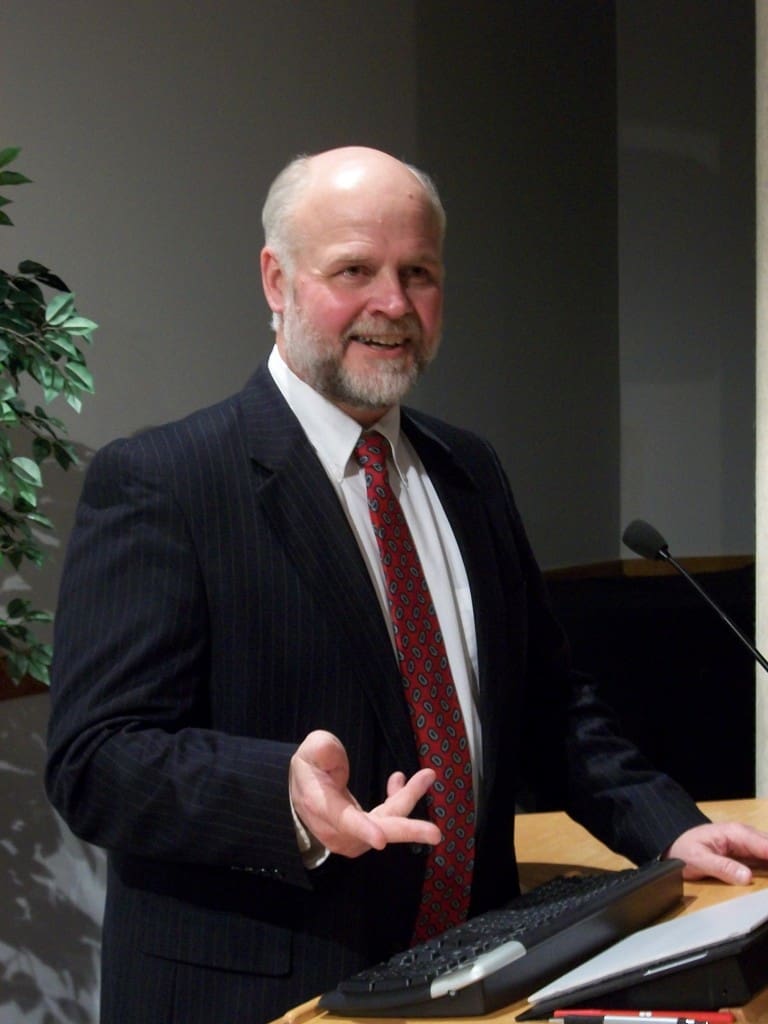
Psychologist Dr. David Christian has spent twenty years as a licensed psychologist, most of that time working with Mormon clients, and in this talk he lays out the framework he uses with people whose faith is hurting them: stop asking whether a belief is true, and start asking whether it works. The presentation, titled “Utility vs. Validity: A Practical Approach to Faith-Related Psychological Problems,” was given at the first Mormon Stories regional conference, held in New York City on March 26, 2011. The slides are available here: New_York_Presentation For Mormon Stories.
Christian is a multi-generational Mormon who grew up in St. George, Utah, served a Spanish-speaking mission in Sydney, Australia, and was raised on what he calls the validity approach: the church is true, and the job is to know it. He describes going to his bishop before his mission and admitting he could not honestly say that. From there he defines the utility approach, which judges a belief by its consequences in the here and now, and answers the common objection that a God might be testing our faith by asking what kind of God that would be.
He then walks through the research on faith and happiness, including a study suggesting the relationship is not a simple straight line, and presents the basic tools he uses with clients: recognizing the thoughts and beliefs that interfere with your values, replacing them with more workable ones, and practicing what cognitive behavioral therapy calls collaborative empiricism. He illustrates the approach with case studies from his practice. The question-and-answer session covers how to advise a twelve-year-old son when you and your spouse no longer believe the same things, gender differences in how people approach validity and utility, and what Christian calls the guerrilla warfare of staying involved in a ward without saying everything you think, including in a temple recommend interview.
Natasha Helfer, then pursuing a PhD in clinical psychology at Utah State University, introduces Christian as a mentor and joins in during the discussion. John Dehlin provides the opening.
What’s covered
- 00:00 Introduction and welcome
- 05:23 Dr. Christian’s background and faith journey
- 12:46 How faith can help or hinder well-being
- 21:14 Validity vs. utility as frameworks for evaluating faith
- 33:58 Research on faith, happiness, and mental health
- 42:04 Therapeutic tools and case studies
- 1:02:30 Audience Q&A on LDS culture and mental health
- 1:26:43 Navigating church participation and closing discussion
Related episodes: 557: Dr. Dave Christian on Epistemology and Orson Wright, the Polygamous Mission President · 1225: Natasha Helfer Parker – "I Am Not Broken" (THRIVEDAY 2019)
Episode Transcript
Host: John Dehlin · Guests: David Christian, Natasha Helfer
This transcript is machine-generated and lightly edited for readability. The audio is authoritative. Please excuse occasional errors in names and spelling.
Introduction and Welcome
John Dehlin [00:00:00] The following presentation was given at the March 2011 Mormon Stories Conference in New York City, sponsored by the New York City Mormon Stories Support group. An excellent PowerPoint presentation that accompanies this audio recording can be found@mormonstories.org under this post. Additional conferences are currently being planned for June 2011 in Salt Lake City and July 2011 in San Diego, California. To attend one of these conferences, to join a support group in your area, or to help plan a Mormon Stories Conference in your city or region, please join the appropriate facebook group@mormonstories.org by clicking on the Support Communities link. Thank you very much. Mormon Stories Podcast is a production of the Open Stories Foundation. All donations to Mormon Stories are fully tax deductible and go directly towards keeping the podcast alive and and towards building a community of support for Mormons like you. To support the podcast or to join the community, please become a monthly subscriber today@mormonstories.org.
Natasha Helfer [00:01:09] Many of you know that I'm pursuing a PhD in clinical psychology at Utah State University. Dave is one of the most well respected psychologists in Cache Valley. He's respected by Mormons and non Mormons alike. And Dave and I go on a morning walk every Is it Thursday or Friday Now?
Natasha Helfer [00:01:31] Every Thursday morning Dave and I go on an hour walk and I'm kind of. I kind of think of Dave as a bit of a mentor for me to help me be a better psychologist professional when I'm done. Dave's been a licensed psychologist for 20 years. He spent most of that time as a mental health professional to Mormons. And Dave's not just a psychologist, he's a scientist. He loves to read, he loves wisdom, he loves to fix and build things.
Natasha Helfer [00:01:58] And he's kind of a guy that just knows a lot about a lot of things. And so he's not just here to talk to us about Mormonism and mental health. He's here to talk to us about the advantages and disadvantages of different types of belief and about epistemology and about all that. And so Natasha and I will kind of back up Dave a little bit, but we're going to start with Dave. Dave's got several presents, several slides to present, and we kind of debated whether or not it made sense to just do lots of Q and A or to have a lot of slides or combination.
Natasha Helfer [00:02:30] We decided on a combination. He's got a framework that I think is very valuable, so we're going to ask that you kind of let him. Generally, if you've got some questions here and there that you want to that are crucial to sort of the flow of the presentation. Please feel free to jump in. We've got a recorder over there. We'd love you to speak loud enough so that our listening audience can hear the questions.
Natasha Helfer [00:02:54] But let's let Dave generally get through the presentation then we'll save time at the end for Q and A. But we hope to have a really good interactive Q and A session. So without any further ado, take it away, Dave.
David Christian [00:03:06] Thanks John. It's a great pleasure for me to join you. This is kind of my debut with this group. I know you've existed out there through John. I haven't been much of a participant in the group, just marginally, but certainly have known all of you and what's going on out there through John. And it's a great pleasure to have a chance to interact with you over this whole weekend. I'm getting acquainted on a personal level with many of you and that's been a real pleasure and I look forward to more of it. Well, John's set things up quite nicely here to kind of create a paradigm for how I'll approach this topic.
David Christian [00:03:43] And one way to look at this is I think it's important given the kind of folks that we have here. We've now already done a little sample of who's who here. I think it's important for you to know that if what I hope you'll take away from this presentation is something that's going to help your personal life, I hope to get beyond the abstract. I hope to make this personally applicable. And frankly, if you came up to me a year from now and said, Dave, what you shared on that day, I decided to go back into Mormonism. I'm a more active member today and I'm a happier member today and it's working for me better.
David Christian [00:04:18] I would celebrate that with you. And if you came to me a year from now and said, Dave, I was on the fence and you know, you gave me some tools and I'm out now and I'm happier and my life's working better, I would celebrate that with you.
David Christian [00:04:29] So just so you know where my commitment is, it isn't to one side or the other. What my commitment is, is to your well being. And that's the same commitment I bring to my clients. It's the paradigm I use when I do my work and it's the paradigm that I bring to this topic today. As far as time goes. John, we're at 1:30 now. Do you still want to wrap up at 2:30. How would you like to.
Natasha Helfer [00:04:49] I'll take it out of my time.
David Christian [00:04:50] So just do your full presentation. Feel free to put some brakes on and we'll adjust accordingly. How do I activate this again? Start here and I'll get it working. Oh great. So here's some quick self introduction. I think it's useful for you to know a little bit about me just so that you're aware of my biases, my background. And in a group like this, I think we're all kind of curious when we're talking to somebody new, where do they stand on all of this? So we can kind of gently try to tease that out of one another. So I'm going to save you the effort and I'll just lay it out there.
Dr. Christian's Background and Faith Journey
David Christian [00:05:23] I was born and raised in the church. I'm a multi generational Mormon. I have Mormons back on both sides. Joseph Knight, my great great great great grandfather was the one who Joseph Smith borrowed a buggy from without asking, by the way, to go get the gold plates.
David Christian [00:05:39] I've got ancestors on both sides that have figured prominently in the LDS Church. Grew up in St. George, Utah, almost completely Mormon community. My family's almost completely LDS and very actively so I served a Spanish speaking mission in Sydney, Australia.
David Christian [00:05:54] Kind of an oddball. I realize this issue that we're going to be talking about today, validity versus utility. Validity is that approach to faith that concerns itself primarily with is it true? Are these truth claims truly true? Are they valid? The utility approach I'm defining is that approach that says that looks at a set of beliefs and says do they work? In fact, Greg raised this question earlier. He said there's a three word sentence that captures this nicely. Does it work? That's the utility approach. And we can ask that question about any particular belief. And of course we have to ask that question idiographically. That means on an individual level.
David Christian [00:06:33] We can't ask that for a whole population. We can do that, but we lose a lot of very interesting data when we ask it nomothetically versus ideographically. So I was raised with a validity approach to the church. I was told I was raised with the idea this is the only true church. And as I was approaching time for my mission, I realized I was going to have to go out and knock on doors and tell people this is the only true church. And I know to be that.
David Christian [00:06:59] That gave me pause because I had been raised in a 90% LDS community my entire life. So I went to my bishop and I said, I know you're going to be interviewing me for a mission here shortly. But I can't really answer that question honestly. And honesty was important to me.
David Christian [00:07:13] Integrity was important to me. And I could see a bit of a problem coming down the road at me full speed. And so I and several of my good friends who were about to go on missions arranged to go to Las Vegas, which was only two hours south of us. And they were the only place nearby that had a real good selection of churches. And we'd go hit them on Sunday and we'd map it out so that we'd start at sunrise, and we would attend Greek Orthodox, everything we could get our hands on. Lutheran, Christian Scientists, the works. And we would make a point not only just to go to the service, but we corner the minister afterwards and have key questions ready for them.
David Christian [00:07:49] So I did my best. And finally, when it came time for my mission, I told my stake president. He says, do you have a testimony? I said, well, I realize I took the scripture from the Book of Mormon. Only after the trial of your faith shall you receive a witness. I said, I believe it's true. I can't say that I know it's true. He says, that's good enough, Elder.
Guest 1 [00:08:04] Off you go.
David Christian [00:08:06] Okay. And off I went. Did the mission. My current orientation. Well, let's go back shortly. Post mission, a review of historical, philosophical and ethical issues led me to dig deeper into the church. And to make a long story short, I decided not too long after my mission that I could not in good conscience stay inside the church. And so I made my departure. Not officially, but I chose to no longer be active in the church. And that was an incredibly difficult choice, especially given the social pressures that I found myself in the midst of. When I went in, I was. As soon as I got off my mission, I was called to be the Stake Mission president for the Dixie College, now Dixie State College stake.
David Christian [00:08:50] And it was very difficult to go into my stake presidency. All of these men I knew, well, I had done research with them. I was a scientist. I was heading into science. I planned to be a scientist. I respected their judgment. And I had to say, gentlemen, I can no longer in good conscience fulfill my duties and stake Mission President, please release me at your very earliest convenience. And they understood.
David Christian [00:09:15] So I appreciate the dilemma that so many of us face when we deal with these issues of faith, but if you have more questions about that, we'll go into that another time. My current orientation. What am I? I could call myself a lot of things. I'm an ethical pragmatist. I believe in doing good practicing wisdom. Wisdom is a topic here haven't noticed that's really enjoying resurgence and research in the last decade and a half and I find that very exciting and I think it's a great foundation from which to do good.
David Christian [00:09:44] And so in a strange sense I guess I have left God for good. The pun is intended. So I'm technically an atheist but goodness is what I find very, very important to me and finding ways to put it into practice. Professor of psychology for six years at University of Idaho, was then recruited back to Logan, Utah, same town John's from to be a to help start found a group practice which I did. I've been a licensed psychologist for I think about 20 years. Clinical practice currently is what I do three days a week. I also do coaching, professional coaching and consulting for the last 13 years.
David Christian [00:10:22] Most of my clients are LDs. Logan has a demographic where we're about 70% LDs and I'd say a little less than that or a percent of my practice is LDS, probably 60% I'd estimate. And there's an interesting thing. I think clients are very good. The grapevine's alive and well in Logan, Utah and they check me out before they come to me. And your reputation precedes you in a town the size of Logan, Utah. And I think there's so my clientele is probably on the liberal LDS side of the spectrum. They self select and I've had a few folks who came in and they found I just was not conservative enough for them.
David Christian [00:10:56] I'll give you a quick example. I had a young man who was a client, he had diabetes and he was also about 16 years old and was becoming very clear on the fact that he was gay. And his parents were putting tremendous pressure on him to disavow his feelings, reject those feelings and back away from those feelings.
David Christian [00:11:16] And he did his darndest to do this, but it only pushed him deeper into depression as he saw that that was virtually impossible for him to do. And so finally he took a massive dose of insulin, went outside into a vacant field outside of town, administered a massive dose of insulin to throw himself into an insulin shock as an attempt to kill himself. That was the point of which I had to have what we call in the south where I went on internship a come to Jesus, talk with mom and dad and say folks, I understand your values here, but it's not working. You may have to make a choice.
David Christian [00:11:53] Do you want a live gay son or a dead straight one? That looks to be what you're now looking at and they didn't like things presented in that way and so they found a more conservative building as counselor.
David Christian [00:12:06] So but for the most part I deal with a fairly liberal group of clients. I'm married to Marianne. Interestingly she is a seeker. She started out Christian Scientist, she practiced in the science of mind New Age religion for some time and she's now a Buddhist and also a Hindu Hubu or a, I don't know what you'd call that hybrid.
David Christian [00:12:29] But anyway, a seeker. And let me tell you, I have to practice what I preach at home. It's not just in my practice as far as how to deal with faith. Three kids, 18, 15, 11. And I'm pretty fetch and happy and I'm proud of that. That's cool. Oh, thanks John.
How Faith Can Help or Hinder Well-Being
David Christian [00:12:46] So, presentation objectives for today I'd like us to consider how faith, especially the LDS faith, can help or hinder psychological well being. I'd like to present a few practical approaches to dealing with faith related psychological problems. Look at how this approach has worked for a number of LDS clients. I've got a bunch of case studies studies at the end so if we get short on time I'll just be more selective in which case studies I share. There's a lot of this presentation that's designed to be let go if necessary for sake of time. And I hope that you learned something that might be of help to you dealing with your own faith related challenges.
David Christian [00:13:23] Just to kind of make a distinction. Some people don't quite understand the difference between therapy that I do and coaching. Here's just a quick slide that indicates the difference. Difference in therapy I'm working on clinical issues that have a diagnosis. This is typically paid for by health insurance and it's conducted in a face to face way. The coaching that I do doesn't have to have a clinical focus to it. It can be more goal oriented and it can be done telephonically. Just a brief distinction there.
David Christian [00:13:50] When we talk about faith today, I think a quick definition might be helpful. We can call faith a confident belief in a transcendent reality, a supreme vision, or a religious dogma or some combination belief which does not rest on logical proof necessarily or material evidence.
David Christian [00:14:06] And faith also can refer to a particular religious practice. Faith is involved in most aspects of my work. Depression, anxiety are the two most common clinical problems that I gender roles, health behavior, social support, self concept assessment. I've got a picture of a pill bottle here.
David Christian [00:14:27] Medications, Utah. You may be aware, you may have seen this in the news. There's a Number of studies that have suggested Utah has the highest rate of antidepressant use in the United States. And yet Mormons, when you confront them about this, they will tell you that they are uncomfortable at the thought of using psychoactive medications to deal with emotional problems. This creates a very interesting dilemma for many people.
David Christian [00:14:51] They see the need for the medications, but they are conflicted about use. So the two approaches that I'm going to contrast today are the validity approach versus the utility approach that I mentioned earlier. The validity approach asks this question, is it true?
David Christian [00:15:07] This is unhelpful if the necessary truth tests are unclear. Now, there are some places where the validity approach is exactly what is would be most useful. And I have to say that there's an interesting gender difference in my experience with regard to these two approaches.
David Christian [00:15:25] Which of these two approaches or what combination you're likely to take does seem to be correlated with your gender to some degree? And it's based on what you see as good. What's the foundation of your ethical system? The first major researcher on ethics and moral development was a man at Harvard by the name of Lawrence Cole.
David Christian [00:15:46] Kohlberg developed a very famous stage theory of moral development and it was the standard for a number of years. Then along came a woman named Carol Gilligan. She said, Colbert, you've got it right. For half of the population, women see morality quite differently. And she conducted a number of studies and wrote a book which became quite a landmark in this area, pointing out that women tend to base their.
David Christian [00:16:12] For Kohlberg, the basis of moral development is rules. Men tend to take a rule oriented approach to morality. Either it's right or it's not. It's a validity sort of approach. There are certain rules, you break the rules. That's wrong. So it's a legalistic sort of a definition of morality. Gilligan pointed out that women tend to use a basis for morality that's based on relationships. Does it work?
David Christian [00:16:37] What effect, what impact will it have on relationships and the more human side of things? And I think that these two approaches tie into those two moral approaches. We have to remember that even if something is objectively false, it can be helpful.
David Christian [00:16:54] We'll be giving you some concrete examples of that. For example, people of different incompatible faiths experience wellness and longevity benefits. Not all of those faith claims can be technically true. And yet faith generically correlates with emotional and physical well being. So it can be based on the truth value, the validity of the claims, because they're all over the map. But the fact that people have faith and practice it correlates quite strongly with different types of well being.
David Christian [00:17:26] The utility approach, or what you could also call the practical approach. Ask this question, is faith helpful? Does it work? In other words, how well is a particular person's practice of faith promoting their own well being, the well being of those around them and or the environment on which we all depend?
David Christian [00:17:47] So that's kind of the core ethic to this second approach. Let's take some examples. This is a Palestinian woman training her young son. Thank you, Joe. Training her young son to be a suicide bomber. The rest of the story is he suffers from an illness anyway, so he's probably not going to live too long.
David Christian [00:18:14] So what a wonderful way in this woman's estimation to let him go out, literally in a blaze of glory. So from this second approach we'd have to question this. What are the implications for his well being and those of the people around him and for the environment for that matter. Here we have aid workers distributing aid.
David Christian [00:18:36] Probably a good example of something that generally can benefit other people. But is distributing aid always beneficial? This is a question I thought about when I saw the Bill and Melinda Gates foundation distributing tons of rice around Africa.
David Christian [00:18:49] So you're simply solving current problem but setting the stage for increased reproduction, reproductive success. And you're going to have bigger famines and bigger shortages. Little Melendra are pretty smart. Turns out they've done the research on this and it turns out from their studies you don't increase reproductive rates. In fact, reproductive rates can drop off as a result of providing aid and you don't create that backlash. So to be this kind of good, you have to be smart.
David Christian [00:19:16] And if it's good for the environment, of course is the third criteria. So what's the goodness test when we say is it good for these folks or does it promote well being? We're talking about something that can be assessed in here and now. Scriptural basis that I sometimes use if the client is interested in. This is a title array scripture most of us are familiar with. The Bible says, ye shall know them by their fruits. Do men gather grapes of thorns or figs of thistles?
David Christian [00:19:45] This is very commonsensical. In the Book of Mormon we have the scripture that says and whatsoever thing persuadeth men to do good is of for good cometh of none save it be of me. The utility approach is based on a spirit of the law. So another way to look at this is spirit of the law versus letter of the law. And you don't have to do an either or. I'm not Suggesting, you've got to pick one of these two approaches.
David Christian [00:20:08] Jesus routinely rebuked the Pharisees for getting too strict on letter of the law. When they accused him of breaking the Sabbath for gathering grain, he said Sabbath was made for man and not man for the Sabbath. So here's a question.
David Christian [00:20:26] Let's get down to nuts and bolts here. If your loved one believes something that you believe, if you. Excuse me. If your loved one believes something that you believe is false, but it helps them and causes little or no harm, what should you do?
David Christian [00:20:40] The validity approach would suggest, confront and convert them to the truth. The utility approach says, let them believe. You may even want to support those beliefs. Next question. Many faith ideas. This is another challenge to this approach. Many faith ideas are about what is useful and otherworldly sense. For example, many of the Mormon dogmas will say that doing X is likely to help you get into the heaven or the celestial kingdom. How do you deal with that kind of a belief?
Validity vs. Utility Frameworks for Evaluating Faith
David Christian [00:21:14] The validity approach says you must ascertain the validity of these ideas using correct scriptures, Authority, prayer, revelation, etc. Most of you know that gets to be a very tricky question to answer because what are the correct methods in the correct scriptures? Utility approach takes a very different approach, saying, focus on this worldly consequences of faith, that is consequences that can be evaluated in the here and now.
David Christian [00:21:39] Last question. Last challenge to this approach is for now. But what if there is a God who is testing our faith in this way? This is a common line of reasoning that you'll hear. Validity approach will say, well, we need to figure out which faith is the right one and believe it. Get after it. Utility approach says the only moral God that makes sense would be one who expects us to learn what is good and do it. A God who expects us
Guest 2 [00:22:12] to harm
David Christian [00:22:13] ourselves or others in this world on the chance that it may be moral in another world is not a God that is worthy of respect. So that's another rationale for this approach. Here's some examples. When I was a child, my mother kept this quote on the refrigerator that I'm going to share with you.
David Christian [00:22:34] And the quote was, she was a big fan of the composer. She was quite a pianist and really loved the history of the composers. Goethe said of Beethoven, he is not wrong with finding fault with the world, but it makes him miserable.
David Christian [00:22:49] Goethe was his personal friend, he knew him well. Beethoven was brilliant. And it wasn't that his assertions about the world were false, but Goethe observed accurately that it made Beethoven miserable and depressed. Today we have good clinical Research to back this idea up. There is a phenomenon in clinical psychology called depressive realism.
David Christian [00:23:13] Depressed people appear to have a more realistic perception of their importance in the eyes of their friends, their reputation, what can actually be controlled in their lives, their own personal abilities and relative risks of accidents. Even they have more statistically accurate perceptions of these things than non depressed people.
David Christian [00:23:38] So the utility approach favors use of unsuberved validity. Just because you have the truth, the truth will not necessarily make you free. It may make you depressed is what depressive realism suggests. And here's more evidence to support that. The fellow on the right is Martin Seligman, one of the most highly respected psychologists today. He was elected, with the biggest majority in the history of psychology to be the president of the American Psychological Association. He's a dynamite researcher. You've probably read some of his books. His first one was called Learned Helplessness and the sequel was Learned Optimism. Sullivan's research shows that optimists achieve more and have better overall health.
David Christian [00:24:19] But optimistic thinking is somewhat irrational in the following. Optimists see bad events as transient. It's not going to last, just a passing phenomenon. Whether or not that's true, optimists compartmentalize bad events and generalize good events. The they see bad events as having a narrow range of impact and they believe that good events have much larger impacts than they do. They think the good they do is going to touch more people. For example, optimists externalize bad events. So when something bad happens, an optimist tends to blame it on the circumstances, the transient circumstances that surround them. And if something good happens in their life, they irrationally take too much credential up for it, more than the facts would warrant.
David Christian [00:25:05] And yet with this irrational belief system, they tend to out produce other people and they tend to be happy. They have better physical and emotional well being in this sadly delusional world in which they live. The wisdom literature that I find very fascinating talks about a skillful mean.
David Christian [00:25:29] In fact, Daniel Goleman in a book that was published as I was in graduate school called Vitalized and Simple Truths. Goldman, you may recognize, is also the very popular Harvard psychologist who's written books the Emotional intelligence that you may be familiar with and many others.
David Christian [00:25:45] Goldman makes these claims in this book. The mind can protect itself against anxiety by diminishing awareness. And he gives study after study to show that psychologically healthy people minimize their awareness of certain facts that are not helpful. They're true, but they're not helpful.
David Christian [00:26:03] Let me give you some examples. When I was a young person I was really. I grew up in St. George. That's the red rock country with all the big high cliffs. Zion National Park, I love to repel. I bought my own gear at 16 and was repelling off 2, 3, 400 foot cliffs.
David Christian [00:26:19] And I learned very quickly that if I'm hanging on 11 millimeters of Dacron line 200ft off the ground, I can engage in some very rational thinking, such as if there's a chipmunk at the top, it will take him about 30 seconds to chew through 11 millimeters of Dacron. I will be dead.
David Christian [00:26:40] I'm 200ft off the ground. I'll make a very nasty splatter mark. All of these kinds of things are true. You learn they're not helpful in that situation because what it does is it activates a very old evolutionary program we all share called the fight or flight response. And what happens once fight or flight comes on you?
David Christian [00:27:00] You become very prepared to deal with an imminent physical threat. But it comes at a tremendous cost because the blood that serves your cortex and makes you smart is rerouted to your amygdala, which gives you adrenaline and the strength you need to fight a physical threat. And literally, your IQ can be cut in half. And now your focus on what is true has now made you stupid and actually at greater risk to make stupid maneuvers. You might panic and do something that really would put you at risk. So out there in the real world, if you start looking carefully, you'll find many places where the truth is not necessarily your friend.
Guest 3 [00:27:38] You have.
David Christian [00:27:39] You may have heard that phrase in other places, but it certainly has some interesting applications here. This mechanism creates a blind spot or a zone of blocked attention and self deception, which is not always a bad thing. Such blind spots occur at each major level of behavior, from the psychological to the social.
David Christian [00:27:57] We're talking a lot about Mormonism here. This happens, these blind spots, not just at the individual levels, but they occur quite culturally. Whole cultures have a blind spot. I sometimes have this kind of interesting discussion with my uncle, who's a cardiologist. He graduated first in his class at Yale Medical School, and he's been the personal physician to more than one of the presidents of the LDS Church. And he's a very devout Mormon. I say to him, I've had a heart attack, Grant, but the literature shows that if I have two to three glasses of wine a day, that's going to increase my. That's going to reduce my morbidity and mortality risk.
David Christian [00:28:35] That's against the word of wisdom. What do you do with that. And so in cases like this, yes, the church, I think, finds some challenges. And I'm usually not that much of a smartass. I try not to be. I've gotten better over the years.
David Christian [00:28:50] I really do try to keep that under control. Grant likes to provoke me sometimes, so we have some great discussions. But for the LDS Church, you simply.
Guest 3 [00:28:59] It's a.
David Christian [00:29:00] You just don't drink. It doesn't matter if you're in one of those groups where the health benefits would actually outweigh the risks. But that's okay. This isn't. This is part of what it means to be a part of any faith or any system of belief.
David Christian [00:29:14] He knew I was baiting him. He saw it coming. And so, you know, he wouldn't even address it directly. He says, yes, from a medical standpoint, you might do better, but, you know, love of life. And he quickly changed the topic of essentially what happened. Didn't have much fun on that one.
David Christian [00:29:31] Somewhere between these two poles of living a life of vital lies and speaking simple truths, there lies a skillful meaning, a path to sanity and survival. That's the final line of Goldman's book where he summarizes it all. And that's my thesis that there is a balance between the validity approach and the utility approach, where your best chance for optimum mental, physical, and I would suggest spiritual health exists.
David Christian [00:30:00] Here's some quick pros and cons of faith. We can spend a lot of time here. Faith has tremendous potential for doing good, and the research supports this. It provides meaning. It can also. But I'm going to talk about both sides.
David Christian [00:30:18] Anything that's powerful has power to push you in either direction. Faith can provide tremendous meaning. And we know that people that have a deep sense of meaning are what psychologists call hardy. They deal with stress much better. Faith can also create terrible confusion for people. And we'll talk about the forms that that can take, especially for people who like to ask questions. I'm guessing that's most of the folks in this room.
David Christian [00:30:43] Creating social support is huge. We have. If you look at Dean Ornish at Stanford University, he's got a great little book. If you want a quickly accessible summary of this research is his book called Love and Survival, where he talks about the hundreds of medical studies that show that if you have an intimate community, a community of support, regardless of where you get, that it greatly improves your. It essentially reduces almost every known cause of mortality and morbidity, including accidents. Go figure.
David Christian [00:31:13] We don't know why, but people do better in general. Who have more emotional support and more connections with others. But it can also create peer pressure and all sorts of problems in that social system. It can aid ethical behavior. It can aid unethical behavior. Let me give you a quick example. Some of you may recognize the fellow on the left at the bottom.
David Christian [00:31:36] This is former governor Mike Levitt of Utah. He's technically a cousin of mine. We descended, we both descend from the same fellow on the right. That's my great, great grandfather, Dudley Levitt. Dudley Levitt was one of the early pioneers of southern Utah. He was commissioned by Brigham Young. He had five wives. He essentially founded five different communities. And his solution to keeping peace between his five wives was to found a separate town for each one of them and worked for Dudley.
David Christian [00:32:11] Here's the sad thing. I have only discovered this in about the last couple of months. Three independent historians have implicated Dudley Levitt as one of those present in participating in the Mountain Meadows Massacre. That never got mentioned in any of my family. It's about diary.
David Christian [00:32:33] So we know that religion has this power to promote very ethical behavior, but it also has its dark side. Well, I'm going to pick up the pace here. Don't have to hit every one of these items. By the way, if any of you are interested in these materials at the very end I'll have a frame up that shows you how to get in touch with me. I've got a website, I've got an email address with. If you want I can send you the PowerPoint.
Guest 2 [00:32:56] So.
David Christian [00:32:57] And I'm going to apologize in advance because we're going to go faster here now. Yep, we're going to start picking up speed. So that way, if you need, if you want the details, just let me know, I'll get them to you. Faith is clearly powerful. On the left hand side we have Mr. Nick Vajusik who recently visited Salt Lake City. He was born with a condition called tetramelia where he was born with no limbs whatsoever. He has a rudimentary toe on his left stump with which he turns the pages of the Bible. As you can see here, he's a motivational speaker. He was ready to kill himself at the age of 10.
David Christian [00:33:30] Faith, I think saved this guy, gave him meaning. And boy, he's doing quite well with his faith. He's a fundamentalist Christian. On the right we have a sad photograph of the remnants of the inhabitants of Jonestown, Guyana, where 900 people, the largest mass suicide in modern history, occurred largely because of a set of faith beliefs that went bad.
Research on Faith, Happiness, and Mental Health
David Christian [00:33:58] What is the dose response Relationship between faith and well being and happiness. Some of you in this group actually got this reference to me shortly before the presentation, so I included it. For a long time we have known about the right side of this curve.
David Christian [00:34:13] We know about this piece right here that as faith increases, it appears that happiness does too. That's cool. Of course, atheists and agnostics are very underrepresented in these samples. So somebody went to the bother of really looking carefully at what's going on with atheists, agnostics and non believers. Now this isn't actually I haven't been able to get to the article because I got this at the last minute.
David Christian [00:34:39] So I've given you the actual reference. So what I've tried to do here is graph what they're telling us. But here's what they say in the abstract it says while fervent believers benefit from their involvement, those with weaker beliefs are actually less happy than those who do not ascribe to any religion. Atheists and agnostics. These results may help explain why in spite of the well documented benefits of religion, an increasing number of people are abandoning their faith. As commitment wanes, religious involvement may become detrimental to well being and individuals may be better off seeking new affiliations.
David Christian [00:35:15] So really what this study is doing is it's really looked carefully and it turns out it appears the curve goes back up. But I refer you to the article to get the details since I haven't been able to get the whole article yet.
David Christian [00:35:28] Kind of lends credibility to that scripture in the Bible that you be either hot or cold. For if thou art lukewarm, I shall spew thee out of my mouth. Looks like folks are kind of getting spewed in the middle here.
David Christian [00:35:41] Existentialists recognized this a long time ago. Even in the 1800s, the phenomenologists and then the existentialists who followed them in the last century noticed what we call the existential cycle. They noticed that people tend to start off with a stable worldview. And I'm going to use myself as an example. I was born with a very stable, well articulated Mormon worldview.
David Christian [00:36:03] But then I started questioning. My mother made the mistake of feeding my insatiable appetite for science books. I was doing pretty advanced experiments when I was a young child, much to her consternation, every time she heard something explode in the backyard, she'd cover her eyes and hope I'd come in with all my fingers.
David Christian [00:36:20] But this parlayed into something useful. I would the only kid in Utah who won four straight international science and engineering fairs and competed on an international level with students from all over the world. But that questioning, unfortunately didn't get confined just to science. I started applying it to my religious beliefs. That's where doubt, rejection of the worldview begins. And the existentialists point out that there's two sides to this phase. There's an analysis phase where we break things down. And those viewers with a biological background, you'll notice this looks a little bit like the Krebs cycle. That's what your body does. It breaks things down before it can turn it into you.
David Christian [00:36:57] So the banana you had at lunch has to be broken down into simple elements before it can be turned into your tissues. And psychologically, something parallel happens for questioners. But as this happens, chaos, disorientation, depression sets in as your worldview falls apart.
David Christian [00:37:14] So when I was on my mission, this is where this really came to a peak. I was embroiled in a very intense conflict with my mission president because we were pilot testing a cross lighting tool that I felt was psychologically absolutely unethical. We were using extremely high pressure techniques on people where we would meet them, teach them, baptize them within 24 hours.
David Christian [00:37:38] And you cannot imagine the kind of, of things we were asked to do to make this happen. And so I was certain that there was a good chance I was going to be kicked out of my mission for very sharp conflicts over this ethical issue with my mission president.
David Christian [00:37:52] He got kicked out before I did. Surprisingly, a meeting was called. All the missionaries showed up. Thomas Monson conducted the meeting. Joseph E. Worton was second in command. Elders and elders. We noticed the sisters were not around, didn't make much of it. We thought it was a little odd. We had 12 sister missionaries, says, you've got a new mission president. Joseph B. Worthen will be your new mission president. And the implication was our former president had been called to something higher and more important.
David Christian [00:38:24] Turns out my mission president had been using those very techniques I was confronting him on to convince the 12 sister missionaries in my mission that plural marriage was coming back and they were to be his 12 plural wives.
David Christian [00:38:41] Ten of the 12 sisters received a spiritual confirmation, the same that gave them their testimony of the Book of Mormon, as far as they were concerned, that this was true. And that's the technique that he used, the very techniques we were using to convert people. They got the witness that this, this is true, that it wasn't because they liked it, but they felt the witness, two of them broke the code of silence. And within hours of the time, their parents learned of what was going on. Thomas Monson et al were on planes headed for Australia.
David Christian [00:39:13] So at this point you're in chaos when you're in this place where your world doesn't make sense. But then you can begin the synthesis phase where you start constructing a more authentic worldview, which is this one that I call workability. Does it work? You find something that works better and in some cases you have to raise the building to the ground before you can start building up. Look at the buildings around here. Do they knock the building half down before they put up the new one?
David Christian [00:39:37] Not a good idea. In many cases you're going to have to knock the building all the way down to get to a good bedrock. Manhattan's interesting. We have the tallest buildings in the world here in terms of and the reason we do is we have very good bedrock on Manhattan. We're on big geological shield of metamorphic material that makes the best place in the world to build skyscrapers. That's essentially what you have to get down to if you're going to build an existentially genuine foundation for your next worldview.
David Christian [00:40:06] Not a pretty process. Clinical depression in my case going through that, I've never been more depressed than I was going through that crisis of faith. So a utility approach to faith related problems. What I tend to do here and I'm going to try to make a lot of fairly technical clinical material as simple as possible just so that you get the idea. I use two very popular approaches. One is the most popular approach in clinical psychology today which is called CBT Cognitive Behavioral therapy. It's based on the idea that when people come that your thinking is what makes you ill. And if you can, by changing dysfunctional thinking you can improve the functionality of both your emotions and your behaviors.
David Christian [00:40:50] There's a ton of research supporting this National Institute of Health Studies Health wazoo. So when people come into my office and I have to approach them clinically, they don't leave their religious beliefs in the waiting room. We're going to have to deal with those. Too many psychological problems are intimately connected to the person's faith. It's best not to get between a person and their God is my policy.
David Christian [00:41:14] I use a bit of cbt, the most common type of therapy in the United States. And Act Acceptance and Commitment therapy is a newer approach that covers areas not well addressed by cbt. Both are listed by the United States Substance Abuse and Mental Health Services Administration SAMHSA as empirically supportive methods. I'm an empiricist. I go with what science tells me works And I'll show you some places where we'll go even beyond the science. But I think you better be careful when you do that.
David Christian [00:41:44] Cognitive behavioral therapy was essentially derived. The Greeks were practicing it. Epictetus and the Stoic philosophers are where we find the foundation for it. It helps change thoughts and behaviors in ways to create positive changes in emotions, biology and their sit and the situation situations that people are involved in.
Therapeutic Tools and Case Studies
David Christian [00:42:04] Any one of these things could be the foundation of a very long presentation. So then go real quick here. Here's the basic methods. Recognize the thoughts, assumptions and beliefs that are interfering with values. Replace the dysfunctional thoughts with more workable ones. Gradually increase value of activities which have been avoided. Try out new ways of behaving and reacting, and practice collaborative empiricism. It is the foundation of cbt. It means if you're my client, you and I are going to work together as a couple of little scientists. You're going to be doing most of the work. I'm a coach, essentially. And we're going to take a look at the beliefs that you've got here.
David Christian [00:42:36] Which ones are not serving your values. Your values are the foundation for this, not mine. We're looking for a set of beliefs that will better serve your values. But of course, sometimes you might choose to check some of those values. While we're at it, here are some of the thinking errors that are that we look for in cbt. All or nothing thinking. And that's I'm just going to point out, this is the one I'm going to focus on the most today. It's the first one identified by David Burns. This is the most popular CBT book in America. Feeling Good Handbook. If you want a good introduction to CBT and how to use it yourself, Feeling Good Handbook is a great resource.
David Christian [00:43:14] But with my LDS clients, I would have to say that the very first one that Burns lists is the source of considerable emotional distress. We'll give you some examples on what we do with that. Burns then identifies 10 ways to untwist your thinking. These are some of the cognitive tools that we use to help turn thinking around or modify thoughts to get the results that we're looking for. Here's a quick introduction to act acceptance and commitment. Therapy, integration. Very hard science. This comes from the hardest scientists in the field of psychology today, the behaviorist. You'll recognize B.F. skinner here. But this is wild stuff, folks.
David Christian [00:43:53] The other side of ACT comes from Buddhism, the oldest psychology on the planet. If you look at original Buddhism. I'm not talking about the stuff out there with the bells and the whistles and the saffron robes and that. That's the cultural trappings that eventually got integrated with the Buddhist teacher.
David Christian [00:44:10] Buddha was originally a radical empiricist. He says, I do what works. And sometimes the mind gets in the way of even seeing what works. So there's a set of techniques that this group of scientists led by Steve Hayes, the fellow at the bottom, techniques that help us serve your values much better.
David Christian [00:44:30] The first article that was written on this topic was Making Sense of Spirituality by Steve Hayes. In probably one of the most empirical journals, refereed journals in all of psychology, the journal behaviorism. This, this would be like Hugh Hefner publishing in the ensign, something like spirituality even. Maybe that word showing up in the journal like behaviorism was groundbreaking. So ACT really has brought something new to the science of psychology.
David Christian [00:45:00] The six core ACT skills are identifying what you're willing to stand for. The very first thing we do is help people identify their values. We build commitment to serving those values. We help people learn to accept what cannot be changed. Rather than wasting energy in the useless struggles.
David Christian [00:45:17] Help them detach or what we call defuse from interfering thoughts and feelings and act from the observing or transcendent self. And that's the spiritual piece of that. Active tech is a scientific form of spirituality. If you'd like a succinct summary, as if those are two words that are hard to put into the same sentence. And the final skill is staying mindful of the present moment, especially what's workable. And workability is defined as that which serves your values.
David Christian [00:45:47] When I go into therapy, I'm looking. I sometimes think of my myself as a mechanic. I have to recognize that every vehicle, that is every belief system that people bring in is unique and every person is unique. My goal is to maximize the performance of this vehicle. I am not there to be a car salesman. I'm not going to help Mormons become non Mormons. I'm not going to help Baptists become atheists or vice versa. That's not my business.
David Christian [00:46:15] My business is to enhance the well being of this person, whatever that requires with an ethical foundation. If clients conclude it's not practical to repair their vehicle, then I might be able to help them find more workable alternatives. But that's their decision, not mine.
David Christian [00:46:34] Now here's something I'm going to invite all of you to think about using the mechanical metaphor with cars. Here are you your face. It's very easy for us to engage in fusion with our faith beliefs or any of our beliefs. Whether I'm an atheist or a father or anything else, I think of myself as that.
David Christian [00:46:57] But what ACT invites us to do is to see these as things we have rather than things we are. Your beliefs are things you have. So today I have a plaid shirt on. Am I this plaid shirt? No, that would be silly. But am I my faith?
David Christian [00:47:13] The problem is when we get rigidly fused with a set of ideas, we've lost our flexibility and suffering is very likely to result sooner or later. So what we're really doing here is looking for tools to help people stay flexible and pursuing their values.
David Christian [00:47:29] And this is where the spiritual piece is. We're encouraging people to experience themselves as the transcendent or observing self. That's the spirituality that ACT has to offer, which means seeing yourself as the context for your experiences rather than the content of your experiences. You are the goal rather than the contents. You are the place where your experience happens, but you are not your experience otherwise. Jesus on the cross, suffering measurably. Was he the suffering? He had the suffering, but we have to recognize that he transcended that. So this takes a little time to unpack, but that's the general idea.
David Christian [00:48:09] So let's take some case examples of the utility approach. And what I've done here is I've gone through my own clinical files. I've changed the names, I've changed. The pictures that you're going to see are obviously not the people involved, but I give them because it gives you a flavor of the kind of person I'm working with.
David Christian [00:48:26] I want you to notice how we're using utility and workability to deal with these issues that have faith involved. Note the diversity of LDS styles. One of the things that amazes me is how diverse my LDS clients are. You'll see a bit of that as we go through these case studies where possible intervention is made using LDS compatible terms and concepts. In fact, I'm quite certain that some of my clients come into therapy, leave therapy, assuming that I'm very practicing Mormon, because they never bothered to ask me. My policy is if somebody asks me, I'll tell them exactly where I stand. I believe in being honest, but the reason some of my patients leave with that impression is I speak lds.
David Christian [00:49:08] I know that language. I speak Spanish. I use that language. Is one language true and another one false? No, you use the language that's true. And that's another example of workability. Let's get some real life examples. Utah. Here's a little background. Utah is number one in online porn subscription sales. Did you know somebody find that wired ironic, don't know where to find it for free?
David Christian [00:49:33] That's one of the arguments that's been made. They're not very sophisticated. They end up paying for stuff they could have had for free. And if you look at the apologist at fair, they'll talk about the other explanations and sure, take a look at that.
David Christian [00:49:48] Now, I'm going to offer you some possibilities here. Eternal life hangs in the balance awaiting the works of man. This process toward eternal life is a matter of achieving perfection. Now notice how many times the word perfection shows up. And who am I reading here? This is out of the Miracle of Forgiveness by Spencer W. Kimball. Living all the commandments guarantees total forgiveness, again, an absolute turn of sins and assumes one's assures one's exaltation through the perfection, which comes by complying with the formula the Lord gave us. And I won't read the rest of it, but you can see I've highlighted the term perfect and references to perfection.
David Christian [00:50:24] I'm going to point out that this is not a workable, it's a psychologically risky way to promote adherence to these standards. Frankly, if I were advising the brethren and I I said you really want people to use more or less in Utah? This is not the way to do it. This is a place where there's a real paradox psychologically.
David Christian [00:50:46] What this does is it creates a phenomenon known as the abstinence violation effect that researchers have known about for decades. The abstinence violation effect occurs when there's a rigid law, a rigid rule to abstain from a particular behavior.
David Christian [00:51:01] And when you establish it and reinforce it with all or nothing or perfectionistic thinking, then if a slip or a lapse occurs, the person is inclined to define it as a serious failure. And once they've defined it that way, lapses are seen as the result of a personal internal flaw. And you strangely increase the likelihood that a person is going to snap into that behavior and they will stick with it longer than if you hadn't taken this rigid approach. We got a ton of research on this with substance abuse, pornography and other addictive behaviors. I sometimes call this virginity thinking.
David Christian [00:51:36] So I'm no less virgin if I sleep with 10 people. Let's suppose I resolve I'm going to be a virgin until I marry. Things got a little out of hand in the backseat of the car one night. I'm not a virgin.
David Christian [00:51:48] Am I any less of a virgin if I sleep with 10 people in the next month? Virginity is an all or nothing absolutistic concept. And when you add to this, this perfectionistic thinking, you set people up for problems. My high school, Dixie High School in sweet little St. George, Utah, mostly LDS, one of the most high concentrations of LDS kids in the state of Utah. We had the highest teen pregnancy rate out of the state of Utah and we were the most Mormon.
David Christian [00:52:18] Abstinence violation effect, folks, watch out for it. I'm going to invite you to see how this works. Pull a credit card or any plastic card out of your pocket. It could take some real unpacking because there's a number of possible explanations, but either way, something's going on here that isn't good. And we know the absence violation effect. It was reinforced because I said, do you know how many morality firesides I went to as a kid? And boy, the way they define it, it's all or nothing. Brother set us up. So if you want to see how the abstinence violation effect is, it happens anytime. You have a behavior where there's a pressure to resist.
David Christian [00:53:04] I'd like you to create some pressure to resist temptation by squeezing down on your credit card and let your credit card bend outward in a convex fashion, like I am. If you want to try this. So there's the pressure to resist. Now what I'm going to do is start applying the pressure to act. So if you're male and you're young, your testosterone's boiling out at the seams and you're a little curious because you've heard there's some pretty good looking stuff on the Internet. It doesn't even cost anything and nobody'd really know. And your friend told you how you can hide your history and one day.
David Christian [00:53:34] So the pressure builds and the pressure builds. Now let's suppose you don't have very much pressure here. You don't have the absolutistic thing, so you just lightly bent the card this way. And now if you start light like I am, and whoops, you slip over the line and you spent half an hour looking at pouring. Now you've snapped the dark side, but look how easy it is to snap back. How much effort does it take to snap back? You've got a lot. When there's very little vertical pressure here, there's very, there's a lot of flexibility here. It doesn't take much effort to spring it back to its original position.
David Christian [00:54:06] Now apply this heavy perfectionistic thing and you can see how much stress is being applied by the flexion of the card. Now take your finger and push and watch. There certainly is resistance to that, but Watch what happens when you get into what is called the bifurcation zone. Wham. It snaps all the way to the other side. You can do this better if you have a rigid frame to hold this rather than your hands. It works better. Now it's snapped over here and look how much pressure it's going to take to get it back to its own stakes.
David Christian [00:54:35] You've actually made it harder with this vertical pressure to get it back to its original state. This is what's called catastrophic behavior. There's a whole theory in mathematics called catastrophe theory that explains phenomena of this sort. One more evidence of my nerdy childhood. When I was a junior in high school, I read Scientific American and catastrophe theory had just come out. It had been developed by a French mathematician, Rene Font, developed for practical use by a fellow by the professor at Cambridge, E.C. zeman. And I started corresponding with Zeeman and told him that the research that I was doing, I was studying animal behavior. He sent me articles and I ended up testing it with gerbils and found really interesting uses of this in gerbil behavior of all things.
David Christian [00:55:23] So anyway, well known phenomena. So let's take some looks at this applications. It's interesting and I've got to pick the pace up even more here. I can see it's notable that groups with the lowest incidence of alcohol abuse, Jews and Italians, have the lowest abstinence rates as well. Among cultural groups, especially the Italians, the highest. And yet they have the highest consumption rates. Look at cultures that do well with alcohol. Low abuse rates. They tend to have fairly high use rates, but abuse rates are low. Would be an application of this. By the way, LDS people who start drinking have a much higher risk of alcoholism than those who don't have an LDS background.
David Christian [00:56:05] Let me give you some concrete examples. These are the case studies. Now, Alan Physician, who's serving in a high council is feeling very guilty about his porn habit, masturbation and impure thoughts. What was the solution we found? Recognize the paradox of control.
David Christian [00:56:20] With act, we teach people to let go of thought control. Now, how many of you have seen the play the Book of Mormon so far? Good percentage. Click it off. Turn it off. Thank you. Turn it off. If any of you have actually tried that, you will know what a futile strategy that is. And yet how many of us have been counseled to do this ACT shows and we got tons of research on what works better. If you take the pressure off and actually become permissive and say first thoughts can show up whenever they want, you'll have much less problems with Them. There's a real paradox here.
David Christian [00:56:57] Focus on serving values, practice. I won't go into Western self forgiveness, but that's one of the things we used here. And from cbt, we revised his all or nothing thinking. And he got out of the abstinence violation effect. And his use of pornography went way down and his masturbation went way down. And he found himself quite a bit happier.
David Christian [00:57:19] Another client, we'll call her Stacy. She came in, she was married with two children. She's a technology worker. She and her husband had chosen to leave the church. She proposed to her husband. Well, let's have an open marriage. He wasn't ready for that.
David Christian [00:57:33] So what were our solutions here? Living monogamously for now is what they decided to do. But with Stacy having more freedom to pursue platonic male relationships, is that risky? Yes, but be careful because if you try to over control something. John used the example of the dam. If a dam doesn't have an outlet, pressure tends to build behind it. Show me any dam that has stood the test of time. It has an outlet, it has floodgates. In fact, much of the energy that we enjoy comes from letting the water out, controlled fashion. So essentially that's what we did here. We found some outlets that for now are working.
David Christian [00:58:10] I won't go into the details there. So let's see, we gotta kick it up here. Andrea, this is a case of gender roles. Well, she and her husband are returned missionaries. Her husband is an attorney and very traditional.
David Christian [00:58:24] She's felt. She felt compelled to do something with her education, but didn't find anything that was meaningful. She became clinically depressed. Her dilemma was that feeling a stay home mom was too confining for her. But here's the solution. It turned out I found a way to help Andrea become completely at peace with a domestic role. Generally, my values are women should get out there and do stuff. I think that's cool. And there's a lot of research that says that's good for them. But in her case, what worked was reframing her domestic role as challenging and meaningful. A little book that I shared with her is called Sidetracked Home Executives.
David Christian [00:59:01] If you're going to be a stay home parent, male or female, it's a dynamite book. I tend to be the primary domestic person at my house. I'm the one that teaches the kids to do the domestic tasks. My wife's job is more demanding in mine in terms of time. And so I find this useful. I take my domestic roles very seriously. I treat them as seriously as I Do my other professional roles. Andrea found this useful. That's a CBT sort of an approach.
David Christian [00:59:25] Bill is another interesting client of mine. He's a former east coast bike gang member. He has a history of polydrug abuse, a very dangerous lifestyle. Converted to Mormonism, married a returned missionary. His favorite church character is Orton Porter Rockwell. There's a guy Bill can relate to who church really helps him maintain a sober lifestyle. This guy would have been dead today if it weren't for that. He's now discovering problems with church history though, and it's beginning to undermine his faith. He felt he had to make an all or nothing choice about the church. I said, no, you don't. There's lots of different possibilities in here.
David Christian [01:00:00] So we got out of the all or nothing thinking again. We challenged his or helped him let go of the all or nothing thinking. He now self identifies as lds, but doesn't participate very much at all in church. He created his own liberal LDS practice. In fact, here's an example. His wife is not interested in sex. They're getting a little older now. She has no interest. He still has a pretty active libido. They negotiate, she said, as long as you never pay for porn. So he's one of the exceptions to the Utah porn rules. He's become quite adept at finding free porn. She says that's okay.
David Christian [01:00:33] Masturbation, pornography, it's your business. I just don't want you spending any money on it. He's still sober, they're still happy. It works for them. And that's again, I don't have an a priori. Whoops, I think we lost something here. John just hit the return button
Natasha Helfer [01:00:54] because
Guest 3 [01:00:54] it's definitely not the iPhone.
David Christian [01:00:56] Exactly. I'm going to give you one more example and let's go to questions because I got several more examples here. Jane was told when she was. This was a number of years ago, the priesthood leaders advised her to marry a gay man to cure. How many of you have heard of this phenomenon? It was very common in the church not too long ago. I'm afraid it's not over.
David Christian [01:01:18] She became. It didn't work. He could not maintain a straight lifestyle. He became promiscuous in the marriage even while he was serving in a bishopric. She became very angry at gays and then she became very angry at the church and she chose to leave the church.
David Christian [01:01:34] So her solution, what worked for her is she left the church. She said, this has ruined my life. But once she was able to get over that, she's now found a heterosexual Boyfriend. She amicably co parents with her ex gay husband. They even vacationed together, she and he with his gay partner. And it works for them.
David Christian [01:01:57] And so again, what we're trying to find here are what works where we're trying to sidestep the pharisaical approach to applying rules rigidly and find ways in which people can serve their values that work for them. Well, there's a number of these. More illustrations I could give. I'm worried right now. Let's shift to questions. I'm interested to hear what you're thinking. Responses, agreements, disagreements, but what ifs, whatever you got. Let's open.
Audience Q&A on LDS Culture and Mental Health
Guest 1 [01:02:30] I had a question. I have five kids. That's a personal story, but me and my wife discussion is raising our kids mostly boys. He doesn't understand men's thinking. You know, we've had the discussions and whatnot, but our oldest is 12 years old and I don't know, I'm coming into the area of advising him because I know what he's taught at church, basically. I mean, we're still an active, participating family.
David Christian [01:03:02] The factory.
Guest 1 [01:03:04] What's that?
Guest 3 [01:03:05] The little factory.
Guest 1 [01:03:06] The little factory.
David Christian [01:03:10] Little factory's cranking up about.
Guest 1 [01:03:11] Yeah, he's 12 years old, so I don't know how to approach him. I have my personal belief. I also don't want to step on my wife's personal beliefs, but she trusts me in teaching him.
David Christian [01:03:24] That's good. Yeah. I say, first thing I do with clients is say, okay, what are your values? If your child behaved the way you want them to, what does that look like?
Guest 1 [01:03:32] I'm afraid your credit card example is. I just, you know, I don't want
David Christian [01:03:37] the too much pressure because of the backlash that creates. And so every kid's here's where we can't even make a rule by family. We have to make it by child. Because every child is truly unique. And if you haven't had very many kids, you haven't appreciated this yet. Just because they both have shared two biological parents doesn't mean they're going to be very similar at all. And so I think you've got to make us something that's going to work for each of your kids.
David Christian [01:04:03] My oldest daughter, who's 18, we have to put many more limits in place for her because of her personality. She will test those limits and we have to create real limits, but also have the flexibility there with consequences for her. But for my son who's 15, and my daughter, who's 11, we almost have to push them out and say, you need to go try more things. Not that I'm saying go try things that are questionable, but it just depends on the child. You've got to come up with something that's going to work for your value system. So that I'd have. I'd ask you what happens if you. What if you knew he was masturbating
Guest 1 [01:04:37] on a day with.
David Christian [01:04:38] Would that be a problem,
Guest 1 [01:04:41] you guys mean? No. If my wife found out, it probably would.
David Christian [01:04:46] That's something.
Natasha Helfer [01:04:47] What if you didn't close the door?
David Christian [01:04:53] We're going to look for ways to, to, to make this work for both you and her and him. And because we have to respect Aaron's judgment to a large extent. But I'm also going to sometimes say, what does the research show? Are kids going to be psychologically damaged by masturbating daily?
David Christian [01:05:12] They aren't. The thing that's probably much riskier for masturbation is making a child feel that they're inherently evil for doing something they have little control of as they're going through the biggest hormonal surge of their entire life. We're really setting them up for problems, but we're also going to have to match that with your belief and values to come up with some compromise that's going to work promote the best well being for you, your wife and your son. I realize that's not a specific answer, but we start looking at where is that zone of flexibility where everybody's flexing in a way that works optimally? Good question.
Guest 3 [01:05:48] Thanks, Dr. Christian, for the interesting discussion. I had a question about from your own experience working with people as they struggle through the psychological health of religion, the rigidity of beliefs, would you say that things are getting better? Is the church becoming. Does it facilitate more psychological health with the way it is now versus the way it was before? Are there any trends in that you see that are good or maybe some trends that you see that are unhealthy and as a result you're seeing more and more patients?
David Christian [01:06:27] It's a great question and I don't have the demographic statistics to answer the question on the level I'd like to. I'll certainly speak to my observations of my clientele. I think the church is losing control in some good ways.
David Christian [01:06:43] One of the things that's happened is when I was a kid, when, when I wanted access to historical data about the church to answer these questions, you know, what was Joseph Smith really like and what did he do and McQuigley and blah blah, blah. I had to go to University of New York.
David Christian [01:06:56] I Had to get clearance, a security clearance to go into the Special Collections section and read the original works under a TV camera. That's how I got my information. That's how old I am today. For the privacy of my bedroom, I can access 10 times more than what I could access in Special Collections.
David Christian [01:07:17] And so in that sense, the church has lost a lot of control over some of this information, which means people are getting access to information like they've never done before. And that's changing the landscape. That's changing the cognitive landscape of people.
Guest 3 [01:07:28] Is that why church history is kind of like pornography?
David Christian [01:07:31] It's often treated the same.
Guest 3 [01:07:33] I know
David Christian [01:07:36] there is a parallel. This creates the potential for this thing called cognitive dissonance or the existential cycle. So we're going to see that much more frequently. But people have much more information with which to process that. For me, I was very isolated. That's another thing. There is a massive community of seekers out there and websites that provide information and social support. When I went through this, I thought I was going crazy. I didn't know anybody else was doing this. Everybody told me you're general authority material today. Everybody. I mean, I was president of seminary and the whole works. I was the star kid. And what am I thinking?
David Christian [01:08:16] I'm going off the deep end here. I'm going out to sea. And I didn't have any peers and it took me a long time to find that, oh yeah, there are other people out there. There's no mechanism for connecting to those people. This community. I. What John's talking about here is to create community is critical for people. And when they've got that, that social support allows you to do things, you would risk considerable psychological distress to try to do without the support.
David Christian [01:08:42] So I think that's one of the things I see in my clients. There is way more diversity in the LDS population than I think the leaders would like to believe. They like to have this belief that, you know, quite a uniform faith. I mean, correlation strives for this kind of unity, but, boy, it certainly they may unify the doctrines and what's deliberative from pulpit, but I think they're losing control of the. What's going on in the minds of the saints. You think they're recognizing and just turning it off. Excuse me?
Guest 3 [01:09:12] Do you think they're recognizing that fact
Guest 2 [01:09:13] and then just turning it off?
David Christian [01:09:16] I'm sure they'd like to. I really don't know how they're. How they're going to deal with that. I think they have to. Some of the discussion that transpired before this meeting, I think was very interesting to me to hear that some of the struggles that we are aware the brethren are facing with regard to this in falling attendance rates and activity rates.
David Christian [01:09:37] It's going to be a big challenge for them. And frankly, if I were their advisor and they wanted to maintain, maximize faith, I think don't. I was attacked by every person approach would actually serve them and then keep more people in. Frankly. I think the LH Church has a lot of great stuff to offer. And if people can take it in a spirit of the law fashion, as opposed to the pharisaical, rigid version, it can do a lot of people a lot of good. And I think they're going to lose a lot of people because the pharisaical approach is not the only one that's officially offered.
David Christian [01:10:06] And that's. I frankly think I said, even though I don't choose to participate, I can see lots of other people for the benefit who will be. They will be snapped out because there's so much vertical pressure getting placed on.
David Christian [01:10:18] I. I'm sort of curious how much we can learn historically. You may not direct masses too, but how much you've learned historically from other churches. Almost cycle stage where, you know, Judaism, that you see a lot here in New York City, the different levels of Orthodoxy. I mean, it's almost like a cycle point.
David Christian [01:10:46] I think we can take a lot of lessons from our fellow faiths. Look at Catholicism. When you look at Catholicism in Central America or even in Africa, Jesus and the Virgin Mary are brown or black. They have completely, in some cases integrated their cultural traditions. You find Aztec culture being integrated with capacity. Catholicism in Central America and the same in Africa. And of course, our play last night illustrated how one of the things that's wonderful is that ideas undergo evolution. If you read Richard Dawkins, it's the notion of memes. And memes are like viruses and they mutate and they follow strangely similar patterns to the evolution of organic beings like ourselves.
David Christian [01:11:25] And you see churches undergoing evolution right now. The pressures, the environmental pressures are coming to bear on it. And I think we're going to see a new kind of church coming out of this. I mean, literally the old one cannot exist. The conditions necessary for its survival no longer exist. The environment is changing so fast with regard to the information we're awash in, it will be a new animal. And I think we can take lessons from other faiths who have adapted by allowing more room. They have taken the vertical pressure off and saying, you're one of us. Whether you're here, here, here or here, we'll still call you one of us. You can be part of our, our considered our, our faith.
Guest 3 [01:12:02] But do you think about the bottom up change versus the top down change? I just don't see the leaders of the church making these kind of announcements.
David Christian [01:12:13] I think it's going to be both.
Guest 3 [01:12:15] Symposiums are now good and, but, but maybe, maybe members of church can take liberties that maybe the brethren have blessed off on. So bottom up, of course, verse is the topic.
David Christian [01:12:28] I think it's going to have to be both. I think we'll be instigated from the bottom. I think it's coming from the grassroots. To use the metaphor of the Book of Mormon play, when you saw our African friends who have taken power over their story, what a wonderful thing that is. Look at people who have said, we are going to make this story hours now, that is this pragmatic approach. It's not the validity approach. It's not saying, is this true to what Joseph Smith preached in the early 1800s? It's not the point.
Natasha Helfer [01:12:56] We already lost that though. We lost that about 100 years ago.
David Christian [01:12:59] Yeah, but here's an example. And I think one of the things that really touched me about the play is the beauty of that. Because we as humans need stories. It's not about relief. We need our validity. I'm a scientist, I respect science. I wonderful. And that validity approach is so powerful. It's given us the lights above us and the projector. I mean, we've got blessings coming out, the ying ying that we have science to thank for. So I respect the validity approach deeply, but we cannot give up on the utility approach. And one of the things that lends utility to human lives is stories that give meaning.
David Christian [01:13:33] And the stories don't have to be true to do that. They don't have to be true in a technically accurate look at the great myths that have inspired the Greeks. Look at the great myths that have inspired others. But here's the trick. The challenge is when you as an individual say, but can I get the same benefit out of this, looking at it as a myth as I do, as taking it literally true. You're right. That's a big challenge. If you want to be a true believer in the sense that you're going to accept on the literal, not the figurative side, you've got a new challenge.
David Christian [01:14:01] But that's going to become increasingly challenging for I think all Mormons because of this tidal wave, this tsunami of information that we're being inundated with and we more and more in my, the privacy of my bedroom at Molding, Utah, I can be a citizen of the world. I can be connecting with people, Uganda, at any time, hour of the day or night.
Guest 2 [01:14:19] Yes, I just say that the church isn't the only place where this is happening. This is happening across the board. I'm in the high tech industry and you're finding that, that old star at the general door, if you think of them as IT administrators, the millennialists, this kid's born in 1980, that are coming into their organizations, they've decided, you know, the rule was, I'm going to give you a laptop. That's the thing you're going to use. Don't use anything else. And the millennials are going like, I don't care what the rule is. I'm going to use the device I want to and I'm going to break your rules and I'm going to hack your system and I'm going to make it work. These guys are tearing their hair out. What in the hell am I going to do and make this happen? It's a tidal wave they cannot stop.
David Christian [01:14:54] And there's two groups, there's those who
Guest 2 [01:14:56] are resisting it and they're going to be destroyed by this. Or the ones who are saying, I need to change the vertical pressure I'm putting on this thing in order to allow this thing to work. And so what I find fascinating is that this very thing that we're describing here is happening in all kinds of places across our society.
David Christian [01:15:13] Technology, religion. Look at it in warfare. Why did we get our butts kicked in Vietnam, we had a far superior, superior technological. And in terms of numbers, for us, they switched to guerrilla warfare. Guerrilla warfare says, we're throwing out all the rules. We're not meeting you out on the battlefield. We did this. When we got our liberty movement from the Brits, they'd come out in nice tiny little red uniforms with a white X in the middle. They gave nice little rules what the cause do. We hid behind trees and rocks and picked them off right and left. We switched. We broke the rules. We said, to hell with the belief validity rules of warfare. We're going to utility. We're going to do what works.
Guest 2 [01:15:50] Egypt. This change in Egypt just now and across the Middle east is the same thing. High technology, fast communication, the ability to correlate and coordinate in rapid fashion across a wide spectrum, all being driven by that younger population did something that could not have been done previously. If it took you six months to organize a riot,
David Christian [01:16:14] The guerrilla Mentality which is we go for utility, we're serving values and we're going to do what we have to serve our values on a workable scale that is a tough, tough one to beat even with much higher power. Yes. Back here at first glance you would think that the LDS hierarchy does much a top down change 1978 made
Natasha Helfer [01:16:39] but
David Christian [01:16:39] there's another way of doing top down change. It's not what they do, it's what they stop doing. And if you want to see a really graphic example where you had to have a lot of patience. It took us about a century to get from talking about birth control as race suicide to talking about it as her business alone. The way that we did was to periodically restate the orthodoxy and leave something out and you can track that in very discrete steps. So this often is what's going to happen that there will be change that you don't notice because you weren't paying enough attention to what they weren't saying. Great point. There's a verse in the spiritual. And I think the correct me if I'm wrong for the literature is pretty robots that change cycle doesn't work for some other people's problem which is masturbating.
Guest 3 [01:17:41] And
David Christian [01:17:44] so the church has a problem. They got the evidence they got the church services treating their patients took the master vision problem like patient feel guilty and eradicate to me if you can take someone who masturbation times a month and get them to do it like three that's a victory. When the church can't ever there's no. The only good masturbation is no masturbation. I see the church ever slowly conceding that hey it's a losing battle we know every six months in
John Dehlin [01:18:23] but even
David Christian [01:18:23] then once they get to the point
Guest 3 [01:18:25] of no the only good master no masturbation.
David Christian [01:18:37] I mean this. This is like damaging marriages so unnecessarily in my opinion. One of them is my sister and guess what the bishop told me to read. Unbelievable. That's malpractice. I hate to say it but these guys are making business for me. One of my next slides here I'll just quickly go to without going into any detail. Let's see. Whoops.
Natasha Helfer [01:19:07] Other way.
David Christian [01:19:09] Guilty. Let's see. Mike bankrupt again. Greg, I must have skipped over. Let me see. Here it is Krista. She feared she was homosexual. Why she was having these homosexual thoughts. She went to LDS social services. This is the story Boyd K. Packer states delete from the mind any unworthy thought that tries to take root Church News 10, 3. I tried to get a recent reference on this one. This made things worse. The more she tried to get these lesbian bots out of mind. She'd been a perfectly, I mean, normal white heterosexual. Not that normal is good here. I just mean that's. She was a typical heterosexual. But as soon as she started getting these lesbian thoughts in her mind, she tried to turn them on, turn it off.
Guest 2 [01:19:49] Don't think of an elephant, don't think
David Christian [01:19:51] of the pink elephant. It's a paradox. And so they just blossomed. She went into LDS social service. Her well meaning therapist said, yeah, it looks like you have. The temperature is after you back. You've got to resist these thoughts. She was suicidal within a few weeks. The more she resisted, the more they came and she was, it was breaking her soul. And finally one of her friends said, hey, I saw this guy named Christian and for something kind of similar, you might want to check him out. She came in. She wasn't a homosexual. She had a condition known as OCD which hinges on this very condition. I explained it to her. A little basic education. I'm taking the ACT approach. Two weeks later, she's laughing about it. It's laughable. And she's not perfectly typical heterosexual relationship. So you're right, this approach is not just not workable, it's actually dangerous. It really makes things worse.
Guest 2 [01:20:38] I think another funny example is growing up. The recommendation was always, you got a
Guest 3 [01:20:43] scotch, you pick your favorite church hymn.
Guest 2 [01:20:45] But then obviously what they found is,
Guest 3 [01:20:48] you know, you're sitting in church,
David Christian [01:21:02] Rise up, humano God. That's absolutely true from a psychological standpoint. I wasn't gonna go there, but as long as you did, you know, it's so sad because, you know, they are. But here's the problem, because they go with a letter of the law approach and they won't stop to take a look at the workability, the utility approach, as I call it. The sad thing is they're defeating themselves because they are so committed to the letter of the law. They're not looking for at the spirit of law. Is it really working? And these techniques, psychologists, we're practical folks, we're based in science, so we say, let's take a look. If it works, we'll do it. But we look at it and go, no, it makes it worse.
Guest 2 [01:21:56] Well, I think the follow up of that is, you realize, you know, a
Guest 3 [01:21:59] lot of these bishops are very well
Guest 2 [01:22:00] meaning and they're not trained professionals. And so there's an attempt and I think they're hindered to a certain extent because there's this expectation that you have inspiration, that you don't really need any type of professional help. And so I think you have a lot of these well meaning bishops trying to struggle along here and doing their best but really kind of creating some difficult situations.
David Christian [01:22:25] It gets kind of scary sometimes. I think there was. You've been waiting a while. Let me get you back to you.
Guest 2 [01:22:35] I'm wondering in your practice how you differentiate between family with, with all these examples how you differentiate between family system and LDS church. From my experience, completely intertwined. Because from my experience in conversation with
David Christian [01:22:51] people, they too the two intermix heavily.
Guest 2 [01:22:54] Family has a huge impact.
David Christian [01:22:56] Sure does.
Guest 2 [01:22:57] On the way that their LDS doctrine has been taught to them. Absolutely always from. But I seem like always linked to the family and then to the church.
David Christian [01:23:07] The church, the bigger family. It's families with inside families. I'll give you a very quick. I'll give you a quick answer for that. I refuse to see children and adolescents in individual therapy essentially anymore for that very reason because the family system is so critical to it. If somebody comes in, the old model is. It was the mechanical model doc, you know, this kid is acting up, I want you to fix him. And that's like dropping their car off with the mechanic going back at 5 o' clock to pick them up and you know, have them fixed. Doesn't work. I've been to work with the parents.
David Christian [01:23:36] This stuff has to be done with the parents too. Otherwise this little 15 minute window I have with a child or an adolescent has so little impact compared to what that parent's going to have over the course of an entire week. So oftentimes I'm coaching a parent for 45 to 50% of the session, or excuse me, 45 minutes, which is about 75% of the session and the child the rest of the time. Oftentimes they'll have it together. I'm not going to say one thing behind the child's back. We're behind the parents back. Everybody knows we're all going to be on the same page. But that's more of a family systems approach. Good question.
Guest 1 [01:24:09] You next.
David Christian [01:24:10] My question goes along with that a little bit. You gave several examples of increasing pressure. A few of your patients. What do you do with a child that's naturally assertive and as members of the church you sort of abrogated authority to these people, these church leaders who have made authoritative statements about things like working in the factory. And then you've got the kid who hears the parents say don't worry about it. And then you have church of authorities who speak to God who says,
Natasha Helfer [01:24:49] how
David Christian [01:24:50] do you release vertical pressure? One of the options. Here's a short answer. One of the things I attempt to do, again this is parallels with scripture where we are told to be in the world but not of the world. Sometimes you have to know how to be in the church but not of the church.
David Christian [01:25:10] And that's a strange idea. But for many people that's what works. They realize they're going to be inundated with these messages, but I'm going to teach them. As far as the people I have direct contact with, Johnny and mom and dad say, okay, you know what you're going to hear across the pulpit, but here's what you can do with that. And frankly, everybody's doing this all the time. Yemen's are always consumers.
David Christian [01:25:30] Whether you like to think it or not, we're all cafeteria. No matter whether we're scientists or Mormons or Baptists or Buddhists, we are constantly making choices about which pieces we're going to keep and which we aren't. What I'm going to try to do is to help them make hopefully more mindful choices there with regard to the menu options that the leaders are offering and base it on lookability.
David Christian [01:25:54] And they can try the alternative. They'll say, if you want to do it the other way, usually that's what they've been doing. That's why they're here. They'll say, you can compare this with what works together and tell me, do you feel spiritually better doing it the old way or this way?
David Christian [01:26:08] More often than not, people say if they can buy the idea that by their work she shall know of that approach. Oh my goodness, I am more spiritual. I feel better about myself. I feel better about going to church. I've got people who go back to church now because they work with me and they can be in the church and not have to be all of it. It's like they now have the skills to go into that environment and draw the grace good that it has to offer without the stuff that's previously been toxic for they can be more discriminative.
David Christian [01:26:36] Cut me off whenever we're ready here. I'm going to trust John to cut this off because he's my timekeeper. So I'll keep on until he gives me the signal.
Navigating Church Participation and Closing Discussion
Guest 3 [01:26:43] You've used the guerrilla warfare analogy a few times. I think it's good. I think it's a good analogy. One of the criticisms of people who engage in guerrilla Warfare is that they're not following the rules. You're breaking the honor code of warfare. That's right. So you're getting back into the guerrilla
David Christian [01:27:01] warfare of church participation.
Guest 3 [01:27:03] Let's say you go, you kind of make up your own rules for you, but you also depending on the ward that you go to, and we live in Georgia, it's very conservative there. You can't say necessarily what you think
David Christian [01:27:20] when you go into an interview for bishop.
Guest 3 [01:27:22] You can't necessarily say that, you know, it's all a metaphor and you know, it's very liberal minded.
Natasha Helfer [01:27:29] So.
Guest 3 [01:27:30] And my question is if that, how does that affect the person engaging in the unfair tactics of, you know, a guerrilla church warfare? Because I think that also affects their psychological well being also.
David Christian [01:27:44] Two quick answers. And this is one that can be unpacked for an hour. So two quick responses. One is using the guerrilla metaphor. If we hadn't engaged in guerrilla tactics, we would still be a colony of Great Britain and being very pissed at them for it.
David Christian [01:27:56] Where are we today? We fought an ugly war with them. We are allies today. They're some of our strongest allies. We have wonderful relationships with them today. Sometimes you have to fight a war of liberation before you can have a good relationship.
David Christian [01:28:09] Second thought, render unto God what is God's. Render unto Caesar what is Caesar's. Jesus figured this one out. Am I encouraging you to engage in active deceit? No, what I'm saying is render unto God what is God's, and unto Caesar what is Caesar's. Now there's lots of ways to apply that. So when you're in your temple, recommend interview, render accordingly. And I'll let you follow the spirit, brother.
Natasha Helfer [01:28:42] It's a sensitive issue around here.
David Christian [01:28:46] Okay.
Guest 2 [01:28:47] Early on, he alluded to gender differences in the validity approach and utility approach.
Guest 1 [01:28:56] Oh, yeah.
David Christian [01:28:57] Rhonda's question for those of you in the back is talk a little bit more about Kohlberg versus Gilligan and this there seems to be this gender difference brethren. I'm going to have to say I tend to hang out with people who, I mean, many of the people that I'm acquainted with have taken the validity approach. And it's probably, I have to fault myself. I took that approach and I tend to gravitate and historically gravitate towards people who look at things from a validity viewpoint. And I'm seeing more and more as I get older. I hope it means wiser, I don't know. But that this utility approach has so much.
David Christian [01:29:27] I'm not going to give give up my validity Approach, I love it dearly. But women, I think, intuitively come to this more easily than we do. I see my wife, she just gets it. I have to work for this. It's the understanding of you do what fosters the things that are most sacred to us. Relationships.
David Christian [01:29:45] It's the things that. We are tribal creatures. If you're an evolutionist, we are tribal creatures. You have to. We depend on our tribe, we depend on our little family, family unions. And now we are a world family. We don't have the luxury of being isolated anymore. We have to start thinking as a global tribe. And that's about relationship and fostering relationships. And look at how when we lean towards the validity approach on issues, we end up killing each other in the name of validity.
David Christian [01:30:13] And so I really do think we need more of this emotional or yoga we're calling emotion based or relationship based approach to the ethics of what we do. It doesn't mean one's true and one's wrong, but it means we perhaps lean too far in the validity direction. I never thought I'd hear myself saying that my great heroes have been from the validity camp traditionally. But more and more I'm trying to include in my pantheon of role models people from that other camp because I'm learning I have to go out to them.
David Christian [01:30:45] That personality. I'm very fascinated because when I first went through the whole cave crisis and even leaving the church, I believe a lot of it was my personality, which I didn't understand at the time was around that time I was diagnosed with anxiety disorder, ocd, and through a really common psychologist in our area, and he was fascinated by this too. He spent a lot of time talking about it. But when you are that way, you know, you have anxiety, you tend to find your. Yes, and. And it's in. I couldn't. And I couldn't. I couldn't function until I could reconcile it. So I went through that process rather quickly so that I could get back to living my life.
David Christian [01:31:27] And now that I've been out of it for a while, I've been able to find the grays, as my psychologist used to call. And most of life is in the gray zone, but it takes a while. It really does.
David Christian [01:31:45] Great comment, Appreciate it. And John's finally given me the signal that it really needs to be the end. Now let me say thank you so much for letting me join you today and be a part of this, and I wish you all the very best.
John Dehlin [01:32:08] Thank you for joining us today on Mormon Stories Podcast to discuss this podcast with others please check us out@mormonstories.org to keep the podcast alive or to join our support community, please consider a tax deductible donation today@mormonstories.org music for this podcast was provided by Clayton and Sky Pixton. The Mormon Stories logo was generously provided by studiocase.com thank you for listening.
Guest 4 [01:32:37] Come little child, and together we'll learn of his commandments that we may return home to his presence to live in his sight Always, always to walk in the light Father in heaven, we thank Thee this day for loving guidance to show us the way Grateful, we praise Thee with songs of delight Gladly, gladly, we'll walk in the light.
Transcript © 2026 John P. Dehlin. All rights reserved. Brief quotations are welcome with attribution and a link to mormonstories.org; all other use requires written permission.

33 Responses
This is a great presentation so far! I definitely can’t wait to go through the rest of it!
Many thanks to Dr Christian. I will listen to this podcast again and again. The concepts that Dr Cristian shared in his presentation are truly liberating. Every once in a while we are given the opportunity to see clearly through the fog. For me listening to this podcast was one of those experiences. This exposition helped me to recognize the damage that occurs when we buy into the absolute thinking that is frequently poured down upon us from the pulpit. I have struggled with depression at various times throughout my life. Trying to understand the sources of this depression is what has led me to dig deeper into the church’s teachings and into the history of the church. I have often felt that the church played a contributing role in this malady of depression, but I have been unable to put my finger on the actual cause. I can now clearly see that it is the “Black or White – All or Nothing” thinking that is promoted by many church authorities, that has contaminated my thinking. This all or nothing thinking carries with it the seeds of intolerance towards everyone and everything that is not embraced by this religion.
My main motivation for listening to these podcasts is to try understand who I am and to understand if there is a divine guiding force for good that directs, interacts, listens and influences our lives. Many times it feels like religion is nothing more than fodder to feed superstitious beliefs. I really like the way Dr Christian spells things out. It is a scientific approach that makes sense. It is an approach that speaks peace and happiness to my mind. Thanks you for touching my life.
I very much enjoyed this presentation. I was especially pleased to hear another Australia Sydney Spanish speaking alum. Although Dr. Christian was there about 7 years before I was there. I can confirm the story of the ASM apostasy. By brother-in-law was there for the fun. And missionaries still paid the price for the aggressive tactics under Dr. Christian’s mission president.
I enjoyed the discussion on the distinctions he made about pragmatic and verifiable truths. (did I get that right?) Thanks for posting this. I look forward to the MS Salt Lake convention in June.
Thank you for this podcast. As a therapist, I appreciated Dr. Christian’s thoughts. I use CBT and am a big fan of Dr. Burns.
Here is a link to a Ensign article about the myths many in the church believe about mental illness.
https://lds.org/ensign/2005/10/myths-about-mental-illness?lang=eng&query=mental+illness
Thanks for the link to the Mental Health article. I remember it was not long ago when hard line leaders were blaming mental health problems on sin. It is good to see that some of them are finally getting educated about these illnesses. My heart goes out to those who were negatively affected by the statements of the leaders in days gone by. Nothing is worse than being in the throes of depression and to hear some general authority, the true representatives from God, tell you that you have brought it on yourself because of your sins or lack of belief.
@johndehlin:disqus @5ae203365ff69144ca99ff9e21837c68:disqus :
@5ae203365ff69144ca99ff9e21837c68:disqus
What in the blue blazes ia s hard line leader?
C’mon!
In 60 years as a Mormon I have never heard any Church leader blame mental illness on sin. Sin can bring unhappiness, but unhappiness as a result of a guilty conscience is not mental illness. That kind of unhappiness is part of the warp and woof of life, in the same way as when one is being oppressed or persecuted by the block bully one becomes unhappy.
The trend of this thread to seek to pin the blame for mental illness on LDS leaders or doctine is an example of superficial psychobabble. I know non-LDS Christians that try to kill themselves, but no one with any sense puts the blame on Christianity. That would be not only muddled thinking but dangerous thinking and en even more dangerous teaching.
Can we let some light into this thread, get rid of ome of the heat, and let good sense and science rule rather than make it simplgy another anti-Mormon rant? Innocents reading this might believe it is meant to be taken seriously.
Come on!
True representatives speak the mind and will of God. Either God is a psycho whimsical being or the organization is a hoax. Latter Day history is filled with a wishy washy Elohim and Jehovah of the LDS church. Heart goes out to victims and abused survivors of the scheme.
‘how to be in the church and not of the church ‘ : )
Thanks, Dr Christian and those that made this possible.
As a psychology major many years ago who got into it my major by reading Watson and Skinner and got out of it by reading Rogers, and a lot of other existential therapists, I found this highly interesting on a number of levels.
First, it looks like psychology therapy has changed for the better in the last 40 years. Especially the type taught at BYU back then. (mostly behavioristic)
I am reminded of Dr. Phil’s question in regards to Dr. Christian Utility Premise, “So, how’s that working for ya”?
Also, in some of the Church’s solution to problems I am reminded of “what is resisted, persists”. Try to not think about an elephant is one of those. It is almost impossible not to think about an elephant when resisting to think about it.
It looks like a lot of ACT mythology is similar to Eckhart Tolle’s the “Power of Now” especially in the accept, defuse, transcendent and mindful skills. However, he comes to the values and commitment from the “back door” by looking at what you value by what you do after living in the Presence. Also, Tolle, follows some of the CBT concepts when he addresses the fact that you are not your thoughts, and that most of the pain and suffering in the world generally, and in a person specifically are not because of the thoughts themselves but identifying with them.
The “Use a Matrix to Clarify and Rate Values” slide – reminds me, as a retired professional computer scientist, of the type of decision matrix I used when evaluating computer systems. Migrating from Psychology into Computer Science – I know, weird. ;-)
The statement “People of different (incompatible) faiths experience wellness and longevity benefits. Not all those faiths can be technically ‘true'” showing Utility power over Validity raises the question: What about those people who have a belief that their tradition is false, but go along with it for Validity reasons, are they better for it?
I have been accused as a “All or Nothing” thinker and maybe that is because of my training and experience with computers where all digital computers work with 1s and 0s only. However, like computers and the physical world if approached at the right level “All or Nothing” has it merits. If you believe in the validity (excuse the pun) of quantum theory, then you are forced to believe in “All or Nothing” at some level. However, when it comes to Faith, one has to understand the level of their thoughts. There are so many possibilities. For an illustration consider this, does believing in the Book of Mormon necessarily force you logically to believe in the Church?
CBT reminds me of some NLP beginings of Bandler and Grindler’s teachings in “The Structure of Magic – A Book about Language and Therapy” where they identify some ways we think erroneously by looking at linguistic forms that all of us use to deceive ourselves and others. Which were later classified into four different areas by O’Connor and Seymour in “Introducing Neuro-Linguistic Programming”:
Deletion
Unspecified Noun
Unspecified Verb
Comparison
Judgement – Example: “The Church is False”
Nominalization – making a verb into a noun
Kosher: Does the form of the sentence match the parameters?
Generalization
Modal Operators of Possibility: Example, “I can’t ..”
Modal Operators of Necessity: Example, “I have to…”
Universal Qualifiers: Example, “All True Believing Mormons are naive”. (over generalization)
Distortions
Presupposition: Assuming something without investigating it further
Cause and Effect: Example: “His sin caused him to leave the Church”.
Mindreading: Example: “She knows….”
Complex Equivalence: Example: “If you don’t look at me when I am speaking, you are not paying attention”.
I am always reminded when looking at thought (words) identification:
“The map is not the territory” – Bandler
“You are not your thoughts” – Tolle
“for there is nothing either good or bad, but thinking makes it so.” – Shakespeare
“Truth has nothing to do with words. Truth can be likened to the bright moon in the sky. Words, in this case, can be likened to a finger. The finger can point to the moon’s location. However, the finger is not the moon. To look at the moon, it is necessary to gaze beyond the finger, right?” – Sixth Patriach Huineng
Thanks again all for this podcast.
Loved the riff — ‘This is going to be a lot more business for me down the road’ — in relation to the church approaching pornography the way it does.
I really liked this podcast, to which I have nothing to add off the top of my head except, “Amen!” The credit card analogy explaining catastrophe theory was great!
This podcast was outstanding!!! I have heard everyone of the MS podcasts since day one and I reckon this is one of the best. I work in CBT/REBT based programmes working with offenders in the criminal justice system here in the UK. For a long time I’ve thought the ‘All or Nothing’ thinking in the Church is very rigid and damaging to spiritual and emotional growth. Dr Christian’s presentation helped me bring some order to the thoughts and ideas I’d had about it. Many thanks to John and Dr Christian for facilitating this presentation and discussion; just wish I could have been there. Is there a YouTube version?
So helpful!!! Thank you.
This was very interesting. I enjoyed it. It’s great to get to the heart of real issues. I think I’d like to hear John and Dr. Christian expand on some of these issues in a regular interview podcast.
Thank you both.
Great topic. Lots of insightful, concrete information on how to have a healthy approach to religion and life in general. I particularly like the ideas regarding the absolute thinking, “virginity” model, and absence theory. I find when I am living more in the grey I am more comfortable with myself and place in the mormon spectrum. When I get into the absolute thinking I go a little crazy.
Agree with JackUK. This is one of the best podcasts in the MS series. Having the slide show on line together with the podcast is quite effective. This scientific / psychological approach to examining faith really makes sense to me. John, thanks for letting us share in the NY conference even though we cannot all be there. We are with you in spirit.
Thanks ya’ll! So glad you enjoyed!!!
I was a little conflicted with this one. I am aware that depressed people see the world more accurately than optimists or even “normal” people, so you have to wonder why the depressed people are the ones drugged up. It makes you realize just how the world is if you need to be delusional and in denial all the time to cope.
When Dr Christian suggested that what someone believes is truth or false doesn’t matter as long as it works for them, I thought that maybe Mormons who are happy in the church should be left alone like the delusional optimists who live a lie but are happy.
However, optimists don’t really go about trying to change other people to be like they are, and if they won’t change, condemn them. Optimists won’t demonise someone who doesn’t share their view. Optimists don’t treat people who aren’t born like they are so badly that they kill themselves. Optimists don’t threaten eternal separation from family if they aren’t given money. Optimists don’t make other people hate themselves or feel guilty all the time for no reason. Optimists don’t have a list of books and website that contain irrefutable, referenced facts that they won’t allow other people to view.
So, despite research showing optimists are unable to see reality as it is, and are unable to see bad things that happen in the same way as good things that happen, they are benign and probably useful to humanity. We need optimists to be test pilots and motivators.
However, the delusion that is Mormonism is not benign. It feeds on pushing those who are not like them down. It controls it’s members through fear, guilt and shame. It takes money from people that need money. It fills lives with time-wasting ritual and bureaucracy.
No, while some delusions are fine it seems, those who are getting the benefits from Mormonism do so at the expense of many others. Optimists don’t leave a trail of human wreckage and suicides behind them.
As my pappy used to say, “I’ve told you a million times not to exaggerate”! Let me guess, you are not an Optimist!
Seriously, however, I sense your anger with Mormonism and shared it at one time.
Hypocrisy never was happiness, to paraphrase scripture. Resistance only makes it stronger – what resists persists. I wonder what Mormonism would be like if the Saints were not kicked out of every place they were in during their early history. If accepted, they would probably have as much power as the Amish have today. ;-)
What is, is, and no amount of anger will change that and I have accepted it. I guess I am an Optimist! If it is God’s Church He will take care of it, if it is not time will. If it is Satan’s Church God will take care of it, if it is not time will. If there is no God or Satan, then time will take care of it as it does all forms both thoughts and things. I don’t identify with Mormonism anymore and have a much more peaceful life as a plain vanilla Christian. All the fruits and none of the baggage.
No, while some delusions are fine it seems, those who are getting the
benefits from Mormonism do so at the expense of many others. Optimists
don’t leave a trail of human wreckage and suicides behind them.
I see a considerable amount of “all or
nothing” thinking in this response. ;-)
Sorry Ozproof that you seem to have lost faith in not just Mormonism, but in Christianity as a whole or for that matter God.
You see Christ did try to encourage people to become like him while reaping the blessings by doing so. Christ did condemn those that did not follow his teachings especially those that he called hypocrites. Christ was not like Judas yet Christ still allowed Judas to follow his own path to a suicidal destruction. Christ did tell his disciples that if they wanted to be with him in heaven that they would have to do as He did which would suggest that those of their families that did not follow him would be somewhere else in the afterlife.
So please do not beat up on LDSs. Beat up on all of Christianity if you want, or on all that believe in a God, but please broaden your scope to include all of the culprits as you see them.
Best regards for a better life.
JCH.
Fabulous podcast. He hit the nail right on the head. A few years ago I had to sacrifice the church’s truth claims in order to keep my own sanity, so to have it analyzed this eloquently convinces me that my experience is not uncommon. For a long time I thought that this was just the way I ended up framing it personally. I thought that maybe my way of framing it was abstract and not understandable, so to have it articulated so skillfully is very validating.
Thank you very much for this podcast. I was curious about the statement: “Utah is number one in online porn subscription sales.” This is what I found through Google:
“The most porn-watching ZIP codes in Utah, ‘with unexpectedly high subscriptions relative to their population and broadband usage,’ are 84766 in Sevier County, 84112 in Salt Lake County, 84018 in Morgan County, 84006 in southwest Salt Lake County, and 84536 in San Juan County.”
https://www.deseretnews.com/article/705288350/Utah-No-1-in-online-porn-subscriptions-report-says.html
That is because the anti-Mormons and foyer-Mormons (uncorrelated) are “ free” and on the hunt for pornJ Come on out of the foyer, (sorry but you must give up your porn) help others and live the gospel.
Excellent podcast. Minor note – it might be a good idea to get some volunteer to do a little sound editing of these live presentations. For instance, it’d improve the listening experience if the volume of the throat clearing were dropped lower – it’s a little startling through headphones.
Anyway, content-wise this was great!
Sigh. I agree. Thanks, Buff.
Who was the General Authority who said “The truth is not always useful?” Dr. Christian seems to be validating that idea.
People that what to be part of a “family” but constantly tear at it and have some vague view of they what that “family” to become are sad (they are in company of some those on the other side of the partition who similarly spend their dark-negitive-spiritual-energy tearing at those that are on the path.) They criticize and cast doubt but never build anything that really lasts. There will always be those that scoff from the sidelines.
Thank you thank you. This is so good, and just what I needed to hear right now.
Fascinating! Love it!
This is definetly a great presentation! Can’t wait to see the rest of it. Thanks!